EP1286651B1 - Utilisation des acides aminobenzoiques dans des compositions avec des parfums - Google Patents
Utilisation des acides aminobenzoiques dans des compositions avec des parfums Download PDFInfo
- Publication number
- EP1286651B1 EP1286651B1 EP01934190A EP01934190A EP1286651B1 EP 1286651 B1 EP1286651 B1 EP 1286651B1 EP 01934190 A EP01934190 A EP 01934190A EP 01934190 A EP01934190 A EP 01934190A EP 1286651 B1 EP1286651 B1 EP 1286651B1
- Authority
- EP
- European Patent Office
- Prior art keywords
- perfume
- aminobenzoate
- trapping agent
- reaction product
- use according
- Prior art date
- Legal status (The legal status is an assumption and is not a legal conclusion. Google has not performed a legal analysis and makes no representation as to the accuracy of the status listed.)
- Expired - Lifetime
Links
- WULNHGNFNNVCRL-UHFFFAOYSA-N CCCC(C(CC)COC(c(cc1)ccc1N)=O)OC(c(cc1)ccc1N)=O Chemical compound CCCC(C(CC)COC(c(cc1)ccc1N)=O)OC(c(cc1)ccc1N)=O WULNHGNFNNVCRL-UHFFFAOYSA-N 0.000 description 1
Images


Classifications
-
- A—HUMAN NECESSITIES
- A61—MEDICAL OR VETERINARY SCIENCE; HYGIENE
- A61Q—SPECIFIC USE OF COSMETICS OR SIMILAR TOILETRY PREPARATIONS
- A61Q13/00—Formulations or additives for perfume preparations
-
- A—HUMAN NECESSITIES
- A61—MEDICAL OR VETERINARY SCIENCE; HYGIENE
- A61K—PREPARATIONS FOR MEDICAL, DENTAL OR TOILETRY PURPOSES
- A61K8/00—Cosmetics or similar toiletry preparations
- A61K8/18—Cosmetics or similar toiletry preparations characterised by the composition
- A61K8/30—Cosmetics or similar toiletry preparations characterised by the composition containing organic compounds
- A61K8/40—Cosmetics or similar toiletry preparations characterised by the composition containing organic compounds containing nitrogen
- A61K8/44—Aminocarboxylic acids or derivatives thereof, e.g. aminocarboxylic acids containing sulfur; Salts; Esters or N-acylated derivatives thereof
- A61K8/445—Aminocarboxylic acids or derivatives thereof, e.g. aminocarboxylic acids containing sulfur; Salts; Esters or N-acylated derivatives thereof aromatic, i.e. the carboxylic acid directly linked to the aromatic ring
-
- C—CHEMISTRY; METALLURGY
- C11—ANIMAL OR VEGETABLE OILS, FATS, FATTY SUBSTANCES OR WAXES; FATTY ACIDS THEREFROM; DETERGENTS; CANDLES
- C11D—DETERGENT COMPOSITIONS; USE OF SINGLE SUBSTANCES AS DETERGENTS; SOAP OR SOAP-MAKING; RESIN SOAPS; RECOVERY OF GLYCEROL
- C11D3/00—Other compounding ingredients of detergent compositions covered in group C11D1/00
- C11D3/16—Organic compounds
- C11D3/26—Organic compounds containing nitrogen
- C11D3/30—Amines; Substituted amines ; Quaternized amines
-
- C—CHEMISTRY; METALLURGY
- C11—ANIMAL OR VEGETABLE OILS, FATS, FATTY SUBSTANCES OR WAXES; FATTY ACIDS THEREFROM; DETERGENTS; CANDLES
- C11D—DETERGENT COMPOSITIONS; USE OF SINGLE SUBSTANCES AS DETERGENTS; SOAP OR SOAP-MAKING; RESIN SOAPS; RECOVERY OF GLYCEROL
- C11D3/00—Other compounding ingredients of detergent compositions covered in group C11D1/00
- C11D3/50—Perfumes
- C11D3/502—Protected perfumes
- C11D3/507—Compounds releasing perfumes by thermal or chemical activation
-
- A—HUMAN NECESSITIES
- A61—MEDICAL OR VETERINARY SCIENCE; HYGIENE
- A61K—PREPARATIONS FOR MEDICAL, DENTAL OR TOILETRY PURPOSES
- A61K2800/00—Properties of cosmetic compositions or active ingredients thereof or formulation aids used therein and process related aspects
- A61K2800/40—Chemical, physico-chemical or functional or structural properties of particular ingredients
- A61K2800/57—Compounds covalently linked to a(n inert) carrier molecule, e.g. conjugates, pro-fragrances
Definitions
- perfume is used to mean a fragrant chemical substance which exhibits odour properties, ie has a generally discernible odour or smell under normal ambient conditions of pressure (atmospheric) and temperature (about 20°C), the odour usually generally being regarded as pleasant or attractive, or at least inoffensive, but possibly being unpleasant in nature.
- perfumes are known and are widely used in consumer products (referred to herein as "perfumed products"), typically to impart a desired odour to the product itself or to a substrate following use of the product, eg on skin following use of a fine fragrance product, perfumed soap etc, on clothes following use of a perfumed laundry product etc.
- Perfumes are usually used by being formulated into mixtures of perfumes, often containing a large number of different perfumes, to produce a mixture having desired odour properties, typically mixed with or dissolved in a suitable solvent or mixed with a solid substrate.
- perfumes are liable to suffer from reduced efficacy over time on storage in a perfumed product. This can be due to loss of volatile fragrant materials, such as volatile aldehydes and alcohols, or due to degradation, eg as a result of chemical reaction with other materials such as bleach in the product, with oxygen in ambient air etc.
- volatile fragrant materials such as volatile aldehydes and alcohols
- degradation eg as a result of chemical reaction with other materials such as bleach in the product, with oxygen in ambient air etc.
- Some perfumes are also chemically unstable in use and so do not function to impart odour properties for as long as desirable: for example, aldehydes can be subject to oxidation on exposure to air.
- pro-perfumes or “pro-fragrances” have been devised. These generally comprise a derivative of a perfume that is more stable than the perfume itself, eg being less volatile, being chemically protected from taking part in undesired reactions etc, and from which the perfume can be released in use, eg in response to water (hydrolysis), heat (thermolysis) etc.
- the pro-perfume is included in a mixture of perfumes or a perfumed product in place of the perfume. See, for example, WO 99/46318 which concerns various silicone polymer pro-fragrances.
- WO 00/02981 discloses laundry and cleaning compositions including a product of reaction between a primary and/or secondary amine compound e.g. ethyl 4-aminobenzoate (having an Odour Intensity Index of less than that of a 1% solution of methylanthranilate in dipropylene glycol) and a perfume component selected from ketone, aldehyde and mixtures thereof, the reaction product generally being an azomethine (also known as a Schiff's base or imine). Delayed release of the perfume (ketone or aldehyde) from the reaction product is obtained, which is believed to occur by mechanisms including hydrolysis, photochemical cleavage, oxidative cleavage or enzymatic cleavage.
- a primary and/or secondary amine compound e.g. ethyl 4-aminobenzoate (having an Odour Intensity Index of less than that of a 1% solution of methylanthranilate in dipropylene
- the amine reaction product is preferably preformed before incorporation into the laundry and cleaning composition, to enable better control of the yield and purity of the reaction product and avoid possible interaction with perfume present in the composition.
- the amine reaction product is preferably incorporated in the composition separately from the perfume, for better control of the amine reaction product and subsequent perfume release therefrom.
- WO 00/02982 is generally similar to WO 00/02981, but requires the use of an amino functional polymer comprising at least one primary amine and/or secondary amine group.
- EP 1004654 concerns use of various aminobenzoate derivatives, particularly methyl ortho-aminobenzoate (methyl anthranilate), as adjuvants for reducing adaptation to odour-emitting substances such as perfumes.
- EP-A-971025 discloses reaction products of amines with aldehyde or ketone perfumes, and the use of such reaction products in eg. softening compositions for laundry.
- Phenyl 4-aminobenzoate and 4-amino-N-(3-aminopropyl)benzamide are named as preferred aminobenzene derivatives.
- Ethyl 4-aminobenzoate and 4-aminobenzoic acid are reacted with perfumes The compounds achieve a delayed release of perfume
- the present invention is based on an alternative approach to enhancing perfume efficacy, not using pro-perfumes or pro-fragrances, which aims to overcome the problems discussed above.
- the present invention provides use of a substantially odourless aromatic amine trapping agent in a composition including perfume, for the purpose of enabling the perfume and trapping agent to react chemically spontaneously and reversibly to form a reaction product from which the perfume can be released, wherein the trapping agent comprises an amino derivative of benzoic acid and wherein the performe includes a carbonyl group.
- the present invention thus uses a different approach to the prior art using pro-perfumes.
- the reaction product formed in the present invention is not used by being included as such in a mixture of perfumes or perfumed product, but instead the perfume and trapping agent are included in a mixture of perfumes or perfumed product where they react spontaneously in situ to form a transient reaction product for subsequent release of the perfume.
- substantially odourless aromatic amine trapping agent is used to mean an aromatic amine (i.e. an amine including an aromatic ring) that has little or no odour properties, ie little or no discernible odour or smell under normal ambient conditions of pressure (atmospheric) and temperature (about 20°C). The trapping agent thus does not significantly add to the odour of the composition.
- Odour intensity can be measured and qualified by various known techniques, including the Odour Intensity Index method as disclosed in EP-A-0404470, which is based on a comparison by trained assessors with benzyl acetate diluted in dipropylene glycol.
- the perfume and trapping agent react together spontaneously, ie without requiring any external driving force such as the application of heat, light etc at normal ambient conditions of pressure (atmospheric) and temperature (about 20°C).
- the perfume may be protected against degradation, premature evaporation etc, with the perfume being releasable from the reaction product, in a manner possibly analogous to that of a pro-perfume.
- a single trapping agent can react with a number of different perfumes (either in the same or different perfume compositions) to give a range of different corresponding reaction products, rather than it being necessary separately to synthesise a separate respective pro-perfume for each different perfume to be protected.
- a single trapping agent can thus be very versatile.
- the perfume can be released from the reaction product by a number of different possible mechanisms, including hydrolysis (possibly simply on exposure to moisture in air and/or exposure to water), thermolysis, photochemical cleavage, oxidative cleavage and enzymatic cleavage.
- hydrolysis possibly simply on exposure to moisture in air and/or exposure to water
- thermolysis thermolysis
- photochemical cleavage oxidative cleavage
- enzymatic cleavage e.g., oxidative cleavage, enzymatic cleavage.
- the reaction product may hydrolyse to release the perfume on exposure to water under appropriate conditions of pH etc.
- the reaction product is preferably stable in a perfume composition or perfumed product under normal conditions of formulation and storage, with the perfume being released during or following normal usage as desired.
- many products are formulated to have alkaline pH during storage and use, and in such cases it is desirable for the reaction product to be stable under alkaline conditions.
- the reaction product is desirably deposited and retained on a surface, eg fabric, skin.
- pH is reduced to become more acid, eg on exposure to rinse water, enzymes in skin flora etc, the reaction product hydrolyses mores rapidly to release the perfume.
- Such mechanisms are described, eg in WO 99/46318 on page 11.
- the trapping agent is preferably non-polymeric in nature, ie comprising no more than 5 monomer units.
- the trapping agent may generally be any of the amine-containing materials disclosed in WO 00/02981 and WO 00/02982, although the trapping agent is preferably a primary amine.
- the trapping agent is a benzoic acid ester, possibly a lower alkyl (ie having from 1 to 5 carbon atoms) ester.
- the trapping agent is an amino derivative of an ortho- or para- benzoic acid ester.
- Ortho- and para-derivatives tend to have greater stability than corresponding meta-derivatives, hence the preference.
- Para-derivatives are preferred to ortho-derivatives, generally being less coloured and less odiferous.
- Para-aminobenzoate esters have the following structure:
- Para-aminobenzoate esters are well known sunscreen agents, as noted above, so use of such materials as trapping agents is likely to have the added benefit of the trapping agent acting as an ultraviolet protection agent for skin and/or hair and for protecting perfumes against ultraviolet induced degradation.
- the trapping agent may, for example, comprise methyl para-aminobenzoate (or methyl 4-aminobenzoate) (with R being CH 3 in the structure above) (which has a calculated log P value, as discussed below, of 1.96) or methyl meta-aminobenzoate, both of which have a slight but not significant odour and so constitute substantially odourless materials.
- the para-compound is preferred to the meta- compound for reasons of stability.
- Methyl ortho-aminobenzoate methyl anthranilate
- aminobenzoate esters having lower volatility and higher calculated log P values, as discussed below. It is also preferred in some cases to use aminobenzoate esters having branched alkyl groups, as these can display better solubility profiles.
- hydrolysis of the reaction product may result in release of the alcohol from which the ester is formed, depending on reaction conditions such as pH etc and depending upon the exact ester. Alcohol release may have associated benefits, such as contribution to odour or antimicrobial effects.
- the trapping agent preferably has a calculated log P value in the range 4 to 10, more preferably 5 to 9, where P stands for the octanol/water partitioning coefficient of a material, ie the ratio between its equilibrium concentration in octanol and water, which is a measure of hydrophobicity. High partitioning coefficient values are more conveniently given in the form of their logarithm to the base 10, log P. While log P values can be measured experimentally, and measured log P data is available for many perfumes, log P values are most conveniently calculated. There are several recognised calculation or estimation methods available commercially and/or described in the literature (see for example A Leo, Chem.Rev 93(4), 1281-1306, (1993), "Calculating log P oct from structures").
- Log P values indicate the substantivity (ie ability to bind) of a material to hydrophobic surfaces eg cloth and hair. Materials with a calculated log P in the preferred ranges should be able to survive typical machine washing and hair washing processes without being dissolved and washed away.
- the reaction product preferably has a higher calculated log P value than that of the trapping agent from which it is formed, for enhanced substantivity of the reaction product.
- the perfume may include additional functional groups such as alcohols, esters, ethers etc.
- the perfume may be saturated or unsaturated, linear, branched or cyclic.
- the perfume preferably includes at least 7 carbon atoms. Many perfumes satisfying these requirements are well known to those' skilled in the art, and examples are given on pages 13 to 15 of WO 99/46318.
- a perfume containing a carbonyl group may react with an amine trapping agent in a condensation reaction to form a Schiff' s base, in known manner.
- reaction is reversed by hydrolysis, eg on exposure to water at appropriate pH in use as discussed above, releasing the perfume.
- the reaction product is preferably also substantially odourless as defined above, or is at least less strongly odiferous than perfume materials in the composition, so that the odour properties of the composition are not affected, or are not adversely affected, by the presence of the reaction product.
- the composition consists of a perfume and trapping agent. More usually, however, the composition will include one or more additional perfumes, possibly a large number of different perfumes, to produce a mixture having desired odour properties, typically mixed with or dissolved in suitable solvent or mixed with solid substrate.
- the presence of the trapping agent may affect the odour properties of a perfume composition, particularly a composition including a number of different perfume ingredients, possibly reducing the impact of the perfume, so the composition may require some rebalancing or reformulation to compensate.
- perfumes that can be included in the composition include natural products such as extracts, essential oils, absolutes, resinoids, resins, concretes etc, and also synthetic materials such as hydrocarbons, alcohols, aldehydes, ketones, ethers, acids, esters, acetals, ketals, nitriles etc, including saturated and unsaturated compounds, aliphatic, carbocyclic and heterocyclic compounds, as is well known to those skilled in the art.
- Such perfumes are mentioned, for example, in S. Arctander, Perfume and Flavor Chemicals (Montclair, N.J., 1969), in S. Arctander, Perfume and Flavor Materials of Natural Origin (Elizabeth, N.J., 1960) and in "Flavor and Fragrance Materials -1991", Allured Publishing Co. Wheaton, Ill. USA.
- Solvents which can be included in the composition include those known for perfumery use, such as ethanol, isopropanol, diethyleneglycol monoethyl ether, dipropylene glycol, diethyl phthalate, triethyl citrate, isopropyl myristate, etc, or mixtures thereof, as is well known to those skilled in the art.
- the composition can be used in or constitute a wide range of perfumed products including fabric care products such as fabric washing powders, liquids and fabric softeners, fabric ironing sprays; dishwasher products; detergents and household cleaning, scouring and disinfection products; air fresheners, room sprays and pomanders; soaps, bath and shower gels, shampoos, hair conditioners and other personal cleansing products; fine fragrances; cosmetics such as creams ointments, toilet waters, preshave, aftershave, skin and other lotions, talcum powders, body deodorants and antiperspirants, etc.
- fabric care products such as fabric washing powders, liquids and fabric softeners, fabric ironing sprays; dishwasher products; detergents and household cleaning, scouring and disinfection products; air fresheners, room sprays and pomanders; soaps, bath and shower gels, shampoos, hair conditioners and other personal cleansing products; fine fragrances; cosmetics such as creams ointments, toilet waters, preshave, aftershave, skin and other
- the trapping agent is typically added to a perfume (or mixture of a number of different perfumes) possibly combined with one or more solvents and/or solid substrates to produce a perfume composition that may otherwise be of conventional formulation.
- the resulting perfume composition may then be used in conventional manner, eg being included in a perfumed product. It is also possible for the trapping agent to be added to a conventional perfumed product, to react with perfume in the product.
- the trapping agent is suitably present in a composition in an appropriate amount to react with the perfume, and typically is present in an amount in the range 0.1% to 15%, preferably 0.1% to 5%, by weight of the weight of the composition.
- the trapping agent is typically present in a composition in an amount in the range 0.001 % to 10%by weight of the weight of the product.
- the perfume and/or trapping agent may be encapsulated, separately or together, in known manner, particularly prior to addition to a product presenting a hostile environment.
- the invention also provides a perfume composition as specified in claim 14.
- Particularly preferred trapping agents include the following six specific materials (which are all substantially odourless):
- the currently favoured trapping agent is QTR54 (3,7 dimethyloctyl 4-aminobenzoate).
- the corresponding 2-aminobenzoate versions of the above six materials may also be used, although these are generally less favoured, tending to be more coloured.
- the 2-aminobenzoate version of QTR54 has a log P of 6.45, while that of QTR57 has a log P of 5.74.
- the perfume is preferably as described above in connection with the first aspect of the invention.
- the trapping agent effectively functions as a perfume fixative, prolonging the effect of the perfume and so prolonging perfume life, generally by delaying the loss of volatile top note fragrance materials.
- the trapping agent particularly higher molecular weight materials (having a molecular weight of at least 250 and a calculated log P of at least 5), in addition to functioning by the spontaneous reversible reaction discussed above, may also function to give useful perfume fixative effects by other mechanisms with a wide range of perfumes.
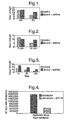
- Examples 1 to 3 concern preliminary odour assessment experiments using methyl 4-aminobenzoate as an example of a trapping agent in accordance with the invention. All odour assessments were carried out by a panel of 5 trained assessors who assessed the samples on the basis of odour strength and rated the samples on a scale of 0 - 5 . The results were pooled and expressed in the form of a bar graph.
- Perfume was added to the base formulation at a level of 0.8% w/w.
- the perfume has the following base formulation in parts by weight: alcohol (straight chain)C-10 7 citronellol 16 diphenyl oxide 2 geraniol 48 linalol 2 aldehyde C-10 (straight chain - decanal) 10 aldehyde MNA (methyl nonyl aldehyde) 5 Ligustral (Ligustral is a Trade Mark) 10
- a control formulation was produced by adding the perfume base formulation to the conditioner base formulation (control).
- a composition using a trapping agent in accordance with the invention was produced by adding to the conditioner base formulation the perfume base formulation additionally including 25 parts by weight of methyl 4-aminobenzoate (accord + additive).
- the perfume was as specified in Example 1, both with methyl 4-aminobenzoate (accord + additive) and without methyl 4-aminobenzoate (control).
- Control cologne was as specified above while cologne with a trapping agent in accordance with the invention (accord + additive) also included 0.2 parts by weight of methyl 4-aminobenzoate. Both colognes were applied to standard perfumery blotters or smelling strips and were left in the open under ambient conditions. Odour assessments were carried out 1hr, 4hr and 16hr after application. The results were as follows: 1 hr 4 hr 16 hr Control 15 8 3 Accord + additive 25 18 10
- NMR spectra were measured using a Jeol Eclipse +400 spectrometer at 400MHz 1 H in deuteriochloroform solution using the residual chloroform at ⁇ 7.25 as internal standard or at 100MHz 13 C in deuteriochloroform solution with CDCl 3 (middle peak) at 77ppm as internal standard.
- Mass spectra were measured using a Finigan MAT GCQ GC/Mass Spec.
- Control perfume delta damascone (0.1g) in Fabric Conditioner (50g)
- Test perfume delta damascone (0.1g) + QTR 54 (0.2g) in Fabric Conditioner (50g)
- the aminobenzoate fixative or trapping agent QTR54 has the effect of reducing the headspace of delta damascone in fabric conditioner (in product) by a factor of 3.5 relative to a delta damascone control. After the cloth is line dried for 4 hours this trend is reversed, with the level of delta damascone by headspace above the cloth being 4.6 fold less than the cloth washed with fabric conditioner containing both delta damascone and the aminobenzoate fixative. This is due to the enhanced substantivity of delta damascone to the cloth in the presence of QTR54.
- the substantivity is expressed as a ratio of the amount of perfume ingredient deposited onto the cloth over that initially present in the wash water. Thus 100% substantivity represents total deposition of the ingredient onto the cloth from the wash solution.
- Control perfume decanal (0.1g) in Fabric Conditioner (50g)
- Test perfume decanal (0.1g) + QTR 57 (0.2g) in Fabric Conditioner (50g)
- Control perfume aldehyde MNA (0.02g) + Lilial (0.08g) in Fabric Conditioner (50g)
- Test perfume aldehyde MNA (0.015g) + lilial (0.06g) + QTR 54 (0.15g) in Fabric Conditioner (50g)
- Example 9 Additional example of a different aminobenzoate forming a complex with an aldehyde
Landscapes
- Life Sciences & Earth Sciences (AREA)
- Chemical & Material Sciences (AREA)
- Health & Medical Sciences (AREA)
- Oil, Petroleum & Natural Gas (AREA)
- Veterinary Medicine (AREA)
- Wood Science & Technology (AREA)
- Organic Chemistry (AREA)
- Chemical Kinetics & Catalysis (AREA)
- Engineering & Computer Science (AREA)
- Public Health (AREA)
- Animal Behavior & Ethology (AREA)
- General Health & Medical Sciences (AREA)
- Epidemiology (AREA)
- Birds (AREA)
- Fats And Perfumes (AREA)
- Organic Low-Molecular-Weight Compounds And Preparation Thereof (AREA)
- Detergent Compositions (AREA)
Abstract
Claims (21)
- Utilisation d'un agent de piégeage amine aromatique essentiellement inodore dans une composition comprenant un parfum, destiné à permettre au parfum et à l'agent de piégeage de réagir chimiquement spontanément et de manière réversible pour former un produit réactionnel à partir duquel le parfum peut être libéré, l'agent de piégeage comprenant un dérivé amino de l'acide benzoïque et le parfum comprenant un groupe carbonyle.
- Utilisation selon la revendication 1, dans laquelle l'agent de piégeage comprend un dérivé amino d'un ester de l'acide benzoïque.
- Utilisation selon la revendication 2, dans laquelle l'agent de piégeage comprend un dérivé amino d'un ester d'acide benzoïque ortho ou para.
- Utilisation selon l'une quelconque des revendications précédentes, dans laquelle l'agent de piégeage comprend une amine primaire.
- Utilisation selon la revendication 4, dans laquelle l'agent de piégeage comprend un ou plusieurs des suivants :3,7 diméthyloctyl 4-aminobenzoate3,5,5 triméthylhexyl 4-aminobenzoate2(E/Z)3,7 diméthyloct-2,6-diényl 4-aminobenzoate3-méthyl-5-phénylpentyl 4-aminobenzoate3,7 diméthyloct-6-ényl 4-aminobenzoate3 [(4-aminobenzoyl)oxy]-2-éthylhexyl 4-aminobenzoate.
- Utilisation selon l'une quelconque des revendications précédentes, dans laquelle l'agent de piégeage a un log P calculé dans l'intervalle 4 à 10, de préférence 5 à 9.
- Utilisation selon l'une quelconque des revendications précédentes, dans laquelle le parfum est un aldéhyde ou une cétone.
- Utilisation selon l'une quelconque des revendications précédentes, dans laquelle le parfum et l'agent de piégeage réagissent pour former une base de Schiff comme produit réactionnel.
- Utilisation selon l'une quelconque des revendications précédentes, dans laquelle le parfum est libéré du produit réactionnel par une réaction d'hydrolyse.
- Utilisation selon l'une quelconque des revendications précédentes, dans laquelle le produit réactionnel est essentiellement inodore.
- Utilisation selon l'une quelconque des revendications précédentes, dans laquelle la composition comprend en outre un ou plusieurs parfums supplémentaires.
- Utilisation selon l'une quelconque des revendications précédentes, dans laquelle la composition comprend en outre un solvant et/ou un substrat solide.
- Utilisation selon l'une quelconque des revendications précédentes, dans laquelle la composition comprend un produit parfumé.
- Composition de parfum, comprenant un parfum et un agent de piégeage amine aromatique essentiellement inodore qui réagissent ensemble chimiquement spontanément et de manière réversible pour former un produit réactionnel à partir duquel le parfum peut être libéré, dans laquelle le parfum comprend un groupe carbonyle et dans laquelle l'agent de piégeage comprend un ou plusieurs des suivants.3,7 diméthyloctyl 4-aminobenzoate3,5,5 triméthylhexyl 4-aminobenzoate2(E/Z)3,7 diméthyloct-2,6-diényl 4-aminobenzoate3-méthyl-5-phénylpentyl 4-aminobenzoate3,7 diméthyloct-6-ényl 4-aminobenzoate3 [(4-aminobenzoyl)oxy]-2-éthylhéxyl 4-aminobenzoate.
- Composition de parfum selon la revendication 14, dans laquelle le parfum est un aldéhyde ou une cétone.
- Composition de parfum selon la revendication 14 ou 15, dans laquelle le parfum et l'agent de piégeage réagissent pour former une base de Schiff comme produit réactionnel.
- Composition de parfum selon la revendication 14, 15 ou 16, dans laquelle le parfum est libéré du produit réactionnel par une réaction d'hydrolyse.
- Composition de parfum selon l'une quelconque des revendications 14 à 17, dans laquelle le produit réactionnel est essentiellement inodore.
- Composition de parfum selon l'une quelconque des revendications 14 à 18, comprenant en outre un ou plusieurs parfums supplémentaires.
- Composition de parfum selon l'une quelconque des revendications 14 à 19, comprenant en outre un solvant et/ou un substrat solide.
- Composition de parfum selon l'une quelconque des revendications 14 à 20, la composition comprenant un produit parfumé.
Priority Applications (1)
| Application Number | Priority Date | Filing Date | Title |
|---|---|---|---|
| EP01934190A EP1286651B1 (fr) | 2000-06-02 | 2001-06-01 | Utilisation des acides aminobenzoiques dans des compositions avec des parfums |
Applications Claiming Priority (4)
| Application Number | Priority Date | Filing Date | Title |
|---|---|---|---|
| EP00304721 | 2000-06-02 | ||
| EP00304721 | 2000-06-02 | ||
| PCT/GB2001/002446 WO2001093823A1 (fr) | 2000-06-02 | 2001-06-01 | Ameliorations concernant des parfums |
| EP01934190A EP1286651B1 (fr) | 2000-06-02 | 2001-06-01 | Utilisation des acides aminobenzoiques dans des compositions avec des parfums |
Publications (2)
| Publication Number | Publication Date |
|---|---|
| EP1286651A1 EP1286651A1 (fr) | 2003-03-05 |
| EP1286651B1 true EP1286651B1 (fr) | 2006-08-02 |
Family
ID=8173043
Family Applications (1)
| Application Number | Title | Priority Date | Filing Date |
|---|---|---|---|
| EP01934190A Expired - Lifetime EP1286651B1 (fr) | 2000-06-02 | 2001-06-01 | Utilisation des acides aminobenzoiques dans des compositions avec des parfums |
Country Status (5)
| Country | Link |
|---|---|
| US (1) | US7129204B2 (fr) |
| EP (1) | EP1286651B1 (fr) |
| AU (1) | AU6049401A (fr) |
| DE (1) | DE60121939T2 (fr) |
| WO (1) | WO2001093823A1 (fr) |
Families Citing this family (32)
| Publication number | Priority date | Publication date | Assignee | Title |
|---|---|---|---|---|
| US20030134772A1 (en) * | 2001-10-19 | 2003-07-17 | Dykstra Robert Richard | Benefit agent delivery systems |
| US20030158079A1 (en) * | 2001-10-19 | 2003-08-21 | The Procter & Gamble Company | Controlled benefit agent delivery system |
| KR20070036072A (ko) * | 2004-06-24 | 2007-04-02 | 플렉시트랄, 인코포레이티드 | 신규 알데하이드 무스크 및 그 유도체 |
| US20070275866A1 (en) * | 2006-05-23 | 2007-11-29 | Robert Richard Dykstra | Perfume delivery systems for consumer goods |
| KR20090113260A (ko) * | 2007-01-30 | 2009-10-29 | 피르메니히 에스아 | 활성 알데히드 및 케톤의 평형 유동 혼합물로부터의 제어 방출 |
| BRPI0812323A2 (pt) * | 2007-06-05 | 2014-11-25 | Procter & Gamble | Sistemas de perfume |
| BRPI0922770A2 (pt) | 2008-12-01 | 2019-09-24 | Procter & Gamble | sistemas de perfume |
| US8754028B2 (en) * | 2008-12-16 | 2014-06-17 | The Procter & Gamble Company | Perfume systems |
| EP2270124A1 (fr) | 2009-06-30 | 2011-01-05 | The Procter & Gamble Company | Compositions de blanchiment comportant un système de livraison de parfum |
| MX2012006616A (es) | 2009-12-09 | 2012-06-21 | Procter & Gamble | Productos para el cuidado de las telas y el hogar. |
| JP5782046B2 (ja) | 2009-12-17 | 2015-09-24 | ザ プロクター アンド ギャンブルカンパニー | 悪臭結合ポリマー及び悪臭制御構成成分を含むフレッシュニング組成物 |
| EP3287511A1 (fr) | 2010-06-22 | 2018-02-28 | The Procter & Gamble Company | Systèmes de parfum |
| JP5744192B2 (ja) | 2010-06-22 | 2015-07-01 | ザ プロクター アンド ギャンブルカンパニー | 香料系 |
| JP5859526B2 (ja) | 2010-07-02 | 2016-02-10 | ザ プロクター アンド ギャンブルカンパニー | 活性剤不織布ウェブを含むフィラメント及びその製造方法 |
| RU2543892C2 (ru) | 2010-07-02 | 2015-03-10 | Дзе Проктер Энд Гэмбл Компани | Способ получения пленок из нетканых полотен |
| CA2803382C (fr) | 2010-07-02 | 2015-03-31 | The Procter & Gamble Company | Procede de diffusion d'un agent actif |
| WO2012003351A2 (fr) | 2010-07-02 | 2012-01-05 | The Procter & Gamble Company | Matériau de voile et ses procédés de fabrication |
| RU2541275C2 (ru) | 2010-07-02 | 2015-02-10 | Дзе Проктер Энд Гэмбл Компани | Филаменты, содержащие неароматизированный активный агент, нетканые полотна и способы их получения |
| US8912350B2 (en) | 2011-06-23 | 2014-12-16 | The Procter & Gamble Company | Perfume systems |
| US20140141126A1 (en) | 2011-06-29 | 2014-05-22 | Solae Llc | Baked food compositions comprising soy whey proteins that have been isolated from processing streams |
| EP3369845B1 (fr) | 2012-01-04 | 2020-03-25 | The Procter & Gamble Company | Structures fibreuses contenant des principes actifs et présentant de multiples zones ayant des densités différentes |
| EP3719192B1 (fr) | 2012-01-04 | 2025-06-25 | The Procter & Gamble Company | Structures fibreuses comprenant des particules et leurs procédés de fabrication |
| US9139802B2 (en) | 2012-01-04 | 2015-09-22 | The Procter & Gamble Company | Active containing fibrous structures with multiple regions |
| EP4253649B1 (fr) | 2013-12-09 | 2025-04-23 | The Procter & Gamble Company | Structures fibreuses comprenant un agent actif et dotées d'un graphique imprimé dessus |
| US11697904B2 (en) | 2017-01-27 | 2023-07-11 | The Procter & Gamble Company | Active agent-containing articles that exhibit consumer acceptable article in-use properties |
| WO2018140472A1 (fr) | 2017-01-27 | 2018-08-02 | The Procter & Gamble Company | Articles contenant des agents actifs présentant des propriétés d'utilisation d'articles acceptables pour le consommateur |
| US11697905B2 (en) | 2017-01-27 | 2023-07-11 | The Procter & Gamble Company | Active agent-containing articles that exhibit consumer acceptable article in-use properties |
| US11697906B2 (en) | 2017-01-27 | 2023-07-11 | The Procter & Gamble Company | Active agent-containing articles and product-shipping assemblies for containing the same |
| FR3064640A1 (fr) | 2017-04-04 | 2018-10-05 | Compagnie Generale Des Etablissements Michelin | Composition de caoutchouc a base de resine renforcante et d'un derive d'aminobenzoate |
| FR3083242B1 (fr) | 2018-07-02 | 2020-06-12 | Compagnie Generale Des Etablissements Michelin | Composition de caoutchouc a base de resine epoxyde et d’un derive d’aminobenzoate |
| US11485940B2 (en) | 2019-12-05 | 2022-11-01 | The Procter & Gamble Company | Method of making a cleaning composition |
| CN114667337A (zh) | 2019-12-05 | 2022-06-24 | 宝洁公司 | 清洁组合物 |
Family Cites Families (10)
| Publication number | Priority date | Publication date | Assignee | Title |
|---|---|---|---|---|
| US3330730A (en) * | 1962-08-03 | 1967-07-11 | Colgate Palmolive Co | Pressurized emulsion quick breaking foam compositions |
| DE1492322A1 (de) | 1964-06-08 | 1970-01-15 | Domekos Dr H Doering Gmbh | Verwendung UV-absorbierender Substanzen als Zusaetze fuer Kosmetika |
| US4511495A (en) * | 1980-05-16 | 1985-04-16 | Lever Brothers Company | Tumble dryer products for depositing perfume |
| US5500138A (en) * | 1994-10-20 | 1996-03-19 | The Procter & Gamble Company | Fabric softener compositions with improved environmental impact |
| BR9815725A (pt) * | 1998-03-12 | 2000-11-14 | Procter & Gamble | Polìmero de silicone pró-fragrância e composições do mesmo |
| EP0971025A1 (fr) * | 1998-07-10 | 2000-01-12 | The Procter & Gamble Company | Produits de réaction d'aminé comprenant un ou plusieurs principes actifs |
| EP0971024A1 (fr) * | 1998-07-10 | 2000-01-12 | The Procter & Gamble Company | Compositions de blanchissage et de lavage |
| US6413920B1 (en) * | 1998-07-10 | 2002-07-02 | Procter & Gamble Company | Amine reaction compounds comprising one or more active ingredient |
| US6150409A (en) | 1998-10-23 | 2000-11-21 | Monell Chemical Senses Center | Adjuvants and methods for raising intracellular calcium ion concentration |
| EP1314777A1 (fr) * | 2001-11-27 | 2003-05-28 | The Procter & Gamble Company | Compositions précurseur de parfum utilisées dans des produits de nettoyage et traitement de tissus |
-
2001
- 2001-06-01 EP EP01934190A patent/EP1286651B1/fr not_active Expired - Lifetime
- 2001-06-01 US US10/296,805 patent/US7129204B2/en not_active Expired - Fee Related
- 2001-06-01 AU AU60494/01A patent/AU6049401A/en not_active Abandoned
- 2001-06-01 DE DE60121939T patent/DE60121939T2/de not_active Expired - Lifetime
- 2001-06-01 WO PCT/GB2001/002446 patent/WO2001093823A1/fr not_active Ceased
Also Published As
| Publication number | Publication date |
|---|---|
| DE60121939D1 (de) | 2006-09-14 |
| WO2001093823A1 (fr) | 2001-12-13 |
| US7129204B2 (en) | 2006-10-31 |
| DE60121939T2 (de) | 2007-01-25 |
| US20030199422A1 (en) | 2003-10-23 |
| AU6049401A (en) | 2001-12-17 |
| EP1286651A1 (fr) | 2003-03-05 |
Similar Documents
| Publication | Publication Date | Title |
|---|---|---|
| US7129204B2 (en) | Perfumes | |
| CA2501380A1 (fr) | Composition de matieres odorantes contenant au moins un liquide ionique, procede de production et utilisation de ladite composition | |
| US9758749B2 (en) | Thioether derivatives as precursors for a controlled release of active molecules | |
| US20110142776A1 (en) | Divinyl ether derivatives capable of releasing active aldehydes and ketones and methods of use for perfuming surfaces | |
| US20030089885A1 (en) | Use of low molecular weight acetal, alcohol, acylated alcohol and ester compounds to block or reduce odor of carboxylic acids | |
| US7589055B2 (en) | Compounds for a controlled release of active molecules | |
| CN102858930A (zh) | 具有香草气味的有机碳酸酯 | |
| EP3131889B1 (fr) | Nouveaux composés organoleptiques et leur utilisation dans des compositions d'arôme et de fragrance | |
| JP6377154B2 (ja) | 香料成分としての1−イソプロポキシ−1−オキソプロパン−2−イルピバレート | |
| US8349790B2 (en) | Substituted octane(ene) nitriles, methods for the synthesis thereof and uses thereof in perfumery | |
| EP3072875A1 (fr) | Composés organoleptiques | |
| US9732304B2 (en) | 3-(cyclohex-1-en-1-yl)propionates and their use in perfume compositions | |
| JP2003520203A (ja) | 第2のカルバモイル基を有するエステルおよびその発香性アルコール前駆体としての使用 | |
| US4584127A (en) | Utilization of 1-cyclopentenylacetic acid as perfuming ingredient | |
| EP1904541B1 (fr) | Conjugues de copolymeres amphiphiles pour la liberation regulee de molecules actives | |
| EP3025591B1 (fr) | Compositions de parfum et de fragrance contenant du thiopyrane-carbaldéhyde | |
| CN115052859B (zh) | 香料化合物的硒化物衍生物 | |
| JP5150627B2 (ja) | 芳香成分としてのオキサチアン誘導体 | |
| CN108203395B (zh) | 感官化合物 | |
| US8399522B2 (en) | 3.2.1-bicyclo-octane compounds | |
| JP2025519864A (ja) | 悪臭を放つアルデヒドおよびケトンを防止、低減、または改善するための組成物およびその使用 | |
| CN111479549A (zh) | 含8,8-二甲基-6,10-二氧杂螺[4.5]癸烷的芳香物质混合物 |
Legal Events
| Date | Code | Title | Description |
|---|---|---|---|
| PUAI | Public reference made under article 153(3) epc to a published international application that has entered the european phase |
Free format text: ORIGINAL CODE: 0009012 |
|
| 17P | Request for examination filed |
Effective date: 20021129 |
|
| AK | Designated contracting states |
Designated state(s): AT BE CH CY DE DK ES FI FR GB GR IE IT LI LU MC NL PT SE TR Kind code of ref document: A1 Designated state(s): AT BE CH CY DE DK ES FI FR GB GR IE IT LI LU MC NL PT SE TR |
|
| AX | Request for extension of the european patent |
Extension state: AL LT LV MK RO SI |
|
| RAP1 | Party data changed (applicant data changed or rights of an application transferred) |
Owner name: QUEST INTERNATIONAL B.V. |
|
| RBV | Designated contracting states (corrected) |
Designated state(s): AT BE CH DE GB LI NL |
|
| 17Q | First examination report despatched |
Effective date: 20040712 |
|
| GRAP | Despatch of communication of intention to grant a patent |
Free format text: ORIGINAL CODE: EPIDOSNIGR1 |
|
| RIC1 | Information provided on ipc code assigned before grant |
Ipc: C11B 9/00 19680901ALI20051208BHEP Ipc: C11D 3/30 19850101ALI20051208BHEP Ipc: C11D 3/33 19850101ALI20051208BHEP Ipc: A61Q 13/00 00000000ALI20051208BHEP Ipc: A61K 8/35 00000000ALI20051208BHEP Ipc: A61K 8/44 00000000AFI20051208BHEP |
|
| RTI1 | Title (correction) |
Free format text: USE OF AMINOBENZOIC ACIDS IN COMPOSITIONS WITH PERFUMES |
|
| RAP1 | Party data changed (applicant data changed or rights of an application transferred) |
Owner name: QUEST INTERNATIONAL SERVICES B.V. |
|
| GRAS | Grant fee paid |
Free format text: ORIGINAL CODE: EPIDOSNIGR3 |
|
| GRAA | (expected) grant |
Free format text: ORIGINAL CODE: 0009210 |
|
| RBV | Designated contracting states (corrected) |
Designated state(s): DE GB NL |
|
| AK | Designated contracting states |
Kind code of ref document: B1 Designated state(s): DE GB NL |
|
| PG25 | Lapsed in a contracting state [announced via postgrant information from national office to epo] |
Ref country code: NL Free format text: LAPSE BECAUSE OF FAILURE TO SUBMIT A TRANSLATION OF THE DESCRIPTION OR TO PAY THE FEE WITHIN THE PRESCRIBED TIME-LIMIT Effective date: 20060802 |
|
| REG | Reference to a national code |
Ref country code: GB Ref legal event code: FG4D |
|
| REF | Corresponds to: |
Ref document number: 60121939 Country of ref document: DE Date of ref document: 20060914 Kind code of ref document: P |
|
| NLV1 | Nl: lapsed or annulled due to failure to fulfill the requirements of art. 29p and 29m of the patents act | ||
| PLBE | No opposition filed within time limit |
Free format text: ORIGINAL CODE: 0009261 |
|
| STAA | Information on the status of an ep patent application or granted ep patent |
Free format text: STATUS: NO OPPOSITION FILED WITHIN TIME LIMIT |
|
| 26N | No opposition filed |
Effective date: 20070503 |
|
| PGFP | Annual fee paid to national office [announced via postgrant information from national office to epo] |
Ref country code: GB Payment date: 20110620 Year of fee payment: 11 |
|
| PGFP | Annual fee paid to national office [announced via postgrant information from national office to epo] |
Ref country code: DE Payment date: 20110622 Year of fee payment: 11 |
|
| GBPC | Gb: european patent ceased through non-payment of renewal fee |
Effective date: 20120601 |
|
| REG | Reference to a national code |
Ref country code: DE Ref legal event code: R119 Ref document number: 60121939 Country of ref document: DE Effective date: 20130101 |
|
| PG25 | Lapsed in a contracting state [announced via postgrant information from national office to epo] |
Ref country code: GB Free format text: LAPSE BECAUSE OF NON-PAYMENT OF DUE FEES Effective date: 20120601 Ref country code: DE Free format text: LAPSE BECAUSE OF NON-PAYMENT OF DUE FEES Effective date: 20130101 |