EP1288237A2 - Procédé de préparation d'un liqueur noire a base d'une resine phenol formaldehyde thermodurcissable - Google Patents
Procédé de préparation d'un liqueur noire a base d'une resine phenol formaldehyde thermodurcissable Download PDFInfo
- Publication number
- EP1288237A2 EP1288237A2 EP02292069A EP02292069A EP1288237A2 EP 1288237 A2 EP1288237 A2 EP 1288237A2 EP 02292069 A EP02292069 A EP 02292069A EP 02292069 A EP02292069 A EP 02292069A EP 1288237 A2 EP1288237 A2 EP 1288237A2
- Authority
- EP
- European Patent Office
- Prior art keywords
- black liquor
- resin
- formaldehyde
- phenol
- base
- Prior art date
- Legal status (The legal status is an assumption and is not a legal conclusion. Google has not performed a legal analysis and makes no representation as to the accuracy of the status listed.)
- Withdrawn
Links
Images

Classifications
-
- C—CHEMISTRY; METALLURGY
- C08—ORGANIC MACROMOLECULAR COMPOUNDS; THEIR PREPARATION OR CHEMICAL WORKING-UP; COMPOSITIONS BASED THEREON
- C08H—DERIVATIVES OF NATURAL MACROMOLECULAR COMPOUNDS
- C08H6/00—Macromolecular compounds derived from lignin, e.g. tannins, humic acids
-
- C—CHEMISTRY; METALLURGY
- C08—ORGANIC MACROMOLECULAR COMPOUNDS; THEIR PREPARATION OR CHEMICAL WORKING-UP; COMPOSITIONS BASED THEREON
- C08G—MACROMOLECULAR COMPOUNDS OBTAINED OTHERWISE THAN BY REACTIONS ONLY INVOLVING UNSATURATED CARBON-TO-CARBON BONDS
- C08G8/00—Condensation polymers of aldehydes or ketones with phenols only
- C08G8/04—Condensation polymers of aldehydes or ketones with phenols only of aldehydes
- C08G8/08—Condensation polymers of aldehydes or ketones with phenols only of aldehydes of formaldehyde, e.g. of formaldehyde formed in situ
- C08G8/10—Condensation polymers of aldehydes or ketones with phenols only of aldehydes of formaldehyde, e.g. of formaldehyde formed in situ with phenol
-
- C—CHEMISTRY; METALLURGY
- C08—ORGANIC MACROMOLECULAR COMPOUNDS; THEIR PREPARATION OR CHEMICAL WORKING-UP; COMPOSITIONS BASED THEREON
- C08G—MACROMOLECULAR COMPOUNDS OBTAINED OTHERWISE THAN BY REACTIONS ONLY INVOLVING UNSATURATED CARBON-TO-CARBON BONDS
- C08G8/00—Condensation polymers of aldehydes or ketones with phenols only
- C08G8/28—Chemically modified polycondensates
-
- C—CHEMISTRY; METALLURGY
- C08—ORGANIC MACROMOLECULAR COMPOUNDS; THEIR PREPARATION OR CHEMICAL WORKING-UP; COMPOSITIONS BASED THEREON
- C08L—COMPOSITIONS OF MACROMOLECULAR COMPOUNDS
- C08L61/00—Compositions of condensation polymers of aldehydes or ketones; Compositions of derivatives of such polymers
- C08L61/04—Condensation polymers of aldehydes or ketones with phenols only
- C08L61/06—Condensation polymers of aldehydes or ketones with phenols only of aldehydes with phenols
-
- C—CHEMISTRY; METALLURGY
- C08—ORGANIC MACROMOLECULAR COMPOUNDS; THEIR PREPARATION OR CHEMICAL WORKING-UP; COMPOSITIONS BASED THEREON
- C08L—COMPOSITIONS OF MACROMOLECULAR COMPOUNDS
- C08L61/00—Compositions of condensation polymers of aldehydes or ketones; Compositions of derivatives of such polymers
- C08L61/04—Condensation polymers of aldehydes or ketones with phenols only
- C08L61/06—Condensation polymers of aldehydes or ketones with phenols only of aldehydes with phenols
- C08L61/14—Modified phenol-aldehyde condensates
-
- C—CHEMISTRY; METALLURGY
- C08—ORGANIC MACROMOLECULAR COMPOUNDS; THEIR PREPARATION OR CHEMICAL WORKING-UP; COMPOSITIONS BASED THEREON
- C08L—COMPOSITIONS OF MACROMOLECULAR COMPOUNDS
- C08L97/00—Compositions of lignin-containing materials
- C08L97/02—Lignocellulosic material, e.g. wood, straw or bagasse
-
- C—CHEMISTRY; METALLURGY
- C09—DYES; PAINTS; POLISHES; NATURAL RESINS; ADHESIVES; COMPOSITIONS NOT OTHERWISE PROVIDED FOR; APPLICATIONS OF MATERIALS NOT OTHERWISE PROVIDED FOR
- C09D—COATING COMPOSITIONS, e.g. PAINTS, VARNISHES OR LACQUERS; FILLING PASTES; CHEMICAL PAINT OR INK REMOVERS; INKS; CORRECTING FLUIDS; WOODSTAINS; PASTES OR SOLIDS FOR COLOURING OR PRINTING; USE OF MATERIALS THEREFOR
- C09D161/00—Coating compositions based on condensation polymers of aldehydes or ketones; Coating compositions based on derivatives of such polymers
- C09D161/04—Condensation polymers of aldehydes or ketones with phenols only
- C09D161/06—Condensation polymers of aldehydes or ketones with phenols only of aldehydes with phenols
- C09D161/14—Modified phenol-aldehyde condensates
-
- C—CHEMISTRY; METALLURGY
- C09—DYES; PAINTS; POLISHES; NATURAL RESINS; ADHESIVES; COMPOSITIONS NOT OTHERWISE PROVIDED FOR; APPLICATIONS OF MATERIALS NOT OTHERWISE PROVIDED FOR
- C09J—ADHESIVES; NON-MECHANICAL ASPECTS OF ADHESIVE PROCESSES IN GENERAL; ADHESIVE PROCESSES NOT PROVIDED FOR ELSEWHERE; USE OF MATERIALS AS ADHESIVES
- C09J197/00—Adhesives based on lignin-containing materials
- C09J197/005—Lignin
-
- C—CHEMISTRY; METALLURGY
- C08—ORGANIC MACROMOLECULAR COMPOUNDS; THEIR PREPARATION OR CHEMICAL WORKING-UP; COMPOSITIONS BASED THEREON
- C08L—COMPOSITIONS OF MACROMOLECULAR COMPOUNDS
- C08L97/00—Compositions of lignin-containing materials
- C08L97/005—Lignin
Definitions
- the present invention relates to a process for preparing a black liquor-phenol formaldehyde thermoset resin for use in the engineered forest products industry.
- the invention also relates to the so prepared resin wherein phenol and formaldehyde are copolymerized with lignin found in a black liquor, and more preferably a sodium carbonate black liquor, which is extracted from a pulping process.
- lignin includes lignosulfonates, kraft lignin and/or sodium carbonate lignin.
- the so prepared resin can be used in liquid state or it can be converted into a powder by spray drying. It is particularly useful as a binder for engineered forest products, such as wafer boards, oriented strand boards (OSB), plywood and the like.
- engineered forest products such as wafer boards, oriented strand boards (OSB), plywood and the like.
- thermoset resins are used as binders ( viz. adhesives) in the engineered forest products industry. When cured, these thermoset resins bond wood chips or veneers to each other under heat and pressure.
- the phenolic resins that are used are Resole type resins, the pH of which is above 7 and the mole ratio of formaldehyde to phenol is greater than 1.
- black liquors or lignins extracted from black liquors
- phenolic resins for use in the plywood and OSB industry
- black liquors arises from the fact that black liquors contain lignin, which is a polymer containing phenolic groups with reactive sites for further polymerization. Since the black liquor is a by-product of the pulping process, the cost of the liquor is substantially lower than phenol.
- recent advancement in pressing technology has reduced from 25 seconds per millimeter to 16 seconds or less per millimeter the time required in the press to make OSB panels under elevated pressure and temperature. Because of such a reduction in time in the press cycle, the existing black liquor modified resins may not meet the CSA and ASTM standards for internal bond strength. Moreover, the existing black liquor modified resins contain small amounts of black liquor which make them economically less attractive.
- a main object of the present invention is to provide a process for preparing a black liquor-phenol formaldehyde thermoset resin, comprising the steps of :
- step a the black liquor, phenol and base are mixed altogether and then the so obtained mixture is heated and kept to react.
- the black liquor used as starting material is a sodium carbonate black liquor.
- black liquors could alternatively be used, such as those obtained via a bisulfite process that contains lignosulfonates or via a Kraft process which uses sodium sulfide and sodium hydroxide as active alkali (Kraft lignin).
- sodium carbonate black liquor is preferred because of its reactivity and availability.
- the amount of black liquor that is used can be up to 80% by weight of the total weight of the resin (the preferred range being 40% and higher by weight of the total weight of the resin) and still meet the CSA and ASTM requirements for bond strength in Oriented Strand Board (OSB) and plywood.
- OSB Oriented Strand Board
- the above method may also comprise the additional step of reacting the resin that has been obtained with urea.
- Another object of the invention is the black liquor-phenol formaldehyde thermoset resin obtained by the above process.
- a further object of the invention is the use of the above black liquor-phenol formaldehyde thermoset resin as a binder for engineered forest products.
- a potassium carbonate solution can be added to the resin so that it cures faster.
- Phenol and formaldehyde are known to be two chemicals that when mixed together, react to form a polymer and water. Because the reaction forms water, it is called a condensation reaction. At room temperature, the reaction occurs very slowly but as the temperature is raised, it proceeds at a faster rate. The polymer formation is closely related to the amount of formaldehyde that is available and to the pH at which the reaction is carried out. At low pH ( viz. lower than 7) the polymer tends to be mostly a linear type molecule: reactions occur on the two ortho positions of the phenol ring. As the pH increases, the chances of para-addition to the phenol ring increases and cross-linking begins.
- the resin In low pH and usually with mole ratios of formaldehyde to phenol of less than 1, the resin is called NOVOLAK. At higher pH viz. higher than 7 with mole ratio, as above, of greater than 1 the resin is called RESOL. If the pH is higher than 7 and the mole ratio is 1 to 1.5, then the resin will cross-link but not fully and not very rapidly. This makes for a poor high strength binder. If the pH is lower than 7 and the mole ratio is higher than 1, then the resin will cross-link in the presence of an acid catalyst and the cost of the resin will increase dramatically.
- the basic purpose of the present invention is to formulate a phenol formaldehyde resin with the highest possible amount of the black liquor preferably sodium carbonate black liquor.
- the basic purpose of the present invention is to provide a process for preparing a thermoset resin wherein a black liquor, preferably a sodium carbonate black liquor, is used in significant amount to copolymerize with phenol and formaldehyde.
- a black liquor preferably a sodium carbonate black liquor
- the amount of black liquor that is used can be up to 80% by weight of the total weight of the resin (the preferred range being 40% or higher by weight of the total weight of the resin) and still meet the CSA and ASTM requirements for bond strength in Oriented Strand Board (OSB) and plywood.
- OSB Oriented Strand Board
- the use of black liquor advantageously reduces the amount of phenol and formaldehyde solids required to form the resin.
- the black liquor does not replace phenol or formaldehyde but reacts with the same to form a copolymer. Therefore, the product obtained by the present invention is not a modified phenolic resin but a black liquor-phenol-formaldehyde copolymer resin.
- the first step of the process according to the invention consists of mixing a black liquor with phenol and a base and letting the so obtained mixture reacts at high temperature.
- the order of addition of the above starting compounds is not important but it is preferred to add phenol to the black liquor first, and then potassium hydroxide in the form of a solution containing 45% by weight of potassium hydroxide.
- the so prepared mixture is heated to a temperature close to reflux, preferably at 95°C, for a period of time sufficient to initiate reaction between the black liquor and phenol. Such a period is, for example, 1 to 2 hours.
- any kind of black liquor may be used.
- sodium salts present in the sodium carbonate black liquor helps to stabilize the high molecular weight polymer resin that is being formed.
- the viscosity of any thermoset resin is not stable at ambient temperature. The rate of polymerization decreases as the temperature decreases. At ambient temperature and at a high pH, the resin will undergo further polymerization.
- the presence of sodium salts, especially sodium acetate and sodium bicarbonate helps buffer the effects of the pH and slow down the polymerization process, thereby keeping the viscosity rise minimal. If excess alkalinity is added to the modified resin, then the viscosity increases and the resin is subjected to rapid polymerization.
- the addition of a base to the mixture is actually an essential feature of the invention. Indeed, although the black liquor has a pH greater than 7, the reaction is extremely slow when phenol and formaldehyde are added to it. The salts that are in the black liquor do not catalyze the requested degree of polymerization in a reasonable period of time. The pH required must be higher than 11 and only the addition of a base may accomplish it.
- any base may be used provided that it actually catalyzes the reaction.
- an inorganic base such as a solution containing 50% of sodium hydroxide
- sodium hydroxide is commonly used to catalyse the copolymerization.
- potassium hydroxide is also known cure the resin at a faster rate.
- potassium hydroxide is preferably used essentially because:
- the second step consists of cooling the mixture and adding a specific amount of formaldehyde into the mixture.
- the formaldehyde will react fast on ortho positions of the phenol and with available sites on the lignin contained inside the black liquor.
- a linear phenol containing some lignin molecules at specific position is then obtained.
- the third step of the process according to the invention consists of adding more formaldehyde and more base, preferably potassium hydroxide. If only more formaldehyde is added, then the polymer will continue to build but the polymerization rate or degree of polymerization is slower at lower temperature. In order to decrease the energy required to react the polymer, an additional amount of the base, preferably potassium hydroxide, is added. At this point, the polymer at a temperature of say, 82°C, builds very fast. Therefore, control of the temperature is important. Otherwise, proper viscosity may not be achieved.
- base preferably potassium hydroxide
- the addition of formaldehyde is advantageously carried out twice, in two separate stages.
- the first stage which actually corresponds to the second step of the process according to the invention produces a polymer of low molecular weight distribution
- the second stage which corresponds to the third step of the process according to the invention enhances the degree of polymerization while leaving some excess formaldehyde behind.
- a high degree of polymerization is required as are an increased alkalinity and an excess of formaldehyde to provide an exothermic reaction that promotes fast curing of the resin.
- the amount added in each stage, the temperatures at which the addition are carried out and/or the mole ratios of formaldehyde to phenol may vary depending on the user's needs.
- the mole ratio of formaldehyde to phenol preferably ranges from 1.7:1 to 3.5:1 for fast curing OSB core resin. More preferably, the mole ratio ranges from 2.8:1 to 3.2:1 to achieve better results in terms of curing time and stability (see the chart enclosed as Figure 1).
- the resin that has been obtained by the above process is subsequently reacted with urea in a further step in order to tie up any free formaldehyde that would be in excess.
- formaldehyde is known to be an irritant to the mucous membrane in quantities of less than 0.1%.
- urea must be added in sufficient amount to bring the free formaldehyde to levels of less than 0.1% in solution.
- bound formaldehyde reacts with the resin and becomes involved in the final cross-linking.
- urea should preferably be used to reduce formaldehyde emissions. It is worth noting that instead of urea, use could alternatively be made of any primary, secondary or tertiary amine capable of binding to formaldehyde, commonly known as a formaldehyde scavenger. More specifically, any chemical known for scavenging formaldehyde could be used as long as the desired characteristics and/or properties of the resin are maintained. In practice, urea is preferred because of its low toxicity and cost.
- the amount of urea to be used is proportional to the free formaldehyde remaining in the resin. If the amount of free formaldehyde is reduced, so will be the required amount of urea.
- the same resin can also be used for the manufacture of plywood with adjustments to pH and mole ratio.
- the resin has the ability to exceed the 50 psi internal bond strength in the core of an OSB panel, that has an approximate density of 40 lbs/ft 3 , and with a dry solid resin content of 2.5% to 3.0%.
- the black liquor-phenolic core resin containing the sodium carbonate black liquor
- MOR modulus of rupture
- the black liquor-phenol formaldehyde resin according to the invention has the required adhesion strength to meet the CSA and ASTM requirement for a core resin in OSB.
- a solution containing carbonate ions may advantageously be added to the resin at ambient temperature.
- Such an addition will cause resin to cure at a faster rate which is actually proportional to the amount of the potassium carbonate solution added.
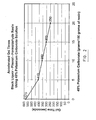
- a rate can range from 5 to 20 parts of the solution that is of 45% potassium carbonate per 100 parts of resin (see the chart enclosed as Figure 2).
- This addition can be made just before the resin is applied onto the wafers or veneers.
- the potassium carbonate helps to further promote the rapid curing of the resin by lowering the energy required to initiate an exothermic reaction in the press.
- the cure time for the resin can be decreased by 30% to 50%.
- test methods were used for determining the properties of an example of resin according to the invention during and after its preparation. These test methods are standard methods of the Structural Board Association. Measurement of viscosity helps in determining the degree of polymerization of the resin.
- the black liquor that was used in the examples had a solid content of about 40%.
- the black liquors that are produced in mills have solid contents that may vary from 15% to 80% depending on the conditions of the mill on a particular day or the equipment available.
- the percentage of solids given hereinabove refers to all the solids (non-volatile materials) contained within the black liquor.
- the amount of lignin and salts will vary with the percent solid content of the black liquor.
- the properties of the so prepared resin using paraformaldehyde at a concentration of 95% and a black liquor containing 40% by weight of solids are as follows: % Solids: 50% to 53% Specific Gravity (g/mL): 1.23 to 1.26 at 25°C pH: 11 to 12 Viscosity (centipoises): 200 to 350 Gel Time (seconds): 200 to 400 (@ 120 to 122°C)
- the temperature was then increased to 80°C and maintained in a range of 80°C to 82°C at a viscosity of 1000 to 1200 cps for 90 minutes. Then, the resin was cooled to 65°C and 172 g of urea was added to it. Once urea was dissolved, the resin was cooled to 20°C.
Landscapes
- Chemical & Material Sciences (AREA)
- Organic Chemistry (AREA)
- Polymers & Plastics (AREA)
- Health & Medical Sciences (AREA)
- Chemical Kinetics & Catalysis (AREA)
- Medicinal Chemistry (AREA)
- Engineering & Computer Science (AREA)
- Materials Engineering (AREA)
- Life Sciences & Earth Sciences (AREA)
- Wood Science & Technology (AREA)
- General Chemical & Material Sciences (AREA)
- Biochemistry (AREA)
- Phenolic Resins Or Amino Resins (AREA)
Applications Claiming Priority (2)
| Application Number | Priority Date | Filing Date | Title |
|---|---|---|---|
| CA002355808A CA2355808A1 (fr) | 2001-08-24 | 2001-08-24 | Processus pour preparer une resine de boue noire et de phenol- formaldehyde thermodurcie |
| CA2355808 | 2001-08-24 |
Publications (2)
| Publication Number | Publication Date |
|---|---|
| EP1288237A2 true EP1288237A2 (fr) | 2003-03-05 |
| EP1288237A3 EP1288237A3 (fr) | 2003-06-25 |
Family
ID=4169805
Family Applications (1)
| Application Number | Title | Priority Date | Filing Date |
|---|---|---|---|
| EP02292069A Withdrawn EP1288237A3 (fr) | 2001-08-24 | 2002-08-21 | Procédé de préparation d'un liqueur noire a base d'une resine phenol formaldehyde thermodurcissable |
Country Status (3)
| Country | Link |
|---|---|
| US (1) | US6632912B2 (fr) |
| EP (1) | EP1288237A3 (fr) |
| CA (1) | CA2355808A1 (fr) |
Cited By (9)
| Publication number | Priority date | Publication date | Assignee | Title |
|---|---|---|---|---|
| WO2010127422A1 (fr) * | 2009-05-08 | 2010-11-11 | Flavio Maluf | Liant/charge destinée à la production de panneaux de particules et de panneaux de fibres de bois |
| CN102516909A (zh) * | 2011-11-15 | 2012-06-27 | 陕西科技大学 | 一种制浆废液胶粘剂的制备方法 |
| CN104910341A (zh) * | 2015-06-24 | 2015-09-16 | 湖南师范大学 | 一种利用微波-CuO处理造纸废液制备木素酚醛树脂胶黏剂的方法 |
| WO2017006215A1 (fr) * | 2015-07-03 | 2017-01-12 | Stora Enso Oyj | Procédé permettant d'augmenter la réactivité de la lignine, composition de résine comprenant ladite lignine et utilisation de ladite composition de résine |
| CN109661446A (zh) * | 2016-07-11 | 2019-04-19 | 斯道拉恩索公司 | 基于木质素的酚醛树脂 |
| WO2019113554A1 (fr) * | 2017-12-08 | 2019-06-13 | Georgia-Pacific Chemicals Llc | Résines d'alcool aromatique-lignine-aldéhyde, et leurs procédés de fabrication et d'utilisation |
| CN111171722A (zh) * | 2020-01-19 | 2020-05-19 | 青岛科技大学 | 一种包含碱法制浆黑液的涂料、其制备方法及应用 |
| CN111961428A (zh) * | 2020-07-07 | 2020-11-20 | 广西大学 | 一种木质素改性酚醛树脂胶粘剂的制备方法 |
| CN112266682A (zh) * | 2020-10-28 | 2021-01-26 | 乌鲁木齐市华泰隆化学助剂有限公司 | 一种pvc悬浮聚合生产用新型高效防粘釜剂及其制备方法 |
Families Citing this family (19)
| Publication number | Priority date | Publication date | Assignee | Title |
|---|---|---|---|---|
| CA2544316A1 (fr) * | 2003-10-31 | 2005-05-12 | Ebara Corporation | Methode de separation et de recuperation d'une solution acide/sucre et d'un derive de lignophenol a partir d'une substance lignocellulosique |
| CN101234865A (zh) * | 2007-08-22 | 2008-08-06 | 陈国忠 | 一种利用纸浆稀黑液改性接枝羰基脂肪族制备混凝土高效减水剂的方法 |
| FR2929953B1 (fr) | 2008-04-11 | 2011-02-11 | Saint Gobain Isover | Composition d'encollage pour fibres minerales et produits resultants |
| CN101348698B (zh) * | 2008-09-12 | 2011-08-31 | 中国林业科学研究院林产化学工业研究所 | 木材工业用碱木质素-酚醛复合胶粘剂的制备方法 |
| CA2721490C (fr) | 2010-03-31 | 2014-08-12 | Weyerhaeuser Nr Company | L'utilisation de lignine kraft dans des resines adhesives phenol/formaldehyde pour des panneaux de copeaux orientes (osb) |
| CN102115520B (zh) * | 2011-01-04 | 2012-12-26 | 福州大学 | 碱木素-酚-对氨基苯磺酸钠-甲醛缩聚物及其制备方法 |
| WO2013133820A1 (fr) * | 2012-03-07 | 2013-09-12 | Empire Technology Development Llc | Agents tensio-actifs à base de lignine |
| FI123936B2 (en) * | 2012-03-29 | 2019-03-29 | Upm Kymmene Corp | A method for increasing the reactivity of lignin |
| US9090731B2 (en) | 2013-03-29 | 2015-07-28 | Weyerhaeuser Nr Company | Liquid kraft lignin compositions |
| DE102013008687A1 (de) | 2013-05-22 | 2014-11-27 | Stefan Martin Hanstein | Herstellung von wässrigen Reaktionslösungen auf der Basis von pflanzlichen Hydroxyzimtsäuren (Phenolsäuren/Phenylpropanoide/Phenylpropene) und Lignin für die Beschichtung von Düngergranulaten. Im Besonderen: Herstellung von entsprechenden Reaktionslösunge |
| FI129414B (en) * | 2013-09-30 | 2022-02-15 | Upm Kymmene Corp | A method for increasing the reactivity of lignin |
| FI126736B (en) | 2013-11-26 | 2017-04-28 | Upm Kymmene Corp | Process for treating lignin and preparing a binder composition |
| FI126737B (en) | 2013-11-26 | 2017-04-28 | Upm Kymmene Corp | A process for treating lignin and preparing a binder composition |
| EA034416B1 (ru) * | 2015-01-30 | 2020-02-05 | Сэн-Гобэн Изовер | Изоляционный продукт |
| CN104553220B (zh) * | 2015-02-10 | 2017-11-17 | 安徽希玛欧美佳装饰材料工业有限公司 | 一种实验室用耐腐蚀理化板 |
| CN104589713B (zh) * | 2015-02-10 | 2017-11-17 | 安徽希玛欧美佳装饰材料工业有限公司 | 一种耐腐蚀耐热理化板 |
| US10858554B2 (en) | 2015-04-15 | 2020-12-08 | Fpinnovations | High residual content (HRC) kraft/soda lignin as an ingredient in wood adhesives |
| SE541439C2 (en) * | 2017-07-18 | 2019-10-01 | Stora Enso Oyj | Liquid lignin composition |
| US10808068B2 (en) * | 2018-01-26 | 2020-10-20 | Hexion Inc. | Manufacture of novolacs and resoles using lignin |
Family Cites Families (7)
| Publication number | Priority date | Publication date | Assignee | Title |
|---|---|---|---|---|
| US3597375A (en) * | 1969-07-30 | 1971-08-03 | Georgia Pacific Corp | Adhesive composition from lignosulfonate phenoplasts |
| US3658638A (en) * | 1970-12-02 | 1972-04-25 | Georgia Pacific Corp | Plywood process and product wherein the adhesive comprises a lignosulfonate-phenol-formaldehyde reaction product |
| US3864291A (en) * | 1973-07-05 | 1975-02-04 | Terje Ulf Eugen Enkvist | Kraft or soda black liquor adhesive and procedure for making the same |
| US4127544A (en) * | 1975-09-11 | 1978-11-28 | Weyerhaeuser Company | Process for the partial substitution of ammonium lignosulfonate for phenol in phenolic-aldehyde resin adhesives |
| US4537941A (en) * | 1984-08-28 | 1985-08-27 | Reichhold Limited | Lignin-modified phenolic adhesives for pressed wood products |
| US4769434A (en) * | 1985-06-19 | 1988-09-06 | South African Inventions Development Corporation | Lignin derivative polymers |
| DE4030718A1 (de) * | 1990-09-28 | 1992-04-02 | Univ Dresden Tech | Verfahren zur herstellung eines bindemittels auf ligninbasis |
-
2001
- 2001-08-24 CA CA002355808A patent/CA2355808A1/fr not_active Abandoned
-
2002
- 2002-08-21 EP EP02292069A patent/EP1288237A3/fr not_active Withdrawn
- 2002-08-22 US US10/225,664 patent/US6632912B2/en not_active Expired - Lifetime
Cited By (14)
| Publication number | Priority date | Publication date | Assignee | Title |
|---|---|---|---|---|
| WO2010127422A1 (fr) * | 2009-05-08 | 2010-11-11 | Flavio Maluf | Liant/charge destinée à la production de panneaux de particules et de panneaux de fibres de bois |
| CN102516909A (zh) * | 2011-11-15 | 2012-06-27 | 陕西科技大学 | 一种制浆废液胶粘剂的制备方法 |
| CN104910341A (zh) * | 2015-06-24 | 2015-09-16 | 湖南师范大学 | 一种利用微波-CuO处理造纸废液制备木素酚醛树脂胶黏剂的方法 |
| US11104774B2 (en) | 2015-07-03 | 2021-08-31 | Stora Enso Oyj | Method for increasing the reacitivity of lignin, and a resin composition comprising said lignin |
| WO2017006215A1 (fr) * | 2015-07-03 | 2017-01-12 | Stora Enso Oyj | Procédé permettant d'augmenter la réactivité de la lignine, composition de résine comprenant ladite lignine et utilisation de ladite composition de résine |
| CN109661446A (zh) * | 2016-07-11 | 2019-04-19 | 斯道拉恩索公司 | 基于木质素的酚醛树脂 |
| CN109661446B (zh) * | 2016-07-11 | 2022-05-24 | 斯道拉恩索公司 | 基于木质素的酚醛树脂 |
| WO2019113554A1 (fr) * | 2017-12-08 | 2019-06-13 | Georgia-Pacific Chemicals Llc | Résines d'alcool aromatique-lignine-aldéhyde, et leurs procédés de fabrication et d'utilisation |
| US11542370B2 (en) | 2017-12-08 | 2023-01-03 | Bakelite UK Holding Ltd. | Aromatic alcohol-lignin-aldehyde resins and processes for making and using same |
| CN111171722A (zh) * | 2020-01-19 | 2020-05-19 | 青岛科技大学 | 一种包含碱法制浆黑液的涂料、其制备方法及应用 |
| CN111171722B (zh) * | 2020-01-19 | 2021-12-21 | 青岛科技大学 | 一种包含碱法制浆黑液的涂料、其制备方法及应用 |
| CN111961428A (zh) * | 2020-07-07 | 2020-11-20 | 广西大学 | 一种木质素改性酚醛树脂胶粘剂的制备方法 |
| CN112266682B (zh) * | 2020-10-28 | 2021-08-31 | 乌鲁木齐市华泰隆化学助剂有限公司 | 一种pvc悬浮聚合生产用高效防粘釜剂及其制备方法 |
| CN112266682A (zh) * | 2020-10-28 | 2021-01-26 | 乌鲁木齐市华泰隆化学助剂有限公司 | 一种pvc悬浮聚合生产用新型高效防粘釜剂及其制备方法 |
Also Published As
| Publication number | Publication date |
|---|---|
| US6632912B2 (en) | 2003-10-14 |
| US20030045665A1 (en) | 2003-03-06 |
| EP1288237A3 (fr) | 2003-06-25 |
| CA2355808A1 (fr) | 2003-02-24 |
Similar Documents
| Publication | Publication Date | Title |
|---|---|---|
| US6632912B2 (en) | Process for preparing a black liquor-phenol formaldehyde thermoset resin | |
| US6747076B2 (en) | Furfuryl alcohol and lignin adhesive composition | |
| CA2478328C (fr) | Resines de phenol-formaldehyde sechant par pulverisation | |
| Lee et al. | Properties of resorcinol–tannin–formaldehyde copolymer resins prepared from the bark extracts of Taiwan acacia and China fir | |
| US4828643A (en) | Liquified cellulosic fiber, resin binders and articles manufactured therewith, and method of manufacturing same | |
| CN100572445C (zh) | 一种改性脲醛树脂的制备方法 | |
| US4130515A (en) | Lignin-based composition board binder comprising a copolymer of a lignosulfonate, melamine and an aldehyde | |
| US4603191A (en) | Process for preparing a urea-formaldehyde resin having a very low mole ratio of formaldehyde to urea | |
| EP0693090A4 (fr) | Formulations a base de lignine destinees a des materiaux composites de bois | |
| US4968772A (en) | Process for the preparation of urea-formaldehyde resins | |
| WO2008026056A2 (fr) | Nouveau liant hybride comprenant des composés naturels pour produits à faible taux d'émission | |
| US20190194510A1 (en) | Glyoxalated lignin compositions | |
| CA2338043A1 (fr) | Ameliorations apportees a l'ensimage a la cire et a la liaison a la resine d'un composite lignocellulosique | |
| CA2399171C (fr) | Methode de preparation d'une resine thermodurcissable a base de liqueur noire et de phenol-formaldehyde | |
| US6291558B1 (en) | Composition board binding material | |
| US4968773A (en) | Process for the preparation of urea-formaldehyde resins | |
| AU2003218011B2 (en) | Colorless phenol-formaldehyde resins that cure colorless | |
| US3081217A (en) | Adhesive and its manufacture | |
| CZ190196A3 (en) | Binding agent for producing pressed pieces containing ligno-cellulose | |
| JP2000143751A (ja) | 低ホルムアルデヒド型アミノ樹脂の製造方法 | |
| JPH11138513A (ja) | 木質ボードの製造方法 | |
| JP2005206740A (ja) | ユリアメラミン樹脂組成物、これを用いた木質材料用接着剤、木質板及びユリアメラミン樹脂水溶液の製造方法 | |
| AU1539100A (en) | Phenol formaldehyde resins | |
| JPH11217552A (ja) | 木材用接着剤組成物 | |
| JPS6140389A (ja) | 木材用接着剤組成物 |
Legal Events
| Date | Code | Title | Description |
|---|---|---|---|
| PUAI | Public reference made under article 153(3) epc to a published international application that has entered the european phase |
Free format text: ORIGINAL CODE: 0009012 |
|
| AK | Designated contracting states |
Kind code of ref document: A2 Designated state(s): AT BE BG CH CY CZ DE DK EE ES FI FR GB GR IE IT LI LU MC NL PT SE SK TR Designated state(s): AT BE BG CH CY CZ DE DK EE ES FI FR GB GR IE IT LI LU MC NL PT SE SK TR |
|
| AX | Request for extension of the european patent |
Extension state: AL LT LV MK RO SI |
|
| PUAL | Search report despatched |
Free format text: ORIGINAL CODE: 0009013 |
|
| AK | Designated contracting states |
Designated state(s): AT BE BG CH CY CZ DE DK EE ES FI FR GB GR IE IT LI LU MC NL PT SE SK TR |
|
| AX | Request for extension of the european patent |
Extension state: AL LT LV MK RO SI |
|
| RIC1 | Information provided on ipc code assigned before grant |
Ipc: 7C 08L 97/02 B Ipc: 7C 08G 8/28 B Ipc: 7C 08G 8/10 A |
|
| AKX | Designation fees paid |
Designated state(s): AT BE BG CH CY CZ DE DK EE ES FI FR GB GR IE IT LI LU MC NL PT SE SK TR |
|
| STAA | Information on the status of an ep patent application or granted ep patent |
Free format text: STATUS: THE APPLICATION IS DEEMED TO BE WITHDRAWN |
|
| 18D | Application deemed to be withdrawn |
Effective date: 20031230 |