EP1289183A1 - Méthode de contrôle de transmission de données sur un réseau à protocol Internet - Google Patents
Méthode de contrôle de transmission de données sur un réseau à protocol Internet Download PDFInfo
- Publication number
- EP1289183A1 EP1289183A1 EP01660158A EP01660158A EP1289183A1 EP 1289183 A1 EP1289183 A1 EP 1289183A1 EP 01660158 A EP01660158 A EP 01660158A EP 01660158 A EP01660158 A EP 01660158A EP 1289183 A1 EP1289183 A1 EP 1289183A1
- Authority
- EP
- European Patent Office
- Prior art keywords
- packet
- communication link
- network node
- packets
- ipsec
- Prior art date
- Legal status (The legal status is an assumption and is not a legal conclusion. Google has not performed a legal analysis and makes no representation as to the accuracy of the status listed.)
- Granted
Links
Images

Classifications
-
- H—ELECTRICITY
- H04—ELECTRIC COMMUNICATION TECHNIQUE
- H04L—TRANSMISSION OF DIGITAL INFORMATION, e.g. TELEGRAPHIC COMMUNICATION
- H04L63/00—Network architectures or network communication protocols for network security
- H04L63/16—Implementing security features at a particular protocol layer
- H04L63/164—Implementing security features at a particular protocol layer at the network layer
-
- H—ELECTRICITY
- H04—ELECTRIC COMMUNICATION TECHNIQUE
- H04L—TRANSMISSION OF DIGITAL INFORMATION, e.g. TELEGRAPHIC COMMUNICATION
- H04L1/00—Arrangements for detecting or preventing errors in the information received
- H04L1/12—Arrangements for detecting or preventing errors in the information received by using return channel
- H04L1/16—Arrangements for detecting or preventing errors in the information received by using return channel in which the return channel carries supervisory signals, e.g. repetition request signals
- H04L1/1607—Details of the supervisory signal
- H04L1/1671—Details of the supervisory signal the supervisory signal being transmitted together with control information
-
- H—ELECTRICITY
- H04—ELECTRIC COMMUNICATION TECHNIQUE
- H04L—TRANSMISSION OF DIGITAL INFORMATION, e.g. TELEGRAPHIC COMMUNICATION
- H04L1/00—Arrangements for detecting or preventing errors in the information received
- H04L1/12—Arrangements for detecting or preventing errors in the information received by using return channel
- H04L1/16—Arrangements for detecting or preventing errors in the information received by using return channel in which the return channel carries supervisory signals, e.g. repetition request signals
- H04L1/18—Automatic repetition systems, e.g. Van Duuren systems
- H04L1/1829—Arrangements specially adapted for the receiver end
- H04L1/1854—Scheduling and prioritising arrangements
-
- H—ELECTRICITY
- H04—ELECTRIC COMMUNICATION TECHNIQUE
- H04L—TRANSMISSION OF DIGITAL INFORMATION, e.g. TELEGRAPHIC COMMUNICATION
- H04L1/00—Arrangements for detecting or preventing errors in the information received
- H04L1/12—Arrangements for detecting or preventing errors in the information received by using return channel
- H04L1/16—Arrangements for detecting or preventing errors in the information received by using return channel in which the return channel carries supervisory signals, e.g. repetition request signals
- H04L1/18—Automatic repetition systems, e.g. Van Duuren systems
- H04L1/1867—Arrangements specially adapted for the transmitter end
-
- H—ELECTRICITY
- H04—ELECTRIC COMMUNICATION TECHNIQUE
- H04L—TRANSMISSION OF DIGITAL INFORMATION, e.g. TELEGRAPHIC COMMUNICATION
- H04L43/00—Arrangements for monitoring or testing data switching networks
- H04L43/50—Testing arrangements
Definitions
- the invention relates to methods for controlling of transmission of data in IP networks. Especially, the invention is related to such a method as specified in the preamble of the independent method claim.
- the public Internet is presently being used more and more for sensitive and mission critical communications. Since the basic mechanisms of the internet were originally not designed with secrecy and confidentiality in mind, the internet is an untrusted network. Skilled individuals can in many cases eavesdrop or divert communications, which requires the use of different kinds of security measures in order to use the internet for sensitive communications.
- VPN virtual private network
- a virtual private network is established on top of an untrusted network such as the Internet by constructing encrypted data transmission channels.
- a virtual private network is typically used to connect distant offices of an organization to each other over the public Internet. All traffic from the local area network of a first office directed to a second office is encrypted by a network element at the first office, sent in encrypted form over the internet to the second office, where a network element decrypts the transmitted data and forwards the decrypted data to the local area network of the second office.
- the VPN is typically transparent to the processes that are communicating between each other.
- Virtual private networks are typically constructed using the IPSec protocol suite.
- the IPSec protocol suite is described in the standard RFC 2401 "Security Architecture for the Internet Protocol".
- IPSec offers access control, connectionless integrity, data origin authentication, protection against replays, confidentiality (encryption), and limited traffic flow confidentiality.
- the IPSec protocol suite provides an infrastructure for the data transmission and encryption processes, but does not define any specific encryption method. Many different kinds of encryption methods can be used for IPSec connections.
- Virtual private networks typically use so called tunnel mode, in which an entire data packet is encrypted, and the result is transmitted as a payload in another data packet.
- IPSec traffic is unidirectional.
- IPSec does not provide flow control or error recovery, but leaves these to the protocols carried within the secured channel created by IPSec. IPSec does not thus give any help for measuring the quality of connection such as the throughput of the connection or delays of the connection or even detecting that a connection has turned inoperative. This is a problem especially when a plurality of transmission paths is used for transferring data between two parties.
- An object of the invention is to realize a measurement method enabling the monitoring of the performance of an IPSec link.
- a further object of the invention is to realize a measurement method, which allows monitoring of a plurality of links.
- the objects are reached by sending acknowledgement packets after every N:th received IPSec packet or after receiving any packet when a pretermined time has occurred after sending a previous acknowledgement packet, the acknowledgement comprising at least sequence number of received IPSec packet and preferably also a counter value indicating the number of packets received from that link and/or the number of bytes received from that link, allowing the determination of the packet success and/or the throughput of the link. Further information such as round trip time of the link can be obtained by storing sending times and sequence numbers of sent IPSec packets and comparing them with receiving times of acknowledgement packets containing the same sequence number.
- Further information such as round trip time of a link not currently used to pass any traffic can be obtained by sending special probe packets, storing the sending times of such packets and substracting that time from the time of receiving a responce to such packet. Additionally the transmission of a plurality of such probe packets can be used to determine the packet success rate of a link not currently used to pass any traffic.
- the method for monitoring of a communication link between a source network node and a destination network node is characterized by that, which is specified in the characterizing part of the independent method claim directed to a method for monitoring of a communication link between a source network node and a destination network node.
- the method for monitoring of a plurality of communication links between a source network site and a destination network site is characterized by that, which is specified in the characterizing part of the independent method claim directed to a method for monitoring of a plurality of communication links between a source network site and a destination network site.
- the network nodes according to the invention is characterized by that, which is specified in the characterizing parts of the independent claims directed to a network node.
- the computer software product according to the invention is characterized by that, which is specified in the characterizing part of the independent claim directed to a computer software product.
- clustered multi-ISP VPN a structure called as a "clustered multi-ISP VPN" is described generally for clarifying the whole system in which the invention is applied.
- Clustered VPN means that instead of single VPN gateway in a site, more than one gateways is used.
- the clustered structure increases availability and distributes encryption and decryption load, therefore reducing the probability of a downtime to nearly zero and increasing the throughput of the VPN.
- the number of nodes i.e. gateways may be different at different endpoints of the VPN.
- Clustering may also be applied to one endpoint of a VPN only.
- Figure 1 illustrates a configuration where there are 3 nodes in site A and 5 nodes in site B. Nodes A1, A2, and A3 connect the internal network A of site A to the internet 10, and nodes B1, B2, B3, 4, and B5 connect the internal network B of site B to the internet 10. In the structure of figure 1, each site is connected to the internet via only one ISP PA1, PB1.
- multi-ISP VPN refers to such a configuation, in which a site is connected to the internet using more than one connection offered by internet service providers (ISP). Preferably each connection is via a different ISP in order to provide redundancy to avoid large problems, if the service of one of the internet service providers malfunctions.
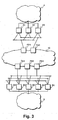
- Figure 2 illustrates such a configuration.
- Figure 2 shows the internal network A of site A, internet 10, and internal network B of site B.
- the VPN gateway node A1 of site A is connected to two different internet service providers PA1 and PA2.
- the VPN gateway node B1 of site B is connected to three different internet service providers PB1, PB2, and PB3.
- Such a configuration increases the availability of the connection, since should one of the ISP connections malfunction, the traffic can be directed to flow via another ISP.
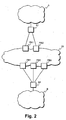
- Figure 3 illustrates a structure, where both clustering and connections via multiple internet service providers are used.
- Figure 3 shows the internal network A of site A, internet 10, and internal network B of site B.
- Site A has three VPN nodes A1, A2, and A3, each of which is connected to both internet service providers PA1, PA2.
- Site B has five VPN nodes B1, B2, B3, B4, and B5, each of which is connected to three ISP connections PB1, PB2, and PB3.
- Such a structure provides a system having high availability i.e. an extremely low probability of outage of service.
- Such a structure can manage breakdowns in a VPN node, breaks in connections between a site and an ISP, and breaks in the internet connections of ISPs.
- Such a structure also provides an increased amount of processing power needed for encryption and decryption.
- Another factor which increases the capacity of the structure is that a plurality of connections exist in the internet between the various ISPs, and the structure is able to select the best performing route through Internet among those offered by the ISPs.
- a data packet traversing from a host in a first internal network A to a host in a second internal network B can use many different routes.
- the packet can be handled by any of the VPN nodes at both ends, and transmitted via any of the ISPs at both ends. Consequently, there are four route selection decisions to be made when transmitting the packet from a host in network A to a host in network B. These decisions and the way in which they are made are critical regarding the performance of the total system.
- the route selection decisions are the following:
- the selections should be stable i.e. stay the same for a relatively long time for packets in a given logical connection between the particular hosts in the internal networks A and B, unless availability and/or performance reasons dictate a change in the selections. Stability requirements arise from the need to try to preserve the order of the packets going through Internet.
- the selection of the ISP via which the packet is sent from the originating site is performed in the originating VPN node. Examples of ways of performing the selection are described later in this patent application.
- the selection of the ISP via which the packet is routed from the internet to the destination site is performed in the originating VPN node. Examples of ways of performing the selection are described later in this patent application.
- a method for measuring the performance of a communication link employing the IPSec protocol is provided.
- the monitoring is effected by arranging the destination network node to send an acknowledgement packet for every N:th IPSec packet received from the originating network node.
- the acknowledgement packet comprises at least a sequence number of the IPSec packet, after which the acknowledgement packet is sent.
- the sequence number of an IPSec packet is present in the ESP (enhanced security payload) or in the AH (authentication header) header, as described in the corresponding RFC documents and well known by a man skilled in the art.
- sending of an acknowledgement packet is caused also by reaching a certain time limit.
- an acknowledgement packet is sent immediately when an IPSec packet is received even if less than N packets have been received. That is, the fulfillment of either criterion - reception of more than N packets or elapsing of time T after sending of the previous acknowledgement packet - causes the sending of an acknowledgement packet.
- the time T depends on the requirements of the particular application of the invention, whereby no fixed values for T can be given. Considering the typical capacities of packet networks and typical requirements for data transmission for VPN connections at the time of writing this patent application, the time T can advantageously be between 0.1 and 100 seconds, even more advantageously between 1 and 10 seconds.
- the number of received packets and/or the number of received bytes are counted at the destination node, and the current value of one or both of these counters is included in the acknowledgement packets when they are generated and sent.
- This allows the destination node to adjust the acknowledgement frequency (i.e. the number N) without negotiation with the originating node or explicit indication of the change of N to the originating node, since the originating node can then observe how many packets have gone through when receiving an acknowledgement packet.
- the inclusion of one or both of these counter values in the acknowledgement packets has also the advantage, that the measurement error caused by loss of an acknowledgement packet is remedied more rapidly than without these counter values.
- the source network node receives the acknowledgement packets, and notes the sequence number mentioned in the acknowledgement packet, and the packet counter value in such an embodiment, in which packet counter values are included in the acknowledgement packets.
- the source network node stores sending times, SPI field contents and sequence numbers of sent IPSec packets for a period of time in order to be able to measure the round trip time (RTT) of the connection.
- the number of timestamps needed to store depend on N, IPSec packet sending frequency, and RTT.
- the source network node can then calculate the round trip time by comparing the sequence number of a received acknowledgement packet and its reception time to the stored sending time of the corresponding original IPSec packet.
- the source network node can also calculate the packet success rate for the connection by calculating the ratio of sent IPSec packets and received acknowledgements.
- the source network node can advantageously calculate a moving average of the success rate to filter out the effects of temporary changes in round trip time.
- the source network node in which packet counter values are included in the acknowledgement packets, can calculate the packet success rate for the connection by calculating the ratio of sent IPSec packets and the differences of the packet counter values of received acknowledgements. Further, in such an embodiment in which byte counter values are included in the acknowledgement packets, the source network node can calculate the realized throughput based on the byte counter values and associated timestamps of a received acknowledgement and the previous received acknowledgements. The source network node can advantageously calculate a moving average of the success rate and throughput to filter out the effects of temporary changes in round trip time.
- the number N is advantageously between 50 and 500.
- the optimum value of N depends on the quality of the communication link and the statistical properties of changes in the quality of the communication link. If the properties of the link such as the throughput and the delay of the link do not vary much within relatively short monitoring periods, it is not necessary to follow the properties very accurately, whereby the number N can be adjusted to a high value such as 1000 or even higher. Conversely, if the properties of the communication link vary considerably even within short monitoring periods, it may be advantageous to follow the variations more accurately, in which case the number N can be adjusted to a low value, such as 50, 20, or even 10. However, lowering the value of number N increases the load caused by the performance monitoring on the network. Therefore, the optimum value for the number N depends on the requirements of the particular application of the invention and properties of the particular communication link or links used.
- the time interval T is advantageously between 1 second and 10 seconds.
- the optimum value of T depends on the quality of the communication link and other factors similar to those affecting the optimum value of T. Therefore, the optimum value for the interval T depends on the requirements of the particular application of the invention and properties of the particular communication link or links used.
- This measurement method is able to measure the round trip time, packet success rate and throughput.
- the method is also able to continuously monitor these parameters as long as there is traffic to be sent over the connection.
- the measurement method has also the advantage, that the overhead load inflicted by the measurement method is very light.
- inactive routes are monitored using probing in addition to the monitoring of active routes as described above.
- a VPN node sends one or more probe packets via each possible connection to a VPN node at the other site, which sends a response packet as a response to receiving a probe packet.
- the originating VPN node can measure round trip time for that route. If the originating VPN node sends a plurality of probe packets via each possible route, the originating VPN node can also monitor packet success rate, i.e. what percentage of packets go successivefully through the network.
- packet success rate i.e. what percentage of packets go successivefully through the network.
- Such probing can be used on all possible combinations of ISP connections and VPN nodes.
- a tunneling IPSec packet When a tunneling IPSec packet is constructed in the originating firewall node, its source IP address is set to the originating cluster's IP address and its destination IP address to the IP address of the destination cluster. These IP addresses are called the tunnel endpoints.
- a cluster In such configuration where a cluster is connected to the Internet using multiple ISP connections, a cluster has several IP addresses, i.e. one for each ISP connection. Such ISP connections can be connections provided by different ISPs. In such a configuration the selection of these IP addresses determines the ISP connections to be used. Selection of a source IP address and a destination IP address for a data packet therefore selects the ISP connection at the source site and the ISP connection for transmission of the data packet. Since the sender of a data packet specifies both of these IP addresses, the ISP connections for the packet are specified by the sender. The present aspect of the invention specifies an advantageous way of selecting the ISP connections at the source and the destination site.
- a selection method should select such a combination of source and destination ISP connections that is currently functional if one such combination exists, select such a combination of source and destination ISP connections that currently has the best throughput, and minimize the changes in the combination of source and destination ISP connections in order to minimize the overhead spent in setting up IPSec connections.
- the source and destination ISP connections are selected at least in part on the basis of at least the following three parameters:
- the source and destination ISP connections are selected at least in part on the basis of at least the following four parameters:
- R is the measured round trip time (RTT)
- S packet success rate
- T T the throughput
- A, B, C, and N are constants, which are adjusted according to the requirements of the particular application of the embodiment. Suitable values can be found for example by experimentation. Since characteristics of practical implementations vary widely, any more details about values for these constants suitable for general use cannot be given here.
- the value P calculated for each route is used to rank the available routes in a preference order for selection of a route, i.e. particular source and destination ISP connections. According to equation (1), the shorter the round trip time or the higher the packet success rate is, the higher is the preference P of a particular route.
- the third term of equation (1) gives weight to the
- D depends on the properties of the network between the source and destination nodes and can be determined experimentally.
- a suitable value for K can be determined for example by correlation experiments. In such a case in which packet success rate is zero, a large time constant such as 10 seconds is used for the value of the round trip time.
- the properties of different combinations of source and destination ISP connections are determined by sending probe packets via each combination, to which the destination site replies.
- the round trip time for each combination can then be found out from the time elapsed between sending of the probe packets and the received replies. For example, if the source site has two ISP connections and the destination site has three ISP connections, six probe packets are enough to test all six combinations.
- probe packets are sent only via inactive combinations, and the round trip time of an active connection is measured from acknowledgement packets sent by the destination site as described previously in this patent application.
- the throughput can be measured by measuring the traffic flowing through the connection.
- a measurement does not always reflect the true throughput, since the true capacity of the connection combination can be well above the current amount of traffic.
- a peak throughput value observed in a time window of specified length is used as the measurement value for throughput.
- a throughput value for use in performance estimation of a link is calculated according to a predefined function on the basis of round trip time of that link. This approach may give advantageous results, since it has been observed, that short round trip times are generally correlated with high throughput values.
- the properties of the combinations are monitored semicontinuously by sending probe packets at certain time intervals. If the time intervals are relatively long, say a plurality of seconds such as 30 seconds, the transmission of probe packets do not create any significant load on the transmission network.
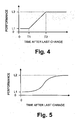
- Time elapsed after last change ISP connection in either end is in an advantageous embodiment of the invention used to minimize the changes, which require setting up of new IPSec connections. Shortly after a change in the ISP connections, a new change is made only if the current connection is nearly or completely broken. Later on, the readiness for making a change increases and eventually reaches a point when a relatively small assumed increase in performace would trigger a change.
- figure 4 shows a graph depicting how low the level of performance of the current link needs to drop before inducing a change in the ISP connections used. The vertical axis shows the minimum required performance level, and the horizontal axis shows the time elapsed after last change in configuration.
- the units of the vertical axis and the parameters L1 and L2 specify certain absolute performance values.
- the limits can be set to be between 0% and 100% of the best observed performance for the current link.
- the limits L1 and L2 specify certain relative performance values, i.e. values of the ratio of the current performance of the current link to the best observed performance of all of the available links i.e. ISP connection combinations.
- equation (3) an increase of the packet success rate, increase of the throughput or a decrease of the round trip time increase the observed performance.
- equation (3) is only an example of a feasible calculation method, and many different calculation methods can be used in various embodiments of the invention.
- Figure 4 shows a simple piecewise linear function as the time-dependent treshold function. Such a simple function is advantageous due to the ease of implementation of such a function. However, the invention is not limited to only such a function.
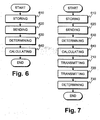
- Figure 5 shows another example of a suitable function, in which the limit changes smoothly from L1 to L2 over a period of time. The optimum function for use depends on the requirements of the particular application of the invention, wherefore the invention is not limited to any specific function to be used.
- multiple links are kept active and traffic is divided between the links in proportions that correspond to the performance value P calculated for each link in a way similar to those performance values presented in equations (3) and (4).
- a method for monitoring of a communication link employing the IPSec protocol between a source network node and a destination network node is provided.
- Various embodiments according to the present aspect of the invention are illustrated in figure 6. According to an advantageous embodiment of the invention, the method comprises at least the steps of
- the method further comprises the step of calculating 640 of packet success rate and throughput value of the connection on the basis of number of transmitted packets and the number of received packets and bytes determined from the counter values sent in the acknowledgement packets.
- a method for controlling of communication between a source network site and a destination network site, in which communication IPSec protocol is used, in which communication a plurality of different routes between the source network site and the destination network site can be used is provided.
- Various embodiments according to the present aspect of the invention are illustrated in figure 7. According to an advantageous embodiment of the invention, the method comprises at least the steps of
- the method further comprises the step of calculation 640 of packet success rate and throughput value of the connection on the basis of number of transmitted packets and the number of received packets and bytes determined from the counter values sent in the acknowledgement packets.
- the method further comprises the steps of
- a network node for receiving communication employing the IPSec protocol is provided.
- the node comprises at least
- a network node for sending communication employing the IPSec protocol is provided.
- the node comprises at least
- a method for monitoring of a communication link between a source network node and a destination network node, which communication link employs the IPSec protocol comprises at least the step of transmission of an acknowledgement packet by the destination network node if at least one of a first condition and a second condition is fulfilled, said first condition being the reception of at least a predetermined number of IPSec packets after transmission of the previous acknowledgement packet, and said second condition being the reception of a packet via the communication link after a predetermined time has passed after transmission of the previous acknowledgement packet.
- active connection refers to a connection being used for transmission of payload data
- inactive connection refers to a connection not being used for transmission of payload data
- the acknowledgement packet comprises at least the sequence number of the last received IPSec packet and at least one value corresponding to the amount of data received via the communication link.
- said acknowledgement packet comprises at least a packet counter value indicating the number of packets received via the communication link.
- said acknowledgement packet comprises at least a byte counter value indicating the number of bytes received via the communication link.
- said acknowledgement packet comprises at least a packet counter value indicating the number of packets received via the communication link and a byte counter value indicating the number of bytes received via the communication link.
- the method further comprises at least the step of determining the packet success rate of the communication link at least partly on the basis of information contained in an acknowledgement packet.
- the method further comprises at least the step of determining the throughput of the communication link at least partly on the basis of information contained in an acknowledgement packet.
- the method further comprises at least the steps of storing of the sequence number and the transmission time of each IPSec packet transmitted from the source network node to the destination network node in a memory means, and determining the round trip time of the communication link on the basis of the reception time of an acknowledgement packet and the stored transmission time of the corresponding transmitted packet.
- a method for monitoring of a plurality of communication links between a source network site and a destination network site, each of the sites having at least one network node is provided.
- an active communication link is monitored and an inactive communication link is monitored
- method steps for monitoring an active communication link between the source network site and the destination network site, the active communication link employing the IPSec protocol comprise at least the step of transmission of an acknowledgement packet by the destination network node if at least one of a first condition and a second condition is fulfilled, said first condition being the reception of at least a predetermined number of IPSec packets after transmission of the previous acknowledgement packet, and said second condition being the reception of a packet via the communication link after a predetermined time has passed after transmission of the previous acknowledgement packet, and in which method steps for monitoring an inactive communication link between the source network site and the destination network site comprise at least the steps of
- the method further comprises the steps of transmitting a plurality of probe packets from said source node at the source network site via said inactive communication link to said destination node at the destination network site, receiving response packets to said probe packets, and determining the packet success rate of said inactive communication link from the number of said received response packets and the number of transmitted probe packets.
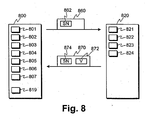
- a source network node 800 for communicating with the IPSec protocol with a destination 820 network node via a communication link is provided.
- This aspect of the invention is illustrated in figure 8.
- the network node comprises at least
- Such a network node can advantageously be used as a source node of an IPSec connection.
- the network node further comprises at least means 805 for determining the throughput of the communication link at least partly on the basis of said value 872.
- the network node further comprises at least means 806 for storing in a memory means 819 the sequence number and the transmission time of each IPSec packet transmitted by the network node via the communication link, and means 807 for determining the round trip time of the communication link on the basis of the reception time of an acknowledgement packet and the stored transmission time of the corresponding transmitted packet.
- a destination network node 820 for communicating with the IPSec protocol with a source network node 800 via a communication link is provided.
- the network node 820 comprises at least means 821 for transmission of an acknowledgement packet if at least one of a first condition and a second condition is fulfilled, said first condition being the reception of at least a predetermined number of IPSec packets after transmission of the previous acknowledgement packet, and said second condition being the reception of a packet via the communication link after a predetermined time has passed after transmission of the previous acknowledgement packet.
- Such a network node can advantageously be used as a destination node of an IPSec connection.
- the network node comprises at least means 822 for including a sequence number 862, 874 of a received IPSec packet 860 and at least one value corresponding to the amount of data received via the communication link in said acknowledgement packet 870.
- the network node comprises at least means 823 for including a packet counter value 872 in said acknowledgement packet 870, said packet counter value indicating the number of packets received via the communication link.
- the network node comprises at least means 824 for including a byte counter value 872 in said acknowledgement packet, said byte counter value indicating the number of bytes received via the communication link.
- a network node comprises the functionality of a source network node 800 and a destination network node 820 of IPSec connections. According to such an embodiment, the network node comprises at least
- Means 801 to 807 adn 821 to 824 can advantageously be implemented using software program code means executed by a processor unit.
- a software program product for a network node for communicating with the IPSec protocol with a second network node via a communication link is provided.
- Such a software program product can be used for implementing network nodes able to communicate using the IPSec protocol.
- the software program product comprises at least
- the software program product can be realized in many different ways, such as for example a software routine library for inclusion in other products or as a stand-alone application ready for use in a network node, and represented within many different types of media, such as magnetic, optical or magneto-optical mass memory means such as CD-ROMs, in electronic memory means such as semiconductor memory chips.
- method for selection of a route for transmission of data packets from a source network site to a destination network site comprises at least steps of
- the round trip time value can be a last measured round trip time value, or for example if no measurement for a particular combination has been performed or the measurement is older than a specified limit, a default value.
- the throughput value can be a last measured throughput value, or for example if no measurement for a particular combination has been performed or the measurement is older than a specified limit, a default value.
- said selections are performed at least in part also on the time elapsed after the selection of routes was previously changed.
- the amount change in the packet success rate, throughput and/or round trip time of a connection required to cause a change in the route selection reduces as a function of time.
- said function of time is a piecewise linear function.
- a network node for transmitting data packets from from a source network site to a destination network site.
- the network node comprises at least
- a computer software product for a system for transmitting data packets from from a source network site to a destination network site.
- the computer software product comprises at least
Landscapes
- Engineering & Computer Science (AREA)
- Computer Networks & Wireless Communication (AREA)
- Signal Processing (AREA)
- Computer Security & Cryptography (AREA)
- Computer Hardware Design (AREA)
- Computing Systems (AREA)
- General Engineering & Computer Science (AREA)
- Data Exchanges In Wide-Area Networks (AREA)
- Communication Control (AREA)
Priority Applications (4)
| Application Number | Priority Date | Filing Date | Title |
|---|---|---|---|
| EP01660158A EP1289183B1 (fr) | 2001-08-31 | 2001-08-31 | Méthode de contrôle de transmission de données sur un réseau à protocol Internet |
| ES01660158T ES2219488T3 (es) | 2001-08-31 | 2001-08-31 | Metodo de control de transmision de datos a traves de una red de protocolo internet. |
| AT01660158T ATE264030T1 (de) | 2001-08-31 | 2001-08-31 | Verfahren zur datenübertragungssteuerung über ein internet protokollnetzwerk |
| DE60102692T DE60102692T2 (de) | 2001-08-31 | 2001-08-31 | Verfahren zur Datenübertragungssteuerung über ein Internet Protokollnetzwerk |
Applications Claiming Priority (1)
| Application Number | Priority Date | Filing Date | Title |
|---|---|---|---|
| EP01660158A EP1289183B1 (fr) | 2001-08-31 | 2001-08-31 | Méthode de contrôle de transmission de données sur un réseau à protocol Internet |
Publications (2)
| Publication Number | Publication Date |
|---|---|
| EP1289183A1 true EP1289183A1 (fr) | 2003-03-05 |
| EP1289183B1 EP1289183B1 (fr) | 2004-04-07 |
Family
ID=8183633
Family Applications (1)
| Application Number | Title | Priority Date | Filing Date |
|---|---|---|---|
| EP01660158A Expired - Lifetime EP1289183B1 (fr) | 2001-08-31 | 2001-08-31 | Méthode de contrôle de transmission de données sur un réseau à protocol Internet |
Country Status (4)
| Country | Link |
|---|---|
| EP (1) | EP1289183B1 (fr) |
| AT (1) | ATE264030T1 (fr) |
| DE (1) | DE60102692T2 (fr) |
| ES (1) | ES2219488T3 (fr) |
Families Citing this family (1)
| Publication number | Priority date | Publication date | Assignee | Title |
|---|---|---|---|---|
| DE102011078309A1 (de) * | 2011-06-29 | 2013-01-03 | Siemens Aktiengesellschaft | Verfahren und Vorrichtung zum Überwachen eines VPN-Tunnels |
Citations (2)
| Publication number | Priority date | Publication date | Assignee | Title |
|---|---|---|---|---|
| US4617657A (en) * | 1984-12-28 | 1986-10-14 | Northern Telecom Limited | Transmitting sequence numbers of information in a packet data transmission system |
| EP1052797A2 (fr) * | 1999-05-08 | 2000-11-15 | Kent Ridge Digital Labs | Système de transmission avec acquittement de réception differé dynamiquement |
-
2001
- 2001-08-31 AT AT01660158T patent/ATE264030T1/de active
- 2001-08-31 DE DE60102692T patent/DE60102692T2/de not_active Expired - Lifetime
- 2001-08-31 EP EP01660158A patent/EP1289183B1/fr not_active Expired - Lifetime
- 2001-08-31 ES ES01660158T patent/ES2219488T3/es not_active Expired - Lifetime
Patent Citations (2)
| Publication number | Priority date | Publication date | Assignee | Title |
|---|---|---|---|---|
| US4617657A (en) * | 1984-12-28 | 1986-10-14 | Northern Telecom Limited | Transmitting sequence numbers of information in a packet data transmission system |
| EP1052797A2 (fr) * | 1999-05-08 | 2000-11-15 | Kent Ridge Digital Labs | Système de transmission avec acquittement de réception differé dynamiquement |
Non-Patent Citations (1)
| Title |
|---|
| BAKIN D S ET AL: "Quantifying TCP performance improvements in noisy environments using protocol boosters", PROCEEDINGS ISCC 2000. FIFTH IEEE SYMPOSIUM ON COMPUTERS AND COMMUNICATIONS, PROCEEDINGS OF 5TH IEEE SYMPOSIUM ON COMPUTER AND COMMUNICATIONS (ISCC 2000), ANTIBES-JUAN LES PINS, FRANCE, 3-6 JULY 2000, 2000, Los Alamitos, CA, USA, IEEE Comput. Soc, USA, pages 92 - 97, XP002189754, ISBN: 0-7695-0722-0 * |
Also Published As
| Publication number | Publication date |
|---|---|
| DE60102692T2 (de) | 2004-08-12 |
| ES2219488T3 (es) | 2004-12-01 |
| EP1289183B1 (fr) | 2004-04-07 |
| ATE264030T1 (de) | 2004-04-15 |
| DE60102692D1 (de) | 2004-05-13 |
Similar Documents
| Publication | Publication Date | Title |
|---|---|---|
| US6912200B2 (en) | Data transmission control method | |
| US7099284B2 (en) | Data transmission control and performance monitoring method of an IPSec link in a virtual private network | |
| US6363053B1 (en) | Method and apparatus for measurement-based conformance testing of service level agreements in networks | |
| EP1891526B1 (fr) | Systemes et procedes destines a fournir un protocole de verification des voies du reseau | |
| CN102783089B (zh) | 用于估计子路径的可用带宽的方法 | |
| EP1111871A2 (fr) | Mesure de l'efficacité de transmission de données | |
| US20050185587A1 (en) | System and method for end to end route control | |
| US20060098586A1 (en) | Method and apparatus for application route discovery | |
| US20060274791A1 (en) | Method measuring a delay time metric and measurement system | |
| US6970429B2 (en) | Method and apparatus for measuring internet router traffic | |
| EP1289202B1 (fr) | Procédé et noeud de réseau de communication pour la sélection de route en utilisant le temps de propagation aller-retour et le débit de paquets | |
| US7274663B2 (en) | System and method for testing differentiated services in a value add network service | |
| CN101827089B (zh) | 加密通信量识别装置及具有该装置的加密通信量识别系统 | |
| EP1289183B1 (fr) | Méthode de contrôle de transmission de données sur un réseau à protocol Internet | |
| CN115914081B (zh) | 测量网络往返时间的方法、装置、存储介质和电子设备 | |
| EP3100413B1 (fr) | Session d'exploration de réseau fiable | |
| Pournaghshband et al. | End-to-end detection of middlebox interference | |
| EP1879349A1 (fr) | Procédé pour mesurer la perte de paquets | |
| Morton et al. | RFC 9097: Metrics and Methods for One-Way IP Capacity | |
| Luckie et al. | Path diagnosis with IPMP | |
| WO2017191423A1 (fr) | Moyens de mesures de performance d'une connexion internet d'un terminal | |
| JP2007243428A (ja) | パケット集約方法、装置、およびプログラム | |
| JP2003509962A (ja) | ネットワーク相互接続用のルータ | |
| Zhang | DiffServ measurement |
Legal Events
| Date | Code | Title | Description |
|---|---|---|---|
| PUAI | Public reference made under article 153(3) epc to a published international application that has entered the european phase |
Free format text: ORIGINAL CODE: 0009012 |
|
| 17P | Request for examination filed |
Effective date: 20020412 |
|
| AK | Designated contracting states |
Kind code of ref document: A1 Designated state(s): AT BE CH CY DE DK ES FI FR GB GR IE IT LI LU MC NL PT SE TR |
|
| AX | Request for extension of the european patent |
Extension state: AL LT LV MK RO SI |
|
| GRAP | Despatch of communication of intention to grant a patent |
Free format text: ORIGINAL CODE: EPIDOSNIGR1 |
|
| GRAS | Grant fee paid |
Free format text: ORIGINAL CODE: EPIDOSNIGR3 |
|
| AKX | Designation fees paid |
Designated state(s): AT BE CH CY DE DK ES FI FR GB GR IE IT LI LU MC NL PT SE TR |
|
| GRAA | (expected) grant |
Free format text: ORIGINAL CODE: 0009210 |
|
| AK | Designated contracting states |
Kind code of ref document: B1 Designated state(s): AT BE CH CY DE DK ES FI FR GB GR IE IT LI LU MC NL PT SE TR |
|
| PG25 | Lapsed in a contracting state [announced via postgrant information from national office to epo] |
Ref country code: LI Free format text: LAPSE BECAUSE OF FAILURE TO SUBMIT A TRANSLATION OF THE DESCRIPTION OR TO PAY THE FEE WITHIN THE PRESCRIBED TIME-LIMIT Effective date: 20040407 Ref country code: NL Free format text: LAPSE BECAUSE OF FAILURE TO SUBMIT A TRANSLATION OF THE DESCRIPTION OR TO PAY THE FEE WITHIN THE PRESCRIBED TIME-LIMIT Effective date: 20040407 Ref country code: FI Free format text: LAPSE BECAUSE OF FAILURE TO SUBMIT A TRANSLATION OF THE DESCRIPTION OR TO PAY THE FEE WITHIN THE PRESCRIBED TIME-LIMIT Effective date: 20040407 Ref country code: CH Free format text: LAPSE BECAUSE OF FAILURE TO SUBMIT A TRANSLATION OF THE DESCRIPTION OR TO PAY THE FEE WITHIN THE PRESCRIBED TIME-LIMIT Effective date: 20040407 Ref country code: CY Free format text: LAPSE BECAUSE OF FAILURE TO SUBMIT A TRANSLATION OF THE DESCRIPTION OR TO PAY THE FEE WITHIN THE PRESCRIBED TIME-LIMIT Effective date: 20040407 Ref country code: TR Free format text: LAPSE BECAUSE OF FAILURE TO SUBMIT A TRANSLATION OF THE DESCRIPTION OR TO PAY THE FEE WITHIN THE PRESCRIBED TIME-LIMIT Effective date: 20040407 Ref country code: BE Free format text: LAPSE BECAUSE OF FAILURE TO SUBMIT A TRANSLATION OF THE DESCRIPTION OR TO PAY THE FEE WITHIN THE PRESCRIBED TIME-LIMIT Effective date: 20040407 |
|
| REG | Reference to a national code |
Ref country code: GB Ref legal event code: FG4D |
|
| REG | Reference to a national code |
Ref country code: CH Ref legal event code: EP |
|
| REF | Corresponds to: |
Ref document number: 60102692 Country of ref document: DE Date of ref document: 20040513 Kind code of ref document: P |
|
| REG | Reference to a national code |
Ref country code: IE Ref legal event code: FG4D |
|
| PG25 | Lapsed in a contracting state [announced via postgrant information from national office to epo] |
Ref country code: DK Free format text: LAPSE BECAUSE OF FAILURE TO SUBMIT A TRANSLATION OF THE DESCRIPTION OR TO PAY THE FEE WITHIN THE PRESCRIBED TIME-LIMIT Effective date: 20040707 Ref country code: SE Free format text: LAPSE BECAUSE OF FAILURE TO SUBMIT A TRANSLATION OF THE DESCRIPTION OR TO PAY THE FEE WITHIN THE PRESCRIBED TIME-LIMIT Effective date: 20040707 Ref country code: GR Free format text: LAPSE BECAUSE OF FAILURE TO SUBMIT A TRANSLATION OF THE DESCRIPTION OR TO PAY THE FEE WITHIN THE PRESCRIBED TIME-LIMIT Effective date: 20040707 |
|
| PG25 | Lapsed in a contracting state [announced via postgrant information from national office to epo] |
Ref country code: MC Free format text: LAPSE BECAUSE OF NON-PAYMENT OF DUE FEES Effective date: 20040831 Ref country code: LU Free format text: LAPSE BECAUSE OF NON-PAYMENT OF DUE FEES Effective date: 20040831 |
|
| NLV1 | Nl: lapsed or annulled due to failure to fulfill the requirements of art. 29p and 29m of the patents act | ||
| REG | Reference to a national code |
Ref country code: CH Ref legal event code: PL |
|
| PGFP | Annual fee paid to national office [announced via postgrant information from national office to epo] |
Ref country code: IE Payment date: 20041111 Year of fee payment: 4 |
|
| REG | Reference to a national code |
Ref country code: ES Ref legal event code: FG2A Ref document number: 2219488 Country of ref document: ES Kind code of ref document: T3 |
|
| ET | Fr: translation filed | ||
| PLBE | No opposition filed within time limit |
Free format text: ORIGINAL CODE: 0009261 |
|
| STAA | Information on the status of an ep patent application or granted ep patent |
Free format text: STATUS: NO OPPOSITION FILED WITHIN TIME LIMIT |
|
| 26N | No opposition filed |
Effective date: 20050110 |
|
| PG25 | Lapsed in a contracting state [announced via postgrant information from national office to epo] |
Ref country code: IE Free format text: LAPSE BECAUSE OF NON-PAYMENT OF DUE FEES Effective date: 20050831 |
|
| REG | Reference to a national code |
Ref country code: IE Ref legal event code: MM4A |
|
| PG25 | Lapsed in a contracting state [announced via postgrant information from national office to epo] |
Ref country code: PT Free format text: LAPSE BECAUSE OF NON-PAYMENT OF DUE FEES Effective date: 20040907 |
|
| PGFP | Annual fee paid to national office [announced via postgrant information from national office to epo] |
Ref country code: AT Payment date: 20110829 Year of fee payment: 11 Ref country code: ES Payment date: 20110823 Year of fee payment: 11 |
|
| PGFP | Annual fee paid to national office [announced via postgrant information from national office to epo] |
Ref country code: IT Payment date: 20110822 Year of fee payment: 11 |
|
| REG | Reference to a national code |
Ref country code: AT Ref legal event code: MM01 Ref document number: 264030 Country of ref document: AT Kind code of ref document: T Effective date: 20120831 |
|
| PG25 | Lapsed in a contracting state [announced via postgrant information from national office to epo] |
Ref country code: IT Free format text: LAPSE BECAUSE OF NON-PAYMENT OF DUE FEES Effective date: 20120831 |
|
| PG25 | Lapsed in a contracting state [announced via postgrant information from national office to epo] |
Ref country code: AT Free format text: LAPSE BECAUSE OF NON-PAYMENT OF DUE FEES Effective date: 20120831 |
|
| REG | Reference to a national code |
Ref country code: ES Ref legal event code: FD2A Effective date: 20131021 |
|
| PG25 | Lapsed in a contracting state [announced via postgrant information from national office to epo] |
Ref country code: ES Free format text: LAPSE BECAUSE OF NON-PAYMENT OF DUE FEES Effective date: 20120901 |
|
| REG | Reference to a national code |
Ref country code: FR Ref legal event code: PLFP Year of fee payment: 16 |
|
| PGFP | Annual fee paid to national office [announced via postgrant information from national office to epo] |
Ref country code: GB Payment date: 20160831 Year of fee payment: 16 |
|
| PGFP | Annual fee paid to national office [announced via postgrant information from national office to epo] |
Ref country code: FR Payment date: 20160712 Year of fee payment: 16 |
|
| GBPC | Gb: european patent ceased through non-payment of renewal fee |
Effective date: 20170831 |
|
| REG | Reference to a national code |
Ref country code: FR Ref legal event code: ST Effective date: 20180430 |
|
| PG25 | Lapsed in a contracting state [announced via postgrant information from national office to epo] |
Ref country code: GB Free format text: LAPSE BECAUSE OF NON-PAYMENT OF DUE FEES Effective date: 20170831 |
|
| PG25 | Lapsed in a contracting state [announced via postgrant information from national office to epo] |
Ref country code: FR Free format text: LAPSE BECAUSE OF NON-PAYMENT OF DUE FEES Effective date: 20170831 |
|
| PGFP | Annual fee paid to national office [announced via postgrant information from national office to epo] |
Ref country code: DE Payment date: 20200819 Year of fee payment: 20 |
|
| REG | Reference to a national code |
Ref country code: DE Ref legal event code: R071 Ref document number: 60102692 Country of ref document: DE |