EP1291037A2 - Ratenadaptiver Herzschrittmacher - Google Patents
Ratenadaptiver Herzschrittmacher Download PDFInfo
- Publication number
- EP1291037A2 EP1291037A2 EP02090320A EP02090320A EP1291037A2 EP 1291037 A2 EP1291037 A2 EP 1291037A2 EP 02090320 A EP02090320 A EP 02090320A EP 02090320 A EP02090320 A EP 02090320A EP 1291037 A2 EP1291037 A2 EP 1291037A2
- Authority
- EP
- European Patent Office
- Prior art keywords
- rate
- activity
- stimulation
- unit
- basic
- Prior art date
- Legal status (The legal status is an assumption and is not a legal conclusion. Google has not performed a legal analysis and makes no representation as to the accuracy of the status listed.)
- Granted
Links
- 230000003044 adaptive effect Effects 0.000 title claims abstract description 9
- 230000000694 effects Effects 0.000 claims abstract description 76
- 230000000638 stimulation Effects 0.000 claims abstract description 76
- 230000002861 ventricular Effects 0.000 claims abstract description 29
- 230000001746 atrial effect Effects 0.000 claims abstract description 26
- 230000001419 dependent effect Effects 0.000 claims abstract description 4
- 238000001514 detection method Methods 0.000 claims description 34
- 230000008859 change Effects 0.000 claims description 29
- 230000002269 spontaneous effect Effects 0.000 claims description 19
- 230000000875 corresponding effect Effects 0.000 claims description 7
- 208000009729 Ventricular Premature Complexes Diseases 0.000 claims description 6
- 206010047289 Ventricular extrasystoles Diseases 0.000 claims description 4
- 238000005259 measurement Methods 0.000 abstract description 5
- 230000001447 compensatory effect Effects 0.000 description 9
- 210000001992 atrioventricular node Anatomy 0.000 description 5
- 230000000747 cardiac effect Effects 0.000 description 5
- 238000011156 evaluation Methods 0.000 description 5
- 238000000034 method Methods 0.000 description 5
- 230000029058 respiratory gaseous exchange Effects 0.000 description 5
- 206010003130 Arrhythmia supraventricular Diseases 0.000 description 4
- 206010003658 Atrial Fibrillation Diseases 0.000 description 4
- 238000002679 ablation Methods 0.000 description 4
- 230000006978 adaptation Effects 0.000 description 4
- 230000008569 process Effects 0.000 description 4
- 230000009467 reduction Effects 0.000 description 4
- 238000002560 therapeutic procedure Methods 0.000 description 4
- 206010040639 Sick sinus syndrome Diseases 0.000 description 3
- 230000009471 action Effects 0.000 description 3
- 238000010586 diagram Methods 0.000 description 3
- 210000002837 heart atrium Anatomy 0.000 description 3
- 230000002503 metabolic effect Effects 0.000 description 3
- 206010003671 Atrioventricular Block Diseases 0.000 description 2
- 206010050202 Carotid sinus syndrome Diseases 0.000 description 2
- 206010015856 Extrasystoles Diseases 0.000 description 2
- 206010019280 Heart failures Diseases 0.000 description 2
- 208000000418 Premature Cardiac Complexes Diseases 0.000 description 2
- 206010042602 Supraventricular extrasystoles Diseases 0.000 description 2
- 230000008901 benefit Effects 0.000 description 2
- 230000001276 controlling effect Effects 0.000 description 2
- 206010020871 hypertrophic cardiomyopathy Diseases 0.000 description 2
- 238000012545 processing Methods 0.000 description 2
- 230000000241 respiratory effect Effects 0.000 description 2
- 210000000689 upper leg Anatomy 0.000 description 2
- 208000020446 Cardiac disease Diseases 0.000 description 1
- 230000001133 acceleration Effects 0.000 description 1
- 230000008878 coupling Effects 0.000 description 1
- 238000010168 coupling process Methods 0.000 description 1
- 238000005859 coupling reaction Methods 0.000 description 1
- 230000003247 decreasing effect Effects 0.000 description 1
- 201000010099 disease Diseases 0.000 description 1
- 208000037265 diseases, disorders, signs and symptoms Diseases 0.000 description 1
- 238000000605 extraction Methods 0.000 description 1
- 230000006870 function Effects 0.000 description 1
- 230000036541 health Effects 0.000 description 1
- 208000019622 heart disease Diseases 0.000 description 1
- 238000002513 implantation Methods 0.000 description 1
- 230000006872 improvement Effects 0.000 description 1
- 230000007774 longterm Effects 0.000 description 1
- 238000012544 monitoring process Methods 0.000 description 1
- 238000005457 optimization Methods 0.000 description 1
- 230000002980 postoperative effect Effects 0.000 description 1
- 230000002035 prolonged effect Effects 0.000 description 1
- 230000006641 stabilisation Effects 0.000 description 1
- 238000011105 stabilization Methods 0.000 description 1
- 230000000087 stabilizing effect Effects 0.000 description 1
- 230000001629 suppression Effects 0.000 description 1
- 238000012546 transfer Methods 0.000 description 1
- 238000011282 treatment Methods 0.000 description 1
- 230000001457 vasomotor Effects 0.000 description 1
- 230000036642 wellbeing Effects 0.000 description 1
Images



Classifications
-
- A—HUMAN NECESSITIES
- A61—MEDICAL OR VETERINARY SCIENCE; HYGIENE
- A61N—ELECTROTHERAPY; MAGNETOTHERAPY; RADIATION THERAPY; ULTRASOUND THERAPY
- A61N1/00—Electrotherapy; Circuits therefor
- A61N1/18—Applying electric currents by contact electrodes
- A61N1/32—Applying electric currents by contact electrodes alternating or intermittent currents
- A61N1/36—Applying electric currents by contact electrodes alternating or intermittent currents for stimulation
- A61N1/362—Heart stimulators
- A61N1/365—Heart stimulators controlled by a physiological parameter, e.g. heart potential
- A61N1/36585—Heart stimulators controlled by a physiological parameter, e.g. heart potential controlled by two or more physical parameters
Definitions
- pacemakers To program pacemakers individually for the patient and so for everyone Treatments tailored to the patient's cardiac disease To be able to create, pacemakers (HSM) have one today Variety of parameters by means of which the pacemaker works and thus the therapy offered by the pacemaker in the company is stopped can be.
- a rate-adaptive cardiac pacemaker is known from DE 199 40 952, at which the rate adaption takes place depending on the respiration rate.
- the starting point here is the central nervous coupling of respiratory and Circulatory activity, in which the heart rate, heartbeat volume and vasomotor function are important.
- the measurement of the respiration rate can be done by measuring the intrathoracic and / or the intracardiac impedance.
- EP 0 449 401 also shows a rate-adaptive cardiac pacemaker, which is an impedance system for measuring a right ventricular (or atrial) volume or a pressure transducer for measuring the right ventricular (or atrial) pressure and a signal processing unit for Beat-to-beat extraction of one of the volume or pressure parameters has to thereby obtain a signal which with the respiration rate varies, and a peak-to-peak amplitude proportional to the depth of respiration having.
- the signal processing unit is provided extract the period of the respiratory signal and the peak-to-peak amplitude and to use the resulting signals to use the determine the required pacing rate for the pacemaker.
- Algorithms for stabilizing the heart rate are, for example, from PA-CE, Vol. 23, October 2000, Part I, page 1509 ff.
- pacemakers It is desirable to have the pacing and sensing properties of pacemakers even further to the actual metabolic needs of one Being able to adapt patients and / or stabilize the heart rate.
- the object of the invention is achieved by a rate-adaptive cardiac pacemaker solved with the features of claim 1.
- a rate-adaptive pacemaker for this purpose, which a detection unit, an event determination unit, a stimulation control unit and a stimulation unit, the event determination unit with the detection unit and stimulation control unit connected as well as the stimulation unit with the stimulation control unit connected is.
- the detection unit detects an ECG signal Heart and the event determination unit determined from that of the Detection unit recorded ECG signals and from the stimulation control unit sent signals whether a detected event is a spontaneous or represents a stimulated event.
- the stimulation control unit determines a stimulation rate depending on a basic rate and one physiological needs and changes the basic rate depending on the Event determination unit in a first mode when atrial occurs or ventricular events such that in the event of a spontaneous atrial Event extends a spontaneous interval by a first change value is that in the event of a paced atrial event a basic interval is extended by a second change value and that in the case of a ventricular extrasystole a basic interval around a third change value is extended, whereby the basic rate is reduced in all cases.
- the stimulation control unit is designed, the basic rate in a second mode when ventricular events occur change that in the event of a spontaneous ventricular event the Basic rate is increased and in the event of a stimulated ventricular event the base rate is lowered. Lowering the basic rate in the second mode takes place suddenly in smaller steps than that also suddenly Increase the base rate in the case of sensed natural (spontaneous) ventricular Events.
- the stimulation unit stimulates the heart according to that of signals received by the stimulation control unit.
- the advantages associated with the invention are in particular that translating medical expertise into one for one Pacemaker processable form, i.e. minimal computing effort for the Pacemaker and thus fulfillment of a feasibility without the (battery) Significantly affect lifetime, is achieved.
- the pacemaker patient may receive a significant increase in quality of life.
- the therapy improvements for the Patients are monitored by extracorporeal monitoring (e.g. long-term surface ECG) understandable (every heart activity and thus also the algorithm functionality can be analyzed precisely).
- the stimulation control unit suitable to keep the basic rate of the heart within given To determine limits. This ensures that the basic rate of the heart does not drop below a critical value or above a critical value Value increases which affects the well-being or health of the patient can affect.
- the rate-adaptive cardiac pacemaker an activity detection unit, which is designed for this purpose is to record the activity of a patient and a corresponding activity signal issue.
- the stimulation control unit is with the activity detection unit connected and trained to a basic rate of one Patients according to a first or a second operating mode rate adaptive to determine that the basic heart rate accordingly the first operating mode in a predetermined first step interval is lowered if the. within a predetermined first time interval Activity signal indicates no patient activity, and the basic rate of Heart according to the second mode in a predetermined second step interval is increased if within a predetermined interval is increased if within a predetermined second time interval the activity signal indicates an activity of the patient.
- the first time interval is longer than the second time interval, while the first step interval is identical to the second step interval.
- the pacemaker takes into account atrial or ventricular events hence the patient's activity.
- the Base frequency lowered while going back to activity is increased.
- the object of the invention is further achieved by a rate-adaptive cardiac pacemaker solved according to claim 4.
- the rate-adaptive pacemaker an activity detection unit, which is designed to to record the activity of a patient and a corresponding activity signal output, and has a stimulation control unit, which with the activity detection unit is connected and configured to one Basic rate of a patient according to a first or a second operating mode rate-adaptive to determine the basic rate of the heart corresponding to the first operating mode in a predetermined first step interval is lowered if within a predetermined first time interval the activity signal indicates no patient activity, and the base rate of the heart according to the second mode in a given one second step interval is increased if within a predetermined second time interval, the activity signal indicates an activity of the patient.
- the rate-adaptive pacemaker also has a stimulation unit which is connected to the stimulation control unit and designed for this purpose is the heart depending on the output signal of the stimulation control unit stimulate, with the first time interval longer than that second time interval and the first step interval equal to the second step interval is.
- the associated advantages are in particular that the Fundamental frequency not abruptly but gradually reduced and upon detection an activity of the patient is quickly raised so that the Metabolic needs of the patient better and depending on the situation or stress can be covered.
- the pacemaker has a detection unit 1, an event determination unit 2, a stimulation control unit 3, a fundamental frequency parameter memory 4, a memory 5 for mode 1, a memory 6 for mode 2 and a stimulation unit 11 on.
- the detection unit 1 is connected on the one hand to two electrodes, one of which an electrode 7 in the atrium and an electrode 8 in the ventricle, and on the other hand with the event determination unit 2.
- the stimulation control unit 3 is with the event determination unit 2, the fundamental frequency parameter memory 4, the memory 5, the memory 6 and with the stimulation unit 11 connected.
- the stimulation unit 11 has electrodes 10 and 12 in the atrium or ventricle connected. Different assignments are each one or more electrodes in the atrium and ventricle to the detection unit 1 and the stimulation unit 11 possibly using switchers, so that known unipolar or bipolar sensing and / or a unipolar or bipolar stimulation is possible.
- the acquisition unit 1 acquires the EKG signals of the heart 100 using the Electrodes 7 and 8 and passes these signals to the event determination unit 2 further.
- the event determination unit 2 receives the ECG signals of the heart output by the detection unit 1 and signals output by the stimulation control unit 3, which indicate whether stimulation has taken place. Based on these received The event determination unit 2 determines whether there is a signal detected event is a spontaneous event or a stimulated event is. The result of this determination is sent to the stimulation control unit 3 forwarded.
- the stimulation control unit selects on the basis of this result 3 mode 1 stored in memory 5 or in Memory 6 saved mode 2 off.
- the patient-specific upper and lower limits of the basic frequency GF OG and GF UG as well as the variable lower basic frequency GF UGvar for the pacemaker are stored in the memory 4.
- Pacemaker should the basic frequency GF as close as possible to the Natural frequency of the patient can be kept.
- the first embodiment corresponds to mode 1.
- the pacemaker engages HSM does not default to one, but there will be compensatory breaks after ventricular extrasystoles VES interrupted by an HSM stimulus.
- Ap / (Ap + As) ⁇ VES portion should correspond.
- Suitable patients are preferably patients with a pacemaker in the DDD or AAl mode and with frequent ventricular and supraventricular Extra systoles (e.g. in sick sinus syndrome, AV blockages or HOCM). This can be done, for example, in patients with an AV block II °, type 2: 1, dominant, use with frequent VES.
- a pacemaker according to the first exemplary embodiment is not suitable however for patients with a higher basic frequency, e.g. to AV node ablation, patients with severe heart failure without thigh block, Patients who want a high level of stimulation (e.g. with torsades) and patients with a pacemaker with one VDD and VVI mode, since it is asynchronous when the atrial rhythm is maintained Ventricular stimulation is coming.
- Tracking the basic frequency to the current intrinsic heart rate should reduce the compensatory breaks without the disrupt intrinsic heart rate history. This is particularly so with patients interesting, where a low fundamental frequency was programmed and this can result in long compensatory breaks without that the pacemaker can intervene.
- the basic frequency is tracked so that it is as close as possible to the intrinsic heart rate. All in all, except for the compensatory breaks after extrasystoles, stimulation should be as little as possible. At the same time, it is ensured that the fundamental frequency GF is always within the defined limits of the fundamental frequency UG, ie the lower fundamental frequency, and fundamental frequency OG, ie the upper fundamental frequency.
- the basic interval GI is increased by the change value delta_ap after the event A P prolonged. If, on the other hand, an atrial spontaneous event is detected by the detection unit 1 and determined by the event determination unit 2, the spontaneous interval is extended by the change value delta_as after the A S event.
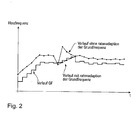
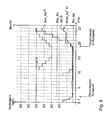
- Fig. 2 shows a graph of heart rate over time.
- Fig. 2 are both the course of the basic frequency GF and the course of the heart rate are shown, both for the case without rate adaptation of the basic frequency as well as in the case of rate-adaptive tracking of the fundamental frequency.
- the the second embodiment corresponds to mode 2.
- the course of the Graph clearly shows that the compensatory pause in a VES Due to the tracked basic frequency GF interrupted by a stimulus becomes.
- Pacemaker is said to be through permanent stimulation in the ventricle the transfer of rapid atrial beats through retrograde blockages of the AV nodes are suppressed.
- the fundamental frequency GF not at an unnecessarily high value, but adapted to the situation can be lowered.
- a pacemaker according to the second exemplary embodiment is not suitable however, for patients with a preserved atrial rhythm or only intermittent.
- Atrial fibrillation in patients with a high basic frequency, e.g. to AV node ablation, with an HSM in VDD and DDD mode, since it is here preserved atrial rhythm for increased asynchronous ventricular stimulation comes and an HSM in AAl mode since no data about ventricular events available.
- the basic frequency GF is tracked such that it is as close as possible to the intrinsic heart rate. Essentially, Vp / (Vp + Vs) ⁇ 100%.
- the stimulation control unit 3 controls the stimulation unit 11 in accordance with the data stored in the memory 4 in such a way that the basic frequency is always within the defined limits, ie basic frequency GF UG as the minimum permitted value for the basic frequency and basic frequency GF OG as the maximum permitted value for the fundamental frequency.
- the algorithm according to the second embodiment of the invention is performed for each ventricular action and corresponds to mode two:
- n_limit for example 10
- delta_vp for example 1 ppm (pulse per minute)
- n_reinit for example 7. It is then checked whether the basic frequency GF is below the minimum permitted value for the basic frequency GF UG . If this is the case, the fundamental frequency GF is set to the minimum permitted value for the fundamental frequency GF UG .
- the counter n is set to 0 and the basic frequency GF is increased by delta_vs, for example 4 ppm. It is then checked whether the basic frequency GF is above the maximum permitted value for the basic frequency GF OG . If this is the case, the fundamental frequency GF is set to the maximum permitted value for the fundamental frequency GF OG .
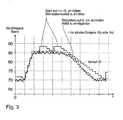
- Figure 3 shows a graph of heart rate over time.
- Fig. 3 are both the course of the basic frequency GF and the ventricular events are shown, taking the ventricular events as points and the course of the Basic frequency GF can be represented as a solid line.
- the history clearly shows how the fundamental frequency GF changes over time ventricular events. To a high proportion of stimulation to get a lowering of the stimulation component is only initialized, when the counter n has reached the value 10. The subsequent reset of the counter n to 6 enables the stimulation component to drop rapidly.
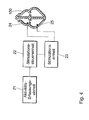
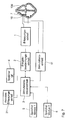
- the pacemaker has a stimulation control unit 22, a stimulation unit 23 and an activity detection unit 21, wherein the stimulation control unit 22 with the Stimulation unit 23 and the activity detection unit 21 is connected.
- the stimulation unit 23 is in turn connected to the atrial electrode 24 and / or connected to the ventricular electrode 25 and stimulates the heart corresponding to those obtained from the stimulation control unit 22 Control signals through these electrodes.
- the activity detection unit 21 can be an acceleration measurement unit, for example or alternatively also a respiration rate detection unit, as described in DE 197 47 820 or EP 0 449 401.
- the rate-adaptive pacemaker according to the third embodiment the invention is particularly for patients with sick sinus syndrome or suitable for patients with chronic atrial fibrillation.
- the pacemaker is not for patients who need a high basic frequency (e.g. after AV node ablation or torsades), for patients with frequent SVES and VES (risk of prolonging the comp. Break) or for patients with carotid sinus syndrome (insufficient increase in frequency during episode).
- the (night) lowering of the basic frequency during patient rest is not on rigid times linked to the activity of the patient. Besides, will the base frequency is not lowered abruptly but gradually.
- the basic frequency becomes gradually lowered. Will be within a short period of time Activity is measured, the basic frequency is gradually reduced to theirs old value raised.
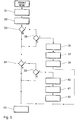
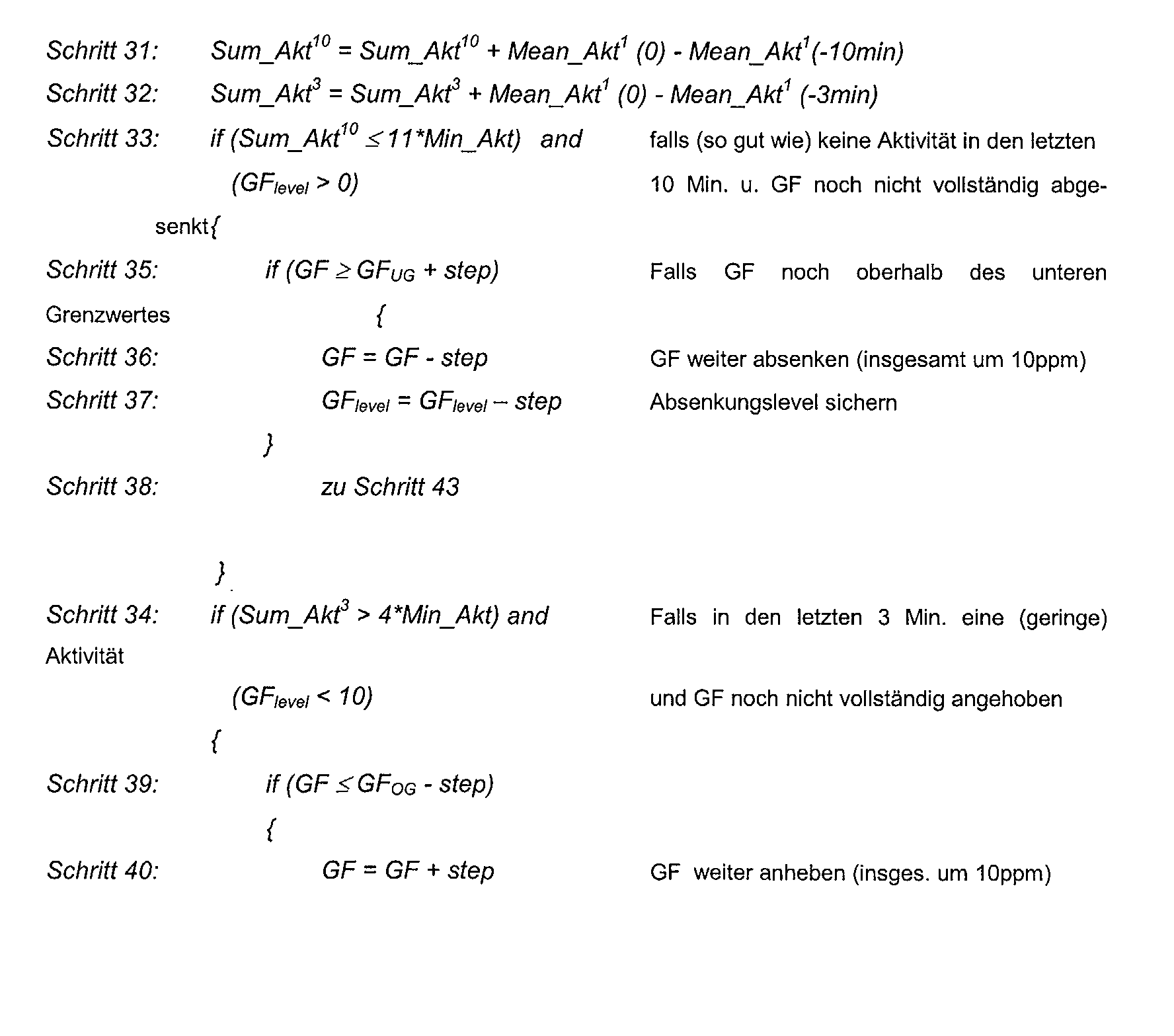
- the stimulation control unit 22 According to the value of timer, the following evaluation is carried out by the stimulation control unit 22:
- step 35 it is checked whether the fundamental frequency GF is still above the lower limit. If not, the flow continues go to step 34. Otherwise, the flow proceeds to step 36.
- step 36 the basic frequency GF is further reduced by the change value step (10ppm in total) and the flow proceeds to step 37.
- Step 37 saves the subsidence level and the flow continues Step 38 further.
- step 38 the flow jumps to step 43.
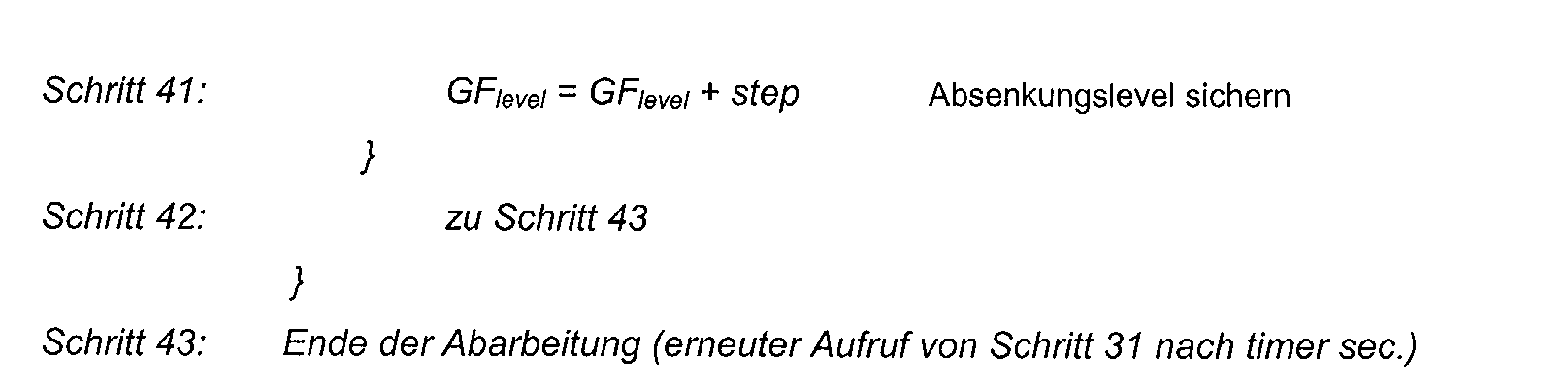
- step 34 it is checked whether there has been (slight) activity in the last 3 minutes recorded and the fundamental frequency has not yet been raised completely. If if it is, the flow proceeds to step 39, otherwise it proceeds the flow continues to step 43.
- step 39 it is checked whether the fundamental frequency GF is still below the upper limit value GF OG . If so, the flow proceeds to step 40; otherwise, the flow proceeds to step 43.
- step 40 the basic frequency GF is increased further by the change value step (in total by 10 ppm) and the flow proceeds to step 41, where the reduction level is secured. The flow then proceeds to step 42 where the flow is directed to step 43.
- step 43 After the set time (timer) has elapsed the process started again in step 31.
- This algorithm is gem. the value of the variable timer e.g. every 60 seconds repeated.
- FIG. 6 is a graph of a patient's heart rate with a rate adaptive Pacemaker according to the third embodiment of Figure 4, shown over time. A decrease in the fundamental frequency during a rest of the patient and the increase in the basic frequency at the end the break can be clearly seen in this graph.
- FIG. 7 shows a rate-adaptive pacemaker according to a fourth exemplary embodiment shown the invention.
- the structure of the pacemaker corresponds essentially to the structure of the pacemaker according to the first embodiment of the invention from FIG. 1.
- an activity detection unit 21 which is connected to the stimulation control unit 3.
- the acquisition unit 1 acquires the EKG signals of the heart 100 using the Electrodes 7 and 8 and passes these signals to the event determination unit 2 further.
- the event determination unit 2 receives the ECG signals of the heart output by the detection unit 1 and signals output by the stimulation control unit 3, which indicate whether stimulation has taken place. Based on this received The event determination unit 2 determines whether there is a signal detected event is a spontaneous event or a stimulated event is. The result of this determination is sent to the stimulation control unit 3 forwarded.
- the stimulation control unit selects on the basis of this result 3 mode 1 stored in memory 5 or in Memory 6 saved mode 2 off.
- the rate-adaptive pacemaker according to the fourth embodiment corresponds essentially to a combination of the characteristics of the pacemaker according to the first embodiment and a pacemaker according to the third embodiment of the invention.
- the essential The difference is that the level of the fundamental frequency is dependent is varied by the activity of the patient.
- the fundamental frequency GF is as close as possible to the natural frequency of the Patient kept.
- the HSM does not intervene by default, it does however, compensatory pauses after VES by an HSM stimulus interrupted.
- the minimum becomes during breaks Basic frequency (lower limit) gradually by a total of 10 ppm lowered.
- the minimum Basic frequency quickly raised again.
- Suitable patients are preferably patients with a pacemaker in the DDD or AAI mode and with frequent ventricular and supraventricular Extrasystoles (e.g. in sick sinus syndrome, AV blockages or HOCM)
- Unsuitable patients are patients with a higher basic frequency, e.g. after AV node ablation, patients with severe heart failure without thigh block, patients in whom a high proportion of stimulation is desired, e.g. for torsades, patients with an HSM in the VDD and VVI mode, since it is asynchronous when the atrial rhythm is maintained Ventricular stimulation comes, and patients with carotid sinus syndrome (not sufficient increase in frequency during episode)
- Tracking the basic frequency to the current intrinsic heart rate is intended to reduce the compensatory breaks without the disrupt intrinsic heart rate history. This is particularly so with patients interesting, where a low fundamental frequency was programmed and this can result in long compensatory breaks without that the pacemaker can intervene.
- the basic frequency is tracked so that it is as close as possible the intrinsic heart rate. Overall - except in the compensatory breaks after extrasystoles - stimulated as little as possible become.
- the basic frequency is always within the defined limits, ie basic frequency OG as the minimum permitted value for the basic frequency GF OG and basic frequency UG + 10 ppm (when active) or basic frequency UG (when at rest).
- the lower one becomes Limit gradually lowered by a total of 10ppm so that the fundamental frequency can also be lowered further. Will be within a short Period of activity measured, the lower limit is gradually again raised to its old value, which also causes the tracked fundamental frequency can no longer accept these low values.
- Step Duration for lowering by a total of 10ppm Duration for raising by a total of 10ppm 1 20 min (10min + 10 min) 11 min (1 min + 10 min) 2 15 min (10min + 5 min) 6 min (1 min + 5 min) 5 12 min (10min + 2 min) 3 min (1 min + 2 min)
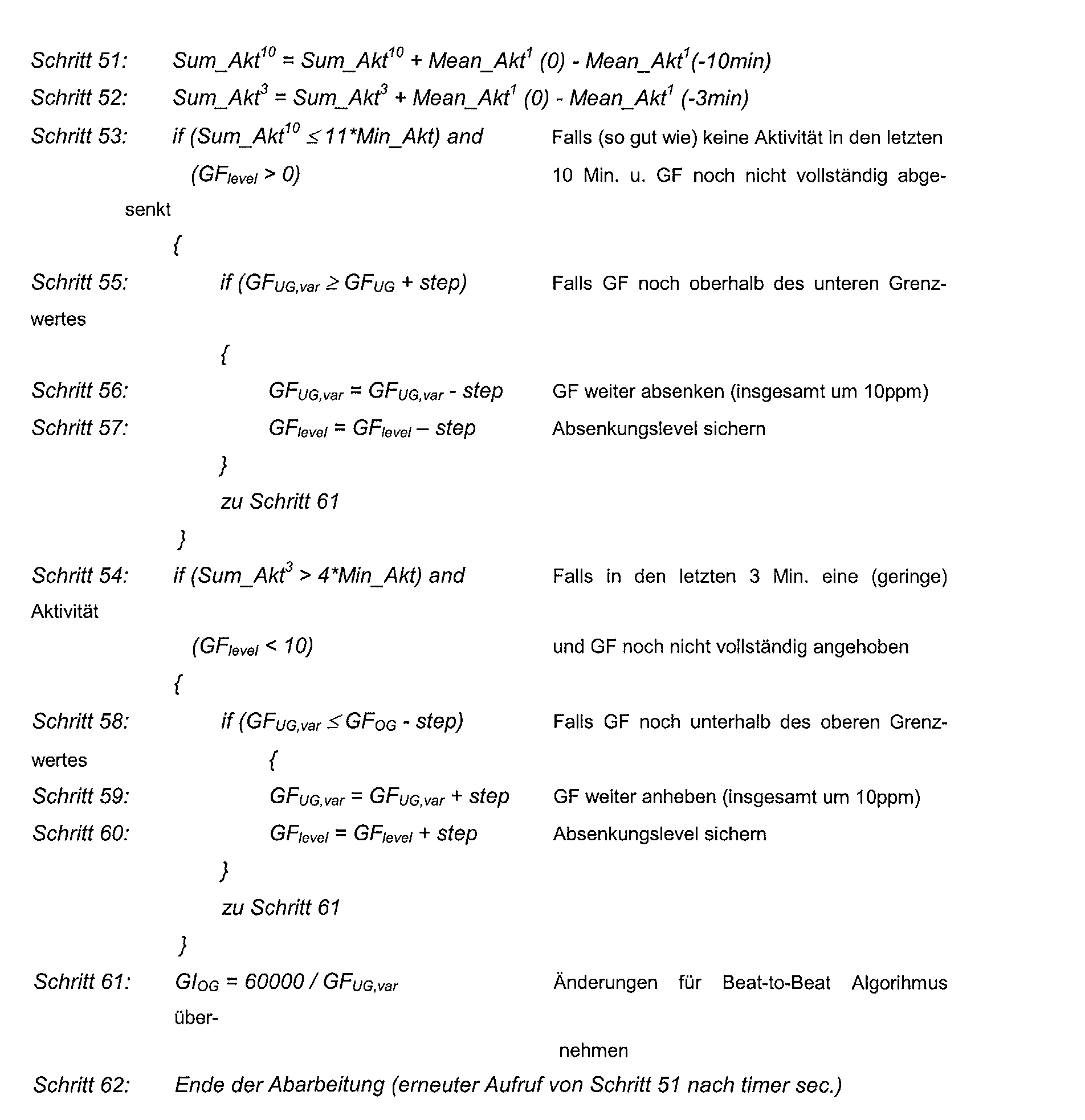
- Akt Current degree of activity (value of activity detection unit 21) at time t Mean_act n (t) Average of the degree of activity of the last n minutes at time t Min_Akt Minimum degree of activity (min. Value of activity detection unit 21) Max_Akt Maximum degree of activity (max. Value of activity detection unit 21) Sum_Akt n Sum of the activity values of the last n minutes
- step 55 it is checked whether the fundamental frequency GF is still above the lower limit. If not, the flow continues to step 54. Otherwise, the flow proceeds to step 56.
- step 56 the fundamental frequency GF is further reduced by the change value step (a total of 10ppm) and the flow proceeds to step 57.
- Step 57 saves the subsidence level and the flow continues Step 61 further.
- step 54 it is checked whether there has been (slight) activity in the last 3 minutes recorded and the fundamental frequency GF has not yet been raised completely. If so, the flow proceeds to step 58, otherwise the flow proceeds to step 61.
- step 58 it is checked whether the fundamental frequency GF is still below the upper limit value GF OG . If so, the flow advances to step 59, otherwise the flow advances to step 61.
- step 59 the fundamental frequency GF is further increased by the change value step (in total by 10 ppm) and the flow proceeds to step 60, where the reduction level is secured. The flow then proceeds to step 61.
- step 61 the change in the upper limit of the basic interval GI OG is adopted for the beat-to-beat algorithm.
- step 62 After a specified time (timer) the process is started again in step 51.
- This algorithm is implemented according to the value of the variable timer e.g. every 60 seconds repeated.
- 9 shows the frequency curve of a heart over time for a pacemaker according to the fourth exemplary embodiment.
- the course of the heart rate without rate adaptation of the basic frequency is shown by dots and the course of the rate-adapted basic frequency GF is shown as a solid line.
- 9 also shows the upper and lower fundamental frequencies GF UG , GF OG and the variable lower fundamental frequency GF UG, var . It is particularly noteworthy how the variable lower fundamental frequency GF UG, var is reduced as time progresses and there is no activity.
Landscapes
- Health & Medical Sciences (AREA)
- Heart & Thoracic Surgery (AREA)
- Life Sciences & Earth Sciences (AREA)
- Cardiology (AREA)
- Nuclear Medicine, Radiotherapy & Molecular Imaging (AREA)
- Physiology (AREA)
- Engineering & Computer Science (AREA)
- Biomedical Technology (AREA)
- Biophysics (AREA)
- Radiology & Medical Imaging (AREA)
- Animal Behavior & Ethology (AREA)
- General Health & Medical Sciences (AREA)
- Public Health (AREA)
- Veterinary Medicine (AREA)
- Electrotherapy Devices (AREA)
- Peptides Or Proteins (AREA)
Abstract
Description
- Fig. 1
- ein Blockschaltbild eines ratenadaptiven Herzschrittmacher gemäß einem ersten und einem zweiten Ausführungsbeispiel,
- Fig. 2
- einen Graph der Herzfrequenz eines Patienten, mit einem ratenadaptiven Herzschrittmacher gemäß einem ersten Ausführungsbeispiel von Figur 1, über die Zeit,
- Fig. 3
- einen Graph der Herzfrequenz eines Patienten, mit einem ratenadaptiven Herzschrittmacher gemäß einem zweiten Ausführungsbeispiel von Figur 1, über die Zeit,
- Fig. 4
- ein Blockschaltbild eines ratenadaptiven Herzschrittmacher gemäß einem dritten Ausführungsbeispiel,
- Fig. 5
- ein Flussdiagramm zur Steuerung des ratenadaptiven Herzschrittmachers gemäß dem dritten Ausführungsbeispiel in Fig. 4,
- Fig. 6
- einen Graph der Herzfrequenz eines Patienten, mit einem ratenadaptiven Herzschrittmacher gemäß dem dritten Ausführungsbeispiel von Figur 4, über die Zeit,
- Fig. 7
- ein Blockschaltbild eines ratenadaptiven Herzschrittmacher gemäß einem vierten Ausführungsbeispiel,
- Fig. 8
- ein Flussdiagramm zur Steuerung des ratenadaptiven Herzschrittmachers gemäß dem vierten Ausführungsbeispiel in Fig. 6, und
- Fig. 9
- einen Graph der Herzfrequenz eines Patienten, mit einem ratenadaptiven Herzschrittmacher gemäß einem vierten Ausführungsbeispiel von Figur 7, über die Zeit.
| Folgende Eingangswerte müssen von einem Arzt vorgeben werden: | |
| GFUG | Minimal erlaubter Wert für die Grundfrequenz (untere Grenze) |
| GFOG | Maximal erlaubter Wert für die Grundfrequenz (obere Grenze) |
| delta_ap | Änderungswert nach Ap-Event (einem atrialen Pacing- bzw. Stimulations-Ereignis) |
| delta_as | Änderungswert nach As-Event (einem atrialen spontanen Ereignis) |
| delta_ves | Änderungswert nach VES-Event |
| Hilfswerte (interne Variablen): | |
| GIUG | Minimal erlaubter Wert für das Grundintervall (untere Grenze) |
| GIOG | Maximal erlaubter Wert für das Grundintervall (obere Grenze) |
| GI | Grundintervall |
| ASI | Letztes atriales Spontanintervall (intrinsisch und/oder stimuliert) |
| V_VES_I | Intervall zwischen letztem ventr. Ereignis (intr. oder stimuliert) und detektierter VES |
| AV-Delay | Herzschrittmacher-Parameter |
| GFUG | Minimal erlaubter Wert für die Grundfrequenz (untere Grenze) |
| GFOG | Maximal erlaubter Wert für die Grundfrequenz (obere Grenze) |
| delta_vp | Änderungswert nach Vp-Event (z.B. 1 ppm) |
| delta_vs | Änderungswert nach Vs-Event |
| n_limit | Obere Grenze für internen Zähler (z.B. 10) |
| n_reinit | Re-Initialisierung des internen Zählers (z.B. 7) |
| Parameter: | |
| GF | Grundfrequenz |
| Hilfswerte (interne Variablen): | |
| n | Zähler |
| Zur Initialisierungen wird: | |
| n | = 0 gesetzt. |


| GFUG | Minimal erlaubter Wert für die Grundfrequenz (untere Grenze) |
| GFOG | Maximal erlaubter Wert für die Grundfrequenz (obere Grenze) |
| timer | Wiederholungswert des Algorithmus (Zeitdauer in Sekunden) |
| step | Änderungswert (1, 2 oder 5). |
| step | Zeitdauer für Absenkung um insgesamt 10ppm | Zeitdauer für Anhebung um insgesamt 10ppm |
| 1 | 20 min (10min + 10 min) | 11 min (1 min + 10 min) |
| 2 | 15 min (10min + 5 min) | 6 min (1 min + 5 min) |
| 5 | 12 min (10min + 2 min) | 3 min (1 min + 2 min) |
| Parameter: | |
| GF | Grundfrequenz |
| Hilfswerte (interne Variablen): | |
| GFlevel | "Level" der Grundfrequenz (aktueller Zustand) |
| Akt(t) | Aktueller Aktivitätsgrad (Wert von Aktivitäts-Erfassungseinheit 21) zum Zeitpunkt t |
| Mean_Aktn(t) | Mittelwert des Aktivitätsgrades der letzten n Minuten zum Zeitpunkt t |
| Min_Akt | Minimaler Aktivitätsgrad (min. Wert von Aktivitäts-Erfassungseinheit 21) |
| Max_Akt | Maximaler Aktivitätsgrad (max. Wert von Aktivitäts-Erfassungseinheit 21) |
| Sum_Aktn | Summe der Aktivitätswerte der letzten n Minuten |
| Initialisierungen: | |
| GFlevel = 10 |
| GFOG | Minimal erlaubter Wert für die Grundfrequenz (obere Grenze) |
| GFUG | Minimal erlaubter Wert für die Grundfrequenz (untere Grenze) |
| delta_ap | Änderungswert nach Ap-Event |
| delta_as | Änderungswert nach As-Event |
| delta_ves | Änderungswert nach VES-Event |
| timer | Wiederholung des Algorithmus (Zeitdauer in Sekunden) |
| step | Änderungswert (1, 2 oder 5). |
| Step | Zeitdauer für Absenkung um insgesamt 10ppm | Zeitdauer für Anhebung um insgesamt 10ppm |
| 1 | 20 min (10min + 10 min) | 11 min (1 min + 10 min) |
| 2 | 15 min (10min + 5 min) | 6 min (1 min + 5 min) |
| 5 | 12 min (10min + 2 min) | 3 min (1 min + 2 min) |
| Parameter: | |
| GF | Grundfrequenz |
| Hilfswerte (interne Variablen): | |
| GI | Grundintervall |
| GIUG | Minimal erlaubter Wert für das Grundintervall (untere Grenze) |
| GIOG | Maximal erlaubter Wert für das Grundintervall (obere Grenze) |
| ASI | letztes atriales Spontanintervall (intrinsisch und/oder stimuliert) |
| V_VES_I VES | Intervall zw. letztem ventr. Ereignis (intr. Oder stim.) und detektierter |
| AV-Delay | HSM-Parameter |
| GFUG,var | Minimal erlaubter Wert für die Grundfrequenz (untere Grenze bei Aktivität) |
| GFlevel | "Level" der Grundfrequenz (aktueller Zustand) |
| Akt(t) | Aktueller Aktivitätsgrad (Wert von Aktivitäts-Erfassungseinheit 21) zum Zeitpunkt t |
| Mean_Aktn(t) | Mittelwert des Aktivitätsgrades der letzten n Minuten zum Zeitpunkt t |
| Min_Akt | Minimaler Aktivitätsgrad (min. Wert von Aktivitäts-Erfassungseinheit 21) |
| Max_Akt | Maximaler Aktivitätsgrad (max. Wert von Aktivitäts-Erfassungseinheit 21) |
| Sum_Aktn | Summe der Aktivitätswerte der letzten n Minuten |
Claims (6)
- Ratenadaptiver Herzschrittmacher, mitwobei die Ereignis-Bestimmungseinheit (2) mit der Erfassungseinheit (1) und Stimulations-Steuereinheit (3) verbunden sowie die Stimulationseinheit (11) mit der Stimulations-Steuereinheit (3) verbunden ist, wobei die Erfassungseinheit (1) dazu ausgebildet ist, EKG-Signale eines Herzens (100) zu erfassen, wobei die Ereignis-Bestimmungseinheit (2) dazu ausgebildet ist, anhand der von der Erfassungseinheit (1) erfassten EKG-Signale und von der Stimulations-Steuereinheit (3) ausgesendeten Signalen zu bestimmen, ob ein erfasstes Ereignis ein spontanes oder ein stimuliertes Ereignis darstellt, und wobei die Stimulations-Steuereinheit (3) dazu ausgestaltet ist, eine Stimulationsrate in Abhängigkeit von einer Grundrate und einem physiologischen Bedarf zu bestimmen und die Grundrate bei jedem erfassten natürlichen oder stimulierten Ereignis in Abhängigkeit von der Ereignis-Bestimmungseinheit (2) in einem ersten Modus bei Auftreten von atrialen Ereignissen derart zu verändern, dass im Falle eines spontanen atrialen Ereignisses ein Spontanintervall um einen ersten Änderungswert verlängert wird und dass im Falle eines stimulierten atrialen Ereignisses ein Grundintervall um einen zweiten Änderungswert verlängert wird, wodurch in beiden Fällen die Grundrate gesenkt wird, sowie alternativ oder zusätzlich in einem zweiten Modus bei Auftreten von ventrikulären Ereignissen derart zu verändern, dass im Falle eines spontanen ventrikulären Ereignisses die Grundrate um einen dritten Änderungswert erhöht wird und im Falle eines stimulierten ventrikulären Ereignisses die Grundrate um einen vierten Änderungswert, der kleiner ist als der dritte Änderungswert, gesenkt wird, wobei die Stimulationseinheit (11) dazu ausgestaltet ist, das Herz (100) entsprechend der von der Stimulations-Steuereinheit (3) empfangenen Signalen zu stimulieren.einer Erfassungseinheit (1),einer Ereignis-Bestimmungseinheit (2),einer Stimulations-Steuereinheit (3) undeiner Stimulationseinheit (11),
- Ratenadaptiver Herzschrittmacher nach Anspruch 1, bei dem in dem ersten Modus bei Auftreten von ventrikulären Ereignissen die Grundrate derart verändert wird, dass bei Auftreten einer ventrikulären Extrasystole (VES) ein Grundintervall um einen dritten Änderungswert (delta_ves) verlängert wird, wodurch die Grundrate im Falle ventrikulärer Extrasystolen gesenkt wird.
- Ratenadaptiver Herzschrittmacher nach Anspruch 1 oder 2, wobei die Stimulations-Steuereinheit (3) dazu ausgestaltet ist, die Grundrate des Herzens (100) innerhalb vorgegebener Grenzen zu bestimmen.
- Ratenadaptiver Herzschrittmacher nach Anspruch 1, wobei die Stimulations-Steuereinheit (3) dazu ausgestaltet ist, die Stimulationseinheit (11) in Abhängigkeit von jedem atrialen oder ventrikulären Ereignis zu steuern.
- Ratenadaptiver Herzschrittmacher, mit einer Aktivität-Erfassungseinheit (21), welche dazu ausgestaltet ist, die Aktivität eines Patienten zu erfassen und ein entsprechendes Aktivitätssignal auszugeben, und einer Stimulations-Steuereinheit (22), welche mit der Aktivitäts-Erfassungseinheit (21) verbunden und dazu ausgestaltet ist, eine Grundrate eines Patienten entsprechend einer ersten oder einer zweiten Betriebsart derart ratenadaptiv zu bestimmen, dass die Grundrate des Herzens (100) entsprechend der ersten Betriebsart in einem vorgegebenen ersten Schrittintervall (N1) abgesenkt wird, wenn innerhalb eines vorgegebenen ersten Zeitintervalls (T1) das Aktivitätssignal eine minimale Aktivität des Patienten anzeigt, und die Grundrate des Herzens (100) entsprechend der zweiten Betriebsart in einem vorgegebenen zweiten Schrittintervall (N2) erhöht wird, wenn innerhalb eines vorgegebenen zweiten Zeitintervalls (T2) das Aktivitätssignal eine Aktivität des Patienten anzeigt, und einer Stimulationseinheit (23), welche mit der Stimulations-Steuereinheit (22) verbunden ist und dazu ausgestaltet ist, das Herz (100) in Abhängigkeit von dem Ausgangssignal der Stimulations-Steuereinheit (22) zu stimulieren, wobei das erste Zeitintervall (T1) länger als das zweite Zeitintervall (T2) ist, wobei das erste Schrittintervall (N1) gleich dem zweiten Schrittintervall (N2) ist.
- Ratenadaptiver Herzschrittmacher nach Anspruch 1, mit einer Aktivitäts-Erfassungseinheit (21), welche dazu ausgestaltet ist, die Aktivität eines Patienten zu erfassen und ein entsprechendes Aktivitätssignal auszugeben, wobei die Stimulations-Steuereinheit (4) mit der Aktivitäts-Erfassungsein-heit (21) verbunden und dazu ausgebildet ist, eine Grundrate eines Patienten entsprechend einer ersten oder einer zweiten Betriebsart derart ratenadaptiv zu bestimmen, dass die Grundrate des Herzens (100) entsprechend der ersten Betriebsart in einem vorgegebenen ersten Schrittintervall (N1) abgesenkt wird, wenn innerhalb eines vorgegebenen ersten Zeitintervalls (T1) das Aktivitätssignal keine Aktivität des Patienten anzeigt, und die Grundrate des Herzens (100) entsprechend der zweiten Betriebsart in einem vorgegebenen zweiten Schrittintervall (N2) erhöht wird, wenn innerhalb eines vorgegebenen zweiten Zeitintervalls (T2) das Aktivitätssignal eine Aktivität des Patienten anzeigt, wobei das erste Zeitintervall (T1) länger als das zweite Zeitintervall (T2) ist, wobei das erste Schrittintervall (N1) gleich dem zweiten Schrittintervall (N2) ist.
Applications Claiming Priority (2)
| Application Number | Priority Date | Filing Date | Title |
|---|---|---|---|
| DE10144442A DE10144442A1 (de) | 2001-09-06 | 2001-09-06 | Ratenadaptiver Herzschrittmacher |
| DE10144442 | 2001-09-06 |
Publications (3)
| Publication Number | Publication Date |
|---|---|
| EP1291037A2 true EP1291037A2 (de) | 2003-03-12 |
| EP1291037A3 EP1291037A3 (de) | 2004-02-04 |
| EP1291037B1 EP1291037B1 (de) | 2006-06-21 |
Family
ID=7698441
Family Applications (1)
| Application Number | Title | Priority Date | Filing Date |
|---|---|---|---|
| EP02090320A Expired - Lifetime EP1291037B1 (de) | 2001-09-06 | 2002-09-05 | Ratenadaptiver Herzschrittmacher |
Country Status (4)
| Country | Link |
|---|---|
| US (1) | US7065404B2 (de) |
| EP (1) | EP1291037B1 (de) |
| AT (1) | ATE330666T1 (de) |
| DE (2) | DE10144442A1 (de) |
Families Citing this family (1)
| Publication number | Priority date | Publication date | Assignee | Title |
|---|---|---|---|---|
| CN106110502B (zh) * | 2016-06-07 | 2018-08-24 | 创领心律管理医疗器械(上海)有限公司 | Pr间期驱动频率应答的医疗设备 |
Citations (3)
| Publication number | Priority date | Publication date | Assignee | Title |
|---|---|---|---|---|
| EP0449401A2 (de) | 1990-03-08 | 1991-10-02 | Cardiac Pacemakers, Inc. | Änderungen des Herzkammervolumens oder -drucks als Steuerparameter |
| DE19747820A1 (de) | 1997-10-23 | 1999-04-29 | Biotronik Mess & Therapieg | Ratenadaptiver Herzschrittmacher |
| DE19940952A1 (de) | 1999-08-20 | 2001-02-22 | Biotronik Mess & Therapieg | Ratenadaptiver Herzschrittmacher |
Family Cites Families (19)
| Publication number | Priority date | Publication date | Assignee | Title |
|---|---|---|---|---|
| DE3175940D1 (en) * | 1981-10-26 | 1987-04-09 | Vitafin Nv | Programmable cardiac pacemaker |
| US4856524A (en) * | 1988-08-29 | 1989-08-15 | Intermedics, Inc. | A-V responsive rate adaptive pacemaker |
| US4941471A (en) * | 1988-09-07 | 1990-07-17 | Medtronic, Inc. | Rate stabilization pacemaker |
| US5085215A (en) | 1990-03-20 | 1992-02-04 | Telectronics Pacing Systems, Inc. | Metabolic demand driven rate-responsive pacemaker |
| US5144949A (en) | 1991-03-15 | 1992-09-08 | Medtronic, Inc. | Dual chamber rate responsive pacemaker with automatic mode switching |
| FR2685641B1 (fr) * | 1991-12-31 | 1998-04-10 | Ela Medical Sa | Procede de commande d'un stimulateur cardiaque en cas d'extra-systole ventriculaire. |
| US5417714A (en) * | 1992-03-05 | 1995-05-23 | Pacesetter, Inc. | DDI pacing with PVC-protected hysteresis and automatic AV interval adjustment |
| US5237992A (en) * | 1992-03-05 | 1993-08-24 | Siemens Pacesetter, Inc. | Implantable pacemaker providing hysteresis in dual-chamber modes |
| US5292340A (en) | 1993-01-04 | 1994-03-08 | Telectronics Pacing Systems, Inc. | Physiologically-calibrated rate adaptive, dual chamber pacemaker |
| US5374281A (en) * | 1993-02-09 | 1994-12-20 | Siemens Pacesetter, Inc. | Hysteresis in a rate-responsive pacemaker |
| FR2717397B1 (fr) * | 1994-03-16 | 1996-06-14 | Ela Medical Sa | Procédé de commande de la fréquence de base d'un stimulateur cardiaque. |
| US5507782A (en) * | 1994-03-17 | 1996-04-16 | Medtronic, Inc. | Method and apparatus for dual chamber cardiac pacing |
| US5514164A (en) | 1994-03-25 | 1996-05-07 | Pacesetter, Inc. | DDD pacing response to atrial tachyucardia and retrograde conduction |
| US5713929A (en) * | 1996-05-03 | 1998-02-03 | Medtronic, Inc. | Arrhythmia and fibrillation prevention pacemaker using ratchet up and decay modes of operation |
| US5792192A (en) | 1997-04-19 | 1998-08-11 | Lu; Richard | Pacemaker with automatic mode switching using detection of hidden intrinsic cardiac pulses |
| FR2763247B1 (fr) * | 1997-05-16 | 2000-02-18 | Ela Medical Sa | Dispositif medical implantable actif, notamment stimulateur cardiaque, defibrillateur et/ou cardioverteur a reduction des episodes d'arythmie, notamment d'arythmie auriculaire |
| DE10029677B4 (de) * | 1999-06-25 | 2008-04-30 | Martin Dr. Hexamer | Herzschrittmacher mit Regelung zur belastungsabhängigen Steuerung der atrialen Stimulationsfrequenz |
| FR2796292B1 (fr) * | 1999-07-15 | 2001-09-21 | Ela Medical Sa | Dispositif medical actif implantable, notamment stimulateur cardiaque, defibrillateur ou cardioverteur, asservi et protege contre les effets des extrasystolies brady et/ou tachy-dependantes |
| SE9902735D0 (sv) | 1999-07-19 | 1999-07-19 | Pacesetter Ab | Pacemaker |
-
2001
- 2001-09-06 DE DE10144442A patent/DE10144442A1/de not_active Withdrawn
-
2002
- 2002-09-03 US US10/234,023 patent/US7065404B2/en not_active Expired - Fee Related
- 2002-09-05 AT AT02090320T patent/ATE330666T1/de not_active IP Right Cessation
- 2002-09-05 DE DE50207260T patent/DE50207260D1/de not_active Expired - Lifetime
- 2002-09-05 EP EP02090320A patent/EP1291037B1/de not_active Expired - Lifetime
Patent Citations (3)
| Publication number | Priority date | Publication date | Assignee | Title |
|---|---|---|---|---|
| EP0449401A2 (de) | 1990-03-08 | 1991-10-02 | Cardiac Pacemakers, Inc. | Änderungen des Herzkammervolumens oder -drucks als Steuerparameter |
| DE19747820A1 (de) | 1997-10-23 | 1999-04-29 | Biotronik Mess & Therapieg | Ratenadaptiver Herzschrittmacher |
| DE19940952A1 (de) | 1999-08-20 | 2001-02-22 | Biotronik Mess & Therapieg | Ratenadaptiver Herzschrittmacher |
Also Published As
| Publication number | Publication date |
|---|---|
| ATE330666T1 (de) | 2006-07-15 |
| DE50207260D1 (de) | 2006-08-03 |
| US7065404B2 (en) | 2006-06-20 |
| DE10144442A1 (de) | 2003-03-27 |
| EP1291037A3 (de) | 2004-02-04 |
| EP1291037B1 (de) | 2006-06-21 |
| US20030105498A1 (en) | 2003-06-05 |
Similar Documents
| Publication | Publication Date | Title |
|---|---|---|
| DE68927447T2 (de) | Frequenz-empfindlicher Herzschrittmacher | |
| DE69633957T2 (de) | Implantierbares Gerät zur Antitachykardierierung | |
| DE60316036T2 (de) | Herzschrittmacher, der vorhofarrhythmie durch bestimmung der wanddehnung mittels impedanzmessung feststellt | |
| DE60106645T2 (de) | Apparat zur messung des mittleren blutdruckes in der lungenarterie von der herzkammer aus mit einem mobilen überwachungsgerät | |
| DE69307510T2 (de) | Vorrichtung zur behandlung von angina pectoris | |
| DE69323543T2 (de) | Vorrichtung zum Steuern und Überwachen des Herzrhythmus mit der "aktiven Zeit" als Steuerparameter | |
| DE69431044T2 (de) | Ableitung von hämodynamischen signalen von einem herzwand-bewegungssensor | |
| DE69213657T2 (de) | Implantierbares Gerät zur Überwachung und Stimulation des Herzens für Diagnose und Therapie | |
| DE60313297T2 (de) | Gerät zum nachweis und zur behandlung von synkope | |
| DE69226547T2 (de) | Gerät zur Dauerüberwachung des hämodynamischen Zustandes eines Patienten bei Verwendung von Doppler-Ultraschall | |
| DE602005001342T2 (de) | System zur elektrischen Therapie während Hyperventilationsphasen einer periodischen Atmung unter Verwendung einer implantierbaren medizinischen Einrichtung | |
| DE69123558T2 (de) | Implantierbarer, auf hämodynamische Grössen ansprechender Herzschrittmacher zur Herzrhythmuskorrektur bzw. Defibrillation | |
| DE3856192T2 (de) | Ratenadaptierender Herzschrittmacher | |
| DE60019710T2 (de) | Verfahren und Vorrichtung zur Schnellgangsreizung eines Herzgewebe unter Verwendung einer implantierbaren Herzstimulationseinrichtung | |
| DE3686713T3 (de) | System zur taktabhängigen Herzstimulierung. | |
| DE60222071T2 (de) | Implantierbares Herzschrittmachersystem mit Kalibrierung für automatische Erregungsbestätigung | |
| DE60314482T2 (de) | Hämodynamikanalyse, insbesondere in einem Herzschrittmacher | |
| DE69600596T2 (de) | Zweikammer-schrittmacher-anordnung zur kontinuierlichen regelung des av zeitintervalles mit dem ziel, optimierte stimulierung zur behandlung von kardiomyopathien zu erreichen | |
| DE69307509T2 (de) | Vorrichtung zur behandlung von herzfehlern | |
| DE69832639T2 (de) | Implantierbares Herzschrittmachersystem | |
| EP1106206B1 (de) | Gerät zur Regelung der Herzfrequenz und der Herzpumpkraft | |
| DE69625925T2 (de) | Vorrichtung zur hämodynamischen stimulation bei einer ventrikulären tachykardie | |
| DE60301161T2 (de) | Vorrichtung zur Überwachung des Herzens und ein System beinhaltend eine solche Vorrichtung | |
| DE69600595T2 (de) | Zweikammer-herzschrittmacher-system mit optimierter verstellung der av-verzögerung zur behandlung von kardiomyopathien | |
| EP0255899B1 (de) | Frequenzadaptierender Herzschrittmacher |
Legal Events
| Date | Code | Title | Description |
|---|---|---|---|
| PUAI | Public reference made under article 153(3) epc to a published international application that has entered the european phase |
Free format text: ORIGINAL CODE: 0009012 |
|
| AK | Designated contracting states |
Kind code of ref document: A2 Designated state(s): AT BE BG CH CY CZ DE DK EE ES FI FR GB GR IE IT LI LU MC NL PT SE SK TR |
|
| AX | Request for extension of the european patent |
Extension state: AL LT LV MK RO SI |
|
| PUAL | Search report despatched |
Free format text: ORIGINAL CODE: 0009013 |
|
| AK | Designated contracting states |
Kind code of ref document: A3 Designated state(s): AT BE BG CH CY CZ DE DK EE ES FI FR GB GR IE IT LI LU MC NL PT SE SK TR |
|
| AX | Request for extension of the european patent |
Extension state: AL LT LV MK RO SI |
|
| RIC1 | Information provided on ipc code assigned before grant |
Ipc: 7A 61N 1/365 B Ipc: 7A 61N 1/368 A Ipc: 7A 61N 1/37 B Ipc: 7A 61N 1/362 B Ipc: 7A 61B 5/0468 B Ipc: 7A 61B 5/0432 B |
|
| 17P | Request for examination filed |
Effective date: 20040804 |
|
| AKX | Designation fees paid |
Designated state(s): AT BE BG CH CY CZ DE DK EE ES FI FR GB GR IE IT LI LU MC NL PT SE SK TR |
|
| 17Q | First examination report despatched |
Effective date: 20050627 |
|
| GRAP | Despatch of communication of intention to grant a patent |
Free format text: ORIGINAL CODE: EPIDOSNIGR1 |
|
| RAP1 | Party data changed (applicant data changed or rights of an application transferred) |
Owner name: BIOTRONIK GMBH & CO. KG |
|
| GRAS | Grant fee paid |
Free format text: ORIGINAL CODE: EPIDOSNIGR3 |
|
| GRAA | (expected) grant |
Free format text: ORIGINAL CODE: 0009210 |
|
| AK | Designated contracting states |
Kind code of ref document: B1 Designated state(s): AT BE BG CH CY CZ DE DK EE ES FI FR GB GR IE IT LI LU MC NL PT SE SK TR |
|
| PG25 | Lapsed in a contracting state [announced via postgrant information from national office to epo] |
Ref country code: FI Free format text: LAPSE BECAUSE OF FAILURE TO SUBMIT A TRANSLATION OF THE DESCRIPTION OR TO PAY THE FEE WITHIN THE PRESCRIBED TIME-LIMIT Effective date: 20060621 Ref country code: CZ Free format text: LAPSE BECAUSE OF FAILURE TO SUBMIT A TRANSLATION OF THE DESCRIPTION OR TO PAY THE FEE WITHIN THE PRESCRIBED TIME-LIMIT Effective date: 20060621 Ref country code: SK Free format text: LAPSE BECAUSE OF FAILURE TO SUBMIT A TRANSLATION OF THE DESCRIPTION OR TO PAY THE FEE WITHIN THE PRESCRIBED TIME-LIMIT Effective date: 20060621 Ref country code: IE Free format text: LAPSE BECAUSE OF FAILURE TO SUBMIT A TRANSLATION OF THE DESCRIPTION OR TO PAY THE FEE WITHIN THE PRESCRIBED TIME-LIMIT Effective date: 20060621 |
|
| REG | Reference to a national code |
Ref country code: GB Ref legal event code: FG4D Free format text: NOT ENGLISH |
|
| REG | Reference to a national code |
Ref country code: CH Ref legal event code: EP |
|
| REG | Reference to a national code |
Ref country code: IE Ref legal event code: FG4D Free format text: LANGUAGE OF EP DOCUMENT: GERMAN |
|
| REF | Corresponds to: |
Ref document number: 50207260 Country of ref document: DE Date of ref document: 20060803 Kind code of ref document: P |
|
| REG | Reference to a national code |
Ref country code: SE Ref legal event code: TRGR |
|
| GBT | Gb: translation of ep patent filed (gb section 77(6)(a)/1977) |
Effective date: 20060824 |
|
| PG25 | Lapsed in a contracting state [announced via postgrant information from national office to epo] |
Ref country code: DK Free format text: LAPSE BECAUSE OF FAILURE TO SUBMIT A TRANSLATION OF THE DESCRIPTION OR TO PAY THE FEE WITHIN THE PRESCRIBED TIME-LIMIT Effective date: 20060921 |
|
| PG25 | Lapsed in a contracting state [announced via postgrant information from national office to epo] |
Ref country code: MC Free format text: LAPSE BECAUSE OF NON-PAYMENT OF DUE FEES Effective date: 20060930 Ref country code: BE Free format text: LAPSE BECAUSE OF NON-PAYMENT OF DUE FEES Effective date: 20060930 |
|
| PG25 | Lapsed in a contracting state [announced via postgrant information from national office to epo] |
Ref country code: ES Free format text: LAPSE BECAUSE OF FAILURE TO SUBMIT A TRANSLATION OF THE DESCRIPTION OR TO PAY THE FEE WITHIN THE PRESCRIBED TIME-LIMIT Effective date: 20061002 |
|
| PG25 | Lapsed in a contracting state [announced via postgrant information from national office to epo] |
Ref country code: PT Free format text: LAPSE BECAUSE OF FAILURE TO SUBMIT A TRANSLATION OF THE DESCRIPTION OR TO PAY THE FEE WITHIN THE PRESCRIBED TIME-LIMIT Effective date: 20061121 |
|
| ET | Fr: translation filed | ||
| REG | Reference to a national code |
Ref country code: IE Ref legal event code: FD4D |
|
| PLBE | No opposition filed within time limit |
Free format text: ORIGINAL CODE: 0009261 |
|
| STAA | Information on the status of an ep patent application or granted ep patent |
Free format text: STATUS: NO OPPOSITION FILED WITHIN TIME LIMIT |
|
| 26N | No opposition filed |
Effective date: 20070322 |
|
| PG25 | Lapsed in a contracting state [announced via postgrant information from national office to epo] |
Ref country code: AT Free format text: LAPSE BECAUSE OF NON-PAYMENT OF DUE FEES Effective date: 20060905 |
|
| BERE | Be: lapsed |
Owner name: BIOTRONIK G.M.B.H. & CO. KG Effective date: 20060930 |
|
| PG25 | Lapsed in a contracting state [announced via postgrant information from national office to epo] |
Ref country code: GR Free format text: LAPSE BECAUSE OF FAILURE TO SUBMIT A TRANSLATION OF THE DESCRIPTION OR TO PAY THE FEE WITHIN THE PRESCRIBED TIME-LIMIT Effective date: 20060922 |
|
| PG25 | Lapsed in a contracting state [announced via postgrant information from national office to epo] |
Ref country code: BG Free format text: LAPSE BECAUSE OF FAILURE TO SUBMIT A TRANSLATION OF THE DESCRIPTION OR TO PAY THE FEE WITHIN THE PRESCRIBED TIME-LIMIT Effective date: 20060921 Ref country code: EE Free format text: LAPSE BECAUSE OF FAILURE TO SUBMIT A TRANSLATION OF THE DESCRIPTION OR TO PAY THE FEE WITHIN THE PRESCRIBED TIME-LIMIT Effective date: 20060621 |
|
| PG25 | Lapsed in a contracting state [announced via postgrant information from national office to epo] |
Ref country code: LU Free format text: LAPSE BECAUSE OF NON-PAYMENT OF DUE FEES Effective date: 20060905 Ref country code: TR Free format text: LAPSE BECAUSE OF FAILURE TO SUBMIT A TRANSLATION OF THE DESCRIPTION OR TO PAY THE FEE WITHIN THE PRESCRIBED TIME-LIMIT Effective date: 20060621 |
|
| PG25 | Lapsed in a contracting state [announced via postgrant information from national office to epo] |
Ref country code: CY Free format text: LAPSE BECAUSE OF FAILURE TO SUBMIT A TRANSLATION OF THE DESCRIPTION OR TO PAY THE FEE WITHIN THE PRESCRIBED TIME-LIMIT Effective date: 20060621 |
|
| PGFP | Annual fee paid to national office [announced via postgrant information from national office to epo] |
Ref country code: IT Payment date: 20080924 Year of fee payment: 7 Ref country code: NL Payment date: 20080922 Year of fee payment: 7 |
|
| REG | Reference to a national code |
Ref country code: NL Ref legal event code: V1 Effective date: 20100401 |
|
| PG25 | Lapsed in a contracting state [announced via postgrant information from national office to epo] |
Ref country code: NL Free format text: LAPSE BECAUSE OF NON-PAYMENT OF DUE FEES Effective date: 20100401 |
|
| PG25 | Lapsed in a contracting state [announced via postgrant information from national office to epo] |
Ref country code: IT Free format text: LAPSE BECAUSE OF NON-PAYMENT OF DUE FEES Effective date: 20090905 |
|
| REG | Reference to a national code |
Ref country code: DE Ref legal event code: R082 Ref document number: 50207260 Country of ref document: DE Representative=s name: RANDOLL, SOEREN, DIPL.-CHEM. UNIV. DR. RER. NA, DE |
|
| REG | Reference to a national code |
Ref country code: DE Ref legal event code: R081 Ref document number: 50207260 Country of ref document: DE Owner name: BIOTRONIK SE & CO. KG, DE Free format text: FORMER OWNER: BIOTRONIK GMBH & CO. KG, 12359 BERLIN, DE Effective date: 20111219 |
|
| PGFP | Annual fee paid to national office [announced via postgrant information from national office to epo] |
Ref country code: GB Payment date: 20120920 Year of fee payment: 11 Ref country code: SE Payment date: 20120920 Year of fee payment: 11 |
|
| PGFP | Annual fee paid to national office [announced via postgrant information from national office to epo] |
Ref country code: FR Payment date: 20121008 Year of fee payment: 11 |
|
| REG | Reference to a national code |
Ref country code: SE Ref legal event code: EUG |
|
| PG25 | Lapsed in a contracting state [announced via postgrant information from national office to epo] |
Ref country code: SE Free format text: LAPSE BECAUSE OF NON-PAYMENT OF DUE FEES Effective date: 20130906 |
|
| GBPC | Gb: european patent ceased through non-payment of renewal fee |
Effective date: 20130905 |
|
| REG | Reference to a national code |
Ref country code: FR Ref legal event code: ST Effective date: 20140530 |
|
| PG25 | Lapsed in a contracting state [announced via postgrant information from national office to epo] |
Ref country code: GB Free format text: LAPSE BECAUSE OF NON-PAYMENT OF DUE FEES Effective date: 20130905 |
|
| PG25 | Lapsed in a contracting state [announced via postgrant information from national office to epo] |
Ref country code: FR Free format text: LAPSE BECAUSE OF NON-PAYMENT OF DUE FEES Effective date: 20130930 |
|
| PGFP | Annual fee paid to national office [announced via postgrant information from national office to epo] |
Ref country code: CH Payment date: 20160926 Year of fee payment: 15 Ref country code: DE Payment date: 20160923 Year of fee payment: 15 |
|
| REG | Reference to a national code |
Ref country code: DE Ref legal event code: R119 Ref document number: 50207260 Country of ref document: DE |
|
| REG | Reference to a national code |
Ref country code: CH Ref legal event code: PL |
|
| PG25 | Lapsed in a contracting state [announced via postgrant information from national office to epo] |
Ref country code: CH Free format text: LAPSE BECAUSE OF NON-PAYMENT OF DUE FEES Effective date: 20170930 Ref country code: LI Free format text: LAPSE BECAUSE OF NON-PAYMENT OF DUE FEES Effective date: 20170930 Ref country code: DE Free format text: LAPSE BECAUSE OF NON-PAYMENT OF DUE FEES Effective date: 20180404 |