EP1291347A2 - Verfahren zur Herstellung von Bisallylboranen und nicht-aromatischen Boronsäuren - Google Patents
Verfahren zur Herstellung von Bisallylboranen und nicht-aromatischen Boronsäuren Download PDFInfo
- Publication number
- EP1291347A2 EP1291347A2 EP02018873A EP02018873A EP1291347A2 EP 1291347 A2 EP1291347 A2 EP 1291347A2 EP 02018873 A EP02018873 A EP 02018873A EP 02018873 A EP02018873 A EP 02018873A EP 1291347 A2 EP1291347 A2 EP 1291347A2
- Authority
- EP
- European Patent Office
- Prior art keywords
- alkyl
- borane
- formula
- diene
- allyl
- Prior art date
- Legal status (The legal status is an assumption and is not a legal conclusion. Google has not performed a legal analysis and makes no representation as to the accuracy of the status listed.)
- Granted
Links
- -1 aromatic boronic acids Chemical class 0.000 title claims description 7
- 238000004519 manufacturing process Methods 0.000 title abstract description 5
- UORVGPXVDQYIDP-UHFFFAOYSA-N borane Chemical class B UORVGPXVDQYIDP-UHFFFAOYSA-N 0.000 claims abstract description 53
- 229910000085 borane Inorganic materials 0.000 claims abstract description 35
- 150000001993 dienes Chemical class 0.000 claims abstract description 18
- 238000000034 method Methods 0.000 claims abstract description 16
- 125000000217 alkyl group Chemical group 0.000 claims abstract description 14
- 239000007800 oxidant agent Substances 0.000 claims abstract description 12
- 150000001336 alkenes Chemical class 0.000 claims abstract description 10
- 229910000033 sodium borohydride Inorganic materials 0.000 claims abstract description 10
- 239000012279 sodium borohydride Substances 0.000 claims abstract description 10
- 150000001345 alkine derivatives Chemical class 0.000 claims abstract description 8
- 125000005620 boronic acid group Chemical class 0.000 claims abstract description 7
- 239000012442 inert solvent Substances 0.000 claims abstract description 7
- 125000003118 aryl group Chemical group 0.000 claims abstract description 5
- XIXSBTKGTZXZFJ-UHFFFAOYSA-N bis(2,5-dimethylhex-4-en-3-yl)borane Chemical compound CC(C)=CC(C(C)C)BC(C=C(C)C)C(C)C XIXSBTKGTZXZFJ-UHFFFAOYSA-N 0.000 claims abstract description 5
- 125000003903 2-propenyl group Chemical group [H]C([*])([H])C([H])=C([H])[H] 0.000 claims description 26
- 238000006243 chemical reaction Methods 0.000 claims description 20
- CSCPPACGZOOCGX-UHFFFAOYSA-N Acetone Chemical compound CC(C)=O CSCPPACGZOOCGX-UHFFFAOYSA-N 0.000 claims description 6
- 238000006069 Suzuki reaction reaction Methods 0.000 claims description 6
- 150000003254 radicals Chemical class 0.000 claims description 6
- 125000004122 cyclic group Chemical group 0.000 claims description 5
- DZPCYXCBXGQBRN-UHFFFAOYSA-N 2,5-Dimethyl-2,4-hexadiene Chemical compound CC(C)=CC=C(C)C DZPCYXCBXGQBRN-UHFFFAOYSA-N 0.000 claims description 4
- QSJXEFYPDANLFS-UHFFFAOYSA-N Diacetyl Chemical group CC(=O)C(C)=O QSJXEFYPDANLFS-UHFFFAOYSA-N 0.000 claims description 4
- LEQAOMBKQFMDFZ-UHFFFAOYSA-N glyoxal Chemical compound O=CC=O LEQAOMBKQFMDFZ-UHFFFAOYSA-N 0.000 claims description 4
- 125000001072 heteroaryl group Chemical group 0.000 claims description 4
- 238000011065 in-situ storage Methods 0.000 claims description 4
- 125000002496 methyl group Chemical group [H]C([H])([H])* 0.000 claims description 4
- 238000002360 preparation method Methods 0.000 claims description 4
- 239000002253 acid Substances 0.000 claims description 3
- 229910052801 chlorine Inorganic materials 0.000 claims description 3
- 239000000460 chlorine Substances 0.000 claims description 3
- 150000008050 dialkyl sulfates Chemical class 0.000 claims description 3
- SBZXBUIDTXKZTM-UHFFFAOYSA-N diglyme Chemical compound COCCOCCOC SBZXBUIDTXKZTM-UHFFFAOYSA-N 0.000 claims description 3
- 229930195733 hydrocarbon Natural products 0.000 claims description 3
- 150000002430 hydrocarbons Chemical class 0.000 claims description 3
- 239000000203 mixture Substances 0.000 claims description 3
- ZAMOUSCENKQFHK-UHFFFAOYSA-N Chlorine atom Chemical compound [Cl] ZAMOUSCENKQFHK-UHFFFAOYSA-N 0.000 claims description 2
- PXGOKWXKJXAPGV-UHFFFAOYSA-N Fluorine Chemical compound FF PXGOKWXKJXAPGV-UHFFFAOYSA-N 0.000 claims description 2
- 229910004013 NO 2 Inorganic materials 0.000 claims description 2
- AGEZXYOZHKGVCM-UHFFFAOYSA-N benzyl bromide Chemical compound BrCC1=CC=CC=C1 AGEZXYOZHKGVCM-UHFFFAOYSA-N 0.000 claims description 2
- 125000006297 carbonyl amino group Chemical group [H]N([*:2])C([*:1])=O 0.000 claims description 2
- DENRZWYUOJLTMF-UHFFFAOYSA-N diethyl sulfate Chemical compound CCOS(=O)(=O)OCC DENRZWYUOJLTMF-UHFFFAOYSA-N 0.000 claims description 2
- 229940008406 diethyl sulfate Drugs 0.000 claims description 2
- 229910052731 fluorine Inorganic materials 0.000 claims description 2
- 239000011737 fluorine Substances 0.000 claims description 2
- 229940015043 glyoxal Drugs 0.000 claims description 2
- 125000005842 heteroatom Chemical group 0.000 claims description 2
- HVTICUPFWKNHNG-UHFFFAOYSA-N iodoethane Chemical compound CCI HVTICUPFWKNHNG-UHFFFAOYSA-N 0.000 claims description 2
- WSFSSNUMVMOOMR-NJFSPNSNSA-N methanone Chemical compound O=[14CH2] WSFSSNUMVMOOMR-NJFSPNSNSA-N 0.000 claims description 2
- 125000001424 substituent group Chemical group 0.000 claims description 2
- RTZKZFJDLAIYFH-UHFFFAOYSA-N Diethyl ether Chemical compound CCOCC RTZKZFJDLAIYFH-UHFFFAOYSA-N 0.000 claims 2
- 150000001350 alkyl halides Chemical class 0.000 claims 1
- 125000000118 dimethyl group Chemical group [H]C([H])([H])* 0.000 claims 1
- 125000003342 alkenyl group Chemical group 0.000 abstract 1
- 150000001875 compounds Chemical class 0.000 abstract 1
- PYGSKMBEVAICCR-UHFFFAOYSA-N hexa-1,5-diene Chemical group C=CCCC=C PYGSKMBEVAICCR-UHFFFAOYSA-N 0.000 abstract 1
- 230000001590 oxidative effect Effects 0.000 abstract 1
- WSFSSNUMVMOOMR-UHFFFAOYSA-N Formaldehyde Chemical compound O=C WSFSSNUMVMOOMR-UHFFFAOYSA-N 0.000 description 9
- 230000003647 oxidation Effects 0.000 description 7
- 238000007254 oxidation reaction Methods 0.000 description 7
- 230000015572 biosynthetic process Effects 0.000 description 4
- 150000002148 esters Chemical class 0.000 description 4
- 238000003786 synthesis reaction Methods 0.000 description 4
- LYCAIKOWRPUZTN-UHFFFAOYSA-N Ethylene glycol Chemical compound OCCO LYCAIKOWRPUZTN-UHFFFAOYSA-N 0.000 description 3
- 150000001642 boronic acid derivatives Chemical class 0.000 description 3
- 229910052794 bromium Inorganic materials 0.000 description 3
- ZBCBWPMODOFKDW-UHFFFAOYSA-N diethanolamine Chemical compound OCCNCCO ZBCBWPMODOFKDW-UHFFFAOYSA-N 0.000 description 3
- 150000002170 ethers Chemical class 0.000 description 3
- 230000007062 hydrolysis Effects 0.000 description 3
- 238000006460 hydrolysis reaction Methods 0.000 description 3
- IVDFJHOHABJVEH-UHFFFAOYSA-N pinacol Chemical compound CC(C)(O)C(C)(C)O IVDFJHOHABJVEH-UHFFFAOYSA-N 0.000 description 3
- 239000011541 reaction mixture Substances 0.000 description 3
- 239000000758 substrate Substances 0.000 description 3
- ZOXJGFHDIHLPTG-UHFFFAOYSA-N Boron Chemical compound [B] ZOXJGFHDIHLPTG-UHFFFAOYSA-N 0.000 description 2
- WKBOTKDWSSQWDR-UHFFFAOYSA-N Bromine atom Chemical compound [Br] WKBOTKDWSSQWDR-UHFFFAOYSA-N 0.000 description 2
- XEKOWRVHYACXOJ-UHFFFAOYSA-N Ethyl acetate Chemical compound CCOC(C)=O XEKOWRVHYACXOJ-UHFFFAOYSA-N 0.000 description 2
- UEXCJVNBTNXOEH-UHFFFAOYSA-N Ethynylbenzene Chemical group C#CC1=CC=CC=C1 UEXCJVNBTNXOEH-UHFFFAOYSA-N 0.000 description 2
- 125000001931 aliphatic group Chemical group 0.000 description 2
- KGBXLFKZBHKPEV-UHFFFAOYSA-N boric acid Chemical class OB(O)O KGBXLFKZBHKPEV-UHFFFAOYSA-N 0.000 description 2
- 229910052796 boron Inorganic materials 0.000 description 2
- ZADPBFCGQRWHPN-UHFFFAOYSA-N boronic acid Chemical compound OBO ZADPBFCGQRWHPN-UHFFFAOYSA-N 0.000 description 2
- GDTBXPJZTBHREO-UHFFFAOYSA-N bromine Substances BrBr GDTBXPJZTBHREO-UHFFFAOYSA-N 0.000 description 2
- ZDQWVKDDJDIVAL-UHFFFAOYSA-N catecholborane Chemical compound C1=CC=C2O[B]OC2=C1 ZDQWVKDDJDIVAL-UHFFFAOYSA-N 0.000 description 2
- 238000001816 cooling Methods 0.000 description 2
- 238000006197 hydroboration reaction Methods 0.000 description 2
- 125000000468 ketone group Chemical group 0.000 description 2
- 239000000725 suspension Substances 0.000 description 2
- 238000005160 1H NMR spectroscopy Methods 0.000 description 1
- WEVYAHXRMPXWCK-UHFFFAOYSA-N Acetonitrile Chemical compound CC#N WEVYAHXRMPXWCK-UHFFFAOYSA-N 0.000 description 1
- VIPYWXCXULKCQE-UHFFFAOYSA-N C1(CCCCC1)OOBOOC1CCCCC1 Chemical class C1(CCCCC1)OOBOOC1CCCCC1 VIPYWXCXULKCQE-UHFFFAOYSA-N 0.000 description 1
- OKKJLVBELUTLKV-MZCSYVLQSA-N Deuterated methanol Chemical compound [2H]OC([2H])([2H])[2H] OKKJLVBELUTLKV-MZCSYVLQSA-N 0.000 description 1
- 150000001204 N-oxides Chemical class 0.000 description 1
- 238000005481 NMR spectroscopy Methods 0.000 description 1
- 150000007513 acids Chemical class 0.000 description 1
- 125000004423 acyloxy group Chemical group 0.000 description 1
- 125000003545 alkoxy group Chemical group 0.000 description 1
- 125000005907 alkyl ester group Chemical group 0.000 description 1
- 150000001351 alkyl iodides Chemical class 0.000 description 1
- 150000004791 alkyl magnesium halides Chemical class 0.000 description 1
- 239000012298 atmosphere Substances 0.000 description 1
- 150000004849 borolanes Chemical class 0.000 description 1
- 150000001649 bromium compounds Chemical class 0.000 description 1
- 239000003153 chemical reaction reagent Substances 0.000 description 1
- 238000005352 clarification Methods 0.000 description 1
- 238000005859 coupling reaction Methods 0.000 description 1
- XNYOSXARXANYPB-UHFFFAOYSA-N dicyclohexylborane Chemical class C1CCCCC1BC1CCCCC1 XNYOSXARXANYPB-UHFFFAOYSA-N 0.000 description 1
- VAYGXNSJCAHWJZ-UHFFFAOYSA-N dimethyl sulfate Chemical compound COS(=O)(=O)OC VAYGXNSJCAHWJZ-UHFFFAOYSA-N 0.000 description 1
- 238000007323 disproportionation reaction Methods 0.000 description 1
- 235000019439 ethyl acetate Nutrition 0.000 description 1
- 238000001704 evaporation Methods 0.000 description 1
- 230000008020 evaporation Effects 0.000 description 1
- 229910052736 halogen Inorganic materials 0.000 description 1
- 238000010438 heat treatment Methods 0.000 description 1
- 229910052740 iodine Inorganic materials 0.000 description 1
- 125000002346 iodo group Chemical group I* 0.000 description 1
- 238000002955 isolation Methods 0.000 description 1
- 239000011777 magnesium Substances 0.000 description 1
- 229910052749 magnesium Inorganic materials 0.000 description 1
- 239000012074 organic phase Substances 0.000 description 1
- 229920000151 polyglycol Polymers 0.000 description 1
- 239000010695 polyglycol Substances 0.000 description 1
- 239000000376 reactant Substances 0.000 description 1
- 239000002002 slurry Substances 0.000 description 1
- 239000011734 sodium Substances 0.000 description 1
- 239000007787 solid Substances 0.000 description 1
- 239000002904 solvent Substances 0.000 description 1
- 238000001228 spectrum Methods 0.000 description 1
- 238000003756 stirring Methods 0.000 description 1
- 150000003440 styrenes Chemical class 0.000 description 1
- 239000000126 substance Substances 0.000 description 1
- XLYOFNOQVPJJNP-UHFFFAOYSA-N water Substances O XLYOFNOQVPJJNP-UHFFFAOYSA-N 0.000 description 1
Classifications
-
- C—CHEMISTRY; METALLURGY
- C07—ORGANIC CHEMISTRY
- C07F—ACYCLIC, CARBOCYCLIC OR HETEROCYCLIC COMPOUNDS CONTAINING ELEMENTS OTHER THAN CARBON, HYDROGEN, HALOGEN, OXYGEN, NITROGEN, SULFUR, SELENIUM OR TELLURIUM
- C07F5/00—Compounds containing elements of Groups 3 or 13 of the Periodic Table
- C07F5/02—Boron compounds
- C07F5/027—Organoboranes and organoborohydrides
Definitions
- Aromatic boronic acids have become indispensable in the synthesis of complex organic molecules. They make it possible to manufacture a large number of structures that are otherwise difficult to access. There are numerous examples of such Suzuki reactions in the chemical literature. CC linkage reactions using aliphatic or olefinic boronic acids are meanwhile rare.
- Aliphatic and olefinic boronic acids are mostly about hydroboration of alkenes and alkynes or via Grignardization of halogen olefins and Addition of the magnesium organyls thus obtained to boric acid esters. This In many cases, however, reactions are characterized by only slight chemo- and Regioselectivities. Examples of this are the reaction of catecholborane with Styrenes or the reaction of alkyl magnesium halides with boric acid esters. In particular, the handling of boranes on an industrial scale is due to their dangerous properties are often an obstacle.
- the present invention describes a simple, direct and good one Yielding access to alkyl and alkenylboronic acids via the corresponding bis (allyl) boranes in a saucepan.
- the present invention thus relates to a process for the preparation of bis (allyl) boranes of the formula (I) by reacting a diene with sodium borohydride in the presence of an oxidizing agent in an inert solvent, the borane generated in situ with the diene being selective to the bis (allyl) borane of formula (I) reacts.
- borane is generated in the first step, which dimerizes to diborane in the absence of diene, but forms the corresponding bis (allyl) borane with the diene in a highly selective manner.
- the alkene or alkyne is added to the bis (allyl) borane thus generated and reacted. This reaction is highly regio- and chemoselective.
- the alkyl (V) or alkenyl-bis (allyl) borane (III) thus formed is selectively oxidized in the same pot to the corresponding boron acid bisallyl ester.
- the bis (allyl) ester can be isolated or derivatized as such.
- the bis (allyl) boranes and bis (allyl) esters produced can be used in the same pot in CC linkage reactions, for example Suzuki reactions. Isolation of the boronic acid can then be avoided. This is particularly useful if the boronic acid is very sensitive to oxidation, heat or hydrolysis.
- sodium borohydride is used with the aid of an oxidizing agent (Ox), for example with, optionally substituted, C 1 -C 8 -, in particular C 1 -C 4 -alkyl halides or dialkyl sulfates, preferably with alkyl iodides or bromides or dialkyl sulfates, particularly preferably with Dimethyl sulfate, diethyl sulfate, benzyl bromide or iodoethane, in an inert solvent, at temperatures from -20 to + 30 ° C, preferably at -5 to + 10 ° C, produces diborane in situ, which selectively with the diene present in the reaction mixture to the corresponding Bis (allyl) borane I reacts.
- Ox oxidizing agent
- Suitable solvents are, for example, various ethers or hydrocarbons, in particular C 1 -C 10 hydrocarbons or mixtures thereof, preferably ethers such as end-protected oligo- or polyglycol ethers or THF, particularly preferably diglyme, which are inert to the reactants.
- the radicals R 1 -R 6 denote H, aryl or C 1 -C 4 alkyl, substituted or unsubstituted, and can be closed to form a cyclic system, for example via the radicals R 1 and R 5 to form a six-membered ring, preferably H and Methyl.
- the diene is used in 1 to 10 molar equivalents based on sodium borohydride, preferably in 2-3 molar equivalents.
- the concentration of bis (allyl) borane formed is between 0.1 and 5 mol / l, preferably between 0.5 and 2 mol / l.
- the present invention further relates to a method for producing Boronic acids, by reacting a diene with sodium borohydride in the presence an oxidizing agent to the corresponding bis (allyl) borane of formula (I) and further reaction of the borane (I) with a corresponding alkene (II) or alkyne (IV) to the alkyl (III) and alkenylbis (ally) boranes (V), which in the presence of a Oxidizing agent directly to the corresponding alkyl or alkenyl boronic acid bisallyesters are oxidized and optionally subsequently be derivatized.
- the bis (allyl) borane (I) thus produced is substituted with a in the same pot Alkene (II) or alkyne (IV) at temperatures in the range from -10 to 100 ° C, preferred from 0 to 50 ° C, particularly preferably from 0 to 25 ° C to the alkyl bis (allyl) boranes (III) or alkenylbis (allyl) boranes (V) implemented, which are advantageous Manner in C-C coupling reactions, especially in Suzuki coupling reactions, Find application.
- the radicals R 7 to R 12 are particularly aryl, optionally substituted, alkyl (C 1 -C 8 ), optionally branched and or substituted, alkoxy (C 1 -C 8 ), acyloxy (C 1 -C 8 ), OPhenyl, fluorine, chlorine, NO 2 , NH 2 , NHAlkyl- (C 1 -C 8 ), NAlkyl 2 - (C 1 -C 8 ), CN, CHO, SO 3 H, SO 3 R, SO 2 NH 2 , SO 2 N (alkyl- (C 1 -C 8 )) 2 , SO 2 -alkyl- (C 1 -C 8 ), COO-alkyl- (C 1 -C 8 ), CONH 2 , CO-alkyl- (C 1 -C 8 ), NHCHO, CF 3 , 5-ring heteroaryl and 6-ring heteroaryl.
- Two residues can also form a cyclic system that can contain heteroatoms.
- the range of alkenes and alkynes that can be used is very wide.
- the examples given for substituents represent only an extract from the spectrum, but in no way limit the process according to the invention to this.
- the oxidation takes place at temperatures from 0 to 100 ° C., preferably at 10 to 40 ° C. instead of.
- the keto compounds are used in a molar ratio of 1-2 relative to that used Sodium borohydride added.
- the boronic acid esters resulting from the oxidation of the alkyl bis (allyl) boranes (III) have the analogous structure, only the alkyl substituent on the boron differently.
- the described method offers the possibility, in particular, of the bis (allyl) boranes (III) and (V) produced in situ or the ester derivatives (VI) and (VII) (also the corresponding alkyl boronic esters from the bis (allyl) boranes (III)) to react with any suitable substrates in the sense of a Suzuki coupling.
- the substrates must have a leaving group LG, LG being in particular I, Br, Cl or OSO 2 CF 3 .
- Examples of substrates are, for example, bromine or iodo aromatics and bromine or iodo olefins.
- This compound was prepared according to general procedure A from diphenylacetylene (3.56 g, 20 mmol), which was added to the reaction as a solid, and in 66% yield (3.89 g, 13.27 mmol) in the form of colorless crystals isolated, mp 227-228.5 ° C; IR (KBr) 3222, 3076, 2859, 1595, 1493, 1270, 1198, 1132, 1102, 1070, 1050 cm -1 ; 1 H NMR (200 MHz, DMSO-d 6 ) 7.30-6.90 (m, 8H), 6.90-6.80 (m, 2H), 6.71 (s, 1H), 6.58 (br.
- This compound was prepared according to general procedure A from vinyltrimethylsilane (2.93 mL, 20 mmol) while stirring the reaction mixture at RT for a further 2 h before quenching with water and in 55% yield (2.35 g, 10.92 mmol) isolated in the form of colorless needles; Mp 185-186 ° C; IR (KBr) 3090, 2955, 2897, 1461, 1421, 1353, 1296, 1244, 1216, 1159, 1111, 1065, 963 cm -1 ; 1 H NMR (200 MHz, DMSO-d 6 ) 6.52 (br.
- This compound was prepared from indene (2.33 ml, 20 mmol) according to general procedure A while stirring the reaction mixture at RT for a further 2 h before quenching with water and in 48% yield (2.24 g, 9.69 mmol). isolated in the form of colorless needles; Mp 216-219 ° C (dec.); IR (KBr) 3091 br, 2931, 2887, 1482, 1456, 1274, 1244, 1216, 1112, 1067 cm -1 ; 1 H-NMR (300 MHz, DMSO-d 6 ) 8.28-8.17 (m, 2H), 8.17-8.06 (m, 2H), 7.93 (br.
- This compound was prepared according to the general procedure C from trimethylsilylacetylene (2.83 ml, 20 mmol) and isolated in 59% yield (4.91 g, 11.73 mmol) in the form of a colorless viscous oil, bp.
Landscapes
- Chemical & Material Sciences (AREA)
- Organic Chemistry (AREA)
- Organic Low-Molecular-Weight Compounds And Preparation Thereof (AREA)
Abstract
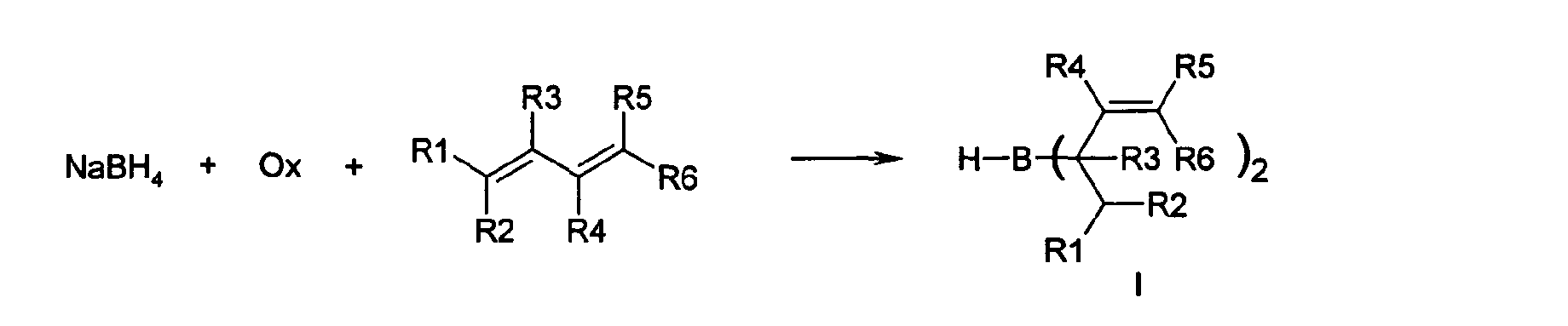
In einer besonders bevorzugten Ausführungsform wird als Dien 2,5-Dimethylhexa-2,4-dien (R1, R2, R5, R6 = Methyl, R3, R4 = H) eingesetzt.
Description
In der chemischen Literatur gibt es eine Vielzahl von Beispielen für solche Suzuki-Reaktionen.
C-C-Verknüpfungsreaktionen, in denen aliphatische oder olefinische Boronsäuren zum Einsatz kommen, sind unterdessen eher selten.

In einer bevorzugten Ausführungsform wird als Dien 2,5-Dimethylhexa-2,4-dien (R1, R2, R5, R6 = Methyl, R3, R4 = H) eingesetzt.

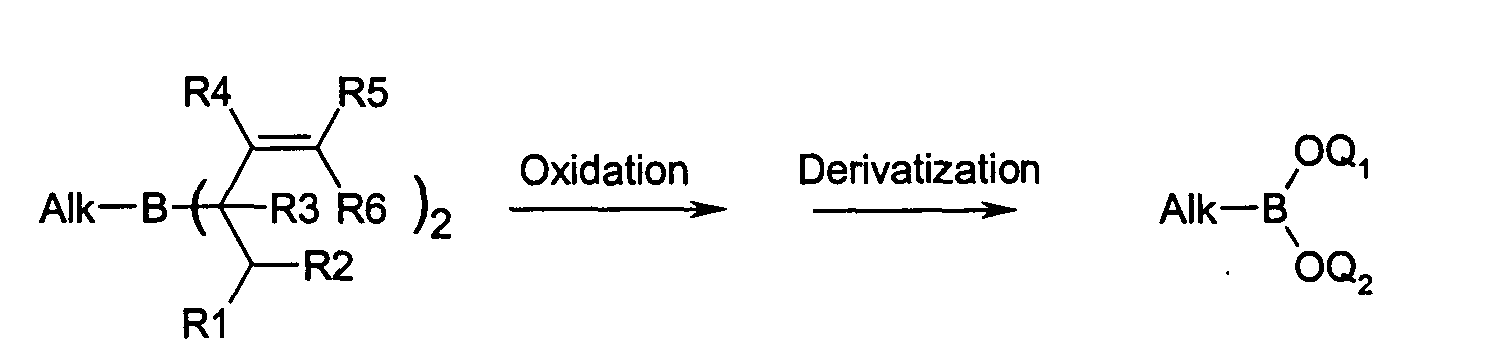
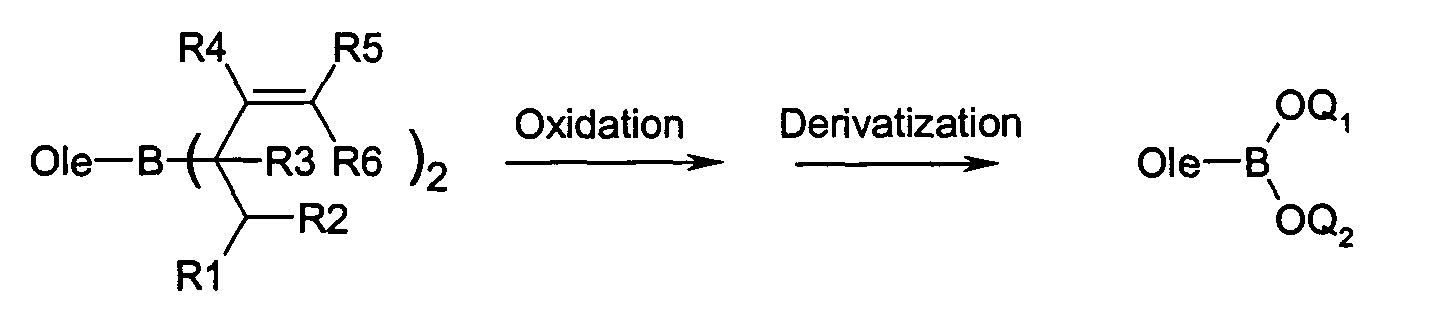
Eine Isolierung der Boronsäure kann dann umgangen werden. Dies ist besonders dann sinnvoll, wenn die Boronsäure sehr oxidations-, hitze- oder hydrolyseempfindlich ist.
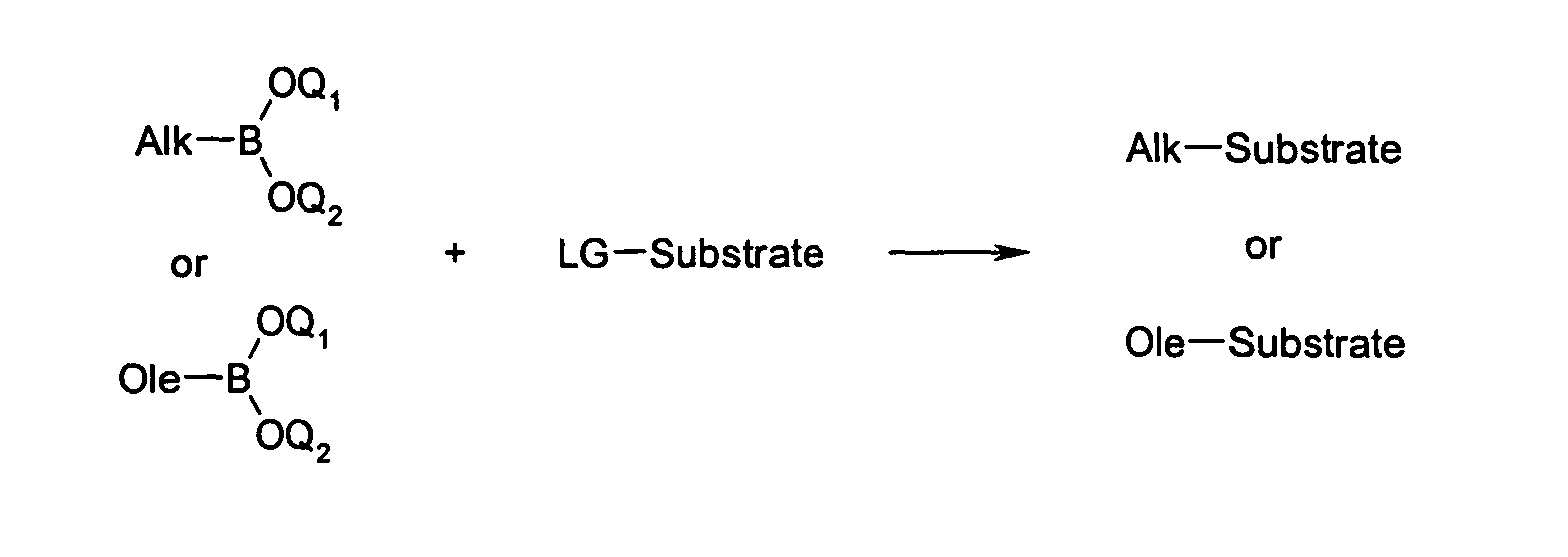
Das Dien wird in 1 bis 10 Moläquivalenten bezogen auf Natriumborhydrid eingesetzt, bevorzugt in 2-3 Moläquivalenten. Die Konzentration des gebildeten Bis(allyl)borans liegt zwischen 0.1 und 5 Mol/I, bevorzugt zwischen 0.5 und 2 Mol/l.
Die Breite der einsetzbaren Alkene und Alkine ist sehr groß. Die gegebenen Beispiele für Substituenten stellen lediglich einen Ausschnitt aus dem Spektrum dar, beschränken das erfindungsgemäße Verfahren jedoch keinesfalls darauf.

Claims (14)
- Verfahren zur Herstellung von Bisallylboranen der Formel (I) durch Umsetzung eines Dienes mit Natriumborhydrid in Gegenwart eines Oxidationsmittelsin einem inerten Lösungsmittel, wobei das in situ erzeugte Boran mit dem Dien selektiv zum Bis(allyl)boran der Formel (I) reagiert und die Substituenten R1 bis R6 folgende Bedeutung haben:
 R1-R6 bedeuten H, Aryl oder substituiertes oder unsubstituiertes C1-C4-Alkyl oder zwei Reste R können zu einem cyclischen System geschlossen sein.
 - Verfahren nach Anspruch 1, dadurch gekennzeichnet, dass als Dien 2,5-Dimethylhexa-2,4-dien (R1, R2, R5, R6 = Methyl, R3, R4 = H) eingesetzt wird.
- Verfahren nach Anspruch 1 und/oder 2, dadurch gekennzeichnet, dass als Oxidationsmittel Alkylhalogenide oder Dialkylsulfate verwendet werden.
- Verfahren nach mindestens einem der vorhergehenden Ansprüche, dadurch gekennzeichnet, dass als Oxidationsmittel Dimethyl- oder Diethylsulfat oder Benzylbromid oder lodethan verwendet werden.
- Verfahren nach mindestens einem der vorhergehenden Ansprüche, dadurch gekennzeichnet, dass als inertes Lösungsmittel Ether oder (C1- C10)-Kohlenwasserstoffe oder deren Gemische verwendet werden.
- Verfahren nach mindestens einem der vorhergehenden Ansprüche, dadurch gekennzeichnet, dass als inertes Lösungsmittel Diglyme verwendet wird.
- Verfahren nach mindestens einem der vorhergehenden Ansprüche, dadurch gekennzeichnet, dass das Dien in 1 bis 10 Moläquivalenten bezogen auf das Natriumborhydrid eingesetzt wird.
- Di-(1-1-isopropyl-3-methylbut-2-enyl)boran der Formel (la)
- Bis(allyl)borane der Formel (I) erhältlich gemäß einem Verfahren nach mindestens einem der Ansprüche 1 bis 7.
- Verwendung eines Bis(allyl)borans der Formel (III) oder (V) in C-C-Knüpfungsreaktionen, insbesondere in Suzuki-Kupplungsreaktionen.
- Verfahren zur Herstellung von Boronsäuren, durch Umsetzung eines Dienes mit Natriumborhydrid in Gegenwart eines Oxidationsmittels zu dem entsprechenden Bis(allyl)boran der Formel (I) gemäß Anspruch 1 und weiterer Reaktion des Borans (I) mit einem entsprechenden Alken (II) oder Alkin (IV) zu den Alkyl- (III) und Alkenylbis(ally)boranen (V), welche in Gegenwart eines Oxidationsmittels direkt zu den entsprechenden Alkyl- bzw. Alkenyl-boronsäurebisallyestern oxidiert werden und gegebenenfalls anschließend derivatisiert werden.
- Verfahren nach Anspruch 11, dadurch gekennzeichnet, dass Alkene der Formel (II) und Alkine der Formel (IV) eingesetzt werden, worin die Reste R7 bis R12 folgende Bedeutung haben: Aryl, gegebenenfalls substituiert, Alkyl-(C1-C8), gegebenenfalls verzweigt und oder substituiert, Alkoxy-(C1-C8), Acyloxy-(C1-C8), OPhenyl, Fluor, Chlor, NO2, NH2, NHAlkyl-(C1-C8), NAlkyl2-(C1-C8), CN, CHO, SO3H, SO3R, SO2NH2, SO2N(Alkyl-(C1-C8))2, SO2-Alkyl-(C1-C8), COO-Alkyl-(C1-C8), CONH2, CO-Alkyl-(C1-C8), NHCHO, CF3, 5-Ring-heteroaryl und 6-Ring-heteroaryl, wobei zwei Reste auch ein cyclisches System bilden können, das Heteroatome enthalten kann.
- Verfahren nach Anspruch 11 und 12, dadurch gekennzeichnet, dass als Oxidationsmittel Formaldehyd, Aceton, Glyoxal und Diacetyl verwendet werden.
- Verwendung eines gemäß Anspruch 11 erzeugten Alkyl- bzw. Alkenylboronsäurebis(allyl)esters in C-C-Knüpfungsreaktionen, insbesondere in Suzuki-Kupplungsreaktionen.
Applications Claiming Priority (2)
| Application Number | Priority Date | Filing Date | Title |
|---|---|---|---|
| DE10143979 | 2001-09-07 | ||
| DE10143979A DE10143979A1 (de) | 2001-09-07 | 2001-09-07 | Verfahren zur Herstellung von Bisallylboranen und nicht-aromatischen Boronsäuren |
Publications (3)
| Publication Number | Publication Date |
|---|---|
| EP1291347A2 true EP1291347A2 (de) | 2003-03-12 |
| EP1291347A3 EP1291347A3 (de) | 2003-09-17 |
| EP1291347B1 EP1291347B1 (de) | 2006-08-23 |
Family
ID=7698109
Family Applications (1)
| Application Number | Title | Priority Date | Filing Date |
|---|---|---|---|
| EP02018873A Expired - Lifetime EP1291347B1 (de) | 2001-09-07 | 2002-08-24 | Verfahren zur Herstellung von Bisallylboranen und nicht-aromatischen Boronsäuren |
Country Status (4)
| Country | Link |
|---|---|
| US (2) | US6706925B2 (de) |
| EP (1) | EP1291347B1 (de) |
| JP (1) | JP2003096083A (de) |
| DE (2) | DE10143979A1 (de) |
Cited By (2)
| Publication number | Priority date | Publication date | Assignee | Title |
|---|---|---|---|---|
| WO2004089960A3 (en) * | 2003-04-08 | 2005-01-06 | Isotechnika Inc | Process for preparation of cyclosporin “a” analogues having a terminal diene group |
| FR2966153A1 (fr) * | 2010-10-19 | 2012-04-20 | Commissariat Energie Atomique | Utilisation d'azaboronates cycliques comme materiaux sensibles dans des capteurs destines a detecter la presence de peroxydes dans un milieu gazeux |
Families Citing this family (22)
| Publication number | Priority date | Publication date | Assignee | Title |
|---|---|---|---|---|
| NZ578297A (en) * | 2005-02-16 | 2010-11-26 | Anacor Pharmaceuticals Inc | Boron-containing small molecules |
| EP1976536A4 (de) | 2005-12-30 | 2011-03-02 | Anacor Pharmaceuticals Inc | Borhaltige kleine moleküle |
| CN102532180B (zh) * | 2005-12-30 | 2016-06-29 | 安纳考尔医药公司 | 含硼的小分子 |
| ME02188B (me) | 2006-02-16 | 2016-02-20 | Anacor Pharmaceuticals Inc | Mali molekuli koji sadrže boron kao antiinflamatorni agensi |
| JO3396B1 (ar) | 2007-06-20 | 2019-10-20 | Anacor Pharmaceuticals Inc | جزيئات صغيرة تحتوي على البورون |
| CN102014927A (zh) | 2008-03-06 | 2011-04-13 | 安纳考尔医药公司 | 作为抗炎药的含硼的小分子 |
| WO2009140309A2 (en) * | 2008-05-12 | 2009-11-19 | Anacor Pharmaceuticals, Inc. | Boron-containing small molecules |
| US8461336B2 (en) | 2008-09-04 | 2013-06-11 | Anacor Pharmaceuticals, Inc. | Boron-containing small molecules |
| WO2010027975A1 (en) * | 2008-09-04 | 2010-03-11 | Anacor Pharmaceuticals, Inc. | Boron-containing small molecules |
| US9493489B2 (en) * | 2008-10-15 | 2016-11-15 | Anacor Pharmaceuticals, Inc. | Boron-containing small molecules as anti-protozoal agents |
| MX2011006334A (es) * | 2008-12-17 | 2011-09-22 | Anacor Pharmaceuticals Inc | Polimorfos de (s)-3-amino-metil-7-(3-hidroxi-propoxi)-3h-benzo-[c] [1,2]-oxaborol-1-ol. |
| WO2011017125A1 (en) * | 2009-07-28 | 2011-02-10 | Anacor Pharmaceuticals, Inc. | Trisubstituted boron-containing molecules |
| AP4039A (en) | 2009-08-14 | 2017-02-28 | Daitao Chen | Boron-containing small molecules as antiprotozoal agents |
| WO2011022337A1 (en) * | 2009-08-19 | 2011-02-24 | Anacor Pharmaceuticals, Inc. | Boron-containing small molecules as antiprotozoal agents |
| US20110124597A1 (en) * | 2009-09-25 | 2011-05-26 | Anacor Pharmaceuticals, Inc. | Boron containing small molecules |
| WO2011049971A1 (en) | 2009-10-20 | 2011-04-28 | Anacor Pharmaceuticals, Inc. | Boron-containing small molecules as antiprotozoal agents |
| US8461134B2 (en) * | 2009-11-11 | 2013-06-11 | Anacor Pharmaceuticals, Inc. | Boron-containing small molecules |
| US8716478B2 (en) | 2010-01-27 | 2014-05-06 | Anacor Pharmaceuticals, Inc. | Boron-containing small molecules |
| WO2011116348A1 (en) | 2010-03-19 | 2011-09-22 | Anacor Pharmaceuticals, Inc. | Boron-containing small molecules as anti-protozoal agent |
| WO2012033858A2 (en) | 2010-09-07 | 2012-03-15 | Anacor Pharmaceuticals, Inc. | Boron-containing small molecules |
| WO2014121008A1 (en) * | 2013-01-31 | 2014-08-07 | Promerus, Llc | Norbornenylhydrocarbylene dihydrocarbylboranes and methods of making the same |
| US11447506B2 (en) | 2016-05-09 | 2022-09-20 | Anacor Pharmaceuticals, Inc. | Crystal forms of crisaborole in free form and preparation method and use thereof |
Family Cites Families (3)
| Publication number | Priority date | Publication date | Assignee | Title |
|---|---|---|---|---|
| DE1097446B (de) * | 1959-11-05 | 1961-01-19 | Bayer Ag | Verfahren zur Herstellung von Estern und Carboxylaten der Alkylborsaeuren |
| US3206446A (en) * | 1962-06-04 | 1965-09-14 | Du Pont | Process for making organic boron compounds |
| US4978794A (en) * | 1990-03-26 | 1990-12-18 | Aldrich Chemical Company, Inc. | Novel β-(2-alkenyl)bis(2-isocaranyl)boranes |
-
2001
- 2001-09-07 DE DE10143979A patent/DE10143979A1/de not_active Withdrawn
-
2002
- 2002-08-24 EP EP02018873A patent/EP1291347B1/de not_active Expired - Lifetime
- 2002-08-24 DE DE50207915T patent/DE50207915D1/de not_active Expired - Lifetime
- 2002-09-06 US US10/236,749 patent/US6706925B2/en not_active Expired - Fee Related
- 2002-09-09 JP JP2002262563A patent/JP2003096083A/ja active Pending
-
2003
- 2003-08-28 US US10/650,370 patent/US6855848B2/en not_active Expired - Fee Related
Non-Patent Citations (1)
| Title |
|---|
| MIKHAILOV, B. M. ET AL: "Organoboron compounds. CCXCV. Permanent allyl rearrangement in tris(3-methyl-2-buten-1-yl)borane and 1-allyl-2-(3-buten-1-yl)-4,4- dimethyl-5-chloromethyleneboracyclopentane " ZHURNAL OBSHCHEI KHIMII (1975), 45(1), 51-6 , 1975, XP002249210 * |
Cited By (4)
| Publication number | Priority date | Publication date | Assignee | Title |
|---|---|---|---|---|
| WO2004089960A3 (en) * | 2003-04-08 | 2005-01-06 | Isotechnika Inc | Process for preparation of cyclosporin “a” analogues having a terminal diene group |
| FR2966153A1 (fr) * | 2010-10-19 | 2012-04-20 | Commissariat Energie Atomique | Utilisation d'azaboronates cycliques comme materiaux sensibles dans des capteurs destines a detecter la presence de peroxydes dans un milieu gazeux |
| WO2012052399A1 (fr) * | 2010-10-19 | 2012-04-26 | Commissariat à l'énergie atomique et aux énergies alternatives | Utilisation d'azaboronates cycliques comme materiaux sensibles dans des capteurs destines a detecter la presence de peroxydes dans un milieu gazeux |
| US9194853B2 (en) | 2010-10-19 | 2015-11-24 | Commissariat A L'energie Atomique Et Aux Energies Alternatives | Use of cyclic azaboronates as sensitive materials in sensors for detecting the presence of peroxides in a gaseous environment |
Also Published As
| Publication number | Publication date |
|---|---|
| US6706925B2 (en) | 2004-03-16 |
| US20030096995A1 (en) | 2003-05-22 |
| DE10143979A1 (de) | 2003-03-27 |
| JP2003096083A (ja) | 2003-04-03 |
| EP1291347A3 (de) | 2003-09-17 |
| US6855848B2 (en) | 2005-02-15 |
| EP1291347B1 (de) | 2006-08-23 |
| DE50207915D1 (de) | 2006-10-05 |
| US20040039233A1 (en) | 2004-02-26 |
Similar Documents
| Publication | Publication Date | Title |
|---|---|---|
| EP1291347A2 (de) | Verfahren zur Herstellung von Bisallylboranen und nicht-aromatischen Boronsäuren | |
| DE19932571A1 (de) | Verfahren zur Herstellung von Biarylen unter Palladophosphacyclobutan-Katalyse | |
| US3347793A (en) | Borate esters and gasoline or lubricating oil compositions | |
| US2535172A (en) | Dialkyl 2-alkoxy-ethanephosphonates and process of preparing | |
| DE69328408T2 (de) | Herstellung von Borester | |
| DE3214828A1 (de) | Phosphorverbindungen | |
| EP1070718B1 (de) | Verfahren zur Herstellung von Grignard-Reagenzien und neue Grignard-Reagenzien | |
| EP0024611B1 (de) | Verfahren zur Herstellung von substituierten Benzaldehyden | |
| CH631181A5 (de) | Verfahren zur herstellung von 2,6-dimethoxy-4-(quaternaeren-alkyl)phenyl-disubstituierten-phosphaten. | |
| DE60010092T2 (de) | Verfahren zur herstellung von acylierten 1,3-dicarbonylverbindungen | |
| DE69132772T2 (de) | Herstellung von Borsäurederivaten | |
| DE19605778C1 (de) | Herstellung und Verwendung von (3-Alkoxyphenyl)magnesiumchloriden | |
| DE19858594A1 (de) | Verfahren zur Herstellung von Cyanbenzolboronsäuren | |
| CH433290A (de) | Verfahren zur Herstellung von Diorganohalogenphosphinen | |
| US3185723A (en) | O-alkyl, s, 1-phenyl-2-alkoxycarbonylethyl alkylphosphonothioates | |
| EP0036159B1 (de) | 4-(2,5-Dihydroxyphen-1-yl)-crotonsäure und deren Derivate sowie Verfahren zur Herstellung dieser Verbindungen | |
| DE69920049T2 (de) | Herstellung von alkalimetall-substituierten borohydridreagenzien | |
| DE60115663T2 (de) | Verfahren zur herstellung von alkyllithium-verbindungen | |
| DE1060397B (de) | Verfahren zur Herstellung von metallorganischen Verbindungen des Nickels | |
| US3180888A (en) | Aminohaloboranes and preparation thereof | |
| DE2609126A1 (de) | Verfahren zur herstellung von eckige klammer auf 2-(halogenformyl)- vinyl eckige klammer zu organyl-phosphinsaeurehalogeniden | |
| DE938187C (de) | Verfahren zur Herstellung von Derivaten der Cyanphosphonsaeure | |
| US2164357A (en) | Esters of heterocyclic monocarboxylic acids | |
| EP0005186B1 (de) | 3-Alkyl-5-(2-hydroxy-styryl)-isoxazole und Verfahren zu ihrer Herstellung | |
| DE19808260A1 (de) | Verbessertes Verfahren zur Herstellung von Octa-2,7-dienyl-1-amin aus Butadien und Ammoniak, neue Triphenylphosphanmono- und -dimethoxytrinatriumsulfonate und die Verwendung von Triphenylphosphantrimethoxytrinatriumsulfonaten, Triphenylphosphantrimethyltrinatriumsulfonaten und Triphenylphosphantrifluordinatrium- und trinatriumsulfonaten als Liganden zur Herstellung von Palladium-Komplexen |
Legal Events
| Date | Code | Title | Description |
|---|---|---|---|
| PUAI | Public reference made under article 153(3) epc to a published international application that has entered the european phase |
Free format text: ORIGINAL CODE: 0009012 |
|
| AK | Designated contracting states |
Kind code of ref document: A2 Designated state(s): AT BE BG CH CY CZ DE DK EE ES FI FR GB GR IE IT LI LU MC NL PT SE SK TR |
|
| AX | Request for extension of the european patent |
Extension state: AL LT LV MK RO SI |
|
| PUAL | Search report despatched |
Free format text: ORIGINAL CODE: 0009013 |
|
| AK | Designated contracting states |
Kind code of ref document: A3 Designated state(s): AT BE BG CH CY CZ DE DK EE ES FI FR GB GR IE IT LI LU MC NL PT SE SK TR |
|
| AX | Request for extension of the european patent |
Extension state: AL LT LV MK RO SI |
|
| 17P | Request for examination filed |
Effective date: 20040317 |
|
| AKX | Designation fees paid |
Designated state(s): CH DE FR GB LI |
|
| GRAP | Despatch of communication of intention to grant a patent |
Free format text: ORIGINAL CODE: EPIDOSNIGR1 |
|
| RAP1 | Party data changed (applicant data changed or rights of an application transferred) |
Owner name: CLARIANT PRODUKTE (DEUTSCHLAND) GMBH |
|
| GRAS | Grant fee paid |
Free format text: ORIGINAL CODE: EPIDOSNIGR3 |
|
| GRAA | (expected) grant |
Free format text: ORIGINAL CODE: 0009210 |
|
| AK | Designated contracting states |
Kind code of ref document: B1 Designated state(s): CH DE FR GB LI |
|
| REG | Reference to a national code |
Ref country code: GB Ref legal event code: FG4D Free format text: NOT ENGLISH |
|
| REG | Reference to a national code |
Ref country code: CH Ref legal event code: EP |
|
| RAP2 | Party data changed (patent owner data changed or rights of a patent transferred) |
Owner name: ARCHIMICA GMBH |
|
| REF | Corresponds to: |
Ref document number: 50207915 Country of ref document: DE Date of ref document: 20061005 Kind code of ref document: P |
|
| REG | Reference to a national code |
Ref country code: GB Ref legal event code: 732E |
|
| GBT | Gb: translation of ep patent filed (gb section 77(6)(a)/1977) |
Effective date: 20061108 |
|
| ET | Fr: translation filed | ||
| PLBE | No opposition filed within time limit |
Free format text: ORIGINAL CODE: 0009261 |
|
| STAA | Information on the status of an ep patent application or granted ep patent |
Free format text: STATUS: NO OPPOSITION FILED WITHIN TIME LIMIT |
|
| 26N | No opposition filed |
Effective date: 20070524 |
|
| PGFP | Annual fee paid to national office [announced via postgrant information from national office to epo] |
Ref country code: CH Payment date: 20070815 Year of fee payment: 6 |
|
| PGFP | Annual fee paid to national office [announced via postgrant information from national office to epo] |
Ref country code: GB Payment date: 20070822 Year of fee payment: 6 |
|
| PGFP | Annual fee paid to national office [announced via postgrant information from national office to epo] |
Ref country code: FR Payment date: 20070808 Year of fee payment: 6 |
|
| REG | Reference to a national code |
Ref country code: CH Ref legal event code: PL |
|
| GBPC | Gb: european patent ceased through non-payment of renewal fee |
Effective date: 20080824 |
|
| REG | Reference to a national code |
Ref country code: FR Ref legal event code: ST Effective date: 20090430 |
|
| PG25 | Lapsed in a contracting state [announced via postgrant information from national office to epo] |
Ref country code: CH Free format text: LAPSE BECAUSE OF NON-PAYMENT OF DUE FEES Effective date: 20080831 Ref country code: LI Free format text: LAPSE BECAUSE OF NON-PAYMENT OF DUE FEES Effective date: 20080831 |
|
| PG25 | Lapsed in a contracting state [announced via postgrant information from national office to epo] |
Ref country code: FR Free format text: LAPSE BECAUSE OF NON-PAYMENT OF DUE FEES Effective date: 20080901 |
|
| PG25 | Lapsed in a contracting state [announced via postgrant information from national office to epo] |
Ref country code: GB Free format text: LAPSE BECAUSE OF NON-PAYMENT OF DUE FEES Effective date: 20080824 |
|
| PGFP | Annual fee paid to national office [announced via postgrant information from national office to epo] |
Ref country code: DE Payment date: 20100816 Year of fee payment: 9 |
|
| REG | Reference to a national code |
Ref country code: DE Ref legal event code: R119 Ref document number: 50207915 Country of ref document: DE Effective date: 20120301 |
|
| PG25 | Lapsed in a contracting state [announced via postgrant information from national office to epo] |
Ref country code: DE Free format text: LAPSE BECAUSE OF NON-PAYMENT OF DUE FEES Effective date: 20120301 |