EP1292053A2 - Transport de signaux SONET à travers un réseau de communication optique - Google Patents
Transport de signaux SONET à travers un réseau de communication optique Download PDFInfo
- Publication number
- EP1292053A2 EP1292053A2 EP02256203A EP02256203A EP1292053A2 EP 1292053 A2 EP1292053 A2 EP 1292053A2 EP 02256203 A EP02256203 A EP 02256203A EP 02256203 A EP02256203 A EP 02256203A EP 1292053 A2 EP1292053 A2 EP 1292053A2
- Authority
- EP
- European Patent Office
- Prior art keywords
- packet
- sonet
- combus
- data
- signal
- Prior art date
- Legal status (The legal status is an assumption and is not a legal conclusion. Google has not performed a legal analysis and makes no representation as to the accuracy of the status listed.)
- Withdrawn
Links
- 230000003287 optical effect Effects 0.000 title claims abstract description 15
- RGNPBRKPHBKNKX-UHFFFAOYSA-N hexaflumuron Chemical group C1=C(Cl)C(OC(F)(F)C(F)F)=C(Cl)C=C1NC(=O)NC(=O)C1=C(F)C=CC=C1F RGNPBRKPHBKNKX-UHFFFAOYSA-N 0.000 title claims abstract 11
- 238000004891 communication Methods 0.000 title description 5
- 238000000034 method Methods 0.000 claims abstract description 23
- 230000001360 synchronised effect Effects 0.000 claims abstract description 17
- 238000001514 detection method Methods 0.000 claims abstract description 14
- 230000005540 biological transmission Effects 0.000 claims description 10
- 125000004122 cyclic group Chemical group 0.000 claims description 3
- 238000013507 mapping Methods 0.000 claims 1
- 102100040338 Ubiquitin-associated and SH3 domain-containing protein B Human genes 0.000 description 17
- 101710143616 Ubiquitin-associated and SH3 domain-containing protein B Proteins 0.000 description 17
- 230000009975 flexible effect Effects 0.000 description 3
- 239000000835 fiber Substances 0.000 description 2
- 101100366327 Caenorhabditis elegans spe-26 gene Proteins 0.000 description 1
- 101100442582 Neurospora crassa (strain ATCC 24698 / 74-OR23-1A / CBS 708.71 / DSM 1257 / FGSC 987) spe-1 gene Proteins 0.000 description 1
- 238000005516 engineering process Methods 0.000 description 1
- 238000000605 extraction Methods 0.000 description 1
- 238000011084 recovery Methods 0.000 description 1
- 239000002699 waste material Substances 0.000 description 1
Images


Classifications
-
- H—ELECTRICITY
- H04—ELECTRIC COMMUNICATION TECHNIQUE
- H04J—MULTIPLEX COMMUNICATION
- H04J3/00—Time-division multiplex systems
- H04J3/16—Time-division multiplex systems in which the time allocation to individual channels within a transmission cycle is variable, e.g. to accommodate varying complexity of signals, to vary number of channels transmitted
- H04J3/1605—Fixed allocated frame structures
- H04J3/1611—Synchronous digital hierarchy [SDH] or SONET
-
- H—ELECTRICITY
- H04—ELECTRIC COMMUNICATION TECHNIQUE
- H04J—MULTIPLEX COMMUNICATION
- H04J3/00—Time-division multiplex systems
- H04J3/02—Details
- H04J3/06—Synchronising arrangements
- H04J3/0635—Clock or time synchronisation in a network
- H04J3/0685—Clock or time synchronisation in a node; Intranode synchronisation
- H04J3/0691—Synchronisation in a TDM node
Definitions
- the present invention relates to optical communications in general and, in particular, to transport of SONET signals over an optical communications network.
- Synchronous optical network is a standard for optical telecommunications transport. It was formulated by the ECSA (European Speech Communication Association) for ANS1 (the American National Standards Institute). The SONET standard is expected to provide the transport infrastructure for worldwide telecommunications for at least the next two or three decades.
- SONET defines optical carrier (OC) levels and electrically equivalent synchronous transport signals (STSs) for the fiber-optic-based transmission hierarchy.
- SONET is a technology for carrying many signals of different capacities through a synchronous, flexible, optical hierarchy This is accomplished by means of a byte-interleaved multiplexing scheme. Byte-interleaving simplifies multiplexing and offers end-to-end network management.
- the first step in the SONET multiplexing process involves the generation of the lowest level or base signal.
- this base signal is referred to as STS-1, which operates at 51.84 Mbps.
- Higher-level signals are integer multiples of STS-1, creating the family of STS-N signals.
- An STS-N signal is composed of N byte-interleaved STS-1 signals.
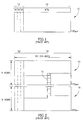
- the frame 10 structure or format of the conventional STS-1 signal is shown schematically in Fig. 1.
- the frame 10 can be divided into two main areas: transport overhead 12 and the synchronous payload envelope (SPE) 14.
- SPE synchronous payload envelope
- the synchronous payload envelope 14 can also be divided into two parts: the STS path overhead (POH) 16 and the payload 18, as seen in Fig. 2.
- the payload 18 is the revenue-producing traffic being transported and routed over the SONET network Once the payload is multiplexed into the synchronous payload envelope, it can be transported and switched through SONET without having to be examined, and possibly demultiplexed, at intermediate nodes. Thus, SONET is said to be service-independent or transparent.
- the STS-1 SPE may begin anywhere in the STS-1 envelope capacity, as illustrated schematically in Fig. 2. Typically, it begins in one STS-1 frame and ends in the next.
- the STS payload pointer (which points to J1), contained in the transport overhead, designates the location of the byte where the STS-1 SPE begins.
- STS POH is associated with each payload, and is used to communicate various information from the point where a payload is mapped into the STS-1 SPE to where it is delivered.
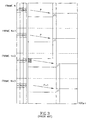
- the pointer is incremented by one in the next frame, and the subsequent pointers contain the new value. Simply put, if the SPE frame is traveling more slowly than the STS-1 frame, every now and then stuffing an extra byte in the flow gives the SPE a one-byte delay.
- bits 8, 10, 12, 14, and 16 of the pointer word are inverted, thus allowing 5-bit majority voting at the receiver, These bits are known as the D-bits or decrement bits.
- D-bits or decrement bits are known as the D-bits or decrement bits.
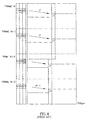
- the SPE frame is about one byte off, these bits are inverted, indicating that negative stuffing must occur, as shown schematically in Fig. 4. Because the alignment of the container advances in time, the envelope capacity must be moved forward. Thus, actual data is written in the H3 byte, the negative stuff opportunity (within the overhead); this is known as negative justification or stuffing.
- the pointer is decremented by one in the next frame, and the subsequent pointers contain the new value.
- the SPE frame is traveling more quickly than the STS-1 frame, every now and then pulling an extra byte from the flow and stuffing it into the overhead capacity (the H3 byte) gives the SPE a one-byte advance. In either case, there must be at least three frames in which the pointer remains constant before another stuffing operation (and therefore a pointer value change) can occur.
- a SONET frame (STS-N or Vc (virtual concatenation)) can be specified using a so-called TelecomBus Interface.
- a conventional TelecomBus is standard in local TDM processing (within a single ADM) but cannot be transmitted over large distances. Thus, it is used at present to send TDM SONET signals a short distance between SONET cards in telecommunications equipment.
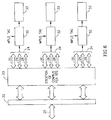
- One example of a conventional TelecomBus Interface is shown schematically in Fig. 5,
- the TelecomBus consists of the following signals:
- a SONET framer which receives a SONET signal to be transported, is capable of producing the Telecombus from the SONET signal.
- the present invention provides a method for transporting SONET signals over an optical telecommunications network, the method including generating a ComBus signal, including payload data, J1/C1 and synchronous payload envelope (SPE), per SONET path, Smart extracting of data from the ComBus signal (J1 detection and N/P detection), gathering the payload data and J1 into short packets, adding a packet header to each short packet, transporting the short packets to a destination, and generating C1 and SPE at the destination so as to reconstruct the SONET signals out of the ComBus signal.
- a ComBus signal including payload data, J1/C1 and synchronous payload envelope (SPE), per SONET path, Smart extracting of data from the ComBus signal (J1 detection and N/P detection), gathering the payload data and J1 into short packets, adding a packet header to each short packet, transporting the short packets to a destination, and generating C1 and SPE at the destination so as to reconstruct the SONET signals out of the ComBus signal.
- a system for transporting SONET signals over an optical telecommunications network including a framer for generating a ComBus signal, including payload data, J1/C1 and synchronous payload envelope (SPE), per SONET path, a packetization module for smart extracting of data from the ComBus signal (J1 detection and N/P detection), gathering the payload data and J1 into short packets, and adding a packet header to each short packet, optical means for transporting the short packets to a destination, and a packetization module at the destination for generating C1 and SPE so as to reconstruct the SONET signals out of the ComBus signal.
- a framer for generating a ComBus signal, including payload data, J1/C1 and synchronous payload envelope (SPE), per SONET path
- a packetization module for smart extracting of data from the ComBus signal (J1 detection and N/P detection), gathering the payload data and J1 into short packets, and adding a packet header to each short packet
- the present invention relates to a method and system for transporting SONET signals, together with packet services, over the same channels in an optical telecommunications network. This is accomplished by transmitting SONET signals (OC-N) over packets by combining the data and J1 signal from a plurality of SONET signals into a plurality of short packets. These SONET signals can be transmitted over a single network together with data from other packet services, or with other short packets, which can be synchronous or asynchronous. A packet header is added to each short SONET packet to instruct the destination node how to reconstruct the SONET data and synchronization after depacketization,
- the method includes generating a ComBus signal from the SONET signal, which is similar to the conventional TelecomBus, but has a different structure and is capable of transporting data over long distances within the network, which is not possible with conventional TelecomBuses.
- the ComBus signal is generated out of the SONET signal. Then, data is enhanced, extracted, and gathered into short packets, which are transmitted in a high priority over a packet network, such as that described in full in co-pending US patent application serial number 09/753,400, to the same assignee.
- the ComBus of the present application transmits parallel transmissions over short distances by a SERDES (serialization/deserialization) device, as known. This reduces RFI problems and eliminates problems of delay and loss, as all remain within the defined tolerance of SONET. It also permits the transmission of synchronous and asynchronous, packet and SONET services, over the same channels, so as to more completely utilize the available bandwidth.
- SERDES serialization/deserialization
- ComBus packetization includes the following processing operations:
- Framer 22 can be a conventional framer, for example, the Specta-622 - PM3513 (Oc-12 framer), manufactured and marketed by PMC-Siera Inc, Canada V5A4V7.
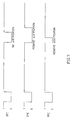
- Framer 22 generates a ComBus signal 24 from each SONET path.
- Each ComBus signal 24 consists of payload data 30, the SPE 26, which is on when a SONET payload is transmitted, and J1/C1 28, which is set if and when C1/J1 occurs.
- the data 30 is collected in a packetization module 32, which also detects J1, P and N (location in SPE of the beginning of a SONET frame, Positive or Negative Justification).
- the packetization module 32 encapsulates the input data into MPLS (Multi-Protocol Label Switching protocol) over POS (Packet Over SONET/SDH) 33.
- MPLS Multi-Protocol Label Switching protocol
- POS Packet Over SONET/SDH
- the preferred method described in detail in Assignee's co-pending US patent application SN 09/753,400, includes the steps of segmenting an incoming bit stream, adding an MPLS tag to a header of each segment, each tag including data identifying the bit stream's route between source and destination end-points, and encapsulating the tagged segment into a Point-to-Point Protocol (PPP) packet in a frame.
- PPP Point-to-Point Protocol
- MPLS provides the switching layer
- the standard used today and, therefore, the preferred frame at present, is a High bit rate Digital Link Control (HDLC)-like frame.
- HDLC High bit rate Digital Link Control
- PoS Packet over SDH
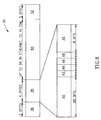
- Fig. 8 is a schematic illustration of a generic packet format created by the preferred method of the invention.
- Packet 34 includes PPP protocol information 36, which is a standard component of any PPP packet.
- PPP protocol information 36 is followed by an MPLS tag 38.
- MPLS tag 38 is a 32 bits header that may be stacked on one another to enable nesting of MPLS clouds, and is composed of a label 40 indicating the route of the packet, and experimental (EXP) bits, including intra-network indications.
- the EXP bits include a Protection bit 42, an Extra-traffic bit 44, and a priority indication 46, for the SONET over PoS of the present invention, indicated as High Priority Group.
- the tag 38 also includes a Stack bit 48, and a TTL byte 49, as known in conventional MPLS tags. It will be appreciated that this internal use of the EXP bits does not limit any external use of EXP bits, if it should be required in the future.
- Data packet 50 is the data frame combining all data services to be sent over the fiber (Ethernet, Fibre Channel, etc.) with an arbitrary payload slice in TDM services (SONET packets as formed from the ComBus).
- the packet is closed with a PPP protocol closure 52, including FCS and a flag to indicate the end of the PPP packet, as known.
- the packetization module creates a short packet of tagged data from incoming SONET signals, for transport over the network, including the destination address, and SPE information to permit reconstruction of the original SONET signal at the destination.
- the framer 22 generates all three signals: data, SPE and C1/J1, which are required in order to reconstruct the SONET signal out of the ComBus.
- SONET packet 60 includes a SONET packet header 62 and the data 64 to be transported, as described above.
- the packet is short, having a fixed size of 72 bytes.
- the packet is assigned highest priority in the packet network.
- Fig. 9 is a schematic illustration of the structure of a SONET packet header 62 according to one embodiment of the invention.
- the SONET packet header 62 includes an MPLS header 64, as described above in the generic packetization process, and a ComBus header 66.
- ComBus header 66 includes an indication 68 of J1 and justification, as described above, as well as a packet Cyclic ID 70, to enable detection of packet loss.
- Error correcting CRC 72 is calculated on the header & inserted to packet header 62. If J1 is present, the value of J1 appears in the header at 73. Finally, a parity bit 74 completes the ComBus header.
- the data and packet header are received in a framer (see Fig. 6 in the receiving direction).
- the MPLS tag is removed, leaving the data and J1.
- C1 & SPE signals are generated from the same clock at far end (J1 is composed with C1 signal to create C1/J1.)
- Negative/Positive justification is inserted in the far end, according to instructions in the message header, by changing the SPE width.
- the packet Cyclic ID is examined to enable detection and recovery from packet loss.
- a ComBus signal is generated for every SONET path (i.e STS-1, STS-3c, etc). Therefore, each SONET path resides in an MPLS flow. This provides the capabilities of designating different SONET paths to different destinations, or Fractional SONET Service (transmitting only partial paths).
- the SONET packets are short, fixed sized & and assigned the highest priority. This guarantees low delay, which is essential for TDM.
- DCC Data Communication Channel
- transmission can be enabled by using another MPLS flow for merely DCC traffic.
Landscapes
- Engineering & Computer Science (AREA)
- Computer Networks & Wireless Communication (AREA)
- Signal Processing (AREA)
- Time-Division Multiplex Systems (AREA)
- Optical Communication System (AREA)
Applications Claiming Priority (2)
| Application Number | Priority Date | Filing Date | Title |
|---|---|---|---|
| US09/947,664 US6987766B2 (en) | 2001-09-06 | 2001-09-06 | Transport of SONET signals over an optical communications network |
| US947664 | 2001-09-06 |
Publications (2)
| Publication Number | Publication Date |
|---|---|
| EP1292053A2 true EP1292053A2 (fr) | 2003-03-12 |
| EP1292053A3 EP1292053A3 (fr) | 2006-03-15 |
Family
ID=25486525
Family Applications (1)
| Application Number | Title | Priority Date | Filing Date |
|---|---|---|---|
| EP02256203A Withdrawn EP1292053A3 (fr) | 2001-09-06 | 2002-09-06 | Transport de signaux SONET à travers un réseau de communication optique |
Country Status (3)
| Country | Link |
|---|---|
| US (1) | US6987766B2 (fr) |
| EP (1) | EP1292053A3 (fr) |
| IL (1) | IL151624A (fr) |
Families Citing this family (6)
| Publication number | Priority date | Publication date | Assignee | Title |
|---|---|---|---|---|
| US7068663B1 (en) * | 2001-01-23 | 2006-06-27 | Cisco Technology, Inc. | Path routing and provisioning method and apparatus |
| WO2003043240A1 (fr) * | 2001-11-13 | 2003-05-22 | Fujitsu Limited | Procede et dispositif de transmission de concatenation virtuelle |
| US7236501B1 (en) | 2002-03-22 | 2007-06-26 | Juniper Networks, Inc. | Systems and methods for handling packet fragmentation |
| US7212530B1 (en) * | 2002-03-22 | 2007-05-01 | Juniper Networks, Inc. | Optimized buffer loading for packet header processing |
| CN1310473C (zh) * | 2003-01-07 | 2007-04-11 | 华为技术有限公司 | 基于同步数字传送网的数据传送方法 |
| JP4252610B2 (ja) * | 2005-03-01 | 2009-04-08 | 富士通株式会社 | 伝送装置、伝送装置試験方法および伝送装置試験プログラム |
Family Cites Families (13)
| Publication number | Priority date | Publication date | Assignee | Title |
|---|---|---|---|---|
| US5282195A (en) * | 1991-09-05 | 1994-01-25 | Raynet Corporation | DSO cross-connect for floating virtual tributaries |
| US5784377A (en) * | 1993-03-09 | 1998-07-21 | Hubbell Incorporated | Integrated digital loop carrier system with virtual tributary mapper circuit |
| US5526344A (en) * | 1994-04-15 | 1996-06-11 | Dsc Communications Corporation | Multi-service switch for a telecommunications network |
| WO2001020852A1 (fr) * | 1999-09-14 | 2001-03-22 | Fujitsu Limited | Systeme d'echange artificiel de ligne, procede correspondant, et emetteurs cote emission et cote reception pour ce type de systeme |
| US6847644B1 (en) * | 2000-02-23 | 2005-01-25 | Cypress Semiconductor Corp. | Hybrid data transport scheme over optical networks |
| CA2307895A1 (fr) * | 2000-05-05 | 2001-11-05 | Pmc-Sierra Inc. | Interface de bus pour le transfert de donnees sonet/sdh |
| US6831932B1 (en) * | 2000-07-14 | 2004-12-14 | Level 3 Communications, Inc. | Transfer of SONET traffic over a packet-switched network |
| US6965619B2 (en) * | 2000-12-04 | 2005-11-15 | Ciena Corporation | Flexible multiplexer/demultiplexer and method for transport of optical line data to a wide/metro area link |
| US20020085563A1 (en) * | 2001-01-03 | 2002-07-04 | Michael Mesh | Packet processing method and engine |
| US6839871B2 (en) * | 2001-02-08 | 2005-01-04 | Sycamore Networks, Inc. | Method for transparent multiplexing of SONET/ SDH streams |
| US7626999B2 (en) * | 2001-03-16 | 2009-12-01 | Tellabs San Jose, Inc. | Apparatus and methods for circuit emulation of a point-to-point protocol operating over a multi-packet label switching network |
| JP3822088B2 (ja) * | 2001-03-29 | 2006-09-13 | 大日本スクリーン製造株式会社 | 印刷機における湿し水とインキの供給方法 |
| US7515605B2 (en) * | 2003-03-24 | 2009-04-07 | Corrigent Systems Ltd | Efficient transport of TDM services over packet networks |
-
2001
- 2001-09-06 US US09/947,664 patent/US6987766B2/en not_active Expired - Fee Related
-
2002
- 2002-09-05 IL IL151624A patent/IL151624A/en not_active IP Right Cessation
- 2002-09-06 EP EP02256203A patent/EP1292053A3/fr not_active Withdrawn
Non-Patent Citations (1)
| Title |
|---|
| None * |
Also Published As
| Publication number | Publication date |
|---|---|
| US6987766B2 (en) | 2006-01-17 |
| IL151624A0 (en) | 2003-04-10 |
| IL151624A (en) | 2006-08-01 |
| EP1292053A3 (fr) | 2006-03-15 |
| US20030058865A1 (en) | 2003-03-27 |
Similar Documents
| Publication | Publication Date | Title |
|---|---|---|
| EP1091513B1 (fr) | Affluents semi-transparents pour la transmission numérique | |
| US6704326B2 (en) | Payload mapping in synchronous networks | |
| US6771663B1 (en) | Hybrid data transport scheme over optical networks | |
| US7006525B1 (en) | Hybrid data transport scheme over optical networks | |
| EP1248420B1 (fr) | Méthode et dispositif pour associer des paquets d'ethernet à haute vitesse avec des contenants SONET à travers un système sans fil | |
| JP4215355B2 (ja) | 通信システム | |
| US7133415B2 (en) | SONET circuit emulation with VT compression | |
| JP2010057202A (ja) | Sonet技術に基づく高速イーサネット | |
| US6778561B1 (en) | Hybrid data transport scheme over optical networks | |
| US6973084B1 (en) | Hybrid data transport scheme over optical networks | |
| US7353288B1 (en) | SONET/SDH payload re-mapping and cross-connect | |
| CN105933087B (zh) | 一种以太网中数据处理的方法、相关设备及系统 | |
| US6987766B2 (en) | Transport of SONET signals over an optical communications network | |
| WO2001069834A1 (fr) | Mecanisme hybride de transport de donnees sur des reseaux optiques | |
| EP1100222B1 (fr) | Détection de panne dans la section précédente pour une unité tributaire transparente | |
| US20140119389A1 (en) | Interface for asynchronous virtual container channels and high data rate port | |
| CA2338812A1 (fr) | Procede et appareil de production d'un canal ameliore de communication de donnees en reseau optique synchrone | |
| EP1079560A2 (fr) | Système de transmission synchrone numérique | |
| Caballero | SDH Next Generation | |
| Dutta et al. | Grooming mechanisms in SONET/SDH and next-generation SONET/SDH | |
| WO2002080420A1 (fr) | Reutilisation de capacites dans des reseaux de communication de donnees |
Legal Events
| Date | Code | Title | Description |
|---|---|---|---|
| PUAI | Public reference made under article 153(3) epc to a published international application that has entered the european phase |
Free format text: ORIGINAL CODE: 0009012 |
|
| AK | Designated contracting states |
Kind code of ref document: A2 Designated state(s): AT BE BG CH CY CZ DE DK EE ES FI FR GB GR IE IT LI LU MC NL PT SE SK TR Designated state(s): AT BE BG CH CY CZ DE DK EE ES FI FR GB GR IE IT LI LU MC NL PT SE SK TR |
|
| AX | Request for extension of the european patent |
Extension state: AL LT LV MK RO SI |
|
| PUAL | Search report despatched |
Free format text: ORIGINAL CODE: 0009013 |
|
| AK | Designated contracting states |
Kind code of ref document: A3 Designated state(s): AT BE BG CH CY CZ DE DK EE ES FI FR GB GR IE IT LI LU MC NL PT SE SK TR |
|
| AX | Request for extension of the european patent |
Extension state: AL LT LV MK RO SI |
|
| RIC1 | Information provided on ipc code assigned before grant |
Ipc: H04L 12/64 20060101ALI20060125BHEP Ipc: H04J 3/16 20060101AFI20021108BHEP |
|
| 17P | Request for examination filed |
Effective date: 20060905 |
|
| AKX | Designation fees paid |
Designated state(s): AT BE BG CH CY CZ DE DK EE ES FI FR GB GR IE IT LI LU MC NL PT SE SK TR |
|
| GRAP | Despatch of communication of intention to grant a patent |
Free format text: ORIGINAL CODE: EPIDOSNIGR1 |
|
| GRAS | Grant fee paid |
Free format text: ORIGINAL CODE: EPIDOSNIGR3 |
|
| STAA | Information on the status of an ep patent application or granted ep patent |
Free format text: STATUS: THE APPLICATION IS DEEMED TO BE WITHDRAWN |
|
| 18D | Application deemed to be withdrawn |
Effective date: 20080401 |