EP1294208A1 - Systeme et procédé pour la planification et l'evaluation de un reseau radio CDMA - Google Patents
Systeme et procédé pour la planification et l'evaluation de un reseau radio CDMA Download PDFInfo
- Publication number
- EP1294208A1 EP1294208A1 EP02078703A EP02078703A EP1294208A1 EP 1294208 A1 EP1294208 A1 EP 1294208A1 EP 02078703 A EP02078703 A EP 02078703A EP 02078703 A EP02078703 A EP 02078703A EP 1294208 A1 EP1294208 A1 EP 1294208A1
- Authority
- EP
- European Patent Office
- Prior art keywords
- cell
- pixel
- radio network
- noise rise
- link budget
- Prior art date
- Legal status (The legal status is an assumption and is not a legal conclusion. Google has not performed a legal analysis and makes no representation as to the accuracy of the status listed.)
- Withdrawn
Links
Images





Classifications
-
- H—ELECTRICITY
- H04—ELECTRIC COMMUNICATION TECHNIQUE
- H04W—WIRELESS COMMUNICATION NETWORKS
- H04W16/00—Network planning, e.g. coverage or traffic planning tools; Network deployment, e.g. resource partitioning or cells structures
- H04W16/18—Network planning tools
Definitions
- the invention relates to a method and system for planning and evaluation of radio networks. More specifically, the invention relates to a method and system for planning and evaluation of CDMA radio networks comprising at least one base station that defines at least one cell.
- Radio planning and evaluation typically involves stages such as dimensioning, detailed capacity and coverage planning and network optimisation. Radio planning is important for e.g. quick and accurate response to changes in e.g. traffic conditions and as a consequence provides an operator with competitive advantages. Moreover accurate planning can contribute to higher cost efficiency in operating radio networks.
- the dimensioning stage in radio planning involves the estimation of the number and configuration of network elements, based on the operators requirements and the radio propagation in the area.
- base station locations In the capacity and coverage planning stage base station locations, configurations and parameters are determined in more detail on the basis of e.g. real propagation data and estimated user density and traffic. In the network optimisation stage the overall experienced network quality is assessed and improved if necessary.
- the method and system according to the invention can be used in all stages of the radio planning and evaluation.
- Monte-Carlo simulation involves the random generation of multiple network states defined by the number of users of the network and their positions. Users are generated a number of times. The multiple states are analysed and the results of the analysis are evaluated. From the statistics results such as the maximum cell capacity and the cell coverage can be determined.
- An important drawback of the Monte-Carlo and other simulations is the required time to obtain reliable results.
- the known simulation methods do not possess the ability to quickly optimise a network or introduce a new site and see its effects on the radio network.
- a method and system are provided for the planning and/or evaluation of radio networks comprising at least one base station defining at least one cell.
- the method and system relate to the division of at least part of at least one service area of the radio network into pixels. In order to obtain information on the coverage by the radio network according to the invention it is determined which of the pixels are covered by the at least one cell.
- a probability is determined whether or not at least one of the pixels is covered by the at least one cell.
- the pixels are divided into layers.
- a probability is determined whether or not at least one of the layers is covered by the at least one cell.
- cells are preferably initially assigned to a pixel before starting the planning and/or evaluation process to obtain coverage information.
- a method and system are provided for planning and/or evaluation of a CDMA radio network comprising at least one base station defining at least one cell.
- the method and system relate to dividing at least part of a service area of the CDMA radio network into pixels and determining a probability whether or not the pixels are covered by the at least one cell.
- a link budget L and noise rise ⁇ are calculated for the at least one pixel and the at least one cell respectively and are used in the planning and/or evaluation of the CDMA radio network, taking traffic, i.e. activity of user terminals in the at least one pixel, into account.
- traffic i.e. activity of user terminals in the at least one pixel
- the link budget L and the noise rise ⁇ By comparing the link budget L and the noise rise ⁇ , or a function of at least L and ⁇ , e.g f(L- ⁇ ), f(L, ⁇ ,...) or an alternative function of L and ⁇ , with e.g a certain number, coverage information of the at least one pixel by the at least one cell can be obtained.
- several effects might be taken into account, such as inter-cell interference and soft handover (HO) gain.
- the calculations can be performed iteratively.
- the iterative calculations might not be necessary at all times.
- the iterations can be used to refine the first estimate.
- An advantage of the algorithm employed by an embodiment of the method and system is that the trade-off between complexity and accurateness can be chosen quite freely. A rough estimate of the coverage of a loaded system can be obtained very easily and with relatively few calculations. This estimate can be improved by incorporating more details in the model, for example to model the effects of soft HO, and by taking inter-cell interference into account in a more precise way through an iterative process.
- the results of performing the algorithm can be used to determine the power headroom for a user in a pixel and to perform missed traffic calculations.
- the method and system use pixels that preferably correspond to particular geographical areas.
- the service area of the radio network is divided into a grid consisting of such pixels for the planning and/or evaluation purposes. More service areas, i.e. areas where the operator of the radio network wants to provide services to users, can be present as well.
- a pixel e.g. measures 500 times 500 metres, preferably 250 times 250 metres, more preferably 100 times 100 metres, even more preferably 50 times 50 metres or 25 times 25 metres. It should be noted that these pixels should not necessarily be squares, but can basically take any form or shape, such as but not limited to rectangles, triangles, polygones etc. Moreover the pixels not necessarily fit to each other, but open spaces between several pixels can be present.
- a cell is defined as the area that is served by one particular base station. Base stations often do not employ omnidirectional antennae, but use antenna sectorization instead. In that case a cell is defined as the service area covered by a particular sector of a base station, i.e. the area in which the user is connected to that sector. Pixels that are defined for the planning and/or evaluation purposes might be covered by more cells. Each pixel can have an own set of layers.
- Layers can be regarded as a set of individual pixels with the same geographical position but different sets of parameters characterizing the environment and the service for a user in the particular layer. Furthermore, each layer can have its own traffic distribution.
- CDMA radio networks are more complex.
- One of the main reasons behind this complexity is that the coverage of the radio network is intrinsically linked to the loading of the system. The more traffic is carried by a cell, the smaller the coverage area of the cell becomes. Since traffic in a cell will change continuously, the coverage area of the cell will change continuously as well. This effect is known as cell breathing. The dynamic behaviour of the cell makes CDMA radio planning and evaluation complex.
- a solution is provided for radio planning and/or evaluation of CDMA radio networks that takes the complication of the cell breathing effect into account. This is done by calculating parameters such as link budget L, noise rise ⁇ and soft HO gain, taking the traffic into account for each pixel.
- the link budget can be defined for uplink (i.e. from the user terminal to the basestation) as the power headroom for a user terminal in a pixel that remains after diverse effects such as maximum transmission power of the user terminal, propagation losses (path and penetration) and the receiver sensitivity of the base station have been taken into account.
- the link budget calculation involves, besides parameters known from GSM radio networks, some specific CDMA network parameters as well.
- a typical CDMA parameter that can be included in link budget calculations is soft HO gain.
- Soft HO gain can be described as the link budget enhancing effect when the signal from the user terminal is received in several cells, which may belong to several base stations.
- the noise rise ⁇ is another typical CDMA parameter.
- the noise rise can be defined as the ratio of the total received power by the base station and the thermal noise. It can be shown that, amongst others, noise rise depends on the number of users N in a cell and the type of service required by these users. Moreover interference from other cells might influence the noise rise in the cell under consideration.
- CDMA radio planning and/or evaluation according to the invention relates to comparing the link budget for an unloaded system with the noise rise due to loading, i.e. the noise rise taking traffic into account. It is noted that the embodiments and/or aspects can be combined.
- the planning and/or evaluation method according to an embodiment of the invention can involve the following phases as shown schematically in figure 1. Each phase can involve one or more steps programmed in corresponding modules or subroutines. At first initial cell assignment is employed. Afterwards a base station position and a traffic grid are evaluated in terms of noise rise in a cell. Information is gained about which pixels are covered and the margin in the link budget for a user terminal in a given pixel.
- the power headroom for every pixel in the radio network is calculated which can be translated into an outage probability for a given type of fading environment.
- Other information might be obtained, such as sensitivity to variations in traffic density.
- a module can be provided to perform missed traffic calculations that might be used in the planning and/or evaluation activities with respect to the radio network. The steps of the method according to an embodiment of the invention will be discussed in more detail below.
- FIG 2 An example of the analysis to be performed in this phase is shown in figure 2.
- Figure 2 considers the initial cell assignment and uplink planning steps as shown in figure 1 in more detail.
- the algorithm might consist of the following three steps.
- the purpose of this step is twofold.
- the cell assignment step can be used to give a first indication of the coverage of a cell. Moreover it can be used to reduce algorithm complexity by limiting the number of cells which are associated with a pixel.
- Several methods can be used to perform the initial cell assignment.
- a first method to initially assign cells to pixels is to use the link budget L. For each pixel, the link budget to relevant base stations in the pixel is calculated. By putting constraints on the link budget for either the downlink pilot channel or the traffic channel (uplink or downlink or both), a coverage estimate is used to assign any number of cells to a given pixel. This gives, per pixel, a set C of possible cell candidates.
- the link budget can calculated in several ways. Noise rise and soft HO gain are preferably disregarded here.
- the coverage probability can e.g. be used as a constraint and therefore a fading margin is taken into account in calculating the link budget:
- Additional elements might be included in the link budget calculation as well, such as e.g. antenna gain.
- a cell assignment as performed in the procedure above might still give too many cell candidates per pixel.
- a more realistic estimate of the cells that cover certain pixels can be obtained by comparing link budgets. It is then assumed that a user in a certain pixel will only make use of the strongest cell, or a cell which is only marginally weaker (or several cells in soft HO).
- To assign cells to pixels the following procedure can be used in this case:
- the previous initial coverage estimate is not necessarily performed for this part and the rest of the algorithm, but can be very usefull to reduce the complexity by reducing the length of the noise rise tables, as discussed below.
- the initial state for the possible iterations is obtained. Basically most non-zero or non-infinite values can be used as a starting point, but to make the algorithm converge within a reasonable period of time preferably values can be used that are already close to the final values.
- Two initialisation examples will be presented. In a first example the coverage is calculated for loaded cells, without taking inter-cell interference into account. For each cell, a so-called noise rise table is calculated (see table 1).
- This table consists of five columns and preferably takes all pixels (the respective rows in the table) into account, to which the cell of interest has been assigned.
- the first column refers to the pixel number, making it possible to refer to data stored for the pixel.
- the second column contains the link budget (see equations (1) or (2)) - the entire table is preferably sorted according to this column, starting with the pixel with the best link budget.
- the next column contains the number of users in the pixel (denoted by N n,p in pixel p of cell n).
- the fourth column comprises the accumulated number of users in this pixel and all other pixels which precede it, i.e. pixels having a better link budget L than the pixel under consideration if the pixels have been sorted on the basis of the link budget value.
- the last column represents the noise rise calculated from the accumulated number of users.
- Alternative expressions for the noise rise can be used as well.
- the number of users N preferably refers to the equivalent number of continuously active users of a reference service.
- the probability of using this terminal is 1%.
- the effective activity is relevant, suppose for a speech terminal this to be 60%. The equivalent number of users in this pixel yields 6 for this situation.
- Users of other services e.g.
- Pixel index L budget Number of users N n ⁇ a ⁇ best link budget> N n,a N n,a ⁇ ( N n,a ) b ⁇ second best link budget> N n,b N n,a + N n,b ⁇ ( N n,a + N n,b ) ... ... c ⁇ worst link budget> N n,c N n,a + N n,b + ... + N n,c ⁇ ( N n,a + N n,b + ... + N n,c )
- the introduction of a weight factor can especially be useful if the link budget does not take a fading margin into account. If the link budget does take a fading margin into account it can be assumed that all users are able to establish a connection as long as the link budget is adequate.
- the coverage of a single loaded cell can be found by searching from the top in the noise rise table for the last row which satisfies the coverage condition ⁇ ⁇ L budget
- the coverage condition can be based on a predetermined minimum allowable L budget - ⁇ ratio ⁇ (formula 4b) or a predetermined minimum allowable difference ⁇ between L budget - ⁇ (formula 4c).
- a maximum allowed noise rise for a cell can be defined and used as an extra criterion to limit the noise rise and the number of users ⁇ ⁇ ⁇ allowed .
- the first example as discussed above excluded inter-cell interference in the calculation of the noise rise for the initial noise rise table. In other words, it was assumed that no other cells were present or at least no interference occurred. For a multi-cell environment effects of inter-cell interference should preferably be taken into account. A reasonable coverage approximation accounting for inter-cell interference can already be obtained in the initialisation step. To include the effect of inter-cell interference some estimate of the number of users in other cells is assumed to be available. An initial estimate can be made from the best server area (BSA). The best server area of a certain cell is defined as the set of pixels for which this cell provides the best link budget.
- BSA server area
- the noise rise estimate for inter-cell interference is with ⁇ mn a coupling factor.
- the coupling factor describes the effect of the interference caused by users in cell m on cell n and can take the distribution of the other users, the propagation conditions, the power level and the sensitivity of cell n to this interference into account.
- the product ⁇ mn N m corresponds to the equivalent number of users in cell n. It is generally advantageous to first calculate a nominal (traffic independent, i.e.
- the nominal coupling factor is preferably traffic independent in the sense that for a given cell size it does not depend on the actual number of users in the cell or their power levels, only on the geographical distribution of the users.
- the nominal coupling factor can be calculated in advance and tabulated as a function of cell size.
- ⁇ n f( ⁇ 1 , ⁇ 2 , ..., ⁇ n-1 , ⁇ n+1 , ... ⁇ M, B), where B is the matrix of coupling factors. Since this equation is valid for all cells, a system of n equations with n unknown variables is available.
- the third step of the algorithm comprises the iterative procedure.
- the iteration can comprise a few steps, some of which can be equivalent to the steps taken to calculate the initial noise rise table 1.
- cells in the radionetwork do not overlap, i.e no more than one cell is assigned to a pixel, and consequently a users terminal may have connection to only one cell at a time.
- the noise rise column in the noise rise table for cell n is updated using results from the previous situation according to where and
- N n For a particular row, i.e. pixel of the service area, the value of N n is taken from the fourth column of the same row in the noise rise table.
- the coupling factor can be variable, requiring an update in every iteration as well.
- pixels can be grouped into clusters, reducing the number of rows in the table, or - because only the last row which satisfies the coverage condition ⁇ ⁇ L budget and the maximum allowed noise rise condition ⁇ ⁇ ⁇ allowed needs to be found - a searching procedure can be imagined which does not require every row to be evaluated.
- the new coverage area can be obtained from the noise rise table by looking for the last row which satisfies the coverage condition and the maximum allowed noise rise condition. This gives the final values for ⁇ n (i) and N n (i) , which can be used in the next iteration. If no maximum allowed noise rise is used as a criterion, or if this is too high for a highly loaded cell, it might be that the interference from this cell is so high that other cells will have no coverage at all. Therefore, the maximum allowed noise rise should be chosen carefully for each cell. The assignment of cells to a pixel might need to be updated during the iterative process.
- the cell assignment can be made according to any criteria, not only coverage. For example, one could model the actual sector selection and call control procedures instead.
- the iteration can e.g. be stopped when the noise rise change from one iteration to another is smaller than a given number, or when there are only very small changes in coverage.
- the soft HO gain is a function of relative differences in received signal strength in the base station. However, the signal strength received by a particular base station must be compared with the noise rise experienced in the corresponding cell. Therefore the soft HO gain is a function of both link budget differences and cell load, and is no longer dependent on the pixel position only.
- the cell load changes, not only the received signal level above noise rise level changes, but the cell border changes as well.
- a pixel which was in soft HO in a lightly loaded system might have connection with only one base station when the load increases. Changes of cell assignments and noise rise result in changes in the soft HO gain and therefore also in the link budget. This must be reflected by changes in the noise rise table as well.
- the soft HO gain is preferably also taken into account in the noise rise calculation. This can be done by giving users in soft HO a lower weight, as will be discussed below.
- soft HO gain can be modelled in several ways.
- a very simple way is to use an average soft HO gain for all users which according to the cell assignment criteria are in soft HO. This gain can be used both in the link budget calculation and in the noise rise calculation. More sophisticated modelling of the soft HO gain can be based on the link budget differences as used for the cell assignment.
- the new noise rise table 2 including soft HO effects.
- c ⁇ worst link budget> N n,c / G softHO,c N n,a / G softHO,a + N n,b / G softHO,b + ... + N n,c / G softHO,c ⁇ ( N n,a / G softHO,a + N n,b / G softHO,b + ... + N n,c / G softHO,c )
- the link budget will change when traffic enters the systems, and consequently the soft HO gain will change as well.
- the noise rise is modified such that the users in soft HO, which belong to two or more cells, only contribute once to the total interference.
- the users are distinguished in areas of no hand-over, soft HO with one cell, soft HO with two cells, and so on; see figure 3 for an example.
- N p N' p + N np + N mp + N nmp
- the radio planning and evaluation process as described is preferably implemented by means of modules or routines and submodules.
- Parameters to be used can be grouped into general network parameters, parameters and vectors describing a pixel and pixel structure, parameters describing a cell structure and parameters describing a table.
- a main module can be used for the actual planning and/or evaluation process. This main module can take information about the network, the traffic grid, link budgets etc. as input and calculates the resulting noise rise in each cell. In addition information can be obtained about which pixels are covered and the link budget margin in each pixel.
- the main module can call several submodules some of them will be described below.
- a network definition submodule defines the parameters which are valid for the entire radio network; these parameters can be retrieved from a database.
- a pixel definition submodule takes data from a database and puts them in a pixel structure.
- a cell-definition submodule takes data from databases and puts them in the cell structure. This structure preferably only contains data relevant for the noise rise planning module.
- modules are provided to initially assign cells to pixels based on e.g. coverage or link budget differences.
- a module can be provided to update the coverage information, which can change from one iteration to another as a result of cell breathing.
- the coverage information can be taken from the noise rise table and the coverage search.
- the coverage information can be used for several purposes, amongst which there are estimations of soft HO areas calculation and plotting. If soft HO gain is not accounted for, it can be sufficient to update the cell coverage information before plotting.
- a module can be provided to build the initial noise rise table. Besides the traffic in the cell of interest it can also take an initial estimate of the traffic in other cells into account (e.g. based on the number of users in the BSAs). Modules can be provided to calculate the coupling factor ⁇ and the noise rise ⁇ as parameters and the equivalent number of users from other cells. The fact that users from other cells may be in soft HO can be taken into account in this module. Modules can be provided to calculate the link budget and the soft HO gain. The former module can calculate the link budget between a given cell and pixel as a function of the maximum transmit power of the user terminal Tx, the receiver sensitivity Rx, and the path loss. The fading margin, antenna gain and soft HO gain can be taken into account as well. Soft HO gain can be taken into account e.g. by estimating an average soft HO gain for all users that according to the cell assignment criteria are in soft HO or based on the link budget differences as used for the cell assignment.
- Modules can be provided for performing diverse kinds of table manipulations and for extracting information from the tables. Examples of these kind of modules include a module to sort based on e.g. the link budget column in decreasing order. The other columns, except for the pixel index and the number of users per pixel, are not necessarily sorted as well, since they will be recalculated before the table is evaluated. Another example of these modules includes a module to search the table for the last row (i.e. pixel of the cell under consideration) where the noise rise is less than the link budget or the allowed noise rise. Modules can be provided to evaluate stopping criteria for the iteration.
- a structure of seven omni-directional cells is considered, arranged such that the cell in the middle is surrounded by a ring of six other cells.
- the pixels are 150 m x 150 m. Initially three load situations are evaluated:
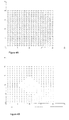
- Figure 5A shows the best server areas (BSAs) of the cells indicated by their different grey scales.
- BSAs server areas
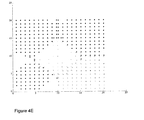
- FIG 5B the number of connections in the UL which can be used in each pixel is demonstrated by different grey scales. The assignment depends on the soft HO thresholds.
- the link budgets for each pixel is shown in case of different traffic densities. Note that the numbers have been inverted for plotting purposes, such that red means a critical link budget (close to zero dB), and that blue means an uncritical link budget (about 10 dB or higher). A white area means that the pixel is not covered. From this data it is also possible to calculate the required UE transmission power.
- a reference service can be defined.
- the number of users of other services are then expressed as the equivalent number of users (in terms of average transmission power) of the reference service.
- each pixel has an own set of layers.
- the only thing the layers have in common is the geographical position and thus also the basic, i.e. outdoor, propagation loss. Any extra loss can be one of the variables that characterize the layer. For example, one could have one layer for outdoor speech users, another for indoor speech users, and a third for indoor data users, and so on.
- Each layer can have a unique set of parameters characterizing the environment and the service for the user in the particular layer.
- each layer can have its own traffic distribution. This makes it possible to distribute for example in-car users along roads, and indoor users of high data rates in office buildings, and evaluate those layers individually.
- each layer of a pixel can be treated like a pixel of its own.
- the layers can also be regarded as a set of individual pixels with the same geographical position.
- the evaluation steps when using layers can be as follows.
- Continuous activity of the user terminal is of course not realistic, but merely a matter of definition.
- the traffic grid should be defined such that the expected average traffic is expressed as the number of continuous-activity users of the reference service.
- the traffic will be divided between the frequencies according to some principle. Because in the example algorithm it is assumed that all users use one frequency, an extension to the multiple frequency case can be made by using several traffic grids, one for each frequency, and perform the algorithm once per frequency. This approach will probably be accurate enough for most situations. More accurateness can be obtained by taking the load on the different frequencies into account and in each iteration adjust the traffic grid for the individual frequencies according to a load sharing mechanism and taking inter-frequency interference into account in a similar manner as inter-cell interference.
- cell assignment is performed, i.e. the service area is divided into a grid of pixels after which for each pixel it is determined which cell or cells cover this pixel.
- the cell or cells covering the pixel under consideration are assigned to these pixels.
- the other way around, i.e. pixel assignment can be used as well.
- the radio planning and evaluation algorithm as described above can be applied for other evaluations as well.
- CDMA and/or CDMA radio network It should be noted however that e.g. in the United States CDMA is used as a name for an IS-95 network instead of the access technology as the term CDMA refers to in Europe. The applicants wishes to stress explicitely that any kind of network having the same properties and/or characteristics with respect to e.g. noise rise as the CDMA radio network discussed in the text and claimed is included in this application.
- the power headroom for each pixel in the network can be calculated, based on the preceding cell assignment and noise rise calculation.
- the power headroom can be defined as the difference between the maximum transmission power P max of a user terminal and the average transmission power P t required to obtain a sufficient C/I (the ratio of the carrier power C at the antenna and the interference power I) at the base station.
- ⁇ P P max - P t
- P max is a property of the user terminal and is preferably input to the simulation.
- P t depends on the average path loss experienced by the signal to the base station and is calculated for each pixel individually.
- the power headroom is a measure for the ability of user terminals in a pixel to combat fading effects.
- Power headroom can be translated into an outage probability for a given type of fading environment.
- Outage probability, or non-coverage probability can be defined by two variables, namely the power headroom and the fading standard deviation; together, they form a stochastic variable that is assumed to be normally distributed. This is shown in figure 6.
- the fading margin might be dependent on the clutter type, e.g. indoor or outdoor, rural or urban area.
- Several types of outage probabilities can be used, e.g.
- the former refers to the maximum realised outage or minimum realised coverage in the cell, with a cell defined by e.g. the non-handover pixels; the latter refers to the perceived outage or coverage when moving through the cell.
- the latter outage probability can be weighted with the local traffic density or absolute traffic by: with T i the traffic, e.g. in Erlang, in pixel i, and P NHO ( c ) the non-handover pixels belonging to cell c.
- the method according to the invention can be used to predict the effects due to errors made in the traffic estimations for the network. These predictions can be advantageously used in the planning of the network by giving a marginal error that is allowed in traffic estimation before correct planning of the radio network fails. To obtain these predictions the following steps can be executed.
Landscapes
- Engineering & Computer Science (AREA)
- Computer Networks & Wireless Communication (AREA)
- Signal Processing (AREA)
- Mobile Radio Communication Systems (AREA)
Priority Applications (1)
| Application Number | Priority Date | Filing Date | Title |
|---|---|---|---|
| EP02078703A EP1294208A1 (fr) | 2001-09-10 | 2002-09-06 | Systeme et procédé pour la planification et l'evaluation de un reseau radio CDMA |
Applications Claiming Priority (5)
| Application Number | Priority Date | Filing Date | Title |
|---|---|---|---|
| EP01203391A EP1292162A1 (fr) | 2001-09-10 | 2001-09-10 | Système et procédé pour la planification et l'évaluation d'un réseau radio CDMA |
| EP01203391 | 2001-09-10 | ||
| EP02075071 | 2002-01-14 | ||
| EP02075071 | 2002-01-14 | ||
| EP02078703A EP1294208A1 (fr) | 2001-09-10 | 2002-09-06 | Systeme et procédé pour la planification et l'evaluation de un reseau radio CDMA |
Publications (1)
| Publication Number | Publication Date |
|---|---|
| EP1294208A1 true EP1294208A1 (fr) | 2003-03-19 |
Family
ID=27224310
Family Applications (1)
| Application Number | Title | Priority Date | Filing Date |
|---|---|---|---|
| EP02078703A Withdrawn EP1294208A1 (fr) | 2001-09-10 | 2002-09-06 | Systeme et procédé pour la planification et l'evaluation de un reseau radio CDMA |
Country Status (1)
| Country | Link |
|---|---|
| EP (1) | EP1294208A1 (fr) |
Cited By (9)
| Publication number | Priority date | Publication date | Assignee | Title |
|---|---|---|---|---|
| WO2006119743A1 (fr) * | 2005-05-13 | 2006-11-16 | T-Mobile International Ag & Co. Kg | Production d'une banque de donnees de trafic de communications relative au territoire dans un reseau de telephonie mobile |
| WO2007057046A1 (fr) * | 2005-11-21 | 2007-05-24 | Telecom Italia S.P.A. | Procede de planification d'un reseau cellulaire mobile de telecommunications |
| CN102131202A (zh) * | 2011-02-28 | 2011-07-20 | 浪潮通信信息系统有限公司 | 一种基于面积法的通信网络信息地理网格化的方法 |
| US8073456B2 (en) | 2004-12-22 | 2011-12-06 | Telefonaktiebolaget Lm Ericsson (Publ) | Methods and arrangements for estimating uplink coverage in wireless communication networks with dynamic cell coverage |
| WO2014014404A3 (fr) * | 2012-07-20 | 2014-04-03 | Telefonaktiebolaget L M Ericsson (Publ) | Programmation semi-décentralisée dans un réseau sans fil |
| WO2014190528A1 (fr) * | 2013-05-30 | 2014-12-04 | 华为技术有限公司 | Procédé et appareil de planification et d'optimisation de réseau reposant sur la distribution de services |
| CN104883692A (zh) * | 2014-12-25 | 2015-09-02 | 北京科技大学 | 一种能量高效的频谱共享与基站休眠联合方法 |
| CN107347189A (zh) * | 2017-06-19 | 2017-11-14 | 国网浙江省电力公司嘉兴供电公司 | 一种td‑lte 230无线专网基站规划方法 |
| CN107682862A (zh) * | 2017-07-13 | 2018-02-09 | 国网浙江省电力公司嘉兴供电公司 | 一种td‑lte230电力系统通信网络基站的选址方法 |
Citations (3)
| Publication number | Priority date | Publication date | Assignee | Title |
|---|---|---|---|---|
| US5710758A (en) * | 1995-09-29 | 1998-01-20 | Qualcomm Incorporated | Wireless network planning tool |
| WO2000036863A1 (fr) * | 1998-12-17 | 2000-06-22 | Cisco Systems, Inc. | Procede et systeme d'allocation de largeur de bande dans un reseau de communications sans fil |
| US6094580A (en) * | 1997-10-16 | 2000-07-25 | Nortel Networks Corporation | Method for optimizing cell-site placement |
-
2002
- 2002-09-06 EP EP02078703A patent/EP1294208A1/fr not_active Withdrawn
Patent Citations (3)
| Publication number | Priority date | Publication date | Assignee | Title |
|---|---|---|---|---|
| US5710758A (en) * | 1995-09-29 | 1998-01-20 | Qualcomm Incorporated | Wireless network planning tool |
| US6094580A (en) * | 1997-10-16 | 2000-07-25 | Nortel Networks Corporation | Method for optimizing cell-site placement |
| WO2000036863A1 (fr) * | 1998-12-17 | 2000-06-22 | Cisco Systems, Inc. | Procede et systeme d'allocation de largeur de bande dans un reseau de communications sans fil |
Non-Patent Citations (2)
| Title |
|---|
| MENOLASCINO, PIZARROSO: "Storms Project Final report", A016/CSE/MRM/DR/P/091/A1, April 1999 (1999-04-01), XP002194512 * |
| WACKER A ET AL: "Static simulator for studying WCDMA radio network planning issues", VEHICULAR TECHNOLOGY CONFERENCE, 1999 IEEE 49TH HOUSTON, TX, USA 16-20 MAY 1999, PISCATAWAY, NJ, USA,IEEE, US, 16 May 1999 (1999-05-16), pages 2436 - 2440, XP010342261, ISBN: 0-7803-5565-2 * |
Cited By (17)
| Publication number | Priority date | Publication date | Assignee | Title |
|---|---|---|---|---|
| US8073456B2 (en) | 2004-12-22 | 2011-12-06 | Telefonaktiebolaget Lm Ericsson (Publ) | Methods and arrangements for estimating uplink coverage in wireless communication networks with dynamic cell coverage |
| WO2006119743A1 (fr) * | 2005-05-13 | 2006-11-16 | T-Mobile International Ag & Co. Kg | Production d'une banque de donnees de trafic de communications relative au territoire dans un reseau de telephonie mobile |
| US8385927B2 (en) | 2005-05-13 | 2013-02-26 | T-Mobile International Ag & Co. Kg | Generation of a space-related traffic database in a radio network |
| WO2007057046A1 (fr) * | 2005-11-21 | 2007-05-24 | Telecom Italia S.P.A. | Procede de planification d'un reseau cellulaire mobile de telecommunications |
| US8219124B2 (en) | 2005-11-21 | 2012-07-10 | Telecom Italia S.P.A. | Method for planning a cellular mobile telecommunications network |
| CN102131202A (zh) * | 2011-02-28 | 2011-07-20 | 浪潮通信信息系统有限公司 | 一种基于面积法的通信网络信息地理网格化的方法 |
| WO2014014404A3 (fr) * | 2012-07-20 | 2014-04-03 | Telefonaktiebolaget L M Ericsson (Publ) | Programmation semi-décentralisée dans un réseau sans fil |
| US9648624B2 (en) | 2012-07-20 | 2017-05-09 | Telefonaktiebolaget Lm Ericsson (Publ) | Semi-decentralized scheduling in a wireless network |
| CN104335622A (zh) * | 2013-05-30 | 2015-02-04 | 华为技术有限公司 | 基于业务分布的网络规划、优化方法及装置 |
| WO2014190528A1 (fr) * | 2013-05-30 | 2014-12-04 | 华为技术有限公司 | Procédé et appareil de planification et d'optimisation de réseau reposant sur la distribution de services |
| CN104335622B (zh) * | 2013-05-30 | 2018-05-04 | 华为技术有限公司 | 基于业务分布的网络规划、优化方法及装置 |
| CN104883692A (zh) * | 2014-12-25 | 2015-09-02 | 北京科技大学 | 一种能量高效的频谱共享与基站休眠联合方法 |
| CN104883692B (zh) * | 2014-12-25 | 2018-04-06 | 北京科技大学 | 一种能量高效的频谱共享与基站休眠联合方法 |
| CN107347189A (zh) * | 2017-06-19 | 2017-11-14 | 国网浙江省电力公司嘉兴供电公司 | 一种td‑lte 230无线专网基站规划方法 |
| CN107347189B (zh) * | 2017-06-19 | 2020-09-01 | 国网浙江省电力公司嘉兴供电公司 | 一种td-lte 230无线专网基站规划方法 |
| CN107682862A (zh) * | 2017-07-13 | 2018-02-09 | 国网浙江省电力公司嘉兴供电公司 | 一种td‑lte230电力系统通信网络基站的选址方法 |
| CN107682862B (zh) * | 2017-07-13 | 2020-12-25 | 国网浙江省电力公司嘉兴供电公司 | 一种td-lte230电力系统通信网络基站的选址方法 |
Similar Documents
| Publication | Publication Date | Title |
|---|---|---|
| US6985735B2 (en) | Method and system for planning and evaluation of CDMA radio networks | |
| US6487414B1 (en) | System and method for frequency planning in wireless communication networks | |
| US5293640A (en) | Method for planning radio cells | |
| US7212822B1 (en) | Method and techniques for penalty-based channel assignments in a cellular network | |
| US6611500B1 (en) | Methods and apparatus for derivative-based optimization of wireless network performance | |
| US6842431B2 (en) | Methods and apparatus for characterization, adjustment and optimization of wireless networks | |
| US6990348B1 (en) | Self-configuring wireless system and a method to derive re-use criteria and neighboring lists therefor | |
| US20130122885A1 (en) | Parameter setting apparatus and parameter setting method | |
| US11445516B2 (en) | Systems and methods for multi-band resource control | |
| Hampel et al. | The tradeoff between coverage and capacity in dynamic optimization of 3G cellular networks | |
| Farooq et al. | Mobility prediction based proactive dynamic network orchestration for load balancing with QoS constraint (OPERA) | |
| Ruiz Aviles et al. | A femtocell location strategy for improving adaptive traffic sharing in heterogeneous LTE networks | |
| Grillo et al. | Teletraffic engineering for mobile personal communications in ITU-T work: The need to match practice and theory | |
| EP1292162A1 (fr) | Système et procédé pour la planification et l'évaluation d'un réseau radio CDMA | |
| EP1294208A1 (fr) | Systeme et procédé pour la planification et l'evaluation de un reseau radio CDMA | |
| US7486636B2 (en) | Method, system and computer program for planning a telecommunications network | |
| Avilés et al. | Analysis of load sharing techniques in enterprise LTE femtocells | |
| Srikantamurthy et al. | A novel unified handover algorithm for LTE-A | |
| US20030188029A1 (en) | Determining cell service areas in a wireless network | |
| Jaziri et al. | Tracking traffic peaks in mobile networks using statistics of performance metrics | |
| Hoppe et al. | Fast planning of efficient WCDMA radio networks | |
| Sánchez‐González et al. | A multi‐cell multi‐objective self‐optimisation methodology based on genetic algorithms for wireless cellular networks | |
| EP1718089A1 (fr) | Procédé d'analyse de paramètres opérationels dépendants du trafic dans un système de communication cellulaire, système correspondant et produit de programme d'ordinateur | |
| Šekuljica et al. | Mobile networks optimization using open-source GRASS-RaPlaT tool and evolutionary algorithm | |
| Jamaa et al. | UMTS design strategies based on indicator matrix approach |
Legal Events
| Date | Code | Title | Description |
|---|---|---|---|
| PUAI | Public reference made under article 153(3) epc to a published international application that has entered the european phase |
Free format text: ORIGINAL CODE: 0009012 |
|
| AK | Designated contracting states |
Kind code of ref document: A1 Designated state(s): AT BE BG CH CY CZ DE DK EE ES FI FR GB GR IE IT LI LU MC NL PT SE SK TR |
|
| AX | Request for extension of the european patent |
Extension state: AL LT LV MK RO SI |
|
| 17P | Request for examination filed |
Effective date: 20030919 |
|
| AKX | Designation fees paid |
Designated state(s): AT BE BG CH CY CZ DE DK EE ES FI FR GB GR IE IT LI LU MC NL PT SE SK TR |
|
| 17Q | First examination report despatched |
Effective date: 20031120 |
|
| STAA | Information on the status of an ep patent application or granted ep patent |
Free format text: STATUS: THE APPLICATION HAS BEEN WITHDRAWN |
|
| 18W | Application withdrawn |
Effective date: 20161124 |