EP1296242A2 - Verfahren und Vorrichtung zur Zuweisung von Betriebsmitteln in einem System mit mehreren Domänen - Google Patents
Verfahren und Vorrichtung zur Zuweisung von Betriebsmitteln in einem System mit mehreren Domänen Download PDFInfo
- Publication number
- EP1296242A2 EP1296242A2 EP02256621A EP02256621A EP1296242A2 EP 1296242 A2 EP1296242 A2 EP 1296242A2 EP 02256621 A EP02256621 A EP 02256621A EP 02256621 A EP02256621 A EP 02256621A EP 1296242 A2 EP1296242 A2 EP 1296242A2
- Authority
- EP
- European Patent Office
- Prior art keywords
- domain
- transactions
- system resource
- tracking
- interface
- Prior art date
- Legal status (The legal status is an assumption and is not a legal conclusion. Google has not performed a legal analysis and makes no representation as to the accuracy of the status listed.)
- Withdrawn
Links
Images


Classifications
-
- G—PHYSICS
- G06—COMPUTING OR CALCULATING; COUNTING
- G06F—ELECTRIC DIGITAL DATA PROCESSING
- G06F9/00—Arrangements for program control, e.g. control units
- G06F9/06—Arrangements for program control, e.g. control units using stored programs, i.e. using an internal store of processing equipment to receive or retain programs
- G06F9/46—Multiprogramming arrangements
- G06F9/50—Allocation of resources, e.g. of the central processing unit [CPU]
- G06F9/5061—Partitioning or combining of resources
- G06F9/5077—Logical partitioning of resources; Management or configuration of virtualized resources
-
- G—PHYSICS
- G06—COMPUTING OR CALCULATING; COUNTING
- G06F—ELECTRIC DIGITAL DATA PROCESSING
- G06F11/00—Error detection; Error correction; Monitoring
- G06F11/07—Responding to the occurrence of a fault, e.g. fault tolerance
- G06F11/0703—Error or fault processing not based on redundancy, i.e. by taking additional measures to deal with the error or fault not making use of redundancy in operation, in hardware, or in data representation
- G06F11/0706—Error or fault processing not based on redundancy, i.e. by taking additional measures to deal with the error or fault not making use of redundancy in operation, in hardware, or in data representation the processing taking place on a specific hardware platform or in a specific software environment
- G06F11/0709—Error or fault processing not based on redundancy, i.e. by taking additional measures to deal with the error or fault not making use of redundancy in operation, in hardware, or in data representation the processing taking place on a specific hardware platform or in a specific software environment in a distributed system consisting of a plurality of standalone computer nodes, e.g. clusters, client-server systems
-
- G—PHYSICS
- G06—COMPUTING OR CALCULATING; COUNTING
- G06F—ELECTRIC DIGITAL DATA PROCESSING
- G06F11/00—Error detection; Error correction; Monitoring
- G06F11/07—Responding to the occurrence of a fault, e.g. fault tolerance
- G06F11/16—Error detection or correction of the data by redundancy in hardware
- G06F11/20—Error detection or correction of the data by redundancy in hardware using active fault-masking, e.g. by switching out faulty elements or by switching in spare elements
- G06F11/202—Error detection or correction of the data by redundancy in hardware using active fault-masking, e.g. by switching out faulty elements or by switching in spare elements where processing functionality is redundant
- G06F11/2038—Error detection or correction of the data by redundancy in hardware using active fault-masking, e.g. by switching out faulty elements or by switching in spare elements where processing functionality is redundant with a single idle spare processing component
-
- G—PHYSICS
- G06—COMPUTING OR CALCULATING; COUNTING
- G06F—ELECTRIC DIGITAL DATA PROCESSING
- G06F11/00—Error detection; Error correction; Monitoring
- G06F11/07—Responding to the occurrence of a fault, e.g. fault tolerance
- G06F11/16—Error detection or correction of the data by redundancy in hardware
- G06F11/20—Error detection or correction of the data by redundancy in hardware using active fault-masking, e.g. by switching out faulty elements or by switching in spare elements
- G06F11/202—Error detection or correction of the data by redundancy in hardware using active fault-masking, e.g. by switching out faulty elements or by switching in spare elements where processing functionality is redundant
- G06F11/2041—Error detection or correction of the data by redundancy in hardware using active fault-masking, e.g. by switching out faulty elements or by switching in spare elements where processing functionality is redundant with more than one idle spare processing component
-
- G—PHYSICS
- G06—COMPUTING OR CALCULATING; COUNTING
- G06F—ELECTRIC DIGITAL DATA PROCESSING
- G06F11/00—Error detection; Error correction; Monitoring
- G06F11/07—Responding to the occurrence of a fault, e.g. fault tolerance
- G06F11/0703—Error or fault processing not based on redundancy, i.e. by taking additional measures to deal with the error or fault not making use of redundancy in operation, in hardware, or in data representation
- G06F11/079—Root cause analysis, i.e. error or fault diagnosis
-
- G—PHYSICS
- G06—COMPUTING OR CALCULATING; COUNTING
- G06F—ELECTRIC DIGITAL DATA PROCESSING
- G06F11/00—Error detection; Error correction; Monitoring
- G06F11/07—Responding to the occurrence of a fault, e.g. fault tolerance
- G06F11/16—Error detection or correction of the data by redundancy in hardware
- G06F11/20—Error detection or correction of the data by redundancy in hardware using active fault-masking, e.g. by switching out faulty elements or by switching in spare elements
- G06F11/2097—Error detection or correction of the data by redundancy in hardware using active fault-masking, e.g. by switching out faulty elements or by switching in spare elements maintaining the standby controller/processing unit updated
Definitions
- This invention relates generally to computer systems and such-like, and, more particularly, to the allocation of resources in a multi-domain system.
- ASPs Applications Service Providers
- a processor-based system used in a network environment is a mid-range server system.
- a single mid-range server system may be configured for a plurality of operating domains, where a domain acts as a separate machine by running its own instance of an operating system, in order to perform one or more of the configured tasks.
- one embodiment of the invention provides a method for allocating a plurality of system resources to form at least a first and second domain, the system resources of the first domain performing a set of transactions independently from a set of transactions performed by the system resources of the second domain. It is determined if an interface communicates with one system resource of the first domain and another system resource from the second domain. The set of transactions performed by the system resource of the first domain and the system resource of the second domain are tracked independently from one another, providing the interface communicates with at least one system resource of the first domain and at least one system resource of the second domain.
- a system in another embodiment, comprises a plurality of system resources allocated to form at least a first and second domain.
- the system resources of the first domain perform a set of transactions independently from a set of transactions performed by the system resources of the second domain.
- the system further comprises at least one interface for coupling one system resource from the first domain and one system resource from the second domain.
- the at least one interface tracks the set of transactions performed by the system resource of the first domain and the system resource of the second domain independently from one another.
- an interface couples to at least one system resource of a first domain and at least one system resource of a second domain, the first and second domains being independent from one another.
- the interface comprises a first logic for tracking the transactions of the system resource of the first domain and a second logic for tracking the transactions of the system resource of the second domain.
- the first logic tracks the transactions of the system resource of the first domain and the second logic tracks the transactions of the system resource of the second domain independently from one another.
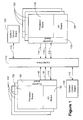
- FIG. 1 shows a simplified block diagram of a system 100 for providing error isolation in a multi-domain computer network according to one embodiment of the present invention.
- the system 100 comprises a pair of system control boards 102, 105 coupled to a center plane 110 (i.e., a communications medium controller) via communication links 115.
- the communication links 115 take the form of edge connectors. It will be appreciated, however, that the communication links 115 may alternatively take the form of cables or various other types of interfaces.
- one of the system control boards 102 serves as the "main” system control board for providing system controller resources for the system 100 and managing the overall operation thereof.
- Another "secondary" system control board 105 which may be functionally and/or structurally identical to the main system control board 102, may serve as a backup for managing the system 100 if the main system control board 105 fails or is otherwise made unavailable.
- the system 100 further includes a plurality of system board sets 120, which are coupled to the center plane 110 via the communication links 115.
- the system board sets 120 comprise one or more boards, which may include a processor board 125, an I/O board 130, and an expander board 135.
- the processor board 125 may include a plurality of processors and memories for executing various computing tasks.
- the I/O board 130 may manage I/O cards, such as peripheral component interface (PCI) cards and optical cards that are installed in the system 100 for connection to various I/O devices (not shown).
- PCI peripheral component interface
- the expander board 135 allows both the processor board 125 and I/O board 130 to interface with the center plane 110.
- the system 100 may include up to a total of 18 expander boards 135, with each expander board 135 having a slot for accommodating a processor board 125 and an I/O board 130 for a total of 36 boards 125, 130.
- the expander board 135 may be configured to accommodate various other arrangements of processor boards 125 and I/O boards 130.
- the expander board 135 may be configured to accommodate two processor boards 125 or one processor board 125 and one I/O board 130 (as shown in Figure 1).
- the system 100 may be configured with a greater or fewer number of boards 125, 130, 135 than provided in the illustrated example.
- the center plane 110 serves as a communication medium for the plurality of system board sets 120 and system control boards 102, 105 to communicate with one another.
- the center plane 110 takes the form of an 18 x 18 crossbar to accommodate communication between the 36 boards 125, 130. Accordingly, the center plane 110 permits the two system control boards 102, 105 to communicate with each other or with other system board sets 120, as well as allowing the system board sets 120 to communicate with each other.
- the system resources (e.g., processor boards, I/O boards) of the system 100 may be dynamically subdivided into a plurality of system domains, where each domain may have a separate boot disk to execute a specific instance of an operating system, plus separate disk storage, network interfaces, and/or I/O interfaces.
- Each domain is able to operate largely as a separate machine, in order to perform a variety of user-configured services.
- one or more domains may be designated as an application server, a web server, a database server, etc.
- each domain may be allocated to a specific department within a company or organization.
- one domain may be allocated to a marketing department and another domain may be allocated to an accounting department, in order to accommodate their respective computing needs.
- the system 100 may be shared by a few smaller companies or organizations through a computer service company, where it would otherwise be impractical for any one company or organization to purchase and maintain the system 100.
- each such company or organization could be allocated a specific grouping of system resources from the system 100 (i.e., allocated a domain) for their individual use.
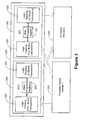
- the system resources of the system 100 are divided into two domains.
- the first domain is identified by the numeral "1"
- the system resources e.g., processor boards, I/O boards, etc.
- the second domain is identified by the numeral "2”
- its corresponding grouping of system resources are labeled by the numeral "2".
- expander boards 205, 210 are associated with processor boards 230, 240 and I/O boards 235, 245 that are allocated within domain 1.
- Expander boards 215, 220 are associated with processor boards 260, 270 and I/O boards 265, 275 that are allocated within domain 2.
- each domain defines a particular grouping of system resources within the system 100 to perform a particular task or set of tasks, which the domain is formed to accomplish.
- the expander board 135 is interfaced with a processor board 125 and I/O board 130 within the same domain, it is referred to as a "non-split" expander or a "non-split" slot.
- the expander boards 205, 210 and the expander boards 215, 220 are non-split expanders because they are interfaced with system resources from a single domain.
- the expander boards 205, 210 respectively interface with processor boards 230, 240 and I/O boards 235, 245 from the same domain (i.e., domain 1).
- the expander boards 215, 220 interface with processor boards 260, 270 and I/O boards 265, 275 from the same domain (i.e., domain 2).
- the expander board 225 i.e., expander C
- the expander board 225 is interfaced with the processor board 250 from domain 1 and the I/O board 255 from domain 2.
- the expander board 135 is interfaced with system resources from differing domains, it is referred to as a "split" expander or "split" slot. Accordingly, in the example provided in Figure 2, the expander board 225 is a split expander.
- a domain may be formed from an entire system board set 120, or from one or more boards (e.g., processor board 125 and I/O board 130) from selected system board sets 120, or from a combination thereof. Additionally, it will be appreciated that physical proximity of the boards is not needed to be within a given domain. It will further be appreciated that the number of domains is not necessarily limited to two as shown in the example of Figure 2, but may include additional domains. For example, it is conceivable that each system board set 120 within the system 100 forms its own domain. It will also be appreciated that the arrangement of system resources is not limited to that illustrated in Figure 2, but rather other arrangements of the system resources may be formed.
- the system 100 is configured to perform intra -domain communications, i.e., communications solely within domain 1 and communications solely within domain 2, but not communications between domains 1 and 2.
- intra-domain communications i.e., communications solely within domain 1 and communications solely within domain 2, but not communications between domains 1 and 2.
- the transactions that occur in one domain on a non-split expander board do not affect the transactions that occur in another domain because the expander board 135 interfaces solely with processor and/or I/O boards 125, 130 within one domain (i.e., either domain 1 or domain 2).
- the transactions for the processor board 250 ( Figure 2) of domain 1 and the I/O board 255 of domain 2, which are both coupled to the split expander 225 are independent of one another, i.e., communication occurs solely between the system resources within domain 1, and solely between the system resources of domain 2.
- intra-domain communications of one domain may be adversely affected if the other domain is "down" (i.e., has failed). That is, because the split expander board 225 handles transactions for both domains, so that if one domain goes down (such as domain 1, for example), it may adversely affect the operation of the other domain (i.e., domain 2) that shares the split expander board 225. Accordingly, if the system resources for one domain go down, the system resources for the other domain may go down as well as a result of the two independent domains sharing the same expander board 135.
- the split expander board 225 receives transactions from the center plane 110 and directs transactions to the center plane 110 for the processor board 250 of domain 1 and the I/O board 255 of domain 2.
- the transactions received from and transmitted to the center plane 110 include address, response and data transactions.
- An address transaction may include a request made by one system resource to another system resource within its own domain.
- the processor board 250 ( Figure 2) of domain 1 may send an address transaction to the I/O board 235 of domain 1 to access data from a hard drive (not shown) associated with the I/O board 235.
- a data transaction would be performed to send the requested data from the I/O board 235 to the processor board 250.
- the expander board 205 would then send a response transaction to the expander board 225 indicating the completion of the data transaction.
- the split expander board 225 is configured with an Address Expander Queue (AXQ) module 305 for processing the address and response transactions to and from the center plane 110 and the processor and I/O boards 250, 255.
- the split expander board 225 is further configured with a System Data Interface (SDI) module 310 for processing data transactions to and from the center plane 110 and the processor and I/O boards 250, 255.
- SDI System Data Interface
- the AXQ module 305 is further configured with logic 320 to track all address and response transactions directed between the processor board 250 in domain 1 and the center plane 110. Similarly, all address and response transactions directed between the I/O board 255 in domain 2 and the center plane 110 are tracked by logic 325.
- the SDI module 310 is configured with logic 330 for tracking data transactions to and from the processor board 250 in domain 1 and the center plane 110.
- Logic 335 similarly tracks all data transactions between the I/O board 255 and the center plane 110. Accordingly, all transactions directed to/from the processor board 250 in domain 1 of the split expander 225 are tracked separately from all of the transactions directed to/from the I/O board 255 in domain 2. That is, the logic 320, 330 tracks the address, response and data transactions of the processor board 250 within domain 1, and the logic 325, 335 separately tracks all transactions occurring with the I/O board 255 in domain 2. Thus, all transactions to and from the split expander 225 are separately and independently maintained for each of the two domains that the split expander 225 handles.
- the AXQ module 305 and the SDI module 310 each further includes a main programmable register 340, 345 (respectively) for directing all incoming and outgoing transactions to and from the split expander board 225.
- the main programmable registers 340, 345 take the form of four 18-bit registers, which map the relationship between the processor boards and I/O boards within the system 100 relative to each of the processor board 250 and I/O board 255 of the split expander board 225.
- the mapping information stored within the main programmable register 340 of the AXQ module 305 is identical to that of the main programmable register 345 of the SDI 310.
- the main programmable registers 340, 345 of the AXQ and SDI modules 305, 310 store this mapping information within four registers 410 - 440 according to one embodiment.
- the first register 410 indicates which of the processor boards of the system 100 are in the same domain as the processor board 250 of the split expander 225, as well as the expander boards to which they are coupled.
- the particular expander board coupled to each of the processor and I/O boards 125, 130 may be determined from the position of a bit within the register, since there is one bit in each register that corresponds to each expander board of the system 100.
- the processor boards 230, 240 of the expander boards 205, 210 are in the same domain as the processor board 250 of the split expander board 225.
- a second register 420 indicates which of the I/O boards within the system 100 are within the same domain as the processor board 250 of the split expander 225, as well as the expander board to which they are coupled.
- the I/O boards 235, 245 of the expander boards 205, 210 are within the same domain as the processor board 250 of the split expander 225.
- a third register 430 within the main programmable register 340, 345 indicates which of the processor boards are within the same domain as the I/O board 255 of the split expander 225.
- a fourth register 440 within the main programmable register 340, 345 indicates which of the I/O boards 130 within the system 100 are within the same domain as the I/O board 255 of the split expander 225. Accordingly, a mapping of the relationship between all the system resources (i.e., processor and I/O boards) within the system 100, specifying the particular domain to which they belong and the expander board to which they are coupled, is established in the main programmable registers 340, 345.
- an identifier of the expander board 135 coupled to the processor or I/O board 125, 130 originating the transaction is transmitted along with the transaction.
- the transaction is received at the destination expander board, the transaction is directed to the AXQ module 305 or the SDI module 310 of the destination expander. If the transaction is an address or response transaction, it is directed to the AXQ module 305. Otherwise, if the transaction is a data transaction, it is directed to the SDI module 310.
- the main programmable register 340, 345 routes the transaction to the appropriate logic 320, 325, 330, 335 based upon the mapping information stored therein.
- the expander 220 (upon receiving the transaction from the processor board 270) routes the transaction to the split expander 225 via the center plane 110.
- the split expander 225 Upon receiving the transaction from the center plane 110, the split expander 225 forwards the transaction to the AXQ module 305 because the transaction is an address transaction (otherwise the transaction would have been routed to the SDI 310 if it were a data transaction). It is then determined that the transaction originated from the expander 220 based upon the originating expander's identifier (i.e., expander 220) within the received transaction.
- the transaction originated from processor 270, which is in the same domain (i.e., domain 2) as the I/O board 255 of the split expander 225. Accordingly, the transaction is routed to the logic 325, which keeps track of all the transactions of the I/O board 255, and the transaction is recorded and then forwarded to the I/O board 255 for processing the received transaction. Thus, if a failure had occurred in domain 1, the transaction directed to the I/O board 255 of domain 2 may still be processed because its transactions are tracked independently and separately from the transactions that are directed to the processor board 250 of domain 1.
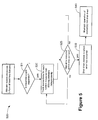
- the process 500 commences at block 505 where a plurality of system resources of the system 100 are allocated to form at least two domains.
- the system resources include the processor boards 125 and the I/O boards 130, which are allocated to the domains formed within the system 100.
- the process 500 determines if any of the expander boards 135 in the system 100 are configured in a split expander mode (i.e., an expander 135 having two boards 125, 130 from differing domains).
- the expander board 135 is operating in a non-split expander mode (i.e., where the two boards 125, 130 coupled to the expander 135 are from the same domain), the transactions of the boards 125, 130 coupled to the non-split expander are tracked for the single domain at block 515. If, on the other hand, it is determined that the expander board 135 is operating in a split mode, then the transactions for each of the boards 125, 130 that are coupled to the split expander 135 are tracked for each domain individually via the logic 320, 325 of the AXQ module 305 and the logic 330, 335 of the SDI module 335 at block 520.
- the center plane 110 determines whether an error has occurred within a domain of the system 100. If an error has not occurred with a domain of the system 100, the process 500 reverts back to either block 515 to track the transactions of a single domain for the non-split expander boards of the system 100, or to block 520 to track the transactions of each domain separately for the split expander board(s) of the system 100. If at block 525, it is determined that an error has occurred in a domain of the system 100, the center plane 110 shuts down the affected domain in which the error has occurred at bock 530.
- the center plane 110 shuts down the non-split expander boards of the system 100 that are coupled to the boards 125, 130 of the domain in which the error had occurred, thereby shutting down the affected domain.
- the center plane 110 may be configured to disable communications, block communications, power down, provide an idle mode of operation, suspend transactions, etc. of the affected system resources.
- the process 500 maintains the operation of the domain(s) not shut down by permitting the non-split expander boards of the unaffected domain(s) to operate, and by permitting the portion of the system resources of the split expander board(s) that were not affected by the domain that was shut down to continue to track the transactions of the unaffected domain in a separate and independent manner.
Landscapes
- Engineering & Computer Science (AREA)
- Theoretical Computer Science (AREA)
- General Engineering & Computer Science (AREA)
- Physics & Mathematics (AREA)
- General Physics & Mathematics (AREA)
- Quality & Reliability (AREA)
- Software Systems (AREA)
- Computer Hardware Design (AREA)
- Multi Processors (AREA)
- Hardware Redundancy (AREA)
Applications Claiming Priority (2)
| Application Number | Priority Date | Filing Date | Title |
|---|---|---|---|
| US963082 | 1997-11-03 | ||
| US09/963,082 US6877108B2 (en) | 2001-09-25 | 2001-09-25 | Method and apparatus for providing error isolation in a multi-domain computer system |
Publications (1)
| Publication Number | Publication Date |
|---|---|
| EP1296242A2 true EP1296242A2 (de) | 2003-03-26 |
Family
ID=25506724
Family Applications (1)
| Application Number | Title | Priority Date | Filing Date |
|---|---|---|---|
| EP02256621A Withdrawn EP1296242A2 (de) | 2001-09-25 | 2002-09-24 | Verfahren und Vorrichtung zur Zuweisung von Betriebsmitteln in einem System mit mehreren Domänen |
Country Status (3)
| Country | Link |
|---|---|
| US (1) | US6877108B2 (de) |
| EP (1) | EP1296242A2 (de) |
| JP (1) | JP2003186858A (de) |
Families Citing this family (6)
| Publication number | Priority date | Publication date | Assignee | Title |
|---|---|---|---|---|
| US6915370B2 (en) * | 2001-12-20 | 2005-07-05 | Intel Corporation | Domain partitioning in a multi-node system |
| US20050081080A1 (en) * | 2003-10-14 | 2005-04-14 | International Business Machines Corporation | Error recovery for data processing systems transferring message packets through communications adapters |
| US20050097141A1 (en) * | 2003-10-30 | 2005-05-05 | International Business Machines Corporation | Autonomic filesystem recovery |
| US20050165862A1 (en) * | 2004-01-12 | 2005-07-28 | International Business Machines Corporation | Autonomic and fully recovering filesystem operations |
| US7669073B2 (en) * | 2005-08-19 | 2010-02-23 | Stratus Technologies Bermuda Ltd. | Systems and methods for split mode operation of fault-tolerant computer systems |
| JP2010033506A (ja) * | 2008-07-31 | 2010-02-12 | Nec Corp | 二重化システム、および二重化システムにおける運用系決定方法 |
Family Cites Families (12)
| Publication number | Priority date | Publication date | Assignee | Title |
|---|---|---|---|---|
| US5055999A (en) * | 1987-12-22 | 1991-10-08 | Kendall Square Research Corporation | Multiprocessor digital data processing system |
| US5253342A (en) * | 1989-01-18 | 1993-10-12 | International Business Machines Corporation | Intermachine communication services |
| US5394554A (en) * | 1992-03-30 | 1995-02-28 | International Business Machines Corporation | Interdicting I/O and messaging operations from sending central processing complex to other central processing complexes and to I/O device in multi-system complex |
| US5598568A (en) * | 1993-05-06 | 1997-01-28 | Mercury Computer Systems, Inc. | Multicomputer memory access architecture |
| US6148377A (en) * | 1996-11-22 | 2000-11-14 | Mangosoft Corporation | Shared memory computer networks |
| US6074427A (en) | 1997-08-30 | 2000-06-13 | Sun Microsystems, Inc. | Apparatus and method for simulating multiple nodes on a single machine |
| US6332180B1 (en) * | 1998-06-10 | 2001-12-18 | Compaq Information Technologies Group, L.P. | Method and apparatus for communication in a multi-processor computer system |
| US6425094B1 (en) | 1999-08-09 | 2002-07-23 | Sun Microsystems, Inc. | Diagnostic cage for testing redundant system controllers |
| US6571360B1 (en) * | 1999-10-19 | 2003-05-27 | Sun Microsystems, Inc. | Cage for dynamic attach testing of I/O boards |
| US6748474B1 (en) * | 2000-02-25 | 2004-06-08 | Telica, Inc. | Midplane apparatus |
| US6636929B1 (en) * | 2000-04-06 | 2003-10-21 | Hewlett-Packard Development Company, L.P. | USB virtual devices |
| US6829729B2 (en) * | 2001-03-29 | 2004-12-07 | International Business Machines Corporation | Method and system for fault isolation methodology for I/O unrecoverable, uncorrectable error |
-
2001
- 2001-09-25 US US09/963,082 patent/US6877108B2/en not_active Expired - Lifetime
-
2002
- 2002-09-24 EP EP02256621A patent/EP1296242A2/de not_active Withdrawn
- 2002-09-25 JP JP2002279086A patent/JP2003186858A/ja active Pending
Also Published As
| Publication number | Publication date |
|---|---|
| US20030061538A1 (en) | 2003-03-27 |
| US6877108B2 (en) | 2005-04-05 |
| JP2003186858A (ja) | 2003-07-04 |
Similar Documents
| Publication | Publication Date | Title |
|---|---|---|
| US6985951B2 (en) | Inter-partition message passing method, system and program product for managing workload in a partitioned processing environment | |
| US20090043877A1 (en) | System for transferring standby resource entitlement | |
| US8024497B2 (en) | Distributing virtual input/output operations across multiple logical partitions | |
| EP0709779B1 (de) | Gemeinsam genutzte virtuelle Platten mit anwendungstransparenter Wiedergewinnung | |
| CN108829507B (zh) | 分布式数据库系统的资源隔离方法、装置和服务器 | |
| US6704812B2 (en) | Transparent and dynamic management of redundant physical paths to peripheral devices | |
| US20080147988A1 (en) | Multiprocessor System With Dynamic Cache Coherency Regions | |
| US8875153B2 (en) | Routing workloads based on relative queue lengths of dispatchers | |
| US20020129274A1 (en) | Inter-partition message passing method, system and program product for a security server in a partitioned processing environment | |
| US20020129172A1 (en) | Inter-partition message passing method, system and program product for a shared I/O driver | |
| US20080288963A1 (en) | Selective event registration | |
| US10481963B1 (en) | Load-balancing for achieving transaction fault tolerance | |
| KR100323255B1 (ko) | 업무인계시스템 | |
| WO2006097512A1 (en) | Resource allocation in computing systems | |
| CN111459654B (zh) | 服务器集群的部署方法、装置、设备及存储介质 | |
| US7096306B2 (en) | Distributed system with cross-connect interconnect transaction aliasing | |
| US6877108B2 (en) | Method and apparatus for providing error isolation in a multi-domain computer system | |
| US20110072433A1 (en) | Method to Automatically ReDirect SRB Routines to a ZIIP Eligible Enclave | |
| US6704823B1 (en) | Method and apparatus for dynamic allocation of interrupt lines through interrupt sharing | |
| US7509392B2 (en) | Creating and removing application server partitions in a server cluster based on client request contexts | |
| EP1304840A2 (de) | Verwaltung von Netzverbindungen in einem System | |
| US10891060B2 (en) | Data storage system binding virtual volumes to host-specific protocol endpoints | |
| US20030061326A1 (en) | Managing one or more domains in a system | |
| US7536422B2 (en) | Method for process substitution on a database management system | |
| CN101147131A (zh) | 用于增强远程调用性能的多级高速缓存器装置和方法 |
Legal Events
| Date | Code | Title | Description |
|---|---|---|---|
| PUAI | Public reference made under article 153(3) epc to a published international application that has entered the european phase |
Free format text: ORIGINAL CODE: 0009012 |
|
| AK | Designated contracting states |
Kind code of ref document: A2 Designated state(s): AT BE BG CH CY CZ DE DK EE ES FI FR GB GR IE IT LI LU MC NL PT SE SK TR Designated state(s): AT BE BG CH CY CZ DE DK EE ES FI FR GB GR IE IT LI LU MC NL PT SE SK TR |
|
| AX | Request for extension of the european patent |
Extension state: AL LT LV MK RO SI |
|
| RAP1 | Party data changed (applicant data changed or rights of an application transferred) |
Owner name: SUN MICROSYSTEMS, INC. |
|
| RIN1 | Information on inventor provided before grant (corrected) |
Inventor name: PHELPS, ANDREW E. Inventor name: GRAF, ERIC E. Inventor name: WEISS, STEVEN F. Inventor name: KANE, DONALD |
|
| STAA | Information on the status of an ep patent application or granted ep patent |
Free format text: STATUS: THE APPLICATION HAS BEEN WITHDRAWN |
|
| 18W | Application withdrawn |
Effective date: 20041109 |