EP1296485B1 - System und Verfahren für eine hardware-basierte Wiederzusammensetzung von fragmentierten Paketen - Google Patents
System und Verfahren für eine hardware-basierte Wiederzusammensetzung von fragmentierten Paketen Download PDFInfo
- Publication number
- EP1296485B1 EP1296485B1 EP02256415A EP02256415A EP1296485B1 EP 1296485 B1 EP1296485 B1 EP 1296485B1 EP 02256415 A EP02256415 A EP 02256415A EP 02256415 A EP02256415 A EP 02256415A EP 1296485 B1 EP1296485 B1 EP 1296485B1
- Authority
- EP
- European Patent Office
- Prior art keywords
- data packet
- service identifier
- data
- reassembly
- reassembled
- Prior art date
- Legal status (The legal status is an assumption and is not a legal conclusion. Google has not performed a legal analysis and makes no representation as to the accuracy of the status listed.)
- Expired - Lifetime
Links
- 238000000034 method Methods 0.000 title claims abstract description 11
- 239000012634 fragment Substances 0.000 claims abstract description 86
- 238000004891 communication Methods 0.000 description 24
- 238000013467 fragmentation Methods 0.000 description 13
- 238000006062 fragmentation reaction Methods 0.000 description 13
- 238000004590 computer program Methods 0.000 description 8
- 238000011144 upstream manufacturing Methods 0.000 description 6
- 230000003287 optical effect Effects 0.000 description 4
- 238000010586 diagram Methods 0.000 description 3
- 239000000835 fiber Substances 0.000 description 3
- 125000004122 cyclic group Chemical group 0.000 description 2
- 230000006870 function Effects 0.000 description 2
- 230000007246 mechanism Effects 0.000 description 2
- 238000012163 sequencing technique Methods 0.000 description 2
- XUIMIQQOPSSXEZ-UHFFFAOYSA-N Silicon Chemical compound [Si] XUIMIQQOPSSXEZ-UHFFFAOYSA-N 0.000 description 1
- 206010000210 abortion Diseases 0.000 description 1
- 230000009471 action Effects 0.000 description 1
- 230000008901 benefit Effects 0.000 description 1
- 230000005540 biological transmission Effects 0.000 description 1
- 230000001413 cellular effect Effects 0.000 description 1
- 230000001419 dependent effect Effects 0.000 description 1
- 230000006872 improvement Effects 0.000 description 1
- 238000009448 modified atmosphere packaging Methods 0.000 description 1
- 235000019837 monoammonium phosphate Nutrition 0.000 description 1
- 230000004044 response Effects 0.000 description 1
- 229910052710 silicon Inorganic materials 0.000 description 1
- 239000010703 silicon Substances 0.000 description 1
Images


Classifications
-
- H—ELECTRICITY
- H04—ELECTRIC COMMUNICATION TECHNIQUE
- H04N—PICTORIAL COMMUNICATION, e.g. TELEVISION
- H04N7/00—Television systems
- H04N7/16—Analogue secrecy systems; Analogue subscription systems
- H04N7/173—Analogue secrecy systems; Analogue subscription systems with two-way working, e.g. subscriber sending a programme selection signal
- H04N7/17309—Transmission or handling of upstream communications
-
- H—ELECTRICITY
- H04—ELECTRIC COMMUNICATION TECHNIQUE
- H04L—TRANSMISSION OF DIGITAL INFORMATION, e.g. TELEGRAPHIC COMMUNICATION
- H04L12/00—Data switching networks
- H04L12/28—Data switching networks characterised by path configuration, e.g. LAN [Local Area Networks] or WAN [Wide Area Networks]
- H04L12/2801—Broadband local area networks
-
- H—ELECTRICITY
- H04—ELECTRIC COMMUNICATION TECHNIQUE
- H04L—TRANSMISSION OF DIGITAL INFORMATION, e.g. TELEGRAPHIC COMMUNICATION
- H04L47/00—Traffic control in data switching networks
- H04L47/10—Flow control; Congestion control
-
- H—ELECTRICITY
- H04—ELECTRIC COMMUNICATION TECHNIQUE
- H04L—TRANSMISSION OF DIGITAL INFORMATION, e.g. TELEGRAPHIC COMMUNICATION
- H04L47/00—Traffic control in data switching networks
- H04L47/10—Flow control; Congestion control
- H04L47/34—Flow control; Congestion control ensuring sequence integrity, e.g. using sequence numbers
-
- H—ELECTRICITY
- H04—ELECTRIC COMMUNICATION TECHNIQUE
- H04L—TRANSMISSION OF DIGITAL INFORMATION, e.g. TELEGRAPHIC COMMUNICATION
- H04L47/00—Traffic control in data switching networks
- H04L47/10—Flow control; Congestion control
- H04L47/43—Assembling or disassembling of packets, e.g. segmentation and reassembly [SAR]
-
- H—ELECTRICITY
- H04—ELECTRIC COMMUNICATION TECHNIQUE
- H04L—TRANSMISSION OF DIGITAL INFORMATION, e.g. TELEGRAPHIC COMMUNICATION
- H04L69/00—Network arrangements, protocols or services independent of the application payload and not provided for in the other groups of this subclass
- H04L69/12—Protocol engines
-
- H—ELECTRICITY
- H04—ELECTRIC COMMUNICATION TECHNIQUE
- H04L—TRANSMISSION OF DIGITAL INFORMATION, e.g. TELEGRAPHIC COMMUNICATION
- H04L69/00—Network arrangements, protocols or services independent of the application payload and not provided for in the other groups of this subclass
- H04L69/16—Implementation or adaptation of Internet protocol [IP], of transmission control protocol [TCP] or of user datagram protocol [UDP]
- H04L69/166—IP fragmentation; TCP segmentation
-
- H—ELECTRICITY
- H04—ELECTRIC COMMUNICATION TECHNIQUE
- H04L—TRANSMISSION OF DIGITAL INFORMATION, e.g. TELEGRAPHIC COMMUNICATION
- H04L69/00—Network arrangements, protocols or services independent of the application payload and not provided for in the other groups of this subclass
- H04L69/30—Definitions, standards or architectural aspects of layered protocol stacks
- H04L69/32—Architecture of open systems interconnection [OSI] 7-layer type protocol stacks, e.g. the interfaces between the data link level and the physical level
- H04L69/322—Intralayer communication protocols among peer entities or protocol data unit [PDU] definitions
- H04L69/324—Intralayer communication protocols among peer entities or protocol data unit [PDU] definitions in the data link layer [OSI layer 2], e.g. HDLC
Definitions
- the present invention is generally related to offloading cable modem termination system (CMTS) software by using hardware to reassemble fragmented frames or packets from a cable modem.
- CMTS cable modem termination system
- Rapid data access and exchange is partly dependent upon how efficiently bandwidth is allocated to a data provider in order for the data provider to transfer the requested data to a user via one of the communication mediums mentioned above.
- Cable modems provide asynchronous communications on cable networks.
- a user connects a cable modem to the TV outlet for his or her cable TV, and the cable TV operator connects a cable modem termination system ("CMTS") in the operator's headend.
- CMTS cable modem termination system
- the CMTS is a central device for connecting the cable network to a data network like the Internet.
- the CMTS is a central distribution point for a cable system. Data flows "downstream" from the CMTS to the cable modem (i.e., downstream communication). Alternatively, data flows "upstream” from the cable modem to the CMTS (i.e., upstream communication).
- DOCSIS Data Over Cable Service Interface Specification
- a cable modem forwards or provides data via asynchronous communications on cable networks.
- the cable modem receives data from a user that needs to be transferred via a cable network.
- the cable modem in order for the cable modem to transfer the data via a cable network it must request that the CMTS grant to it the necessary bandwidth to send a data packet or frame. At times the CMTS only grants the cable modem enough bandwidth to send part of the packet.
- the cable modem sends as much of the packet as will fit in the bandwidth grant, along with a special "fragment header" indicating that it is sending a fragment and including a sequence number for the fragment and flags indicating when the fragment is the first or last fragment of the packet.
- a cyclic redundancy check CRC
- Subsequent bandwidth grants from the CMTS may be large enough to fill all or part of the remainder of the packet.
- the cable modem sends another fragment as above, and so on until the entire remainder of the packet fits in a bandwidth grant.
- the cable modem sets a flag indicating that this fragment is the last fragment in the packet.
- fragments sent by the cable modem must be reassembled to reconstruct the original frame or packet by the CMTS software.
- the reassembly operation involves removing the special fragment header and CRC, combining the data from each fragment in the correct order, maintaining the session state, and using the session state to check for error conditions such as lost fragments or incorrect sequence numbers.
- the reassembly of fragmented frames is handled by software running on an embedded CPU in the CMTS. This requires the CMTS software to do detailed parsing of every frame, even non-fragmented ones (since arrival of a non-fragmented frame can affect the state of a fragmentation session). This burden on software reduces system performance and increases cost by requiring a higher performance CPU or multiple CPUs.
- fragmentation is enabled for a DOCSIS 1.1 modem
- fragmentation is enabled on a per-Service Flow basis via the Request/Transmission Policy Configuration Settings.
- fragmentation is initiated by the CMTS when it grants bandwidth to a particular CM with a grant size that is smaller than the corresponding bandwidth request from the CM. This is known as a Partial Grant.
- Section 8.3.1 further specifies CM Fragmentation Support, especially Fragmentation Rules (section 8.3.1.1), inter alia: step1 that if time fragmentation is enabled and the grant size is smaller than the request, the CM must fill the partial grant it receives with the maximum amount of data (fragment payload) possible accounting for fragmentation overhead and physical layer overhead; step 2 that the CM must send up a piggyback request any time there is no later grant or grant pending for that SID in MAPs that have been received at the CM; step 3 that if the CM is fragmenting a frame, any piggyback request must be made in the BPI EHDR portion of the fragment header; and step 10 that the CM must increment the fragment sequence number sequentially for each fragment of a frame transmitted.
- section 8.3.1.1 inter alia: step1 that if time fragmentation is enabled and the grant size is smaller than the request, the CM must fill the partial grant it receives with the maximum amount of data (fragment payload) possible accounting for fragmentation overhead and physical layer overhead; step 2 that
- the present invention by using hardware instead of software to reassemble fragmented frames or packets from a data provider, obtains significant savings in CPU cycles for the CMTS software.
- the present invention is described in terms of being utilized with a cable network. It should be understood that the present invention is not limited to use with a cable network. In fact, the present invention may be used with any communication medium, including but not limited to, the Internet, intranets, fiber optic networks, wireless networks and satellites.
- Data in the present invention includes any type of information that is deterministic (such as voice traffic ), as well as with best effort data traffic including but not limited to digital, voice, video, and audio.
- deterministic such as voice traffic
- best effort data traffic including but not limited to digital, voice, video, and audio.
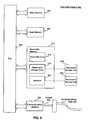
- FIG. 1 is a block diagram representing an example operating environment of the present invention. It should be understood that the example operating environment in FIG. 1 is shown for illustrative purposes only and does not limit the invention.
- a cable modem termination system (CMTS) 102 further includes a cable modem scheduler 110.
- CMTS 102 further includes a CMTS scheduler 112, a MAC 113 (media access controller) and an external memory 120.
- MAC 113 includes a reassembly processor 114 and an internal memory 116.
- Internal memory 116 includes a SID (service identifier) table 118.
- External memory 120 includes a SID table 122.
- cable modem 104 forwards or provides data via asynchronous communications on cable networks via upstream communication 106.
- Cable modem 104 receives data from a user that needs to be transferred via a cable network.
- CMTS 102 grant to it the necessary bandwidth via downstream communication 108 to send a data packet or frame.
- Cable modem scheduler 110 of cable modem 104 is responsible for multiplexing the internal traffic (i.e., requesting the necessary bandwidth that cable modem 104 needs to transfer its current types of data). Cable modem scheduler 110 must take into consideration the different priorities given to the current data to be transferred and to request bandwidth from CMTS 102 accordingly.
- CMTS 102 is a central device for connecting the cable network to a data network.
- CMTS scheduler 112 is a bandwidth manager that decides how to grant available bandwidth according to the current bandwidth requests.
- a connection admission control (not shown) decides whether or not to admit more traffic in the system.
- CMTS 102 In order for cable modem 104 to transfer data via a cable network it must request that CMTS 102 grant to it the necessary bandwidth via downstream communication 108 to send a data packet or frame. At times CMTS 102 only grants cable modem 104 enough bandwidth to send part of the packet. In this case, cable modem 104 sends as much of the packet as will fit in the bandwidth grant, along with a special "fragment header" indicating that it is sending a fragment.
- the fragment header includes, but is not limited to, a sequence number for the fragment (indicating the fragment's order in the data packet) and flags indicating when the fragment is the first or last fragment of the packet. With fragmentation, a CRC (cyclic redundancy check) is appended to the fragment that covers only the bytes in the fragment. CRC is described in more detail below.
- Subsequent bandwidth grants from CMTS 102 may be large enough to fill all or part of the remainder of the packet.
- cable modem 104 sends another fragment as above, and so on until the entire remainder of the packet fits in a bandwidth grant.
- cable modem 104 sets a flag indicating that this fragment is the last fragment in the packet.
- Reassembly processor 114 is responsible for reassembling the data fragments, thereby offloading the CMTS software. Reassembly processor 114 maintains SID table 118 in internal memory 116 and SID table 122 in external memory 120. SID table 118 in internal memory 116 contains a bit per SID to indicate if a reassembly session is in progress for that SID. The present invention use of internal memory 116 reduces processing time and improves performance since the "session in progress" status must be checked for every packet that arrives from cable modem104 and access to internal memory 116 is much faster than access to external memory 120.
- SID table 122 of external memory 120 need not be accessed at all, so the choice of the present invention to store the information it does in internal memory 116 also gives a performance improvement.
- SID table 122 in external memory 120 stores all other state information for reassembly sessions in progress.
- Internal table 118 in internal memory 116 is kept small by the present invention to reduce silicon area, yet provides the critical information to decide if further action is required in low latency internal memory.
- the larger state information is kept in external memory 120.
- Reassembly processor 114 provides a method to detect fragment received from cable modem 104.
- the fragments are associated by the SID number from which the fragment was received and the sequence number contained in the fragment header. Received fragments are stored in external memory 120 until all fragments of a particular session are received. Correct sequencing of the fragments are assured by the sequence number. Once the last flag indicates that all fragments are received, reassembly processor 114 reassembles the fragments by concatenating the correctly sequenced fragments. When a sequencing error occurs, then the received fragment is discarded. Key features of the present invention is the ability to store packets or fragments for varying amounts of time and the ability to tag the fragments with the SID and sequence numbers.
- a CRC is appended to the fragment that covers only the bytes in the fragment.
- a CRC is created by passing the fragment data through an algorithm (either hardware and/or software) to create a unique value from the fragment data. This value (i.e., CRC) is sent along with the packet to CMTS 102, and at CMTS 102 the same operation is repeated and the new value compared to the sent value. If the two values match, then there is a high probability the received data is correct.
- reassembly processor 114 of present invention bypasses the CMTS software and reassembles fragmented frames or packets from a data provider (thereby obtaining significant savings in CPU cycles for the CMTS software), is described next with the flowchart in FIG. 2 .
- step 202 cable modem 104 requests bandwidth from CMTS 102 in order to transmit a data packet. Control then passes to step 204.
- step 204 CMTS 102 grants to cable modem 104 bandwidth that cannot accommodate the entire original data packet. Control then passes to step 206.
- step 206 cable modem 104 fits as much data as possible into the granted bandwidth. Control then passes to step 208.
- step 208 cable modem 104 attaches a fragment header and a CRC to the fragment and forwards the fragment in the granted bandwidth to reassembly processor 114. Control then passes to step 210.
- reassembly processor 114 tags the fragment with the SID and sequence number and stores the fragment in external memory 120 for the fragment session. For the first fragment ofthe data packet, reassembly processor 114 indicates in SID table 118 in internal memory 116 that a reassembly session is in progress for the SID. Control then passes to step 211.
- reassembly processor 114 checks for error conditions. An error condition would occur if one of the fragments was lost while it was being transferred from cable modem 104 via upstream communication. Reassembly processor 114 notes this type of error when there is a missing sequence number (e.g., the sequence numbers have incremented by a number other than one). Also, if reassembly processor 114 receives a first flag set for a different SID prior to it receiving the last flag set for the SID being processed, then it knows the last fragment for the SID being processed has been lost. Control then passes to step 212.
- step 212 if an error has been detected, then control passes to step 216 where the reassembly session is aborted and external memory released. Alternatively, control passes to step 213.
- reassembly processor 114 determines whether the last fragment received has its last flag set in the header fragment. If the last flag is set (indicating that this fragment is the last fragment in the data packet), then control passes to step 214. If the last flag is not set (indicating that there are still more fragments remaining in the data packet), then control passes to step 204. Here, steps 204 through 212 are repeated until the last flag is set in a fragment.
- reassembly processor 114 concatenates the fragments in the correct sequence based on the sequence numbers of the fragments.
- the logic of the present invention performs reassembly including error checking.
- the combination of fragments into a complete packet is accomplished with a linked list data structure.
- a pointer to it is stored along with the previous fragment.
- all fragments are read in beginning with the first and following the links in the linked list to subsequent fragments to give the whole packet (or frame).
- An advantage of using a linked list data structure is that memory can be allocated in fragment-sized chunks and as many chunks as needed can be linked together, rather than allocating enough memory for a maximum-length reassembled packet even if the final reassembled packet ends up being shorter in length. Control then passes to step 216.
- reassembly processor 114 aborts the reassembly session and releases the memory utilized in external memory 120 to store the fragments.
- the number of reassembly sessions is not limited by the processing of reassembly processor 114 itself, but only by memory available to hold fragments.
- Reassembly processor 114 also indicates in SID table 118 in internal memory 116 that a reassembly session is no longer in progress for the SID.
- a mechanism may also be provided by the invention to enable manual aborting of reassembly sessions.
- the CMTS software indicates for which SID it wants to abort reassembly, and reassembly processor 114 frees up any memory in use and clears the state for that reassembly session.
- the CMTS software could use the manual aborting feature of the present invention when it deallocates a SID in order to guarantee that memory in use for fragments from the deallocated SID is freed.
- the flowchart in FIG. 2 ends at this point.
- CMTS 102, CMTS scheduler 112, cable modem 104, cable modem scheduler 110, MAC 113 and reassembly processor 114 may be implemented using computer 300 as shown in FIG. 3 . Obviously, more than one of these functional components could be implemented on a single computer 300.
- the present invention may be implemented using hardware, or a combination of hardware and software and may be implemented in a computer system or other processing system.
- the invention is directed toward one or more computer systems capable of carrying out the functionality described herein.
- the computer system 300 includes one or more processors, such as processor 304.
- the processor 304 is connected to a communication bus 306.
- Various software embodiments are described in terms of this example computer system. After reading this description, it will become apparent to a person skilled in the relevant art how to implement the invention using other computer systems and/or computer architectures.
- Computer system 300 also includes a main memory 308, preferably random access memory (RAM), and can also include a secondary memory 310.
- the secondary memory 310 can include, for example, a hard disk drive 312 and/or a removable storage drive 314, representing a floppy disk drive, a magnetic tape drive, an optical disk drive, etc.
- the removable storage drive 314 reads from and/or writes to a removable storage unit 318 in a well known manner.
- Removable storage unit 318 represents a floppy disk, magnetic tape, optical disk, etc. which is read by and written to by removable storage drive 314.
- the removable storage unit 318 includes a computer usable storage medium having stored therein computer software and/or data.
- secondary memory 310 may include other similar means for allowing computer programs or other instructions to be loaded into computer system 300.
- Such means can include, for example, a removable storage unit 322 and an interface 320. Examples of such can include a program cartridge and cartridge interface (such as that found in video game devices), a removable memory chip (such as an EPROM, or PROM) and associated socket, and other removable storage units 322 and interfaces 320 which allow software and data to be transferred from the removable storage unit 318 to computer system 300.
- Computer system 300 can also include a communications interface 324.
- Communications interface 324 allows software and data to be transferred between computer system 300 and external devices. Examples of communications interface 324 can include a modem, a network interface (such as an Ethernet card), a communications port, a PCMCIA slot and card, etc.
- Software and data transferred via communications interface 324 are in the form of signals which can be electronic, electromagnetic, optical or other signals capable of being received by communications interface 324. These signals 326 are provided to communications interface via a channel 328. This channel 328 carries signals 326 and can be implemented using wire or cable, fiber optics, a phone line, a cellular phone link, an RF link and other communications channels.
- computer program medium and “computer usable medium” are used to generally refer to media such as removable storage device 318, a hard disk installed in hard disk drive 312, and signals 326. These computer program products are means for providing software to computer system 300.
- Computer programs are stored in main memory and/or secondary memory 310. Computer programs can also be received via communications interface 324. Such computer programs, when executed, enable the computer system 300 to perform the features of the present invention as discussed herein. In particular, the computer programs, when executed, enable the processor 304 to perform the features of the present invention. Accordingly, such computer programs represent controllers of the computer system 300.
- the invention is implemented primarily in hardware using, for example, hardware components such as application specific integrated circuits (ASICs).
- ASICs application specific integrated circuits
- the invention is implemented using a combination of both hardware and software.
Landscapes
- Engineering & Computer Science (AREA)
- Signal Processing (AREA)
- Computer Networks & Wireless Communication (AREA)
- Computer Security & Cryptography (AREA)
- Multimedia (AREA)
- Data Exchanges In Wide-Area Networks (AREA)
- Communication Control (AREA)
Claims (15)
- System (102) zum Wiederzusammensetzen fragmentierter Pakete von einem Datenlieferanten (104), das aufweist:eine Einrichtung zum Empfangen einer Bandbreitenanfrage zum Übertragen eines Datenpakets von dem Datenlieferanten (104);eine Einrichtung zum Zuteilen von Bandbreite (112) zu dem Datenlieferanten (104), wobei die zugeteilte Bandbreite geringer ist, als die angefragte Bandbreite;eine Einrichtung zum Empfangen eines Teils (113) des Datenpakets in der zugeteilten Bandbreite von dem Datenlieferanten (104), wobei der Teil des Datenpakets einen Fragment-Header aufweist, wobei der Fragment-Header eine Folgenummer für den Teil des Datenpakets aufweist;gekennzeichnet durcheine Einrichtung zum Angeben in einem internen Speicher (116), ob eine Wiederzusammensetzungs-Sitzung für einen bestimmten Service-Identifizierer im Gange ist, wenn ein Fragment-Header oder fragmentierte Pakete von einem Datenlieferanten (104) durch die Empfangseinrichtung (113) empfangen werden;eine Einrichtung zum Markieren des Teils des Datenpakets mit dem bestimmten Service-Identifizierer;eine Einrichtung zum Speichern (113) des Teils des Datenpakets zusammen mit dem bestimmten Service-Identifizierer in einer Service-Identifizierer-Tabelle (122) in einem externen Speicher (120) nur dann, wenn eine Wiederzusammensetzungs-Sitzung für den Teil des Datenpakets im Gange ist, wobei auf den bestimmten Service-Identifizierer in der Service-Identifizierer-Tabelle (122) nicht zugegriffen wird, wenn keine Wiederzusammensetzungs-Sitzung für den bestimmten Service-Identifizierer im Gange ist, wobei die Service-Identifizierer-Tabelle (122) sich in dem externen Speicher (120) befindet;eine Einrichtung zum Angeben, dass die Wiederzusammensetzungs-Sitzung für den bestimmten Service-Identifizierer nicht länger im Gange ist, wenn ein Fehler ermittelt wird, oder wenn die Wiederzusammensetzungs-Sitzung für den bestimmten Service-Identifizierer abgeschlossen ist; undeine Einrichtung zum Wiederzusammensetzen (113, 114) des Datenpakets durch Zusammenfügen des Teils des Datenpakets mit anderen Teilen des Datenpakets in der korrekten Abfolge, basierend auf den Folgenummern in dem Fragment-Header, wobei jedes wieder zusammenzusetzende Datenpaket mit dem Service-Identifizierer assoziiert und in dem externen Speicher (120) gespeichert wird, so dass ein wieder zusammengesetztes Datenpaket gebildet wird, wobeidie Einrichtung zum Wiederzusammensetzen (113, 114) in Hardware implementiert ist.
- System nach einem der vorhergehenden Ansprüche, wobei der Datenlieferant ein Kabelmodem (104) ist.
- System nach einem der vorhergehenden Ansprüche, wobei die Einrichtung zum Wiederzusammensetzen (114) eine verkettete Liste verwendet, um das wieder zusammengesetzte Datenpaket wieder zusammenzusetzen.
- System nach einem der vorhergehenden Ansprüche, das des Weiteren eine Einrichtung zur Fehlerprüfung jedes Teils des Datenpakets aufweist, indem sie eine zyklische Redundanzprüfung, die dem Teil des Datenpakets durch den Datenlieferanten (104) angehängt wird, mit einer zyklischen Redundanzprüfung des empfangenen Teils des Datenpakets vergleicht.
- System nach einem der vorhergehenden Ansprüche, das des Weiteren eine Einrichtung zur Fehlerprüfung des wieder zusammengesetzten Datenpakets aufweist.
- System nach einem der vorhergehenden Ansprüche, das des Weiteren eine Einrichtung zum Freigeben des externen Speichers (120), der den Teil des wieder zusammengesetzten Datenpakets speichert, aufweist.
- System nach Anspruch 6, das des Weiteren aufweist:eine Einrichtung zum Angeben, dass der Service-Identifizierer sich in einem Wiederzusammensetzungs-Zustand befindet;eine Einrichtung zum Angeben, dass der Service-Identifizierer sich nicht länger in einem Wiederzusammensetzungs-Zustand befindet, sobald das Datenpaket erstellt worden ist.
- System nach einem der vorhergehenden Ansprüche, wobei die Einrichtung zum Empfangen (113), die Einrichtung zum Speichern (113) und die Einrichtung zum Wiederzusammensetzen (113, 114) in einem Media Access Controller (113) integriert sind.
- Verfahren zum Wiederzusammensetzen fragmentierter Datenpakete von einem Datenlieferanten, das die folgenden Schritte umfasst:Empfangen einer Bandbreitenanfrage zum Übertragen eines Datenpakets von dem Datenlieferanten;Zuteilen von Bandbreite zu dem Datenlieferanten, wobei die zugeteilte Bandbreite geringer ist, als die angefragte Bandbreite;Empfangen eines Teils des Datenpakets in der zugeteilten Bandbreite von dem Datenlieferanten, wobei der Teil des Datenpakets einen Fragment-Header aufweist, wobei der Fragment-Header eine Folgenummer für den Teil des Datenpakets aufweist;gekennzeichnet durchAngeben in einem internen Speicher (116), ob eine Wiederzusammensetzungs-Sitzung für einen bestimmten Service-Identifizierer im Gange ist, wenn ein Fragment-Header oder fragmentierte Pakete von einem Datenlieferanten (104) durch die Empfangseinrichtung (113) empfangen werden;Markieren des Teils des Datenpakets mit dem bestimmten Service-Identifizierer;Speichern des Teils des Datenpakets zusammen mit dem bestimmten Service-Identifizierer in einer Service-Identifizierer-Tabelle (122) in einem externen Speicher (120) nur dann, wenn eine Wiederzusammensetzungs-Sitzung für den Teil des Datenpakets im Gange ist, wobei auf den bestimmten Service-Identifizierer in der Service-Identifizierer-Tabelle (122) nicht zugegriffen wird, wenn keine Wiederzusammensetzungs-Sitzung für den bestimmten Service-Identifizierer im Gange ist;Angeben, dass die Wiederzusammensetzungs-Sitzung für den bestimmten Service-Identifizierer nicht länger im Gange ist, wenn ein Fehler ermittelt wird, oder wenn die Wiederzusammensetzung für den bestimmten Service-Identifizierer abgeschlossen ist; undWiederzusammensetzen des Datenpakets durch Zusammenfügen des Teils des Datenpakets mit anderen Teilen des Datenpakets in der korrekten Abfolge, basierend auf den Folgenummern in dem Fragment-Header, wobei jedes wieder zusammenzusetzende Datenpaket mit dem Service-Identifizierer assoziiert und in dem externen Speicher (120) gespeichert wird, so dass ein wieder zusammengesetztes Datenpaket gebildet wird.
- Verfahren nach Anspruch 9, wobei der Datenlieferant ein Kabelmodem (104) ist.
- Verfahren nach Anspruch 9 oder Anspruch 10, wobei der Schritt des Wiederzusammensetzens eine verkettete Liste verwendet, um das wieder zusammengesetzte Datenpaket zu erstellen.
- Verfahren nach einem der Ansprüche 9 bis 11, das des Weiteren einen Schritt der Fehlerprüfung jedes Teils des Datenpakets umfasst, indem eine zyklische Redundanzprüfung, die dem Teil des Datenpakets durch den Datenlieferanten (104) angehängt wird, mit einer zyklischen Redundanzprüfung des empfangenen Teils des Datenpakets verglichen wird.
- Verfahren nach einem der Ansprüche 9 bis 12, das des Weiteren den Schritt der Fehlerprüfung des wieder zusammengesetzten Datenpakets umfasst.
- Verfahren nach einem der Ansprüche 9 bis 13, das des Weiteren den Schritt des Freigebens des externen Speichers (120), der den Teil des wieder zusammengesetzten Datenpakets speichert, umfasst.
- Verfahren nach einem der Ansprüche 9 bis 14, das des Weiteren die folgenden Schritte umfasst:Angeben, dass der Service-Identifizierer sich in einem Wiederzusammensetzungs-Zustand befindet; undAngeben, dass der Service-Identifizierer sich nicht länger in einem Wiederzusammensetzungs-Zustand befindet, sobald das wieder zusammengesetzte Datenpaket erstellt worden ist.
Applications Claiming Priority (2)
| Application Number | Priority Date | Filing Date | Title |
|---|---|---|---|
| US960725 | 2001-09-24 | ||
| US09/960,725 US6779050B2 (en) | 2001-09-24 | 2001-09-24 | System and method for hardware based reassembly of a fragmented packet |
Publications (3)
| Publication Number | Publication Date |
|---|---|
| EP1296485A2 EP1296485A2 (de) | 2003-03-26 |
| EP1296485A3 EP1296485A3 (de) | 2005-12-21 |
| EP1296485B1 true EP1296485B1 (de) | 2009-12-16 |
Family
ID=25503537
Family Applications (1)
| Application Number | Title | Priority Date | Filing Date |
|---|---|---|---|
| EP02256415A Expired - Lifetime EP1296485B1 (de) | 2001-09-24 | 2002-09-13 | System und Verfahren für eine hardware-basierte Wiederzusammensetzung von fragmentierten Paketen |
Country Status (4)
| Country | Link |
|---|---|
| US (4) | US6779050B2 (de) |
| EP (1) | EP1296485B1 (de) |
| AT (1) | ATE452485T1 (de) |
| DE (1) | DE60234745D1 (de) |
Families Citing this family (56)
| Publication number | Priority date | Publication date | Assignee | Title |
|---|---|---|---|---|
| US7639617B2 (en) | 2001-06-27 | 2009-12-29 | Cisco Technology, Inc. | Upstream physical interface for modular cable modem termination system |
| US7688828B2 (en) | 2001-06-27 | 2010-03-30 | Cisco Technology, Inc. | Downstream remote physical interface for modular cable modem termination system |
| US7209442B1 (en) * | 2001-06-27 | 2007-04-24 | Cisco Technology, Inc. | Packet fiber node |
| US6779050B2 (en) * | 2001-09-24 | 2004-08-17 | Broadcom Corporation | System and method for hardware based reassembly of a fragmented packet |
| US7599360B2 (en) * | 2001-12-26 | 2009-10-06 | Cisco Technology, Inc. | Methods and apparatus for encapsulating a frame for transmission in a storage area network |
| US7499410B2 (en) * | 2001-12-26 | 2009-03-03 | Cisco Technology, Inc. | Fibre channel switch that enables end devices in different fabrics to communicate with one another while retaining their unique fibre channel domain—IDs |
| US7319666B2 (en) * | 2002-02-06 | 2008-01-15 | Thomson Licensing | Method and apparatus for concatenating and piggybacking data packets |
| US7080308B2 (en) * | 2002-03-22 | 2006-07-18 | Intel Corporation | Method and apparatus to perform error control |
| US7406034B1 (en) | 2002-04-01 | 2008-07-29 | Cisco Technology, Inc. | Methods and apparatus for fibre channel frame delivery |
| US7616637B1 (en) * | 2002-04-01 | 2009-11-10 | Cisco Technology, Inc. | Label switching in fibre channel networks |
| US7206288B2 (en) * | 2002-06-12 | 2007-04-17 | Cisco Technology, Inc. | Methods and apparatus for characterizing a route in fibre channel fabric |
| US7089486B1 (en) * | 2002-08-16 | 2006-08-08 | Juniper Networks, Inc. | Context switching for on-the-fly processing of fragmented frames |
| US7433326B2 (en) * | 2002-11-27 | 2008-10-07 | Cisco Technology, Inc. | Methods and devices for exchanging peer parameters between network devices |
| US20040240472A1 (en) * | 2003-05-28 | 2004-12-02 | Alok Kumar | Method and system for maintenance of packet order using caching |
| US7583704B1 (en) | 2003-06-10 | 2009-09-01 | Carl Walker | Synchronizing separated upstream and downstream channels of cable modem termination systems |
| US8325717B2 (en) * | 2003-07-30 | 2012-12-04 | Foundry Networks, Llc | Method and system for IP fragmentation handling |
| US7532627B2 (en) * | 2004-05-25 | 2009-05-12 | Cisco Technology, Inc. | Wideband upstream protocol |
| US7835274B2 (en) | 2004-05-25 | 2010-11-16 | Cisco Technology, Inc. | Wideband provisioning |
| US7864686B2 (en) | 2004-05-25 | 2011-01-04 | Cisco Technology, Inc. | Tunneling scheme for transporting information over a cable network |
| US8102854B2 (en) | 2004-05-25 | 2012-01-24 | Cisco Technology, Inc. | Neighbor discovery proxy with distributed packet inspection scheme |
| US8149833B2 (en) | 2004-05-25 | 2012-04-03 | Cisco Technology, Inc. | Wideband cable downstream protocol |
| US7646786B2 (en) | 2004-05-25 | 2010-01-12 | Cisco Technology, Inc. | Neighbor discovery in cable networks |
| US7720101B2 (en) * | 2004-05-25 | 2010-05-18 | Cisco Technology, Inc. | Wideband cable modem with narrowband circuitry |
| US7817553B2 (en) * | 2004-05-25 | 2010-10-19 | Cisco Technology, Inc. | Local area network services in a cable modem network |
| US7539208B2 (en) * | 2004-05-25 | 2009-05-26 | Cisco Technology, Inc. | Timing system for modular cable modem termination system |
| JP4490331B2 (ja) * | 2004-08-03 | 2010-06-23 | 富士通株式会社 | 断片パケット処理方法及びこれを用いるパケット転送装置 |
| US7593324B2 (en) | 2004-10-25 | 2009-09-22 | Cisco Technology, Inc. | Graceful port shutdown protocol for fibre channel interfaces |
| US7991007B2 (en) * | 2004-10-29 | 2011-08-02 | Broadcom Corporation | Method and apparatus for hardware packets reassembly in constrained networks |
| US7916628B2 (en) * | 2004-11-01 | 2011-03-29 | Cisco Technology, Inc. | Trunking for fabric ports in fibre channel switches and attached devices |
| US7649844B2 (en) * | 2004-12-29 | 2010-01-19 | Cisco Technology, Inc. | In-order fibre channel packet delivery |
| WO2006116195A1 (en) * | 2005-04-21 | 2006-11-02 | Sinett Corporation | Methods and systems for fragmentation and reassembly for ip tunnels |
| US7630361B2 (en) | 2005-05-20 | 2009-12-08 | Cisco Technology, Inc. | Method and apparatus for using data-over-cable applications and services in non-cable environments |
| US7970000B2 (en) * | 2005-08-03 | 2011-06-28 | Cisco Technology, Inc. | Increasing the number of supported devices on a DOCSIS interface |
| JP4690857B2 (ja) * | 2005-10-28 | 2011-06-01 | マスプロ電工株式会社 | バルク伝送システム |
| US7773630B2 (en) * | 2005-11-12 | 2010-08-10 | Liquid Computing Corportation | High performance memory based communications interface |
| US7701951B2 (en) | 2006-03-06 | 2010-04-20 | Cisco Technology, Inc. | Resource reservation and admission control for IP network |
| US8676188B2 (en) * | 2006-04-14 | 2014-03-18 | Litepoint Corporation | Apparatus, system and method for calibrating and verifying a wireless communication device |
| US7962823B2 (en) * | 2006-06-06 | 2011-06-14 | Litepoint Corporation | System and method for testing multiple packet data transmitters |
| US7484146B2 (en) * | 2006-06-06 | 2009-01-27 | Litepoint Corp. | Method for capturing multiple data packets in a data signal for analysis |
| WO2007149742A2 (en) * | 2006-06-19 | 2007-12-27 | Liquid Computing Corporation | Methods and systems for reliable data transmission using selective retransmission |
| US7873964B2 (en) * | 2006-10-30 | 2011-01-18 | Liquid Computing Corporation | Kernel functions for inter-processor communications in high performance multi-processor systems |
| WO2008066347A1 (en) * | 2006-12-01 | 2008-06-05 | Electronics And Telecommunications Research Institute | Hierarchical header format and data transmission method in communication system |
| KR100896507B1 (ko) * | 2006-12-01 | 2009-05-08 | 한국전자통신연구원 | 통신 시스템에서의 계층적 헤더 포맷과 데이터 전송 방법 |
| US8208489B2 (en) * | 2006-12-05 | 2012-06-26 | Electronics And Telecommunications Research Institute | Method for reporting downstream packet resequencing status in cable modem |
| KR100857465B1 (ko) | 2006-12-05 | 2008-09-08 | 한국전자통신연구원 | 케이블 모뎀의 하향 패킷 재정렬 상태 보고 방법 |
| KR101476813B1 (ko) * | 2007-11-30 | 2014-12-29 | 삼성전자주식회사 | 패킷 중계 노드의 패킷 재조립 시스템 및 방법 |
| US8743907B1 (en) | 2008-01-28 | 2014-06-03 | Marvell Israel (M.I.S.L.) Ltd. | Apparatus for reassembling a fragmented data unit and transmitting the reassembled data unit |
| CN101309219B (zh) * | 2008-06-27 | 2010-12-15 | 华为技术有限公司 | 一种分片报文的流量限制方法和装置 |
| US8239567B1 (en) | 2008-09-09 | 2012-08-07 | Marvell International Ltd. | Filtering superfluous data fragments on a computer network |
| US8797854B2 (en) * | 2008-09-29 | 2014-08-05 | Cisco Technology, Inc. | Scheduling for RF over fiber optic cable [RFoG] |
| US8116208B2 (en) * | 2009-10-19 | 2012-02-14 | Litepoint Corporation | System and method for testing multiple digital signal transceivers in parallel |
| US9063841B1 (en) | 2011-08-01 | 2015-06-23 | Marvell Israel (M.L.S.L.) Ltd. | External memory management in a network device |
| US9100206B1 (en) * | 2012-03-30 | 2015-08-04 | Juniper Networks, Inc. | Seamless architecture for cable access networks |
| US20130330087A1 (en) * | 2012-06-11 | 2013-12-12 | Mark O. Vogel | Method and apparatus for reducing interference during upstream micronode transmissions |
| US9398490B2 (en) * | 2013-03-15 | 2016-07-19 | Trane International Inc. | Method of fragmenting a message in a network |
| US9618577B2 (en) | 2014-01-03 | 2017-04-11 | Litepoint Corporation | System and method for testing data packet transceivers having varied performance characteristics and requirements using standard test equipment |
Family Cites Families (17)
| Publication number | Priority date | Publication date | Assignee | Title |
|---|---|---|---|---|
| US5131081A (en) * | 1989-03-23 | 1992-07-14 | North American Philips Corp., Signetics Div. | System having a host independent input/output processor for controlling data transfer between a memory and a plurality of i/o controllers |
| US5396490A (en) * | 1992-03-23 | 1995-03-07 | Motorola, Inc. | Packet reassembly method and apparatus |
| FI964919A7 (fi) * | 1994-06-08 | 1997-02-07 | Hughes Electronics Corp | Laite ja menetelmä hybridiverkkoon pääsyä varten |
| US5714768A (en) * | 1995-10-24 | 1998-02-03 | Energy Conversion Devices, Inc. | Second-layer phase change memory array on top of a logic device |
| US5781549A (en) * | 1996-02-23 | 1998-07-14 | Allied Telesyn International Corp. | Method and apparatus for switching data packets in a data network |
| US5956341A (en) * | 1996-12-13 | 1999-09-21 | International Business Machines Corporation | Method and system for optimizing data transmission line bandwidth occupation in a multipriority data traffic environment |
| JP3922312B2 (ja) * | 1997-02-13 | 2007-05-30 | ソニー株式会社 | ケーブルモデムおよびケーブルモデムの制御方法 |
| US6263444B1 (en) * | 1997-03-11 | 2001-07-17 | National Aerospace Laboratory Of Science & Technology Agency | Network unauthorized access analysis method, network unauthorized access analysis apparatus utilizing the method, and computer-readable recording medium having network unauthorized access analysis program recorded thereon |
| US6208650B1 (en) * | 1997-12-30 | 2001-03-27 | Paradyne Corporation | Circuit for performing high-speed, low latency frame relay switching with support for fragmentation and reassembly and channel multiplexing |
| US6219339B1 (en) * | 1998-02-20 | 2001-04-17 | Lucent Technologies Inc. | Method and apparatus for selectively discarding packets |
| US6438123B1 (en) * | 1998-11-10 | 2002-08-20 | Cisco Technology, Inc. | Method and apparatus for supporting header suppression and multiple microflows in a network |
| US6606352B2 (en) * | 1999-01-15 | 2003-08-12 | Broadcom Corporation | Method and apparatus for converting between byte lengths and burdened burst lengths in a high speed modem |
| US6515990B1 (en) * | 1999-03-31 | 2003-02-04 | Advanced Micro Devices, Inc. | Dequeuing logic architecture and operation in a multiport communication switch |
| US6532128B1 (en) * | 1999-05-19 | 2003-03-11 | International Business Machines Corporation | Data set to recording media registration and synchronization |
| US6526070B1 (en) * | 1999-10-09 | 2003-02-25 | Conexant Systems, Inc. | Method and apparatus for upstream burst transmissions synchronization in cable modems |
| US7222150B1 (en) * | 2000-08-15 | 2007-05-22 | Ikadega, Inc. | Network server card and method for handling requests received via a network interface |
| US6779050B2 (en) * | 2001-09-24 | 2004-08-17 | Broadcom Corporation | System and method for hardware based reassembly of a fragmented packet |
-
2001
- 2001-09-24 US US09/960,725 patent/US6779050B2/en not_active Expired - Fee Related
-
2002
- 2002-09-13 AT AT02256415T patent/ATE452485T1/de not_active IP Right Cessation
- 2002-09-13 DE DE60234745T patent/DE60234745D1/de not_active Expired - Lifetime
- 2002-09-13 EP EP02256415A patent/EP1296485B1/de not_active Expired - Lifetime
-
2004
- 2004-05-27 US US10/854,633 patent/US6915358B2/en not_active Expired - Fee Related
-
2005
- 2005-04-12 US US11/103,425 patent/US7349437B2/en not_active Expired - Fee Related
-
2007
- 2007-08-17 US US11/892,029 patent/US20080046607A1/en not_active Abandoned
Non-Patent Citations (1)
| Title |
|---|
| KÜHN P.J.: "TECHNISCHE INFORMATIK II - RECHNERARCHITEKTUREN UND RECHNERNETZE, SPEICHERHIERARCHIE UND MANAGEMENT", UNTERLAGEN ZUR LEHRVERANSTALTUNG, 1 January 1998 (1998-01-01), UNIVERSITÄET STUTTGART, pages 1 - 14, XP000863936 * |
Also Published As
| Publication number | Publication date |
|---|---|
| US20080046607A1 (en) | 2008-02-21 |
| US20040221074A1 (en) | 2004-11-04 |
| US7349437B2 (en) | 2008-03-25 |
| ATE452485T1 (de) | 2010-01-15 |
| EP1296485A3 (de) | 2005-12-21 |
| US6915358B2 (en) | 2005-07-05 |
| US20030061415A1 (en) | 2003-03-27 |
| DE60234745D1 (de) | 2010-01-28 |
| US6779050B2 (en) | 2004-08-17 |
| EP1296485A2 (de) | 2003-03-26 |
| US20050182866A1 (en) | 2005-08-18 |
Similar Documents
| Publication | Publication Date | Title |
|---|---|---|
| EP1296485B1 (de) | System und Verfahren für eine hardware-basierte Wiederzusammensetzung von fragmentierten Paketen | |
| EP1360813B1 (de) | Verallgemeinerter Mechanismus für Paketkopfkommpression | |
| US8934503B2 (en) | Highly integrated media access control | |
| US8593966B2 (en) | Method for dropping lower priority packets that are slated for wireless transmission | |
| US20080159140A1 (en) | Dynamic Header Creation and Flow Control for A Programmable Communications Processor, and Applications Thereof | |
| US7738460B2 (en) | Apparatus and method for hardware creation of a header | |
| US7379472B2 (en) | Hardware filtering of unsolicited grant service extended headers | |
| US20050135395A1 (en) | Method and system for pre-pending layer 2 (L2) frame descriptors | |
| US6973096B2 (en) | System and method for processing bandwidth allocation messages | |
| US6434165B1 (en) | Method and system to abort data communication traffic in a communication network | |
| US7839785B2 (en) | System and method for dropping lower priority packets that are slated for transmission | |
| US7428242B2 (en) | Action list for a split media access and control layer communications system |
Legal Events
| Date | Code | Title | Description |
|---|---|---|---|
| PUAI | Public reference made under article 153(3) epc to a published international application that has entered the european phase |
Free format text: ORIGINAL CODE: 0009012 |
|
| AK | Designated contracting states |
Kind code of ref document: A2 Designated state(s): AT BE BG CH CY CZ DE DK EE ES FI FR GB GR IE IT LI LU MC NL PT SE SK TR |
|
| AX | Request for extension of the european patent |
Extension state: AL LT LV MK RO SI |
|
| PUAL | Search report despatched |
Free format text: ORIGINAL CODE: 0009013 |
|
| AK | Designated contracting states |
Kind code of ref document: A3 Designated state(s): AT BE BG CH CY CZ DE DK EE ES FI FR GB GR IE IT LI LU MC NL PT SE SK TR |
|
| AX | Request for extension of the european patent |
Extension state: AL LT LV MK RO SI |
|
| 17P | Request for examination filed |
Effective date: 20060621 |
|
| AKX | Designation fees paid |
Designated state(s): AT BE BG CH CY CZ DE DK EE ES FI FR GB GR IE IT LI LU MC NL PT SE SK TR |
|
| 17Q | First examination report despatched |
Effective date: 20060830 |
|
| RAP1 | Party data changed (applicant data changed or rights of an application transferred) |
Owner name: BROADCOM CORPORATION |
|
| GRAP | Despatch of communication of intention to grant a patent |
Free format text: ORIGINAL CODE: EPIDOSNIGR1 |
|
| GRAS | Grant fee paid |
Free format text: ORIGINAL CODE: EPIDOSNIGR3 |
|
| GRAA | (expected) grant |
Free format text: ORIGINAL CODE: 0009210 |
|
| AK | Designated contracting states |
Kind code of ref document: B1 Designated state(s): AT BE BG CH CY CZ DE DK EE ES FI FR GB GR IE IT LI LU MC NL PT SE SK TR |
|
| REG | Reference to a national code |
Ref country code: GB Ref legal event code: FG4D |
|
| REG | Reference to a national code |
Ref country code: CH Ref legal event code: EP |
|
| REG | Reference to a national code |
Ref country code: IE Ref legal event code: FG4D |
|
| REF | Corresponds to: |
Ref document number: 60234745 Country of ref document: DE Date of ref document: 20100128 Kind code of ref document: P |
|
| REG | Reference to a national code |
Ref country code: NL Ref legal event code: VDEP Effective date: 20091216 |
|
| PG25 | Lapsed in a contracting state [announced via postgrant information from national office to epo] |
Ref country code: FI Free format text: LAPSE BECAUSE OF FAILURE TO SUBMIT A TRANSLATION OF THE DESCRIPTION OR TO PAY THE FEE WITHIN THE PRESCRIBED TIME-LIMIT Effective date: 20091216 Ref country code: SE Free format text: LAPSE BECAUSE OF FAILURE TO SUBMIT A TRANSLATION OF THE DESCRIPTION OR TO PAY THE FEE WITHIN THE PRESCRIBED TIME-LIMIT Effective date: 20091216 |
|
| PG25 | Lapsed in a contracting state [announced via postgrant information from national office to epo] |
Ref country code: AT Free format text: LAPSE BECAUSE OF FAILURE TO SUBMIT A TRANSLATION OF THE DESCRIPTION OR TO PAY THE FEE WITHIN THE PRESCRIBED TIME-LIMIT Effective date: 20091216 |
|
| PG25 | Lapsed in a contracting state [announced via postgrant information from national office to epo] |
Ref country code: EE Free format text: LAPSE BECAUSE OF FAILURE TO SUBMIT A TRANSLATION OF THE DESCRIPTION OR TO PAY THE FEE WITHIN THE PRESCRIBED TIME-LIMIT Effective date: 20091216 Ref country code: PT Free format text: LAPSE BECAUSE OF FAILURE TO SUBMIT A TRANSLATION OF THE DESCRIPTION OR TO PAY THE FEE WITHIN THE PRESCRIBED TIME-LIMIT Effective date: 20100416 Ref country code: NL Free format text: LAPSE BECAUSE OF FAILURE TO SUBMIT A TRANSLATION OF THE DESCRIPTION OR TO PAY THE FEE WITHIN THE PRESCRIBED TIME-LIMIT Effective date: 20091216 Ref country code: BG Free format text: LAPSE BECAUSE OF FAILURE TO SUBMIT A TRANSLATION OF THE DESCRIPTION OR TO PAY THE FEE WITHIN THE PRESCRIBED TIME-LIMIT Effective date: 20100316 Ref country code: ES Free format text: LAPSE BECAUSE OF FAILURE TO SUBMIT A TRANSLATION OF THE DESCRIPTION OR TO PAY THE FEE WITHIN THE PRESCRIBED TIME-LIMIT Effective date: 20100327 |
|
| PG25 | Lapsed in a contracting state [announced via postgrant information from national office to epo] |
Ref country code: SK Free format text: LAPSE BECAUSE OF FAILURE TO SUBMIT A TRANSLATION OF THE DESCRIPTION OR TO PAY THE FEE WITHIN THE PRESCRIBED TIME-LIMIT Effective date: 20091216 Ref country code: BE Free format text: LAPSE BECAUSE OF FAILURE TO SUBMIT A TRANSLATION OF THE DESCRIPTION OR TO PAY THE FEE WITHIN THE PRESCRIBED TIME-LIMIT Effective date: 20091216 Ref country code: CZ Free format text: LAPSE BECAUSE OF FAILURE TO SUBMIT A TRANSLATION OF THE DESCRIPTION OR TO PAY THE FEE WITHIN THE PRESCRIBED TIME-LIMIT Effective date: 20091216 |
|
| PLBE | No opposition filed within time limit |
Free format text: ORIGINAL CODE: 0009261 |
|
| STAA | Information on the status of an ep patent application or granted ep patent |
Free format text: STATUS: NO OPPOSITION FILED WITHIN TIME LIMIT |
|
| PG25 | Lapsed in a contracting state [announced via postgrant information from national office to epo] |
Ref country code: GR Free format text: LAPSE BECAUSE OF FAILURE TO SUBMIT A TRANSLATION OF THE DESCRIPTION OR TO PAY THE FEE WITHIN THE PRESCRIBED TIME-LIMIT Effective date: 20100317 Ref country code: CY Free format text: LAPSE BECAUSE OF FAILURE TO SUBMIT A TRANSLATION OF THE DESCRIPTION OR TO PAY THE FEE WITHIN THE PRESCRIBED TIME-LIMIT Effective date: 20091216 |
|
| 26N | No opposition filed |
Effective date: 20100917 |
|
| PG25 | Lapsed in a contracting state [announced via postgrant information from national office to epo] |
Ref country code: DK Free format text: LAPSE BECAUSE OF FAILURE TO SUBMIT A TRANSLATION OF THE DESCRIPTION OR TO PAY THE FEE WITHIN THE PRESCRIBED TIME-LIMIT Effective date: 20091216 |
|
| PG25 | Lapsed in a contracting state [announced via postgrant information from national office to epo] |
Ref country code: IT Free format text: LAPSE BECAUSE OF FAILURE TO SUBMIT A TRANSLATION OF THE DESCRIPTION OR TO PAY THE FEE WITHIN THE PRESCRIBED TIME-LIMIT Effective date: 20091216 |
|
| PG25 | Lapsed in a contracting state [announced via postgrant information from national office to epo] |
Ref country code: MC Free format text: LAPSE BECAUSE OF NON-PAYMENT OF DUE FEES Effective date: 20100930 |
|
| REG | Reference to a national code |
Ref country code: CH Ref legal event code: PL |
|
| REG | Reference to a national code |
Ref country code: FR Ref legal event code: ST Effective date: 20110531 |
|
| PG25 | Lapsed in a contracting state [announced via postgrant information from national office to epo] |
Ref country code: CH Free format text: LAPSE BECAUSE OF NON-PAYMENT OF DUE FEES Effective date: 20100930 Ref country code: LI Free format text: LAPSE BECAUSE OF NON-PAYMENT OF DUE FEES Effective date: 20100930 Ref country code: FR Free format text: LAPSE BECAUSE OF NON-PAYMENT OF DUE FEES Effective date: 20100930 Ref country code: IE Free format text: LAPSE BECAUSE OF NON-PAYMENT OF DUE FEES Effective date: 20100913 |
|
| PG25 | Lapsed in a contracting state [announced via postgrant information from national office to epo] |
Ref country code: LU Free format text: LAPSE BECAUSE OF NON-PAYMENT OF DUE FEES Effective date: 20100913 |
|
| PG25 | Lapsed in a contracting state [announced via postgrant information from national office to epo] |
Ref country code: TR Free format text: LAPSE BECAUSE OF FAILURE TO SUBMIT A TRANSLATION OF THE DESCRIPTION OR TO PAY THE FEE WITHIN THE PRESCRIBED TIME-LIMIT Effective date: 20091216 |
|
| PGFP | Annual fee paid to national office [announced via postgrant information from national office to epo] |
Ref country code: GB Payment date: 20160927 Year of fee payment: 15 |
|
| REG | Reference to a national code |
Ref country code: DE Ref legal event code: R082 Ref document number: 60234745 Country of ref document: DE Representative=s name: BOSCH JEHLE PATENTANWALTSGESELLSCHAFT MBH, DE Ref country code: DE Ref legal event code: R081 Ref document number: 60234745 Country of ref document: DE Owner name: AVAGO TECHNOLOGIES INTERNATIONAL SALES PTE. LT, SG Free format text: FORMER OWNER: BROADCOM CORP., IRVINE, CALIF., US Ref country code: DE Ref legal event code: R081 Ref document number: 60234745 Country of ref document: DE Owner name: AVAGO TECHNOLOGIES GENERAL IP (SINGAPORE) PTE., SG Free format text: FORMER OWNER: BROADCOM CORP., IRVINE, CALIF., US |
|
| REG | Reference to a national code |
Ref country code: GB Ref legal event code: 732E Free format text: REGISTERED BETWEEN 20171207 AND 20171213 |
|
| GBPC | Gb: european patent ceased through non-payment of renewal fee |
Effective date: 20170913 |
|
| PG25 | Lapsed in a contracting state [announced via postgrant information from national office to epo] |
Ref country code: GB Free format text: LAPSE BECAUSE OF NON-PAYMENT OF DUE FEES Effective date: 20170913 |
|
| REG | Reference to a national code |
Ref country code: DE Ref legal event code: R082 Ref document number: 60234745 Country of ref document: DE Representative=s name: BOSCH JEHLE PATENTANWALTSGESELLSCHAFT MBH, DE Ref country code: DE Ref legal event code: R081 Ref document number: 60234745 Country of ref document: DE Owner name: AVAGO TECHNOLOGIES INTERNATIONAL SALES PTE. LT, SG Free format text: FORMER OWNER: AVAGO TECHNOLOGIES GENERAL IP (SINGAPORE) PTE. LTD., SINGAPORE, SG |
|
| PGFP | Annual fee paid to national office [announced via postgrant information from national office to epo] |
Ref country code: DE Payment date: 20190930 Year of fee payment: 18 |
|
| REG | Reference to a national code |
Ref country code: DE Ref legal event code: R119 Ref document number: 60234745 Country of ref document: DE |
|
| PG25 | Lapsed in a contracting state [announced via postgrant information from national office to epo] |
Ref country code: DE Free format text: LAPSE BECAUSE OF NON-PAYMENT OF DUE FEES Effective date: 20210401 |