EP1297784B1 - Procédé et dispositif de mesure du pouls - Google Patents
Procédé et dispositif de mesure du pouls Download PDFInfo
- Publication number
- EP1297784B1 EP1297784B1 EP01203686A EP01203686A EP1297784B1 EP 1297784 B1 EP1297784 B1 EP 1297784B1 EP 01203686 A EP01203686 A EP 01203686A EP 01203686 A EP01203686 A EP 01203686A EP 1297784 B1 EP1297784 B1 EP 1297784B1
- Authority
- EP
- European Patent Office
- Prior art keywords
- detecting device
- pulse rate
- motion
- light
- signals
- Prior art date
- Legal status (The legal status is an assumption and is not a legal conclusion. Google has not performed a legal analysis and makes no representation as to the accuracy of the status listed.)
- Expired - Lifetime
Links
Images




Classifications
-
- A—HUMAN NECESSITIES
- A61—MEDICAL OR VETERINARY SCIENCE; HYGIENE
- A61B—DIAGNOSIS; SURGERY; IDENTIFICATION
- A61B5/00—Measuring for diagnostic purposes; Identification of persons
- A61B5/72—Signal processing specially adapted for physiological signals or for diagnostic purposes
- A61B5/7203—Signal processing specially adapted for physiological signals or for diagnostic purposes for noise prevention, reduction or removal
- A61B5/7207—Signal processing specially adapted for physiological signals or for diagnostic purposes for noise prevention, reduction or removal of noise induced by motion artifacts
- A61B5/721—Signal processing specially adapted for physiological signals or for diagnostic purposes for noise prevention, reduction or removal of noise induced by motion artifacts using a separate sensor to detect motion or using motion information derived from signals other than the physiological signal to be measured
-
- A—HUMAN NECESSITIES
- A61—MEDICAL OR VETERINARY SCIENCE; HYGIENE
- A61B—DIAGNOSIS; SURGERY; IDENTIFICATION
- A61B5/00—Measuring for diagnostic purposes; Identification of persons
- A61B5/02—Detecting, measuring or recording for evaluating the cardiovascular system, e.g. pulse, heart rate, blood pressure or blood flow
- A61B5/024—Measuring pulse rate or heart rate
- A61B5/02416—Measuring pulse rate or heart rate using photoplethysmograph signals, e.g. generated by infrared radiation
Definitions
- This invention is in the field of signal processing and is more specifically directed to pulse rate detection.
- Portable heart rate monitoring devices are classically composed of a processing device and an external probe (e.g. electronic stethoscope, optical measure at ear lobe, chest belt for electrocardiogram - ECG - based measurement, etc.).
- an external probe e.g. electronic stethoscope, optical measure at ear lobe, chest belt for electrocardiogram - ECG - based measurement, etc.
- the use of an external probe is often considered as a reduction of the user's comfort.
- ECG-based pulse rate detecting devices using external electrode probes are for instance disclosed in documents US 4,108,166 , US 6,018,677 , US 6,149,602 and WO 00/51680 .
- Pulse rate detection devices using pressure sensitive transducers such as piezoelectric elements are for instance disclosed in documents US 3,838,684 , US 4,195,642 , US 4,331,154 , US 5,807,267 and WO 80/00912 .
- PPG photoplethysmography
- the measurement system classically consists of a source of radiant energy (usually an infra-red light source), at least one detector for detecting the intensity of the radiant energy after propagation through the human body tissue and a data processing means for extracting bodily parameters such as pulse rate or oxygen concentration in the blood.
- Infra-red light is predominantly used since it is relatively well absorbed in blood and weakly absorbed in body tissue. Blood volume changes are therefore observed with a reasonable contrast.
- the principal advantage of PPG measurement resides in the fact that it is entirely non-invasive and can be applied to any blood bearing tissue, typically a finger, nail, ear lobe, nose and, in some instances, wrist.
- a detector positioned on the surface of the skin can measure reflections (or transmissions) from a range of depths and those reflections (or transmissions) are variously absorbed depending on whether the light encounters weakly or highly absorbing tissue. Any change in blood volume will be registered by the detector at the surface since increasing (or decreasing) volume will cause more (or less) absorption. The effect will be averaged over many arteries and veins. In the absence of any blood volume changes, the signal level will be determined by the tissue type, skin type, probe positioning, static blood volume content and of course the geometry and sensitivity of the sensor itself.
- PPG systems differentiate between light absorption due to blood volume and that of other fluid and tissue constituents by observation that arterial blood flow pulsates while tissue absorption remains static. As the illuminated blood flow pulsates, it alters the optical path length and therefore modulates the light absorption throughout the cardiac cycle. Non-pulsating fluids and tissues do not modulate the light but have a fixed level of absorption (assuming there is no movement).
- any light reflected from (or transmitted through) the pulsating vascular bed contains an AC component which is proportional to and synchronous with the patients plethysmographic signal. It is this modulated component which is known as the photoplethysmographic signal.
- This PPG signal is superimposed onto a DC level which represents the difference between incident radiant energy and the constant absorption of the tissue, blood and anything else in the optical path with constant absorption.
- PPG measurement can be achieved by measurement of the intensity of radiant energy transmitted through (transmission mode systems) or reflected by (reflection mode systems) body tissue.
- a reflection mode system typically has much poorer signal to noise ratio, resulting from the fact that a smaller proportion of the light which is not absorbed will be reflected than transmitted. That is the reason why most of the prior art devices and systems use a detecting arrangement that is placed on the user's finger, nail, ear lobe, nose or part of the body through which light can easily be transmitted.
- PPG has widely been used for measuring arterial oxygen saturation known as pulse oximetry.
- the technique relies on the knowledge that haemoglobin and oxyhaemoglobin absorb light to varying degrees as a function of wavelength. In particular, the absorption characteristics of red and near infrared light are inverted for the two species. It is thus possible to derive the proportion of oxyhaemoglobin and therefore the arterial oxygen saturation from a knowledge of the absorption characteristics of the arterial blood at these two wavelengths.
- PPG-based oximetry sensing devices employing sensors which are typically in contact with the user's finger or nail are for instance disclosed in documents US 5,237,994 , US 5,645,060 , US 5,662,106 , US 5,934,277 , US 6,018,673 , WO 99/52420 , WO 99/62399 and WO 01/25802 .
- PPG-based oximetry and heart rate detecting devices intended to be worn on or around other parts of the human body such as the wrist or ear, are also known, for instance from documents US 5,807,267 and WO 97/14357 .
- processing of ambient light artefacts is not critical because the influence of ambient light can be measured using multiplexing techniques and the PPG signal can be restored using subtractive-type techniques. Reference can here be made to the article " Effect of motion, ambient light, and hypoperfusion on pulse oximeter function", Trivedi N. et al., Journal of Clinical Anaesthesia, vol 9, pp. 179-183, 1997 , for a description of these problems.
- processing of motion artefacts is a tough task since its contribution often exceed that of the useful pulse-related signal by an order of magnitude. It is essentially caused by mechanical forces that induces changes in the optical coupling and the optical properties of the tissue.
- Motion artefacts are a particularly critical problem for the design of a wrist-located pulse detecting device.
- model-based noise cancelling techniques have been applied more recently for the enhancement of optical signals. Examples are for instance described in documents US 5,490,505 , WO 94/03102 , EP0941694 and in articles " Simple photon diffusion analysis of the effects of multiple scattering on pulse oximetry", Schmitt J., IEEE Transactions on Biomedical Engineering, vol. 38, pp. 1194-2002, December 1991 , and " Noise-resistant oximetry using a synthetic reference signal", Coetzee F. M. et al., IEEE Transactions on Biomedical Engineering, vol. 47, pp. 1018-1026, August 2000 .
- an object of the present invention is to provide a solution that allows for adequate removal of ambient light and motion contributions in the optical signals.
- Another object of the invention is to provide a solution that is suitable for enabling measurement and detection to happen at the wrist level.
- an accurate motion detecting device is used to provide a reliable motion reference signal.
- This motion detecting device is preferably a fully integrated three dimensional accelerometer which exhibits a high accuracy and very low noise.
- nonlinear model-based techniques are applied.
- This nonlinear modelling preferably consists in a polynomial expansion model using a moving average and an associated model selection based on the Minimum Description Length (MDL) criterion.
- MDL Minimum Description Length
- At least two optical sensors are used.
- This two-channel arrangement associated with an adequate noise reduction algorithm (preferably an algorithm based on so-called spatio-temporal Principal Component Analysis or PCA), allows one to remove measurement noise and non-modelled stochastic signal contributions as well as reduce artefacts related to finger movements which are generally not recorded by the accelerometer and therefore not initially cancelled.
- PCA Principal Component Analysis
- the heart rate is estimated from the enhanced signals using inter-beat extraction based on physiological properties of cardiac cells and maximum likelihood histogram clustering of the resulting time series.
- Figures 1 and 2 schematically show a top view of the bottom side and a side view of a wrist-located pulse rate detecting device, indicated globally by reference numeral 1, according to a preferred embodiment of the present invention.
- the detecting device could be designed to be worn on other parts of the human body such as a patient's finger, nail, ear lobe or any other suitable member or part of the human body.
- the same principles could be applied to a detecting device based on the measurement of light transmitted through the body tissue (such as those typically used in pulse oximetry) where the signal to noise ratio is higher.
- these principles could be applied for pulse oximetry on the red and IR signals.
- detecting device 1 comprises a housing 2 and a strap 3 for attaching detecting device 1 on the patient's wrist.
- Housing 2 comprises, located in a bottom side 2a of the device in contact with the skin, a light source 10 for emitting radiant energy at the surface of (or through) the human body tissue, designated by reference numeral 5.
- Light source 10 is preferably an infrared light emitting device (LED).
- housing 2 further includes two pairs of light detectors 21, 22 and 23, 24 for detecting the intensity of the radiant energy after propagation through the human body tissue.
- Such light detectors may conveniently be photodiodes.
- the pairs 21, 22 and 23, 24 of light detectors are respectively disposed along first and second axes, indicated by references A and B, which are substantially perpendicular and parallel to the longitudinal axis of the strap, respectively.
- light source 10 is located in a substantially central part of bottom side 2a and light detectors 21 to 24 are disposed around and at a determined distance from light source 10. In this example, this distance is advantageously selected to be approximately equal to 10 mm.
- the detecting device of Figures 1 and 2 could thus be designed to have only one pair, three or even more than four light detectors.
- the number and spatial arrangement of these light detectors should however be selected in an adequate manner to provide sufficient spatial diversity for removing light-related artefacts and, as this will be seen hereinafter, to remove other contributions which cannot be detected by the accelerometer, such as reciprocal contributions due to finger movements.
- the two-axes arrangement illustrated in Figures 1 and 2 has the advantage of allowing a good detection of such finger-related reciprocal contributions.
- housing 2 further comprises a motion detecting device 40 which is for example disposed in an upper part 2b of housing 2.
- This motion detecting device 40 is preferably a three dimensional accelerometer, that is, in effect, three accelerometers disposed along three orthogonal measurement axes and providing three dimensional acceleration data representative of the acceleration to which the device is subjected.
- This accelerometer is preferably and advantageously an accelerometer of the type manufactured by the company Colibrys S.A. under reference MS 6100. It will however be appreciated that other types of accelerometers or motion detecting devices could be used provided they deliver a reliable measure of motion of the pulse rate detecting device on and with respect to the human body tissue.
- Processing of the signals can either be done by an external processing unit linked to the portable device (by means of a direct or wireless connection) or preferably by an adequately programmed digital signal processor or DSP (indicated schematically by reference numeral 50 in Figure 2 ) housed within the device.
- DSP digital signal processor
- the portable pulse rate detecting device may further comprise means for outputting an indication of the detected pulse rate in the form of an optical, audible signal, or other sensorial signal.
- Such means could be a display, a buzzer, a vibrating device or any other suitable device adapted for transmitting information representative of the pulse rate measurement to the user.
- the detecting device may also comprise alarm means for generating an alarm when the detected pulse rate reaches a determined threshold, which could be either a low or high threshold or both.
- the basic principle of the invention resides in emitting an optical infrared (IR) signal at the surface of the human body tissue (or alternatively through the body tissue). This signal is then propagated through the tissue where it is submitted to modifications due to reflection, refraction, scattering and absorption. The resulting signal, after propagation through the tissue is grasped by the light detectors. Since variations of optical tissue characteristics are related to variations in the subcutaneous blood flow, the received signal can be used for the estimation of the heart rate.
- IR optical infrared
- the received IR light signal contains both a constant (DC) and a time varying (AC) component.
- the constant component is generally ascribed to baseline absorption of blood and soft tissue, non expansive tissue such as bone, as well as reflectance loss.
- the time varying component reflects the modification of the effective path length due to the expansion of the tissues subject to the varying blood pressure.
- l i (t) and l o (t) are the input and output light intensity
- ⁇ is the wavelength of light
- dj(t) and ⁇ ⁇ ,j represent, respectively, the concentrations, the spanning path length and the absorption coefficient of the different components.
- l o t l i t ⁇ ⁇ tissue ⁇ ⁇ pulse t ⁇ ⁇ gravity t ⁇ ⁇ motion t
- ⁇ tissue is the static attenuation due to the tissue
- ⁇ pulse (t) is due to pulsatile absorption of the blood
- ⁇ gravity (t) is due to change of position
- ⁇ motion (t) is due to dynamic changes of the tissue induced by the movement of the arm (assuming the device is worn on the wrist).
- IR-signals recorded at the wrist are mainly affected by perturbations, such as tissue modifications, motion and gravity related artefacts.
- the main issue resides in the estimation of the mean heart rate from short time recordings of IR-signals (e.g. 10 seconds).
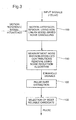
- the proposed method according to the present invention works on a frame-to-frame basis with a frame duration of e.g. 3 seconds and it consists of mainly a three step algorithm as shown in Figure 3 .
- a first step 100 the observed optical signals y 1 (t), y 2 (t) are enhanced using nonlinear, model-based noise cancelling techniques (see for instance " Adaptive Filter Theory", Haykin S., Prentice Hall, 1991 ).
- an accurate motion reference signal i.e. acceleration signals a x (t), ay(t) and a z (t)
- MDL Minimum Description Length
- a second step 110 measurement noise and non-modelled stochastic signal contributions in the two recorded channels are preferably removed.
- This is achieved, according to the preferred embodiment of the present invention, by a noise reduction algorithm based on spatio-temporal Principal Component Analysis (PCA).
- PCA Principal Component Analysis
- spatio-temporal PCA allows one to reduce artefacts related to finger movements, which are generally not cancelled in step 100. Indeed, finger movements do not necessarily imply a global displacement of the forearm and are therefore not grasped by the accelerometer. Finger movements, often imply tiny, reciprocal tendon related displacement of the forearm tissue, which yields reciprocal artefact contributions in the two channels. Due to the reciprocity of these signal contributions, they can efficiently be cancelled by a spatio-temporal PCA.
- the pulse rate is extracted from the enhanced IR-signals.
- This extraction essentially consists of an inter-beat interval extraction achieved through a classical maximum detection procedure, preferably with inhibition of peak detection during the refractory period of cardiac cells.
- a maximum likelihood histogram clustering of the resulting inter-beat intervals is performed (cf. "Vector Quantization and Signal Compression", Gersho A. et al., Kluwer Academic Publishers, 1992).
- a fourth step 130 the most reliable candidate can be selected.
- a robust and reliable estimate of the pulse rate can be obtained through a nonlinear mapping of the two candidate values in function of their reliability measures.
- This nonlinear mapping is advantageously achieved by Multiple Layer Perceptron (MLP), which has been trained on data of various experimental setups as described in "Neural Networks", Haykin S., Macmillan College Publishing Company Inc., 1994.
- MLP Multiple Layer Perceptron
- Figure 4 shows a diagram illustrating the preferred algorithm according to the invention where block 200 refers to the nonlinear modelling based on the motion reference signal (a x (t), ay(t), a z (t)), block 210 refers to the measurement noise and non-modelled contributions cancellation using PCA, block 220 refers to the inter-beat interval extraction on the two enhanced signals, block 225 refers to the maximum likelihood histogram clustering, block 226 refers to the detection of the non-stationary signal segments, and block 230 refers to the final selection of the most reliable candidate using a nonlinear mapping technique.
- block 200 refers to the nonlinear modelling based on the motion reference signal (a x (t), ay(t), a z (t))
- block 210 refers to the measurement noise and non-modelled contributions cancellation using PCA
- block 220 refers to the inter-beat interval extraction on the two enhanced signals
- block 225 refers to the maximum likelihood histogram clustering
- block 226 refers to the detection
- NMA third order polynomial moving average model
- this model includes a parsimonious selection criterion (that is the MDL criterion) together with an efficient search algorithm, linear terms are first tested and nonlinear higher order polynomial terms are only included if they are required for an efficient and parsimonious description of the data at disposal.
- a parsimonious selection criterion that is the MDL criterion
- Noise reduction based on PCA has been shown to provide high enhancement performance in various applications (cf. " A signal subspace approach for speech enhancement", Ephraim Y. et al., IEEE Transactions on Speech and Audio Processing, vol. 3, pp. 251-266, 1995 and " Observer of autonomic cardiac outflow based on blind source separation of ECG parameters", Vetter R. et al., IEEE Transactions on Biomedical Engineering, vol. 47, pp. 578-582, 2000 ).
- the main problem in PCA-based noise reduction algorithms is the optimal choice of the parameters p and m .
- the optimal PCA dimension m one can benefit from the fact that, in the given biomedical application, one deals with signals containing quasi-periodic contributions.
- the embedding dimension can therefore be estimated from the bandwidth of these quasi-periodic contributions.
- Model-based noise reduction and artefact cancellation using spatio-temporal PCA described above are not able to cope with highly non-stationary signals such as the one resulting from random irregular movements. Indeed, irregular movement yield burst-like, non-stationary activity signals. Such signal segments constitute outliers from a statistical point of view and they induce large errors in the parameter estimation process. As a result, enhancement performance degrades drastically for random irregular movements.
- a method is thus preferably included for determining non-stationary signal segments in the motion reference signals a x (t), ay(t), a z (t) (block 226 in Figure 4 ).
- Stationarity detection is achieved as follows :
- the detecting device of the present invention it will be appreciated that the light-emitting source (10 in Figure 2 ), the light detectors (21 to 24 in Figure 2 ) and/or the processing means (50 in Figure 2 ) may be disabled when non-stationary signal segments are detected, this being also advantageous in terms of power consumption since processing of the signals is not unnecessarily performed in highly unstable environments. One can indeed obtain an efficient system with lowest power consumption.
- Pulse detection through maximum likelihood histogram clustering (block 225 in Figure 4 ) mentioned hereinabove, will now briefly be discussed. Estimation of the pulse rate is achieved on a frame-to-frame basis, with a frame duration of approximately 10 seconds (in the above illustrative example). Histogram clustering is performed as follows :
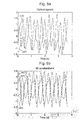
- Figures 5a to 5d are diagrams respectively illustrating the evolution, as a function of time, (a) of the two optical signals y 1 (t), y 2 (t) provided by the light detectors, (b) of the measured acceleration signals a x (t), a y (t), a z (t) along the three orthogonal measurement axes, (c) of the two enhanced optical signals after removal of the motion artefacts, and (d) of the two enhanced optical signals after measurement noise removal (using PCA).
- Figure 5e illustrates the corresponding electrocardiogram ECG.
- Figures 5a and 5b respectively show an example of two PPG optical signals y 1 (t), y 2 (t) and associated motion reference signals, i.e. acceleration signals a x (t), ay(t) and a z (t) provided by the three dimensional accelerometer.
- Figure 5c shows the resulting optical signals after modelling and removal of the motion-related artefact, that is after subtraction of the constructed nonlinear models from both PPG optical signals y 1 (t), y 2 (t). After model-based artefact cancelling, one can see, in a qualitative manner, that pulse-related peaks are recovered, while motion-related contributions are discarded.
- Figure 5d shows the enhanced optical signals after noise reduction using PCA. Residual noise contributions due to tiny local movements not grasped by the accelerometers, modelling errors, and other stochastic influences are removed by spatio-temporal PCA. Figure 5d also shows an almost perfect matching of the two enhanced optical signals, highlighting the efficiency of the proposed algorithm.
- the present invention could also be modified to allow measurement of the oxygen saturation in the blood, provided that the device is equipped with separate red and infrared light sources.
- the above-described enhancing schemes would then be applied for both red and IR signals.
- the detecting device of the invention could be designed as a device adapted to fit around the user's ear, the light source and light detectors being conveniently disposed to emit and detect propagation of light through the ear lobe.
- An example of such a device is disclosed in document WO 97/14357 which has already been cited in the preamble part of the description.
- Such an ear-mounted device could be provided with means for generating an audible signal indicative of the detected pulse rate or of an alarm when a determined threshold is reached.
Landscapes
- Health & Medical Sciences (AREA)
- Life Sciences & Earth Sciences (AREA)
- Engineering & Computer Science (AREA)
- Surgery (AREA)
- General Health & Medical Sciences (AREA)
- Biophysics (AREA)
- Pathology (AREA)
- Physiology (AREA)
- Biomedical Technology (AREA)
- Heart & Thoracic Surgery (AREA)
- Medical Informatics (AREA)
- Molecular Biology (AREA)
- Cardiology (AREA)
- Animal Behavior & Ethology (AREA)
- Physics & Mathematics (AREA)
- Public Health (AREA)
- Veterinary Medicine (AREA)
- Signal Processing (AREA)
- Artificial Intelligence (AREA)
- Computer Vision & Pattern Recognition (AREA)
- Psychiatry (AREA)
- Measuring Pulse, Heart Rate, Blood Pressure Or Blood Flow (AREA)
- Manipulation Of Pulses (AREA)
- Measurement Of The Respiration, Hearing Ability, Form, And Blood Characteristics Of Living Organisms (AREA)
Claims (17)
- Dispositif portable de détection de fréquence cardiaque (1) destiné à être porté et à être en contact avec un tissu de poignet humain (5), comprenant- une source émettrice de lumière (10) pour émettre une énergie radiante à la surface du tissu du poignet humain (5) ou à travers celui-ci ;- au moins un premier et un deuxième détecteurs de lumière (21, 22, 23, 24) pour détecter l'intensité de ladite énergie radiante après propagation à travers le tissu du poignet humain (5) et pour fournir des premier et second signaux d'entrée (y1(t), y2(t)) représentatifs de ladite propagation ;- un dispositif (40) pour mesurer le mouvement du dispositif de détection (1) et pour fournir un signal de référence de mouvement (ax(t), ay(t), az(t)) représentatifs dudit mouvement ; et- des moyens de traitement (50) pour supprimer, desdits premier et second signaux d'entrée (y1(t), y2(t)), des contributions relatives au mouvement dues au mouvement du dispositif de détection (1) et produire des premier et second signaux améliorés,- lesdits moyens de traitement étant conçus pour• élaborer un modèle non linéaire desdites contributions relatives au mouvement sur la base dudit signal de référence de mouvement (ax(t), ay(t), az(t)),• sélectionner ledit modèle en utilisant un critère de Minimum Description Length (MDL),• soustraire ce modèle de chacun desdits premier et second signaux d'entrée (y1(t), y2(t)),• supprimer le bruit de mesure et les contributions non modélisées résiduelles desdits premier et second signaux améliorés en utilisant un algorithme de réduction de bruit basé sur une analyse en composantes principales (ACP).
- Dispositif portable de détection de fréquence cardiaque (1) selon la revendication 1, dans lequel ledit modèle non linéaire est un modèle de moyennes mobiles polynomial du troisième degré.
- Dispositif portable de détection de fréquence cardiaque (1) selon l'une quelconque des revendications précédentes, dans lequel lesdits moyens de traitement (50) sont conçus pour détecter des pics dans lesdits premier et second signaux améliorés et pour extraire des intervalles entre battements à partir desdits pics détectés pour fournir une mesure de la fréquence cardiaque, la détection desdits pics étant inhibée pendant la période réfractaire des cellules cardiaques.
- Dispositif portable de détection de fréquence cardiaque (1) selon l'une quelconque des revendications précédentes, dans lequel ledit dispositif de détection comprend une bande (3) devant être portée autour du poignet, ladite source émettrice de lumière (10) et lesdits détecteurs de lumière (21, 22, 23, 24) étant disposés sur un côté inférieur (2a) dudit dispositif de détection en contact avec le tissu du corps humain (5).
- Dispositif portable de détection de fréquence cardiaque (1) selon l'une quelconque des revendications précédentes, dans lequel lesdits premier et deuxième détecteurs de lumière (21, 22) se trouvent de chaque côté de la source émettrice de lumière (10) le long d'un premier axe (A), ce dispositif de détection comprenant en outre des troisième et quatrième détecteurs de lumière (23, 24) situés de chaque côté de la source émettrice de lumière (10) le long d'un second axe (B) sensiblement perpendiculaire au premier axe (A).
- Dispositif portable de détection de fréquence cardiaque (1) selon la revendication 5, dans lequel lesdits premier et second axes (A, B) sont respectivement perpendiculaires et parallèles à une direction longitudinale de ladite bande (3).
- Dispositif portable de détection de fréquence cardiaque (1) selon l'une quelconque des revendications 4 à 6, dans lequel ladite source émettrice de lumière (10) se trouve dans une zone sensiblement centrale du côté inférieur (2a) du dispositif de détection et lesdits détecteurs de lumière (21, 22, 23, 24) sont disposés autour de ladite source émettrice de lumière (10).
- Dispositif portable de détection de fréquence cardiaque selon l'une quelconque des revendications précédentes, dans lequel la distance entre ladite source émettrice de lumière (10) et lesdits détecteurs de lumière (21, 22, 23, 24) est d'environ 10 mm.
- Dispositif portable de détection de fréquence cardiaque selon l'une quelconque des revendications précédentes, dans lequel ladite source émettrice de lumière (10) est un dispositif émetteur de lumière infrarouge et lesdits détecteurs de lumière (21, 22, 23, 24) sont des photodiodes.
- Dispositif portable de détection de fréquence cardiaque selon l'une quelconque des revendications précédentes, dans lequel lesdits moyens de traitement (50) sont sous la forme d'un processeur de signaux numériques PSN logé à l'intérieur dudit dispositif de détection (1).
- Dispositif portable de détection de fréquence cardiaque selon l'une quelconque des revendications précédentes, dans lequel ledit dispositif (40) destiné à fournir le signal de référence de mouvement (ax(t), ay(t), az(t)) est un accéléromètre tridimensionnel.
- Dispositif portable de détection de fréquence cardiaque selon l'une quelconque des revendications précédentes, comprenant en outre des moyens (226) pour détecter des segments de signaux non stationnaires dans ledit signal de référence de mouvement (ax(t), ay(t), az(t)) et pour désactiver ladite source émettrice de lumière (10), lesdits détecteurs de lumière (21, 22, 23, 24) et/ou lesdits moyens de traitement (50) lorsque des segments de signaux non stationnaires sont détectés.
- Dispositif portable de détection de fréquence cardiaque selon l'une quelconque des revendications précédentes, comprenant en outre des moyens pour produire une indication de la fréquence cardiaque détectée sous la forme d'un signal optique, sonore ou autre signal sensoriel et/ou pour produire une alarme lorsque la fréquence cardiaque détectée atteint un seuil prédéterminé.
- Procédé pour détecter une fréquence cardiaque comprenant les étapes consistant à :a) émettre une énergie radiante à la surface du tissu du poignet humain (5) ou à travers celui-ci au moyen d'une source émettrice de lumière (10) ;b) mesurer l'intensité de ladite énergie radiante après propagation à travers le tissu du poignet humain (5) grâce au moins à des premier et deuxième détecteurs de lumière (21, 22, 23, 24) situés à une distance déterminée de ladite source émettrice de lumière (10) et fournissant des premier et second signaux d'entrée (y1(t), y2(t)) représentatifs de ladite propagation ;c) mesurer le mouvement du dispositif de détection (1) pendant la propagation de ladite énergie radiante à travers le tissu du corps humain (5) au moyen d'un dispositif de détection de mouvement (40) et fournir un signal de référence de mouvement (ax(t), ay(t), az(t)) représentatif dudit mouvement ;d) traiter lesdits premier et second signaux d'entrée (y1(t), y2(t)) pour supprimer les contributions relatives au mouvement en raison du mouvement du dispositif de détection (1) et produire des premier et second signaux améliorés ;
ledit traitement comprenant l'élaboration d'un modèle non linéaire desdites contributions relatives au mouvement sur la base dudit signal de référence de mouvement (ax(t), ay(t), az(t)), la sélection dudit modèle en utilisant un critère de Minimum Description Length (MDL), la soustraction de ce modèle de chacun desdits premier et second signaux d'entrée (y1(t), y2(t)) ;e) supprimer le bruit de mesure et les contributions non modélisées résiduelles desdits premier et second signaux améliorés en utilisant un algorithme de réduction de bruit basé sur l'analyse en composantes principales (ACP). - Procédé selon la revendication 14, caractérisé en ce qu'il comprend en outre les étapes consistant à :f) détecter des pics dans lesdits premier et second signaux améliorés et extraire les intervalles entre battements desdits pics détectés ;g) effectuer une estimation de vraisemblance maximale sur la base d'un histogramme obtenu par des techniques d'agrégation desdits intervalles entre battements et fournir une première et une seconde mesures de fréquence de pouls de chacun desdits premier et second signaux améliorés ; eth) fournir une première et une seconde mesures de fiabilité des première et seconde mesures de fréquence cardiaque de chacun desdits premier et second signaux améliorés et obtenir la fréquence cardiaque en effectuant un mappage non linéaire des première et seconde mesures de fréquence cardiaque en fonction de leurs mesures de fiabilité.
- Procédé selon la revendication 14 ou la revendication 15, dans lequel ledit modèle non linéaire est un modèle de moyennes mobiles polynomial du troisième degré.
- Procédé selon la revendication 15 ou 16, dans lequel la détection desdits pics est inhibée pendant la période réfractaire des cellules cardiaques.
Priority Applications (4)
| Application Number | Priority Date | Filing Date | Title |
|---|---|---|---|
| DE60143115T DE60143115D1 (de) | 2001-09-28 | 2001-09-28 | Verfahren und Vorrichtung zur Pulsmessung |
| AT01203686T ATE481922T1 (de) | 2001-09-28 | 2001-09-28 | Verfahren und vorrichtung zur pulsmessung |
| EP01203686A EP1297784B8 (fr) | 2001-09-28 | 2001-09-28 | Procédé et dispositif de mesure du pouls |
| US10/255,068 US7018338B2 (en) | 2001-09-28 | 2002-09-26 | Method and device for pulse rate detection |
Applications Claiming Priority (1)
| Application Number | Priority Date | Filing Date | Title |
|---|---|---|---|
| EP01203686A EP1297784B8 (fr) | 2001-09-28 | 2001-09-28 | Procédé et dispositif de mesure du pouls |
Publications (3)
| Publication Number | Publication Date |
|---|---|
| EP1297784A1 EP1297784A1 (fr) | 2003-04-02 |
| EP1297784B1 true EP1297784B1 (fr) | 2010-09-22 |
| EP1297784B8 EP1297784B8 (fr) | 2011-01-12 |
Family
ID=8180985
Family Applications (1)
| Application Number | Title | Priority Date | Filing Date |
|---|---|---|---|
| EP01203686A Expired - Lifetime EP1297784B8 (fr) | 2001-09-28 | 2001-09-28 | Procédé et dispositif de mesure du pouls |
Country Status (4)
| Country | Link |
|---|---|
| US (1) | US7018338B2 (fr) |
| EP (1) | EP1297784B8 (fr) |
| AT (1) | ATE481922T1 (fr) |
| DE (1) | DE60143115D1 (fr) |
Families Citing this family (218)
| Publication number | Priority date | Publication date | Assignee | Title |
|---|---|---|---|---|
| FR2840794B1 (fr) | 2002-06-18 | 2005-04-15 | Suisse Electronique Microtech | Equipement portable destine a la mesure et/ou la surveillance de la frequence cardiaque |
| JP4603887B2 (ja) | 2002-10-01 | 2010-12-22 | ネルコー ピューリタン ベネット エルエルシー | 張力インジケータ付きヘッドバンド |
| JP3815448B2 (ja) * | 2003-03-19 | 2006-08-30 | セイコーエプソン株式会社 | 情報収集装置および脈拍計 |
| JP3726832B2 (ja) * | 2003-03-19 | 2005-12-14 | セイコーエプソン株式会社 | 脈拍計、腕時計型情報機器、制御プログラムおよび記録媒体 |
| GB2400907A (en) * | 2003-04-25 | 2004-10-27 | D4 Technology Ltd | Electro-optical pulse rate monitor with data transfer between monitor and external device via the optical sensor |
| US7341561B2 (en) * | 2003-05-30 | 2008-03-11 | Casio Computer Co., Ltd. | Wrist-worn high-accuracy pulsation measuring apparatus |
| DE60303536T2 (de) * | 2003-06-04 | 2006-09-21 | Eta Sa Manufacture Horlogère Suisse | Portables Instrument mit optischer Messeinheit zur Messung einer physiologischen Grösse und Mitteln zur Übertragung und/oder zum Empfang von Daten |
| TWI334342B (en) * | 2003-06-04 | 2010-12-11 | Eta Sa Mft Horlogere Suisse | Portable instrument provided with an optical device for measuring a physiological quantity and means for transmitting and/or receiving data |
| US7526327B2 (en) | 2003-06-04 | 2009-04-28 | Eta Sa Manufacture Horlogère Suisse | Instrument having optical device measuring a physiological quantity and means for transmitting and/or receiving data |
| US7047056B2 (en) | 2003-06-25 | 2006-05-16 | Nellcor Puritan Bennett Incorporated | Hat-based oximeter sensor |
| US8412297B2 (en) | 2003-10-01 | 2013-04-02 | Covidien Lp | Forehead sensor placement |
| FI118753B (fi) * | 2003-10-03 | 2008-03-14 | Suunto Oy | Menetelmä sydämen lyöntien tunnistamiseksi ja siitä saatavien suureiden laskemiseksi |
| US8172761B1 (en) | 2004-09-28 | 2012-05-08 | Impact Sports Technologies, Inc. | Monitoring device with an accelerometer, method and system |
| US8915859B1 (en) | 2004-09-28 | 2014-12-23 | Impact Sports Technologies, Inc. | Monitoring device, system and method for a multi-player interactive game |
| US7993276B2 (en) * | 2004-10-15 | 2011-08-09 | Pulse Tracer, Inc. | Motion cancellation of optical input signals for physiological pulse measurement |
| US20060122520A1 (en) * | 2004-12-07 | 2006-06-08 | Dr. Matthew Banet | Vital sign-monitoring system with multiple optical modules |
| US20070123121A1 (en) * | 2005-01-13 | 2007-05-31 | Jacqueline Quintero | Water safety device |
| EP2286721B1 (fr) | 2005-03-01 | 2018-10-24 | Masimo Laboratories, Inc. | Mesure de confidence de paramètre physiologique |
| US7657293B2 (en) | 2005-09-08 | 2010-02-02 | Vioptix Inc. | Method for monitoring viability of tissue flaps |
| US20070070800A1 (en) * | 2005-09-27 | 2007-03-29 | Nathalie Virag | Externally worn vasovagal syncope detection device |
| US8005523B2 (en) * | 2005-09-30 | 2011-08-23 | Conmed Corporation | Signal processing for pulse oximetry |
| US7787947B2 (en) * | 2006-03-31 | 2010-08-31 | Medtronic, Inc. | Method and apparatus for using an optical hemodynamic sensor to identify an unstable arrhythmia |
| US7559899B2 (en) * | 2006-04-12 | 2009-07-14 | Salutron, Inc. | Power saving techniques for continuous heart rate monitoring |
| DE102006024459A1 (de) | 2006-05-24 | 2007-11-29 | Fraunhofer-Gesellschaft zur Förderung der angewandten Forschung e.V. | Sensor, Verarbeitungseinrichtung, Verfahren und Computerprogramm zum Liefern einer Information über einen Vitalparameter eines Lebewesens |
| EP1880666B1 (fr) * | 2006-07-21 | 2009-07-01 | ETA SA Manufacture Horlogère Suisse | Pulsomètre portable au poignet et procédé de commande associé |
| EP1908401A1 (fr) | 2006-10-06 | 2008-04-09 | ETA SA Manufacture Horlogère Suisse | Méthode et dispositif de mesure d'une pulsation cardiaque lors de la pratique d'un sport rythmique |
| EP1908402B1 (fr) | 2006-10-06 | 2015-12-09 | ETA SA Manufacture Horlogère Suisse | Méthode et dispositif intégré de mesure d'une pulsation cardiaque |
| US20080132798A1 (en) * | 2006-11-30 | 2008-06-05 | Motorola, Inc | Wireless headsets and wireless communication networks for heart rate monitoring |
| US8652040B2 (en) | 2006-12-19 | 2014-02-18 | Valencell, Inc. | Telemetric apparatus for health and environmental monitoring |
| US8157730B2 (en) | 2006-12-19 | 2012-04-17 | Valencell, Inc. | Physiological and environmental monitoring systems and methods |
| KR20080069851A (ko) * | 2007-01-24 | 2008-07-29 | 삼성전자주식회사 | 생체 신호 측정 센서 장치 및 상기 센서 장치를 구비한헤드셋 장치 및 팬던트 장치 |
| WO2009036333A1 (fr) | 2007-09-14 | 2009-03-19 | Corventis, Inc. | Couplage dynamique de patients à des passerelles de collecte de données |
| US8897868B2 (en) | 2007-09-14 | 2014-11-25 | Medtronic, Inc. | Medical device automatic start-up upon contact to patient tissue |
| US8116841B2 (en) | 2007-09-14 | 2012-02-14 | Corventis, Inc. | Adherent device with multiple physiological sensors |
| WO2009036256A1 (fr) | 2007-09-14 | 2009-03-19 | Corventis, Inc. | Système de surveillance physiologique injectable |
| US8591430B2 (en) | 2007-09-14 | 2013-11-26 | Corventis, Inc. | Adherent device for respiratory monitoring |
| WO2009036306A1 (fr) | 2007-09-14 | 2009-03-19 | Corventis, Inc. | Moniteur cardiaque adhérent doté de capacités avancées de détection |
| EP2194864B1 (fr) | 2007-09-14 | 2018-08-29 | Medtronic Monitoring, Inc. | Système et procédés pour la surveillance sans fil de fluides corporels |
| US8251903B2 (en) | 2007-10-25 | 2012-08-28 | Valencell, Inc. | Noninvasive physiological analysis using excitation-sensor modules and related devices and methods |
| US8149273B2 (en) * | 2007-11-30 | 2012-04-03 | Fuji Xerox Co., Ltd. | System and methods for vital sign estimation from passive thermal video |
| RU2010120767A (ru) * | 2007-12-04 | 2012-01-10 | Джи-И Хелткер Лимитед (GB) | Анализ изображений |
| WO2009071128A1 (fr) | 2007-12-06 | 2009-06-11 | Csem Centre Suisse D'electronique Et De Microtechnique Sa - Recherche Et Developpement | Dispositif de commande avec un capteur de fréquence cardiaque et un capteur de mouvement |
| US8979762B2 (en) * | 2008-01-07 | 2015-03-17 | Well Being Digital Limited | Method of determining body parameters during exercise |
| US20090226071A1 (en) * | 2008-03-06 | 2009-09-10 | Motorola, Inc. | Method and Apparatus to Facilitate Using Visible Light Images to Determine a Heart Rate |
| EP2257216B1 (fr) | 2008-03-12 | 2021-04-28 | Medtronic Monitoring, Inc. | Prévision d'une décompensation d'insuffisance cardiaque sur la base du rythme cardiaque |
| US20090247850A1 (en) * | 2008-03-28 | 2009-10-01 | Nellcor Puritan Bennett Llc | Manually Powered Oximeter |
| WO2009146214A1 (fr) | 2008-04-18 | 2009-12-03 | Corventis, Inc. | Procede et appareil permettant de mesurer l’impedance bioelectrique d’un tissu de patient |
| EP2116183B1 (fr) | 2008-05-07 | 2012-02-01 | CSEM Centre Suisse d'Electronique et de Microtechnique SA | Dispositif de surveillance cardiovasculaire opto-électrique robuste localisé sur l'oreille |
| DE102008002741B4 (de) | 2008-06-27 | 2019-07-11 | CiS Forschungsinstitut für Mikrosensorik und Photovoltaik GmbH | Optoelektronische Durchblutungsmessvorrichtung für funktionelle Kreislaufdiagnostik |
| WO2010003134A2 (fr) | 2008-07-03 | 2010-01-07 | Masimo Laboratories, Inc. | Protrusion, source froide thermodynamique et protection pour améliorer les mesures spectroscopiques des constituants sanguins |
| US8630691B2 (en) | 2008-08-04 | 2014-01-14 | Cercacor Laboratories, Inc. | Multi-stream sensor front ends for noninvasive measurement of blood constituents |
| US8257274B2 (en) | 2008-09-25 | 2012-09-04 | Nellcor Puritan Bennett Llc | Medical sensor and technique for using the same |
| US8364220B2 (en) | 2008-09-25 | 2013-01-29 | Covidien Lp | Medical sensor and technique for using the same |
| US10213164B2 (en) * | 2008-09-26 | 2019-02-26 | Qualcomm Incorporated | Method and apparatus for under-sampled acquisition and transmission of photoplethysmograph (PPG) data and reconstruction of full band PPG data at the receiver |
| US20100145171A1 (en) * | 2008-12-05 | 2010-06-10 | Electronics And Telecommunications Research Institute | Apparatus for measuring motion noise robust pulse wave and method thereof |
| WO2010083363A1 (fr) * | 2009-01-15 | 2010-07-22 | Medtronic, Inc. | Dispositif médical implantable offrant un traitement adaptatif du signal et une annulation de l'artéfact |
| US8391944B2 (en) * | 2009-01-15 | 2013-03-05 | Medtronic, Inc. | Implantable medical device with adaptive signal processing and artifact cancellation |
| US8587426B2 (en) * | 2009-01-15 | 2013-11-19 | Medtronic, Inc. | Implantable medical device with adaptive signal processing and artifact cancellation |
| US8788002B2 (en) | 2009-02-25 | 2014-07-22 | Valencell, Inc. | Light-guiding devices and monitoring devices incorporating same |
| US8700111B2 (en) | 2009-02-25 | 2014-04-15 | Valencell, Inc. | Light-guiding devices and monitoring devices incorporating same |
| US9750462B2 (en) | 2009-02-25 | 2017-09-05 | Valencell, Inc. | Monitoring apparatus and methods for measuring physiological and/or environmental conditions |
| EP2229880A1 (fr) | 2009-03-18 | 2010-09-22 | CSEM Centre Suisse d'Electronique et de Microtechnique SA | Unité de surveillance intégrée dans un bandeau utilisant un accéléromètre |
| US8515515B2 (en) | 2009-03-25 | 2013-08-20 | Covidien Lp | Medical sensor with compressible light barrier and technique for using the same |
| US8605961B2 (en) * | 2009-03-30 | 2013-12-10 | Motorola Mobility Llc | Method and apparatus for determining a physiological parameter using a fingerprint sensor on a portable electronic device |
| US8781548B2 (en) | 2009-03-31 | 2014-07-15 | Covidien Lp | Medical sensor with flexible components and technique for using the same |
| US9060722B2 (en) * | 2009-04-22 | 2015-06-23 | Rodrigo E. Teixeira | Apparatus for processing physiological sensor data using a physiological model and method of operation therefor |
| US9451886B2 (en) | 2009-04-22 | 2016-09-27 | Rodrigo E. Teixeira | Probabilistic parameter estimation using fused data apparatus and method of use thereof |
| US10699206B2 (en) | 2009-04-22 | 2020-06-30 | Rodrigo E. Teixeira | Iterative probabilistic parameter estimation apparatus and method of use therefor |
| US9375171B2 (en) | 2009-04-22 | 2016-06-28 | Rodrigo E. Teixeira | Probabilistic biomedical parameter estimation apparatus and method of operation therefor |
| US10460843B2 (en) | 2009-04-22 | 2019-10-29 | Rodrigo E. Teixeira | Probabilistic parameter estimation using fused data apparatus and method of use thereof |
| US9173574B2 (en) | 2009-04-22 | 2015-11-03 | Rodrigo E. Teixeira | Mechanical health monitor apparatus and method of operation therefor |
| EP2473094B1 (fr) | 2009-09-03 | 2018-10-10 | CSEM Centre Suisse d'Electronique et de Microtechnique SA - Recherche et Développement | Dispositif et procédé de suivi pour estimer la concentration d'un constituant du sang pour des tissus à faible perfusion |
| US8718980B2 (en) | 2009-09-11 | 2014-05-06 | Qualcomm Incorporated | Method and apparatus for artifacts mitigation with multiple wireless sensors |
| US9554739B2 (en) | 2009-09-29 | 2017-01-31 | Covidien Lp | Smart cable for coupling a medical sensor to an electronic patient monitor |
| US8430817B1 (en) | 2009-10-15 | 2013-04-30 | Masimo Corporation | System for determining confidence in respiratory rate measurements |
| US9848800B1 (en) | 2009-10-16 | 2017-12-26 | Masimo Corporation | Respiratory pause detector |
| US8790259B2 (en) | 2009-10-22 | 2014-07-29 | Corventis, Inc. | Method and apparatus for remote detection and monitoring of functional chronotropic incompetence |
| US9451897B2 (en) | 2009-12-14 | 2016-09-27 | Medtronic Monitoring, Inc. | Body adherent patch with electronics for physiologic monitoring |
| JP5454147B2 (ja) * | 2010-01-05 | 2014-03-26 | セイコーエプソン株式会社 | 生体情報検出器及び生体情報測定装置 |
| JP5581697B2 (ja) * | 2010-01-05 | 2014-09-03 | セイコーエプソン株式会社 | 生体情報検出器及び生体情報測定装置 |
| JP5446915B2 (ja) * | 2010-01-21 | 2014-03-19 | セイコーエプソン株式会社 | 生体情報検出器及び生体情報測定装置 |
| US9078610B2 (en) * | 2010-02-22 | 2015-07-14 | Covidien Lp | Motion energy harvesting with wireless sensors |
| US9307928B1 (en) | 2010-03-30 | 2016-04-12 | Masimo Corporation | Plethysmographic respiration processor |
| FI20105335A0 (fi) | 2010-03-31 | 2010-03-31 | Polar Electro Oy | Sydämen sykkeen havainnointi |
| US8965498B2 (en) | 2010-04-05 | 2015-02-24 | Corventis, Inc. | Method and apparatus for personalized physiologic parameters |
| US7884933B1 (en) | 2010-05-05 | 2011-02-08 | Revolutionary Business Concepts, Inc. | Apparatus and method for determining analyte concentrations |
| CN101853070B (zh) * | 2010-05-13 | 2012-07-11 | 天津大学 | 前额脑电与血氧信息融合的人机交互装置 |
| US8092393B1 (en) | 2010-07-28 | 2012-01-10 | Impact Sports Technologies, Inc. | Monitoring device with an accelerometer, method and system |
| US9833171B2 (en) * | 2010-08-04 | 2017-12-05 | Koninklijke Philips N.V. | Monitoring of vital body signals during movement |
| US10216893B2 (en) | 2010-09-30 | 2019-02-26 | Fitbit, Inc. | Multimode sensor devices |
| US8888701B2 (en) | 2011-01-27 | 2014-11-18 | Valencell, Inc. | Apparatus and methods for monitoring physiological data during environmental interference |
| GB2502236B (en) | 2011-02-14 | 2018-01-17 | Gladshtein Reuven | Indications of cross-section of small branched blood vessels |
| US9109902B1 (en) | 2011-06-13 | 2015-08-18 | Impact Sports Technologies, Inc. | Monitoring device with a pedometer |
| US9427191B2 (en) | 2011-07-25 | 2016-08-30 | Valencell, Inc. | Apparatus and methods for estimating time-state physiological parameters |
| EP3222210B1 (fr) | 2011-08-02 | 2024-09-25 | Yukka Magic LLC | Systèmes et méthodes d'ajustement d'un filtre variable en fonction de la fréquence cardiaque |
| WO2013038296A1 (fr) | 2011-09-16 | 2013-03-21 | Koninklijke Philips Electronics N.V. | Dispositif et procédé pour estimer la fréquence cardiaque d'une personne en mouvement |
| EP2804526A1 (fr) | 2012-01-16 | 2014-11-26 | Valencell, Inc. | Réduction d'erreur métrique physiologique en raison d'une cadence inertielle |
| CN104168828A (zh) | 2012-01-16 | 2014-11-26 | 瓦伦赛尔公司 | 生理指标估值的上升和下降极限 |
| WO2013132147A2 (fr) | 2012-03-05 | 2013-09-12 | Polar Electro Oy | Détection optique d'effets de mouvement |
| JP2013202289A (ja) * | 2012-03-29 | 2013-10-07 | Seiko Epson Corp | 拍動検出装置、電子機器及びプログラム |
| US9070004B2 (en) | 2012-05-03 | 2015-06-30 | General Electric Company | Automatic segmentation and characterization of cellular motion |
| US9005129B2 (en) | 2012-06-22 | 2015-04-14 | Fitbit, Inc. | Wearable heart rate monitor |
| US9044149B2 (en) | 2012-06-22 | 2015-06-02 | Fitbit, Inc. | Heart rate data collection |
| US8948832B2 (en) | 2012-06-22 | 2015-02-03 | Fitbit, Inc. | Wearable heart rate monitor |
| EP2687154B8 (fr) * | 2012-07-20 | 2019-09-11 | CSEM Centre Suisse d'Electronique et de Microtechnique SA - Recherche et Développement | Dispositif portable et procédé pour déterminer un paramètre de sommeil d'un utilisateur |
| US9357936B2 (en) | 2012-09-11 | 2016-06-07 | Covidien Lp | Methods and systems for determining physiological information based on a correlation matrix |
| US9392976B2 (en) | 2012-09-11 | 2016-07-19 | Covidien Lp | Methods and systems for determining physiological information based on a combined autocorrelation sequence |
| US9119598B2 (en) | 2012-09-11 | 2015-09-01 | Covidien Lp | Methods and systems for determining physiological information using reference waveforms |
| US9149232B2 (en) | 2012-09-11 | 2015-10-06 | Covidien Lp | Methods and systems for qualifying calculated values based on state transitions |
| US9149196B2 (en) | 2012-09-11 | 2015-10-06 | Covidien Lp | Methods and systems for determining an algorithm setting based on a difference signal |
| US8868148B2 (en) | 2012-09-11 | 2014-10-21 | Covidien Lp | Methods and systems for qualifying physiological values based on segments of a physiological signal |
| US9186108B2 (en) | 2012-09-11 | 2015-11-17 | Covidien Lp | Methods and systems for determining an algorithm setting based on a skew metric |
| US9192310B2 (en) | 2012-09-11 | 2015-11-24 | Covidien Lp | Methods and systems for qualifying a calculated value based on baseline and deviation information |
| US9161723B2 (en) | 2012-09-11 | 2015-10-20 | Covidien Lp | Methods and systems for qualifying calculated values based on multiple difference signals |
| US9314209B2 (en) | 2012-09-11 | 2016-04-19 | Covidien Lp | Methods and systems for determining physiological information based on a correlation sequence |
| US9186110B2 (en) | 2012-09-11 | 2015-11-17 | Covidien Lp | Methods and systems for qualifying calculated values based on a statistical metric |
| US9392974B2 (en) | 2012-09-11 | 2016-07-19 | Covidien Lp | Methods and systems for qualifying physiological values based on segments from a cross-correlation sequence |
| US9226670B2 (en) | 2012-09-11 | 2016-01-05 | Covidien Lp | Methods and systems for determining physiological information based on statistical regression analysis |
| US9155478B2 (en) | 2012-09-11 | 2015-10-13 | Covidien Lp | Methods and systems for determining an algorithm setting based on a difference signal |
| US9339235B2 (en) | 2012-09-11 | 2016-05-17 | Covidien Lp | Methods and systems for determining signal-to-noise information from a physiological signal |
| US9186109B2 (en) | 2012-09-11 | 2015-11-17 | Covidien Lp | Methods and systems for qualifying physiological values based on metrics |
| US9259186B2 (en) | 2012-09-11 | 2016-02-16 | Covidien Lp | Methods and systems for determining noise information from a physiological signal |
| US9247887B2 (en) | 2012-09-11 | 2016-02-02 | Covidien Lp | Methods and systems for determining physiological information based on low and high frequency components |
| US9186076B2 (en) | 2012-09-11 | 2015-11-17 | Covidien Lp | Methods and systems for qualifying a correlation lag value based on skewness |
| US9241670B2 (en) | 2012-09-11 | 2016-01-26 | Covidien Lp | Methods and systems for conditioning physiological information using a normalization technique |
| US9220423B2 (en) | 2012-09-11 | 2015-12-29 | Covidien Lp | Methods and systems for qualifying a calculated value based on differently sized sorted difference signals |
| US9186101B2 (en) | 2012-09-11 | 2015-11-17 | Covidien Lp | Methods and systems for qualifying a correlation lag value based on a correlation value at a different lag |
| WO2014045243A1 (fr) * | 2012-09-21 | 2014-03-27 | Tabrasco Sa | Moniteur d'activité cardiaque pour le tir à l' arc |
| US10610159B2 (en) * | 2012-10-07 | 2020-04-07 | Rhythm Diagnostic Systems, Inc. | Health monitoring systems and methods |
| USD850626S1 (en) | 2013-03-15 | 2019-06-04 | Rhythm Diagnostic Systems, Inc. | Health monitoring apparatuses |
| US10413251B2 (en) | 2012-10-07 | 2019-09-17 | Rhythm Diagnostic Systems, Inc. | Wearable cardiac monitor |
| US10244949B2 (en) | 2012-10-07 | 2019-04-02 | Rhythm Diagnostic Systems, Inc. | Health monitoring systems and methods |
| EP2943753B1 (fr) | 2013-01-09 | 2020-04-01 | Valencell, Inc. | Détection de cadence basée sur des harmoniques d'inertie |
| US9039614B2 (en) | 2013-01-15 | 2015-05-26 | Fitbit, Inc. | Methods, systems and devices for measuring fingertip heart rate |
| ITMI20130104A1 (it) | 2013-01-24 | 2014-07-25 | Empatica Srl | Dispositivo, sistema e metodo per la rilevazione e il trattamento di segnali di battito cardiaco |
| WO2014116942A2 (fr) | 2013-01-28 | 2014-07-31 | Valencell, Inc. | Dispositifs de surveillance physiologique ayant des éléments de détection découplés d'un mouvement de corps |
| US10441181B1 (en) | 2013-03-13 | 2019-10-15 | Masimo Corporation | Acoustic pulse and respiration monitoring system |
| FI126338B (en) | 2013-05-15 | 2016-10-14 | Pulseon Oy | Portable heart rate monitor |
| US10512407B2 (en) | 2013-06-24 | 2019-12-24 | Fitbit, Inc. | Heart rate data collection |
| US20160235369A1 (en) * | 2013-09-27 | 2016-08-18 | Pioneer Corporation | Measuring instrument |
| US9864843B2 (en) | 2013-10-24 | 2018-01-09 | Logitech Europe S.A. | System and method for identifying performance days |
| US10078734B2 (en) | 2013-10-24 | 2018-09-18 | Logitech Europe, S.A. | System and method for identifying performance days using earphones with biometric sensors |
| US9848828B2 (en) | 2013-10-24 | 2017-12-26 | Logitech Europe, S.A. | System and method for identifying fatigue sources |
| US9626478B2 (en) | 2013-10-24 | 2017-04-18 | Logitech Europe, S.A. | System and method for tracking biological age over time based upon heart rate variability |
| US9314172B2 (en) | 2013-10-24 | 2016-04-19 | JayBird LLC | System and method for providing a training load schedule for peak performance positioning |
| US9622685B2 (en) | 2013-10-24 | 2017-04-18 | Logitech Europe, S.A. | System and method for providing a training load schedule for peak performance positioning using earphones with biometric sensors |
| US20160030809A1 (en) * | 2013-10-24 | 2016-02-04 | JayBird LLC | System and method for identifying fitness cycles using earphones with biometric sensors |
| US20150116125A1 (en) * | 2013-10-24 | 2015-04-30 | JayBird LLC | Wristband with removable activity monitoring device |
| US20150164352A1 (en) * | 2013-12-18 | 2015-06-18 | Lg Electronics Inc. | Apparatus for measuring bio-information and a method for error compensation thereof |
| US20150173674A1 (en) * | 2013-12-20 | 2015-06-25 | Diabetes Sentry Products Inc. | Detecting and communicating health conditions |
| USD777186S1 (en) | 2014-12-24 | 2017-01-24 | Logitech Europe, S.A. | Display screen or portion thereof with a graphical user interface |
| EP4434457A3 (fr) | 2014-01-07 | 2024-12-18 | Opsolution GmbH | Dispositif et procédé de détermination d'une concentration dans un échantillon |
| WO2015116891A1 (fr) * | 2014-01-30 | 2015-08-06 | Basis Science, Inc. | Commande intelligente de rapport signal à bruit de photopléthysmographe pour la récupération de signaux biologiques pendant des périodes de mouvement |
| EP3102099B1 (fr) | 2014-02-04 | 2017-07-19 | Koninklijke Philips N.V. | Dispositif optique de mesure de fréquence cardiaque d'un utilisateur |
| US10165955B2 (en) | 2014-02-06 | 2019-01-01 | Reuven Gladshtein | Obtaining cardiovascular parameters using arterioles related transient time |
| EP3146896B1 (fr) | 2014-02-28 | 2020-04-01 | Valencell, Inc. | Procédé et appareil de génération d'évaluations à l'aide de paramètres d'activité physique et biométriques |
| USD739533S1 (en) | 2014-03-12 | 2015-09-22 | Butterfleye SAL | Waterproof heart rate measuring apparatus |
| EP3119269A1 (fr) | 2014-03-17 | 2017-01-25 | Koninklijke Philips N.V. | Système de moniteur de fréquence cardiaque |
| US9179849B1 (en) | 2014-07-25 | 2015-11-10 | Impact Sports Technologies, Inc. | Mobile plethysmographic device |
| US20160029898A1 (en) | 2014-07-30 | 2016-02-04 | Valencell, Inc. | Physiological Monitoring Devices and Methods Using Optical Sensors |
| US10536768B2 (en) | 2014-08-06 | 2020-01-14 | Valencell, Inc. | Optical physiological sensor modules with reduced signal noise |
| US9794653B2 (en) | 2014-09-27 | 2017-10-17 | Valencell, Inc. | Methods and apparatus for improving signal quality in wearable biometric monitoring devices |
| JP6413574B2 (ja) * | 2014-10-01 | 2018-10-31 | セイコーエプソン株式会社 | 活動状態情報検出装置及び活動状態情報検出装置の制御方法 |
| US9826938B2 (en) | 2014-10-29 | 2017-11-28 | Microsoft Technology Licensing, Llc | Motion compensation for optical heart rate sensors |
| GB2532453B (en) | 2014-11-19 | 2017-07-19 | Suunto Oy | Wearable sports monitoring equipment for measuring heart rate or muscular activity and relating method |
| US9849538B2 (en) | 2014-12-24 | 2017-12-26 | Logitech Europe, S.A. | Watertight welding methods and components |
| JP6180668B2 (ja) * | 2015-01-16 | 2017-08-16 | コーニンクレッカ フィリップス エヌ ヴェKoninklijke Philips N.V. | 光学的バイタルサインセンサ |
| US10448897B2 (en) | 2015-02-25 | 2019-10-22 | Polar Electro Oy | Heart activity measurement |
| US9392946B1 (en) * | 2015-05-28 | 2016-07-19 | Fitbit, Inc. | Heart rate sensor with high-aspect-ratio photodetector element |
| USD784961S1 (en) | 2015-06-05 | 2017-04-25 | Logitech Europe, S.A. | Ear cushion |
| US9872652B2 (en) | 2015-06-09 | 2018-01-23 | University Of Connecticut | Method and apparatus for heart rate monitoring using an electrocardiogram sensor |
| US11160461B2 (en) | 2015-06-12 | 2021-11-02 | ChroniSense Medical Ltd. | Blood pressure measurement using a wearable device |
| US11712190B2 (en) | 2015-06-12 | 2023-08-01 | ChroniSense Medical Ltd. | Wearable device electrocardiogram |
| US11464457B2 (en) | 2015-06-12 | 2022-10-11 | ChroniSense Medical Ltd. | Determining an early warning score based on wearable device measurements |
| US10952638B2 (en) | 2015-06-12 | 2021-03-23 | ChroniSense Medical Ltd. | System and method for monitoring respiratory rate and oxygen saturation |
| US11160459B2 (en) * | 2015-06-12 | 2021-11-02 | ChroniSense Medical Ltd. | Monitoring health status of people suffering from chronic diseases |
| US10687742B2 (en) | 2015-06-12 | 2020-06-23 | ChroniSense Medical Ltd. | Using invariant factors for pulse oximetry |
| CN107735019B (zh) * | 2015-06-30 | 2021-03-05 | 皇家飞利浦有限公司 | 利用多个ppg传感器的传感器系统和方法 |
| US20170020459A1 (en) * | 2015-07-22 | 2017-01-26 | Edwards Lifesciences Corporation | Motion compensated biomedical sensing |
| US9729953B2 (en) | 2015-07-24 | 2017-08-08 | Logitech Europe S.A. | Wearable earbuds having a reduced tip dimension |
| US10299734B2 (en) * | 2015-10-02 | 2019-05-28 | Covidien Lp | Medical device with adaptive power consumption |
| US9743745B2 (en) | 2015-10-02 | 2017-08-29 | Logitech Europe S.A. | Optimized cord clip |
| US10117015B2 (en) | 2015-10-20 | 2018-10-30 | Logitech Europe, S.A. | Earphones optimized for users with small ear anatomy |
| US10945618B2 (en) | 2015-10-23 | 2021-03-16 | Valencell, Inc. | Physiological monitoring devices and methods for noise reduction in physiological signals based on subject activity type |
| EP3344127A4 (fr) | 2015-10-23 | 2018-07-25 | Valencell, Inc. | Dispositifs de surveillance physiologique et procédés d'identification de type d'activité chez un sujet |
| US10559220B2 (en) | 2015-10-30 | 2020-02-11 | Logitech Europe, S.A. | Systems and methods for creating a neural network to provide personalized recommendations using activity monitoring devices with biometric sensors |
| US10292606B2 (en) | 2015-11-05 | 2019-05-21 | Logitech Europe, S.A. | System and method for determining performance capacity |
| US9986323B2 (en) | 2015-11-19 | 2018-05-29 | Logitech Europe, S.A. | Earphones with attachable expansion pack |
| US11206989B2 (en) | 2015-12-10 | 2021-12-28 | Fitbit, Inc. | Light field management in an optical biological parameter sensor |
| US10568525B1 (en) | 2015-12-14 | 2020-02-25 | Fitbit, Inc. | Multi-wavelength pulse oximetry |
| KR102463076B1 (ko) * | 2015-12-24 | 2022-11-03 | 삼성전자주식회사 | 산소 포화도 측정장치 및 그의 산소 포화도 측정방법 |
| US10112075B2 (en) | 2016-02-01 | 2018-10-30 | Logitech Europe, S.A. | Systems, methods and devices for providing a personalized exercise program recommendation |
| US10420474B2 (en) | 2016-02-01 | 2019-09-24 | Logitech Europe, S.A. | Systems and methods for gathering and interpreting heart rate data from an activity monitoring device |
| US10129628B2 (en) | 2016-02-01 | 2018-11-13 | Logitech Europe, S.A. | Systems, methods and devices for providing an exertion recommendation based on performance capacity |
| EP3416538A1 (fr) * | 2016-02-15 | 2018-12-26 | Koninklijke Philips N.V. | Dispositif et procédé d'extraction d'informations de fréquence cardiaque |
| US11000235B2 (en) | 2016-03-14 | 2021-05-11 | ChroniSense Medical Ltd. | Monitoring procedure for early warning of cardiac episodes |
| CN109195510A (zh) | 2016-04-29 | 2019-01-11 | 飞比特公司 | 多信道光电容积脉搏波传感器 |
| US10966662B2 (en) | 2016-07-08 | 2021-04-06 | Valencell, Inc. | Motion-dependent averaging for physiological metric estimating systems and methods |
| US11229372B2 (en) | 2016-09-21 | 2022-01-25 | Arizona Board of Regents on Behalf of Arizona State of University | Systems and methods for computer monitoring of remote photoplethysmography based on chromaticity in a converted color space |
| US11000193B2 (en) | 2017-01-04 | 2021-05-11 | Livemetric (Medical) S.A. | Blood pressure measurement system using force resistive sensor array |
| EP3565454B1 (fr) * | 2017-01-04 | 2020-10-28 | Koninklijke Philips N.V. | Système et procédé permettant d'obtenir des informations physiologiques d'un sujet |
| US12471790B2 (en) | 2017-04-07 | 2025-11-18 | Fitbit, LLC | Multiple source-detector pair photoplethysmography (PPG) sensor |
| US11051706B1 (en) | 2017-04-07 | 2021-07-06 | Fitbit, Inc. | Multiple source-detector pair photoplethysmography (PPG) sensor |
| JP6417594B2 (ja) * | 2017-05-02 | 2018-11-07 | セイコーエプソン株式会社 | 生体情報計測装置 |
| IT201700114495A1 (it) * | 2017-10-11 | 2019-04-11 | General Medical Merate S P A | Sistema per il controllo di almeno un movimento di un componente motorizzato di un’apparecchiatura radiologica e apparecchiatura radiologica che lo utilizza |
| US11234652B2 (en) | 2018-03-09 | 2022-02-01 | Biopause | Method for low noise biopotential signal measurement |
| CN109758140A (zh) * | 2019-01-09 | 2019-05-17 | 平安科技(深圳)有限公司 | 一种心率检测方法和装置 |
| FI128751B (en) * | 2019-01-09 | 2020-11-30 | Turun Yliopisto | Apparatus and method for measuring arterial system functionality |
| WO2020154697A1 (fr) | 2019-01-25 | 2020-07-30 | Rhythm Diagnostic Systems, Inc. | Systèmes et procédés de surveillance de la santé |
| US11445927B2 (en) * | 2019-02-13 | 2022-09-20 | Viavi Solutions Inc. | Baseline correction and extraction of heartbeat profiles |
| WO2021021920A1 (fr) * | 2019-07-30 | 2021-02-04 | Valencell, Inc. | Procédés et appareil permettant d'identifier de manière dynamique et de sélectionner le meilleur canal de détection de photopléthysmographie pendant un contrôle |
| EP4021293A4 (fr) | 2019-08-28 | 2023-08-09 | Rds | Systèmes et procédés de surveillance de signes vitaux ou de santé |
| US12114974B2 (en) | 2020-01-13 | 2024-10-15 | Masimo Corporation | Wearable device with physiological parameters monitoring |
| US12336796B2 (en) | 2021-07-13 | 2025-06-24 | Masimo Corporation | Wearable device with physiological parameters monitoring |
| EP4309573A1 (fr) | 2022-07-21 | 2024-01-24 | Sonion Nederland B.V. | Détermination d'un paramètre lié à l'écoulement sanguin dans une partie perfusée de sang à l'aide d'un vcsel |
| US20240194333A1 (en) * | 2022-12-12 | 2024-06-13 | Plume Design, Inc. | Replacing data points in a sequence of peak-to-peak interval calculations |
| CN117883076B (zh) * | 2024-01-23 | 2024-06-18 | 北京邦尼营策科技有限公司 | 一种基于大数据的人体运动能量消耗监测系统及方法 |
| CN119014841B (zh) * | 2024-08-21 | 2025-04-18 | 山东大学 | 基于可穿戴设备的体育运动数据采集系统 |
Family Cites Families (29)
| Publication number | Priority date | Publication date | Assignee | Title |
|---|---|---|---|---|
| US3838684A (en) | 1971-01-20 | 1974-10-01 | B Manuel | Cardiac monitor |
| US4108166A (en) | 1976-05-19 | 1978-08-22 | Walter Schmid | Cardiac frequency measuring instrument |
| US4195642A (en) | 1978-01-03 | 1980-04-01 | Beehive International | Wearable heart rate monitor |
| IT1162436B (it) | 1978-11-09 | 1987-04-01 | Walbeoffe Wilson John H | Dispositivo segnalatore di pulsazioni da applicare al polso |
| US4331154A (en) | 1979-10-15 | 1982-05-25 | Tech Engineering & Design | Blood pressure and heart rate measuring watch |
| JPH0315502U (fr) * | 1989-06-28 | 1991-02-15 | ||
| US5055671A (en) * | 1990-10-03 | 1991-10-08 | Spacelabs, Inc. | Apparatus for detecting transducer movement using a first and second light detector |
| US5490505A (en) | 1991-03-07 | 1996-02-13 | Masimo Corporation | Signal processing apparatus |
| US5237994A (en) | 1991-03-12 | 1993-08-24 | Square One Technology | Integrated lead frame pulse oximetry sensor |
| US5934277A (en) | 1991-09-03 | 1999-08-10 | Datex-Ohmeda, Inc. | System for pulse oximetry SpO2 determination |
| GB9216431D0 (en) | 1992-08-01 | 1992-09-16 | Univ Swansea | Optical monitoring or measuring artefact suppression |
| US5368026A (en) | 1993-03-26 | 1994-11-29 | Nellcor Incorporated | Oximeter with motion detection for alarm modification |
| JP3387171B2 (ja) * | 1993-09-28 | 2003-03-17 | セイコーエプソン株式会社 | 脈波検出装置および運動強度測定装置 |
| US5807267A (en) | 1994-06-01 | 1998-09-15 | Advanced Body Metrics Corporation | Heart pulse monitor |
| US5645060A (en) | 1995-06-14 | 1997-07-08 | Nellcor Puritan Bennett Incorporated | Method and apparatus for removing artifact and noise from pulse oximetry |
| GB9521453D0 (en) | 1995-10-19 | 1995-12-20 | Healthcare Technology Ltd | Heart rate monitor |
| US6149602A (en) | 1996-09-10 | 2000-11-21 | Arcelus; Almudena | User-worn electrocardiogram viewer device |
| US6018673A (en) | 1996-10-10 | 2000-01-25 | Nellcor Puritan Bennett Incorporated | Motion compatible sensor for non-invasive optical blood analysis |
| JP3584143B2 (ja) * | 1997-03-17 | 2004-11-04 | セイコーエプソン株式会社 | 脈波検出装置および脈拍計 |
| US6002952A (en) * | 1997-04-14 | 1999-12-14 | Masimo Corporation | Signal processing apparatus and method |
| US6229856B1 (en) | 1997-04-14 | 2001-05-08 | Masimo Corporation | Method and apparatus for demodulating signals in a pulse oximetry system |
| US6198951B1 (en) * | 1997-09-05 | 2001-03-06 | Seiko Epson Corporation | Reflection photodetector and biological information measuring instrument |
| US6293915B1 (en) * | 1997-11-20 | 2001-09-25 | Seiko Epson Corporation | Pulse wave examination apparatus, blood pressure monitor, pulse waveform monitor, and pharmacological action monitor |
| US6018677A (en) | 1997-11-25 | 2000-01-25 | Tectrix Fitness Equipment, Inc. | Heart rate monitor and method |
| EP2319398B1 (fr) | 1998-06-03 | 2019-01-16 | Masimo Corporation | Stéréo-oxymètre de pouls |
| US6519486B1 (en) | 1998-10-15 | 2003-02-11 | Ntc Technology Inc. | Method, apparatus and system for removing motion artifacts from measurements of bodily parameters |
| US6508771B1 (en) | 1999-03-05 | 2003-01-21 | Medtronic, Inc. | Method and apparatus for monitoring heart rate |
| US6434408B1 (en) * | 2000-09-29 | 2002-08-13 | Datex-Ohmeda, Inc. | Pulse oximetry method and system with improved motion correction |
| JP2002360530A (ja) * | 2001-06-11 | 2002-12-17 | Waatekkusu:Kk | 脈波センサ及び脈拍数検出装置 |
-
2001
- 2001-09-28 AT AT01203686T patent/ATE481922T1/de not_active IP Right Cessation
- 2001-09-28 DE DE60143115T patent/DE60143115D1/de not_active Expired - Lifetime
- 2001-09-28 EP EP01203686A patent/EP1297784B8/fr not_active Expired - Lifetime
-
2002
- 2002-09-26 US US10/255,068 patent/US7018338B2/en not_active Expired - Lifetime
Also Published As
| Publication number | Publication date |
|---|---|
| EP1297784A1 (fr) | 2003-04-02 |
| US20030065269A1 (en) | 2003-04-03 |
| DE60143115D1 (de) | 2010-11-04 |
| ATE481922T1 (de) | 2010-10-15 |
| US7018338B2 (en) | 2006-03-28 |
| EP1297784B8 (fr) | 2011-01-12 |
Similar Documents
| Publication | Publication Date | Title |
|---|---|---|
| US7018338B2 (en) | Method and device for pulse rate detection | |
| Renevey et al. | Wrist-located pulse detection using IR signals, activity and nonlinear artifact cancellation | |
| US5934277A (en) | System for pulse oximetry SpO2 determination | |
| Yousefi et al. | A motion-tolerant adaptive algorithm for wearable photoplethysmographic biosensors | |
| US6714803B1 (en) | Pulse oximetry SpO2 determination | |
| US7072702B2 (en) | Method, apparatus and system for removing motion artifacts from measurements of bodily parameters | |
| US5503148A (en) | System for pulse oximetry SPO2 determination | |
| US7991448B2 (en) | Method, apparatus, and system for removing motion artifacts from measurements of bodily parameters | |
| US9149216B2 (en) | Photoplethysmography device and method | |
| EP2034900B1 (fr) | Classification multiparamétrique d'un son cardiovasculaire | |
| US6987994B1 (en) | Pulse oximetry SpO2 determination | |
| US5588427A (en) | Enhancement of physiological signals using fractal analysis | |
| EP1121051B1 (fr) | Procede, appareil et systeme permettant de supprimer des artefacts de mouvement au cours de mesures de parametres corporels | |
| JP3483635B2 (ja) | 非侵襲的脈拍オキシメータ装置における異常状態検出方法 | |
| US6845263B2 (en) | Heart-sound detecting apparatus and pulse-wave-propagation-velocity-relating-information obtaining system using the heart-sound detecting apparatus | |
| US20110082355A1 (en) | Photoplethysmography device and method | |
| EP0613653A2 (fr) | Méthode pour la mesure non-invasive du taux d'oxygène | |
| JP2007527773A (ja) | 組織における混合した静脈拍動および動脈拍動の光検出のための方法および装置 | |
| US20190192079A1 (en) | System and a method for motion artifact reduction in a ppg signal | |
| Celka et al. | Motion resistant earphone located infrared based heart rate measurement device | |
| EP3292813A1 (fr) | Procédé et dispositif de traitement de signaux biologiques | |
| US20070070800A1 (en) | Externally worn vasovagal syncope detection device | |
| WO2010146327A1 (fr) | Determination d'un etat de maladie au moyen d'une charge induite | |
| Habbu et al. | Noninvasive blood glucose estimation using pulse based cepstral coefficients | |
| Cherif et al. | Detection of artifacts on photoplethysmography signals using random distortion testing |
Legal Events
| Date | Code | Title | Description |
|---|---|---|---|
| PUAI | Public reference made under article 153(3) epc to a published international application that has entered the european phase |
Free format text: ORIGINAL CODE: 0009012 |
|
| AK | Designated contracting states |
Kind code of ref document: A1 Designated state(s): AT BE CH CY DE DK ES FI FR GB GR IE IT LI LU MC NL PT SE TR Designated state(s): AT BE CH CY DE DK ES FI FR GB GR IE IT LI LU MC NL PT SE TR |
|
| AX | Request for extension of the european patent |
Extension state: AL LT LV MK RO SI |
|
| 17P | Request for examination filed |
Effective date: 20030828 |
|
| AKX | Designation fees paid |
Designated state(s): AT BE CH CY DE DK ES FI FR GB GR IE IT LI LU MC NL PT SE TR |
|
| 17Q | First examination report despatched |
Effective date: 20070904 |
|
| GRAP | Despatch of communication of intention to grant a patent |
Free format text: ORIGINAL CODE: EPIDOSNIGR1 |
|
| GRAS | Grant fee paid |
Free format text: ORIGINAL CODE: EPIDOSNIGR3 |
|
| GRAA | (expected) grant |
Free format text: ORIGINAL CODE: 0009210 |
|
| RIN1 | Information on inventor provided before grant (corrected) |
Inventor name: DEPEURSINGE YVES Inventor name: KRAUSS, JENS Inventor name: GENTSCH, ROLAND Inventor name: PHILIPPE, RENEVEY Inventor name: VETTER, ROLF |
|
| AK | Designated contracting states |
Kind code of ref document: B1 Designated state(s): AT BE CH CY DE DK ES FI FR GB GR IE IT LI LU MC NL PT SE TR |
|
| REG | Reference to a national code |
Ref country code: GB Ref legal event code: FG4D |
|
| REG | Reference to a national code |
Ref country code: CH Ref legal event code: EP |
|
| REG | Reference to a national code |
Ref country code: IE Ref legal event code: FG4D |
|
| REF | Corresponds to: |
Ref document number: 60143115 Country of ref document: DE Date of ref document: 20101104 Kind code of ref document: P |
|
| REG | Reference to a national code |
Ref country code: CH Ref legal event code: NV Representative=s name: GLN GRESSET & LAESSER NEUCHATEL CABINET DE CONSEIL |
|
| RAP2 | Party data changed (patent owner data changed or rights of a patent transferred) |
Owner name: CSEM CENTRE SUISSE D'ELECTRONIQUE ET DE MICROTECHN |
|
| PG25 | Lapsed in a contracting state [announced via postgrant information from national office to epo] |
Ref country code: FI Free format text: LAPSE BECAUSE OF FAILURE TO SUBMIT A TRANSLATION OF THE DESCRIPTION OR TO PAY THE FEE WITHIN THE PRESCRIBED TIME-LIMIT Effective date: 20100922 Ref country code: AT Free format text: LAPSE BECAUSE OF FAILURE TO SUBMIT A TRANSLATION OF THE DESCRIPTION OR TO PAY THE FEE WITHIN THE PRESCRIBED TIME-LIMIT Effective date: 20100922 |
|
| REG | Reference to a national code |
Ref country code: NL Ref legal event code: VDEP Effective date: 20100922 |
|
| PG25 | Lapsed in a contracting state [announced via postgrant information from national office to epo] |
Ref country code: SE Free format text: LAPSE BECAUSE OF FAILURE TO SUBMIT A TRANSLATION OF THE DESCRIPTION OR TO PAY THE FEE WITHIN THE PRESCRIBED TIME-LIMIT Effective date: 20100922 Ref country code: GR Free format text: LAPSE BECAUSE OF FAILURE TO SUBMIT A TRANSLATION OF THE DESCRIPTION OR TO PAY THE FEE WITHIN THE PRESCRIBED TIME-LIMIT Effective date: 20101223 |
|
| PG25 | Lapsed in a contracting state [announced via postgrant information from national office to epo] |
Ref country code: MC Free format text: LAPSE BECAUSE OF NON-PAYMENT OF DUE FEES Effective date: 20100930 |
|
| PG25 | Lapsed in a contracting state [announced via postgrant information from national office to epo] |
Ref country code: PT Free format text: LAPSE BECAUSE OF FAILURE TO SUBMIT A TRANSLATION OF THE DESCRIPTION OR TO PAY THE FEE WITHIN THE PRESCRIBED TIME-LIMIT Effective date: 20110124 Ref country code: IT Free format text: LAPSE BECAUSE OF FAILURE TO SUBMIT A TRANSLATION OF THE DESCRIPTION OR TO PAY THE FEE WITHIN THE PRESCRIBED TIME-LIMIT Effective date: 20100922 Ref country code: NL Free format text: LAPSE BECAUSE OF FAILURE TO SUBMIT A TRANSLATION OF THE DESCRIPTION OR TO PAY THE FEE WITHIN THE PRESCRIBED TIME-LIMIT Effective date: 20100922 |
|
| PG25 | Lapsed in a contracting state [announced via postgrant information from national office to epo] |
Ref country code: BE Free format text: LAPSE BECAUSE OF FAILURE TO SUBMIT A TRANSLATION OF THE DESCRIPTION OR TO PAY THE FEE WITHIN THE PRESCRIBED TIME-LIMIT Effective date: 20100922 |
|
| PG25 | Lapsed in a contracting state [announced via postgrant information from national office to epo] |
Ref country code: IE Free format text: LAPSE BECAUSE OF NON-PAYMENT OF DUE FEES Effective date: 20100928 Ref country code: ES Free format text: LAPSE BECAUSE OF FAILURE TO SUBMIT A TRANSLATION OF THE DESCRIPTION OR TO PAY THE FEE WITHIN THE PRESCRIBED TIME-LIMIT Effective date: 20110102 |
|
| PLBE | No opposition filed within time limit |
Free format text: ORIGINAL CODE: 0009261 |
|
| STAA | Information on the status of an ep patent application or granted ep patent |
Free format text: STATUS: NO OPPOSITION FILED WITHIN TIME LIMIT |
|
| 26N | No opposition filed |
Effective date: 20110623 |
|
| PG25 | Lapsed in a contracting state [announced via postgrant information from national office to epo] |
Ref country code: DK Free format text: LAPSE BECAUSE OF FAILURE TO SUBMIT A TRANSLATION OF THE DESCRIPTION OR TO PAY THE FEE WITHIN THE PRESCRIBED TIME-LIMIT Effective date: 20100922 |
|
| REG | Reference to a national code |
Ref country code: DE Ref legal event code: R097 Ref document number: 60143115 Country of ref document: DE Effective date: 20110623 |
|
| PG25 | Lapsed in a contracting state [announced via postgrant information from national office to epo] |
Ref country code: CY Free format text: LAPSE BECAUSE OF FAILURE TO SUBMIT A TRANSLATION OF THE DESCRIPTION OR TO PAY THE FEE WITHIN THE PRESCRIBED TIME-LIMIT Effective date: 20100922 |
|
| PG25 | Lapsed in a contracting state [announced via postgrant information from national office to epo] |
Ref country code: LU Free format text: LAPSE BECAUSE OF NON-PAYMENT OF DUE FEES Effective date: 20100928 |
|
| PG25 | Lapsed in a contracting state [announced via postgrant information from national office to epo] |
Ref country code: TR Free format text: LAPSE BECAUSE OF FAILURE TO SUBMIT A TRANSLATION OF THE DESCRIPTION OR TO PAY THE FEE WITHIN THE PRESCRIBED TIME-LIMIT Effective date: 20100922 |
|
| REG | Reference to a national code |
Ref country code: CH Ref legal event code: PFA Owner name: CSEM CENTRE SUISSE D'ELECTRONIQUE ET DE MICROT, CH Free format text: FORMER OWNER: CSEM CENTRE SUISSE D'ELECTRONIQUE ET DE MICROTECHNIQUE SA - RECHERCHE ET DEVELOPPEMENT, CH |
|
| REG | Reference to a national code |
Ref country code: FR Ref legal event code: PLFP Year of fee payment: 16 |
|
| REG | Reference to a national code |
Ref country code: CH Ref legal event code: PFA Owner name: CSEM CENTRE SUISSE D'ELECTRONIQUE ET DE MICROT, CH Free format text: FORMER OWNER: CSEM CENTRE SUISSE D'ELECTRONIQUE ET DE MICROTECHNIQUE SA - RECHERCHE ET DEVELOPPEMENT, CH |
|
| REG | Reference to a national code |
Ref country code: FR Ref legal event code: PLFP Year of fee payment: 17 |
|
| REG | Reference to a national code |
Ref country code: FR Ref legal event code: PLFP Year of fee payment: 18 |
|
| REG | Reference to a national code |
Ref country code: CH Ref legal event code: NV Representative=s name: BOVARD SA NEUCHATEL CONSEILS EN PROPRIETE INTE, CH |
|
| PGFP | Annual fee paid to national office [announced via postgrant information from national office to epo] |
Ref country code: DE Payment date: 20200924 Year of fee payment: 20 Ref country code: GB Payment date: 20200929 Year of fee payment: 20 Ref country code: FR Payment date: 20200928 Year of fee payment: 20 |
|
| PGFP | Annual fee paid to national office [announced via postgrant information from national office to epo] |
Ref country code: CH Payment date: 20200930 Year of fee payment: 20 |
|
| REG | Reference to a national code |
Ref country code: DE Ref legal event code: R071 Ref document number: 60143115 Country of ref document: DE |
|
| REG | Reference to a national code |
Ref country code: CH Ref legal event code: PL |
|
| REG | Reference to a national code |
Ref country code: GB Ref legal event code: PE20 Expiry date: 20210927 |
|
| PG25 | Lapsed in a contracting state [announced via postgrant information from national office to epo] |
Ref country code: GB Free format text: LAPSE BECAUSE OF EXPIRATION OF PROTECTION Effective date: 20210927 |