EP1298108A2 - Corps liée en métal -céramique - Google Patents
Corps liée en métal -céramique Download PDFInfo
- Publication number
- EP1298108A2 EP1298108A2 EP02007405A EP02007405A EP1298108A2 EP 1298108 A2 EP1298108 A2 EP 1298108A2 EP 02007405 A EP02007405 A EP 02007405A EP 02007405 A EP02007405 A EP 02007405A EP 1298108 A2 EP1298108 A2 EP 1298108A2
- Authority
- EP
- European Patent Office
- Prior art keywords
- metal
- brazing filler
- ceramic bonding
- bonding article
- metal plate
- Prior art date
- Legal status (The legal status is an assumption and is not a legal conclusion. Google has not performed a legal analysis and makes no representation as to the accuracy of the status listed.)
- Granted
Links
Images




Classifications
-
- C—CHEMISTRY; METALLURGY
- C04—CEMENTS; CONCRETE; ARTIFICIAL STONE; CERAMICS; REFRACTORIES
- C04B—LIME, MAGNESIA; SLAG; CEMENTS; COMPOSITIONS THEREOF, e.g. MORTARS, CONCRETE OR LIKE BUILDING MATERIALS; ARTIFICIAL STONE; CERAMICS; REFRACTORIES; TREATMENT OF NATURAL STONE
- C04B37/00—Joining burned ceramic articles with other burned ceramic articles or other articles by heating
- C04B37/02—Joining burned ceramic articles with other burned ceramic articles or other articles by heating with metallic articles
- C04B37/023—Joining burned ceramic articles with other burned ceramic articles or other articles by heating with metallic articles characterised by the interlayer used
- C04B37/026—Joining burned ceramic articles with other burned ceramic articles or other articles by heating with metallic articles characterised by the interlayer used consisting of metals or metal salts
-
- B—PERFORMING OPERATIONS; TRANSPORTING
- B32—LAYERED PRODUCTS
- B32B—LAYERED PRODUCTS, i.e. PRODUCTS BUILT-UP OF STRATA OF FLAT OR NON-FLAT, e.g. CELLULAR OR HONEYCOMB, FORM
- B32B18/00—Layered products essentially comprising ceramics, e.g. refractory products
-
- C—CHEMISTRY; METALLURGY
- C04—CEMENTS; CONCRETE; ARTIFICIAL STONE; CERAMICS; REFRACTORIES
- C04B—LIME, MAGNESIA; SLAG; CEMENTS; COMPOSITIONS THEREOF, e.g. MORTARS, CONCRETE OR LIKE BUILDING MATERIALS; ARTIFICIAL STONE; CERAMICS; REFRACTORIES; TREATMENT OF NATURAL STONE
- C04B35/00—Shaped ceramic products characterised by their composition; Ceramics compositions; Processing powders of inorganic compounds preparatory to the manufacturing of ceramic products
- C04B35/01—Shaped ceramic products characterised by their composition; Ceramics compositions; Processing powders of inorganic compounds preparatory to the manufacturing of ceramic products based on oxide ceramics
-
- C—CHEMISTRY; METALLURGY
- C04—CEMENTS; CONCRETE; ARTIFICIAL STONE; CERAMICS; REFRACTORIES
- C04B—LIME, MAGNESIA; SLAG; CEMENTS; COMPOSITIONS THEREOF, e.g. MORTARS, CONCRETE OR LIKE BUILDING MATERIALS; ARTIFICIAL STONE; CERAMICS; REFRACTORIES; TREATMENT OF NATURAL STONE
- C04B35/00—Shaped ceramic products characterised by their composition; Ceramics compositions; Processing powders of inorganic compounds preparatory to the manufacturing of ceramic products
- C04B35/01—Shaped ceramic products characterised by their composition; Ceramics compositions; Processing powders of inorganic compounds preparatory to the manufacturing of ceramic products based on oxide ceramics
- C04B35/10—Shaped ceramic products characterised by their composition; Ceramics compositions; Processing powders of inorganic compounds preparatory to the manufacturing of ceramic products based on oxide ceramics based on aluminium oxide
-
- C—CHEMISTRY; METALLURGY
- C04—CEMENTS; CONCRETE; ARTIFICIAL STONE; CERAMICS; REFRACTORIES
- C04B—LIME, MAGNESIA; SLAG; CEMENTS; COMPOSITIONS THEREOF, e.g. MORTARS, CONCRETE OR LIKE BUILDING MATERIALS; ARTIFICIAL STONE; CERAMICS; REFRACTORIES; TREATMENT OF NATURAL STONE
- C04B35/00—Shaped ceramic products characterised by their composition; Ceramics compositions; Processing powders of inorganic compounds preparatory to the manufacturing of ceramic products
- C04B35/515—Shaped ceramic products characterised by their composition; Ceramics compositions; Processing powders of inorganic compounds preparatory to the manufacturing of ceramic products based on non-oxide ceramics
- C04B35/56—Shaped ceramic products characterised by their composition; Ceramics compositions; Processing powders of inorganic compounds preparatory to the manufacturing of ceramic products based on non-oxide ceramics based on carbides or oxycarbides
-
- C—CHEMISTRY; METALLURGY
- C04—CEMENTS; CONCRETE; ARTIFICIAL STONE; CERAMICS; REFRACTORIES
- C04B—LIME, MAGNESIA; SLAG; CEMENTS; COMPOSITIONS THEREOF, e.g. MORTARS, CONCRETE OR LIKE BUILDING MATERIALS; ARTIFICIAL STONE; CERAMICS; REFRACTORIES; TREATMENT OF NATURAL STONE
- C04B35/00—Shaped ceramic products characterised by their composition; Ceramics compositions; Processing powders of inorganic compounds preparatory to the manufacturing of ceramic products
- C04B35/515—Shaped ceramic products characterised by their composition; Ceramics compositions; Processing powders of inorganic compounds preparatory to the manufacturing of ceramic products based on non-oxide ceramics
- C04B35/56—Shaped ceramic products characterised by their composition; Ceramics compositions; Processing powders of inorganic compounds preparatory to the manufacturing of ceramic products based on non-oxide ceramics based on carbides or oxycarbides
- C04B35/565—Shaped ceramic products characterised by their composition; Ceramics compositions; Processing powders of inorganic compounds preparatory to the manufacturing of ceramic products based on non-oxide ceramics based on carbides or oxycarbides based on silicon carbide
-
- C—CHEMISTRY; METALLURGY
- C04—CEMENTS; CONCRETE; ARTIFICIAL STONE; CERAMICS; REFRACTORIES
- C04B—LIME, MAGNESIA; SLAG; CEMENTS; COMPOSITIONS THEREOF, e.g. MORTARS, CONCRETE OR LIKE BUILDING MATERIALS; ARTIFICIAL STONE; CERAMICS; REFRACTORIES; TREATMENT OF NATURAL STONE
- C04B35/00—Shaped ceramic products characterised by their composition; Ceramics compositions; Processing powders of inorganic compounds preparatory to the manufacturing of ceramic products
- C04B35/515—Shaped ceramic products characterised by their composition; Ceramics compositions; Processing powders of inorganic compounds preparatory to the manufacturing of ceramic products based on non-oxide ceramics
- C04B35/58—Shaped ceramic products characterised by their composition; Ceramics compositions; Processing powders of inorganic compounds preparatory to the manufacturing of ceramic products based on non-oxide ceramics based on borides, nitrides, i.e. nitrides, oxynitrides, carbonitrides or oxycarbonitrides or silicides
-
- C—CHEMISTRY; METALLURGY
- C04—CEMENTS; CONCRETE; ARTIFICIAL STONE; CERAMICS; REFRACTORIES
- C04B—LIME, MAGNESIA; SLAG; CEMENTS; COMPOSITIONS THEREOF, e.g. MORTARS, CONCRETE OR LIKE BUILDING MATERIALS; ARTIFICIAL STONE; CERAMICS; REFRACTORIES; TREATMENT OF NATURAL STONE
- C04B35/00—Shaped ceramic products characterised by their composition; Ceramics compositions; Processing powders of inorganic compounds preparatory to the manufacturing of ceramic products
- C04B35/515—Shaped ceramic products characterised by their composition; Ceramics compositions; Processing powders of inorganic compounds preparatory to the manufacturing of ceramic products based on non-oxide ceramics
- C04B35/58—Shaped ceramic products characterised by their composition; Ceramics compositions; Processing powders of inorganic compounds preparatory to the manufacturing of ceramic products based on non-oxide ceramics based on borides, nitrides, i.e. nitrides, oxynitrides, carbonitrides or oxycarbonitrides or silicides
- C04B35/581—Shaped ceramic products characterised by their composition; Ceramics compositions; Processing powders of inorganic compounds preparatory to the manufacturing of ceramic products based on non-oxide ceramics based on borides, nitrides, i.e. nitrides, oxynitrides, carbonitrides or oxycarbonitrides or silicides based on aluminium nitride
-
- C—CHEMISTRY; METALLURGY
- C04—CEMENTS; CONCRETE; ARTIFICIAL STONE; CERAMICS; REFRACTORIES
- C04B—LIME, MAGNESIA; SLAG; CEMENTS; COMPOSITIONS THEREOF, e.g. MORTARS, CONCRETE OR LIKE BUILDING MATERIALS; ARTIFICIAL STONE; CERAMICS; REFRACTORIES; TREATMENT OF NATURAL STONE
- C04B35/00—Shaped ceramic products characterised by their composition; Ceramics compositions; Processing powders of inorganic compounds preparatory to the manufacturing of ceramic products
- C04B35/515—Shaped ceramic products characterised by their composition; Ceramics compositions; Processing powders of inorganic compounds preparatory to the manufacturing of ceramic products based on non-oxide ceramics
- C04B35/58—Shaped ceramic products characterised by their composition; Ceramics compositions; Processing powders of inorganic compounds preparatory to the manufacturing of ceramic products based on non-oxide ceramics based on borides, nitrides, i.e. nitrides, oxynitrides, carbonitrides or oxycarbonitrides or silicides
- C04B35/584—Shaped ceramic products characterised by their composition; Ceramics compositions; Processing powders of inorganic compounds preparatory to the manufacturing of ceramic products based on non-oxide ceramics based on borides, nitrides, i.e. nitrides, oxynitrides, carbonitrides or oxycarbonitrides or silicides based on silicon nitride
-
- C—CHEMISTRY; METALLURGY
- C04—CEMENTS; CONCRETE; ARTIFICIAL STONE; CERAMICS; REFRACTORIES
- C04B—LIME, MAGNESIA; SLAG; CEMENTS; COMPOSITIONS THEREOF, e.g. MORTARS, CONCRETE OR LIKE BUILDING MATERIALS; ARTIFICIAL STONE; CERAMICS; REFRACTORIES; TREATMENT OF NATURAL STONE
- C04B37/00—Joining burned ceramic articles with other burned ceramic articles or other articles by heating
- C04B37/02—Joining burned ceramic articles with other burned ceramic articles or other articles by heating with metallic articles
- C04B37/023—Joining burned ceramic articles with other burned ceramic articles or other articles by heating with metallic articles characterised by the interlayer used
-
- H—ELECTRICITY
- H05—ELECTRIC TECHNIQUES NOT OTHERWISE PROVIDED FOR
- H05K—PRINTED CIRCUITS; CASINGS OR CONSTRUCTIONAL DETAILS OF ELECTRIC APPARATUS; MANUFACTURE OF ASSEMBLAGES OF ELECTRICAL COMPONENTS
- H05K3/00—Apparatus or processes for manufacturing printed circuits
- H05K3/38—Improvement of the adhesion between the insulating substrate and the metal
-
- B—PERFORMING OPERATIONS; TRANSPORTING
- B23—MACHINE TOOLS; METAL-WORKING NOT OTHERWISE PROVIDED FOR
- B23K—SOLDERING OR UNSOLDERING; WELDING; CLADDING OR PLATING BY SOLDERING OR WELDING; CUTTING BY APPLYING HEAT LOCALLY, e.g. FLAME CUTTING; WORKING BY LASER BEAM
- B23K2101/00—Articles made by soldering, welding or cutting
- B23K2101/34—Coated articles ; Surface treated articles
-
- B—PERFORMING OPERATIONS; TRANSPORTING
- B23—MACHINE TOOLS; METAL-WORKING NOT OTHERWISE PROVIDED FOR
- B23K—SOLDERING OR UNSOLDERING; WELDING; CLADDING OR PLATING BY SOLDERING OR WELDING; CUTTING BY APPLYING HEAT LOCALLY, e.g. FLAME CUTTING; WORKING BY LASER BEAM
- B23K2103/00—Materials to be soldered, welded or cut
- B23K2103/08—Non-ferrous metals or alloys
- B23K2103/10—Aluminium or alloys thereof
-
- B—PERFORMING OPERATIONS; TRANSPORTING
- B23—MACHINE TOOLS; METAL-WORKING NOT OTHERWISE PROVIDED FOR
- B23K—SOLDERING OR UNSOLDERING; WELDING; CLADDING OR PLATING BY SOLDERING OR WELDING; CUTTING BY APPLYING HEAT LOCALLY, e.g. FLAME CUTTING; WORKING BY LASER BEAM
- B23K2103/00—Materials to be soldered, welded or cut
- B23K2103/08—Non-ferrous metals or alloys
- B23K2103/12—Copper or alloys thereof
-
- B—PERFORMING OPERATIONS; TRANSPORTING
- B23—MACHINE TOOLS; METAL-WORKING NOT OTHERWISE PROVIDED FOR
- B23K—SOLDERING OR UNSOLDERING; WELDING; CLADDING OR PLATING BY SOLDERING OR WELDING; CUTTING BY APPLYING HEAT LOCALLY, e.g. FLAME CUTTING; WORKING BY LASER BEAM
- B23K2103/00—Materials to be soldered, welded or cut
- B23K2103/18—Dissimilar materials
-
- B—PERFORMING OPERATIONS; TRANSPORTING
- B23—MACHINE TOOLS; METAL-WORKING NOT OTHERWISE PROVIDED FOR
- B23K—SOLDERING OR UNSOLDERING; WELDING; CLADDING OR PLATING BY SOLDERING OR WELDING; CUTTING BY APPLYING HEAT LOCALLY, e.g. FLAME CUTTING; WORKING BY LASER BEAM
- B23K2103/00—Materials to be soldered, welded or cut
- B23K2103/50—Inorganic materials other than metals or composite materials
- B23K2103/52—Ceramics
-
- B—PERFORMING OPERATIONS; TRANSPORTING
- B23—MACHINE TOOLS; METAL-WORKING NOT OTHERWISE PROVIDED FOR
- B23K—SOLDERING OR UNSOLDERING; WELDING; CLADDING OR PLATING BY SOLDERING OR WELDING; CUTTING BY APPLYING HEAT LOCALLY, e.g. FLAME CUTTING; WORKING BY LASER BEAM
- B23K35/00—Rods, electrodes, materials, or media, for use in soldering, welding, or cutting
- B23K35/001—Interlayers, transition pieces for metallurgical bonding of workpieces
- B23K35/007—Interlayers, transition pieces for metallurgical bonding of workpieces at least one of the workpieces being of copper or another noble metal
-
- B—PERFORMING OPERATIONS; TRANSPORTING
- B23—MACHINE TOOLS; METAL-WORKING NOT OTHERWISE PROVIDED FOR
- B23K—SOLDERING OR UNSOLDERING; WELDING; CLADDING OR PLATING BY SOLDERING OR WELDING; CUTTING BY APPLYING HEAT LOCALLY, e.g. FLAME CUTTING; WORKING BY LASER BEAM
- B23K35/00—Rods, electrodes, materials, or media, for use in soldering, welding, or cutting
- B23K35/22—Rods, electrodes, materials, or media, for use in soldering, welding, or cutting characterised by the composition or nature of the material
- B23K35/24—Selection of soldering or welding materials proper
- B23K35/28—Selection of soldering or welding materials proper with the principal constituent melting at less than 950°C
- B23K35/286—Al as the principal constituent
-
- B—PERFORMING OPERATIONS; TRANSPORTING
- B23—MACHINE TOOLS; METAL-WORKING NOT OTHERWISE PROVIDED FOR
- B23K—SOLDERING OR UNSOLDERING; WELDING; CLADDING OR PLATING BY SOLDERING OR WELDING; CUTTING BY APPLYING HEAT LOCALLY, e.g. FLAME CUTTING; WORKING BY LASER BEAM
- B23K35/00—Rods, electrodes, materials, or media, for use in soldering, welding, or cutting
- B23K35/22—Rods, electrodes, materials, or media, for use in soldering, welding, or cutting characterised by the composition or nature of the material
- B23K35/24—Selection of soldering or welding materials proper
- B23K35/30—Selection of soldering or welding materials proper with the principal constituent melting at less than 1550°C
- B23K35/3006—Ag as the principal constituent
-
- B—PERFORMING OPERATIONS; TRANSPORTING
- B32—LAYERED PRODUCTS
- B32B—LAYERED PRODUCTS, i.e. PRODUCTS BUILT-UP OF STRATA OF FLAT OR NON-FLAT, e.g. CELLULAR OR HONEYCOMB, FORM
- B32B2309/00—Parameters for the laminating or treatment process; Apparatus details
- B32B2309/60—In a particular environment
- B32B2309/68—Vacuum
-
- B—PERFORMING OPERATIONS; TRANSPORTING
- B32—LAYERED PRODUCTS
- B32B—LAYERED PRODUCTS, i.e. PRODUCTS BUILT-UP OF STRATA OF FLAT OR NON-FLAT, e.g. CELLULAR OR HONEYCOMB, FORM
- B32B2311/00—Metals, their alloys or their compounds
- B32B2311/12—Copper
-
- B—PERFORMING OPERATIONS; TRANSPORTING
- B32—LAYERED PRODUCTS
- B32B—LAYERED PRODUCTS, i.e. PRODUCTS BUILT-UP OF STRATA OF FLAT OR NON-FLAT, e.g. CELLULAR OR HONEYCOMB, FORM
- B32B2311/00—Metals, their alloys or their compounds
- B32B2311/24—Aluminium
-
- B—PERFORMING OPERATIONS; TRANSPORTING
- B32—LAYERED PRODUCTS
- B32B—LAYERED PRODUCTS, i.e. PRODUCTS BUILT-UP OF STRATA OF FLAT OR NON-FLAT, e.g. CELLULAR OR HONEYCOMB, FORM
- B32B38/00—Ancillary operations in connection with laminating processes
- B32B38/14—Printing or colouring
- B32B38/145—Printing
-
- C—CHEMISTRY; METALLURGY
- C04—CEMENTS; CONCRETE; ARTIFICIAL STONE; CERAMICS; REFRACTORIES
- C04B—LIME, MAGNESIA; SLAG; CEMENTS; COMPOSITIONS THEREOF, e.g. MORTARS, CONCRETE OR LIKE BUILDING MATERIALS; ARTIFICIAL STONE; CERAMICS; REFRACTORIES; TREATMENT OF NATURAL STONE
- C04B2235/00—Aspects relating to ceramic starting mixtures or sintered ceramic products
- C04B2235/02—Composition of constituents of the starting material or of secondary phases of the final product
- C04B2235/30—Constituents and secondary phases not being of a fibrous nature
- C04B2235/32—Metal oxides, mixed metal oxides, or oxide-forming salts thereof, e.g. carbonates, nitrates, (oxy)hydroxides, chlorides
- C04B2235/3231—Refractory metal oxides, their mixed metal oxides, or oxide-forming salts thereof
- C04B2235/3232—Titanium oxides or titanates, e.g. rutile or anatase
-
- C—CHEMISTRY; METALLURGY
- C04—CEMENTS; CONCRETE; ARTIFICIAL STONE; CERAMICS; REFRACTORIES
- C04B—LIME, MAGNESIA; SLAG; CEMENTS; COMPOSITIONS THEREOF, e.g. MORTARS, CONCRETE OR LIKE BUILDING MATERIALS; ARTIFICIAL STONE; CERAMICS; REFRACTORIES; TREATMENT OF NATURAL STONE
- C04B2235/00—Aspects relating to ceramic starting mixtures or sintered ceramic products
- C04B2235/02—Composition of constituents of the starting material or of secondary phases of the final product
- C04B2235/30—Constituents and secondary phases not being of a fibrous nature
- C04B2235/40—Metallic constituents or additives not added as binding phase
- C04B2235/402—Aluminium
-
- C—CHEMISTRY; METALLURGY
- C04—CEMENTS; CONCRETE; ARTIFICIAL STONE; CERAMICS; REFRACTORIES
- C04B—LIME, MAGNESIA; SLAG; CEMENTS; COMPOSITIONS THEREOF, e.g. MORTARS, CONCRETE OR LIKE BUILDING MATERIALS; ARTIFICIAL STONE; CERAMICS; REFRACTORIES; TREATMENT OF NATURAL STONE
- C04B2235/00—Aspects relating to ceramic starting mixtures or sintered ceramic products
- C04B2235/02—Composition of constituents of the starting material or of secondary phases of the final product
- C04B2235/30—Constituents and secondary phases not being of a fibrous nature
- C04B2235/40—Metallic constituents or additives not added as binding phase
- C04B2235/404—Refractory metals
-
- C—CHEMISTRY; METALLURGY
- C04—CEMENTS; CONCRETE; ARTIFICIAL STONE; CERAMICS; REFRACTORIES
- C04B—LIME, MAGNESIA; SLAG; CEMENTS; COMPOSITIONS THEREOF, e.g. MORTARS, CONCRETE OR LIKE BUILDING MATERIALS; ARTIFICIAL STONE; CERAMICS; REFRACTORIES; TREATMENT OF NATURAL STONE
- C04B2235/00—Aspects relating to ceramic starting mixtures or sintered ceramic products
- C04B2235/02—Composition of constituents of the starting material or of secondary phases of the final product
- C04B2235/30—Constituents and secondary phases not being of a fibrous nature
- C04B2235/40—Metallic constituents or additives not added as binding phase
- C04B2235/405—Iron group metals
-
- C—CHEMISTRY; METALLURGY
- C04—CEMENTS; CONCRETE; ARTIFICIAL STONE; CERAMICS; REFRACTORIES
- C04B—LIME, MAGNESIA; SLAG; CEMENTS; COMPOSITIONS THEREOF, e.g. MORTARS, CONCRETE OR LIKE BUILDING MATERIALS; ARTIFICIAL STONE; CERAMICS; REFRACTORIES; TREATMENT OF NATURAL STONE
- C04B2235/00—Aspects relating to ceramic starting mixtures or sintered ceramic products
- C04B2235/02—Composition of constituents of the starting material or of secondary phases of the final product
- C04B2235/30—Constituents and secondary phases not being of a fibrous nature
- C04B2235/40—Metallic constituents or additives not added as binding phase
- C04B2235/407—Copper
-
- C—CHEMISTRY; METALLURGY
- C04—CEMENTS; CONCRETE; ARTIFICIAL STONE; CERAMICS; REFRACTORIES
- C04B—LIME, MAGNESIA; SLAG; CEMENTS; COMPOSITIONS THEREOF, e.g. MORTARS, CONCRETE OR LIKE BUILDING MATERIALS; ARTIFICIAL STONE; CERAMICS; REFRACTORIES; TREATMENT OF NATURAL STONE
- C04B2235/00—Aspects relating to ceramic starting mixtures or sintered ceramic products
- C04B2235/02—Composition of constituents of the starting material or of secondary phases of the final product
- C04B2235/30—Constituents and secondary phases not being of a fibrous nature
- C04B2235/40—Metallic constituents or additives not added as binding phase
- C04B2235/408—Noble metals
-
- C—CHEMISTRY; METALLURGY
- C04—CEMENTS; CONCRETE; ARTIFICIAL STONE; CERAMICS; REFRACTORIES
- C04B—LIME, MAGNESIA; SLAG; CEMENTS; COMPOSITIONS THEREOF, e.g. MORTARS, CONCRETE OR LIKE BUILDING MATERIALS; ARTIFICIAL STONE; CERAMICS; REFRACTORIES; TREATMENT OF NATURAL STONE
- C04B2235/00—Aspects relating to ceramic starting mixtures or sintered ceramic products
- C04B2235/02—Composition of constituents of the starting material or of secondary phases of the final product
- C04B2235/30—Constituents and secondary phases not being of a fibrous nature
- C04B2235/42—Non metallic elements added as constituents or additives, e.g. sulfur, phosphor, selenium or tellurium
- C04B2235/428—Silicon
-
- C—CHEMISTRY; METALLURGY
- C04—CEMENTS; CONCRETE; ARTIFICIAL STONE; CERAMICS; REFRACTORIES
- C04B—LIME, MAGNESIA; SLAG; CEMENTS; COMPOSITIONS THEREOF, e.g. MORTARS, CONCRETE OR LIKE BUILDING MATERIALS; ARTIFICIAL STONE; CERAMICS; REFRACTORIES; TREATMENT OF NATURAL STONE
- C04B2235/00—Aspects relating to ceramic starting mixtures or sintered ceramic products
- C04B2235/70—Aspects relating to sintered or melt-casted ceramic products
- C04B2235/96—Properties of ceramic products, e.g. mechanical properties such as strength, toughness, wear resistance
-
- C—CHEMISTRY; METALLURGY
- C04—CEMENTS; CONCRETE; ARTIFICIAL STONE; CERAMICS; REFRACTORIES
- C04B—LIME, MAGNESIA; SLAG; CEMENTS; COMPOSITIONS THEREOF, e.g. MORTARS, CONCRETE OR LIKE BUILDING MATERIALS; ARTIFICIAL STONE; CERAMICS; REFRACTORIES; TREATMENT OF NATURAL STONE
- C04B2237/00—Aspects relating to ceramic laminates or to joining of ceramic articles with other articles by heating
- C04B2237/02—Aspects relating to interlayers, e.g. used to join ceramic articles with other articles by heating
- C04B2237/12—Metallic interlayers
- C04B2237/121—Metallic interlayers based on aluminium
-
- C—CHEMISTRY; METALLURGY
- C04—CEMENTS; CONCRETE; ARTIFICIAL STONE; CERAMICS; REFRACTORIES
- C04B—LIME, MAGNESIA; SLAG; CEMENTS; COMPOSITIONS THEREOF, e.g. MORTARS, CONCRETE OR LIKE BUILDING MATERIALS; ARTIFICIAL STONE; CERAMICS; REFRACTORIES; TREATMENT OF NATURAL STONE
- C04B2237/00—Aspects relating to ceramic laminates or to joining of ceramic articles with other articles by heating
- C04B2237/02—Aspects relating to interlayers, e.g. used to join ceramic articles with other articles by heating
- C04B2237/12—Metallic interlayers
- C04B2237/125—Metallic interlayers based on noble metals, e.g. silver
-
- C—CHEMISTRY; METALLURGY
- C04—CEMENTS; CONCRETE; ARTIFICIAL STONE; CERAMICS; REFRACTORIES
- C04B—LIME, MAGNESIA; SLAG; CEMENTS; COMPOSITIONS THEREOF, e.g. MORTARS, CONCRETE OR LIKE BUILDING MATERIALS; ARTIFICIAL STONE; CERAMICS; REFRACTORIES; TREATMENT OF NATURAL STONE
- C04B2237/00—Aspects relating to ceramic laminates or to joining of ceramic articles with other articles by heating
- C04B2237/30—Composition of layers of ceramic laminates or of ceramic or metallic articles to be joined by heating, e.g. Si substrates
- C04B2237/40—Metallic
- C04B2237/402—Aluminium
-
- C—CHEMISTRY; METALLURGY
- C04—CEMENTS; CONCRETE; ARTIFICIAL STONE; CERAMICS; REFRACTORIES
- C04B—LIME, MAGNESIA; SLAG; CEMENTS; COMPOSITIONS THEREOF, e.g. MORTARS, CONCRETE OR LIKE BUILDING MATERIALS; ARTIFICIAL STONE; CERAMICS; REFRACTORIES; TREATMENT OF NATURAL STONE
- C04B2237/00—Aspects relating to ceramic laminates or to joining of ceramic articles with other articles by heating
- C04B2237/30—Composition of layers of ceramic laminates or of ceramic or metallic articles to be joined by heating, e.g. Si substrates
- C04B2237/40—Metallic
- C04B2237/407—Copper
-
- C—CHEMISTRY; METALLURGY
- C04—CEMENTS; CONCRETE; ARTIFICIAL STONE; CERAMICS; REFRACTORIES
- C04B—LIME, MAGNESIA; SLAG; CEMENTS; COMPOSITIONS THEREOF, e.g. MORTARS, CONCRETE OR LIKE BUILDING MATERIALS; ARTIFICIAL STONE; CERAMICS; REFRACTORIES; TREATMENT OF NATURAL STONE
- C04B2237/00—Aspects relating to ceramic laminates or to joining of ceramic articles with other articles by heating
- C04B2237/50—Processing aspects relating to ceramic laminates or to the joining of ceramic articles with other articles by heating
-
- C—CHEMISTRY; METALLURGY
- C04—CEMENTS; CONCRETE; ARTIFICIAL STONE; CERAMICS; REFRACTORIES
- C04B—LIME, MAGNESIA; SLAG; CEMENTS; COMPOSITIONS THEREOF, e.g. MORTARS, CONCRETE OR LIKE BUILDING MATERIALS; ARTIFICIAL STONE; CERAMICS; REFRACTORIES; TREATMENT OF NATURAL STONE
- C04B2237/00—Aspects relating to ceramic laminates or to joining of ceramic articles with other articles by heating
- C04B2237/50—Processing aspects relating to ceramic laminates or to the joining of ceramic articles with other articles by heating
- C04B2237/70—Forming laminates or joined articles comprising layers of a specific, unusual thickness
- C04B2237/708—Forming laminates or joined articles comprising layers of a specific, unusual thickness of one or more of the interlayers
-
- H—ELECTRICITY
- H05—ELECTRIC TECHNIQUES NOT OTHERWISE PROVIDED FOR
- H05K—PRINTED CIRCUITS; CASINGS OR CONSTRUCTIONAL DETAILS OF ELECTRIC APPARATUS; MANUFACTURE OF ASSEMBLAGES OF ELECTRICAL COMPONENTS
- H05K1/00—Printed circuits
- H05K1/02—Details
- H05K1/03—Use of materials for the substrate
- H05K1/0306—Inorganic insulating substrates, e.g. ceramic, glass
-
- H—ELECTRICITY
- H10—SEMICONDUCTOR DEVICES; ELECTRIC SOLID-STATE DEVICES NOT OTHERWISE PROVIDED FOR
- H10W—GENERIC PACKAGES, INTERCONNECTIONS, CONNECTORS OR OTHER CONSTRUCTIONAL DETAILS OF DEVICES COVERED BY CLASS H10
- H10W72/00—Interconnections or connectors in packages
- H10W72/30—Die-attach connectors
- H10W72/351—Materials of die-attach connectors
- H10W72/352—Materials of die-attach connectors comprising metals or metalloids, e.g. solders
-
- H—ELECTRICITY
- H10—SEMICONDUCTOR DEVICES; ELECTRIC SOLID-STATE DEVICES NOT OTHERWISE PROVIDED FOR
- H10W—GENERIC PACKAGES, INTERCONNECTIONS, CONNECTORS OR OTHER CONSTRUCTIONAL DETAILS OF DEVICES COVERED BY CLASS H10
- H10W90/00—Package configurations
- H10W90/701—Package configurations characterised by the relative positions of pads or connectors relative to package parts
- H10W90/731—Package configurations characterised by the relative positions of pads or connectors relative to package parts of die-attach connectors
- H10W90/734—Package configurations characterised by the relative positions of pads or connectors relative to package parts of die-attach connectors between a chip and a stacked insulating package substrate, interposer or RDL
-
- Y—GENERAL TAGGING OF NEW TECHNOLOGICAL DEVELOPMENTS; GENERAL TAGGING OF CROSS-SECTIONAL TECHNOLOGIES SPANNING OVER SEVERAL SECTIONS OF THE IPC; TECHNICAL SUBJECTS COVERED BY FORMER USPC CROSS-REFERENCE ART COLLECTIONS [XRACs] AND DIGESTS
- Y10—TECHNICAL SUBJECTS COVERED BY FORMER USPC
- Y10T—TECHNICAL SUBJECTS COVERED BY FORMER US CLASSIFICATION
- Y10T428/00—Stock material or miscellaneous articles
- Y10T428/12—All metal or with adjacent metals
- Y10T428/12493—Composite; i.e., plural, adjacent, spatially distinct metal components [e.g., layers, joint, etc.]
- Y10T428/12535—Composite; i.e., plural, adjacent, spatially distinct metal components [e.g., layers, joint, etc.] with additional, spatially distinct nonmetal component
-
- Y—GENERAL TAGGING OF NEW TECHNOLOGICAL DEVELOPMENTS; GENERAL TAGGING OF CROSS-SECTIONAL TECHNOLOGIES SPANNING OVER SEVERAL SECTIONS OF THE IPC; TECHNICAL SUBJECTS COVERED BY FORMER USPC CROSS-REFERENCE ART COLLECTIONS [XRACs] AND DIGESTS
- Y10—TECHNICAL SUBJECTS COVERED BY FORMER USPC
- Y10T—TECHNICAL SUBJECTS COVERED BY FORMER US CLASSIFICATION
- Y10T428/00—Stock material or miscellaneous articles
- Y10T428/12—All metal or with adjacent metals
- Y10T428/12493—Composite; i.e., plural, adjacent, spatially distinct metal components [e.g., layers, joint, etc.]
- Y10T428/12535—Composite; i.e., plural, adjacent, spatially distinct metal components [e.g., layers, joint, etc.] with additional, spatially distinct nonmetal component
- Y10T428/12576—Boride, carbide or nitride component
-
- Y—GENERAL TAGGING OF NEW TECHNOLOGICAL DEVELOPMENTS; GENERAL TAGGING OF CROSS-SECTIONAL TECHNOLOGIES SPANNING OVER SEVERAL SECTIONS OF THE IPC; TECHNICAL SUBJECTS COVERED BY FORMER USPC CROSS-REFERENCE ART COLLECTIONS [XRACs] AND DIGESTS
- Y10—TECHNICAL SUBJECTS COVERED BY FORMER USPC
- Y10T—TECHNICAL SUBJECTS COVERED BY FORMER US CLASSIFICATION
- Y10T428/00—Stock material or miscellaneous articles
- Y10T428/12—All metal or with adjacent metals
- Y10T428/12493—Composite; i.e., plural, adjacent, spatially distinct metal components [e.g., layers, joint, etc.]
- Y10T428/12535—Composite; i.e., plural, adjacent, spatially distinct metal components [e.g., layers, joint, etc.] with additional, spatially distinct nonmetal component
- Y10T428/12583—Component contains compound of adjacent metal
- Y10T428/1259—Oxide
Definitions
- the present invention generally relates to a metal/ceramic bonding article having a ceramic substrate and a metal plate which is bonded to the ceramic substrate via a brazing filler metal. More specifically, the invention relates to a metal/ceramic bonding article on which parts, such as semiconductor parts, are mounted and which is used for a power module or a Peltier element module.
- a metal plate and a ceramic substrate are first bonded to each other.
- the direct bonding method for arranging a copper plate on a ceramic substrate so as to allow the copper plate to directly contact the ceramic substrate and for heating the copper plate and the ceramic substrate in an inert gas to bond the ceramic substrate and the copper plate to each other.
- the brazing and soldering method for arranging a copper plate on a ceramic substrate via a brazing filler metal containing an active metal, such as Ti, Zr or Hf, and for heating them in a vacuum to bond the ceramic substrate and the copper plate to each other.
- the active metal concerns the bonding of the ceramic substrate to the metal plate, and the ceramic substrate reacts with the brazing filler metal to form a reaction product.
- a brazing filler metal reacts with a ceramic substrate of an oxide, such as Al 2 O 3 , to form an oxide of an active metal, reacts with a ceramic substrate of a non-oxide, such as AlN or Si 3 N 4 , to form a nitride of an active metal, and reacts with a ceramic substrate of a carbide, such as SiC, to form a carbide of an active metal, so that the product bonds the ceramic substrate to the copper plate.
- the brazing filler metal layer after bonding comprises a layer mainly containing the metal, and a layer mainly containing an interface product of the interface between the brazing filler metal and the ceramic substrate.
- a method for forming a predetermined circuit shape by patterning after bonding a metal plate, such as a copper plate, for a circuit or radiation there is the etching method also utilized for a printed circuit board or the like.
- This method is widely utilized since it is easy to obtain a fine pattern and it is possible to relatively simply cope with the change of a circuit design.
- a mixed solution of iron chloride or copper chloride, hydrochloric acid and hydrogen peroxide is usually used as an etchant for a metal plate, such as a copper plate.
- this etchant can carry out etching and patterning without causing problems since it is possible to ignore reaction products.
- this etchant can dissolve the metal plate, but it can not dissolve the brazing filler metal and a reaction product of the brazing filler metal with the ceramic substrate (the general term for the brazing filler metal and the reaction product will be hereinafter referred to as a "brazing filler metal and so forth"), so that the brazing filler metal and so forth remain between circuit patterns and/or on the edge face of the substrate. Since the brazing filler metal and so forth are conductors, it is not possible to satisfy basic characteristics of a circuit board to isolate the circuit patterns from each other and/or the surface and reverse of the board from each other.
- nickel plating, nickel alloy plating, gold plating or preservation is carried out in accordance with its purpose.
- chip parts such as semiconductor parts, are mounted thereon by soldering or the like to be used as a power module or a Peltier element module.
- 10-326949 has proposed a substrate having a structure wherein the difference between the dimensions of the bottom and top faces of the peripheral edge portion of a metal circuit plate is in the range of from 50 ⁇ m to 100 ⁇ m (this difference is the distance between a plane perpendicular to the principal plane of a metal plate at one end of the bottom face of the metal plate and a plane perpendicular to the principal plane of the metal plate at one end of the top face of the metal plate on the same side as the one end of the bottom face of the metal plate, i.e., the length shown by L1 in FIG.
- a brazing filler metal protruding length is in the range of from -50 ⁇ m to +30 ⁇ m.
- Japanese Patent 2,797,011 has proposed a substrate having a structure wherein a brazing filler metal protruding length from the interface between a metal plate and a brazing filler metal bonded thereto is 250 ⁇ m or more.
- a brazing filler metal protruding length from the interface between a metal plate and a brazing filler metal bonded thereto is in the range of from -50 ⁇ m to +30 ⁇ m, it is not possible to obtain thermal shock resistance sufficient for market's demands. If a brazing filler metal protruding length from the interface between a metal plate and a brazing filler metal bonded thereto is 250 ⁇ m or more, it is possible to obtain sufficiently high thermal shock resistance.
- the inventors have diligently studied and found that it is possible to provide a metal/ceramic bonding article which ensure sufficient thermal shock resistance and has a substrate having a small outside dimension and which has both high reliability and compactness, by optimally controlling a brazing filler metal protruding length so as to be capable of designing a larger part mounting area. As a result, the inventors have made the present invention.
- a metal/ceramic bonding article comprising: a ceramic substrate; and a metal plate bonded to the ceramic substrate via a brazing filler metal, wherein the brazing filler metal protrudes from the bottom face of the metal plate by a length which is longer than 30 ⁇ m and which is 250 ⁇ m or less.
- a metal/ceramic bonding article comprising: a ceramic substrate; and a metal plate bonded to the ceramic substrate via a brazing filler metal, wherein the brazing filler metal protrudes from the bottom face of the metal plate by a length which is 25 % or more of the thickness of the metal plate.
- the length of the protruding portion of the brazing filler metal may be in the range of from 50 ⁇ m to 200 ⁇ m.
- the distance between a plane perpendicular to the principal plane of the metal plate at one end of the bottom face of the metal plate and a plane perpendicular to the principal plane of the metal plate at one end of the top face of the metal plate on the same side as the one end of the bottom face of the metal plate may be 50 ⁇ m or less assuming that the distance is positive when the area of the bottom face is greater than the area of the top face.
- the ceramic substrate may be formed of a material selected from the group consisting of oxides, nitrides and carbides.
- the metal plate may be formed of a material selected from the group consisting of copper, aluminum, alloys containing copper as a principal component, and alloys containing aluminum as a principal component.
- the brazing filler metal may contain silver and an active metal.
- the brazing filler metal may include aluminum.
- the metal plate and the brazing filler metal may be treated by at least one of nickel plating, nickel alloy plating, gold plating and preservation.
- the preferred embodiment of a metal/ceramic bonding article according to the present invention comprises a ceramic substrate and a metal plate which is bonded to the ceramic substrate via a brazing filler metal, wherein the length of the brazing filler metal protruding from the bottom face of the metal plate is longer than 30 ⁇ m and 250 ⁇ m or less, preferably in the range of from 50 ⁇ m to 200 ⁇ m, or the length of the brazing filler metal protruding from the bottom face of the metal plate is 25 % or more, preferably 30 % or more, of the thickness of the metal plate.
- the degree of strength of a substrate deteriorated by a stress caused in the peripheral portion of the metal circuit plate during application of thermal shock is improved as the protruding length of the brazing filler metal increases, and sufficient thermal shock resistance is obtained if the protruding length of the brazing filler metal is 30 ⁇ m or more, preferably 50 ⁇ m or more. If the protruding length of the brazing filler metal is set to be as long as the design dimension of the substrate allows, it is possible to obtain high thermal shock resistance.
- the thickness of the metal circuit plate is about 0.15 mm or less, the strain stress to the substrate during thermal expansion and thermal contraction of the metal decreases. Therefore, even if the brazing filler metal protruding length from the interface between the metal circuit plate and the brazing filler metal is less than 30 ⁇ m, it is possible to maintain thermal shock resistance.
- the brazing filler metal protruding length is preferably 25 % or more, more preferably 30 % or more, of the thickness of the metal circuit portion. If the brazing filler metal protruding length is set to be as long as the design dimension of the substrate allows, it is possible to obtain high thermal shock resistance.
- Al 2 O 3 alumina
- AlN is characterized by good thermal conductivity through though it is expensiveness
- Si 3 N 4 and SiC are characterized by high strength and high toughness.
- Al 2 O 3 can provide an inexpensive ceramic circuit board
- AlN can utilize its excellent radiating performance to provide a ceramic circuit board suitable for a semiconductor having a high calorific value, such as a large power chip
- Si 3 N 4 and SiC can utilize their excellent strength to provide a ceramic circuit board which has high thermal shock resistance and high environment resistance and which is used in severe environment, such as automotive vehicles.
- the brazing filler metal used for bonding the metal plate to the ceramic substrate can be selected in accordance with physical properties of the metal of the metal plate and the ceramic of the ceramic substrate. If the metal plate is a copper plate and if the ceramic substrate is an AlN substrate or an Al 2 O 3 substrate, the composition of the metal components of the brazing filler metal preferably comprises 65 to 99 wt% of Ag, 1 to 10 wt% of an active metal and the rest of substantially Cu. At least one kind of element selected from Ti or Zr may be added as the active metal, and a very small amount of fourth component, such as TiO 2 , may be added for stress relaxation.
- the brazing filler metal may be arranged on the whole surface of the ceramic substrate, or may be arranged only at a predetermined place.
- the brazing filler metal may be selectively used in accordance with its use if necessary.
- the brazing filler metal to be arranged may have any form, such as a paste form or a foil form. If the metal plate is an aluminum plate, the metal components of the brazing filler metal are preferably metal components mainly containing aluminum, such as Al-Si or Al-Si-Ti, regardless of the form, such as a paste form or a foil form.
- a copper plate is often used in view of its good electrical conductivity.
- a method for covering the metal plate with a resist to etch the metal plate to form a predetermined circuit pattern is used.
- chemicals for dissolving the brazing filler metal such as a fluoride or chelate, may be used since the mixed solution of iron chloride or copper chloride, hydrochloric acid and hydrogen peroxide, which is usually utilized, can not sufficiently dissolve the brazing filler metal and so forth.
- the brazing filler metal protruding length is nothing or a very short length in the state that the undesired portion of the brazing filler metal and so forth is removed with chemicals, it is required to further work to obtain a desired brazing filler metal protruding length.
- a method for obtaining such a desired brazing filler metal protruding length there may be used, e.g., a method for applying a resist, which is slightly smaller than a circuit pattern of an etched metal plate, on the surface of the circuit pattern to dissolve the metal plate by etching or chemical polishing to obtain a desired brazing filler metal protruding length.
- the brazing filler metal protruding length can also be greatly changed by etching or chemical polishing conditions, and can also be controlled by conditions, such as temperature and spray pressure.
- a method for obtaining a desired brazing filler metal protruding length there may be used a method for forming a brazing filler metal having a pattern shape, which expects a target brazing filler metal protruding length with respect to a target circuit pattern of a metal plate, on a ceramic substrate by printing or the like, and thereafter, bonding the metal plate, which has been worked so as to have a pattern shape by press working or etching, to the ceramic substrate via the brazing filler metal.
- the present invention should not be limited to these methods.
- the difference between the dimensions of the bottom and top faces is preferably a minus dimensional difference (the area of the top face is larger than the area of the bottom face) to an extent that discharge is not caused, and 40 ⁇ m or less. This range is set by changing the etching process and/or etching conditions.
- nickel plating, nickel alloy plating, gold plating or preservation is preferably carried out.
- the plating process is carried out by, e.g., a usual electroless plating method which uses chemicals containing a hypophosphite as an Ni-P electroless plating solution after degreasing, chemical polishing and pretreatment by Pd activating chemicals, or a method for carrying out electroplating while causing an electrode to contact a pattern.
- preservation is preferably carried out by a usual azole compound.
- metal circuit plate of the metal/ceramic bonding circuit board produced according to the present invention electrical and electronic parts, such as semiconductor chips and resistors, are mounted by soldering or the like, and to the opposite face thereto, a radiating plate is bonded by soldering or the like. Moreover, steps of bonding a plastic case and so forth, connecting external terminals to the circuit board by ultrasonic bonding wires, injecting an insulating gel, and biding a top lid are carried out to complete a module.
- the weight of metal powder containing metal components was measured so that the components are 91 Ag - 7 Cu -1.5 Ti - 0.5 TiO 2 (wt%).
- To this metal powder about 10 % of an acrylic vehicle was added.
- a paste-like brazing filler metal was prepared.
- a ceramic substrate 10 was prepared (FIG. 1A), and the brazing filler metal 12 was applied on both faces of the ceramic substrate 10 by the screen printing (FIG. 1B). Then, copper plates 14 having a thickness of 0.25 mm were arranged on both side thereof, and the copper plates 14 were bonded to the ceramic substrate 10 at 835°C in a vacuum furnace. In order to verify the thickness of the brazing filler metal 12, the sample thus bonded was cut to measure the thickness of the brazing filler metal 12. As a result, the thickness of the brazing filler metal 12 was about 20 ⁇ m.
- the ceramic substrate 10 an S grade AlN substrate produced by ATG company was used.
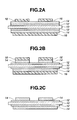
- FIGS. 2A through 2C ultraviolet curing alkali peeling resists 16 having a desired circuit pattern and a thickness of 10 to 15 ⁇ m were applied on both faces of the bonded copper plates 14 (FIG. 2A), and undesired portions of the copper plates 14 were removed with an etchant comprising copper chloride, hydrogen peroxide and hydrochloric acid (FIG. 2B). Thereafter, the resists 16 were removed with an aqueous solution of 3.5 % sodium hydroxide (FIG. 2C).
- the sample was dipped in a mixed solution containing 1.4 % EDTA, 6 % hydrogen peroxide and 3 % ammonia to remove undesired portions of the brazing filler metal 12 (FIG. 3A).
- ultraviolet curing alkali peeling resists 18 having a desired circuit pattern were applied on both faces of the copper plates 14 again (FIG. 3B), and the copper plates 14 were etched again for 15 minutes with an etchant comprising copper chloride, hydrogen peroxide and hydrochloric acid (FIG. 3C).
- the resists 18 were removed with an aqueous solution of 3.5 % sodium hydroxide (FIG. 4A), and an Ni-P electroless plating 20 was carried out (FIG. 4B).
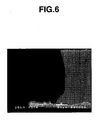
- FIG. 6 shows a photomicrograph of a cross section of the metal/ceramic bonding article thus obtained.
- the brazing filler metal protruding length and the skirt spreading length of the metal circuit portion were measured, so that the lengths were 102 ⁇ m and ⁇ 0 ⁇ m, respectively.
- a furnace passing treatment (a treatment for cooling the article after heating the article at 370°C for ten minutes in a reducing atmosphere (nitrogen 4 + hydrogen 1)) was carried out, and reliability was evaluated by a furnace passing resistance (number).
- the furnace passing resistance (number) of the metal/ceramic bonding article produced in this Example was 58.
- Example 2 By the same method as that in Example 1, a metal/ceramic bonding article having a brazing filler metal protruding length of 101 ⁇ m and a metal circuit portion having a skirt spreading length of ⁇ 0 ⁇ m was obtained. With respect to the metal/ceramic bonding article obtained in this Example, a furnace passing treatment was carried out, and reliability was evaluated by a furnace passing resistance (number). As a result, the furnace passing resistance (number) was 58.
- Example 2 By the same method as that in Example 1, a metal/ceramic bonding article having a brazing filler metal protruding length of 95 ⁇ m and a metal circuit portion having a skirt spreading length of 3 ⁇ m was obtained. With respect to the metal/ceramic bonding article obtained in this Example, a furnace passing treatment was carried out, and reliability was evaluated by a furnace passing resistance (number). As a result, the furnace passing resistance (number) was 68.
- Example 2 By the same method as that in Example 1 except that the second etching was carried out for twenty minutes, a metal/ceramic bonding article having a brazing filler metal protruding length of 124 ⁇ m and a metal circuit portion having a skirt spreading length of ⁇ 0 ⁇ m was obtained.
- a furnace passing treatment was carried out, and reliability was evaluated by a furnace passing resistance (number). As a result, the furnace passing resistance (number) was 84.
- Example 2 By the same method as that in Example 1, a metal/ceramic bonding article having a brazing filler metal protruding length of 88 ⁇ m and a metal circuit portion having a skirt spreading length of 11 ⁇ m was obtained. With respect to the metal/ceramic bonding article obtained in this Example, a furnace passing treatment was carried out, and reliability was evaluated by a furnace passing resistance (number). As a result, the furnace passing resistance (number) was 78.
- a bending strength measuring device SHIMADZU AGS-1000D, produced by Shimadzu Seisakusho
- SHIMADZU AGS-1000D produced by Shimadzu Seisakusho
- the initial bending strength was 615 MPa
- the bending strength after three passages through furnace was 535 MPa.
- Example 4 By the same method as that in Example 4, a metal/ceramic bonding article having a brazing filler metal protruding length of 133 ⁇ m and a metal circuit portion having a skirt spreading length of ⁇ 0 ⁇ m was obtained. With respect to the metal/ceramic bonding article obtained in this Example, a furnace passing treatment was carried out, and reliability was evaluated by a furnace passing resistance (number). As a result, the furnace passing resistance (number) was 98.
- Example 2 By the same method as that in Example 1 except that the second etching was carried out for ten minutes, a metal/ceramic bonding article having a brazing filler metal protruding length of 73 ⁇ m and a metal circuit portion having a skirt spreading length of 8 ⁇ m was obtained.
- a furnace passing treatment was carried out, and reliability was evaluated by a furnace passing resistance (number). As a result, the furnace passing resistance (number) was 74.
- Example 2 By the same method as that in Example 1, a metal/ceramic bonding article having a brazing filler metal protruding length of 82 ⁇ m and a metal circuit portion having a skirt spreading length of 4 ⁇ m was obtained.
- a furnace passing treatment was carried out, and reliability was evaluated by a furnace passing resistance (number).
- the furnace passing resistance (number) was 58.
- an initial bending strength and a bending strength after three passages through furnace were measured similar to Example 5. As a result, the initial bending strength was 609 MPa, and the bending strength after three passages through furnace was 570 MPa.
- Example 2 By the same method as that in Example 1, a metal/ceramic bonding article having a brazing filler metal protruding length of 83 ⁇ m and a metal circuit portion having a skirt spreading length of 11 ⁇ m was obtained. With respect to the metal/ceramic bonding article obtained in this Example, a furnace passing treatment was carried out, and reliability was evaluated by a furnace passing resistance (number). As a result, the furnace passing resistance (number) was 42.
- Example 2 By the same method as that in Example 1, a metal/ceramic bonding article having a brazing filler metal protruding length of 93 ⁇ m and a metal circuit portion having a skirt spreading length of 5 ⁇ m was obtained. With respect to the metal/ceramic bonding article obtained in this Example, a furnace passing treatment was carried out, and reliability was evaluated by a furnace passing resistance (number). As a result, the furnace passing resistance (number) was 52.
- Example 7 By the same method as that in Example 7, a metal/ceramic bonding article having a brazing filler metal protruding length of 65 ⁇ m and a metal circuit portion having a skirt spreading length of 21 ⁇ m was obtained. With respect to the metal/ceramic bonding article obtained in this Example, a furnace passing treatment was carried out, and reliability was evaluated by a furnace passing resistance (number). As a result, the furnace passing resistance (number) was 32.
- Example 7 By the same method as that in Example 7, a metal/ceramic bonding article having a brazing filler metal protruding length of 53 ⁇ m and a metal circuit portion having a skirt spreading length of 23 ⁇ m was obtained. With respect to the metal/ceramic bonding article obtained in this Example, a furnace passing treatment was carried out, and reliability was evaluated by a furnace passing resistance (number). As a result, the furnace passing resistance (number) was 32.
- Example 7 By the same method as that in Example 7, a metal/ceramic bonding article having a brazing filler metal protruding length of 62 ⁇ m and a metal circuit portion having a skirt spreading length of 31 ⁇ m was obtained. With respect to the metal/ceramic bonding article obtained in this Example, a furnace passing treatment was carried out, and reliability was evaluated by a furnace passing resistance (number). As a result, the furnace passing resistance (number) was 32.
- Example 7 By the same method as that in Example 7, a metal/ceramic bonding article having a brazing filler metal protruding length of 54 ⁇ m and a metal circuit portion having a skirt spreading length of 15 ⁇ m was obtained. With respect to the metal/ceramic bonding article obtained in this Example, a furnace passing treatment was carried out, and reliability was evaluated by a furnace passing resistance (number). As a result, the furnace passing resistance (number) was 40.
- Example 7 By the same method as that in Example 7, a metal/ceramic bonding article having a brazing filler metal protruding length of 57 ⁇ m and a metal circuit portion having a skirt spreading length of 26 ⁇ m was obtained. With respect to the metal/ceramic bonding article obtained in this Example, a furnace passing treatment was carried out, and reliability was evaluated by a furnace passing resistance (number). As a result, the furnace passing resistance (number) was 26.
- Example 7 By the same method as that in Example 7, a metal/ceramic bonding article having a brazing filler metal protruding length of 55 ⁇ m and a metal circuit portion having a skirt spreading length of 25 ⁇ m was obtained. With respect to the metal/ceramic bonding article obtained in this Example, a furnace passing treatment was carried out, and reliability was evaluated by a furnace passing resistance (number). As a result, the furnace passing resistance (number) was 30.
- Example 7 By the same method as that in Example 7, a metal/ceramic bonding article having a brazing filler metal protruding length of 55 ⁇ m and a metal circuit portion having a skirt spreading length of 26 ⁇ m was obtained. With respect to the metal/ceramic bonding article obtained in this Example, a furnace passing treatment was carried out, and reliability was evaluated by a furnace passing resistance (number). As a result, the furnace passing resistance (number) was 32.
- Example 4 By the same method as that in Example 4, a metal/ceramic bonding article having a brazing filler metal protruding length of 134 ⁇ m and a metal circuit portion having a skirt spreading length of ⁇ 0 ⁇ m was obtained. With respect to the metal/ceramic bonding article obtained in this Example, a furnace passing treatment was carried out, and reliability was evaluated by a furnace passing resistance (number). As a result, the furnace passing resistance (number) was 92.
- Example 7 By the same method as that in Example 7, a metal/ceramic bonding article having a brazing filler metal protruding length of 52 ⁇ m and a metal circuit portion having a skirt spreading length of 18 ⁇ m was obtained.
- a furnace passing treatment was carried out, and reliability was evaluated by a furnace passing resistance (number).
- the furnace passing resistance (number) was 26.
- an initial bending strength and a bending strength after three passages through furnace were measured similar to Example 5. As a result, the initial bending strength was 622 MPa, and the bending strength after three passages through furnace was 549 MPa.
- Example 7 By the same method as that in Example 7, a metal/ceramic bonding article having a brazing filler metal protruding length of 62 ⁇ m and a metal circuit portion having a skirt spreading length of 10 ⁇ m was obtained. With respect to the metal/ceramic bonding article obtained in this Example, a furnace passing treatment was carried out, and reliability was evaluated by a furnace passing resistance (number). As a result, the furnace passing resistance (number) was 36.
- Example 7 By the same method as that in Example 7, a metal/ceramic bonding article having a brazing filler metal protruding length of 62 ⁇ m and a metal circuit portion having a skirt spreading length of 20 ⁇ m was obtained. With respect to the metal/ceramic bonding article obtained in this Example, a furnace passing treatment was carried out, and reliability was evaluated by a furnace passing resistance (number). As a result, the furnace passing resistance (number) was 38.
- Example 2 By the same method as that in Example 1 except that the second etching was carried out for five minutes, a metal/ceramic bonding article having a brazing filler metal protruding length of -20 ⁇ m and a metal circuit portion having a skirt spreading length of 45 ⁇ m was obtained.
- a furnace passing treatment was carried out, and reliability was evaluated by a furnace passing resistance (number).
- the furnace passing resistance (number) was 11 which was smaller than those in Examples 1 through 21.
- an initial bending strength and a bending strength after three passages through furnace were measured similar to Example 5. As a result, the initial bending strength was 548 MPa, and the bending strength after three passages through furnace was 203 MPa. Both strengths were weaker than those in Examples 5, 8 and 19.
- Example 2 By the same method as that in Example 1, a metal/ceramic bonding article having a brazing filler metal protruding length of 0 ⁇ m and a metal circuit portion having a skirt spreading length of 30 ⁇ m was obtained.
- a furnace passing treatment was carried out, and reliability was evaluated by a furnace passing resistance (number).
- the furnace passing resistance (number) was 19 which was smaller than those in Examples 1 through 21.
- an initial bending strength and a bending strength after three passages through furnace were measured similar to Example 5. As a result, the initial bending strength was 590 MPa, and the bending strength after three passages through furnace was 331 MPa. Both strengths were weaker than those in Examples 5, 8 and 19.
- Example 2 By the same method as that in Example 1, a metal/ceramic bonding article having a brazing filler metal protruding length of 30 ⁇ m and a metal circuit portion having a skirt spreading length of 15 ⁇ m was obtained.
- a furnace passing treatment was carried out, and reliability was evaluated by a furnace passing resistance (number).
- the furnace passing resistance (number) was 25 which was smaller than those in Examples 1 through 21.
- an initial bending strength and a bending strength after three passages through furnace were measured similar to Example 5. As a result, the initial bending strength was 610 MPa, and the bending strength after three passages through furnace was 510 MPa. Both strengths were weaker than those in Examples 5, 8 and 19.
- FIGS. 7 and 8 show the relationship between the brazing filler metal protruding length ( ⁇ m) and the furnace passing resistance (number), and the relationship between the brazing filler metal protruding length ( ⁇ m) and the bending strength (MPa), respectively.
- the brazing filler metal protruding length exceeds about 30 ⁇ m, the furnace passing resistance rapidly increases, and if the brazing filler metal protruding length exceeds about 130 ⁇ m, the variation in furnace passing resistance decreases.
- the brazing filler metal protruding length exceeds about 30 ⁇ m, the difference between the initial bending strength and the bending strength after three passages through furnace becomes small. Therefore, it can be seen that the thermal shock resistance can be greatly improved if the brazing filler metal protruding length is greater than about 30 ⁇ m.
Landscapes
- Engineering & Computer Science (AREA)
- Chemical & Material Sciences (AREA)
- Ceramic Engineering (AREA)
- Materials Engineering (AREA)
- Structural Engineering (AREA)
- Organic Chemistry (AREA)
- Manufacturing & Machinery (AREA)
- Microelectronics & Electronic Packaging (AREA)
- Ceramic Products (AREA)
- Manufacturing Of Printed Wiring (AREA)
Applications Claiming Priority (2)
| Application Number | Priority Date | Filing Date | Title |
|---|---|---|---|
| JP2001304277 | 2001-09-28 | ||
| JP2001304277A JP4168114B2 (ja) | 2001-09-28 | 2001-09-28 | 金属−セラミックス接合体 |
Publications (3)
| Publication Number | Publication Date |
|---|---|
| EP1298108A2 true EP1298108A2 (fr) | 2003-04-02 |
| EP1298108A3 EP1298108A3 (fr) | 2004-02-04 |
| EP1298108B1 EP1298108B1 (fr) | 2017-03-08 |
Family
ID=19124223
Family Applications (1)
| Application Number | Title | Priority Date | Filing Date |
|---|---|---|---|
| EP02007405.0A Expired - Lifetime EP1298108B1 (fr) | 2001-09-28 | 2002-03-28 | Corps liée en métal -céramique |
Country Status (3)
| Country | Link |
|---|---|
| US (1) | US6613450B2 (fr) |
| EP (1) | EP1298108B1 (fr) |
| JP (1) | JP4168114B2 (fr) |
Cited By (6)
| Publication number | Priority date | Publication date | Assignee | Title |
|---|---|---|---|---|
| EP1631132A3 (fr) * | 2004-08-26 | 2007-08-01 | Dowa Mining Co., Ltd. | Substrat composite en aluminium/céramique |
| GB2444978A (en) * | 2006-08-30 | 2008-06-25 | Denso Corp | Interconnections between two substrates in power electronic package for chips and components. |
| US7999369B2 (en) | 2006-08-29 | 2011-08-16 | Denso Corporation | Power electronic package having two substrates with multiple semiconductor chips and electronic components |
| EP2530707A3 (fr) * | 2011-05-31 | 2014-04-30 | IXYS Semiconductor GmbH | Procédé d'assemblage de substrats métal-céramique sur des corps en métal |
| EP2546870A4 (fr) * | 2010-03-09 | 2017-11-29 | KCC Corporation | Substrat céramique à métal lié |
| EP4130308A4 (fr) * | 2020-03-31 | 2024-05-01 | Dowa Metaltech Co., Ltd. | Matériau de brasage, procédé de production associé et procédé de production d'un substrat lié en métal-céramique |
Families Citing this family (36)
| Publication number | Priority date | Publication date | Assignee | Title |
|---|---|---|---|---|
| JP4887583B2 (ja) * | 2001-08-09 | 2012-02-29 | Dowaメタルテック株式会社 | セラミックス回路基板の製造方法 |
| JP3969987B2 (ja) * | 2001-10-01 | 2007-09-05 | Dowaホールディングス株式会社 | セラミックスと合金の接合体 |
| JP3863067B2 (ja) * | 2002-06-04 | 2006-12-27 | Dowaホールディングス株式会社 | 金属−セラミックス接合体の製造方法 |
| JP3868854B2 (ja) * | 2002-06-14 | 2007-01-17 | Dowaホールディングス株式会社 | 金属−セラミックス接合体およびその製造方法 |
| US7159757B2 (en) * | 2002-09-26 | 2007-01-09 | Dowa Mining Co., Ltd. | Metal/ceramic bonding article and method for producing same |
| JP4394477B2 (ja) * | 2003-03-27 | 2010-01-06 | Dowaホールディングス株式会社 | 金属−セラミックス接合基板の製造方法 |
| JP5299160B2 (ja) * | 2003-03-27 | 2013-09-25 | Dowaメタルテック株式会社 | 金属−セラミックス接合基板の製造方法 |
| JP4500065B2 (ja) * | 2004-02-19 | 2010-07-14 | Dowaホールディングス株式会社 | アルミナ部材と銅電極との接合方法およびアルミナ部材と銅電極との接合体 |
| NL1027632C2 (nl) * | 2004-12-01 | 2006-06-02 | Electrische App Nfabriek Capax | Drager voor elektrische componenten met aangesoldeerd koellichaam. |
| JP4760251B2 (ja) * | 2005-09-15 | 2011-08-31 | 日立金属株式会社 | 回路基板の製造方法及び回路基板、半導体モジュール |
| JP5204958B2 (ja) * | 2006-06-19 | 2013-06-05 | 日本発條株式会社 | 接合体 |
| TWI335792B (en) * | 2007-02-09 | 2011-01-01 | Univ Nat Taiwan | Method of manufacturing ceramic/metal composite structure |
| US7857194B2 (en) * | 2007-05-01 | 2010-12-28 | University Of Dayton | Method of joining metals to ceramic matrix composites |
| JP4998100B2 (ja) * | 2007-06-11 | 2012-08-15 | 三菱マテリアル株式会社 | パワーモジュール用基板及びパワーモジュール |
| US8154114B2 (en) * | 2007-08-06 | 2012-04-10 | Infineon Technologies Ag | Power semiconductor module |
| US8018047B2 (en) * | 2007-08-06 | 2011-09-13 | Infineon Technologies Ag | Power semiconductor module including a multilayer substrate |
| US9586382B2 (en) | 2008-01-24 | 2017-03-07 | National Taiwan University | Ceramic/metal composite structure |
| JP5568026B2 (ja) | 2011-01-20 | 2014-08-06 | トヨタ自動車株式会社 | ろう付け方法及びろう付け構造 |
| FR2975528B1 (fr) * | 2011-05-17 | 2014-02-28 | Alstom Transport Sa | Dispositif d'isolation electrique d'un plan conducteur presentant un premier potentiel electrique par rapport a un deuxieme potentiel, comprenant des moyens de diminution de la valeur du champ electrostatique en un point du bord peripherique du plan conducteur |
| JP6162986B2 (ja) * | 2013-03-18 | 2017-07-12 | Dowaメタルテック株式会社 | 金属−セラミックス回路基板の製造方法 |
| WO2015114987A1 (fr) * | 2014-01-29 | 2015-08-06 | Ngkエレクトロデバイス株式会社 | Substrat de module de puissance, procédé de fabrication de substrat de module de puissance et module de puissance mettant en œuvre ledit substrat de module de puissance |
| WO2015125907A1 (fr) * | 2014-02-21 | 2015-08-27 | 電気化学工業株式会社 | Substrat de circuit en céramique |
| US9499275B2 (en) * | 2014-10-16 | 2016-11-22 | Rohr, Inc. | Stress-relieving joint between materials with differing coefficients of thermal expansion |
| JP6631333B2 (ja) * | 2016-03-11 | 2020-01-15 | 三菱マテリアル株式会社 | パワーモジュール用基板の製造方法 |
| JP6799479B2 (ja) * | 2017-03-03 | 2020-12-16 | Dowaメタルテック株式会社 | 金属−セラミックス回路基板の製造方法 |
| WO2019022133A1 (fr) | 2017-07-25 | 2019-01-31 | デンカ株式会社 | Carte de circuit imprimé en céramique et son procédé de production |
| JP7332588B2 (ja) * | 2018-05-16 | 2023-08-23 | 株式会社東芝 | セラミックス銅回路基板およびその製造方法 |
| JP7050643B2 (ja) * | 2018-10-10 | 2022-04-08 | 三菱電機株式会社 | 半導体装置 |
| US12065385B2 (en) | 2018-11-22 | 2024-08-20 | Denka Company Limited | Ceramic-copper composite, method of producing ceramic-copper composite, ceramic circuit board, and power module |
| JP7212700B2 (ja) | 2018-12-28 | 2023-01-25 | デンカ株式会社 | セラミックス-銅複合体、セラミックス回路基板、パワーモジュール及びセラミックス-銅複合体の製造方法 |
| WO2021112046A1 (fr) * | 2019-12-06 | 2021-06-10 | 三菱マテリアル株式会社 | Ensemble cuivre/céramique, carte de circuit imprimé isolée, procédé de production d'ensemble cuivre/céramique et procédé de production de carte de circuit imprimé isolée |
| US20220375819A1 (en) * | 2019-12-12 | 2022-11-24 | Mitsubishi Materials Corporation | Copper/ceramic assembly and insulated circuit board |
| WO2021149802A1 (fr) * | 2020-01-24 | 2021-07-29 | 三菱マテリアル株式会社 | Corps assemblé cuivre/graphène et son procédé de fabrication, et structure assemblée cuivre/graphène |
| CN119501220A (zh) * | 2020-02-17 | 2025-02-25 | 株式会社东芝 | 接合体的制造方法 |
| CN114478022B (zh) * | 2021-12-31 | 2023-01-03 | 南通威斯派尔半导体技术有限公司 | 一种高可靠性氮化铝覆铜陶瓷基板及其制备方法 |
| CN114349471B (zh) * | 2022-01-20 | 2022-11-25 | 深圳思睿辰新材料有限公司 | 一种用于igbt封装的陶瓷覆铝板及其制备方法 |
Family Cites Families (22)
| Publication number | Priority date | Publication date | Assignee | Title |
|---|---|---|---|---|
| JPS58137285A (ja) * | 1982-02-10 | 1983-08-15 | 株式会社日立製作所 | 金属板付セラミック基板の製造法 |
| US4993148A (en) * | 1987-05-19 | 1991-02-19 | Mitsubishi Denki Kabushiki Kaisha | Method of manufacturing a circuit board |
| US5330098A (en) * | 1988-11-07 | 1994-07-19 | The Morgan Crucible Co., Plc | Silver-copper-aluminum-titanium brazing alloy |
| JPH0777989B2 (ja) * | 1989-01-25 | 1995-08-23 | 同和鉱業株式会社 | セラミックスと金属の接合体の製造法 |
| JP2797011B2 (ja) * | 1990-03-13 | 1998-09-17 | 同和鉱業株式会社 | セラミックスと金属との接合体およびその製造法 |
| JP2712778B2 (ja) * | 1990-07-16 | 1998-02-16 | 昭和電工株式会社 | 金属・セラミックス複合基板の製造方法 |
| US5561321A (en) * | 1992-07-03 | 1996-10-01 | Noritake Co., Ltd. | Ceramic-metal composite structure and process of producing same |
| JPH0736467A (ja) | 1993-07-15 | 1995-02-07 | Nippon Tokushu Toryo Co Ltd | 防音部品の製造方法 |
| JPH09275165A (ja) * | 1996-02-07 | 1997-10-21 | Hitachi Ltd | 回路基板及びそれを用いた半導体装置 |
| JP3890539B2 (ja) * | 1996-04-12 | 2007-03-07 | Dowaホールディングス株式会社 | セラミックス−金属複合回路基板 |
| JP3512977B2 (ja) * | 1996-08-27 | 2004-03-31 | 同和鉱業株式会社 | 高信頼性半導体用基板 |
| EP0935286A4 (fr) * | 1997-05-26 | 2008-04-09 | Sumitomo Electric Industries | Substrat jonction de circuit en cuivre et procede de production de ce substrat |
| JP3449458B2 (ja) * | 1997-05-26 | 2003-09-22 | 電気化学工業株式会社 | 回路基板 |
| CN1222636C (zh) * | 1997-12-18 | 2005-10-12 | 株式会社日矿材料 | 化学镀镍的预处理溶液及预处理方法 |
| JPH11322455A (ja) * | 1998-05-14 | 1999-11-24 | Tokuyama Corp | セラミックス/金属接合体およびその製造方法 |
| DE19832249A1 (de) * | 1998-07-17 | 2000-02-03 | Roland Haefele | Verfahren zum chemischen Vernickeln einer galvanisch abgeschiedenen Nickelschicht und Leiterplatte |
| JP4018264B2 (ja) * | 1998-10-16 | 2007-12-05 | Dowaホールディングス株式会社 | アルミニウム−窒化アルミニウム絶縁基板の製造方法 |
| JP2000340912A (ja) * | 1999-05-27 | 2000-12-08 | Kyocera Corp | セラミック回路基板 |
| JP2001089257A (ja) * | 1999-09-13 | 2001-04-03 | Denki Kagaku Kogyo Kk | Al回路板用ろう材とそれを用いたセラミックス回路基板 |
| JP4088394B2 (ja) * | 1999-09-29 | 2008-05-21 | 株式会社日立製作所 | 絶縁回路基板およびそれを用いた半導体装置 |
| JP2001203299A (ja) * | 2000-01-21 | 2001-07-27 | Denki Kagaku Kogyo Kk | アルミニウム板とそれを用いたセラミックス回路基板 |
| JP2001332854A (ja) * | 2000-05-24 | 2001-11-30 | Toshiba Corp | セラミックス回路基板 |
-
2001
- 2001-09-28 JP JP2001304277A patent/JP4168114B2/ja not_active Expired - Lifetime
-
2002
- 2002-03-27 US US10/108,317 patent/US6613450B2/en not_active Expired - Lifetime
- 2002-03-28 EP EP02007405.0A patent/EP1298108B1/fr not_active Expired - Lifetime
Cited By (9)
| Publication number | Priority date | Publication date | Assignee | Title |
|---|---|---|---|---|
| EP1631132A3 (fr) * | 2004-08-26 | 2007-08-01 | Dowa Mining Co., Ltd. | Substrat composite en aluminium/céramique |
| US7999369B2 (en) | 2006-08-29 | 2011-08-16 | Denso Corporation | Power electronic package having two substrates with multiple semiconductor chips and electronic components |
| US8432030B2 (en) | 2006-08-29 | 2013-04-30 | Denso Corporation | Power electronic package having two substrates with multiple semiconductor chips and electronic components |
| GB2444978A (en) * | 2006-08-30 | 2008-06-25 | Denso Corp | Interconnections between two substrates in power electronic package for chips and components. |
| GB2444978B (en) * | 2006-08-30 | 2012-03-14 | Denso Corp | Power electronic package having two substrates with multiple semiconductor chips and electronic components |
| EP2546870A4 (fr) * | 2010-03-09 | 2017-11-29 | KCC Corporation | Substrat céramique à métal lié |
| EP2530707A3 (fr) * | 2011-05-31 | 2014-04-30 | IXYS Semiconductor GmbH | Procédé d'assemblage de substrats métal-céramique sur des corps en métal |
| EP4130308A4 (fr) * | 2020-03-31 | 2024-05-01 | Dowa Metaltech Co., Ltd. | Matériau de brasage, procédé de production associé et procédé de production d'un substrat lié en métal-céramique |
| US12337421B2 (en) | 2020-03-31 | 2025-06-24 | Dowa Metaltech Co., Ltd. | Brazing material, method for producing the same, and method for producing metal-ceramics bonded substrate |
Also Published As
| Publication number | Publication date |
|---|---|
| US20030068532A1 (en) | 2003-04-10 |
| EP1298108A3 (fr) | 2004-02-04 |
| EP1298108B1 (fr) | 2017-03-08 |
| JP2003112980A (ja) | 2003-04-18 |
| US6613450B2 (en) | 2003-09-02 |
| JP4168114B2 (ja) | 2008-10-22 |
Similar Documents
| Publication | Publication Date | Title |
|---|---|---|
| EP1298108B1 (fr) | Corps liée en métal -céramique | |
| EP1298970B1 (fr) | Procédé de fabrication d'un panneau de circuit à liaison métal/céramique | |
| EP1465251B1 (fr) | Procédé de fabrication d'un substrat à liaison métal-céramique | |
| KR100328407B1 (ko) | 세라믹회로기판 | |
| KR102516917B1 (ko) | 세라믹스 회로 기판 및 그 제조 방법과 그것을 사용한 모듈 | |
| EP3321957B1 (fr) | Carte de circuit imprimé céramique-métal et dispositif à semi-conducteur l'utilisant | |
| US5672848A (en) | Ceramic circuit board | |
| EP3632879B1 (fr) | Carte de circuit imprimé en céramique et son procede de fabrication | |
| EP1298968B1 (fr) | Plaquette de circuit en céramique portant un film métallique | |
| EP1246514A2 (fr) | Panneau à circuit et son procédé de fabrication | |
| EP1482771B1 (fr) | Panneau à circuit métal/céramique et son procédé de fabrication | |
| KR100374379B1 (ko) | 기판 | |
| CN100471668C (zh) | 金属/陶瓷粘合制品 | |
| US6780520B2 (en) | Metal/ceramic bonding article and method for producing same | |
| EP1345264B1 (fr) | Carte de circuit ceramique de type integre et procede pour la produire | |
| KR100873772B1 (ko) | 금속/세라믹 접합 제품 | |
| US6936337B2 (en) | Metal/ceramic circuit board | |
| JPH09162325A (ja) | 窒化珪素回路基板及びその製造方法 | |
| JP2002359453A (ja) | 回路基板及びその製造方法 | |
| JPH10247763A (ja) | 回路基板及びその製造方法 | |
| JPH10167804A (ja) | セラミックス基板及びそれを用いた回路基板とその製造方法 | |
| JP3190282B2 (ja) | 回路基板の製造方法 | |
| JPH0936541A (ja) | 回路基板の製造方法 | |
| JP2000031609A (ja) | 回路基板 | |
| JP3812988B2 (ja) | 回路基板 |
Legal Events
| Date | Code | Title | Description |
|---|---|---|---|
| PUAI | Public reference made under article 153(3) epc to a published international application that has entered the european phase |
Free format text: ORIGINAL CODE: 0009012 |
|
| AK | Designated contracting states |
Kind code of ref document: A2 Designated state(s): AT BE CH CY DE DK ES FI FR GB GR IE IT LI LU MC NL PT SE TR Designated state(s): AT BE CH CY DE DK ES FI FR GB GR IE IT LI LU MC NL PT SE TR |
|
| AX | Request for extension of the european patent |
Extension state: AL LT LV MK RO SI |
|
| PUAL | Search report despatched |
Free format text: ORIGINAL CODE: 0009013 |
|
| AK | Designated contracting states |
Kind code of ref document: A3 Designated state(s): AT BE CH CY DE DK ES FI FR GB GR IE IT LI LU MC NL PT SE TR |
|
| AX | Request for extension of the european patent |
Extension state: AL LT LV MK RO SI |
|
| AKX | Designation fees paid | ||
| 17P | Request for examination filed |
Effective date: 20040528 |
|
| RBV | Designated contracting states (corrected) |
Designated state(s): DE FR GB NL |
|
| REG | Reference to a national code |
Ref country code: DE Ref legal event code: 8566 |
|
| 17Q | First examination report despatched |
Effective date: 20050202 |
|
| RAP1 | Party data changed (applicant data changed or rights of an application transferred) |
Owner name: DOWA HOLDINGS CO., LTD. |
|
| RAP1 | Party data changed (applicant data changed or rights of an application transferred) |
Owner name: DOWA METALTECH CO., LTD. |
|
| GRAP | Despatch of communication of intention to grant a patent |
Free format text: ORIGINAL CODE: EPIDOSNIGR1 |
|
| INTG | Intention to grant announced |
Effective date: 20161019 |
|
| GRAS | Grant fee paid |
Free format text: ORIGINAL CODE: EPIDOSNIGR3 |
|
| GRAA | (expected) grant |
Free format text: ORIGINAL CODE: 0009210 |
|
| AK | Designated contracting states |
Kind code of ref document: B1 Designated state(s): DE FR GB NL |
|
| REG | Reference to a national code |
Ref country code: GB Ref legal event code: FG4D |
|
| REG | Reference to a national code |
Ref country code: DE Ref legal event code: R096 Ref document number: 60248710 Country of ref document: DE |
|
| REG | Reference to a national code |
Ref country code: NL Ref legal event code: MP Effective date: 20170308 |
|
| PG25 | Lapsed in a contracting state [announced via postgrant information from national office to epo] |
Ref country code: NL Free format text: LAPSE BECAUSE OF FAILURE TO SUBMIT A TRANSLATION OF THE DESCRIPTION OR TO PAY THE FEE WITHIN THE PRESCRIBED TIME-LIMIT Effective date: 20170308 |
|
| REG | Reference to a national code |
Ref country code: DE Ref legal event code: R097 Ref document number: 60248710 Country of ref document: DE |
|
| PLBE | No opposition filed within time limit |
Free format text: ORIGINAL CODE: 0009261 |
|
| STAA | Information on the status of an ep patent application or granted ep patent |
Free format text: STATUS: NO OPPOSITION FILED WITHIN TIME LIMIT |
|
| REG | Reference to a national code |
Ref country code: FR Ref legal event code: ST Effective date: 20171227 |
|
| PG25 | Lapsed in a contracting state [announced via postgrant information from national office to epo] |
Ref country code: FR Free format text: LAPSE BECAUSE OF NON-PAYMENT OF DUE FEES Effective date: 20170509 |
|
| 26N | No opposition filed |
Effective date: 20171211 |
|
| GBPC | Gb: european patent ceased through non-payment of renewal fee |
Effective date: 20170608 |
|
| PG25 | Lapsed in a contracting state [announced via postgrant information from national office to epo] |
Ref country code: GB Free format text: LAPSE BECAUSE OF NON-PAYMENT OF DUE FEES Effective date: 20170608 |
|
| PGFP | Annual fee paid to national office [announced via postgrant information from national office to epo] |
Ref country code: DE Payment date: 20210316 Year of fee payment: 20 |
|
| REG | Reference to a national code |
Ref country code: DE Ref legal event code: R071 Ref document number: 60248710 Country of ref document: DE |