EP1298136A2 - Chirale Monophosphorverbindungen - Google Patents
Chirale Monophosphorverbindungen Download PDFInfo
- Publication number
- EP1298136A2 EP1298136A2 EP02020595A EP02020595A EP1298136A2 EP 1298136 A2 EP1298136 A2 EP 1298136A2 EP 02020595 A EP02020595 A EP 02020595A EP 02020595 A EP02020595 A EP 02020595A EP 1298136 A2 EP1298136 A2 EP 1298136A2
- Authority
- EP
- European Patent Office
- Prior art keywords
- biphenyl
- diyl
- phosphite
- tert
- butyl
- Prior art date
- Legal status (The legal status is an assumption and is not a legal conclusion. Google has not performed a legal analysis and makes no representation as to the accuracy of the status listed.)
- Withdrawn
Links
- 0 CC1*Oc2cccc(C)c2-c(c(C)ccc2)c2O*1 Chemical compound CC1*Oc2cccc(C)c2-c(c(C)ccc2)c2O*1 0.000 description 2
- KTYZEXVGBOVFRY-UHFFFAOYSA-N CC(C)(C)OC(COc(cccc1C)c1-c(c(C)ccc1)c1OCC(OC(C)(C)C)=O)=O Chemical compound CC(C)(C)OC(COc(cccc1C)c1-c(c(C)ccc1)c1OCC(OC(C)(C)C)=O)=O KTYZEXVGBOVFRY-UHFFFAOYSA-N 0.000 description 1
- IAKXRGISIPXUAF-UHFFFAOYSA-N CC(C)COc(cccc1C)c1-c(c(C)ccc1)c1OCC(C)C Chemical compound CC(C)COc(cccc1C)c1-c(c(C)ccc1)c1OCC(C)C IAKXRGISIPXUAF-UHFFFAOYSA-N 0.000 description 1
- XFUHLVOSOQKLBI-UHFFFAOYSA-N CC(C)Oc(cccc1C)c1-c1c(C)cccc1OC(C)C Chemical compound CC(C)Oc(cccc1C)c1-c1c(C)cccc1OC(C)C XFUHLVOSOQKLBI-UHFFFAOYSA-N 0.000 description 1
- CEWBFVOKNKVKKV-UHFFFAOYSA-N CCCCC(CC)COc(cccc1C)c1-c(c(C)ccc1)c1OCC(CC)CCCC Chemical compound CCCCC(CC)COc(cccc1C)c1-c(c(C)ccc1)c1OCC(CC)CCCC CEWBFVOKNKVKKV-UHFFFAOYSA-N 0.000 description 1
- NYJMTOLJXAMFRV-UHFFFAOYSA-N CCOc(cccc1C)c1-c(c(C)ccc1)c1OCC Chemical compound CCOc(cccc1C)c1-c(c(C)ccc1)c1OCC NYJMTOLJXAMFRV-UHFFFAOYSA-N 0.000 description 1
- DEUBIYWQWLAULR-UHFFFAOYSA-N Cc(cccc1OC)c1-c(c(C)ccc1)c1OC Chemical compound Cc(cccc1OC)c1-c(c(C)ccc1)c1OC DEUBIYWQWLAULR-UHFFFAOYSA-N 0.000 description 1
- SZBUJZVUQOCHLJ-UHFFFAOYSA-N Cc1cccc(O)c1-c(c(C)ccc1)c1O Chemical compound Cc1cccc(O)c1-c(c(C)ccc1)c1O SZBUJZVUQOCHLJ-UHFFFAOYSA-N 0.000 description 1
Classifications
-
- C—CHEMISTRY; METALLURGY
- C07—ORGANIC CHEMISTRY
- C07F—ACYCLIC, CARBOCYCLIC OR HETEROCYCLIC COMPOUNDS CONTAINING ELEMENTS OTHER THAN CARBON, HYDROGEN, HALOGEN, OXYGEN, NITROGEN, SULFUR, SELENIUM OR TELLURIUM
- C07F9/00—Compounds containing elements of Groups 5 or 15 of the Periodic Table
- C07F9/02—Phosphorus compounds
- C07F9/547—Heterocyclic compounds, e.g. containing phosphorus as a ring hetero atom
- C07F9/6564—Heterocyclic compounds, e.g. containing phosphorus as a ring hetero atom having phosphorus atoms, with or without nitrogen, oxygen, sulfur, selenium or tellurium atoms, as ring hetero atoms
- C07F9/6571—Heterocyclic compounds, e.g. containing phosphorus as a ring hetero atom having phosphorus atoms, with or without nitrogen, oxygen, sulfur, selenium or tellurium atoms, as ring hetero atoms having phosphorus and oxygen atoms as the only ring hetero atoms
- C07F9/6574—Esters of oxyacids of phosphorus
- C07F9/65744—Esters of oxyacids of phosphorus condensed with carbocyclic or heterocyclic rings or ring systems
-
- B—PERFORMING OPERATIONS; TRANSPORTING
- B01—PHYSICAL OR CHEMICAL PROCESSES OR APPARATUS IN GENERAL
- B01J—CHEMICAL OR PHYSICAL PROCESSES, e.g. CATALYSIS OR COLLOID CHEMISTRY; THEIR RELEVANT APPARATUS
- B01J31/00—Catalysts comprising hydrides, coordination complexes or organic compounds
- B01J31/16—Catalysts comprising hydrides, coordination complexes or organic compounds containing coordination complexes
- B01J31/18—Catalysts comprising hydrides, coordination complexes or organic compounds containing coordination complexes containing nitrogen, phosphorus, arsenic or antimony as complexing atoms, e.g. in pyridine ligands, or in resonance therewith, e.g. in isocyanide ligands C=N-R or as complexed central atoms
- B01J31/1845—Catalysts comprising hydrides, coordination complexes or organic compounds containing coordination complexes containing nitrogen, phosphorus, arsenic or antimony as complexing atoms, e.g. in pyridine ligands, or in resonance therewith, e.g. in isocyanide ligands C=N-R or as complexed central atoms the ligands containing phosphorus
- B01J31/185—Phosphites ((RO)3P), their isomeric phosphonates (R(RO)2P=O) and RO-substitution derivatives thereof
-
- C—CHEMISTRY; METALLURGY
- C07—ORGANIC CHEMISTRY
- C07B—GENERAL METHODS OF ORGANIC CHEMISTRY; APPARATUS THEREFOR
- C07B53/00—Asymmetric syntheses
-
- C—CHEMISTRY; METALLURGY
- C07—ORGANIC CHEMISTRY
- C07C—ACYCLIC OR CARBOCYCLIC COMPOUNDS
- C07C231/00—Preparation of carboxylic acid amides
- C07C231/12—Preparation of carboxylic acid amides by reactions not involving the formation of carboxamide groups
-
- C—CHEMISTRY; METALLURGY
- C07—ORGANIC CHEMISTRY
- C07C—ACYCLIC OR CARBOCYCLIC COMPOUNDS
- C07C231/00—Preparation of carboxylic acid amides
- C07C231/16—Preparation of optical isomers
- C07C231/18—Preparation of optical isomers by stereospecific synthesis
-
- C—CHEMISTRY; METALLURGY
- C07—ORGANIC CHEMISTRY
- C07C—ACYCLIC OR CARBOCYCLIC COMPOUNDS
- C07C45/00—Preparation of compounds having >C = O groups bound only to carbon or hydrogen atoms; Preparation of chelates of such compounds
- C07C45/49—Preparation of compounds having >C = O groups bound only to carbon or hydrogen atoms; Preparation of chelates of such compounds by reaction with carbon monoxide
- C07C45/50—Preparation of compounds having >C = O groups bound only to carbon or hydrogen atoms; Preparation of chelates of such compounds by reaction with carbon monoxide by oxo-reactions
- C07C45/505—Asymmetric hydroformylation
-
- C—CHEMISTRY; METALLURGY
- C07—ORGANIC CHEMISTRY
- C07C—ACYCLIC OR CARBOCYCLIC COMPOUNDS
- C07C67/00—Preparation of carboxylic acid esters
- C07C67/30—Preparation of carboxylic acid esters by modifying the acid moiety of the ester, such modification not being an introduction of an ester group
- C07C67/303—Preparation of carboxylic acid esters by modifying the acid moiety of the ester, such modification not being an introduction of an ester group by hydrogenation of unsaturated carbon-to-carbon bonds
-
- C—CHEMISTRY; METALLURGY
- C07—ORGANIC CHEMISTRY
- C07F—ACYCLIC, CARBOCYCLIC OR HETEROCYCLIC COMPOUNDS CONTAINING ELEMENTS OTHER THAN CARBON, HYDROGEN, HALOGEN, OXYGEN, NITROGEN, SULFUR, SELENIUM OR TELLURIUM
- C07F9/00—Compounds containing elements of Groups 5 or 15 of the Periodic Table
- C07F9/02—Phosphorus compounds
- C07F9/547—Heterocyclic compounds, e.g. containing phosphorus as a ring hetero atom
- C07F9/6564—Heterocyclic compounds, e.g. containing phosphorus as a ring hetero atom having phosphorus atoms, with or without nitrogen, oxygen, sulfur, selenium or tellurium atoms, as ring hetero atoms
- C07F9/6571—Heterocyclic compounds, e.g. containing phosphorus as a ring hetero atom having phosphorus atoms, with or without nitrogen, oxygen, sulfur, selenium or tellurium atoms, as ring hetero atoms having phosphorus and oxygen atoms as the only ring hetero atoms
-
- C—CHEMISTRY; METALLURGY
- C07—ORGANIC CHEMISTRY
- C07F—ACYCLIC, CARBOCYCLIC OR HETEROCYCLIC COMPOUNDS CONTAINING ELEMENTS OTHER THAN CARBON, HYDROGEN, HALOGEN, OXYGEN, NITROGEN, SULFUR, SELENIUM OR TELLURIUM
- C07F9/00—Compounds containing elements of Groups 5 or 15 of the Periodic Table
- C07F9/02—Phosphorus compounds
- C07F9/547—Heterocyclic compounds, e.g. containing phosphorus as a ring hetero atom
- C07F9/6564—Heterocyclic compounds, e.g. containing phosphorus as a ring hetero atom having phosphorus atoms, with or without nitrogen, oxygen, sulfur, selenium or tellurium atoms, as ring hetero atoms
- C07F9/6571—Heterocyclic compounds, e.g. containing phosphorus as a ring hetero atom having phosphorus atoms, with or without nitrogen, oxygen, sulfur, selenium or tellurium atoms, as ring hetero atoms having phosphorus and oxygen atoms as the only ring hetero atoms
- C07F9/657154—Cyclic esteramides of oxyacids of phosphorus
-
- C—CHEMISTRY; METALLURGY
- C07—ORGANIC CHEMISTRY
- C07F—ACYCLIC, CARBOCYCLIC OR HETEROCYCLIC COMPOUNDS CONTAINING ELEMENTS OTHER THAN CARBON, HYDROGEN, HALOGEN, OXYGEN, NITROGEN, SULFUR, SELENIUM OR TELLURIUM
- C07F9/00—Compounds containing elements of Groups 5 or 15 of the Periodic Table
- C07F9/02—Phosphorus compounds
- C07F9/547—Heterocyclic compounds, e.g. containing phosphorus as a ring hetero atom
- C07F9/6564—Heterocyclic compounds, e.g. containing phosphorus as a ring hetero atom having phosphorus atoms, with or without nitrogen, oxygen, sulfur, selenium or tellurium atoms, as ring hetero atoms
- C07F9/6571—Heterocyclic compounds, e.g. containing phosphorus as a ring hetero atom having phosphorus atoms, with or without nitrogen, oxygen, sulfur, selenium or tellurium atoms, as ring hetero atoms having phosphorus and oxygen atoms as the only ring hetero atoms
- C07F9/657163—Heterocyclic compounds, e.g. containing phosphorus as a ring hetero atom having phosphorus atoms, with or without nitrogen, oxygen, sulfur, selenium or tellurium atoms, as ring hetero atoms having phosphorus and oxygen atoms as the only ring hetero atoms the ring phosphorus atom being bound to at least one carbon atom
- C07F9/65719—Heterocyclic compounds, e.g. containing phosphorus as a ring hetero atom having phosphorus atoms, with or without nitrogen, oxygen, sulfur, selenium or tellurium atoms, as ring hetero atoms having phosphorus and oxygen atoms as the only ring hetero atoms the ring phosphorus atom being bound to at least one carbon atom the ring phosphorus atom and, at least, one ring oxygen atom being part of a (thio)phosphonous acid derivative
-
- B—PERFORMING OPERATIONS; TRANSPORTING
- B01—PHYSICAL OR CHEMICAL PROCESSES OR APPARATUS IN GENERAL
- B01J—CHEMICAL OR PHYSICAL PROCESSES, e.g. CATALYSIS OR COLLOID CHEMISTRY; THEIR RELEVANT APPARATUS
- B01J2231/00—Catalytic reactions performed with catalysts classified in B01J31/00
- B01J2231/40—Substitution reactions at carbon centres, e.g. C-C or C-X, i.e. carbon-hetero atom, cross-coupling, C-H activation or ring-opening reactions
- B01J2231/42—Catalytic cross-coupling, i.e. connection of previously not connected C-atoms or C- and X-atoms without rearrangement
- B01J2231/4205—C-C cross-coupling, e.g. metal catalyzed or Friedel-Crafts type
- B01J2231/4261—Heck-type, i.e. RY + C=C, in which R is aryl
-
- B—PERFORMING OPERATIONS; TRANSPORTING
- B01—PHYSICAL OR CHEMICAL PROCESSES OR APPARATUS IN GENERAL
- B01J—CHEMICAL OR PHYSICAL PROCESSES, e.g. CATALYSIS OR COLLOID CHEMISTRY; THEIR RELEVANT APPARATUS
- B01J2231/00—Catalytic reactions performed with catalysts classified in B01J31/00
- B01J2231/60—Reduction reactions, e.g. hydrogenation
- B01J2231/64—Reductions in general of organic substrates, e.g. hydride reductions or hydrogenations
- B01J2231/641—Hydrogenation of organic substrates, i.e. H2 or H-transfer hydrogenations, e.g. Fischer-Tropsch processes
- B01J2231/643—Hydrogenation of organic substrates, i.e. H2 or H-transfer hydrogenations, e.g. Fischer-Tropsch processes of R2C=O or R2C=NR (R= C, H)
-
- B—PERFORMING OPERATIONS; TRANSPORTING
- B01—PHYSICAL OR CHEMICAL PROCESSES OR APPARATUS IN GENERAL
- B01J—CHEMICAL OR PHYSICAL PROCESSES, e.g. CATALYSIS OR COLLOID CHEMISTRY; THEIR RELEVANT APPARATUS
- B01J2231/00—Catalytic reactions performed with catalysts classified in B01J31/00
- B01J2231/60—Reduction reactions, e.g. hydrogenation
- B01J2231/64—Reductions in general of organic substrates, e.g. hydride reductions or hydrogenations
- B01J2231/641—Hydrogenation of organic substrates, i.e. H2 or H-transfer hydrogenations, e.g. Fischer-Tropsch processes
- B01J2231/645—Hydrogenation of organic substrates, i.e. H2 or H-transfer hydrogenations, e.g. Fischer-Tropsch processes of C=C or C-C triple bonds
-
- B—PERFORMING OPERATIONS; TRANSPORTING
- B01—PHYSICAL OR CHEMICAL PROCESSES OR APPARATUS IN GENERAL
- B01J—CHEMICAL OR PHYSICAL PROCESSES, e.g. CATALYSIS OR COLLOID CHEMISTRY; THEIR RELEVANT APPARATUS
- B01J2531/00—Additional information regarding catalytic systems classified in B01J31/00
- B01J2531/80—Complexes comprising metals of Group VIII as the central metal
- B01J2531/82—Metals of the platinum group
- B01J2531/822—Rhodium
-
- C—CHEMISTRY; METALLURGY
- C07—ORGANIC CHEMISTRY
- C07B—GENERAL METHODS OF ORGANIC CHEMISTRY; APPARATUS THEREFOR
- C07B2200/00—Indexing scheme relating to specific properties of organic compounds
- C07B2200/07—Optical isomers
Definitions
- the present invention relates to catalysts containing chiral monophosphorus compounds, and their use, the chiral monophosphorus compounds themselves and their preliminary stages.
- Chiral monophosphorus compounds are within the scope the invention in particular chiral monophosphites, monophosphoramidites and Monophosphonites.
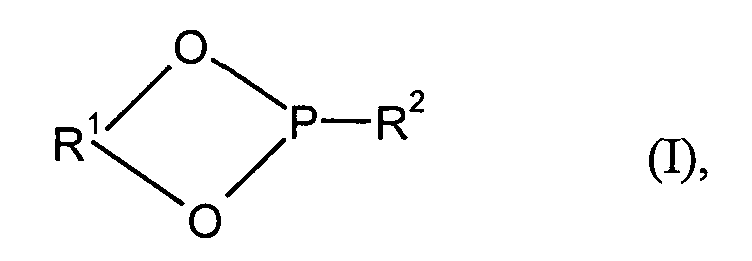
- R 2 preferably represents substituted or unsubstituted alkoxy or substituted or unsubstituted aryloxy or tertiary amino, particularly preferably substituted or unsubstituted alkoxy or substituted or unsubstituted aryloxy.
- Unsubstituted or substituted alkyl is, for example and preferably, unbranched, branched, cyclic or acyclic C 1 -C 18 -alkyl radicals which are either not or at least partially by fluorine, chlorine, bromine, oxo, hydroxy, unsubstituted or substituted aryl, C 1 -C 6 -alkoxy, such as methoxy, ethoxy, iso-propoxy or n-propoxy, n-butoxy, or tert-butoxy, primary, secondary or tertiary amino, cyano or carboxyl groups or derivatives thereof are substituted.
- Examples of derivatives of carboxyl groups are esters, amides or salts.
- Unsubstituted or substituted alkyl is particularly preferably branched, cyclic or acyclic C 3 -C 12 -alkyl radicals which are either not or at least partially by fluorine, oxo, hydroxy, methoxy, ethoxy, phenyl, 2-methoxyphenyl, 2-pyridyl, 3- Pyridyl, 4-pyridyl, amino, dimethylamino, diethylamino, diisopropylamino, cyano or carboxyl groups, their sodium or potassium salt or their methyl or ethyl ester or their amide, dimethylamide or diethylamide are substituted.
- Unsubstituted or substituted alkyl very particularly preferably represents isopropyl, tert-butyl, cyclohexyl, 1-butyl, 2-butyl, 2-ethylhex-1-yl, benzyl, 2-methoxybenzyl, 2-pyridylmethyl, 1-phenylethyl.
- Unsubstituted or substituted alkoxy is, for example and preferably, unbranched, branched, cyclic or acyclic C 1 -C 18 alkoxy radicals which are either not or at least partially by fluorine, chlorine, bromine, oxo, free or protected hydroxy, C 1 -C 6 - Alkoxy, such as methoxy, ethoxy, iso-propoxy or n-propoxy, n-butoxy or tert-butoxy, substituted or unsubstituted C 6 -C 10 aryl, such as phenyl or 2-pyridyl, primary, secondary or tertiary amino, cyano or carboxyl groups or derivatives thereof are substituted.
- C 1 -C 6 - Alkoxy such as methoxy, ethoxy, iso-propoxy or n-propoxy, n-butoxy or tert-butoxy
- substituted or unsubstituted C 6 -C 10 aryl such as
- Unsubstituted or substituted alkoxy is particularly preferably unbranched, branched, cyclic or acyclic C 2 -C 12 alkoxy radicals which are either not or at least partially substituted by fluorine, chlorine, free or protected hydroxy, substituted or unsubstituted phenyl, 2-pyridyl, C 1 -C 6 alkoxy, such as methoxy, ethoxy, iso-propoxy or n-propoxy, n-butoxy or tert-butoxy, C 1 -C 6 dialkylamino, C 1 -C 6 alkylcarbonylamino, benzoylamino, 4- Methylphenylsulfonylamino, imidazoyl, phthalimidyl, C 1 -C 6 alkyloxycarbonyl, C 1 -C 4 dialkylaminocarbonyl.
- Unsubstituted or substituted alkoxy very particularly preferably represents unbranched, branched, cyclic or acyclic C 2 -C 6 alkoxy radicals which are either not or at least partially by fluorine, chlorine, free or protected hydroxy, mono- or disubstituted or unsubstituted phenyl, 2- Pyridinyl, C 1 -C 4 dialkylamino, C 1 -C 4 alkylcarbonylamino, benzoylamino, 4-methylphenylsulfonylamino, imidazoyl, phthalimidyl, C 1 -C 4 alkyloxycarbonyl, C 1 -C 4 dialkylaminocarbonyl, C 1 -C 4 -alkoxy, such as methoxy, ethoxy, iso-propoxy or n-propoxy, n-butoxy or tert-butoxy, are substituted.
- unsubstituted or substituted alkoxy is methoxy, Ethoxy, iso-propoxy, cyclohexyloxy, phenoxy, (R) -1-phenylethoxy or (S) -1-phenylethoxy.
- carbocyclic aromatic radicals with 6 to 18 carbon atoms are for example phenyl, naphthyl, phenanthrenyl, anthracenyl or fluorenyl, heteroaromatic radicals with 5 to 18 carbon atoms in which none, one, two or three carbon atoms per cycle, at least in the entire molecule however, a skeletal carbon atom, by heteroatoms, selected from the group Nitrogen, sulfur or oxygen can be substituted, for example Pyridinyl, oxazolyl, thiophene-yl, benzofuranyl, benzothiophene-yl, dibenzofuranyl, Dibenzothiophen-yl, furanyl, indolyl, pyridazinyl, pyrazinyl, pyrimidinyl, Triazolyl or quinolinyl.
- Nitrogen, sulfur or oxygen can be substituted, for example Pyridinyl, oxazolyl, thiophene-yl,
- Protected formyl in the context of the invention represents a formyl radical which by conversion to an aminal, acetal or a mixed aminal acetal is protected, the aminals, acetals and mixed aminal acetals acyclic or can be cyclic.
- Protected hydroxy in the context of the invention stands for a hydroxy radical which is protected by conversion into an acetal, carbonate, carbamate or carboxylate. Examples of this are the conversion into a tetrahydropyranyl adduct, into a Benzyloxycarbonyl, allyloxycarbonyl or a tert-butyloxycarbonyl derivative.
- Substituted or unsubstituted aryloxy is, for example and preferably, radicals of the formula (IV) -O-Ar in which Ar has the same broadest meaning as that given above for substituted or unsubstituted aryl.
- the two radicals R 10 can also be bridging together.
- the invention also includes the cases in which the two R 10 radicals are each chiral or together are chiral and bridging.
- the two radicals R 10 can also be bridging together.
- Preferred and for example bridges of formula (VII) come into consideration here -OG 1 -KG 2 -O- in which, independently of one another, G 1 and G 2 can either be omitted, be a carbonyl group or a carbonylamino group,
- K can be an unsubstituted or substituted C 2 -C 6 alkylene chain.
- R 1 very particularly preferably represents an unsubstituted or substituted 1,1'-biphenyl-2,2'-diyl radical of the general formula (VI) in which the radicals R 7 , R 8 , R 9 and R 10 are each independent are selected from the group consisting of fluorine, chlorine, bromine, free or protected hydroxy, unsubstituted or substituted C 1 -C 4 alkyl, unsubstituted or substituted C 1 -C 4 alkoxy, or radicals of the general formula (II), ABDE in the independently of each other A is missing and B is absent or represents oxygen, and D represents a carbonyl group and E represents R 4 , OR 4 , NHR 5 or NR 5 R 6 , wherein R 4 is C 1 -C 4 alkyl or C 6 -C 10 aryl and R 5 and R 6 each independently represent C 1 -C 4 alkyl or NR 5 R 6 together represents a cyclic amino radical, or radicals of the general formulas (
- K represents an unsubstituted or substituted C 2 -C 4 alkylene chain.
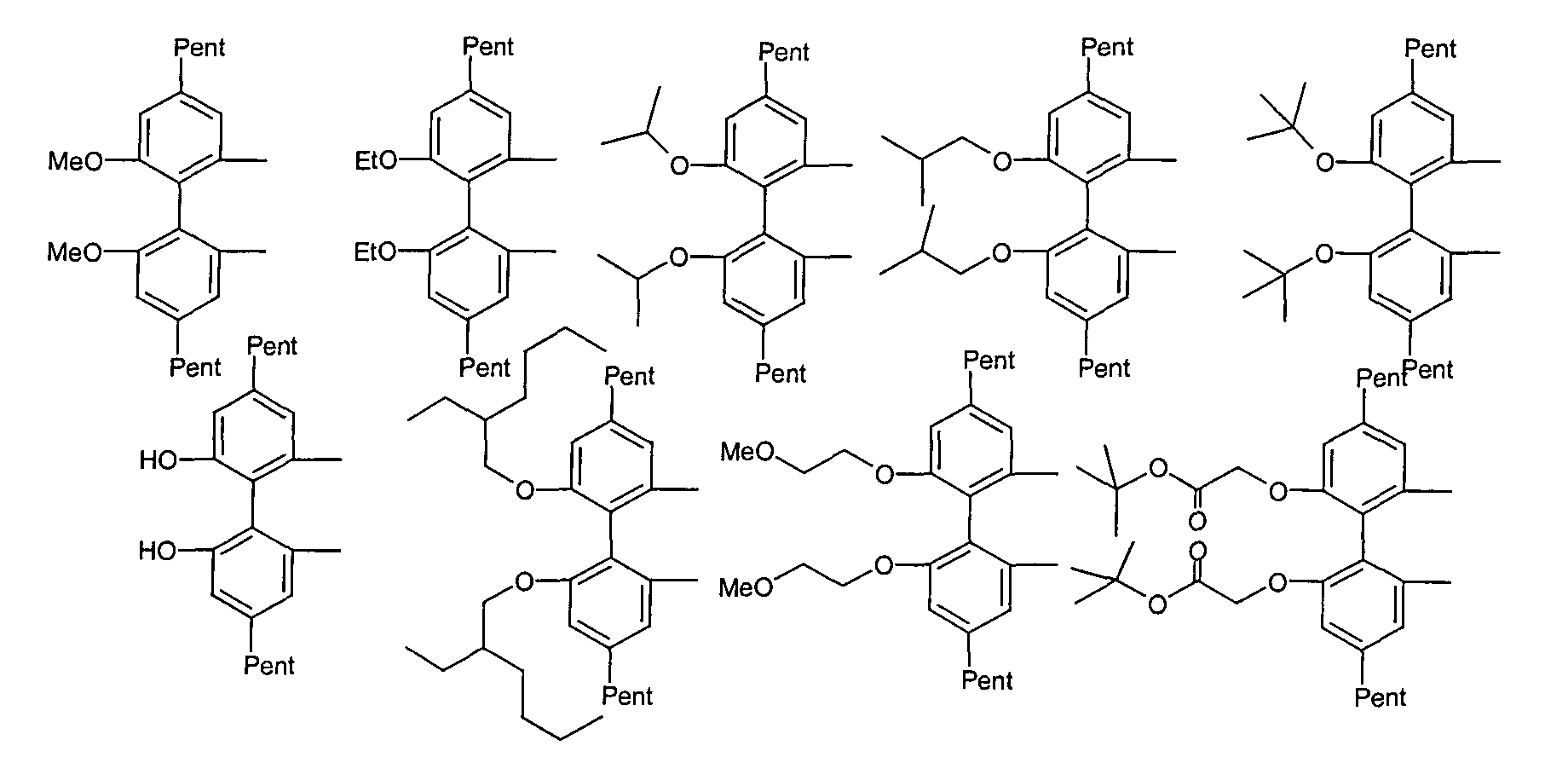
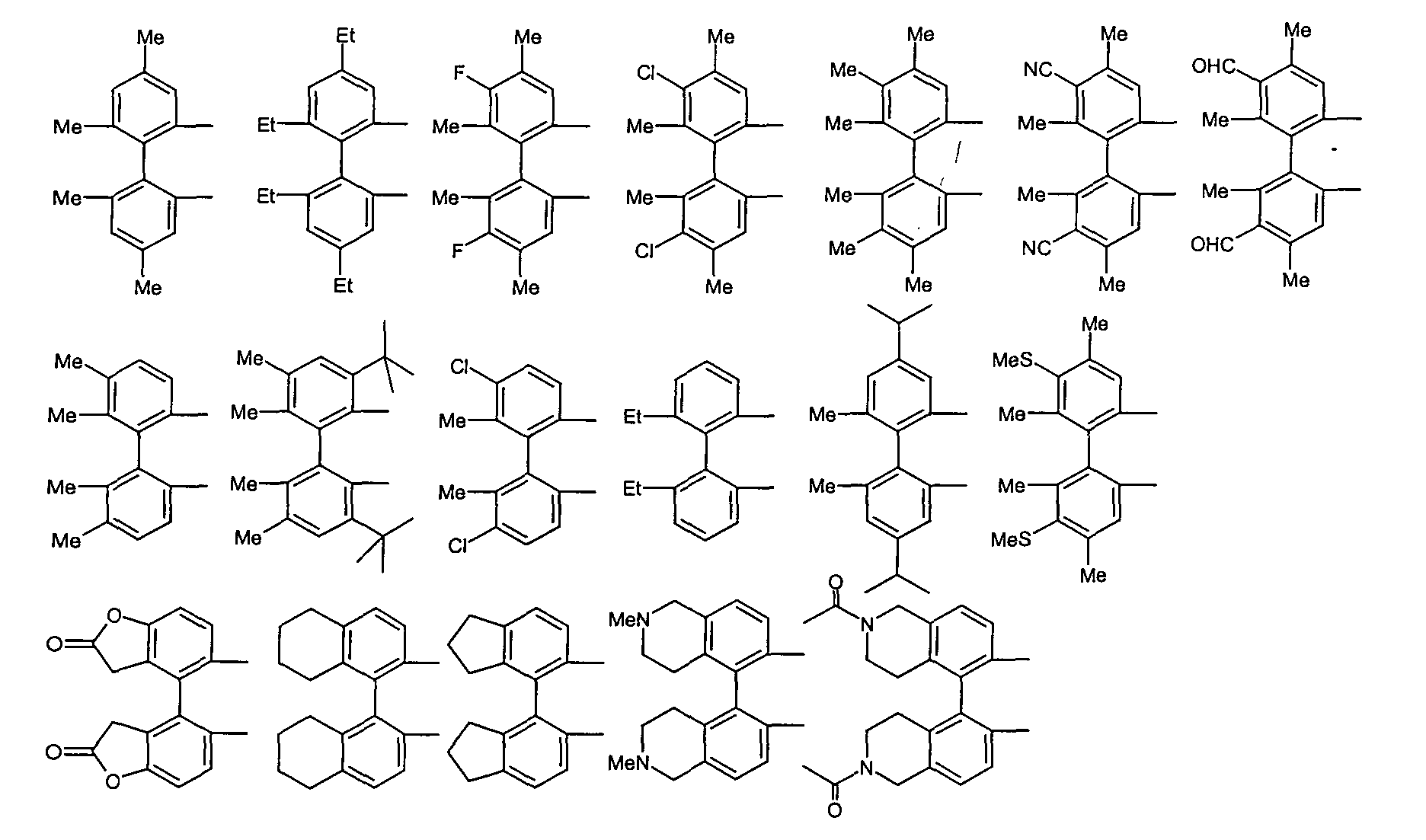
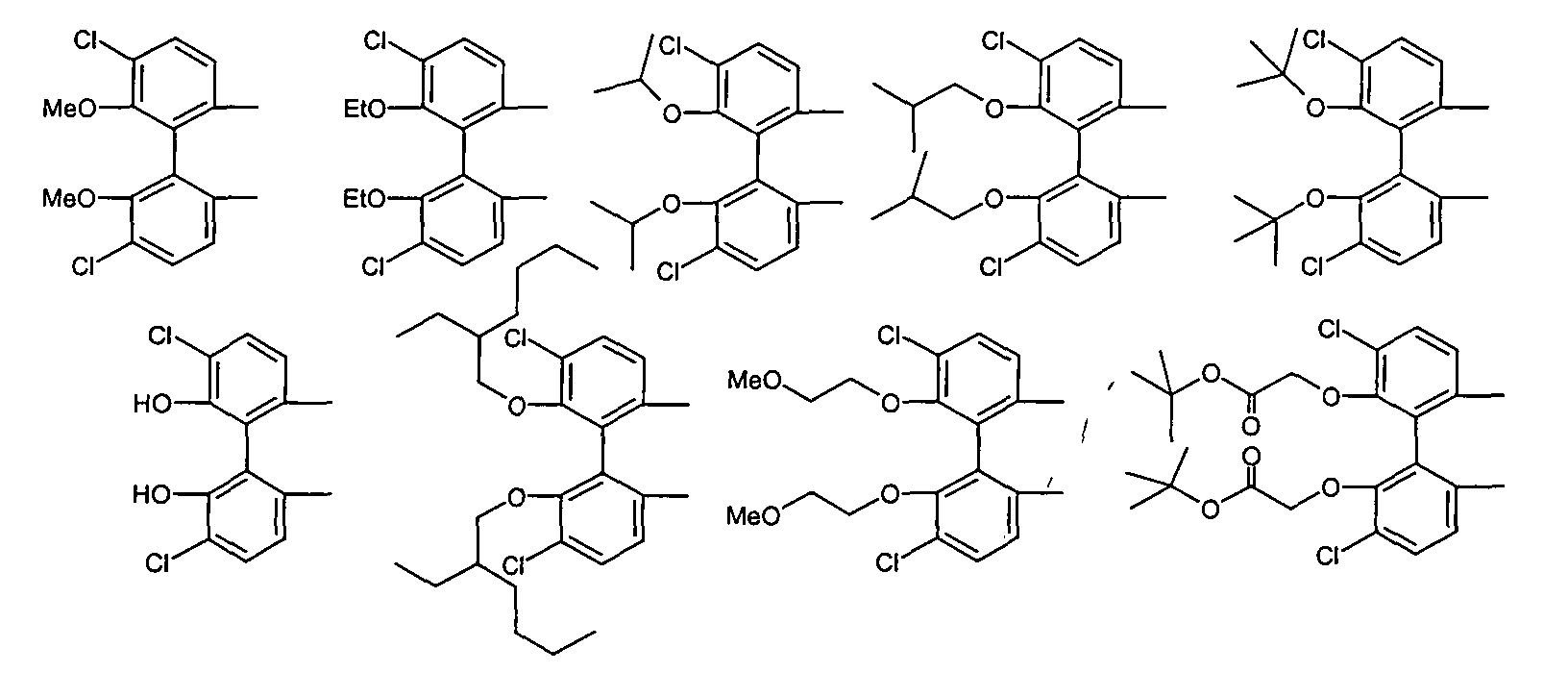
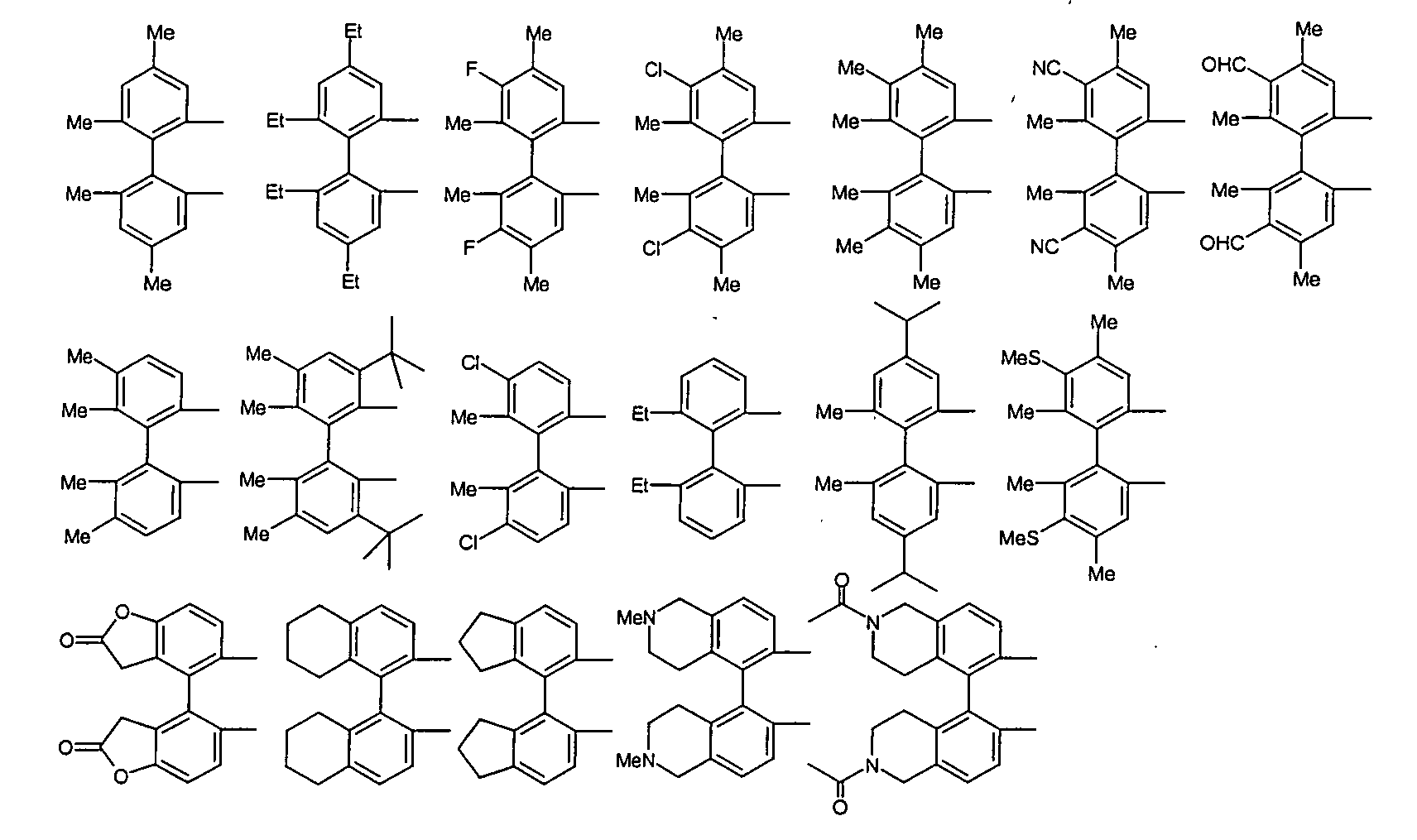
- R 1 is even more preferably the following radicals: or for such radicals of the general formula (VIII) in the G 1 -KG 2 together for (R) -1,2-propanediyl, (S, S) -1,2-cyclohexanediyl, (R, R) -1,2-cyclohexanediyl, 1,2-ethanediyl, 1 , 3-propanediyl, 1,4-butanediyl or 1,4-dioxobutanediyl or for the following radicals:
- All stereoisomeric compounds of the chiral monophosphorus compounds are from the invention of the general formula (I), both in pure form Form as well as in the form of any mixtures of stereoisomeric compounds, such as racemates or mixtures of diastereomers.
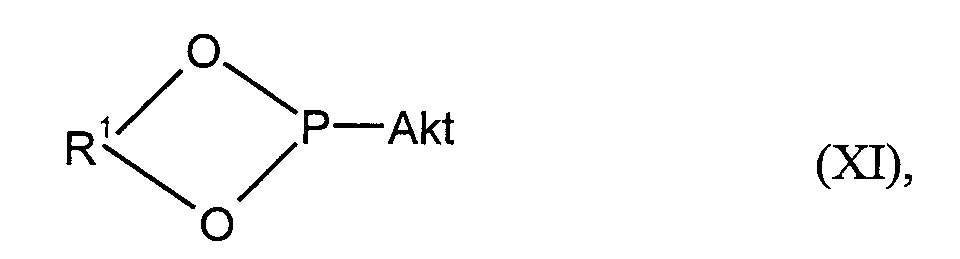
- the compounds of general formula (XI) are also from the invention includes.
- Stereoisomers can be separated, for example, by separating biphenyl compounds of the general formula (VI) into the enantiomers by co-crystallization with suitable chiral, enantiomer-enriched auxiliaries, such as, for example, chiral enantiomerically pure amines.
- Enantiomerically pure biphenols of the general formula (VI) can also be prepared by first reacting with a suitable activated phosphorus compound such as PCl 3 or P (NMe 2 ) 3 (see K. Sasse, Methods of Organic Chemistry, Houben -Weyl, Georg Thieme Verlag, 1964, Vol. XII / 2,4.
- enantiomerically pure alcohol such as menthol
- diastereomeric phosphites are produced, which are separated in the usual way and after subsequent cleavage lead to enantiomerically enriched biphenols of the general formula (VI).
- compounds of the formula (VI) and of the formula (I) can be separated into their enantiomers by chromatography on chiral stationary phases.
- enantiomerically pure biphenyl compounds of the formula (VI) can be obtained by reaction with enantiomerically pure biselectrophiles and substituted 2,2 ', 6,6'-tetrahydroxy-1,1'-biphenyls in analogy to T. Harada et al. (Organic Letters, 2000, Vol.2, p. 1319) can be obtained.
- the invention also includes catalysts, the transition metal complexes of the chiral monophosphorus compounds of the general formula (I) according to the invention contain.
- these are transition metal complexes of ruthenium, Osmium, cobalt, rhodium, iridium, nickel, palladium, platinum and copper are preferred those of ruthenium, rhodium, iridium, nickel, palladium, platinum and copper.
- transition metal complexes can be used as catalysts are used or transition metal complexes, which consist of the chiral monophosphorus compounds of the general formula (I) and a metal compound be generated.
- Transition metal complexes consisting of chiral ones are preferred as catalysts
- Monophosphorus compounds of the general formula (I) and at least one Metal connection are used.
- metal compounds such as Ni (1,5-cyclooctadiene) 2 , Pd 2 (dibenzylidene acetone) 3 , Pd [PPh 3 ] 4 cyclopentadienyl 2 Ru, Rh (acac) (CO) 2 , Ir (pyridine) 2 (1, 5-cyclooctadiene), Cu (phenyl) Br, Cu (phenyl) Cl, Cu (phenyl) I, Cu (PPh 3 ) 2 Br, [Cu (CH 3 CN) 4 ] BF 4 and [Cu (CH 3 CN) 4 ] PF 6 or multinuclear bridged complexes such as [Rh (1,5-cyclooctadiene) Cl] 2 and [Rh (1,5-cyclooctadiene) Br] 2 , [Rh (ethene) 2 Cl] 2 , [Rh (cyclooctene ) 2 Cl] 2 suitable.
- Rh (COD) 2 trifluoromethanesulfonate, Rh (nbd) 2 PF 6 and Rh (nbd) 2 BF 4 are even more preferred.
- the amount of the metal compound used can be, for example, 25 to 200 mol% based on the chiral monophosphorus compound of the general Formula (I) are preferably 30 to 100 mol%, very particularly preferably 40 to 60 mol%, and more preferably 45 to 55 mol%.
- the catalysts, the in situ generated transition metal complexes or isolated Containing transition metal complexes are particularly suitable for use in a process for the preparation of chiral compounds.
- the catalysts are preferred for asymmetric 1,4-additions, asymmetric Hydroformylations, asymmetric hydrocyanations, asymmetric Heck reactions and asymmetric hydrogenations are used, especially preferred for asymmetric hydrogenations.
- Particularly preferred asymmetrical Hydrogenations are hydrogenations of prochiral enamines and olefins.
- the amount of the metal compound or transition metal complex used can for example 0.001 to 5 mol% based on the used Are substrate, preferably 0.001 to 0.5 mol%, very particularly preferred 0.001 to 0.1 mol%, and still more preferably 0.001 to 0.008 mol%.
- asymmetric hydrogenations can For example, be carried out so that the catalyst in situ from a metal compound and a chiral monophosphorus compound of the general formula (I) optionally produced in a suitable solvent, the substrate is added and the reaction mixture at reaction temperature under hydrogen pressure is set.
- Particularly preferred metal compounds for asymmetric hydrogenations are [Rh (1,5-cyclooctadiene) 2 ] BF 4 , [Rh (1,5-cyclooctadiene) 2 ] PF 6 , [Rh (norbornadiene) 2 ] PF 6 and [Rh (norbornadiene) 2 ] BF 4 .
- metal compound and monophosphorus compound are dissolved in degassed solvent in a heated glass autoclave.
- the mixture is stirred for about 5 minutes and then the substrate is added in degassed solvent. After the respective temperature has been set, the mixture is hydrogenated with H 2 overpressure.
- Suitable solvents for the asymmetric hydrogenation are, for example, chlorinated alkanes such as methylene chloride, short-chain C 1 -C 6 alcohols such as methanol, isopropanol or ethanol, aromatic hydrocarbons such as toluene or benzene, ketones such as acetone or carboxylic acid esters such as ethyl acetate.
- chlorinated alkanes such as methylene chloride
- short-chain C 1 -C 6 alcohols such as methanol, isopropanol or ethanol
- aromatic hydrocarbons such as toluene or benzene
- ketones such as acetone or carboxylic acid esters such as ethyl acetate.
- the asymmetric hydrogenation is, for example, at a temperature of -20 ° C to 200 ° C, preferably 0 to 100 ° C and particularly preferably at 20 to 70 ° C carried out.
- the hydrogen pressure can be, for example, 0.1 to 200 bar, preferably 0.5 to 50 bar particularly preferably 0.5 to 5 bar.
- the catalysts of the invention are particularly suitable in one process for the production of chiral active ingredients in pharmaceuticals and agricultural chemicals, or intermediate products of these two classes.
- the advantage of the present invention is that previously unachieved activities of well over 1000 h -1 (TOF) can be achieved with ligands that are easy to prepare, especially in asymmetric hydrogenations.
- the ligands (from Examples 21 and 24) were weighed into the reaction vessels (batch size: 0.09 mmol). The substrates were then prepared as a stock solution (dilution 0.13 mol / l) in 5.1 ml methylene chloride and degassed. 5.6 mg of bis (1,5-cycloctadiene) rhodium triflate Rh (COD) 2 OTf was added to each and degassed again. In the glove box, 0.72 ml of solution was distributed to the individual vessels (2 mol% catalyst and 2 mol% ligand). All batches were hydrogenated in an autoclave (23h, 3bar hydrogen pressure RT).
Landscapes
- Chemical & Material Sciences (AREA)
- Organic Chemistry (AREA)
- Biochemistry (AREA)
- Health & Medical Sciences (AREA)
- General Health & Medical Sciences (AREA)
- Molecular Biology (AREA)
- Life Sciences & Earth Sciences (AREA)
- Chemical Kinetics & Catalysis (AREA)
- Inorganic Chemistry (AREA)
- Engineering & Computer Science (AREA)
- Materials Engineering (AREA)
- Organic Low-Molecular-Weight Compounds And Preparation Thereof (AREA)
- Catalysts (AREA)
- Low-Molecular Organic Synthesis Reactions Using Catalysts (AREA)
Abstract
Description
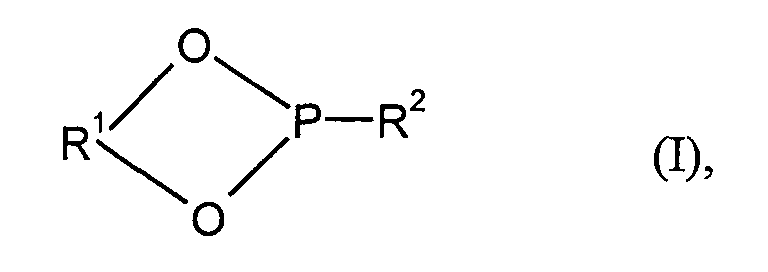
- R1
- für einen unsubstituierten oder substituierten 1,1'-Biphenyl-2,2'-diyl-Rest steht und R2 für einen Rest steht, der ausgewählt ist aus der Gruppe substituiertes oder unsubstituiertes Alkyl, substituiertes oder unsubstituiertes Aryl, substituiertes oder unsubstituiertes Alkoxy, substituiertes oder unsubstituiertes Aryloxy oder tertiäres Amino.
- A
- fehlt oder für einen C1-C8-Alkylenrest wie zum Beispiel Methylen, 1,2-Ethylen, 1,1-Ethylen, 1,3-Propylen, 1,2-Propylen, 1,4-Butylen oder 2,3-Butylen steht und
- B
- fehlt oder für Sauerstoff, Schwefel oder NR3 steht,
wobei- R3
- Wasserstoff, C1-C16-Alkyl wie beispielsweise Methyl, Ethyl, n-Propyl, iso-Propyl, n-Butyl, tert.-Butyl, Cyclohexyl, n-Hexyl, n-Octyl oder iso-Octyl oder C6-C10-Aryl wie beispielsweise Phenyl oder 2-, 3- oder 4-Tolyl bedeutet und
- D
- für eine Carbonyl-Gruppe steht und
- E
- für R4, OR4, NHR5 oder N(R5R6)2 steht,
wobei- R4
- für C1-C12-Alkyl, C6-C10-Aryl und
- R5 und R6
- jeweils unabhängig für C1-C8-Alkyl, oder C6-C10-Aryl oder N(R5R6)2 zusammen für einen cyclischen Aminorest stehen,
- A
- fehlt oder für Methylen steht
- B
- fehlt oder für Sauerstoff oder NR3 steht,
wobei- R3
- Wasserstoff, Methyl oder Ethyl und
- D
- für eine Carbonyl-Gruppe steht und
- E
- für R4, OR4, NHR5 oder NR5R6 steht,
wobei- R4
- für Methyl, Ethyl, n-Propyl, iso-Propyl, n-Butyl, tert.-Butyl, Benzyl, 2-Hydroxyethyl, Trifluormethyl oder Phenyl und
- R5 und R6
- jeweils unabhängig für Methyl, Ethyl, n-Propyl, iso-Propyl, n-Butyl, Benzyl, 2-Hydroxyethyl oder Phenyl oder
- NR5R6
- zusammen für Morpholinyl, Piperidinyl oder Pyrolidinyl stehen und
- X
- für OH, NH2, oder OM steht, wobei M für ein Natrium-, Kalium- oder Ammoniumion steht.
Ganz besonders bevorzugt steht unsubstituiertes oder substituiertes Aryloxy für Reste der allgemeinen Formel (IV), in der Ar für Phenyl steht, das mit keinem, einem oder zwei weiteren Substituenten substituiert ist, die ausgewählt sind aus der Gruppe Fluor, Chlor, Cyano, Methoxy, Methyl, Ethyl, Phenyl, Trifluormethyl, und Resten der allgemeinen Formeln (II) sowie (IIIa) und (IIIb), in denen
A und B fehlen und- D
- für eine Carbonyl-Gruppe steht und
- E
- für R4 oder OR4 steht,
wobei- R4
- für Methyl, Ethyl oder Phenyl steht.
Noch weiter bevorzugt steht unsubstituiertes oder substituiertes Aryloxy für Phenoxy, 2,4-Dimethylphenoxy, 3,5-Dimethylphenoxy, 3,5-Bis(trifluormethyl)-phenoxy, 4-Methylphenoxy, 3-Methylphenoxy, 3-Methoxyphenoxy, 4-Methoxyphenoxy, 2-Methoxyphenoxy, 2-Methylphenoxy, 2,4-Dichlorphenoxy, 2-Ethoxycarbonylphenyl, 2-Methoxycarbonyl, 2-Acetylphenyl, 4-Acetylphenyl oder 2,6-Dimethylphenoxy.
Tertiäres Amino steht beispielsweise für Alkylarylamino, Dialkylamino oder Diarylamino, bevorzugt für Dialkylamino oder Diarylamino. Auch cyclische Aminoreste sind vom Rahmen der Erfindung mitumfasst.
Bevorzugte Beispiele für tertiäres Amino sind Di(substituiertes oder unsubstituiertes C1-C12-Alkyl)amino wie zum Beispiel Dimethylamino, Diethylamino, Diisopropylamino, Di-n-butylamino, Di-(R)-Phenylethylamino, Di-(S)-Phenylethylamino, Dibenzylamin und Di(substituiertes oder unsubstituiertes C6-C10-Aryl)amino, wie zum Beispiel Diphenylamino, Di-(p-Tolyl)amino oder cyclische Aminoreste wie R,R-Dimethylpyrolidino, S,S-Dimethylpyrrolidino, Morpholino, Piperidino, Tetramethylpiperidino.- R1
- steht beispielsweise und bevorzugt für einen unsubstituierten oder substituierten 1,1'-Biphenyl-2,2'-diyl-Rest der allgemeinen Formel (VI),
in der die Reste R7, R8, R9und R10 jeweils unabhängig voneinander ausgewählt sind aus der Gruppe Fluor, Chlor, Brom, unsubstituiertes oder substituiertes geschütztes Hydroxy, unsubstituiertes oder substituiertes C1-C6-Alkyl, unsubstituiertes oder substituiertes C1-C6-Alkoxy, unsubstituiertes oder substituiertes C1-C6-Alkylthio, Cyano, freies oder geschütztes Formyl, unsubstituiertes oder substituiertes C6-C12-Aryl, Tri(C1-C6-alkyl)siloxyl oder Resten der allgemeinen Formel (II),
- A
- fehlt oder für einen C1-C8-Alkylenrest steht und
- B
- fehlt oder für Sauerstoff, Schwefel oder NR3 steht,
wobei- R3
- Wasserstoff, C1-C16-Alkyl oder C6-C10-Aryl bedeutet und
- D
- für eine Carbonyl-Gruppe steht und
- E
- für R4, OR4, NHR5 oder NR5R6 steht,
wobei- R4
- für C1-C12-Alkyl oder C6-C10-Aryl und
- R5 und R6
- jeweils unabhängig voneinander für C1-C8-Alkyl oder C6-C10-Aryl stehen oder NR5R6 zusammen für einen cyclischen Aminorest steht,
- A
- fehlt oder für einen C1-C4-Alkylenrest steht und
- B
- fehlt oder für Sauerstoff oder NR3 steht,
- D
- für eine Carbonyl-Gruppe steht und
- E
- für R4, OR4, NHR5 oder NR5R6 steht,
R5 und R6 jeweils unabhängig voneinander für C1-C4-Alkyl oder C6-Aryl stehen oder NR5R6 zusammen für einen cyclischen Aminorest steht,
oder Resten der allgemeinen Formeln (IIIa) und (IIIb) mit der oben angegebenen weitesten Bedeutung steht.
A fehlt und
B fehlt oder für Sauerstoff steht,
und
D für eine Carbonyl-Gruppe steht und
E für R4, OR4, NHR5 oder NR5R6 steht,
wobei R4 für C1-C4-Alkyl oder C6-C10-Aryl und
R5 und R6 jeweils unabhängig voneinander für C1-C4-Alkyl stehen oder NR5R6 zusammen für einen cyclischen Aminorest steht,
oder Resten der allgemeinen Formeln (IIIa) und (IIIb) mit der oben angegebenen weitesten Bedeutung steht oder die beiden Reste R10 für Verbrückungen der allgemeinen Formel (VII) stehen, in der G entweder entfallen kann, eine Carbonylgruppe oder eine Carbonylaminogruppe ist und
- Diole der allgemeinen Formel (IX),
- mit aktivierten Phosphanen der allgemeinen Formel (X)
- Akt
- für Chlor, Brom, Iod, Dialkylamino wie beispielsweise Dimethylamino oder Diethylamino steht und
- R2
- die unter der allgemeinen Formel (I) angegebene Bedeutung besitzt und
- n
- für 2 oder 3 steht
- in Gegenwart einer Base wie zum Beispiel Triethylamin oder nach Deprotonierung des eingesetzten Diols der allgemeinen Formel (IX) miteinander umsetzt.
Akt für Chlor oder Dimethylamino oder Diethylamino,
besonders bevorzugt für Chlor.
gegebenenfalls in Gegenwart einer Base wie zum Beispiel Triethylamin oder nach vorheriger Deprotonierung zu den chiralen Monophosphorverbindungen der allgemeinen Formel (I) umgesetzt werden können.
- M
- für Ruthenium, Rhodium, Iridium, Nickel, Palladium, Platin oder Kupfer und
- Y1
- für Chlorid, Bromid, Acetat, Nitrat, Methansulfonat, Trifluormethansulfonat oder Acetylacetonat und
- p
- für Ruthenium, Rhodium und Iridium für 3, für
Nickel, Palladium und Platin für 2 und für
Kupfer für 1 stehen,
- M
- für Ruthenium, Rhodium, Iridium, Nickel, Palladium, Platin oder Kupfer und
- Y2
- für Chlorid, Bromid, Acetat, Methansulfonat, Trifluormethansulfonat, Tetrafluoroborat, Hexafluorophosphat Perchlorat, Hexafluoroantimonat, Tetra(bis-3,5-trifluormethylphenyl)borat oder Tetraphenylborat stehen und
- p
- für Rhodium und Iridium für 1, für
Nickel, Palladium, Platin und Ruthenium für 2 und für
Kupfer für 1 steht, - B1
- jeweils für ein C2-C12-Alken wie beispielsweise Ethylen oder Cycloocten, oder ein Nitril wie beispielsweise Acetonitril, Benzonitril oder Benzylnitril steht, oder
- B12
- zusammen für ein (C4-C12)-Dien wie beispielsweise Norbornadien oder 1,5-Cyclooctadien steht
M für Ruthenium und
- B2
- für Arylreste wie zum Beispiel Cymol, Mesityl, Phenyl oder Cyclooctadien, Norbornadien oder Methylallyl stehen
- M
- für Palladium, Nickel, Iridium oder Rhodium und
- Y3
- für Chlorid oder Bromid stehen und
- Me
- für Lithium, Natrium, Kalium, Ammonium oder organisches Ammonium steht und
- p
- für Rhodium und Iridium für 3, für
Nickel, Palladium und Platin für 2 steht,
- M
- für Iridium oder Rhodium und
- B3
- für ein (C4-C12)-Dien wie beispielsweise Norbornadien oder 1,5-Cyclooctadien stehen
- An
- für ein nicht oder schwach koordinierendes Anion wie zum Beispiel Methansulfonat, Trifluormethansulfonat, Tetrafluoroborat, Hexafluorophosphat Perchlorat, Hexafluoroantimonat, Tetra(bis-3,5-trifluormethylphenyl)borat oder Tetraphenylborat steht.
[Rh(COD)Cl]2, [Rh(COD)2Br], [Rh(COD)2]ClO4, [Rh(COD)2]BF4, [Rh(COD)2]PF6, [Rh(COD)2]OTf, [Rh(COD)2]BAr4 (Ar = 3,5-bistrifluormethylphenyl) [Rh(COD)2]SbF6 RuCl2(COD), [(Cymol)RuCl2]2, [(Benzol)RuCl2]2, [(Mesityl)RuCl2]2, [(Cymol)RuBr2]2, [(Cymol)RuI2]2, [(Cymol)Ru(BF4)2]2, [(Cymol)Ru(PF6)2]2, [(Cymol)Ru(BAr4)2]2, (Ar = 3,5-bistrifluormethylphenyl), [(Cymol)Ru(SbF6)2]2, [Ir(cod)2Cl]2, [Ir(COD)2]PF6, [Ir(COD)2]ClO4, [Ir(COD)2]SbF6 [Ir(COD)2]BF4, [Ir(COD)2]OTf, [Ir(COD)2]BAr4 (Ar = 3,5-bistrifluormethylphenyl) RuCl3, NiCl2, RhCl3, PdCl2, PdBr2, Pd(OAc)2, Pd2(dibenzylidenaceton)3, Pd(acetylacetonat)2, CuOTf, CuI, CuCl, Cu(OTf)2, CuBr, CuI, CuBr2, CuCl2, CuI2,
[Rh(nbd)Cl]2, [Rh(nbd)2Br], [Rh(nbd)2]ClO4, [Rh(nbd)2]BF4, [Rh(nbd)2]PF6, [Rh(nbd)2]OTf, [Rh(nbd)2]BAr4 (Ar = 3,5-bistrifluormethylphenyl) [Rh(nbd)2]SbF6 RuCl2(nbd), [Ir(nbd)2]PF6, [Ir(nbd)2]ClO4, [Ir(nbd)2]SbF6 [Ir(nbd)2]BF4, [Ir(nbd)2]OTf, [Ir(nbd)2]BAr4 (Ar = 3,5-bistrifluormethylphenyl), Ir(pyridin)2(nbd), [Ru(DMSO)4Cl2], [Ru(CH3CN)4Cl2], [Ru(PhCN)4Cl2], [Ru(COD)Cl2]n, [Ru(COD)(Methallyl)2], [Ru(acetylacetonat)3]
- M
- für Rhodium und
- B3
- für ein (C4-C12)-Dien wie beispielsweise Norbornadien oder 1,5-Cyclooctadien stehen und
- An
- für ein nicht oder schwach koordinierendes Anion wie zum Beispiel Methansulfonat, Trifluormethansulfonat, Tetrafluoroborat, Hexafluoro-phosphat Perchlorat, Hexafluoroantimonat, Hexachloroantimonat, Tetra(bis-3,5-trifluormethylphenyl)borat oder Tetraphenylborat steht oder
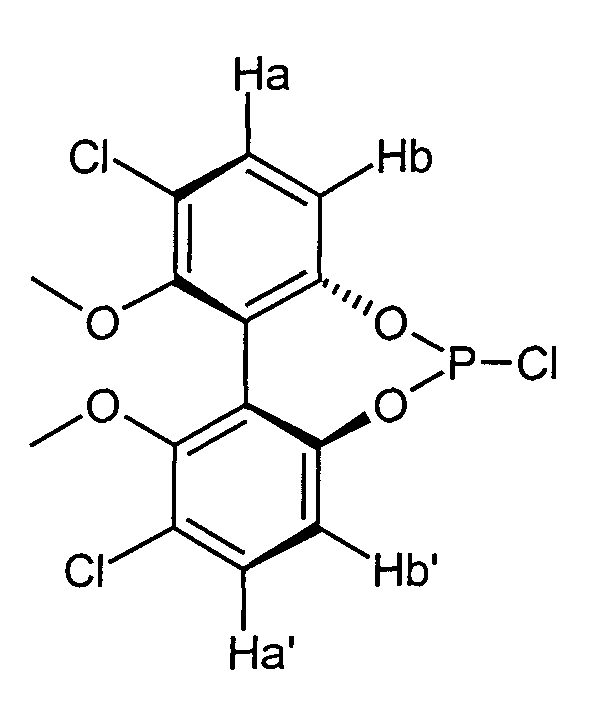
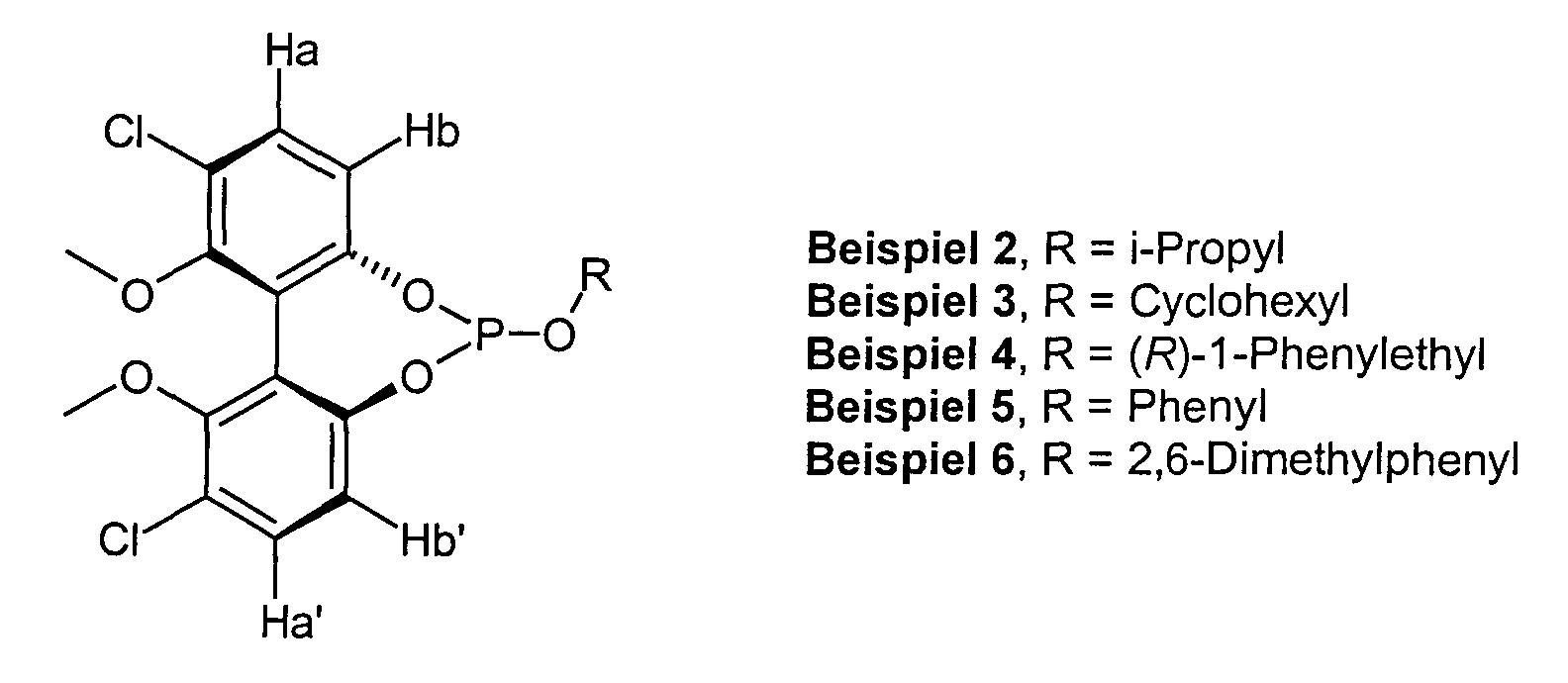
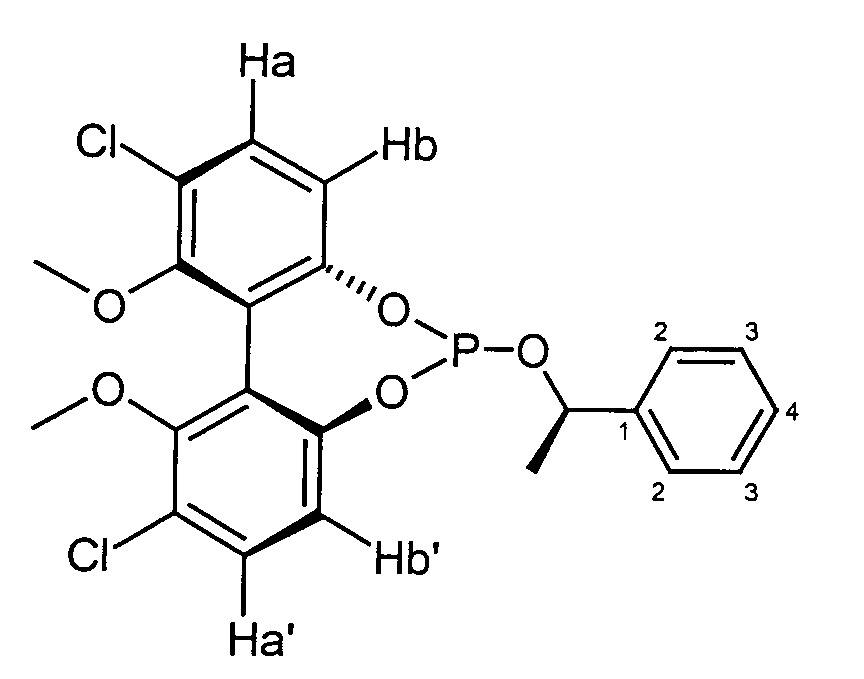
1H-NMR (CDCl3): δ [ppm] = 3.57 (s, 3H, OCH3); 3.59 (s, 3H, OCH3); 6.92 (d, 3J = 8.7, 1H, Hb o. b'); 7.01 (dd, 1H, 3J = 8.7, J(H-P) = 1.1, 1H, Hb o. b'); 7,46 (br d, 3J = 8.7, 2H, Ha u. a'); 31P-NMR (CDCl3):
δ [ppm] = 176.4

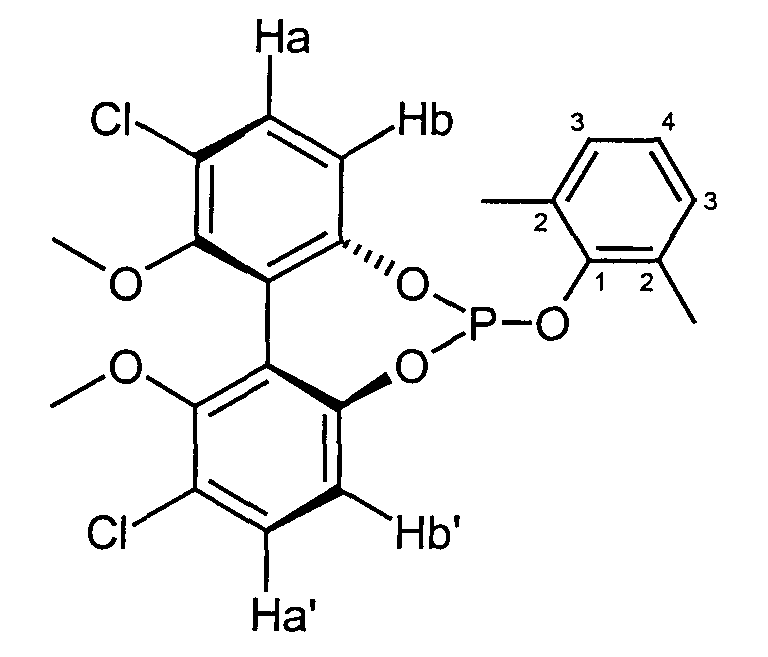
δ [ppm] = 145.3


| Beispiel | Ligand (Konfiguration) | Umsatz [%] | ee [%], Konfigaration | ||
| RT | 0°C | RT | 0°C | ||
| 7 | R = i-Propyl (S) aus Beispiel 2 | 100 | 100 | 96 (S) | 97 (S) |
| 8 | R = Cyclohexyl (S) ausBeispiel 3 | 100 | 100 | 91 (S) | 94 (S) |
| 9 | R = (R)-1-Phenylethyl (S) aus Beispiel 4 | 100 | 100 | 97 (S) | 99 (S) |
| 10 | R = Phenyl (S) aus Beispiel 5 | 100 | 87 | 82 (S) | 91 (S) |
| 11 | R = 2,6-Dimethylphenyl (S) aus Beispiel 6 | 58 | 41 | 59 (S) | 74 (S) |
| Beispiele | Ligand (Konfiguration) | Umsatz [%] | ee [%] Konfiguration |
| 12 | R = i-Propyl (S) aus Beispiel 2 | 90 | 97 (S) |
| 13 | R = (R)-1-Phenylethyl (S) aus Beispiel 4 | 100 | 99 (S) |
| Beispiele | Ligand (Konfiguration) | Umsatz [%] | ee [%] Konfiguration |
| 14 | R = i-Propyl (S) aus Beispiel 2 | 100 | 94 (R) |
| 15 | R = Cyclohexyl (S) aus Beispiel 3 | 100 | 94 (R) |
| 16 | R = (R)-1-Phenylethyl (S) aus Beispiel 4 | 100 | 83 (R) |
| 17 | R = Phenyl (S) aus Beispiel 5 | 100 | 77 (R) |
| 18 | R = 2,6-Dimethylphenyl (S) aus Beispiel 6 | 100 | 18 (R) |
| Beispiele | Ligand (Konfiguration) | Umsatz [%] | ee [%] |
| 19 | R = i-Propyl (S) (Bsp. 2) | 4 | 71 |
| 20 | R = Cyclohexyl (S) (Bsp. 3) | 3 | 56 (andere Enantiomer |
| Beispiel: | Ansatz | Ausbeute | Analytik |
| 21 | 0,26 g (0,0028 mol) | 0,911 g (68 %) gelber | 31P NMR: δ = 135,29 ppm |
| Phenol | Feststoff | ||
| 22 | 0,15 ml (0,0028 mol;1 | 0,802 g (67 %) weißer | 31P NMR: δ = 132,45 ppm |
| äq) Ethanol | Feststoff | ||
| 23 | 0,34 g (0,0028 mol;1 | 1,353 g (95 %) weißer | 31P NMR: δ = 135,77 ppm |
| äq) 2,6-Dimethylphenol | Feststoff | ||
| 0,14 g (0,0058 mol;1,1 | |||
| äq) Natriumhydrid | |||
| 24 | 0,11 ml (0,0028 mol;1 | 1,151 g(99 %) weißer | 31P NMR δ = 130,18 ppm |
| äq) Methanol | Feststoff | ||
| 25 | 0,424 ml (0,0028 mol;1 | 0,978 g(65 %) gelber | 31P NMR δ = 136,3 ppm |
| äq) tert-Buthylphenol | Feststoff | ||
| 26 | 0,34 ml (0,0028 mol;1 | 0,881 g(62 %) weiß- | 31P NMR δ = 141,82 ppm |
| äq) Phenethyalkohol | gelber Feststoff | und 138,58 (Diastereomerenpaar). | |
| 27 | 0,52 g (0,0028 mol;1 | 0,771 g (48 %) weißer | 31P NMR δ = 136,35 ppm |
| äq) Diphenylcarbinol | Feststoff | ||
| 28 | 0,22 ml (0,0028 mol;1 | 0,521 g (33 %) weißen | 31P NMR: δ 142,84 ppm |
| äq) Isopropanol | Feststoff | ||
| 29 | Fünffacher Ansatz 8,1 | 7,23 g (92 %) gelber | 31P NMR: δ 1365,74 ppm |
| ml (0,014mol; äq) 2,6- | Feststoff | ||
| Diisopropylphenol |
| Hydrierung von (Z)-3-Acetamidobutensäuremethylester | ||
| Ligand | 21 | 24 |
| Umsatz [%] | 100 | 100 |
| ee [%] | 11.3 | 59 |
| Beispiel Nr. | 30 | 31 |
| Hydrierung von Dimethylitakonat | ||
| Ligand | 21 | 24 |
| Umsatz [%] | 100 | 100 |
| ee [%] | 14 | 13 |
| Beispiel Nr. | 32 | 33 |
Claims (23)
- Chirale Monophosphorverbindungen der allgemeinen Formel (I),in der
- R1
- für einen unsubstituierten oder substituierten 1,1'-Biphenyl-2,2'-diyl-Rest steht und
- R2
- für einen Rest steht, der ausgewählt ist aus der Gruppe substituiertes oder unsubstituiertes Alkyl, substituiertes oder unsubstituiertes Aryl, substituiertes oder unsubstituiertes Alkoxy, substituiertes oder unsubstituiertes Aryloxy oder tertiäres Amino.
- Chirale Monophosphorverbindungen gemäß Anspruch 1, dadurch gekennzeichnet, dass in der allgemeinen Formel (I)
- R1
- für einen unsubstituierten oder substituierten 1,1'-Biphenyl-2,2'-diyl-Rest steht und
- R2
- für einen Rest steht, der ausgewählt ist aus der Gruppe substituiertes oder unsubstituiertes Alkoxy, substituiertes oder unsubstituiertes Aryloxy oder tertiäres Amino.
- Chirale Monophosphorverbindungen gemäß Anspruch 1, dadurch gekennzeichnet, dass in der allgemeinen Formel (I)
- R1
- für einen unsubstituierten oder substituierten 1,1'-Biphenyl-2,2'-diyl-Rest der allgemeinen Formel (VI) steht,
in der die Reste R7, R8, R9 und R10 jeweils unabhängig voneinander ausgewählt sind aus der Gruppe Fluor, Chlor, Brom, unsubstituiertes oder substituiertes geschütztes Hydroxy, unsubstituiertes oder substituiertes C1-C6-Alkyl, unsubstituiertes oder substituiertes C1-C6-Alkoxy, unsubstituiertes oder substituiertes C1-C6-Alkylthio, Cyano, freies oder geschütztes Formyl, unsubstituiertes oder substituiertes C6-C12-Aryl, Tri(C1-C6-alkyl)siloxyl oder Resten der allgemeinen Formel (II)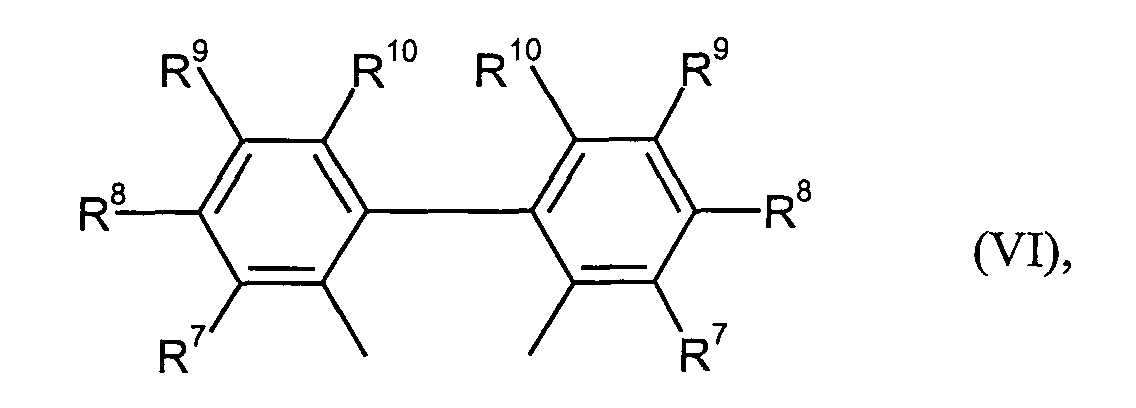
- A
- fehlt oder für einen C1-C8-Alkylenrest steht und
- B
- fehlt oder für Sauerstoff, Schwefel oder NR3 steht,
- R3
- Wasserstoff, C1-C16-Alkyl oder C6-C10-Aryl bedeutet und
- D
- für eine Carbonyl-Gruppe steht und
- E
- für R4, OR4, NHR5 oder NR5R6 steht,
wobei- R4
- für C1-C12-Alkyl oder C6-C10-Aryl und
- R5 und R6
- jeweils unabhängig voneinander für C1-C8-Alkyl oder C6-C10-Aryl stehen oder NR5R6 zusammen für einen cyclischen Aminorest steht,
oder
die beiden Reste R10 zusammen verbrückend sind. - Chirale Monophosphorverbindungen gemäß Anspruch 1, dadurch gekennzeichnet, dass in der allgemeinen Formel (I)
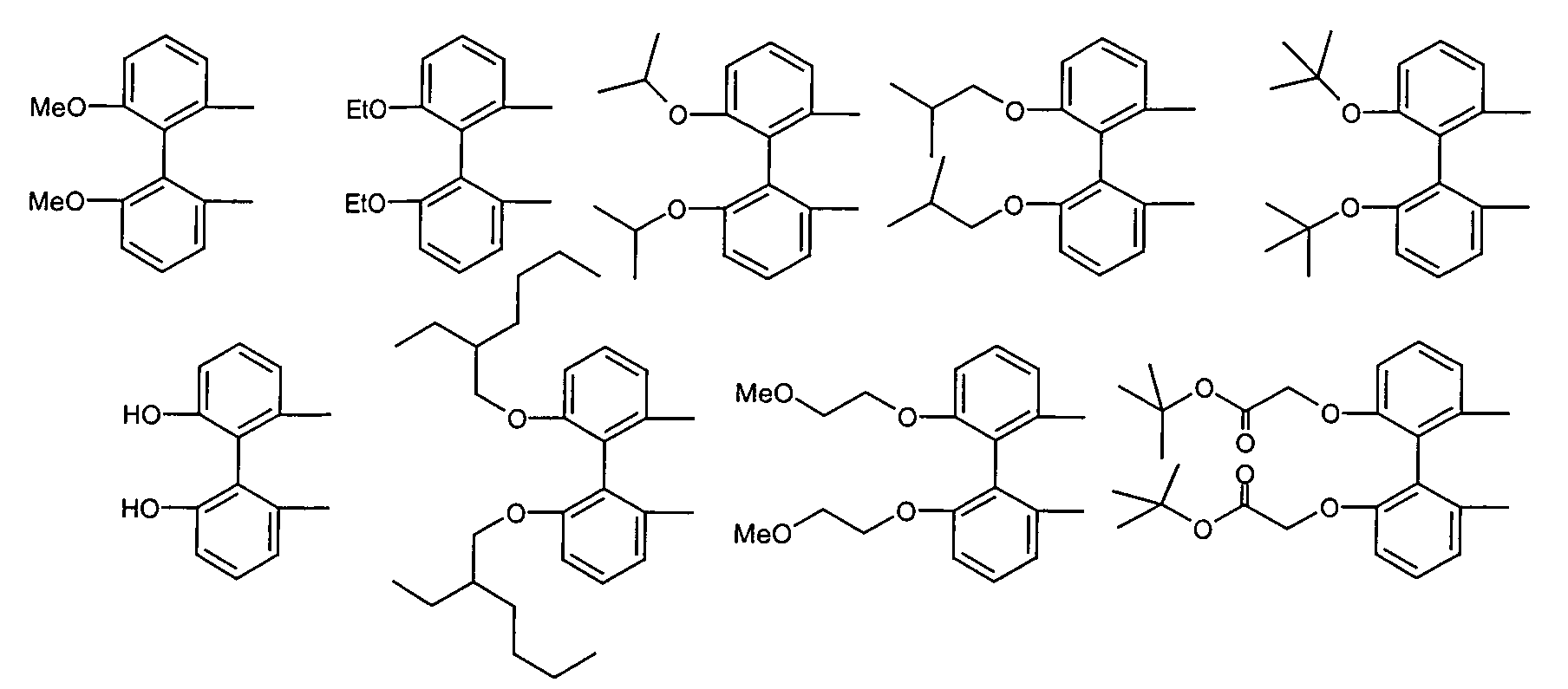
- R1
- für einen der folgenden Reste steht:
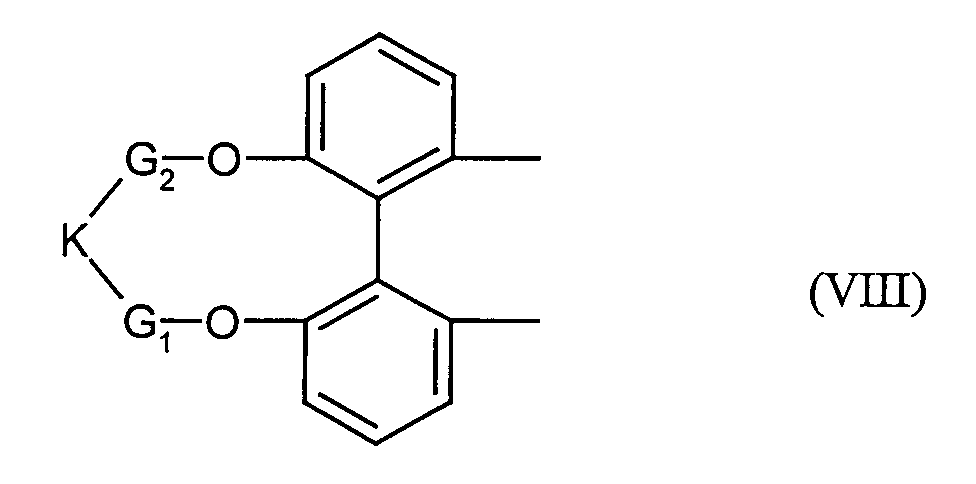
 oder R1 für solche Reste der allgemeinen Formel (VIII)
 in der G1-K-G2 zusammen für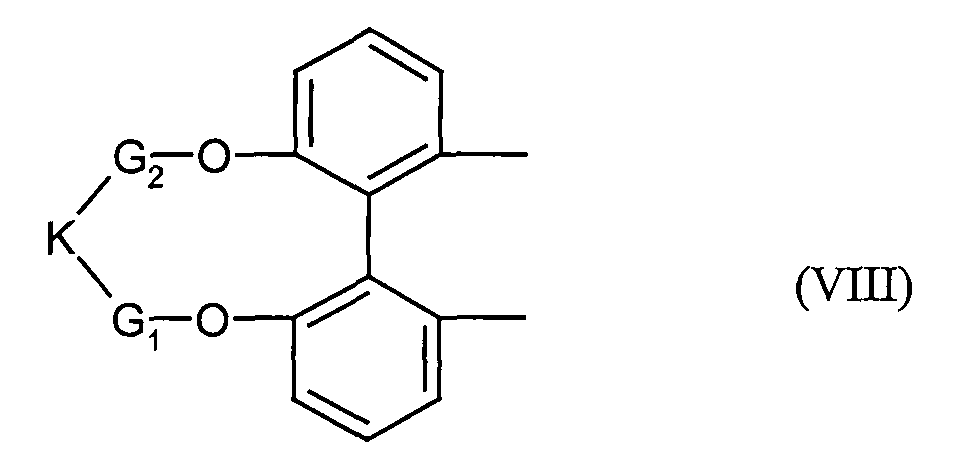
(R)-1,2-Propandiyl, (S,S)-1,2-Cyclohexandiyl, (R,R)-1,2-Cyclohexandiyl, 1,2-Ethandiyl, 1,3-Propandiyl, 1,4-Butandiyl oder 1,4-Dioxobutandiyl steht
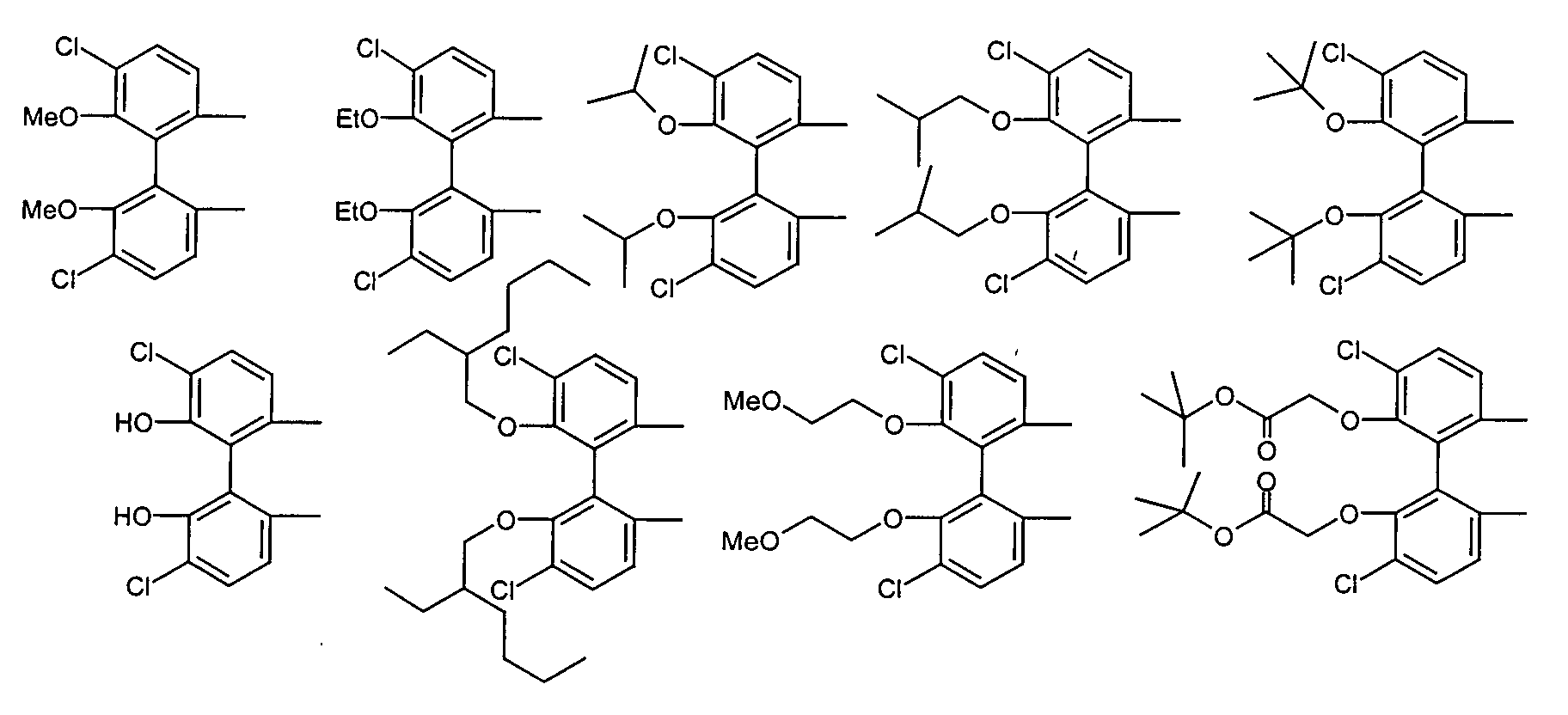
oder R1 für folgende Reste steht: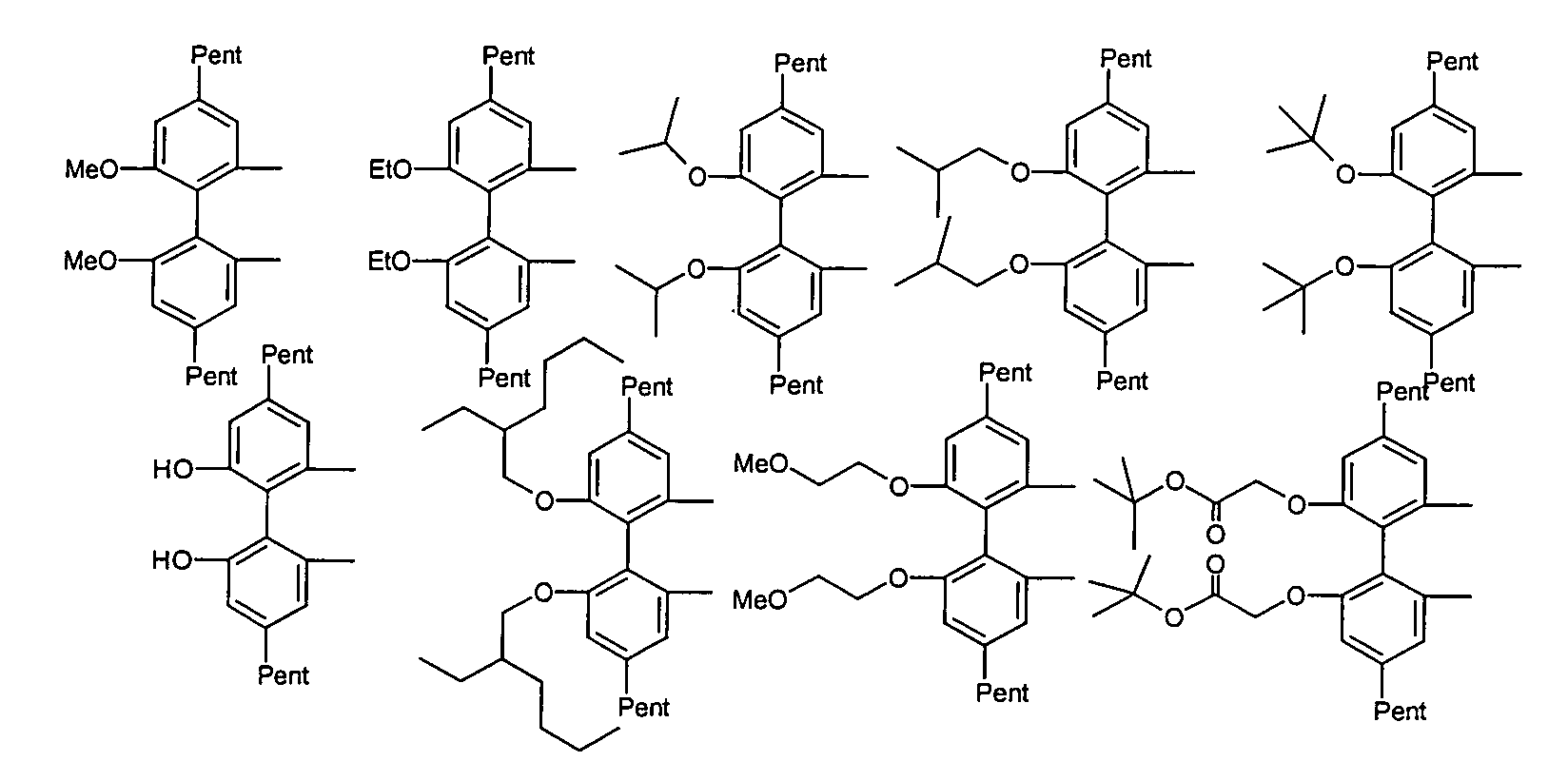
- Chirale Monophosphorverbindungen gemäß Anspruch 1, dadurch gekennzeichnet, dass in der allgemeinen Formel (I)
R2 für Methoxy, Ethoxy, iso-Propoxy, Cyclohexyloxy, Phenoxy, (R)-1-Phenylethoxy oder (S)-1-Phenylethoxy steht. - ((S)-5,5'-Dichlor-6,6'-dimethoxy-1,1'-biphenyl-2,2'-diyl)-isopropyl-phosphit
((R)-5,5'-Dichlor-6,6'-dimethoxy-1,1'-biphenyl-2,2'-diyl)-isopropyl-phosphit
((R)-5,5'-Dichlor-6,6'-dimethoxy-1,1'-biphenyl-2,2'-diyl)-(R)-1-phenylethylphosphit
((R)-5,5'-Dichlor-6,6'-dimethoxy-1,1'-biphenyl-2,2'-diyl)-(S)-1-phenylethylphosphit
((S)-5,5 '-Dichlor-6,6'-dimethoxy-1,1'-biphenyl-2,2'-diyl)-(R)-1-phenylethylphosphit
((S)-5,5 '-Dichlor-6,6'-dimethoxy-1,1'-biphenyl-2,2'-diyl)-(S)-1-phenylethylphosphit
((S)-5,5'-Dichlor-6,6'-dimethoxy-1,1'-biphenyl-2,2'-diyl)-cyclohexyl-phosphit
((R)-5,5 '-Dichlor-6,6'-dimethoxy-1,1'-biphenyl-2,2'-diyl)-cyclohexyl-phosphit
((S)-5,5'-Dichlor-6,6'-dimethoxy-1,1'-biphenyl-2,2'-diyl)-phenyl-phosphit
((R)-5,5'-Dichlor-6,6'-dimethoxy-1,1'-biphenyl-2,2'-diyl)-phenyl-phosphit
((S)-5,5'-Dichlor-6,6'-dimethoxy-1,1'-biphenyl-2,2'-diyl)-2,6-dimethylphenyl-phosphit
((R)-5,5 '-Dichlor-6,6'-dimethoxy-1,1'-biphenyl-2,2'-diyl)-2,6-dimethylphenyl-phosphit
((S)-5,5',6,6'-tetramethyl-3,3 '-bis(tert.-butyl)-1,1'-biphenyl-2,2'-diyl)-isopropyl-phosphit
((R)-5,5',6,6'-tetramethyl-3,3'-bis(tert.-butyl)-1,1'-biphenyl-2,2'-diyl)-isopropyl-phosphit
((S)-5,5',6,6'-tetramethyl-3,3'-bis(tert.-butyl)-1,1 '-biphenyl-2,2'-diyl)-(rac)-1 -phenylethyl-phosphit
((R)-5,5',6,6'-tetramethyl-3,3'-bis(tert.-butyl)-1,1'-biphenyl-2,2'-diyl)-(rac)-1 -phenylethyl-phosphit
((S)-5,5',6,6'-tetramethyl-3,3'-bis(tert.-butyl)-1,1'-biphenyl-2,2'-diyl)-(S)-1-phenylethyl-phosphit
((R)-5,5',6,6'-tetramethyl-3,3 '-bis(tert.-butyl)-1,1'-biphenyl-2,2'-diyl)-(S)-1-phenylethyl-phosphit
((S)-5,5',6,6'-tetramethyl-3,3'-bis(tert.-butyl)-1,1'-biphenyl-2,2'-diyl)-(R)-1-phenylethyl-phosphit
((R)-5,5',6,6'-tetramethyl-3,3'-bis(tert.-butyl)-1,1'-biphenyl-2,2'-diyl)-(R)-1-phenylethyl-phosphit
((S)-5,5',6,6'-tetramethyl-3,3'-bis(tert.-butyl)-1,1'-biphenyl-2,2'-diyl)-diphenylmethyl-phosphit
((R)-5,5',6,6'-tetramethyl-3,3'-bis(tert.-butyl)-1,1'-biphenyl-2,2'-diyl)-diphenylmethyl-phosphit
((S)-5,5',6,6'-tetramethyl-3,3'-bis(tert.-butyl)-1,1'-biphenyl-2,2'-diyl)-methyl-phosphit
((R)-5,5',6,6'-tetramethyl-3,3'-bis(tert.-butyl)-1,1'-biphenyl-2,2'-diyl)-methyl-phosphit
((S)-5,5',6,6'-tetramethyl-3,3'-bis(tert.-butyl)-1,1'-biphenyl-2,2'-diyl)-2,6-dimethylphenyl-phosphit
((R)-5,5',6,6'-tetramethyl-3,3'-bis(tert.-butyl)-1,1'-biphenyl-2,2'-diyl)-2,6-dimethylphenyl-phosphit
((S)-5,5',6,6'-tetramethyl-3,3'-bis(tert.-butyl)-1,1'-biphenyl-2,2'-diyl)-2,6-diiso-propylphenyl-phosphit
((R)-5,5',6,6'-tetramethyl-3,3'-bis(tert.-butyl)-1,1'-biphenyl-2,2'-diyl)-2,6-diiso-propylphenyl-phosphit
((S)-5,5',6,6'-tetramethyl-3,3'-bis(tert.-butyl)-1,1'-biphenyl-2,2'-diyl)-phenyl-phosphit
((R)-5,5',6,6'-tetramethyl-3,3'-bis(tert.-butyl)-1,1'-biphenyl-2,2'-diyl)-phenyl-phosphit
((S)-5,5',6,6'-tetramethyl-3,3'-bis(tert.-butyl)-1,1'-biphenyl-2,2'-diyl)-ethyl-phosphit
((R)-5,5',6,6'-tetramethyl-3,3'-bis(tert.-butyl)-1,1'-biphenyl-2,2'-diyl)-ethyl-phosphit
((S)-5,5',6,6'-tetramethyl-3,3'-bis(tert.-butyl)-1,1'-biphenyl-2,2'-diyl)-4-tert-butylphenyl-phosphit
((R)-5,5',6,6'-tetramethyl-3,3'-bis(tert.-butyl)-1,1'-biphenyl-2,2'-diyl)-4-tert-butylphenyl-phosphit - Verbindungen der allgemeinen Formel (XI)in der R1 für einen unsubstituierten oder substituierten 1,1'-Biphenyl-2,2'-diyl-Rest steht und
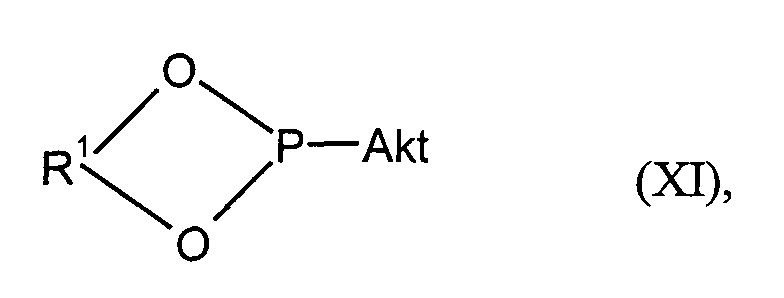
- Akt
- für Chlor, Brom, Iod oder Dialkylamino steht.
- Verwendung von Verbindungen gemäß Anspruch 7 zur Herstellung von chiralen Phosphoniten, chiralen Phosphoramiditen und chiralen Phosphiten.
- Verwendung von chiralen Monophosphorverbindungen gemäß einem der Ansprüche 1 bis 7 in der asymmetrischen Synthese.
- Verwendung von chiralen Monophosphorverbindungen gemäß einem der Ansprüche 1 bis 7 für asymmetrische 1,4-Additionen, asymmetrische Hydroformylierungen, asymmetrische Hydrocyanierungen, asymmetrische Heck-Reaktionen und asymmetrische Hydrogenierungen.
- Verwendung von chiralen Monophosphorverbindungen gemäß einem der Ansprüche 1 bis 7 für asymmetrische Hydrogenierungen.
- Verwendung von chiralen Monophosphorverbindungen gemäß einem der Ansprüche 1 bis 7 für asymmetrische Hydrogenierungen von prochiralen Olefinen oder prochiralen Enaminen.
- Katalysatoren, enthaltend Übergangsmetallkomplexe von chiralen Monophosphorverbindungen der allgemeinen Formel (I)in der
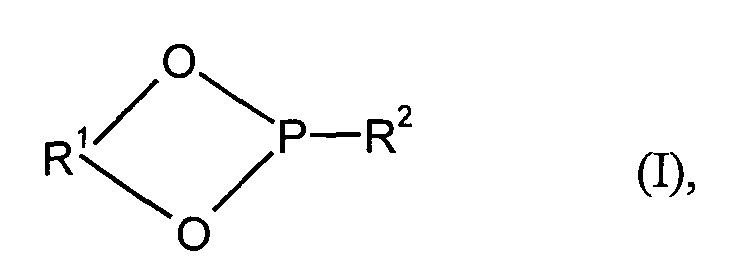
- R1
- für einen unsubstituierten oder substituierten 1,1'-Biphenyl-2,2'-diyl-Rest steht und
- R2
- für einen Rest steht, der ausgewählt ist aus der Gruppe substituiertes oder unsubstituiertes Alkyl, substituiertes oder unsubstituiertes Aryl, substituiertes oder unsubstituiertes Alkoxy, substituiertes oder unsubstituiertes Aryloxy oder tertiäres Amino.
- Katalysatoren gemäß Anspruch 13, dadurch gekennzeichnet, dass sie aus chiralen Monophosphorverbindungen der allgemeinen Formel (I) und Metallverbindungen erzeugt werden.
- Verfahren zur Herstellung chiraler Verbindungen, dadurch gekennzeichnet, dass als Katalysatoren solche gemäß den Ansprüchen 13 bis 14 eingesetzt werden.
- Verfahren zur asymmetrischen Hydrierung von Substraten, dadurch gekennzeichnet, dass als Katalysatoren solche gemäß den Ansprüchen 13 bis 14 eingesetzt werden.
- Verfahren gemäß Anspruch 16, dadurch gekennzeichnet, dass als Katalysatoren solche eingesetzt werden, die aus chiralen Monophosphorverbindungen gemäß den Ansprüchen 1 bis 7 und Metallverbindungen der allgemeinen Formel (XIIIe)
- M
- für Rhodium und
- B3
- für ein (C4-C12)-Dien wie beispielsweise Norbornadien oder 1,5-Cyclooctadien stehen und
- An
- für ein nicht oder schwach koordinierendes Anion steht,
- Verfahren nach Ansprüchen 16 bis 17, dadurch gekennzeichnet, dass es in mindestens einem Lösungsmittel ausgewählt aus der Gruppe chlorierte Alkane, C1-C6-Alkohole aromatische Kohlenwasserstoffe, Ketone und Carbonsäureester durchgeführt wird.
- Verfahren nach Ansprüchen 16 bis 18, dadurch gekennzeichnet, dass es bei Temperaturen von -20 bis 200°C durchgeführt wird.
- Verfahren nach Ansprüchen 16 bis 19, dadurch gekennzeichnet, dass es bei einem Wasserstoffdruck von 0,1 bis 200 bar durchgeführt wird.
- Verfahren nach Ansprüchen 16 bis 20, dadurch gekennzeichnet, dass die Menge der eingesetzten Metallverbindung oder des eingesetzten Übergangsmetallkomplexes 0,001 bis 5 mol-% bezogen auf das eingesetzte Substrat beträgt.
- Verfahren nach einem oder mehreren der Ansprüche 15 bis 21, dadurch gekennzeichnet, dass die Substrat-Umsatzrate über 1000 h-1 beträgt.
- Verwendung von Verbindungen, die nach einem Verfahren gemäß einem oder mehreren der Ansprüche 15 bis 20 hergestellt wurden, zur Herstellung von chiralen Wirkstoffen in Arzneimitteln und Agrarchemikalien, oder Zwischenprodukten dieser beiden Klassen.
Applications Claiming Priority (2)
| Application Number | Priority Date | Filing Date | Title |
|---|---|---|---|
| DE10148551A DE10148551A1 (de) | 2001-10-01 | 2001-10-01 | Chirale Monophosphorverbindungen |
| DE10148551 | 2001-10-01 |
Publications (2)
| Publication Number | Publication Date |
|---|---|
| EP1298136A2 true EP1298136A2 (de) | 2003-04-02 |
| EP1298136A3 EP1298136A3 (de) | 2003-10-01 |
Family
ID=7701090
Family Applications (1)
| Application Number | Title | Priority Date | Filing Date |
|---|---|---|---|
| EP02020595A Withdrawn EP1298136A3 (de) | 2001-10-01 | 2002-09-18 | Chirale Monophosphorverbindungen |
Country Status (6)
| Country | Link |
|---|---|
| US (2) | US7057061B2 (de) |
| EP (1) | EP1298136A3 (de) |
| JP (1) | JP2003176293A (de) |
| KR (1) | KR20030028433A (de) |
| CA (1) | CA2405623A1 (de) |
| DE (1) | DE10148551A1 (de) |
Families Citing this family (5)
| Publication number | Priority date | Publication date | Assignee | Title |
|---|---|---|---|---|
| AT501193B1 (de) * | 2004-12-27 | 2007-03-15 | Dsm Fine Chem Austria Gmbh | Verfahen zur übergangsmetall - katalysierten asymmetrischen hydrierung von acrylsäurederivaten |
| EP2041070A1 (de) * | 2006-07-06 | 2009-04-01 | Basf Se | Verfahren zur herstellung von optisch aktiven 3-aminocarbonsäureestern |
| WO2017136254A1 (en) * | 2016-02-04 | 2017-08-10 | Merck Sharp & Dohme Corp. | Methods of preparing hydroxylamine derivatives useful in the preparation of anti-infective agents |
| CN115707518B (zh) * | 2021-08-19 | 2023-12-19 | 华南理工大学 | 一种手性双核铑金属催化剂及其制备方法和应用 |
| CN115490732B (zh) * | 2022-09-30 | 2023-04-25 | 安徽泽升科技有限公司 | 一类手性联苯二醇类催化剂的合成方法 |
Family Cites Families (9)
| Publication number | Priority date | Publication date | Assignee | Title |
|---|---|---|---|---|
| DE1668883A1 (de) * | 1968-01-25 | 1971-02-11 | Dynamit Nobel Ag | Verfahren zur Herstellung von halogenierten Estern der Phosphorsaeuren |
| US4288391A (en) * | 1978-01-03 | 1981-09-08 | Ciba-Geigy Corporation | Alkylated 2,2'-biphenylene phosphites |
| EP0005500B1 (de) * | 1978-05-18 | 1981-10-07 | Ciba-Geigy Ag | Dioxaphosphepine, ihre Herstellung und Verwendung als Stabilisatoren für organisches Material |
| US4599206A (en) * | 1984-02-17 | 1986-07-08 | Union Carbide Corporation | Transition metal complex catalyzed reactions |
| US4737588A (en) * | 1984-12-28 | 1988-04-12 | Union Carbide Corporation | Transition metal complex catalyzed reactions |
| US4835299A (en) * | 1987-03-31 | 1989-05-30 | Union Carbide Corporation | Process for purifying tertiary organophosphites |
| US5932772A (en) * | 1998-02-02 | 1999-08-03 | Union Carbide Chemicals & Plastics Technology Corporation | Separation processes |
| WO1999059721A1 (en) * | 1998-05-18 | 1999-11-25 | The Penn State Research Foundation | Catalytic asymmetric hydrogenation, hydroformylation, and hydrovinylation via transition metal catalysts with phosphines and phosphites |
| DE10027505A1 (de) * | 2000-06-06 | 2001-12-13 | Studiengesellschaft Kohle Mbh | Chirale Monophosphite als Liganden für die asymmetrische Übergangsmetall-katalysierte Hydrierung |
-
2001
- 2001-10-01 DE DE10148551A patent/DE10148551A1/de not_active Withdrawn
-
2002
- 2002-09-18 EP EP02020595A patent/EP1298136A3/de not_active Withdrawn
- 2002-09-27 US US10/256,700 patent/US7057061B2/en not_active Expired - Fee Related
- 2002-09-27 CA CA002405623A patent/CA2405623A1/en not_active Abandoned
- 2002-10-01 KR KR1020020059735A patent/KR20030028433A/ko not_active Withdrawn
- 2002-10-01 JP JP2002289154A patent/JP2003176293A/ja active Pending
-
2006
- 2006-04-10 US US11/402,244 patent/US20060183930A1/en not_active Abandoned
Also Published As
| Publication number | Publication date |
|---|---|
| US7057061B2 (en) | 2006-06-06 |
| US20060183930A1 (en) | 2006-08-17 |
| KR20030028433A (ko) | 2003-04-08 |
| DE10148551A1 (de) | 2003-04-10 |
| JP2003176293A (ja) | 2003-06-24 |
| US20030119664A1 (en) | 2003-06-26 |
| EP1298136A3 (de) | 2003-10-01 |
| CA2405623A1 (en) | 2003-04-01 |
Similar Documents
| Publication | Publication Date | Title |
|---|---|---|
| DE60123093T2 (de) | Katalysator für asymmetrische hydrogenierung | |
| WO2003014061A1 (de) | Verfahren zur herstellung von aminen durch reduktive aminierung von carbonylverbindungen unter transfer-hydrierungsbedingungen | |
| DE69114986T2 (de) | Eine Phosphino-Binapthyl-Verbindung und Übergangsmetall-Komplexe davon. | |
| DE602004008478T2 (de) | Biphosphinrutheniumkomplexe mit chiralen diaminliganden als katalysatoren | |
| DE69921588T2 (de) | Aminophosphin-Metallkomplex für asymmetrische Reaktionen | |
| DE60102587T2 (de) | Chirale ligande für asymmetrische katalysatoren | |
| EP1200452B1 (de) | Neue chirale phosphorliganden und ihre verwendung in der herstellung optisch aktiver produkte | |
| EP1394168B1 (de) | Verfahren zur Herstellung von Phosphiten und Übergangsmetallkomplexen | |
| DE60209344T2 (de) | Liganden und deren verwendung | |
| EP1298136A2 (de) | Chirale Monophosphorverbindungen | |
| DE102005044355A1 (de) | Chirale Phosphoramidite | |
| EP1595885A2 (de) | Chirale Diphosphorverbindungen und deren Übergangsmetallkomplexe | |
| EP1636243B1 (de) | Chirale liganden zur anwendung in asymmetrischen synthesen | |
| EP1516880B1 (de) | Chirale Phosphane zur Verwendung in asymmetrischen Synthesen | |
| DE60307724T2 (de) | Neue Diphosphinverbindung, Zwischenprodukte für deren Herstellung, Übergangsmetallkomplex enthaltend die Verbindung als Ligand und Katalysator für asymmetrische Hydrierungen, welcher den Komplex enthält | |
| WO2004104014A2 (de) | Chirale liganden und deren übergangsmetallkomplexe | |
| DE69914889T2 (de) | Asymmetrische hydrierung | |
| EP0889049B1 (de) | Neue Diarsinverbindungen | |
| DE10327109A1 (de) | Liganden zur Anwendung in stereoselektiven Synthesen | |
| DE102005025797A1 (de) | Chirale Diphosphonite als Liganden in der ruthenium-katalysierten enantioselektiven Reduktion von Ketonen, β-Ketoestern und Ketiminen | |
| DD253947A1 (de) | Verfahren zur herstellung chiraler uebergangsmetallkomplexkatalysatoren | |
| DE10337013A1 (de) | Chirale Liganden zur Anwendung in asymmetrischen Synthesen | |
| DE10242351A1 (de) | Chirale Monophosphorverbindungen und deren Übergangsmetallkomplexe | |
| DE102004027772A1 (de) | Bistropylidenamine und deren Verwendung | |
| EP1800747A1 (de) | Übergangsmetallkatalysatoren |
Legal Events
| Date | Code | Title | Description |
|---|---|---|---|
| PUAI | Public reference made under article 153(3) epc to a published international application that has entered the european phase |
Free format text: ORIGINAL CODE: 0009012 |
|
| AK | Designated contracting states |
Kind code of ref document: A2 Designated state(s): AT BE BG CH CY CZ DE DK EE ES FI FR GB GR IE IT LI LU MC NL PT SE SK TR Designated state(s): AT BE BG CH CY CZ DE DK EE ES FI FR GB GR IE IT LI LU MC NL PT SE SK TR |
|
| AX | Request for extension of the european patent |
Extension state: AL LT LV MK RO SI |
|
| PUAL | Search report despatched |
Free format text: ORIGINAL CODE: 0009013 |
|
| AK | Designated contracting states |
Kind code of ref document: A3 Designated state(s): AT BE BG CH CY CZ DE DK EE ES FI FR GB GR IE IT LI LU MC NL PT SE SK TR |
|
| AX | Request for extension of the european patent |
Extension state: AL LT LV MK RO SI |
|
| RAP1 | Party data changed (applicant data changed or rights of an application transferred) |
Owner name: BAYER CHEMICALS AG |
|
| 17P | Request for examination filed |
Effective date: 20040401 |
|
| AKX | Designation fees paid |
Designated state(s): AT BE BG CH CY CZ DE DK EE ES FI FR GB GR IE IT LI LU MC NL PT SE SK TR |
|
| RAP1 | Party data changed (applicant data changed or rights of an application transferred) |
Owner name: LANXESS DEUTSCHLAND GMBH |
|
| STAA | Information on the status of an ep patent application or granted ep patent |
Free format text: STATUS: THE APPLICATION IS DEEMED TO BE WITHDRAWN |
|
| RAP1 | Party data changed (applicant data changed or rights of an application transferred) |
Owner name: SALTIGO GMBH |
|
| 18D | Application deemed to be withdrawn |
Effective date: 20060321 |