EP1298582A1 - Verfahren und Vorrichtung zur Analyse von Daten - Google Patents
Verfahren und Vorrichtung zur Analyse von Daten Download PDFInfo
- Publication number
- EP1298582A1 EP1298582A1 EP01308280A EP01308280A EP1298582A1 EP 1298582 A1 EP1298582 A1 EP 1298582A1 EP 01308280 A EP01308280 A EP 01308280A EP 01308280 A EP01308280 A EP 01308280A EP 1298582 A1 EP1298582 A1 EP 1298582A1
- Authority
- EP
- European Patent Office
- Prior art keywords
- data analysis
- user
- data
- fuzzy
- model
- Prior art date
- Legal status (The legal status is an assumption and is not a legal conclusion. Google has not performed a legal analysis and makes no representation as to the accuracy of the status listed.)
- Withdrawn
Links
Images





Classifications
-
- G—PHYSICS
- G06—COMPUTING OR CALCULATING; COUNTING
- G06N—COMPUTING ARRANGEMENTS BASED ON SPECIFIC COMPUTATIONAL MODELS
- G06N5/00—Computing arrangements using knowledge-based models
- G06N5/04—Inference or reasoning models
- G06N5/048—Fuzzy inferencing
-
- G—PHYSICS
- G06—COMPUTING OR CALCULATING; COUNTING
- G06F—ELECTRIC DIGITAL DATA PROCESSING
- G06F18/00—Pattern recognition
- G06F18/20—Analysing
- G06F18/24—Classification techniques
- G06F18/24765—Rule-based classification
-
- G—PHYSICS
- G06—COMPUTING OR CALCULATING; COUNTING
- G06F—ELECTRIC DIGITAL DATA PROCESSING
- G06F18/00—Pattern recognition
- G06F18/40—Software arrangements specially adapted for pattern recognition, e.g. user interfaces or toolboxes therefor
Definitions
- the present invention relates to a method and apparatus for data analysis, and is particularly, but not exclusively, suited to selecting methods for analysing data.
- decisions and recommendations which are dependent on that information, are dependent on the ways in which data is analysed. For example, in forecasting the weather, predicting the behaviour of stock markets, identifying prospective customers, recognising objects and patterns in images, etc, previously observed data is analysed and used to form the basis of predictions and classifications.
- a further problem with data analysis is that questions relating to the data are usually not formulated precisely enough to enable identification of a single data analysis method, or a particular combination of data analysis methods. Very often new questions arise during the analysis process, as a result of the analysis process itself, and these typically require iterative application of other methods.
- Known data analysis tools include statistical techniques, (e.g. SPSS: “SPSS 10.0 Guide to Data Analysis”, Marija J. Norusis, Prentice Hall, 2000, ISBN: 0130292044; Statistica: “Statistica Software”, Statsoft, International Thomson Publishers, 1997, ISBN: 0213097732). These statistical tools provide state of the art statistics, but usually only include a few artificial intelligence or soft computing techniques. Specialised data mining tools (e.g. IBM Intelligent Miner, Data Engine, Clementine) provide some machine learning (ML) techniques like top-down induction of decision trees (TDIDT) or neural networks (NN) but are often weak in statistics methods.
- ML machine learning
- TIDT decision trees
- NN neural networks
- Both the statistical and data mining kinds of tools are method-oriented. They require the user to select an analysis method that then fits a model to the data.
- the tools do not support an exploratory approach and do not suggest appropriate analysis methods to the user. In addition these methods are unable to automatically select analysis strategies.
- a method of selecting a data analysis method in accordance with a user preference wherein the user preference relates to a feature of the data analysis method and is represented by a fuzzy set comprising a range of values, the method comprising the steps of
- the user preference may include descriptions of features of a data analysis method, such as user-friendliness, simplicity, and maintainability.
- a feature of a data analysis method is also referred to as a user characteristic.
- a description may be, e.g. high, so that the user preference is for high simplicity.
- Rules including user preference relate user preference to one or more data analysis characteristics.
- Data analysis characteristics include number of parameters, level of user interaction, adaptability, customisability etc., and a rule may take the following exemplary form:
- the instance of the data analysis characteristic number of parameters is low .
- the evaluating step (ii) comprises identifying occurrences of each data analysis characteristic, so that, if there is more than one occurrence of any data analysis characteristic, the evaluating step (ii) includes combining instances corresponding thereto so as to generate a combined instance of that data analysis characteristic.
- the instances of each respective rule is combined to generate a combined instance for the number of parameters characteristic.
- the comparing step (iv) comprises correlating the instance identified at step (ii) with the fuzzy sets of the data analysis methods accessed at step (iii).
- Each of the data analysis methods typically has instances of data analysis characteristics (or the characteristics can be derived from a data analysis method), for at least some of the data analysis characteristics.
- the instance in the rule (in this example low ) is compared with the instances corresponding to the data analysis methods, and whichever of these instances match the instance in the rule most closely is identified as matching the user preference most closely.
- the match between data analysis methods and instance(s) of data analysis characteristics is quantified as a correlation between the corresponding fuzzy sets.
- a type of data analysis method can be defined so that and the said selection of a data analysis method is performed in accordance with the predefined type.
- this is realised by filtering the data analysis methods accessed in the accessing step (iv) so as to remove any data analysis methods that are not of the predefined type.
- the method can include modifying the fuzzy sets corresponding to at least one of the data analysis characteristics in such a manner as to increase the number of data analysis methods that match the user preference.
- the method further includes ranking the identified methods in accordance with their degree of match with the user preference; receiving an indicator representative of which of the identified data analysis methods best matches user requirements; and modifying the fuzzy set corresponding to the user preference in accordance with at least one aspect of the indicated data analysis method.
- the degree of match can, for example, be given by the degree of correlation between the instance(s) of data analysis characteristic in the rule(s) and the instances in the data analysis characteristics corresponding to each of the data analysis methods. If the user indicates that a method, other than that ranked highest, meets his requirements more closely, information about that method is used to modify the fuzzy set of the user preference. In this way the fuzzy sets may be customised for individual users, based on feedback from the user; for example, the range of values defining the fuzzy set for high, for the feature "simplicity" may be different for different users, reflecting their different perceptions of a simple model.
- the data analysis method selected using the steps described above can be used to create a model.
- the steps involved in creating such a model include:
- An example of such data analysis methods includes a neural network, which is a data analysis method while it is learning, and thus undergoes a learning process.
- a control rule can be a rule that controls aspects of the analysis method in dependence on the behaviour of the model parameters during the learning process.
- An example of a control rule for the example of a neural network, is "If the error oscillates strongly, then reduce the learning rate strongly".
- the model parameter is "error oscillation” and the fuzzy set relating thereto is strongly. If the rule should be applied, the neural network can then be modified in accordance with the consequent part of the rule: "reduce the learning rate strongly".
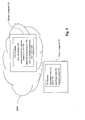
- Figure 1 shows a generally conventional arrangement of computer systems 10, 20 configured to perform data analysis according to known analysis methods.
- the computer systems 10, 20 are arranged in a conventional client-server relationship, wherein a first computer 10 acts as a client to a second computer 20 and communication occurs over a network NW1.
- NW1 network
- data to be analysed is input to one or more processes 1201 running on the server computer 20 via an interface 101 running on the client computer 10.
- the interface 101 typically includes means 103 for allowing an analysis method to be selected from a predetermined list of methods, and means 105 for allowing the user to specify data to be analysed.
- the predetermined list of methods may be retrieved from the server computer 20 via one of the processes 1201.
- the processes 1201 further include means 1203 for receiving data indicative of the selected analysis method together with the data to be analysed, and means 1205 for performing the selected analysis method.
- the processes 1201 further include means 1207 for summarising results of analysing the data and means 1209 for sending the summarised results to the client computer.
- the means 1209 for sending the summarised results may be the same means as used to send the predetermined list of methods.
- the interface 101 includes means 107 for presenting the summarised results to the user.
- Embodiments of the invention arise from a realisation that the user needs support for the whole analysis process, from data pre-processing, method selection, model fitting, and solution understanding, through to generating an application from a successful model.
- the fundamental realisation is that data analysis is an iterative process that should be driven by questions emanating from the user, rather than, as is the case with known methods, mere selection of a model.
- Embodiments are thus concerned with providing a means of interacting with the user in order to select one or more data analysis methods that are suited both to the data to be analysed and to the user's requirements.
- embodiments of the invention provide a means of characterising data analysis methods in terms of tangible and non-tangible parameters such as user-friendliness, accuracy, simplicity, interpretability, speed, cost, comprehensibility, and transparency, and attempt to match these to the user's requirements.
- Embodiments include a knowledge base comprising data analysis methods coupled with fuzzy logic expressions for each of a plurality of parameters such as simplicity, accuracy, interpretability etc.
- An example of a typical fuzzy set is the fuzzy set for simplicity: very simple, simple, slightly complex, complex, very complex.
- the fuzzy set maps onto an arbitrary scale such as [0,100].
- the knowledge base stores one, or a set of, values within this scale, which is indicative of its simplicity (based on a characteristic of the model such as number of hidden units, if the method is a neural network).
- This approach has many advantages. Firstly, it allows disparate types of models, such as a neural network and a fuzzy system, to be assessed on a universal scale, so that a ranked list of such disparate types of models can then be recommended to the user. Secondly it allows the user to interactively select a model having characteristics such as a very accurate and very simple to analyse their data, and provide some feedback regarding, for example, the user's interpretation of "very accurate", which can be used to generate a bespoke fuzzy scale for the user.
- FIG. 2 shows a server computer 20 comprising a central processing unit (CPU) 201; a memory unit 203; an input/output device 205 for connecting the server computer 20 to the client computer 10 via the network NW1; storage 207; and a suite of operating system programs 209, which control and coordinate low level operation of the server computer 20.
- CPU central processing unit
- memory unit 203 for storing data
- input/output device 205 for connecting the server computer 20 to the client computer 10 via the network NW1; storage 207; and a suite of operating system programs 209, which control and coordinate low level operation of the server computer 20.
- a data analyser 200 Generally embodiments of the invention are referred to as a data analyser 200, and comprise at least some of programs 211, 213, 215, 217, 219. These programs may be stored on storage 207, or stored on a storage device (not shown) located remote from the server computer 20. The programs are processable by the CPU 201. It will be understood that each of the programs 211, 213, 215, 217, 219 comprising the data analyser 200 may comprise a suite of programs.
- the programs include a program 211 for capturing analysis requirements, a program 213 for identifying one or more analysis methods that match data captured by the capturing program 211, and a program 215 for building one or more models in accordance with the identified analysis methods.
- the programs additionally include a program 217 for pre-processing data that has been selected for analysis, and a program 219 for evaluating model output in accordance with user feedback captured by the capturing program 211.
- the data analyser 200 includes one or more knowledge bases KB, KB2 which store fuzzy information relating to a plurality of data analysis methods and models.
- the knowledge base(s) KB, KB2 may be located on, or remote from, the server computer 20.
- the capturing program 211 manages an interactive dialogue session with the user at the client computer 10, in order to capture user requirements.
- the capturing program 211 could be a Java applet running inside a browser, or a plain Hyper-Text Markup Language (HTML) form downloaded from a server computer (not necessarily the server computer 20) to the client computer 10.
- the capturing program 211 could comprise a stand-alone program that either uses a communication protocol or uses Remote Method Invocation (where the client executes methods inside the server by calls over the network) to exchange information with a corresponding program (not shown) running on the server computer 20.
- the capturing program 211 would include conventional text fields, lists, radio buttons etc. that are designed to enable a user to input requisite data, and would send data input by the user to the server upon completion of the said data input.
- User requirements include type of data analysis method and user preferences.
- a user preference is an instance of a user characteristic; an example of a user characteristic is simplicity, and an instance of the user characteristic, or a user preference, is high level of simplicity .
- User preferences, such as high can also be represented using fuzzy sets, as is described below.
- the capturing program 211 could take many forms, as would be appreciated by one skilled in the art.
- the following passage shows one example of processes invoked by the capturing program 211 in an attempt to capture user requirements.
- the example relates to test result from cancer patients, where, for each patient there are nine results (i.e. cancer attributes, such as clump thickness, uniformity of cell size, uniformity of cell shape etc.) each having possible integer values between 1 and 10, and each case has been pre-classified as being benign or malignant. It is to be understood that the capturing program 211 is not limited to the processes described in this specific example.
- the capturing program 211 is an applet that has, for example, been downloaded from the server computer 20, as shown schematically in Figure 2.
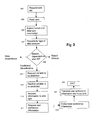
- the capturing program 211 firstly requests 301 the user to input a data set, whereupon the user duly submits the data.
- This may be in the form of a data file (e.g. database file, Excel spreadsheet, text file) or a graphical representation (e.g. an image such as an x-ray image).
- the capturing program 211 reads 303 in the data, and applies 305 standard techniques to extract format and data type information from the data, in order to identify variables present in the data. If the data is input in the form of a data file, these techniques include searching for white spaces, commas, semi-colons etc. so as to identify a number of variables within the data set (here 10), identifying data types (i.e. integer, real, string) for each of the variables, and identifying any missing values within the data set.
- An example of identifying data types includes reading a value as a string and trying to transform it into a specific data type. Typically the most specific data type is tried first, followed by the more general ones. A typical sequence is: date/time, boolean, integer, double. If all of the transformations fail, the value is considered to be a string.
- the capturing program 211 asks 307 the user to select a type of data analysis for the data set - e.g. the capturing program 211 presents the user with the following options:
- the capturing program 211 branches 309 into one of three processes. Assuming (for the purposes of this example) the user selects option (A), the capturing program 211 then asks 311 the user to select, from one of the variables identified at step 305, a variable to be predicted. Assuming the user selects the tenth variable (diagnosis, say) the capturing program 211 receives 313 this selected variable, and then queries 315 the user regarding the nature of the variables identified at step 305.
- the capturing program 211 may submit the following question, and options, to the user at step 315: There are nine input variables. All of them display only integer values. Do you know if the values represent actually symbols or real numbers, i.e. would decimal fractions theoretically be possible?
- This statement is generated dynamically by the capturing program 211, using information captured at step 305: in general the capturing program 211 may have access to a selection of templates, in which the captured information ( nine, integer ) is inserted. Selection of template is dependent on branching (step 309), and type of data identified at step 305.
- the capturing program 211 then asks 317 the user to select (or specify) instances of user characteristics, by, for example, presenting the user with a matrix of user characteristics, and allowing the user to select an instance thereof.
- An example of such a matrix, as completed by a user, is shown in Table 1: USER CHARACTERISTICS Instance of user characteristic High Low Medium user friendliness X interpretability X simplicity X accuracy X speed X maintainability X robustness X
- the capturing program 211 may translate 321 the user preference information into fuzzy sets.
- high is a fuzzy set, which is represented by a membership function over an artificial scale of 0 to 100.
- Example membership functions for high could start at 50 with membership degree 0.0, reach membership degree 1.0 at 75 and remain at 1.0 until it reaches 100.
- the membership function for high can be described by three characteristic points, which are connected by straight lines: (50, 0.0); (75, 1.0); (100, 1.0).
- the fuzzy set medium is represented as (25, 0.0), (50, 1.0), (75, 0.0); and the fuzzy set low is represented as (0, 0.0), (25, 1.0), (50, 0.0).
- a fuzzy set could be specified in many alternative formats, for example by two, or four characteristic points, or by a parameterised function.
- the capturing program 211 then exits 323.
- the capturing program 211 collects at least some of the following information: type of data analysis (in this example prediction); type of data to be analysed (in this example integer); and user preferences in terms of type of data analysis. Other information, such as identification of variable to be predicted is dependent on user selection (steps 309, 311), and will vary from example to example.
- the identifying program 213 receives, as input, information describing the type of data analysis required by the user (e.g. predictive, classification, clustering etc.), together with the user's preferences (e.g. very simple, highly accurate etc., which has already been, or can be, translated e.g. into fuzzy logic sets). This input is typically received from the capturing program 211.
- information describing the type of data analysis required by the user e.g. predictive, classification, clustering etc.
- the user's preferences e.g. very simple, highly accurate etc., which has already been, or can be, translated e.g. into fuzzy logic sets.
- the identifying program 213 is operable to identify, by application of predetermined fuzzy rules, or equivalent, analysis methods (also referred to as models) having characteristics that meet the user's preferences. These rules are stored in the knowledge base KB, and map user characteristic to model characteristic as shown in the following examples: Rule format: IF [instance of user characteristic] then [instance of model characteristic] e.g. RULE TYPE: SIMPLICITY If simplicity is high then number of parameters is low If simplicity is high then skill required is low
- these rules are used to translate user preferences, which, as described above, are themselves represented as fuzzy sets, into fuzzy sets for the model characteristics.
- the identifying program 213 compares the said model characteristic fuzzy sets with fuzzy sets representative of actual data analysis methods (shown in Table 3), so as to identify one or more data analysis methods that satisfy the user preferences.
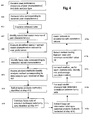
- the identifying program 213 receives 401 user preferences and data analysis type via the capturing program 211.
- the identifying program 213 then retrieves 403 rules corresponding to user characteristic(s) for which there is a user preference. For the purposes of the present example it is assumed that the user has input a single user preference, of high simplicity, and a predictive data analysis type, so that the identifying program 213 retrieves rules corresponding to the user characteristic simplicity at step 403.
- the identifying program 213 then examines 405 the simplicity-type rules, and, by examination of the antecedent part of the rules, identifies 407 one or more rules that match the level of simplicity specified by the user ( high ) to a degree larger than zero.
- the identifying program 213 evaluates 409 the identified rules.
- This identifies an instance of, or fuzzy sets corresponding to, one or more model characteristics.
- the first model characteristic is number of parameters, for which the instance of the model characteristic is low (i.e. has a membership function that can be described by three characteristic points, which are connected by straight lines: (O, 0.0); (25, 1.0); (50, 0.0)).
- the second model characteristic is skill required, for which the instance is novice (i.e. has a membership function that can be described by three characteristic points, which are connected by straight lines: (0, 1.0); (25, 1.0); (50, 0.0)).
- the identifying program 213 thus identifies 411 as many fuzzy membership sets as number of model characteristics extracted at step 409 (which in this case is 2).
- the identifying program 213 then accesses 413 entries corresponding to at least some analysis methods (e.g. by referring to a look-up table such as Table 4) and identifies 414 methods corresponding to the type of data analysis specified as input from the capturing program 211 at step 401.
- 413 entries corresponding to at least some analysis methods (e.g. by referring to a look-up table such as Table 4) and identifies 414 methods corresponding to the type of data analysis specified as input from the capturing program 211 at step 401.
- the knowledge base KB may store this information in the following form: TYPE OF DATA ANALYSIS Data analysis method Prediction Neural Network (feedforward), Neuro-Fuzzy, Decision Tree, Linear Regression, Non-linear Regression, Discriminant Analysis, K-Nearest Neighbour, Naive Bayes Classifier, Bayesian Network Clustering Neural Network (Self-Organising Feature Map), Fuzzy Cluster Analysis, K-Means Clustering Description of Dependencies Association Rules, Bayesian Network
- the identifying program 213 receives, at step 401, "prediction" as a type of data analysis, then the identifying program 213 selects 414 all of the methods corresponding to "Prediction". It will be appreciated by one skilled in the art that such a selection is a preferable, but not essential, aspect of the invention.
- the identifying program 213 then identifies 415 those that have fuzzy membership corresponding to the fuzzy sets identified at step 411 (e.g. by referring to a look-up table such as Table 3). In some embodiments, particularly when there are multiple user preferences, this step 415 involves correlating fuzzy sets of the methods accessed at step 413 with fuzzy sets identified at step 411. (This is described below.)
- simple pattern matching techniques including, e.g. inspection
- NF methods have low number of parameters and require only novice or casual skills, meaning that both of these methods would suit a user input of "simple model”.
- the identifying program 213 will receive user preference information relating to multiple user characteristics.
- Other embodiments of the invention thus may involve more stages than those described above.
- the identifying program 213 identifies rules R1 and R3 as being relevant to the user preferences at step 407. Rules R1 and R3 provide a complete match with the user preferences. Rule R2 does not match, because the membership functions high and low for accuracy do not overlap.
- the identifying program 213 evaluates 409 the rules R1 and R3, thereby computing the conclusions of the rules R1, R3.
- the conclusions are identical to the consequent part (the "then” part), and model characteristics number parameters, adaptability, customisation are extracted.
- Step 411 which identifies degrees of membership of the model characteristics, thus identifies the following three fuzzy sets:
- the identifying program 213 determines 415b the correlation between the characteristics to be matched and the fuzzy sets corresponding to each of the method types.
- the identifying program 213 identifies 415c minimum and average correlation values for each of the methods: Neural Network Linear Regression Decision Tree Neuro-fuzzy Min correlation 0.0 1.0 0.5 0.0 Mean correlation 0.75 1.0 0.83 0.16 and selects 415d whichever method has both the highest mean, and a minimum correlation greater than 0. In the present example the method linear regression would be selected because it has the highest mean and the minimum correlation value is greater than 0 (in fact both values are 1.0, indicating that this method matches user requirements exactly).
- the identifying program 213 can rank 415e the methods in accordance with the mean and minimum correlation values. This ranking indicates how well the methods are estimated to match the user requirements.
- each of the three model characteristics extracted at step 409 occurs once only.
- more than one rule identified at step 407 involves the same model characteristic.
- rules identified at step 407 may include If simplicity is high then number of parameters is low [R1] If maintainability is medium then number parameters is medium [R2]
- step 411 which involves identifying fuzzy sets for the model characteristics, based on the consequent parts of rules R1 and R2, additionally involves combining 411a (step not shown) low and medium to identify a fuzzy set for number of parameters.
- Steps 415a, 415b and 415c proceed as described above.
- correlation 507 between user requirements and the method Neural Network for the model characteristic number of parameters is 0.5.
- the rule output fuzzy sets can be amended by an "at least” operation.
- the result customisation none can be replaced by " at least none", thereby effectively extending the rule conclusions.
- This has the effect of increasing the likelihood that at least one method will satisfy the conditions applied at step 415d (step 415d: identify method having highest mean correlation and minimum correlation greater than 0).
- rules could be similarly modified if only a single method can be identified, and the intention (e.g. specified by the user) is to evaluate results from two or more suitable methods.
- Data pre-processing is a process whereby data is processed prior to input to one or more data analysis methods.
- data pre-processing includes at least some of: detecting and removing outliers and anomalies from the data; analysis of the pattern of missing values in the data; variable selection; and sampling of the data.
- Different analysis methods have different requirements relating to data format, scaling, and sampling etc, so that the pre-processing program 217 selects and automatically applies appropriate pre-processing methods depending on the data, the goal of the analysis, and the methods that are selected to analyse the data.
- the pre-processing program 217 receives input from the capturing program 211.
- This input includes the data set to be analysed, together with information indicative of type of data and number of variables, and the type of data analysis to be performed on the data set (e.g. prediction, classification etc.).
- This input enables the pre-processing program 217 to perform several data manipulation steps.
- the actual steps carried out vary in accordance with the type of data analysis requested by the user, and on the form of the data to be utilised.
- Figure 6 shows several possible pre-processing operations, not all of which will be performed for all cases.
- running of the pre-processing program 217 is not essential to the invention; in some cases the data may be sufficiently "clean", and in a format suitable for data analysis.
- the pre-processing program 217 performs 601 some cursory operations such as identifying missing values in the data set, identifying which of the data should be used for the analysis (e.g. removing constants and identifiers such as strings or increasing integers) and computing statistical information such as mean, variance etc. Then the pre-processing program 217 determines 603, from the size of the data set, whether it needs to create sample data sets. If it does, then at step 605 the pre-processing program 217 accordingly creates sample data sets.
- some cursory operations such as identifying missing values in the data set, identifying which of the data should be used for the analysis (e.g. removing constants and identifiers such as strings or increasing integers) and computing statistical information such as mean, variance etc. Then the pre-processing program 217 determines 603, from the size of the data set, whether it needs to create sample data sets. If it does, then at step 605 the pre-processing program 217 accordingly creates sample data sets.
- the pre-processing program 217 then performs some type-dependent processing steps.
- the pre-processing program 217 selects 607 one or more dependency tests in order to identify which variables should be used for the data analysis.
- the selection of dependency tests is dependent on the data type (again, this information is received at step 401), and the pre-processing program 217 selects from tests such as correlations, chi-square tests etc. Having selected appropriate tests, the pre-processing program 217 computes 609 the selected tests.
- the pre-processing program 217 determines 617 whether or not it has sufficient training examples of each classification type. If there are insufficient training examples of a particular type (e.g. if there are 3 classes, and, within the data set, the data is spread 45% to class 1, 45% to class 2 and 10% to class 3, so that there is an insufficient number of data of class 3), the pre-processing program 217 can equalise the distribution of data among the classes. Accordingly pre-processing program 217 computes 619a, for each class, a cost for misclassification (e.g. from the class frequencies) and/or boosts 619b the class frequency by adding a certain number of data copies to class 3, or deletes a corresponding number of data from classes 1 and 2 to equalise the class frequencies.
- a cost for misclassification e.g. from the class frequencies
- boosts 619b boosts 619b the class frequency by adding a certain number of data copies to class 3, or deletes a corresponding number of data from classes 1 and 2 to equalis
- the pre-processing program 217 may have received an input, which is indicative of whichever data analysis method has been identified to be most suitable to the user's requirements, from the identifying program 213. Accordingly the pre-processing program 217 may perform additional method-dependent processing of the data.
- the pre-processing program 217 performs the following operations on the data set (sample data set or whole data set, according to decision at step 603): remove 621 any item of data for which there is null entry against one or more variables, or replace null entries by suitable statistical values; encode 623 any symbolic variable by a 1-from-n code, where n depends on the number of different values of the variable.
- the pre-processing program 217 identifies 631 the largest values of all variables in the data set and normalises 633 all variables by the identified largest value.
- the building program 215 accesses a second knowledge base KB2 (which may be part of, or located remote from (as shown in Figure 2), the knowledge base KB) to create (a) model(s) using the identified methods.
- a second knowledge base KB2 which may be part of, or located remote from (as shown in Figure 2), the knowledge base KB
- a data analysis method creates a model using data.
- the building program 215 receives the data set input to the capturing program 211 (or, if the data set has been pre-processed by the pre-processing program 217, from the pre-processing program 217), and this data set is used by the identified methods (e.g. during learning to create a model, or to learn classification rules etc.).
- the building program 215 has access to standard, and purpose-built, analysis tools that carry out the identified methods.
- the building program 215 interoperates with the standard analysis tools via wrappers 701, as shown in Figure 7.
- a wrapper 701 is a piece of software that interfaces between an external tool 703 and the building program 215; essentially each wrapper 701 is associated with an external tool and translates information between the building program 215 and its associated tool 703, so that the tool 703 can be executed in accordance with instructions from the building program 215.
- each tool can carry out a particular data analysis method.
- the following external tools are utilised: METHOD DETAILS Decision trees "DT Package", which is available under the Gnu Public License from the University of Magdeburg, author Christian Borgelt, described in "Attributaus angles usefule für die Indu Vietnamesesbaumen: Ein structural", Christian Borgelt und Rudolf Kruse.ln: Gholamreza Nakhaeizadeh, ed. Data Mining: Theoreticianaggregat und füren, pp. 77-98. Physica-Verlag, Heidelberg, Germany 1998.
- the instructions, which control execution of the tool, are stored in the second knowledge base KB2, and essentially comprise heuristics, in the form of exact and fuzzy rules. These heuristics define the learning process required for model creation.
- the rules are method-specific, e.g. for Method type NEURAL NETWORK, which is a bespoke tool for generating a neural network, there are three possible learning algorithms: backpropagation (BackProp), quickpropagation (QuickProp) and resilient propagation (Rprop), and the selection and processing of the learning algorithms involve the following steps (referring to Figure 8): Apply Rprop first 801. If Rprop fails apply QuickProp 813 If QuickProp fails apply BackProp 823 If BackProp fails, then abort 831 neural network generation
- the building program 215 observes parameters such as oscillation, error, convergence speed, number of parameters etc. (as they are inherent features of the learning/analysis/model creation algorithms), and compares these against predetermined fuzzy learning rules [RRn], such as:
- the building program 215 observes 802 at least some of the parameters listed above. Then the building program 215 determines 803 a degree of membership of the parameters to the fuzzy learning sets in the antecedent of the fuzzy learning rules listed above, in order to determine whether the learning rule is relevant, and thus whether a learning rule should be executed. If a learning rule is relevant, the building program 215 executes 805 the said rule.
- the building program 215 changes 807 the number of parameters of the neural network to add more hidden units, and restarts 809 the algorithm. If any of the algorithms fail, the building program 215 changes 811 the algorithm - to apply one of the other learning algorithms.
- the second knowledge base KB2 contains fuzzy learning rules of the following format:
- the building program 215 can be arranged to evaluate, during construction of a model, at least some of the model characteristics, and to compare them with fuzzy set(s) generated at step 411.
- the building program 215 is adapted to evaluate, using one or more predetermined rules, a number of parameters for the said model under construction, and to compare the evaluated number with the fuzzy set for number of parameters evaluated at step 411.
- This is a non-dimensional number, which maps directly onto the fuzzy set scale [0...100], and thus enables comparison of the actual number of parameters for this method under construction (or to be constructed/having been constructed) with the fuzzy set evaluated at step 411.
- step 803 data analysis and model creation are heavily dependent on the fuzzy learning sets in the learning rules: firstly, for a learning rule to be considered relevant (step 803), the antecedent fuzzy learning set has to overlap with the method parameters; secondly, the effect of the learning rule, or the degree to which an algorithm is modified (step 807), is dependent on the consequent fuzzy learning set.
- Embodiments of the invention thus include means by which the building program 215 monitors the performance of these fuzzy learning rules, and can adapt the learning rules (e.g. by modifying the fuzzy learning sets defining the learning rules), based on the "success" rate thereof.
- This means could be a neuro-fuzzy algorithm.
- neuro-fuzzy algorithms modify fuzzy rules by adapting antecedent and consequent fuzzy sets in accordance with observed data.
- a neuro-fuzzy algorithm such as the NEFPROX fuzzy rule-learning algorithm, referred to above, could be used.
- the building program 215 concludes that the consequent part of the rule is too weak, and sets the oscillation value to be an error value.
- the building program 215 modifies, using a neuro-fuzzy learning algorithm and the error value, the consequent part of this fuzzy learning rule (the fuzzy learning set "slightly” ) so that next time the rule is applied, the degree of reduction applied to the learning rate is greater.
- the antecedent part the fuzzy learning set strongly
- the parameters - in this case the oscillation - that can be interpreted as error values are identified to the building program 215. These error values are then utilised to modify fuzzy learning rules as described above.
- more than one method may be identified as relevant to the user's preferences, so that the building program 215 builds more than one model.
- Information relating to the model(s) is/are presented to the user, preferably via the capturing program 211.
- the building program 215 sends performance-related data to the capturing program 211 as part of a "reporting session" to the user.
- the user can view information about the model itself by clicking on a button displayed by the capturing program 211, such as "Tell me more" Successive clicking on the "Tell me more” button has the effect of successively “drilling" down to access and view further details of the model(s).
- the building program 215 has built a model using a neuro-fuzzy method
- the capturing program 211 would provide the following information:
- the capturing program 211 states that the model comprises a neuro-fuzzy model having 10 rules
- the capturing program 211 shows the rules in a text form
- the capturing program 211 displays the fuzzy sets graphically.
- the capturing program 211 states that the model comprises a NN model having x number of units;
- the capturing program 211 displays the learning algorithm used
- the capturing program 211 displays the activation functions used
- the capturing program 211 displays the weights computed.
- This information is organized by the building program 215 after the model(s) has/have been built, and is either wholly communicated to the capturing program 211 prior to the reporting session or retrieved by the capturing program 211 in response to the user clicking on the "Tell me more" button.
- a model has been selected - either by the user, (e.g. via the capturing program 211), or automatically by the building program 215, it creates an application based on the model.
- This application is a standalone program, and comprises program code required to execute the created model.
- the application can access the same kind of data source that the user has submitted for analysis, e.g. data in a database, a text file or an Excel spread sheet. The user can then use that application to process new data and perform predictions, classifications etc.
- the application typically has a simple user interface that asks the user for a data source and displays the results of the model application, e.g. in form of table, where the result for each record is shown. It also creates an output file that contains the results.
- the data analyser 200 operates in accordance with the following assumptions:
- embodiments of the data analyser 200 may include means for individual definition of these preference categories.
- embodiments may include a program 219 for monitoring user feedback to the model data, and for modifying the fuzzy set definition of terms low, medium, high in accordance with the feedback.
- any modification to the definition of a fuzzy set is stored as a function of the user.
- a suitable way of storing specific user definitions of the fuzzy sets is via user profiles.
- Such feedback may be captured when model results are presented to the user via the capturing program 211.
- the capturing program 211 may additionally include means for the user to specify whether or not the model concords with user requirements. This means may be an edit box, or a graphical slide-means, which allows the user to specify whether, for example, the model created is too complex, not sufficiently interpretable, not sufficiently accurate etc.
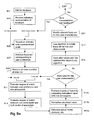
- the monitoring program 219 asks 901 the user for feedback relating to specific user characteristics.
- the capturing program 211 includes a graphical slider
- the user can move the slider to express how closely the model information (presented by the building program 215, as described above) matches his requirements. For example, for the user characteristic simple, such a slider could be moved between "far too simple - too simple - exactly right - too complex - far too complex"
- the monitoring program 219 receives 903 an indicator representative of the user feedback, and transforms 905 the indicator into a number between - 1 and + 1. For example, assuming that the user sets the slider position to "too simple", which means that the user is has some experience with these methods (i.e. what is categorised as being simple to most users is too simple for this user), then at step 905 the monitoring program 219 translates the slider position to a numerical error value of -0.6.
- the monitoring program 219 then retrieves 907 the fuzzy set corresponding to the user preference simple, which was collected by the capturing program 211 at step 319, for use in modifying the fuzzy set for high (for user characteristic simple).
- the sign of the error transformed at step 905 indicates whether the fuzzy set should be extended to lower values (negative error values), or towards higher values (positive error values). In the present example, for which the error value is -0.6, this indicates that the fuzzy set for high should be extended towards lower values.
- the monitoring program 219 retrieves 909 all of the rules identified as step 407, corresponding to user characteristic simple. Recalling the example rules used above, in the context of the identifying program 213:
- the modifying means 219 evaluates 913 a degree of match between the rule consequent fuzzy sets and the model characteristics of the built model.
- the steps involved in this evaluation are best illustrated by the example of model characteristic number of parameters: the number of parameters actually generated for the model built by the building program 215 is calculated 913a (assuming, for the sake of clarity, that only one model is built); the number calculated at step 913a is normalised 913b (as described in the neuro-fuzzy example above); and a degree of match between the evaluated number of parameters and the default fuzzy set for low is calculated 913c.
- the monitoring program 219 then repeats step 913 (913a, 913b, 913c) for the second rule (relating to model characteristic skill required), and calculates a second error value relating to user characteristic simple.
- the monitoring program 219 then inputs 915 both the error values, both antecedent degrees of match evaluated at step 911 and both degrees of match evaluated at step 913, into a Neuro-fuzzy learning algorithm, and, in a known manner, uses 917 the algorithm to modify the fuzzy set corresponding to high for user characteristic simple.
- the monitoring program 219 modifies 919 the adjacent fuzzy set, (in this case medium ), to account for any overlap between high and medium.
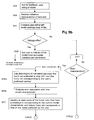
- Figure 9b shows a second embodiment wherein fuzzy sets are modified in accordance with user feedback.
- Figure 9b is spread over two sheets, and connection points are represented as CIRC1 and CIRC2.
- the monitoring program 219 asks 901 the user to rate the models built by the building program 215.
- the building program 215 has built more than one model.
- the monitoring program 219 compares 931 the user's rating with model rankings generated by the building program 215 at step 415e, as described above.
- the monitoring program 219 asks 933 the user whether the model with the highest user rating matches the user's "requirements" more closely. If the user replies in the affirmative, the monitoring program 219 performs the following steps:
- the monitoring program 219 identifies 937, from the second knowledge base KB2, at least some (preferably all) of the fuzzy rules that have a consequent corresponding to the model characteristics identified at step 411 (Number of parameters, adaptability, customisation) and whose fuzzy set corresponds to that of the model preferred by the user.
- step 937 the monitoring program 219 attempts to identify all fuzzy rules that have medium number of parameters in its rule consequent. Assuming that the following rule is stored in the second knowledge base KB2:
- the monitoring program 219 then reviews 939 the antecedent of the rule(s) identified at step 937, and modifies 941 the fuzzy set (here high ) relating to the user characteristic of the antecedent (here simplicity) in accordance with the user's preferences received at step 319.
- the monitoring program 219 modifies the fuzzy set for high, so that it is more closely related to the fuzzy set for medium (which could be the default fuzzy set for medium, or could itself have been modified in accordance with user feedback, as described herein).
- This modification can be performed in the following manner: for each non-zero error value evaluated at step 935b (for this example, there is only one: 0.5), the monitoring program 219 appends 941a a sign to the error value by comparing the fuzzy set of the user preference (high) with that of the antecedent of the rule identified at step 937 ( medium ); next, the monitoring program 219 inputs 941b the error value so appended to a neuro-fuzzy algorithm, together with the fuzzy sets for high and medium, and runs 941c the neuro-fuzzy algorithm.
- the neuro-fuzzy algorithm modifies the fuzzy set for high in accordance with the degree of error towards the fuzzy set specified in the rule R5 identified at step 937.
- the monitoring program 219 appends a negative sign to the error value, because high simplicity (the user's requirement) is larger than medium simplicity (the antecedent of the identified rule R5).
- a negative sign means that the fuzzy set for high will be decreased towards the fuzzy set of medium.
- the monitoring means inputs this error value (-0.5), together with the fuzzy set for high and the fuzzy set for medium, to a neuro-fuzzy algorithm (such as one of those described above), which modifies 941c the fuzzy set high simplicity such that high is defined by lower values.
- a neuro-fuzzy algorithm such as one of those described above
- monitoring means 219 modifies 943 the adjacent fuzzy set medium to adjust the overlap between high and medium. Preferably this is done by the neuro-fuzzy learning algorithm.
- evaluation of fuzzy rules at step 409 will be based on fuzzy sets stored in the user's user profile.
- the identifying program 213 will access his user profile to retrieve the fuzzy set corresponding to high for the user characteristic simple. Then, at steps 415a, 415b, where the identifying program 213 evaluates correlation between fuzzy sets of user characteristics and fuzzy sets of model characteristics, the identifying program 213 utilises the user specific fuzzy definitions.
- Step 409 which involves evaluating rules relevant to user preferences, additionally involves matching 409a (step not shown) the default definition of high with the user's definition of high.
- the equation m sup(min(a(x), b(x))), where m is the degree of match, and a and b are the default and user-specified fuzzy sets respectively, is applied.
- m 1.0, meaning that the identified rule is completely applicable. (i.e. the result would be the same if the user's idea of simple was the default definition). If the degree of match were less than 1.0, the conclusion of rule R1 would be capped in accordance with the reduced degree of match.
- the monitoring program 219 is operable to store user preferences captured by the capturing program 211.
- the monitoring program 219 is additionally operable to evaluate the user's most frequently selected user preferences, and to save these in the user profile.
- the user enters his preferences manually.
- the capturing program 211 can retrieve, from the user profile, the user's most frequently selected preferences, and present these to the user proactively.
- step 317 of requesting user preferences, could comprise asking the user the following question: Your current user profile shows that you prefer interpretable, simple and fast models. Do you want to change the preferences for this analysis? Should the user reply in the affirmative, the capturing program 211 is adapted to request 318 (step not shown) fresh user preferences, and receive them as described above, at step 319.
- the data analyzer 200 is written in the Java programming language, but this is not essential to the invention.
- the programs 211, 213, 215, 217, 219 can be distributed over any number of computers.
- the server 20 has a plug-in application program interface (API), meaning that functions (programs 211, 213, 215 etc, knowledge bases KB, KB2, external and bespoke data analysis methods 703 etc) can be provided in modules (plug-ins) that are then plugged into the server via the plug-in API, as shown in Figure 10.
- API application program interface
- the capturing program 311 will typically be an applet, which engages in a simplified user dialogue and hides the complexity of the data analysis process from the user.
- the capturing program 311 could be an expert interface, in the form of a visual programming tool, which provides the user with complete control over the analysis process.
- An expert user interface enables the user to specify data analysis methods and processes by creating, configuring and connecting blocks that represent certain functions.
- the capturing program 311 could be a machine interface that accepts text commands and can be used by agents and software robots (software tools that would use the data analyser 200 to carry out dedicated data analysis on a regular basis without user intervention).
- the data analyser 200 could be used to facilitate decision-making.
- the data analyser 200 could include additional programs (external tools that interface with the data analyser 200 via plug-ins) that monitor network traffic (mobile and/or fixed networks), and feed the traffic data into the data analyser 200 for analysis thereof.
- the data analyser 200 could be configured to classify "normal”, “busy”, “viral” etc. traffic behaviour, and, having performed the classification, could be used to analyse incoming data against these classifications.
- the data analyser 200 could then be used to detect alarm situations, and to couple detection of an alarm situation with a series of actions that change certain variables in order to move from a critical state to a non-critical state.
- Agents are autonomous computer programs acting on behalf of users without requiring direct intervention. Agents that search the Web for information could try to locate prospective data sources in order to answer queries by its user. Once data sources are located, the agent could connect to the data analyser 200, and ask the data analyser 200 to perform a particular type of data analysis on the data sources. The agent would then communicate the result of the analysis back to user.
- the user could pose a query, such as "what will the sterling/dollar exchange rate be next month", to a software agent.
- the agent would locate a suitable financial time series (e.g. by searching on the Internet), and submit the time series (using a machine interface, as described above) to the data analyser 200, together with a request for a prediction_of next month's exchange rate.
- This request and time series data would be input to the identifying program 213, as described above, and a model would be built (as described above) by the building program 215.
- the result would be delivered back to the user via the agent, together with some information about the expected reliability of the prediction and the source of the data.
Landscapes
- Engineering & Computer Science (AREA)
- Theoretical Computer Science (AREA)
- Data Mining & Analysis (AREA)
- General Engineering & Computer Science (AREA)
- Software Systems (AREA)
- Artificial Intelligence (AREA)
- Evolutionary Computation (AREA)
- Physics & Mathematics (AREA)
- General Physics & Mathematics (AREA)
- Computer Vision & Pattern Recognition (AREA)
- Computational Linguistics (AREA)
- Computing Systems (AREA)
- Mathematical Physics (AREA)
- Fuzzy Systems (AREA)
- Life Sciences & Earth Sciences (AREA)
- Bioinformatics & Cheminformatics (AREA)
- Bioinformatics & Computational Biology (AREA)
- Automation & Control Theory (AREA)
- Evolutionary Biology (AREA)
- Human Computer Interaction (AREA)
- Information Retrieval, Db Structures And Fs Structures Therefor (AREA)
Priority Applications (6)
| Application Number | Priority Date | Filing Date | Title |
|---|---|---|---|
| EP01308280A EP1298582A1 (de) | 2001-09-27 | 2001-09-27 | Verfahren und Vorrichtung zur Analyse von Daten |
| EP02765043A EP1483739A2 (de) | 2001-09-27 | 2002-09-24 | Verfahren und gerät für datenanalyse |
| AU2002329417A AU2002329417A1 (en) | 2001-09-27 | 2002-09-24 | Method and apparatus for data analysis |
| CA002457715A CA2457715A1 (en) | 2001-09-27 | 2002-09-24 | Method and apparatus for data analysis |
| PCT/GB2002/004328 WO2003027899A2 (en) | 2001-09-27 | 2002-09-24 | Method and apparatus for data analysis |
| US10/488,782 US7272586B2 (en) | 2001-09-27 | 2002-09-24 | Method and apparatus for data analysis |
Applications Claiming Priority (1)
| Application Number | Priority Date | Filing Date | Title |
|---|---|---|---|
| EP01308280A EP1298582A1 (de) | 2001-09-27 | 2001-09-27 | Verfahren und Vorrichtung zur Analyse von Daten |
Publications (1)
| Publication Number | Publication Date |
|---|---|
| EP1298582A1 true EP1298582A1 (de) | 2003-04-02 |
Family
ID=8182301
Family Applications (1)
| Application Number | Title | Priority Date | Filing Date |
|---|---|---|---|
| EP01308280A Withdrawn EP1298582A1 (de) | 2001-09-27 | 2001-09-27 | Verfahren und Vorrichtung zur Analyse von Daten |
Country Status (1)
| Country | Link |
|---|---|
| EP (1) | EP1298582A1 (de) |
Cited By (2)
| Publication number | Priority date | Publication date | Assignee | Title |
|---|---|---|---|---|
| CN107329996A (zh) * | 2017-06-08 | 2017-11-07 | 三峡大学 | 一种基于模糊神经网络的聊天机器人系统与聊天方法 |
| WO2021139223A1 (zh) * | 2020-08-06 | 2021-07-15 | 平安科技(深圳)有限公司 | 分群模型的解释方法、装置、计算机设备和存储介质 |
Citations (1)
| Publication number | Priority date | Publication date | Assignee | Title |
|---|---|---|---|---|
| US6078924A (en) * | 1998-01-30 | 2000-06-20 | Aeneid Corporation | Method and apparatus for performing data collection, interpretation and analysis, in an information platform |
-
2001
- 2001-09-27 EP EP01308280A patent/EP1298582A1/de not_active Withdrawn
Patent Citations (1)
| Publication number | Priority date | Publication date | Assignee | Title |
|---|---|---|---|---|
| US6078924A (en) * | 1998-01-30 | 2000-06-20 | Aeneid Corporation | Method and apparatus for performing data collection, interpretation and analysis, in an information platform |
Non-Patent Citations (1)
| Title |
|---|
| KORS J A ET AL: "Induction of decision rules that fulfil user-specified performance requirements", PATTERN RECOGNITION LETTERS, NORTH-HOLLAND PUBL. AMSTERDAM, NL, vol. 18, no. 11-13, 1 November 1997 (1997-11-01), pages 1187 - 1195, XP004117917, ISSN: 0167-8655 * |
Cited By (2)
| Publication number | Priority date | Publication date | Assignee | Title |
|---|---|---|---|---|
| CN107329996A (zh) * | 2017-06-08 | 2017-11-07 | 三峡大学 | 一种基于模糊神经网络的聊天机器人系统与聊天方法 |
| WO2021139223A1 (zh) * | 2020-08-06 | 2021-07-15 | 平安科技(深圳)有限公司 | 分群模型的解释方法、装置、计算机设备和存储介质 |
Similar Documents
| Publication | Publication Date | Title |
|---|---|---|
| US7272586B2 (en) | Method and apparatus for data analysis | |
| US12242431B2 (en) | Predictive search and navigation for functional information systems | |
| US10402379B2 (en) | Predictive search and navigation for functional information systems | |
| US11151096B2 (en) | Dynamic syntactic affinity group formation in a high-dimensional functional information system | |
| KR102811533B1 (ko) | 건물 에너지 분석 플랫폼의 정보검색증강 기반 자연어 질의응답 서비스를 제공하는 방법 및 시스템 | |
| Nauck et al. | NEFCLASS-X—a soft computing tool to build readable fuzzy classifiers | |
| US20220164549A1 (en) | Natural language processing parsimonious question generator | |
| KR102788959B1 (ko) | 인공지능 모델을 활용한 기업 경영 진단 및 컨설팅 분석 결과 제공 자동화 솔루션 제공 방법 | |
| US11275903B1 (en) | System and method for text-based conversation with a user, using machine learning | |
| EP1298505A1 (de) | Modellierungsverfahren | |
| Sachdeva et al. | Real life applications of fuzzy decision tree | |
| US12536201B2 (en) | System and methods for varying optimization solutions using constraints based on an endpoint | |
| KR102047012B1 (ko) | 정보 제공 시스템 | |
| EP3443480A1 (de) | Annäherungssuche und navigation für funktionale informationssysteme | |
| US20250225426A1 (en) | Apparatus and methods for the generation and improvement of efficiency data | |
| CN121920507A (zh) | 人工智能模型解决方案交付方法、设备和系统 | |
| Bai et al. | Tabu search enhanced Markov blanket classifier for high dimensional data sets | |
| US20230368013A1 (en) | Accelerated model training from disparate and heterogeneous sources using a meta-database | |
| Nauck et al. | NEFCLASS-J–a java-based soft computing tool | |
| US11822564B1 (en) | Graphical user interface enabling interactive visualizations using a meta-database constructed from autonomously scanned disparate and heterogeneous sources | |
| US12561728B2 (en) | Data aggregation and compression systems facilitating data base querying and file management | |
| JP7806883B2 (ja) | モデル探索装置、モデル探索方法、及び、プログラム | |
| US11928128B2 (en) | Construction of a meta-database from autonomously scanned disparate and heterogeneous sources | |
| US20250225420A1 (en) | Apparatus and a method for the generation and improvement of procedure data | |
| EP1298540A1 (de) | Methode um Begriffsbestimmungen anzupassen |
Legal Events
| Date | Code | Title | Description |
|---|---|---|---|
| PUAI | Public reference made under article 153(3) epc to a published international application that has entered the european phase |
Free format text: ORIGINAL CODE: 0009012 |
|
| AK | Designated contracting states |
Kind code of ref document: A1 Designated state(s): AT BE CH CY DE DK ES FI FR GB GR IE IT LI LU MC NL PT SE TR Designated state(s): AT BE CH CY DE DK ES FI FR GB GR IE IT LI LU MC NL PT SE TR |
|
| AX | Request for extension of the european patent |
Extension state: AL LT LV MK RO SI |
|
| STAA | Information on the status of an ep patent application or granted ep patent |
Free format text: STATUS: THE APPLICATION IS DEEMED TO BE WITHDRAWN |
|
| 18D | Application deemed to be withdrawn |
Effective date: 20030128 |