EP1299155B1 - Therapeutische bestrahlungsanordnung - Google Patents
Therapeutische bestrahlungsanordnung Download PDFInfo
- Publication number
- EP1299155B1 EP1299155B1 EP01956274A EP01956274A EP1299155B1 EP 1299155 B1 EP1299155 B1 EP 1299155B1 EP 01956274 A EP01956274 A EP 01956274A EP 01956274 A EP01956274 A EP 01956274A EP 1299155 B1 EP1299155 B1 EP 1299155B1
- Authority
- EP
- European Patent Office
- Prior art keywords
- oxygen
- arrangement according
- irradiation arrangement
- therapeutic irradiation
- oxygen supply
- Prior art date
- Legal status (The legal status is an assumption and is not a legal conclusion. Google has not performed a legal analysis and makes no representation as to the accuracy of the status listed.)
- Expired - Lifetime
Links
Images


Classifications
-
- A—HUMAN NECESSITIES
- A61—MEDICAL OR VETERINARY SCIENCE; HYGIENE
- A61M—DEVICES FOR INTRODUCING MEDIA INTO, OR ONTO, THE BODY; DEVICES FOR TRANSDUCING BODY MEDIA OR FOR TAKING MEDIA FROM THE BODY; DEVICES FOR PRODUCING OR ENDING SLEEP OR STUPOR
- A61M16/00—Devices for influencing the respiratory system of patients by gas treatment, e.g. ventilators; Tracheal tubes
-
- A—HUMAN NECESSITIES
- A61—MEDICAL OR VETERINARY SCIENCE; HYGIENE
- A61N—ELECTROTHERAPY; MAGNETOTHERAPY; RADIATION THERAPY; ULTRASOUND THERAPY
- A61N5/00—Radiation therapy
- A61N5/06—Radiation therapy using light
- A61N5/0613—Apparatus adapted for a specific treatment
- A61N5/062—Photodynamic therapy, i.e. excitation of an agent
-
- A—HUMAN NECESSITIES
- A61—MEDICAL OR VETERINARY SCIENCE; HYGIENE
- A61M—DEVICES FOR INTRODUCING MEDIA INTO, OR ONTO, THE BODY; DEVICES FOR TRANSDUCING BODY MEDIA OR FOR TAKING MEDIA FROM THE BODY; DEVICES FOR PRODUCING OR ENDING SLEEP OR STUPOR
- A61M2202/00—Special media to be introduced, removed or treated
- A61M2202/02—Gases
- A61M2202/0208—Oxygen
Definitions
- the invention relates to a therapeutic radiation arrangement, in particular for the treatment of completely or partially cell-mediated Inflammation of the skin, such as neurodermatitis, acne or psoriasis.
- Therapeutic radiation arrangements are particularly in the area of Phototherapy of skin diseases has long been known.
- a patient in the wavelength range of 315-1500 will be used nm irradiated.
- the wavelength range between 315-340 nm (UV-A2) has been shown to lead to an increased risk of cancer, so that UV-A1 therapy in particular for the treatment of atopic eczema (340-400 nm) is used.
- Chemo-phototherapy as a generic term generally includes its use of optical radiation to achieve therapeutic effects.
- On Sub-area of chemo-phototherapy is the so-called photodynamic Therapy PDT.
- Two main areas of application for PDT are Cancer treatment and the treatment of all or part of cell-mediated Skin inflammation.
- a common feature of PDT is the generation of reactive oxygen species.
- the optical radiation stimulates the body's own or internally or externally administered dye molecules, which are then in a excited state are transferred. By interacting with Existing oxygen molecules become reactive through energy transfer Oxygen species are formed, which then damage or even destroy the cell.
- the main use case is tumor treatment of internal organs. This is done endoscopically using a Glass fiber guides the optical radiation from a laser to the tumor and this irradiated selectively. Furthermore, photosensitizers become the patient injected. The problem arises that the tumor tissue is considerable is poorly supplied with blood, so that the oxygen content is also very low, which also limits the conversion to reactive oxygen species.
- the Feeding patients increased oxygen inspiratory, so that the Oxygen content in the tumor tissue is increased and more reactive Oxygen species can be formed.
- the second area of application in Cancer therapy with PDT is the treatment of external tumors such as especially skin cancer, where due to the presence of oxygen in the Additional oxygen is not required in the environment.
- the treatment of completely or partially cell-mediated skin inflammation is always a large-scale inflammation, so that extensive radiation sources are used here, which simultaneously irradiate treatment areas of 5 cm 2 to 2 m 2 .
- Another difference to the tumors is the increased blood flow to inflammation, which can already be recognized externally by the redness in the area of inflammation.
- the method of PDT mainly used in the treatment of completely or partially cell-mediated skin diseases is the high-dose UV-A1 therapy in the wavelength range of 340-400 nm.
- UV-A1 therapy remains ineffective in approx. 20 - 30% of the treated patients.
- UV-A1 therapy As long-term therapy for atopic Dermatitis therefore currently appears to be irresponsible.
- atopic dermatitis is also systemic Phototherapy d.
- H the oral administration of psoralens with a subsequent one Whole-body radiation combined with broadband UV-A1 radiation.
- the DNA is damaged directly Cells through the psoralen without the interposition of oxygen.
- PUVA therapy in atopic eczema not to be overlooked that they are with a number in this indication serious disadvantages. It is a high number of Treatments necessary to heal atopic eczema. Often it is required to continue maintenance therapy for many months and years. The disease often begins in childhood and adolescence.
- the invention is therefore based on the technical problem, a therapeutic radiation arrangement in particular for the treatment of to create all or part of cell-mediated skin inflammation that a has improved therapeutic effectiveness.
- the radiation arrangement comprises a device for the inspiratory and topical addition of oxygen. This increases the oxygen content in the parts of the body to be irradiated, which in turn improves the formation of reactive O 2 species.
- the invention is based on the following findings:
- the therapeutic effect in phototherapy is based on the excitation of dye molecules, so-called porphyrins, the excitation of which converts the oxygen present into reactive O 2 species through energy transfer, which in turn causes damage dependent on the location, such as damage to the plasma membrane, the lysomes or mitochondria.
- the amount of light available in the body is increased by the irradiance or the dose and the amount of available porphyrins by additional photosensitizers. Because of the strong reddening as a rule, it has previously been assumed that the parts of the body to be treated are well supplied with blood and are sufficiently supplied with oxygen. However, this is not the case. Rather, the inflammation in the case of completely or partially cell-mediated skin inflammation itself causes acidification in the affected tissue. The associated pH shift worsens the oxygen supply to the tissue despite the increased blood flow by reducing the transport capacity of oxygen molecules such as hemoglobin. In addition, pre-capillary sphincters in the subdermal vascular plexus relax via photorelaxation, which lowers the transcutaneous oxygen pressure.
- the available oxygen concentration is therefore a decisive parameter for the effectiveness of PDT in the treatment of completely or partially cell-mediated skin inflammation, whereby, contrary to all previous assumptions, the normally available amount of oxygen is not sufficiently large. This is significantly increased by the inspiratory and topical addition of oxygen, so that increased oxygen molecules are available which can be converted into reactive O 2 species.
- additive oxygen causes an increase in effectiveness, which can either be used to increase the effectiveness or to reduce the radiated power and the associated apparatus structure.
- the arterial oxygen partial pressure normally present in a healthy person is approx. 12 kPa and is increased to over 67 kPa by inhalation of pure oxygen.
- This high oxygen concentration now leads to the formation of more singlet oxygen and, in addition to the apoptosis of T-lymphocytes, to the spores, fungi and skin germs, such as Staphylococcus aureus, which has affected up to 90% of all patients with neurodermatitis.
- this treatment is particularly efficient since the athlete's foot growth partly takes place in bradytropic tissues, for example in the nail tissues, so that it is favorable to form the highest possible O 2 gradient there by diffusion. Since the diffusion barrier of a nail is significantly greater than that of the cornea, tissue cavitations are generated using an ultrasound applicator, which increase the diffusion of oxygen by a factor of 10.
- the use of an ultrasound applicator is not only limited to the treatment of athlete's foot, but is generally used to increase the topical oxygen supply.
- Another area of application of the therapeutic radiation arrangement is the treatment of autoimmune diseases with recirculating Lymphocytes such as arteriosclerosis, multiple sclerosis, rheumatism, Asthma, COLD, graft rejection and various connective tissue and Organ diseases.
- recirculating Lymphocytes such as arteriosclerosis, multiple sclerosis, rheumatism, Asthma, COLD, graft rejection and various connective tissue and Organ diseases.
- the device comprises a gastight envelope, which is designed depending on the application, in particular in the case of local, superficial inflammations, the envelope can act as a bell be trained, which is then placed locally on the area to be treated and is flooded with oxygen.
- a housing in is particularly advantageous the patient lies or stands completely. Then that is briefly Housing flooded with oxygen and the air inside is exchanged. The patient then breathes in pure oxygen or an oxygen mixture, while the whole skin is washed around.
- the radiation source is arranged within the housing. After that, the reflection and absorption losses on Envelopes avoided and on the other hand, the radiation source can be closer to Patients are placed so that there are higher levels of radiation to adjust. Under certain circumstances, it can be advantageous to use gas-tight Irradiation chamber to supply hyperbaric oxygen, in particular pronounced cases to achieve sufficient oxygenation.
- the inspirational facility Add oxygen as a nose-mouth mask with attached Oxygen bottle to be formed.
- the nose-mouth mask preferably made of a transparent material for the emitting radiation trained so that any inflamed areas in this area are also treatable.
- the emulsion comprises two substances with different solubility for oxygen.
- One substance has a very good solubility for oxygen.
- the other substance forms the carrier substance and has a low oxygen solubility and possibly a low diffusion constant for oxygen.
- Low solubility in oxygen is understood to mean solubilities of 0.01-1 ml of oxygen / 100 ml of substance at 10 5 Pa.
- High oxygen solubility is understood to mean solubilities of 3-300 ml oxygen / 100 ml substance at 10 5 Pa.
- the carrier substance preferably has a high viscosity in the range between 0.5 and 10 Stokes.
- the two substances are mixed either mechanically or by means of ultrasound under an oxygen pressure of, for example, 1-2 * 10 6 Pa.
- Suitable carrier substances are, for example, glycerol, paraffins, fats and oils.
- Perfluorochemical derivatives or various polymers such as polypropylene, PMMA or silicone polymers such as polydimethylsiloxanes are suitable as oxygen carriers.
- the preferred size of the oxygen carrier particles is between 0.1-10 microns.
- the very high partial pressure of Oxygen in the emulsion has a high concentration gradient hypoxic tissue area. Due to the high viscosity of the Carrier substances must come from a gas-tight container under pressure can be applied, as for example analogously for silicone mixtures is known. Furthermore, the gas-tight container should have a charging valve, to keep the oxygen pressure constant when not in use.
- the silicone derivatives in particular polysiloxanes, even without a carrier substance, since they inherently have very good oxygen solubility with an average viscosity of 0.5-10 Stokes.
- 2 * 10 6 Pa approx. 2000 ml oxygen are dissolved in 100 ml polysiloxane, whereby due to the high viscosity microbubbles and cavitation do not occur under recompression conditions.
- the oxygen concentration at the interface to the skin surface after application of the loaded polysiloxane is up to 20 ml oxygen per gram of carrier substance.
- an oxygen partial pressure of up to 10 8 Pa results. Due to the diffusibility, a significant intracutaneous gradient can be expected.
- the entire oxygen binding capacity is available close to the interface.
- the device for topical oxygenation as a coated and oxygenated Polymer film can be formed as a barrier between patients and one Water filter is used.
- the polymer film is preferably as Silicone polymer film formed in the wavelength range of Radiation sources is transparent.
- the polymer film is known Surface coating process with an oxygen impermeable Barrier coated on the side facing away from the skin. This can for example, a polyethylene film applied to the silicone polymer film whose oxygen solubility is orders of magnitude below Silicone polymer film lies.
- the inspiratory and / or topical oxygen supply preferably sets a little before the start of radiation. This allowed better in particular with pronounced inflammatory reactions Results are achieved.
- the time periods can vary from one minute extend up to 24 hours.
- patients were also with Oxygen concentrators or portable liquid oxygen devices during oxygenated throughout the treatment. This will ensured that the tissue to be treated at the start of treatment is sufficiently oxygenated to achieve a maximum singlet oxygen quantum yield to achieve.
- lead times are usually between 15-60 Minutes sufficient.
- the Irradiation arrangement a cooling device for the surface to be treated.
- the cooling device is preferably used to irradiate Surface cooled below normal temperature. Very good results have been reached with local temperatures in the range of ⁇ 30 ° C. Preferably the temperature is reduced to 10-20 ° C. It comes through the cooling a decrease in metabolic activity, causing the Oxygen consumption is reduced, so that an increased Oxygen concentration can be built up in the tissues to be treated can.
- the cooling device is particularly useful for whole-body radiation formed by a layer of water in which the patient then lies, the Water temperature a few degrees below the desired skin temperature lies.
- porphyrin As already stated is another important parameter for the efficiency of the PDT the amount of porphyrin present. Because the natural porphyrins are not very photostable and are only present in low concentrations, external photosensitizers are preferably added in the form of Ointments, liposome preparations and / or emulsions to the treated area applied.
- photosensitizers examples include hematoporphin derivatives, n-THPC, porphycenes, Sn-etioporphyrin, NPE6, Zn-phthalocyanine, benzoporphyrin, pro-drugs, such as 5-delta-amino-laevulinic acid, Pheophorbide and derivatives, methylene blue, rose bengal or texaphyrins.
- the choice of photosensitizer depends on that Spectrum of the radiation source.
- Glucose has proven to be a particularly effective additive can be used broadband and is very stable. Because glucose leads only in the presence of oxygen to a drastic Shift in the metabolic profile of endogenous synthesis of Porphyrin derivatives. In addition, there is a general Increased synthesis of porphyrins.
- the endogenously formed protoporphyrin IX is a mitochondrial product mitochondrial membranes.
- Photoporphyrins show a slightly changed absorption behavior and are significantly more photostable than the PP IX, which is an extreme photolabile substance that acts especially with high area coverage is metabolized within a few minutes by photobleaching. As glucose-glycerin emulsions or glucose liposomes have been particularly suitable proved.
- the photosensitizers and chelating agents (EDTA) added in particular to the glucose compounds that bind iron in releasable complexes, causing a shift the metabolism of ineffective hemoglobin to photoporphyrin IX is achieved.
- the radiation sources preferably generate a radiation power density of greater than 20 mW / cm 2 , since patient-specific threshold values for the effectiveness cannot be ruled out.
- the area is preferred of 400-440 nm used.
- the wavelength ranges around 540 nm and 600-700 nm are also from of particular interest, since there the porphyrin derivatives and their photoproducts Show secondary maxima in the spectral absorption behavior.
- a radiation source which has the maximum power density in the range from 400-440 nm and 530-570 nm.
- Maximum power density is understood to mean that at least 80% of the spectral power density of the useful radiation in these wavelength ranges is emitted by the radiation sources.
- the advantage of these wavelength ranges is their harmlessness compared to UV-A1 in terms of carcinogenicity and photoelastosis or skin aging and the relatively high spectral absorption of the photoporphyrins in this range.
- a number of suitable radiation sources in this wavelength range are listed in DE 198 52 524 A1.
- the radiation source is a mercury low-pressure discharge lamp with one of the following phosphors Sr 2 P 2 O 7 : Eu, (SrMg) 2 P 2 O 7 : Eu, Sr 5 Cl (PO) 4 ) 3 : Eu, BaMg 2 Al 16 O 27 : Eu, SrMgAl 18 O 39 : Eu, BaMg 2 Al 16 O 27 : Eu: Mn, Sr 3 (PO 4 ) 2 : Eu, Ba 3 (PO 4 ) 2 : Eu, CaWO 4 : Pb or CaWO 4 ,
- a medium-pressure mercury lamp with argon as the ignition gas and additions of gallium and gallium halides, in particular gallium iodide are used.
- the UVA and UVB components are suppressed by suitable filters.
- the weight ratio of gallium to gallium iodide and mercury is preferably 1 / 2.4 / 180. This radiation source then has well over 80% of its spectral power density in the wavelength ranges 400-440 and 530-570 nm.
- a radiation source can be described as UV-free in accordance with the limit values of the ACGIH and ICNIRP.
- Indium iodide, selenium, antimony, zinc and cadmium come into consideration as alternative or additional lamp additives.
- this wavelength range can also be suppressed if necessary in order to concentrate the remaining spectral power density on the highly effective range of 400-440 nm.
- the areal Radiation sources are designed as sodium vapor lamps with a increased steam pressure can be operated.
- the increased vapor pressure can either by overload operation or by thermal feedback can be achieved by means of reflectors.
- reflectors in particular slit reflectors into consideration, which in the simplest case consist of a Aluminum foil consist of the full length around the sodium vapor lamp is wrapped and leaves an opening angle of 20-180 °. Due to the increased vapor pressure, the both flanks to the right and left of the self-inversion line around 590 nm
- the 620-650 nm range has one under normal operating conditions relative spectral emission share of approx. 7%, which occurs when operating with twice the nominal power.
- sodium vapor lamps extremely are inexpensive, can be a very inexpensive radiation source in Realize the range of 620-650 nm.
- the advantage of this wavelength range compared to short-wave radiation sources is the greater depth of penetration, so that for example cell-mediated diseases of the hair roots such as alopecia areata are treatable in the local or whole body shape.
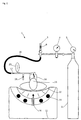
- the irradiation arrangement 1 comprises an oxygen bottle 2, one High pressure valve 3, a manometer 4, a flow controller 5 with a rising ball 6, an enveloping body 7 with an inlet opening 8 and an outlet opening 9, one Variety of optical radiation sources 10 and a cooling unit 11.
- the Envelope body 7 has a net-like support 12 on which a patient 13 can lie.
- the enveloping body 7 is provided with a cooling air supply 14 formed, via the cooling air from the cooling unit 11 in the envelope can be poured in.
- the enveloping body 7 is except for those previously described Inlet and outlet openings are gastight.
- the patient 13 lies down on the net-like support 12, for which purpose the enveloping body 7 is designed to be pivoted open, for example. Subsequently the high pressure valve 3 is opened and oxygen 15 flows over the Inlet opening 8 in the enveloping body 7, a via the flow controller 5 Fine control of the flow rate can be made.
- the patient 13 is in an oxygen atmosphere. It comes through breathing thus inspiratory oxygen uptake.
- the The patient's body is bathed in oxygen so that it can diffuse through the skin topical oxygen uptake also occurs.
- the radiation sources 10 switched on and irradiate the parts of the body to be treated.
- the cooling air supply 14 cooled air is blown into the enveloping body 7.
- the cooling air Design of the cooling air supply 14 or by other measures in the Enveloping body 7 swirled.
- Via the outlet opening 9 a Pressure equalization reached.
- the escaping Gas should be dehumidified, cleaned of carbon dioxide and recycled.
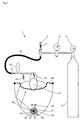
- FIG. 2 shows an irradiation arrangement 1 with a purely inspiratory one Oxygen addition shown.
- the patient 13 is lying on one again net-like edition 12.
- the flow controller 5 at a gas outlet Hose 16 arranged through an inhalation valve 17 with an oral-nasal mask 18 is connected.
- an exhalation valve 19 and a reservoir bag 20 arranged between inhalation valve 17 and mouth-nose mask 18 .
- the patient 13 is treated with the nasal mouth mask put on and the high pressure valve 3 opened so that the patient clean Breathes in oxygen and its exhaled air via exhalation valve 19 is dissipated.
- Fig. 3 is a device 26 for topical oxygen supply with a Emulsion shown.
- the device 26 comprises a gas-tight container 27, in which there is an emulsion of at least two substances, where the one substance has low oxygen solubility and low Has oxygen diffusion constant and the other substance has a high Has oxygen solubility and is loaded with oxygen.
- the device 26 comprises an oxygen bottle 2, a high pressure valve 3 and a first hose 28 through which the oxygen bottle 2 through Charging valve 29 is connected to the gas-tight container 27, so that the Emulsion can be loaded continuously with oxygen.
- the gastight Container 27 is assigned a stamp 30, which is pressed into Arrow direction is movable.
- the stamp 30 is an inlet valve 31 assigned to the high-pressure valve 3 via a second hose 32 the oxygen bottle 2 is connected.
- Behind the stamp 30 is a handle 33 arranged with a switch 34, via which the inlet valve 31 can be actuated is.
- the switch 34 actuated and the inlet valve 31 opened. Then flows under excess pressure Oxygen through the second hose 32 into the stamp 30, thereby the Emulsion is pressed bubble-free from an opening 35.
- the irradiation arrangement 1 comprises a water-filled parabolic reflector channel 36, which is coated, for example, with a highly reflective lacquer based on AlO 3 or TiO 2 .
- an interference-coated aluminum reflector can be used, which is tuned to the wavelength range of the radiation sources 10.
- the radiation sources 10 which for example have a length of 1900 mm and a diameter of 19 mm, each comprise a quartz discharge tube which is arranged at a distance in a quartz or duran glass cylinder 37, so that an air layer 38 is located between the quartz discharge tube and the duran glass cylinder 37.
- the air layer is preferably larger than 10 mm.
- a second duran glass cylinder 39 is arranged around the first duran glass cylinder 37 and is sealed by a radiation cooler detection. Between the two Duran glass cylinders 37 and 39 is a water layer 40 which can be introduced and discharged between the cylinders via the radiation cooler detection.
- the air layer 38 has the effect that the temperature in the discharge vessel of the radiation sources 10 is not lowered too much in order to maintain a sufficient vapor pressure.
- the water layer 40 filters out undesired heat radiation, the Durang glasses filtering out the UV radiation.
- a transparent plastic cylinder 41 Arranged around the second Duran glass cylinder 39 is a transparent plastic cylinder 41, which is fastened in the reflector channel 36 in a watertight manner on the face side via two O-ring-sealed bores.
- a second air layer 42 is then located between the second Duran glass cylinder 39 and the plastic cylinder 41.
- the reflector channel 36 is closed off on the upper side by a preferably elastic film 43.
- the film 43 can also be used for the topical supply of oxygen and can be designed, for example, as a coated and oxygen-saturated silicone polymer film.
- the thickness of the film 43 is preferably 50-100 ⁇ m in order to ensure a sufficiently high heat transfer from the patient 13 to the water of the cooling device located underneath.
- the film 43 is attached so loosely that the cooling water hugs the entire body underside. Because of the limited mechanical stability of the film 43, this is mechanically supported by a mesh-like or semi-transparent support.
- a diffuser 44 is arranged between the radiation sources 10 and the patient 13, which largely prevents direct radiation, which is indicated by the stylized radiation profiles.
Landscapes
- Health & Medical Sciences (AREA)
- Biomedical Technology (AREA)
- Life Sciences & Earth Sciences (AREA)
- Engineering & Computer Science (AREA)
- General Health & Medical Sciences (AREA)
- Animal Behavior & Ethology (AREA)
- Veterinary Medicine (AREA)
- Public Health (AREA)
- Pulmonology (AREA)
- Anesthesiology (AREA)
- Emergency Medicine (AREA)
- Hematology (AREA)
- Heart & Thoracic Surgery (AREA)
- Biophysics (AREA)
- Pathology (AREA)
- Nuclear Medicine, Radiotherapy & Molecular Imaging (AREA)
- Radiology & Medical Imaging (AREA)
- Radiation-Therapy Devices (AREA)
- Medicines That Contain Protein Lipid Enzymes And Other Medicines (AREA)
- Pharmaceuticals Containing Other Organic And Inorganic Compounds (AREA)
Description
- Fig.1
- eine Vorderansicht einer therapeutischen Bestrahlungsanordnung mit topischer und inspiratorischer Sauerstoffzufuhr,
- Fig.2
- eine Vorderansicht einer einer therapeutischen Bestrahlungsanordnung mit inspiratorischer Sauerstoffzufuhr,
- Fig.3
- eine schematische Darstellung einer Einrichtung zur topischen Sauerstoffzugabe mittels einer Emulsion und
- Fig.4
- eine Vorderansicht einer therapeutischen Bestrahlungsanordnung mit inspiratorischer Sauerstoffzufuhr.
Claims (14)
- Therapeutische Bestrahlungsanordnung, umfassend mindestens eine flächenhafte Strahlungsquelle, die im Bereich zwischen 315-1500 nm emittiert, mit einer Einrichtung zur topischen Sauerstoffzugabe,
dadurch gekennzeichnet, dass
der Einrichtung zur topischen Sauerstoffzugabe ein Ultraschall-Applikator zugeordnet ist, durch den Gewebekavitationen erzeugbar sind, wobei die Bestrahlungsanordnung zusätzlich eine Einrichtung und/oder Mittel zur inspiratorischen Sauerstoffzugabe umfasst. - Therapeutische Bestrahlungsanordnung nach Anspruch 1, dadurch gekennzeichnet, dass die Einrichtung einen gasdichten Hüllkörper (7) umfasst, in dem eine reine Sauerstoffatmosphäre erzeugbar ist.
- Therapeutische Bestrahlungsanordnung nach Anspruch 2, dadurch gekennzeichnet, dass die Strahlungsquellen (10) im Hüllkörper (7) angeordnet sind.
- Therapeutische Bestrahlungsanordnung nach einem der vorangegangenen Ansprüche, dadurch gekennzeichnet, dass die Einrichtung zur inspiratorischen Sauerstoffzugabe eine Nasen-Mund-Maske (18) umfasst.
- Therapeutische Bestrahlungsanordnung nach Anspruch 4, dadurch gekennzeichnet, dass die Nasen-Mund-Maske (18) aus einem für die emittierte Strahlung transparenten Material besteht.
- Therapeutische Bestrahlungsanordnung nach einem der vorangegangenen Ansprüche, dadurch gekennzeichnet, dass über die Einrichtung zur inspiratorischen Sauerstoffzugabe Flußraten zwischen 1-100 ml/min einstellbar sind.
- Therapeutische Bestrahlungsanordnung nach einem der vorangegangenen Ansprüche, dadurch gekennzeichnet, dass die Strahlungsquellen (10) mit der Einrichtung zur inspiratorischen und/oder topischen Sauerstoffzugabe derart gekoppelt sind, daß die Strahlungsquellen (10) zeitlich versetzt zur Sauerstoffzufuhr aktivierbar sind.
- Therapeutische Bestrahlungsanordnung nach einem der vorangegangenen Ansprüche, dadurch gekennzeichnet, dass die Bestrahlungsanordnung (1) eine Kühleinrichtung (11) für eine zu bestrahlende Fläche umfasst.
- Therapeutische Bestrahlungsanordnung nach Anspruch 8, dadurch gekennzeichnet, dass mittels der Kühleinrichtung (11) die zu bestrahlende Fläche auf <30°C temperierbar ist.
- Therapeutische Bestrahlungsanordnung nach einem der Ansprüche 8 oder 9, dadurch gekennzeichnet, dass die Kühleinrichtung (11) mit der topischen Sauerstoffzugabe zeitlich gekoppelt ist.
- Therapeutische Bestrahlungsanordnung nach einem der vorangegangenen Ansprüche, dadurch gekennzeichnet, dass die Strahlungsquelle (10) im Bereich von 400-440 nm und 530-570 nm die maximale spektrale Leistungsdichte aufweist.
- Therapeutische Bestrahlungsanordnung nach Anspruch 11, dadurch gekennzeichnet, dass die Strahlungsquelle (10) als Quecksilbemiederdrucklampe mit einem der nachfolgenden Leuchtstoffe Sr2P2O7:Eu, (SrMg)2P2O7:Eu, Sr5Cl(PO4)3:Eu, BaMg2Al16O27:Eu, SrMgAl18O39:Eu, BaMg2Al16O27:Eu:Mn, Sr3(PO4)2:Eu, Ba3(PO4)2:Eu, CaWO4:Pb oder CaWO4 und einem UV-Filter ausgebildet ist.
- Therapeutische Bestrahlungsanordnung nach Anspruch 11, dadurch gekennzeichnet, dass die Strahlungsquelle (10) als mindestens eine Mitteloder Hochdruckentladungslampe mit einem Zündgas und den Additiven Quecksilber und/oder Gallium und/oder Galliumjodid und/oder Indiumjodid und/oder Selen und/oder Antimon und/oder Zink und/oder Cadmium ausgebildet ist.
- Therapeutische Bestrahlungsanordnung nach einem der vorangeganenen Ansprüche, dadurch gekennzeichnet, dass die Einrichtung zur topischen Sauerstoffzufuhr eine mindestens einfach beschichtete, mit Sauerstoff beladene Polymerfolie umfasst.
Applications Claiming Priority (3)
| Application Number | Priority Date | Filing Date | Title |
|---|---|---|---|
| DE10034007 | 2000-07-07 | ||
| DE10034007A DE10034007A1 (de) | 2000-07-07 | 2000-07-07 | Therapeutische Bestrahlungsanordnung |
| PCT/DE2001/002215 WO2002004073A2 (de) | 2000-07-07 | 2001-06-13 | Therapeutische bestrahlungsanordnung |
Publications (2)
| Publication Number | Publication Date |
|---|---|
| EP1299155A2 EP1299155A2 (de) | 2003-04-09 |
| EP1299155B1 true EP1299155B1 (de) | 2004-09-08 |
Family
ID=7648756
Family Applications (1)
| Application Number | Title | Priority Date | Filing Date |
|---|---|---|---|
| EP01956274A Expired - Lifetime EP1299155B1 (de) | 2000-07-07 | 2001-06-13 | Therapeutische bestrahlungsanordnung |
Country Status (5)
| Country | Link |
|---|---|
| EP (1) | EP1299155B1 (de) |
| AT (1) | ATE275427T1 (de) |
| AU (1) | AU2001278359A1 (de) |
| DE (2) | DE10034007A1 (de) |
| WO (1) | WO2002004073A2 (de) |
Families Citing this family (4)
| Publication number | Priority date | Publication date | Assignee | Title |
|---|---|---|---|---|
| NL1020336C2 (nl) * | 2002-04-09 | 2003-10-13 | Photobiochem Leiden N V | Toepassing van een verbinding voor de bereiding van een farmaceutisch preparaat voor het behandelen van brandwonden, en een werkwijze voor het behandelen van brandwonden. |
| JP4540351B2 (ja) | 2004-01-15 | 2010-09-08 | Ntn株式会社 | 鋼の熱処理方法および軸受部品の製造方法 |
| CN109646808A (zh) * | 2018-12-20 | 2019-04-19 | 广州美锐健康产业股份有限公司 | 一种光动力与纯氧复合治疗装置及治疗方法 |
| US12186265B2 (en) | 2020-06-15 | 2025-01-07 | Numotech, Inc. | Isolation system |
Family Cites Families (15)
| Publication number | Priority date | Publication date | Assignee | Title |
|---|---|---|---|---|
| GB920216A (en) * | 1959-08-27 | 1963-03-06 | Eileen Mary Catterall | Improvements in face masks for administering oxygen or other gases |
| GB2024012B (en) * | 1978-04-10 | 1982-07-28 | Johnson & Johnson | Oxygen-generating surgical dressing |
| US4769241A (en) * | 1986-09-23 | 1988-09-06 | Alpha Therapeutic Corporation | Apparatus and process for oxygenation of liquid state dissolved oxygen-carrying formulation |
| DE3821100A1 (de) * | 1988-06-22 | 1989-12-28 | Kratz Josef Gmbh | Braeunungsliege |
| DE4001446A1 (de) * | 1990-01-19 | 1991-07-25 | Gudrun Dannenmann | Kombinierte therapie-behandlungskabine |
| US5084011A (en) * | 1990-01-25 | 1992-01-28 | Grady Daniel J | Method for oxygen therapy using hyperbarically oxygenated liquid |
| DE4010301C1 (en) * | 1990-03-30 | 1991-09-26 | Jk-Josef Kratz Gmbh, 5469 Windhagen, De | Tanning human skin by UV radiation - increasing effective by adding oxygen directly, selectively or alternatingly |
| FR2660548A1 (fr) * | 1990-04-09 | 1991-10-11 | Navau Bernard | Caisson hyperbar synergique. |
| DE4024664A1 (de) * | 1990-08-03 | 1992-02-06 | Mueller Quarzlampenfab Dr F | Bestrahlungsgeraet fuer medizinische zwecke |
| DE9209379U1 (de) * | 1992-06-12 | 1992-11-12 | Mettel, Hans Jürgen, 7899 Ühlingen | Behandlungs- bzw. Therapiekabine für energetische, kosmetische und medizinische Zwecke |
| DE29613075U1 (de) * | 1996-07-27 | 1997-11-27 | SHV Besonnungsanlagen Verwaltungs- und Entwicklungsgesellschaft mbH, 45239 Essen | Besonnungsanlage |
| US5865722A (en) * | 1997-04-04 | 1999-02-02 | Numotech, Incorporated | Shape-adaptable topical hyperbaric oxygen chamber |
| US20020055702A1 (en) * | 1998-02-10 | 2002-05-09 | Anthony Atala | Ultrasound-mediated drug delivery |
| EP1100366B1 (de) * | 1998-07-09 | 2009-04-15 | Curelight Medical Ltd | Vorrichtung und verfahren zur wirkungsvollen hochenergetischen photodynamischen therapie von akne vulgaris und seborrhoe |
| DE19852524A1 (de) * | 1998-11-06 | 2000-05-18 | Spectrometrix Optoelectronic S | Bestrahlungseinrichtung für therapeutische und kosmetische Zwecke |
-
2000
- 2000-07-07 DE DE10034007A patent/DE10034007A1/de not_active Withdrawn
-
2001
- 2001-06-13 AT AT01956274T patent/ATE275427T1/de not_active IP Right Cessation
- 2001-06-13 WO PCT/DE2001/002215 patent/WO2002004073A2/de not_active Ceased
- 2001-06-13 EP EP01956274A patent/EP1299155B1/de not_active Expired - Lifetime
- 2001-06-13 AU AU2001278359A patent/AU2001278359A1/en not_active Abandoned
- 2001-06-13 DE DE50103558T patent/DE50103558D1/de not_active Expired - Fee Related
Also Published As
| Publication number | Publication date |
|---|---|
| WO2002004073A2 (de) | 2002-01-17 |
| EP1299155A2 (de) | 2003-04-09 |
| AU2001278359A1 (en) | 2002-01-21 |
| DE50103558D1 (de) | 2004-10-14 |
| WO2002004073A3 (de) | 2002-09-06 |
| ATE275427T1 (de) | 2004-09-15 |
| DE10034007A1 (de) | 2002-03-21 |
Similar Documents
| Publication | Publication Date | Title |
|---|---|---|
| ES2743446T3 (es) | Dispositivos para proporcionar el cuidado de la piel mediante el uso de fototerapia | |
| DE19507980C2 (de) | Vorrichtung zur therapeutischen Behandlung von Tumoren | |
| Goff et al. | Effects of photodynamic therapy with topical application of 5-aminolevulinic acid on normal skin of hairless guinea pigs | |
| Lipko | Photobiomodulation: evolution and adaptation | |
| Bissonnette et al. | Current status of photodynamic therapy in dermatology | |
| US20150025602A1 (en) | Treatment apparatus and use thereof for treating psoriasis | |
| CN1984695A (zh) | 用光和有益试剂治疗皮肤以缓解痤疮 | |
| KR20050044388A (ko) | 모발 성장 촉진을 위한 방법 및 장치 | |
| US20110238002A1 (en) | Device for photo-dynamic therapy of a living organism's tissues | |
| Fritsch et al. | Fluorescence diagnosis and photodynamic therapy in dermatology from experimental state to clinic standard methods | |
| EP0790845A1 (de) | Behandlungsanordnung für lichttherapie und deren verwendung | |
| US20080146666A1 (en) | Method of treatment of skin | |
| DE602004008661T2 (de) | Gerät zur beleuchtung einer zone von säugetierhaut | |
| WO2002004073A2 (de) | Therapeutische bestrahlungsanordnung | |
| Asimov et al. | Laser-induced photodissociation of oxyhemoglobin: Optical method of elimination of hypoxia (oxygen deficiency in biotissue) | |
| Anderson et al. | A survey of the acute effects of UV lasers on human and animal skin | |
| Jande et al. | In vitro study of 532 nm wavelength laser irradiation on packed erythrocytes using UV-vis spectroscopy | |
| Zheng et al. | Light Emitting Diodes and Low Level Laser Light Therapy | |
| EP0512980B1 (de) | Medizinisches uv-bestrahlungsgerät | |
| EP1318807A1 (de) | Lichtsensibilisierende salbe | |
| CN108853496B (zh) | 一种光敏剂的应用 | |
| DE10222738A1 (de) | Ketoprofen-enthaltende Arzneiformulierungen zur Anwendung für die Photodynamische Therapie | |
| Khvedelidze | The use of low level laser therapy in the treatment of surgical pathology | |
| RU2134133C1 (ru) | Способ облучения циркулирующей крови в организме | |
| Lubart et al. | Photosensitized biostimulation of keratinocytes and fibroblasts by low-energy visible light |
Legal Events
| Date | Code | Title | Description |
|---|---|---|---|
| PUAI | Public reference made under article 153(3) epc to a published international application that has entered the european phase |
Free format text: ORIGINAL CODE: 0009012 |
|
| 17P | Request for examination filed |
Effective date: 20021129 |
|
| AK | Designated contracting states |
Kind code of ref document: A2 Designated state(s): AT BE CH CY DE DK ES FI FR GB GR IE IT LI LU MC NL PT SE TR |
|
| AX | Request for extension of the european patent |
Extension state: AL LT LV MK RO SI |
|
| R17D | Deferred search report published (corrected) |
Effective date: 20020906 |
|
| GRAP | Despatch of communication of intention to grant a patent |
Free format text: ORIGINAL CODE: EPIDOSNIGR1 |
|
| GRAS | Grant fee paid |
Free format text: ORIGINAL CODE: EPIDOSNIGR3 |
|
| GRAA | (expected) grant |
Free format text: ORIGINAL CODE: 0009210 |
|
| AK | Designated contracting states |
Kind code of ref document: B1 Designated state(s): AT BE CH CY DE DK ES FI FR GB GR IE IT LI LU MC NL PT SE TR |
|
| PG25 | Lapsed in a contracting state [announced via postgrant information from national office to epo] |
Ref country code: IT Free format text: LAPSE BECAUSE OF FAILURE TO SUBMIT A TRANSLATION OF THE DESCRIPTION OR TO PAY THE FEE WITHIN THE PRESCRIBED TIME-LIMIT;WARNING: LAPSES OF ITALIAN PATENTS WITH EFFECTIVE DATE BEFORE 2007 MAY HAVE OCCURRED AT ANY TIME BEFORE 2007. THE CORRECT EFFECTIVE DATE MAY BE DIFFERENT FROM THE ONE RECORDED. Effective date: 20040908 Ref country code: FI Free format text: LAPSE BECAUSE OF FAILURE TO SUBMIT A TRANSLATION OF THE DESCRIPTION OR TO PAY THE FEE WITHIN THE PRESCRIBED TIME-LIMIT Effective date: 20040908 Ref country code: NL Free format text: LAPSE BECAUSE OF FAILURE TO SUBMIT A TRANSLATION OF THE DESCRIPTION OR TO PAY THE FEE WITHIN THE PRESCRIBED TIME-LIMIT Effective date: 20040908 Ref country code: IE Free format text: LAPSE BECAUSE OF FAILURE TO SUBMIT A TRANSLATION OF THE DESCRIPTION OR TO PAY THE FEE WITHIN THE PRESCRIBED TIME-LIMIT Effective date: 20040908 Ref country code: GB Free format text: LAPSE BECAUSE OF FAILURE TO SUBMIT A TRANSLATION OF THE DESCRIPTION OR TO PAY THE FEE WITHIN THE PRESCRIBED TIME-LIMIT Effective date: 20040908 Ref country code: FR Free format text: LAPSE BECAUSE OF FAILURE TO SUBMIT A TRANSLATION OF THE DESCRIPTION OR TO PAY THE FEE WITHIN THE PRESCRIBED TIME-LIMIT Effective date: 20040908 Ref country code: TR Free format text: LAPSE BECAUSE OF FAILURE TO SUBMIT A TRANSLATION OF THE DESCRIPTION OR TO PAY THE FEE WITHIN THE PRESCRIBED TIME-LIMIT Effective date: 20040908 |
|
| REG | Reference to a national code |
Ref country code: GB Ref legal event code: FG4D Free format text: NOT ENGLISH |
|
| REG | Reference to a national code |
Ref country code: CH Ref legal event code: EP |
|
| REG | Reference to a national code |
Ref country code: IE Ref legal event code: FG4D Free format text: GERMAN |
|
| REF | Corresponds to: |
Ref document number: 50103558 Country of ref document: DE Date of ref document: 20041014 Kind code of ref document: P |
|
| PG25 | Lapsed in a contracting state [announced via postgrant information from national office to epo] |
Ref country code: DK Free format text: LAPSE BECAUSE OF FAILURE TO SUBMIT A TRANSLATION OF THE DESCRIPTION OR TO PAY THE FEE WITHIN THE PRESCRIBED TIME-LIMIT Effective date: 20041208 Ref country code: GR Free format text: LAPSE BECAUSE OF FAILURE TO SUBMIT A TRANSLATION OF THE DESCRIPTION OR TO PAY THE FEE WITHIN THE PRESCRIBED TIME-LIMIT Effective date: 20041208 Ref country code: SE Free format text: LAPSE BECAUSE OF FAILURE TO SUBMIT A TRANSLATION OF THE DESCRIPTION OR TO PAY THE FEE WITHIN THE PRESCRIBED TIME-LIMIT Effective date: 20041208 |
|
| REG | Reference to a national code |
Ref country code: CH Ref legal event code: NV Representative=s name: E. BLUM & CO. PATENTANWAELTE |
|
| PG25 | Lapsed in a contracting state [announced via postgrant information from national office to epo] |
Ref country code: ES Free format text: LAPSE BECAUSE OF FAILURE TO SUBMIT A TRANSLATION OF THE DESCRIPTION OR TO PAY THE FEE WITHIN THE PRESCRIBED TIME-LIMIT Effective date: 20041219 |
|
| LTIE | Lt: invalidation of european patent or patent extension |
Effective date: 20040908 |
|
| NLV1 | Nl: lapsed or annulled due to failure to fulfill the requirements of art. 29p and 29m of the patents act | ||
| GBV | Gb: ep patent (uk) treated as always having been void in accordance with gb section 77(7)/1977 [no translation filed] |
Effective date: 20040908 |
|
| REG | Reference to a national code |
Ref country code: IE Ref legal event code: FD4D |
|
| PG25 | Lapsed in a contracting state [announced via postgrant information from national office to epo] |
Ref country code: LU Free format text: LAPSE BECAUSE OF NON-PAYMENT OF DUE FEES Effective date: 20050613 Ref country code: CY Free format text: LAPSE BECAUSE OF FAILURE TO SUBMIT A TRANSLATION OF THE DESCRIPTION OR TO PAY THE FEE WITHIN THE PRESCRIBED TIME-LIMIT Effective date: 20050613 |
|
| PG25 | Lapsed in a contracting state [announced via postgrant information from national office to epo] |
Ref country code: MC Free format text: LAPSE BECAUSE OF NON-PAYMENT OF DUE FEES Effective date: 20050630 Ref country code: BE Free format text: LAPSE BECAUSE OF NON-PAYMENT OF DUE FEES Effective date: 20050630 |
|
| PLBE | No opposition filed within time limit |
Free format text: ORIGINAL CODE: 0009261 |
|
| STAA | Information on the status of an ep patent application or granted ep patent |
Free format text: STATUS: NO OPPOSITION FILED WITHIN TIME LIMIT |
|
| 26N | No opposition filed |
Effective date: 20050609 |
|
| EN | Fr: translation not filed | ||
| REG | Reference to a national code |
Ref country code: CH Ref legal event code: PFA Owner name: OPTOMED OPTOMEDICAL SYSTEMS GMBH Free format text: OPTOMED OPTOMEDICAL SYSTEMS GMBH#RUDOWER CHAUSSEE 5#12489 BERLIN (DE) -TRANSFER TO- OPTOMED OPTOMEDICAL SYSTEMS GMBH#RUDOWER CHAUSSEE 5#12489 BERLIN (DE) |
|
| BERE | Be: lapsed |
Owner name: *OPTOMED OPTOMEDICAL SYSTEMS G.M.B.H. Effective date: 20050630 |
|
| PG25 | Lapsed in a contracting state [announced via postgrant information from national office to epo] |
Ref country code: PT Free format text: LAPSE BECAUSE OF NON-PAYMENT OF DUE FEES Effective date: 20050208 |
|
| PGFP | Annual fee paid to national office [announced via postgrant information from national office to epo] |
Ref country code: CH Payment date: 20080613 Year of fee payment: 8 |
|
| PGFP | Annual fee paid to national office [announced via postgrant information from national office to epo] |
Ref country code: AT Payment date: 20080616 Year of fee payment: 8 |
|
| PGFP | Annual fee paid to national office [announced via postgrant information from national office to epo] |
Ref country code: DE Payment date: 20080620 Year of fee payment: 8 |
|
| REG | Reference to a national code |
Ref country code: CH Ref legal event code: PL |
|
| PG25 | Lapsed in a contracting state [announced via postgrant information from national office to epo] |
Ref country code: CH Free format text: LAPSE BECAUSE OF NON-PAYMENT OF DUE FEES Effective date: 20090630 Ref country code: LI Free format text: LAPSE BECAUSE OF NON-PAYMENT OF DUE FEES Effective date: 20090630 |
|
| PG25 | Lapsed in a contracting state [announced via postgrant information from national office to epo] |
Ref country code: AT Free format text: LAPSE BECAUSE OF NON-PAYMENT OF DUE FEES Effective date: 20090613 Ref country code: DE Free format text: LAPSE BECAUSE OF NON-PAYMENT OF DUE FEES Effective date: 20100101 |