EP1299492B1 - Rubans et articles adhesifs autocollants et a liberation par etirage - Google Patents
Rubans et articles adhesifs autocollants et a liberation par etirage Download PDFInfo
- Publication number
- EP1299492B1 EP1299492B1 EP00990185A EP00990185A EP1299492B1 EP 1299492 B1 EP1299492 B1 EP 1299492B1 EP 00990185 A EP00990185 A EP 00990185A EP 00990185 A EP00990185 A EP 00990185A EP 1299492 B1 EP1299492 B1 EP 1299492B1
- Authority
- EP
- European Patent Office
- Prior art keywords
- tape
- sensitive adhesive
- pressure sensitive
- adhesive composition
- substrate
- Prior art date
- Legal status (The legal status is an assumption and is not a legal conclusion. Google has not performed a legal analysis and makes no representation as to the accuracy of the status listed.)
- Expired - Lifetime
Links
- 239000004820 Pressure-sensitive adhesive Substances 0.000 title claims abstract description 138
- 239000000203 mixture Substances 0.000 claims abstract description 124
- 239000000758 substrate Substances 0.000 claims abstract description 98
- 229920001296 polysiloxane Polymers 0.000 claims abstract description 61
- 239000011521 glass Substances 0.000 claims abstract description 35
- 150000004985 diamines Chemical class 0.000 claims description 54
- 229920005989 resin Polymers 0.000 claims description 37
- 239000011347 resin Substances 0.000 claims description 37
- 238000000034 method Methods 0.000 claims description 35
- 229920000768 polyamine Polymers 0.000 claims description 35
- 229920002396 Polyurea Polymers 0.000 claims description 31
- 229920001400 block copolymer Polymers 0.000 claims description 31
- 239000006260 foam Substances 0.000 claims description 30
- 239000002390 adhesive tape Substances 0.000 claims description 25
- 229920001228 polyisocyanate Polymers 0.000 claims description 16
- 239000005056 polyisocyanate Substances 0.000 claims description 16
- 239000007795 chemical reaction product Substances 0.000 claims description 10
- 229920005573 silicon-containing polymer Polymers 0.000 claims description 10
- 229920000642 polymer Polymers 0.000 claims description 9
- 239000000919 ceramic Substances 0.000 claims description 6
- 229910052573 porcelain Inorganic materials 0.000 claims description 3
- -1 e.g. Substances 0.000 description 67
- 230000001070 adhesive effect Effects 0.000 description 54
- 239000000853 adhesive Substances 0.000 description 53
- 239000010410 layer Substances 0.000 description 41
- 238000012360 testing method Methods 0.000 description 25
- 229920002050 silicone resin Polymers 0.000 description 23
- YXFVVABEGXRONW-UHFFFAOYSA-N Toluene Chemical compound CC1=CC=CC=C1 YXFVVABEGXRONW-UHFFFAOYSA-N 0.000 description 18
- 239000002313 adhesive film Substances 0.000 description 17
- 239000002131 composite material Substances 0.000 description 16
- 229920001577 copolymer Polymers 0.000 description 15
- 238000010998 test method Methods 0.000 description 15
- 239000007787 solid Substances 0.000 description 13
- 239000004205 dimethyl polysiloxane Substances 0.000 description 11
- 229920000435 poly(dimethylsiloxane) Polymers 0.000 description 11
- 239000002904 solvent Substances 0.000 description 11
- 238000003860 storage Methods 0.000 description 11
- 239000000463 material Substances 0.000 description 10
- 125000004432 carbon atom Chemical group C* 0.000 description 9
- 239000012790 adhesive layer Substances 0.000 description 7
- 239000003054 catalyst Substances 0.000 description 7
- 238000006243 chemical reaction Methods 0.000 description 7
- 125000005442 diisocyanate group Chemical group 0.000 description 7
- 229920000092 linear low density polyethylene Polymers 0.000 description 7
- 150000003254 radicals Chemical class 0.000 description 7
- KFZMGEQAYNKOFK-UHFFFAOYSA-N Isopropanol Chemical compound CC(C)O KFZMGEQAYNKOFK-UHFFFAOYSA-N 0.000 description 6
- 239000004707 linear low-density polyethylene Substances 0.000 description 6
- 229920003023 plastic Polymers 0.000 description 6
- 239000004033 plastic Substances 0.000 description 6
- 238000002360 preparation method Methods 0.000 description 6
- 239000000126 substance Substances 0.000 description 6
- 125000000391 vinyl group Chemical group [H]C([*])=C([H])[H] 0.000 description 6
- 229910020485 SiO4/2 Inorganic materials 0.000 description 5
- 125000003342 alkenyl group Chemical group 0.000 description 5
- 239000011248 coating agent Substances 0.000 description 5
- 238000000576 coating method Methods 0.000 description 5
- 238000010276 construction Methods 0.000 description 5
- 238000009472 formulation Methods 0.000 description 5
- 229920000139 polyethylene terephthalate Polymers 0.000 description 5
- 239000005020 polyethylene terephthalate Substances 0.000 description 5
- 239000000047 product Substances 0.000 description 5
- SCPYDCQAZCOKTP-UHFFFAOYSA-N silanol Chemical compound [SiH3]O SCPYDCQAZCOKTP-UHFFFAOYSA-N 0.000 description 5
- 239000005062 Polybutadiene Substances 0.000 description 4
- 239000004698 Polyethylene Substances 0.000 description 4
- 239000004743 Polypropylene Substances 0.000 description 4
- 229910020388 SiO1/2 Inorganic materials 0.000 description 4
- 125000000217 alkyl group Chemical group 0.000 description 4
- 238000009833 condensation Methods 0.000 description 4
- 230000000694 effects Effects 0.000 description 4
- 238000010030 laminating Methods 0.000 description 4
- 229920001200 poly(ethylene-vinyl acetate) Polymers 0.000 description 4
- 229920002857 polybutadiene Polymers 0.000 description 4
- 229920000573 polyethylene Polymers 0.000 description 4
- 229920000098 polyolefin Polymers 0.000 description 4
- 229920001155 polypropylene Polymers 0.000 description 4
- JZUHIOJYCPIVLQ-UHFFFAOYSA-N 2-methylpentane-1,5-diamine Chemical compound NCC(C)CCCN JZUHIOJYCPIVLQ-UHFFFAOYSA-N 0.000 description 3
- 238000013006 addition curing Methods 0.000 description 3
- 239000003795 chemical substances by application Substances 0.000 description 3
- 230000005494 condensation Effects 0.000 description 3
- 238000005034 decoration Methods 0.000 description 3
- 229920001971 elastomer Polymers 0.000 description 3
- 125000003709 fluoroalkyl group Chemical group 0.000 description 3
- 239000001257 hydrogen Substances 0.000 description 3
- 229910052739 hydrogen Inorganic materials 0.000 description 3
- 125000004435 hydrogen atom Chemical class [H]* 0.000 description 3
- 238000005304 joining Methods 0.000 description 3
- 238000004519 manufacturing process Methods 0.000 description 3
- 125000001997 phenyl group Chemical group [H]C1=C([H])C([H])=C(*)C([H])=C1[H] 0.000 description 3
- 229920002635 polyurethane Polymers 0.000 description 3
- 239000004814 polyurethane Substances 0.000 description 3
- 238000007660 shear property test Methods 0.000 description 3
- 229920001897 terpolymer Polymers 0.000 description 3
- 238000011282 treatment Methods 0.000 description 3
- BOOBDAVNHSOIDB-UHFFFAOYSA-N (2,3-dichlorobenzoyl) 2,3-dichlorobenzenecarboperoxoate Chemical compound ClC1=CC=CC(C(=O)OOC(=O)C=2C(=C(Cl)C=CC=2)Cl)=C1Cl BOOBDAVNHSOIDB-UHFFFAOYSA-N 0.000 description 2
- VGGSQFUCUMXWEO-UHFFFAOYSA-N Ethene Chemical compound C=C VGGSQFUCUMXWEO-UHFFFAOYSA-N 0.000 description 2
- 239000005977 Ethylene Substances 0.000 description 2
- BLRPTPMANUNPDV-UHFFFAOYSA-N Silane Chemical group [SiH4] BLRPTPMANUNPDV-UHFFFAOYSA-N 0.000 description 2
- 125000002947 alkylene group Chemical group 0.000 description 2
- 229910052782 aluminium Inorganic materials 0.000 description 2
- XAGFODPZIPBFFR-UHFFFAOYSA-N aluminium Chemical compound [Al] XAGFODPZIPBFFR-UHFFFAOYSA-N 0.000 description 2
- 239000004202 carbamide Substances 0.000 description 2
- 230000001143 conditioned effect Effects 0.000 description 2
- 125000000753 cycloalkyl group Chemical group 0.000 description 2
- KPUWHANPEXNPJT-UHFFFAOYSA-N disiloxane Chemical class [SiH3]O[SiH3] KPUWHANPEXNPJT-UHFFFAOYSA-N 0.000 description 2
- 238000005516 engineering process Methods 0.000 description 2
- 239000012948 isocyanate Substances 0.000 description 2
- 150000002513 isocyanates Chemical class 0.000 description 2
- NIMLQBUJDJZYEJ-UHFFFAOYSA-N isophorone diisocyanate Chemical compound CC1(C)CC(N=C=O)CC(C)(CN=C=O)C1 NIMLQBUJDJZYEJ-UHFFFAOYSA-N 0.000 description 2
- 239000004816 latex Substances 0.000 description 2
- 229920000126 latex Polymers 0.000 description 2
- 238000005259 measurement Methods 0.000 description 2
- 230000007246 mechanism Effects 0.000 description 2
- 239000000123 paper Substances 0.000 description 2
- 238000007719 peel strength test Methods 0.000 description 2
- 229920001084 poly(chloroprene) Polymers 0.000 description 2
- 229920001281 polyalkylene Polymers 0.000 description 2
- 229920000728 polyester Polymers 0.000 description 2
- 239000005060 rubber Substances 0.000 description 2
- 238000000926 separation method Methods 0.000 description 2
- 239000002356 single layer Substances 0.000 description 2
- 229920003048 styrene butadiene rubber Polymers 0.000 description 2
- 229920002554 vinyl polymer Polymers 0.000 description 2
- 238000011179 visual inspection Methods 0.000 description 2
- 239000002023 wood Substances 0.000 description 2
- WRXCBRHBHGNNQA-UHFFFAOYSA-N (2,4-dichlorobenzoyl) 2,4-dichlorobenzenecarboperoxoate Chemical compound ClC1=CC(Cl)=CC=C1C(=O)OOC(=O)C1=CC=C(Cl)C=C1Cl WRXCBRHBHGNNQA-UHFFFAOYSA-N 0.000 description 1
- 229920002818 (Hydroxyethyl)methacrylate Polymers 0.000 description 1
- 0 *N(*S(*)(*)O[Si](*)(*)*N(*)*)N Chemical compound *N(*S(*)(*)O[Si](*)(*)*N(*)*)N 0.000 description 1
- GFNDFCFPJQPVQL-UHFFFAOYSA-N 1,12-diisocyanatododecane Chemical compound O=C=NCCCCCCCCCCCCN=C=O GFNDFCFPJQPVQL-UHFFFAOYSA-N 0.000 description 1
- AZYRZNIYJDKRHO-UHFFFAOYSA-N 1,3-bis(2-isocyanatopropan-2-yl)benzene Chemical compound O=C=NC(C)(C)C1=CC=CC(C(C)(C)N=C=O)=C1 AZYRZNIYJDKRHO-UHFFFAOYSA-N 0.000 description 1
- RTTZISZSHSCFRH-UHFFFAOYSA-N 1,3-bis(isocyanatomethyl)benzene Chemical compound O=C=NCC1=CC=CC(CN=C=O)=C1 RTTZISZSHSCFRH-UHFFFAOYSA-N 0.000 description 1
- VGHSXKTVMPXHNG-UHFFFAOYSA-N 1,3-diisocyanatobenzene Chemical compound O=C=NC1=CC=CC(N=C=O)=C1 VGHSXKTVMPXHNG-UHFFFAOYSA-N 0.000 description 1
- 125000004955 1,4-cyclohexylene group Chemical group [H]C1([H])C([H])([H])C([H])([*:1])C([H])([H])C([H])([H])C1([H])[*:2] 0.000 description 1
- ALQLPWJFHRMHIU-UHFFFAOYSA-N 1,4-diisocyanatobenzene Chemical compound O=C=NC1=CC=C(N=C=O)C=C1 ALQLPWJFHRMHIU-UHFFFAOYSA-N 0.000 description 1
- OVBFMUAFNIIQAL-UHFFFAOYSA-N 1,4-diisocyanatobutane Chemical compound O=C=NCCCCN=C=O OVBFMUAFNIIQAL-UHFFFAOYSA-N 0.000 description 1
- AHBNSOZREBSAMG-UHFFFAOYSA-N 1,5-diisocyanato-2-methylpentane Chemical compound O=C=NCC(C)CCCN=C=O AHBNSOZREBSAMG-UHFFFAOYSA-N 0.000 description 1
- LCJLEYPRGLFMGM-UHFFFAOYSA-N 1-(chloromethyl)-2,4-diisocyanatobenzene Chemical compound ClCC1=CC=C(N=C=O)C=C1N=C=O LCJLEYPRGLFMGM-UHFFFAOYSA-N 0.000 description 1
- JIABEENURMZTTI-UHFFFAOYSA-N 1-isocyanato-2-[(2-isocyanatophenyl)methyl]benzene Polymers O=C=NC1=CC=CC=C1CC1=CC=CC=C1N=C=O JIABEENURMZTTI-UHFFFAOYSA-N 0.000 description 1
- KGRVJHAUYBGFFP-UHFFFAOYSA-N 2,2'-Methylenebis(4-methyl-6-tert-butylphenol) Chemical compound CC(C)(C)C1=CC(C)=CC(CC=2C(=C(C=C(C)C=2)C(C)(C)C)O)=C1O KGRVJHAUYBGFFP-UHFFFAOYSA-N 0.000 description 1
- 125000003903 2-propenyl group Chemical group [H]C([*])([H])C([H])=C([H])[H] 0.000 description 1
- JRBJSXQPQWSCCF-UHFFFAOYSA-N 3,3'-Dimethoxybenzidine Chemical compound C1=C(N)C(OC)=CC(C=2C=C(OC)C(N)=CC=2)=C1 JRBJSXQPQWSCCF-UHFFFAOYSA-N 0.000 description 1
- VNHJXLYOGVYVOG-UHFFFAOYSA-N 3-[dimethyl(oxido)silyl]propan-1-amine;tetramethylazanium Chemical compound C[N+](C)(C)C.C[Si](C)([O-])CCCN VNHJXLYOGVYVOG-UHFFFAOYSA-N 0.000 description 1
- KMMGKRDWSDUNQK-UHFFFAOYSA-N 5,5-diisocyanato-6-methoxy-2-(3-methoxyphenyl)cyclohexa-1,3-diene Chemical group C1=CC(N=C=O)(N=C=O)C(OC)C=C1C1=CC=CC(OC)=C1 KMMGKRDWSDUNQK-UHFFFAOYSA-N 0.000 description 1
- NIXOWILDQLNWCW-UHFFFAOYSA-M Acrylate Chemical compound [O-]C(=O)C=C NIXOWILDQLNWCW-UHFFFAOYSA-M 0.000 description 1
- 239000004971 Cross linker Substances 0.000 description 1
- 229920000089 Cyclic olefin copolymer Polymers 0.000 description 1
- 239000009261 D 400 Substances 0.000 description 1
- JYGLAHSAISAEAL-UHFFFAOYSA-N Diphenadione Chemical compound O=C1C2=CC=CC=C2C(=O)C1C(=O)C(C=1C=CC=CC=1)C1=CC=CC=C1 JYGLAHSAISAEAL-UHFFFAOYSA-N 0.000 description 1
- 229920002943 EPDM rubber Polymers 0.000 description 1
- PIICEJLVQHRZGT-UHFFFAOYSA-N Ethylenediamine Chemical compound NCCN PIICEJLVQHRZGT-UHFFFAOYSA-N 0.000 description 1
- YCKRFDGAMUMZLT-UHFFFAOYSA-N Fluorine atom Chemical compound [F] YCKRFDGAMUMZLT-UHFFFAOYSA-N 0.000 description 1
- 244000043261 Hevea brasiliensis Species 0.000 description 1
- 239000004831 Hot glue Substances 0.000 description 1
- WOBHKFSMXKNTIM-UHFFFAOYSA-N Hydroxyethyl methacrylate Chemical compound CC(=C)C(=O)OCCO WOBHKFSMXKNTIM-UHFFFAOYSA-N 0.000 description 1
- 239000005058 Isophorone diisocyanate Substances 0.000 description 1
- 229920000459 Nitrile rubber Polymers 0.000 description 1
- BPQQTUXANYXVAA-UHFFFAOYSA-N Orthosilicate Chemical compound [O-][Si]([O-])([O-])[O-] BPQQTUXANYXVAA-UHFFFAOYSA-N 0.000 description 1
- 229920001774 Perfluoroether Polymers 0.000 description 1
- 229920003171 Poly (ethylene oxide) Polymers 0.000 description 1
- 229920002367 Polyisobutene Polymers 0.000 description 1
- 229910020447 SiO2/2 Inorganic materials 0.000 description 1
- 230000006750 UV protection Effects 0.000 description 1
- XSQUKJJJFZCRTK-UHFFFAOYSA-N Urea Chemical compound NC(N)=O XSQUKJJJFZCRTK-UHFFFAOYSA-N 0.000 description 1
- 239000002253 acid Substances 0.000 description 1
- 229920006243 acrylic copolymer Polymers 0.000 description 1
- XECAHXYUAAWDEL-UHFFFAOYSA-N acrylonitrile butadiene styrene Chemical compound C=CC=C.C=CC#N.C=CC1=CC=CC=C1 XECAHXYUAAWDEL-UHFFFAOYSA-N 0.000 description 1
- 229920000122 acrylonitrile butadiene styrene Polymers 0.000 description 1
- 239000004676 acrylonitrile butadiene styrene Substances 0.000 description 1
- 239000000654 additive Substances 0.000 description 1
- 239000002318 adhesion promoter Substances 0.000 description 1
- 125000004103 aminoalkyl group Chemical group 0.000 description 1
- 125000003118 aryl group Chemical group 0.000 description 1
- 235000013361 beverage Nutrition 0.000 description 1
- 238000009835 boiling Methods 0.000 description 1
- 229920005549 butyl rubber Polymers 0.000 description 1
- 229910052792 caesium Inorganic materials 0.000 description 1
- TVFDJXOCXUVLDH-UHFFFAOYSA-N caesium atom Chemical compound [Cs] TVFDJXOCXUVLDH-UHFFFAOYSA-N 0.000 description 1
- 238000004364 calculation method Methods 0.000 description 1
- 229910052799 carbon Inorganic materials 0.000 description 1
- 239000007810 chemical reaction solvent Substances 0.000 description 1
- 229920003211 cis-1,4-polyisoprene Polymers 0.000 description 1
- 238000013005 condensation curing Methods 0.000 description 1
- 238000001816 cooling Methods 0.000 description 1
- 238000004132 cross linking Methods 0.000 description 1
- 238000001723 curing Methods 0.000 description 1
- 125000002993 cycloalkylene group Chemical group 0.000 description 1
- 238000013016 damping Methods 0.000 description 1
- CZZYITDELCSZES-UHFFFAOYSA-N diphenylmethane Chemical compound C=1C=CC=CC=1CC1=CC=CC=C1 CZZYITDELCSZES-UHFFFAOYSA-N 0.000 description 1
- 239000000806 elastomer Substances 0.000 description 1
- 239000013536 elastomeric material Substances 0.000 description 1
- 238000010894 electron beam technology Methods 0.000 description 1
- 238000005530 etching Methods 0.000 description 1
- HQQADJVZYDDRJT-UHFFFAOYSA-N ethene;prop-1-ene Chemical group C=C.CC=C HQQADJVZYDDRJT-UHFFFAOYSA-N 0.000 description 1
- 239000000945 filler Substances 0.000 description 1
- 229910052731 fluorine Inorganic materials 0.000 description 1
- 239000011737 fluorine Substances 0.000 description 1
- 125000000524 functional group Chemical group 0.000 description 1
- 229910052602 gypsum Inorganic materials 0.000 description 1
- 239000010440 gypsum Substances 0.000 description 1
- 238000010438 heat treatment Methods 0.000 description 1
- 125000000623 heterocyclic group Chemical group 0.000 description 1
- RRAMGCGOFNQTLD-UHFFFAOYSA-N hexamethylene diisocyanate Chemical compound O=C=NCCCCCCN=C=O RRAMGCGOFNQTLD-UHFFFAOYSA-N 0.000 description 1
- 229920001903 high density polyethylene Polymers 0.000 description 1
- 229920005669 high impact polystyrene Polymers 0.000 description 1
- 239000004700 high-density polyethylene Substances 0.000 description 1
- 239000004797 high-impact polystyrene Substances 0.000 description 1
- 238000006459 hydrosilylation reaction Methods 0.000 description 1
- NYMPGSQKHIOWIO-UHFFFAOYSA-N hydroxy(diphenyl)silicon Chemical compound C=1C=CC=CC=1[Si](O)C1=CC=CC=C1 NYMPGSQKHIOWIO-UHFFFAOYSA-N 0.000 description 1
- NLYAJNPCOHFWQQ-UHFFFAOYSA-N kaolin Chemical compound O.O.O=[Al]O[Si](=O)O[Si](=O)O[Al]=O NLYAJNPCOHFWQQ-UHFFFAOYSA-N 0.000 description 1
- 239000002655 kraft paper Substances 0.000 description 1
- 238000002372 labelling Methods 0.000 description 1
- 229920005679 linear ultra low density polyethylene Polymers 0.000 description 1
- 229920001684 low density polyethylene Polymers 0.000 description 1
- 239000004702 low-density polyethylene Substances 0.000 description 1
- 125000002496 methyl group Chemical group [H]C([H])([H])* 0.000 description 1
- 238000005065 mining Methods 0.000 description 1
- 238000002156 mixing Methods 0.000 description 1
- 238000013008 moisture curing Methods 0.000 description 1
- 238000000465 moulding Methods 0.000 description 1
- 229920003052 natural elastomer Polymers 0.000 description 1
- 229920001194 natural rubber Polymers 0.000 description 1
- 229910000510 noble metal Inorganic materials 0.000 description 1
- 239000003960 organic solvent Substances 0.000 description 1
- 238000000643 oven drying Methods 0.000 description 1
- UJMWVICAENGCRF-UHFFFAOYSA-N oxygen difluoride Chemical compound FOF UJMWVICAENGCRF-UHFFFAOYSA-N 0.000 description 1
- 238000004806 packaging method and process Methods 0.000 description 1
- 239000003973 paint Substances 0.000 description 1
- 125000005010 perfluoroalkyl group Chemical group 0.000 description 1
- 125000000843 phenylene group Chemical group C1(=C(C=CC=C1)*)* 0.000 description 1
- 230000000704 physical effect Effects 0.000 description 1
- 239000000049 pigment Substances 0.000 description 1
- 229920000233 poly(alkylene oxides) Polymers 0.000 description 1
- 229920000058 polyacrylate Polymers 0.000 description 1
- 229920001748 polybutylene Polymers 0.000 description 1
- 239000004417 polycarbonate Substances 0.000 description 1
- 229920001692 polycarbonate urethane Polymers 0.000 description 1
- 239000002685 polymerization catalyst Substances 0.000 description 1
- 238000006116 polymerization reaction Methods 0.000 description 1
- 229920001451 polypropylene glycol Polymers 0.000 description 1
- 229920000346 polystyrene-polyisoprene block-polystyrene Polymers 0.000 description 1
- 229920003225 polyurethane elastomer Polymers 0.000 description 1
- 229920002689 polyvinyl acetate Polymers 0.000 description 1
- 229920000915 polyvinyl chloride Polymers 0.000 description 1
- 230000037452 priming Effects 0.000 description 1
- 125000004368 propenyl group Chemical group C(=CC)* 0.000 description 1
- 230000005855 radiation Effects 0.000 description 1
- 238000010526 radical polymerization reaction Methods 0.000 description 1
- 239000000376 reactant Substances 0.000 description 1
- 239000011541 reaction mixture Substances 0.000 description 1
- 229910052701 rubidium Inorganic materials 0.000 description 1
- IGLNJRXAVVLDKE-UHFFFAOYSA-N rubidium atom Chemical compound [Rb] IGLNJRXAVVLDKE-UHFFFAOYSA-N 0.000 description 1
- 239000002453 shampoo Substances 0.000 description 1
- 238000010008 shearing Methods 0.000 description 1
- 125000005372 silanol group Chemical group 0.000 description 1
- 229920002379 silicone rubber Polymers 0.000 description 1
- 239000004945 silicone rubber Substances 0.000 description 1
- 239000000344 soap Substances 0.000 description 1
- 238000001694 spray drying Methods 0.000 description 1
- 238000007655 standard test method Methods 0.000 description 1
- 239000007858 starting material Substances 0.000 description 1
- 238000003756 stirring Methods 0.000 description 1
- 229920002725 thermoplastic elastomer Polymers 0.000 description 1
- 229920002397 thermoplastic olefin Polymers 0.000 description 1
- DVKJHBMWWAPEIU-UHFFFAOYSA-N toluene 2,4-diisocyanate Chemical compound CC1=CC=C(N=C=O)C=C1N=C=O DVKJHBMWWAPEIU-UHFFFAOYSA-N 0.000 description 1
- RUELTTOHQODFPA-UHFFFAOYSA-N toluene 2,6-diisocyanate Chemical compound CC1=C(N=C=O)C=CC=C1N=C=O RUELTTOHQODFPA-UHFFFAOYSA-N 0.000 description 1
- 125000004950 trifluoroalkyl group Chemical group 0.000 description 1
- 125000000725 trifluoropropyl group Chemical group [H]C([H])(*)C([H])([H])C(F)(F)F 0.000 description 1
- 229920001862 ultra low molecular weight polyethylene Polymers 0.000 description 1
- 229940117958 vinyl acetate Drugs 0.000 description 1
- 229920006163 vinyl copolymer Polymers 0.000 description 1
- ORGHESHFQPYLAO-UHFFFAOYSA-N vinyl radical Chemical compound C=[CH] ORGHESHFQPYLAO-UHFFFAOYSA-N 0.000 description 1
Images


Classifications
-
- C—CHEMISTRY; METALLURGY
- C09—DYES; PAINTS; POLISHES; NATURAL RESINS; ADHESIVES; COMPOSITIONS NOT OTHERWISE PROVIDED FOR; APPLICATIONS OF MATERIALS NOT OTHERWISE PROVIDED FOR
- C09J—ADHESIVES; NON-MECHANICAL ASPECTS OF ADHESIVE PROCESSES IN GENERAL; ADHESIVE PROCESSES NOT PROVIDED FOR ELSEWHERE; USE OF MATERIALS AS ADHESIVES
- C09J7/00—Adhesives in the form of films or foils
- C09J7/20—Adhesives in the form of films or foils characterised by their carriers
- C09J7/29—Laminated material
-
- C—CHEMISTRY; METALLURGY
- C08—ORGANIC MACROMOLECULAR COMPOUNDS; THEIR PREPARATION OR CHEMICAL WORKING-UP; COMPOSITIONS BASED THEREON
- C08G—MACROMOLECULAR COMPOUNDS OBTAINED OTHERWISE THAN BY REACTIONS ONLY INVOLVING UNSATURATED CARBON-TO-CARBON BONDS
- C08G18/00—Polymeric products of isocyanates or isothiocyanates
- C08G18/06—Polymeric products of isocyanates or isothiocyanates with compounds having active hydrogen
- C08G18/28—Polymeric products of isocyanates or isothiocyanates with compounds having active hydrogen characterised by the compounds used containing active hydrogen
- C08G18/40—High-molecular-weight compounds
- C08G18/61—Polysiloxanes
-
- C—CHEMISTRY; METALLURGY
- C08—ORGANIC MACROMOLECULAR COMPOUNDS; THEIR PREPARATION OR CHEMICAL WORKING-UP; COMPOSITIONS BASED THEREON
- C08G—MACROMOLECULAR COMPOUNDS OBTAINED OTHERWISE THAN BY REACTIONS ONLY INVOLVING UNSATURATED CARBON-TO-CARBON BONDS
- C08G18/00—Polymeric products of isocyanates or isothiocyanates
- C08G18/06—Polymeric products of isocyanates or isothiocyanates with compounds having active hydrogen
- C08G18/70—Polymeric products of isocyanates or isothiocyanates with compounds having active hydrogen characterised by the isocyanates or isothiocyanates used
- C08G18/72—Polyisocyanates or polyisothiocyanates
- C08G18/74—Polyisocyanates or polyisothiocyanates cyclic
- C08G18/75—Polyisocyanates or polyisothiocyanates cyclic cycloaliphatic
- C08G18/758—Polyisocyanates or polyisothiocyanates cyclic cycloaliphatic containing two or more cycloaliphatic rings
-
- C—CHEMISTRY; METALLURGY
- C09—DYES; PAINTS; POLISHES; NATURAL RESINS; ADHESIVES; COMPOSITIONS NOT OTHERWISE PROVIDED FOR; APPLICATIONS OF MATERIALS NOT OTHERWISE PROVIDED FOR
- C09J—ADHESIVES; NON-MECHANICAL ASPECTS OF ADHESIVE PROCESSES IN GENERAL; ADHESIVE PROCESSES NOT PROVIDED FOR ELSEWHERE; USE OF MATERIALS AS ADHESIVES
- C09J7/00—Adhesives in the form of films or foils
- C09J7/10—Adhesives in the form of films or foils without carriers
-
- C—CHEMISTRY; METALLURGY
- C09—DYES; PAINTS; POLISHES; NATURAL RESINS; ADHESIVES; COMPOSITIONS NOT OTHERWISE PROVIDED FOR; APPLICATIONS OF MATERIALS NOT OTHERWISE PROVIDED FOR
- C09J—ADHESIVES; NON-MECHANICAL ASPECTS OF ADHESIVE PROCESSES IN GENERAL; ADHESIVE PROCESSES NOT PROVIDED FOR ELSEWHERE; USE OF MATERIALS AS ADHESIVES
- C09J7/00—Adhesives in the form of films or foils
- C09J7/20—Adhesives in the form of films or foils characterised by their carriers
- C09J7/22—Plastics; Metallised plastics
-
- C—CHEMISTRY; METALLURGY
- C09—DYES; PAINTS; POLISHES; NATURAL RESINS; ADHESIVES; COMPOSITIONS NOT OTHERWISE PROVIDED FOR; APPLICATIONS OF MATERIALS NOT OTHERWISE PROVIDED FOR
- C09J—ADHESIVES; NON-MECHANICAL ASPECTS OF ADHESIVE PROCESSES IN GENERAL; ADHESIVE PROCESSES NOT PROVIDED FOR ELSEWHERE; USE OF MATERIALS AS ADHESIVES
- C09J7/00—Adhesives in the form of films or foils
- C09J7/30—Adhesives in the form of films or foils characterised by the adhesive composition
- C09J7/38—Pressure-sensitive adhesives [PSA]
-
- C—CHEMISTRY; METALLURGY
- C09—DYES; PAINTS; POLISHES; NATURAL RESINS; ADHESIVES; COMPOSITIONS NOT OTHERWISE PROVIDED FOR; APPLICATIONS OF MATERIALS NOT OTHERWISE PROVIDED FOR
- C09J—ADHESIVES; NON-MECHANICAL ASPECTS OF ADHESIVE PROCESSES IN GENERAL; ADHESIVE PROCESSES NOT PROVIDED FOR ELSEWHERE; USE OF MATERIALS AS ADHESIVES
- C09J2301/00—Additional features of adhesives in the form of films or foils
- C09J2301/30—Additional features of adhesives in the form of films or foils characterized by the chemical, physicochemical or physical properties of the adhesive or the carrier
- C09J2301/308—Additional features of adhesives in the form of films or foils characterized by the chemical, physicochemical or physical properties of the adhesive or the carrier the adhesive tape or sheet losing adhesive strength when being stretched, e.g. stretch adhesive
-
- C—CHEMISTRY; METALLURGY
- C09—DYES; PAINTS; POLISHES; NATURAL RESINS; ADHESIVES; COMPOSITIONS NOT OTHERWISE PROVIDED FOR; APPLICATIONS OF MATERIALS NOT OTHERWISE PROVIDED FOR
- C09J—ADHESIVES; NON-MECHANICAL ASPECTS OF ADHESIVE PROCESSES IN GENERAL; ADHESIVE PROCESSES NOT PROVIDED FOR ELSEWHERE; USE OF MATERIALS AS ADHESIVES
- C09J2400/00—Presence of inorganic and organic materials
- C09J2400/20—Presence of organic materials
- C09J2400/24—Presence of a foam
- C09J2400/243—Presence of a foam in the substrate
-
- C—CHEMISTRY; METALLURGY
- C09—DYES; PAINTS; POLISHES; NATURAL RESINS; ADHESIVES; COMPOSITIONS NOT OTHERWISE PROVIDED FOR; APPLICATIONS OF MATERIALS NOT OTHERWISE PROVIDED FOR
- C09J—ADHESIVES; NON-MECHANICAL ASPECTS OF ADHESIVE PROCESSES IN GENERAL; ADHESIVE PROCESSES NOT PROVIDED FOR ELSEWHERE; USE OF MATERIALS AS ADHESIVES
- C09J2483/00—Presence of polysiloxane
-
- Y—GENERAL TAGGING OF NEW TECHNOLOGICAL DEVELOPMENTS; GENERAL TAGGING OF CROSS-SECTIONAL TECHNOLOGIES SPANNING OVER SEVERAL SECTIONS OF THE IPC; TECHNICAL SUBJECTS COVERED BY FORMER USPC CROSS-REFERENCE ART COLLECTIONS [XRACs] AND DIGESTS
- Y10—TECHNICAL SUBJECTS COVERED BY FORMER USPC
- Y10T—TECHNICAL SUBJECTS COVERED BY FORMER US CLASSIFICATION
- Y10T428/00—Stock material or miscellaneous articles
- Y10T428/14—Layer or component removable to expose adhesive
-
- Y—GENERAL TAGGING OF NEW TECHNOLOGICAL DEVELOPMENTS; GENERAL TAGGING OF CROSS-SECTIONAL TECHNOLOGIES SPANNING OVER SEVERAL SECTIONS OF THE IPC; TECHNICAL SUBJECTS COVERED BY FORMER USPC CROSS-REFERENCE ART COLLECTIONS [XRACs] AND DIGESTS
- Y10—TECHNICAL SUBJECTS COVERED BY FORMER USPC
- Y10T—TECHNICAL SUBJECTS COVERED BY FORMER US CLASSIFICATION
- Y10T428/00—Stock material or miscellaneous articles
- Y10T428/28—Web or sheet containing structurally defined element or component and having an adhesive outermost layer
-
- Y—GENERAL TAGGING OF NEW TECHNOLOGICAL DEVELOPMENTS; GENERAL TAGGING OF CROSS-SECTIONAL TECHNOLOGIES SPANNING OVER SEVERAL SECTIONS OF THE IPC; TECHNICAL SUBJECTS COVERED BY FORMER USPC CROSS-REFERENCE ART COLLECTIONS [XRACs] AND DIGESTS
- Y10—TECHNICAL SUBJECTS COVERED BY FORMER USPC
- Y10T—TECHNICAL SUBJECTS COVERED BY FORMER US CLASSIFICATION
- Y10T428/00—Stock material or miscellaneous articles
- Y10T428/28—Web or sheet containing structurally defined element or component and having an adhesive outermost layer
- Y10T428/2852—Adhesive compositions
- Y10T428/2878—Adhesive compositions including addition polymer from unsaturated monomer
- Y10T428/2883—Adhesive compositions including addition polymer from unsaturated monomer including addition polymer of diene monomer [e.g., SBR, SIS, etc.]
-
- Y—GENERAL TAGGING OF NEW TECHNOLOGICAL DEVELOPMENTS; GENERAL TAGGING OF CROSS-SECTIONAL TECHNOLOGIES SPANNING OVER SEVERAL SECTIONS OF THE IPC; TECHNICAL SUBJECTS COVERED BY FORMER USPC CROSS-REFERENCE ART COLLECTIONS [XRACs] AND DIGESTS
- Y10—TECHNICAL SUBJECTS COVERED BY FORMER USPC
- Y10T—TECHNICAL SUBJECTS COVERED BY FORMER US CLASSIFICATION
- Y10T428/00—Stock material or miscellaneous articles
- Y10T428/31504—Composite [nonstructural laminate]
- Y10T428/31652—Of asbestos
- Y10T428/31663—As siloxane, silicone or silane
Definitions
- the invention relates to stretch releasing adhesive tape.
- Stretch releasing adhesive tapes are often used to bond to a substrate and then release from the substrate upon stretching. Stretch releasing adhesive tapes are useful in a variety of applications including, e.g., assembling, joining, attaching and mounting applications. The stretch releasing tape can be removed from the substrate by stretching the tape at an angle to the surface of the substrate to which it is bonded.
- stretch releasing adhesive tapes include products sold under the trade designation COMMAND by Minnesota Mining and Manufacturing Company, St. Paul, Minnesota, and the product sold under the trade designation POWER-STRIPS by Beiersdorf AG, Hamburg, Germany. These products are available as discrete strips in which one end of the strip includes a non-adhesive pull tab to facilitate stretching of the strip during removal.
- Stretch releasing adhesive tapes are used in a variety of applications and are applied to a variety of substrates including painted wallboard and finished wood. Available stretch releasing adhesive tapes, however, have difficulty maintaining adhesion to substrates such as ceramic and glass in high humidity environments such as showers, bathrooms and kitchens.
- the adhesive tapes have a stretchable backing layer, plastic or elastic, and a lower-adhesion or non-adhesive portion of one adhesive surface, so that a corresponding greater adhesive portion of the other side remains more aggressively adhered to a surface during stretch removal while the portion of the one adhesive surface is less aggressively adhered or completely released from its surface.
- compositions comprising a curable polydiorganosiloxane oligourea segmented copolymer which has alternating soft polydiorganosiloxane units and hard diisocyanate residues, the diisocyanate residues being the diisocyanate minus the -NCO groups.
- the units are connected together by urea linkages and the copolymer has end groups that are reactive under free radical or moisture cure conditions, and silicate resin.
- pressure-sensitive adhesives, hot melt adhesives and vibration damping composites are also disclosed.
- the invention features a stretch releasing adhesive tape construction that includes a silicone pressure sensitive adhesive composition that exhibits a 180° peel strength on a glass substrate at 98% relative humidity of at least about 5.47 N/dm, and a non-tacky tab.
- the pressure sensitive adhesive composition includes a silicone polymer selected from the group consisting of silicone polyurea block copolymers, polydiorganosiloxane polymers, and mixtures thereof.
- the pressure sensitive adhesive composition includes a) a silicone polyurea block copolymer comprising the reaction product of i) a polydiorganosiloxane diamine having a molecular weight of at least 5,000 g/mole, and ii) a polyisocyanate, and b) from about 30% by weight to about 70% by weight MQ resin.
- the silicone polyurea block copolymer includes the reaction product of a polydiorganosiloxane diamine having a molecular weight of at least 5,000 g/mole, a polyamine, and a polyisocyanate.
- the polyamine has a molecular weight no greater than 300 g/mole.
- the polydiorganosiloxane diamine has a molecular weight of from about 10,000 g/mole to about 65,000 g/mole.
- the polydiorganosiloxane diamine can also have a molecular weight of from about 25,000 g/mole to about 50,000 g/mole.
- the silicone polyurea block copolymer includes the reaction product of a polydiorganosiloxane diamine having a molecular weight of from about 10,000 g/mole to about 65,000 g/mole, no greater than 3 moles polyamine (more preferably from about 0.25 moles to 2 moles polyamine), and a polyisocyanate.
- the pressure sensitive adhesive composition includes from about 40% by weight to about 60% by weight MQ resin. In some embodiments, the pressure sensitive adhesive composition includes from about 45% by weight to about 55% by weight MQ resin.
- the pressure sensitive adhesive composition exhibits a 180° peel strength on a glass substrate at 98% relative humidity of at least about 21.9 N/dm. In another embodiment, the pressure sensitive adhesive composition exhibits a 180° peel strength on a glass substrate at 98% relative humidity of at least about 32.8 N/dm.
- the pressure sensitive adhesive composition has a modulus at -17°C of no greater than about 1 x 10 7 Pa. In other embodiments, the pressure sensitive adhesive composition has a modulus at 1 radian/second and -17°C of no greater than about 5 x 10 6 Pa. In another embodiment, the pressure sensitive adhesive composition has a modulus at 1 radian/second and -17°C of no greater than about 2 x 10 6 Pa.
- the tape includes a pressure sensitive adhesive foam.
- the tape further includes a backing and the pressure sensitive adhesive composition is disposed on the backing.
- the backing is selected from the group consisting of elastic backings, highly extensible backings, and substantially inelastic backings, and combinations thereof.
- the backing includes a film selected from the group consisting of single layer, multi-layer, woven, non-woven and porous films, and combinations thereof.
- the backing includes a layer of polymeric film and a layer of polymeric foam.
- the backing includes a layer of foam, a first film disposed on a first surface of the foam and a second film disposed on a second surface of the foam.
- the backing includes a treated surface
- the pressure sensitive adhesive composition is disposed on the treated surface of the backing and exhibits greater adhesion to the treated backing relative to an untreated backing.
- the tape further includes a primer composition disposed between the pressure sensitive adhesive composition and the backing.
- a pressure sensitive adhesive composition is disposed on a first major surface of the backing and a second major surface of the backing opposite the first major surface.
- the stretch releasing pressure sensitive adhesive tape when a first substrate is bonded to a second substrate through the stretch releasing pressure sensitive adhesive tape, the stretch releasing pressure sensitive adhesive tape is capable of completely separating from one of the first substrate or the second substrate prior to completely separating from the other of the first substrate or the second substrate.
- the invention features an assembly that includes a device for holding an article and an above-described stretch releasing pressure sensitive adhesive tape disposed on a surface of the device.
- the device is capable of holding an article selected from the group consisting of razor, bottle, bar of soap and combinations thereof.
- the invention features a method of removably bonding an above-described assembly to a substrate.
- the method includes contacting the substrate with the stretch releasing pressure sensitive adhesive tape such that the device is bonded to the substrate through the stretch releasing pressure sensitive adhesive tape and the non-tacky tab is available for grasping by a user.
- the method further includes pulling the tab such that the pressure sensitive adhesive tape stretches and releases from at least one of the device and the substrate.
- the method includes removably bonding the assembly to a substrate selected from the group consisting of glass, ceramic, porcelain and combinations thereof.
- the substrate is disposed in a high humidity environment.
- the substrate is in a location selected from the group consisting of a shower, a steam room, a bathtub, and a refrigerator.
- the substrate is in a location selected from the group consisting of a refrigerator and a portable cooler.
- the invention features a kit that includes a device for holding an article and a stretch releasing pressure sensitive adhesive tape capable of forming a bond to a surface of the device and to a substrate, the tape including a silicone pressure sensitive adhesive composition that exhibits a 180° peel adhesion to a glass substrate at 98% relative humidity of at least about 5.47 N/dm.
- the stretch releasing adhesive tape further includes a non-tacky tab.
- the pressure sensitive adhesive composition includes a silicone polymer selected from the group consisting of silicone polyurea block copolymers, polydiorganosiloxane polymers, and mixtures thereof.
- the stretch releasing pressure sensitive adhesive tape is capable of completely separating from one of the device or the substrate prior to completely separating from the other of the device or the substrate.
- the invention features a stretch releasing adhesive tape that can maintain a bond to silacious substrates including, e.g., glass, ceramic, porcelain and glass-like substrates, in high humidity and wet environments, e.g., bathroom, shower, kitchen and pool areas.
- the stretch releasing adhesive tape can also be formulated to form and maintain a bond to a substrate at relatively low temperatures, and is well suited to applications in low temperature environments including, e.g., outdoor mounting in cooler weather and mounting in refrigerators.
- the stretch releasing pressure sensitive adhesive tape also exhibits good UV resistance and is suitable for use in applications where there is possible UV exposure including, e.g., windows, outdoor applications and automobiles.
- the stretch releasing adhesive tape removes cleanly from a variety of substrates including, e.g., glass, ceramic, and painted wallboard, without damage to the substrate.
- the stretch releasing pressure sensitive adhesive tape exhibits good adhesion to a broad range of surfaces and substrates, is conformable to rough surfaces, and can be formulated to exhibit high load shear properties and rapid adhesion build.
- the stretch releasing pressure sensitive adhesive tape can also be constructed to completely separate from a first substrate to which it is bonded prior to completely separating from a second substrate to which it is bonded.
- a stretch releasing pressure sensitive adhesive tape 10 that includes a stretch releasing pressure sensitive adhesive composition 12 and a non-tacky tab portion 14.
- Figs. 2 and 3 illustrate a stretch releasing pressure sensitive adhesive tape 10' that includes a stretch releasing pressure sensitive adhesive composition 12 disposed on a backing 16.
- the stretch releasing pressure sensitive adhesive composition can be used without a backing as illustrated in Figs. 4 and 5.
- the stretch releasing pressure sensitive adhesive tape is capable of forming a bond with a substrate and maintaining adhesion to the substrate in high humidity environments.
- the pressure sensitive adhesive composition can be formulated to exhibit a desired 180° peel strength to a glass substrate at room temperature and 98% relative humidity.
- the pressure sensitive adhesive composition exhibits a 180° peel strength to a glass substrate at room temperature and 98% relative humidity of at least about 5.47 N/dm (5 oz/in).
- the pressure sensitive adhesive composition can also be formulated to exhibit a 180° peel strength to a glass substrate at room temperature and 98% relative humidity of at least about 21.89 N/dm (20 oz/in) or at least about 32.83 N/dm (30 oz/in).
- the stretch releasing pressure sensitive adhesive tape is preferably formulated to form and maintain a bond to a substrate at low temperatures.
- One measure of the pressure sensitive adhesive property of a composition is shear storage modulus.
- Preferred pressure sensitive adhesive compositions have a shear storage modulus at 1 radian/second and -17°C no greater than about 1 x 10 7 Pa, preferably no greater than about 5 x 10 6 Pa, more preferably no greater than 2 x 10 6 Pa, most preferably no greater than 5 x 10 5 Pa.
- the pressure sensitive adhesive tape is extensible, stretchable and preferably cleanly removable (i.e., does not leave a visible residue) from a variety of substrates including, e.g., glass, ceramic, painted wallboard, and finished, e.g., stained and varnished, wood.
- substrates including, e.g., glass, ceramic, painted wallboard, and finished, e.g., stained and varnished, wood.
- the pressure sensitive adhesive tape after having been bonded to a substrate, is also capable of being removed from the substrate without damaging the substrate.
- Suitable pressure sensitive adhesive compositions include silicone-based adhesive compositions.
- Useful silicone-based pressure sensitive adhesive compositions include a MQ tackifying resin and a silicone polymer.
- the MQ tackifying resin and the silicone polymer can be present in the form of, e.g., a blend ofMQ tackifying resin and silicone polymer, a reaction product of MQ tackifying resin and silicone polymer, e.g., a condensation cure or addition cure type reaction product, or a mixture thereof.
- the silicone polymer is present in the silicone-based pressure sensitive adhesive composition in an amount of from about 30% by weight to about 70% by weight, more preferably 35% by weight to 65% by weight.
- the MQ tackifying resin is present in the silicone-based pressure sensitive adhesive composition in an amount of from about 30% by weight to about 70 % by weight, preferably from about 40% by weight to about 60% by weight, more preferably 45% by weight to 55% by weight.
- Useful MQ tackifying resins include, e.g., MQ silicone resins, MQD silicone resins, and MQT silicone resins, which also may be referred to as copolymeric silicone resins and which preferably have a number average molecular weight of about 100 to about 50,000, more preferably about 500 to about 20,000 and generally have methyl substituents.
- the MQ silicone resins include both non-functional and functional resins, the functional resins having one or more functionalities including, for example, silicon-bonded hydrogen, silicon-bonded alkenyl, and silanol.
- MQ silicone resins are copolymeric silicone resins having R' 3 SiO 1/2 units (M units) and SiO 4/2 units (Q units). Such resins are described in, for example, Encyclopedia of Polymer Science and Engineering, vol. 15, John Wiley & Sons, New York, (1989), pp. 265 to 270, and U.S. Patent Nos. 2,676,182; 3,627,851; 3,772,247; and 5,248,739. MQ silicone resins having functional groups are described in U.S. Patent No. 4,774,310, which describes silyl hydride groups, U.S. Patent No. 5,262,558, which describes vinyl and trifluoropropyl groups, and U. S. Patent No.
- MQD silicone resins are terpolymers having R' 3 SiO 1/2 units (M units), SiO 4/2 units (Q units), and R' 2 SiO 2/2 units (D units) as described, e.g., in U.S. Patent No. 5,110,890 and Japanese Kokai HEI 2-36234.
- MQT silicone resins are terpolymers having R 3 SiO 1/2 units (M units), SiO 4/2 units (Q units), and RSiO 3/2 units (T units) (MQT resins).
- MQ resins include SR-545 MQ resin in toluene available from General Electric Co., Silicone Resins Division (Waterford, N.Y.), MQOH resins which are MQ silicone resins in toluene available from PCR, Inc. (Gainesville, Fla.). Such resins are generally supplied in organic solvent. These organic solutions of MQ silicone resin may be used as is or may be dried by any number of techniques known in the art including, e.g., spray drying, oven drying, and steam separation, to provide a MQ silicone resin at 100 percent non-volatile content.
- the MQ silicone resin can also include blends of two or more silicone resins.
- Silicone polyurea block copolymers include the reaction product of a polydiorganosiloxane diamine (also referred to as silicone diamine), a diisocyanate, and optionally an organic polyamine.
- Useful silicone polyurea block copolymers are disclosed in, e.g., U.S. Patent Nos. 5,512,650, 5,214,119, and 5,461,134, WO 96/35458, WO 98/17726, WO 96/34028, WO 96/34030 and WO 97/40103.
- silicone diamines used in the preparation of silicone polyurea block copolymers include polydiorganosiloxane diamines represented by the formula wherein each of R, Y, D, and p are defined as above.
- the number average molecular weight of the polydiorganosiloxane diamines is greater than about 700.
- Useful polydiorganosiloxane diamines include any polydiorganosiloxane diamines that fall within Formula II above and include those polydiorganosiloxane diamines having molecular weights in the range of about 700 to 150,000, preferably from about 10,000 to about 60,000, more preferably from about 25,000 to about 50,000.
- Suitable polydiorganosiloxane diamines and methods of manufacturing polydiorganosiloxane diamines are disclosed in, e.g., U.S. Patent Nos. 3,890,269, 4, 661,577, 5,026,890, and 5,276,122, International Patent Publication Nos. WO 95/03354 and WO 96/35458.
- Examples of useful polydiorganosiloxane diamines include polydimethylsiloxane diamine, polydiphenylsiloxane diamine, polytrifluoropropylmethylsiloxane diamine, polyphenylmethylsiloxane diamine, polydiethylsiloxane diamine, polydivinylsiloxane diamine, polyvinylmethylsiloxane diamine, poly(5-hexenyl)methylsiloxane diamine, and mixtures and copolymers thereof.
- Suitable polydiorganosiloxane diamines are commercially available from, for example, Shin Etsu Silicones of America, Inc., Torrance, CA, and Huls America, Inc.
- the polydiorganosiloxane diamines are substantially pure and prepared as disclosed in U.S. Patent No. 5,214,119.
- Polydiorganosiloxane diamines having such high purity are prepared from the reaction of cyclic organosilanes and bis(aminoalkyl)disiloxanes utilizing an anhydrous amino alkyl functional silanolate catalyst such as tetramethylammonium-3-aminopropyldimethyl silanolate, preferably in an amount less than 0.15 % by weight based on the weight of the total amount of cyclic organosiloxane with the reaction run in two stages.
- Particularly preferred polydiorganosiloxane diamines are prepared using cesium and rubidium catalysts and are disclosed in U.S. Patent No. 5,512,650.
- the polydiorganosiloxane diamine component provides a means of adjusting the modulus of the resultant silicone polyurea block copolymer.
- high molecular weight polydiorganosiloxane diamines provide copolymers of lower modulus whereas low molecular polydiorganosiloxane polyamines provide copolymers of higher modulus.
- polystyrene resins examples include polyoxyalkylene diamines including, e.g., polyoxyalkylene diamines commercially available under the trade designation D-230, D-400, D-2000, D-4000, ED-2001 and EDR-148 from Hunstman Corporation (Houston, Texas), polyoxyalkylene triamines including, e.g., polyoxyalkylene triamines commercially available under the trade designations T-403, T-3000 and T-5000 from Hunstman, and polyalkylenes including, e.g., ethylene diamine and polyalkylenes available under the trade designations Dytek A and Dytek EP from DuPont (Wilmington, Delaware).
- polyoxyalkylene diamines including, e.g., polyoxyalkylene diamines commercially available under the trade designation D-230, D-400, D-2000, D-4000, ED-2001 and EDR-148 from Hunstman Corporation (Houston, Texas
- the optional polyamine provides a means of modifying the modulus of the copolymer.
- concentration, type and molecular weight of the organic polyamine influence the modulus of the silicone polyurea block copolymer.
- the silicone polyurea block copolymer preferably includes polyamine in an amount of no greater than about 3 moles, more preferably from about 0.25 to about 2 moles.
- the polyamine has a molecular weight of no greater than about 300 g/mole.
- any polyisocyanate including, e.g., diisocyanates and triisocyanates, capable of reacting with the above-described polyamines can be used in the preparation of the silicone polyurea block copolymer.
- suitable diisocyanates include aromatic diisocyanates, such as 2,6-toluene diisocyanate, 2,5-toluene diisocyanate, 2,4-toluene diisocyanate, m-phenylene diisocyanate, p-phenylene diisocyanate, methylene bis(o-chlorophenyl diisocyanate), methylenediphenylene-4,4'-diisocyanate, polycarbodiimidemodified methylenediphenylene diisocyanate, (4,4'-diisocyanato-3,3',5,5'-tetraethyl) diphenylmethane, 4,4-diisocyanato-3,3'-dime
- triisocyanate that can react with a polyamine, and in particular with the polydiorganosiloxane diamine is suitable.
- triisocyanates include, e.g., polyfunctional isocyanates, such as those produced from biurets, isocyanurates, and adducts.
- polyfunctional isocyanates such as those produced from biurets, isocyanurates, and adducts.
- commercially available polyisocyanates include portions of the series of polyisocyanates available under the trade designations DESMODUR and MONDUR from Bayer and PAPI from Dow Plastics.
- the polyisocyanate is preferably present in a stoichiometric amount based on the amount of polydiorganosiloxane diamine and optional polyamine.
- the silicone polyurea block copolymer can be prepared by solvent-based processes, solventless processes or a combination thereof.
- solvent-based processes are described in, e.g., Tyagi et al., "Segmented Organosiloxane Copolymers: 2. Thermal and Mechanical Properties of Siloxane-Urea Copolymers," Polymer, vol. 25, December, 1984, and U.S. Patent No. 5,214,119 (Leir et al.).
- Useful methods of manufacturing silicone polyurea block copolymers are also described in, e.g., U.S. Patent Nos. 5,512,650, 5,214,119, and 5,461,134, WO 96/35458, WO 98/17726, WO 96/34028, and WO 97/40103.
- Silicone polyurea block copolymer-based pressure sensitive adhesive compositions can also be prepared by solvent-based processes, solventless processes or a combination thereof
- the MQ silicone resin can be introduced before, during or after the polyamines and polyisocyanates have been introduced into the reaction mixture.
- the reaction of the polyamines and the polyisocyanate is carried out in a solvent or a mixture of solvents.
- the solvents are preferably nonreactive with the polyamines and polyisocyanates.
- the starting materials and final products preferably remain completely miscible in the solvents during and after the completion of the polymerization. These reactions can be conducted at room temperature or up to the boiling point of the reaction solvent.
- the reaction is preferably carried out at ambient temperature up to 50°C.
- the polyamines and the polyisocyanate and the MQ silicone resin are mixed in a reactor and the reactants are allowed to react to form the silicone polyurea block copolymer, which, with the MQ resin, forms the pressure sensitive adhesive composition.
- One useful method that includes a combination of a solvent-based process and a solventless process includes preparing the silicone polyurea block copolymer using a solventless process and then mixing silicone polyurea block copolymer with the MQ resin solution in a solvent.
- the silicone polyurea block copolymer-based pressure sensitive adhesive composition prepared according to the above-described combination method to produce a blend of silicone polyurea block copolymer and MQ resin.
- polydiorganosiloxane polymers Another example of a useful class of silicone polymers is polydiorganosiloxane polymers.
- Suitable polydiorganosiloxane polymers include, e.g., polydimethylsiloxane and polydimethyldiphenylsiloxane polymers having silanol functionality or alkenyl functionality.
- the silicone polydiorganosiloxane-based silicone pressure sensitive adhesive compositions can be made by reacting the MQ resin and the polydiorganosiloxane. To achieve such a reaction, two different reaction chemistries have been commonly used: condensation chemistry and addition-cure chemistry.
- condensation chemistry includes admixing silanol functional MQ tackifying resins that include triorganosiloxy units and SiO 4/2 units with silanol-endblocked polydiorganosiloxanes as described in, e.g., U.S. Patent Nos. 2,736,721, 2,814,601, 4,309,520, 4,831,070, 2,857,356, 3,528,940, and 5,308,887, and Great Britain Patent No. 998,232.
- the MQ resin and the polydiorganosiloxane can be intercondensed, which provides intra- and inter-condensation within the adhesive composition. Condensation between the copolymeric silicone resin and the polydiorganosiloxane can be effected either in the presence of catalyst at ambient or elevated temperature, or in the absence of catalyst at elevated temperatures.
- a silicone pressure sensitive adhesive composition that includes the intercondensation product of a silanol functional polydiorganosiloxane and a silanol functional MQ resin, as discussed above, can optionally include a free radical polymerization catalyst, such as a diaryl peroxide crosslinker, to crosslink the adhesive composition, thereby improving the high temperature shear properties of the silicone pressure sensitive adhesive composition with only a slight loss in peel adhesion as taught in The Handbook of Pressure-Sensitive Adhesive Technology, (Satas, 1982).
- a free radical polymerization catalyst such as a diaryl peroxide crosslinker
- Silicone pressure sensitive adhesive compositions prepared by addition-cure chemistry generally include polydiorganosiloxanes having alkenyl groups, MQ silicone resins that include R 3 SiO 1/2 and SiO 4/2 structural units, wherein R is as defined previously having one or more of the following functionalities: silicone-bonded hydrogen, silicone bonded alkenyl groups such as those selected from the group consisting of vinyl, allyl, propenyl and higher alkenyl groups; or silanol, optionally a crosslinking or chain extending agent, and Pt or other noble metal hydrosilation catalyst to effect the curing of the silicone pressure sensitive adhesive composition. Examples of such compositions are found in U.S. Patent Nos. 3,527,842; 3,983,298; 4,774,297; European Patent Publication Nos. 355,991, and 393,426, and Kokai HEI 2-58587.
- silicone pressure sensitive adhesive compositions Wide ranges of commercially available silicone pressure sensitive adhesive compositions are suitable. Examples of such silicone pressure sensitive adhesive compositions include Dow Corning's 280A, 282, 7355, 7358, 7502, 7657, Q2-7406, Q2-7566 and Q2-7735; General Electric's PSA 590, PSA 600, PSA 595, PSA 610, PSA 518 (medium phenyl content), PSA 6574 (high phenyl content), and PSA 529, PSA 750-D1, PSA 825-D1, and PSA 800-C.
- Dow Corning's 280A, 282, 7355, 7358, 7502, 7657, Q2-7406, Q2-7566 and Q2-7735 General Electric's PSA 590, PSA 600, PSA 595, PSA 610, PSA 518 (medium phenyl content), PSA 6574 (high phenyl content), and PSA 529, PSA 750-D1, PSA 825
- silicone pressure sensitive adhesive compositions such as blends of two different dimethylsiloxane-based silicone pressure sensitive adhesive compositions, as taught in The Handbook of Pressure-Sensitive Adhesive Technology , (Satas, 1982), p. 346, or blends of dimethylsiloxane-based silicone pressure sensitive adhesive compositions with dimethylsiloxane/diphenylsiloxane-based pressure sensitive adhesive compositions as described in U.S. Patent No. 4,925,671.
- the silicone pressure sensitive adhesive composition can also include additives including, e.g., pigments and fillers.
- the stretch releasing pressure sensitive adhesive composition may also include a mixture of a silicone polyurea block copolymer-based pressure sensitive adhesive composition and a silicone polydiorganosiloxane-based pressure sensitive adhesive composition.
- the stretch releasing pressure-sensitive adhesive composition can be in the form of a tape disposed on a backing.
- the backing can include single layer and multi-layer constructions.
- Useful backings include, e.g., a polymeric foam layer, a polymeric film layer, and combinations thereof.
- Suitable polymeric backing materials are disclosed in U.S. Patent No. 5,516,581 and PCT Application No. WO 95/06691.
- suitable polymeric backing materials for polymeric foam layers or solid polymeric film layers include polyolefins, e.g., polyethylene, including high density polyethylene, low density polyethylene, linear low density polyethylene, and linear ultra low density polyethylene, polypropylene and polybutylenes; vinyl copolymers, e.g., polyvinyl chlorides, both plasticized and unplasticized, and polyvinyl acetates; olefin copolymers, e.g., ethylene/methacrylate copolymers, ethylene/vinylacetate copolymers, acrylonitrile-butadiene-styrene copolymers, and ethylene/propylene copolymers; acrylic polymers and copolymer; and combinations thereof.
- polyolefins e.g., polyethylene, including high density polyethylene, low density polyethylene, linear low density polyethylene, and linear ultra low density polyethylene, polypropylene and polybutylenes
- vinyl copolymers e.
- Solid polymeric film backings are preferably selected from polyethylene and polypropylene films, with the most preferred materials being unoriented linear low density and ultra low density polyethylene films.
- An example of a useful linear low density polyethylene film is commercially available under the trade designation XMAX 161.1 from Huntsman Packaging (Chippewa Falls, Wisconsin).
- Polymeric foams can be selected to optimize tape properties such as conformability and resiliency, which are useful when the tape is to be adhered to surfaces having surface irregularities, e.g., painted wallboard. Conformable and resilient polymeric foams are well suited for applications in which the adhesive tape is to be adhered to surfaces having surface irregularities. Such is the case with a typical wall surface.
- Polymeric foam layers for use in the backing generally will have a density of about 2 to about 30 pounds per cubic foot (about 32 to about 481 kg/m 3 ), particularly in tape constructions where the foam is to be stretched to effect debonding.
- Polyolefin foams are preferred plastic polymeric foam layers for the tape backing.
- Polymeric foam layers are most preferably polyolefin foams available under the trade designations VolextraTM and VolaraTM from Voltek, Division of Sekisui America Corporation (Lawrence, Massachusetts).
- Polymeric films may be used to increase load bearing strength and rupture strength of the tape. Films are particularly well suited to applications involving adhering smooth surfaces together.
- a polymeric film layer preferably has a thickness of about 0.4 to about 10 mils, more preferably from about 0.4 to about 6 mils.
- the backing can include an elastomeric material.
- Suitable elastomeric backing materials include, e.g., styrene-butadiene copolymer, polychloroprene (i.e., neoprene), nitrile rubber, butyl rubber, polysufide rubber, cis-1,4-polyisoprene, ethylene-propylene terpolymers (e.g., EPDM rubber), silicone rubber, silicone polyurea block copolymers, polyurethane rubber, polyisobutylene, natural rubber, acrylate rubber, thermoplastic rubbers, e.g., styrene-butadiene block copolymers and styrene-isoprene-styrene block copolymers, and thermoplastic polyolefin rubber materials.
- the stretch releasing pressure sensitive adhesive tape can be constructed in a variety of configurations.
- the tape can include a backing having several distinct layers arranged in a stack and can include alternating layers of elastic, plastic (e.g., polymeric film), foam or adhesive materials and combinations thereof.
- the backing layers can be bonded to one another according to a variety of methods including, e.g., adhesive, laminating or coextrusion.
- the stretch releasing pressure sensitive adhesive tape can be single-coated (i.e., at least one pressure-sensitive adhesive composition is disposed on one surface of the backing) or double-coated (i.e., two opposite surfaces of the backing include an adhesive composition).
- the pressure-sensitive adhesive tape can include a number of different adhesive compositions, a number of layers of the same or different adhesive composition, and combinations thereof, disposed on a single surface of a backing or on multiple surfaces of a backing.
- the stretch releasing pressure sensitive adhesive tape can include a non-tacky tab, e.g., as illustrated in the Figures, which can be grasped and pulled by a user to stretch the tape during the removal process, so as to remove the tape from the object or substrate to which it has been affixed.
- the non-tacky tab can be an extension of the backing material or a detackified portion of the stretch releasing pressure sensitive adhesive.
- the non-tacky tab can be formed from a tacky adhesive substrate using any known method of producing a non-tacky area including, e.g., applying a detackifying material to the adhesive to render it non-tacky.
- the stretch releasing pressure sensitive adhesive tape can also include one or more liners disposed on the exposed surface(s) of the pressure sensitive adhesive composition to protect the adhesive until use.
- suitable liners include paper, e.g., kraft paper, or polymeric films, e.g., polyethylene, polypropylene or polyester.
- At least one surface of the liner can be treated with a release agent such as silicone, a fluorochemical, or other low surface energy based release material to provide a release liner.
- Suitable release liners and methods for treating liners are described in, e.g., U.S. Patent Nos. 4,472,480, 4,980,443 and 4,736,048.
- Preferred release liners are fluoroalkyl silicone polycoated paper.
- the release liners can be printed with lines, brand indicia, or other information.
- the stretch releasing pressure sensitive adhesive tape can be prepared using a variety of common methods for preparing pressure sensitive adhesive tapes.
- the pressure sensitive adhesive composition can be coated onto a release liner, coated directly onto a backing, or formed as a separate layer (e.g., coated onto a release liner) and then laminated to a backing.
- the backing can be pretreated prior to applying, e.g., coating or laminating, the adhesive composition on the backing.
- suitable treatments include corona discharge, plasma discharge, flame treatment, electron beam irradiation, ultraviolet (UV) radiation, acid etching, chemical priming and combinations thereof.
- the treatment can optionally be performed with a reactive chemical adhesion promoter including, e.g., hydroayethylacrylate, or hydroxyethyl methacrylate, or another reactive species of low molecular weight.
- Removing the tape from the surface of a substrate is carried out by stretching the tape.
- the tape is stretched in a direction substantially parallel to the plane of the substrate surface. More preferably the tape is stretched in a direction up to an angle of about 35° from the surface of the substrate to which it is adhered. Removal at the appropriate angle will result in leaving no visible adhesive residue on the substrate and will prevent the surface from being damaged.
- FIG. 3a shows a stretch releasing pressure sensitive adhesive tape 10' bonded to a substrate 18.
- a force (F) is applied in a direction substantially parallel to the surface of the substrate 18.
- the bonded structure exhibits a relatively high initial resistance to shearing stress.
- the backing 16 begins to deform as illustrated in Fig. 3b.
- Fig. 3c the backing 16 yields while the adhesive 12 elongates and releases from the substrate 18.
- the stretch releasing pressure sensitive adhesive tape is suitable for a variety of applications including, e.g., bonding two substrates together, mounting applications using articles including, e.g., hooks, hangers, and holders, e.g., holders for razors, sponges, shampoo bottles, towels, articles that are located in wet or high humidity environments such as those found in bathrooms, e.g., toilets (including, e.g., toilet tanks), tubs, sinks, and walls, showers, locker rooms, steam rooms, pools, hot tubs, kitchens, e.g., kitchen sinks, dishwashers and back splash areas, refrigerators and coolers, and articles that are used in low temperatures applications including outdoor applications and refrigerators.
- Useful outdoor applications include bonding articles including, e.g., signage, to outdoor surfaces such as windows and vehicles.
- stretch releasing pressure sensitive adhesive tape include (1) other mounting applications, such as wall hangings, decorations, e.g., holiday decorations, calendars, posters, body side moldings on vehicles, carrying handles, signing application, e.g., road signs, vehicle markings, transportation markings, and reflective sheeting; (2) joining applications, such as adhering two or more containers, e.g., boxes, for later separation, e.g., closure applications, such as container closures, e.g., box closures, closures for food and beverage containers, and the like, diaper closures, surgical drape closures, etc.; (3) labeling, e.g., removable labels such as notes, price tags or identification labels on containers; (4) medical applications, such as bandages; (5) fastening applications, e.g., fastening one object, e.g., a vase, to another object, e.g., a table or a book shelf; (6) securing applications, e.g., fastening one or more components of a
- FIG. 4 illustrates an embodiment of an article that includes a stretch releasing pressure sensitive adhesive composition in the form of a tape without a backing in a mounting application.
- Mounting assembly 20 includes a hook portion 22 and a support 24. The support 24 is adhered to the stretch releasing pressure sensitive adhesive tape 26.
- a tab 34 which includes detackified portions 35a and 35b, is provided to allow grasping of tape 26, in order to facilitate removal of tape 26 from wall 36. Tab 34 can be left exposed or the hook design can be such that tab 34 is concealed by support 24.
- the mounting assembly 20 can then be pressed on a wall 36 in the desired location.
- tab 34 at the bottom of mounting assembly 20 can be pulled in a direction parallel to wall 36. As tape 26 stretches, it slowly releases mounting assembly 20 from the wall as illustrated in Fig. 5.
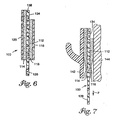
- Fig. 6 illustrates another embodiment of the adhesive tape 100, which is particularly designed for stretching the entire tape 100 to effect debonding and achieving a controlled sequential release, as described in more detail below.
- the tape 100 includes a foam backing 112, a non-tacky tab 126, and adhesive layers 114 and 116 on opposite surfaces of the backing 112. Adhesive layers 114 and 116 are protected by liners 118 and 120 before the adhesive tape 100 is put into use.
- Controlled sequential release can be facilitated using a variety of mechanisms including, e.g., a non-adhesive zone 134, which can be provided by not coating the adhesive composition 116 all the way to the end 138 of the adhesive tape.
- the liner 118 is coextensive with the adhesive layer 116, although it may extend further to cover the non-adhesive zone 134.
- Fig. 7 the tape of Fig. 6 has been positioned between and adhered to a hook 142 and a substrate 144, e.g., a wall.
- the mounting configuration of Fig. 7 will permit a sequential release of the double-sided adhesive tape structure 100 first from the wall 144 and then from the hook 142 during stretch release.
- the non-adhesive zone 134 prevents bonding in that area and therefore releases the tape 100 from the wall 144 when the stretch release progresses up to the non-adhesive zone 134.
- the release of adhesive layer 116 progresses with the release of adhesive layer 114 so that a portion of adhesive layer 114 will still be adhered to the hook 142 when the stretch release progresses to the non-adhesive zone 134, at which point the adhesive layer 116 is entirely released then from wall 144.
- the stretch releasing pressure sensitive adhesive tape can also be a component of an assembly that includes a substrate, e.g., a mounting device, and a stretch releasing pressure sensitive adhesive tape adhered to a surface of the substrate.
- the assembly can include a release liner disposed on an adhesive surface of the tape that is not in contact with the substrate.
- the stretch releasing pressure sensitive adhesive tape can also be a component of a kit that includes, e.g., at least one tape and each tape may have a different property, e.g., dimensions, and at least one device, e.g., hook, holder, hanger, decoration, part, label or a combination thereof, packaged together as a unit.
- a kit that includes, e.g., at least one tape and each tape may have a different property, e.g., dimensions, and at least one device, e.g., hook, holder, hanger, decoration, part, label or a combination thereof, packaged together as a unit.
- Test procedures used in the examples include the following.
- a conventional variable angle peel jig is modified to be used with an IMASS adhesion tester (Imass, Inc., Hingham, MA) to measure low angle debond forces for adhesive tape adhered to a test surface.
- the jig can securely hold a 5.08 cm x 30.5 cm (2 in x 12 in) substrate.
- the jig is secured to the IMASS platen.
- test sample A 1.59 cm x 6.99 cm (5/8 in x 2.75 in) test sample is adhered to the substrate of interest to provide a bond area of 1.59 cm x 5.08 cm (5/8 in x 2 in).
- the test sample has a 1.59 cm x 1.91 cm (5/8 in x 3 ⁇ 4 in) non-adhering tab for clamping to the IMASS tester.
- a 1.59 cm x 5.08 cm x 0.16 cm (1/16 in) high impact polystyrene flat piece is bonded to the side of a test sample opposite the substrate.
- the test sample is then conditioned for 24 hours under conditions of 50 % relative humidity and 22.2°C and then debonded at a peel speed of 76.2 cm/min (30 in/min) and at a peel angle of 2°.
- the average debond force required to stretch the backing for removal from the substrate is recorded in units of ounces per 5/8 in width. Three measurements are made from each substrate and the results are averaged.
- % Extension at Debond AD I * 100 where I is the length of the backing prior to debonding (i.e., stretch release), and AD is the length of the backing after debonding (i.e., stretch release).
- U.S. Gypsum wallboard is painted with Sherwin Williams ProMar 200 interior latex primer. Sherwin Williams Classic 99 interior flat latex wall paint is then painted on the primer. The painted wallboard is aged under ambient conditions at 22°C for a minimum of 48 hours prior to use in testing.
- the amount of adhesive residue remaining on the substrate is determined by visual inspection.
- the occurrence of any damage to the surface of the substrate is determined by visual inspection.
- a test sample is prepared by directly coating an adhesive composition onto a 0.00381 cm (1.5 mil) surface of a polyethylene terephthalate film backing, which has been primed with an aminated polybutadiene, to form an adhesive film having a dry coating thickness of from 0.00381 cm to about 0.00762 cm (1.5 mil to 2.0 mil) onto a 0.00381 cm (1.5 mil) surface of a polyethylene terephthalate film backing that has been primed with an aminated polybutadiene.
- the exposed adhesive is then placed on a glass substrate and a 2.04 kg (4.5 lb) roller is passed over the polyethylene terephthalate backing four times at a rate of 30.48 cm/min (12 in/min).
- the test sample is then conditioned for 24 hours at 22.2°C (72°F) and greater than 98% relative humidity.
- test sample is then tested according to the 180° Peel Strength Test Method.
- Test samples are prepared by laminating together several layers of adhesive film to form a test sample having a thickness of about 1 mm.
- Storage modulus, G', the loss modulus, G", and the loss factor, tan ⁇ are determined using a Rheometrics RDA2 (Piscataway, NJ) and a test mode of dynamic temperature ramp.
- the parallel plates are 8 mm in diameter. Data is collected at a frequency of 1 radian/second over a temperature range of -80°C to +200°C and at a heating/cooling rate of 5°C/minute.
- Test samples are prepared by laminating together several layers of adhesive film to form a test sample having a thickness of about 1 mm.
- Storage modulus, G', the loss modulus, G", and the loss factor, tan ⁇ are determined using a Polymer Laboratories Dynamic Mechanical Thermal Analyzer (DMTA) Mark II and a technique of multiplexing frequency during a thermal scan, i.e., properties are measured while both frequency and temperature are changing.
- the shear plates are 8 mm in diameter. The temperature is varied from -120°C to 200°C at a rate of 2°C/minute continuous at a strain setting of xl.
- Storage modulus is recorded at -17°C and a frequency of 0.3 Hz (1.88 radians/second).
- a 1.91 cm x 5.08 cm (3 ⁇ 4 in. x 2 in.) anodized aluminum tab is bonded to one side of the adhesive tape test sample for the purpose of attaching the load.
- the test samples and glass substrates are equilibrated at (4.4°C) 40°F overnight.
- a 1.27 cm x 1.27 cm (0.5 in x 0.5 in) test sample is then adhered to the glass substrate at 4.4°C (40°F).
- the test sample is bonded to the glass substrate by passing a 2.04 kg (4.5 lb) roller over the test sample four times at a rate of 30.48 cm/min (12 in/min).
- the test sample is allowed to dwell on the substrate for 1 hour and thereafter a 1 kg weight is applied.
- the time to failure for five samples is recorded in minutes and the average value is reported.
- a 1.91 cm x 5.08 cm (3 ⁇ 4 in. x 2 in.) anodized aluminum tab is bonded to one side of the adhesive tape test sample for the purpose of attaching the load.
- a 1.27 cm x 1.27 cm (0.5 in x 0.5 in) test sample is then adhered to a glass substrate at 22°C (12°F), 50% relative humidity.
- the test sample is bonded to the glass substrate by passing a 2.04 kg (4.5 lb) roller over the test sample four times at a rate of 30.48 cm/min (12 in/min).
- the test sample is allowed to dwell on the substrate for 1 hour at 22°C and 50% relative humidity, placed under conditions of 32.2°C (90°F) and 90% relative humidity, and allowed to equilibrate for 10 minutes. Thereafter a 1 kg weight is applied.
- the time to failure for four samples is recorded in minutes and the average value is reported.
- a pressure sensitive adhesive composition formulated with 29.6/0/50 (molecular weight (MW) polydimethylorganosiloxane (PDMS) diamine (divided by 1000) /moles polyamine per mole of PDMS diamine/% by weight MQ resin based upon the total weight of the silicone polyurea block copolymer) was prepared as follows.
- PDMS diamine 14.86 parts 29,600 molecular weight PDMS diamine were charged to a glass reactor and mixed with 0 parts polyamine, 39.00 parts toluene and 21.00 parts 2-propanol. 0.13 parts methylene-diphyenlyene-4'-diisocyanate (H 12 MDI) was added to the solution while stirring at room temperature. The isocyanate was added in a stoichiometric amount based upon the amount of diamine, which includes the PDMS diamine and any optional polyamine. The mixture was then stirred for two hours and became viscous.
- H 12 MDI methylene-diphyenlyene-4'-diisocyanate
- the resulting silicone polyurea block copolymer solution which had a PDMS diamine/polyamine/polyisocyanate molar ratio of 1:0:1, was mixed with 25.00 parts SR-545 60% MQ silicone resin solution in toluene solution (General Electric Company) to form a pressure sensitive adhesive composition.
- the pressure sensitive adhesive compositions of Examples 2-7 were prepared according to the method of Example 1 with the exception that the amount of each component was altered to achieve pressure sensitive adhesive compositions formulated with the MW PDMS diamine(/1000)/moles polyamine/% by weight MQ resin set forth in Table 1.
- the pressure sensitive adhesive compositions of Examples 1-7 were each coated at a wet coating thickness of about 0.033 cm to 0.036 cm (13 to 14 mils) on Rexam 10256 release liner (Rexam Release, Bedford Park, Illinois) and immediately dried at 70°C for 10 minutes to form an adhesive film having a thickness of about 0.00635 cm (2.5 mils).
- a 36 mil multi-layer composite foam laminate backing consisting of a polyethylene vinyl acetate copolymer foam having a density of 6 pounds per cubic foot (pcf) laminated between two pieces of 0.0046 cm (1.80 mil) thick linear low-density polyethylene film was treated with a chemical primer prepared according to Example 15 of U.S. Patent No. 5,677,376 (Groves).
- the dried adhesive films prepared in Examples 1-7 were dry laminated to both sides of the primed multi-layer composite foam laminate backing to form a multi-layer composite tape.
- Perkadox PD-505-ps-a dichlorobenzoyl peroxide based upon 100% solid adhesive was added to adhesive solutions and allowed to mix overnight on a roller.
- the adhesive solution for each example was as follows: Dow Corning Q2-7735 polydimethylsiloxane pressure sensitive adhesive ("PSA") (Example 8); General Electric Silicone PSA 518 polydimethyldiphenylsiloxane (Example 9); General Electric Silicone PSA 6574 polydimethyldiphenylsiloxane (Example 10).
- the adhesive compositions were then coated at 40% solids on Rexam 10256 release liner, immediately dried at 70°C for 1 minute, and then immediately cured at 165°C for 2 minutes to form an adhesive film having a thickness of about 0.00635 cm (2.5 mils).
- a 36 mil multi-layer composite foam laminate backing consisting of a polyethylene vinyl acetate copolymer foam having a density of 6 pounds per cubic foot (pcf) laminated between two pieces of 0.0046 cm (1.80 mil) thick linear low-density polyethylene film was treated with a chemical primer prepared according to Example 15 of U.S. Patent No. 5,677,376 (Groves).
- the dried adhesive films prepared in Examples 8-11 were dry laminated to both sides of the primed multi-layer composite foam laminate backing to form a multi-layer composite tape.
- the pressure sensitive adhesive compositions of Examples 12-21 were prepared according to the method of Example 1 with the exception that the amount of each component was altered to achieve pressure sensitive adhesive compositions with the MW PDMS diamine(/1000)/moles polyamine/% by weight MQ resin set forth in Table 2.
- the pressure sensitive adhesive compositions of Examples 12-21 were coated onto a 0.00381 cm (1.5 mil) surface of a polyethylene terephthalate film backing, which had been primed with an aminated polybutadiene, and then immediately dried at 70°C for 10 minutes to form adhesive tapes.
- the thickness of each dried adhesive film was about 0.00508 cm (2 mils).
- Perkadox PD-505-ps-a dichlorobenzoyl peroxide 0.75 weight percent Perkadox PD-505-ps-a dichlorobenzoyl peroxide, based upon 100% solid adhesive, was added to an adhesive solution and allowed to mix overnight on a roller to form an adhesive composition.
- the adhesive solution for each example was as follows: Dow Coming 7355 polydimethylsiloxane PSA (Examples 22); Dow Corning 7358 polydimethylsiloxane PSA (Example 23); Dow Corning Q2-7735 polydimethylsiloxane PSA (Example 24); General Electric PSA 518 polydimethyldiphenylsiloxane PSA (Example 25); General Electric PSA 6574 polydimethyldiphenylsiloxane PSA (Example 26).
- the adhesive composition was then coated at 40% solids on a 0.00381 cm (1.5 mil) surface of a polyethylene terephthalate film backing that has been primed with an aminated polybutadiene, immediately dried at 70°C for 1 minute, and then immediately cured at 165°C for 2 minutes to form a pressure sensitive adhesive tape having a thickness of about 0.00508 cm (2 mils).
- a pressure sensitive adhesive composition formulated with 33/0.25/50 MW PDMS diamine(/1000)/moles polyamine/% by weight MQ resin was prepared as follows
- the pressure sensitive adhesive compositions of Examples 28-38 were prepared according to the method of Example 27 with the exception that the amount of each component was altered to achieve a pressure sensitive adhesive composition with the MW PDMS diamine/moles polyamine/% by weight MQ resin as set forth in Table 3.
- the pressure sensitive adhesive compositions of Examples 27-38 were coated on a Rexam 10256 release liner and then immediately dried at 70°C for 10 minutes to form adhesive films having a thickness of about 0.00508 cm (2 mils).
- TS50 2,4- dichlorobenzoyl peroxide based on 100% solid adhesive was added to adhesive solutions and allowed to mix overnight on a roller.
- the adhesive solutions were as follows: General Electric PSA 518 polydimethyldiphenyl siloxane (Example 39); General Electric PSA 590 polydimethylsiloxane (Example 40); General Electric PSA 595 polydimethylsiloxane (Example 41); and Dow Corning 280A polydimethylsiloxane PSA (Example 42).
- the adhesive compositions were coated at 40% solids on Rexam 10256 release liner. The coated adhesive was immediately dried at 70°C for 1 minute and then immediately cured at 175°C for 2 minutes to form an adhesive film having a thickness of about 0.00508 cm (2 mils).
- the pressure sensitive adhesive compositions of Examples 44-46 were prepared according to the method of Example 27 with the exception that the amount of each component was altered to achieve a pressure sensitive adhesive composition with the MW PDMS diamine(/1000)/moles polyamine/% by weight MQ resin as set forth in Table 4.
- the adhesive compositions of Examples 44-46 were coated on a Rexam 10256 release liner and then immediately dried at 70°C for 10 minutes to form an adhesive film having a thickness of about 0.00635 cm (2.5 mils).
- the adhesive film was dry laminated to both sides of a 0.09144 cm (36 mil) multi-layer composite foam laminate backing consisting of a polyethylene vinyl acetate copolymer foam having a density of 6 pcf laminated between two pieces of 0.0046 cm (1.80 mil) thick linear low-density polyethylene film that had been treated with a chemical primer prepared according to Example 15 of U.S. Patent No. 5,677,376 (Groves), to form a multi-layer composite tape.
- Example Formulation MW PDMS diamine (/1000)/moles DytekA polyamine/% by weight MQ resin Average Shear (minutes) 44 33/0.25/50 25000+ 45 33/0.5/50 25000+ 46 33/1/50 25000+
- the pressure sensitive adhesive composition of Examples 47-48 were prepared according to the method of Example 1 with the exception that the amount of each component was altered to achieve a pressure sensitive adhesive composition with a MW PDMS diamine (/1000)/moles polyamine/% by weight MQ resin as set forth in Table 5.
- the pressure sensitive adhesive compositions of Examples 47 and 48 were coated on a Rexam 10256 release liner and then immediately dried at 70°C for 10 minutes to form an adhesive film having a thickness of about 0.00635 cm (2.5 mils).
- the adhesive film was dry laminated to both sides of a 0.09144 cm (36 mil) multi-layer composite foam laminate backing consisting of a polyethylene vinyl acetate copolymer foam having a density of 6 pcf laminated between two pieces of 0.0046 cm (1.80 mil) thick linear low-density polyethylene film that had been treated with a chemical primer prepared according to Example 15 of U.S. Patent No. 5,677,376 (Groves), to form a multi-layer composite tape.
Landscapes
- Chemical & Material Sciences (AREA)
- Organic Chemistry (AREA)
- Health & Medical Sciences (AREA)
- Chemical Kinetics & Catalysis (AREA)
- Medicinal Chemistry (AREA)
- Polymers & Plastics (AREA)
- Adhesive Tapes (AREA)
- Adhesives Or Adhesive Processes (AREA)
- Polyurethanes Or Polyureas (AREA)
- Storage Of Web-Like Or Filamentary Materials (AREA)
Claims (21)
- Ruban adhésif à libération par étirage comprenant :une composition adhésive silicone sensible à la pression qui présente une résistance au décollement à 180 °, sur un substrat en verre à 98 % d'humidité relative, d'au moins environ 5,47 N/dm ; etune languette non collante.
- Ruban selon la revendication 1, dans lequel ladite composition adhésive sensible à la pression a un module, à 1 radian/seconde et à -17 °C, ne dépassant pas environ 1 x 10⁷ Pa.
- Ruban selon l'une quelconque des revendications 1 ou 2, dans lequel ladite composition adhésive sensible à la pression comprend un polymère silicone sélectionné dans le groupe constitué des copolymères à blocs silicone-polyurée, des polymères de polydiorganosiloxane, et de mélanges de ceux-ci.
- Ruban selon la revendication 1, dans lequel ladite composition adhésive sensible à la pression comprenda. un copolymère à blocs silicone-polyurée comprenant le produit réactionnel dei) une polydiorganosiloxane-diamine ayant une masse moléculaire d'au moins 5 000 g/mole ; etii) un polyisocyanate ; etb. entre environ 30 % en poids et environ 70 % en poids de résine MQ.
- Ruban selon la revendication 4, dans lequel ledit copolymère à blocs silicone-polyurée comprend le produit réactionnel dei) une polydiorganosiloxane-diamine ayant une masse moléculaire d'au moins 5 000 g/mole ;ii) une polyamine ; etiii) un polyisocyanate.
- Ruban selon la revendication 5, dans lequel ladite polyamine a une masse moléculaire ne dépassant pas 300 g/mole.
- Ruban selon l'une quelconque des revendications 4, 5 ou 6, dans lequel ladite polydiorganosiloxane-diamine a une masse moléculaire entre environ 10 000 g/mole et environ 65 000 g/mole.
- Ruban selon la revendication 5, dans lequel ledit copolymère à blocs silicone-polyurée comprend le produit réactionnel dei) une polydiorganosiloxane-diamine ayant une masse moléculaire entre environ 10 000 g/mole et environ 65 000 g/mole ;ii) pas plus de 3 moles de polyamine ; etiii) un polyisocyanate.
- Ruban selon la revendication 5, dans lequel ledit copolymère à blocs silicone-polyurée comprend le produit réactionnel dei) une polydiorganosiloxane-diamine ayant une masse moléculaire entre environ 10 000 g/mole et environ 65 000 g/mole ;ii) entre environ 0,25 mole et 2 moles de polyamine ; etiii) un polyisocyanate.
- Ruban selon l'une quelconque des revendications 1-8 ou 9, dans lequel ladite composition adhésive sensible à la pression comprend entre environ 40 % en poids et environ 60 % en poids de résine MQ.
- Ruban selon l'une quelconque des revendications 1-9 ou 10, dans lequel ladite composition adhésive sensible à la pression présente une résistance au décollement à 180 °, sur un substrat en verre à 98 % d'humidité relative, d'au moins environ 32,8 N/dm.
- Ruban selon l'une quelconque des revendications 1-10 ou 11, dans lequel ladite composition adhésive sensible à la pression a un module, à 1 radian/seconde et à -17 °C, ne dépassant pas environ 5 x 10⁶ Pa.
- Ruban selon l'une quelconque des revendications 1-11 ou 12, dans lequel ledit ruban comprend une mousse adhésive sensible à la pression.
- Ruban selon l'une quelconque des revendications 1-12 ou 13, dans lequel ledit ruban comprend en outre un support, ladite composition adhésive sensible à la pression étant disposée sur ledit support.
- Ruban selon la revendication 14, dans lequel ledit support est sélectionné dans le groupe constitué des supports élastiques, des supports hautement extensibles, et des supports fondamentalement inélastiques, et de combinaisons de ceux-ci.
- Ruban selon l'une quelconque des revendications 14 ou 15, dans lequel ledit support comprend une couche de film polymère et une couche de mousse polymère.
- Ruban selon l'une quelconque des revendications 14, 15 ou 16, comprenant en outre une deuxième composition adhésive sensible à la pression, ladite première composition adhésive sensible à la pression étant disposée sur une première surface dudit support, et ladite deuxième composition adhésive sensible à la pression étant disposée sur une deuxième surface dudit support.
- Assemblage comprenant :un dispositif pour maintenir un article ; etle ruban adhésif sensible à la pression à libération par étirage selon l'une quelconque des revendications 1-16 ou 17, disposé sur une surface dudit dispositif.
- Méthode de fixation amovible de l'assemblage selon la revendication 18 à un substrat, ladite méthode comprenant
la mise en contact du substrat avec ledit ruban adhésif sensible à la pression à libération par étirage, de sorte que ledit dispositif soit fixé audit substrat par ledit ruban adhésif sensible à la pression à libération par étirage et que ladite languette non collante soit disponible pour qu'un utilisateur puisse la saisir. - Méthode selon la revendication 19, dans laquelle ledit substrat est sélectionné dans le groupe constitué du verre, de la céramique, de la porcelaine, et de combinaisons de ceux-ci.
- Kit comprenant :un dispositif pour maintenir un article ; etle ruban adhésif sensible à la pression à libération par étirage selon l'une quelconque des revendications 1 16 ou 17, dans lequel ledit ruban est capable de former une liaison avec une surface dudit dispositif et avec un substrat,ledit ruban comprenant une composition adhésive silicone sensible à la pression présentant une résistance au décollement à 180 °, sur un substrat en verre à 98 % d'humidité relative, d'au moins environ 5,47 N/dm.
Applications Claiming Priority (3)
| Application Number | Priority Date | Filing Date | Title |
|---|---|---|---|
| US612341 | 2000-07-06 | ||
| US09/612,341 US6569521B1 (en) | 2000-07-06 | 2000-07-06 | Stretch releasing pressure sensitive adhesive tape and articles |
| PCT/US2000/031609 WO2002004571A1 (fr) | 2000-07-06 | 2000-11-17 | Rubans et articles adhesifs autocollants et a liberation par etirage |
Publications (2)
| Publication Number | Publication Date |
|---|---|
| EP1299492A1 EP1299492A1 (fr) | 2003-04-09 |
| EP1299492B1 true EP1299492B1 (fr) | 2005-08-17 |
Family
ID=24452754
Family Applications (1)
| Application Number | Title | Priority Date | Filing Date |
|---|---|---|---|
| EP00990185A Expired - Lifetime EP1299492B1 (fr) | 2000-07-06 | 2000-11-17 | Rubans et articles adhesifs autocollants et a liberation par etirage |
Country Status (12)
| Country | Link |
|---|---|
| US (2) | US6569521B1 (fr) |
| EP (1) | EP1299492B1 (fr) |
| JP (1) | JP5068914B2 (fr) |
| KR (1) | KR100697735B1 (fr) |
| CN (1) | CN100358961C (fr) |
| AT (1) | ATE302246T1 (fr) |
| AU (2) | AU2724701A (fr) |
| BR (1) | BR0017282A (fr) |
| CA (1) | CA2412738C (fr) |
| DE (1) | DE60022101T2 (fr) |
| MX (1) | MXPA02012726A (fr) |
| WO (1) | WO2002004571A1 (fr) |
Cited By (2)
| Publication number | Priority date | Publication date | Assignee | Title |
|---|---|---|---|---|
| US20160128912A1 (en) * | 2014-11-10 | 2016-05-12 | The Procter & Gamble Company | Personal Care Compositions and Hangers |
| US10399716B2 (en) | 2014-11-10 | 2019-09-03 | The Procter & Gamble Company | Personal care compositions and hangers |
Families Citing this family (208)
| Publication number | Priority date | Publication date | Assignee | Title |
|---|---|---|---|---|
| US6001067A (en) | 1997-03-04 | 1999-12-14 | Shults; Mark C. | Device and method for determining analyte levels |
| US20050033132A1 (en) | 1997-03-04 | 2005-02-10 | Shults Mark C. | Analyte measuring device |
| US7192450B2 (en) | 2003-05-21 | 2007-03-20 | Dexcom, Inc. | Porous membranes for use with implantable devices |
| US6949816B2 (en) | 2003-04-21 | 2005-09-27 | Motorola, Inc. | Semiconductor component having first surface area for electrically coupling to a semiconductor chip and second surface area for electrically coupling to a substrate, and method of manufacturing same |
| US6175752B1 (en) | 1998-04-30 | 2001-01-16 | Therasense, Inc. | Analyte monitoring device and methods of use |
| US8480580B2 (en) | 1998-04-30 | 2013-07-09 | Abbott Diabetes Care Inc. | Analyte monitoring device and methods of use |
| US8688188B2 (en) | 1998-04-30 | 2014-04-01 | Abbott Diabetes Care Inc. | Analyte monitoring device and methods of use |
| US8465425B2 (en) | 1998-04-30 | 2013-06-18 | Abbott Diabetes Care Inc. | Analyte monitoring device and methods of use |
| US8346337B2 (en) | 1998-04-30 | 2013-01-01 | Abbott Diabetes Care Inc. | Analyte monitoring device and methods of use |
| US8974386B2 (en) | 1998-04-30 | 2015-03-10 | Abbott Diabetes Care Inc. | Analyte monitoring device and methods of use |
| US9066695B2 (en) | 1998-04-30 | 2015-06-30 | Abbott Diabetes Care Inc. | Analyte monitoring device and methods of use |
| US6569521B1 (en) | 2000-07-06 | 2003-05-27 | 3M Innovative Properties Company | Stretch releasing pressure sensitive adhesive tape and articles |
| US6641105B1 (en) * | 2000-11-06 | 2003-11-04 | 3M Innovative Properties Company | Hanger |
| US6560471B1 (en) | 2001-01-02 | 2003-05-06 | Therasense, Inc. | Analyte monitoring device and methods of use |
| AU2002309528A1 (en) | 2001-04-02 | 2002-10-15 | Therasense, Inc. | Blood glucose tracking apparatus and methods |
| US7278218B2 (en) * | 2003-06-18 | 2007-10-09 | Irwin Industrial Tool Company | Laser line generating device with swivel base |
| US6702857B2 (en) | 2001-07-27 | 2004-03-09 | Dexcom, Inc. | Membrane for use with implantable devices |
| US20030032874A1 (en) | 2001-07-27 | 2003-02-13 | Dexcom, Inc. | Sensor head for use with implantable devices |
| US7063887B2 (en) | 2002-02-04 | 2006-06-20 | 3M Innovative Properties Company | Stretch releasable foams, articles including same and methods for the manufacture thereof |
| US9282925B2 (en) | 2002-02-12 | 2016-03-15 | Dexcom, Inc. | Systems and methods for replacing signal artifacts in a glucose sensor data stream |
| US8260393B2 (en) | 2003-07-25 | 2012-09-04 | Dexcom, Inc. | Systems and methods for replacing signal data artifacts in a glucose sensor data stream |
| US7613491B2 (en) | 2002-05-22 | 2009-11-03 | Dexcom, Inc. | Silicone based membranes for use in implantable glucose sensors |
| US8364229B2 (en) | 2003-07-25 | 2013-01-29 | Dexcom, Inc. | Analyte sensors having a signal-to-noise ratio substantially unaffected by non-constant noise |
| US8010174B2 (en) | 2003-08-22 | 2011-08-30 | Dexcom, Inc. | Systems and methods for replacing signal artifacts in a glucose sensor data stream |
| US9247901B2 (en) | 2003-08-22 | 2016-02-02 | Dexcom, Inc. | Systems and methods for replacing signal artifacts in a glucose sensor data stream |
| US6814362B2 (en) * | 2002-02-22 | 2004-11-09 | Wellmaster Pipe and Supply, Inc. | Quiet shelf for an agricultural cart |
| US6773807B2 (en) | 2002-07-30 | 2004-08-10 | Mccalland Innovations, Llc | Reflective labeling tape |
| US6991133B2 (en) * | 2002-08-06 | 2006-01-31 | Unilever Home & Personal Care Usa Division Of Conopco, Inc. | Wall mountable personal care products using stretch release adhesives |
| DE10249460A1 (de) * | 2002-10-24 | 2004-05-13 | Ott, Reinhold, Waterloo | Halteteil zur Warensicherung |
| US6865836B2 (en) * | 2003-01-03 | 2005-03-15 | Tracy Sachs-Lavery | Picture frame system |
| US20040202782A1 (en) * | 2003-04-14 | 2004-10-14 | General Electric Company | Methods for repairing insulating material |
| US7875293B2 (en) | 2003-05-21 | 2011-01-25 | Dexcom, Inc. | Biointerface membranes incorporating bioactive agents |
| US7269907B2 (en) * | 2003-07-01 | 2007-09-18 | Irwin Industrial Tool Company | Laser line generating device with swivel base |
| US9763609B2 (en) | 2003-07-25 | 2017-09-19 | Dexcom, Inc. | Analyte sensors having a signal-to-noise ratio substantially unaffected by non-constant noise |
| US8282549B2 (en) | 2003-12-09 | 2012-10-09 | Dexcom, Inc. | Signal processing for continuous analyte sensor |
| US8060173B2 (en) | 2003-08-01 | 2011-11-15 | Dexcom, Inc. | System and methods for processing analyte sensor data |
| US7519408B2 (en) | 2003-11-19 | 2009-04-14 | Dexcom, Inc. | Integrated receiver for continuous analyte sensor |
| US20190357827A1 (en) | 2003-08-01 | 2019-11-28 | Dexcom, Inc. | Analyte sensor |
| US8160669B2 (en) | 2003-08-01 | 2012-04-17 | Dexcom, Inc. | Transcutaneous analyte sensor |
| US7774145B2 (en) | 2003-08-01 | 2010-08-10 | Dexcom, Inc. | Transcutaneous analyte sensor |
| US20100168657A1 (en) | 2003-08-01 | 2010-07-01 | Dexcom, Inc. | System and methods for processing analyte sensor data |
| US8845536B2 (en) | 2003-08-01 | 2014-09-30 | Dexcom, Inc. | Transcutaneous analyte sensor |
| US7986986B2 (en) | 2003-08-01 | 2011-07-26 | Dexcom, Inc. | System and methods for processing analyte sensor data |
| US7591801B2 (en) | 2004-02-26 | 2009-09-22 | Dexcom, Inc. | Integrated delivery device for continuous glucose sensor |
| US8275437B2 (en) | 2003-08-01 | 2012-09-25 | Dexcom, Inc. | Transcutaneous analyte sensor |
| US8886273B2 (en) | 2003-08-01 | 2014-11-11 | Dexcom, Inc. | Analyte sensor |
| US8369919B2 (en) | 2003-08-01 | 2013-02-05 | Dexcom, Inc. | Systems and methods for processing sensor data |
| US8761856B2 (en) | 2003-08-01 | 2014-06-24 | Dexcom, Inc. | System and methods for processing analyte sensor data |
| US7920906B2 (en) | 2005-03-10 | 2011-04-05 | Dexcom, Inc. | System and methods for processing analyte sensor data for sensor calibration |
| US20140121989A1 (en) | 2003-08-22 | 2014-05-01 | Dexcom, Inc. | Systems and methods for processing analyte sensor data |
| JP4462892B2 (ja) * | 2003-10-22 | 2010-05-12 | 日東電工株式会社 | 防水気密用粘着テープ |
| JP2005146212A (ja) * | 2003-11-19 | 2005-06-09 | Three M Innovative Properties Co | 片面粘着テープ |
| US9247900B2 (en) | 2004-07-13 | 2016-02-02 | Dexcom, Inc. | Analyte sensor |
| US8364231B2 (en) | 2006-10-04 | 2013-01-29 | Dexcom, Inc. | Analyte sensor |
| US8423114B2 (en) | 2006-10-04 | 2013-04-16 | Dexcom, Inc. | Dual electrode system for a continuous analyte sensor |
| US11633133B2 (en) | 2003-12-05 | 2023-04-25 | Dexcom, Inc. | Dual electrode system for a continuous analyte sensor |
| US8532730B2 (en) | 2006-10-04 | 2013-09-10 | Dexcom, Inc. | Analyte sensor |
| WO2005057168A2 (fr) | 2003-12-05 | 2005-06-23 | Dexcom, Inc. | Techniques d'etalonnage pour un capteur de substances a analyser en continu |
| KR20060117981A (ko) * | 2003-12-31 | 2006-11-17 | 쓰리엠 이노베이티브 프로퍼티즈 컴파니 | 발수성 및 발유성 플루오로아크릴레이트 |
| US8808228B2 (en) | 2004-02-26 | 2014-08-19 | Dexcom, Inc. | Integrated medicament delivery device for use with continuous analyte sensor |
| WO2009048462A1 (fr) | 2007-10-09 | 2009-04-16 | Dexcom, Inc. | Système d'administration d'insuline intégré avec un capteur de glucose en continu |
| US7599420B2 (en) * | 2004-07-30 | 2009-10-06 | Rearden, Llc | System and method for distributed input distributed output wireless communications |
| US8989833B2 (en) | 2004-07-13 | 2015-03-24 | Dexcom, Inc. | Transcutaneous analyte sensor |
| US7276272B2 (en) * | 2004-09-29 | 2007-10-02 | 3M Innovative Properties Company | Stretch releasing adhesive article for fragile surfaces |
| US7291688B2 (en) * | 2004-12-28 | 2007-11-06 | 3M Innovative Properties Company | Fluoroacrylate-mercaptofunctional copolymers |
| US20060142530A1 (en) | 2004-12-28 | 2006-06-29 | Moore George G | Water- and oil-repellent fluorourethanes and fluoroureas |
| US7345123B2 (en) * | 2004-12-28 | 2008-03-18 | 3M Innovative Properties Company | Fluoroacrylate-multifunctional acrylate copolymer compositions |
| US7279210B2 (en) * | 2005-09-07 | 2007-10-09 | 3M Innovative Properties Company | Curable compositions, methods of making and using the same, and articles therefrom |
| US20070059520A1 (en) * | 2005-09-13 | 2007-03-15 | Hatin Paul M | Method and article for mounting a touch screen |
| US20070125919A1 (en) * | 2005-12-06 | 2007-06-07 | Hopkins William K | Apparatus and method for displaying objects on shelves and the like |
| US7560166B2 (en) * | 2005-12-28 | 2009-07-14 | 3M Innovative Properties Company | Adhesive article, composite article, and methods of making the same |
| JP5043340B2 (ja) * | 2006-02-01 | 2012-10-10 | スリーエム イノベイティブ プロパティズ カンパニー | 物品取り付けキット |
| WO2007102842A2 (fr) | 2006-03-09 | 2007-09-13 | Dexcom, Inc. | Systèmes et procédés de traitement de données de capteur de substance à analyser |
| US7472487B2 (en) * | 2006-05-26 | 2009-01-06 | The Stanley Works | Level |
| WO2007143225A2 (fr) | 2006-06-07 | 2007-12-13 | Abbott Diabetes Care, Inc. | Système et procédé de surveillance d'un analyte |
| US7506450B2 (en) * | 2006-06-30 | 2009-03-24 | The Stanley Works | Adhesive mount for a leveling device and a leveling device |
| US20080027199A1 (en) | 2006-07-28 | 2008-01-31 | 3M Innovative Properties Company | Shape memory polymer articles with a microstructured surface |
| US7951319B2 (en) | 2006-07-28 | 2011-05-31 | 3M Innovative Properties Company | Methods for changing the shape of a surface of a shape memory polymer article |
| DE102006038719A1 (de) | 2006-08-18 | 2008-02-21 | Tesa Ag | Haftklebestreifen für feuchtigkeitsunempfindliche wiederablösbare Verklebungen |
| WO2008030816A1 (fr) * | 2006-09-06 | 2008-03-13 | 3M Innovative Properties Company | Système de grille de fils métalliques présentant des accessoires amovibles pouvant être monté sur une paroi murale destiné à ranger des ustensiles de manière ordonnée |
| US7931160B2 (en) * | 2006-09-06 | 2011-04-26 | 3M Innovative Properties Company | Vertically mounted shelf assembly and accessories therefor |
| CN101511233B (zh) * | 2006-09-06 | 2011-01-26 | 3M创新有限公司 | 具有矩形框架和可拆卸式托盘的壁挂式搁架系统 |
| JP5586226B2 (ja) * | 2006-09-06 | 2014-09-10 | スリーエム イノベイティブ プロパティズ カンパニー | 水平に装着される棚組立体及びその棚組立体用のアクセサリ |
| EP2066206B1 (fr) * | 2006-09-06 | 2011-02-23 | 3M Innovative Properties Company | Étagère coudée à montage mural adhésif |
| EP2094801B2 (fr) * | 2006-12-07 | 2017-02-22 | 3M Innovative Properties Company | Adhésifs à mélange de copolymères blocs à agents collants multiples |
| CA2671436C (fr) | 2006-12-07 | 2015-03-24 | 3M Innovative Properties Company | Melanges d'adhesifs a base de copolymere sequence et d'adhesifs acryliques |
| US20080135159A1 (en) | 2006-12-12 | 2008-06-12 | 3M Innovative Properties Company | Stretch releasing pressure-sensitive adhesive articles and methods of using the same |
| US20080220194A1 (en) * | 2007-03-08 | 2008-09-11 | Ross Alan Spalding Burnham | Kit for adhesive products |
| US20080224004A1 (en) * | 2007-03-13 | 2008-09-18 | Hangman Products, Inc. | Shelf mounting system |
| US20080261018A1 (en) * | 2007-04-17 | 2008-10-23 | Susan Russell | Articles providing non-magnetic adherence to surfaces |
| US7833577B2 (en) * | 2007-05-11 | 2010-11-16 | 3M Innovative Properties Company | Methods of making a pressure-sensitive adhesive assembly |
| US8334037B2 (en) * | 2007-05-11 | 2012-12-18 | 3M Innovative Properties Company | Multi-layer assembly, multi-layer stretch releasing pressure-sensitive adhesive assembly, and methods of making and using the same |
| US20200037875A1 (en) | 2007-05-18 | 2020-02-06 | Dexcom, Inc. | Analyte sensors having a signal-to-noise ratio substantially unaffected by non-constant noise |
| US20080306444A1 (en) | 2007-06-08 | 2008-12-11 | Dexcom, Inc. | Integrated medicament delivery device for use with continuous analyte sensor |
| US8332962B1 (en) | 2007-07-02 | 2012-12-18 | The Grid, Inc. | Multi-layered polychloroprene taping material and method of manufacturing and applying such material |
| US8417312B2 (en) | 2007-10-25 | 2013-04-09 | Dexcom, Inc. | Systems and methods for processing sensor data |
| JP5393024B2 (ja) * | 2007-12-14 | 2014-01-22 | 株式会社ニトムズ | 延伸剥離テープ |
| US9228117B2 (en) | 2008-01-11 | 2016-01-05 | 3M Innovative Properties Company | Stretch releasing optically clear pressure sensitive adhesive |
| WO2009105709A1 (fr) | 2008-02-21 | 2009-08-27 | Dexcom, Inc. | Systèmes et procédés pour traiter, transmettre et afficher des données de détecteur |
| US8673419B2 (en) * | 2008-03-14 | 2014-03-18 | 3M Innovative Properties Company | Stretch releasable adhesive tape |
| NZ605100A (en) * | 2008-03-14 | 2014-12-24 | 3M Innovative Properties Co | Assembly comprising a stretch releasable adhesive article |
| US8583204B2 (en) | 2008-03-28 | 2013-11-12 | Dexcom, Inc. | Polymer membranes for continuous analyte sensors |
| US8682408B2 (en) | 2008-03-28 | 2014-03-25 | Dexcom, Inc. | Polymer membranes for continuous analyte sensors |
| US11730407B2 (en) | 2008-03-28 | 2023-08-22 | Dexcom, Inc. | Polymer membranes for continuous analyte sensors |
| US8241616B2 (en) * | 2008-04-03 | 2012-08-14 | Rohm And Haas Company | Hair styling composition |
| KR20160105527A (ko) | 2008-07-10 | 2016-09-06 | 쓰리엠 이노베이티브 프로퍼티즈 컴파니 | 점탄성 도광체 |
| US8651720B2 (en) | 2008-07-10 | 2014-02-18 | 3M Innovative Properties Company | Retroreflective articles and devices having viscoelastic lightguide |
| EP2310885B1 (fr) * | 2008-07-10 | 2017-03-29 | 3M Innovative Properties Company | Articles rétroréfléchissants et dispositifs possédant un guide d'onde optique viscoélastique |
| KR20110043732A (ko) | 2008-08-08 | 2011-04-27 | 쓰리엠 이노베이티브 프로퍼티즈 컴파니 | 광을 처리하기 위한 점탄성층을 갖는 도광체 |
| US8361633B2 (en) | 2008-10-03 | 2013-01-29 | 3M Innovative Properties Company | Cloud point-resistant adhesives and laminates |
| EP2379660A1 (fr) | 2008-12-31 | 2011-10-26 | 3M Innovative Properties Company | Ruban adhésif à décollement par extension |
| KR20110100304A (ko) * | 2008-12-31 | 2011-09-09 | 쓰리엠 이노베이티브 프로퍼티즈 컴파니 | 연신 분리가능한 접착 테이프 |
| DE102009011165A1 (de) * | 2009-03-04 | 2010-09-09 | Tesa Se | Haftklebemasse |
| CN101846153A (zh) * | 2009-03-24 | 2010-09-29 | 富准精密工业(深圳)有限公司 | 泡棉组件 |
| US20100267302A1 (en) | 2009-04-17 | 2010-10-21 | 3M Innovative Properties Company | Silicone gel adhesive construction |
| JP5840126B2 (ja) | 2009-06-25 | 2016-01-06 | スリーエム イノベイティブ プロパティズ カンパニー | 光活性化抗微生物性物品及び使用方法 |
| CN102481385B (zh) | 2009-06-30 | 2016-01-27 | 3M创新有限公司 | 光活化抗微生物制品及其使用方法 |
| US8292254B2 (en) | 2009-10-29 | 2012-10-23 | Groepler Elizabeth A | Method for hanging party favors and apparatus and kits related thereto |
| US20110101188A1 (en) * | 2009-10-29 | 2011-05-05 | Groepler Elizabeth A | Method for hanging party favors and apparatus and kits apparatus related thereto |
| KR20120123741A (ko) | 2010-01-13 | 2012-11-09 | 쓰리엠 이노베이티브 프로퍼티즈 컴파니 | 미세 구조화 저 굴절률 나노공극형 층을 갖는 광학 필름 및 이의 제조 방법 |
| KR20120115568A (ko) | 2010-02-10 | 2012-10-18 | 쓰리엠 이노베이티브 프로퍼티즈 컴파니 | 점탄성 층을 구비한 조명 장치 |
| BR112012026795A2 (pt) | 2010-04-14 | 2019-09-24 | 3M Innovative Properties Co | dutos removíveis com adesivo no verso para cabeamento e um método de remoção. |
| US8627626B2 (en) | 2010-04-21 | 2014-01-14 | Russell Boxall | Transferring loads across joints in concrete slabs |
| KR20130106373A (ko) * | 2010-08-26 | 2013-09-27 | 쓰리엠 이노베이티브 프로퍼티즈 컴파니 | 양면 다-층 접착제 |
| US8851440B2 (en) | 2010-09-29 | 2014-10-07 | Velcro Industries B.V. | Releasable hanging system |
| WO2012050663A1 (fr) | 2010-10-11 | 2012-04-19 | 3M Innovative Properties Company | Dispositif d'éclairage doté d'un guide lumineux viscoélastique |
| JP6001545B2 (ja) | 2010-10-20 | 2016-10-05 | スリーエム イノベイティブ プロパティズ カンパニー | ナノ空隙ポリマー層を組み込んだ広帯域半鏡面ミラーフィルム |
| CN103443226B (zh) | 2010-10-21 | 2016-08-17 | 马萨诸塞州大学 | 高负载易剥离延长使用的粘合装置 |
| JP2014505119A (ja) * | 2010-11-24 | 2014-02-27 | ダウ コーニング コーポレーション | ブロックコポリマーの形態の制御 |
| JP5941059B2 (ja) | 2010-12-04 | 2016-06-29 | スリーエム イノベイティブ プロパティズ カンパニー | 照明アセンブリ及びその形成方法 |
| CN104808270B (zh) | 2010-12-04 | 2017-08-15 | 3M创新有限公司 | 照明组件及其形成方法 |
| WO2012116215A1 (fr) | 2011-02-25 | 2012-08-30 | 3M Innovative Properties Company | Article d'éclairage et dispositif pour élément de dispersion réfléchissant à éclairage avant |
| CN103354917B (zh) | 2011-02-25 | 2016-08-10 | 3M创新有限公司 | 前照式反射型显示装置 |
| WO2012116199A1 (fr) | 2011-02-25 | 2012-08-30 | 3M Innovative Properties Company | Couche d'extraction de lumière à indice variable et procédé d'éclairage avec celle-ci |
| US8556224B2 (en) | 2011-03-17 | 2013-10-15 | Liberty Hardware Mfg. Corp. | Adhesively mountable bathroom accessories |
| DE102011015372A1 (de) * | 2011-03-29 | 2012-10-04 | Bernd Stöver | Multifunktionsklammer |
| EP3575796B1 (fr) | 2011-04-15 | 2020-11-11 | DexCom, Inc. | Étalonnage avancé de capteur d'échantillon à analyser et détection d'erreur avancée |
| CN103502855B (zh) | 2011-05-13 | 2016-12-28 | 3M创新有限公司 | 具有可变折射率光提取层的背照式透射型显示器 |
| CN103597379B (zh) | 2011-05-25 | 2016-10-05 | 3M创新有限公司 | 光控膜 |
| US20130037672A1 (en) * | 2011-08-11 | 2013-02-14 | Roy C. Sanchez | Twist Tie Hat Hook Headrest Hanger |
| CN106313756A (zh) | 2012-01-19 | 2017-01-11 | 马萨诸塞大学 | 可剥离的表面粘附装置 |
| WO2013134000A1 (fr) * | 2012-03-08 | 2013-09-12 | 3M Innovative Properties Company | Ruban à décollement propre par étirement |
| US10456499B2 (en) | 2012-05-18 | 2019-10-29 | 3M Innovative Properties Company | Adhesive articles for medical applications |
| WO2014018231A1 (fr) | 2012-07-26 | 2014-01-30 | 3M Innovative Properties Company | Articles optiques pouvant être décollés par la chaleur |
| KR20150038203A (ko) | 2012-07-26 | 2015-04-08 | 쓰리엠 이노베이티브 프로퍼티즈 컴파니 | 열 접합해제성 접착제 물품 |
| WO2014031726A1 (fr) | 2012-08-24 | 2014-02-27 | 3M Innovative Properties Company | Couche d'extraction de lumière à indice variable et son procédé de fabrication |
| US8889240B2 (en) | 2012-12-28 | 2014-11-18 | 3M Innovative Properties Company | Stretch release article |
| WO2014123936A1 (fr) | 2013-02-06 | 2014-08-14 | University Of Massachusetts | Adhésifs porteurs de charge avec angles ajustables |
| WO2014152485A1 (fr) | 2013-03-14 | 2014-09-25 | University Of Masssachusetts | Dispositifs pour l'application et le support de charge et leur procédé d'utilisation |
| BR112015023403A2 (pt) | 2013-03-15 | 2017-07-18 | Univ Massachusetts | dispositivos adesivos de fechamento de uso prolon-gado com alta capacidade liberação fácil |
| DE102013206624A1 (de) | 2013-04-15 | 2014-10-16 | Tesa Se | Haftklebemasse und Verwendung derselben in einem Haftklebstreifen |
| WO2014192460A1 (fr) * | 2013-05-27 | 2014-12-04 | Dic株式会社 | Ruban adhésif double-face |
| CN105324452B (zh) | 2013-06-24 | 2018-04-24 | 3M创新有限公司 | 具有表面富集条带的压敏粘合剂层及其制备方法 |
| CN105339453B (zh) * | 2013-06-24 | 2018-08-17 | 3M创新有限公司 | 具有包括第一压敏粘合剂条带和第二压敏粘合剂条带的粘合剂层的制品 |
| MX371002B (es) | 2013-06-24 | 2020-01-13 | 3M Innovative Properties Co | Artículo que comprende tiras adhesivas sensibles a la presión. |
| US9554674B2 (en) | 2013-10-08 | 2017-01-31 | Liberty Hardware Mfg. Corp. | Shower rod mounting assembly |
| CN105829465A (zh) | 2013-12-16 | 2016-08-03 | 3M创新有限公司 | 共混剥离材料 |
| US10925417B2 (en) | 2014-01-22 | 2021-02-23 | Ccl Label, Inc. | Secure hold hook |
| US9904001B2 (en) | 2014-03-18 | 2018-02-27 | 3M Innovative Properties Company | Marketing strip with viscoelastic lightguide |
| US10328371B2 (en) | 2014-03-21 | 2019-06-25 | 3M Innovative Properties Company | Refillable air filter assembly |
| KR20160113914A (ko) | 2015-03-23 | 2016-10-04 | 쓰리엠 이노베이티브 프로퍼티즈 캄파니 | 디스플레이 장치의 각이 진 프레임용 보호 테이프, 그 제조방법 및 이를 포함하는 디스플레이 장치 |
| WO2016164315A1 (fr) | 2015-04-06 | 2016-10-13 | 3M Innovative Properties Company | Compositions de gel filmogène amovibles et leurs procédés d'application |
| JP2018524423A (ja) * | 2015-06-03 | 2018-08-30 | スリーエム イノベイティブ プロパティズ カンパニー | フレキシブルディスプレイ用途用のシリコーン系アセンブリ層 |
| JP6152409B1 (ja) * | 2015-12-21 | 2017-06-21 | レノボ・シンガポール・プライベート・リミテッド | 粘着部材および電子機器 |
| US20190048233A1 (en) | 2016-02-01 | 2019-02-14 | 3M Innovative Properties Company | Conformable, peelable adhesive articles |
| TWI722105B (zh) * | 2016-02-01 | 2021-03-21 | 美商3M新設資產公司 | 可適形、拉伸可離型黏著物品 |
| US10959547B2 (en) * | 2016-02-01 | 2021-03-30 | 3M Innovative Properties Company | Folding flap hanger device having multiple peel fronts |
| KR20170110998A (ko) * | 2016-03-24 | 2017-10-12 | 다우 코닝 코포레이션 | 낮은 스토리지 모듈러스 실리콘 기재층을 포함하는 광학용 실리콘 양면 테이프 |
| WO2018071278A1 (fr) | 2016-10-13 | 2018-04-19 | 3M Innovative Properties Company | Compositions de gel de formation de film éliminable présentant des promoteurs d'adhérence |
| US10221883B2 (en) | 2017-04-07 | 2019-03-05 | Artskills, Inc. | Apparatus for supporting articles |
| DE102017206083A1 (de) | 2017-04-10 | 2018-10-11 | Tesa Se | Verklebung in elektrochemischen Zellen und Stapeln von elektrochemischen Zellen |
| TWI804497B (zh) * | 2017-06-26 | 2023-06-11 | 日商迪愛生股份有限公司 | 黏著帶及將黏著帶由被黏物剝離的方法 |
| JP6931741B2 (ja) | 2017-08-25 | 2021-09-08 | スリーエム イノベイティブ プロパティズ カンパニー | 損傷のない取り外しを可能にする接着性物品 |
| JP7237063B2 (ja) | 2017-08-25 | 2023-03-10 | スリーエム イノベイティブ プロパティズ カンパニー | 損傷のない取り外しを可能にする接着性物品 |
| US9909035B1 (en) * | 2017-09-29 | 2018-03-06 | Mayapple Baby Llc | Mountable articles, dual-adhesive-adhesive tape and mounting methods using them |
| WO2019071379A1 (fr) * | 2017-10-09 | 2019-04-18 | 3M Innovative Properties Company | Couches adhésives d'amortissement pour diaphragmes de micro-haut-parleurs |
| US11331022B2 (en) | 2017-10-24 | 2022-05-17 | Dexcom, Inc. | Pre-connected analyte sensors |
| US11382540B2 (en) | 2017-10-24 | 2022-07-12 | Dexcom, Inc. | Pre-connected analyte sensors |
| US11466187B2 (en) | 2017-10-26 | 2022-10-11 | 3M Innovative Properties Company | Composition containing a silicone-based adhesive and cellulose nanocrystals, and methods and articles |
| WO2019120484A1 (fr) * | 2017-12-19 | 2019-06-27 | Wacker Chemie Ag | Procédé de production de siloxanes présentant des groupes oxamidoester |
| US20190216173A1 (en) * | 2018-01-15 | 2019-07-18 | I-Hui Chao | Adherable Footwear Cushion |
| CN110131291A (zh) * | 2018-02-08 | 2019-08-16 | 中山市太力家庭用品制造有限公司 | 一种粘性吸盘 |
| JP7244198B2 (ja) * | 2018-02-28 | 2023-03-22 | ダウ・東レ株式会社 | 粘着フィルム |
| CN112153924A (zh) | 2018-05-23 | 2020-12-29 | 3M创新有限公司 | 用于重物体的壁锚定件和组件 |
| KR20210003272A (ko) | 2018-05-25 | 2021-01-11 | 쓰리엠 이노베이티브 프로퍼티즈 컴파니 | 상 분리된 물품 |
| DE102018214237A1 (de) | 2018-05-28 | 2019-11-28 | Tesa Se | Wiederablösbarer Haftklebestreifen |
| EP3841178A4 (fr) * | 2018-08-23 | 2022-06-08 | 3M Innovative Properties Company | Compositions adhésives de silicone donnant du collant et remplies |
| WO2020141477A1 (fr) | 2019-01-04 | 2020-07-09 | 3M Innovative Properties Company | Articles adhésifs ajustables à mobilité parallèle au plan de montage |
| EP3919031B1 (fr) * | 2019-01-28 | 2026-03-04 | Nitto Denko Corporation | Matériau de timbre dermique adhésif |
| JP6933305B2 (ja) * | 2019-03-04 | 2021-09-08 | Dic株式会社 | 積層フィルム、粘着テープおよび接着体 |
| JP6912020B2 (ja) * | 2019-03-04 | 2021-07-28 | Dic株式会社 | 粘着テープおよび接着体 |
| KR102236932B1 (ko) * | 2019-04-16 | 2021-04-06 | (주)동원인텍 | 양면 점착 풀인 테이프 |
| US11699865B2 (en) * | 2019-05-10 | 2023-07-11 | 3M Innovative Properties Company | Removable electrical connectors and devices |
| WO2020243506A1 (fr) | 2019-05-31 | 2020-12-03 | Kindeva Drug Delivery | Compositions de gel formant un film amovible présentant des promoteurs d'adhérence |
| CN114207201B (zh) | 2019-08-15 | 2023-08-01 | 3M创新有限公司 | 具有含有机硅的嵌段共聚物芯的芯-鞘丝 |
| WO2021038389A1 (fr) | 2019-08-26 | 2021-03-04 | 3M Innovative Properties Company | Éléments d'ancrage de paroi et ensembles pour objets lourds |
| WO2021090178A1 (fr) * | 2019-11-08 | 2021-05-14 | 3M Innovative Properties Company | Articles adhésifs repositionnables pour retrait par décollement par étirement |
| US12612492B2 (en) | 2019-12-19 | 2026-04-28 | 3M Innovative Properties Company | Silicone polyoxamide copolymers with amine-based end groups |
| GB2597490B (en) * | 2020-07-21 | 2023-10-18 | Coles Lee | A light fitting anchor device |
| CA3198869A1 (fr) | 2020-10-15 | 2022-04-21 | 3M Innovative Properties Company | Ensembles adhesifs permettant des performances portantes ameliorees avec enlevement sans dommage |
| WO2022170094A1 (fr) * | 2021-02-05 | 2022-08-11 | Oswald Iain William Herbert | Récipients d'emballage de biens de consommation portant un film adhésif |
| JP2024519522A (ja) * | 2021-04-23 | 2024-05-15 | スリーエム イノベイティブ プロパティズ カンパニー | 壁紙に適用するための積層体及びそれを用いた物品 |
| EP4603510A3 (fr) * | 2021-05-19 | 2025-10-15 | Jeffery L. Jackson | Procédés et appareil pour dispositifs adhésifs non destructifs |
| US20240307416A1 (en) | 2021-07-29 | 2024-09-19 | 3M Innovative Properties Company | Film-forming compositions comprising salicylic acid and methods of use |
| WO2025099507A1 (fr) | 2023-11-10 | 2025-05-15 | Solventum Intellectual Properties Company | Procédé d'utilisation d'un pansement de thérapie de plaie par pression négative |
| EP4578922A1 (fr) | 2023-12-27 | 2025-07-02 | Tesa Se | Empilement de collage et ruban auto-adhésif pour celui-ci |
| WO2025181728A1 (fr) | 2024-03-01 | 2025-09-04 | 3M Innovative Properties Company | Adhésif différentiel activant des couches antiadhésives en silicone platine pour adhésifs à base de silicone |
| JP7776907B1 (ja) * | 2025-01-28 | 2025-11-27 | 株式会社清和産業 | 接着構造体 |
Family Cites Families (23)
| Publication number | Priority date | Publication date | Assignee | Title |
|---|---|---|---|---|
| US4024312A (en) | 1976-06-23 | 1977-05-17 | Johnson & Johnson | Pressure-sensitive adhesive tape having extensible and elastic backing composed of a block copolymer |
| EP0250248B1 (fr) * | 1986-06-20 | 1997-11-05 | Minnesota Mining And Manufacturing Company | Copolymère séquencé, sa préparation, diamines comme précurseurs pour sa préparation, méthode pour la préparation de ces diamines et produits finals contenant ce copolymère séquencé |
| US5512650A (en) | 1986-06-20 | 1996-04-30 | Minnesota Mining And Manufacturing Company | Block copolymer, method of making the same, diamine precursors of the same, method of making such diamines and end products comprising the block copolymer |
| US5214119A (en) | 1986-06-20 | 1993-05-25 | Minnesota Mining And Manufacturing Company | Block copolymer, method of making the same, dimaine precursors of the same, method of making such diamines and end products comprising the block copolymer |
| DE3741251A1 (de) * | 1987-12-05 | 1989-06-15 | Lohmann Gmbh & Co Kg | Polymerbeschichteter schaumstoff sowie verfahren zu seiner herstellung |
| US5516581A (en) | 1990-12-20 | 1996-05-14 | Minnesota Mining And Manufacturing Company | Removable adhesive tape |
| JP3382638B2 (ja) | 1992-07-17 | 2003-03-04 | コニシ株式会社 | 粘着テープ |
| DE4233872C2 (de) | 1992-09-30 | 1994-07-28 | Beiersdorf Ag | Wiederablösbarer, selbstklebender Haken |
| EP0716672B1 (fr) | 1993-08-31 | 2002-04-10 | Minnesota Mining And Manufacturing Company | Bande adhesive amovible de type mousse |
| DE4339604C2 (de) | 1993-11-20 | 1996-06-05 | Beiersdorf Ag | Verwendung eines Klebfolien-Abschnitts für eine wiederablösbare Verklebung |
| DE69615833T2 (de) * | 1995-04-25 | 2002-05-29 | Minnesota Mining And Mfg. Co., Saint Paul | Klebriggemachte segmentierte polydiorganosiloxan-oligoharnstoff-copolymere sowie verfahren zu deren herstellung |
| WO1996034028A1 (fr) | 1995-04-25 | 1996-10-31 | Minnesota Mining And Manufacturing Company | Copolymeres segmentes de polydiorganosiloxanes et d'oligo-uree rendus collants, et procede de fabrication |
| WO1996035458A2 (fr) | 1995-04-25 | 1996-11-14 | Minnesota Mining And Manufacturing Company | Copolymeres collants segmentes de polydiorganisiloxane polyuree et un procede pour leur production |
| WO1997007172A1 (fr) | 1995-08-11 | 1997-02-27 | Minnesota Mining And Manufacturing Company | Bande adhesive non permanente a decollement sequentiel regule |
| US6001471A (en) | 1995-08-11 | 1999-12-14 | 3M Innovative Properties Company | Removable adhesive tape with controlled sequential release |
| AU6909396A (en) | 1996-04-25 | 1997-11-12 | Minnesota Mining And Manufacturing Company | Silicone compositions containing a silicone-urea segmented copolymer |
| ES2180857T3 (es) | 1996-07-06 | 2003-02-16 | Tesa Ag | Utilizacion de una tira de una cinta adhesiva. |
| DE19641118C1 (de) | 1996-10-05 | 1998-04-23 | Beiersdorf Ag | Wiederablösbarer, selbstklebender Haken |
| US6846893B1 (en) | 1996-10-23 | 2005-01-25 | Minnesota Mining And Manufacturing Company | Polymer mixtures containing polydiorganosiloxane urea-containing components |
| US5866222A (en) | 1997-07-18 | 1999-02-02 | Minnesota Mining And Manufacturing Co. | Silicone copolymer modified release tapes |
| US6972141B1 (en) * | 1997-12-12 | 2005-12-06 | 3M Innovative Properties Company | Removable adhesive tape laminate and separable fastener |
| DE19820858A1 (de) | 1998-05-09 | 1999-11-18 | Beiersdorf Ag | Klebeband |
| US6569521B1 (en) | 2000-07-06 | 2003-05-27 | 3M Innovative Properties Company | Stretch releasing pressure sensitive adhesive tape and articles |
-
2000
- 2000-07-06 US US09/612,341 patent/US6569521B1/en not_active Expired - Lifetime
- 2000-11-17 DE DE60022101T patent/DE60022101T2/de not_active Expired - Lifetime
- 2000-11-17 MX MXPA02012726A patent/MXPA02012726A/es active IP Right Grant
- 2000-11-17 AU AU2724701A patent/AU2724701A/xx active Pending
- 2000-11-17 CN CNB008197326A patent/CN100358961C/zh not_active Expired - Fee Related
- 2000-11-17 CA CA2412738A patent/CA2412738C/fr not_active Expired - Lifetime
- 2000-11-17 WO PCT/US2000/031609 patent/WO2002004571A1/fr not_active Ceased
- 2000-11-17 EP EP00990185A patent/EP1299492B1/fr not_active Expired - Lifetime
- 2000-11-17 JP JP2002509428A patent/JP5068914B2/ja not_active Expired - Fee Related
- 2000-11-17 KR KR1020037000106A patent/KR100697735B1/ko not_active Expired - Fee Related
- 2000-11-17 AU AU2001227247A patent/AU2001227247B2/en not_active Expired
- 2000-11-17 BR BR0017282-0A patent/BR0017282A/pt not_active Application Discontinuation
- 2000-11-17 AT AT00990185T patent/ATE302246T1/de not_active IP Right Cessation
-
2003
- 2003-04-08 US US10/409,361 patent/US7078093B2/en not_active Expired - Lifetime
Cited By (2)
| Publication number | Priority date | Publication date | Assignee | Title |
|---|---|---|---|---|
| US20160128912A1 (en) * | 2014-11-10 | 2016-05-12 | The Procter & Gamble Company | Personal Care Compositions and Hangers |
| US10399716B2 (en) | 2014-11-10 | 2019-09-03 | The Procter & Gamble Company | Personal care compositions and hangers |
Also Published As
| Publication number | Publication date |
|---|---|
| ATE302246T1 (de) | 2005-09-15 |
| CN100358961C (zh) | 2008-01-02 |
| CN1454247A (zh) | 2003-11-05 |
| JP2004502858A (ja) | 2004-01-29 |
| MXPA02012726A (es) | 2003-05-14 |
| US20030211317A1 (en) | 2003-11-13 |
| KR20040030386A (ko) | 2004-04-09 |
| CA2412738A1 (fr) | 2002-01-17 |
| CA2412738C (fr) | 2010-05-11 |
| AU2724701A (en) | 2002-01-21 |
| US7078093B2 (en) | 2006-07-18 |
| KR100697735B1 (ko) | 2007-03-23 |
| US6569521B1 (en) | 2003-05-27 |
| EP1299492A1 (fr) | 2003-04-09 |
| WO2002004571A1 (fr) | 2002-01-17 |
| DE60022101D1 (de) | 2005-09-22 |
| BR0017282A (pt) | 2003-05-20 |
| AU2001227247B2 (en) | 2006-03-02 |
| DE60022101T2 (de) | 2006-06-01 |
| JP5068914B2 (ja) | 2012-11-07 |
Similar Documents
| Publication | Publication Date | Title |
|---|---|---|
| EP1299492B1 (fr) | Rubans et articles adhesifs autocollants et a liberation par etirage | |
| AU2001227247A1 (en) | Stretch releasing pressure sensitive adhesive tapes and articles | |
| AU2008251658B2 (en) | Multi-layer assembly, multi-layer stretch releasing pressure-sensitive adhesive assembly, and methods of making and using the same | |
| AU2008251655B2 (en) | Multi-layer assembly, multi-layer stretch releasing pressure-sensitive adhesive assembly, and methods of making and using the same | |
| AU2019326076A1 (en) | Tackified and filled silicone adhesive compositions | |
| WO2025181728A1 (fr) | Adhésif différentiel activant des couches antiadhésives en silicone platine pour adhésifs à base de silicone |
Legal Events
| Date | Code | Title | Description |
|---|---|---|---|
| PUAI | Public reference made under article 153(3) epc to a published international application that has entered the european phase |
Free format text: ORIGINAL CODE: 0009012 |
|
| 17P | Request for examination filed |
Effective date: 20021220 |
|
| AK | Designated contracting states |
Designated state(s): AT BE CH CY DE DK ES FI FR GB GR IE IT LI LU MC NL PT SE TR Kind code of ref document: A1 Designated state(s): AT BE CH CY DE DK ES FI FR GB GR IE IT LI LU MC NL PT SE TR |
|
| AX | Request for extension of the european patent |
Extension state: AL LT LV MK RO SI |
|
| 17Q | First examination report despatched |
Effective date: 20030908 |
|
| GRAP | Despatch of communication of intention to grant a patent |
Free format text: ORIGINAL CODE: EPIDOSNIGR1 |
|
| GRAS | Grant fee paid |
Free format text: ORIGINAL CODE: EPIDOSNIGR3 |
|
| GRAA | (expected) grant |
Free format text: ORIGINAL CODE: 0009210 |
|
| AK | Designated contracting states |
Kind code of ref document: B1 Designated state(s): AT BE CH CY DE DK ES FI FR GB GR IE IT LI LU MC NL PT SE TR |
|
| PG25 | Lapsed in a contracting state [announced via postgrant information from national office to epo] |
Ref country code: TR Free format text: LAPSE BECAUSE OF FAILURE TO SUBMIT A TRANSLATION OF THE DESCRIPTION OR TO PAY THE FEE WITHIN THE PRESCRIBED TIME-LIMIT Effective date: 20050817 Ref country code: AT Free format text: LAPSE BECAUSE OF FAILURE TO SUBMIT A TRANSLATION OF THE DESCRIPTION OR TO PAY THE FEE WITHIN THE PRESCRIBED TIME-LIMIT Effective date: 20050817 Ref country code: CH Free format text: LAPSE BECAUSE OF FAILURE TO SUBMIT A TRANSLATION OF THE DESCRIPTION OR TO PAY THE FEE WITHIN THE PRESCRIBED TIME-LIMIT Effective date: 20050817 Ref country code: LI Free format text: LAPSE BECAUSE OF FAILURE TO SUBMIT A TRANSLATION OF THE DESCRIPTION OR TO PAY THE FEE WITHIN THE PRESCRIBED TIME-LIMIT Effective date: 20050817 Ref country code: BE Free format text: LAPSE BECAUSE OF FAILURE TO SUBMIT A TRANSLATION OF THE DESCRIPTION OR TO PAY THE FEE WITHIN THE PRESCRIBED TIME-LIMIT Effective date: 20050817 Ref country code: FI Free format text: LAPSE BECAUSE OF FAILURE TO SUBMIT A TRANSLATION OF THE DESCRIPTION OR TO PAY THE FEE WITHIN THE PRESCRIBED TIME-LIMIT Effective date: 20050817 Ref country code: NL Free format text: LAPSE BECAUSE OF FAILURE TO SUBMIT A TRANSLATION OF THE DESCRIPTION OR TO PAY THE FEE WITHIN THE PRESCRIBED TIME-LIMIT Effective date: 20050817 |
|
| REG | Reference to a national code |
Ref country code: GB Ref legal event code: FG4D |
|
| REG | Reference to a national code |
Ref country code: CH Ref legal event code: EP |
|
| REG | Reference to a national code |
Ref country code: IE Ref legal event code: FG4D |
|
| REF | Corresponds to: |
Ref document number: 60022101 Country of ref document: DE Date of ref document: 20050922 Kind code of ref document: P |
|
| PG25 | Lapsed in a contracting state [announced via postgrant information from national office to epo] |
Ref country code: CY Free format text: LAPSE BECAUSE OF FAILURE TO SUBMIT A TRANSLATION OF THE DESCRIPTION OR TO PAY THE FEE WITHIN THE PRESCRIBED TIME-LIMIT Effective date: 20051117 Ref country code: GR Free format text: LAPSE BECAUSE OF FAILURE TO SUBMIT A TRANSLATION OF THE DESCRIPTION OR TO PAY THE FEE WITHIN THE PRESCRIBED TIME-LIMIT Effective date: 20051117 Ref country code: SE Free format text: LAPSE BECAUSE OF FAILURE TO SUBMIT A TRANSLATION OF THE DESCRIPTION OR TO PAY THE FEE WITHIN THE PRESCRIBED TIME-LIMIT Effective date: 20051117 Ref country code: DK Free format text: LAPSE BECAUSE OF FAILURE TO SUBMIT A TRANSLATION OF THE DESCRIPTION OR TO PAY THE FEE WITHIN THE PRESCRIBED TIME-LIMIT Effective date: 20051117 Ref country code: IE Free format text: LAPSE BECAUSE OF NON-PAYMENT OF DUE FEES Effective date: 20051117 |
|
| PG25 | Lapsed in a contracting state [announced via postgrant information from national office to epo] |
Ref country code: ES Free format text: LAPSE BECAUSE OF FAILURE TO SUBMIT A TRANSLATION OF THE DESCRIPTION OR TO PAY THE FEE WITHIN THE PRESCRIBED TIME-LIMIT Effective date: 20051128 |
|
| PG25 | Lapsed in a contracting state [announced via postgrant information from national office to epo] |
Ref country code: MC Free format text: LAPSE BECAUSE OF NON-PAYMENT OF DUE FEES Effective date: 20051130 Ref country code: LU Free format text: LAPSE BECAUSE OF NON-PAYMENT OF DUE FEES Effective date: 20051130 |
|
| PG25 | Lapsed in a contracting state [announced via postgrant information from national office to epo] |
Ref country code: PT Free format text: LAPSE BECAUSE OF FAILURE TO SUBMIT A TRANSLATION OF THE DESCRIPTION OR TO PAY THE FEE WITHIN THE PRESCRIBED TIME-LIMIT Effective date: 20060117 |
|
| NLV1 | Nl: lapsed or annulled due to failure to fulfill the requirements of art. 29p and 29m of the patents act | ||
| REG | Reference to a national code |
Ref country code: CH Ref legal event code: PL |
|
| ET | Fr: translation filed | ||
| PLBE | No opposition filed within time limit |
Free format text: ORIGINAL CODE: 0009261 |
|
| STAA | Information on the status of an ep patent application or granted ep patent |
Free format text: STATUS: NO OPPOSITION FILED WITHIN TIME LIMIT |
|
| 26N | No opposition filed |
Effective date: 20060518 |
|
| REG | Reference to a national code |
Ref country code: IE Ref legal event code: MM4A |
|
| PGFP | Annual fee paid to national office [announced via postgrant information from national office to epo] |
Ref country code: IT Payment date: 20071127 Year of fee payment: 8 |
|
| PGFP | Annual fee paid to national office [announced via postgrant information from national office to epo] |
Ref country code: GB Payment date: 20071128 Year of fee payment: 8 |
|
| GBPC | Gb: european patent ceased through non-payment of renewal fee |
Effective date: 20081117 |
|
| PG25 | Lapsed in a contracting state [announced via postgrant information from national office to epo] |
Ref country code: IT Free format text: LAPSE BECAUSE OF NON-PAYMENT OF DUE FEES Effective date: 20081117 |
|
| PG25 | Lapsed in a contracting state [announced via postgrant information from national office to epo] |
Ref country code: GB Free format text: LAPSE BECAUSE OF NON-PAYMENT OF DUE FEES Effective date: 20081117 |
|
| REG | Reference to a national code |
Ref country code: FR Ref legal event code: PLFP Year of fee payment: 16 |
|
| REG | Reference to a national code |
Ref country code: FR Ref legal event code: PLFP Year of fee payment: 17 |
|
| REG | Reference to a national code |
Ref country code: FR Ref legal event code: PLFP Year of fee payment: 18 |
|
| REG | Reference to a national code |
Ref country code: DE Ref legal event code: R079 Ref document number: 60022101 Country of ref document: DE Free format text: PREVIOUS MAIN CLASS: C09J0007020000 Ipc: C09J0007200000 |
|
| REG | Reference to a national code |
Ref country code: FR Ref legal event code: PLFP Year of fee payment: 19 |
|
| PGFP | Annual fee paid to national office [announced via postgrant information from national office to epo] |
Ref country code: FR Payment date: 20181011 Year of fee payment: 19 |
|
| PGFP | Annual fee paid to national office [announced via postgrant information from national office to epo] |
Ref country code: DE Payment date: 20191105 Year of fee payment: 20 |
|
| PG25 | Lapsed in a contracting state [announced via postgrant information from national office to epo] |
Ref country code: FR Free format text: LAPSE BECAUSE OF NON-PAYMENT OF DUE FEES Effective date: 20191130 |
|
| REG | Reference to a national code |
Ref country code: DE Ref legal event code: R071 Ref document number: 60022101 Country of ref document: DE |