EP1300355B1 - Procédé et appareil de traitement de films polymères multicouches - Google Patents
Procédé et appareil de traitement de films polymères multicouches Download PDFInfo
- Publication number
- EP1300355B1 EP1300355B1 EP02020624A EP02020624A EP1300355B1 EP 1300355 B1 EP1300355 B1 EP 1300355B1 EP 02020624 A EP02020624 A EP 02020624A EP 02020624 A EP02020624 A EP 02020624A EP 1300355 B1 EP1300355 B1 EP 1300355B1
- Authority
- EP
- European Patent Office
- Prior art keywords
- temperature
- film
- layer
- sealable
- processing
- Prior art date
- Legal status (The legal status is an assumption and is not a legal conclusion. Google has not performed a legal analysis and makes no representation as to the accuracy of the status listed.)
- Expired - Lifetime
Links
- 238000000034 method Methods 0.000 title claims abstract description 14
- 238000001816 cooling Methods 0.000 claims abstract description 37
- 238000007789 sealing Methods 0.000 claims description 23
- 238000010438 heat treatment Methods 0.000 claims description 12
- 239000000463 material Substances 0.000 claims description 8
- 238000011144 upstream manufacturing Methods 0.000 claims description 2
- 229920003023 plastic Polymers 0.000 claims 7
- 239000004033 plastic Substances 0.000 claims 7
- 239000002985 plastic film Substances 0.000 abstract description 11
- 229920006255 plastic film Polymers 0.000 description 10
- XLYOFNOQVPJJNP-UHFFFAOYSA-N water Substances O XLYOFNOQVPJJNP-UHFFFAOYSA-N 0.000 description 4
- 238000007664 blowing Methods 0.000 description 3
- 229920000642 polymer Polymers 0.000 description 3
- WNEODWDFDXWOLU-QHCPKHFHSA-N 3-[3-(hydroxymethyl)-4-[1-methyl-5-[[5-[(2s)-2-methyl-4-(oxetan-3-yl)piperazin-1-yl]pyridin-2-yl]amino]-6-oxopyridin-3-yl]pyridin-2-yl]-7,7-dimethyl-1,2,6,8-tetrahydrocyclopenta[3,4]pyrrolo[3,5-b]pyrazin-4-one Chemical compound C([C@@H](N(CC1)C=2C=NC(NC=3C(N(C)C=C(C=3)C=3C(=C(N4C(C5=CC=6CC(C)(C)CC=6N5CC4)=O)N=CC=3)CO)=O)=CC=2)C)N1C1COC1 WNEODWDFDXWOLU-QHCPKHFHSA-N 0.000 description 2
- 230000006735 deficit Effects 0.000 description 2
- 238000009826 distribution Methods 0.000 description 2
- 238000002844 melting Methods 0.000 description 2
- 230000008018 melting Effects 0.000 description 2
- 238000004806 packaging method and process Methods 0.000 description 2
- 230000007704 transition Effects 0.000 description 2
- 239000011248 coating agent Substances 0.000 description 1
- 238000000576 coating method Methods 0.000 description 1
- 239000004020 conductor Substances 0.000 description 1
- 230000003247 decreasing effect Effects 0.000 description 1
- 238000010586 diagram Methods 0.000 description 1
- 238000005265 energy consumption Methods 0.000 description 1
- 238000001125 extrusion Methods 0.000 description 1
- 239000011888 foil Substances 0.000 description 1
- 230000000977 initiatory effect Effects 0.000 description 1
- 230000007257 malfunction Effects 0.000 description 1
- 238000004519 manufacturing process Methods 0.000 description 1
- 230000035515 penetration Effects 0.000 description 1
- 229920006254 polymer film Polymers 0.000 description 1
- 238000005096 rolling process Methods 0.000 description 1
Images




Classifications
-
- B—PERFORMING OPERATIONS; TRANSPORTING
- B29—WORKING OF PLASTICS; WORKING OF SUBSTANCES IN A PLASTIC STATE IN GENERAL
- B29C—SHAPING OR JOINING OF PLASTICS; SHAPING OF MATERIAL IN A PLASTIC STATE, NOT OTHERWISE PROVIDED FOR; AFTER-TREATMENT OF THE SHAPED PRODUCTS, e.g. REPAIRING
- B29C48/00—Extrusion moulding, i.e. expressing the moulding material through a die or nozzle which imparts the desired form; Apparatus therefor
- B29C48/25—Component parts, details or accessories; Auxiliary operations
- B29C48/88—Thermal treatment of the stream of extruded material, e.g. cooling
- B29C48/911—Cooling
- B29C48/9135—Cooling of flat articles, e.g. using specially adapted supporting means
- B29C48/9175—Cooling of flat articles, e.g. using specially adapted supporting means by interposing a fluid layer between the supporting means and the flat article
-
- B—PERFORMING OPERATIONS; TRANSPORTING
- B29—WORKING OF PLASTICS; WORKING OF SUBSTANCES IN A PLASTIC STATE IN GENERAL
- B29C—SHAPING OR JOINING OF PLASTICS; SHAPING OF MATERIAL IN A PLASTIC STATE, NOT OTHERWISE PROVIDED FOR; AFTER-TREATMENT OF THE SHAPED PRODUCTS, e.g. REPAIRING
- B29C48/00—Extrusion moulding, i.e. expressing the moulding material through a die or nozzle which imparts the desired form; Apparatus therefor
- B29C48/03—Extrusion moulding, i.e. expressing the moulding material through a die or nozzle which imparts the desired form; Apparatus therefor characterised by the shape of the extruded material at extrusion
- B29C48/07—Flat, e.g. panels
- B29C48/08—Flat, e.g. panels flexible, e.g. films
-
- B—PERFORMING OPERATIONS; TRANSPORTING
- B29—WORKING OF PLASTICS; WORKING OF SUBSTANCES IN A PLASTIC STATE IN GENERAL
- B29C—SHAPING OR JOINING OF PLASTICS; SHAPING OF MATERIAL IN A PLASTIC STATE, NOT OTHERWISE PROVIDED FOR; AFTER-TREATMENT OF THE SHAPED PRODUCTS, e.g. REPAIRING
- B29C48/00—Extrusion moulding, i.e. expressing the moulding material through a die or nozzle which imparts the desired form; Apparatus therefor
- B29C48/25—Component parts, details or accessories; Auxiliary operations
- B29C48/88—Thermal treatment of the stream of extruded material, e.g. cooling
- B29C48/91—Heating, e.g. for cross linking
-
- B—PERFORMING OPERATIONS; TRANSPORTING
- B29—WORKING OF PLASTICS; WORKING OF SUBSTANCES IN A PLASTIC STATE IN GENERAL
- B29C—SHAPING OR JOINING OF PLASTICS; SHAPING OF MATERIAL IN A PLASTIC STATE, NOT OTHERWISE PROVIDED FOR; AFTER-TREATMENT OF THE SHAPED PRODUCTS, e.g. REPAIRING
- B29C48/00—Extrusion moulding, i.e. expressing the moulding material through a die or nozzle which imparts the desired form; Apparatus therefor
- B29C48/25—Component parts, details or accessories; Auxiliary operations
- B29C48/88—Thermal treatment of the stream of extruded material, e.g. cooling
- B29C48/911—Cooling
- B29C48/9135—Cooling of flat articles, e.g. using specially adapted supporting means
- B29C48/914—Cooling drums
-
- B—PERFORMING OPERATIONS; TRANSPORTING
- B29—WORKING OF PLASTICS; WORKING OF SUBSTANCES IN A PLASTIC STATE IN GENERAL
- B29C—SHAPING OR JOINING OF PLASTICS; SHAPING OF MATERIAL IN A PLASTIC STATE, NOT OTHERWISE PROVIDED FOR; AFTER-TREATMENT OF THE SHAPED PRODUCTS, e.g. REPAIRING
- B29C71/00—After-treatment of articles without altering their shape; Apparatus therefor
- B29C71/02—Thermal after-treatment
-
- B—PERFORMING OPERATIONS; TRANSPORTING
- B29—WORKING OF PLASTICS; WORKING OF SUBSTANCES IN A PLASTIC STATE IN GENERAL
- B29L—INDEXING SCHEME ASSOCIATED WITH SUBCLASS B29C, RELATING TO PARTICULAR ARTICLES
- B29L2009/00—Layered products
Definitions
- the invention relates to a method and a device for processing multilayer plastic films with low-temperature sealable layers, according to the preamble of the independent claims.
- the time portion of the sealing process can be reduced in total processing time. This increases the possible processing speeds.
- various heating and cooling processes are required. This is done either by contact heating or cooling on rollers or by Blowing with appropriately tempered air.
- the films must be passed through the processing machine. This is usually done by guide and guide rollers. Typical processing temperatures are between 80 ° C and 220 ° C. Sealable layers are typically activated at temperatures of currently 100-140 ° C. However, the trend is towards ever lower temperatures.
- sealing temperatures For example, polymers for the sealing layers are currently being tested with sealing temperatures of 70 - 80 ° C
- the large temperature differences between processing temperatures and sealing temperatures lead to problems in the processing machines - especially in heating and deflection rollers. It comes in rolls with surface temperatures that are above the sealing temperature, for bonding and thus destroying the sealable layer. In addition, this can lead to malfunctions that require a shutdown of the system.
- a heating of the film and the sealable layer on the sealing temperature addition is possible by contactless heating.
- a deflection of the film by means of rollers, which come into contact with the hot, sealable layer, is critical, even if the deflection roller is cooled, since at the first emergence of the film on the guide roller, the deflection roller contacting layer still has too high a temperature.
- the object of the invention is to provide a method and an apparatus for processing multilayer plastic films with sealable outer layer, according to which even with sealable coated films with very low sealing temperature deflection rollers can be used without causing an impairment of the sealable coating or damage to the Rolling comes.
- a highly efficient short cooling device and on the opposite side of the web a heating device is placed on the side of the goods runway, which carries the sealable layer, before running on a guide roller.
- the cooling device consists of a set of nozzles, with the aid of which cooled air is blown onto the sealable layer at high speed. This ensures that the outer layer cools so far that it does not come to the above-mentioned problems when emerging on the, possibly also cooled, guide roller.
- the cooling device it is important that by the cooling device, the temperature level of the entire Film is not lowered too much, but essentially only the outer critical layer is affected. If the cooling device is designed in such a way that a high heat transfer is achieved over the shortest possible distance, the relatively poor thermal conductivity of the polymers prevents too much penetration of the cooling within the film layers. On the other hand, due to the high heat transfer, sufficient cooling of the sealable layer before emergence onto the deflection or guide rolls is achieved.
- Figures 1, 2 and 4-7 relate to embodiments which are not part of the invention.
- FIG. 1 shows schematically the arrangement of the cooling device 3 in a film processing plant.
- the multilayer plastic film 1 with a sealable layer L applied to the underside enters the cooling device 3 from the left in the film running direction 10.
- the cooling device 3 comprises a nozzle box which is arranged below the film 1 and has a multiplicity of air nozzles 4 directed onto the underside of the film.
- the nozzle box ensures the distribution of air cooled by an air cooler 7 and blown in by a blower 6. By the upwardly directed nozzles 4, the air is blown at high speed to the hot, the sealing temperature exceeding layer of the film 1.
- the guide roller 5 itself is cooled by a water cooling. Powered by a pump 8, the water cooled by a water cooler 9 circulates in the cooling circuit of the guide roller 5.
- FIG. 2 different points or points in time t1 to t5 during film transport are indicated, to which reference is made in the following drawings and their description.
- FIG. 3 schematically shows a cross section through a multilayer plastic film 1, which is subdivided into twelve equally thick layers A-L for the thermal calculation of the temperatures prevailing in the plastic film, for example.
- the outside of the film 1 is formed in the example by the layer A, while the inside and sealable layer, for example, the layer L is.
- the layers A - L are theoretically separated by layer boundaries. For example, a layer boundary is the transition from layer A to B.
- the temperature was calculated using the Binder-Schmidt difference method at a specific point in time at the respective layer boundaries.
- the approximate temperature profile shown in the drawings is obtained by combining the temperatures which are established at the time at the layers.
- FIG. 4 shows the calculated temperature profiles of the individual film layers A-L over time.
- the individual time steps of the calculation are plotted, while the ordinate shows the temperature T.
- the temperature of all layers A-L of the film 1 is constant at an assumed processing temperature of, for example, 130.degree. This represents the situation before entry into the cooling device 3.
- the temperature distribution over the thickness of the film 1 shows no differences.
- the film is completely and uniformly warmed through.
- the cooling device 3 has already cooled the film 1 from the inside.
- the layer L has only a temperature of about 120 ° C, while on the outside at layer A still the constant processing temperature of 130 ° C prevails.
- the film 1 on the inside (layer L) is further cooled. On the outside (layer A) is already detect a slight decrease in temperature.
- time t4 ie when running onto a cooled deflection roller 5, the temperature of the film 1 has risen overall again slightly. This is because between the time t3, ie leaving the cooling device 3, and the time t4, ie the emergence on the guide roller 5, due to the ambient conditions 2, in the example 130 ° C, the film 1 is again briefly supplied heat. In addition, due to the heat flow within the film 1, there will be a balance between warmer and colder. When running on the guide roller 5, the temperature of the sealing layer L is greatly reduced, so that it does not come to sticking on the guide roller 5. Time t5 shows the temperature of the film 1 when leaving the guide roller 5.
- the temperature of the film 1 Due to the cooled to about 25 ° C guide roller 5, the temperature of the film 1 is still a total decreased, especially the temperature of coming into contact with the guide roller sealing layer L is strong declined.
- the required cooling capacity of the cooling device 3 must be selected so that from the shrinkage of the film 1 in the cooling device 3 to the emergence of the film 1 on the guide roller 5, the temperature of the edge layer L is reduced so far that their sealing temperature is exceeded. This is possible with the help of the air velocity, the air temperature, the length of the blow box and the distance of the nozzle 4 to the film 1.
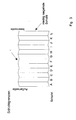
- FIG. 5 shows the calculated time profile of the temperature of the various layers A-L of the film 1.
- the individual layers A-L are identified on the abscissa.
- the temperature T is again plotted on the ordinate.
- the diagram thus represents the temperature profile within the film at different positions and times t1, t3, t4 and t5 shown in FIG.
- the film is completely warmed through and has a processing temperature of z. For example 130 ° C.
- time t3 when leaving the cooling device 3 the temperature on the cooled side is greatly reduced, while on the opposite side still almost the starting temperature is present.
- the temperature within the film is somewhat equalized and, in particular in the inner layers K and L, increases slightly due to the ambient temperature of 130 ° C.
- the temperature of which in this case was mathematically assumed to be 25 ° C. the temperature of the film 1 at the inner layer L drops sharply to below 80 ° C.
- the temperature remains at almost 126 ° C.
- Figures 6 and 7 correspond to Figures 4 and 5, wherein here only the Umlenkwalzentemperatur on z. B. 90 ° C was raised. It can be seen that the inner layer L of the film is still sufficiently cooled to a temperature below the sealing temperature while, overall, the temperature within the film is more uniform.
- Figure 8 shows an embodiment of the invention.
- the outer layer ie the layer of the film 1 opposite the sealing layer, is assigned a heating device 13 with blowing nozzles 14, which supplies heat to the outside of the film 1, while the inside is cooled by the cooling device 3.
- a heating device 13 with blowing nozzles 14 which supplies heat to the outside of the film 1, while the inside is cooled by the cooling device 3.
- Such Heating device could also be arranged around the guide roller and the heat to the outside of the film 1.
- a heating device 11 with air nozzles 12 can also be arranged in front of the cooling device 3, which feeds heat to the inside of the film 1 and keeps it up to the processing temperature up to the cooling device 3.
Landscapes
- Engineering & Computer Science (AREA)
- Mechanical Engineering (AREA)
- Physics & Mathematics (AREA)
- Thermal Sciences (AREA)
- Lining Or Joining Of Plastics Or The Like (AREA)
- Package Closures (AREA)
- Extrusion Moulding Of Plastics Or The Like (AREA)
- Laminated Bodies (AREA)
- Processing And Handling Of Plastics And Other Materials For Molding In General (AREA)
Claims (6)
- Procédé de traitement de feuilles de plastique plates à plusieurs couches (1) avec une couche externe (L) hermétique placée à une température supérieure à une température déterminée de scellement, dans lequel avant d'être travaillée, la feuille de plastique plate est préchauffée jusqu'à une température de travail, et dans lequel la couche externe hermétique (L) de la feuille de plastique plate est placée en contact avec au moins un cylindre déflecteur (5), caractérisé en ce que la couche externe hermétique (L) de la feuille de plastique plate (1) est refroidie avant d'atteindre le cylindre déflecteur à une température inférieure à la température de scellement, tandis que dans les autres couches de la feuille de plastique, le niveau de la température de traitement est maintenu globalement constant, de sorte qu'en même temps de la chaleur est acheminée à la couche (A) située tout contre la couche hermétique (L).
- Procédé selon la revendication 1 caractérisé en ce que l'on utilise de l'air refroidi pour le refroidissement de la couche étanche (L).
- Procédé selon la revendication 1 caractérisé en ce que le cylindre déflecteur (5) est refroidi à une température inférieure à la température de scellement.
- Procédé selon la revendication 1 caractérisé en ce que la température de scellement est inférieure à la température de travail.
- Dispositif pour le traitement de feuilles de plastique plates à plusieurs couches (1) avec une couche externe (L) hermétique placée à une température supérieure à une température déterminée de scellement, dans lequel la feuille de plastique plate (1) chauffée à une température de travail est placée en contact avec au moins un cylindre déflecteur (5) et dans lequel est prévu dans la direction de transport des feuilles (10) avant le cylindre déflecteur (5) un dispositif de refroidissement (3) produisant de l'air froid, à l'aide duquel la couche hermétique (L) est refroidie avant d'atteindre le cylindre déflecteur (5) à une température inférieure à la température de scellement, caractérisé en ce que le dispositif de refroidissement (3) est disposé contre un système de chauffage (13).
- Dispositif selon la revendication 5 caractérisé en ce que le dispositif de refroidissement (3) comprend un certain nombre (4) de buses d'air dirigées sur la couche hermétique (L) qui conduisent de l'air refroidi sur la couche.
Applications Claiming Priority (2)
| Application Number | Priority Date | Filing Date | Title |
|---|---|---|---|
| DE10149371A DE10149371A1 (de) | 2001-10-06 | 2001-10-06 | Verfahren und Vorrichtung zur Verarbeitung von Mehrschichtkunststofffolien |
| DE10149371 | 2001-10-06 |
Publications (3)
| Publication Number | Publication Date |
|---|---|
| EP1300355A2 EP1300355A2 (fr) | 2003-04-09 |
| EP1300355A3 EP1300355A3 (fr) | 2004-03-31 |
| EP1300355B1 true EP1300355B1 (fr) | 2006-06-28 |
Family
ID=7701653
Family Applications (1)
| Application Number | Title | Priority Date | Filing Date |
|---|---|---|---|
| EP02020624A Expired - Lifetime EP1300355B1 (fr) | 2001-10-06 | 2002-09-13 | Procédé et appareil de traitement de films polymères multicouches |
Country Status (5)
| Country | Link |
|---|---|
| US (1) | US20030066602A1 (fr) |
| EP (1) | EP1300355B1 (fr) |
| JP (1) | JP3892381B2 (fr) |
| AT (1) | ATE331685T1 (fr) |
| DE (2) | DE10149371A1 (fr) |
Families Citing this family (1)
| Publication number | Priority date | Publication date | Assignee | Title |
|---|---|---|---|---|
| US20130270739A1 (en) * | 2012-04-13 | 2013-10-17 | Miroslav Planeta | Method and apparatus for controlled shrinking of plastic sheet material |
Family Cites Families (17)
| Publication number | Priority date | Publication date | Assignee | Title |
|---|---|---|---|---|
| NL73233C (fr) * | 1949-01-18 | |||
| US3318018A (en) * | 1964-12-31 | 1967-05-09 | Beloit Corp | Cooling and protective means for printed web material |
| DE1619291A1 (de) * | 1966-06-23 | 1971-06-03 | Schacht Kg F | In bekannter Weise impraegnierte und vorzugsweise mit Deckschichten versehene Dachdichtungsbahn |
| GB1371334A (en) * | 1970-10-30 | 1974-10-23 | Agfa Gevaert | Film stretching method and apparatus |
| US3985604A (en) * | 1971-11-26 | 1976-10-12 | Deering Milliken Research Corporation | Method for the manufacture of laminated packing material containing metal foil |
| DE2833189C2 (de) * | 1978-07-28 | 1984-09-20 | Brückner - Maschinenbau Gernot Brückner GmbH & Co KG, 8221 Siegsdorf | Verfahren zum Längsrecken einer zumindest zweischichtigen thermoplastischen Kunststoffolie sowie Vorrichtung zur Durchführung des Verfahrens |
| ZA795410B (en) * | 1978-12-28 | 1980-09-24 | Grace W R & Co | Improved heat sealing irradiated film |
| GB2055855A (en) * | 1979-08-07 | 1981-03-11 | Ici Ltd | Heat-treating polyolefin films |
| EP0172924B1 (fr) * | 1984-08-14 | 1989-03-15 | Mitsubishi Jukogyo Kabushiki Kaisha | Dispositif pour la production de feuilles |
| US4631155A (en) * | 1985-02-01 | 1986-12-23 | American Hoechst Corporation | Process for manufacture of surface-modified oriented polymeric film |
| DE3620219A1 (de) * | 1986-06-16 | 1987-12-17 | Hoechst Ag | Verfahren zur herstellung von biaxial gestreckten folien sowie vorrichtung zur durchfuehrung des verfahrens |
| US5204182A (en) * | 1990-05-04 | 1993-04-20 | Imperial Chemical Industries Plc | Polyolefin film |
| TW200424B (fr) * | 1991-09-09 | 1993-02-21 | Avery Dennison Corp | |
| US5429785A (en) * | 1994-03-01 | 1995-07-04 | E. I. Du Pont De Nemours And Company | Method of making biaxially oriented thermoplastic films |
| US5866249A (en) * | 1995-12-18 | 1999-02-02 | Minnesota Mining And Manufacturing Company | Pressure-sensitive adhesive based on partially oriented and partially crystallized elastomer |
| US6726969B1 (en) * | 1997-01-28 | 2004-04-27 | Avery Dennison Corporation | In-mold labels and uses thereof |
| DE19708886C1 (de) * | 1997-03-05 | 1998-02-12 | Dornier Gmbh Lindauer | Verfahren und Vorrichtung zum kontinuierlichen Abziehen eines Schmelzefilms aus einer Folienproduktionsanlage |
-
2001
- 2001-10-06 DE DE10149371A patent/DE10149371A1/de not_active Withdrawn
-
2002
- 2002-09-13 AT AT02020624T patent/ATE331685T1/de not_active IP Right Cessation
- 2002-09-13 DE DE50207369T patent/DE50207369D1/de not_active Expired - Lifetime
- 2002-09-13 EP EP02020624A patent/EP1300355B1/fr not_active Expired - Lifetime
- 2002-10-01 JP JP2002288718A patent/JP3892381B2/ja not_active Expired - Fee Related
- 2002-10-07 US US10/267,070 patent/US20030066602A1/en not_active Abandoned
Also Published As
| Publication number | Publication date |
|---|---|
| JP3892381B2 (ja) | 2007-03-14 |
| JP2003200501A (ja) | 2003-07-15 |
| DE50207369D1 (de) | 2006-08-10 |
| ATE331685T1 (de) | 2006-07-15 |
| US20030066602A1 (en) | 2003-04-10 |
| EP1300355A2 (fr) | 2003-04-09 |
| DE10149371A1 (de) | 2003-04-24 |
| EP1300355A3 (fr) | 2004-03-31 |
Similar Documents
| Publication | Publication Date | Title |
|---|---|---|
| EP2559546B1 (fr) | Procédé et dispositif de fabrication d'une feuille en matière thermoplastique et feuille obtenue par le procédé | |
| DE69505647T2 (de) | Verfahren zur herstellung von biaxial orientierten filmen aus thermoplastischem polymer | |
| EP2952330A1 (fr) | Installation de lamelle de soufflage et procédé de fabrication d'une bande de lamelle de soufflage | |
| DE69727826T2 (de) | Heizung der seitlichen wülste einer folie beim simultanstrecken | |
| EP0461488B1 (fr) | Procédé pour fabriquer des feuilles ou des plaques massives lissées extrudées en matière thermoplastique | |
| WO2015055170A1 (fr) | Procédé de fabrication d'une bande de film soufflé et système de soufflage de films | |
| EP2809496B1 (fr) | Banc d'étirage et procédé d'allongement d'une bande continue de film | |
| EP0485896B1 (fr) | Dispositif et procédé pour produire un stratifié multicouche | |
| US9505183B2 (en) | Process for combined rolling and stretching of tapes | |
| EP0546311B1 (fr) | Dispositif et procédé pour produire un stratifié multicouche | |
| DE2158141B2 (de) | Verfahren und Vorrichtung zum Herstellen einer verstreckten Folienbahn aus thermoplastischem Kunststoff | |
| EP0485895A1 (fr) | Dispositif et procédé pour produire un stratifié multicouche | |
| DE1704728B2 (de) | Vorrichtung zum waermefixieren einer molekularorientierten folienbahn | |
| DE60220323T2 (de) | Verfahren zur herstellung eines mehrschichtfolienartikels mit aufblasbaren kammern | |
| DE69524787T2 (de) | Verfahren und vorrichtung zur beschichtung eines metallbleches und daraus hergestelltes produkt | |
| DE3620219A1 (de) | Verfahren zur herstellung von biaxial gestreckten folien sowie vorrichtung zur durchfuehrung des verfahrens | |
| EP1300355B1 (fr) | Procédé et appareil de traitement de films polymères multicouches | |
| EP3520989A1 (fr) | Procédé et dispositif de fabrication d'une feuille en matière plastique | |
| DE69829060T2 (de) | Verfahren und Vorrichtung zum Beschichten eines metallischen bandförmigen Substrats mit einem Kunststoffband | |
| DE69613731T2 (de) | Wickel-, Temper- und Abwickelverfahren eines Polymerfilms, eine Tempervorrichtung und ein photographischer Filmträger hergestellt mit diesem Verfahren oder Vorrichtung | |
| EP1270214B1 (fr) | Procédé pour revêtir la surface d'une bande métallique avec un film plastique | |
| EP1883525B1 (fr) | Procede d'etirage transversal d'une bande de matiere | |
| WO2022161584A1 (fr) | Installation de fabrication de feuilles soufflées et procédé pour faire fonctionner une installation de fabrication de feuilles soufflées | |
| DE1404397B2 (de) | Verfahren zum kontinuierlichen herstellen einer biaxial orientierten thermofixierten filmbahn aus polyaethylen terephthalat | |
| DE102023110788A1 (de) | Verfahren zum Einstellen von Schrumpfeigenschaften eines Kunststoffmaterials, Kunststoffformgebende Anlage und Kunststofffolie |
Legal Events
| Date | Code | Title | Description |
|---|---|---|---|
| PUAI | Public reference made under article 153(3) epc to a published international application that has entered the european phase |
Free format text: ORIGINAL CODE: 0009012 |
|
| AK | Designated contracting states |
Designated state(s): AT BE BG CH CY CZ DE DK EE ES FI FR GB GR IE IT LI LU MC NL PT SE SK TR Kind code of ref document: A2 Designated state(s): AT BE BG CH CY CZ DE DK EE ES FI FR GB GR IE IT LI LU MC NL PT SE SK TR |
|
| AX | Request for extension of the european patent |
Extension state: AL LT LV MK RO SI |
|
| PUAL | Search report despatched |
Free format text: ORIGINAL CODE: 0009013 |
|
| AK | Designated contracting states |
Kind code of ref document: A3 Designated state(s): AT BE BG CH CY CZ DE DK EE ES FI FR GB GR IE IT LI LU MC NL PT SE SK TR |
|
| AX | Request for extension of the european patent |
Extension state: AL LT LV MK RO SI |
|
| 17P | Request for examination filed |
Effective date: 20040615 |
|
| 17Q | First examination report despatched |
Effective date: 20041103 |
|
| AKX | Designation fees paid |
Designated state(s): AT BE BG CH CY CZ DE DK EE ES FI FR GB GR IE IT LI LU MC NL PT SE SK TR |
|
| GRAP | Despatch of communication of intention to grant a patent |
Free format text: ORIGINAL CODE: EPIDOSNIGR1 |
|
| GRAS | Grant fee paid |
Free format text: ORIGINAL CODE: EPIDOSNIGR3 |
|
| GRAA | (expected) grant |
Free format text: ORIGINAL CODE: 0009210 |
|
| AK | Designated contracting states |
Kind code of ref document: B1 Designated state(s): AT BE BG CH CY CZ DE DK EE ES FI FR GB GR IE IT LI LU MC NL PT SE SK TR |
|
| PG25 | Lapsed in a contracting state [announced via postgrant information from national office to epo] |
Ref country code: SK Free format text: LAPSE BECAUSE OF FAILURE TO SUBMIT A TRANSLATION OF THE DESCRIPTION OR TO PAY THE FEE WITHIN THE PRESCRIBED TIME-LIMIT Effective date: 20060628 Ref country code: NL Free format text: LAPSE BECAUSE OF FAILURE TO SUBMIT A TRANSLATION OF THE DESCRIPTION OR TO PAY THE FEE WITHIN THE PRESCRIBED TIME-LIMIT Effective date: 20060628 Ref country code: GB Free format text: LAPSE BECAUSE OF FAILURE TO SUBMIT A TRANSLATION OF THE DESCRIPTION OR TO PAY THE FEE WITHIN THE PRESCRIBED TIME-LIMIT Effective date: 20060628 Ref country code: FI Free format text: LAPSE BECAUSE OF FAILURE TO SUBMIT A TRANSLATION OF THE DESCRIPTION OR TO PAY THE FEE WITHIN THE PRESCRIBED TIME-LIMIT Effective date: 20060628 Ref country code: IE Free format text: LAPSE BECAUSE OF FAILURE TO SUBMIT A TRANSLATION OF THE DESCRIPTION OR TO PAY THE FEE WITHIN THE PRESCRIBED TIME-LIMIT Effective date: 20060628 |
|
| REG | Reference to a national code |
Ref country code: GB Ref legal event code: FG4D Free format text: NOT ENGLISH |
|
| REG | Reference to a national code |
Ref country code: CH Ref legal event code: EP |
|
| REG | Reference to a national code |
Ref country code: IE Ref legal event code: FG4D Free format text: LANGUAGE OF EP DOCUMENT: GERMAN |
|
| REF | Corresponds to: |
Ref document number: 50207369 Country of ref document: DE Date of ref document: 20060810 Kind code of ref document: P |
|
| PG25 | Lapsed in a contracting state [announced via postgrant information from national office to epo] |
Ref country code: SE Free format text: LAPSE BECAUSE OF FAILURE TO SUBMIT A TRANSLATION OF THE DESCRIPTION OR TO PAY THE FEE WITHIN THE PRESCRIBED TIME-LIMIT Effective date: 20060928 Ref country code: DK Free format text: LAPSE BECAUSE OF FAILURE TO SUBMIT A TRANSLATION OF THE DESCRIPTION OR TO PAY THE FEE WITHIN THE PRESCRIBED TIME-LIMIT Effective date: 20060928 |
|
| PG25 | Lapsed in a contracting state [announced via postgrant information from national office to epo] |
Ref country code: BE Free format text: LAPSE BECAUSE OF NON-PAYMENT OF DUE FEES Effective date: 20060930 Ref country code: LI Free format text: LAPSE BECAUSE OF NON-PAYMENT OF DUE FEES Effective date: 20060930 Ref country code: CH Free format text: LAPSE BECAUSE OF NON-PAYMENT OF DUE FEES Effective date: 20060930 Ref country code: MC Free format text: LAPSE BECAUSE OF NON-PAYMENT OF DUE FEES Effective date: 20060930 |
|
| PG25 | Lapsed in a contracting state [announced via postgrant information from national office to epo] |
Ref country code: ES Free format text: LAPSE BECAUSE OF FAILURE TO SUBMIT A TRANSLATION OF THE DESCRIPTION OR TO PAY THE FEE WITHIN THE PRESCRIBED TIME-LIMIT Effective date: 20061009 |
|
| PG25 | Lapsed in a contracting state [announced via postgrant information from national office to epo] |
Ref country code: PT Free format text: LAPSE BECAUSE OF FAILURE TO SUBMIT A TRANSLATION OF THE DESCRIPTION OR TO PAY THE FEE WITHIN THE PRESCRIBED TIME-LIMIT Effective date: 20061128 |
|
| NLV1 | Nl: lapsed or annulled due to failure to fulfill the requirements of art. 29p and 29m of the patents act | ||
| GBV | Gb: ep patent (uk) treated as always having been void in accordance with gb section 77(7)/1977 [no translation filed] |
Effective date: 20060628 |
|
| ET | Fr: translation filed | ||
| REG | Reference to a national code |
Ref country code: IE Ref legal event code: FD4D |
|
| PLBE | No opposition filed within time limit |
Free format text: ORIGINAL CODE: 0009261 |
|
| STAA | Information on the status of an ep patent application or granted ep patent |
Free format text: STATUS: NO OPPOSITION FILED WITHIN TIME LIMIT |
|
| REG | Reference to a national code |
Ref country code: CH Ref legal event code: PL |
|
| 26N | No opposition filed |
Effective date: 20070329 |
|
| BERE | Be: lapsed |
Owner name: LINDAUER DORNIER G.- M.B.H Effective date: 20060930 |
|
| PG25 | Lapsed in a contracting state [announced via postgrant information from national office to epo] |
Ref country code: GR Free format text: LAPSE BECAUSE OF FAILURE TO SUBMIT A TRANSLATION OF THE DESCRIPTION OR TO PAY THE FEE WITHIN THE PRESCRIBED TIME-LIMIT Effective date: 20060929 |
|
| PG25 | Lapsed in a contracting state [announced via postgrant information from national office to epo] |
Ref country code: BG Free format text: LAPSE BECAUSE OF FAILURE TO SUBMIT A TRANSLATION OF THE DESCRIPTION OR TO PAY THE FEE WITHIN THE PRESCRIBED TIME-LIMIT Effective date: 20060928 Ref country code: EE Free format text: LAPSE BECAUSE OF FAILURE TO SUBMIT A TRANSLATION OF THE DESCRIPTION OR TO PAY THE FEE WITHIN THE PRESCRIBED TIME-LIMIT Effective date: 20060628 |
|
| PG25 | Lapsed in a contracting state [announced via postgrant information from national office to epo] |
Ref country code: LU Free format text: LAPSE BECAUSE OF NON-PAYMENT OF DUE FEES Effective date: 20060913 |
|
| PG25 | Lapsed in a contracting state [announced via postgrant information from national office to epo] |
Ref country code: CY Free format text: LAPSE BECAUSE OF FAILURE TO SUBMIT A TRANSLATION OF THE DESCRIPTION OR TO PAY THE FEE WITHIN THE PRESCRIBED TIME-LIMIT Effective date: 20060628 |
|
| PGFP | Annual fee paid to national office [announced via postgrant information from national office to epo] |
Ref country code: CZ Payment date: 20080728 Year of fee payment: 7 Ref country code: IT Payment date: 20080911 Year of fee payment: 7 |
|
| PGFP | Annual fee paid to national office [announced via postgrant information from national office to epo] |
Ref country code: TR Payment date: 20080806 Year of fee payment: 7 |
|
| PGFP | Annual fee paid to national office [announced via postgrant information from national office to epo] |
Ref country code: AT Payment date: 20090907 Year of fee payment: 8 |
|
| PGFP | Annual fee paid to national office [announced via postgrant information from national office to epo] |
Ref country code: DE Payment date: 20090730 Year of fee payment: 8 |
|
| PG25 | Lapsed in a contracting state [announced via postgrant information from national office to epo] |
Ref country code: CZ Free format text: LAPSE BECAUSE OF NON-PAYMENT OF DUE FEES Effective date: 20090913 |
|
| PG25 | Lapsed in a contracting state [announced via postgrant information from national office to epo] |
Ref country code: IT Free format text: LAPSE BECAUSE OF NON-PAYMENT OF DUE FEES Effective date: 20090913 |
|
| REG | Reference to a national code |
Ref country code: FR Ref legal event code: ST Effective date: 20110531 |
|
| REG | Reference to a national code |
Ref country code: DE Ref legal event code: R119 Ref document number: 50207369 Country of ref document: DE Effective date: 20110401 |
|
| PG25 | Lapsed in a contracting state [announced via postgrant information from national office to epo] |
Ref country code: FR Free format text: LAPSE BECAUSE OF NON-PAYMENT OF DUE FEES Effective date: 20100930 Ref country code: DE Free format text: LAPSE BECAUSE OF NON-PAYMENT OF DUE FEES Effective date: 20110401 |
|
| PG25 | Lapsed in a contracting state [announced via postgrant information from national office to epo] |
Ref country code: AT Free format text: LAPSE BECAUSE OF NON-PAYMENT OF DUE FEES Effective date: 20100913 |
|
| PGFP | Annual fee paid to national office [announced via postgrant information from national office to epo] |
Ref country code: FR Payment date: 20091002 Year of fee payment: 8 |
|
| PG25 | Lapsed in a contracting state [announced via postgrant information from national office to epo] |
Ref country code: TR Free format text: LAPSE BECAUSE OF NON-PAYMENT OF DUE FEES Effective date: 20090913 |