EP1300511A2 - Thermoformbare Akustikplatte - Google Patents
Thermoformbare Akustikplatte Download PDFInfo
- Publication number
- EP1300511A2 EP1300511A2 EP02019435A EP02019435A EP1300511A2 EP 1300511 A2 EP1300511 A2 EP 1300511A2 EP 02019435 A EP02019435 A EP 02019435A EP 02019435 A EP02019435 A EP 02019435A EP 1300511 A2 EP1300511 A2 EP 1300511A2
- Authority
- EP
- European Patent Office
- Prior art keywords
- polymer
- panel
- fibers
- acoustical panel
- batt
- Prior art date
- Legal status (The legal status is an assumption and is not a legal conclusion. Google has not performed a legal analysis and makes no representation as to the accuracy of the status listed.)
- Withdrawn
Links
Images

Classifications
-
- E—FIXED CONSTRUCTIONS
- E04—BUILDING
- E04C—STRUCTURAL ELEMENTS; BUILDING MATERIALS
- E04C2/00—Building elements of relatively thin form for the construction of parts of buildings, e.g. sheet materials, slabs, or panels
- E04C2/02—Building elements of relatively thin form for the construction of parts of buildings, e.g. sheet materials, slabs, or panels characterised by specified materials
- E04C2/10—Building elements of relatively thin form for the construction of parts of buildings, e.g. sheet materials, slabs, or panels characterised by specified materials of wood, fibres, chips, vegetable stems, or the like; of plastics; of foamed products
- E04C2/16—Building elements of relatively thin form for the construction of parts of buildings, e.g. sheet materials, slabs, or panels characterised by specified materials of wood, fibres, chips, vegetable stems, or the like; of plastics; of foamed products of fibres, chips, vegetable stems, or the like
-
- B—PERFORMING OPERATIONS; TRANSPORTING
- B32—LAYERED PRODUCTS
- B32B—LAYERED PRODUCTS, i.e. PRODUCTS BUILT-UP OF STRATA OF FLAT OR NON-FLAT, e.g. CELLULAR OR HONEYCOMB, FORM
- B32B5/00—Layered products characterised by the non- homogeneity or physical structure, i.e. comprising a fibrous, filamentary, particulate or foam layer; Layered products characterised by having a layer differing constitutionally or physically in different parts
- B32B5/02—Layered products characterised by the non- homogeneity or physical structure, i.e. comprising a fibrous, filamentary, particulate or foam layer; Layered products characterised by having a layer differing constitutionally or physically in different parts characterised by structural features of a fibrous or filamentary layer
- B32B5/06—Layered products characterised by the non- homogeneity or physical structure, i.e. comprising a fibrous, filamentary, particulate or foam layer; Layered products characterised by having a layer differing constitutionally or physically in different parts characterised by structural features of a fibrous or filamentary layer characterised by a fibrous or filamentary layer mechanically connected, e.g. by needling to another layer, e.g. of fibres, of paper
-
- D—TEXTILES; PAPER
- D04—BRAIDING; LACE-MAKING; KNITTING; TRIMMINGS; NON-WOVEN FABRICS
- D04H—MAKING TEXTILE FABRICS, e.g. FROM FIBRES OR FILAMENTARY MATERIAL; FABRICS MADE BY SUCH PROCESSES OR APPARATUS, e.g. FELTS, NON-WOVEN FABRICS; COTTON-WOOL; WADDING ; NON-WOVEN FABRICS FROM STAPLE FIBRES, FILAMENTS OR YARNS, BONDED WITH AT LEAST ONE WEB-LIKE MATERIAL DURING THEIR CONSOLIDATION
- D04H1/00—Non-woven fabrics formed wholly or mainly of staple fibres or like relatively short fibres
- D04H1/40—Non-woven fabrics formed wholly or mainly of staple fibres or like relatively short fibres from fleeces or layers composed of fibres without existing or potential cohesive properties
- D04H1/42—Non-woven fabrics formed wholly or mainly of staple fibres or like relatively short fibres from fleeces or layers composed of fibres without existing or potential cohesive properties characterised by the use of certain kinds of fibres insofar as this use has no preponderant influence on the consolidation of the fleece
- D04H1/4209—Inorganic fibres
-
- D—TEXTILES; PAPER
- D04—BRAIDING; LACE-MAKING; KNITTING; TRIMMINGS; NON-WOVEN FABRICS
- D04H—MAKING TEXTILE FABRICS, e.g. FROM FIBRES OR FILAMENTARY MATERIAL; FABRICS MADE BY SUCH PROCESSES OR APPARATUS, e.g. FELTS, NON-WOVEN FABRICS; COTTON-WOOL; WADDING ; NON-WOVEN FABRICS FROM STAPLE FIBRES, FILAMENTS OR YARNS, BONDED WITH AT LEAST ONE WEB-LIKE MATERIAL DURING THEIR CONSOLIDATION
- D04H1/00—Non-woven fabrics formed wholly or mainly of staple fibres or like relatively short fibres
- D04H1/40—Non-woven fabrics formed wholly or mainly of staple fibres or like relatively short fibres from fleeces or layers composed of fibres without existing or potential cohesive properties
- D04H1/42—Non-woven fabrics formed wholly or mainly of staple fibres or like relatively short fibres from fleeces or layers composed of fibres without existing or potential cohesive properties characterised by the use of certain kinds of fibres insofar as this use has no preponderant influence on the consolidation of the fleece
- D04H1/4282—Addition polymers
- D04H1/4291—Olefin series
-
- D—TEXTILES; PAPER
- D04—BRAIDING; LACE-MAKING; KNITTING; TRIMMINGS; NON-WOVEN FABRICS
- D04H—MAKING TEXTILE FABRICS, e.g. FROM FIBRES OR FILAMENTARY MATERIAL; FABRICS MADE BY SUCH PROCESSES OR APPARATUS, e.g. FELTS, NON-WOVEN FABRICS; COTTON-WOOL; WADDING ; NON-WOVEN FABRICS FROM STAPLE FIBRES, FILAMENTS OR YARNS, BONDED WITH AT LEAST ONE WEB-LIKE MATERIAL DURING THEIR CONSOLIDATION
- D04H1/00—Non-woven fabrics formed wholly or mainly of staple fibres or like relatively short fibres
- D04H1/40—Non-woven fabrics formed wholly or mainly of staple fibres or like relatively short fibres from fleeces or layers composed of fibres without existing or potential cohesive properties
- D04H1/42—Non-woven fabrics formed wholly or mainly of staple fibres or like relatively short fibres from fleeces or layers composed of fibres without existing or potential cohesive properties characterised by the use of certain kinds of fibres insofar as this use has no preponderant influence on the consolidation of the fleece
- D04H1/4326—Condensation or reaction polymers
- D04H1/435—Polyesters
-
- D—TEXTILES; PAPER
- D04—BRAIDING; LACE-MAKING; KNITTING; TRIMMINGS; NON-WOVEN FABRICS
- D04H—MAKING TEXTILE FABRICS, e.g. FROM FIBRES OR FILAMENTARY MATERIAL; FABRICS MADE BY SUCH PROCESSES OR APPARATUS, e.g. FELTS, NON-WOVEN FABRICS; COTTON-WOOL; WADDING ; NON-WOVEN FABRICS FROM STAPLE FIBRES, FILAMENTS OR YARNS, BONDED WITH AT LEAST ONE WEB-LIKE MATERIAL DURING THEIR CONSOLIDATION
- D04H1/00—Non-woven fabrics formed wholly or mainly of staple fibres or like relatively short fibres
- D04H1/40—Non-woven fabrics formed wholly or mainly of staple fibres or like relatively short fibres from fleeces or layers composed of fibres without existing or potential cohesive properties
- D04H1/42—Non-woven fabrics formed wholly or mainly of staple fibres or like relatively short fibres from fleeces or layers composed of fibres without existing or potential cohesive properties characterised by the use of certain kinds of fibres insofar as this use has no preponderant influence on the consolidation of the fleece
- D04H1/4382—Stretched reticular film fibres; Composite fibres; Mixed fibres; Ultrafine fibres; Fibres for artificial leather
- D04H1/43825—Composite fibres
- D04H1/43828—Composite fibres sheath-core
-
- D—TEXTILES; PAPER
- D04—BRAIDING; LACE-MAKING; KNITTING; TRIMMINGS; NON-WOVEN FABRICS
- D04H—MAKING TEXTILE FABRICS, e.g. FROM FIBRES OR FILAMENTARY MATERIAL; FABRICS MADE BY SUCH PROCESSES OR APPARATUS, e.g. FELTS, NON-WOVEN FABRICS; COTTON-WOOL; WADDING ; NON-WOVEN FABRICS FROM STAPLE FIBRES, FILAMENTS OR YARNS, BONDED WITH AT LEAST ONE WEB-LIKE MATERIAL DURING THEIR CONSOLIDATION
- D04H1/00—Non-woven fabrics formed wholly or mainly of staple fibres or like relatively short fibres
- D04H1/40—Non-woven fabrics formed wholly or mainly of staple fibres or like relatively short fibres from fleeces or layers composed of fibres without existing or potential cohesive properties
- D04H1/42—Non-woven fabrics formed wholly or mainly of staple fibres or like relatively short fibres from fleeces or layers composed of fibres without existing or potential cohesive properties characterised by the use of certain kinds of fibres insofar as this use has no preponderant influence on the consolidation of the fleece
- D04H1/4382—Stretched reticular film fibres; Composite fibres; Mixed fibres; Ultrafine fibres; Fibres for artificial leather
- D04H1/43835—Mixed fibres, e.g. at least two chemically different fibres or fibre blends
-
- D—TEXTILES; PAPER
- D04—BRAIDING; LACE-MAKING; KNITTING; TRIMMINGS; NON-WOVEN FABRICS
- D04H—MAKING TEXTILE FABRICS, e.g. FROM FIBRES OR FILAMENTARY MATERIAL; FABRICS MADE BY SUCH PROCESSES OR APPARATUS, e.g. FELTS, NON-WOVEN FABRICS; COTTON-WOOL; WADDING ; NON-WOVEN FABRICS FROM STAPLE FIBRES, FILAMENTS OR YARNS, BONDED WITH AT LEAST ONE WEB-LIKE MATERIAL DURING THEIR CONSOLIDATION
- D04H1/00—Non-woven fabrics formed wholly or mainly of staple fibres or like relatively short fibres
- D04H1/40—Non-woven fabrics formed wholly or mainly of staple fibres or like relatively short fibres from fleeces or layers composed of fibres without existing or potential cohesive properties
- D04H1/42—Non-woven fabrics formed wholly or mainly of staple fibres or like relatively short fibres from fleeces or layers composed of fibres without existing or potential cohesive properties characterised by the use of certain kinds of fibres insofar as this use has no preponderant influence on the consolidation of the fleece
- D04H1/4382—Stretched reticular film fibres; Composite fibres; Mixed fibres; Ultrafine fibres; Fibres for artificial leather
- D04H1/43838—Ultrafine fibres, e.g. microfibres
-
- D—TEXTILES; PAPER
- D04—BRAIDING; LACE-MAKING; KNITTING; TRIMMINGS; NON-WOVEN FABRICS
- D04H—MAKING TEXTILE FABRICS, e.g. FROM FIBRES OR FILAMENTARY MATERIAL; FABRICS MADE BY SUCH PROCESSES OR APPARATUS, e.g. FELTS, NON-WOVEN FABRICS; COTTON-WOOL; WADDING ; NON-WOVEN FABRICS FROM STAPLE FIBRES, FILAMENTS OR YARNS, BONDED WITH AT LEAST ONE WEB-LIKE MATERIAL DURING THEIR CONSOLIDATION
- D04H1/00—Non-woven fabrics formed wholly or mainly of staple fibres or like relatively short fibres
- D04H1/40—Non-woven fabrics formed wholly or mainly of staple fibres or like relatively short fibres from fleeces or layers composed of fibres without existing or potential cohesive properties
- D04H1/44—Non-woven fabrics formed wholly or mainly of staple fibres or like relatively short fibres from fleeces or layers composed of fibres without existing or potential cohesive properties the fleeces or layers being consolidated by mechanical means, e.g. by rolling
- D04H1/52—Non-woven fabrics formed wholly or mainly of staple fibres or like relatively short fibres from fleeces or layers composed of fibres without existing or potential cohesive properties the fleeces or layers being consolidated by mechanical means, e.g. by rolling by applying or inserting filamentary binding elements
-
- D—TEXTILES; PAPER
- D04—BRAIDING; LACE-MAKING; KNITTING; TRIMMINGS; NON-WOVEN FABRICS
- D04H—MAKING TEXTILE FABRICS, e.g. FROM FIBRES OR FILAMENTARY MATERIAL; FABRICS MADE BY SUCH PROCESSES OR APPARATUS, e.g. FELTS, NON-WOVEN FABRICS; COTTON-WOOL; WADDING ; NON-WOVEN FABRICS FROM STAPLE FIBRES, FILAMENTS OR YARNS, BONDED WITH AT LEAST ONE WEB-LIKE MATERIAL DURING THEIR CONSOLIDATION
- D04H1/00—Non-woven fabrics formed wholly or mainly of staple fibres or like relatively short fibres
- D04H1/40—Non-woven fabrics formed wholly or mainly of staple fibres or like relatively short fibres from fleeces or layers composed of fibres without existing or potential cohesive properties
- D04H1/54—Non-woven fabrics formed wholly or mainly of staple fibres or like relatively short fibres from fleeces or layers composed of fibres without existing or potential cohesive properties by welding together the fibres, e.g. by partially melting or dissolving
-
- D—TEXTILES; PAPER
- D04—BRAIDING; LACE-MAKING; KNITTING; TRIMMINGS; NON-WOVEN FABRICS
- D04H—MAKING TEXTILE FABRICS, e.g. FROM FIBRES OR FILAMENTARY MATERIAL; FABRICS MADE BY SUCH PROCESSES OR APPARATUS, e.g. FELTS, NON-WOVEN FABRICS; COTTON-WOOL; WADDING ; NON-WOVEN FABRICS FROM STAPLE FIBRES, FILAMENTS OR YARNS, BONDED WITH AT LEAST ONE WEB-LIKE MATERIAL DURING THEIR CONSOLIDATION
- D04H1/00—Non-woven fabrics formed wholly or mainly of staple fibres or like relatively short fibres
- D04H1/70—Non-woven fabrics formed wholly or mainly of staple fibres or like relatively short fibres characterised by the method of forming fleeces or layers, e.g. reorientation of fibres
- D04H1/72—Non-woven fabrics formed wholly or mainly of staple fibres or like relatively short fibres characterised by the method of forming fleeces or layers, e.g. reorientation of fibres the fibres being randomly arranged
- D04H1/732—Non-woven fabrics formed wholly or mainly of staple fibres or like relatively short fibres characterised by the method of forming fleeces or layers, e.g. reorientation of fibres the fibres being randomly arranged by fluid current, e.g. air-lay
-
- D—TEXTILES; PAPER
- D04—BRAIDING; LACE-MAKING; KNITTING; TRIMMINGS; NON-WOVEN FABRICS
- D04H—MAKING TEXTILE FABRICS, e.g. FROM FIBRES OR FILAMENTARY MATERIAL; FABRICS MADE BY SUCH PROCESSES OR APPARATUS, e.g. FELTS, NON-WOVEN FABRICS; COTTON-WOOL; WADDING ; NON-WOVEN FABRICS FROM STAPLE FIBRES, FILAMENTS OR YARNS, BONDED WITH AT LEAST ONE WEB-LIKE MATERIAL DURING THEIR CONSOLIDATION
- D04H5/00—Non woven fabrics formed of mixtures of relatively short fibres and yarns or like filamentary material of substantial length
- D04H5/06—Non woven fabrics formed of mixtures of relatively short fibres and yarns or like filamentary material of substantial length strengthened or consolidated by welding-together thermoplastic fibres, filaments, or yarns
-
- D—TEXTILES; PAPER
- D04—BRAIDING; LACE-MAKING; KNITTING; TRIMMINGS; NON-WOVEN FABRICS
- D04H—MAKING TEXTILE FABRICS, e.g. FROM FIBRES OR FILAMENTARY MATERIAL; FABRICS MADE BY SUCH PROCESSES OR APPARATUS, e.g. FELTS, NON-WOVEN FABRICS; COTTON-WOOL; WADDING ; NON-WOVEN FABRICS FROM STAPLE FIBRES, FILAMENTS OR YARNS, BONDED WITH AT LEAST ONE WEB-LIKE MATERIAL DURING THEIR CONSOLIDATION
- D04H5/00—Non woven fabrics formed of mixtures of relatively short fibres and yarns or like filamentary material of substantial length
- D04H5/12—Glass fibres
-
- D—TEXTILES; PAPER
- D21—PAPER-MAKING; PRODUCTION OF CELLULOSE
- D21H—PULP COMPOSITIONS; PREPARATION THEREOF NOT COVERED BY SUBCLASSES D21C OR D21D; IMPREGNATING OR COATING OF PAPER; TREATMENT OF FINISHED PAPER NOT COVERED BY CLASS B31 OR SUBCLASS D21G; PAPER NOT OTHERWISE PROVIDED FOR
- D21H13/00—Pulp or paper, comprising synthetic cellulose or non-cellulose fibres or web-forming material
- D21H13/36—Inorganic fibres or flakes
- D21H13/38—Inorganic fibres or flakes siliceous
- D21H13/40—Inorganic fibres or flakes siliceous vitreous, e.g. mineral wool, glass fibres
-
- D—TEXTILES; PAPER
- D21—PAPER-MAKING; PRODUCTION OF CELLULOSE
- D21H—PULP COMPOSITIONS; PREPARATION THEREOF NOT COVERED BY SUBCLASSES D21C OR D21D; IMPREGNATING OR COATING OF PAPER; TREATMENT OF FINISHED PAPER NOT COVERED BY CLASS B31 OR SUBCLASS D21G; PAPER NOT OTHERWISE PROVIDED FOR
- D21H15/00—Pulp or paper, comprising fibres or web-forming material characterised by features other than their chemical constitution
- D21H15/02—Pulp or paper, comprising fibres or web-forming material characterised by features other than their chemical constitution characterised by configuration
- D21H15/10—Composite fibres
-
- D—TEXTILES; PAPER
- D21—PAPER-MAKING; PRODUCTION OF CELLULOSE
- D21H—PULP COMPOSITIONS; PREPARATION THEREOF NOT COVERED BY SUBCLASSES D21C OR D21D; IMPREGNATING OR COATING OF PAPER; TREATMENT OF FINISHED PAPER NOT COVERED BY CLASS B31 OR SUBCLASS D21G; PAPER NOT OTHERWISE PROVIDED FOR
- D21H25/00—After-treatment of paper not provided for in groups D21H17/00 - D21H23/00
- D21H25/04—Physical treatment, e.g. heating, irradiating
-
- E—FIXED CONSTRUCTIONS
- E04—BUILDING
- E04B—GENERAL BUILDING CONSTRUCTIONS; WALLS, e.g. PARTITIONS; ROOFS; FLOORS; CEILINGS; INSULATION OR OTHER PROTECTION OF BUILDINGS
- E04B1/00—Constructions in general; Structures which are not restricted either to walls, e.g. partitions, or floors or ceilings or roofs
- E04B1/62—Insulation or other protection; Elements or use of specified material therefor
- E04B1/74—Heat, sound or noise insulation, absorption, or reflection; Other building methods affording favourable thermal or acoustical conditions, e.g. accumulating of heat within walls
- E04B1/82—Heat, sound or noise insulation, absorption, or reflection; Other building methods affording favourable thermal or acoustical conditions, e.g. accumulating of heat within walls specifically with respect to sound only
- E04B1/84—Sound-absorbing elements
- E04B1/86—Sound-absorbing elements slab-shaped
-
- D—TEXTILES; PAPER
- D21—PAPER-MAKING; PRODUCTION OF CELLULOSE
- D21H—PULP COMPOSITIONS; PREPARATION THEREOF NOT COVERED BY SUBCLASSES D21C OR D21D; IMPREGNATING OR COATING OF PAPER; TREATMENT OF FINISHED PAPER NOT COVERED BY CLASS B31 OR SUBCLASS D21G; PAPER NOT OTHERWISE PROVIDED FOR
- D21H13/00—Pulp or paper, comprising synthetic cellulose or non-cellulose fibres or web-forming material
- D21H13/10—Organic non-cellulose fibres
- D21H13/12—Organic non-cellulose fibres from macromolecular compounds obtained by reactions only involving carbon-to-carbon unsaturated bonds
- D21H13/14—Polyalkenes, e.g. polystyrene polyethylene
-
- D—TEXTILES; PAPER
- D21—PAPER-MAKING; PRODUCTION OF CELLULOSE
- D21H—PULP COMPOSITIONS; PREPARATION THEREOF NOT COVERED BY SUBCLASSES D21C OR D21D; IMPREGNATING OR COATING OF PAPER; TREATMENT OF FINISHED PAPER NOT COVERED BY CLASS B31 OR SUBCLASS D21G; PAPER NOT OTHERWISE PROVIDED FOR
- D21H13/00—Pulp or paper, comprising synthetic cellulose or non-cellulose fibres or web-forming material
- D21H13/10—Organic non-cellulose fibres
- D21H13/20—Organic non-cellulose fibres from macromolecular compounds obtained otherwise than by reactions only involving carbon-to-carbon unsaturated bonds
- D21H13/24—Polyesters
-
- E—FIXED CONSTRUCTIONS
- E04—BUILDING
- E04B—GENERAL BUILDING CONSTRUCTIONS; WALLS, e.g. PARTITIONS; ROOFS; FLOORS; CEILINGS; INSULATION OR OTHER PROTECTION OF BUILDINGS
- E04B1/00—Constructions in general; Structures which are not restricted either to walls, e.g. partitions, or floors or ceilings or roofs
- E04B1/62—Insulation or other protection; Elements or use of specified material therefor
- E04B1/74—Heat, sound or noise insulation, absorption, or reflection; Other building methods affording favourable thermal or acoustical conditions, e.g. accumulating of heat within walls
- E04B1/76—Heat, sound or noise insulation, absorption, or reflection; Other building methods affording favourable thermal or acoustical conditions, e.g. accumulating of heat within walls specifically with respect to heat only
- E04B2001/7687—Crumble resistant fibrous blankets or panels using adhesives or meltable fibres
-
- E—FIXED CONSTRUCTIONS
- E04—BUILDING
- E04B—GENERAL BUILDING CONSTRUCTIONS; WALLS, e.g. PARTITIONS; ROOFS; FLOORS; CEILINGS; INSULATION OR OTHER PROTECTION OF BUILDINGS
- E04B1/00—Constructions in general; Structures which are not restricted either to walls, e.g. partitions, or floors or ceilings or roofs
- E04B1/62—Insulation or other protection; Elements or use of specified material therefor
- E04B1/74—Heat, sound or noise insulation, absorption, or reflection; Other building methods affording favourable thermal or acoustical conditions, e.g. accumulating of heat within walls
- E04B1/82—Heat, sound or noise insulation, absorption, or reflection; Other building methods affording favourable thermal or acoustical conditions, e.g. accumulating of heat within walls specifically with respect to sound only
- E04B1/84—Sound-absorbing elements
- E04B2001/8457—Solid slabs or blocks
-
- Y—GENERAL TAGGING OF NEW TECHNOLOGICAL DEVELOPMENTS; GENERAL TAGGING OF CROSS-SECTIONAL TECHNOLOGIES SPANNING OVER SEVERAL SECTIONS OF THE IPC; TECHNICAL SUBJECTS COVERED BY FORMER USPC CROSS-REFERENCE ART COLLECTIONS [XRACs] AND DIGESTS
- Y10—TECHNICAL SUBJECTS COVERED BY FORMER USPC
- Y10T—TECHNICAL SUBJECTS COVERED BY FORMER US CLASSIFICATION
- Y10T442/00—Fabric [woven, knitted, or nonwoven textile or cloth, etc.]
- Y10T442/30—Woven fabric [i.e., woven strand or strip material]
-
- Y—GENERAL TAGGING OF NEW TECHNOLOGICAL DEVELOPMENTS; GENERAL TAGGING OF CROSS-SECTIONAL TECHNOLOGIES SPANNING OVER SEVERAL SECTIONS OF THE IPC; TECHNICAL SUBJECTS COVERED BY FORMER USPC CROSS-REFERENCE ART COLLECTIONS [XRACs] AND DIGESTS
- Y10—TECHNICAL SUBJECTS COVERED BY FORMER USPC
- Y10T—TECHNICAL SUBJECTS COVERED BY FORMER US CLASSIFICATION
- Y10T442/00—Fabric [woven, knitted, or nonwoven textile or cloth, etc.]
- Y10T442/60—Nonwoven fabric [i.e., nonwoven strand or fiber material]
-
- Y—GENERAL TAGGING OF NEW TECHNOLOGICAL DEVELOPMENTS; GENERAL TAGGING OF CROSS-SECTIONAL TECHNOLOGIES SPANNING OVER SEVERAL SECTIONS OF THE IPC; TECHNICAL SUBJECTS COVERED BY FORMER USPC CROSS-REFERENCE ART COLLECTIONS [XRACs] AND DIGESTS
- Y10—TECHNICAL SUBJECTS COVERED BY FORMER USPC
- Y10T—TECHNICAL SUBJECTS COVERED BY FORMER US CLASSIFICATION
- Y10T442/00—Fabric [woven, knitted, or nonwoven textile or cloth, etc.]
- Y10T442/60—Nonwoven fabric [i.e., nonwoven strand or fiber material]
- Y10T442/637—Including strand or fiber material which is a monofilament composed of two or more polymeric materials in physically distinct relationship [e.g., sheath-core, side-by-side, islands-in-sea, fibrils-in-matrix, etc.] or composed of physical blend of chemically different polymeric materials or a physical blend of a polymeric material and a filler material
-
- Y—GENERAL TAGGING OF NEW TECHNOLOGICAL DEVELOPMENTS; GENERAL TAGGING OF CROSS-SECTIONAL TECHNOLOGIES SPANNING OVER SEVERAL SECTIONS OF THE IPC; TECHNICAL SUBJECTS COVERED BY FORMER USPC CROSS-REFERENCE ART COLLECTIONS [XRACs] AND DIGESTS
- Y10—TECHNICAL SUBJECTS COVERED BY FORMER USPC
- Y10T—TECHNICAL SUBJECTS COVERED BY FORMER US CLASSIFICATION
- Y10T442/00—Fabric [woven, knitted, or nonwoven textile or cloth, etc.]
- Y10T442/60—Nonwoven fabric [i.e., nonwoven strand or fiber material]
- Y10T442/637—Including strand or fiber material which is a monofilament composed of two or more polymeric materials in physically distinct relationship [e.g., sheath-core, side-by-side, islands-in-sea, fibrils-in-matrix, etc.] or composed of physical blend of chemically different polymeric materials or a physical blend of a polymeric material and a filler material
- Y10T442/641—Sheath-core multicomponent strand or fiber material
-
- Y—GENERAL TAGGING OF NEW TECHNOLOGICAL DEVELOPMENTS; GENERAL TAGGING OF CROSS-SECTIONAL TECHNOLOGIES SPANNING OVER SEVERAL SECTIONS OF THE IPC; TECHNICAL SUBJECTS COVERED BY FORMER USPC CROSS-REFERENCE ART COLLECTIONS [XRACs] AND DIGESTS
- Y10—TECHNICAL SUBJECTS COVERED BY FORMER USPC
- Y10T—TECHNICAL SUBJECTS COVERED BY FORMER US CLASSIFICATION
- Y10T442/00—Fabric [woven, knitted, or nonwoven textile or cloth, etc.]
- Y10T442/60—Nonwoven fabric [i.e., nonwoven strand or fiber material]
- Y10T442/69—Autogenously bonded nonwoven fabric
-
- Y—GENERAL TAGGING OF NEW TECHNOLOGICAL DEVELOPMENTS; GENERAL TAGGING OF CROSS-SECTIONAL TECHNOLOGIES SPANNING OVER SEVERAL SECTIONS OF THE IPC; TECHNICAL SUBJECTS COVERED BY FORMER USPC CROSS-REFERENCE ART COLLECTIONS [XRACs] AND DIGESTS
- Y10—TECHNICAL SUBJECTS COVERED BY FORMER USPC
- Y10T—TECHNICAL SUBJECTS COVERED BY FORMER US CLASSIFICATION
- Y10T442/00—Fabric [woven, knitted, or nonwoven textile or cloth, etc.]
- Y10T442/60—Nonwoven fabric [i.e., nonwoven strand or fiber material]
- Y10T442/69—Autogenously bonded nonwoven fabric
- Y10T442/692—Containing at least two chemically different strand or fiber materials
-
- Y—GENERAL TAGGING OF NEW TECHNOLOGICAL DEVELOPMENTS; GENERAL TAGGING OF CROSS-SECTIONAL TECHNOLOGIES SPANNING OVER SEVERAL SECTIONS OF THE IPC; TECHNICAL SUBJECTS COVERED BY FORMER USPC CROSS-REFERENCE ART COLLECTIONS [XRACs] AND DIGESTS
- Y10—TECHNICAL SUBJECTS COVERED BY FORMER USPC
- Y10T—TECHNICAL SUBJECTS COVERED BY FORMER US CLASSIFICATION
- Y10T442/00—Fabric [woven, knitted, or nonwoven textile or cloth, etc.]
- Y10T442/60—Nonwoven fabric [i.e., nonwoven strand or fiber material]
- Y10T442/696—Including strand or fiber material which is stated to have specific attributes [e.g., heat or fire resistance, chemical or solvent resistance, high absorption for aqueous compositions, water solubility, heat shrinkability, etc.]
-
- Y—GENERAL TAGGING OF NEW TECHNOLOGICAL DEVELOPMENTS; GENERAL TAGGING OF CROSS-SECTIONAL TECHNOLOGIES SPANNING OVER SEVERAL SECTIONS OF THE IPC; TECHNICAL SUBJECTS COVERED BY FORMER USPC CROSS-REFERENCE ART COLLECTIONS [XRACs] AND DIGESTS
- Y10—TECHNICAL SUBJECTS COVERED BY FORMER USPC
- Y10T—TECHNICAL SUBJECTS COVERED BY FORMER US CLASSIFICATION
- Y10T442/00—Fabric [woven, knitted, or nonwoven textile or cloth, etc.]
- Y10T442/60—Nonwoven fabric [i.e., nonwoven strand or fiber material]
- Y10T442/697—Containing at least two chemically different strand or fiber materials
Definitions
- the present invention generally relates to acoustical panels and more specifically to thermo formable acoustical panels.
- Fibrous acoustical panels are used for a variety of different purposes and are comprised of an array of different fibers, binders and fillers. Primarily, fibrous panels are made from mineral wool, perlite, cellulosic fibers, fillers and binders.
- Fibrous panel production utilizes combinations of fibers, fillers, bulking agents, binders, water, surfactants and other additives mixed into a slurry and processed into a fibrous panel.
- fibers used may include mineral wools, fiberglass, and cellulosic material.
- Mineral wool is a lightweight, vitreous, silica-based material spun into a fibrous structure similar to fiberglass.
- Cellulosic material is typically in the form of newsprint.
- Added fillers may include expanded perlite, brighteners, such as titanium oxide, and clay. Expanded perlite reduces material density and clay enhances fire resistance.
- binders used in fibrous panels include starch, latex and reconstituted paper products which link together and create a binding system locking all ingredients into a structural matrix.
- Organic binders such as starch
- Starch is often the primary component providing structural adhesion for the fibrous panel.
- Starch is often the preferred organic binder because it is relatively inexpensive.
- fibrous panels containing newsprint, mineral wool and perlite can be bound together by starch.
- Starch imparts both strength and durability to the fibrous panel structure, but is susceptible to moisture and sag.
- Synthetic polymeric materials such as styrene-acrylate lattices and polyethylene terepthalate mono-filament fibers have been used to bind mineral fiber-based articles together in an effort to overcome the deficiencies of organic binders.
- one current method provides for disposing a surface charge of styrene-acrylate lattices onto cellulosic components of a mineral fiber panel during the wet formation process with subsequent drying serving to coalesce the latex and bind the fibers and particulates.
- the use of such moisture insensitive binders provides for a more dimensionally stable and sag resistant panel.
- a further example includes attaching polymeric fibers and melted fiber particulates onto fiberglass by directing a stream of mono-filament high weight polymeric fibers into a hot stream of newly formed fiberglass, collecting the polymer treated fibers, and then heat-forming into an article.
- Fibrous acoustical panels formed from mineral fiber are inflexible and cannot be molded into curved or irregular shapes. Furthermore, embossing such boards is only accomplished with great difficulty using processes that are destructive and which reduce porosity and destroy the acoustical performance. Such panels are often bound with starch and have a high density of about 12-16 lb/ft 3 . The formed panels break readily and do not absorb impact energy. They are easily dented, particularly those with densities low enough to possess high acoustical absorption characteristics. Maximum noise reduction coefficients, NRC values, are approximately 0.75. Thin panels of such compositions must necessarily have less porosity to be strong enough for transporting, handling and installation. These thin panels have even poorer acoustical absorption characteristics, with NRC values in the range of 0.45-0.55.
- the other major category of acoustical fibrous panels includes panels made from fiberglass bound with a phenolic resin.
- Fiberglass is a relatively long continuous fiber compared to rock or slag mineral wools. Fiberglass panels have significantly greater acoustical absorption character than current mineral fiber products. Fiberglass panels are inflexible because the thermoset binder cannot be post-formed. The panels are yellow and have irregular surfaces and density inhomogeneities. An expensive scrim coat and paint are required to hide the yellow color, while also albwing acoustical permeation.
- the phenolic resins traditionally employed to bind fiberglass batts have associated environmental problems. The resins deposit on process equipment, requiring frequent shut-downs and cleaning of the equipment. Formaldehyde gas is evolved as the resin cures.
- a flexible acoustical panel that can be molded and embossed and that is highly acoustically absorbent and possesses a smooth paintable surface is desirable. Additionally, it would be desirable if the panel could be made thin, yet relatively durable and possessing a high NRC value. Furthermore, a panel that is not moisture sensitive and requires no coating or back-coating systems to prevent the panel from sagging in a humid environment would also be desirable.
- the present invention provides both a composition and method for forming a thermo-formable acoustical panel.
- the panel may be formed from multi-component polymer fibers or mono-filament polymer fibers dispersed in a mineral fiber batt.
- the polymer fibers are bound to the mineral fibers by the application of heat.
- the acoustical panel includes multi-component polymer fibers having a sheath layer which substantially surrounds an inner core 4.
- the sheath layer comprises a first polymer having a melting point which is less than the melting point of a second polymer comprising the inner core.
- the acoustical panel is comprised of mineral fibers or mineral wool.
- the acoustical panel may also include cellulose and perlite and be coated with an organic coating or a scrim.
- the acoustical panel typically has a density of between about 5 lb./ft 3 to about 20 Ib./ft 3 and an NRC value of at least 0.65.
- the method of forming an acoustical panel includes the steps of providing multi-component polymer fibers having a sheath layer surrounding an inner core.
- the sheath layer is comprised of a first polymer having a melting point lower than a melting point of a second polymer comprising the inner core.
- the provided polymers are then mixed with mineral fibers to from a fibrous batt.
- the fibrous batt is then heated to melt the sheath polymer layer to bind the polymer fibers to the mineral fibers of the fibrous batt to form the acoustical panel.
- the fibers may be either mixed and dispersed in a high velocity air stream or combined with water to form a wet mixture which is then dewatered to form a fibrous batt.
- the fibrous batt may be consolidated to add strength to the acoustical panel.
- the panel may be consolidated by sequential heating and cooling and pressing the formed acoustical panel.
- a further embodiment includes a method of forming the acoustical panel comprising the steps of providing mono-filament polymer fibers which are dispersed and mixed with mineral fibers in an aqueous mix to form a wet fibrous batt.
- the wet fibrous batt is then de-watered and heated to bond the polymer fibers to the mineral fibers by melting the polymer fibers.
- An additional method of forming an acoustical panel comprises the steps of providing dispersible polymer particulate binders which are dispersed and mixed with mineral fibers in a high velocity air stream to form a fibrous batt. The batt is then heated and the particulate binders are then melted to bond the fibrous batt to form the acoustical panel.
- a further embodiment includes a method of forming an acoustical panel including the steps of providing dispersible polymer particulate binders having a glass transition temperature of between about -50°C to about 75°C and dispersing and mixing the particulate binders with mineral wool fibers in an aqueous mix to form a wet fibrous batt.
- the wet fibrous batt is then de-watered to form a dewatered batt which is then heated to melt the particulate binders within the dewatered batt to form the acoustical panel.
- An additional embodiment includes a multi-layered acoustical panel comprising at least a first and second layer.
- the first layer includes multi-component polymer fibers having a sheath layer substantially surrounding an inner core.
- the sheath layer is comprised of a first polymer having a melting point lower than a melting point of a second polymer comprising the inner core and mineral fiber.
- the second layer is in contact with the first layer and the second layer which includes both a binder and filler.
- a further embodiment includes a method of forming an acoustical panel comprising a first mono-filament polymer fiber and a second mono-filament polymer fiber.
- the first polymer fiber has a melting point which is lower than the melting point of the second polymer fiber.
- the combined first and second fibers are then dispersed and mixed with mineral wool fibers in an aqueous mix to form a wet fibrous batt.
- the wet fibrous batt is dewatered and heated. Upon heating, the first polymer fiber substantially melts and binds the fibers together to aid in forming the acoustical panel.
- a method of forming an acoustical panel comprises providing both dispersible polymer particulate binders and polymer fibers and dispersing and mixing them with mineral wool to form a fibrous mix. The fibrous mix is then combined to form a fibrous batt which is heated to substantially melt the particulate binders within the fibrous batt to form the acoustical panel.
- the present invention provides both a composition and method for forming a thermo-formable acoustical panel.
- the panel may be formed from multi-component polymer fibers or mono-filament polymer fibers dispersed in a mineral fiber batt.
- the polymer fibers are bound to the mineral fibers by the application of heat.
- the multi-component polymer fiber typically comprises at least two polymers.
- a bicomponent polymer fiber 6 typically consists of a sheath layer 2 which substantially surrounds an inner core 4.
- the sheath layer 2 substantially encases the inner core 4.
- the sheath layer 2 is not required to totally surround or encase the inner core 4.
- the sheath layer 2 is comprised of a polymer having a lower melting point than the inner core 4. The difference in the melting point is such that upon the application of heat the sheath layer 2 softens or melts and bonds with the surrounding fibers which are typically mineral fibers.
- the inner core 4 preferably remains substantially intact or unmelted such that the inner core 4 fiber provides a fibrous support for the panel.
- the multi-component panel may be either dry formed or wet formed.
- the method of forming the panel includes dispersing and mixing the polymer fibers with mineral wool fibers to form a fibrous batt 8 and heating the fibrous batt 8 to melt the sheath polymer layer to form the acoustical panel.
- the mineral fibers are mixed and dispersed in a high velocity air stream.
- the wet forming process the polymer fibers and mineral fibers are mixed with water to form a wet mixture and then dewatered to form the fibrous batt 8.
- the batt In the step of heating the fibrous batt 8 the batt is heated to a temperature above the melting temperature of the first polymer and below the melting temperature of the second polymer.
- the method may further comprise consolidating the formed acoustical panel by sequential heating and cooling.
- the panel may be further processed by pressing the formed acoustical panel into either a flat or curved shape.
- the acoustical panel commonly comprises mineral fibers or mineral wool.
- Mineral wool may comprise fibers of rock wool or basalt wool.
- the fibers in general, have a diameter of about 3 to about 6 microns. Further, the fibers may be used in the "sized” or “naked” state. Sizing agents such as mineral oils or acrylic polymer dispersions may be employed. These fibers contribute to the structural integrity and strength of the panel.
- the panel can further comprise cellulose fibers derived from wood fibers, primary paper fibers, secondary paper fibers, or cotton linters.
- Such primary and secondary paper fibers respectively include pre-and post-consumer paper products, such as newsprint paper.
- the fiber length can be up to about 1/4 inch in length or greater.
- the cellulosic fibers are newsprint fibers, which generally have a length of from about 1/4 millimeter to about 5 millimeters with an average length of about 1 millimeter.
- the newsprint comprises cellulosic fibers that contribute to the wet strength of the board as it is converted from the slurry to a substantially solid wet felt enroute to becoming the panel in the wet forming process.
- Retention agents may be utilized in wet forming process to assist in retaining the base binder, non-fibrous fillers, and fibers therein during de-watering operations.
- retention agents available on the market which can be employed in the present invention.
- One such retention agent is a cationic polyacrylamide marketed as PURACHEM 240 EC by Hercules Chemical Co.
- Non-fibrous fillers may be employed in the panel in an amount from 0 to about 20 dry wt. %.
- the non-fibrous fillers can be selected from kaolin clay, calcium carbonate, silica, vermiculite, ball clay or bentonite, talc, mica, gypsum, and combinations thereof.
- Expanded perlite can also be employed in the panel in an amount from 0 to about 30 dry wt. %.
- Perlite is a volcanic glass ore, similar to obsidian with the capacity to expand greatly on heating, typically comprising silica, aluminum, calcium or other alkaline earth silicate. Perlite contributes to the bulk and hardness of the panel. Expanded perlite and a methods of making expanded perlite are discussed in U.S. Patent No. 5,911,818, which is incorporated herein by reference. Generally, perlite contains 65-75% SiO 2 , 10-20% Al 2 O 3 , 2-5% H 2 O, and smaller amounts of soda, potash, and lime.
- Expanded perlite denotes any glass rock and more particularly a volcanic glass that has been expanded suddenly or "popped” while being heated rapidly. This "popping” generally occurs when the grains of crushed perlite are heated to the temperatures of incipient fusion. The water contained in the particles is converted into steam and the crushed particles expand to form light, fluffy, cellular particles. Volume increases of the particles of at least ten fold are common. Expanded perlite is generally characterized by a system of concentric, spheroidal cracks, which are called perlite structure. Different types of perlite are characterized by variations in the composition of the glass affecting properties such as softening point, type, and degree of expansion, size of the bubbles and wall thickness between them, and porosity of the product.
- the panel may include colemanite or boric acid. Boric acid may also be added to assists the panel in resisting color degradation during welt felt drying operations. Other such flame-proofing agents may be employed. Furthermore, pigments, water repellant may be employed.
- Dry broke is predominately recycled board material that may have been rejected or cut from the commercially acceptable boards, as well as other waste products.
- additives such as dispersants, defoaming agents, fungicides, and combinations thereof, may be added in the formation of the panel.
- additives are known in the art and may be readily employed by those of ordinary skill in the art.
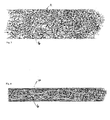
- FIG 2 illustrates a cross-sectional view of a mineral wool batt 8 in which the bicomponent polymeric fibers 6 are interspersed.
- the mineral wool is represented by the short, fine lines and the bicomponent fibers are represented by the large multi-layered tubes.
- the macroscopic bicomponent fibers provide a loft and a continuous structure within a relatively low density, highly open batt structure. The forming of such a batt may be accomplished in a variety of ways.
- An air-forming process may be used, in which the fibers are carried and co-mingled in an air-stream and subsequently deposited on an air-permeable wire conveyer. However, it is preferred that the fiber dispersion and co-mingling processes are not destructive to the mineral fiber.
- An example air-forming process includes that designed by DOA GmbH, in which the fibers are dispersed and mixed in a high velocity air-stream.
- the wet-forming method such as in the papermaking process in which the fibers are dispersed and co-mingled in water and subsequently deposited and de-watered on a wire conveyor may be used.
- Figure 3 depicts the fibrous batt 8 heated above the melting point of the sheath polymer but below the melting point of the inner core polymer.
- the heating process follows the forming process. Heat is applied to the batt to provide a temperature in excess of the melting temperature of the bicomponent sheath.
- the sheath polymer layer melts and flows out into the fiber matrix and binds the mineral wool fibers to one another and to the core polymer fiber that has remained intact as a structural element of the panel. The loft and continuity of the batt is retained and the fibers are bound together.
- the bonded batt may be subjected to a sequential hot and cold plattened pressing. This serves to consolidate the batt further, while smoothing and compressing a porous skin layer 10 onto both sides of the finished panel.
- the hot stage of the pressing re-melts the binder while compressing and smoothing the surfaces.
- the cold stage re-solidifies the binder and sets the panel structure into place.
- the formed acoustical panel may be further embossed with a pattern or design and/or molded into a desired shape or form.
- the term "thermo-formed” is used to describe all such processes where the formed acoustical panel is further processed by the application of heat and/or pressure to either emboss the panel or form it into various shapes or dimensions.
- a sufficiently rigid and self-supporting panel may be formed without the consolidation step when the panel is wet formed.
- Support for the wet formed panel may be created by adding several percentages of pulped newsprint fiber.
- Pulped newsprint fiber may be used to impart rigidity and process wet-web strength in combination with very low bicomponent binder fibers. Additionally, natural fiber additions may also contribute rigidity and self-support. Examples include pulped sisal, hemp, abaca or other cellulosic fibers or cut strands of unpulped fibers in lengths of 1/4 inch or longer. Rigid inorganic fibers such as glass, mineral, and carbon may also be used.
- Chart 1 illustrates example formulations for wet-formed structures:
- the droop length illustrated is the measured horizontal extension length of the sample material out from the edge of a support table, at which the material deflects or "droops" two inches downward and is a relative measure of the material rigidity. Panels with a 20 inch droop length will be self-supporting with minimal downward deflection in standard 2' x 2' and 2' x 4' ceiling support grids.
- the "French Cabin" flamespread test, (NFP 92-50 Epiradiateur test), and the calculated Calorific Values indicate the materials that will comply with the stringent M-O fire resistance performance for France.
- Acoustical wet formed panels having bicomponent binder fibers can provide a low density, highly open, acoustically absorbent structure. There is a significant rebounding expansion of the material in the drying step of the process, and there is no migration of binder to close the surface porosity, such as with starch.
- the combination of newsprint and bicomponent fiber yields even greater wet-web strength and noise reduction coefficient, (NRC), than standard wet-formed mineral fiber products.
- the panels as low as 0.25 lb/ft 2 basis weight and material 1 ⁇ 4 inch thick can be successfully processed.
- the present formed acoustical panel resists humidity induced sag, and can be made by standard Fourdrinier wet-forming techniques. The panels can be heated and formed into curved, shaped or embossed panels.
- Mono-filament polymeric fibers may also be added to the fibrous batt 8 to create the acoustical panels. Panels bound with mono-filament polymer fibers such as polypropylene or polyethylene may be successfully wet formed. Mono-filament polymeric fibers such as polypropylene, polyethylene terepthalate and polyethylene can be applied as binders in wet-formed mineral fiber panels to produce a self-supporting, flame resistant, highly acoustical and thermo-formable panel.
- Granulated polypropylene, polyester, and crosslinkable thermoplastic particulates such as the Wacker VinnexTM core-shell binders may be applied as binders in air-formed acoustical ceiling panels.
- the particulates can be dispersed into airlaid webs.
- the formed batts can be thermally bonded to create highly acoustical soft-fiber panels that can be post-compressed or surface scrimmed for optimal rigidity and self-support. Additionally, particulates can be dispersed in water, flocculated and retained in wet-formed panels and thermally bonded in the drying process of the web.
- latexes may be used as a binder.
- Latexes having a low glass transition temperature, (Tg) such as styrene-butadiene can be applied as binders.
- Latexes having Tg range from about -50°C to about 75°C may be used.
- Layered panels may be either dry formed or wet formed. In the dry-forming process the layering can be accomplished in several ways. Forming units can be placed in tandem along a conveyor forming screen; such commercially available dry-forming processes as the Danweb, A/S and M&J A/S systems capable of forming layered structures of a variety of products for the disposables and hygienic markets. Acoustical panels generally have greater thickness and basis weight than these products. Mineral fibers have significantly higher density than the organic fibers, fillers and absorbents that comprise the disposables. Other dry-forming systems based on lickerin roll/vacuum technology, such as the Laroche S.A and DOA GmbH systems may be used to deliver separate fiber streams to several lickerin-rolls along a conveyed forming screen. Alternatively, preformed non-woven scrims or batts may be unrolled and fed beneath or above a core batt fiber stream and thermally or chemically adhered to each other in a thermal bonding oven.
- wet-forming techniques may be used in separate stock streams to one of several forming head-boxes along a conveyed forming wire, with the application of vacuum dewatering.
- An "Oliver” type vacuum drum or Fourdinier method may be used.
- the multi-layer mineral fiber panel comprises one layer and a second layer which is co-formed or laminated to the other.
- the additional second layer may be comprised of binder of about 0.2% to about 15%.
- the binder may be comprised of bicomponent, low-melt monofilament binder fiber, a thermoplastic particulate, latex or resin binder, a thermosetting particulate, latex or resin binder, a combination thermoplastic/thermosetting particulate, latex, resin binder or a combination thereof.
- the filler may comprise about 85 to about 99.8%.
- the filler may be glass, synthetic polymeric, or natural cellulosic fibers or combinations.
- the second layer may be employed as a facing layer to impart smoothness, homogeneity and surface finish to the product.
- the second layer may also contribute to the rigidity, strength and structural unity of the panel.
- the second layer may also be employed as a backing layer for support, strength and sag resistance and as a barrier to prevent sound from permeating through the product to increase the CAC (ceiling attenuation class) of the panel.
- the facing layer may be low density, permeable, thinner than the first or primary layer, and of a uniform formation and visual quality.
- the backing layer is typically impermeable to air and sound.
- a facing and backing may be co-formed or laminated to a core layer. Structures with more layers are also considered.
- a further method of forming an acoustical panel comprising manufacturing an acoustical panel having at least two mono-filament polymer fibers.
- a first mono-filament polymer fiber and a second mono-filament polymer fiber are combined in a fibrous mix.
- the first polymer fiber has a melting point which is lower than the melting point of the second polymer fiber.
- the lower melting point polymer is intended to bind the surrounding fibers by substantially melting upon heating.
- the higher melting point polymer binds as a substantially unmelted fiber within the fibrous matrix of the panel.
- more than two types of polymer fibers may be used. It is contemplated that multiple polymer fibers having various melting points may be used.
- first and second fibers are combined and then dispersed and mixed with mineral wool fibers in an aqueous mix to form a wet fibrous batt 8.
- the wet fibrous batt 8 is dewatered and heated. Upon heating, the first polymer fiber substantially melts and binds the fibers together to aid in forming the acoustical panel.
- a method for forming an acoustical panel comprising both a dispersible polymer particulate binder and a polymer fiber.
- multiple binders and fibers may be combined in this method.
- the binders and fibers are dispersed and mixed with mineral wool to form a fibrous mix.
- the fibrous mix may then be combined to form a fibrous batt 8 which is then heated to substantially melt the particulate binders within the fibrous batt 8 to form the acoustical panel.
- the humidity sag test used in the present examples was run in 4 cycles. One cycle is 17 hours at 82°F-90%RH, followed by 6 hours at 82°F-35%RH. Typically, the greatest sag deflection is observed during the 4 th cycle 90%RH condition.
- the noise reduction coefficient is determined by the reverberation room test ASTM C423. It averages the amount of sound absorption at 4 critical frequencies. Values range from 0.00 to 1.00.
- FSR is a general indication of flame spread performance and the values for the FSR test were determined under the ASTME84 tunnel test.
- the air-forming system used are designed and manufactured by DOA GmbH in Wels, Austria.
- an Armstrong wet-lay Fourdrinier pilot machine was used. Although there was a difference in the required fiber length of the bicomponent for the wet-lay process, and some difference in the formation quality and surface smoothness of the initial batt, both processes yielded adequately formed batts that compressed to smooth, rigid, self-supporting, durable, acoustical panels.
- Example 1 the material was air-formed by the DOA process.
- the finished compression and smoothing of the panel was accomplished on a Schott & Meissner Thermofix plattened hot/cold stage continuous compression unit.
- the formulation of the formed acoustical panel is listed below: Material Mass% Source Specifications Mineral Wool 70 Armstrong 0.7-1.2 mm length Pontarlier Plant 4-6 micron diameter Bicomponent 30 Leigh Fibers Japanese PET/PET Fiber Spartanburg, SC 110°C sheath melt 4 denier 2 inch length
- Example 2 Furthermore, a standard application of paint was applied to the acoustical panels formed in Example 1. The paint was applied to a very tough and durable fiberglass scrim with which the product is faced. A metal tyne drag test, the "Hess rake" test, is used to measure of the surface scratch resistance of acoustical panels. The painted prototype material Hess rake break through value was 25.
- the binder level was reduced to form a thinner panel.
- the DOA air-lay process and the Thermofix compression unit were employed in this Example.
- One to two inch flax fibers were incorporated into the formulation to provide loft for a reduced density category.
- the chart bellow illustrates the tested results.
- Example 2 Furthermore, an acoustical panel formed in Example 2 was placed over the top of a wire cylinder and heated to 300°F in a convection oven. The panel was able to soften and conform to the shape of the cylinder. Upon cooling, the panel set into a tightly curved panel. No change in panel thickness was encountered.
- Example 3 illustrates forming an acoustical panel by a wet-forming process on a Fourdrinier pilot line and then drying and thermally setting in a continuous convection oven.
- the bicomponent fiber used for this processing was obtained from KoSa Corporation, Charlotte, NC.
- This fiber, designated Cellbond 105 is a polyethelene sheath composition rather than a low melt PET sheath, and is only 1 ⁇ 2 inch long rather than 2 inches long.
- the core is PET.
- the formulations used in Example 3 are illustrated below: Material Mass% Source Specifications Mineral Wool 90 MFS, Bethlehem, 0.7-1.2 mm length PA 4-6 micron diameter Bicomponent Fiber 10 KoSa Fibers Bico PE/PET Charlotte, NC 128°C sheath melt 4 denier 1 ⁇ 2 inch length
- the Cellbond 105 dispersed very uniformly with the mineral wool in water.
- the dispersion dewatered rapidly on the Fourdrinier machine, yielding a reasonably well formed wet-mat that was adequately smoothed with press-rolls.
- No flocculant was required to assist in dewatering and a significantly low moisture content of the wet-mat, (42%), was determined. Of course a flocculant may be used.
- the drain-water was clean and fiber/particle free.
- the wet mats were transferred onto expanded metal screens for support through the roller conveyor of the dryer.
- the material was dried in a belted through-convection oven and it set in approximately 30 minutes at 350°F.
- the resulting batt was observed to be significantly lower in density than a bat of similar formulation made by the air-forming process, 5.6 lb/ft 3 rather than 15-20lb/ft 3 .
- This lower density presumably results from an expansion induced by the evaporation of water.
- the batts were compressed into panels using a static plattened press with top and bottom heated. The compressed batts were removed from the press as rapidly as possible and a cool heavy steel plate was put on top of it to avoid rebounding. Densities of 18-19 lb/ft 3 were achieved and the resulting panels were relatively self-supporting and smooth.
Landscapes
- Engineering & Computer Science (AREA)
- Textile Engineering (AREA)
- Architecture (AREA)
- Physics & Mathematics (AREA)
- Chemical & Material Sciences (AREA)
- Acoustics & Sound (AREA)
- Structural Engineering (AREA)
- Civil Engineering (AREA)
- Inorganic Chemistry (AREA)
- Chemical Kinetics & Catalysis (AREA)
- Wood Science & Technology (AREA)
- Life Sciences & Earth Sciences (AREA)
- Electromagnetism (AREA)
- Mechanical Engineering (AREA)
- Soundproofing, Sound Blocking, And Sound Damping (AREA)
- Nonwoven Fabrics (AREA)
- Building Environments (AREA)
- Laminated Bodies (AREA)
Applications Claiming Priority (2)
| Application Number | Priority Date | Filing Date | Title |
|---|---|---|---|
| US956665 | 2001-09-20 | ||
| US09/956,665 US20030060113A1 (en) | 2001-09-20 | 2001-09-20 | Thermo formable acoustical panel |
Publications (2)
| Publication Number | Publication Date |
|---|---|
| EP1300511A2 true EP1300511A2 (de) | 2003-04-09 |
| EP1300511A3 EP1300511A3 (de) | 2005-02-09 |
Family
ID=25498516
Family Applications (1)
| Application Number | Title | Priority Date | Filing Date |
|---|---|---|---|
| EP20020019435 Withdrawn EP1300511A3 (de) | 2001-09-20 | 2002-08-30 | Thermoformbare Akustikplatte |
Country Status (11)
| Country | Link |
|---|---|
| US (2) | US20030060113A1 (de) |
| EP (1) | EP1300511A3 (de) |
| JP (1) | JP2003140661A (de) |
| KR (1) | KR20030025840A (de) |
| AR (1) | AR036560A1 (de) |
| BR (1) | BR0203822A (de) |
| CA (1) | CA2401062A1 (de) |
| EA (1) | EA200200884A1 (de) |
| MX (1) | MXPA02009192A (de) |
| PL (1) | PL356151A1 (de) |
| TW (1) | TW576885B (de) |
Cited By (42)
| Publication number | Priority date | Publication date | Assignee | Title |
|---|---|---|---|---|
| WO2005080659A1 (en) * | 2004-02-19 | 2005-09-01 | Saint-Gobain Isover | Inorganic fiber insulation |
| WO2006124305A1 (en) * | 2005-05-17 | 2006-11-23 | Milliken & Company | Non-woven material with barrier skin |
| WO2007008663A3 (en) * | 2005-07-11 | 2007-05-18 | Owens Corning Fiberglass Corp | Glass/polymer reinforcement backing for siding and compression packaging of siding backed with glass/polymer reinforcement |
| WO2007008660A3 (en) * | 2005-07-11 | 2007-07-19 | Owens Corning Fiberglass Corp | Polymer/wucs mat and method of forming same |
| WO2007101624A1 (de) * | 2006-03-03 | 2007-09-13 | W.L. Gore & Associates Gmbh | Schuhstabilisierungsmaterial und aufgebaut damit barriereeinheit, schuhsohlenverbund und schuhwerk |
| WO2008039239A1 (en) * | 2006-09-27 | 2008-04-03 | Milliken & Company | Non-woven material with barrier skin |
| WO2008027207A3 (en) * | 2006-08-29 | 2008-04-24 | Owens Corning Intellectual Cap | Reinforced acoustical material having high strength, high modulus properties |
| WO2008054583A1 (en) | 2006-10-27 | 2008-05-08 | Milliken & Company | Non-woven composite |
| US7446065B2 (en) | 2004-05-07 | 2008-11-04 | Milliken & Company | Heat and flame shield |
| FR2935012A1 (fr) * | 2008-08-12 | 2010-02-19 | Cermix | Revetement de sol, constitue d'une couche en ceramique, c'est-a-dire un carrelage ou similaire, et d'une sous-couche d'isolation phonique a base de fibres |
| RU2393748C2 (ru) * | 2006-03-03 | 2010-07-10 | В. Л. Горе Унд Ассошиэйтс Гмбх | Стабилизирующий обувь материал и выполненные с ним барьерный модуль, обувной подошвенный узел и обувь |
| WO2011053955A3 (en) * | 2009-11-02 | 2011-11-24 | The Procter & Gamble Company | Fibrous structures that exhibit consumer relevant property values |
| US8142886B2 (en) | 2007-07-24 | 2012-03-27 | Howmedica Osteonics Corp. | Porous laser sintered articles |
| GB2484545A (en) * | 2010-10-15 | 2012-04-18 | Glenn Williams | Panel comprising sustainable material |
| WO2012103966A1 (en) * | 2011-01-31 | 2012-08-09 | Rockwool International A/S | Method for manufacturing a mineral fibre-containing element and element produced by that method |
| EP2122054A4 (de) * | 2007-01-10 | 2012-08-29 | Federal Mogul Powertrain Inc | Vliestafel und konstruktionsverfahren dafür |
| US8268100B2 (en) | 2002-11-08 | 2012-09-18 | Howmedica Osteonics Corp. | Laser-produced porous surface |
| US8353344B2 (en) | 2007-12-14 | 2013-01-15 | 3M Innovative Properties Company | Fiber aggregate |
| CN101421453B (zh) * | 2006-03-03 | 2013-01-16 | W.L.戈尔有限公司 | 鞋稳定材料和以此制造的阻挡单元,复合鞋底和鞋 |
| WO2013052270A1 (en) * | 2011-10-03 | 2013-04-11 | Usg Interiors, Llc | Improved distribution of starch in composition of building products |
| US8852474B2 (en) | 2007-07-17 | 2014-10-07 | The Procter & Gamble Company | Process for making fibrous structures |
| EP2048295A3 (de) * | 2007-10-09 | 2014-10-29 | HOMATHERM GmbH | Holzfaser-Wärmedämmmaterial und Verfahren für desen Herstellung |
| EP2889406A1 (de) * | 2013-12-24 | 2015-07-01 | Armstrong World Industries, Inc. | Akustische Platten mit niedriger Dichte |
| US9135374B2 (en) | 2012-04-06 | 2015-09-15 | Howmedica Osteonics Corp. | Surface modified unit cell lattice structures for optimized secure freeform fabrication |
| US9180010B2 (en) | 2012-04-06 | 2015-11-10 | Howmedica Osteonics Corp. | Surface modified unit cell lattice structures for optimized secure freeform fabrication |
| EP2963199A1 (de) | 2014-07-01 | 2016-01-06 | akustik & innovation gmbh | Schalldämmende platte |
| US9456901B2 (en) | 2004-12-30 | 2016-10-04 | Howmedica Osteonics Corp. | Laser-produced porous structure |
| US9458573B2 (en) | 2009-11-02 | 2016-10-04 | The Procter & Gamble Company | Fibrous structures and methods for making same |
| US9631321B2 (en) | 2010-03-31 | 2017-04-25 | The Procter & Gamble Company | Absorptive fibrous structures |
| US10024000B2 (en) | 2007-07-17 | 2018-07-17 | The Procter & Gamble Company | Fibrous structures and methods for making same |
| IT201700023953A1 (it) * | 2017-03-03 | 2018-09-03 | Anton Ebner | Procedimento per la realizzazione di un sistema per costruzioni fonoassorbente e pannelli per realizzare detto sistema |
| US10398559B2 (en) | 2005-12-06 | 2019-09-03 | Howmedica Osteonics Corp. | Laser-produced porous surface |
| WO2020226596A1 (en) * | 2019-05-09 | 2020-11-12 | Dalsan Yatirim Ve Enerji Anonim Sirketi | Production method of a thermal insulation board and a thermal insulation board produced by this method |
| US10858785B2 (en) | 2007-07-17 | 2020-12-08 | The Procter & Gamble Company | Fibrous structures and methods for making same |
| US10895022B2 (en) | 2009-11-02 | 2021-01-19 | The Procter & Gamble Company | Fibrous elements and fibrous structures employing same |
| IT202000017005A1 (it) * | 2020-07-14 | 2022-01-14 | Consiglio Nazionale Ricerche | Procedimento per la degradazione di cellulosa da assorbenti igienici e pannolini e per la produzione di feltro e materiali isolanti |
| US11298747B2 (en) | 2017-05-18 | 2022-04-12 | Howmedica Osteonics Corp. | High fatigue strength porous structure |
| SE2051429A1 (en) * | 2020-12-08 | 2022-06-09 | Stora Enso Oyj | Sound absorbing or damping air-laid blank |
| US11414798B2 (en) | 2007-07-17 | 2022-08-16 | The Procter & Gamble Company | Fibrous structures |
| IT202100012008A1 (it) | 2021-05-11 | 2022-11-11 | Anton Ebner | Sistema costruttivo fonoassorbente |
| EP4379135A1 (de) * | 2022-12-01 | 2024-06-05 | Impact Acoustic AG | Verfahren zur herstellung einer schalldämmenden platte |
| WO2025137339A1 (en) * | 2023-12-19 | 2025-06-26 | Armstrong World Industries, Inc. | Acoustic felt structures and methods of making the same |
Families Citing this family (60)
| Publication number | Priority date | Publication date | Assignee | Title |
|---|---|---|---|---|
| US20040028958A1 (en) * | 2002-06-18 | 2004-02-12 | Total Innovative Manufacturing Llc | Recyclable fire-resistant moldable batt and panels formed therefrom |
| US20070060005A1 (en) * | 2001-09-06 | 2007-03-15 | Certainteed Corporation | Insulation product from rotary and textile inorganic fibers with improved binder component and method of making same |
| US20040163724A1 (en) * | 2001-09-06 | 2004-08-26 | Mark Trabbold | Formaldehyde-free duct liner |
| CA2483709C (en) * | 2002-04-22 | 2009-10-13 | Lydall, Inc. | Gradient density padding material and method of making same |
| US6729807B1 (en) * | 2002-11-07 | 2004-05-04 | Profile Products L.L.C. | Integral lofty polymer grid and fiber web matrix turf reinforcement mats |
| US20070163042A1 (en) * | 2003-02-14 | 2007-07-19 | Baldwin Timothy S | Articles of stabilized fibrous construction material |
| RU2360883C2 (ru) * | 2003-03-19 | 2009-07-10 | Юнайтед Стейтс Джипсум Компани | Акустическая панель, содержащая переплетенную фиксированную матрицу из затвердевшего гипса, и способ ее изготовления |
| US20050032452A1 (en) * | 2003-08-07 | 2005-02-10 | Helwig Gregory S. | Conformable surfacing veil or reinforcement mat |
| US20050266757A1 (en) * | 2003-10-17 | 2005-12-01 | Roekens Bertrand J | Static free wet use chopped strands (WUCS) for use in a dry laid process |
| US20080251187A1 (en) * | 2003-10-17 | 2008-10-16 | Enamul Haque | Composite material with improved structural, acoustic and thermal properties |
| US7521386B2 (en) | 2004-02-07 | 2009-04-21 | Milliken & Company | Moldable heat shield |
| DE102004011931B4 (de) * | 2004-03-11 | 2006-09-14 | Kronotec Ag | Dämmstoffplatte aus einem Holzwerkstoff-Bindemittelfaser-Gemisch |
| US8567117B2 (en) * | 2004-10-04 | 2013-10-29 | Profile Products, Llc | Netless fiber mulch mats bound with bicomponent fibers |
| US7279059B2 (en) * | 2004-12-28 | 2007-10-09 | Owens Corning Intellectual Capital, Llc | Polymer/WUCS mat for use in automotive applications |
| US20060137799A1 (en) * | 2004-12-29 | 2006-06-29 | Enamul Haque | Thermoplastic composites with improved sound absorbing capabilities |
| US7252729B2 (en) * | 2004-12-29 | 2007-08-07 | Owens-Corning Fiberglas Technology Inc. | Polymer/WUCS mat for use in sheet molding compounds |
| JP5215841B2 (ja) * | 2005-04-05 | 2013-06-19 | クヴァドラント・プラスティック・コンポジッツ・アクチェンゲゼルシャフト | 熱可塑的変形繊維により強化された半製品の製造方法 |
| US20060246797A1 (en) * | 2005-04-27 | 2006-11-02 | Rabasco John J | Sound absorbing laminates |
| US7428803B2 (en) | 2005-05-17 | 2008-09-30 | Milliken & Company | Ceiling panel system with non-woven panels having barrier skins |
| US8182922B2 (en) * | 2005-08-24 | 2012-05-22 | Usg Interiors, Llc | Composite ceiling tile |
| CA2535801C (en) * | 2006-02-09 | 2012-11-27 | Canadian Forest Products Ltd. | A blended mulch product, an erosion control medium and methods of making same |
| US8555544B2 (en) | 2006-02-10 | 2013-10-15 | Profile Products L.L.C. | Visual attenuation compositions and methods of using the same |
| CA2536538A1 (en) * | 2006-02-14 | 2007-08-14 | Canadian Forest Products Ltd. | Blended mulch products for spray application to a surface |
| US20080045101A1 (en) * | 2006-08-18 | 2008-02-21 | Near Shannon D | Decorative dual scrim composite panel |
| KR100824703B1 (ko) * | 2006-11-29 | 2008-04-24 | (주)에이피엠티 | 난연성 경량의 적층흡음시트 |
| US8454795B1 (en) | 2006-12-05 | 2013-06-04 | Mark J. Henderson | System and method for producing bonded fiber/cellulose products |
| US8256158B2 (en) | 2007-01-04 | 2012-09-04 | Profile Products Llc | Visual attenuation compositions and methods of using the same |
| US20110189911A1 (en) * | 2007-01-10 | 2011-08-04 | Ritesh Mehbubani | High loft nonwoven sheet material and method of construction thereof |
| KR100807285B1 (ko) * | 2007-09-14 | 2008-02-28 | 박공영 | 폴리에스테르 단섬유를 사용한 식생기반체 및 그 생산방법 |
| CN101903453B (zh) | 2007-12-14 | 2013-11-06 | 普拉德研究及开发股份有限公司 | 支撑剂及其应用 |
| BRPI0821118B1 (pt) | 2007-12-14 | 2018-11-06 | Prad Research And Development Limited | método de completar um poço, método de tratar uma formação subterrânea interceptada por um poço, utilizando aditivos mutáveis, e método |
| US8133354B2 (en) * | 2008-01-04 | 2012-03-13 | USG Interiors, LLC. | Acoustic ceiling tiles made with paper processing waste |
| KR100955012B1 (ko) * | 2008-01-31 | 2010-04-27 | 주식회사 아이자 | 베갯속의 제조방법 |
| US20090252941A1 (en) * | 2008-04-03 | 2009-10-08 | Usg Interiors, Inc. | Non-woven material and method of making such material |
| US8563449B2 (en) * | 2008-04-03 | 2013-10-22 | Usg Interiors, Llc | Non-woven material and method of making such material |
| US8181408B1 (en) * | 2008-11-17 | 2012-05-22 | Triglia Joseph P | Method to manufacture paneling or flooring strips from wooden barrel staves |
| US8062565B2 (en) * | 2009-06-18 | 2011-11-22 | Usg Interiors, Inc. | Low density non-woven material useful with acoustic ceiling tile products |
| CN102985388A (zh) * | 2009-10-02 | 2013-03-20 | 尤尼弗瑞克斯I有限责任公司 | 超低重量隔热板 |
| US9364896B2 (en) | 2012-02-07 | 2016-06-14 | Medical Modeling Inc. | Fabrication of hybrid solid-porous medical implantable devices with electron beam melting technology |
| US9689097B2 (en) | 2012-05-31 | 2017-06-27 | Wm. T. Burnett Ip, Llc | Nonwoven composite fabric and panel made therefrom |
| US8734613B1 (en) * | 2013-07-05 | 2014-05-27 | Usg Interiors, Llc | Glass fiber enhanced mineral wool based acoustical tile |
| GB201420676D0 (en) * | 2014-11-20 | 2015-01-07 | Bpb Ltd | Construction panel having improved fixing strength |
| CA2915610C (en) * | 2014-12-17 | 2021-03-30 | James R. Keene | Roof ventilation system and method |
| US9909310B2 (en) * | 2016-01-14 | 2018-03-06 | Usg Interiors, Llc | Mineral fiber based ceiling tile |
| US10632936B2 (en) | 2017-05-11 | 2020-04-28 | Ford Global Technologies, Llc | Extrusion grade perlite reinforced polypropylene polymer |
| EP3444086B1 (de) * | 2017-08-16 | 2022-02-23 | SWISS KRONO Tec AG | Multifunktionsplatte aus holz- und bicomponentenfasern und verfahren zum herstellen einer multifunktionsplatte |
| US11111174B2 (en) | 2017-09-13 | 2021-09-07 | United States Gypsum Company | Mineral fiber roof cover boards |
| CA3075644A1 (en) | 2017-10-09 | 2019-04-18 | Owens Corning Intellectual Capital, Llc | Aqueous binder compositions |
| US11111372B2 (en) | 2017-10-09 | 2021-09-07 | Owens Corning Intellectual Capital, Llc | Aqueous binder compositions |
| WO2019104224A1 (en) | 2017-11-21 | 2019-05-31 | Nut Shell LLC | Multi-layer acoustic medium |
| US20200054975A1 (en) * | 2018-08-20 | 2020-02-20 | Hollingsworth & Vose Company | Filter media comprising binder components |
| WO2020210191A1 (en) | 2019-04-09 | 2020-10-15 | Owens Corning Intellectual Capital, Llc | Insulation products formed with aqueous binder compositions |
| AU2020270841A1 (en) | 2019-04-09 | 2021-12-02 | Owens Corning Intellectual Capital, Llc | Aqueous binder compositions |
| US11731391B2 (en) | 2019-05-23 | 2023-08-22 | Awi Licensing Llc | Fire resistant low density acoustic panel |
| WO2021003219A1 (en) * | 2019-07-01 | 2021-01-07 | Armstrong World Industries, Inc. | Sag-resistant acoustic board |
| CN114787261B (zh) | 2019-12-09 | 2024-06-14 | 欧文斯科宁知识产权资产有限公司 | 玻璃纤维绝缘产品 |
| US11813833B2 (en) | 2019-12-09 | 2023-11-14 | Owens Corning Intellectual Capital, Llc | Fiberglass insulation product |
| KR20230082034A (ko) | 2020-10-01 | 2023-06-08 | 오웬스 코닝 인텔렉츄얼 캐피탈 엘엘씨 | B-스테이지 가능한 수성 결합제 조성물 |
| AU2022284877A1 (en) | 2021-06-04 | 2023-11-02 | Owens Corning Intellectual Capital, Llc | Fine fiber insulation products with improved thermal properties |
| CN114703601A (zh) * | 2021-12-03 | 2022-07-05 | 东华大学 | 一种具有分形孔道结构的纤维保暖絮片及其制备方法 |
Family Cites Families (11)
| Publication number | Priority date | Publication date | Assignee | Title |
|---|---|---|---|---|
| US4957809A (en) * | 1985-12-02 | 1990-09-18 | Sheller-Globe Corporation | Fiber web for compression molding structural substrates for panels |
| US4889764A (en) * | 1987-05-22 | 1989-12-26 | Guardian Industries Corp. | Non-woven fibrous product |
| US4840832A (en) * | 1987-06-23 | 1989-06-20 | Collins & Aikman Corporation | Molded automobile headliner |
| US4826724A (en) * | 1988-06-10 | 1989-05-02 | Manville Corporation | Moldable fibrous mat |
| US4963603A (en) * | 1989-05-24 | 1990-10-16 | Armstrong World Industries, Inc. | Composite fiberboard and process of manufacture |
| US5614312A (en) * | 1993-05-07 | 1997-03-25 | E. I. Du Pont De Nemours And Company | Wet-laid sheet material and composites thereof |
| US5490961A (en) * | 1993-06-21 | 1996-02-13 | Owens-Corning Fiberglas Technology, Inc. | Method for manufacturing a mineral fiber product |
| US5491186A (en) * | 1995-01-18 | 1996-02-13 | Kean; James H. | Bonded insulating batt |
| DE19807821C2 (de) * | 1998-02-26 | 2003-11-13 | Jps Int Ab Goeteborg | Verfahren zum Herstellen eines Dämmstoffs aus Pflanzenfasern |
| AU7719700A (en) * | 1999-09-27 | 2001-04-30 | Owens Corning | Making a fibrous insulation product using a multicomponent polymer binder fiber |
| WO2001031131A1 (en) * | 1999-10-29 | 2001-05-03 | Owens Corning | Fibrous acoustical insulation product |
-
2001
- 2001-09-20 US US09/956,665 patent/US20030060113A1/en not_active Abandoned
-
2002
- 2002-08-30 TW TW91119827A patent/TW576885B/zh not_active IP Right Cessation
- 2002-08-30 EP EP20020019435 patent/EP1300511A3/de not_active Withdrawn
- 2002-09-03 CA CA 2401062 patent/CA2401062A1/en not_active Abandoned
- 2002-09-11 JP JP2002266146A patent/JP2003140661A/ja not_active Withdrawn
- 2002-09-18 KR KR1020020056953A patent/KR20030025840A/ko not_active Withdrawn
- 2002-09-19 EA EA200200884A patent/EA200200884A1/ru unknown
- 2002-09-19 PL PL35615102A patent/PL356151A1/xx not_active Application Discontinuation
- 2002-09-19 AR ARP020103534 patent/AR036560A1/es not_active Application Discontinuation
- 2002-09-20 BR BR0203822A patent/BR0203822A/pt not_active Application Discontinuation
- 2002-09-20 MX MXPA02009192A patent/MXPA02009192A/es unknown
- 2002-11-12 US US10/293,395 patent/US20030134556A1/en not_active Abandoned
Cited By (70)
| Publication number | Priority date | Publication date | Assignee | Title |
|---|---|---|---|---|
| US10525688B2 (en) | 2002-11-08 | 2020-01-07 | Howmedica Osteonics Corp. | Laser-produced porous surface |
| US8992703B2 (en) | 2002-11-08 | 2015-03-31 | Howmedica Osteonics Corp. | Laser-produced porous surface |
| US11155073B2 (en) | 2002-11-08 | 2021-10-26 | Howmedica Osteonics Corp. | Laser-produced porous surface |
| US8268100B2 (en) | 2002-11-08 | 2012-09-18 | Howmedica Osteonics Corp. | Laser-produced porous surface |
| US11186077B2 (en) | 2002-11-08 | 2021-11-30 | Howmedica Osteonics Corp. | Laser-produced porous surface |
| US11510783B2 (en) | 2002-11-08 | 2022-11-29 | Howmedica Osteonics Corp. | Laser-produced porous surface |
| WO2005080659A1 (en) * | 2004-02-19 | 2005-09-01 | Saint-Gobain Isover | Inorganic fiber insulation |
| US7446065B2 (en) | 2004-05-07 | 2008-11-04 | Milliken & Company | Heat and flame shield |
| US7454817B2 (en) | 2004-05-07 | 2008-11-25 | Milliken & Company | Heat and flame shield |
| US9456901B2 (en) | 2004-12-30 | 2016-10-04 | Howmedica Osteonics Corp. | Laser-produced porous structure |
| US11660195B2 (en) | 2004-12-30 | 2023-05-30 | Howmedica Osteonics Corp. | Laser-produced porous structure |
| US7341963B2 (en) | 2005-05-17 | 2008-03-11 | Milliken & Company | Non-woven material with barrier skin |
| US7709405B2 (en) | 2005-05-17 | 2010-05-04 | Milliken & Company | Non-woven composite |
| WO2006124305A1 (en) * | 2005-05-17 | 2006-11-23 | Milliken & Company | Non-woven material with barrier skin |
| WO2007008660A3 (en) * | 2005-07-11 | 2007-07-19 | Owens Corning Fiberglass Corp | Polymer/wucs mat and method of forming same |
| WO2007008663A3 (en) * | 2005-07-11 | 2007-05-18 | Owens Corning Fiberglass Corp | Glass/polymer reinforcement backing for siding and compression packaging of siding backed with glass/polymer reinforcement |
| US8069629B2 (en) | 2005-07-11 | 2011-12-06 | Certainteed Corporation | Process for manufacturing insulated siding |
| US10398559B2 (en) | 2005-12-06 | 2019-09-03 | Howmedica Osteonics Corp. | Laser-produced porous surface |
| US10716673B2 (en) | 2005-12-06 | 2020-07-21 | Howmedica Osteonics Corp. | Laser-produced porous surface |
| US12011355B2 (en) | 2005-12-06 | 2024-06-18 | Howmedica Osteonics Corp. | Laser-produced porous surface |
| US11918474B2 (en) | 2005-12-06 | 2024-03-05 | The University Of Liverpool | Laser-produced porous surface |
| WO2007101624A1 (de) * | 2006-03-03 | 2007-09-13 | W.L. Gore & Associates Gmbh | Schuhstabilisierungsmaterial und aufgebaut damit barriereeinheit, schuhsohlenverbund und schuhwerk |
| CN101421453B (zh) * | 2006-03-03 | 2013-01-16 | W.L.戈尔有限公司 | 鞋稳定材料和以此制造的阻挡单元,复合鞋底和鞋 |
| KR101229018B1 (ko) * | 2006-03-03 | 2013-02-01 | 더블유.엘.고어 앤드 어소시에이츠 게엠베하 | 섬유 복합체, 및 이로 구성된 배리어 유닛, 복합체 슈즈 밑창, 및 신발 |
| AU2007222643B2 (en) * | 2006-03-03 | 2011-07-28 | W.L. Gore & Associates Gmbh | Shoe reinforcing material and barrier unit, composite shoe sole and footwear constituted thereof |
| RU2393748C2 (ru) * | 2006-03-03 | 2010-07-10 | В. Л. Горе Унд Ассошиэйтс Гмбх | Стабилизирующий обувь материал и выполненные с ним барьерный модуль, обувной подошвенный узел и обувь |
| WO2008027207A3 (en) * | 2006-08-29 | 2008-04-24 | Owens Corning Intellectual Cap | Reinforced acoustical material having high strength, high modulus properties |
| WO2008039239A1 (en) * | 2006-09-27 | 2008-04-03 | Milliken & Company | Non-woven material with barrier skin |
| WO2008054583A1 (en) | 2006-10-27 | 2008-05-08 | Milliken & Company | Non-woven composite |
| EP2122054A4 (de) * | 2007-01-10 | 2012-08-29 | Federal Mogul Powertrain Inc | Vliestafel und konstruktionsverfahren dafür |
| US10858785B2 (en) | 2007-07-17 | 2020-12-08 | The Procter & Gamble Company | Fibrous structures and methods for making same |
| US11414798B2 (en) | 2007-07-17 | 2022-08-16 | The Procter & Gamble Company | Fibrous structures |
| US8852474B2 (en) | 2007-07-17 | 2014-10-07 | The Procter & Gamble Company | Process for making fibrous structures |
| US9926648B2 (en) | 2007-07-17 | 2018-03-27 | The Procter & Gamble Company | Process for making fibrous structures |
| US10024000B2 (en) | 2007-07-17 | 2018-07-17 | The Procter & Gamble Company | Fibrous structures and methods for making same |
| US8142886B2 (en) | 2007-07-24 | 2012-03-27 | Howmedica Osteonics Corp. | Porous laser sintered articles |
| EP2048295A3 (de) * | 2007-10-09 | 2014-10-29 | HOMATHERM GmbH | Holzfaser-Wärmedämmmaterial und Verfahren für desen Herstellung |
| US8353344B2 (en) | 2007-12-14 | 2013-01-15 | 3M Innovative Properties Company | Fiber aggregate |
| FR2935012A1 (fr) * | 2008-08-12 | 2010-02-19 | Cermix | Revetement de sol, constitue d'une couche en ceramique, c'est-a-dire un carrelage ou similaire, et d'une sous-couche d'isolation phonique a base de fibres |
| US9458573B2 (en) | 2009-11-02 | 2016-10-04 | The Procter & Gamble Company | Fibrous structures and methods for making same |
| US11618977B2 (en) | 2009-11-02 | 2023-04-04 | The Procter & Gamble Company | Fibrous elements and fibrous structures employing same |
| WO2011053955A3 (en) * | 2009-11-02 | 2011-11-24 | The Procter & Gamble Company | Fibrous structures that exhibit consumer relevant property values |
| US10895022B2 (en) | 2009-11-02 | 2021-01-19 | The Procter & Gamble Company | Fibrous elements and fibrous structures employing same |
| US9631321B2 (en) | 2010-03-31 | 2017-04-25 | The Procter & Gamble Company | Absorptive fibrous structures |
| GB2484545A (en) * | 2010-10-15 | 2012-04-18 | Glenn Williams | Panel comprising sustainable material |
| US9221965B2 (en) | 2011-01-31 | 2015-12-29 | Rockwool International A/S | Method for manufacturing a mineral fibre-containing element and element produced by that method |
| RU2542545C1 (ru) * | 2011-01-31 | 2015-02-20 | Роквул Интернэшнл А/С | Способ изготовления элемента, содержащего минеральное волокно, и элемент, изготовленный этим способом |
| WO2012103966A1 (en) * | 2011-01-31 | 2012-08-09 | Rockwool International A/S | Method for manufacturing a mineral fibre-containing element and element produced by that method |
| WO2013052270A1 (en) * | 2011-10-03 | 2013-04-11 | Usg Interiors, Llc | Improved distribution of starch in composition of building products |
| US11759323B2 (en) | 2012-04-06 | 2023-09-19 | Howmedica Osteonics Corp. | Surface modified unit cell lattice structures for optimized secure freeform fabrication |
| US10614176B2 (en) | 2012-04-06 | 2020-04-07 | Howmedica Osteonics Corp. | Surface modified unit cell lattice structures for optimized secure freeform fabrication |
| US12102538B2 (en) | 2012-04-06 | 2024-10-01 | Howmedica Osteonics Corp. | Surface modified unit cell lattice structures for optimized secure freeform fabrication |
| US9135374B2 (en) | 2012-04-06 | 2015-09-15 | Howmedica Osteonics Corp. | Surface modified unit cell lattice structures for optimized secure freeform fabrication |
| US9180010B2 (en) | 2012-04-06 | 2015-11-10 | Howmedica Osteonics Corp. | Surface modified unit cell lattice structures for optimized secure freeform fabrication |
| EP2889406A1 (de) * | 2013-12-24 | 2015-07-01 | Armstrong World Industries, Inc. | Akustische Platten mit niedriger Dichte |
| EP2963199B1 (de) | 2014-07-01 | 2021-04-07 | akustik & innovation gmbh | Schalldämmende platte |
| EP2963199A1 (de) | 2014-07-01 | 2016-01-06 | akustik & innovation gmbh | Schalldämmende platte |
| IT201700023953A1 (it) * | 2017-03-03 | 2018-09-03 | Anton Ebner | Procedimento per la realizzazione di un sistema per costruzioni fonoassorbente e pannelli per realizzare detto sistema |
| US11684478B2 (en) | 2017-05-18 | 2023-06-27 | Howmedica Osteonics Corp. | High fatigue strength porous structure |
| US11298747B2 (en) | 2017-05-18 | 2022-04-12 | Howmedica Osteonics Corp. | High fatigue strength porous structure |
| WO2020226596A1 (en) * | 2019-05-09 | 2020-11-12 | Dalsan Yatirim Ve Enerji Anonim Sirketi | Production method of a thermal insulation board and a thermal insulation board produced by this method |
| EP3940130A1 (de) | 2020-07-14 | 2022-01-19 | Consiglio Nazionale Delle Ricerche | Verfahren zur degradierung von zellulose aus hygienischen absorbenten und windeln und zur herstellung von filz- und dämpfungsmaterialien |
| IT202000017005A1 (it) * | 2020-07-14 | 2022-01-14 | Consiglio Nazionale Ricerche | Procedimento per la degradazione di cellulosa da assorbenti igienici e pannolini e per la produzione di feltro e materiali isolanti |
| SE544593C2 (en) * | 2020-12-08 | 2022-09-20 | Stora Enso Oyj | Sound absorbing or damping air-laid blank |
| WO2022123439A1 (en) * | 2020-12-08 | 2022-06-16 | Stora Enso Oyj | Air-laid blank for sound absorbing or damping, and methods and apparatuses for producing such |
| SE2051429A1 (en) * | 2020-12-08 | 2022-06-09 | Stora Enso Oyj | Sound absorbing or damping air-laid blank |
| EP4089247A1 (de) | 2021-05-11 | 2022-11-16 | Anton Ebner | Schallabsorbierendes bausystem |
| IT202100012008A1 (it) | 2021-05-11 | 2022-11-11 | Anton Ebner | Sistema costruttivo fonoassorbente |
| EP4379135A1 (de) * | 2022-12-01 | 2024-06-05 | Impact Acoustic AG | Verfahren zur herstellung einer schalldämmenden platte |
| WO2025137339A1 (en) * | 2023-12-19 | 2025-06-26 | Armstrong World Industries, Inc. | Acoustic felt structures and methods of making the same |
Also Published As
| Publication number | Publication date |
|---|---|
| TW576885B (en) | 2004-02-21 |
| AR036560A1 (es) | 2004-09-15 |
| CA2401062A1 (en) | 2003-03-20 |
| KR20030025840A (ko) | 2003-03-29 |
| JP2003140661A (ja) | 2003-05-16 |
| EP1300511A3 (de) | 2005-02-09 |
| EA200200884A1 (ru) | 2003-06-26 |
| BR0203822A (pt) | 2003-06-03 |
| US20030060113A1 (en) | 2003-03-27 |
| US20030134556A1 (en) | 2003-07-17 |
| PL356151A1 (en) | 2003-03-24 |
| MXPA02009192A (es) | 2004-12-13 |
Similar Documents
| Publication | Publication Date | Title |
|---|---|---|
| EP1300511A2 (de) | Thermoformbare Akustikplatte | |
| KR101676351B1 (ko) | 부직포 재료 및 이와 같은 재료를 제조하는 방법 | |
| KR101609567B1 (ko) | 부직포 재료 및 이와 같은 재료를 제조하는 방법 | |
| US8118177B2 (en) | Non-woven webs and methods of manufacturing the same | |
| EP2464796B1 (de) | Vliesmaterial mit geringer dichte mit akustischen deckenfliesenprodukten | |
| EP1710076B1 (de) | Mehrschichtiger Vliesstoff Laminat und Verfahren zur Herstellung des Laminats | |
| CN101163827A (zh) | 具有改进的吸声性能的热塑性复合材料 | |
| CA2637828A1 (en) | Industrial hemp low-density fiberboard | |
| HK1053682A (en) | Thermo formable acoustical panel | |
| TWI532899B (zh) | 適於隔音天花板瓷磚產品的低密度不織布材料及形成隔音天花板瓷磚之方法 | |
| HK1151326A (en) | Non-woven material and method of making such material | |
| KR20050050848A (ko) | 건축용 흡차음 단열재의 제조방법 |
Legal Events
| Date | Code | Title | Description |
|---|---|---|---|
| PUAI | Public reference made under article 153(3) epc to a published international application that has entered the european phase |
Free format text: ORIGINAL CODE: 0009012 |
|
| AK | Designated contracting states |
Kind code of ref document: A2 Designated state(s): AT BE BG CH CY CZ DE DK EE ES FI FR GB GR IE IT LI LU MC NL PT SE SK TR Designated state(s): AT BE BG CH CY CZ DE DK EE ES FI FR GB GR IE IT LI LU MC NL PT SE SK TR |
|
| AX | Request for extension of the european patent |
Extension state: AL LT LV MK RO SI |
|
| PUAL | Search report despatched |
Free format text: ORIGINAL CODE: 0009013 |
|
| AK | Designated contracting states |
Kind code of ref document: A3 Designated state(s): AT BE BG CH CY CZ DE DK EE ES FI FR GB GR IE IT LI LU MC NL PT SE SK TR |
|
| AX | Request for extension of the european patent |
Extension state: AL LT LV MK RO SI |
|
| RIC1 | Information provided on ipc code assigned before grant |
Ipc: 7E 04B 1/90 B Ipc: 7E 04B 1/86 B Ipc: 7D 04H 13/00 B Ipc: 7D 04H 1/60 B Ipc: 7D 04H 1/54 B Ipc: 7D 21H 25/04 B Ipc: 7D 21H 13/40 B Ipc: 7D 21H 15/10 A |
|
| AKX | Designation fees paid | ||
| REG | Reference to a national code |
Ref country code: DE Ref legal event code: 8566 |
|
| STAA | Information on the status of an ep patent application or granted ep patent |
Free format text: STATUS: THE APPLICATION IS DEEMED TO BE WITHDRAWN |
|
| 18D | Application deemed to be withdrawn |
Effective date: 20050810 |
|
| REG | Reference to a national code |
Ref country code: HK Ref legal event code: WD Ref document number: 1053682 Country of ref document: HK |