EP1301523B1 - Bases de purine presentant une liaison n8 et c8 et heterocycles de structure apparentee en tant que nucleosides universels utilises pour une hybridation d'oligonucleotides - Google Patents
Bases de purine presentant une liaison n8 et c8 et heterocycles de structure apparentee en tant que nucleosides universels utilises pour une hybridation d'oligonucleotides Download PDFInfo
- Publication number
- EP1301523B1 EP1301523B1 EP01919395A EP01919395A EP1301523B1 EP 1301523 B1 EP1301523 B1 EP 1301523B1 EP 01919395 A EP01919395 A EP 01919395A EP 01919395 A EP01919395 A EP 01919395A EP 1301523 B1 EP1301523 B1 EP 1301523B1
- Authority
- EP
- European Patent Office
- Prior art keywords
- group
- alkyl
- nucleic acid
- acid binding
- binding compound
- Prior art date
- Legal status (The legal status is an assumption and is not a legal conclusion. Google has not performed a legal analysis and makes no representation as to the accuracy of the status listed.)
- Expired - Lifetime
Links
- 0 *C[C@@](C(C1)O)O[C@]1[n]1nc2ncnc([*+])c2c1 Chemical compound *C[C@@](C(C1)O)O[C@]1[n]1nc2ncnc([*+])c2c1 0.000 description 6
- MBXRWVRBXWGOEU-SSHYPLHYSA-N NC1NC=NC2N(CC(CO[C@@H]3CO)=C3O)N=CC12 Chemical compound NC1NC=NC2N(CC(CO[C@@H]3CO)=C3O)N=CC12 MBXRWVRBXWGOEU-SSHYPLHYSA-N 0.000 description 1
Images






Classifications
-
- C—CHEMISTRY; METALLURGY
- C07—ORGANIC CHEMISTRY
- C07H—SUGARS; DERIVATIVES THEREOF; NUCLEOSIDES; NUCLEOTIDES; NUCLEIC ACIDS
- C07H19/00—Compounds containing a hetero ring sharing one ring hetero atom with a saccharide radical; Nucleosides; Mononucleotides; Anhydro-derivatives thereof
- C07H19/02—Compounds containing a hetero ring sharing one ring hetero atom with a saccharide radical; Nucleosides; Mononucleotides; Anhydro-derivatives thereof sharing nitrogen
- C07H19/04—Heterocyclic radicals containing only nitrogen atoms as ring hetero atom
- C07H19/06—Pyrimidine radicals
- C07H19/10—Pyrimidine radicals with the saccharide radical esterified by phosphoric or polyphosphoric acids
-
- C—CHEMISTRY; METALLURGY
- C07—ORGANIC CHEMISTRY
- C07H—SUGARS; DERIVATIVES THEREOF; NUCLEOSIDES; NUCLEOTIDES; NUCLEIC ACIDS
- C07H19/00—Compounds containing a hetero ring sharing one ring hetero atom with a saccharide radical; Nucleosides; Mononucleotides; Anhydro-derivatives thereof
- C07H19/02—Compounds containing a hetero ring sharing one ring hetero atom with a saccharide radical; Nucleosides; Mononucleotides; Anhydro-derivatives thereof sharing nitrogen
- C07H19/04—Heterocyclic radicals containing only nitrogen atoms as ring hetero atom
-
- C—CHEMISTRY; METALLURGY
- C07—ORGANIC CHEMISTRY
- C07H—SUGARS; DERIVATIVES THEREOF; NUCLEOSIDES; NUCLEOTIDES; NUCLEIC ACIDS
- C07H19/00—Compounds containing a hetero ring sharing one ring hetero atom with a saccharide radical; Nucleosides; Mononucleotides; Anhydro-derivatives thereof
- C07H19/02—Compounds containing a hetero ring sharing one ring hetero atom with a saccharide radical; Nucleosides; Mononucleotides; Anhydro-derivatives thereof sharing nitrogen
- C07H19/04—Heterocyclic radicals containing only nitrogen atoms as ring hetero atom
- C07H19/16—Purine radicals
- C07H19/20—Purine radicals with the saccharide radical esterified by phosphoric or polyphosphoric acids
-
- C—CHEMISTRY; METALLURGY
- C07—ORGANIC CHEMISTRY
- C07H—SUGARS; DERIVATIVES THEREOF; NUCLEOSIDES; NUCLEOTIDES; NUCLEIC ACIDS
- C07H21/00—Compounds containing two or more mononucleotide units having separate phosphate or polyphosphate groups linked by saccharide radicals of nucleoside groups, e.g. nucleic acids
Definitions
- the present invention is directed to a nucleic acid binding compound comprising a N 8 - -linked purine base a method for the determination of a nucleic acid using said compound, and several uses of the 8-linked purine base
- the present invention is particularly useful for nucleic acid hybridization methods, for example in nucleic acid determinations in analytics, especially in the field of health care. It can also be used for in-vitro-mutagenesis. It can also be applied in the pharmaceutical field, for example in oligonucleotides to be used as antisense oligonucleotides.
- Nucleic acids have been found to be useful analytes for the determination of the presence or absence of genes or microorganisms in human body fluid, food or environment. Especially since the introduction of nucleic amplification techniques like the Polymerase Chain Reaction (PCR, see US-A-4,683,202 ) the determination of nucleic acids is widely used, because of their good sensitivity.
- PCR Polymerase Chain Reaction
- the amplified nucleic acids can be determined using a variety of different techniques, dependent from the particular purpose. Most assays require the use of a probe which is either immobilized or immobilizable or is labeled by attachment of one or more reporter groups.
- a reporter group has the characteristics to be itself capable to be determined or it can be reacted with reagents that make the probe determinable via said reporter group.
- probes that are labeled by reporter groups can be determined, as can be hybrids that contain the probe and a nucleic acid to be determined.
- the hybridization behavior of the oligonucleotides used as primers and probes is very important.
- Nucleic acid determination is largely based on the fact, that the natural canonical bases A, C, G and T are only able to base pair with only one of the four natural bases.
- the different stability of A paired with T compared to G paired with C could be a problem, because therefore the melting point of an hybrid not only depends on the length of the probe oligonucleotide but also on its GC-content.
- a universal base is one which pairs with some or all of the natural bases without major discrimination. Hypoxanthine for which the term universal base was coined is widely used as universal base, because it can form hydrogen bonds with all four natural bases ( Y. Takahashi, K. Kato, Y. Hayashizaki, T. Wakabayashi, E. Ohtsuka, S. Matsuki, M. Ikehara, K. Matsubara, Proc. Natl. Acad. Sci. USA 1985, 1931-1935 ).
- nucleoside P can form Watson-Crick base pairs with the purine nucleosides dA and dG while the nucleoside K forms base pairs with dT and dC.
- the subject of the present invention is a nucleic acid binding compound comprising a detectable reporter group, wherein the nucleic acid binding compound comprises a backbone, said backbone having attached heterocyclic groups capable of base pairing to natural nucleobases characterized in that at least one of said heterocyclic groups is N8-glycosylated 8-Aza-7-deazaadenine.
- N8-glycosylated 8-Aza-7-deazaadenine is mainly characterized by the following properties:
- N8-glycosylated 8-Aza-7-deazaadenine is linked at the 8-position to the backbone of a nucleic acid binding compound. It is differently located in a double strand complex compared with normal 9-linked purines when hybridized with other nucleic acids.
- a (naturally) 9-linked guanine or adenine only basepair with its complement base e.g. cytosine and thymine respectively.
- N8-glycosylated 8-Aza-7-deazaadenine contained in a nucleic acid binding compound shows a reduced specificity and allows base pairing via H-bonds with all four natural bases (A, C, G, T) contained in the opposite position of a nucleic acid when hybridized to said nucleic acid binding compound in a double strand complex.
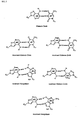
- Possible structures of N8-glycosylated 8-aza-7-deazaadenine with all four natural bases in a duplex are shown in figure 5 .
- N8-glycosylated 8-Aza-7-deazaadenine not only allows basepairing with all four natural bases, but alsopairs with all four natural bases with nearly the same stability.
- Nucleic acid binding compounds containing N8-glycosylated 8-Aza-7-deazaadenine a certain position show the same or an even lower Tm difference when hybridized to different oligonucleotides having A, C, G, or T at the opposite position compared with inosine-containing nucleic acid binding compounds (see example 6).
- N8-glycosylated 8-Aza-7-deazaadenine can be used as substitute for natural nucleobases in nucleic acid binding compounds with improved properties.
- Such nucleic acid binding compounds as oligonucleotides, can be used for example in hybridization methods when the sequence of a target nucleic acid sequence was deduced from the amino acid sequence of a protein, which led to a variety of possible target nucleic acid sequences.
- Replacing natural nucleobases by N8-glycosylated 8-Aza-7-deazaadenine at positions so that it hybridizes with positions of target nucleic acids which are degenerated allows the determination of these target nucleic acids without the need of multiple hybridization probes.
- nucleic acids when allelic sequences containing a different sequence at certain positions are to be determined.
- N8-glycosylated 8-aza-7-deazaadenine can be used as a substitute for each of the four natural bases contained in an oligonucleotide in order to change the Tm of the resulting hybridization complex when hybridized to a nucleic acid.
- This change in the Tm compared to the Tm of the former probe -nucleic acid complex can be used to equalize the Tm of several hybridization complexes when conducting multiplex hybridization methods like PCR-, multiplex-PCR, multiplex-probe-hybridization-methods or other hybridization techniques performed in solution and/or on a surface.
- These compounds containing universal bases can also be used in in-vitro-mutagenesis method and as pharmaceuticals.
- heterocyclic groups comprising N8-glycosylated nucleobases are shown in Figure 7 (heterocycles are shown schematically, substituents are not further described). Also included in the present invention are tautomeric forms and salts of.
- Halogen means a fluoro, chloro, bromo or iodo group.
- the most preferred halogen groups are -Cl and -Br.
- Alkyl groups are preferably chosen from alkyl groups containing from 1 to 10 carbon atoms, either arranged in linear, branched or cyclic form. The actual length of the alkyl group will depend on the steric situation at the specific position where the alkyl group is located. If there are steric constraints, the alkyl group will generally be smaller, the methyl and ethyl group being most preferred. All alkyl, alkenyl and alkynyl groups can be either unsubstituted or substituted. Substitution by hetero atoms as outlined above, will help to increase solubility in aqueous solutions.
- Alkenyl groups are preferably selected from alkenyl groups containing from 2 to 10 carbon atoms. For the selections similar considerations apply as for alkyl groups. They also can be linear, branched and cyclic. The most preferred alkenyl group is the ethylene group.
- Alkynyl groups have preferably from 2 to 10 carbon atoms. Again, those carbon atoms can be arranged in linear, branched and cyclic manner. Further, there can be more than one triple bond in the alkynyl group. The most preferred alkynyl group is the 3-propargyl-group.
- Alkoxy groups preferably contain from 1 to 6 carbon atoms and are attached to the rest of the moiety via the oxygen atom.
- alkyl group contained in the alkoxy groups the same considerations apply as for alkyl groups.
- the most preferred alkoxy group is the methoxy group.
- Aryloxy groups preferably contain from 6 to 20 carbon atoms. Those carbon atoms may be contained in one or more aromatic rings and further in side chains (for example, alkyl chains) attached to the aromatic moiety. Preferred aryloxy groups are the phenoxy and the benzoxy group.
- O-protecting groups are the aroyl groups, the diphenylcarbamoyl group, the acyl groups and the silyl groups. Among these most preferred is the benzoyl group.
- Preferred silyl groups are the trialkylsilyl groups, like, trimethylsilyl, triethylsilyl and tertiary butyl-dimethyl-silyl.
- Another preferred silyl group is the trimethylsilyl-oxymethyl group (TOM)( Swiss Patent Application 01931/97 ).
- a phosphorous atom can either mean the regular 31 P or the radioactive 32 P or a mixture thereof.
- hydrogen H/D/T
- carbon C
- iodine Cl, Br, I
- nitrogen N
- R 5 , R 6 are selected independently from the group consisting of-H, -(C 1 -C 10 )-alkyl, -(C 2 -C 10 )-alkenyl, -(C 2 -C 10 )-alkinyl, -(C 6 -C 22 )-aryl, a protecting group and a reporter group.
- any groups -OH, -SH and -NH 2 should be protected by suitable protecting groups. Further, during chemical synthesis, the compound will be attached for convenience to a solid phase. In these cases, the definitions of the substituents given above will be selected accordingly.
- a protecting group is a chemical group that is attached to a functional moiety (for example to the oxygen in a hydroxyl group or the nitrogen in an amino group, replacing the hydrogen) to protect the functional group from reacting in an undesired way.
- a protecting group is further defined by the fact that it can be removed without destroying the biological activity of the molecule formed, here the binding of the nucleic acid binding compound to a nucleic acid.
- Suitable protecting groups are known to a man skilled in the art.
- Especially preferred protecting groups for example for hydroxyl groups at the 5'-end of a nucleotide or oligonucleotide are selected from the trityl groups, for example dimethoxytrityl.
- Preferred protecting groups at the exocyclic amino group in N8-glycosylated-8-Aza-7-deazaadenine are the acyl groups, most preferred the benzoyl group (Bz), phenoxyacetyl or acetyl or formyl, and the N,N-dialkylformamidine group, preferentially the dimethyl-, diisobutyl-, and the di-n-butylformamidine group.
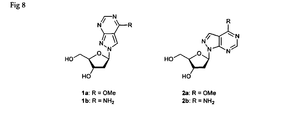
- a simplified protocol for the synthesis of certain nucleosides is described in Fig 8 and Example 8.
- the 6-methoxy pyrazolo[3,4-d]pyrimidine is synthesized.
- the methoxy-group is exchanged by an amino-group, which has to be coupled to a protecting group to protect the amino-function for example when using the pyrazolo[3,4-d]pyrimidine phosphoramidite for an oligonucleotide synthesis.
- the 6-methoxy group of the pyrazolo[3,4-d]pyrimidines 1a and 2a can be converted into an amino function under conditions normally used for deprotection in the last step of an oligonucleotide synthesis. Furthermore, the stability of the 6-methoxy-group allows further synthesis steps necessary to synthesize nucleoside monomers, which can be used for oligonucleotide synthesis, for example phosphoramidite monomers.
- the nucleic acid binding compound according to the invention preferably has a length of less than 100 subunits, more preferably of from 10 to 30 subunits.
- the substituents should be chosen such that hydrogen bonds to heterocyclic groups at the nucleic acid to be bound are enabled, preferably by base pairing, for example by Watson-Crick or Hoogsteen base pairing.
- Compounds in which the substituents do not enable such preferred hydrogen bonding can be useful as intermediates for the preparation of nucleic acid binding compounds.
- Preferred nucleic acid binding compounds of the invention are those which are chemically synthesized.
- any of the substituents are selected such as to contain a reporter group. While as many reporter groups can be attached as useful to label the nucleic acid compound sufficiently, it is preferred to attach only a limited number of reporter groups to a single subunit, such that recognition of nucleic acids, affinities to nucleic acids and solubility is not affected such that the probe would not be useful in hybridization assays. In a very preferred case, there will be only from 1 to 4, most preferably 1 or 2 or most preferred only one reporter group in each nucleic acid binding compound.
- nucleic acid determination There are formats for the nucleic acid determination which require more than one reporter group attached to the probe.
- An example for such formats is disclosed in WO92/02638 .
- one of the reporter groups will be a fluorescence emitter, while the other is a fluorescence quencher.
- Reporter groups are generally groups that make the nucleic acid binding compound as well as any nucleic acids bound thereto distinguishable from the remainder of the liquid, i.e. the sample (nucleic acid binding compounds having attached a reporter group can also be termed labeled nucleic acid binding compounds, labeled probes or just probes). This distinction can be either effected by selecting the reporter group from the group of directly or indirectly detectable groups or from the groups of immobilized or immobilizable groups.
- Directly detectable groups are for example fluorescent compounds, like fluorescein and its derivatives, like hexachlorofluorescein and hexafluorofluorescein, rhodamines, psoralenes, squaraines, porphyrines, fluorescent particles, bioluminescent compounds, like acridinium esters and luminol, or the cyanine dyes, like Cy-5. Examples of such compounds are disclosed in EP 0 680 969 .
- spin labels like TEMPO electrochemically detectably groups
- ferrocene like viologene, heavy metal chelates and electrochemiluminescent labels, like ruthenium bispyridyl complexes, and naphthoquinones, quencherdyes, like dabcyl, and nuclease active complexes, for example of Fe and Cu
- electrochemiluminescent labels like ruthenium bispyridyl complexes, and naphthoquinones, quencherdyes, like dabcyl, and nuclease active complexes, for example of Fe and Cu
- Other examples of such compounds are europium complexes.
- Indirectly detectable groups are groups that can be recognized by another moiety which is directly or indirectly labelled. Examples of such indirect detectable groups are haptens, like digoxigenin or biotin. Digoxigenin for example can be recognized by antibodies against digoxigenin.
- Those antibodies may either be labelled directly or can be recognized by labelled antibodies directed against the (antidigoxigenin) antibodies. Formats based on the recognition of digoxigenin are disclosed in EP-B-0 324 474 . Biotin can be recognized by avidin and similar compounds, like streptavidin and other biotin binding compounds. Again, those compounds can be labelled directly or indirectly.
- the reporter group can further be a nucleotide sequence which does not interfere with other nucleotide sequences in the sample.
- the sequence can therefore be specifically recognized by nucleotide containing a complementary sequence.
- This nucleotide sequence can be labelled directly or indirectly or can be immobilizable or immobilized.
- a reporter group can further be a solid phase. Attachment of the nucleic acid binding compound with solid phase can be either directly or indirectly as pointed out above for the detectable group. Examples of such solid phases are latex beads or gold particles.
- Direct labelling can be effected by covalent coupling of a nucleic acid binding compound to a reactive group on the solid phase, i.e. preferably via a linker.
- Indirect labelling can be made similar as disclosed above for the detectable groups.
- indirect attachment is non-covalently by biospecific interactions, for example those selected from the group of hapten-antibody, vitamin-receptor and nucleic acid-complementary nucleic acid. Again, those interactions and their use in nucleic acid assays is known to a man skilled in the art.
- Solid phases that are useful for immobilization of the probe according to the invention are preferably selected from the group of polystyrene, polyethylene, polypropylene, glass and TiO 2 .
- the formats of such solid phases can be selected according to the needs of the instrumentation and format of the assay.
- a solid phase may assume the form of a bead or a vessel.
- reporter group and the specific embodiments preferably include a linker which is used to connect the moiety intended to be used (the actual solid phase or the fluorophoric moiety) to the position of attachment as the reporter group.
- the linker will provide flexibility such that the nucleic acid binding compound can bind the nucleic acid sequence to be determined without major hindrance by the solid phase.
- Linkers especially those that are not hydrophobic, for example based on consecutive ethylenoxy units, for example as disclosed in DE 3943522 are known to a man skilled in the art.
- RNA ribonucleoside subunits
- DNA deoxyribonucleoside subunits
- PNA peptide nucleic acid subunits
- the backbone comprises sugar and phosphate moieties.
- the sugar configuration is selected from the group consisting of the ⁇ -D-, ⁇ -D-, ⁇ -L- and ⁇ -L-configurations, most preferred the compound contains at least one 2'-deoxy- ⁇ -D-erythro-pentofuranosyl moiety or one ⁇ -D-ribofuranosyl moiety.
- Preferred aryl group is the phenyl or naphthyl moiety, either unsubstituted or substituted by one or more of amino, -aminoalkyl, -O-(C 1 -C 10 )-alkyl, -S-(C 1 -C 10 )-alkyl, -(C 1 -C 10 )-alkyl, sulfonyl, sulfenyl, sulfinyl, nitro and nitroso. Most preferred aryl group is the phenyl group.
- Preferred arylalkyl group is the benzyl group.
- the preferred alkylamino group is the ethylamino group.
- the preferred -COO(C 1 -C 4 ) alkyl group contains one or two carbon atoms in the alkyl moiety (methyl or ethyl esters).
- N8-glycosylated 8-Aza-7 deazaadenine is linked via the glycosid C-1 of a sugar moiety of the compound according to the invention.
- the nucleic acid binding compound will be constructed such that it contains a nucleobase sequence which is substantially complementary to the nucleic acid to be determined or the nucleic acid to which it is intended to be bound by base pairing.
- nucleic acids will usually contain at least once any of the naturally occurring nucleobases Ade, Cyt, Gua and Thy or Ura
- the nucleic acid binding compound according to the invention will also contain any of those four bases.
- at least one of the heterocyclic groups is replaced by N8-glycosylated 8-Aza-7-deazaadenine.
- the nucleic acid binding compound according to the invention will bind to nucleic acids preferably in the antiparallel mode. However, by carefully selecting the nucleobases of a nucleic acid and/or of the nucleic binding compound, the binding in its function as probe can also be forced to be in the parallel mode. Parallel hybridization of nucleic acids containing iso-C and iso-G is for example disclosed in EP 0 624 161 .
- Preferred nucleic acid binding compounds are those, wherein the backbone comprises one or more moieties of the general formula II wherein
- R 14 is hydrogen.
- Preferred definition of L is oxy.
- Preferred definition of U is -OH and -O-reporter group.
- Preferred definition of V is oxy.
- Preferred definition of c is an integer from 2 to 4, and of d an integer from 0 to 2.
- Compounds of formula II are especially suited to contain the heterocyclic moiety of the invention as an integrated part (preferably not at one of the termini) of the nucleic acid binding compound.
- the group NR 23 R 24 is preferably selected from the group consisting of dialkylamino groups. In case of this group together with the forming of 5- or 6-membered heterocyclic ring, it assumes preferably the definition of morpholinyl, pyrrolidinyl or piperidinyl.
- a preferred subject of the invention is therefore a nucleic acid binding compound as outlined above, wherein the backbone comprises one or more moieties of the general formula III wherein
- Nucleic acid binding compounds wherein N8-glycosylated 8-Aza-7-deazaadenine is attached to subunits, for example the nucleotide, at the 3'-terminus of the compound, are useful either as starting compound for the synthesis of longer compounds or/and as end-labeled probes.
- This group of compounds is especially preferred because the terminal position of probes generally is the most tolerant in view of attachment of chemical moieties.
- a further preferred subject of the invention is a nucleic acid binding compound as outlined above comprising a backbone moiety of the formula V wherein
- a very preferred compound is a compound of formula V, wherein M' is O, R 16 is H and R 14 is selected from the group consisting of hydrogen and hydroxyl.
- the backbone of the nucleic acid binding compound has the function to bear the base pairing heterocycles such that the compound can bind to a nucleic acid having a complementary sequence.
- the degree of complementarity in the naturally occurring bases will be in the range from 70 % up to 100 % in a stretch of bases in a region effecting binding, compared to the stretch of same length in the region of the nucleic acid to be bound. Deletions and insertions of subunits in each sequence will therefor, in this calculation, be counted as gaps until the next fitting base and thus reduce complementarity by as many bases as the gap contains.
- Preferred backbone contains sugar-phosphate moieties. From these, deoxy sugar containing backbones are further preferred.
- Each moiety in the backbone bearing a moiety capable of base pairing to a nucleic acid of complementary sequence, including the moieties of the invention, are termed a subunit.
- Compounds are known that have backbones mixed of different kinds of subunits. Recently, a new kind of non-natural nucleic acid binding compounds was described. They are termed Peptide Nucleic Acids (PNA), as they contain at least one peptide bond between the subunits ( WO 92/20702 ).
- PNA Peptide Nucleic Acids
- the nucleic acid binding compound of the present invention can have any length. However, due to the convenience of chemical synthesis, compounds of a length of less than 100, more preferably from 10 to 30 subunits, for example nucleosides, are preferred.
- the nucleic acid binding compound of the present invention can be prepared in solution or, preferably, on a solid phase, where appropriate using an automatic synthesis device.
- the oligomers can be assembled stepwise by successively condensing a mononucleotide, which in each case possesses a nucleotide base, onto an appropriately derivatized support or onto a growing oligomer chain.
- the nucleic acid binding compounds can be assembled by joining dinucleotides or trinucleotides together [ S. Beaucage et al., Tetrahedron, 48 (12), 2223-2311, (1992 ); and Tetrahedron, 48 (28), 6123-6194, (1993 )]. This is particularly advanteous when synthesizing oligonucleotides which posses modified phosphate bridges.
- oligonucleotides are assembled using methods which are known to the person skilled in the art, such as the triester method, the H-phosphonate method or the phosphoramidite method [ E. Sonveaux, (1986), Bioorganic Chemistry, 14, 274-325 ; S. L. Beaucage et al., (1992), Tetrahedron, 48, 2223-2311 ].
- a method for the chemical synthesis of nucleic acid binding compounds of the present invention comprises using activated subunits, wherein said subunit contains at least one N8-glycosylated 8-Aza-7-deazaadenine.
- the most preferred method of chemical synthesis uses the phosphoramidite approach.
- a particularly preferred method uses a activated subunit one or more compounds of general formula VII. This method has the advantage that it is very convenient and the reagents necessary, for example a phosphoramidite containing N8-glycosylated 8-Aza-7-deazaadenine, are possible to be included easily.
- the compounds of the formula VII can be prepared, as structural components for the oligonucleotide solid phase synthesis, by proceeding from the corresponding 8-glycosylated nucleosides.
- the preparation of the 8-glycosylated derivatives which are substituted at the 7- or 9-position by halogen or methyl can be performed in the case of 7-deazapurine derivative as described by Seela et al. [Helv. Chim. Acta, (1994), 77, 897-903 ].
- Alkenyl- or alkynyl-substituted 8-glycosylated nucleoside derivatives of the formula VII can be prepared by coupling of alkenyl or alkynyl groups into the 7 or 8 position of the six-five-membered ring system by means of cross-coupling reaction in the presence of tetrakis(triphenylphospine)palladium(0). Electrophilic substituents (for example halogens) can be introduced into the 7 or 9 position of the five-six membered base.
- halogenated bases can be glycosylated in acetonitrile with ⁇ -halogenose in the presence of KOH and TDA-1 to yield the 8-glycosylated and the 9- or 7-glycosylated derivatives.
- the halogenated nucleosides can then be used as starting compounds for the insertion of other substituents, for example alky, alkenyl or alkynyl groups, by means of the above described palladium-catalyzed cross-coupling reaction.
- Alkoxy derivatives or substituted amine derivatives can be introduced by nucleophilic substitution, and nitro groups can be indroduced by electrophilic substitution.
- Suitable protective groups for the amino groups at position 6 and for the free 5'-hydroxyl group of the sugar moiety have been introduced, the monomers are converted into the corresponding phosphonate or phosphoramidite derivatives.
- Suitable amino protective groups for example in the form of acyl protective groups (e.g. isobutyryl, acetyl or phenoxyacetyl), are inserted using well-known methods [ J. C. Schulhof, D. Molko, R. Teoule, (1987), Nucleic Acids Res., 15, 397-416 ].
- An example of a suitable protective group for the free 5'-OH group of the sugar is the 4,4'-dimethoxytrityl residue, whose insertion is likewise effected using known methods [ C.
- Cyanoethyl-phosphoramidite derivatives can, for example, be prepared by reacting the monomers with chloro- ⁇ -cyanoethoxy-(N,N-diisopropylamino)phosphane in anhydrous dichlormethane [ N. D. Sinha et al., (1984), Nucleic Acids Res., 12, 4539 ].
- nucleic acid binding compounds as mentioned above and the precursors thereof.
- the oligomers are produced enzymatically.
- a starting oligomer is reacted with a polymerase and a triphosphate or modified triphosphate such that a monophoshate or a modified monophosphate is attached to a terminus of the oligomer, thus elongating the oligomer.
- the man skilled in the art will know several possible formates, like the nick-translation approach, or the simple primer extension ( J. Sambrook. E.F. Fritsch, T. Maniatis, Molecular Cloning - A laboratory Manual, Cold Spring Harbor Laboratory Press 1989 ).
- a method for the enzymatic synthesis of a nucleic acid binding compound according to the invention comprising reacting a triphosphate subunit with a primer using a nucleic acid as a template for the elongation of the primer, wherein the triphosphate subunit contains N8-glycosylated 8-Aza-7-deazaadenine .
- the triphosphate subunit has the formula VI.
- -M'R 16 is a triphosphate group and -MR 15 is OH.
- the most preferred compound is the one in which R 14 is -H.
- 3' deoxy- and 2'-3'-didesoxytriphosphate subunits according to formula VIII for example can be used as terminating nucleotides in sequencing methods.
- nucleic acid binding component it is principally possible to introduce only one monomer containing the moiety of the invention into one nucleic acid binding component, but also more than one, as the case may be. This is especially possible using chemical methods for the synthesis of nucleic acid binding compounds.
- nucleic acid compounds can be usefully applied in hybridization methods. Therefore, a further subject of the invention is a method for the determination of a nucleic acid comprising the steps
- N8-glycosylated 8-Aza-7-deazaadenine is preferably used as universal base capable to base pair with each of the four natural nucleobases.
- Nucleic acid binding compounds containing N8-glycosylated 8-Aza-7-deazaadenine can be used for example as probes and primers. Like other nucleic acid binding compounds they hybridize under stringent conditions only with nucleic acids having their complementary sequence. But at positions containing N8-glycosylated 8-Aza-7-deazaadenine the nucleic acid binding compound hybridize to a nucleic acid unrelated to its sequence. Therefore a non-discriminating hybridization is possible.
- nucleic acid This can be useful in the case the concrete natural base at a certain position of a nucleic acid to be determined (target nucleic acid) is not known. Normally one has to prepare several probes containing all possible complementary nucleotides at the position base pairing with the uncertain position of the target nucleic acid in order to be sure that the target nucleic acid can be determined. Using the nucleic acid binding compounds according to the present invention only one probe, which contains a universal base at that position is sufficient to allow the hybridization with the target nucleic acid. Especially when the nucleotide sequence of the target nucleic acid at several positions is not known, the use of a probe containing more than one universal base is preferred than using several probes of all possible sequences. Therefore the use of a probe according to the present invention can be extremely helpful for the determination of a nucleic acid when its sequence was deduced from a protein sequence, because the redundancy of the genetic code lead to a multitude of possible nucleic acid sequences.
- Probes of the present invention also allow the determination of nucleic acids in the case that alleles or sequences belonging to subtypes containing different sequences at certain positions are known.
- An example is the determination of pathogens like bacteria or viruses, for example HCV, HBV and HIV.
- pathogens like bacteria or viruses, for example HCV, HBV and HIV.
- subtypes of these pathogens have different nucleic acid sequences at certain positions in their genomes, which hinder the determination of all subtypes belonging to one genus using only one probe.
- the use of probes containing N8-glycosylated 8-Aza-7-deazaadenine can solve this problem.
- N8-glycosylated 8-Aza-7-deazaadenine pairs with all natural nucleobases Like other known universal bases, for example inosin, N8-glycosylated 8-Aza-7-deazaadenine pairs with all natural nucleobases.
- the binding stability of said base according the invention paired with all natural bases is very similar. Therefore when hybridizing a nucleic acid binding compound containing N8-glycosylated 8-Aza-7-deazaadenine with nucleic acids each having the same sequence except in the position pairing with the universal base (A, C, G, T), the Tm's are very similar.
- a defined 12-mer see example 6
- hybridized to a nucleic acid binding compound containing N8-glycosylated 8-Aza-7-deazaadenine the ⁇ Tm was 3°C. Therefore the binding stability of these hybridization complexes is less dependent to which natural base N8-glycosylated 8-Aza-7-deazaadenine pairs
- N8-glycosylated 8-Aza-7-deazaadenine contained in a probe or a primer can be used for the detection of nucleic acids having allelic differences or where the sequence at certain positions is not known. Because the Tm of the hybridization complexes is less dependent to which natural base N8-glycosylated 8-Aza-7-deazaadenine pairs the nucleic acid binding compounds of the present invention not only avoid the need of multiple probes or primers in order to determine nucleic acids containing partially unknown or allelic sequences, but they also improve the reliability of an assay and make it easier to find appropriate hybridization conditions which need to be used.
- Nucleic acid binding compounds according to the present invention also can be applied in nucleic acid determination methods in the case the nucleic acid to be determined is amplified.
- Several methods are known in the art, like Qb-amplification, NASBA, LCR, SDA, TMA.
- a preferred method is PCR.
- the nucleic acid binding compounds according to the present invention can be used as primers and probes.
- the nucleic acid binding compound should be used as probe, it preferably will contain a detectable reporter group. Any hybrids formed from the nucleic acid binding compound and a nucleic acid can then be determined via the detectable reporter group.
- This group of assays can further be divided into two groups, one being the group of homogeneous assays and the other being the heterogeneous assays.
- the hybrid (binding product) will be determined when bound to a solid phase.
- This embodiment has the advantage that any excess of probe and other components can be removed easily from the hybrid, thus make the determination easier.
- the hybrid formed can be captured to a solid phase either covalently, noncovalently, specifically or unspecifically.
- the hybrid formed will not be bound to a solid phase, but will be determined either directly or indirectly in solution.
- a preferred example of such assays is disclosed in PCT/US 91/05571 which is incorporated by reference here.
- a further subject of the present invention is a method for the determination of the presence, absence or amount of a nucleic acid in a sample comprising the steps:
- N8-glycosylated 8-Aza-7-deazaadenine can also be used in multiplex hybridization methods in order to change the Tm of one or more hybridization complexes formed in an assay.
- N8-glycosylated 8-Aza-7 deazaadenine instead of a natural base contained in a nucleic acid binding compound used in that assay the Tm of the hybridization complex formed with its target nucleic acid can be changed.
- Such changes of the Tm still allows the specific hybridization of the nucleic acid compound with its target nucleic acid at a different temperature.
- This approach can be used to equalize the Tm's of the hybridization complexes which may occur in an assay with respect to target nucleic acids present in a sample.
- N8-glycosylated 8-Aza-7-deazaadenine is not restricted to positions of the nucleic acid binding compound which base pair with target nucleic acids containing unkno n or allelic sequences, but can also applied to other positions. Therefore N8-glycosylated 8-Aza-7-deazaadenine not only be used as universal base but also as Tm equalizing base in multiplex hybridization methods.
- a preferred application field are multiplex hybridization methods on chips which often use hundred to thousands hybridization probes.
- N8-glycosylated 8 Aza-7-deazaadenine can also be used for in-vitro mutagenesis, for example using amplification methods like the PCR.
- the invention can furthermore be useful for pharmaceutical compositions comprising one or more nucleic acid binding compounds containing at least one N8-glycosylated 8-Aza-7-deazaadenine together with a physiologically acceptable excipients and, where appropriate, suitable additives and/or conventional auxiliary substances.
- the present invention extends to the use of such nucleic acid binding compounds in therapeutically effective compositions.
- Such compositions are understood to mean to include the nucleic acid binding compounds according to the invention as antisense oligonucleotides, triple helix forming oligonucleotides, aptamers or ribozymes, in particular antisense oligonucleotides.
- intermediates and precursor compounds for the chemical synthesis of the described nucleic acid binding compounds are also useful for the present invention.
- Preferred intermediates and precursor compounds are described below.
- Preferred is a solid phase bound precursor for the synthesis of a nucleic acid binding compound comprising a backbone , wherein the backbone comprises a moiety of the general formula VI wherein
- Such compounds of Formula VI can be used for chemical synthesis of nucleic acid binding compounds according to the invention as precursors.
- the compounds are linked to a solid phase, preferred R 14 is O-solid phase or R 15 or R 16 is solid phase, most preferred R 15 is solid phase. It is also preferred that reactive groups are protected by protective groups.
- nucleic acid binding compound wherein the backbone comprises a moiety of the general formula III wherein
- Solid phases for chemical synthesis of a nucleic acid binding compound according to the invention preferably also include linkers to fix the growing nucleic acid binding compound.
- linkers are known in the art.
- linkers can be cleaved after synthesis to free said nucleic acid binding compound and can for example also be used to generate a free 3'-hydroxy group in said nucleic acid binding compound.
- linkers are known in the art, for example succinic acid bound via an ester and amide bond.
- Preferred R 15 is solid phase, but in the precursor for chemical synthesis of a nucleic acid binding compound according to formula III alternatively R 14 may also be solid phase. Reactive groups of said compound are preferably protected by a protective group.
- a more general formula of preferred precursors and intermediates according to the present invention are compounds comprising a backbone, said backbone having attached heterocyclic groups characterized in that at least one of said heterocyclic groups is N8-glycosylated 8-Aza-7-deazaadenine.
- the precursor compound or intermediate is coupled to the solid phase at the backbone, it can also be linked at the N8-glycosylated 8-Aza-7-deazaadenine included in said compound, for example using the -NH 2 group as attachment site.
- the other reactive groups of said compound are protected by protective groups.
- oligonucleotides containing universal nucleoside could be carried out by using standard protocols on commercial available DNA/RNA synthesizers. In general, the synthesis of the oligonucleotides proceeds through a phosphorous-based intermediate. Some examples of useful intermediates are shown in Figure 3 including phosphoramidites according to Beaucage and Caruthers (1981) and H-phosphonates according to Froehler and Matteucci (1986).
- the 4-(amino)-2-(2-deoxy- ⁇ -D- erythro -pentofuranosyl)-2 H -pyrazolo[3,4- d ]pyrimidine (1) was first synthesized using phase-transfer glycosylation ( F. Seela, H. Steker Helv. Chim. Acta 1985, 68, 563 ).
- a methyl protected phosphoramidite was prepared which required an extra step for the deprotection the methyl group, e.g thiophenol ( F. Seela, K. Kaiser Helv. Chim. Acta 1988, 71, 1813 ).
- This building block was protected by a benzoyl group, which shows a rather long half-life time of deprotection (290 min at 40°C in 25% aq. NH 3 ).
- This building block is not compatible with common protocols of P(III) oligonucleotide synthesis or the fast deprotection procedures.
- the oligonucleotides shown in Table 1 have been synthesized by oligonucleotide solid-phase synthesis according to the common protocol of phosphoramidite chemistry.
- the oligomers were purified by HPLC and the nucleoside composition was determined by reverese phase HPLC, enzymatic hydrolysis with snake venom phosphodiesterase followed by alkaline phosphatase.
- the oligonucleotides contain one ore two universal nucleoside 1 residues (see Figure 4 ). They were hybridized and thermal denaturation profiles have been determined.
- Tm-Values for oligonucleotides containing one or two 8-aza-7-deaza-N 8 -2'-deoxyadenosines (A*) residues opposite to each of the four natural nucleosides dA, dC, dG and dT were measured according to [ F. Seela, C. Wei, Helv. Chim. Acta (1999), Vol 82, p. 726-745 ]. The results are presented in Table 1. Table 1.
- the methoxy group of the pyrazolo[3,4-d]pyrimidines 1a and 2a ( F. Seela, H. Steker, Helv. Chim. Acta 1985, 68, 563-570 ) can easily be converted into an amino function on the oligonucleotide level.
- the methoxy phosphoramidite 4 ( Fig 10 ) can be used as precursor to incorporate 1b or 2b ( Fig 8 ) in DNA by the solid-phase oligonucleotide synthesis.
- the conversion of the methoxy group occurs during the deprotection of the oligonucleotide with ammonia.
- the half-life values of the methoxy-amino exchange were determined UV-spectrophoto-metrically by treatment with 25% aq. ammonia at 40°C. For the half-life values see Table 3 and Fig 9 .
- the 4,4'-dimethoxytriphenylmethyl group was introduced into the 5'-OH position and compound 3 ( Fig 10 ) was converted to the ⁇ -cyanoethyl phosphoramidite 4 ( Fig 10 ) using the standard protocol ( Fig 10 ).
- the coupling yield of phosphoramidite 4 ( Fig 10 ) was found to be at least 99%. Table 3.
- the solvents were evaporated at 0.1 mbar at 40 °C by using a rotary evaporator.
- the product eluates at 49 % B.
- the corresponding fractions were collected and evaporated at reduced pressure to a volume of 2 ml.
- the product solution was added to a 80 ml of a 2 : 1 mixture of Aceton/Ethanol.
- the suspension was centrifuged, the resulting pellet was washed 3 times with acetone to remove LiCl and than dried in high vacuum. yield: 10 mg.
- 31 P NMR (Bruker DPX 300, Solvent D 2 O [ppm]: -3.91 (d); -9.47 (d); -19.27 (t)
- the compound 2 can be bound to a solid phase using the protocol described in F. Seela, H. Debelak, N.Usman, A. Burgin, L. Beigelman, Nucleic Acids Res. 1998, Vol. 26, page 1010-1018 .
Landscapes
- Chemical & Material Sciences (AREA)
- Organic Chemistry (AREA)
- Molecular Biology (AREA)
- Life Sciences & Earth Sciences (AREA)
- Health & Medical Sciences (AREA)
- Biochemistry (AREA)
- Engineering & Computer Science (AREA)
- Genetics & Genomics (AREA)
- General Health & Medical Sciences (AREA)
- Biotechnology (AREA)
- Saccharide Compounds (AREA)
- Measuring Or Testing Involving Enzymes Or Micro-Organisms (AREA)
- Pharmaceuticals Containing Other Organic And Inorganic Compounds (AREA)
- Nitrogen Condensed Heterocyclic Rings (AREA)
Claims (19)
- Composé de liaison à un acide nucléique comprenant un groupe rapporteur détectable, dans lequel le composé de liaison à l'acide nucléique comprend un squelette, ledit squelette ayant des groupes hétérocycliques fixés capables d'appariement de bases à des nucléobases naturelles dans lesquelles au moins l'un desdits groupes hétérocycliques est la 8-aza-7-deazaadénine N8-glycosylée.
- Procédé de détermination d'un acide nucléique comprenant les étapes- de fourniture d'un échantillon suspecté de contenir ledit acide nucléique,- de fourniture d'un composé de liaison à un acide nucléique, qui est essentiellement complémentaire d'une partie ou de tout ledit acide nucléique et qui contient un groupe rapporteur détectable,- de mise en contact dudit échantillon avec ledit composé de liaison à un acide nucléique sous des conditions de liaison dudit composé de liaison à un acide nucléique audit acide nucléique,- de détermination du produit de liaison formé à partir dudit acide nucléique et dudit composé de liaison à un acide nucléique comme une mesure de la présence dudit acide nucléiquedans lequel le composé de liaison à un acide nucléique comprend un squelette, ledit squelette ayant des groupes hétérocycliques fixés capables d'appariement de bases à des nucléobases naturelles dans lesquelles au moins l'un desdits groupes hétérocycliques est la 8-aza-7-deazaadénine N8-glycosylée.
- Procédé selon la revendication 2, dans lequel plus d'un groupe rapporteur est fixé au composé de liaison à un acide nucléique.
- Procédé selon la revendication 3, dans lequel l'un des groupes rapporteurs est un émetteur de fluorescence, tandis que l'autre est un extincteur de fluorescence.
- Procédé selon la revendication 2, dans lequel 1 à 4 groupe(s) rapporteur(s) se trouve(nt) dans le composé de liaison à un acide nucléique.
- Procédé selon la revendication 5, dans lequel 1 ou 2 groupe(s) rapporteur(s) se trouve(nt) dans le composé de liaison à un acide nucléique.
- Procédé selon la revendication 6, dans lequel un groupe rapporteur se trouve dans le composé de liaison à un acide nucléique.
- Procédé de détermination de la présence, de l'absence ou d'une quantité d'un acide nucléique dans un échantillon comprenant les étapes :- de fourniture d'amorces, une première amorce étant essentiellement complémentaire d'une première séquence de liaison dudit acide nucléique, et la seconde amorce étant essentiellement complémentaire d'une séquence de liaison d'un complément de cet acide nucléique, et une sonde étant complémentaire de l'acide nucléique ou du complément de celui-ci entre les séquences de liaison desdites amorces, ladite sonde étant marquée à différentes sous-unités d'au moins deux différents groupes rapporteurs,- de soumission de l'échantillon auxdites amorces et à ladite sonde sous des conditions favorisant l'extension desdites amorces et la séparation desdits groupes rapporteurs l'un de l'autre par la désintégration de la sonde, et- de détermination de l'étendue de la désintégration de la sonde via au moins l'un desdits groupes rapporteurs,caractérisé en ce qu'au moins l'une de ladite amorce ou/et sonde est un composé de liaison à un acide nucléique comprenant un squelette, ledit squelette ayant des groupes hétérocycliques fixés capables d'appariement de bases à des nucléobases naturelles,
par lequel la 8-aza-7-deazaadénine N8-glycosylée est contenue à l'intérieur dudit composé de liaison à un acide nucléique. - Utilisation d'un composé de liaison à un acide nucléique comme amorce, dans laquelle le composé de liaison à un acide nucléique comprend un squelette, ledit squelette ayant des groupes hétérocycliques fixés capables d'appariement de bases à des nucléobases naturelles dans laquelle au moins l'un desdits groupes hétérocycliques est la 8-aza-7-deazaadénine N8-glycosylée.
- Utilisation d'un composé de liaison à un acide nucléique qui contient un groupe rapporteur détectable comme amorce ou comme sonde ou pour la détermination d'un acide nucléique, dans laquelle le composé de liaison à un acide nucléique comprend un squelette, ledit squelette ayant des groupes hétérocycliques fixés capables d'appariement de bases à des nucléobases naturelles dans lesquelles au moins l'un desdits groupes hétérocycliques est la 8-aza-7-deazaadénine N8-glycosylée.
- Utilisation d'un composé de liaison à un acide nucléique pour la mutagenèse in vitro, dans laquelle le composé de liaison à un acide nucléique comprend un squelette, ledit squelette ayant des groupes hétérocycliques fixés capables d'appariement de bases à des nucléobases naturelles dans lesquelles au moins l'un desdits groupes hétérocycliques est la 8-aza-7-deazaadénine N8-glycosylée.
- Utilisation d'un composé de liaison à un acide nucléique, par laquelle la 8-aza-7-deazaadénine N8-glycosylée est contenue à l'intérieur dudit composé de liaison à un acide nucléique,
dans une réaction d'hybridisation multiplex, par laquelle la 8-aza-7-deazaadénine N8-glycosylée était introduite dans ledit composé de liaison à un acide nucléique pour égaliser la stabilité du complexe dudit composé de liaison à un acide nucléique hybridé à un acide nucléique cible comparée à la stabilité d'un complexe d'hybridation supplémentaire formé par un composé de liaison à un acide nucléique supplémentaire hybridé à son acide nucléique cible. - Procédé selon l'une quelconque des revendications 2 à 8, ou utilisation selon l'une quelconque des revendications 9 à 12 dans lequel le squelette comprend des fractions sucre et phosphate.
- Procédé ou utilisation selon la revendication 13, dans lequel la configuration du sucre est choisie parmi le groupe constitué des configurations α-D-, β-D-, α-L- et β-L-.
- Procédé ou utilisation selon la revendication 13, dans lequel la fraction sucre est une fraction 2'-deoxy-β-D-érythropentofuranosyle.
- Composé selon la revendication 1 ou procédé selon l'une quelconque des revendications 2 à 8, ou 13 à 15, ou utilisation selon l'une quelconque des revendications 9 à 12, ou 13 à 15, dans lequel ledit composé acide nucléique comprend une ou plusieurs fraction(s) de la formule générale II
 A est choisi parmi le groupe constitué de O, S, CH2, d'un groupe N-(alkyle en C1-C10),L est choisi parmi le groupe constitué d'un groupe oxy, sulfanediyle, -CH2- et -NR22-,T est choisi parmi le groupe constitué du groupe oxo, thioxo et sélénoxo,U est choisi parmi le groupe constitué de -OH, d'un groupe -O-rapporteur, -SH, d'un groupe -S rapporteur -SeH, -alcoxy en C1-C10, alkyle en C1-C10, -aryle en C6-C22, (aryle en C6-C14)-(alkyle en C1-C10), -NR23R24, et-O-(alkyle en C1-C10)-O-(alkyle en C1-C10)-R25, ou dans lequel -NR23R24 peuvent conjointement avec N être un cycle hétérocyclique à 5 - 6 chaînons,V est choisi parmi le groupe constitué du groupe oxy, sulfanediyle, -CH2-, ou -NR22-,R14 est choisi parmi le groupe constitué du groupe -H, -OH, -alcoxy en C1-C10, -(alcényle en C2-C10)-oxy, -halogéno, -azido, -O-allyle, -O-alcinyle, et -NH2,R22 est indépendamment choisi parmi le groupe de -H et -alkyle en C1-C10,R23 et R24 sont indépendamment choisis parmi le groupe constitué du groupe -alkyle en C1-C10, -aryle en C1-C20, -(aryle en C6-C14)-(alkyle en C1-C10), -(alkyle en C1-C6)-[NH(CH2)c]d-NR26R27 et un groupe rapporteur,R25 est choisi parmi le groupe constitué de -H, -OH, -halogéno, -amino, -alkylamino en C1-C18, -COOH, -CONH2 et -COO(alkyle en C1-C4) et un groupe rapporteur,R26 et R27 sont indépendamment choisis parmi le groupe constitué de -H, d'un groupe -alkyle en C1-C6, et -(alcoxy en C1-C4)-(alkyle en C1-C6) et d'un groupe rapporteur,c est un nombre entier ayant une valeur allant de 2 à 6,d est un nombre entier ayant une valeur allant de 0 à 6, etB est la 8-aza-7-deazaadénine N8-glycosylée,
dans lequel n'importe quel groupe alkyle, alcényle et alcynyle peut être substitué ou non substitué par une ou plusieurs fraction(s) choisie(s) parmi le groupe constitué d'un groupe -halogéno, -SH, -S-(alkyle en C1-C6), -alcoxy en C1-C6, -OH, -NR5R6, -COR11, -NH-CONR5R6, -NH-CSNR5R6 et -[O-(CH2)r]s-NR5R6,r et s sont indépendamment l'un de l'autre un nombre entier prenant une valeur allant de 1 à 18,et n'importe quels sels de ceux-ci. - Composé selon la revendication 1 ou procédé selon l'une quelconque des revendications 2 à 8, ou utilisation selon l'une quelconque des revendications 9 à 12, dans lequel le squelette comprend une fraction de la formule générale III
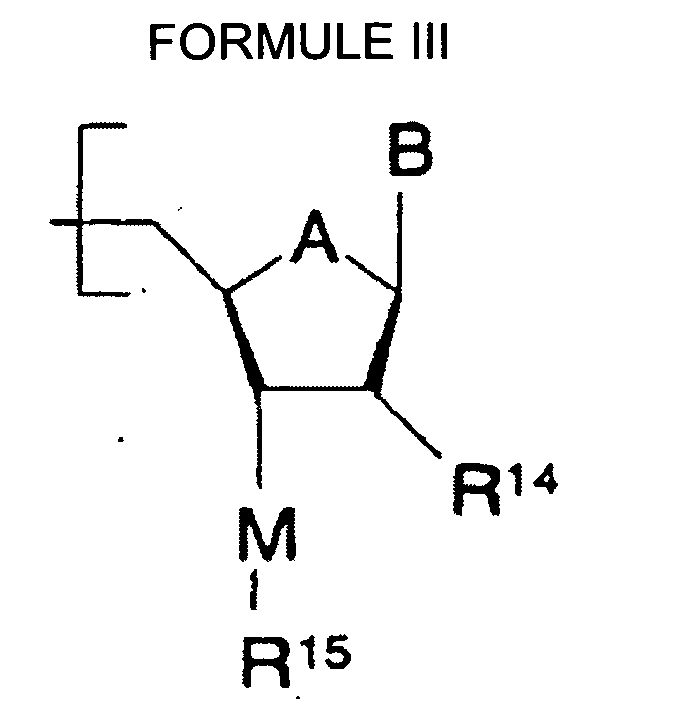 A est choisi parmi le groupe constitué de O, S, CH2 et un groupe N-(alkyle en C1-C6),M est choisi parmi le groupe constitué du groupe oxy, sulfanediyle, -NR22-, -(alkyle en C1-C10)-, ou -O-(alkyle en C1-C10)-O-, et -S-(alkyle en C1-C10)-O- et -NR22-(alkyle en C1-C6)-O-,R22 est choisi parmi le groupe constitué de -H, -(alkyle en C1-C10), d'un groupe protecteur et d'un groupe rapporteur,R14 est choisi parmi le groupe constitué de -H, -OH, -alcoxy en C1-C10, -alcényloxy en C2-C10, -alcynyloxy en C2-C10, -halogéno, -azido, SH, -(alkylmercapto en C1-C10), O-groupe rapporteur, O-phase solide et -NH2,R15 est choisi parmi le groupe constitué de -H, -alkyle en C1-C6, -alcényle en C2-C10, -alcynyle en C2-C10, -(alkyle en C2-C10)-carbonyle, -(alcényle en C3-C19)-carbonyle, -(alcynyle en C3-C19)-carbonyle, -(aryle en C6-C14)-(alkyle en C1-C10), une phase solide et un groupe de formule IVdans laquelle
 T est choisi parmi le groupe constitué du groupe oxo, thioxo et sélénoxo, etU est choisi parmi le groupe constitué de -OH, -O-groupe rapporteur, -SH, -SeH, -alcoxy en C1-C10, -alkyle en C1-C10, -aryle en C6-C22, -(aryle en C6-C14)-(alkyle en C1-C10), -NR23R24, et -O-(alkyle en C1-C10)-O-(alkyle en C1-C10)-R25, ou dans laquelle NR23R24 peut conjointement avec N être un cycle hétérocyclique à 5 - 6 chaînons,R23 et R24 sont indépendamment choisis parmi le groupe constitué de -alkyle en C1-C10, -aryle en C1-C20, (aryle en C6-C14)-(alkyle en C1-C10), -(alkyle en C1-C6)-[NH(CH2)c]d-NR26R27,R25 est choisi parmi le groupe constitué de -H, -OH, -halogéno, -amino, -alkylamino en C1-C18, -COOH; -CONH2 et -COO(alkyle en C1-C4),R26 et R27 sont indépendamment choisis parmi le groupe constitué de -H, -alkyle en C1-C6, et -(alcoxy en C1-C4)-(alkyle en C1-C6)R29 est choisi parmi le groupe constitué de -OR30 et -SR30,R30 est choisi parmi le groupe constitué de -H, -alkyle en C1-C10, -alcényle en C2-C10, -aryle en C6-C22, d'un groupe protecteur, d'une phase solide et d'un groupe rapporteurc est un nombre entier prenant une valeur allant de 2 à 6,d est un nombre entier prenant une valeur allant de 0 à 6, etB est le lien à la 8-aza-7-deazaadénine N8-glycosylée,
dans laquelle n'importe quel groupe alkyle, alcényle et alcynyle peut être substitué ou non substitué par une ou plusieurs fraction(s) choisie(s) parmi le groupe constitué d'un groupe -halogéno, -SH, -S-(alkyle en C1-C6, -alcoxy en C1-C6, -OH, -NR5R6, -COR11, -NH-CONR5R6, -NH-CSNR5R6 et -[O-(CH2)r]s -NR5R6,r et s sont indépendamment l'un de l'autre un nombre entier prenant une valeur allant de 1 à 18,et n'importe quels sels de ceux-ci. - Composé selon la revendication 1 ou procédé selon l'une quelconque des revendications 2 à 8, ou utilisation selon l'une quelconque des revendications 9 à 12, dans lequel ledit squelette comprend une fraction de la formule V
 A est choisi parmi le groupe constitué de O, S, CH2 et du groupe N-(alkyle en C1-C6),M' est choisi parmi le groupe constitué du groupe oxy, sulfanediyle, -NR22-, -alkyle en C1-C10, ou -O-(alkyle en C1-C10)-O-, et -S-(alkyle en C1-C10) -O- et -NR22-(alkyle en C1-C6)-O-,R22 est choisi parmi le groupe constitué de -H, d'un groupe protecteur, d'un groupe rapporteur et -alkyle en C1-C10,R14 est choisi parmi le groupe constitué de -H, -OH, -alcoxy en C1-C10, -alcényloxy en C2-C10, -alcynyloxy en C2-C10, -halogéno, azido, -SH, -S-(alkylmercapto en C1-C6), O-groupe rapporteur, O-phase solide et NH2,R16 est choisi parmi le groupe constitué de -H, d'un groupe -alkyle en C1-C8, -alcényle en C2-C18, -alcynyle en C2-C18, -(alkyle en C2-C18)-carbonyle, -(alcényle en C3-C19)-carbonyle, -(alcynyle en C3-C19)-carbonyle, -(aryle en C6-C14)-(alkyle en C1-C8), d'un groupe protecteur ou d'un composé de formule IVdans laquelle
 T est choisi parmi le groupe constitué du groupe oxo, thioxo et sélénoxo,U est choisi parmi le groupe constitué de -OH, -SH, -SeH, -alcoxy en C1-C10, -alkyle en C1-C10, -aryle en C6-C22, -(aryle en C6-C14)-(alkyle en C1-C10), -NR23R24, et -O-(alkyle en C1-C10)-O-(alkyle en C1-C10)-R25, dans lequel NR23R24 peut conjointement avec N être un cycle hétérocyclique à 5 à 6 chaînons,R23 et R24 sont indépendamment choisis parmi le groupe constitué d'un groupe -alkyle en C1-C10, -aryle en C1-C20, -(aryle en C6-C14)-(alkyle en C1-C10), -(alkyle en C1-C6)-[NH(CH2)c]d-NR26R27,R25 est choisi parmi le groupe constitué de -H, -OH, -halogéno, -amino, -alkylamino en C1-C18, -COOH, -CONH2 et -COO(alkyle en C1-C4),R26 et R27 sont indépendamment choisis parmi le groupe constitué de -H, -alkyle en C1-C6, et -(alcoxy en C1-C4)-(alkyle en C1-C6)R29 est choisi parmi le groupe constitué de -OR30 et -SR30,R30 est choisi parmi le groupe constitué de -H, -alkyle en C1-C10, -alcényle en C2-C10, -aryle en C6-C22, d'un groupe protecteur, d'une phase solide et d'un groupe rapporteur, etc est un nombre entier prenant une valeur allant de 2 à 6,d est un nombre entier prenant une valeur allant de 0 à 6, etB est le lien à la 8-aza-7-deazaadenine N8-glycosylée,
dans laquelle n'importe quel groupe alkyle, alcényle et alcynyle peut être substitué ou non substitué par une ou plusieurs fraction(s) choisie(s) parmi le groupe constitué d'un groupe -halogéno, -SH, -S-(alkyle en C1-C6), -alcoxy en C1-C6, -OH, -NR5R6, -COR11, -NH-CONR5R6, -NH-CSNR5R6 et -[O-(CH2)r]s -NR5R6,r et s sont indépendamment l'un de l'autre un nombre entier prenant une valeur allant de 1 à 18,et n'importe quels sels de ceux-ci. - Composé ou procédé ou utilisation selon la revendication 18, dans lequel M' est O, R16 est H et R14 est choisi parmi le groupe constitué de -H et -OH.
Priority Applications (1)
| Application Number | Priority Date | Filing Date | Title |
|---|---|---|---|
| EP01919395A EP1301523B1 (fr) | 2000-03-28 | 2001-03-27 | Bases de purine presentant une liaison n8 et c8 et heterocycles de structure apparentee en tant que nucleosides universels utilises pour une hybridation d'oligonucleotides |
Applications Claiming Priority (6)
| Application Number | Priority Date | Filing Date | Title |
|---|---|---|---|
| EP00106017A EP1138688A1 (fr) | 2000-03-28 | 2000-03-28 | Bases puriniques liées en position N8- ou C8- comme nucléosides universelles utilisées pour hybridization avec oligonucléotides |
| EP00106017 | 2000-03-28 | ||
| EP00108023 | 2000-04-20 | ||
| EP00108023A EP1138689A1 (fr) | 2000-03-28 | 2000-04-20 | Bases puriniques liées en position N8- ou C8- comme nucléosides universelles utilisées pour hybridization avec oligonucléotides |
| PCT/EP2001/003458 WO2001072764A1 (fr) | 2000-03-28 | 2001-03-27 | Bases de purine presentant une liaison n8 et c8 et heterocycles de structure apparentee en tant que nucleosides universels utilises pour une hybridation d'oligonucleotides |
| EP01919395A EP1301523B1 (fr) | 2000-03-28 | 2001-03-27 | Bases de purine presentant une liaison n8 et c8 et heterocycles de structure apparentee en tant que nucleosides universels utilises pour une hybridation d'oligonucleotides |
Publications (2)
| Publication Number | Publication Date |
|---|---|
| EP1301523A1 EP1301523A1 (fr) | 2003-04-16 |
| EP1301523B1 true EP1301523B1 (fr) | 2009-01-14 |
Family
ID=26070695
Family Applications (2)
| Application Number | Title | Priority Date | Filing Date |
|---|---|---|---|
| EP00108023A Withdrawn EP1138689A1 (fr) | 2000-03-28 | 2000-04-20 | Bases puriniques liées en position N8- ou C8- comme nucléosides universelles utilisées pour hybridization avec oligonucléotides |
| EP01919395A Expired - Lifetime EP1301523B1 (fr) | 2000-03-28 | 2001-03-27 | Bases de purine presentant une liaison n8 et c8 et heterocycles de structure apparentee en tant que nucleosides universels utilises pour une hybridation d'oligonucleotides |
Family Applications Before (1)
| Application Number | Title | Priority Date | Filing Date |
|---|---|---|---|
| EP00108023A Withdrawn EP1138689A1 (fr) | 2000-03-28 | 2000-04-20 | Bases puriniques liées en position N8- ou C8- comme nucléosides universelles utilisées pour hybridization avec oligonucléotides |
Country Status (6)
| Country | Link |
|---|---|
| US (2) | US7063945B2 (fr) |
| EP (2) | EP1138689A1 (fr) |
| JP (2) | JP4130545B2 (fr) |
| AT (1) | ATE420886T1 (fr) |
| DE (1) | DE60137428D1 (fr) |
| WO (1) | WO2001072764A1 (fr) |
Families Citing this family (16)
| Publication number | Priority date | Publication date | Assignee | Title |
|---|---|---|---|---|
| US7144868B2 (en) | 2003-10-27 | 2006-12-05 | Genelabs Technologies, Inc. | Nucleoside compounds for treating viral infections |
| EP1687321A1 (fr) | 2003-10-27 | 2006-08-09 | Genelabs Technologies, Inc. | Composes nucleosidiques de traitement d'infections virales |
| CA2543116A1 (fr) | 2003-10-27 | 2005-05-19 | Genelabs Technologies, Inc. | Procedes de preparation de derives 7-(2'-.szlig.-d-ribofuranosyl substitue)-4-(nr2r3)-5-(ethyn-1-yl substitue)-pyrrolo[2,3-d]pyrimidine |
| US7202223B2 (en) | 2003-10-27 | 2007-04-10 | Genelabs Technologies, Inc. | Nucleoside compounds for treating viral infections |
| CA2542776A1 (fr) | 2003-10-27 | 2005-05-12 | Genelabs Technologies, Inc. | Composes nucleosides permettant de traiter des infections virales |
| JP5251125B2 (ja) * | 2005-08-30 | 2013-07-31 | 国立大学法人高知大学 | ユニバーサル塩基含有ポリマー |
| JP5137118B2 (ja) * | 2005-08-30 | 2013-02-06 | 国立大学法人高知大学 | ユニバーサル塩基 |
| WO2007116129A1 (fr) * | 2006-04-10 | 2007-10-18 | Wallac Oy | Système de marquage universel |
| US7772390B1 (en) | 2006-07-18 | 2010-08-10 | The Regents Of The University Of California | Lipid mediated nucleic acid synthesis |
| WO2012075381A1 (fr) | 2010-12-03 | 2012-06-07 | Epizyme, Inc. | Composés purines et 7-déazapurines substituées en tant que modulateurs d'enzymes épigéniques |
| US9145438B2 (en) | 2010-12-03 | 2015-09-29 | Epizyme, Inc. | 7-deazapurine modulators of histone methyltransferase, and methods of use thereof |
| WO2014026198A1 (fr) | 2012-08-10 | 2014-02-13 | Epizyme, Inc. | Inhibiteurs de protéine méthyltransférase de dot1l et leurs procédés d'utilisation |
| US9597348B2 (en) | 2012-09-06 | 2017-03-21 | Epizyme, Inc. | Method of treating leukemia |
| JP2016517426A (ja) | 2013-03-15 | 2016-06-16 | エピザイム,インコーポレイティド | 置換プリン化合物の合成方法 |
| CA3033867A1 (fr) | 2016-08-17 | 2018-02-22 | Solstice Biologics, Ltd. | Constructions polynucleotidiques |
| US11597744B2 (en) | 2017-06-30 | 2023-03-07 | Sirius Therapeutics, Inc. | Chiral phosphoramidite auxiliaries and methods of their use |
Family Cites Families (2)
| Publication number | Priority date | Publication date | Assignee | Title |
|---|---|---|---|---|
| US5438131A (en) * | 1992-09-16 | 1995-08-01 | Bergstrom; Donald E. | 3-nitropyrrole nucleoside |
| DE4415370A1 (de) * | 1994-05-02 | 1995-11-09 | Hoechst Ag | Modifizierte Oligonukleotide, deren Herstellung sowie deren Verwendung |
-
2000
- 2000-04-20 EP EP00108023A patent/EP1138689A1/fr not_active Withdrawn
-
2001
- 2001-03-27 AT AT01919395T patent/ATE420886T1/de not_active IP Right Cessation
- 2001-03-27 EP EP01919395A patent/EP1301523B1/fr not_active Expired - Lifetime
- 2001-03-27 US US10/221,306 patent/US7063945B2/en not_active Expired - Lifetime
- 2001-03-27 JP JP2001571695A patent/JP4130545B2/ja not_active Expired - Lifetime
- 2001-03-27 DE DE60137428T patent/DE60137428D1/de not_active Expired - Lifetime
- 2001-03-27 WO PCT/EP2001/003458 patent/WO2001072764A1/fr not_active Ceased
-
2006
- 2006-01-23 US US11/338,149 patent/US7566775B2/en not_active Expired - Lifetime
-
2008
- 2008-01-24 JP JP2008014190A patent/JP5231032B2/ja not_active Expired - Lifetime
Also Published As
| Publication number | Publication date |
|---|---|
| WO2001072764A1 (fr) | 2001-10-04 |
| US20040171820A1 (en) | 2004-09-02 |
| US7063945B2 (en) | 2006-06-20 |
| US7566775B2 (en) | 2009-07-28 |
| ATE420886T1 (de) | 2009-01-15 |
| JP2003528883A (ja) | 2003-09-30 |
| JP2008113669A (ja) | 2008-05-22 |
| JP4130545B2 (ja) | 2008-08-06 |
| US20060135462A1 (en) | 2006-06-22 |
| EP1301523A1 (fr) | 2003-04-16 |
| EP1138689A1 (fr) | 2001-10-04 |
| DE60137428D1 (de) | 2009-03-05 |
| JP5231032B2 (ja) | 2013-07-10 |
Similar Documents
| Publication | Publication Date | Title |
|---|---|---|
| JP5231032B2 (ja) | オリゴヌクレオチド・ハイブリダイゼーションにユニバーサル・ヌクレオシドとして使用されるn8−及びc8−連結プリン塩基、並びに構造的に関連したヘテロ環 | |
| EP1307469B1 (fr) | Composes de fixation d'acides nucleiques contenant des analogues pyrazolo¬3,4-d pyrimidine de purine 2,6-diamine et leurs utilisations | |
| EP1446412B1 (fr) | Compositions d'acides nucleiques verrouilles et utilisations | |
| EP0963997B1 (fr) | Nouveaux analogues de nucleotides | |
| CN1066456C (zh) | 具有2'-醚基的寡核苷酸 | |
| WO2003039523A2 (fr) | Oligonucleotides modifies a l'aide de nouveaux analogues d'arn-l-alpha | |
| US7847075B2 (en) | 2-Azapurine compounds and their use | |
| EP1314734A1 (fr) | Analogues de nucleosides et derives d'oligonucleotides renfermant ces analogues | |
| WO1997030064A1 (fr) | Oligonucleotides contenant de l'hexitol et leur utilisation dans des strategies antisens | |
| US7276592B2 (en) | Nucleotide analogs with six-membered rings | |
| WO1990012022A1 (fr) | Phosphorodithioates de polynucleotides servant d'agents therapeutiques contre des infections retrovirales | |
| EP1138688A1 (fr) | Bases puriniques liées en position N8- ou C8- comme nucléosides universelles utilisées pour hybridization avec oligonucléotides | |
| NZ292140A (en) | Oligomers consisting of 1,5-anhydrohexitol nucleosides, antisence techniques. | |
| CN118146285A (zh) | 修饰核苷、其制备方法及由其制备的寡核苷酸与应用 | |
| EP1466919A1 (fr) | Analogues nucleotidiques hexacycliques | |
| CA2569615A1 (fr) | Composes de fixation d'acides nucleiques contenant des analogues pyrazolo[3,4-d]pyrimidine de purine 2,6-diamine et leurs utilisations |
Legal Events
| Date | Code | Title | Description |
|---|---|---|---|
| PUAI | Public reference made under article 153(3) epc to a published international application that has entered the european phase |
Free format text: ORIGINAL CODE: 0009012 |
|
| 17P | Request for examination filed |
Effective date: 20021028 |
|
| AK | Designated contracting states |
Designated state(s): AT BE CH CY DE DK ES FI FR GB GR IE IT LI LU MC NL PT SE TR |
|
| RAP1 | Party data changed (applicant data changed or rights of an application transferred) |
Owner name: F. HOFFMANN-LA ROCHE AG Owner name: ROCHE DIAGNOSTICS GMBH |
|
| 17Q | First examination report despatched |
Effective date: 20050127 |
|
| 17Q | First examination report despatched |
Effective date: 20050127 |
|
| 17Q | First examination report despatched |
Effective date: 20050127 |
|
| GRAP | Despatch of communication of intention to grant a patent |
Free format text: ORIGINAL CODE: EPIDOSNIGR1 |
|
| GRAS | Grant fee paid |
Free format text: ORIGINAL CODE: EPIDOSNIGR3 |
|
| GRAA | (expected) grant |
Free format text: ORIGINAL CODE: 0009210 |
|
| AK | Designated contracting states |
Kind code of ref document: B1 Designated state(s): AT BE CH CY DE DK ES FI FR GB GR IE IT LI LU MC NL PT SE TR |
|
| REG | Reference to a national code |
Ref country code: GB Ref legal event code: FG4D |
|
| REG | Reference to a national code |
Ref country code: CH Ref legal event code: EP |
|
| REG | Reference to a national code |
Ref country code: IE Ref legal event code: FG4D |
|
| REF | Corresponds to: |
Ref document number: 60137428 Country of ref document: DE Date of ref document: 20090305 Kind code of ref document: P |
|
| PG25 | Lapsed in a contracting state [announced via postgrant information from national office to epo] |
Ref country code: NL Free format text: LAPSE BECAUSE OF FAILURE TO SUBMIT A TRANSLATION OF THE DESCRIPTION OR TO PAY THE FEE WITHIN THE PRESCRIBED TIME-LIMIT Effective date: 20090114 |
|
| NLV1 | Nl: lapsed or annulled due to failure to fulfill the requirements of art. 29p and 29m of the patents act | ||
| PG25 | Lapsed in a contracting state [announced via postgrant information from national office to epo] |
Ref country code: FI Free format text: LAPSE BECAUSE OF FAILURE TO SUBMIT A TRANSLATION OF THE DESCRIPTION OR TO PAY THE FEE WITHIN THE PRESCRIBED TIME-LIMIT Effective date: 20090114 Ref country code: ES Free format text: LAPSE BECAUSE OF FAILURE TO SUBMIT A TRANSLATION OF THE DESCRIPTION OR TO PAY THE FEE WITHIN THE PRESCRIBED TIME-LIMIT Effective date: 20090425 |
|
| PG25 | Lapsed in a contracting state [announced via postgrant information from national office to epo] |
Ref country code: PT Free format text: LAPSE BECAUSE OF FAILURE TO SUBMIT A TRANSLATION OF THE DESCRIPTION OR TO PAY THE FEE WITHIN THE PRESCRIBED TIME-LIMIT Effective date: 20090615 Ref country code: SE Free format text: LAPSE BECAUSE OF FAILURE TO SUBMIT A TRANSLATION OF THE DESCRIPTION OR TO PAY THE FEE WITHIN THE PRESCRIBED TIME-LIMIT Effective date: 20090414 Ref country code: AT Free format text: LAPSE BECAUSE OF FAILURE TO SUBMIT A TRANSLATION OF THE DESCRIPTION OR TO PAY THE FEE WITHIN THE PRESCRIBED TIME-LIMIT Effective date: 20090114 |
|
| PG25 | Lapsed in a contracting state [announced via postgrant information from national office to epo] |
Ref country code: BE Free format text: LAPSE BECAUSE OF FAILURE TO SUBMIT A TRANSLATION OF THE DESCRIPTION OR TO PAY THE FEE WITHIN THE PRESCRIBED TIME-LIMIT Effective date: 20090114 |
|
| PG25 | Lapsed in a contracting state [announced via postgrant information from national office to epo] |
Ref country code: MC Free format text: LAPSE BECAUSE OF NON-PAYMENT OF DUE FEES Effective date: 20090331 Ref country code: DK Free format text: LAPSE BECAUSE OF FAILURE TO SUBMIT A TRANSLATION OF THE DESCRIPTION OR TO PAY THE FEE WITHIN THE PRESCRIBED TIME-LIMIT Effective date: 20090114 |
|
| REG | Reference to a national code |
Ref country code: CH Ref legal event code: PL |
|
| PLBE | No opposition filed within time limit |
Free format text: ORIGINAL CODE: 0009261 |
|
| STAA | Information on the status of an ep patent application or granted ep patent |
Free format text: STATUS: NO OPPOSITION FILED WITHIN TIME LIMIT |
|
| 26N | No opposition filed |
Effective date: 20091015 |
|
| REG | Reference to a national code |
Ref country code: IE Ref legal event code: MM4A |
|
| PG25 | Lapsed in a contracting state [announced via postgrant information from national office to epo] |
Ref country code: IE Free format text: LAPSE BECAUSE OF NON-PAYMENT OF DUE FEES Effective date: 20090327 Ref country code: CH Free format text: LAPSE BECAUSE OF NON-PAYMENT OF DUE FEES Effective date: 20090331 Ref country code: LI Free format text: LAPSE BECAUSE OF NON-PAYMENT OF DUE FEES Effective date: 20090331 |
|
| PG25 | Lapsed in a contracting state [announced via postgrant information from national office to epo] |
Ref country code: GR Free format text: LAPSE BECAUSE OF FAILURE TO SUBMIT A TRANSLATION OF THE DESCRIPTION OR TO PAY THE FEE WITHIN THE PRESCRIBED TIME-LIMIT Effective date: 20090415 |
|
| PG25 | Lapsed in a contracting state [announced via postgrant information from national office to epo] |
Ref country code: IT Free format text: LAPSE BECAUSE OF FAILURE TO SUBMIT A TRANSLATION OF THE DESCRIPTION OR TO PAY THE FEE WITHIN THE PRESCRIBED TIME-LIMIT Effective date: 20090114 |
|
| PG25 | Lapsed in a contracting state [announced via postgrant information from national office to epo] |
Ref country code: LU Free format text: LAPSE BECAUSE OF NON-PAYMENT OF DUE FEES Effective date: 20090327 |
|
| PG25 | Lapsed in a contracting state [announced via postgrant information from national office to epo] |
Ref country code: TR Free format text: LAPSE BECAUSE OF FAILURE TO SUBMIT A TRANSLATION OF THE DESCRIPTION OR TO PAY THE FEE WITHIN THE PRESCRIBED TIME-LIMIT Effective date: 20090114 |
|
| PG25 | Lapsed in a contracting state [announced via postgrant information from national office to epo] |
Ref country code: CY Free format text: LAPSE BECAUSE OF FAILURE TO SUBMIT A TRANSLATION OF THE DESCRIPTION OR TO PAY THE FEE WITHIN THE PRESCRIBED TIME-LIMIT Effective date: 20090114 |
|
| REG | Reference to a national code |
Ref country code: FR Ref legal event code: PLFP Year of fee payment: 16 |
|
| REG | Reference to a national code |
Ref country code: FR Ref legal event code: PLFP Year of fee payment: 17 |
|
| REG | Reference to a national code |
Ref country code: FR Ref legal event code: PLFP Year of fee payment: 18 |
|
| PGFP | Annual fee paid to national office [announced via postgrant information from national office to epo] |
Ref country code: GB Payment date: 20200228 Year of fee payment: 20 Ref country code: DE Payment date: 20200214 Year of fee payment: 20 |
|
| PGFP | Annual fee paid to national office [announced via postgrant information from national office to epo] |
Ref country code: FR Payment date: 20200219 Year of fee payment: 20 |
|
| REG | Reference to a national code |
Ref country code: DE Ref legal event code: R071 Ref document number: 60137428 Country of ref document: DE |
|
| REG | Reference to a national code |
Ref country code: GB Ref legal event code: PE20 Expiry date: 20210326 |
|
| PG25 | Lapsed in a contracting state [announced via postgrant information from national office to epo] |
Ref country code: GB Free format text: LAPSE BECAUSE OF EXPIRATION OF PROTECTION Effective date: 20210326 |