EP1302156A2 - Evaluation de l'état d'insuffisance cardiaque utilisant la morphologie des signaux de la pression artérielle - Google Patents
Evaluation de l'état d'insuffisance cardiaque utilisant la morphologie des signaux de la pression artérielle Download PDFInfo
- Publication number
- EP1302156A2 EP1302156A2 EP02023161A EP02023161A EP1302156A2 EP 1302156 A2 EP1302156 A2 EP 1302156A2 EP 02023161 A EP02023161 A EP 02023161A EP 02023161 A EP02023161 A EP 02023161A EP 1302156 A2 EP1302156 A2 EP 1302156A2
- Authority
- EP
- European Patent Office
- Prior art keywords
- signal
- monitor
- light
- status
- plethysmography
- Prior art date
- Legal status (The legal status is an assumption and is not a legal conclusion. Google has not performed a legal analysis and makes no representation as to the accuracy of the status listed.)
- Withdrawn
Links
- 206010019280 Heart failures Diseases 0.000 title claims abstract description 148
- 230000035485 pulse pressure Effects 0.000 title claims abstract description 44
- 230000001960 triggered effect Effects 0.000 claims description 21
- 230000005713 exacerbation Effects 0.000 claims description 15
- 230000005540 biological transmission Effects 0.000 claims description 7
- 238000001361 intraarterial administration Methods 0.000 claims description 7
- 238000009795 derivation Methods 0.000 abstract 1
- 238000013186 photoplethysmography Methods 0.000 description 17
- 210000002216 heart Anatomy 0.000 description 16
- 230000003287 optical effect Effects 0.000 description 16
- 238000000034 method Methods 0.000 description 15
- 238000012544 monitoring process Methods 0.000 description 15
- 238000005259 measurement Methods 0.000 description 14
- 238000010586 diagram Methods 0.000 description 12
- 210000001519 tissue Anatomy 0.000 description 11
- 239000008280 blood Substances 0.000 description 10
- 210000004369 blood Anatomy 0.000 description 10
- 230000000747 cardiac effect Effects 0.000 description 10
- 230000001965 increasing effect Effects 0.000 description 9
- 229940079593 drug Drugs 0.000 description 8
- 239000003814 drug Substances 0.000 description 8
- 230000004872 arterial blood pressure Effects 0.000 description 7
- 230000008901 benefit Effects 0.000 description 7
- 230000007423 decrease Effects 0.000 description 7
- 238000001514 detection method Methods 0.000 description 7
- 210000000624 ear auricle Anatomy 0.000 description 7
- 230000009177 electrical depolarization Effects 0.000 description 7
- 210000005241 right ventricle Anatomy 0.000 description 7
- 230000001684 chronic effect Effects 0.000 description 6
- 230000000004 hemodynamic effect Effects 0.000 description 6
- 230000001447 compensatory effect Effects 0.000 description 5
- 210000001147 pulmonary artery Anatomy 0.000 description 5
- 210000004204 blood vessel Anatomy 0.000 description 4
- 238000004364 calculation method Methods 0.000 description 4
- 230000000694 effects Effects 0.000 description 4
- 230000007246 mechanism Effects 0.000 description 4
- LFQSCWFLJHTTHZ-UHFFFAOYSA-N Ethanol Chemical compound CCO LFQSCWFLJHTTHZ-UHFFFAOYSA-N 0.000 description 3
- 238000013459 approach Methods 0.000 description 3
- 230000009286 beneficial effect Effects 0.000 description 3
- 230000008859 change Effects 0.000 description 3
- 238000004891 communication Methods 0.000 description 3
- 238000011161 development Methods 0.000 description 3
- 238000002651 drug therapy Methods 0.000 description 3
- 230000003993 interaction Effects 0.000 description 3
- 230000002107 myocardial effect Effects 0.000 description 3
- 238000000718 qrs complex Methods 0.000 description 3
- AOJJSUZBOXZQNB-TZSSRYMLSA-N Doxorubicin Chemical compound O([C@H]1C[C@@](O)(CC=2C(O)=C3C(=O)C=4C=CC=C(C=4C(=O)C3=C(O)C=21)OC)C(=O)CO)[C@H]1C[C@H](N)[C@H](O)[C@H](C)O1 AOJJSUZBOXZQNB-TZSSRYMLSA-N 0.000 description 2
- RPTUSVTUFVMDQK-UHFFFAOYSA-N Hidralazin Chemical compound C1=CC=C2C(NN)=NN=CC2=C1 RPTUSVTUFVMDQK-UHFFFAOYSA-N 0.000 description 2
- 208000010378 Pulmonary Embolism Diseases 0.000 description 2
- 230000004913 activation Effects 0.000 description 2
- 206010000891 acute myocardial infarction Diseases 0.000 description 2
- 238000004458 analytical method Methods 0.000 description 2
- 206010003119 arrhythmia Diseases 0.000 description 2
- 230000006793 arrhythmia Effects 0.000 description 2
- 210000002565 arteriole Anatomy 0.000 description 2
- 239000002876 beta blocker Substances 0.000 description 2
- 229940097320 beta blocking agent Drugs 0.000 description 2
- 230000017531 blood circulation Effects 0.000 description 2
- 210000002302 brachial artery Anatomy 0.000 description 2
- 210000001715 carotid artery Anatomy 0.000 description 2
- ZPUCINDJVBIVPJ-LJISPDSOSA-N cocaine Chemical compound O([C@H]1C[C@@H]2CC[C@@H](N2C)[C@H]1C(=O)OC)C(=O)C1=CC=CC=C1 ZPUCINDJVBIVPJ-LJISPDSOSA-N 0.000 description 2
- 238000001914 filtration Methods 0.000 description 2
- 230000006870 function Effects 0.000 description 2
- 230000000670 limiting effect Effects 0.000 description 2
- 238000012806 monitoring device Methods 0.000 description 2
- 230000010016 myocardial function Effects 0.000 description 2
- 210000004165 myocardium Anatomy 0.000 description 2
- 229960001597 nifedipine Drugs 0.000 description 2
- HYIMSNHJOBLJNT-UHFFFAOYSA-N nifedipine Chemical compound COC(=O)C1=C(C)NC(C)=C(C(=O)OC)C1C1=CC=CC=C1[N+]([O-])=O HYIMSNHJOBLJNT-UHFFFAOYSA-N 0.000 description 2
- 229940021182 non-steroidal anti-inflammatory drug Drugs 0.000 description 2
- 230000010412 perfusion Effects 0.000 description 2
- 230000004044 response Effects 0.000 description 2
- 238000001228 spectrum Methods 0.000 description 2
- 210000002820 sympathetic nervous system Anatomy 0.000 description 2
- 208000024891 symptom Diseases 0.000 description 2
- 210000000779 thoracic wall Anatomy 0.000 description 2
- 230000002792 vascular Effects 0.000 description 2
- SGTNSNPWRIOYBX-UHFFFAOYSA-N 2-(3,4-dimethoxyphenyl)-5-{[2-(3,4-dimethoxyphenyl)ethyl](methyl)amino}-2-(propan-2-yl)pentanenitrile Chemical compound C1=C(OC)C(OC)=CC=C1CCN(C)CCCC(C#N)(C(C)C)C1=CC=C(OC)C(OC)=C1 SGTNSNPWRIOYBX-UHFFFAOYSA-N 0.000 description 1
- STQGQHZAVUOBTE-UHFFFAOYSA-N 7-Cyan-hept-2t-en-4,6-diinsaeure Natural products C1=2C(O)=C3C(=O)C=4C(OC)=CC=CC=4C(=O)C3=C(O)C=2CC(O)(C(C)=O)CC1OC1CC(N)C(O)C(C)O1 STQGQHZAVUOBTE-UHFFFAOYSA-N 0.000 description 1
- 208000007848 Alcoholism Diseases 0.000 description 1
- 229940127291 Calcium channel antagonist Drugs 0.000 description 1
- 206010007556 Cardiac failure acute Diseases 0.000 description 1
- 208000015121 Cardiac valve disease Diseases 0.000 description 1
- 208000031229 Cardiomyopathies Diseases 0.000 description 1
- 206010011224 Cough Diseases 0.000 description 1
- 235000013175 Crataegus laevigata Nutrition 0.000 description 1
- WEAHRLBPCANXCN-UHFFFAOYSA-N Daunomycin Natural products CCC1(O)CC(OC2CC(N)C(O)C(C)O2)c3cc4C(=O)c5c(OC)cccc5C(=O)c4c(O)c3C1 WEAHRLBPCANXCN-UHFFFAOYSA-N 0.000 description 1
- 206010014666 Endocarditis bacterial Diseases 0.000 description 1
- DJBNUMBKLMJRSA-UHFFFAOYSA-N Flecainide Chemical compound FC(F)(F)COC1=CC=C(OCC(F)(F)F)C(C(=O)NCC2NCCCC2)=C1 DJBNUMBKLMJRSA-UHFFFAOYSA-N 0.000 description 1
- 206010020772 Hypertension Diseases 0.000 description 1
- 206010020850 Hyperthyroidism Diseases 0.000 description 1
- DGAQECJNVWCQMB-PUAWFVPOSA-M Ilexoside XXIX Chemical compound C[C@@H]1CC[C@@]2(CC[C@@]3(C(=CC[C@H]4[C@]3(CC[C@@H]5[C@@]4(CC[C@@H](C5(C)C)OS(=O)(=O)[O-])C)C)[C@@H]2[C@]1(C)O)C)C(=O)O[C@H]6[C@@H]([C@H]([C@@H]([C@H](O6)CO)O)O)O.[Na+] DGAQECJNVWCQMB-PUAWFVPOSA-M 0.000 description 1
- WHXSMMKQMYFTQS-UHFFFAOYSA-N Lithium Chemical compound [Li] WHXSMMKQMYFTQS-UHFFFAOYSA-N 0.000 description 1
- 206010051739 Pulmonary sepsis Diseases 0.000 description 1
- 229940123445 Tricyclic antidepressant Drugs 0.000 description 1
- 241000876466 Varanus bengalensis Species 0.000 description 1
- 206010047295 Ventricular hypertrophy Diseases 0.000 description 1
- 230000005856 abnormality Effects 0.000 description 1
- 238000010521 absorption reaction Methods 0.000 description 1
- 230000003213 activating effect Effects 0.000 description 1
- 230000001154 acute effect Effects 0.000 description 1
- 206010001584 alcohol abuse Diseases 0.000 description 1
- 208000025746 alcohol use disease Diseases 0.000 description 1
- 229960002478 aldosterone Drugs 0.000 description 1
- 230000004075 alteration Effects 0.000 description 1
- IYIKLHRQXLHMJQ-UHFFFAOYSA-N amiodarone Chemical compound CCCCC=1OC2=CC=CC=C2C=1C(=O)C1=CC(I)=C(OCCN(CC)CC)C(I)=C1 IYIKLHRQXLHMJQ-UHFFFAOYSA-N 0.000 description 1
- 229960005260 amiodarone Drugs 0.000 description 1
- 208000007502 anemia Diseases 0.000 description 1
- 230000003288 anthiarrhythmic effect Effects 0.000 description 1
- 239000003416 antiarrhythmic agent Substances 0.000 description 1
- 229940030600 antihypertensive agent Drugs 0.000 description 1
- 239000002220 antihypertensive agent Substances 0.000 description 1
- 208000021328 arterial occlusion Diseases 0.000 description 1
- 210000005249 arterial vasculature Anatomy 0.000 description 1
- 210000001367 artery Anatomy 0.000 description 1
- 210000003403 autonomic nervous system Anatomy 0.000 description 1
- 208000009361 bacterial endocarditis Diseases 0.000 description 1
- 230000008081 blood perfusion Effects 0.000 description 1
- 239000000480 calcium channel blocker Substances 0.000 description 1
- 239000003990 capacitor Substances 0.000 description 1
- 229960005255 carbenicillin disodium Drugs 0.000 description 1
- RTYJTGSCYUUYAL-YCAHSCEMSA-L carbenicillin disodium Chemical compound [Na+].[Na+].N([C@H]1[C@H]2SC([C@@H](N2C1=O)C([O-])=O)(C)C)C(=O)C(C([O-])=O)C1=CC=CC=C1 RTYJTGSCYUUYAL-YCAHSCEMSA-L 0.000 description 1
- 210000005242 cardiac chamber Anatomy 0.000 description 1
- 238000006243 chemical reaction Methods 0.000 description 1
- 238000002512 chemotherapy Methods 0.000 description 1
- 230000004087 circulation Effects 0.000 description 1
- 229960003920 cocaine Drugs 0.000 description 1
- 230000008602 contraction Effects 0.000 description 1
- 208000029078 coronary artery disease Diseases 0.000 description 1
- STQGQHZAVUOBTE-VGBVRHCVSA-N daunorubicin Chemical compound O([C@H]1C[C@@](O)(CC=2C(O)=C3C(=O)C=4C=CC=C(C=4C(=O)C3=C(O)C=21)OC)C(C)=O)[C@H]1C[C@H](N)[C@H](O)[C@H](C)O1 STQGQHZAVUOBTE-VGBVRHCVSA-N 0.000 description 1
- 230000003247 decreasing effect Effects 0.000 description 1
- 230000006735 deficit Effects 0.000 description 1
- 230000000994 depressogenic effect Effects 0.000 description 1
- 230000003205 diastolic effect Effects 0.000 description 1
- 235000005911 diet Nutrition 0.000 description 1
- 230000000378 dietary effect Effects 0.000 description 1
- HSUGRBWQSSZJOP-RTWAWAEBSA-N diltiazem Chemical compound C1=CC(OC)=CC=C1[C@H]1[C@@H](OC(C)=O)C(=O)N(CCN(C)C)C2=CC=CC=C2S1 HSUGRBWQSSZJOP-RTWAWAEBSA-N 0.000 description 1
- 229960004166 diltiazem Drugs 0.000 description 1
- 201000010099 disease Diseases 0.000 description 1
- 208000037265 diseases, disorders, signs and symptoms Diseases 0.000 description 1
- UVTNFZQICZKOEM-UHFFFAOYSA-N disopyramide Chemical compound C=1C=CC=NC=1C(C(N)=O)(CCN(C(C)C)C(C)C)C1=CC=CC=C1 UVTNFZQICZKOEM-UHFFFAOYSA-N 0.000 description 1
- 229960001066 disopyramide Drugs 0.000 description 1
- 229960004679 doxorubicin Drugs 0.000 description 1
- 230000009977 dual effect Effects 0.000 description 1
- 230000004064 dysfunction Effects 0.000 description 1
- 239000000835 fiber Substances 0.000 description 1
- 229960000449 flecainide Drugs 0.000 description 1
- 230000009760 functional impairment Effects 0.000 description 1
- 230000003862 health status Effects 0.000 description 1
- 229940088597 hormone Drugs 0.000 description 1
- 239000005556 hormone Substances 0.000 description 1
- 229960002474 hydralazine Drugs 0.000 description 1
- 208000022368 idiopathic cardiomyopathy Diseases 0.000 description 1
- 238000002513 implantation Methods 0.000 description 1
- 230000001976 improved effect Effects 0.000 description 1
- 230000001939 inductive effect Effects 0.000 description 1
- 201000007119 infective endocarditis Diseases 0.000 description 1
- 230000000297 inotrophic effect Effects 0.000 description 1
- 238000003780 insertion Methods 0.000 description 1
- 230000037431 insertion Effects 0.000 description 1
- 238000009434 installation Methods 0.000 description 1
- 230000002452 interceptive effect Effects 0.000 description 1
- 201000007170 intrinsic cardiomyopathy Diseases 0.000 description 1
- 208000017169 kidney disease Diseases 0.000 description 1
- 229910052744 lithium Inorganic materials 0.000 description 1
- 210000004185 liver Anatomy 0.000 description 1
- 208000019423 liver disease Diseases 0.000 description 1
- 230000007774 longterm Effects 0.000 description 1
- 238000004519 manufacturing process Methods 0.000 description 1
- 210000003205 muscle Anatomy 0.000 description 1
- 208000031225 myocardial ischemia Diseases 0.000 description 1
- 210000000056 organ Anatomy 0.000 description 1
- 230000001991 pathophysiological effect Effects 0.000 description 1
- 230000003836 peripheral circulation Effects 0.000 description 1
- 230000002093 peripheral effect Effects 0.000 description 1
- 230000035479 physiological effects, processes and functions Effects 0.000 description 1
- 230000036316 preload Effects 0.000 description 1
- 238000003825 pressing Methods 0.000 description 1
- 230000008569 process Effects 0.000 description 1
- 238000012545 processing Methods 0.000 description 1
- 230000004088 pulmonary circulation Effects 0.000 description 1
- 230000000541 pulsatile effect Effects 0.000 description 1
- 230000010349 pulsation Effects 0.000 description 1
- 230000002829 reductive effect Effects 0.000 description 1
- 230000001105 regulatory effect Effects 0.000 description 1
- 238000012552 review Methods 0.000 description 1
- 210000005245 right atrium Anatomy 0.000 description 1
- 229910052708 sodium Inorganic materials 0.000 description 1
- 239000011734 sodium Substances 0.000 description 1
- 235000021023 sodium intake Nutrition 0.000 description 1
- 229960002370 sotalol Drugs 0.000 description 1
- ZBMZVLHSJCTVON-UHFFFAOYSA-N sotalol Chemical compound CC(C)NCC(O)C1=CC=C(NS(C)(=O)=O)C=C1 ZBMZVLHSJCTVON-UHFFFAOYSA-N 0.000 description 1
- 230000003068 static effect Effects 0.000 description 1
- 150000003431 steroids Chemical class 0.000 description 1
- 230000000638 stimulation Effects 0.000 description 1
- 230000002889 sympathetic effect Effects 0.000 description 1
- 230000001225 therapeutic effect Effects 0.000 description 1
- 208000005057 thyrotoxicosis Diseases 0.000 description 1
- 239000003053 toxin Substances 0.000 description 1
- 231100000765 toxin Toxicity 0.000 description 1
- 108700012359 toxins Proteins 0.000 description 1
- 238000012546 transfer Methods 0.000 description 1
- 239000003029 tricyclic antidepressant agent Substances 0.000 description 1
- 238000007631 vascular surgery Methods 0.000 description 1
- 230000002861 ventricular Effects 0.000 description 1
- 229960001722 verapamil Drugs 0.000 description 1
- 206010047470 viral myocarditis Diseases 0.000 description 1
- 230000000007 visual effect Effects 0.000 description 1
Images






Classifications
-
- A—HUMAN NECESSITIES
- A61—MEDICAL OR VETERINARY SCIENCE; HYGIENE
- A61B—DIAGNOSIS; SURGERY; IDENTIFICATION
- A61B5/00—Measuring for diagnostic purposes; Identification of persons
- A61B5/41—Detecting, measuring or recording for evaluating the immune or lymphatic systems
- A61B5/412—Detecting or monitoring sepsis
-
- A—HUMAN NECESSITIES
- A61—MEDICAL OR VETERINARY SCIENCE; HYGIENE
- A61B—DIAGNOSIS; SURGERY; IDENTIFICATION
- A61B5/00—Measuring for diagnostic purposes; Identification of persons
- A61B5/02—Detecting, measuring or recording for evaluating the cardiovascular system, e.g. pulse, heart rate, blood pressure or blood flow
- A61B5/024—Measuring pulse rate or heart rate
- A61B5/02416—Measuring pulse rate or heart rate using photoplethysmograph signals, e.g. generated by infrared radiation
- A61B5/02427—Details of sensor
-
- A—HUMAN NECESSITIES
- A61—MEDICAL OR VETERINARY SCIENCE; HYGIENE
- A61B—DIAGNOSIS; SURGERY; IDENTIFICATION
- A61B5/00—Measuring for diagnostic purposes; Identification of persons
- A61B5/72—Signal processing specially adapted for physiological signals or for diagnostic purposes
- A61B5/7235—Details of waveform analysis
- A61B5/7239—Details of waveform analysis using differentiation including higher order derivatives
-
- A—HUMAN NECESSITIES
- A61—MEDICAL OR VETERINARY SCIENCE; HYGIENE
- A61B—DIAGNOSIS; SURGERY; IDENTIFICATION
- A61B5/00—Measuring for diagnostic purposes; Identification of persons
- A61B5/72—Signal processing specially adapted for physiological signals or for diagnostic purposes
- A61B5/7225—Details of analogue processing, e.g. isolation amplifier, gain or sensitivity adjustment, filtering, baseline or drift compensation
Definitions
- the present invention relates generally to non-invasive and implantable (i.e., invasive) methods, devices and system for assessing heart failure status using morphology of a signal representative of arterial pulse pressure.
- Specific embodiments of the present invention relate to assessing heart failure status based on the morphology of a plethysmography signal.
- Heart failure is a pathophysiologic state in which an abnormality of myocardial function inhibits the ventricles from delivering adequate quantities of blood to metabolizing tissues at rest or during activity. It results not only from a decrease in intrinsic systolic contractility and/or diastolic relaxation of the myocardium but also from alterations in the pulmonary and peripheral circulations as well. HF can develop from a variety of different causes. Coronary artery disease, hypertension, and idiopathic cardiomyopathy are common risk factors for HF. Acute conditions that may result in HF include acute myocardial infarction (AMI), arrhythmias, pulmonary embolism, sepsis, and acute myocardial ischemia.
- AMI acute myocardial infarction
- arrhythmias arrhythmias
- pulmonary embolism pulmonary embolism
- sepsis and acute myocardial ischemia.
- HF Gradual development of HF may be caused by liver or renal disease, primary cardiomyopathy, cardiac valve disease, anemia, bacterial endocarditis, viral myocarditis, thyrotoxicosis, chemotherapy, excessive dietary sodium intake, and ethanol abuse. Drugs can also worsen HF. Drugs that may cause fluid retention, such as nonsteroidal anti-inflammatory drugs (NSAIDs), steroids, hormones, antihypertensives (e.g., hydralazine, nifedipine), sodium-containing drugs (e.g., carbenicillin disodium), and lithium may cause congestion.
- NSAIDs nonsteroidal anti-inflammatory drugs
- steroids hormones
- antihypertensives e.g., hydralazine, nifedipine
- sodium-containing drugs e.g., carbenicillin disodium
- lithium may cause congestion.
- Beta blockers e.g., antiarrhythmics (e.g., disopyramide, flecainide, amiodarone, sotalol), tricyclic antidepressants, and certain calcium channel blockers (e.g., diltiazem, nifedipine, verapamil) have negative inotropic effects and further decrease contractility in an already depressed heart.
- Direct cardiac toxins e.g., amphetamines, cocaine, daunomycin, doxorubicin, ethanol
- HF protonatin-1
- a complex scheme of compensatory mechanisms to raise and maintain perfusion to vital organs include increased preload (volume and pressure or myocardial fiber length of the ventricle prior to contraction, i.e., end of diastole), increased afterload (vascular resistance), ventricular hypertrophy (increased muscle mass) and dilatation, activation of the sympathetic nervous system (SNS), and activation of the renin-angiotensin-aldosterone (RAA) system.
- preload volume and pressure or myocardial fiber length of the ventricle prior to contraction, i.e., end of diastole
- increased afterload vascular resistance
- ventricular hypertrophy increased muscle mass
- dilatation activation of the sympathetic nervous system (SNS)
- SNS sympathetic nervous system
- RAA renin-angiotensin-aldosterone
- U.S. Patent No. 6,080,106 (Lloyd, et al .) describes a patient interface system with a scale.
- the patient interface system described in the '106 patent includes a patient data input means having both a scale and a question and answer means.
- the question and answer means presents the patient with one or more questions related to the patient's health status and records the patient's answers to the questions.
- Example questions include: (1) “Were you tired during the day?”; (2) “On a scale of 1 to 5, 5 being most, how tired were you in the middle of the day?”; (3) “Did you cough during the night?”; (4) “Did you need an extra pillow to sleep?”; (5) “Are your shoes tighter than usual?”; (6) “Did you exercise today?”; and the like.
- the patient steps onto a scale, which automatically activates a processor that compares the weight measured by the scale with the minimum and maximum weights stored in a memory. The measured weight and deviation (if any) from the target weight is displayed on a visual display, and is stored for later transmission to a monitoring staff.
- the question and answer means then presents questions selected by the patient's physician, designed to elicit details about the patient's condition.
- the patient responds by pressing a button that corresponds to the desired answer, or, optionally, the patient simply speaks his or her responses into microphone.
- a processor transmits the measured data and patient's answers to the monitoring staff via modem. While connected to the monitoring staffs computer, the answers and data are examined by the monitoring staff (or compared immediately by the monitoring staffs computer), and new questions, target values, and minimum/maximum values are downloaded to the processor. In this manner, cardiac associated diseases, such as HF, can be remotely monitored.
- a problem with the system of the '106 patent is that it requires a large amount of interaction by the patient.
- the system requires that the patient step on a scale and answer one or more questions. This requires that the patient has the time and the initiative to performs these steps. This also requires that the patient remembers to perform these steps. Additionally, such questions and answers are very subjective, resulting in a very subjective monitoring of HF.
- Patent 5,040,538 and Cohen et al . in U.S. Patent 4,815,469 describe placement of an optical sensor within the right ventricle.
- Cohen and Liem study the effectiveness of a pressure transducer placed in the right ventricle.
- powerful information about hemodynamic status can be obtained using intravascular instrumentation.
- intravascular or intramyocardial instrumentation carries significant risks to the patient, including increased perioperative morbidity and mortality, and increased long-term risks such as stroke and pulmonary embolism.
- intravascular instrumentation can only be performed by extensively trained specialists, thereby limiting the availability of qualified physicians capable of implanting the device, and increasing the cost of the procedure.
- intravascular placement of the sensor increases the cost of development, manufacturing, clinical trials, and regulatory approval.
- the present invention is directed to methods for assessing heart failure (HF) status, and monitoring devices and systems that assess HF status. More specifically, the present invention relates to assessing HF status based on morphology of a signal representative of arterial pulse pressure. Specific embodiments of the present invention relate to assessing heart failure status based on the morphology of a plethysmography signal.
- HF heart failure
- An embodiment of the present invention includes producing a plethysmography signal that is representative of arterial pulse pressure. HF status is then assessed based on the shape of the plethysmography signal.
- Each cardiac cycle of the plethysmography signal includes a primary pulse, a secondary pulse, and a dicrotic notch that separates the primary and secondary pulses. The height of and area under these pulses change when a HF exacerbation is developing. This enables HF assessment to be based on the shape of a plethysmography signal.
- the plethysmography signal can be produced by transmitting light from a light source (e.g., toward a capillary bed) and receiving a portion of the light transmitted from the light source at a light detector.
- the portion of light received at the light detector has an associated detected light intensity that is directly representative of blood volume, which is indirectly representative of the arterial pulse pressure.
- the plethysmography signal is then produced based on the received portion of light.
- the light source and the light detector can be arranged in a transmission or reflection configuration.
- the plethysmography signal is produced by transmitting light from a light source (e.g., toward a capillary bed), wherein an intensity of the transmitted light is based on a light control signal. A portion of the transmitted light is then received at a light detector, the received portion having an associated detected light intensity. A feedback signal is produced based on the received portion of light, wherein the feedback signal is indicative of the detected light intensity. The feedback signal is then compared to a reference signal to produce a comparison signal, which is used to adjust the light control signal. The plethysmography signal is then produced based on the comparison signal and/or the light control signal.
- a light source e.g., toward a capillary bed
- an alert indicator is triggered based on the shape of the plethysmography signal.
- the assessment of HF status includes determining a first value corresponding to the height of one or more primary pulses of the plethysmography signal, and determining a second value corresponding to the height of one or more secondary pulses of the plethysmography signal.
- the HF status is then assessed based on the first and second values.
- an alert indicator can be triggered based on the first and second values.
- the assessment of HF status includes determining a first value corresponding to the height of one or more primary pulses of the plethysmography signal, and determining a second value corresponding to the height of one or more dicrotic notches of the plethysmography signal.
- the HF status is then assessed based on the first and second values.
- An optional alert indicator can be triggered based on the first and second values.
- the assessment of HF status includes determining a first value corresponding to an area under one or more primary pulses of the plethysmography signal, and determining a second value corresponding to the area under one or more secondary pulses of the plethysmography signal.
- the HF status is then assessed based on the first and second values.
- an optional alert indicator can be triggered based on the first and second values.
- a time derivative signal is produced based on the plethysmography signal.
- the time derivative signal is then used to locate maximum and minimum peaks of the plethysmography signal. Values that correspond to at least two located peaks of the plethysmography signal are then determined and used to assess the HF status.
- the values can include, for example, the height of one or more primary pulses of the plethysmography signal, and the height of one or more secondary pulses of the plethysmography signal.
- the values can include the height of one or more primary pulses of the plethysmography signal, and the height of one or more dicrotic notches of the plethysmography signal.
- a chronically implantable sensor is used to produce a signal that is representative of arterial pulse pressure. HF status is then assessed based on the shape of the signal.
- the chronically implantable sensor can be an extravascular sensor that includes a light source and a light detector, and the signal can be a plethysmography signal.
- the chronically implantable sensor can be a intra-arterial sensor, such as a pressure sensor.
- the intra-arterial sensor should be implanted in an appropriate location, such as the pulmonary artery, so that a signal including the desired dicrotic characteristics is produced. The values mentioned above can be determined based on the signal produced using the chronically implanted sensor. HF status can then be assessed based on these values.
- the HF assessment is based on the shape of a time derivative signal that is produced based on a signal that is representative of arterial pulse pressure.
- a plethysmography device is used to produce a signal representative of arterial pulse pressure.
- this embodiment of the present invention uses plethysmography morphology in the assessment of HF status. This is advantageous for many reasons, some of which are discussed below.
- an extravascular sensor is much easier, quicker and less expensive to install than more invasive sensors, such as an intra-arterial sensor or a sensor placed in a heart chamber such as the right ventricle or right atrium. Because an extravascular sensor is relatively noninvasive, it is safer than a more invasive sensor (e.g., an intravascular sensor). Additionally, the engineering requirements of an extravascular sensor are much less demanding than the requirements of more invasive sensors that are constantly exposed to the blood stream. Furthermore, an extravascular sensor can typically be implanted by a general cardiologist. In contrast, a more invasive sensor would typically require a more specialized electrophysiologist for installation.
- a plethysmography signal can be produced using a device that easily clips on a finger, toe or earlobe, as will be explained in more detail below.
- a finger cuff a wristband
- a configuration resembling a watch a configuration resembling a clip-on earring.
- plethysmography is a generic term referring to a variety of techniques for monitoring volume changes.
- the term “plethysmography” refers to techniques for monitoring volume changes in blood vessels of a limb or tissue segment.
- morphology refers to the shape of a waveform or portion thereof.
- the term “plethysmography morphology” herein refers to the shape of a waveform representing volume changes in blood vessels.
- a plethysmography device produces waveform measurements that are similar to arterial pressure waveform measurements, because changes in arterial pressure correspond to relative changes in blood volume.
- Plethysmography waveforms have typically been used for measuring pulse velocity and indicating arterial obstructions.
- the present invention uses plethysmography waveforms to assess HF status.
- the Ewy et al . article did not teach or suggest using plethysmography morphology to assess HF status.
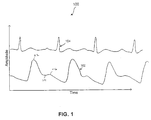
- FIG. 1 illustrates an exemplary plethysmograph 100, which includes a plethysmography waveform 102 of a normal subject produced by a plethysmography device.
- ECG electrocardiogram
- Waveform 102 provides a measure of the volume of the arterial vasculature.
- a measure of arterial pulse amplitude is derived from it.
- a few tens to a few hundreds of milliseconds after the QRS complex the plethysmography amplitude reaches a minimum and starts to increase. This is due to the increasing blood volume in the arterioles as the systolic pulse reaches the periphery.
- the delay is influenced by the distance that the sensor is placed from the heart.
- plethysmography device is a photoplethysmography device (PPG) (also called a pseudoplethysmography or photoelectric plethysmography device), which includes a light detector and a light source.
- PPG photoplethysmography device
- the photoplethysmography utilizes the transmission or reflection of light to demonstrate the changes in blood perfusion.
- Such devices are typically used in the cardiology department or intensive care department of a hospital or in a clinic for diagnostic purposes related to vascular surgery. All such photoplethysmography devices are referred to, herein, simply as plethysmography devices.
- FIG. 2A A block diagram 200A of an exemplary photoplethysmography device is shown in FIG. 2A.
- An exemplary mechanical arrangement 200B for a noninvasive (i.e., not implanted) photoplethysmography device is shown in FIG. 2B.
- An exemplary mechanical arrangement 200C for a chronically implantable photoplethysmography device is shown in FIG. 2C.
- the photoplethysmography device includes a light source 206 and a light detector 214.
- the light source 206 is a light-emitting diode (LED), although in alternative models an incandescent lamp or laser diode can be used as the light source.
- LED light-emitting diode
- FIG. 2A light source 206 outputs a transmit light signal 208 that is transmitted through and/or reflected by (depending on the embodiment) patient tissue 210.
- a receive light signal 212 is received by light detector 214.
- Light detector 214 can include, for example, a photoresistor excited by a constant current source. Changes in light intensity cause proportional changes in the resistance of the photoresistor.
- This varying analog voltage light detection signal 216 which is a plethysmography signal, is typically filtered and amplified and then converted to a digital signal using an analog to digital converter (not shown).
- the light detector can, for example, alternatively include a photodiode, phototransistor, photodarlington or avalanche photodiode. Light detectors are often also referred to as photodetectors or photocells.
- Light may be transmitted through a capillary bed such as in an earlobe or finger tip.
- a capillary bed such as in an earlobe or finger tip.
- the changes in volume of the blood vessels modify the absorption, reflection and scattering of the light.
- an arterial pulse in, for example, a finger tip, or earlobe causes blood volume to change, thereby changing the optical density of the tissue. Therefore, the arterial pulse modulates the intensity of the light passing through the tissue.
- Photoplethysmography devices may operate in either a transmission configuration or a reflection configuration.
- the transmission configuration light source 206 and light detector 214 face one another and a segment of the body (e.g., a finger or earlobe) is interposed between source 206 and detector 214.
- the reflection configuration light source 206 and light detector 214 are mounted adjacent to one another, e.g., on the surface of the body, as shown in FIG. 2B. In this configuration, a fraction of light from light source 206 is backscattered by the tissue into light detector 214.
- light source 206 and light detector 214 can be mounted adjacent to one another on the housing or header of the implantable device.
- Light source 206 and light detector 214 are preferably placed on the side of implantable device 220 that, following implantation, faces the chest wall, and are configured such that light cannot pass directly from the source to the detector.
- the reflection configuration is preferably used when the plethysmography device is implemented in an implantable device.
- the placement on the side of device 220 that faces the chest wall maximizes the signal to noise ratio by 1) directing the signal toward the highly vascularized musculature, and 2) shielding the source and detector from ambient light that enters the body through the skin.
- light source 206 and light detector 214 can be placed on the face of the device that faces the skin of the patient. Additional details of an implantable photoplethysmography device are disclosed in U.S. Patent Application No. 09/543,214, entitled “Extravascular Hemodynamic Sensor” (Turcott), filed April 5, 2000, which is incorporated herein by reference.
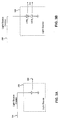
- FIGS. 3A and 3B illustrate exemplary light sources for use in the embodiments of the present invention.
- exemplary light source 206 includes a single LED that produces light signal 208.
- the LED can be, for example, a model L53SRC/F red LED, or a model L53F3C infrared LED, both manufactured by Kingbright Corporation, City of Industry, California.
- a series of LEDs e.g., LED 1 and LED 2
- dual emitter combination LEDs can be used, such as model DLED-660/905-LL5-2, manufactured by UDT Sensors, Inc., Hawthorne, California.
- Light source 206 can be driven by a light control signal 204, as shown in FIGS. 2A, 3A and 3B.
- transmit light signal 208 would have a relatively constant average light intensity, though the light may be pulsed rapidly.
- light control signal 204 is relatively constant when averaged over a period of the pulse train.
- light source 206 may or may not include additional elements that are used, for example, to maintain a relatively constant current through an LED.
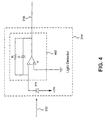
- FIG. 4 illustrates an exemplary light detector for use in embodiments of the present invention.
- exemplary light detector 214 includes a photodiode PD operated in a current sensing photoconductive mode feeding a transimpedance amplifier 402.
- Photodiode PD can be, for example, a model PIN-4.0-LLS, manufactured by UDT Sensors, Inc.
- Transimpedance amplifier 402 includes a resistor R, a capacitor C and an operation amplifier U, such as model ALD1701, manufactured by Advanced Linear Devices, Inc., Sunnyvale, California.
- Amplifier 402, including the RC circuit performs low pass filtering and provides gain. It also serves as an antialiasing filter if A/D conversion is applied directly to its output 216.
- a photodiode PD can alternatively be operated in a voltage sensing configuration. Further, one of ordinary skill in the art will appreciate that the use of other photodiodes (e.g., an avalanche photodiode) and other light detectors (e.g., a photoresistor, a photodarlington, a phototransistor), are within the spirit and scope of the present invention.
- other amplifier configurations e.g., an integrator amplifier or a transistor based amplifier
- An integrated photodiode/amplifier e.g., a Burr-Brown OPT101, available from Burr-Brown Corporation, Arlington, Arizona
- Burr-Brown OPT101 available from Burr-Brown Corporation, Arlington, Arizona
- a constant average optical power is delivered by light source 206 (e.g., an LED) and plethysmograph information (e.g., measurements of waveform 102 shown in FIG. 1) is determined based on time varying optical power incident on light detector 214.
- a photoplethysmography device can alternatively adjust the source of optical power such that a relatively constant average light intensity is detected at a light detector, as described in commonly assigned U.S. Patent Application No. 09/907,349 (Turcott), filed July 16, 2001, entitled “ Methods and Devices for Vascular Plethysmography Via Modulation of Source Intensity,” which is incorporated herein by reference.
- the time-varying modulating signal (e.g., that controls the source power) can then be used as the plethysmography signal (i.e., the information signal), rather than the time-varying detected optical power.
- the time-varying detected optical power is used (e.g., in a feedback loop) to adjust the source intensity.
- waveform 102 has a dicrotic pattern that is related to the dicrotic pattern typically exhibited by an arterial pressure waveform (not shown).
- Each period of an arterial pressure waveform which looks very similar to waveform 102, includes a primary (i.e., larger) pulse also known as the systolic wave, and the second smaller pulse also known as the dicrotic wave.
- a dicrotic notch is located between the primary pulse and second pulse.
- the inventor of the present invention builds upon the teachings of the Ewy et al . article to assess the HF status of patients by measuring/monitoring the dicrotic characteristics of a plethysmography waveform (referred to herein interchangeably as a plethysmography signal). Stated another way, the inventor of the present invention has realized that the dicrotic characteristics of an arterial pressure waveform can be indirectly measured/monitored using plethysmography. The inventor further realized that HF status can thus be assessed by measuring/monitoring the morphology of plethysmography signals. As will be appreciated from the following description, there are many practical advantages to assessing HF status in accordance with this embodiment of the present invention.
- changes in morphology of a pressure waveform are indirectly measured using an extravascular plethysmography device (e.g., a photoplethysmography device).
- an extravascular plethysmography device e.g., a photoplethysmography device.
- the dicrotic character of plethysmography waveform 102 includes a primary pulse 112 followed by a secondary pulse 116 of smaller amplitude.
- a dicrotic notch 114 is located between each primary pulse 112 and secondary pulse 116.
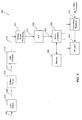
- FIG. 5 includes a block diagram that provides an overview of a HF status monitor 500, according to an embodiment of the present invention.
- Light source 206 outputs a transmit light signal 208 of substantially constant average light intensity (as controlled by light control signal 204).
- Light signal 208 is transmitted through and/or reflected by (depending on the embodiment) patient tissue 210.
- Receive light signal 212 is received by light detector 214. Changes in light intensity of the received light signal 212 are proportional to changes in blood volume in patient tissue 210.
- Light detector 214 produces a light detection signal 216 that is representative of the received light signal 212.
- Analog output signal 216 which is an analog encoded information signal, is preferably filtered and amplified by analog signal processor block 522.
- a filtered and amplified signal 524 is then provided to an analog to digital converter (A/D) 526, which provides a digital encoded plethysmography information signal 528 to microprocessor 530.
- A/D analog to digital converter
- Microprocessor 530 analyzes the encoded information signals 528. According to an embodiment of the present invention, microprocessor 530 analyzes the shape of the plethysmography signal represented by the encoded information signals 528. For example, microprocessor 530 can estimate arterial pulse amplitudes based on maximum and minimum values deciphered from the encoded information signals over durations of cardiac cycles.
- monitor 500 If monitor 500 is not implanted, light source 206 and light detector 214 can be made small and can conveniently attach to a peripheral portion of the body, such as a finger, toe, or ear. Thus, patients are likely to tolerate regular use of these sensors for an extended period of time, such as during sleep each night. Particular embodiments include a finger cuff, a wristband, a configuration resembling a watch, and a configuration resembling a clip-on earring. Light source 206 and light detector 214 could be tethered to a larger unit containing the bulk of the electronic circuitry (e.g., microprocessor 530 and a memory 560). In this case, monitor 500 would be worn primarily when the patient is sleeping.
- the electronic circuitry e.g., microprocessor 530 and a memory 560
- monitor 500 is an implanted, extravascular configuration.
- many embodiments of the present invention are not limited to implantable implementations.
- Monitor 500 can also include a transmitter/receiver 550 (i.e., a telemetric circuit) and a memory 560. If monitor 500 is chronically implanted, transmitter/receiver 550 enables the operating parameters of monitoring device 500 to be non-invasively programmed into the memory 560 through telemetric communications with an external device, such as a programmer or transtelephonic transceiver. Transmitter/receiver 550, which is preferably controlled by microcontroller 530, also enables monitor 500 to communicate with other types of external processors.
- transmitter/receiver 550 enables plethysmography information (e.g., the values discussed above) and status information relating to the operation of device 500 (e.g., as contained in the microcontroller 530 or memory 560) to be sent to an external device (e.g., a remote processor or diagnostic system analyzer) through an established communication link.
- an external device e.g., a remote processor or diagnostic system analyzer
- Microprocessor 530 can produce HF assessment information
- transmitter/receiver 550 can transmit the information to another processor as appropriate.
- Transmitter/receiver 550 can additionally, or alternatively, transmit measured values and/or calculated values to an external device (e.g., a remote processor) that can assess HF status based on such values.
- the encoded information signals can be transmitted directly to an external device (e.g., a remote processor), and the external device can perform appropriate measurements and calculations (individually and collectively referred to herein as "determinations").
- an external device e.g., a remote processor
- a transmitter/receiver 550 also known as a telemetric circuit of a chronically implantable device
- a transmitter/receiver 550 also known as a telemetric circuit
- U.S. Patent No. 4,809,697 entitled “Interactive Programming and Diagnostic System for use with Implantable Pacemaker” (Causey, III et al .)
- U.S. Patent No.4,944,299 entitled “High Speed Digital Telemetry System for Implantable Device” (Silvian)
- TR1000 transceiver manufactured by RF Monolithics, Dallas, TX.
- the TR 1000 is a single-chip, low-power, 916.5 MHz transceiver.
- the operating frequency of 916.5 MHz is desirable because of the modest requirements on antenna size it imposes. Additional implementation details relating to the TR 1000 is described in detail in commonly assigned U.S. Patent Application No. 09/438,017, entitled “Method for Monitoring Heart Failure,” (Turcott) filed November 11, 1999, which is incorporated herein by reference.
- Monitor 500 can also include an HF alert block 540, that informs a patient, physician, clinician and/or any other person (or processor) of the HF status of the patient.
- HF alert block 540 is preferably an external device that telemetrically communicates with microprocessor 530 (e.g., using transmitter/receiver 550).
- HF alert 540 can include an indicator that provides, for example, an acoustic, mechanical vibration, optical and/or electrical indication and/or stimulation. Such an alert indicator can be triggered when a criterion (e.g., threshold) is satisfied (e.g., exceeded), as discussed below.
- HF alert 540 includes an inductive coil that generates both sound and mechanical vibration.
- the function of HF alert 540 is incorporated into microprocessor 530 and transmitter/receiver 550.
- a relatively constant average optical power is delivered by light source 206 (e.g., an LED) and the plethysmograph signal is determined based on the time varying optical power incident on light detector 214.
- a photoplethysmography device can alternatively adjust the source of optical power such that a relatively constant average light intensity is detected at a light detector, as described in commonly assigned U.S. Patent Application No. 09/907,349, which has been incorporated herein by reference above.
- the time-varying modulating signal e.g., that controls the source power
- the time-varying detected optical power is used (e.g., in a feedback loop) to adjust the source intensity.
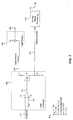
- a monitor 600 includes a light controller 602 that produces light control signal 204 that drives light source 206.
- Light source 206 outputs a transmit light signal 208 based on light control signal 204.
- Light signal 208 is transmitted through and/or reflected by (depending on the embodiment) patient tissue 210.
- a receive light signal 212 is received by a light detector 214.
- Light detector 214 provides light detection signal 216 (also referred to, for this embodiment, as feedback signal 216) to light controller 602.
- Light controller 602 adjusts light control signal 204, based on a difference between feedback signal 216 and an internal reference signal, such that a relatively constant average light intensity is detected by light detector 214. Stated another way, light controller 602 adjusts light control signal 204 based on a difference between feedback signal 216 and a reference signal, such that the difference between feedback signal 216 and the reference signal is minimized.
- a time-varying modulating signal of light controller 602 is used as (or to produce) the plethysmography signal (i.e., the information signal), rather than the time-varying detected optical power.
- an analog output signal 620 is provided from the light controller 602.
- Analog output signal 620 which is an analog encoded information signal, is preferably filtered and amplified by analog signal processor block 522.
- a filtered and amplified signal 524 is then provided to an analog to digital converted (A/D) 526, which provides a digital encoded information signal 528 to microprocessor 530.
- light controller 602 digitally controls light source 206, and a digital plethysmography information signal 618 is provided directly to microprocessor 530.
- Microprocessor 530 analyzes the encoded information signals (e.g., 618 or 528).
- light controller 602 outputs light control signal 204, which drives light source 206.
- light control signal 204 is an analog voltage or current signal having a variable voltage or current amplitude. More specifically, in this embodiment the amplitude of the light control signal 204 is adjusted (i.e., increased or decreased) by light controller 602, based on a difference between feedback signal 216 and a reference signal 704 so that a relatively constant average light intensity is detected by light detector 214 (See FIG. 6). Stated another way, light controller 602 adjusts the amplitude of light control signal 204, based on a difference between feedback signal 216 and a reference signal, such that the difference between feedback signal 216 and the reference signal is minimized.
- light controller 602 includes a comparator 710 (e.g., operation amplifier U), which compares feedback signal 216 to a fixed reference voltage signal 704 (e.g., 1.2 volts).
- comparator is used herein to refer to a device that performs a comparison between two input signals and generates an analog or digital (e.g., binary) output based on the results of the comparison.
- comparator 710 produces an analog output 712 based on the comparison.
- Light controller 602 also includes a transistor Q (e.g., a MOSFET transistor as shown). Transistor Q is controlled by an output 712 (also referred to as comparison signal 712) of comparator 710.
- transistor Q is turned on by an amount proportional to a difference between feedback signal 216 and fixed reference voltage signal 704.
- transistors and/or various other types of current control circuits, can be used while still being within the spirit and scope of the present invention.
- a modulated LED current carrying the plethysmograph information
- a sense resistor R More specifically, the information signal of interest, analog output 620 (which is the voltage across resistor R), is proportional to the LED current. As shown in FIG. 6, this signal 620 can be provided to analog signal processor 522, which filters and amplifies the signal. Filtered and amplified signal 524 can then be provided to A/D 526, which provides a digital encoded information signal 528 to microprocessor 530.
- one or more digital output signals 618 which are digitally encoded information signals, are provided from light controller 602 to microprocessor 530. Additional details of such digital embodiments are described in U.S. Patent Application No. 09/907,349, which was incorporated herein by reference above.
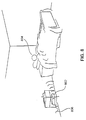
- FIG. 8 illustrates placement of an external telemetry (i.e., transmitter/receiver) unit 802 in, for example, the patient's bedroom.
- External telemetry unit 802 using telemetry at a distance, allows the transfer of data to and from monitor 500 if it is a chronically implanted device or a device that clips on the finger, toe or earlobe, without the active participation of the patient 804 or a clinician.
- External telemetry unit 802 is preferably positioned in a location(s) regularly frequented by the patient, such as the patient's bedroom, office, and/or automobile.
- External telemetry unit 802 can be in communication (e.g., through a telephone line 806, network connection and/or wireless links) with a central location for further processing or review (e.g., by a clinician).
- microprocessor 530 can, for example, determine: maximum and minimum values of primary pulses 112, values of the dicrotic notches 114, and maximum values of secondary pulses 116. Microprocessor 530 can then, for example, produce averages of these values and perform calculations based on these values. Alternatively, microprocessor 530 can perform calculations based on each cardiac cycle of waveform 102, and then average the calculations as desired.
- microprocessor 530 can, for example, determine: [1] a peak height ( p ) of the primary pulse 112; [2] a level ( n ) of the dicrotic notch 114 above the foot (i.e., minimum value) of the primary pulse 112; and [3] a peak height (s) of the secondary pulse 116.
- microprocessor 530 can, for example, determine: [1] the dicrotic notch level ( n ) normalized by the primary pulse height ( p ) (i.e., n / p ); [2] the height of the secondary pulse normalized by the primary pulse height ( p ) (i.e., s / p ); [3] an estimated area ( A p ) under the primary pulse 112; [4] an estimated area ( A s ) under the secondary pulse 116 (above the dicrotic notch); and [5] the area under the secondary pulse as normalized by the area under the primary pulse (i.e., A / A p ).
- microprocessor 330 can use more than the maximum and minimum values of primary pulse 112, the value of the dicrotic notch 114, and the maximum value of secondary pulse 116, (i.e., use additional data points) to more accurately determine the area under the primary pulse 112 and secondary pulse 116.
- an estimate of the widths of the pulses can be used to further characterize the morphology of the waveform, or to further improve the estimate of other parameters, such as the areas.
- the pulse width can be estimated, for example, but measuring the width of each pulse at the level of the dicrotic notch, or at some specified level of the pulse, such as at half the maximum, or by measuring the time between the foot of the primary pulse and the dicrotic notch. If the signal is accoupled, that is, if the dc component has been removed from the signal, then the amplitudes of the primary and secondary pulses can be estimated from the peak values alone. One of ordinary skill in the art would understand how this can be accomplished.
- Microprocessor 530 can then assess the HF status based on some or all of the above discussed values.
- the above discussed values can be transmitted to a remote processor (not shown) using transmitter/receiver 550.
- the remote processor can then assess the HF status based on some or all of the above discussed values.
- the encoded information signals e.g., light detection signal 516 are transmitted directly to a remote processor (e.g., via transmitter/receiver 550), which can perform the functions of microprocessor 530.
- an HF alert 540 can be triggered if a predetermined criteria (e.g., threshold) is satisfied (e.g., exceeded).
- a predetermined criteria e.g., threshold
- an assessment of HF status can be based on the pulse height ( s ) of secondary pulses 116.
- alert indicator 540 can be triggered if the normalized secondary pulse height ( s / p ) exceeds a threshold.
- a threshold can be a predetermined value.
- a threshold can be dynamic in that its value is determined based on previously measured and/or calculated values.
- alert indicator 540 can be triggered if the normalized height ( s / p ) increases by a certain percentage over previous values of the normalized height ( s / p ).
- Triggering of alert indicator 540 can indicate (e.g., to a patient, physician, clinician, monitoring staff, and/or monitoring computer) that a heart failure exacerbation (also known as, an episode of acute heart failure) is developing.
- the assessment of HF status can be based on the height ( n ) of the dicrotic notch (as normalized, i.e., n / p ), which decreases when heart failure exacerbation is developing. Accordingly, alert indicator 540 can be triggered if the normalized height ( n / p ) of the dicrotic notch decreases below a threshold.
- the assessment of HF status can be based on the area ( A s ) of the secondary pulse (as normalized, i.e., A s / A p ), which similarly becomes more prominent when heart failure exacerbation is developing.
- thresholds can be patient specific.
- an HF monitor e.g., 500 of the present invention can look for a deviation away from a baseline.
- the monitor could continually update what it considers to be baseline, so that slow drifts do not trigger a warning, but rapid changes do. For example, a mean and standard deviation can be calculated for any of the above discussed values. If a newly determined value is different than a previously determined mean value by a specified multiple (e.g., 1.5 or 2) of the standard deviation, then an alert indicator can be triggered.
- the monitor could also consider deviations in either direction as evidence of an HF exacerbation.
- HF assessment can be determined based on a time derivative of plethysmography signal 102.
- waveform (b) i.e., signal 902 is the time derivative of waveform (a) (i.e., plethysmography signal 102).
- This waveform can be determined using an appropriate filter.
- An exemplary analog filter 1000 that can be used to produce time derivative signal 902, from plethysmography signal 102, is shown in FIG. 10 (where V t is plethysmography signal 102 and V o is time derivative signal 902).
- the time derivative of plethysmography signal 102 can be calculated numerically by, for example, microprocessor 530.
- the time derivative of a signal represents the slope of the signal.
- the value of time derivative signal 902 equals zero at every maximum or minimum peak of plethysmography signal 102 shown in waveform (a).
- the time derivative signal e.g., 902 can be used in conjunction with a plethysmography signal (e.g., 102) to locate the maximum peaks and minimum peaks (i.e., troughs) of the plethysmography signal.
- assessment of HF status can be determined directly from the time derivative signal (i.e., not in conjunction with the plethysmography signal 102).
- microprocessor 530 can, for example, determine: [1] a peak height ( p d ) of primary derivative pulses 912 (above zero); and [2] a peak height ( s d ) of the secondary derivative pulses 916 (i.e., the derivative of secondary pulses 116, not the second derivative of a pulse).
- Analog peak detectors which are known in the art, can be used to detect these values. The values can then be provided by the peak detectors to microprocessor 530. Alternatively, these values can be determined in the digital domain by microprocessor 530.
- microprocessor 530 can, determine: [1] the peak height ( s d ) of the secondary derivative pulse 916 normalized by the total height of primary derivative pulse 912 ( p d ) (i.e., p d / s d ); [2] an estimated area ( A dp ) under the primary derivative pulse 912; [3] an estimated area ( A ds ) under the secondary derivative pulse 916 (above zero); and [4] the area under the secondary derivative pulse as normalized by the area under the primary pulses (i.e., A ds / A dp ).
- microprocessor 530 can use more than the maximum values of primary derivative pulse 912 and secondary derivative pulse 916, to more accurately determine the areas under the pulses.
- the estimates of the areas of the primary derivative pulse and secondary derivative pulse can be improved by incorporating estimates of their widths. Widths can be measured at some specified level, e.g., their widths at half maximum. Alternatively, the times between successive zero crossings of the derivative signal 912 can be used to estimate the widths of the pulses.
- microprocessor 530 can then assess the HF status based on some or all of the above discussed values.
- Secondary derivative pulses 916 will become more prominent when heart failure exacerbation is developing. Accordingly, an assessment of HF status can be based on the pulse height ( s d ) of secondary derivative pulses 916. For example, alert indicator 540 can be triggered if the normalized secondary derivative pulse height ( s d / p d ) exceeds a threshold. Alternatively, or additionally, the assessment of HF status can be based on the area ( A ds ) of the secondary derivative pulses (as normalized, i.e., A ds / A dp ), which similarly becomes more prominent when heart failure exacerbation is developing. For example, alert indicator 540 can be triggered if the normalized secondary derivative pulse area A ds / A dp exceeds a threshold.
- HF status is assessed based on ejection time, t 0 , which is the time required for the ventricles to eject blood.
- ejection time t 0
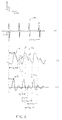
- surrogate measurements of ejection time can be made from a waveform representative of arterial pressure, possibly in conjunction with intracardiac electrogram or surface ECG. These surrogate measurements reflect the true ejection time, with the possible addition of an approximately constant delay. The delay is due to propagation of the arterial pressure wave from the heart to the location of the sensor at the periphery, and is present in the surrogate measurements when the onset of the measurement is defined by electrical activity of the heart. For example, referring to FIG. 11, ejection time surrogate t 1 is the time from electrical depolarization 1104 to dichrotic notch 114.
- Electrical depolarization can be detected, for example, based on a QRS complex of an intracardiac electrogram signal 1102 (shown in waveform (a)) or a surface ECG signal (not shown).
- HF status can be assessed based on the time ( t 2 ) from an electrical depolarization 1104 to the maximum point (i.e., peak) of the primary pulse 112.
- HF status is assessed based on the time ( t 3 ) from electrical depolarization to the maximum of the time derivative waveform 902.
- the pulse propagation delay in the ejection time surrogate measurements is avoided if the measurements are made exclusively from the morphology of the waveform, i.e., if electrical information is not used.
- a surrogate measurement of the ejection time t 4 can be taken as the time from the beginning of an upstroke 1114 to the occurrence of the following dicrotic notch 1116.
- this is the time from the absolute minimum to the time of the following dicrotic notch.
- the derivative signal this is the time from the negative-to-positive zero crossing associated with a primary peak to the next negative-to-positive zero crossing.
- a surrogate measurement of the ejection time t 5 can be taken as the time from the beginning of an upstroke 1114 to the time of the primary peak 1118.
- this is the time from the absolute minimum to the time of the absolute maximum.
- the derivative signal this is the time from the negative-to-positive zero crossing associated with a primary peak to the next positive-to-negative zero crossing.
- the ejection time of a heart will vary in accordance with heart rate (HR).
- HR heart rate
- the time t 1 from an electrical depolarization 1104 to the dicrotic notch 114, the time t 2 from an electrical depolarization 1104 to the maximum point of the secondary pulse 116, and the time t 3 from electrical depolarization 1104 to maximum of the time derivative waveform 902, should be adjusted based on HR if these times are used to assess HF status.
- these time measurements can be normalized by the cycle length of the heart, i.e., the time between successive heart beats. This is readily measured from the intracardiac electrogram or surface ECG as, for example, the time t 9 between successive QRS complexes.
- These can be measured directly from the derivative signal by recording the time between every other negative-to-positive zero crossing or every other positive-to-negative zero crossing.
- the cycle length is readily obtainable in a number of different ways, and can be used to normalize surrogate ejection time measurements to account for heart rate.
- the ratio t 4 / t 6 can be used as a surrogate for ejection time.
- Each of the above discussed adjusted times (i.e., adjusted t 0 , t 1 , t 2 and t 3 ) will decrease when HF exacerbation is developing. This is likely due to an increase in sympathetic activity of the autonomic nervous system and an increase in circulating catacholamines (fight or flight response) that make the heart contract more vigorously. Accordingly, an alert indicator can be triggered if one or more of these times fall below a corresponding threshold(s).
- a threshold(s) can be static or dynamic.
- the threshold(s) can be the same for many patients, or specific to a patient.
- HF status can be assessed based on the frequency characteristics of a signal that is representative of arterial pulse pressure (e.g., plethysmography signal 102).
- a signal representative of arterial pulse pressure should have relatively more high frequency power (i.e., more high frequency content) and relatively less low frequency power (i.e., less low frequency content) when heart failure exacerbation is developing.
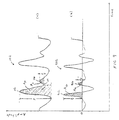
- FIGS. 12A and 12B show that the solid line 102a in FIG. 12A is a plethysmography signal (in the time domain) of a heart that is not experiencing HF exacerbation.
- the solid line 1202a in FIG. 12B is a frequency representation of plethysmography signal 102a.
- the dashed line 102b in FIG. 12A represents a corresponding plethysmography signal 102b when a HF exacerbation is developing.
- the dashed line 1202b in FIG. 12B is a frequency representation of plethysmography signal 102b. Notice the increase in high frequency content when HF exacerbation is developing.
- the frequency characteristics of a signal representative of arterial pulse pressure is determined by first high pass filtering this signal. A variance of the high pass filtered signal, which is representative of the high frequency power, is then determined. The variance is then compared to a threshold. An HF alert indicator can be triggered if the determined variance exceeds a threshold.
- the frequency spectrum of a signal representative of arterial pulse pressure is determined numerically. This can be accomplished, for example, using a Fast Fourier Transform (FFT) algorithm.
- FFT Fast Fourier Transform
- the high frequency content can then be determined based on the frequency spectrum. This can be performed, for example, within microprocessor 530.
- An HF alert indicator can be triggered if the determined high frequency content exceeds a threshold.
- FIG. 13 is a flow diagram that is useful for describing an overview of the operation of the above discussed embodiments of the present invention.
- a plethysmography signal that is representative of arterial pulse pressure is produced.
- HF status is assessed based on the shape (i.e., morphology) of the plethysmography signal.
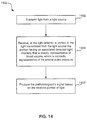
- FIG. 14 is a flow diagram illustrating details of step 1302, according to an embodiment of the present invention.
- a light source e.g., light source 206
- a portion of the light transmitted from the light source is received at a light detector (e.g., light detector 214).
- the received portion of light which was transmitted through a capillary bed (such as in an earlobe or finger tip or some other patient tissue) prior to being received at the light detector, has an associated detected light intensity.
- the light source and light detector which can be arranged in a transmission configuration or a reflection configuration, can be incorporated in a chronically implanted device (e.g., as shown in FIG. 2C), or can be part of a non-implanted device (e.g., as shown in FIG. 2B).
- the plethysmography signal is produced based on the received portion of light.
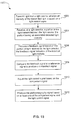
- FIG. 15 is a flow diagram illustrating details of step 1302, according to another embodiment of the present invention, where the time-varying modulating signal that controls the intensity of the transmitted light is used as (or to produce) the plethysmography signal, rather than the time-varying detected optical power.
- a light source e.g., light source 206
- an intensity of the transmitted light is based on a light control signal (e.g., 204).
- a portion of the transmitted light is received from the light source, at a light detector (e.g., light detector 214).
- the received portion of light which was transmitted through a capillary bed (such as in an earlobe or finger tip or some other patient tissue) prior to being received at the light detector, has an associated detected light intensity.
- a feedback signal (e.g., 216) is produced based on the portion of light received at the light detector.
- the feedback signal is indicative of the detected light intensity.
- the feedback signal is compared to a reference signal (e.g., 704) to produce a comparison signal (e.g., 712).
- the light control signal is adjusted based on the comparison signal.
- the plethysmography signal is produced based on at least one of the comparison signal and the light control signal.
- step 1304 where HF status is assessed based on the shape of the plethysmography signal, shall now be discussed. As discussed above, this can be accomplished in many ways.
- FIG. 16 illustrates details of step 1304 according to an embodiment of the present invention.
- a step 1602 one or more values corresponding to the shape of the plethysmography signal are determined.
- the HF status is assessed based on the one or more values determined at step 1602.
- step 1602 can include determining: a first value corresponding to the height of one or more primary pulses of the plethysmography signal; and a second value corresponding to the height of one or more secondary pulses of the plethysmography signal.
- the first value corresponds to total height ( p ) of the primary pulse 112, shown in FIG. 9.
- the second value corresponds to height ( s ) of secondary pulse 116, also shown in FIG. 9.
- the HF status is assessed based on the first and second values.
- This step may include, for example, triggering an alert indicator (e.g., an alarm) based on the first and second values.
- the alert indicator may be triggered if the normalized height ( s / p ) of the secondary pulses exceeds a threshold, as discussed above.
- step 1604 includes determining: a first value corresponding to the height of one or more primary pulses of the plethysmography signal; and a second value corresponding to the height of one or more dicrotic notches of the plethysmography signal. Then, at step 1604, the HF status is assessed based on the first and second values.
- step 1604 includes determining: a first value corresponding to an area under one or more primary pulses of the plethysmography signal; and a second value corresponding to the area under one or more secondary pulses of the plethysmography signal. Then, at step 1604, the HF status is assessed based on the first and second values.
- an indicator alarm can be triggered based on the first and second values.
- the Ewy et al . article does not teach or suggest a chronically implanted sensor (defined herein as a sensor implanted for at least three days) that assesses HF status based on the shape of a signal that is representative of arterial pulse pressure.
- a plethysmography signal is an example of a signal that is representative of arterial pulse pressure.
- there are many advantages to assessing HF status based on a plethysmography signal which can be produced using an extravascular sensor.
- HF status is assessed based on the shape of a plethysmography signal produced by a chronic implanted plethysmography device (e.g., including light source 206 and light detector 214). Details of such an embodiment are described above.
- HF status is assessed based on the shape of a signal, other than a plethysmography signal, that is representative of arterial pulse pressure.
- the alternative signal representative of arterial pulse pressure is produced using a chronically implanted sensor that produces a signal having the desired dicrotic characteristics (i.e., a primary pulse, a dicrotic notch, and a secondary pulse).
- an intra-arterial chronic pressure sensor is used to produce a signal that is representative of arterial pulse pressure.
- the intra-arterial chronic pressure sensor should be implanted within an artery, such as the pulmonary artery.
- An example of an appropriate pressure sensor is the Medtronic Chronicle (also known as an "Implantable Hemodynamic Monitor"), which is manufactured by Medtronic, of Minneapolis, Minnesota.
- the Medtronic Chronicle is typically implanted in the right ventricle. While implanted in the right ventricle, the Medtronic Chronic will not produce a signal having the desired dicrotic characteristics.
- the pressure transducer In order for the Medtronic Chronicle to produce a signal that includes the desired dicrotic characteristics, the pressure transducer should be advanced from the right ventricle into the pulmonary artery.
- Other intra-arterial pressure transducers that can be used produce a signal that is representative of arterial pulse pressure, and include the desired dicrotic characteristics (so long as they are advanced into the pulmonary artery), are disclosed in U.S. Patent No. 5,899,927, entitled “Detection of Pressure Waves Transmitted Through Catheter/Lead Body” (Ecker et al .), and U.S. Patent No. 6,208,900, entitled “Method and Apparatus or Rate-Responsive Cardiac Pacing using Header Mounted Pressure Wave Transducer” (Ecker et al .), both of which are incorporated herein by reference.
- Such alternative signals that are representative of arterial pulse pressure and include the desired dicrotic characteristics will resemble a plethysmography signal (e.g., signal 102). Accordingly, the above described embodiments for assessing HF status based on the shape of a plethysmography signal can be used to assess HF status based on the shape of a signal representative of arterial pulse pressure that is produced using alternative chronically implanted sensors.
- HF status can be assessed based on the frequency characteristics of a signal representative of arterial pulse pressure.
- this aspect of the present invention can be used if the signal representative of arterial pulse pressure is not a plethysmography signal, so long as the signal has the desired dicrotic characteristics (i.e., a primary pulse, a dicrotic notch, and a secondary pulse).
- assessment of HF status based on the frequency characteristics of a signal representative of arterial pulse pressure is not limited to those embodiments where the signal is a plethysmography signal.
- the above described embodiments of the present invention can be used to tailor drug therapy (e.g., beta blockers) that is used to treat HF.
- the dosage of a drug can be adjusted based on the shape of a signal representative of arterial pulse pressure. More specifically, the shape of such a signal can be used as a quantitative measure of drug efficacy. Varying drug dosages can be administered over a period of time (e.g., multiple days or weeks). One or more signals representative of arterial pulse pressure can be measured for each dosage. These signals can then be analyzed in accordance with the various embodiments described above. Following the administration of such drug doses, and analysis of the respective signals representative of arterial pulse pressure, an optimum drug dosage can be determined based on the signals. This is just one example of how drug therapy can be tailored based on one or more signals representative of arterial pulse pressure.
Landscapes
- Health & Medical Sciences (AREA)
- Life Sciences & Earth Sciences (AREA)
- Engineering & Computer Science (AREA)
- Surgery (AREA)
- General Health & Medical Sciences (AREA)
- Biophysics (AREA)
- Pathology (AREA)
- Veterinary Medicine (AREA)
- Biomedical Technology (AREA)
- Heart & Thoracic Surgery (AREA)
- Medical Informatics (AREA)
- Molecular Biology (AREA)
- Public Health (AREA)
- Animal Behavior & Ethology (AREA)
- Physics & Mathematics (AREA)
- Cardiology (AREA)
- Physiology (AREA)
- Immunology (AREA)
- Vascular Medicine (AREA)
- Artificial Intelligence (AREA)
- Computer Vision & Pattern Recognition (AREA)
- Psychiatry (AREA)
- Signal Processing (AREA)
- Measuring Pulse, Heart Rate, Blood Pressure Or Blood Flow (AREA)
Applications Claiming Priority (2)
| Application Number | Priority Date | Filing Date | Title |
|---|---|---|---|
| US09/981,570 US6575912B1 (en) | 2001-10-16 | 2001-10-16 | Assessing heart failure status using morphology of a signal representative of arterial pulse pressure |
| US981570 | 2001-10-16 |
Publications (2)
| Publication Number | Publication Date |
|---|---|
| EP1302156A2 true EP1302156A2 (fr) | 2003-04-16 |
| EP1302156A3 EP1302156A3 (fr) | 2003-10-22 |
Family
ID=25528468
Family Applications (1)
| Application Number | Title | Priority Date | Filing Date |
|---|---|---|---|
| EP02023161A Withdrawn EP1302156A3 (fr) | 2001-10-16 | 2002-10-16 | Evaluation de l'état d'insuffisance cardiaque utilisant la morphologie des signaux de la pression artérielle |
Country Status (2)
| Country | Link |
|---|---|
| US (1) | US6575912B1 (fr) |
| EP (1) | EP1302156A3 (fr) |
Cited By (6)
| Publication number | Priority date | Publication date | Assignee | Title |
|---|---|---|---|---|
| US7324848B1 (en) | 2004-07-19 | 2008-01-29 | Pacesetter, Inc. | Reducing data acquisition, power and processing for photoplethysmography and other applications |
| FR2913588A1 (fr) * | 2007-03-12 | 2008-09-19 | Groupe Ecoles Telecomm | Systeme de televigilance ambulatoire comportant un dispositif de debruitage du pouls, d'actimetrie et de dectection de chute |
| US7909768B1 (en) | 2004-07-19 | 2011-03-22 | Pacesetter, Inc. | Reducing data acquisition, power and processing for hemodynamic signal sampling |
| US7920913B1 (en) | 2007-06-29 | 2011-04-05 | Pacesetter, Inc. | Systems and methods for increasing implantable sensor accuracy |
| CN101790346B (zh) * | 2007-07-24 | 2012-08-29 | 皇家飞利浦电子股份有限公司 | 监测胎儿心率的方法 |
| WO2017129426A1 (fr) | 2016-01-28 | 2017-08-03 | Koninklijke Philips N.V. | Système de détermination permettant de déterminer un risque d'insuffisance cardiaque |
Families Citing this family (77)
| Publication number | Priority date | Publication date | Assignee | Title |
|---|---|---|---|---|
| US7097618B1 (en) * | 2003-03-12 | 2006-08-29 | Transoma Medical, Inc. | Devices and methods for detecting and treating inadequate tissue perfusion |
| US7127290B2 (en) | 1999-10-01 | 2006-10-24 | Cardiac Pacemakers, Inc. | Cardiac rhythm management systems and methods predicting congestive heart failure status |
| US7206636B1 (en) | 1999-11-10 | 2007-04-17 | Pacesetter, Inc. | Pacing optimization based on changes in pulse amplitude and pulse amplitude variability |
| US6731967B1 (en) * | 2001-07-16 | 2004-05-04 | Pacesetter, Inc. | Methods and devices for vascular plethysmography via modulation of source intensity |
| DE10142019A1 (de) * | 2001-08-28 | 2003-03-20 | Philips Corp Intellectual Pty | Schaltungsanordnung zur Demodulation von Signalen |
| US6980851B2 (en) * | 2001-11-15 | 2005-12-27 | Cardiac Pacemakers, Inc. | Method and apparatus for determining changes in heart failure status |
| US7248921B2 (en) | 2003-06-02 | 2007-07-24 | Cameron Health, Inc. | Method and devices for performing cardiac waveform appraisal |
| US9740817B1 (en) | 2002-10-18 | 2017-08-22 | Dennis Sunga Fernandez | Apparatus for biological sensing and alerting of pharmaco-genomic mutation |
| US7529583B1 (en) | 2003-01-15 | 2009-05-05 | Transoma Medical, Inc. | Therapeutic device and method using feedback from implantable pressure sensor |
| US8346482B2 (en) * | 2003-08-22 | 2013-01-01 | Fernandez Dennis S | Integrated biosensor and simulation system for diagnosis and therapy |
| US7194306B1 (en) | 2003-09-05 | 2007-03-20 | Pacesetter, Inc. | Cardiac optimization through low-frequency analysis of hemodynamic variables |
| US7558627B1 (en) | 2003-09-29 | 2009-07-07 | Pacesetter, Inc. | System and method for rapid optimization of control parameters of an implantable cardiac stimulation device |
| WO2005110051A2 (fr) * | 2004-05-10 | 2005-11-24 | Transoma Medical, Inc. | Dispositif portable de surveillance de signaux electrocardiographiques et de signes de circulation sanguine |
| US7468036B1 (en) * | 2004-09-28 | 2008-12-23 | Impact Sports Technology, Inc. | Monitoring device, method and system |
| US7470234B1 (en) * | 2004-09-28 | 2008-12-30 | Impact Sports Technology, Inc. | Monitoring device, method and system |
| US7386345B2 (en) * | 2005-01-27 | 2008-06-10 | Cardiac Pacemakers, Inc. | Apparatus and method for temporary treatment of acute heart failure decompensation |
| US8378811B2 (en) * | 2005-03-11 | 2013-02-19 | Aframe Digital, Inc. | Mobile wireless customizable health and condition monitor |
| US8618930B2 (en) * | 2005-03-11 | 2013-12-31 | Aframe Digital, Inc. | Mobile wireless customizable health and condition monitor |
| US7616110B2 (en) * | 2005-03-11 | 2009-11-10 | Aframe Digital, Inc. | Mobile wireless customizable health and condition monitor |
| US7678057B2 (en) * | 2005-03-24 | 2010-03-16 | Intelomed, Inc. | Device and system that identifies cardiovascular insufficiency |
| US8423108B2 (en) * | 2005-03-24 | 2013-04-16 | Intelomed, Inc. | Device and system that identifies cardiovascular insufficiency |
| JP4559279B2 (ja) * | 2005-04-08 | 2010-10-06 | テルモ株式会社 | 血圧測定装置、血圧測定方法、並びに制御プログラム |
| JP4559281B2 (ja) * | 2005-04-08 | 2010-10-06 | テルモ株式会社 | 血圧測定装置 |
| US7479154B2 (en) * | 2005-05-05 | 2009-01-20 | Mcewen James A | Surgical tourniquet apparatus for measuring limb occlusion pressure |
| US7526338B1 (en) | 2005-05-23 | 2009-04-28 | Pacesetter, Inc. | Implantable cardiac device for monitoring diastolic heart failure and method of operation and use thereof |
| US8229545B2 (en) | 2005-09-15 | 2012-07-24 | St. Jude Medical, Atrial Fibrillation Division, Inc. | System and method for mapping complex fractionated electrogram information |
| US8038625B2 (en) * | 2005-09-15 | 2011-10-18 | St. Jude Medical, Atrial Fibrillation Division, Inc. | System and method for three-dimensional mapping of electrophysiology information |
| JP4468878B2 (ja) * | 2005-10-07 | 2010-05-26 | テルモ株式会社 | 血圧測定用カフおよび血圧測定装置 |
| US7682313B2 (en) | 2005-11-23 | 2010-03-23 | Vital Sensors Holding Company, Inc. | Implantable pressure monitor |
| US7686768B2 (en) * | 2005-11-23 | 2010-03-30 | Vital Sensors Holding Company, Inc. | Implantable pressure monitor |
| US7813805B1 (en) * | 2006-01-11 | 2010-10-12 | Pacesetter, Inc. | Subcardiac threshold vagal nerve stimulation |
| US8712519B1 (en) | 2006-03-31 | 2014-04-29 | Pacesetter, Inc. | Closed-loop adaptive adjustment of pacing therapy based on cardiogenic impedance signals detected by an implantable medical device |
| US7988639B2 (en) * | 2006-05-17 | 2011-08-02 | St. Jude Medical, Atrial Fibrillation Division, Inc. | System and method for complex geometry modeling of anatomy using multiple surface models |
| US7627374B1 (en) | 2006-06-02 | 2009-12-01 | Pacesetter, Inc. | System and method for evaluating and optimizing the contribution of particular heart chambers to the overall efficacy of cardiac pacing therapy |
| US7970465B1 (en) * | 2006-08-31 | 2011-06-28 | Pacesetter, Inc. | Decision paradigms for implantable cardioverter-defibrillators |
| US8202224B2 (en) * | 2006-11-13 | 2012-06-19 | Pacesetter, Inc. | System and method for calibrating cardiac pressure measurements derived from signals detected by an implantable medical device |
| US8014863B2 (en) * | 2007-01-19 | 2011-09-06 | Cardiac Pacemakers, Inc. | Heart attack or ischemia detector |
| DE602008004225D1 (fr) * | 2007-02-28 | 2011-02-10 | Medtronic Inc | |
| US7769436B1 (en) | 2007-06-04 | 2010-08-03 | Pacesetter, Inc. | System and method for adaptively adjusting cardiac ischemia detection thresholds and other detection thresholds used by an implantable medical device |
| US8162841B2 (en) | 2007-08-31 | 2012-04-24 | Pacesetter, Inc. | Standalone systemic arterial blood pressure monitoring device |
| US8147416B2 (en) * | 2007-08-31 | 2012-04-03 | Pacesetter, Inc. | Implantable systemic blood pressure measurement systems and methods |
| US8260415B2 (en) * | 2007-12-21 | 2012-09-04 | Medtronic, Inc. | Optical sensor and method for detecting a patient condition |
| WO2009092055A1 (fr) | 2008-01-18 | 2009-07-23 | Cameron Health, Inc. | Manipulation de données après l'administration d'une stimulation cardiaque dans un dispositif de stimulation cardiaque implantable |
| AU2009221694B2 (en) | 2008-03-07 | 2013-09-26 | Cameron Health, Inc. | Accurate cardiac event detection in an implantable cardiac stimulus device |
| EP2574371B1 (fr) | 2008-03-07 | 2014-06-18 | Cameron Health, Inc. | Dispositifs pour la classification précise de l'activité cardiaque |
| ATE554826T1 (de) | 2008-05-07 | 2012-05-15 | Cameron Health Inc | Vorrichtungen zur genauen klassifizierung der herzaktivität |
| US8328728B2 (en) * | 2008-08-22 | 2012-12-11 | Pacesetter, Inc. | Implantable hemodynamic monitor and methods for use therewith |
| ES2336997B1 (es) * | 2008-10-16 | 2011-06-13 | Sabirmedical,S.L. | Sistema y aparato para la medicion no invasiva de la presion arterial. |
| WO2010068933A1 (fr) | 2008-12-12 | 2010-06-17 | Cameron Health, Inc. | Espacement d'électrodes dans un dispositif de stimulation cardiaque implantable de manière sous-cutanée |
| US8428698B2 (en) * | 2009-03-04 | 2013-04-23 | Pacesetter, Inc. | Systems and methods for monitoring DP, IVRT, DiFT, diastolic function and/or HF |
| WO2011008550A1 (fr) | 2009-06-29 | 2011-01-20 | Cameron Health, Inc. | Confirmation adaptative d'une arythmie traitable dans des dispositifs de stimulation cardiaque implantables |
| US8672855B2 (en) | 2009-07-08 | 2014-03-18 | Pacesetter, Inc. | Methods and systems that monitor for an impending myocardial infarction |
| US8321017B2 (en) * | 2009-07-08 | 2012-11-27 | Pacesetter, Inc. | Electromechanical delay (EMD) monitoring devices, systems and methods |
| US20110028801A1 (en) * | 2009-07-29 | 2011-02-03 | Pacesetter, Inc. | Cardiovascular vessel elasticity monitoring |
| US8744555B2 (en) * | 2009-10-27 | 2014-06-03 | Cameron Health, Inc. | Adaptive waveform appraisal in an implantable cardiac system |
| US8265737B2 (en) | 2009-10-27 | 2012-09-11 | Cameron Health, Inc. | Methods and devices for identifying overdetection of cardiac signals |
| US8548573B2 (en) | 2010-01-18 | 2013-10-01 | Cameron Health, Inc. | Dynamically filtered beat detection in an implantable cardiac device |
| US9002440B2 (en) | 2010-07-08 | 2015-04-07 | Intelomed, Inc. | System and method for characterizing circulatory blood flow |
| CA2804788C (fr) | 2010-07-08 | 2020-08-25 | Intelomed, Inc. | Systeme et procede de caracterisation de flux sanguin circulatoire |
| US8478403B2 (en) | 2011-02-23 | 2013-07-02 | Pacesetter, Inc. | Implantable systems and methods for use therewith for monitoring and modifying arterial blood pressure without requiring an intravascular pressure transducer |
| US9109902B1 (en) | 2011-06-13 | 2015-08-18 | Impact Sports Technologies, Inc. | Monitoring device with a pedometer |
| WO2014062219A1 (fr) | 2012-10-16 | 2014-04-24 | Ams Research Corporation | Ablation par laser à récupération d'énergie électromagnétique |
| US10548535B2 (en) * | 2013-02-19 | 2020-02-04 | Cardiac Pacemakers, Inc. | Method and apparatus for multi-state heart failure decompensation detection |
| US9149645B2 (en) | 2013-03-11 | 2015-10-06 | Cameron Health, Inc. | Methods and devices implementing dual criteria for arrhythmia detection |
| EP3003135B1 (fr) | 2013-06-04 | 2019-07-24 | Intelomed, Inc | Sévérité du risque hémodynamique basée sur la détection et la quantification du comportement de dysrythmie cardiaque en utilisant une forme d'onde de volume d'impulsion |
| US10568583B2 (en) | 2013-06-11 | 2020-02-25 | Intelomed, Inc. | Methods and systems for predicting hypovolemic hypotensive conditions resulting from bradycardia behavior using a pulse volume waveform |
| WO2015023692A1 (fr) | 2013-08-12 | 2015-02-19 | Intelomed, Inc. | Procédés de surveillance et d'analyse d'états cardiovasculaires |
| US9179849B1 (en) | 2014-07-25 | 2015-11-10 | Impact Sports Technologies, Inc. | Mobile plethysmographic device |
| US9554714B2 (en) | 2014-08-14 | 2017-01-31 | Cameron Health Inc. | Use of detection profiles in an implantable medical device |
| CN105078438B (zh) * | 2015-06-19 | 2017-08-11 | 京东方科技集团股份有限公司 | 脉搏周期检测设备和方法和可穿戴电子设备 |
| WO2017044870A1 (fr) * | 2015-09-09 | 2017-03-16 | MyoKardia, Inc. | Capteur pour l'obstruction de voie ventriculaire et d'éjection |
| US9826912B2 (en) * | 2015-11-11 | 2017-11-28 | Livassured B.V. | Photoplethysmographic device for measuring a heart rhythm |
| US20180360359A1 (en) * | 2017-06-14 | 2018-12-20 | Analog Devices Global | Systems and Methods for Measuring Oxygen in a Patient's Bloodstream |
| AU2018391014B2 (en) * | 2017-12-22 | 2024-05-16 | Assistance Publique - Hopitaux De Paris | System for measuring the mean arterial pressure |
| RU195935U1 (ru) * | 2019-10-28 | 2020-02-11 | федеральное государственное автономное образовательное учреждение высшего образования "Самарский национальный исследовательский университет имени академика С.П. Королева" | Устройство для оценки податливости артериальных сосудов |
| EP4225144B1 (fr) | 2020-10-08 | 2025-11-26 | Cardiac Pacemakers, Inc. | Classification de battements cardiaques permettant d'éviter d'administrer un choc pendant la repolarisation ventriculaire |
| WO2025136640A1 (fr) | 2023-12-22 | 2025-06-26 | Tc1 Llc | Systèmes et procédés d'extraction d'encoche dicrotique et de détection d'arythmie basées sur la transformée en ondelettes |
Citations (11)
| Publication number | Priority date | Publication date | Assignee | Title |
|---|---|---|---|---|
| US4809697A (en) | 1987-10-14 | 1989-03-07 | Siemens-Pacesetter, Inc. | Interactive programming and diagnostic system for use with implantable pacemaker |
| US4815469A (en) | 1987-10-08 | 1989-03-28 | Siemens-Pacesetter, Inc. | Implantable blood oxygen sensor and method of use |
| US4944299A (en) | 1989-08-08 | 1990-07-31 | Siemens-Pacesetter, Inc. | High speed digital telemetry system for implantable device |
| US5040538A (en) | 1989-09-05 | 1991-08-20 | Siemens-Pacesetter, Inc. | Pulsed light blood oxygen content sensor system and method of using same |
| US5454838A (en) | 1992-07-27 | 1995-10-03 | Sorin Biomedica S.P.A. | Method and a device for monitoring heart function |
| US5496351A (en) | 1993-10-05 | 1996-03-05 | Sorin Biomedica S.P.A. | Device for determining myocardial function and corresponding procedure |
| WO1996025978A1 (fr) * | 1995-02-22 | 1996-08-29 | Intermedics, Inc. | Dispositif medical implantable avec capteurs incorpores de parametres physiologiques ou liaison telemetrique |
| EP0809965A1 (fr) * | 1995-12-18 | 1997-12-03 | Seiko Epson Corporation | Dispositif de controle de l'etat de sante et dispositif d'assistance d'exercise |
| US6080106A (en) | 1997-10-28 | 2000-06-27 | Alere Incorporated | Patient interface system with a scale |
| US6122536A (en) * | 1995-07-06 | 2000-09-19 | Animas Corporation | Implantable sensor and system for measurement and control of blood constituent levels |
| US6409675B1 (en) | 1999-11-10 | 2002-06-25 | Pacesetter, Inc. | Extravascular hemodynamic monitor |
Family Cites Families (7)
| Publication number | Priority date | Publication date | Assignee | Title |
|---|---|---|---|---|
| DE69416475T2 (de) * | 1993-04-02 | 1999-07-22 | Nagano, Ken, Nagano, Nagano | Elektronisches instrument zur blutdruck-messung |
| US5368040A (en) * | 1993-08-02 | 1994-11-29 | Medtronic, Inc. | Apparatus and method for determining a plurality of hemodynamic variables from a single, chroniclaly implanted absolute pressure sensor |
| JP3409399B2 (ja) * | 1993-11-30 | 2003-05-26 | セイコーエプソン株式会社 | 投薬制御装置 |
| US5743267A (en) * | 1995-10-19 | 1998-04-28 | Telecom Medical, Inc. | System and method to monitor the heart of a patient |
| US5913826A (en) * | 1996-06-12 | 1999-06-22 | K-One Technologies | Wideband external pulse cardiac monitor |
| US6117087A (en) * | 1998-04-01 | 2000-09-12 | Massachusetts Institute Of Technology | Method and apparatus for noninvasive assessment of a subject's cardiovascular system |
| US6328699B1 (en) * | 2000-01-11 | 2001-12-11 | Cedars-Sinai Medical Center | Permanently implantable system and method for detecting, diagnosing and treating congestive heart failure |
-
2001
- 2001-10-16 US US09/981,570 patent/US6575912B1/en not_active Expired - Fee Related
-
2002
- 2002-10-16 EP EP02023161A patent/EP1302156A3/fr not_active Withdrawn
Patent Citations (12)
| Publication number | Priority date | Publication date | Assignee | Title |
|---|---|---|---|---|
| US4815469A (en) | 1987-10-08 | 1989-03-28 | Siemens-Pacesetter, Inc. | Implantable blood oxygen sensor and method of use |
| US4809697A (en) | 1987-10-14 | 1989-03-07 | Siemens-Pacesetter, Inc. | Interactive programming and diagnostic system for use with implantable pacemaker |
| US4944299A (en) | 1989-08-08 | 1990-07-31 | Siemens-Pacesetter, Inc. | High speed digital telemetry system for implantable device |
| US5040538A (en) | 1989-09-05 | 1991-08-20 | Siemens-Pacesetter, Inc. | Pulsed light blood oxygen content sensor system and method of using same |
| EP0416469B1 (fr) * | 1989-09-05 | 1996-03-06 | Pacesetter, Inc. | Capteur de taux d'oxygène pour stimulateur cardiaque et méthode d'utilisation |
| US5454838A (en) | 1992-07-27 | 1995-10-03 | Sorin Biomedica S.P.A. | Method and a device for monitoring heart function |
| US5496351A (en) | 1993-10-05 | 1996-03-05 | Sorin Biomedica S.P.A. | Device for determining myocardial function and corresponding procedure |
| WO1996025978A1 (fr) * | 1995-02-22 | 1996-08-29 | Intermedics, Inc. | Dispositif medical implantable avec capteurs incorpores de parametres physiologiques ou liaison telemetrique |
| US6122536A (en) * | 1995-07-06 | 2000-09-19 | Animas Corporation | Implantable sensor and system for measurement and control of blood constituent levels |
| EP0809965A1 (fr) * | 1995-12-18 | 1997-12-03 | Seiko Epson Corporation | Dispositif de controle de l'etat de sante et dispositif d'assistance d'exercise |
| US6080106A (en) | 1997-10-28 | 2000-06-27 | Alere Incorporated | Patient interface system with a scale |
| US6409675B1 (en) | 1999-11-10 | 2002-06-25 | Pacesetter, Inc. | Extravascular hemodynamic monitor |
Cited By (10)
| Publication number | Priority date | Publication date | Assignee | Title |
|---|---|---|---|---|
| US7324848B1 (en) | 2004-07-19 | 2008-01-29 | Pacesetter, Inc. | Reducing data acquisition, power and processing for photoplethysmography and other applications |
| US7881790B1 (en) | 2004-07-19 | 2011-02-01 | Pacesetter, Inc. | Reducing data acquisition, power and processing for photoplethysmography and other applications |
| US7909768B1 (en) | 2004-07-19 | 2011-03-22 | Pacesetter, Inc. | Reducing data acquisition, power and processing for hemodynamic signal sampling |
| US8617080B2 (en) | 2004-07-19 | 2013-12-31 | Pacesetter, Inc. | Reducing data acquisition, power and processing for hemodynamic signal sampling |
| FR2913588A1 (fr) * | 2007-03-12 | 2008-09-19 | Groupe Ecoles Telecomm | Systeme de televigilance ambulatoire comportant un dispositif de debruitage du pouls, d'actimetrie et de dectection de chute |
| WO2008132359A3 (fr) * | 2007-03-12 | 2008-12-24 | Inst Nat Des Telecomm Int Grou | Systeme de televigilance ambulatoire comportant un dispositif de debruitage du pouls, d'actimetrie et de detection de chute |
| US7920913B1 (en) | 2007-06-29 | 2011-04-05 | Pacesetter, Inc. | Systems and methods for increasing implantable sensor accuracy |
| CN101790346B (zh) * | 2007-07-24 | 2012-08-29 | 皇家飞利浦电子股份有限公司 | 监测胎儿心率的方法 |
| WO2017129426A1 (fr) | 2016-01-28 | 2017-08-03 | Koninklijke Philips N.V. | Système de détermination permettant de déterminer un risque d'insuffisance cardiaque |
| US11337659B2 (en) | 2016-01-28 | 2022-05-24 | Koninklijke Philps N.V. | Determination system for determining a heart failure risk |
Also Published As
| Publication number | Publication date |
|---|---|
| US6575912B1 (en) | 2003-06-10 |
| EP1302156A3 (fr) | 2003-10-22 |
Similar Documents
| Publication | Publication Date | Title |
|---|---|---|
| US6575912B1 (en) | Assessing heart failure status using morphology of a signal representative of arterial pulse pressure | |
| US6561984B1 (en) | Assessing heart failure status using morphology of a signal representative of arterial pulse pressure | |
| US7881790B1 (en) | Reducing data acquisition, power and processing for photoplethysmography and other applications | |
| US8617080B2 (en) | Reducing data acquisition, power and processing for hemodynamic signal sampling | |
| Bernardi et al. | Autonomic control of skin microvessels: assessment by power spectrum of photoplethysmographic waves | |
| US6997879B1 (en) | Methods and devices for reduction of motion-induced noise in optical vascular plethysmography | |
| US20210315524A1 (en) | Chest-based physiological monitor | |
| US6731967B1 (en) | Methods and devices for vascular plethysmography via modulation of source intensity | |
| US7690378B1 (en) | Methods, systems and devices for monitoring respiratory disorders | |
| US8328728B2 (en) | Implantable hemodynamic monitor and methods for use therewith | |
| US6527729B1 (en) | Method for monitoring patient using acoustic sensor | |
| US7194306B1 (en) | Cardiac optimization through low-frequency analysis of hemodynamic variables | |
| EP1151719B1 (fr) | Appareil de surveillance de l'insuffisance cardiaque par l'observation des rythmes respiratoires | |
| US7738935B1 (en) | Methods and devices for reduction of motion-induced noise in pulse oximetry | |
| US6480733B1 (en) | Method for monitoring heart failure | |
| US6371922B1 (en) | Method for measuring baroreflex sensitivity and therapy optimization in heart failure patients | |
| US20090281399A1 (en) | Standalone systemic arterial blood pressure monitoring device | |
| US20180369065A1 (en) | Patient monitoring and treatment systems and methods | |
| US20120215275A1 (en) | Implantable systems and methods for use therewith for monitoring and modifying arterial blood pressure without requiring an intravascular pressure transducer | |
| US20190133516A1 (en) | Physiological monitor for monitoring patients undergoing hemodialysis | |
| US20150151130A1 (en) | Systems and methods for estimating central arterial blood pressure of a patient | |
| US11096590B2 (en) | Patch-based physiological sensor | |
| US11064918B2 (en) | Patch-based physiological sensor | |
| US11202578B2 (en) | Patch-based physiological sensor | |
| WO2021262670A1 (fr) | Système de surveillance de patient |
Legal Events
| Date | Code | Title | Description |
|---|---|---|---|
| PUAI | Public reference made under article 153(3) epc to a published international application that has entered the european phase |
Free format text: ORIGINAL CODE: 0009012 |
|
| AK | Designated contracting states |
Designated state(s): AT BE BG CH CY CZ DE DK EE ES FI FR GB GR IE IT LI LU MC NL PT SE SK TR |
|
| AX | Request for extension of the european patent |
Extension state: AL LT LV MK RO SI |
|
| PUAL | Search report despatched |
Free format text: ORIGINAL CODE: 0009013 |
|
| AK | Designated contracting states |
Kind code of ref document: A3 Designated state(s): AT BE BG CH CY CZ DE DK EE ES FI FR GB GR IE IT LI LU MC NL PT SE SK TR |
|
| AX | Request for extension of the european patent |
Extension state: AL LT LV MK RO SI |
|
| RIC1 | Information provided on ipc code assigned before grant |
Ipc: 7A 61B 5/024 B Ipc: 7A 61B 5/026 A |
|
| 17P | Request for examination filed |
Effective date: 20040407 |
|
| AKX | Designation fees paid |
Designated state(s): CH DE FR IE IT LI |
|
| 17Q | First examination report despatched |
Effective date: 20050810 |
|
| STAA | Information on the status of an ep patent application or granted ep patent |
Free format text: STATUS: THE APPLICATION IS DEEMED TO BE WITHDRAWN |
|
| 18D | Application deemed to be withdrawn |
Effective date: 20070307 |