EP1304484A2 - Pompe à vide - Google Patents
Pompe à vide Download PDFInfo
- Publication number
- EP1304484A2 EP1304484A2 EP02023201A EP02023201A EP1304484A2 EP 1304484 A2 EP1304484 A2 EP 1304484A2 EP 02023201 A EP02023201 A EP 02023201A EP 02023201 A EP02023201 A EP 02023201A EP 1304484 A2 EP1304484 A2 EP 1304484A2
- Authority
- EP
- European Patent Office
- Prior art keywords
- oil
- rotary shaft
- shaft
- seal
- vacuum pump
- Prior art date
- Legal status (The legal status is an assumption and is not a legal conclusion. Google has not performed a legal analysis and makes no representation as to the accuracy of the status listed.)
- Withdrawn
Links
- 239000000314 lubricant Substances 0.000 claims description 37
- 238000005086 pumping Methods 0.000 claims description 11
- 230000007246 mechanism Effects 0.000 claims description 9
- 238000007789 sealing Methods 0.000 abstract description 13
- 230000002265 prevention Effects 0.000 description 7
- 230000003247 decreasing effect Effects 0.000 description 4
- 230000007423 decrease Effects 0.000 description 3
- 230000001050 lubricating effect Effects 0.000 description 3
- 238000005192 partition Methods 0.000 description 3
- 230000004308 accommodation Effects 0.000 description 2
- 230000006835 compression Effects 0.000 description 1
- 238000007906 compression Methods 0.000 description 1
- 230000008878 coupling Effects 0.000 description 1
- 238000010168 coupling process Methods 0.000 description 1
- 238000005859 coupling reaction Methods 0.000 description 1
- 238000007599 discharging Methods 0.000 description 1
- 230000000694 effects Effects 0.000 description 1
- 239000012530 fluid Substances 0.000 description 1
- 230000006698 induction Effects 0.000 description 1
Images




Classifications
-
- F—MECHANICAL ENGINEERING; LIGHTING; HEATING; WEAPONS; BLASTING
- F04—POSITIVE - DISPLACEMENT MACHINES FOR LIQUIDS; PUMPS FOR LIQUIDS OR ELASTIC FLUIDS
- F04C—ROTARY-PISTON, OR OSCILLATING-PISTON, POSITIVE-DISPLACEMENT MACHINES FOR LIQUIDS; ROTARY-PISTON, OR OSCILLATING-PISTON, POSITIVE-DISPLACEMENT PUMPS
- F04C28/00—Control of, monitoring of, or safety arrangements for, pumps or pumping installations specially adapted for elastic fluids
- F04C28/06—Control of, monitoring of, or safety arrangements for, pumps or pumping installations specially adapted for elastic fluids specially adapted for stopping, starting, idling or no-load operation
-
- F—MECHANICAL ENGINEERING; LIGHTING; HEATING; WEAPONS; BLASTING
- F04—POSITIVE - DISPLACEMENT MACHINES FOR LIQUIDS; PUMPS FOR LIQUIDS OR ELASTIC FLUIDS
- F04C—ROTARY-PISTON, OR OSCILLATING-PISTON, POSITIVE-DISPLACEMENT MACHINES FOR LIQUIDS; ROTARY-PISTON, OR OSCILLATING-PISTON, POSITIVE-DISPLACEMENT PUMPS
- F04C27/00—Sealing arrangements in rotary-piston pumps specially adapted for elastic fluids
- F04C27/008—Sealing arrangements in rotary-piston pumps specially adapted for elastic fluids for other than working fluid, i.e. the sealing arrangements are not between working chambers of the machine
- F04C27/009—Shaft sealings specially adapted for pumps
-
- F—MECHANICAL ENGINEERING; LIGHTING; HEATING; WEAPONS; BLASTING
- F04—POSITIVE - DISPLACEMENT MACHINES FOR LIQUIDS; PUMPS FOR LIQUIDS OR ELASTIC FLUIDS
- F04C—ROTARY-PISTON, OR OSCILLATING-PISTON, POSITIVE-DISPLACEMENT MACHINES FOR LIQUIDS; ROTARY-PISTON, OR OSCILLATING-PISTON, POSITIVE-DISPLACEMENT PUMPS
- F04C2240/00—Components
- F04C2240/40—Electric motor
- F04C2240/403—Electric motor with inverter for speed control
Definitions
- the present invention relates to an oil leak prevention structure of vacuum pumps that draw gas by operating a gas conveying body in a pump chamber through rotation of a rotary shaft.
- lubricant oil is used for lubricating moving parts.
- Japanese Laid-Open Patent Publications No. 63-129829 and No. 3-11193 disclose vacuum pumps having structures for preventing oil from entering zones where presence of lubricant oil is undesirable.
- a plate for preventing oil from entering a generator chamber is attached to a rotary shaft. Specifically, when moving along the surface of the rotary shaft toward the generator chamber, oil reaches the plate. The centrifugal force of the plate spatters the oil to an annular groove around the plate. The oil flows to the lower portion of the annular groove and is then drained to the outside along a drain passage connected to the lower portion.
- the vacuum pump disclosed in Publication No. 3-11193 has an annular chamber for supplying oil to a bearing and a slinger provided in the annular chamber.
- oil is thrown away by the slinger.
- the thrown oil is then sent to a motor chamber through a drain hole connected to the annular chamber.
- the plate (slinger), which rotates integrally with the rotary shaft, is a mechanism that prevents oil from entering undesirable zones.
- oil leak preventing operation utilizing centrifugal force of the plate (slinger) is discontinued.
- the vacuum pump shifts from an operating state to a stopped state, pressure difference occurs between a motor chamber (generator chamber) and a pump chamber that are adjacent to each other. If contact type seals such as lip seals are not used, oil could enter the pump chamber from the motor chamber (generator chamber) depending on the level of the pressure difference. Contact type seals such as lip seals prevent oil leakage caused by the pressure difference. However, sealing performance of contact type seals deteriorate over a time and can cause oil leakage.
- the present invention provides a vacuum pump that draws gas by operating a gas conveying body in a pump chamber through rotation of a rotary shaft.
- the vacuum pump includes an oil housing and a non-contact seal for prohibiting the oil from entering the pump chamber.
- the oil housing defines an oil zone adjacent to the pump chamber.
- the rotary shaft extends from the pump chamber through the oil housing and projects to the oil zone. When the rotary shaft shifts from an operation state to a stopped state, the pressure difference occurs between the pump chamber and the oil zone.
- the non -contact seal having an end face is attached to the rotary shaft to integrally rotate with the rotary shaft. Rotation of the rotary shaft is controlled such that the pressure difference between the pump chamber and the oil zone becomes maximum before the rotary shaft completely stops.
- the present invention further provides a vacuum pump including a housing, a pair of rotary shafts, a pair of rotors, a gear mechanism, and a controller.
- the housing has a pump chamber and an oil zone.
- the housing also has a partition wall, which separates the pump chamber from the oil zone.
- the rotary shafts are parallel to each other and extend from the pump chamber through the partition wall into the oil zone. When the rotary shafts shift from an operation state to a stopped state, the pressure difference occurs between the pump chamber and the oil zone.
- the rotors are arranged in the pump chamber. Each rotor is attached to one of the rotary shafts. The rotor on one of the rotary shafts meshes with the rotor on the other one of the rotary shafts.
- the gear mechanism is arranged in the oil zone and couples the rotary shafts with each other such that the rotary shafts integrally rotate with each other.
- the controller controls rotation of the rotary shafts such that the pressure difference between the pump chamber and the oil zone becomes maximum before the rotary shafts completely stop.
- a multiple-stage Roots pump 11 according to a first embodiment of the present invention will now be described with reference to Figs. 1(a) to 7.
- the pump 11 which is a vacuum pump, includes a rotor housing member 12, a front housing member 13, and a rear housing member 14.
- the front housing member 13 is coupled to the front end of the rotor housing member 12.
- a lid 36 closes the front opening of the front housing member 13.
- the rear housing member 14 is coupled to the rear end of the rotor housing member 12.
- the rotor housing member 12 includes a cylinder block 15 and chamber defining walls 16, the number of which is four in this embodiment.
- the cylinder block 15 includes a pair of blocks 17, 18.
- Each chamber defining wall 16 includes a pair of wall sections 161, 162.
- a first pump chamber 39 is defined between the front housing member 13 and the leftmost chamber defining wall 16.
- Second, third, and fourth pump chambers 40, 41, 42 are each defined between two adjacent chamber defining walls 16 in this order from the left to the right as viewed in the drawing.
- a fifth pump chamber 43 is defined between the rear housing member 14 and the rightmost chamber defining wall 16.
- a first rotary shaft 19 is rotatably supported by the front housing member 13 and the rear housing member 14 with a pair of radial bearings 21, 37.
- a second rotary shaft 20 is rotatably supported by the front housing member 13 and the rear housing member 14 with a pair of radial bearings 22, 38.
- the first and second rotary shafts 19, 20 are parallel to each other.
- the rotary shafts 19, 20 extend through the chamber defining walls 16.
- the radial bearings 37, 38 are supported by bearing holders 45, 46.
- Two bearing receptacles 47, 48 are formed in end 144 of the rear housing member 14.
- the bearing holders 45, 46 are fitted in the bearing receptacles 47, 48, respectively.
- First, second, third, fourth, and fifth rotors 23, 24, 25, 26, 27 are formed integrally with the first rotary shaft 19.
- first, second, third, fourth, and fifth rotors 28, 29, 30, 31, 32 are formed integrally with the second rotary shaft 20.
- the thickness of each rotor 23, 24, 25, 26, 27 of the first rotary shaft 19 decreases in this order and the thickness of each rotor 28, 29, 30, 31, 32 of the second rotary shaft 20 decreases in this order.
- the first rotors 23, 28 are accommodated in the first pump chamber 39 and are engaged with each other.
- the second rotors 24, 29 are accommodated in the second pump chamber 40 and are engaged with each other.
- the third rotors 25, 30 are accommodated in the third pump chamber 41 and are engaged with each other.
- the fourth rotors 26, 31 are accommodated in the fourth pump chamber 42 and are engaged with each other.
- the fifth rotors 27, 32 are accommodated in the fifth pump chamber 43 and are engaged with each other.
- the first to fifth pump chambers 39-43 are not lubricated.
- the rotors 23-32 are arranged not to contact any of the cylinder block 15, the chamber defining walls 16, the front housing member 13, and the rear housing member 14. Further, the rotors of each engaged pair do not slide against each other.
- the first rotors 23, 28 define a suction zone 391 and a pressurization zone 392 in the first pump chamber 39.
- the pressure in the pressurization zone 392 is higher than the pressure in the suction zone 391.
- the second to fourth rotors 24-26, 29-31 define suction zones 391 and pressurization zones 392 in the associated pump chambers 40-42.
- the fifth rotors 27, 32 define a suction zone 431 and a pressurization zone 432, which are similar to the suction zone 391 and the pressurization zone 392, in the fifth pump chamber 43.
- a gear housing member 33 is coupled to the rear housing member 14.
- a pair of through holes 141, 142 is formed in the rear housing member 14.
- the rotary shafts 19, 20 extend through the through holes 141, 142 and the first and second bearing receptacles 47, 48, respectively.
- the rotary shafts 19, 20 thus project into the gear housing member 33 to form projecting portions 193, 203, respectively.
- Gears 34, 35 are secured to the projecting portions 193, 203, respectively, and are meshed together.
- An electric motor M is connected to the gear housing member 33.
- a shaft coupling 44 transmits the drive force of the motor M, which is an induction motor, to the first rotary shaft 19.
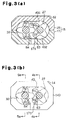
- the motor M rotates the first rotary shaft 19 in the direction indicated by arrow R1 of Figs. 2(a) to 3(b).
- the gears 34, 35 transmit the rotation of the first rotary shaft 19 to the second rotary shaft 20.
- the second rotary shaft 20 thus rotates in the direction indicated by arrow R2 of Figs. 2(a) to 3(b). Accordingly, the first and second rotary shafts 19, 20 rotate in opposite directions.
- the gears 34, 35 cause the rotary shafts 19, 20 to rotate integrally.
- a gear accommodating chamber 331 is defined in the gear housing member 33.
- the gear accommodating chamber 331 retains lubricant oil Y for lubricating the gears 34, 35.
- the gears 34, 35 form a gear mechanism, which is accommodated in the gear accommodating chamber 331.
- the gear accommodating chamber 331 and the bearing receptacles 47, 48 form a sealed oil zone.
- the gear housing member 33 and the rear housing member 14 form an oil housing, or an oil zone adjacent to the fifth pump chamber 43. A portion of the rear housing serves as a partition wall according to the present invention.
- the gears 34, 35 rotate to agitate the lubricant oil in the gear accommodating chamber 331.
- the lubricant oil thus lubricates the radial bearings 37, 38.
- each chamber defining wall 16 has an inlet 164 and an outlet 165 that are connected to the passage 163.
- Each adjacent pair of the pump chambers 39-43 are connected to each other by the passage 163 of the associated chamber defining wall 16.
- an inlet 181 extends through the block 18 of the cylinder block 15 and is connected to the suction zone 391 of the first pump chamber 39.
- an outlet 171 extends through the block 17 of the cylinder block 15 and is connected to the pressurization zone 432 of the fifth pump chamber 43.
- the gas is compressed and its pressure is higher than in the suction zone 391.
- the gas is sent to the suction zone of the second pump chamber 40 through the inlet 164, the passage 163, and the outlet 165 in the corresponding chamber defining wall 16. Afterwards, the gas flows from the second pump chamber 40 to the third, fourth, and fifth pump chambers 41, 42, 43 in this order while repeatedly compressed.
- each rotor 23-32 functions as a gas conveying body for conveying gas.
- the outlet 171 functions as a discharge passage for discharging gas to the exterior of the vacuum pump 11.
- the fifth pump chamber 43 is a final-stage pump chamber that is connected to the outlet 171.
- the pressure in the pressurization zone 432 of the fifth pump chamber 43 is the highest, and the pressurization zone 432 functions as a maximum pressurization zone.
- the outlet 171 is connected to the maximum pressurization zone 432 defined by the fifth rotors 27, 32 in the fifth pump chamber 43.
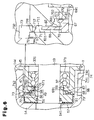
- first and second annular shaft seals 49, 50 are securely fitted about the first and second rotary shafts 19, 20, respectively.
- the shaft seals 49, 50 are located in the first and second bearing receptacles 47, 48, respectively.
- a seal ring 51 is located between the inner circumferential surface of the first shaft seal 49 and the circumferential surface 192 of the first rotary shaft 19.
- a seal ring 52 is located between the inner circumferential surface of the second shaft seal 50 and the circumferential surface 202 of the second rotary shaft 20.
- Each seal ring 51, 52 prevents lubricant oil Y from leaking from the associated receptacle 47, 48 to the fifth pump chamber 43 along the circumferential surface 192, 202 of the associated rotary shaft 19, 20.
- Annular projections 53 coaxially project from the bottom 472 of the first receptacle 47.
- annular projections 54 coaxially project from the bottom 482 of the second receptacle 48.
- Annular grooves 55 are coaxially formed in the front surface 492 of the first shaft seal 49, which faces the bottom 472 of the first receptacle 47.
- annular grooves 56 are coaxially formed in the front surface 502 of the second shaft seal 50, which faces the bottom 482 of the second receptacle 48.
- Each annular projection 53, 54 projects in the associated groove 55, 56. The distal end of the projection 53, 54 is located close to the bottom of the groove 55, 56.
- Each projection 53 divides the interior of the associated groove 55 of the first shaft seal 49 to a pair of labyrinth chambers 551, 552.
- Each projection 54 divides the interior of the associated groove 56 of the second shaft seal 50 to a pair of labyrinth chambers 561, 562.
- the projections 53 and the grooves 55 form a first labyrinth seal 57 corresponding to the first rotary shaft 19.
- the projections 54 and the grooves 56 form a second labyrinth seal 58 corresponding to the second rotary shaft 20.
- the labyrinth seals 57, 58 which are non-contact seals, are mechanisms that prevent oil from entering the fifth pump chamber 43 from the gear accommodating chamber 331.
- the labyrinth seals 57, 58 function as a non-contact seal means for prohibiting the oil from entering the pump chamber.
- the front surfaces 492, 502 of the shaft seals 49, 50 function as sealing surface of the shaft seals 49, 50.
- the bottoms 472, 482 of the bearing receptacles 47, 48 function as sealing surface of the rear housing member 14.
- the front surface 492 and the bottom 472 are formed along a plane perpendicular to the axis 191 of the first rotary shaft 19.
- the front surface 502 and the bottom 482 are formed along a plane perpendicular to the axis 201 of the rotary shaft 20.
- the front surface 492 and the bottom 472 are seal forming surfaces that extend in a radial direction of the first shaft seal 49.
- the front surface 502 and the bottom 482 are seal forming surfaces that extend in a radial direction of the second shaft seal 50.
- a first helical groove 61 is formed in the outer circumferential surface 491 of the large diameter portion 60 of the second shaft seal 49.
- a second helical groove 62 is formed in the outer circumferential surface 501 of the large diameter portion 60 of the second shaft seal 50.
- the first helical groove 61 forms a path that leads from a side corresponding to the gear accommodating chamber 331 toward the fifth pump chamber 43.
- the second helical groove 62 forms a path that leads from a side corresponding to the gear accommodating chamber 331 toward the fifth pump chamber 43.
- each helical groove 61, 62 exerts a pumping effect and conveys fluid from a side corresponding to the fifth pump chamber 43 toward the gear accommodating chamber 331 when the rotary shafts 19, 20 rotate. That is, each helical groove 61, 62 forms pumping means that urges the lubricant oil between the outer circumferential surface 491, 501 of the associated shaft seal 49, 50 and the circumferential wall 471, 481 of the associated receptacle 47, 48 to move from a side corresponding to the fifth pump chamber 43 toward the oil zone.
- the pumping means is a mechanism that prevents oil from entering the fifth pump chamber 43 from the gear accommodating chamber 331.
- the circumferential walls 471, 481 of the bearing receptacles 47, 48 function as sealing surfaces.
- the outer circumferential surfaces 491, 501 face the sealing surfaces.
- the pumping means serves as a non-contact seal means for prohibiting the oil from entering the pump chamber.
- first and second discharge pressure introducing channels 63, 64 are formed in a chamber defining wall 143 of the rear housing member 14.
- the chamber defining wall 143 defines the fifth pump chamber 43, which is at the final stage of compression.
- the first discharge pressure introducing channel 63 is connected to the maximum pressurization zone 432, the volume of which is varied by rotation of the fifth rotors 27, 32.
- the first discharge pressure introducing channel 63 is also connected to the through hole 141.
- the second discharge pressure introducing channel 64 is connected to the maximum pressurization zone 432 and the through hole 142.
- annular leak prevention ring 66 is fitted about the small diameter portion 59 of the first shaft seal 49 to block flow of oil.
- the leak prevention ring 66 includes a first seal 67 having a smaller diameter and a second seal 68 having a larger diameter.
- a front end portion of the bearing holder 45 has an annular projection 69 projecting inward and defines an annular first oil chamber 70 and an annular second oil chamber 71 about the leak prevention ring 66.
- the first oil chamber 70 surrounds the first seal 67, and the second oil chamber 71 surrounds the second seal 68.
- a third seal 72 is integrally formed with the large diameter portion 60 of the first shaft seal 49.
- a third annular oil chamber 73 is defined in the first receptacle 47 to surround the third seal 72. It is to be noted that the first, second and third seals 67, 68 , 72 function as a non-contact seal means for prohibiting the oil from entering the pump chamber.
- a drainage channel 74 is defined in the lowest portion of the first receptacle 47 and the end 144 of the rear housing 14 to return the lubricant oil Y to the gear accommodation chamber 331.
- the drainage channel 74 has an axial portion 741, which is formed in the lowest part of the receptacle 47, and a radial portion 742, which is formed in the end 144.
- the axial portion 741 is communicated with the third oil chamber 73
- the radial portion 742 is communicated with the gear accommodation chamber 331. That is, the third oil chamber 73 is connected to the gear accommodating chamber 331 by the drainage channel 74.
- An annular leak prevention ring 66 is fitted about the small diameter portion 59 of the second shaft seal 50 to block flow of oil.
- a third seal 72 is formed on the large diameter portion 60 of the second shaft seal 50.
- the first and second oil chambers 70, 71 are defined in the bearing holder 46, and the third oil chamber 73 is defined in the second receptacle 48.
- the drainage channel 74 is formed in the lowest part of the receptacle 48. Part of the third oil chamber 73 corresponding to the second shaft seal 50 is connected to the gear accommodating chamber 331 by the drainage channel 74 corresponding to the second shaft seal 50.
- Lubricant oil Y stored in the gear accommodating chamber 331 lubricates the gears 34, 35 and the radial bearings 37, 38. After lubricating the radial bearings 37, 38, lubricant oil Y enters a through hole 691 formed in the projection 69 of each bearing holder 45, 46 through space 371, 381in each radial bearing 37, 38. Then, the lubricant oil Y moves toward the corresponding first oil chamber 70 via a space between the circumference of the small diameter portion 59 of the shaft seal 49, 50 and the circumference of the through hole 691, and a space g1 between the rear surface 672 of the corresponding first seal 67 and the end surface 701 of the corresponding first oil chamber 70.
- the lubricant oil Y moves toward the second oil chamber 71 through a space g2 between the rear surface 681 of the second seal 68 and the end surface 711 of the second oil chamber 71.
- the lubricant oil Y on the rear surface 681 is thrown to the circumferential surface 712 or the end surface 711 of the second oil chamber 71 by the centrifugal force generated by rotation of the second seal 68.
- At least part of the lubricant oil Y thrown to the circumferential surface 712 or the end surface 711 remains on the circumferential surface 712 or the end surface 711.
- the remaining oil Y falls along the surfaces 712, 711 by the self weight and reaches the lowest part of the second oil chamber 71.
- the lubricant oil Y moves to the lowest part of the third oil chamber 73.
- the lubricant oil Y moves toward the third oil chamber 73 through a space g3 between the rear surface 601 of the third seal 72 and the end surface 731 of the third chamber 73.
- the lubricant oil Y on the rear surface 601 is thrown to the circumferential surface 732 or the end surface 731 of the third oil chamber 73 by the centrifugal force generated by rotation of the third seal 72.
- At least part of the lubricant oil Y thrown to the circumferential surface 732 or the end surface 731 remains on the surface 732 or the surface 731.
- the remaining oil Y falls along the circumferential surface 732 and the surface 731 by the self weight and reaches the lowest part of the third oil chamber 73.
- part of the oil may drop on a tapered circumferential surface 671.
- part of the oil Y drops on the tapered circumferential surface 671.
- the oil Y is thrown toward the circumferential surface 702 by the centrifugal force generated by rotation of the leak prevention ring 66 or moves from the side corresponding to the second seal 68 toward the end surface 701 along the surface 671.
- the oil Y When moving on the tapered circumferential surface 671 toward the end surface 701, the oil Y is thrown to the end surface 701 or moves to the rear surface 672 of the first seal 67. Therefore, after reaching the tapered circumferential surface 671, the oil Y moves to the lowest part of the second oil chamber 71.
- the lubricant oil Y is returned to the gear accommodating chamber 331 by the corresponding drainage channel 74.
- Each of the pairs of the first seal 67 and the first oil chamber 70, the second seal 68 and the second oil chamber 71, and the third seal 72 and the third oil chamber 73 forms a mechanism that prevents oil from entering the fifth pump chamber 43 from the gear accommodating chamber 331.
- an inverter 65 is electrically connected to the motor M.
- the inverter 65 receives a command from a controller 75.
- the controller 75 controls the output of the inverter 65 based on the signal from the on-off switch 76.
- the inverter 65 controls the rotational speed of the electric motor M in accordance with the command from the controller 75 by the power from an alternator 77.
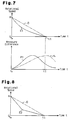
- a curved line E1 in Fig. 7 shows variation of the rotational speed of the rotary shafts 19, 20 after the on-off switch 76 is turned off at time t0 while the vacuum pump 11 is operating.
- the controller 75 sends a command to the inverter 65.
- the command causes the rotational speed of the rotary shafts 19, 20 to vary in a manner as shown by the curved line E1.
- the inverter 65 stops the motor M such that the rotational speed of the rotary shafts 19, 20 varies in a manner shown by the curved line E1.
- the controller 75 is a stop control means for stopping the operation of the vacuum pump 11.
- the rotary shafts 19, 20 are rotated at a constant rotational speed N during a normal operation of the vacuum pump 11.
- N the pressure in the maximum pressurization zone 432 of the fifth pump chamber 43 and the pressure in the gear accommodating chamber 331 are substantially the same.
- the preferred embodiment has the following advantages.
- a curved line P0 in Fig. 7 shows the variation of the pressure difference between the maximum pressurization zone 432 of the fifth pump chamber 43 and the gear accommodating chamber 331 when rotations of the rotary shafts 19, 20 are decelerated at a constant deceleration shown by a straight line D.
- the maximum pressure difference occurs after time t1 at which the rotation of the rotary shafts 19, 20 are completely stopped.
- a curved line P1 in Fig. 7 shows variation of the pressure difference between the maximum pressurization zone 432 of the fifth pump chamber 43 and the gear accommodating chamber 331 when rotations of the rotary shafts 19, 20 are decelerated in a manner as shown by the curved line E1.
- Time required for the rotary shafts 19, 20 to completely stop when decelerating in a manner shown by the curved line E1 is equal to time (t1 - t0) required for the rotary shafts 19, 20 to completely stop when decelerating in a manner shown by the straight line D.
- the maximum pressure difference in this case, is caused before the time t1 at which the rotation of the rotary shafts 19, 20 completely stops.
- the pressure difference at which the rotary shafts 19, 20 completely stops is less than the case in which the rotary shafts 19, 20 are decelerated in the manner shown by the straight line D.
- the rotations of the rotary shafts 19, 20 start to decrease by a greater deceleration than the constant deceleration shown by the straight line D and subsequently the rotations of the rotary shafts 19, 20 are decreased by a smaller deceleration than a constant deceleration shown by the straight line D.
- the rotations of the rotary shafts 19, 20 are stopped by the time (t1 - t0) required to stop the rotation of the rotary shafts 19, 20 at the constant deceleration shown by the straight line D. Controlling the maximum pressure difference between the maximum pressurization zone 432 of the fifth pump chamber 43 and the gear accommodating chamber 331 to be caused before the time t1 prevents the oil from entering the fifth pump chamber 43.
- the curved line E1 is an exponential curve, which is represented by "a ⁇ e -bt" .
- the character t represents time, the characters a and b are positive constant numbers.
- the exponential curve is suitable for minimizing the maximum pressure difference and minimizing the pressure difference when the rotary shafts 19, 20 are completely stopped.
- the pressures in the five pump chambers 39, 40, 41, 42, 43 are lower than the pressure in the gear accommodating chamber 331, which is a zone exposed to the atmospheric pressure.
- the atomized lubricant oil Y moves along the surface of the leak prevention rings 66 and the surface of the shaft seals 49, 50 toward the fifth pump chamber 43.
- the lubricant oil Y is preferably liquefied on a stationary wall. Also, the lubricant oil Y on the rotary shafts 19, 20 or on the members integrally rotating with the rotary shaft 19, 20 is preferably moved to the stationary wall.
- the stoppers 67, 68, 72 effectively move the lubricant oil Y to the walls defining the oil chambers 70, 71, 73.
- the area for receiving oil in the stoppers is increased.
- the amount of oil that is thrown by the centrifugal force generated by rotation of the stoppers is increased- That is, the stoppers 67, 68, 72, which are arranged on each rotary shaft 19, 20, effectively blocks flow of oil.
- the diameters of the front surfaces 492, 502 of the shaft seals 49, 50 fitted about the rotary shafts 19, 20 are larger than the diameter of the circumferential surfaces 192, 202 of the rotary shafts 19, 20. Therefore, the diameters of the labyrinth seals 57, 58 between the front surfaces 492, 502 of the shaft seals 49, 50 and the bottom 472, 482 of the bearing receptacles 47, 48 are larger than the diameters of the labyrinth seals located between the circumferential surface 192, 202 of the rotary shafts 19, 20 and the rear housing member 14.
- the volumes of the labyrinth chambers 551, 552, 561, 562 for preventing pressure fluctuation are increased, which improves the sealing performance of the labyrinth seals 57, 58. That is, the spaces between the front surface 492, 502 of each shaft seals 49, 50 and the bottom 472, 482 of the corresponding bearing receptacle 47, 48 is suitable for retaining the labyrinth seal 57, 58 in terms of increasing the volumes of the labyrinth chambers 551, 552, 561, 562 to improve the sealing property.
- the labyrinth seals 57, 58 sufficiently blocks flow of gas.
- the pressures in the five pump chambers 39-43 are higher than the atmospheric pressure.
- each labyrinth seal 57, 58 prevents gas from leaking from the fifth pump chamber 43 to the gear accommodating chamber 331 along the surface of the associated shaft seal 49, 50. That is, the labyrinth seals 57, 58 stop both oil leak and gas leak and are optimal non-contact type seals.
- a small space is created between the circumferential surface 192 of the first rotary shaft 19 and the through hole 141. Also, a small space is created between each rotor 27, 32 and the chamber defining wall 143 of the rear housing member 14. Therefore, the labyrinth seal 57 is exposed to the pressure in the fifth pump chamber 43 introduced through the narrow spaces. Likewise, a small space is created between the circumferential surface 202 of the second rotary shaft 20 and the through hole 142. Therefore, the second labyrinth seal 58 is exposed to the pressure in the fifth pump chamber 43 through the space. If there are no channels 63, 64, the labyrinth seals 57, 58 are equally exposed to the pressure in the suction zone 431 and to the pressure in the maximum pressurization zone 432.
- the first and second discharge pressure introducing channels 63, 64 expose the labyrinth seals 57, 58 to the pressure in the maximum pressurization zone 432. That is, the labyrinth seals 57, 58 are influenced more by the pressure in the maximum pressurization zone 432 via the introducing channels 63, 64 than by the pressure in the suction zone 431. Thus, compared to a case where no discharge pressure introducing channels 63, 64 are formed, the labyrinth seals 57, 58 of the preferred embodiment receive higher pressure.
- the difference between the pressures acting on the front surface and the rear surface of the labyrinth seals 57, 58 is significantly small.
- the discharge pressure introducing channels 63, 64 significantly improve the oil leakage preventing performance of the labyrinth seals 57, 58.
- Roots pump 11 Since the Roots pump 11 is a dry type, no lubricant oil Y is used in the five pump chambers 39, 40, 41, 42, 43. Therefore, the present invention is suitable for the Roots pump 11.
- the rotational speed of the rotary shafts 19, 20 may be decelerated in a manner shown by a sequential line E2 in Fig. 8.
- the sequential line E2 the rotation of the rotary shafts 19, 20 start to decelerate at a constant deceleration greater than the constant deceleration shown by the straight line D and subsequently decelerate at a constant deceleration smaller than the constant deceleration shown by the straight line D.
- the sequential line E2 is a deceleration line that stops the rotations of the rotary shafts 19, 20 by the time (t1 - t0) required for stopping the rotary shafts 19, 20 by the constant deceleration shown by the straight line D.
- the deceleration control shown by the sequential line E2 creates the maximum pressure difference between the maximum pressurization zone 432 of the fifth pump chamber 43 and the gear accommodating chamber 331 before the time t1.
Landscapes
- Engineering & Computer Science (AREA)
- Mechanical Engineering (AREA)
- General Engineering & Computer Science (AREA)
- Applications Or Details Of Rotary Compressors (AREA)
- Compressor (AREA)
- Control Of Positive-Displacement Pumps (AREA)
Applications Claiming Priority (2)
| Application Number | Priority Date | Filing Date | Title |
|---|---|---|---|
| JP2001318893 | 2001-10-17 | ||
| JP2001318893A JP3941452B2 (ja) | 2001-10-17 | 2001-10-17 | 真空ポンプにおける運転停止制御方法及び運転停止制御装置 |
Publications (2)
| Publication Number | Publication Date |
|---|---|
| EP1304484A2 true EP1304484A2 (fr) | 2003-04-23 |
| EP1304484A3 EP1304484A3 (fr) | 2003-09-03 |
Family
ID=19136518
Family Applications (1)
| Application Number | Title | Priority Date | Filing Date |
|---|---|---|---|
| EP02023201A Withdrawn EP1304484A3 (fr) | 2001-10-17 | 2002-10-16 | Pompe à vide |
Country Status (3)
| Country | Link |
|---|---|
| US (1) | US20030072651A1 (fr) |
| EP (1) | EP1304484A3 (fr) |
| JP (1) | JP3941452B2 (fr) |
Families Citing this family (5)
| Publication number | Priority date | Publication date | Assignee | Title |
|---|---|---|---|---|
| JP4702236B2 (ja) * | 2006-09-12 | 2011-06-15 | 株式会社豊田自動織機 | 真空ポンプの運転停止制御方法及び運転停止制御装置 |
| JP4784484B2 (ja) * | 2006-11-02 | 2011-10-05 | 株式会社豊田自動織機 | 電動ポンプ |
| BRPI1100026A2 (pt) * | 2011-01-26 | 2013-04-24 | Whirlpool Sa | sistema e mÉtodo de controle para compressores reciprocos |
| US9902251B2 (en) | 2016-01-26 | 2018-02-27 | Deere & Company | Recess-mounted hydraulic pump cartridge and work vehicle drivetrain therewith |
| CN110121597B (zh) * | 2017-01-27 | 2021-01-29 | 株式会社日立产机系统 | 涡旋压缩机 |
Citations (2)
| Publication number | Priority date | Publication date | Assignee | Title |
|---|---|---|---|---|
| JPS63129829A (ja) | 1986-11-14 | 1988-06-02 | Nippon Denso Co Ltd | 真空ポンプ付き発電機 |
| JPH0311193A (ja) | 1989-06-08 | 1991-01-18 | Daikin Ind Ltd | 真空ポンプ |
Family Cites Families (9)
| Publication number | Priority date | Publication date | Assignee | Title |
|---|---|---|---|---|
| US2937807A (en) * | 1956-12-26 | 1960-05-24 | Heraeus Gmbh W C | High vacuum pumps |
| FR1449257A (fr) * | 1965-10-05 | 1966-08-12 | Dresser Ind | Joint étanche aux lubrifiants pour pompe rotative volumétrique |
| JPS6429690A (en) * | 1987-07-22 | 1989-01-31 | Hitachi Ltd | Shaft sealing device for screw vacuum pump |
| US5028220A (en) * | 1990-08-13 | 1991-07-02 | Sullair Corpoation | Cooling and lubrication system for a vacuum pump |
| DE59200391D1 (de) * | 1991-03-04 | 1994-09-22 | Leybold Ag | Einrichtung zur inertgasversorgung einer mehrstufigen trockenlaufenden vakuumpumpe. |
| EP0674106A1 (fr) * | 1994-03-16 | 1995-09-27 | Chemitec Co., Ltd. | Pompe à vide à plusieurs étages |
| JP3593365B2 (ja) * | 1994-08-19 | 2004-11-24 | 大亜真空株式会社 | ねじれ角可変型歯車 |
| JP2000170679A (ja) * | 1998-12-04 | 2000-06-20 | Toyota Autom Loom Works Ltd | 多段ルーツポンプ及び多段ポンプ装置 |
| JP2001304115A (ja) * | 2000-04-26 | 2001-10-31 | Toyota Industries Corp | 真空ポンプにおけるガス供給装置 |
-
2001
- 2001-10-17 JP JP2001318893A patent/JP3941452B2/ja not_active Expired - Fee Related
-
2002
- 2002-10-16 EP EP02023201A patent/EP1304484A3/fr not_active Withdrawn
- 2002-10-17 US US10/272,711 patent/US20030072651A1/en not_active Abandoned
Patent Citations (2)
| Publication number | Priority date | Publication date | Assignee | Title |
|---|---|---|---|---|
| JPS63129829A (ja) | 1986-11-14 | 1988-06-02 | Nippon Denso Co Ltd | 真空ポンプ付き発電機 |
| JPH0311193A (ja) | 1989-06-08 | 1991-01-18 | Daikin Ind Ltd | 真空ポンプ |
Also Published As
| Publication number | Publication date |
|---|---|
| EP1304484A3 (fr) | 2003-09-03 |
| JP2003120543A (ja) | 2003-04-23 |
| JP3941452B2 (ja) | 2007-07-04 |
| US20030072651A1 (en) | 2003-04-17 |
Similar Documents
| Publication | Publication Date | Title |
|---|---|---|
| US5232355A (en) | Scroll-type fluid apparatus having a labyrinth and oil seals surrounding a scroll shaft | |
| EP1256720B1 (fr) | Pompe à vide rotatif | |
| US6663367B2 (en) | Shaft seal structure of vacuum pumps | |
| EP1256721A2 (fr) | Système d'étancheité pour pompe à vide rotatif | |
| US20030072651A1 (en) | Method and apparatus for controlling vacuum pump to stop | |
| EP1273801B2 (fr) | Joint d'étancheité pour pompe à vide rotatif | |
| US6659746B2 (en) | Shaft seal structure of vacuum pumps | |
| US6688863B2 (en) | Oil leak prevention structure of vacuum pump | |
| EP0698185B1 (fr) | Compresseur rotatif a vis et a moyens d'etancheite | |
| EP1236902B1 (fr) | Pompe à vide avec joint d'étanchéité d'arbre | |
| CN112012926B (zh) | 无油双螺旋气体压缩机 | |
| CN100400881C (zh) | 具有轴密封结构的真空泵 | |
| JP2012127314A (ja) | 水噴射式スクリュ流体機械 | |
| JP2004293420A (ja) | ドライポンプの潤滑油シール構造 | |
| KR100481758B1 (ko) | 진공 펌프의 오일 누설 방지 구조 | |
| KR100481759B1 (ko) | 진공 펌프의 오일 누설 방지 구조 | |
| KR20040031854A (ko) | 진공 펌프의 오일 누설 방지 구조 | |
| KR100450104B1 (ko) | 진공펌프의 축밀봉구조 | |
| KR100450105B1 (ko) | 진공펌프의 축밀봉구조 | |
| KR20040032504A (ko) | 진공 펌프의 오일 누설 방지 구조 | |
| JP2008051116A (ja) | 真空ポンプにおける軸封構造 |
Legal Events
| Date | Code | Title | Description |
|---|---|---|---|
| PUAI | Public reference made under article 153(3) epc to a published international application that has entered the european phase |
Free format text: ORIGINAL CODE: 0009012 |
|
| 17P | Request for examination filed |
Effective date: 20021016 |
|
| AK | Designated contracting states |
Designated state(s): AT BE BG CH CY CZ DE DK EE ES FI FR GB GR IE IT LI LU MC NL PT SE SK TR |
|
| AX | Request for extension of the european patent |
Extension state: AL LT LV MK RO SI |
|
| PUAL | Search report despatched |
Free format text: ORIGINAL CODE: 0009013 |
|
| AK | Designated contracting states |
Kind code of ref document: A3 Designated state(s): AT BE BG CH CY CZ DE DK EE ES FI FR GB GR IE IT LI LU MC NL PT SE SK TR |
|
| AX | Request for extension of the european patent |
Extension state: AL LT LV MK RO SI |
|
| 17Q | First examination report despatched |
Effective date: 20031117 |
|
| AKX | Designation fees paid |
Designated state(s): DE FR GB |
|
| STAA | Information on the status of an ep patent application or granted ep patent |
Free format text: STATUS: THE APPLICATION IS DEEMED TO BE WITHDRAWN |
|
| 18D | Application deemed to be withdrawn |
Effective date: 20041005 |