EP1304658A1 - Dispositif de sécurité fixé à un support - Google Patents
Dispositif de sécurité fixé à un support Download PDFInfo
- Publication number
- EP1304658A1 EP1304658A1 EP01124809A EP01124809A EP1304658A1 EP 1304658 A1 EP1304658 A1 EP 1304658A1 EP 01124809 A EP01124809 A EP 01124809A EP 01124809 A EP01124809 A EP 01124809A EP 1304658 A1 EP1304658 A1 EP 1304658A1
- Authority
- EP
- European Patent Office
- Prior art keywords
- carrier
- security
- activation
- safety
- safety device
- Prior art date
- Legal status (The legal status is an assumption and is not a legal conclusion. Google has not performed a legal analysis and makes no representation as to the accuracy of the status listed.)
- Withdrawn
Links
- 230000004913 activation Effects 0.000 claims abstract description 47
- 230000000694 effects Effects 0.000 claims description 5
- 230000003213 activating effect Effects 0.000 claims description 4
- 238000001994 activation Methods 0.000 description 38
- 238000000034 method Methods 0.000 description 10
- 238000013475 authorization Methods 0.000 description 9
- 238000011161 development Methods 0.000 description 9
- 230000018109 developmental process Effects 0.000 description 9
- 230000009849 deactivation Effects 0.000 description 8
- 230000008901 benefit Effects 0.000 description 4
- 230000008859 change Effects 0.000 description 3
- 238000012549 training Methods 0.000 description 3
- 230000001960 triggered effect Effects 0.000 description 3
- 238000007796 conventional method Methods 0.000 description 2
- 230000006378 damage Effects 0.000 description 2
- 238000011156 evaluation Methods 0.000 description 2
- 230000007246 mechanism Effects 0.000 description 2
- 230000007935 neutral effect Effects 0.000 description 2
- 230000008569 process Effects 0.000 description 2
- 238000012795 verification Methods 0.000 description 2
- 230000032683 aging Effects 0.000 description 1
- 238000013459 approach Methods 0.000 description 1
- 230000005540 biological transmission Effects 0.000 description 1
- 238000005352 clarification Methods 0.000 description 1
- 230000001419 dependent effect Effects 0.000 description 1
- 238000010586 diagram Methods 0.000 description 1
- 230000006870 function Effects 0.000 description 1
- 239000011521 glass Substances 0.000 description 1
- 230000003779 hair growth Effects 0.000 description 1
- 230000001788 irregular Effects 0.000 description 1
- 230000007334 memory performance Effects 0.000 description 1
- 238000012544 monitoring process Methods 0.000 description 1
- 230000003287 optical effect Effects 0.000 description 1
- 210000001525 retina Anatomy 0.000 description 1
- 230000008054 signal transmission Effects 0.000 description 1
- 230000011664 signaling Effects 0.000 description 1
- 238000012546 transfer Methods 0.000 description 1
Images

Classifications
-
- G—PHYSICS
- G07—CHECKING-DEVICES
- G07C—TIME OR ATTENDANCE REGISTERS; REGISTERING OR INDICATING THE WORKING OF MACHINES; GENERATING RANDOM NUMBERS; VOTING OR LOTTERY APPARATUS; ARRANGEMENTS, SYSTEMS OR APPARATUS FOR CHECKING NOT PROVIDED FOR ELSEWHERE
- G07C9/00—Individual registration on entry or exit
- G07C9/00174—Electronically operated locks; Circuits therefor; Nonmechanical keys therefor, e.g. passive or active electrical keys or other data carriers without mechanical keys
- G07C9/00563—Electronically operated locks; Circuits therefor; Nonmechanical keys therefor, e.g. passive or active electrical keys or other data carriers without mechanical keys using personal physical data of the operator, e.g. finger prints, retinal images, voicepatterns
-
- G—PHYSICS
- G07—CHECKING-DEVICES
- G07C—TIME OR ATTENDANCE REGISTERS; REGISTERING OR INDICATING THE WORKING OF MACHINES; GENERATING RANDOM NUMBERS; VOTING OR LOTTERY APPARATUS; ARRANGEMENTS, SYSTEMS OR APPARATUS FOR CHECKING NOT PROVIDED FOR ELSEWHERE
- G07C9/00—Individual registration on entry or exit
- G07C9/00174—Electronically operated locks; Circuits therefor; Nonmechanical keys therefor, e.g. passive or active electrical keys or other data carriers without mechanical keys
- G07C9/00309—Electronically operated locks; Circuits therefor; Nonmechanical keys therefor, e.g. passive or active electrical keys or other data carriers without mechanical keys operated with bidirectional data transmission between data carrier and locks
-
- G—PHYSICS
- G07—CHECKING-DEVICES
- G07C—TIME OR ATTENDANCE REGISTERS; REGISTERING OR INDICATING THE WORKING OF MACHINES; GENERATING RANDOM NUMBERS; VOTING OR LOTTERY APPARATUS; ARRANGEMENTS, SYSTEMS OR APPARATUS FOR CHECKING NOT PROVIDED FOR ELSEWHERE
- G07C9/00—Individual registration on entry or exit
- G07C9/20—Individual registration on entry or exit involving the use of a pass
- G07C9/28—Individual registration on entry or exit involving the use of a pass the pass enabling tracking or indicating presence
-
- G—PHYSICS
- G07—CHECKING-DEVICES
- G07C—TIME OR ATTENDANCE REGISTERS; REGISTERING OR INDICATING THE WORKING OF MACHINES; GENERATING RANDOM NUMBERS; VOTING OR LOTTERY APPARATUS; ARRANGEMENTS, SYSTEMS OR APPARATUS FOR CHECKING NOT PROVIDED FOR ELSEWHERE
- G07C9/00—Individual registration on entry or exit
- G07C9/00174—Electronically operated locks; Circuits therefor; Nonmechanical keys therefor, e.g. passive or active electrical keys or other data carriers without mechanical keys
- G07C2009/00753—Electronically operated locks; Circuits therefor; Nonmechanical keys therefor, e.g. passive or active electrical keys or other data carriers without mechanical keys operated by active electrical keys
- G07C2009/00769—Electronically operated locks; Circuits therefor; Nonmechanical keys therefor, e.g. passive or active electrical keys or other data carriers without mechanical keys operated by active electrical keys with data transmission performed by wireless means
-
- G—PHYSICS
- G07—CHECKING-DEVICES
- G07C—TIME OR ATTENDANCE REGISTERS; REGISTERING OR INDICATING THE WORKING OF MACHINES; GENERATING RANDOM NUMBERS; VOTING OR LOTTERY APPARATUS; ARRANGEMENTS, SYSTEMS OR APPARATUS FOR CHECKING NOT PROVIDED FOR ELSEWHERE
- G07C9/00—Individual registration on entry or exit
- G07C9/00174—Electronically operated locks; Circuits therefor; Nonmechanical keys therefor, e.g. passive or active electrical keys or other data carriers without mechanical keys
- G07C9/00658—Electronically operated locks; Circuits therefor; Nonmechanical keys therefor, e.g. passive or active electrical keys or other data carriers without mechanical keys operated by passive electrical keys
- G07C9/00674—Electronically operated locks; Circuits therefor; Nonmechanical keys therefor, e.g. passive or active electrical keys or other data carriers without mechanical keys operated by passive electrical keys with switch-buttons
- G07C9/0069—Electronically operated locks; Circuits therefor; Nonmechanical keys therefor, e.g. passive or active electrical keys or other data carriers without mechanical keys operated by passive electrical keys with switch-buttons actuated in a predetermined sequence
Definitions
- the present invention relates to a carrier-bound security device.
- the carrier-related security device transfers authorized persons able to tailor authorizations individually and onto a carrier of the security device to transmit, i.e. the carrier for those associated with the permissions Legitimize actions.
- the carrier-bound safety device displaces in this way legitimized persons are able to easily obtain the permissions that apply to them to get.
- the security usually consists of a simple lock, and the legitimation corresponds to the possession of the associated key.
- Another classic example is verifying the identity of those seeking access Person, e.g. based on an ID card and / or a personal characteristic such as the Signature, by an authorized person, e.g. a counter clerk or one Doorman followed by checking whether the person in question is for the one they want Access is legitimate.
- Magnetic or chip cards are checked an authorization by inserting the card at a reading device and entering a code (e.g. a PIN or a password) on a corresponding input device (usually with a keyboard).
- a code e.g. a PIN or a password
- a corresponding input device usually with a keyboard.
- PIN or password is on the location where access is controlled is entered into an appropriate device must be: It happens again and again (especially at ATMs), that unauthorized persons with criminal attitudes through manipulation, but occasionally by simple observation, in possession of the access code (PIN, password, etc.).
- a further disadvantage of conventional safety devices which has not yet been mentioned, exists in that even a legitimately legitimate person poses a security risk because she is able to exercise her or her personal authorization - be it voluntarily or under duress - to be handed over to one or more unauthorized persons. In particular, if this is done deliberately, there is a risk of a permanent, undetected Abuse, e.g. repeated unauthorized access to high security areas.
- biometric recognition methods have recently been used to verify the legitimacy of a person with a Verify the identity of the person connect, using one or more unique individual body characteristics.
- the different biometric methods that are in the development or already in use are based on the properties of a Fingers, a hand, the face, the retina, the iris, the smell, the voice, the Signature, keystroke, etc.
- each of these methods also has disadvantages. So many of the above-mentioned features are not sufficiently recognizable and distinguishable, or changes over time (e.g. due to hair growth, change in hairstyle, beard growth, Make-up, injuries, aging, etc.). As a result, authorized persons wrongly unable to get access. These procedures are also reversed not 100% counterfeit-proof, which entails the risk of unauthorized persons Wrong access.
- the carrier-related security device comprises a Locking device for applying the safety device, at least one activation device for activating the safety device, opening the closure device deactivating the safety device causes a signal output device, and at least one trigger device around the signal output device to trigger at least one signal when the safety device is activated.
- Opening the locking device inevitably causes the safety device to be deactivated.
- deactivation mechanisms can also be provided. These can be of an active nature and, if necessary, a quick intended deactivation allow by the carrier and / or by authorized persons. But you can too be passive and in the event that unauthorized persons attempt to to get into possession of the activated safety device without the locking device to open. Such a mechanism can e.g. on temperature changes react.
- the safety device In particularly security-relevant areas, it can be useful if deactivation the safety device, for example by opening the closure device, the safety device is irrevocable, i.e. irreversibly deactivated. This will make the Possibilities of abuse further restricted.
- the authorized group of people includes the wearer; in particular in the private sector, only the carrier can be authorized.
- the security device thus enables almost all the advantages of a biometric Procedure to use: You cannot use it without the consent of an authorized person from the legitimate Carrier can be transferred to another person. Because of this commitment to the carrier it represents a quasi-biometric identifier. At the same time, it requires one less hardware expenditure than actual biometric recognition processes and is much easier to identify and more robust against external influences (Dirt, injuries, beard, haircut, glasses, contact lenses, etc.) than this.
- the at least one activation device can comprise, for example, a keypad, an activation by entering a PIN or a password by an authorized Person can be done. In contrast to conventional methods, this happens Advantageously, not input at the location where access is desired, but in a neutral (safe) place, which leads to increased security and further a faster access / access check allowed.
- the code can also be stored in the neutral (safe) place, which in particular the problems associated with the access / coveting access are eliminated Person must know the code by heart.
- a further increase in security compared to conventional methods is also further through the possibility of using significantly longer and thus secure codes (PINs, Passwords, etc.).
- the device according to the invention can also be used in several different ways Areas of application are used simultaneously if they are for each of these areas of application a dedicated activation device, or alternatively, one Activation device with an activation option for each of the different Has areas of application.
- Another advantage of the device according to the invention is that a variety of different Magnetic cards, chips, keys, etc. replaced by a single device can be.
- the at least one triggering device can be actuated manually.
- the at least one triggering device can be actuated without contact.
- each door in a security area can be provided with a transmitter be that outputs continuously or quasi-continuously signals that the least operate a triggering device without contact.
- the latter in turn effects after actuation the triggering device that the signal output device corresponding signals outputs which can be received by a receiving device of the door and in In the case of access authorization, this will open or open can be.
- the at least one activation device is contactless can be activated (and / or deactivated).
- the safety device according to the invention is designed such that the at least one activation device can be activated manually (and / or can be deactivated).
- the activation device can, for example, comprise a sensor field, which by Touching the finger of the authorized wearer can be activated.
- This can the security standard can be further increased because of the quasi-biometric identifier is once again secured by a biometric identifier.
- the manually activatable activation device comprises Entry keys, with the help of the activation device z. B. by typing a letter and / or combination of numbers can be activated.
- An easier education includes only one enter key, activation e.g. similar to one Morse signaling device by entering using key signals of different lengths can be done.
- the carrier-bound security device comprises also an alarm device for outputting an alarm signal when the safety device is deactivated.
- Such further training serves to further increase security, since unauthorized access by a person who, for example, forcibly holds a security device brings not only because of the deactivation of the safety device is refused, but that such an attempt is also immediately triggered by an alarm signal is shown. On the one hand, this acts as a deterrent and therefore reduces from the outset Attempted abuse, but on the other hand it also serves to quickly make things easier Person attempting abuse.
- the invention further relates to a security system for using at least one of the Carrier-related security devices described above, which include: At least a receiving device for receiving signals from the signal output device the at least one wearable safety device, at least one Control device to perform a predetermined activity such as opening effect a door if at least one corresponding signal by the at least a receiving device has been received.
- This security system also allows security areas and other relevant Plants in a user-friendly way, but at the same time with warranty a high security standard.
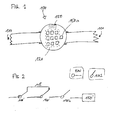
- FIG 1 shows a simple embodiment of the carrier-bound according to the invention
- Safety device designed as a wristwatch-like bracelet. This is they can be easily attached to the arm of the wearer. Only the relevant ones are shown in the illustration Components of the safety device illustrated schematically.
- a particularly preferred embodiment of the invention is yours In terms of appearance, it not only looks like a conventional wristwatch, but preferably also includes their functions, so that those on which the invention is based Features are not readily apparent to the unbiased observer are.
- the device comprises a locking device 110 for putting on and taking off the safety device 100.
- an activation device 120 is designed as a button display, and includes in the example shown - of course without restriction of generality - nine different buttons.
- deactivating the safety device can optionally be provided be that are not based on the opening of the closure device.
- Deactivation can e.g. also by entering a specific number or Letter combination happen in the activation device.
- An alternative or additional possibility of deactivation is that a awarded legitimation is only valid for a predetermined period of time, for which a watch device is preferably provided within the security device, according to Outputs a signal for deactivation after this period.
- the starting point of the predeterminable The period of time can be the time of the activation process or the time of the first entry / access.
- FIG. 2 is a series connection which is intended to illustrate the conditions, that must be fulfilled so that the signal output device can generate a signal for actuating a Switch, a door, etc. outputs.
- Different elements of the safety device are accordingly represented by a switch; activation of the safety device corresponds to closing the associated switch.
- FIGS. 3 to 5 show how a preferred embodiment of the invention Security device can be used to secure on differently Access security areas.
- FIG. 3 shows an activation device 220 for the safety device according to the invention, which has two outputs 220a and 220b. Between these exits and the An actuating device 250a and 250b are provided in each case for signal output device 250.
- the triggering device 250a is to be operated manually by the carrier actuatable trigger device symbolize, while the trigger device 250b contactless should be triggerable, which is illustrated in the present case in Figure 5 becomes.
- reference symbol B 1 denotes a gate or a passage door in a security complex.
- a transmitter S is assigned to this door, which is permanent or sends a signal at regular or irregular intervals that trigger device 250b of the safety device according to the invention can be triggered.
- the activation device 220 has been activated by an authorized person so that the Outputs 220a and 220b of the activation device signals according to the authorization of the carrier can spend. This will be described below with reference to FIG. 4 are illustrated.
- Figure 4 shows schematically a passage hallway in a security wing, the side doors A1, A2, A3, ...., and passage doors B1, B2, ;
- Each of these doors A1, A2, A3, ...., B1, B2, .... comprises a receiving device to receive signals to be able to receive the signal output devices.
- the safety device is applied to the wearer by a safety engineer.
- the activation the safety device is preferably contactless and such that the Device wearers or other people have no information about the type of activation receive.
- the activation preferably takes place without contact via an electromagnetic Signal, which signal should contain information about which signals are on the outputs 220a and 220b of the activation device are to be provided.
- the activation device 220 is activated such that at the output 220a the signals "A1", “A5" and “A8” can be output while at the output 220b the signal “B1" can be output.
- these are signals different from each other and are, for example, in quick succession sent out.
- the carrier of the safety device coming from the left in FIG. 4 has in the first section the hallway only has access to door A1. To avoid every door, too which the person has an access authorization, the carrier must operate the trigger 250a to access the side doors.
- the passage doors B1, B2, ... include one Transmitter that output a signal to trigger device 250b of the safety devices to operate.
- the range of this signal is preferably limited, e.g. to just a few meters.
- the person walking down the aisle approaches the Door B1, the signal emitted by the transmission device of the door from the Receiving device of the triggering device receives and causes the activation device Outputs 220 signals at output 220b. If these signals the signal include that legitimized to open the door B1, the door B1 is hereby approached opened automatically.
- those from the signal output device signals transmitted by the carrier-bound safety device without contact, preferably in the form of electromagnetic waves.
- Embodiments that use these principles can be used especially in payment transactions can be used advantageously in place of the current EC or credit cards, e.g. at ATMs, customer checkouts, ticket counters, etc.
- the ATMs, customer cash registers, ticket counters, etc. must be connected to the carrier Security devices have equivalent contacts over which a signal transmission is possible.
- the contacts can in particular be designed as movable pin contacts, one Moving the contacts (establishment of a contact) automatically the output of a Can cause signals via the contact, so a simple and convenient triggering device represents.
- the existing signal output device of the safety device is used or an additional signal output device is provided in order to output a signal at predetermined intervals or permanently.
- a receiving device positioned in a room or building taking into account the range of the signal output by the security device, can be used to monitor the presence of the person concerned.
- Multiple receivers positioned in different rooms or locations can be used to constantly locate the person and track their change of position.
- a method for counting people may be provided (for example in the case of a Security gate over a bathroom scale, inside rooms by automatic Video evaluation with intelligent image evaluation), which can be used to check whether each the person present is actually authorized to access / attendance and not himself Has gained access through violence or has been introduced by an authorized person.
Landscapes
- Physics & Mathematics (AREA)
- General Physics & Mathematics (AREA)
- Engineering & Computer Science (AREA)
- Computer Networks & Wireless Communication (AREA)
- Lock And Its Accessories (AREA)
Priority Applications (1)
| Application Number | Priority Date | Filing Date | Title |
|---|---|---|---|
| EP01124809A EP1304658A1 (fr) | 2001-10-17 | 2001-10-17 | Dispositif de sécurité fixé à un support |
Applications Claiming Priority (1)
| Application Number | Priority Date | Filing Date | Title |
|---|---|---|---|
| EP01124809A EP1304658A1 (fr) | 2001-10-17 | 2001-10-17 | Dispositif de sécurité fixé à un support |
Publications (1)
| Publication Number | Publication Date |
|---|---|
| EP1304658A1 true EP1304658A1 (fr) | 2003-04-23 |
Family
ID=8178995
Family Applications (1)
| Application Number | Title | Priority Date | Filing Date |
|---|---|---|---|
| EP01124809A Withdrawn EP1304658A1 (fr) | 2001-10-17 | 2001-10-17 | Dispositif de sécurité fixé à un support |
Country Status (1)
| Country | Link |
|---|---|
| EP (1) | EP1304658A1 (fr) |
Citations (8)
| Publication number | Priority date | Publication date | Assignee | Title |
|---|---|---|---|---|
| EP0295985A1 (fr) * | 1987-05-26 | 1988-12-21 | Compagnie Generale Des Matieres Nucleaires (Cogema) | Système d'identification d'individus |
| DE3740794A1 (de) * | 1987-12-02 | 1989-06-15 | Pedro Rodriguez | Elektronisch datenverarbeitende armbanduhr als dialogfaehige, drahtlose datentraeger und steuerelement |
| US5455851A (en) * | 1993-07-02 | 1995-10-03 | Executone Information Systems, Inc. | System for identifying object locations |
| DE4430887A1 (de) * | 1994-08-31 | 1996-03-14 | Ernst Rogge | Alarmmelde- und/oder Alarmauslösesystem für diebstahlgefährdete Objekte |
| EP0886024A2 (fr) * | 1997-06-18 | 1998-12-23 | Marquardt GmbH | Clé électronique |
| DE19832671A1 (de) * | 1998-07-21 | 2000-01-27 | Skidata Ag | Berührungslos arbeitender Datenträger |
| WO2001018332A1 (fr) * | 1999-09-06 | 2001-03-15 | Siemens Aktiengesellschaft | Activation d'objets proteges |
| US6255951B1 (en) * | 1996-12-20 | 2001-07-03 | Carlos De La Huerga | Electronic identification bracelet |
-
2001
- 2001-10-17 EP EP01124809A patent/EP1304658A1/fr not_active Withdrawn
Patent Citations (8)
| Publication number | Priority date | Publication date | Assignee | Title |
|---|---|---|---|---|
| EP0295985A1 (fr) * | 1987-05-26 | 1988-12-21 | Compagnie Generale Des Matieres Nucleaires (Cogema) | Système d'identification d'individus |
| DE3740794A1 (de) * | 1987-12-02 | 1989-06-15 | Pedro Rodriguez | Elektronisch datenverarbeitende armbanduhr als dialogfaehige, drahtlose datentraeger und steuerelement |
| US5455851A (en) * | 1993-07-02 | 1995-10-03 | Executone Information Systems, Inc. | System for identifying object locations |
| DE4430887A1 (de) * | 1994-08-31 | 1996-03-14 | Ernst Rogge | Alarmmelde- und/oder Alarmauslösesystem für diebstahlgefährdete Objekte |
| US6255951B1 (en) * | 1996-12-20 | 2001-07-03 | Carlos De La Huerga | Electronic identification bracelet |
| EP0886024A2 (fr) * | 1997-06-18 | 1998-12-23 | Marquardt GmbH | Clé électronique |
| DE19832671A1 (de) * | 1998-07-21 | 2000-01-27 | Skidata Ag | Berührungslos arbeitender Datenträger |
| WO2001018332A1 (fr) * | 1999-09-06 | 2001-03-15 | Siemens Aktiengesellschaft | Activation d'objets proteges |
Similar Documents
| Publication | Publication Date | Title |
|---|---|---|
| DE69228315T2 (de) | Zugangskontrollsysteme | |
| DE69815272T3 (de) | Durch Fingerabdruckvergleich kontrollierter Zugang zu Türen und Maschinen | |
| EP1249007B1 (fr) | Dispositif de controle d'autorisation | |
| DE3874016T2 (de) | System zur identifizierung von personen. | |
| DE19528203C1 (de) | Sperrvorrichtung für zeitlich begrenzt zu nutzende Nutzobjekte und Verfahren zur kontrollierten Benutzung der Nutzobjekte | |
| EP1892674A1 (fr) | Système de contrôle d'accès basé sur le modèle cérébral | |
| EP2353123A2 (fr) | Procédé d'authentification de personnes basée sur des exigences | |
| EP0917678A2 (fr) | Procede pour verifier l'identite de l'utilisateur d'un ordinateur comportant un clavier generant des caracteres alphanumeriques | |
| DE102007050024A1 (de) | Personenkontrollsystem und Verfahren zum Durchführen einer Personenkontrolle | |
| EP0400441B1 (fr) | Méthode pour tester un terminal communiquant avec des cartes à puce | |
| DE19822206A1 (de) | Vorrichtung zur Erkennung von Lebewesen oder Gegenständen | |
| DE102018003605A1 (de) | Verfahren zur teilautomatisierten Durchgangskontrolle | |
| EP4283625A1 (fr) | Authentification de personnes pour régler au moins une pompe à perfusion | |
| DE2846974C2 (de) | Vorrichtung zur Festellung der Identität einer Person | |
| EP0496344A1 (fr) | Dispositif pour l'autorisation de l'utilisation d'un appareil avec une unité d'actionnement | |
| EP0950217B1 (fr) | Systeme servant a proteger un dispositif de traitement de donnees contre un acces non autorise | |
| DE19904440C2 (de) | Verfahren zur Verifizierung der Identität einer Person | |
| EP2784755A2 (fr) | Procédé de contrôle de l'autorisation d'accès d'une personne à une zone protégée | |
| EP1304658A1 (fr) | Dispositif de sécurité fixé à un support | |
| DE4436605A1 (de) | Verfahren zur sicheren Ver- und Entriegelung von Schlössern mit einer Authentisierung | |
| DE3006677A1 (de) | Einrichtung zur sicherung des zugangs zu raeumen | |
| EP1531227A2 (fr) | Tourniquet de sécurité | |
| DE4321849C2 (de) | Verfahren zum Aufheben eines gesperrten PINs / Kennworts | |
| DE2840716A1 (de) | Einrichtung und verfahren zur automatischen durchgangskontrolle | |
| DE2802472A1 (de) | Verfahren und anordnung fuer verschluesselung von identitaetsnachweis, kontofuehrung, datenspeicherung, oder fuer sicherung von gut und eigentum und/oder zum schutz vor inbetriebnahme elektrisch gesicherter einrichtungen durch unbefugte personen |
Legal Events
| Date | Code | Title | Description |
|---|---|---|---|
| PUAI | Public reference made under article 153(3) epc to a published international application that has entered the european phase |
Free format text: ORIGINAL CODE: 0009012 |
|
| AK | Designated contracting states |
Designated state(s): AT BE CH CY DE DK ES FI FR GB GR IE IT LI LU MC NL PT SE TR |
|
| AX | Request for extension of the european patent |
Extension state: AL LT LV MK RO SI |
|
| RAP1 | Party data changed (applicant data changed or rights of an application transferred) |
Owner name: ZN VISION TECHNOLOGIES AG |
|
| RIN1 | Information on inventor provided before grant (corrected) |
Inventor name: MARTINETZ, THOMAS, PROF. DR. |
|
| 17P | Request for examination filed |
Effective date: 20030918 |
|
| AKX | Designation fees paid |
Designated state(s): DE FR GB |
|
| 17Q | First examination report despatched |
Effective date: 20050210 |
|
| RAP1 | Party data changed (applicant data changed or rights of an application transferred) |
Owner name: VIISAGE TECHNOLOGIES AKTIENGESELLSCHAFT |
|
| RAP1 | Party data changed (applicant data changed or rights of an application transferred) |
Owner name: VIISAGE TECHNOLOGY AKTIENGESELLSCHAFT |
|
| STAA | Information on the status of an ep patent application or granted ep patent |
Free format text: STATUS: THE APPLICATION IS DEEMED TO BE WITHDRAWN |
|
| 18D | Application deemed to be withdrawn |
Effective date: 20060527 |