EP1305925B1 - Verfahren und anordnung für kommunikationssysteme - Google Patents
Verfahren und anordnung für kommunikationssysteme Download PDFInfo
- Publication number
- EP1305925B1 EP1305925B1 EP01950158A EP01950158A EP1305925B1 EP 1305925 B1 EP1305925 B1 EP 1305925B1 EP 01950158 A EP01950158 A EP 01950158A EP 01950158 A EP01950158 A EP 01950158A EP 1305925 B1 EP1305925 B1 EP 1305925B1
- Authority
- EP
- European Patent Office
- Prior art keywords
- address
- list
- packet
- origin
- data packet
- Prior art date
- Legal status (The legal status is an assumption and is not a legal conclusion. Google has not performed a legal analysis and makes no representation as to the accuracy of the status listed.)
- Expired - Lifetime
Links
- 238000004891 communication Methods 0.000 title claims abstract description 22
- 238000000034 method Methods 0.000 title claims abstract description 20
- 230000000903 blocking effect Effects 0.000 claims abstract description 6
- 230000005540 biological transmission Effects 0.000 claims description 3
- 230000001413 cellular effect Effects 0.000 claims 1
- 238000010276 construction Methods 0.000 description 2
- 238000005516 engineering process Methods 0.000 description 2
- 208000027418 Wounds and injury Diseases 0.000 description 1
- 230000006378 damage Effects 0.000 description 1
- 239000000835 fiber Substances 0.000 description 1
- 238000001914 filtration Methods 0.000 description 1
- 238000013467 fragmentation Methods 0.000 description 1
- 238000006062 fragmentation reaction Methods 0.000 description 1
- 230000006870 function Effects 0.000 description 1
- 208000014674 injury Diseases 0.000 description 1
- 238000012986 modification Methods 0.000 description 1
- 230000004048 modification Effects 0.000 description 1
- 230000011664 signaling Effects 0.000 description 1
- 238000011144 upstream manufacturing Methods 0.000 description 1
Images



Classifications
-
- H—ELECTRICITY
- H04—ELECTRIC COMMUNICATION TECHNIQUE
- H04L—TRANSMISSION OF DIGITAL INFORMATION, e.g. TELEGRAPHIC COMMUNICATION
- H04L63/00—Network architectures or network communication protocols for network security
- H04L63/02—Network architectures or network communication protocols for network security for separating internal from external traffic, e.g. firewalls
- H04L63/0227—Filtering policies
- H04L63/0236—Filtering by address, protocol, port number or service, e.g. IP-address or URL
-
- H—ELECTRICITY
- H04—ELECTRIC COMMUNICATION TECHNIQUE
- H04L—TRANSMISSION OF DIGITAL INFORMATION, e.g. TELEGRAPHIC COMMUNICATION
- H04L61/00—Network arrangements, protocols or services for addressing or naming
-
- H—ELECTRICITY
- H04—ELECTRIC COMMUNICATION TECHNIQUE
- H04L—TRANSMISSION OF DIGITAL INFORMATION, e.g. TELEGRAPHIC COMMUNICATION
- H04L61/00—Network arrangements, protocols or services for addressing or naming
- H04L61/35—Network arrangements, protocols or services for addressing or naming involving non-standard use of addresses for implementing network functionalities, e.g. coding subscription information within the address or functional addressing, i.e. assigning an address to a function
-
- H—ELECTRICITY
- H04—ELECTRIC COMMUNICATION TECHNIQUE
- H04L—TRANSMISSION OF DIGITAL INFORMATION, e.g. TELEGRAPHIC COMMUNICATION
- H04L63/00—Network architectures or network communication protocols for network security
- H04L63/02—Network architectures or network communication protocols for network security for separating internal from external traffic, e.g. firewalls
- H04L63/0227—Filtering policies
- H04L63/0254—Stateful filtering
-
- H—ELECTRICITY
- H04—ELECTRIC COMMUNICATION TECHNIQUE
- H04L—TRANSMISSION OF DIGITAL INFORMATION, e.g. TELEGRAPHIC COMMUNICATION
- H04L63/00—Network architectures or network communication protocols for network security
- H04L63/10—Network architectures or network communication protocols for network security for controlling access to devices or network resources
-
- H—ELECTRICITY
- H04—ELECTRIC COMMUNICATION TECHNIQUE
- H04L—TRANSMISSION OF DIGITAL INFORMATION, e.g. TELEGRAPHIC COMMUNICATION
- H04L69/00—Network arrangements, protocols or services independent of the application payload and not provided for in the other groups of this subclass
- H04L69/16—Implementation or adaptation of Internet protocol [IP], of transmission control protocol [TCP] or of user datagram protocol [UDP]
-
- H—ELECTRICITY
- H04—ELECTRIC COMMUNICATION TECHNIQUE
- H04L—TRANSMISSION OF DIGITAL INFORMATION, e.g. TELEGRAPHIC COMMUNICATION
- H04L69/00—Network arrangements, protocols or services independent of the application payload and not provided for in the other groups of this subclass
- H04L69/16—Implementation or adaptation of Internet protocol [IP], of transmission control protocol [TCP] or of user datagram protocol [UDP]
- H04L69/163—In-band adaptation of TCP data exchange; In-band control procedures
-
- H—ELECTRICITY
- H04—ELECTRIC COMMUNICATION TECHNIQUE
- H04Q—SELECTING
- H04Q11/00—Selecting arrangements for multiplex systems
- H04Q11/04—Selecting arrangements for multiplex systems for time-division multiplexing
- H04Q11/0421—Circuit arrangements therefor
-
- H—ELECTRICITY
- H04—ELECTRIC COMMUNICATION TECHNIQUE
- H04L—TRANSMISSION OF DIGITAL INFORMATION, e.g. TELEGRAPHIC COMMUNICATION
- H04L63/00—Network architectures or network communication protocols for network security
- H04L63/02—Network architectures or network communication protocols for network security for separating internal from external traffic, e.g. firewalls
- H04L63/0227—Filtering policies
- H04L63/0263—Rule management
-
- H—ELECTRICITY
- H04—ELECTRIC COMMUNICATION TECHNIQUE
- H04Q—SELECTING
- H04Q2213/00—Indexing scheme relating to selecting arrangements in general and for multiplex systems
- H04Q2213/13256—Call screening
-
- H—ELECTRICITY
- H04—ELECTRIC COMMUNICATION TECHNIQUE
- H04Q—SELECTING
- H04Q2213/00—Indexing scheme relating to selecting arrangements in general and for multiplex systems
- H04Q2213/13296—Packet switching, X.25, frame relay
-
- H—ELECTRICITY
- H04—ELECTRIC COMMUNICATION TECHNIQUE
- H04Q—SELECTING
- H04Q2213/00—Indexing scheme relating to selecting arrangements in general and for multiplex systems
- H04Q2213/13342—Arrangement of switches in the network
-
- H—ELECTRICITY
- H04—ELECTRIC COMMUNICATION TECHNIQUE
- H04Q—SELECTING
- H04Q2213/00—Indexing scheme relating to selecting arrangements in general and for multiplex systems
- H04Q2213/13389—LAN, internet
Definitions
- the present invention relates to the field of data communications systems. More specifically, the invention relates to a method and a communication unit of blocking undesired traffic in a data communications system.
- the invention relates particularly, but not exclusively, to a method of blocking undesired data packets that are sent on a network which uses packet switching and where the network protocol is preferably represented by Internet Protocol (IP).
- IP Internet Protocol
- the invention can be applied on both wireless communications systems, for instance GPRS and WCDMA, and traditional so-called fixed communications systems constructed by fibre cables for instance.
- information is sent in packets, wherein each packet travels over the network with the best of efforts with respect to speed and routing, as opposed to a circuit switched network in which a connection is set up and all information sent precisely in accordance with the pre-established route.
- each packet is marked with a terminal address and the packets then dispatched.
- the network then ensures that the packets arrive at the correct receiver.
- Each packet will normally also include a sender address, so that the sender of the packet will be known.
- information can be sent in a packet switched network at any time whatsoever and to all nodes that are connected to the network, without first contacting the receiver.
- PCT-application WO99/21340 describes methods for providing firewall service in a computer network. It is mentioned that in TCP-conversation, a message is allowed only from an internal host and that an outsider (i.e. not an internal host) cannot initiate a connection. An internal host is identified by saying "Our hosts" and this our-host-condition is specified by a machine number or a similar identification. The present invention does not separate internal and external nodes/hosts to a certain node/host.
- the object of the present invention is to provide a solution to the aforesaid problems.
- this object is realised according to claims 1 and 12 by believing that each terminal address to which data is sent, for example an e- mail receiver or in response to a request on a web page, is considered to be reliable. Data is then accepted solely from these accepted addresses, i.e. from reliable senders, and all other data packets are discarded.
- the checking and filtering of data packets is normally effected automatically.
- a list of accepted senders is created automatically, by investigating the terminal address of outgoing packets and placing this address in the list.
- a user may also insert beforehand addresses from which he is willing to receive data packets.
- the sender address of respective incoming packets is then compared with the addresses on the list.
- the invention can be applied in any network node whatsoever.
- One advantage afforded by the invention is that one avoids receiving undesired data from unknown or unreliable senders.
- Another advantage is that there is no risk of being required to pay for information that has not been requested.
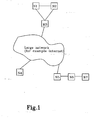
- Figure 1 shows the possible configuration of parts of a packet switching network.
- the example shows how several nodes (N1, N2, N3...) are interlinked in one or more networks.
- the nodes N1-N3 and N5-N7 may form two separate small networks which, in turn, are coupled together with a larger network, for instance with Internet.
- Each small network can use different types of technology, for example FDDI, Ethernet or ATM.
- the nodes N1-N3 might be able to use ATM within their small network, whereas the nodes N5-N7 might be able to use Ethernet within their small network.
- Internet is actually a logic network that consists of a collection of physical networks, i.e. a collection of smaller networks that use different technologies.
- a router ensures that data packets are sent along correct routes between the networks, whereas a gateway manages the communication between different types of protocols, for instance so that an ATM-network is able to communicate with an Ethernet-network.
- the OSI-model shown in Figure 2 describes the various layers that are included in a packet switching communications system.
- the bottom Layer 1 is the physical layer that specifies transportation of bits over the physical medium.
- V.24, V.34 and G.703 are examples of Layer 1 standards.
- Layer 2 is the data link layer that specifies frames and physical addresses.
- Ethernet, Token Ring and High level Data Link Control (HDLC) are examples of Layer 2 standards.
- Layer 3 is the network layer that manages routing, logic addresses and data packet fragmentation.
- IP Internet Protocol
- IPX Internetwork Packet Exchange
- These three lowermost Layers 1-3 are, as shown in Figure 2, implemented in all network nodes, including network switches and all nodes coupled along said networks.
- Layer 4 is the transport layer that is normally implemented solely in the end nodes.
- User Datagram Protocol UDP
- Transmission Control Protocol TCP
- UDP User Datagram Protocol
- TCP Transmission Control Protocol
- Layer 5 is the sessions layer that, inter alia, checks that the session has not been terminated before all data has been transmitted. Examples in this regard may be netbios and winsock.
- Layer 6 is the presentation layer that specifies coding of data.
- HTML HyperText Marup Language
- ASCII American Standard Code for Information Interchange
- the top Layer 7 is where the actual applications are implemented, such as e-mail and file transfers. Examples in this regard are telnet, File Transfer Protocol (FTP), Simple Mail Transfer Protocol (SMPT) and HyperText Transport Protocol (HTTP).
- FTP File Transfer Protocol
- SMPT Simple Mail Transfer Protocol
- HTTP HyperText Transport Protocol
- FIG. 3 illustrates the construction of an IP-header for IP-version 4.
- An Ipv4 header consists of several 32-bit words.
- the first word includes Version which indicates the version of IP used.
- Hlen indicates the length of the entire header.
- TOS Type Of Service
- the field Protocol concerns which higher-layer protocol manages the IP-packet, examples of such protocol being TCP or UDP. This field is thus examined to see whether or not TCP was used, and therewith also examined to see whether or not SYN and ACK were sent, as is carried out in one embodiment of the invention.
- a checksum is a sum that is calculated by discerning the whole of the IP-header as a number of mutually summated 16-bit words. If this field does not agree with the computation carried out upon arrival of the packet, the packet is discarded.
- the SourceAddress reveals the address from which the packet is sent, i.e. the origin of the packet, this being required in order to be able to reply to a message.
- the address of origin may, for instance, be an IP-address, such as 130.240.193.75.
- the DestinationAddress reveals the address to which-the packet shall be sent, in other words the terminal address. This address is used by each router in making a decision and determining the route along which the packet shall be forwarded in the network.
- the receiver address may, for instance, be an IP-address, such as 136.225.151.252. When IP is used in conjunction with the invention, it is this field together with the aforesaid source address field that is used to ascertain whether or not the data packet shall be accepted.
- Data is the actual payload data that may consist of the subject matter to the dispatch, for instance, text, pictures or speech.
- FIG. 4 shows the construction of a TCP-header.
- the TCP-header also consists of several 32-bit words.
- the first field SrcPort indicates the port that was used in the node from which the packet was sent.
- DstPort denotes the corresponding port in the node to which the packet shall be sent. Because TCP is a byte-orientated protocol, each byte of data will have a sequence number, which is given by Seq No. Acknowledgement indicates which sequence is next in line, i.e. the sequence number accepted next by the receiver.
- HdrL denotes the length of the header.
- AdvWindow indicates the size of the transmission window used, i.e. how much data is sent before a receiving acknowledgement can be expected.
- Checksum is a sum that is calculated by summating the contents of the header, so as to ascertain whether or not this content is in agreement with the received content.
- UrgPtr indicates the number of bytes of urgent data (if URG is placed in Flags). TCP-choice can be specified in options, and the Data-field is the payload data sent.
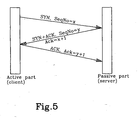
- FIG. 5 is a schematic image of the so-called three way handshake algorithm used by TCP for establishing a connection.
- This algorithm is used between all end nodes that send data therebetween, regardless of whether it involves two clients, two servers, or one server and one client.
- the handshaking algorithm shown by way of example is for TCP, it will be understood that other handshake algorithms may alternatively be used in accordance with the invention, for instance a WAP handshake algorithm.
- SYN/ACK is studied in order to ascertain whether or not packets arriving from this session will be accepted. This reduces the number of outgoing packets that need to be checked. All that is required is to look when a connection is established, therewith obviating the need to check outgoing packets in said session. ?
- FIGS 1-5 now give a background that leads to the invention itself, i.e. how data packets are filtered. This is described below chiefly with reference to Figures 6 and 7.
- FIG. 6 is a flow chart for outgoing data packets in one embodiment of the invention.
- the first step 201 involves ascertaining whether or not data packets are affiliated with a handshake protocol.
- the second step 202 involves ascertaining whether or not an outgoing data packet belongs to a handshake procedure, which when TCP is used is shown, for instance, in the abovementioned field Flags, where SYN and/or ACK may be given. These two steps can be carried out within the concept of the invention to reduce the number of outgoing data packets that shall be examined.
- the third step 203 involves examining the destination address of the data packet, which, when Internet Protocol (IP) is used, can be found in the DestinationAddress of the IP-header, which states the address to which each data packet shall be sent.
- IP Internet Protocol
- the next step 204 involves finding the destination address of the outgoing data packet in the list of accepted addresses.
- Step 205 is implemented when the response in the preceding step 204 is NEGATIVE, meaning that the address is not included in the list. The user is then asked whether or not the destination address of the outgoing data packet shall be included in the list.
- Step 206 involves including the address in the list, if the user answers YES to the question.
- Step 207 involves releasing the packet for transportation out in the network. This step can follow step 204, 205 or 206, depending on the answers given to the aforesaid questions and the result of the list scan, or whether or not automatic updating of the list shall be used instead of asking a question of the user in this regard.
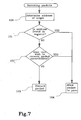
- Figure 7 is a flow chart for incoming data packets in one embodiment of the invention.
- the first step 100 involves examining the address of origin of the data packet. This can be seen, for instance, in the SourceAddress field of the IP-header when using Internet Protocol.
- the next step 101 involves looking for the address in the list of accepted addresses.
- Step 102 is carried out when the address cannot be found in the preceding step 101, meaning that the sender is unknown/not accepted.
- the user is then asked whether or not he is willing to receive the data packet nevertheless.
- Step 103 is carried out when the user states in the preceding step 102 that he does not wish to receive the packet. The packet will then be erased. Alternatively, this step is carried out immediately after step 101 when the address cannot be found and the user does not wish to ask this question for each unknown sender.
- Step 104 which means that receipt of the packet in the node is avoided, may take place after several steps (101 or 102), depending on whether or not the address is found in the list or depending on the answer given to said question.
- the list of accepted addresses of origin might include both addresses statically inserted in the list and addresses that are generated automatically. This enables a user to create the list beforehand or to update the list with accepted addresses of origin. Alternatively, the list can be created or updated automatically by including the addresses to which data packets are sent automatically in the list, in accordance with the invention.
- the person applying the invention may, for instance, be a person who uses a wireless connection to the Internet, via node N4 in Figure 1.
- the user then sends an email to a user connected via node N6 in Figure 1, and requests home a number of web pages from Node N3.
- the user then considers the addresses of nodes N6 and N3 to be reliable. If a file is sent from a person who does not have one of the aforesaid addresses of origin, the file is erased before our person receives the file on his computer.
- the invention can be implemented in a node upstream of our user, for instance in the penultimate node - which may be the base station - prior to the file being sent to our user in a wireless node. This is done in order to save space on the limited bandwidth in the air interface.
Landscapes
- Engineering & Computer Science (AREA)
- Computer Networks & Wireless Communication (AREA)
- Signal Processing (AREA)
- Computer Security & Cryptography (AREA)
- Computer Hardware Design (AREA)
- Computing Systems (AREA)
- General Engineering & Computer Science (AREA)
- Data Exchanges In Wide-Area Networks (AREA)
- Communication Control (AREA)
- Preparation Of Compounds By Using Micro-Organisms (AREA)
- Ultra Sonic Daignosis Equipment (AREA)
Claims (15)
- Verfahren zum Abblocken von Datenverkehr, der von einem ersten Knoten (N4) empfangen wird, von einem zweiten Knoten (N3) in einem Kommunikationssystem, welches wenigstens zwei Knoten (NI-N4) einschließt, wobei eine Kommunikation zwischen den Knoten in einem Paketvermittlungsnetz stattfindet, wobei der erste Knoten Datenpakete sendet, die jeweils eine Zieladresse aufweisen, umfassend die folgenden Schritte in Bezug auf ankommende Datenpakete an dem ersten Knoten (N4):- Bestimmen (100) der Adresse des Ursprungs eines ankommenden Datenpakets;- Vergleichen (101) der Adresse des Ursprungs des ankommenden Datenpakets mit einer Liste von akzeptierten Adressen des Ursprungs;- Zulassen eines Durchgangs (104) des Datenpakets, wenn das Datenpaket eine akzeptierte Adresse des Ursprungs aufweist; oder- Löschen (103) des Datenpakets, wenn dessen Adresse des Ursprungs nicht akzeptiert ist;dadurch gekennzeichnet, dass die akzeptierte Adressen in den folgenden Schritten bestimmt werden:- Bestimmen (203) der Zieladresse eines abgehenden Pakets von dem ersten Knoten (N4);- Untersuchen (204), ob die Zieladresse in der Liste gefunden wird; und- Hinzufügen (206) der Zieladresse zu der Liste, wenn noch nicht in der Liste.
- Verfahren nach Anspruch 1, dadurch gekennzeichnet, dass der Löschung des Datenpakets eine Frage (102) vorausgeht, die anfragt, ob der Benutzer wünscht, dass ein Datenpaket von einer nicht akzeptierten Adresse des Ursprungs empfangen wird.
- Verfahren nach Anspruch 1 , dadurch gekennzeichnet, dass der Hinzufügung (206) einer Zieladresse eine Frage (204) vorausgeht, die anfragt, ob der Benutzer wünscht oder nicht, dass die Zieladresse als eine akzeptierte Adresse des Ursprungs eingeschlossen wird.
- Verfahren nach Anspruch 2-3, dadurch gekennzeichnet, dass die vorangehenden Schritte (203-207) in Bezug auf abgehende Datenpakete ausschließlich während des Handshake-Algorithmus zum Herstellen einer Verbindung ausgeführt werden, und dass den Schritten die folgenden Schritte vorausgehen:- Bestimmen (201), ob ein abgehendes Datenpaket zu einem Handshake-Protokoll gehört oder nicht, und- Bestimmen (202), ob ein abgehendes Datenpaket in einer Handshake-Prozedur eingeschlossen ist oder nicht.
- Verfahren nach irgendeinem der Ansprüche 1-4, dadurch gekennzeichnet, dass das Netzprotokoll aus dem Internet Protokoll IP gebildet ist.
- Verfahren nach Anspruch 5, dadurch gekennzeichnet, das Transportprotokoll aus dem User Datagramm Protokoll UDP gebildet ist.
- Verfahren nach Anspruch 5, dadurch gekennzeichnet, dass das Transportprotokoll das Transmission Control Protokoll TCP ist.
- Verfahren nach irgendeinem der Ansprüche 1-7, dadurch gekennzeichnet, dass das Kommunikationssystem aus einem System des Typs TDMA, Time Division Multiple Access, mit einer Paketdatenhinzufügung gebildet ist.
- Verfahren nach irgendeinem der Ansprüche 1-7, dadurch gekennzeichnet, dass das Kommunikationssystem ein System des Typs PDC, Personal Digital Cellular, ist.
- Verfahren nach irgendeinem der Ansprüche 1-7, dadurch gekennzeichnet, dass das Kommunikationssystem ein System des WCDMA, Wideband Code Divison Multiple Access, Typs ist.
- Verfahren nach Anspruch 8, dadurch gekennzeichnet, dass die Paketdatenhinzufügung ein GPRS, General Packed Radio Service, ist.
- Kommunikationseinheit zum Abblocken von Datenverkehr, der von einem ersten Knoten (N4) empfangen wird, von einem zweiten Knoten (N3) in einem Kommunikationssystem, welches wenigstens zwei Knoten (Nl-N4) einschließt, wobei eine Kommunikation zwischen den Knoten in einem Paketvermittlungsnetz stattfindet, wobei der erste Knoten Datenpakete sendet, die jeweils eine Zieladresse aufweisen, umfassend, in Bezug auf ankommende Datenpakete an dem ersten Knoten (N4),- Mittel zum Bestimmen (100) der Adresse des Ursprungs eines ankommenden Datenpakets;- Mittel zum Vergleichen (101) der Adresse des Ursprungs des ankommenden Datenpakets mit einer Liste von akzeptierten Adressen des Ursprungs;- Mittel zum Zulassen eines Durchgangs des Datenpakets, wenn das Datenpaket eine akzeptierte Adresse des Ursprungs aufweist; oder Löschen des Datenpakets, wenn dessen Adresse des Ursprungs nicht akzeptiert ist;dadurch gekennzeichnet, dass die akzeptierte Adressen bestimmt werden durch- Mittel zum Bestimmen der Zieladresse eines abgehenden Pakets von dem ersten Knoten;- Mittel zum Untersuchen, ob die Zieladresse in der Liste gefunden wird; und- Mittel zum Hinzufügen der Zieladresse zu der Liste, wenn noch nicht in der Liste.
- Kommunikationseinheit nach Anspruch 12, gekennzeichnet durch Mittel zum Befragen des Benutzers, ob er/sie wünscht, dass ein Datenpaket von einer nicht akzeptierten Adresse des Ursprungs empfangen wird.
- Kommunikationseinheit nach Anspruch 12, gekennzeichnet durch Mittel zum Befragen des Benutzers, ob er/sie wünscht, dass eine Zieladresse in die Liste eingebaut wird.
- Kommunikationseinheit nach irgendeinem der Ansprüche 12-14, gekennzeichnet durch Mittel zum Bestimmen, ob abgehende Datenpakete zu einem Handshake-Protokoll gehören oder nicht, und durch Mittel zum Bestimmen, ob die abgehenden Datenpakete in einer Handshake-Prozedur eingeschlossen sind oder nicht.
Applications Claiming Priority (3)
| Application Number | Priority Date | Filing Date | Title |
|---|---|---|---|
| SE0002586 | 2000-07-07 | ||
| SE0002586A SE519317C2 (sv) | 2000-07-07 | 2000-07-07 | Förfarande och kommunikationsenhet för att blockera oönskad trafik i ett datakommunikationssystem |
| PCT/SE2001/001590 WO2002005514A1 (en) | 2000-07-07 | 2001-07-06 | A method and an arrangement relating to communicaitons systems |
Publications (2)
| Publication Number | Publication Date |
|---|---|
| EP1305925A1 EP1305925A1 (de) | 2003-05-02 |
| EP1305925B1 true EP1305925B1 (de) | 2007-06-06 |
Family
ID=20280426
Family Applications (1)
| Application Number | Title | Priority Date | Filing Date |
|---|---|---|---|
| EP01950158A Expired - Lifetime EP1305925B1 (de) | 2000-07-07 | 2001-07-06 | Verfahren und anordnung für kommunikationssysteme |
Country Status (7)
| Country | Link |
|---|---|
| US (1) | US20030152081A1 (de) |
| EP (1) | EP1305925B1 (de) |
| AT (1) | ATE364284T1 (de) |
| AU (1) | AU2001271184A1 (de) |
| DE (1) | DE60128807T2 (de) |
| SE (1) | SE519317C2 (de) |
| WO (1) | WO2002005514A1 (de) |
Families Citing this family (5)
| Publication number | Priority date | Publication date | Assignee | Title |
|---|---|---|---|---|
| US20030233457A1 (en) * | 2002-06-12 | 2003-12-18 | Henrik Basilier | Signaling framework for wireless networks |
| KR20110028555A (ko) * | 2003-12-05 | 2011-03-18 | 리서치 인 모션 리미티드 | 무선 통신 장치로 향하는 원치 않는 트래픽을 제어하는 방법 및 장치 |
| CN1910881B (zh) | 2004-10-29 | 2010-09-29 | 日本电信电话株式会社 | 分组通信网络和分组通信方法 |
| US7930740B2 (en) * | 2005-07-07 | 2011-04-19 | International Business Machines Corporation | System and method for detection and mitigation of distributed denial of service attacks |
| US8301895B2 (en) | 2009-12-02 | 2012-10-30 | Microsoft Corporation | Identity based network policy enablement |
Citations (1)
| Publication number | Priority date | Publication date | Assignee | Title |
|---|---|---|---|---|
| EP0909073A2 (de) * | 1997-09-12 | 1999-04-14 | Lucent Technologies Inc. | Verfahren und Vorrichtung für einen Rechnernetzwerkfirewall mit Proxy-Reflektion |
Family Cites Families (16)
| Publication number | Priority date | Publication date | Assignee | Title |
|---|---|---|---|---|
| US5774552A (en) * | 1995-12-13 | 1998-06-30 | Ncr Corporation | Method and apparatus for retrieving X.509 certificates from an X.500 directory |
| US6510151B1 (en) * | 1996-09-19 | 2003-01-21 | Enterasys Networks, Inc. | Packet filtering in connection-based switching networks |
| US5996011A (en) * | 1997-03-25 | 1999-11-30 | Unified Research Laboratories, Inc. | System and method for filtering data received by a computer system |
| JPH1141272A (ja) * | 1997-04-09 | 1999-02-12 | Alcatel Alsthom Co General Electricite | Lanインターネット接続 |
| US6199102B1 (en) * | 1997-08-26 | 2001-03-06 | Christopher Alan Cobb | Method and system for filtering electronic messages |
| US6092110A (en) * | 1997-10-23 | 2000-07-18 | At&T Wireless Svcs. Inc. | Apparatus for filtering packets using a dedicated processor |
| FI112897B (fi) * | 1998-03-03 | 2004-01-30 | Nokia Corp | Menetelmä tiedonsiirtoverkossa ja tiedonsiirtolaite |
| US6725378B1 (en) * | 1998-04-15 | 2004-04-20 | Purdue Research Foundation | Network protection for denial of service attacks |
| US6189035B1 (en) * | 1998-05-08 | 2001-02-13 | Motorola | Method for protecting a network from data packet overload |
| US6112227A (en) * | 1998-08-06 | 2000-08-29 | Heiner; Jeffrey Nelson | Filter-in method for reducing junk e-mail |
| US6546416B1 (en) * | 1998-12-09 | 2003-04-08 | Infoseek Corporation | Method and system for selectively blocking delivery of bulk electronic mail |
| US6574658B1 (en) * | 1999-01-29 | 2003-06-03 | Lucent Technologies Inc. | System and method for secure classification of electronic mail |
| US6578080B1 (en) * | 1999-02-04 | 2003-06-10 | Advanced Micro Devices, Inc. | Mechanism for run time programming of hardware resources with least interference with continued operation |
| US7016951B1 (en) * | 1999-04-30 | 2006-03-21 | Mantech Ctx Corporation | System and method for network security |
| US6868498B1 (en) * | 1999-09-01 | 2005-03-15 | Peter L. Katsikas | System for eliminating unauthorized electronic mail |
| US7043633B1 (en) * | 2000-08-28 | 2006-05-09 | Verizon Corporation Services Group Inc. | Method and apparatus for providing adaptive self-synchronized dynamic address translation |
-
2000
- 2000-07-07 SE SE0002586A patent/SE519317C2/sv not_active IP Right Cessation
-
2001
- 2001-07-06 WO PCT/SE2001/001590 patent/WO2002005514A1/en not_active Ceased
- 2001-07-06 DE DE60128807T patent/DE60128807T2/de not_active Expired - Lifetime
- 2001-07-06 AT AT01950158T patent/ATE364284T1/de not_active IP Right Cessation
- 2001-07-06 AU AU2001271184A patent/AU2001271184A1/en not_active Abandoned
- 2001-07-06 US US10/332,148 patent/US20030152081A1/en not_active Abandoned
- 2001-07-06 EP EP01950158A patent/EP1305925B1/de not_active Expired - Lifetime
Patent Citations (1)
| Publication number | Priority date | Publication date | Assignee | Title |
|---|---|---|---|---|
| EP0909073A2 (de) * | 1997-09-12 | 1999-04-14 | Lucent Technologies Inc. | Verfahren und Vorrichtung für einen Rechnernetzwerkfirewall mit Proxy-Reflektion |
Non-Patent Citations (1)
| Title |
|---|
| STEVEN M. BELLOVIN AND WILLIAM R. CHESWICK: "Network Firewalls", 2460 IEEE COMMUNICATIONS MAGAZINE, vol. 32, no. 9, September 1994 (1994-09-01), pages 50 - 57, XP000476555 * |
Also Published As
| Publication number | Publication date |
|---|---|
| SE519317C2 (sv) | 2003-02-11 |
| US20030152081A1 (en) | 2003-08-14 |
| AU2001271184A1 (en) | 2002-01-21 |
| DE60128807D1 (de) | 2007-07-19 |
| EP1305925A1 (de) | 2003-05-02 |
| ATE364284T1 (de) | 2007-06-15 |
| SE0002586D0 (sv) | 2000-07-07 |
| SE0002586L (sv) | 2002-01-08 |
| DE60128807T2 (de) | 2008-02-07 |
| WO2002005514A1 (en) | 2002-01-17 |
Similar Documents
| Publication | Publication Date | Title |
|---|---|---|
| Braden | Rfc1122: Requirements for internet hosts-communication layers | |
| Braden | Requirements for Internet hosts-communication layers | |
| US6553423B1 (en) | Method and apparatus for dynamic exchange of capabilities between adjacent/neighboring networks nodes | |
| EP1057309B1 (de) | System und verfahren zur verwendung von domännamen zur lenkung von zu einem netzwerkziel gesendeten daten | |
| US6157950A (en) | Methods and apparatus for interfacing a computer or small network to a wide area network such as the internet | |
| US6415329B1 (en) | Method and apparatus for improving efficiency of TCP/IP protocol over high delay-bandwidth network | |
| US5134610A (en) | Network transit prevention | |
| Baker | Rfc1812: Requirements for IP version 4 routers | |
| US8090859B2 (en) | Decoupling TCP/IP processing in system area networks with call filtering | |
| US7275093B1 (en) | Methods and device for managing message size transmitted over a network | |
| US20030095526A1 (en) | Cell level congestion policy management | |
| CN112154627A (zh) | 服务相关的路由方法和装置 | |
| EP1387533A1 (de) | Kommunikation von Packetdateneinheiten über Signalisierung und Verkehrskanälen | |
| EP1305925B1 (de) | Verfahren und anordnung für kommunikationssysteme | |
| US20010052025A1 (en) | Router setting method and router setting apparatus | |
| CN115514828A (zh) | 数据传输方法及电子设备 | |
| JP2003521137A (ja) | モバイルノードから対応ノードに送信されるデータに関してサービス品質をサポートする方法及び移動局ip環境 | |
| Carne | A professional's guide to data communication in a TCP/IP world | |
| US20060239263A1 (en) | Method for the establishing of connections in a communication system | |
| US7406045B2 (en) | Modular policy decision point for processing resource-reservation requests within a data network | |
| EP1033848B1 (de) | Proxy-server für Unterstützung von IP Dienstleistungsqualität | |
| JPH09270822A (ja) | パケット通信経路試験方法 | |
| Osterloh | IP routing primer plus | |
| JPH11331257A (ja) | 異ネットワーク間接続方法およびルータ装置 | |
| JP2004511136A (ja) | 通信ネットワークのためのインターネット・プロトコル・ヘッダ |
Legal Events
| Date | Code | Title | Description |
|---|---|---|---|
| PUAI | Public reference made under article 153(3) epc to a published international application that has entered the european phase |
Free format text: ORIGINAL CODE: 0009012 |
|
| 17P | Request for examination filed |
Effective date: 20030117 |
|
| AK | Designated contracting states |
Designated state(s): AT BE CH CY DE DK ES FI FR GB GR IE IT LI LU MC NL PT SE TR |
|
| AX | Request for extension of the european patent |
Extension state: AL LT LV MK RO SI |
|
| RAP1 | Party data changed (applicant data changed or rights of an application transferred) |
Owner name: TELEFONAKTIEBOLAGET LM ERICSSON (PUBL) |
|
| GRAP | Despatch of communication of intention to grant a patent |
Free format text: ORIGINAL CODE: EPIDOSNIGR1 |
|
| RTI1 | Title (correction) |
Free format text: A METHOD AND AN ARRANGEMENT RELATING TO COMMUNICATIONS SYSTEMS |
|
| RIN1 | Information on inventor provided before grant (corrected) |
Inventor name: SOEDERBERG, JOHAN Inventor name: HEDLUND, MIKAEL |
|
| GRAS | Grant fee paid |
Free format text: ORIGINAL CODE: EPIDOSNIGR3 |
|
| GRAA | (expected) grant |
Free format text: ORIGINAL CODE: 0009210 |
|
| AK | Designated contracting states |
Kind code of ref document: B1 Designated state(s): AT BE CH CY DE DK ES FI FR GB GR IE IT LI LU MC NL PT SE TR |
|
| PG25 | Lapsed in a contracting state [announced via postgrant information from national office to epo] |
Ref country code: CH Free format text: LAPSE BECAUSE OF FAILURE TO SUBMIT A TRANSLATION OF THE DESCRIPTION OR TO PAY THE FEE WITHIN THE PRESCRIBED TIME-LIMIT Effective date: 20070606 Ref country code: FI Free format text: LAPSE BECAUSE OF FAILURE TO SUBMIT A TRANSLATION OF THE DESCRIPTION OR TO PAY THE FEE WITHIN THE PRESCRIBED TIME-LIMIT Effective date: 20070606 Ref country code: LI Free format text: LAPSE BECAUSE OF FAILURE TO SUBMIT A TRANSLATION OF THE DESCRIPTION OR TO PAY THE FEE WITHIN THE PRESCRIBED TIME-LIMIT Effective date: 20070606 |
|
| REG | Reference to a national code |
Ref country code: GB Ref legal event code: FG4D |
|
| REG | Reference to a national code |
Ref country code: CH Ref legal event code: EP |
|
| REG | Reference to a national code |
Ref country code: IE Ref legal event code: FG4D |
|
| REF | Corresponds to: |
Ref document number: 60128807 Country of ref document: DE Date of ref document: 20070719 Kind code of ref document: P |
|
| PG25 | Lapsed in a contracting state [announced via postgrant information from national office to epo] |
Ref country code: SE Free format text: LAPSE BECAUSE OF FAILURE TO SUBMIT A TRANSLATION OF THE DESCRIPTION OR TO PAY THE FEE WITHIN THE PRESCRIBED TIME-LIMIT Effective date: 20070906 |
|
| PG25 | Lapsed in a contracting state [announced via postgrant information from national office to epo] |
Ref country code: ES Free format text: LAPSE BECAUSE OF FAILURE TO SUBMIT A TRANSLATION OF THE DESCRIPTION OR TO PAY THE FEE WITHIN THE PRESCRIBED TIME-LIMIT Effective date: 20070917 |
|
| PG25 | Lapsed in a contracting state [announced via postgrant information from national office to epo] |
Ref country code: AT Free format text: LAPSE BECAUSE OF FAILURE TO SUBMIT A TRANSLATION OF THE DESCRIPTION OR TO PAY THE FEE WITHIN THE PRESCRIBED TIME-LIMIT Effective date: 20070606 |
|
| NLV1 | Nl: lapsed or annulled due to failure to fulfill the requirements of art. 29p and 29m of the patents act | ||
| REG | Reference to a national code |
Ref country code: CH Ref legal event code: PL |
|
| PG25 | Lapsed in a contracting state [announced via postgrant information from national office to epo] |
Ref country code: BE Free format text: LAPSE BECAUSE OF FAILURE TO SUBMIT A TRANSLATION OF THE DESCRIPTION OR TO PAY THE FEE WITHIN THE PRESCRIBED TIME-LIMIT Effective date: 20070606 |
|
| PG25 | Lapsed in a contracting state [announced via postgrant information from national office to epo] |
Ref country code: NL Free format text: LAPSE BECAUSE OF FAILURE TO SUBMIT A TRANSLATION OF THE DESCRIPTION OR TO PAY THE FEE WITHIN THE PRESCRIBED TIME-LIMIT Effective date: 20070606 Ref country code: PT Free format text: LAPSE BECAUSE OF FAILURE TO SUBMIT A TRANSLATION OF THE DESCRIPTION OR TO PAY THE FEE WITHIN THE PRESCRIBED TIME-LIMIT Effective date: 20071106 |
|
| EN | Fr: translation not filed | ||
| PLBE | No opposition filed within time limit |
Free format text: ORIGINAL CODE: 0009261 |
|
| STAA | Information on the status of an ep patent application or granted ep patent |
Free format text: STATUS: NO OPPOSITION FILED WITHIN TIME LIMIT |
|
| PG25 | Lapsed in a contracting state [announced via postgrant information from national office to epo] |
Ref country code: IT Free format text: LAPSE BECAUSE OF FAILURE TO SUBMIT A TRANSLATION OF THE DESCRIPTION OR TO PAY THE FEE WITHIN THE PRESCRIBED TIME-LIMIT Effective date: 20070606 Ref country code: DK Free format text: LAPSE BECAUSE OF FAILURE TO SUBMIT A TRANSLATION OF THE DESCRIPTION OR TO PAY THE FEE WITHIN THE PRESCRIBED TIME-LIMIT Effective date: 20070606 Ref country code: MC Free format text: LAPSE BECAUSE OF NON-PAYMENT OF DUE FEES Effective date: 20070731 Ref country code: GR Free format text: LAPSE BECAUSE OF FAILURE TO SUBMIT A TRANSLATION OF THE DESCRIPTION OR TO PAY THE FEE WITHIN THE PRESCRIBED TIME-LIMIT Effective date: 20070907 |
|
| 26N | No opposition filed |
Effective date: 20080307 |
|
| PG25 | Lapsed in a contracting state [announced via postgrant information from national office to epo] |
Ref country code: FR Free format text: LAPSE BECAUSE OF FAILURE TO SUBMIT A TRANSLATION OF THE DESCRIPTION OR TO PAY THE FEE WITHIN THE PRESCRIBED TIME-LIMIT Effective date: 20080201 |
|
| PG25 | Lapsed in a contracting state [announced via postgrant information from national office to epo] |
Ref country code: IE Free format text: LAPSE BECAUSE OF NON-PAYMENT OF DUE FEES Effective date: 20070706 |
|
| PG25 | Lapsed in a contracting state [announced via postgrant information from national office to epo] |
Ref country code: CY Free format text: LAPSE BECAUSE OF FAILURE TO SUBMIT A TRANSLATION OF THE DESCRIPTION OR TO PAY THE FEE WITHIN THE PRESCRIBED TIME-LIMIT Effective date: 20070606 |
|
| PG25 | Lapsed in a contracting state [announced via postgrant information from national office to epo] |
Ref country code: LU Free format text: LAPSE BECAUSE OF NON-PAYMENT OF DUE FEES Effective date: 20070706 |
|
| PG25 | Lapsed in a contracting state [announced via postgrant information from national office to epo] |
Ref country code: TR Free format text: LAPSE BECAUSE OF FAILURE TO SUBMIT A TRANSLATION OF THE DESCRIPTION OR TO PAY THE FEE WITHIN THE PRESCRIBED TIME-LIMIT Effective date: 20070606 |
|
| PGFP | Annual fee paid to national office [announced via postgrant information from national office to epo] |
Ref country code: DE Payment date: 20140729 Year of fee payment: 14 |
|
| PGFP | Annual fee paid to national office [announced via postgrant information from national office to epo] |
Ref country code: GB Payment date: 20140729 Year of fee payment: 14 |
|
| REG | Reference to a national code |
Ref country code: DE Ref legal event code: R119 Ref document number: 60128807 Country of ref document: DE |
|
| GBPC | Gb: european patent ceased through non-payment of renewal fee |
Effective date: 20150706 |
|
| PG25 | Lapsed in a contracting state [announced via postgrant information from national office to epo] |
Ref country code: DE Free format text: LAPSE BECAUSE OF NON-PAYMENT OF DUE FEES Effective date: 20160202 Ref country code: GB Free format text: LAPSE BECAUSE OF NON-PAYMENT OF DUE FEES Effective date: 20150706 |