EP1306810A1 - Mémoire tampon d'identification de triangles - Google Patents
Mémoire tampon d'identification de triangles Download PDFInfo
- Publication number
- EP1306810A1 EP1306810A1 EP01309059A EP01309059A EP1306810A1 EP 1306810 A1 EP1306810 A1 EP 1306810A1 EP 01309059 A EP01309059 A EP 01309059A EP 01309059 A EP01309059 A EP 01309059A EP 1306810 A1 EP1306810 A1 EP 1306810A1
- Authority
- EP
- European Patent Office
- Prior art keywords
- triangle
- buffer
- depth
- identifier
- colour
- Prior art date
- Legal status (The legal status is an assumption and is not a legal conclusion. Google has not performed a legal analysis and makes no representation as to the accuracy of the status listed.)
- Withdrawn
Links
Images



Classifications
-
- G—PHYSICS
- G06—COMPUTING OR CALCULATING; COUNTING
- G06T—IMAGE DATA PROCESSING OR GENERATION, IN GENERAL
- G06T15/00—Three-dimensional [3D] image rendering
- G06T15/10—Geometric effects
- G06T15/40—Hidden part removal
- G06T15/405—Hidden part removal using Z-buffer
Definitions
- the present invention relates to graphical manipulation of objects defined in three-dimensional space, and, more particularly, to the rendering of such objects into a colour buffer for subsequent display on a two-dimensional screen such as a computer monitor.
- the invention has been developed primarily for use in graphics chips where speed and throughput of rendered polygons is paramount, and will be described hereinafter with reference to this application. However, it will be appreciated that the invention is not limited to use in this field.
- a typical 3D accelerator includes a rasterising section that takes mathematical representations of the polygons (usually triangles) in three-dimensional space and renders them down to a two dimensional representation suitable for display on a computer monitor or the like.
- the steps in this procedure are relatively well known in the art, and include a color rendering stage where colors from a texture map associated with each polygon are mapped to individual pixels in the two dimensional buffer. Due to memory bandwidth issues, it is desirable to reduce the amount of textures that are imported for mapping onto each polygon.
- each pixel of each polygon as it is considered is depth compared with any pixel already at a corresponding pixel location in the colour buffer. This is usually done with reference to a depth buffer.
- the depth buffer is the same size as the colour buffer, and is used to maintain depth data in the form of a depth value for each pixel that has been written to the colour buffer.
- its depth value is compared with the depth value associated with any pixel that has already been written to the colour buffer at the new pixel's location. In the event that the new pixel is behind the old, then it is discarded because it will be obscured.
- the new pixel's depth value replaces that of the old pixel in the depth-buffer, and colour data is retrieved from associated texture memory and written over the old pixel's colour data in the colour buffer.
- a method of rendering a plurality of triangles into a colour buffer defined by a plurality of pixel locations utilising a triangle identification buffer and a depth buffer, the method including the steps of:
- step (f) includes the substeps of:
- step (f) further includes the substep of forwarding information to the texture cache to enable prefetching of the texture to commence.
- the depth buffer and the triangle identification buffer are combined, such that, at each address defining a pixel location in the combined buffer, there is space for a depth value and a triangle identifier value.
- the depth buffer and triangle buffer are combined with the colour buffer, such that, at each address defining a pixel location in the combined buffer, there is space for the depth value, the triangle identifier value and colour values.
- the steps of generating triangle pixels include the sub-step of scan converting the triangles for which the pixels are to be generated.
- the color data are based on textures stored in an associated texture memory.
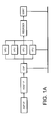
- Figure 1A shows an architecture for generating a two dimensional output for display on, say, a computer monitor, such as that shown in Figure 6, based on representations of one or more polygons in three dimensional space.
- the polygons will take the form of triangles. This is because triangles are always planar and convex, and therefore mathematically easier to deal with than other polygons.
- FIG. 1A there is shown a graphics accelerator card 10 that includes an Accelerated Graphics Port (AGP) interface 11 connected to a host interface 12.
- the host interface is in turn connected to a Command Stream Processor (CSP) 13.
- the CSP has a variety of functions. For example, it interprets the graphics command stream, differentiating between the vertex information and the state information. It is responsible for fetching data from the host. It can also reformat vertex data into a form more suitable for the Vertex Processing Units (VPUs) described below, packetising the data where necessary.
- VPUs Vertex Processing Units
- the CSP 13 is in communication with the video card system memory (not shown) via an on-board bus 14, and is also connected to a set of programmable Vertex Processing Units (VPUs) 15 which are themselves connected to the bus 14 to enable access to the video card and system memory.
- VPUs Vertex Processing Units
- the CSP controls the VPU processors 15 on the basis of instructions from the host computer (as described later in relation to Figure 6).
- the processed polygon data from the VPU processors 15 is then reordered and sorted for display by reordering and sorting circuitry 16 and 17 respectively.
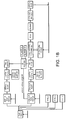
- VPU processors 15 One of the VPU processors 15 will now be described in more detail with reference to Figure 1B.
- the multiple VPU processors 15 are substantially identical.
- the advantages and disadvantages of pipelined processing are well understood.
- the highly repetitive nature of calculations used in video acceleration programming, along with the relatively small number of branches and jumps (all of which behave predictably) makes pipelining particularly well suited to this type of processing.
- triangles are set up for scan conversion. This is shown in more detail in Figure 2, in which is shown an exemplary triangle 200 ready for scan conversion.
- the triangle 200 is defined by set of three tuplets 201, 202 and 203 that specify coordinates, colour and texture information at each vertex.
- These tuplets are: (X 1 , Y 1 , Z 1 , R 1 , G 1 , B 1 , A 1 , U 1 1 V 1 1 , ..., U n 1 ,V n 1 ) (X 2 , Y 2 , Z 2 , R 2 , G 2 , B 2 , A 2 , U 1 2 , V 1 2 , ..., U n 2 , V n 2 ) (X 3 , Y 3 , Z 3 , R 3 , G 3 , B 3 , A 3 , U 1 3 , V 1 3 , ..., U n 3 , V n 3 )
- the values represented by the variables will be well understood by those skilled in the art of three-dimensional graphics.
- the tuplet information represents values of vertices of the triangle. By definition, this means that they lie in the plane of the triangle, so the triangle can be rasterised by interpolating the values at those vertices. Also, whilst only one set of colour components (RGB) is defined in the above tuplets, it is common for two sets to be defined, one for diffuse lighting and the other for specular lighting.
- RGB colour components
- this "overdraw" problem is ameliorated by making a depth assessment of each pixel prior to full rendering. In this way, only those triangles that will actually be visible in the final image will actually go through the relatively bandwidth-hungry rendering stages. It will be appreciated by those skilled in the art that this has the added advantage of speeding up subsequent anti-aliasing procedures.
- this result is achieved by allocating a relatively unique identifier to each triangle to be rendered.
- “relatively unique” it is meant that each triangle is uniquely identified with respect to all other triangles that define the three dimensional components of a particular tile or frame being rendered. For example, a triangle that appears in consecutive frames or adjacent tiles may well be allocated a different identifier in each of those frames.
- each triangle is rasterised to translate the mathematically-defined triangle into a pixel-defined triangle.
- Rasterising is well known to those skilled in the art, and so will not be described in detail. Examples of suitable rasterising techniques are described in "Computer Graphics: Principles and Practice" by James Foley et al.
- Figure 4 represents the steps involved in finding out which triangles will be visible and therefore need to be rendered, whilst Figure 5 represents the steps involved in plotting colour/texture pixels to the colour buffer for the visible pixels determined in Figure 4.
- Figure 9 summarises these steps in a more simplified format.
- each pixel location in the depth-buffer is set to a "far distance" value, such that any pixel subsequently depth-compared with one of the initial values will always be considered “on top” of the initial value.
- steps 402 to 408 of Figure 4 correspond with steps 502 to 508 to Figure 5, and in some embodiments can be performed in the same hardware.
- step 409 a comparison is made between the depth value of the current pixel and that representing the corresponding pixel location in the depth-buffer. If the pixel already at that position in the colour buffer has a depth greater than that of the value at the corresponding position in the depth buffer, then the identifier for the triangle being compared is written into the triangle identification buffer and the depth overwritten into that position in the depth buffer.
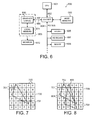
- the contents of the identification buffer and the depth-buffer are shown in be Figure 7. It will be noted that all values in the identification buffer 700 are zero other than those pixel locations 701 associated with the fist triangle 702. Naturally, in alternative embodiments, any other default value can be used to represent a "no triangle" state.
- Each of the pixel locations corresponding to the pixels generated in relation to the first triangle 702 contains the value of the unique identifier originally allocated to the triangle (in this case, the digit "1").
- Each corresponding pixel location in the depth-buffer has stored within it a z-value associated with that pixel.
- the depth value of the current pixel being scanned is compared to the depth value stored in the pixel location in the depth-buffer corresponding to that of the triangle. It will be appreciated that, if the corresponding pixel location has not yet had triangle data written to it, the pixel presently being considered will by definition be visible in the event that no further triangles have pixels at that location. The unique identifier associated with the current triangle will then be written directly to the corresponding pixel location to replace the default value.
- the contents of the triangle identifier buffer after a second triangle 800 has been written to it is shown in Figure 8, along with the first triangle 702 from Figure 7. It will be noted that the second triangle 800 is in front of the first triangle 702 where they overlap, and so the unique identifier 801 of the second triangle (the digit "2") has been written over the first triangle identifiers in the pixel locations corresponding with the overlap area. Similarly, in the depth buffer the depth values corresponding to the overlapping second triangle have also overwritten the depth values of the first triangle. Those portions of the second triangle 800 that are not overlapping the first triangle 700 are also written to the depth and triangle identifier buffers.
- Steps 401 to 410 are repeated until all triangles for the frame or tile being rendered have been processed. In the present example, only the two triangles need to be rendered, so the resultant triangle identifier buffer state is that shown in Figure 8.
- the initial step 501 is to search the ID buffer to locate an active triangle.
- a triangle can be considered active if one or more pixels associated with it are in the depth-buffer. As each active triangle is found, a corresponding set of vertices is retrieved from memory.
- step 507 is reached, however, things proceed differently from the procedure of Figure 4.
- the interpolate mask is still generated, in accordance with step 508.
- r, g, b, a and z are then interpolated in step 509 for each of the live pixels of present triangle.
- the resultant values are then passed to the texture pipe 510, in which texture mapping takes place. This involves mapping a texture stored in memory to the triangle on a pixel-by-pixel basis.
- the procedure is relatively well known in the art, and so will not be described here in further detail.
- the resultant frame representing a two-dimensional view of the three dimensional representations, is output to a display device such as a computer monitor.
- FIG 9 shows a summarised version of the steps described in relation to the other Figures. The steps themselves are self-explanatory in view of the previous detailed description and so will not be described in further detail herein.
- the invention is embodied in a specialist graphics processor on a graphics accelerator card.
- Such cards are used as components in personal and business computers, such as an IBM compatible PC 600 shown in Figure 6.
- the PC includes, amongst other things, a general-purpose processor in the form of a Pentium III processor 601, manufactured by the Intel Corporation. Via a chipset 602, the processor 601 communicates with host memory 603, a PCI bus 604 and an Advanced Graphics Port (AGP) bus 605.
- the PCI bus 604 allows the chipset 602 to interface with various peripheral components, such as a soundcard 606, a keyboard 607 and a mouse 608.
- the AGP bus 605 is used to communicate with a graphics accelerator card 609, which includes, amongst other things, a graphics chip 610 and local memory 611.
- the graphics card outputs graphics signals to a computer monitor 612.
- the preferred embodiment of the present invention is incorporated in the hardware, software and firmware of the graphics card 609.
- the present invention provides a method of rendering polygons from a three-dimensional to a two-dimensional space, whilst reducing overall texture bandwidth requirements.
Landscapes
- Physics & Mathematics (AREA)
- Engineering & Computer Science (AREA)
- Geometry (AREA)
- Computer Graphics (AREA)
- General Physics & Mathematics (AREA)
- Theoretical Computer Science (AREA)
- Image Generation (AREA)
Priority Applications (3)
| Application Number | Priority Date | Filing Date | Title |
|---|---|---|---|
| EP01309059A EP1306810A1 (fr) | 2001-10-25 | 2001-10-25 | Mémoire tampon d'identification de triangles |
| EP02257324A EP1306811A1 (fr) | 2001-10-25 | 2002-10-22 | Mémoire tampon d'identification de triangles |
| US10/445,295 US20050231506A1 (en) | 2001-10-25 | 2003-05-22 | Triangle identification buffer |
Applications Claiming Priority (1)
| Application Number | Priority Date | Filing Date | Title |
|---|---|---|---|
| EP01309059A EP1306810A1 (fr) | 2001-10-25 | 2001-10-25 | Mémoire tampon d'identification de triangles |
Publications (1)
| Publication Number | Publication Date |
|---|---|
| EP1306810A1 true EP1306810A1 (fr) | 2003-05-02 |
Family
ID=8182393
Family Applications (1)
| Application Number | Title | Priority Date | Filing Date |
|---|---|---|---|
| EP01309059A Withdrawn EP1306810A1 (fr) | 2001-10-25 | 2001-10-25 | Mémoire tampon d'identification de triangles |
Country Status (2)
| Country | Link |
|---|---|
| US (1) | US20050231506A1 (fr) |
| EP (1) | EP1306810A1 (fr) |
Families Citing this family (27)
| Publication number | Priority date | Publication date | Assignee | Title |
|---|---|---|---|---|
| US20060007234A1 (en) * | 2004-05-14 | 2006-01-12 | Hutchins Edward A | Coincident graphics pixel scoreboard tracking system and method |
| US8860722B2 (en) * | 2004-05-14 | 2014-10-14 | Nvidia Corporation | Early Z scoreboard tracking system and method |
| US8416242B1 (en) | 2004-05-14 | 2013-04-09 | Nvidia Corporation | Method and system for interpolating level-of-detail in graphics processors |
| US8736628B1 (en) | 2004-05-14 | 2014-05-27 | Nvidia Corporation | Single thread graphics processing system and method |
| US8736620B2 (en) | 2004-05-14 | 2014-05-27 | Nvidia Corporation | Kill bit graphics processing system and method |
| US8411105B1 (en) | 2004-05-14 | 2013-04-02 | Nvidia Corporation | Method and system for computing pixel parameters |
| US8743142B1 (en) | 2004-05-14 | 2014-06-03 | Nvidia Corporation | Unified data fetch graphics processing system and method |
| US8687010B1 (en) | 2004-05-14 | 2014-04-01 | Nvidia Corporation | Arbitrary size texture palettes for use in graphics systems |
| US7079156B1 (en) | 2004-05-14 | 2006-07-18 | Nvidia Corporation | Method and system for implementing multiple high precision and low precision interpolators for a graphics pipeline |
| US8711155B2 (en) | 2004-05-14 | 2014-04-29 | Nvidia Corporation | Early kill removal graphics processing system and method |
| US8432394B1 (en) | 2004-05-14 | 2013-04-30 | Nvidia Corporation | Method and system for implementing clamped z value interpolation in a raster stage of a graphics pipeline |
| KR101257849B1 (ko) * | 2006-09-29 | 2013-04-30 | 삼성전자주식회사 | 3차원 그래픽 객체 렌더링 방법 및 장치, 이를 위한 렌더링객체 최소화 방법 및 장치 |
| US8537168B1 (en) | 2006-11-02 | 2013-09-17 | Nvidia Corporation | Method and system for deferred coverage mask generation in a raster stage |
| US8441497B1 (en) | 2007-08-07 | 2013-05-14 | Nvidia Corporation | Interpolation of vertex attributes in a graphics processor |
| US9183607B1 (en) | 2007-08-15 | 2015-11-10 | Nvidia Corporation | Scoreboard cache coherence in a graphics pipeline |
| EP2034445B1 (fr) * | 2007-09-05 | 2010-01-20 | Vidiom SA | Procédé pour dessiner des formes géométriques |
| US9256514B2 (en) | 2009-02-19 | 2016-02-09 | Nvidia Corporation | Debugging and perfomance analysis of applications |
| US9007374B1 (en) * | 2011-07-20 | 2015-04-14 | Autodesk, Inc. | Selection and thematic highlighting using terrain textures |
| US9411595B2 (en) | 2012-05-31 | 2016-08-09 | Nvidia Corporation | Multi-threaded transactional memory coherence |
| US9824009B2 (en) | 2012-12-21 | 2017-11-21 | Nvidia Corporation | Information coherency maintenance systems and methods |
| US10102142B2 (en) | 2012-12-26 | 2018-10-16 | Nvidia Corporation | Virtual address based memory reordering |
| US9477575B2 (en) | 2013-06-12 | 2016-10-25 | Nvidia Corporation | Method and system for implementing a multi-threaded API stream replay |
| US9569385B2 (en) | 2013-09-09 | 2017-02-14 | Nvidia Corporation | Memory transaction ordering |
| GB2520366B (en) * | 2013-12-13 | 2015-12-09 | Imagination Tech Ltd | Primitive processing in a graphics processing system |
| GB2520365B (en) | 2013-12-13 | 2015-12-09 | Imagination Tech Ltd | Primitive processing in a graphics processing system |
| GB2569546B (en) * | 2017-12-19 | 2020-10-14 | Sony Interactive Entertainment Inc | Determining pixel values using reference images |
| CN115294297A (zh) * | 2022-07-29 | 2022-11-04 | 北京达佳互联信息技术有限公司 | 图像处理方法、装置、电子设备及存储介质 |
Citations (1)
| Publication number | Priority date | Publication date | Assignee | Title |
|---|---|---|---|---|
| EP0606685A1 (fr) * | 1993-01-15 | 1994-07-20 | International Business Machines Corporation | Méthode et appareil pour réduire les calculs d'illumination par la détermination efficace de visibilité |
Family Cites Families (15)
| Publication number | Priority date | Publication date | Assignee | Title |
|---|---|---|---|---|
| US4594673A (en) * | 1983-06-28 | 1986-06-10 | Gti Corporation | Hidden surface processor |
| US4697178A (en) * | 1984-06-29 | 1987-09-29 | Megatek Corporation | Computer graphics system for real-time calculation and display of the perspective view of three-dimensional scenes |
| US4855938A (en) * | 1987-10-30 | 1989-08-08 | International Business Machines Corporation | Hidden line removal method with modified depth buffer |
| US5249264A (en) * | 1988-11-14 | 1993-09-28 | International Business Machines Corporation | Image display method and apparatus |
| US5509110A (en) * | 1993-04-26 | 1996-04-16 | Loral Aerospace Corporation | Method for tree-structured hierarchical occlusion in image generators |
| KR100243179B1 (ko) * | 1994-06-30 | 2000-02-01 | 윤종용 | 그래픽 시스템의 신호처리방법 및 장치 |
| US5600763A (en) * | 1994-07-21 | 1997-02-04 | Apple Computer, Inc. | Error-bounded antialiased rendering of complex scenes |
| JPH0855239A (ja) * | 1994-07-21 | 1996-02-27 | Internatl Business Mach Corp <Ibm> | グラフィカル・オブジェクトの可視性を判定するための方法および装置 |
| US5808617A (en) * | 1995-08-04 | 1998-09-15 | Microsoft Corporation | Method and system for depth complexity reduction in a graphics rendering system |
| JPH0969163A (ja) * | 1995-08-31 | 1997-03-11 | Fujitsu Ltd | コンピュータグラフィックスモデルのポリゴン重なり抽出方法と、ポリゴンのグループ化方法及び装置 |
| US5751291A (en) * | 1996-07-26 | 1998-05-12 | Hewlett-Packard Company | System and method for accelerated occlusion culling |
| JPH10334269A (ja) * | 1997-06-03 | 1998-12-18 | Sega Enterp Ltd | 画像処理装置、画像処理方法、及び画像処理プログラムを記録した記録媒体 |
| US6369813B2 (en) * | 1998-06-30 | 2002-04-09 | Intel Corporation | Processing polygon meshes using mesh pool window |
| US6295068B1 (en) * | 1999-04-06 | 2001-09-25 | Neomagic Corp. | Advanced graphics port (AGP) display driver with restricted execute mode for transparently transferring textures to a local texture cache |
| US6407736B1 (en) * | 1999-06-18 | 2002-06-18 | Interval Research Corporation | Deferred scanline conversion architecture |
-
2001
- 2001-10-25 EP EP01309059A patent/EP1306810A1/fr not_active Withdrawn
-
2003
- 2003-05-22 US US10/445,295 patent/US20050231506A1/en not_active Abandoned
Patent Citations (1)
| Publication number | Priority date | Publication date | Assignee | Title |
|---|---|---|---|---|
| EP0606685A1 (fr) * | 1993-01-15 | 1994-07-20 | International Business Machines Corporation | Méthode et appareil pour réduire les calculs d'illumination par la détermination efficace de visibilité |
Non-Patent Citations (1)
| Title |
|---|
| YU Y: "Efficient visibility processing for projective texture mapping - principles and practice", COMPUTERS AND GRAPHICS, PERGAMON PRESS LTD. OXFORD, GB, vol. 23, no. 2, April 1999 (1999-04-01), pages 245 - 253, XP004165788, ISSN: 0097-8493 * |
Also Published As
| Publication number | Publication date |
|---|---|
| US20050231506A1 (en) | 2005-10-20 |
Similar Documents
| Publication | Publication Date | Title |
|---|---|---|
| EP1306810A1 (fr) | Mémoire tampon d'identification de triangles | |
| US5649173A (en) | Hardware architecture for image generation and manipulation | |
| US6891533B1 (en) | Compositing separately-generated three-dimensional images | |
| US6038031A (en) | 3D graphics object copying with reduced edge artifacts | |
| US5909219A (en) | Embedding a transparency enable bit as part of a resizing bit block transfer operation | |
| US8325177B2 (en) | Leveraging graphics processors to optimize rendering 2-D objects | |
| KR100896155B1 (ko) | 내장형 디바이스의 플렉시블 안티에일리어싱 | |
| US7098922B1 (en) | Multiple data buffers for processing graphics data | |
| US20020122036A1 (en) | Image generation method and device used therefor | |
| US20130127858A1 (en) | Interception of Graphics API Calls for Optimization of Rendering | |
| US6292192B1 (en) | System and method for the direct rendering of curve bounded objects | |
| US6731289B1 (en) | Extended range pixel display system and method | |
| JPH0695636A (ja) | カラーパレット発生方法、装置及びデータ処理システム並びにルックアップテーブル入力発生方法 | |
| US6927778B2 (en) | System for alpha blending and method thereof | |
| US6791561B1 (en) | Method and apparatus for rendering video data | |
| JP2007517330A (ja) | 3次元グラフィック・サブシステムにおけるテクスチャマップデータのプログラム可能なフィルタ処理方法及び装置 | |
| KR100233346B1 (ko) | 그래픽 시스템에서 하나 이상의 가시 객체 식별 방법 및 장치 | |
| EP4379647A1 (fr) | Procédé de sélection de format de rendu et dispositif associé | |
| US7616202B1 (en) | Compaction of z-only samples | |
| US6867778B2 (en) | End point value correction when traversing an edge using a quantized slope value | |
| JP2002519793A (ja) | グラフィックエレメントをレンダリング処理する方法及びシステム | |
| US7116333B1 (en) | Data retrieval method and system | |
| US20160267702A1 (en) | Graphics processing systems | |
| EP1306811A1 (fr) | Mémoire tampon d'identification de triangles | |
| EP1345178A2 (fr) | Procédé pour tramer des données d'image pour une performance optimale |
Legal Events
| Date | Code | Title | Description |
|---|---|---|---|
| PUAI | Public reference made under article 153(3) epc to a published international application that has entered the european phase |
Free format text: ORIGINAL CODE: 0009012 |
|
| AK | Designated contracting states |
Designated state(s): AT BE CH CY DE DK ES FI FR GB GR IE IT LI LU MC NL PT SE TR |
|
| AX | Request for extension of the european patent |
Extension state: AL LT LV MK RO SI |
|
| AKX | Designation fees paid | ||
| REG | Reference to a national code |
Ref country code: DE Ref legal event code: 8566 |
|
| STAA | Information on the status of an ep patent application or granted ep patent |
Free format text: STATUS: THE APPLICATION IS DEEMED TO BE WITHDRAWN |
|
| 18D | Application deemed to be withdrawn |
Effective date: 20031104 |