EP1308103A2 - Aufbau eines Schuhes und Verfahren zur dessen Herstellung - Google Patents
Aufbau eines Schuhes und Verfahren zur dessen Herstellung Download PDFInfo
- Publication number
- EP1308103A2 EP1308103A2 EP02257493A EP02257493A EP1308103A2 EP 1308103 A2 EP1308103 A2 EP 1308103A2 EP 02257493 A EP02257493 A EP 02257493A EP 02257493 A EP02257493 A EP 02257493A EP 1308103 A2 EP1308103 A2 EP 1308103A2
- Authority
- EP
- European Patent Office
- Prior art keywords
- region
- heel
- stitching
- forefoot
- stitch
- Prior art date
- Legal status (The legal status is an assumption and is not a legal conclusion. Google has not performed a legal analysis and makes no representation as to the accuracy of the status listed.)
- Withdrawn
Links
Images






Classifications
-
- A—HUMAN NECESSITIES
- A43—FOOTWEAR
- A43B—CHARACTERISTIC FEATURES OF FOOTWEAR; PARTS OF FOOTWEAR
- A43B13/00—Soles; Sole-and-heel integral units
- A43B13/14—Soles; Sole-and-heel integral units characterised by the constructive form
- A43B13/16—Pieced soles
-
- A—HUMAN NECESSITIES
- A43—FOOTWEAR
- A43B—CHARACTERISTIC FEATURES OF FOOTWEAR; PARTS OF FOOTWEAR
- A43B9/00—Footwear characterised by the assembling of the individual parts
- A43B9/10—Footwear with out-turned uppers
Definitions
- the present invention relates to footwear, and more particularly to the construction of an article of footwear and the method for manufacturing footwear in accordance with this construction.
- a shoe is provided with an upper material that wraps entirely around the foot and a sole that is affixed to the material on the bottom of the shoe in two distinct portions, one located in the heel region and one in the forefoot region.
- the upper material therefore visibly wraps beneath the shoe in the arch region, providing a unique aesthetic appeal.
- a leather insole is secured in the upper to integrate the forefoot and heel portions and to provide the sole with a certain level of rigidity and support.
- FIGs. 1-3 The prior art shoe 200 includes a wrap-around upper 202 and a two-piece sole 204.
- the sole 204 includes a heel portion 222 and a forefoot portion 224 that are spaced apart in the arch region to expose the wrap-around upper 202.
- the upper 202 includes various pieces of leather that are stitched together to form an envelope that encloses the entire foot.
- the upper 202 includes a vamp piece 208 that wraps over the forefoot region and is stitched together along a seam 210 extending longitudinally along the approximate center of the bottom the shoe.
- the upper 202 also includes one or two pieces of material 212 that wrap around the heel region.
- the heel piece(s) 212 are stitched to the vamp piece 208 along an angled, but near to vertical, seam 214.
- heel pieces may be stitched to one another along a seam (not shown) extending longitudinally along the approximate center of the bottom shoe (where it is hidden by the heel portion 222 of the sole 204) and then up along the rear of the shoe (where it is hidden by the backstay 216).
- the upper 202 also includes an eyestay 218 stitched around the tongue opening 220.
- a leather insole 226 is fitted within the shoe.
- this conventional construction suffers from a number of drawbacks.
- this construction requires a large vamp piece that extends entirely around the shoe.
- the vamp piece must be large enough to extend from one side the bottom center of the shoe, around the top of the shoe and back down to the other side of the bottom center of the shoe. This can dramatically increase material costs, particularly when the upper is formed from high-grade leather.
- the shoe includes a heel piece that is joined to the vamp piece along a substantially vertically extending stitch. At the same time, the vamp piece wraps entirely around the arch and forefoot regions seamed only along the bottom center of the shoe. Accordingly, the shape of the upper in the arch and forefoot regions is largely created by deforming the vamp piece on the last. This may lead to an undesirable amount of stretching of the leather, which can buckle, bulge or otherwise misshape the material.
- the leather insole does not provide the level of support and stability desirable for certain activities.
- a footwear construction with a "wrap-around" upper and separate heel and forefoot sole portions is provided with an upper and a bottom that are joined along a substantially horizontal seam.
- the horizontal seam is preferably disposed slightly above the sole and is preferably shaped to extend substantially parallel to the bottom line of the foot.
- the horizontal seam includes an outwardly-turned moc stitch in the forefoot and heel regions, and an inwardly turned butt stitch in the arch region.
- the upper and bottom are preferably cemented along the stitching margin in the forefoot and heel regions to enhance the attachment and resist delamination of the stitched components.
- the sole includes separate forefoot and heel portions and a molded insole that is fitted within the upper atop the bottom bridging the forefoot and heel portions of the sole.
- the molded insole preferably extends through the heel and arch regions terminating in the forefoot region in approximately alignment with the ball of the foot. This provides the heel and arch regions with the desired level of stability while permitting the forefoot to bend and flex as desired.
- the present invention also provides a method for manufacturing an article of footwear.
- the method generally includes the steps of (1) forming the various pieces of the upper, (2) stitching the upper pieces to define a horizontally extending margin, (3) attaching a shank to a bottom leather piece, (4) stitching the bottom leather piece to the upper along the horizontal seam, (5) lasting the upper and bottom leather assembly, (6) setting the shape of the upper and bottom leather assembly, (7) forming the outsole from separate forefoot and heel portions, and (8) installing a molded insole and a footbed in the upper.
- the horizontal stitch is preferably formed with a moc stitch in the forefoot and heel regions and an interior stitch in the arch region.
- the present invention provides an article of footwear that provides a desired aesthetic appeal while enhancing comfort and reducing the costs associated with the manufacture of conventional constructions of similar design.
- the horizontal seam permits the upper to be manufactured from smaller pieces of material, which can significantly reduce material costs, particularly when the upper is formed of leather.
- the horizontal seam further permits the upper to more closely follow the shape of the foot with reduced stretching of the upper on the last. This is further enhanced by a curved horizontal seam the follows the bottom line of the foot.
- the use of an outsole with separate forefoot and heel regions reduces the necessary amount of outsole materials.
- the molded insole permits the forefoot region of the shoe to flex as desired while also providing the arch and heel regions with support and stability.
- a shoe manufactured in accordance with a preferred embodiment of the present invention is shown in Fig. 4 and generally designated 10.
- the shoe 10 includes an upper 12, a bottom 14 and an outsole 16.
- the shoe 10 also includes an insole 20 and a footbed 22 that are fitted within the upper 12.
- the upper 12 and bottom 14 are stitched together along a substantially horizontal seam 18.
- the outsole 16 includes separate forefoot and heel portions, 24 and 26, respectively.
- arch region refers generally to that portion of the shoe corresponding to the arch of the wearer's foot
- forefoot region refers generally to the portion of the shoe forward of the arch region corresponding the forefoot (e.g. ball and toes) of the wearer's foot
- heel region refers generally to that portion of the shoe rearward of the arch region corresponding to the heel of the wearer's foot.
- the forefoot region 30, arch region 32 and heel region 34 are identified in Fig. 4.
- the upper 12 and the bottom 14 cooperatively define the foot-containing envelope of the shoe 10.
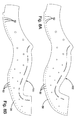
- the upper 12 preferably includes inner quarter 100 (See Fig. 8B), outer quarter 102 (See Fig. 8A), eyestay 104 (See Fig. 8C), backstay 106 (See Fig. 8D) and tongue 108 (See Fig. 8E).
- the upper 12 includes a marginal allowance 36 extending around its periphery for securing the upper 12 to the bottom 14 as described in more detail below.
- the margin 36 varies in width between the forefoot 30, arch 32 and heel 34 regions to provide sufficient material for stitching the upper 12 to the bottom 14. As shown, the margin 36 in the forefoot and heel regions is wide enough to accommodate an outwardly turned moc stitch.
- the margin 36 in the arch region is significantly narrower, providing just enough material for an inwardly turned butt stitch.
- the bottom 14 preferably includes inner piece 112 (See Fig. 9A) and outer piece 114 (See Fig. 9B).
- the two pieces 112 and 114 extend longitudinally along inner and outer sides of the shoe 10 and are joined together along a longitudinal seam extending substantially along the center of the bottom 14.
- the bottom 14 includes a marginal portion 38 extending around its periphery for securing the bottom 14 to the upper 12.
- the bottom margin 38 like the upper margin 36, varies in width between the forefoot, arch and heel regions.
- the margin 38 in the forefoot and heel regions is wide enough to accommodate an outwardly turned moc stitch while the margin 38 in the arch region is narrower, providing just enough material for an inwardly turned butt stitch.
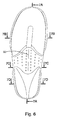
- An insole 20 is cemented within the upper 12 to the top surface of the bottom 14.
- the insole 20 preferably extends only three-quarters of the length of the shoe 10 terminating in the forefoot region 30 in approximate alignment with the ball of the foot.
- the thickness of the insole 20 preferably tapers-off toward its forward edge.
- the insole 20 is preferably shaped to match the contour of the undersurface of a foot, providing a substantially rigid platform to support the arch and heel regions of the foot. Although the rigidity of the insole 20 can vary from application to application, the preferred insole 20 is sufficiently rigid to prevent flexing of the shoe 10 in the heel and arch regions under normal loads. As a result, the insole 20 eliminates the need for a conventional shank.
- the insole 20 is preferably manufactured from conventional materials, such as nylon or other polymeric materials.
- a footbed 22 is removably fitted within the upper 12 atop the insole 20.
- the footbed 22 preferably extends the full length of the shoe 10 and is of a dual-density construction having upper 40 and lower 42 layers.
- the upper layer 40 is preferably manufactured from a cushioning material having a relatively low density. As a result, the upper layer 40 provides resiliency and cushioning under relatively small load, such as during sitting, standing or gentle movements.
- the lower layer 42 is preferably manufactured from a relatively high density material, providing resiliency and cushioning under heavier loads, such as during walking, running or jumping.
- a conventional sock liner (not shown) preferably covers the upper surface of the footbed 22.
- the outsole 16 includes a forefoot portion 24 and a heel portion 26.
- the two outsole portions, 24 and 26, are spaced apart from one another in the arch region. This makes the bottom 14 visible in the arch region providing a desirable aesthetic appeal.
- Figs. 7A-7D are cross-sectional views showing the construction at various locations along the shoe 10.
- the forefoot portion 24 preferably extends through the forefoot region 30 of the shoe 10, providing a wear surface that engages the ground beneath the forefoot of the wearer's foot.
- the bottom surface of the forefoot portion 24 is preferably textured to provide improved traction.
- the forefoot portion 24 can include tread, lugs or other traction improving elements.
- the upper surface of the forefoot portion 24 is preferably shaped to correspond with the desired shape of the insole 20 and footbed 22.
- the heel portion 26 preferably extends through the heel region 34 of the shoe 10, providing a wear surface that engages the ground beneath the heel of the wearer's foot.
- the bottom surface of the heel portion 26 is preferably textured to provide improved traction.
- the heel portion 26 can include treads, lugs or other traction improving elements, as desired.
- the upper surface of the heel portion 26 is preferably shaped to correspond with the desired shape of the insole 20 and footbed 22.
- the forefoot portion 24 and heel portion 26 are preferably molded separately and secured to the bottom 14 by cement or other conventional adhesives. Alternatively, the forefoot portion 24 and heel portion 26 can be molded in place on the bottom using conventional direct attach molding techniques and apparatus.
- the shoe 10 is manufactured using conventional manufacturing equipment.
- the various pieces of the upper 12 are cut from the desired material, such as leather, using conventional techniques and apparatus.
- the upper 12 is preferably assembled from inner quarter 100, outer quarter 102, eyestay 104, backstay 106 and tongue 108 as shown in Figs. 8A-E.
- the upper pieces are stitched together in a conventional manner to form the upper 12.
- the inner quarter 100 is stitched to the outer quarter 102 in the toe region at seam 124 and in the heel region at a second seam (not shown). This second seam (not shown) is covered by backstay 106.
- the upper pieces are cut to define a margin 36 that functions as a stitching allowance extending around the periphery of the assembled upper 12.
- This margin 36 is cooperatively defined by the inner quarter 100, outer quarter 102 and backstay 106.
- the upper pieces are configured such that the margin 36 follows a substantially horizontal line (and more preferably a line that substantially follows the bottom line of a foot) when the upper 12 and bottom 14 are stitched together.
- Holes 62 may be preformed in the margin 36 in the inner quarter 100, outer quarter 102 and backstay 106 to facilitate the moc stitch 52 in those regions.
- the bottom pieces namely inner piece 112 and outer piece 114, are also cut from the desired material using conventional techniques and apparatus (See Figs. 9A-B). The bottom pieces are preferably cut from the same material as the upper pieces to provide the desired "wrap-around" appearance.
- the bottom pieces are cut to define a horizontal seam and to provide sufficient material to form margin 38.
- the bottom pieces are stitched together in a conventional manner to form the bottom 14.
- the seam 50 between the bottom pieces preferably extends longitudinally along the bottom center of the shoe 10.
- Holes 64 may be preformed in the margin 38 in the inner bottom piece 112 and the outer bottom piece 114 to facilitate the moc stitch in those regions.
- the upper 12 and bottom 14 are preferably lined and reinforced with a conventional lining material (not shown), a conventional toe box (not shown) and other conventional reinforcing pieces (not shown) as desired.
- the insole 20 is manufactured from a substantially rigid material, preferably from nylon or other polymeric material. As such, the insole 20 is preferably injection molded or die cast from a molten material, or vacuum formed from a sheet stock. The insole 20 may be manufactured using other conventional techniques and apparatus corresponding to the selected insole material. The manufacture insole 20 is adhered to the upper surface of the bottom 14 using conventional cements or other adhesives.
- the seam extends in a generally horizontal direction, and more preferably along a generally horizontally extending curve that runs parallel to the bottom line of the foot.
- the terms “generally horizontal” and “substantially horizontal” are intended to be sufficiently broad to encompass a line extending substantially parallel to the bottom line of a foot.
- the seam curves slightly upwardly as its extends from the back of the shoe toward the arch region. In the arch region, the seam in more dramatically curved, substantially following the curve of an arch of a foot. It should be noted that the seam preferably follows a higher arch on the medial side of the shoe than on the lateral side, much like the arch of a foot.
- the seam returns to a slight curve in the heel region.
- the curved seam facilitates shaping of the upper to match the shape of the foot.
- the upper 12 and bottom 14 are joined in the forefoot 30 and heel 34 regions by an outwardly turned moc stitch 52 (or cable stitch) that extends along margins 36 and 38.
- the moc stitch 52 may be hand or machine sewn as desired, preferably using a conventional moc-stitch thread.
- a layer of cement is applied between the two margins 36 and 38. The cement reduces the likelihood of separation, or delamination, of the two margins 36 and 38 in the outwardly turned region.
- the upper 12 and bottom 14 are joined in the arch region 32 using a conventional inwardly turned butt stitch 54.
- the butt stitch 54 may be machine or hand sewn as desired.
- the upper 12 and bottom 14 assembly are then fitted over a conventional punch last (not shown).
- a conventional punch last helps to set the shape the shoe 10.
- the upper 12 and bottom 14 assembly is preferably heat set to hold its shape.
- the footbed 22 is a generally conventional dual-density footbed, having coextensive upper 56 and lower 58 layers of differing densities.
- the footbed 22 is manufactured using conventional techniques and apparatus, preferably from EVA, foamed polyurethane or other similar cushioning materials.
- a lining material (not shown) may cover the top surface of the footbed 22.
- the footbed 22 is preferably removably inserted into the shoe 10, but can be "permanently" secured if desired.
Landscapes
- Footwear And Its Accessory, Manufacturing Method And Apparatuses (AREA)
Applications Claiming Priority (2)
| Application Number | Priority Date | Filing Date | Title |
|---|---|---|---|
| US4022 | 1993-01-15 | ||
| US10/004,022 US6662469B2 (en) | 2001-10-31 | 2001-10-31 | Footwear construction and method for manufacturing same |
Publications (2)
| Publication Number | Publication Date |
|---|---|
| EP1308103A2 true EP1308103A2 (de) | 2003-05-07 |
| EP1308103A3 EP1308103A3 (de) | 2003-08-20 |
Family
ID=21708744
Family Applications (1)
| Application Number | Title | Priority Date | Filing Date |
|---|---|---|---|
| EP02257493A Withdrawn EP1308103A3 (de) | 2001-10-31 | 2002-10-29 | Aufbau eines Schuhes und Verfahren zur dessen Herstellung |
Country Status (6)
| Country | Link |
|---|---|
| US (1) | US6662469B2 (de) |
| EP (1) | EP1308103A3 (de) |
| JP (1) | JP2003135107A (de) |
| CA (1) | CA2387640A1 (de) |
| HK (2) | HK1044669A2 (de) |
| TW (1) | TWI224497B (de) |
Cited By (7)
| Publication number | Priority date | Publication date | Assignee | Title |
|---|---|---|---|---|
| WO2005120270A3 (en) * | 2004-06-04 | 2006-05-26 | Nike Inc | Footwear products, methods for making footwear products, and structures used in making footwear products |
| WO2007002440A3 (en) * | 2005-06-27 | 2007-02-08 | Psb Shoe Group Llc | Suspended orthotic shoe and methods of making same |
| US7634831B2 (en) | 2004-06-04 | 2009-12-22 | Nike, Inc. | Footwear products, methods for making footwear products, and structures used in making footwear products |
| AU2007204428B2 (en) * | 2006-01-09 | 2011-09-15 | Puma SE | Shoe, in particular sports shoe |
| DE102012004535A1 (de) * | 2012-03-06 | 2013-09-12 | Rainer Klatt | Zwei- Drittel-Sohle |
| CN105658105A (zh) * | 2013-09-12 | 2016-06-08 | 耐克创新有限合伙公司 | 带有具有带支撑臂的构件的鞋面的鞋类物品 |
| WO2020231259A1 (en) * | 2019-05-15 | 2020-11-19 | Anbo Amersfoort B.V. | Shoe sole assembly, shoe, and method of manufacturing a shoe |
Families Citing this family (44)
| Publication number | Priority date | Publication date | Assignee | Title |
|---|---|---|---|---|
| DE10036100C1 (de) | 2000-07-25 | 2002-02-14 | Adidas Int Bv | Schuh |
| US6931763B2 (en) * | 2002-08-05 | 2005-08-23 | R.G. Barry Corporation | Slipper insole, slipper, and method for manufacturing a slipper |
| US6990754B2 (en) | 2002-08-05 | 2006-01-31 | R. G. Barry Corporation | Slipper insole, slipper, and method for manufacturing a slipper |
| DE10255094B4 (de) | 2002-11-26 | 2017-03-09 | Adidas International Marketing B.V. | Schuh |
| KR20040054853A (ko) * | 2002-12-18 | 2004-06-26 | 한비산업 주식회사 | 신발제조방법 및 이를 이용하여 제조된 신발 |
| AU2004231386B2 (en) * | 2003-04-24 | 2007-02-08 | Asics Corporation | Sports shoes having upper part with improved fitting property |
| CA2436368A1 (en) * | 2003-08-01 | 2005-02-01 | Lorne Canvin | Footwear and insole therefor |
| US8112909B2 (en) * | 2003-10-17 | 2012-02-14 | Asics Corporation | Sole with reinforcement structure |
| JP2005152311A (ja) * | 2003-11-26 | 2005-06-16 | Asics Corp | セパレートされた外底を持つ靴 |
| KR100627143B1 (ko) * | 2004-12-31 | 2006-09-25 | 박장원 | 입체형 신발 갑피용 가교발포 성형체 및 그 제조방법 |
| KR100618385B1 (ko) * | 2005-02-07 | 2006-08-30 | 박장원 | 입체형 신발 갑피용 가교발포 성형체의 제조방법 |
| KR100618383B1 (ko) * | 2005-02-07 | 2006-08-30 | 박장원 | 입체형 신발 갑피용 가교발포 성형체의 제조방법 |
| KR100618384B1 (ko) * | 2005-02-07 | 2006-08-30 | 박장원 | 입체형 신발 갑피용 가교발포 성형체의 제조방법 |
| US20070033835A1 (en) * | 2005-08-02 | 2007-02-15 | Bray Walter T Jr | Insole arrangement; footwear with insole arrangement; and, method of preparation |
| US7937854B2 (en) * | 2005-11-08 | 2011-05-10 | Nike, Inc. | Article of footwear having force attenuation membrane |
| WO2007141797A2 (en) * | 2006-06-09 | 2007-12-13 | Kevan Orvitz | An orthopedic foot appliance |
| US8205358B2 (en) * | 2006-12-22 | 2012-06-26 | Pediped Infant Footwear, LLC | Footwear and method of making thereof |
| US20090044425A1 (en) * | 2007-08-13 | 2009-02-19 | Bethke Jr James Charles | Footwear and Related Methods of Manufacturing Same |
| US8316558B2 (en) * | 2008-12-16 | 2012-11-27 | Skechers U.S.A., Inc. Ii | Shoe |
| US7877897B2 (en) * | 2008-12-16 | 2011-02-01 | Skechers U.S.A., Inc. Ii | Shoe |
| US8171655B2 (en) * | 2009-03-18 | 2012-05-08 | Wolverine World Wide, Inc. | Sole construction and related method of manufacture |
| US8393092B2 (en) * | 2009-04-24 | 2013-03-12 | Nine West Development Corporation | Footbed system and footwear construction |
| US20100307032A1 (en) * | 2009-06-05 | 2010-12-09 | Red Wing Shoe Company, Inc. | Footwear with shaped sole surface |
| AU2011232308B2 (en) * | 2010-03-24 | 2015-10-01 | Muse Dancewear Pty Ltd | Dance shoes with improved heel and arch sections |
| DE102012206062B4 (de) | 2012-04-13 | 2019-09-12 | Adidas Ag | Schuhoberteil |
| KR101426154B1 (ko) * | 2012-11-07 | 2014-08-01 | 성호동 | 신발 |
| US12250994B2 (en) | 2013-04-19 | 2025-03-18 | Adidas Ag | Shoe |
| DE102013207155B4 (de) | 2013-04-19 | 2020-04-23 | Adidas Ag | Schuhoberteil |
| DE102013207156B4 (de) | 2013-04-19 | 2025-12-24 | Adidas Ag | Schuh, insbesondere ein Sportschuh |
| US11666113B2 (en) | 2013-04-19 | 2023-06-06 | Adidas Ag | Shoe with knitted outer sole |
| DE102013207163B4 (de) | 2013-04-19 | 2022-09-22 | Adidas Ag | Schuhoberteil |
| US9241534B2 (en) * | 2013-07-16 | 2016-01-26 | Cole Haan Llc | Shoe having a split welt |
| US20150020412A1 (en) * | 2013-07-22 | 2015-01-22 | Crocs, Inc. | Articles of footwear including unitary footbed-sole components and stitching and methods of manufacturing the same |
| DE102014202432B4 (de) | 2014-02-11 | 2017-07-27 | Adidas Ag | Verbesserter Fußballschuh |
| DE102014220087B4 (de) | 2014-10-02 | 2016-05-12 | Adidas Ag | Flachgestricktes Schuhoberteil für Sportschuhe |
| JP6742687B2 (ja) * | 2014-12-17 | 2020-08-19 | アキレス株式会社 | 通気性靴 |
| JP7430530B2 (ja) | 2017-03-16 | 2024-02-13 | ナイキ イノベイト シーブイ | 履物の物品のための緩衝部材 |
| US11103029B2 (en) * | 2018-12-03 | 2021-08-31 | Cole Haan Llc | Tongueless upper with lacing system |
| CN115844103B (zh) * | 2018-12-28 | 2026-03-24 | 耐克创新有限合伙公司 | 具有活动相接鞋底结构的易于进入的鞋 |
| WO2020219292A1 (en) * | 2019-04-26 | 2020-10-29 | Nike Innovate C.V. | Methods of forming an article of footwear with a multipart strobel structure and articles formed by the same |
| WO2021016189A1 (en) * | 2019-07-25 | 2021-01-28 | Nike Innovate C.V. | Article of footwear |
| US11622602B2 (en) * | 2020-08-18 | 2023-04-11 | Puma SE | Article of footwear having a sole plate |
| USD969469S1 (en) | 2020-12-22 | 2022-11-15 | Puma SE | Shoe |
| USD1011718S1 (en) | 2020-12-22 | 2024-01-23 | Puma SE | Shoe |
Family Cites Families (10)
| Publication number | Priority date | Publication date | Assignee | Title |
|---|---|---|---|---|
| US1643851A (en) * | 1925-11-12 | 1927-09-27 | P Goldsmith Sons Company | Shoe |
| US1871763A (en) * | 1930-09-24 | 1932-08-16 | Abbott Company | Moccasin |
| US1972339A (en) * | 1932-06-23 | 1934-09-04 | Cary Patentverwertungs Ag | Shoe |
| US4519148A (en) | 1983-07-18 | 1985-05-28 | Sisco Jann L | Exercise shoe |
| IT226402Z2 (it) * | 1992-03-27 | 1997-06-16 | Zagato Ovest Di Maura E Andrea | Calzatura con suola suddivisa |
| DE4244147A1 (de) * | 1992-06-06 | 1994-06-30 | Ehrhart Hans | Schuh, insbesondere Mokassinschuh |
| KR0150433B1 (ko) * | 1994-03-18 | 1998-10-15 | 발레 메이커즈, 인코포레이티드 | 분리형 구두창 및 중간부분 보강부로 이루어진 신발 |
| US5682685A (en) * | 1995-10-12 | 1997-11-04 | Ballet Makers Inc. | Dance shoe sole |
| EP0890321B1 (de) * | 1997-07-09 | 2003-09-10 | adidas International B.V. | Sportschuh mit äusserem Rahmen |
| IT1311590B1 (it) * | 1999-11-23 | 2002-03-13 | Testoni A Spa | Metodo per la realizzazione di una calzatura e calzatura da essoottenibile. |
-
2001
- 2001-10-31 US US10/004,022 patent/US6662469B2/en not_active Expired - Fee Related
-
2002
- 2002-05-24 CA CA002387640A patent/CA2387640A1/en not_active Abandoned
- 2002-07-10 JP JP2002201453A patent/JP2003135107A/ja active Pending
- 2002-07-16 TW TW091115773A patent/TWI224497B/zh not_active IP Right Cessation
- 2002-07-18 HK HK02105315A patent/HK1044669A2/xx not_active IP Right Cessation
- 2002-10-29 EP EP02257493A patent/EP1308103A3/de not_active Withdrawn
-
2003
- 2003-09-22 HK HK03106794.2A patent/HK1056102A1/en unknown
Cited By (19)
| Publication number | Priority date | Publication date | Assignee | Title |
|---|---|---|---|---|
| EP2769635A1 (de) * | 2004-06-04 | 2014-08-27 | Nike International Ltd. | Bei Herstellung von Schuhwerkprodukten verwendete Strukturen |
| US7634831B2 (en) | 2004-06-04 | 2009-12-22 | Nike, Inc. | Footwear products, methods for making footwear products, and structures used in making footwear products |
| CN100584234C (zh) * | 2004-06-04 | 2010-01-27 | 耐克国际有限公司 | 鞋产品、制造鞋产品的方法及用于制造鞋产品的结构 |
| EP2409590A1 (de) | 2004-06-04 | 2012-01-25 | Nike International, Ltd. | Schuhwerkprodukte, Verfahren zur Herstellung von Schuhwerkprodukten und bei der Herstellung von Schuhwerkprodukten verwendete Strukturen |
| WO2005120270A3 (en) * | 2004-06-04 | 2006-05-26 | Nike Inc | Footwear products, methods for making footwear products, and structures used in making footwear products |
| US8590175B2 (en) | 2004-06-04 | 2013-11-26 | Nike, Inc. | Footwear products, methods for making footwear products, and structures used in making footwear products |
| WO2007002440A3 (en) * | 2005-06-27 | 2007-02-08 | Psb Shoe Group Llc | Suspended orthotic shoe and methods of making same |
| US7694437B2 (en) | 2005-06-27 | 2010-04-13 | Psb Shoe Group, Llc | Suspended orthotic shoe and methods of making same |
| AU2007204428B2 (en) * | 2006-01-09 | 2011-09-15 | Puma SE | Shoe, in particular sports shoe |
| US8240067B2 (en) | 2006-01-09 | 2012-08-14 | Puma Aktiengesellschaft Rudolf Dassler Sport | Shoe, in particular sports shoe |
| DE102012004535A1 (de) * | 2012-03-06 | 2013-09-12 | Rainer Klatt | Zwei- Drittel-Sohle |
| CN105658105A (zh) * | 2013-09-12 | 2016-06-08 | 耐克创新有限合伙公司 | 带有具有带支撑臂的构件的鞋面的鞋类物品 |
| US9713362B2 (en) | 2013-09-12 | 2017-07-25 | Nike, Inc. | Article of footwear with upper having member with support arm |
| CN105658105B (zh) * | 2013-09-12 | 2017-09-05 | 耐克创新有限合伙公司 | 带有具有带支撑臂的构件的鞋面的鞋类物品 |
| US10932526B2 (en) | 2013-09-12 | 2021-03-02 | Nike, Inc. | Article of footwear with upper having member with support arm |
| US11647812B2 (en) | 2013-09-12 | 2023-05-16 | Nike, Inc. | Article of footwear with upper having member with support arm |
| WO2020231259A1 (en) * | 2019-05-15 | 2020-11-19 | Anbo Amersfoort B.V. | Shoe sole assembly, shoe, and method of manufacturing a shoe |
| NL2023135B1 (en) * | 2019-05-15 | 2020-12-01 | Anbo Amersfoort B V | Shoe sole assembly, shoe, and method of manufacturing a shoe |
| US12075879B2 (en) | 2019-05-15 | 2024-09-03 | Anbo Amersfoort B.V. | Shoe sole assembly, shoe, and method of manufacturing a shoe |
Also Published As
| Publication number | Publication date |
|---|---|
| EP1308103A3 (de) | 2003-08-20 |
| CA2387640A1 (en) | 2003-04-30 |
| TWI224497B (en) | 2004-12-01 |
| US20030079374A1 (en) | 2003-05-01 |
| HK1056102A1 (en) | 2004-02-06 |
| JP2003135107A (ja) | 2003-05-13 |
| US6662469B2 (en) | 2003-12-16 |
| HK1044669A2 (en) | 2002-10-18 |
Similar Documents
| Publication | Publication Date | Title |
|---|---|---|
| US6662469B2 (en) | Footwear construction and method for manufacturing same | |
| JP3030028U (ja) | スノーボード用ブーツ | |
| EP1502517B1 (de) | Schuhwerk mit Rahmen und entsprechendes Herstellungsverfahren | |
| CN101836778B (zh) | 鞋底的结构和相关的制造方法 | |
| US20180103727A1 (en) | Footwear construction with heel support assembly | |
| US6226894B1 (en) | Slipper and method for manufacturing slipper | |
| CA2923715C (en) | Sole assembly for article of footwear | |
| US8834770B2 (en) | Sole component for an article of footwear and method for making same | |
| US6802138B2 (en) | Cushioning system for footwear and related method of manufacture | |
| US7168187B2 (en) | Footwear construction and related method of manufacture | |
| CA2713114C (en) | Cushioned shoe construction | |
| US6574886B1 (en) | Footwear and its method of construction | |
| US10786044B2 (en) | Footwear with protective toe guard and related method | |
| US20020088145A1 (en) | Shoe construction | |
| US11439199B2 (en) | Footwear sole assembly | |
| JP2003339402A (ja) | 靴 | |
| US6018891A (en) | Shoe construction | |
| JP2002506664A (ja) | サンダル | |
| US7111414B2 (en) | Footwear construction and method of manufacture | |
| EP0076236B1 (de) | Schuhartikel | |
| HK1075585B (en) | Articulated welt footwear construction and related method of manufacture | |
| HK1086457A (en) | Footwear construction and related method of manufacture |
Legal Events
| Date | Code | Title | Description |
|---|---|---|---|
| PUAI | Public reference made under article 153(3) epc to a published international application that has entered the european phase |
Free format text: ORIGINAL CODE: 0009012 |
|
| AK | Designated contracting states |
Designated state(s): AT BE BG CH CY CZ DE DK EE ES FI FR GB GR IE IT LI LU MC NL PT SE SK TR |
|
| AX | Request for extension of the european patent |
Extension state: AL LT LV MK RO SI |
|
| PUAL | Search report despatched |
Free format text: ORIGINAL CODE: 0009013 |
|
| AK | Designated contracting states |
Designated state(s): AT BE BG CH CY CZ DE DK EE ES FI FR GB GR IE IT LI LU MC NL PT SE SK TR |
|
| AX | Request for extension of the european patent |
Extension state: AL LT LV MK RO SI |
|
| 17P | Request for examination filed |
Effective date: 20031014 |
|
| AKX | Designation fees paid |
Designated state(s): AT BE BG CH CY CZ DE DK EE ES FI FR GB GR IE IT LI LU MC NL PT SE SK TR |
|
| AXX | Extension fees paid |
Extension state: SI Payment date: 20031014 Extension state: RO Payment date: 20031014 Extension state: MK Payment date: 20031014 Extension state: LV Payment date: 20031014 Extension state: LT Payment date: 20031014 Extension state: AL Payment date: 20031014 |
|
| STAA | Information on the status of an ep patent application or granted ep patent |
Free format text: STATUS: THE APPLICATION IS DEEMED TO BE WITHDRAWN |
|
| 18D | Application deemed to be withdrawn |
Effective date: 20050503 |
|
| REG | Reference to a national code |
Ref country code: HK Ref legal event code: WD Ref document number: 1056102 Country of ref document: HK |