EP1308532A2 - Ferritisches rostfreies Stahlblech mit hervorragender Tiefziehbarkeit zur Nachbehandlung und Herstellungsverfahren - Google Patents
Ferritisches rostfreies Stahlblech mit hervorragender Tiefziehbarkeit zur Nachbehandlung und Herstellungsverfahren Download PDFInfo
- Publication number
- EP1308532A2 EP1308532A2 EP02024457A EP02024457A EP1308532A2 EP 1308532 A2 EP1308532 A2 EP 1308532A2 EP 02024457 A EP02024457 A EP 02024457A EP 02024457 A EP02024457 A EP 02024457A EP 1308532 A2 EP1308532 A2 EP 1308532A2
- Authority
- EP
- European Patent Office
- Prior art keywords
- percent
- mass
- less
- steel sheet
- rolling
- Prior art date
- Legal status (The legal status is an assumption and is not a legal conclusion. Google has not performed a legal analysis and makes no representation as to the accuracy of the status listed.)
- Granted
Links
Images
Classifications
-
- C—CHEMISTRY; METALLURGY
- C22—METALLURGY; FERROUS OR NON-FERROUS ALLOYS; TREATMENT OF ALLOYS OR NON-FERROUS METALS
- C22C—ALLOYS
- C22C38/00—Ferrous alloys, e.g. steel alloys
- C22C38/18—Ferrous alloys, e.g. steel alloys containing chromium
-
- C—CHEMISTRY; METALLURGY
- C22—METALLURGY; FERROUS OR NON-FERROUS ALLOYS; TREATMENT OF ALLOYS OR NON-FERROUS METALS
- C22C—ALLOYS
- C22C38/00—Ferrous alloys, e.g. steel alloys
- C22C38/18—Ferrous alloys, e.g. steel alloys containing chromium
- C22C38/26—Ferrous alloys, e.g. steel alloys containing chromium with niobium or tantalum
-
- C—CHEMISTRY; METALLURGY
- C21—METALLURGY OF IRON
- C21D—MODIFYING THE PHYSICAL STRUCTURE OF FERROUS METALS; GENERAL DEVICES FOR HEAT TREATMENT OF FERROUS OR NON-FERROUS METALS OR ALLOYS; MAKING METAL MALLEABLE, e.g. BY DECARBURISATION OR TEMPERING
- C21D8/00—Modifying the physical properties of ferrous metals or ferrous alloys by deformation combined with, or followed by, heat treatment
- C21D8/02—Modifying the physical properties of ferrous metals or ferrous alloys by deformation combined with, or followed by, heat treatment during manufacturing of plates or strips
- C21D8/04—Modifying the physical properties of ferrous metals or ferrous alloys by deformation combined with, or followed by, heat treatment during manufacturing of plates or strips to produce plates or strips for drawing, e.g. for deep-drawing
-
- C—CHEMISTRY; METALLURGY
- C22—METALLURGY; FERROUS OR NON-FERROUS ALLOYS; TREATMENT OF ALLOYS OR NON-FERROUS METALS
- C22C—ALLOYS
- C22C38/00—Ferrous alloys, e.g. steel alloys
- C22C38/002—Ferrous alloys, e.g. steel alloys containing In, Mg, or other elements not provided for in one single group C22C38/001 - C22C38/60
-
- C—CHEMISTRY; METALLURGY
- C22—METALLURGY; FERROUS OR NON-FERROUS ALLOYS; TREATMENT OF ALLOYS OR NON-FERROUS METALS
- C22C—ALLOYS
- C22C38/00—Ferrous alloys, e.g. steel alloys
- C22C38/004—Very low carbon steels, i.e. having a carbon content of less than 0,01%
-
- C—CHEMISTRY; METALLURGY
- C22—METALLURGY; FERROUS OR NON-FERROUS ALLOYS; TREATMENT OF ALLOYS OR NON-FERROUS METALS
- C22C—ALLOYS
- C22C38/00—Ferrous alloys, e.g. steel alloys
- C22C38/18—Ferrous alloys, e.g. steel alloys containing chromium
- C22C38/24—Ferrous alloys, e.g. steel alloys containing chromium with vanadium
-
- C—CHEMISTRY; METALLURGY
- C22—METALLURGY; FERROUS OR NON-FERROUS ALLOYS; TREATMENT OF ALLOYS OR NON-FERROUS METALS
- C22C—ALLOYS
- C22C38/00—Ferrous alloys, e.g. steel alloys
- C22C38/18—Ferrous alloys, e.g. steel alloys containing chromium
- C22C38/28—Ferrous alloys, e.g. steel alloys containing chromium with titanium or zirconium
-
- C—CHEMISTRY; METALLURGY
- C22—METALLURGY; FERROUS OR NON-FERROUS ALLOYS; TREATMENT OF ALLOYS OR NON-FERROUS METALS
- C22C—ALLOYS
- C22C38/00—Ferrous alloys, e.g. steel alloys
- C22C38/18—Ferrous alloys, e.g. steel alloys containing chromium
- C22C38/32—Ferrous alloys, e.g. steel alloys containing chromium with boron
-
- C—CHEMISTRY; METALLURGY
- C21—METALLURGY OF IRON
- C21D—MODIFYING THE PHYSICAL STRUCTURE OF FERROUS METALS; GENERAL DEVICES FOR HEAT TREATMENT OF FERROUS OR NON-FERROUS METALS OR ALLOYS; MAKING METAL MALLEABLE, e.g. BY DECARBURISATION OR TEMPERING
- C21D8/00—Modifying the physical properties of ferrous metals or ferrous alloys by deformation combined with, or followed by, heat treatment
- C21D8/02—Modifying the physical properties of ferrous metals or ferrous alloys by deformation combined with, or followed by, heat treatment during manufacturing of plates or strips
- C21D8/04—Modifying the physical properties of ferrous metals or ferrous alloys by deformation combined with, or followed by, heat treatment during manufacturing of plates or strips to produce plates or strips for drawing, e.g. for deep-drawing
- C21D8/0447—Modifying the physical properties of ferrous metals or ferrous alloys by deformation combined with, or followed by, heat treatment during manufacturing of plates or strips to produce plates or strips for drawing, e.g. for deep-drawing characterised by the heat treatment
- C21D8/0463—Modifying the physical properties of ferrous metals or ferrous alloys by deformation combined with, or followed by, heat treatment during manufacturing of plates or strips to produce plates or strips for drawing, e.g. for deep-drawing characterised by the heat treatment following hot rolling
-
- C—CHEMISTRY; METALLURGY
- C21—METALLURGY OF IRON
- C21D—MODIFYING THE PHYSICAL STRUCTURE OF FERROUS METALS; GENERAL DEVICES FOR HEAT TREATMENT OF FERROUS OR NON-FERROUS METALS OR ALLOYS; MAKING METAL MALLEABLE, e.g. BY DECARBURISATION OR TEMPERING
- C21D8/00—Modifying the physical properties of ferrous metals or ferrous alloys by deformation combined with, or followed by, heat treatment
- C21D8/02—Modifying the physical properties of ferrous metals or ferrous alloys by deformation combined with, or followed by, heat treatment during manufacturing of plates or strips
- C21D8/04—Modifying the physical properties of ferrous metals or ferrous alloys by deformation combined with, or followed by, heat treatment during manufacturing of plates or strips to produce plates or strips for drawing, e.g. for deep-drawing
- C21D8/0447—Modifying the physical properties of ferrous metals or ferrous alloys by deformation combined with, or followed by, heat treatment during manufacturing of plates or strips to produce plates or strips for drawing, e.g. for deep-drawing characterised by the heat treatment
- C21D8/0473—Final recrystallisation annealing
Definitions
- This invention relates to a cold-rolled ferritic stainless steel sheet having excellent deep-drawability, brittle resistance to secondary processing, compatibility with overcoating, and corrosion resistance suitable for use in outer panels and strengthening members of automobiles and the like.
- the invention also relates to a method for making the cold-rolled ferritic stainless steel sheet.
- outer panels and strengthening members of automobiles are made by press-forming high tensile strength steel sheets of a 440 MPa class.
- Such steel sheets are generally subjected to surface treatment, such as plating, before working or to coating treatment after working to improve the corrosion resistance.
- surface treatment such as plating
- coating treatment after working to improve the corrosion resistance.
- plated steel sheets are worked, they suffer from peeling of plated material.
- Such peeling causes rust to occur, which is a problem.
- Coating treatment after working cannot completely cover the minute details of complicated shapes. Rust occurs in the uncoated minute portions, which is a problem.
- Stainless steel sheets having high corrosion resistance are preferably used to prevent generation of rust resulting from insufficient plating or coating or the like.
- Austenitic stainless steel sheets such as SUS 304, which contain a large amount of expensive nickel as a component, are themselves expensive. Hence, the cost is high compared with conventional coated steel sheets. In contrast, although ferritic stainless steel sheets are relatively inexpensive, they have low workability, e.g., low press-formability, and improvements as to this point are required.
- 9-241738 discloses a technology whereby after carbon and nitrogen in the steel are decreased to 100 ppm or less, the remaining carbon and nitrogen are fixed as deposits by a carbide/nitride forming element such as Ti or Nb, and boron (B) is added to the steel to make ferritic stainless steel sheets having highly balanced ductility and r-value.
- a carbide/nitride forming element such as Ti or Nb
- boron (B) is added to the steel to make ferritic stainless steel sheets having highly balanced ductility and r-value.
- stainless steel sheets must have a higher deep-drawability to be press-formed into complicated shapes such as those required by outer panels or strengthening members of automobiles.
- the r-value of the conventional ferritic stainless steels has been 1.8 at most.
- the average r-value should be increased to 2.0 or more to be effective.
- Workability such as deep-drawability, can be improved by reducing solid-solution carbon and nitrogen and by adding boron, as described above.
- stainless steel is formed into fuel tanks or the like.
- the resulting stainless steel products to which high strain is applied during a drawing process suffer from brittle fracture when an external force is applied thereto such as by flying stones or collision, for example. This is called brittleness to secondary processing.
- the brittle resistance to secondary processing indicates the brittle resistance to an external force applied to a deep-drawn product. This property is of a particular importance in cold climates such as northern North America, e.g., Alaska.
- the deep-drawability, and more specifically the r-value, of ferritic stainless steel sheets has been improved by increasing the annealing temperature of the cold-rolled sheets to promote the development of the ⁇ 111 ⁇ recrystallization structure effective for increasing the r-value and to thereby increase the ductility and the r-value, as described above.
- high-temperature annealing increases the size of crystal grains of cold-rolled annealed sheets, thereby roughening the surface after working and decreasing the brittle resistance to secondary processing.
- Japanese Unexamined Patent Publication No. 9-241738, etc. disclose adding boron, as described above, no reference is made regarding the brittle resistance to secondary processing.
- the technology disclosed in Japanese Unexamined Patent Publication No. 9-241738 cannot achieve both high deep-drawability, i.e., the r-value of 2.0 or more, and high brittle resistance to secondary processing in cold climates, e.g., at an ambient temperature of -60°C.
- the components may suffer from a decrease in brittle resistance to secondary processing and in corrosion resistance due to salt, even though the ferritic stainless steels generally have superior corrosion resistance.
- the components may be provided with a light coating or the like to further enhance the brittle resistance and the corrosion resistance and to widen the applicable range of ferritic stainless steels.
- This invention provides a ferritic stainless steel sheet having superior deep-drawability and brittle resistance to secondary processing and a method for making the ferritic stainless steel sheet.
- a first aspect of the invention provides a ferritic stainless steel sheet including about 0.01 percent by mass or less of carbon; about 1.0 percent by mass or less of silicon; about 1.5 percent by mass or less of manganese; about 11 to about 23 percent by mass of chromium; about 0.06 percent by mass or less of phosphorous; about 0.03 percent by mass or less of sulfur; about 1.0 percent by mass or less of aluminum; about 0.04 percent by mass or less of nitrogen; about 0.0005 to about 0.01 percent by mass of boron; about 0.3 percent by mass or less of vanadium; about 0.8 percent by mass or less of niobium and/or about 1.0 percent by mass or less of titanium wherein 18 ⁇ Nb/(C + N) + 2(Ti/(C + N)) ⁇ 60; and the balance being iron and unavoidable impurities.
- the average crystal grain diameter is about 40 ⁇ m or less and the average surface roughness Ra is about 0.3 ⁇ m or less.
- the ferritic stainless steel sheet further includes about 0.0007 to about 0.0030 percent by mass of calcium and/or at least one of about 0.1 to about 1.0 percent by mass of copper; about 0.05 to about 0.2 percent by mass of cobalt; and about 0.1 to about 2.0 percent by mass of nickel, wherein 0.05 ⁇ (0.55 ⁇ Cu + 0.85 ⁇ Co + Ni) ⁇ 0.30.
- the ferritic stainless steel sheet may be provided with a resin coating film having a thickness of about 2.0 ⁇ m or more on a surface thereof.
- the resin coating film is preferably made of a urethane resin or an epoxy resin.
- a second aspect of the invention provides a method for making a ferritic stainless steel sheet, including the steps of hot-rolling a steel slab comprising about 0.01 percent by mass or less of carbon; about 1.0 percent by mass or less of silicon; about 1.5 percent by mass or less of manganese; about 11 to about 23 percent by mass of chromium; about 0.06 percent by mass or less of phosphorous; about 0.03 percent by mass or less of sulfur; about 1.0 percent by mass or less of aluminum; about 0.04 percent by mass or less of nitrogen; about 0.0005 to about 0.01 percent by mass of boron; about 0.3 percent by mass or less of vanadium; about 0.8 percent by mass or less of niobium and/or about 1.0 percent by mass or less of titanium wherein 18 ⁇ Nb/(C + N) + 2(Ti/(C + N)) ⁇ 60; and the balance being iron and unavoidable impurities to make a hot-rolled sheet; annealing the hot-rolled sheet to prepare an annealed sheet;
- the steel slab preferably further includes about 0.0007 to about 0.0030 percent by mass of calcium and/or at least one of about 0.1 to about 1.0 percent by mass of copper; about 0.05 to about 0.2 percent by mass of cobalt; and about 0.1 to about 2.0 percent by mass of nickel, wherein 0.05 ⁇ (0.55 ⁇ Cu + 0.85 ⁇ Co + Ni) ⁇ 0.30.
- the method further includes the step of skin-pass rolling the pickled steel sheet. More preferably, the method further includes the step of forming a resin coating film having a thickness of about 2.0 ⁇ m or more on a surface of the ferritic steel sheet.
- the resin coating film is preferably made of one of urethane resins and epoxy resins.
- Solid-solution carbon in steel decreases elongation and r-value.
- carbon is removed as much as possible during the steel making process.
- the solid-solution carbon is fixed as carbides by titanium (Ti) and niobium (Nb), as described below.
- Ti and Nb cannot sufficiently fix carbon and solid-solution carbon remains to decrease the r-value and the elongation.
- the carbon content is limited to about 0.01 percent by mass or less.
- the carbon content is preferably about 0.0020 percent by mass or less, and more preferably, about 0.0010 percent by mass or less to increase the r-value and elongation.
- Si about 1.0 percent by mass or less
- Silicon (Si) enhances oxidation resistance and corrosion resistance, particularly the corrosion resistance in air. Addition of about 0.02 percent by mass or more of silicon is necessary to obtain sufficient oxidation and corrosion resistance. However, silicon in an amount exceeding about 1.0 percent by mass decreases the toughness of the steel and the brittle resistance to secondary processing at welds. Thus, the silicon content is limited to about 1.0 percent by mass or less, and more preferably, in the range of about 0.1 to about 0.6 percent by mass.
- Mn about 1.5 percent by mass or less
- Manganese (Mn) forms manganese sulfide (MnS) and renders sulfur (S) harmless, which deteriorates the hot-workability of the steel.
- Manganese in an amount of less than about 0.05 percent by mass cannot sufficiently render sulfur harmless.
- the effect of manganese is saturated at an amount exceeding about 1.5 percent by mass.
- manganese in an amount exceeding about 1.5 percent by mass decreases elongation due to solid-solution hardening.
- the preferable amount of manganese is about 1.5 percent by mass or less, and more preferably about 0.25 percent by mass or less.
- Chromium (Cr) enhances oxidation resistance and corrosion resistance. To achieve sufficient oxidation resistance and corrosion resistance, about 11 percent by mass or more of chromium must be contained in the steel. In view of obtaining sufficient corrosion resistance of welds, the chromium content is preferably about 14 percent by mass or more. On the other hand, chromium decreases the workability of the steel. Deterioration in workability is significant when chromium is contained in an amount exceeding about 23 percent by mass. Thus, the chromium content is limited to the range of about 11 to about 23 percent by mass, and more preferably, about 14 to about 20 percent by mass.
- Phosphorous (P) tends to segregate in grain boundaries.
- phosphorous diminishes the grain-boundary-strengthening effect of boron and deteriorates the brittle resistance to secondary processing at the welds.
- phosphorous deteriorates the workability, the toughness, and the high-temperature fatigue characteristics of the steel.
- the content of phosphorous is thus preferably as low as possible, i.e., about 0.06 percent by mass or less, and more preferably, about 0.03 percent by mass or less.
- the cost of steel production increases if the phosphorous content is reduced excessively.
- S is an impurity that deteriorates formability and decreases the corrosion resistance of the steel sheet.
- the content of sulfur is preferably reduced as much as possible during the steel making process. However, as with phosphorous described above, excessive reduction causes an increase in the cost of steel production. Considering the balance between the cost and the properties, the sulfur content is about 0.03 percent by mass or less, and more preferably, about 0.01 percent by mass or less. At a content of about 0.01 percent by mass or less, sulfur can be fixed by Mn or Ti.
- Al about 1.0 percent by mass or less
- Aluminum (Al) must be contained in the steel in an amount of about 0.001 percent by mass or more as a deoxidizer during steel making. However, aluminum in an amount exceeding about 1.0 percent by mass decreases the elongation due to solid-solution hardening. Moreover, excess aluminum generates inclusions that deteriorates the cosmetic appearance and deteriorates the corrosion resistance. Thus, the aluminum content is limited to about 1.0 percent by mass or less, more preferably in the range of about 0.001 to about 0.6 percent by mass, and most preferably, in the range of about 0.01 to about 0.2 percent by mass.
- N about 0.04 percent by mass or less
- Nitrogen (N) is an impurity and titanium (Ti) forms titanum nitride(TiN) and renders nitrogen harmless.
- Nitrogen in an amount exceeding about 0.04 percent by mass requires a large amount of additive titanium and the ductility of the resulting steel sheet deteriorates due to the precipitation hardening of TiN.
- nitrogen improves the toughness and strengthens grain boundaries, excess nitrogen precipitates in the grain boundaries as nitrides and deteriorates the corrosion resistance.
- the nitrogen content is limited to about 0.04 percent by mass or less.
- the nitrogen content is preferably about 0.002 percent by mass or less to further improve formability.
- Boron (B) segregating in grain boundaries increases the grain boundary strength and enhances the brittle resistance to secondary processing. Moreover, boron forms boron nitride (BN) which prevents the precipitation of TiN which deteriorates the toughness of the resulting steel. Boron must be contained in an amount of 0.0005 percent by mass or more to sufficiently obtain these effects. Since excess boron deteriorates the hot-workability of the steel, the boron content is limited to about 0.01 percent by mass or less.
- V about 0.3 percent by mass or less
- Vanadium (V) is an important element in the invention. Vanadium stabilizes carbon and nitrogen, but in the invention, a portion of titanium is replaced with vanadium and vanadium is added in combination with boron to the steel to improve toughness. About0.004 percent by mass or more of vanadium is required to achieve the improvement in toughness. The upper limit is about 0.3 percent by mass since excess vanadium deteriorates workability due to hardening.
- Nb about 0.8 percent by mass or less
- Ti about 1.0 percent by mass or less
- Niobium and titanium may be used alone or in combination. Titanium forms precipitants with impurities such as carbon, nitride, sulfur, and phosphorous to render these contaminants harmless.
- Niobium joins with carbon, i.e., an impurity of steel, to form niobium carbide (NbC).
- Niobium carbide decreases the grain size of the hot-rolled sheet, increases the r-value, prevents the growth of the crystal grains during finish annealing, and improves the brittle resistance to secondary processing by achieving a fine structure.
- the concentration of solid solution carbon is critical to adequately produce niobium carbide. As described below, niobium can exert a stronger effect when suitably used in combination with titanium.
- niobium and titanium cannot sufficiently be obtained at an amount of less than about 0.01 percent by mass. They are preferably contained in the steel in an amount of about 0.01 percent by mass or more. Niobium in an amount exceeding about 0.8 percent by mass deteriorates the toughness. Titanium in an amount exceeding about 1.0 percent by mass decreases the toughness, and scratches on the cold rolled sheet caused by TiN become significant. Thus, the niobium content is about 0.8 percent by mass or less, and the titanium content is about 1.0 percent by mass or less.
- the alloy design must satisfy the relationship 18 ⁇ Nb/(C + N) + 2(Ti/(C + N)) ⁇ 60 to fix carbon and nitrogen in the steel as carbides and nitrides and obtain a higher workability.
- Each of the C content, N content, Nb content, and Ti content is limited as above because at Nb/(C + N) + 2(Ti/(C + N)) of less than 18, carbon and nitrogen in the steel cannot sufficiently be fixed as carbides and nitrides and the workability and the corrosion resistance are significantly deteriorated.
- the precipitants of carbides and nitrides increase to deteriorate workability at Nb/(C + N) + 2(Ti/(C + N)) exceeding 60.
- the steel sheet of the invention may contain the components described below where required.
- the stainless steel preferably includes at least one of about 0.1 to about 1.0 percent by mass of Cu, about 0.05 to about 0.2 percent by mass of Co, and about 0.1 to about 2.0 percent by mass of Ni, while satisfying the relationship 0.05 ⁇ (0.55 ⁇ Cu + 0.85 ⁇ Co + Ni) ⁇ 0.30. These elements show little effect when they are contained in amounts less than the ranges described above. These elements, if contained in amounts exceeding the above ranges, harden the steel and generate the austenitic phase which may cause stress corrosion cracking.
- a trace amount of calcium (Ca) effectively prevents clogging of immersion nozzles which readily occurs due to titanium inclusions during continuous casting of titanium-containing steel.
- the amount of the calcium must be at least about 0.0007 percent by mass to prevent clogging. Calcium in an amount exceeding about 0.0030 percent by mass dramatically deteriorates the corrosion resistance.
- a more preferable range of the calcium content is about 0.0010 to about 0.0015 percent by mass.
- the balance of the steel is iron (Fe) and unavoidable impurities.
- the stainless steel may include about 0.5 percent by mass or less of zirconium (Zr), about 0.3 percent by mass or less of tantalum (Ta), about 0.3 percent by mass or less of tungsten (W), about 0.3 percent by mass or less of tin (Sn), and about 0.005 percent by mass of magnesium (Mg), if necessary, since these elements in such amounts do not significantly affect the characteristics of the stainless steel of the invention.
- the average crystal grain diameter and the average surface roughness of the cold-rolled steel sheet have a large effect on the brittle resistance to secondary processing and the surface roughness after working.
- the average crystal grain diameter is as small as possible, and the average surface roughness is as low as possible.
- a large average crystal grain diameter of the cold rolled sheet after finish-rolling and pickling or after finish-rolling, pickling, and skin-pass rolling causes the surface of a deep-drawn product to exhibit significant irregularities and thus a decrease in the brittle resistance to secondary processing.
- surface roughening called "orange peel” is observed at the surface of the worked product, thereby impairing the cosmetic appearance. This problem is particularly acute at an average crystal grain diameter exceeding about 40 ⁇ m.
- the average crystal grain diameter is about 40 ⁇ m or less, and preferably, about 35 ⁇ m or less.
- the characteristics such as resistance to secondary processing improve as the average crystal grain diameter becomes smaller, the manufacturing load, particularly the load during the hot-rolling process, for obtaining fine grains is heavy.
- the lower limit of the average crystal grain diameter is about 5 ⁇ m.
- the average surface roughness Ra is a foremost important characteristic in the invention.
- the average surface roughness Ra after cold-roll finish annealing and pickling or after cold-roll finish annealing, pickling, and skin-pass rolling has a large effect on the brittle resistance to secondary processing of the worked product, as does the average crystal grain diameter of the cold rolled sheet. Even when the average crystal grain diameter is adjusted to about 40 ⁇ m or less, the brittle resistance to secondary processing is deteriorated at an average surface roughness Ra exceeding about 0.3 ⁇ m. Thus, the upper limit of the average surface roughness Ra is about 0.3 ⁇ m.
- the average surface roughness Ra also affects the adhesion of the coating film.
- the adhesion of the coating film is improved at an average surface roughness Ra of about 0.05 ⁇ m or more.
- the average surface roughness Ra significantly affects the deep-drawability of the steel sheet.
- An average surface roughness Ra less than about 0.05 ⁇ m increases the contact resistance, i.e., the friction resistance, between the mold and the steel sheet, thereby deteriorating the deep-drawability; This is because an excessively smooth surface of the steel sheets cannot sufficiently hold lubricating oil, but increases the contact area with the mold, thereby resulting in an increase infriction resistance and deterioration in deep-drawability.
- the average surface roughness Ra is preferably in the range of about 0.05 to about 0.3 ⁇ m to balance these characteristics.
- the average surface roughness Ra is preferably adjusted by controlling the roll roughness and the reduction rate during the final cold rolling or during the skin-pass rolling performed after finish annealing and pickling.
- the surface roughness may also be adjusted by controlling the conditions of pickling performed after finish annealing, such as acid concentration, temperature, and pickling time.
- Thickness of the resin coating film about 2 ⁇ m or more
- the steel sheet of the invention exhibits superior corrosion resistance after being provided with resin coating.
- the thickness of the resin coating needs to be at least about 2 ⁇ m to stably provide sufficient corrosion resistance. Thinning of the steel sheet due to rust and corrosion becomes significant at a thickness less than about 2 ⁇ m.
- the resin coating may be applied by any known coating method including spraying coating, brush coating, powder coating, cationic electrodeposition coating, or the like. Since the steel sheet of the invention has a superior corrosion resistance to that of ordinary steel, a sufficient corrosion resistance can be obtained with a thin coating film given that a sufficient adhesion between the resin coating film and steel sheet is provided.
- the upper limit of the film thickness is about 50 ⁇ m. With a coating film having a thickness exceeding about 50 ⁇ m, the rust resistance becomes saturated and work efficiency, such as time for drying the applied coat, is decreased.
- the thickness of the coating film is preferably about 50 ⁇ m or less.
- the cold-rolled steel sheet of the invention is made through the steps of steel making, hot rolling (slab heating, rough rolling, and finish rolling), hot-sheet annealing, pickling, cold rolling, finish annealing, pickling, and, if necessary, skin-pass rolling.
- hot rolling slab heating, rough rolling, and finish rolling
- hot-sheet annealing pickling
- cold rolling finish annealing
- pickling cold rolling
- skin-pass rolling skin-pass rolling
- the slab heating temperature is preferably in the range of about 1,000 to about 1,200°C, and more preferably, about 1,050 to about 1,200°C.
- Hot rough rolling hereinafter simply referred to as "rough rolling" is performed at about 850 to about 1,100°C at a reduction rate of about 35% or more for at least one pass. If the rolling temperature during rough rolling is below about 850°C, recrystallization is inhibited and a coarse (100) colony resulting from the columnar structure of the slab remains. Thus, the workability after finish annealing is deteriorated and the load applied on the rolls becomes larger and shortens the lifetime of the rolls. At a temperature exceeding about 1,100°C, the ferrite crystal grains become coarse, the grain boundary area, i.e., the ⁇ 111 ⁇ nuclei generation site, decreases, and the r-value of the steel sheet after finish annealing decreases. Accordingly, the rolling temperature during rough rolling is in the range of about 850 to about 1100°C, and more preferably about 900 to about 1,050°C.
- At least one pass is performed at a reduction rate of about 35% or more.
- reduction rate below about 35%, a banded unrecrystallized structure remains in a large amount at the center portion of the steel sheet in the sheet thickness direction, thereby deteriorating the deep-drawability.
- the reduction rate for each pass during rough rolling exceeds about 60%, seizure occurs between the roll and the steel sheet and the roll may not properly bite the steel sheet.
- the reduction rate of at least one pass is preferably in the range of about 35 to about 60%.
- a steel having a low high-temperature strength for example, a steel having a high-temperature strength (TS) of about 20 MPa or less at 1,000°C measured according to Japanese Industrial Standard (JIS) G 0567, suffers from strong shear strain at the steel sheet surface during rough rolling. As a result, the unrecrystallized structure remains at the center portion in the sheet thickness direction and seizure may occur between the roll and the steel sheet. In such a case, lubricating treatment may be performed to reduce the friction coefficient to about 0.3 or less.
- TS high-temperature strength
- JIS Japanese Industrial Standard
- the rough rolling step satisfying the above-described rolling temperature conditions and the reduction condition is performed for at least one pass to improve the deep-drawability.
- This at least one pass may be performed at any pass.
- such rough rolling is preferably performed at the last pass from the point of view of the performance of the rolling machine.
- Hot finish rolling following the rough rolling is preferably performed at a rolling temperature of about 650 to about 900°C at a reduction rate of about 20 to about 40% for at least one pass.
- a rolling temperature below about 650°C the reduction rate of about 20% or more is difficult to achieve since the deformation resistance increases. Moreover, the roller pressure also increases.
- the finish-rolling temperature is in the range of about 650 to about 900°C, and more preferably, about 700 to about 800°C.
- a (100)//ND colony i.e., the (100) colony parallel to the normal direction with respect to the steel sheet surface
- (110)//ND colony the (110) colony parallel to the normal direction with respect to the steel sheet surface
- a reduction rate exceeding about 40% causes biting failures and shape defects in the steel sheets, resulting in deterioration of the surface characteristics of the steel.
- rolling at a reduction rate of about 20 to about 40% is preferably performed for at least one pass. More preferably, the reduction rate is in the range of about 25 to about 35%.
- Deep-drawability can be improved by performing at least one pass of finish rolling that satisfies the above described rolling temperature conditions and the reduction rate conditions.
- This at least one pass may be performed at any pass. However, from the point of view of the performance of the rolling machine, it is preferably performed at the last pass.
- Hot-rolled-sheet annealing at a temperature below about 800°C results in insufficient recrystallization which decreases the r-value of the resulting cold-rolled steel sheet and allows the banded structure to remain in the steel. As a result, significant ridging occurs in the resulting finish annealed sheet. At an annealing temperature exceeding about 1,100°C, the structure becomes coarse, resulting in the surface roughening after working, a decrease in the forming limit, and deterioration of the corrosion resistance. Moreover, since carbides that fix solid solution carbon melt again, the amount of the solid solution carbon in the steel increases, thereby inhibiting the formation of the desirable ⁇ 111 ⁇ recrystallization structure. Thus, the hot-rolled-sheet annealing is preferably performed at a temperature in the range of about 800 to about 1,100°C, and more preferably, in the range of about 800 to about 1,050°C.
- the hot-rolled-sheet annealing becomes the annealing process before the final cold rolling.
- the annealing temperature is preferably in the low-temperature side of the above-described temperature range to reduce the amount of solid solution carbon and decrease the crystal grain diameter.
- Either one of a single-stage cold rolling method and a multi-stage cold rolling method with intermediate annealing between cold rolling may be employed.
- the total reduction rate is about 75% or more in both single-stage cold rolling method and the multi-step cold rolling method.
- the total reduction rate need only be achieved over two or more rolling stages.
- the reduction ratio indicated by (reduction rate during first cold rolling)/(reduction rate during final cold rolling) is in the range of about 0.7 to about 1.3.
- An increase in total reduction rate increases the concentration of the ⁇ 111 ⁇ recrystallization structure in the finish-annealed sheet and thus increases the r-value.
- the total reduction rate must be at least about 75%, and is preferably at least about 80%, but less than about 90%. It is also important to adjust the ferrite crystal grain diameter substantially immediately before final cold rolling to about 40 ⁇ m or less.
- the diameter of the roll and direction of rolling during cold rolling are preferably adjusted to reduce the shear deformation at the surface of the rolled sheet, to increase the (222)/(200) ratio, and to effectively increase the r-value.
- a unidirectional tandem rolling with a roll diameter of about 400 mm or more is preferred over a reversing rolling with a roll diameter of about 100 to about 200 mm. This is because a unidirectional tandem rolling with a roll diameter of about 400mm or more is effective for reducing the shear deformation at the surface and for increasing the concentration of the ⁇ 111 ⁇ recrystallization structure and the r-value.
- a high r-value can be stably obtained by increasing the linear pressure, i.e., the rolling pressure/sheet width, to uniformly apply strain in the sheet thickness direction.
- the linear pressure is preferably at least about 3.5 MN/m.
- either one or a combination of decreasing the hot rolling temperature, forming high alloys, and increasing the hot rolling speed may be suitably employed.
- the average surface roughness Ra (Japanese Industrial Standard B 0601) of the rolls of the cold-rolling machine is preferably about 0.01 to about 10 ⁇ m, and the reduction rate is preferably about 0.5 to about 60% to reduce the average surface roughness Ra after finish annealing and pickling to about 0.3 ⁇ m or less.
- intermediate annealing is important for ensuring formation of fine crystal grains of about 40 ⁇ m or less, high r-values, and reduction of solid solution carbon before final cold rolling.
- the intermediate annealing temperature is preferably the lowest temperature that can achieve an average crystal grain diameter before final cold-rolling of about 40 ⁇ m or less and eliminate the unrecrystallized structure.
- the intermediate annealing temperature should be in the range of about 740 to about 940°C.
- the intermediate annealing temperature is preferably about 50°C or more lower than the hot-rolled-sheet annealing temperature. The same applies when cold rolling is performed three times or more to roll a thick hot-rolled sheet.
- the intermediate annealing temperature should also be in the range of about 740 to about 940°C in such a case.
- the ⁇ 111 ⁇ recrystallization structure can be selectively developed and higher r-values can be obtained at high finish-annealing temperatures.
- a finish-annealing temperature of less than about 800°C cannot provide a crystal orientation effective for improving the r-value and cannot achieve an average r-value of about 2.0 or more.
- the banded unrecrystallized structure remains at the center of the steel sheet in the sheet thickness direction and deteriorates the deep-drawability and the ridging resistance of the steel sheet.
- an excessively high annealing temperature increases the crystal grain diameter of the cold-rolled annealed sheet to about 40 ⁇ m or more, thereby deteriorating the brittle resistance to secondary processing.
- the steel sheet of the invention is preferably finish-annealed at a temperature in the range of about 800 to about 1,000°C, and more preferably about 850 to about 980°C to balance the r-value and the brittle resistance to secondary processing.
- the cold rolled sheet is pickled to remove the scale and the Cr-removing layer on the surface of the steel sheet subsequent to finish annealing.
- Pickling is performed by a combination of neutral salt electrolytic pickling, nitric-hydrofluoric mixed acid pickling, and nitric acid electrolysis.
- acid concentration, immersion time, acid temperature, and the like affect the acid-washability, i.e., the scale-removing property, and change the surface roughness resulting from the preceding cold rolling process.
- the roughness of the cold-rolled sheet and optimizing the pickling conditions are necessary, particularly when a 2D-finished steel sheet product, i.e., a steel sheet product which has been annealed and pickled after cold rolling but not subjected to skin-pass rolling, is being manufactured.
- Insufficient pickling allows the scale to remain on the surface, but excessive pickling mainly erodes grain boundaries, resulting in surface roughening or the like, which is a problem.
- the surface roughness during pickling is adjusted by controlling the pickling time, i.e., the traveling speed.
- the preferable neutral salt electrolytic pickling conditions are as follows.
- Acid Na 2 SO 4 ; acid concentration: about 30 to about 100 g/l; acid temperature: about 60 to about 90°C; and pickling time: about 5 to about 60 seconds.
- the preferable nitric-hydrofluoric mixed acid pickling conditions are as follows. Acid: HF + HNO 3 ; acid concentration: about 5 to about 20 g/l; acid temperature: about 50 to about 70°C; and pickling time: about 5 to about 60 seconds.
- the preferable nitric acid electrolysis conditions are as follows. Acid: HNO 3 ; acid concentration: about 50 to about 200 g/l; acid temperature: about 50 to about 70°C; and pickling time: about 5 to about 60 seconds.
- Skin-pass rolling corrects the shape of the cold-rolled annealed sheet and adjusts the roughness of the surface.
- the average surface roughness can be adjusted by controlling the average surface roughness Ra of the skin-pass rolls according to Japanese Industrial Standard (JIS) B 0601 within the range of about 0.05 to about 1 ⁇ m and controlling the reduction within the range of about 0.05% to approximately about 10%.
- JIS Japanese Industrial Standard
- the brittle resistance to secondary processing can be improved at an average surface roughness Ra of about 0.3 ⁇ m or less.
- an average surface roughness Ra of about 0.05 ⁇ m or less causes an increase in the contact resistance between the mold and the steel sheet surface and thus deteriorates the deep-drawability.
- the sheet surface exhibits a high adhesion to an overcoating film when the surface has a suitable degree of roughness since the contact area between the coating and the steel sheet surface is increased.
- stainless steels In actual environment, stainless steels must have high corrosion resistance particularly at crevices, welds, and portions where different metals come into contact. A steel material is selected based on the required corrosion resistance of these portions. Therefore, the remaining portions are provided with excessively high corrosion resistance. However, by applying an overcoat to part or all of the steel sheet to provide high corrosion resistance to the crevices, welds, and portions where different metals come into contact, a stainless steel material having a low alloying element content can be used instead.
- a film of a room-temperature setting type or a thermosetting type is preferred in the invention.
- An overcoating film is made by applying a mixture of a resin, a pigment, and a solvent on the steel sheet and leaving the applied coat to stand in room temperature or heating the applied coat if necessary to dry the applied coat.
- a hard overcoating film containing a resin and a pigment is thus obtained.
- the resin is selected from urethane resins, epoxy resins, fluorocarbon resins, acrylic resins, and silicone resins.
- the pigment is added to improve the dispersibility of the resin and physical properties of the film and to control drying and hardening of the film.
- the pigment comprises a drying agent, a hardener, a plasticizer, an emulsifier, a metal powder selected from zinc, aluminum, stainless steel, and the like for preventing rust, and a color pigment.
- the solvent is a diluent, such as a thinner, containing an organic solvent.
- the resin coating may be applied by a known coating method such as spraying coating, powder coating, cationic electrodeposition coating, or the like.
- electrodeposition coating an excellent overcoating film can be obtained by chemically converting an alkaline-degreased steel sheet and then performing cationic electrodeposition coating.
- the above-described steel sheet of the invention can be welded by any common welding method.
- Examples of such methods include but are not limited to electric arc welding such as tungsten inert gas (TIG) welding and metal inert gas (MIG) welding, resistance welding such as seam welding, and laser welding.
- electric arc welding such as tungsten inert gas (TIG) welding and metal inert gas (MIG) welding
- resistance welding such as seam welding
- laser welding laser welding
- Steels A1 to A26 having compositions shown in Table 1 were processed into steel slabs by continuous casting.
- the resulting slabs were heated again to 1,150°C and rough-rolled at 950 to 1,100°C.
- rough rolling at least one pass was performed at a reduction rate of 40-60%.
- Each rough-rolled slab was finish-rolled at a rolling temperature ranging from 750 to 900°C by a 7-stand rolling mill, at least one pass of which was performed at a reduction rate of 20 to 40%.
- the sheet was cooled at an average cooling rate of 30 °C/min and coiled to obtain a hot-rolled steel sheet having a sheet thickness of 5.0 mm.
- the hot rolled steel sheet was then annealed at 890 to 950°C, pickled, and cold-rolled once to a thickness of 0.8 mm (the total reduction rate: 84%).
- the roll roughness was 0.05 to 1.0 ⁇ m and a unidirectional tandem rolling mill having a roll diameter of 400 mm or more was used.
- the linear pressure was at least 3.5 MN/m.
- finish annealing was performed at 880 to 960°C for 30 seconds.
- the finish annealed sheet was subjected to neutral salt electrolysis (acid: Na 2 SO 4 ; acid concentration: 30 to 100 g/l; acid temperature: 60 to 90°C; pickling time: 5 to 60 seconds).
- the sheet was pickled with a mixed acid (acid: HF + HNO 3 ; acid concentration 5 to 20 g/l; acid temperature 50 to 70°C; pickling time 5 to 60 seconds) and then by nitric acid immersion (acid: HNO 3 ; acid concentration 50 to 200 g/l; acid temperature: 50 to 70°C; pickling time: 5 to 60 seconds).
- a mixed acid acid: HF + HNO 3 ; acid concentration 5 to 20 g/l; acid temperature 50 to 70°C; pickling time 5 to 60 seconds
- nitric acid immersion ascid: HNO 3 ; acid concentration 50 to 200 g/l; acid temperature: 50 to 70°C; pickling time: 5 to 60 seconds.
- the resulting sheet was subjected to skin-pass rolling with skin-pass rolls having a roll roughness of 0.04 to 0.15 ⁇ m at a reduction rate of 0.5%.
- Three specimens from each steel were sampled from the center region in the width direction of the steel sheet coil and subjected to ten
- the average r- value, brittleness transition temperature, average crystal grain diameter, and average surface roughness of the specimens were measured.
- Part of steels A4, A16, and A26 was chemically converted with Surfdine SD2500MZL (manufactured by Nippon Paint Co., Ltd.) solution and provided with coating of various thicknesses by cationic electrolysis with Powertop V-20 (epoxy resin coating material, manufactured by Nippon Paint Co., Ltd.) to test the adhesion of the coating film and the corrosion resistance after coating.
- Tensile strength (TS) and elongation (El.) were measured according to Japanese Industrial Standard (JIS) Z 2241 with JIS 13B test pieces for tensile testing.
- JIS Japanese Industrial Standard
- r-value three JIS 13B test pieces were sampled parallel to the rolling direction (L), at 45 degrees in the rolling direction (D), and perpendicular to the rolling direction (C), respectively, and 15% uniaxial tensile prestrain was applied thereto to obtain r-values r L , r D , and r C in these directions.
- the average surface roughness Ra of the steel sheet was adjusted by controlling the average surface roughness Ra of the rolls and the reduction ratio during final cold rolling or skin-pass rolling following finish annealing.
- the average surface roughness Ra of the rolls was varied within the range of 0.001 to 1.0 ⁇ m.
- the reduction rate was varied within the range of 0.5 to 3%.
- the average roughness of the steel sheet surface was measured according to JIS B 0601.
- the surface roughness of the steel sheet was measured at 5 points in a direction perpendicular to the rolling direction by a contact method, and the average value thereof was calculated.
- the transition temperature is the temperature at which the fracture behavior shifts from ductile fracture to brittle fracture.
- the transition temperature is one of the references for evaluating the brittleness resistance of the steel sheet to secondary processing and was measured as follows.
- a test piece having a diameter of 50 mm was punched out from each finish annealed sheet 0.8 mm in thickness.
- the specimen was drawn into a cup 24.4 mm in diameter with double greasing according to a conical cup test (blank diameter: 50 mm; punch diameter: 17.46 mm; die shoulder R: 4.0 mm; die hole diameter: 19.95 mm; die opening angle: 60°; lubricating oil (machine oil JIS K 2238, ISO VC46, Idemitsu Diana Fresia U46) after degreasing).
- the concave portions of the flange were marked, and the cup was cut to have a height of 21 mm. After the cup was maintained at a predetermined testing temperature, they were placed with the marked concave portions upward. A 4.0 kg cylindrical weight was dropped thereto from a height of 80 cm to examine whether longitudinal cracks were generated. The testing temperature was varied from +80°C to -80°C, and the temperature which generated longitudinal cracks was determined to be the transition temperature. Three test pieces were taken from each steel and the brittle resistance to secondary processing was assumed to be excellent when all of the three pieces had a transition temperature of -60°C or less.
- a test piece with a resin coating film thereon was inscribed by a cutter knife to form a 40 mm ⁇ 40 mm incised checker-board pattern having a line interval of 5 mm.
- the scribed test piece was subjected to a salt spray test for 200 hours with 3.5 wt% NaCl solution (30°C) to evaluate secondary adhesion and rust resistance.
- grade A excellent indicates that neither peeling nor rust was observed
- grade B good indicates that no peeling but minute rust was observed
- grade C fair indicates that minute peeling and rust were observed
- grade D poor indicates that peeling and rust were observed.
- grade B or above is required.
- samples were cut out from any desired five points of the steel sheet.
- the cross-section taken in the rolling direction was buried in a resin and the thickness measured at a x50 to x200 magnification.
- the thickness of each sample was defined as an average value of the thicknesses taken at six points in the sample.
- a board having a width of 300 mm was cut out from the center of the sheet in the sheet width direction 3 m from the tip of the coil.
- a 2 cm ⁇ 2 cm test piece was cut out from the board from five random positions, and the thickness of the film in the cross-section taken along the rolling direction was measured at six positions. The results were averaged and the average thickness was defined as the thickness of the overcoating film.
- the coated steel sheet was exposed to 3.5 wt% NaCl solution spray (30°C) for 200 hours (salt-spray test) to conduct a cross-cut adhesion test and examine occurrence of rust. The samples were visually compared.
- a salt wet-dry alternate cyclic corrosion test was performed to evaluate perforation corrosion resistance. The test conditions were as follows. CCT: 35 °C; 5wt% NaCl salt spray ⁇ 0.5 hour - 60°C dry ⁇ 1 hour - 40°C wet atmosphere (relative humidity ⁇ 95%) ⁇ 1 hour. After 30 cycles, the maximum corrosion depth in the steel sheet was evaluated. The maximum corrosion depth was measured at 10 positions and the results were averaged. A steel sheet having an average maximum corrosion depth of less than 3 ⁇ m was designated as excellent. A steel sheet having an average maximum corrosion depth of 3 to 5 ⁇ m was designated as good. A steel sheet having an average maximum corrosion depth exceeding 5 ⁇ m was designated as poor.
- Table 2 shows the tensile characteristics, i.e., tensile strength (TS) and elongation (El), the average crystal grain diameter, the average r-value, the average surface roughness Ra, and the brittleness transition temperature of each of steels A1 to A26.
- the steels containing less solid solution carbon and nitrogen and adequate amounts of Ti, Nb, and B satisfying the composition ranges of the invention all showed high r-values, i.e., average r-values of 2.0 or more. Moreover, they exhibited superior brittle resistance to secondary processing, i.e., brittleness transition temperatures of -60°C or less, as a result of optimizing the average crystal grain diameter and the average surface roughness.
- the steels outside the composition ranges of the invention did not satisfy the required average r-values and transition temperatures although the average crystal grain diameter and the average surface roughness were within the ranges of the invention.
- the average crystal grain diameter of steel A4 of the invention was varied from 17 to 100 ⁇ m by mainly adjusting the finish annealing conditions after final cold rolling, and the average surface roughness Ra of the steel sheet was varied from 0.03 to 1.21 ⁇ m by changing the average roll surface roughness Ra from 0.1 to 1.0 ⁇ m to determine the tensile characteristics, the average crystal grain diameter, the average r-value, the average surface roughness Ra, and the brittleness transition temperature of steel A4.
- Table 3 The results are shown in Table 3.
- Table 4 shows that an average surface roughness Ra exceeding 0.3 ⁇ m deteriorated the adhesion of the coating and increased the brittleness transition temperature.
- the coating film thickness needs to be about 2.0 ⁇ m or more for the steel of the invention to obtain satisfactory corrosion resistance. This thickness is one fifth or less of the thickness of common steels, i.e., approximately 10 ⁇ m or more.
- the steels of the invention exhibited superior characteristics regarding corrosion resistance of the coating.
- Table 4 also demonstrates that an average surface roughness of 0.05 ⁇ m or more is required to ensure a further superior compatibility with overcoating.
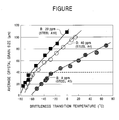
- Fig. 1 demonstrates that sufficient toughness can be obtained by adjusting the average crystal grain diameter to 40 ⁇ m or less and the average surface roughness Ra to 0.3 ⁇ m or less.
Landscapes
- Chemical & Material Sciences (AREA)
- Engineering & Computer Science (AREA)
- Mechanical Engineering (AREA)
- Materials Engineering (AREA)
- Metallurgy (AREA)
- Organic Chemistry (AREA)
- Physics & Mathematics (AREA)
- Thermal Sciences (AREA)
- Crystallography & Structural Chemistry (AREA)
- Heat Treatment Of Sheet Steel (AREA)
Applications Claiming Priority (2)
| Application Number | Priority Date | Filing Date | Title |
|---|---|---|---|
| JP2001334175 | 2001-10-31 | ||
| JP2001334175 | 2001-10-31 |
Publications (3)
| Publication Number | Publication Date |
|---|---|
| EP1308532A2 true EP1308532A2 (de) | 2003-05-07 |
| EP1308532A3 EP1308532A3 (de) | 2004-07-07 |
| EP1308532B1 EP1308532B1 (de) | 2008-08-13 |
Family
ID=19149343
Family Applications (1)
| Application Number | Title | Priority Date | Filing Date |
|---|---|---|---|
| EP02024457A Expired - Lifetime EP1308532B1 (de) | 2001-10-31 | 2002-10-29 | Ferritisches rostfreies Stahlblech mit hervorragender Tiefziehbarkeit zur Nachbehandlung und Herstellungsverfahren |
Country Status (4)
| Country | Link |
|---|---|
| US (2) | US6911098B2 (de) |
| EP (1) | EP1308532B1 (de) |
| KR (1) | KR100762151B1 (de) |
| DE (1) | DE60228186D1 (de) |
Cited By (10)
| Publication number | Priority date | Publication date | Assignee | Title |
|---|---|---|---|---|
| EP1484424A1 (de) * | 2003-06-04 | 2004-12-08 | Nisshin Steel Co., Ltd. | Rostfreier ferritischer Bandstahl mit hervorragenden Press- sowie sekundären Verformungseigenschaften und Verfahren zu seiner Herstellung |
| FR2879216A1 (fr) * | 2004-12-13 | 2006-06-16 | D M S Sa | Procede de recuit d'une bande d'acier inoxydable |
| WO2007049915A1 (en) * | 2005-10-25 | 2007-05-03 | Posco | Corrosion resistance improved steel sheet for autmotive muffler and method of producing the steel sheet |
| EP1889936A4 (de) * | 2005-06-09 | 2009-05-27 | Jfe Steel Corp | Blech aus nichtrostendem ferritstahl für balgstockpipe |
| CN101297055B (zh) * | 2005-10-25 | 2012-11-28 | Posco公司 | 用于机动车消音器的抗蚀性提高的钢板及该钢板的生产方法 |
| EP2280090A4 (de) * | 2008-05-12 | 2015-08-19 | Nisshin Steel Co Ltd | Ferritischer edelstahl |
| CN106795599A (zh) * | 2014-08-29 | 2017-05-31 | 杰富意钢铁株式会社 | 铁素体系不锈钢箔及其制造方法 |
| CN104726784B (zh) * | 2013-12-24 | 2017-06-23 | Posco公司 | 成型性及光泽优异的铁素体不锈钢及其制造方法 |
| EP3159423A4 (de) * | 2014-09-05 | 2018-01-24 | JFE Steel Corporation | Kaltgewalztes blech aus ferritischem edelstahl |
| CN111295458A (zh) * | 2017-10-30 | 2020-06-16 | 杰富意钢铁株式会社 | 铁素体系不锈钢板及其制造方法 |
Families Citing this family (37)
| Publication number | Priority date | Publication date | Assignee | Title |
|---|---|---|---|---|
| US7494551B2 (en) * | 2002-06-17 | 2009-02-24 | Jfe Steel Corporation | Ferritic stainless steel plate with Ti and method for production thereof |
| JP4185425B2 (ja) * | 2002-10-08 | 2008-11-26 | 日新製鋼株式会社 | 成形性と高温強度・耐高温酸化性・低温靱性とを同時改善したフェライト系鋼板 |
| DE102004040259A1 (de) * | 2004-08-18 | 2005-12-22 | Daimlerchrysler Ag | Verfahren zum Schützen eines Bauteils vor Korrosion |
| US7819991B2 (en) * | 2005-06-09 | 2010-10-26 | Jfe Steel Corporation | Ferritic stainless steel sheet for raw material pipe for bellows pipe |
| ES2379384T3 (es) * | 2005-08-17 | 2012-04-25 | Jfe Steel Corporation | Placa de acero inoxidable ferrítico que tiene una excelente resistencia a la corrosión y procedimiento de fabricación de la misma |
| JP4904357B2 (ja) * | 2005-09-15 | 2012-03-28 | グリード・リミテッド・ライアビリティ・カンパニー | 高シリコンニオブ鋳造合金およびその製造方法 |
| US8470237B2 (en) * | 2006-05-09 | 2013-06-25 | Nippon Steel & Sumikin Stainless Steel Corporation | Stainless steel excellent in corrosion resistance, ferritic stainless steel excellent in resistance to crevice corrosion and formability, and ferritic stainless steel excellent in resistance to crevice corrosion |
| KR100821060B1 (ko) * | 2006-12-28 | 2008-04-08 | 주식회사 포스코 | 내식성 및 고온 내변색성이 우수한 페라이트계스테인리스강 |
| JP5303842B2 (ja) * | 2007-02-26 | 2013-10-02 | Jfeスチール株式会社 | 偏平性に優れた熱処理用電縫溶接鋼管の製造方法 |
| JP4651682B2 (ja) * | 2008-01-28 | 2011-03-16 | 新日鐵住金ステンレス株式会社 | 耐食性と加工性に優れた高純度フェライト系ステンレス鋼およびその製造方法 |
| JP5588868B2 (ja) * | 2008-07-23 | 2014-09-10 | 新日鐵住金ステンレス株式会社 | 尿素水タンク用フェライト系ステンレス鋼 |
| JP5462583B2 (ja) * | 2008-10-24 | 2014-04-02 | 新日鐵住金ステンレス株式会社 | Egrクーラ用フェライト系ステンレス鋼板 |
| JP4624473B2 (ja) * | 2008-12-09 | 2011-02-02 | 新日鐵住金ステンレス株式会社 | 耐銹性に優れた高純度フェライト系ステンレス鋼およびその製造方法 |
| KR100993412B1 (ko) | 2008-12-29 | 2010-11-09 | 주식회사 포스코 | 고분자 연료전지 분리판용 스테인리스강 및 그 제조방법 |
| JP5489759B2 (ja) * | 2009-02-09 | 2014-05-14 | 新日鐵住金ステンレス株式会社 | ブラックスポットの生成の少ないフェライト系ステンレス鋼 |
| WO2011077650A1 (ja) * | 2009-12-21 | 2011-06-30 | 住友金属工業株式会社 | 冷間引抜用素管およびその製造方法並びに冷間引抜管の製造方法 |
| JP5586279B2 (ja) * | 2010-03-15 | 2014-09-10 | 新日鐵住金ステンレス株式会社 | 自動車排気系部材用フェライト系ステンレス鋼 |
| CA2802171C (en) | 2010-06-28 | 2015-11-24 | Nippon Steel & Sumitomo Metal Corporation | Heat transfer tube for steam generator and method for producing the same |
| JP5609571B2 (ja) * | 2010-11-11 | 2014-10-22 | Jfeスチール株式会社 | 耐酸化性に優れたフェライト系ステンレス鋼 |
| JP5410466B2 (ja) * | 2011-03-01 | 2014-02-05 | 株式会社神戸製鋼所 | ステンレス鋼フラックス入りワイヤ |
| JP5126437B1 (ja) * | 2011-04-01 | 2013-01-23 | Jfeスチール株式会社 | ステンレス箔およびその箔を用いた排ガス浄化装置用触媒担体 |
| RU2479641C1 (ru) * | 2012-02-22 | 2013-04-20 | Открытое акционерное общество "Магнитогорский металлургический комбинат" | Способ производства холоднокатаной ленты из низкоуглеродистых марок стали |
| TWI495736B (zh) * | 2012-09-03 | 2015-08-11 | Jfe Steel Corp | 肥粒鐵系不鏽鋼 |
| FI124995B (fi) | 2012-11-20 | 2015-04-15 | Outokumpu Oy | Ferriittinen ruostumaton teräs |
| CA2890620C (en) * | 2012-11-30 | 2018-08-28 | Baoshan Iron & Steel Co., Ltd. | Acid concentration control method and device for cold rolling pickling production line |
| EP3052303A4 (de) * | 2013-10-03 | 2017-06-28 | President and Fellows of Harvard College | Konfigurierbare verbundwerkstoffe |
| EP3093362B1 (de) * | 2014-01-08 | 2018-11-28 | JFE Steel Corporation | Ferritischer edelstahl und verfahren zur herstellung davon |
| JP5924459B1 (ja) * | 2014-09-05 | 2016-05-25 | Jfeスチール株式会社 | ステンレス冷延鋼板用素材 |
| KR101709201B1 (ko) * | 2015-07-01 | 2017-02-22 | 주식회사 포스코 | 고강도 고연성 페라이트계 경량 강판 및 그 제조방법 |
| JP6022097B1 (ja) * | 2016-03-30 | 2016-11-09 | 日新製鋼株式会社 | Ti含有フェライト系ステンレス鋼板および製造方法 |
| JP6261648B2 (ja) * | 2016-05-16 | 2018-01-17 | 日新製鋼株式会社 | 排気管フランジ部品用Ti含有フェライト系ステンレス鋼板および製造方法 |
| KR102020511B1 (ko) * | 2017-12-14 | 2019-09-10 | 주식회사 포스코 | 충격 인성이 우수한 페라이트계 스테인리스강 및 그 제조방법 |
| DE112020004634T5 (de) * | 2019-09-27 | 2022-06-15 | Honda Motor Co., Ltd. | Metallbeschichtungsverfahren |
| KR102326044B1 (ko) | 2019-12-20 | 2021-11-15 | 주식회사 포스코 | 자화특성이 향상된 페라이트계 스테인리스강 및 그 제조 방법 |
| KR102370505B1 (ko) * | 2020-04-28 | 2022-03-04 | 주식회사 포스코 | 내식성이 향상된 페라이트계 스테인리스강 및 이의 제조방법 |
| KR102846333B1 (ko) * | 2020-09-30 | 2025-08-14 | 닛폰세이테츠 가부시키가이샤 | 고강도 강판 |
| KR20230059023A (ko) * | 2021-10-25 | 2023-05-03 | 주식회사 포스코 | 클래드 판재 가공성이 우수한 페라이트계 스테인리스강 및 제조방법 |
Family Cites Families (12)
| Publication number | Priority date | Publication date | Assignee | Title |
|---|---|---|---|---|
| DE1247251B (de) | 1964-04-25 | 1967-08-17 | Opel Adam Ag | Ziehblech fuer Ziehteile |
| CA2123470C (en) | 1993-05-19 | 2001-07-03 | Yoshihiro Yazawa | Ferritic stainless steel exhibiting excellent atmospheric corrosion resistance and crevice corrosion resistance |
| JP2933826B2 (ja) | 1994-07-05 | 1999-08-16 | 川崎製鉄株式会社 | 深絞り成形性と耐二次加工脆性に優れるクロム鋼板およびその製造方法 |
| JP3224694B2 (ja) | 1994-10-07 | 2001-11-05 | 新日本製鐵株式会社 | 耐銹性と加工性に優れたフェライト系ステンレス鋼板 |
| JPH08283914A (ja) * | 1995-04-11 | 1996-10-29 | Nippon Steel Corp | ベローズ用フェライト系ステンレス鋼板 |
| JP3064871B2 (ja) * | 1995-06-22 | 2000-07-12 | 川崎製鉄株式会社 | 成形加工後の耐肌あれ性および高温疲労特性に優れるフェライト系ステンレス熱延鋼板 |
| JP3613387B2 (ja) | 1995-06-22 | 2005-01-26 | Jfeスチール株式会社 | 成形加工後の耐肌あれ性および高温疲労特性に優れるフェライト系ステンレス熱延鋼板 |
| JP3357226B2 (ja) | 1995-08-14 | 2002-12-16 | 川崎製鉄株式会社 | 耐リジング性と表面性状に優れたFe−Cr合金 |
| US5851316A (en) | 1995-09-26 | 1998-12-22 | Kawasaki Steel Corporation | Ferrite stainless steel sheet having less planar anisotropy and excellent anti-ridging characteristics and process for producing same |
| JPH09125208A (ja) * | 1995-11-02 | 1997-05-13 | Nippon Steel Corp | ベローズ加工性および耐高温塩害特性に優れたベローズ用フェライト系ステンレス鋼板 |
| USRE40950E1 (en) | 1999-03-30 | 2009-11-10 | Jfe Steel Corporation | Ferritic stainless steel plate |
| TW480288B (en) * | 1999-12-03 | 2002-03-21 | Kawasaki Steel Co | Ferritic stainless steel plate and method |
-
2002
- 2002-10-28 KR KR1020020065729A patent/KR100762151B1/ko not_active Expired - Lifetime
- 2002-10-29 DE DE60228186T patent/DE60228186D1/de not_active Expired - Lifetime
- 2002-10-29 US US10/282,535 patent/US6911098B2/en not_active Expired - Lifetime
- 2002-10-29 EP EP02024457A patent/EP1308532B1/de not_active Expired - Lifetime
-
2003
- 2003-09-24 US US10/671,384 patent/US7056398B2/en not_active Expired - Lifetime
Cited By (16)
| Publication number | Priority date | Publication date | Assignee | Title |
|---|---|---|---|---|
| EP1484424A1 (de) * | 2003-06-04 | 2004-12-08 | Nisshin Steel Co., Ltd. | Rostfreier ferritischer Bandstahl mit hervorragenden Press- sowie sekundären Verformungseigenschaften und Verfahren zu seiner Herstellung |
| FR2879216A1 (fr) * | 2004-12-13 | 2006-06-16 | D M S Sa | Procede de recuit d'une bande d'acier inoxydable |
| EP1669465A3 (de) * | 2004-12-13 | 2007-07-11 | DMS Société Anonyme | Walz- und Glühverfahren für die Herstellung eines Bandes aus nichtrostendem Stahl und Vorrichtung zur Durchführung des Verfahrens |
| EP1889936A4 (de) * | 2005-06-09 | 2009-05-27 | Jfe Steel Corp | Blech aus nichtrostendem ferritstahl für balgstockpipe |
| WO2007049915A1 (en) * | 2005-10-25 | 2007-05-03 | Posco | Corrosion resistance improved steel sheet for autmotive muffler and method of producing the steel sheet |
| US7922968B2 (en) | 2005-10-25 | 2011-04-12 | Posco | Corrosion resistance improved steel sheet for automotive muffler and method of producing the steel sheet |
| CN101297055B (zh) * | 2005-10-25 | 2012-11-28 | Posco公司 | 用于机动车消音器的抗蚀性提高的钢板及该钢板的生产方法 |
| US9249475B2 (en) | 2008-05-12 | 2016-02-02 | Nisshin Steel Co., Ltd. | Ferritic stainless steel |
| EP2280090A4 (de) * | 2008-05-12 | 2015-08-19 | Nisshin Steel Co Ltd | Ferritischer edelstahl |
| CN104726784B (zh) * | 2013-12-24 | 2017-06-23 | Posco公司 | 成型性及光泽优异的铁素体不锈钢及其制造方法 |
| CN106795599A (zh) * | 2014-08-29 | 2017-05-31 | 杰富意钢铁株式会社 | 铁素体系不锈钢箔及其制造方法 |
| EP3187609A4 (de) * | 2014-08-29 | 2017-12-06 | JFE Steel Corporation | Ferritische rostfreie stahlfolie und herstellungsverfahren dafür |
| CN106795599B (zh) * | 2014-08-29 | 2019-12-24 | 杰富意钢铁株式会社 | 铁素体系不锈钢箔及其制造方法 |
| EP3159423A4 (de) * | 2014-09-05 | 2018-01-24 | JFE Steel Corporation | Kaltgewalztes blech aus ferritischem edelstahl |
| US10550454B2 (en) | 2014-09-05 | 2020-02-04 | Jfe Steel Corporation | Cold-rolled ferritic stainless steel sheet |
| CN111295458A (zh) * | 2017-10-30 | 2020-06-16 | 杰富意钢铁株式会社 | 铁素体系不锈钢板及其制造方法 |
Also Published As
| Publication number | Publication date |
|---|---|
| EP1308532A3 (de) | 2004-07-07 |
| US6911098B2 (en) | 2005-06-28 |
| KR20030035972A (ko) | 2003-05-09 |
| US20030094217A1 (en) | 2003-05-22 |
| KR100762151B1 (ko) | 2007-10-01 |
| EP1308532B1 (de) | 2008-08-13 |
| DE60228186D1 (de) | 2008-09-25 |
| US7056398B2 (en) | 2006-06-06 |
| US20040055674A1 (en) | 2004-03-25 |
Similar Documents
| Publication | Publication Date | Title |
|---|---|---|
| US7056398B2 (en) | Method of making ferritic stainless steel sheet having excellent deep-drawability and brittle resistance to secondary processing | |
| JP3680829B2 (ja) | 深絞り性、耐二次加工脆性および耐食性に優れるフェライト系ステンレス鋼板及びその製造方法 | |
| EP2762585B1 (de) | Hochfestes feuerverzinktes stahlblech mit hervorragenden mechanischen schneideigenschaften, hochfestes legiertes feuerverzinktes stahlblech und verfahren zur herstellung dieser bleche | |
| US9551057B2 (en) | Galvannealed layer and steel sheet comprising the same, and method for producing the same | |
| JP5698353B2 (ja) | 高強度の冷間成形可能な鋼及び該鋼から製造された平鋼製品 | |
| RU2554264C2 (ru) | Горяче-или холоднокатаный стальной лист, способ его изготовления и его применение в автомобильной промышленности | |
| KR102728874B1 (ko) | 고강도 강판 및 그 제조 방법 | |
| JP5053157B2 (ja) | プレス成形性の良好な高強度高ヤング率鋼板、溶融亜鉛めっき鋼板、合金化溶融亜鉛めっき鋼板及び鋼管、並びに、それらの製造方法 | |
| EP0930375B1 (de) | Verfahren zur herstellung einer ferritischen rostfreien stahlplatte mit guten tiefzieheigenschaften und hohem widerstand gegen rillenfornmung | |
| EP3214196A1 (de) | Hochfestes stahlblech und verfahren zur herstellung davon | |
| JP6176326B2 (ja) | 冷延鋼板、亜鉛めっき冷延鋼板及びそれらの製造方法 | |
| KR20010023573A (ko) | 고강도 박강판, 고강도 합금화 용융아연도금 강판 및이들의 제조방법 | |
| KR101989726B1 (ko) | 고강도 강판 및 그 제조 방법 | |
| KR102385480B1 (ko) | 고강도 강판 및 그 제조 방법 | |
| JP2008255442A (ja) | 高張力合金化溶融亜鉛めっき鋼板とその製造方法 | |
| US11807924B2 (en) | Al plated welded pipe for hardening use and Al plated hollow member and method for producing same | |
| KR20180095699A (ko) | 고강도 아연 도금 강판, 고강도 부재 및 고강도 아연 도금 강판의 제조 방법 | |
| KR20210118442A (ko) | 고강도 강판 및 그 제조 방법 | |
| CN110475892A (zh) | 高强度冷轧钢板及其制造方法 | |
| JP4888200B2 (ja) | 高張力溶融亜鉛めっき鋼板と製造方法 | |
| JP4577100B2 (ja) | 高張力溶融亜鉛めっき鋼板と製造方法 | |
| JP4457673B2 (ja) | 耐二次加工脆性およびめっき密着性に優れた高成形性燃料タンク用めっき冷延鋼板およびその製造方法 | |
| TWI671410B (zh) | 鋼板及其製造方法 | |
| JP3347155B2 (ja) | 耐孔あき腐食性および孔拡げ性に優れた高張力鋼板およびその製造方法 | |
| CN116457480A (zh) | 低密度经冷轧和退火的钢板、其生产方法以及这样的钢用于生产车辆部件的用途 |
Legal Events
| Date | Code | Title | Description |
|---|---|---|---|
| PUAI | Public reference made under article 153(3) epc to a published international application that has entered the european phase |
Free format text: ORIGINAL CODE: 0009012 |
|
| AK | Designated contracting states |
Designated state(s): AT BE BG CH CY CZ DE DK EE ES FI FR GB GR IE IT LI LU MC NL PT SE SK TR |
|
| AX | Request for extension of the european patent |
Extension state: AL LT LV MK RO SI |
|
| RAP1 | Party data changed (applicant data changed or rights of an application transferred) |
Owner name: JFE STEEL CORPORATION |
|
| PUAL | Search report despatched |
Free format text: ORIGINAL CODE: 0009013 |
|
| RIC1 | Information provided on ipc code assigned before grant |
Ipc: 7C 22C 38/24 B Ipc: 7C 22C 38/32 A Ipc: 7C 22C 38/26 B Ipc: 7C 21D 8/04 B Ipc: 7C 22C 38/00 B Ipc: 7C 22C 38/28 B |
|
| AK | Designated contracting states |
Kind code of ref document: A3 Designated state(s): AT BE BG CH CY CZ DE DK EE ES FI FR GB GR IE IT LI LU MC NL PT SE SK TR |
|
| AX | Request for extension of the european patent |
Extension state: AL LT LV MK RO SI |
|
| 17P | Request for examination filed |
Effective date: 20040810 |
|
| AKX | Designation fees paid |
Designated state(s): DE FR |
|
| 17Q | First examination report despatched |
Effective date: 20070418 |
|
| GRAP | Despatch of communication of intention to grant a patent |
Free format text: ORIGINAL CODE: EPIDOSNIGR1 |
|
| GRAS | Grant fee paid |
Free format text: ORIGINAL CODE: EPIDOSNIGR3 |
|
| GRAA | (expected) grant |
Free format text: ORIGINAL CODE: 0009210 |
|
| AK | Designated contracting states |
Kind code of ref document: B1 Designated state(s): DE FR |
|
| REF | Corresponds to: |
Ref document number: 60228186 Country of ref document: DE Date of ref document: 20080925 Kind code of ref document: P |
|
| PLBE | No opposition filed within time limit |
Free format text: ORIGINAL CODE: 0009261 |
|
| STAA | Information on the status of an ep patent application or granted ep patent |
Free format text: STATUS: NO OPPOSITION FILED WITHIN TIME LIMIT |
|
| 26N | No opposition filed |
Effective date: 20090514 |
|
| REG | Reference to a national code |
Ref country code: FR Ref legal event code: PLFP Year of fee payment: 15 |
|
| REG | Reference to a national code |
Ref country code: FR Ref legal event code: PLFP Year of fee payment: 16 |
|
| REG | Reference to a national code |
Ref country code: FR Ref legal event code: PLFP Year of fee payment: 17 |
|
| PGFP | Annual fee paid to national office [announced via postgrant information from national office to epo] |
Ref country code: FR Payment date: 20210913 Year of fee payment: 20 |
|
| PGFP | Annual fee paid to national office [announced via postgrant information from national office to epo] |
Ref country code: DE Payment date: 20210923 Year of fee payment: 20 |
|
| REG | Reference to a national code |
Ref country code: DE Ref legal event code: R071 Ref document number: 60228186 Country of ref document: DE |