EP1308534A1 - Niedertemperatur Nitrocarburierungssalt und ihre Verwendung - Google Patents
Niedertemperatur Nitrocarburierungssalt und ihre Verwendung Download PDFInfo
- Publication number
- EP1308534A1 EP1308534A1 EP02102527A EP02102527A EP1308534A1 EP 1308534 A1 EP1308534 A1 EP 1308534A1 EP 02102527 A EP02102527 A EP 02102527A EP 02102527 A EP02102527 A EP 02102527A EP 1308534 A1 EP1308534 A1 EP 1308534A1
- Authority
- EP
- European Patent Office
- Prior art keywords
- stainless steel
- cyanate
- corrosion resistance
- temperatures
- hours
- Prior art date
- Legal status (The legal status is an assumption and is not a legal conclusion. Google has not performed a legal analysis and makes no representation as to the accuracy of the status listed.)
- Withdrawn
Links
- 150000003839 salts Chemical class 0.000 title description 62
- 238000000034 method Methods 0.000 title description 5
- 229910001220 stainless steel Inorganic materials 0.000 claims abstract description 45
- 239000010935 stainless steel Substances 0.000 claims abstract description 38
- 239000000203 mixture Substances 0.000 claims abstract description 28
- XLJMAIOERFSOGZ-UHFFFAOYSA-N cyanic acid Chemical compound OC#N XLJMAIOERFSOGZ-UHFFFAOYSA-N 0.000 claims abstract description 14
- 229910052783 alkali metal Inorganic materials 0.000 claims abstract description 11
- -1 alkali metal cyanate Chemical class 0.000 claims abstract description 10
- 150000004767 nitrides Chemical class 0.000 claims abstract description 8
- 229910000288 alkali metal carbonate Inorganic materials 0.000 claims abstract description 6
- 150000008041 alkali metal carbonates Chemical class 0.000 claims abstract description 6
- 238000004519 manufacturing process Methods 0.000 claims abstract description 3
- BVKZGUZCCUSVTD-UHFFFAOYSA-L Carbonate Chemical compound [O-]C([O-])=O BVKZGUZCCUSVTD-UHFFFAOYSA-L 0.000 claims description 21
- DGAQECJNVWCQMB-PUAWFVPOSA-M Ilexoside XXIX Chemical compound C[C@@H]1CC[C@@]2(CC[C@@]3(C(=CC[C@H]4[C@]3(CC[C@@H]5[C@@]4(CC[C@@H](C5(C)C)OS(=O)(=O)[O-])C)C)[C@@H]2[C@]1(C)O)C)C(=O)O[C@H]6[C@@H]([C@H]([C@@H]([C@H](O6)CO)O)O)O.[Na+] DGAQECJNVWCQMB-PUAWFVPOSA-M 0.000 claims description 13
- 239000011734 sodium Substances 0.000 claims description 13
- 229910052708 sodium Inorganic materials 0.000 claims description 13
- ZLMJMSJWJFRBEC-UHFFFAOYSA-N Potassium Chemical compound [K] ZLMJMSJWJFRBEC-UHFFFAOYSA-N 0.000 claims description 11
- 239000011591 potassium Substances 0.000 claims description 11
- 229910052700 potassium Inorganic materials 0.000 claims description 11
- 239000010963 304 stainless steel Substances 0.000 claims description 10
- 229910000589 SAE 304 stainless steel Inorganic materials 0.000 claims description 10
- 239000003513 alkali Substances 0.000 claims description 2
- 150000001340 alkali metals Chemical class 0.000 claims 2
- 238000005260 corrosion Methods 0.000 abstract description 45
- 230000007797 corrosion Effects 0.000 abstract description 45
- 150000001875 compounds Chemical class 0.000 abstract description 18
- 229910000963 austenitic stainless steel Inorganic materials 0.000 abstract description 4
- 238000007654 immersion Methods 0.000 abstract description 2
- 238000005121 nitriding Methods 0.000 description 27
- 238000012360 testing method Methods 0.000 description 21
- 239000010410 layer Substances 0.000 description 20
- 238000011282 treatment Methods 0.000 description 13
- XLJMAIOERFSOGZ-UHFFFAOYSA-M cyanate Chemical compound [O-]C#N XLJMAIOERFSOGZ-UHFFFAOYSA-M 0.000 description 8
- 230000008018 melting Effects 0.000 description 6
- 238000002844 melting Methods 0.000 description 6
- 238000010791 quenching Methods 0.000 description 6
- GKKCIDNWFBPDBW-UHFFFAOYSA-M potassium cyanate Chemical compound [K]OC#N GKKCIDNWFBPDBW-UHFFFAOYSA-M 0.000 description 5
- 230000002411 adverse Effects 0.000 description 4
- 230000015556 catabolic process Effects 0.000 description 4
- 238000006731 degradation reaction Methods 0.000 description 4
- 230000015572 biosynthetic process Effects 0.000 description 3
- 238000006243 chemical reaction Methods 0.000 description 3
- 230000007423 decrease Effects 0.000 description 3
- 238000009792 diffusion process Methods 0.000 description 3
- 230000000694 effects Effects 0.000 description 3
- 239000000463 material Substances 0.000 description 3
- ZVCDLGYNFYZZOK-UHFFFAOYSA-M sodium cyanate Chemical compound [Na]OC#N ZVCDLGYNFYZZOK-UHFFFAOYSA-M 0.000 description 3
- 239000007921 spray Substances 0.000 description 3
- CWYNVVGOOAEACU-UHFFFAOYSA-N Fe2+ Chemical compound [Fe+2] CWYNVVGOOAEACU-UHFFFAOYSA-N 0.000 description 2
- 229910000831 Steel Inorganic materials 0.000 description 2
- 229910045601 alloy Inorganic materials 0.000 description 2
- 239000000956 alloy Substances 0.000 description 2
- 229910001566 austenite Inorganic materials 0.000 description 2
- 238000001556 precipitation Methods 0.000 description 2
- 238000002203 pretreatment Methods 0.000 description 2
- 230000009467 reduction Effects 0.000 description 2
- 239000010959 steel Substances 0.000 description 2
- 238000005496 tempering Methods 0.000 description 2
- 230000007704 transition Effects 0.000 description 2
- YZEZMSPGIPTEBA-UHFFFAOYSA-N 2-n-(4,6-diamino-1,3,5-triazin-2-yl)-1,3,5-triazine-2,4,6-triamine Chemical compound NC1=NC(N)=NC(NC=2N=C(N)N=C(N)N=2)=N1 YZEZMSPGIPTEBA-UHFFFAOYSA-N 0.000 description 1
- 229910000975 Carbon steel Inorganic materials 0.000 description 1
- XFXPMWWXUTWYJX-UHFFFAOYSA-N Cyanide Chemical compound N#[C-] XFXPMWWXUTWYJX-UHFFFAOYSA-N 0.000 description 1
- 229920000877 Melamine resin Polymers 0.000 description 1
- ZOKXTWBITQBERF-UHFFFAOYSA-N Molybdenum Chemical compound [Mo] ZOKXTWBITQBERF-UHFFFAOYSA-N 0.000 description 1
- XSQUKJJJFZCRTK-UHFFFAOYSA-N Urea Chemical compound NC(N)=O XSQUKJJJFZCRTK-UHFFFAOYSA-N 0.000 description 1
- 230000009471 action Effects 0.000 description 1
- 230000009286 beneficial effect Effects 0.000 description 1
- 230000008901 benefit Effects 0.000 description 1
- 239000004202 carbamide Substances 0.000 description 1
- 230000003247 decreasing effect Effects 0.000 description 1
- 230000001419 dependent effect Effects 0.000 description 1
- 230000003467 diminishing effect Effects 0.000 description 1
- 230000005496 eutectics Effects 0.000 description 1
- 239000012530 fluid Substances 0.000 description 1
- 238000010438 heat treatment Methods 0.000 description 1
- 230000006872 improvement Effects 0.000 description 1
- 229910000734 martensite Inorganic materials 0.000 description 1
- 238000005259 measurement Methods 0.000 description 1
- JDSHMPZPIAZGSV-UHFFFAOYSA-N melamine Chemical compound NC1=NC(N)=NC(N)=N1 JDSHMPZPIAZGSV-UHFFFAOYSA-N 0.000 description 1
- 150000007974 melamines Chemical class 0.000 description 1
- YSRVJVDFHZYRPA-UHFFFAOYSA-N melem Chemical compound NC1=NC(N23)=NC(N)=NC2=NC(N)=NC3=N1 YSRVJVDFHZYRPA-UHFFFAOYSA-N 0.000 description 1
- 229910052751 metal Inorganic materials 0.000 description 1
- 239000002184 metal Substances 0.000 description 1
- 150000001247 metal acetylides Chemical class 0.000 description 1
- 238000012986 modification Methods 0.000 description 1
- 230000004048 modification Effects 0.000 description 1
- 229910052750 molybdenum Inorganic materials 0.000 description 1
- 239000011733 molybdenum Substances 0.000 description 1
- 150000002825 nitriles Chemical class 0.000 description 1
- 230000001590 oxidative effect Effects 0.000 description 1
- BITYAPCSNKJESK-UHFFFAOYSA-N potassiosodium Chemical compound [Na].[K] BITYAPCSNKJESK-UHFFFAOYSA-N 0.000 description 1
- 238000004881 precipitation hardening Methods 0.000 description 1
- 230000008569 process Effects 0.000 description 1
- 238000012545 processing Methods 0.000 description 1
- 230000000171 quenching effect Effects 0.000 description 1
- 230000008707 rearrangement Effects 0.000 description 1
- 230000000717 retained effect Effects 0.000 description 1
- 239000011833 salt mixture Substances 0.000 description 1
- 230000000087 stabilizing effect Effects 0.000 description 1
- 238000006467 substitution reaction Methods 0.000 description 1
- 239000002344 surface layer Substances 0.000 description 1
- 230000009466 transformation Effects 0.000 description 1
Images



Classifications
-
- C—CHEMISTRY; METALLURGY
- C23—COATING METALLIC MATERIAL; COATING MATERIAL WITH METALLIC MATERIAL; CHEMICAL SURFACE TREATMENT; DIFFUSION TREATMENT OF METALLIC MATERIAL; COATING BY VACUUM EVAPORATION, BY SPUTTERING, BY ION IMPLANTATION OR BY CHEMICAL VAPOUR DEPOSITION, IN GENERAL; INHIBITING CORROSION OF METALLIC MATERIAL OR INCRUSTATION IN GENERAL
- C23C—COATING METALLIC MATERIAL; COATING MATERIAL WITH METALLIC MATERIAL; SURFACE TREATMENT OF METALLIC MATERIAL BY DIFFUSION INTO THE SURFACE, BY CHEMICAL CONVERSION OR SUBSTITUTION; COATING BY VACUUM EVAPORATION, BY SPUTTERING, BY ION IMPLANTATION OR BY CHEMICAL VAPOUR DEPOSITION, IN GENERAL
- C23C8/00—Solid state diffusion of only non-metal elements into metallic material surfaces; Chemical surface treatment of metallic material by reaction of the surface with a reactive gas, leaving reaction products of surface material in the coating, e.g. conversion coatings, passivation of metals
- C23C8/40—Solid state diffusion of only non-metal elements into metallic material surfaces; Chemical surface treatment of metallic material by reaction of the surface with a reactive gas, leaving reaction products of surface material in the coating, e.g. conversion coatings, passivation of metals using liquids, e.g. salt baths, liquid suspensions
- C23C8/42—Solid state diffusion of only non-metal elements into metallic material surfaces; Chemical surface treatment of metallic material by reaction of the surface with a reactive gas, leaving reaction products of surface material in the coating, e.g. conversion coatings, passivation of metals using liquids, e.g. salt baths, liquid suspensions only one element being applied
- C23C8/48—Nitriding
- C23C8/50—Nitriding of ferrous surfaces
Definitions
- This invention relates generally to providing hard cases on ferrous workpieces and, more particularly, to an improved salt and method of use thereof for forming hard cases on ferrous workpieces, especially stainless steels and, more especially, austenitic and hardenable stainless steels.
- ferritic nitrocarburizing at typical processing temperatures in various media such as salt bath nitrocarburizing (also called salt bath nitriding) at about 579° C (1075° F)
- salt bath nitrocarburizing also called salt bath nitriding
- comparable treatment of austenitic stainless steels is known to reduce resistance to corrosion.
- significant improvement in corrosion resistance over the as-processed corrosion resistance for nitrocarburized 420 grade and other hardenable stainless steel can be achieved by increasing the depth of the case hardened or compound layer on the surface thereof.
- a composition for nitrocarburizing stainless steel parts and a method for producing a nitride or hard case on such parts using the composition sometimes referred to as salt bath nitriding.
- the composition includes alkali metal cyanate and alkali metal carbonate, wherein the cyanate ion (CNO-) is present in a weight percentage of greater than 45% and less than 53%.
- the composition is fused and maintained at a temperature of between about 399° C (750° F) and about 510° C (950° F) depending upon the type of stainless steel to be treated.
- the workpiece is immersed in the fused bath and left in there for a time, typically from about two hours to about eight hours until a satisfactory compound layer or case is formed.
- the present invention provides an improved salt composition for salt bath nitriding stainless steel parts at reduced temperatures and a method of using the salt to provide improved results on stainless steel parts.
- nitriding refers to forming a surface layer or compound layer (CL).
- CL compound layer
- austenitic stainless steel it is possible to provide a hard layer on the surface thereof at temperatures low enough such that the inherent corrosion resistance (which is high) is not adversely affected.
- hardenable grades of stainless steels such as the 400 series stainless steel
- corrosion resistance in the hardened and tempered condition can be increased and a compound layer formed on the surface at a temperature low enough to prevent degradation of the core hardness in certain conventional hardened and tempered conditions of the stainless steel part.
- a benefit is derived in using the present invention in treating austenitic grade stainless steels in that a hardened case can be provided without sacrificing the corrosion resistance and, in the case of hardenable stainless steel, it is possible to maintain the corrosion resistance obtained at normal nitrocarburizing temperatures while not adversely affecting the core hardness in the hardened and tempered condition.
- hardenable or “hardened stainless steel” refers to transformation hardening by the formation of martensite, not precipitation hardening by the precipitation of carbides.
- the salt bath composition for the improved nitrocarburizing bath which is useful at temperatures between about 399° C (750° F) and about 510° C (950° F), comprises an alkali metal cyanate and an alkali metal carbonate, wherein the cyanate ion is present in a weight percentage of greater than 45% and less than 53%, preferably between 48% and 50%, and more preferably at about 48%.
- the alkali metal cyanate and alkali metal carbonate are preferably either sodium cyanate or potassium cyanate or mixtures of sodium and potassium cyanate, preferably mixtures of sodium and potassium cyanate wherein the ratio of the potassium to the sodium is about 3.9 to 1.
- the bath is used in a fused condition, as indicated above, between about 399° C (750° F) and about 510° C (950° F). It has been found that the higher the cyanate content, the lower the melting temperature of the salt, such that the cyanate content in the range of greater than 45% allows the bath to be molten and eventually homogeneous at temperatures between 399° C (750° F) and 510°C (950° F). With the cyanate content at 45% or below, it is difficult to maintain a homogeneous molten salt, especially in the lower part of the range of 399° C (750° F) to 510° C (950° F).
- the workpieces are immersed in the fused bath and a nitride or a hard microstructural phase (sometimes referred to as a "compound layer") is formed.
- a nitride or a hard microstructural phase (sometimes referred to as a "compound layer") is formed.
- the cyanate composition which is depleted during the nitrocarburizing process, is maintained by adding a regenerator to the bath.
- the regenerator is either melamine or urea or a derivative of melamine, such as melam, melem and melom.
- the regenerator reacts with the carbonate to replenish the cyanate ion which is depleted in the nitrocarburizing reaction.
- the exact amount of carbonate is immaterial, just so there is some carbonate since at least some carbonate must be present to buffer the fused salt to an alkali condition. If the carbonate is completely depleted by reaction with the regenerator, this can have an adverse effect in that the bath has a propensity to attack the pot material containing the bath, and also in the formation of unwanted and ineffective regenerator material. Thus, it is necessary in the fused condition that the bath contains at least a measurable amount of carbonate. There is no maximum amount of carbonate that needs to be present, provided, however, that the amount is within the soluble range of carbonate.
- CN cyanide ion
- the composition is fused and then maintained at the desired temperature, the selection of which will be discussed presently, and the workpiece to be nitrocarburized is immersed in the fused bath for the desired period, the selection of which period also will be discussed later.
- conventional post treatments can be performed if desired, some of which will increase corrosion resistance.
- the post nitrocarburizing treatment which is known as a quench-polish-quench operation, can be performed.
- Tests were performed on various samples of different types of steel to determine the effectiveness of salt bath nitriding at various temperatures using the composition of the present invention at temperatures from 399° C (750° F) to 510° C (950° F) and also at various times using a conventional prior art salt bath composition, at temperatures from 538° C (1000°F) to 630°C (1166°F).
- test specimens were cylindrical rods, about one-half inch in diameter and about five inches long, with a small cross hole at one end to permit handling.
- the salt bath had a weight percentage of about 48% cyanate ion and at least 1% by weight of carbonate ion with the potassium to sodium ratio being 3.9 to 1.0.
- test specimens were immersed in the fused bath at various temperatures for various times and then various properties of the test specimens were measured, such as case hardness, case depth and, in the case of hardenable stainless steel, core strength of the specimen. Specifically, tests were performed on 304 grade stainless steel and 316 grade stainless steel and also on 416 grade stainless steel.
- specimens were salt bath nitrided in the as-processed annealed condition.
- Five different salt bath nitriding temperatures were used, with the corresponding time cycles selected to provide various "compound layer” (CL) depths. This "compound layer” is sometimes referred to as the case.
- Two specimens or samples were treated according to each of the conditions of temperature and time indicated in Table I below.
- the composition of the salt bath for those specimens treated at 399° C (750° F) to 510° C (950° F) was a salt bath according to the present invention, including an alkali metal cyanate with 48% cyanate ion and at least 1% carbonate ion with the potassium to sodium ratio being 3.9 to 1.0.
- the object of the tests with respect to the 304 stainless steel which is characteristic of the austenitic grade, was to determine the effect of salt bath nitriding at various temperatures and times on the corrosion resistance of the material and the depth of CL or hard layer formed.
- the test results of the salt bath nitriding performed on 304 stainless steel according to the parameters set forth therein are shown in Table I.
- the corrosion resistance of the 304 stainless steel is as shown graphically in Figure 1 with bar graphs.
- the corrosion test was performed in accordance with ASTM B-117-90 specifications, using a Singleton Chamber Model PSF22. The end point for each corrosion test was based on salt exposure time required to produce a corroded surface area of 10% on each sample. The test was terminated after 10% area was corroded or 1032 hours, whichever came first. Where multiple samples were used, the bar graph shows the maximum time.
- the 'S' phase begins to transform into nitride(s) and, at 510° C (950° F), it is completely transformed into nitrides.
- the nitride phase has corrosion resistance that is significantly reduced over that of the 'S' phase. It is believed that this may explain the excellent test results of the 304 stainless steel at 399° C (750° F) and the somewhat decreased corrosion resistance at 454° C (850° F) and the much poorer corrosion resistance at 510° C (950° F).
- a sufficient case can be provided at below about 435° C (815° F)
- a hardened surface can be provided without degradation of the corrosion resistance characteristics.
- Even at temperatures up to 454° C (850° F) corrosion resistance is improved over nitrocarburizing at temperatures above 510°C (950°F).
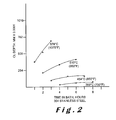
- Diffusion characteristics of the 304 stainless steel resulting in the "compound layer” CL within the 399° C (750° F) - 630° C (1166° F) temperature range were determined by measurement of the "compound layer” CL. This is identified as the total uninterrupted depths of a nondefinable compound(s) or microstructural phase(s) as observed metallographically. The depth of this CL is shown as a function of time and temperature in several curves in Figure 2. These curves demonstrate the significant influence of temperature on diffusion rates. At 399° C (750° F), the effect of time on diffusion rate between four hours and eight hours is minimal, with the resulting compound layer depth not exceeding about 0.0002 in.
- Tests were also performed on test specimens of 416 grade stainless steel which were vacuum hardened at 982° C (1800° F), air quenched and then tempered in accordance with the pre-treatment indicated in Table II below.
- the hardened and tempered samples of 416 stainless steel were then treated in salt bath nitriding for the times and temperatures indicated in Table II below.
- the composition of the salt bath for those specimens treated at 399° C (750° F) to 510° C (950° F) was a salt bath according to the present invention, including alkaline metal cyanate with 48% cyanate ion and at least 1% carbonate ion with the potassium to sodium ratio being 3.9 to 1.0.
- Salt spray test results using the same technique as that described with respect to the spray tests for the 304 grade stainless steel are shown in Figure 3. As can be seen in Figure 3, if no salt bath nitriding treatment is used, the time to 10% corrosion is significantly less than 100 hours. The same value holds for a salt bath treatment at 510° C (950° F) for two hours, 579° C (1075° F) for one hour, and 510° C (950° F) for four hours.
- salt bath treatment at 579° C (1075° F) for two hours, 579° C (1075° F) for three hours, 630° C (1166° F) for one and one-half hours and, significantly, a salt bath treatment at 510° C (950° F) for six hours. Again, when multiple samples were tested, the maximum time is shown.
- a temperature of 510° C (950° F) which is 52°C (125°F) below a normal salt bath treatment of 579° C (1075° F)
- a case can be established which provides at least as good corrosion resistance as at higher temperature nitrocarburizing at shorter times.
- Figure 4 comprises curves showing the depth of the case formed at various times and temperatures on the specimens of the 416 grade stainless steel.
- Figure 5 is a curve that shows the influence of the salt bath nitriding temperature on the core hardness of the pre-hardened and tempered 416 grade stainless steel.
- the 399°C (750° F) salt bath nitriding at either four, six or eight hours does not affect the core hardness of the specimen that was pre-tempered at 399° C (750° F).
- the core hardness is correspondingly reduced as would be expected.
- low temperature salt bath nitriding does not seem to provide any beneficial effect vis-avis precipitation hardened stainless steel, such as 17-4 pH.
Landscapes
- Chemical & Material Sciences (AREA)
- Chemical Kinetics & Catalysis (AREA)
- Engineering & Computer Science (AREA)
- Materials Engineering (AREA)
- Mechanical Engineering (AREA)
- Metallurgy (AREA)
- Organic Chemistry (AREA)
- Solid-Phase Diffusion Into Metallic Material Surfaces (AREA)
Applications Claiming Priority (2)
| Application Number | Priority Date | Filing Date | Title |
|---|---|---|---|
| US10/002,282 US6746546B2 (en) | 2001-11-02 | 2001-11-02 | Low temperature nitriding salt and method of use |
| US2282 | 2001-11-02 |
Publications (1)
| Publication Number | Publication Date |
|---|---|
| EP1308534A1 true EP1308534A1 (de) | 2003-05-07 |
Family
ID=21700056
Family Applications (1)
| Application Number | Title | Priority Date | Filing Date |
|---|---|---|---|
| EP02102527A Withdrawn EP1308534A1 (de) | 2001-11-02 | 2002-11-04 | Niedertemperatur Nitrocarburierungssalt und ihre Verwendung |
Country Status (2)
| Country | Link |
|---|---|
| US (2) | US6746546B2 (de) |
| EP (1) | EP1308534A1 (de) |
Cited By (1)
| Publication number | Priority date | Publication date | Assignee | Title |
|---|---|---|---|---|
| WO2006128645A1 (de) * | 2005-05-31 | 2006-12-07 | Renold Plc | Rollenkette |
Families Citing this family (7)
| Publication number | Priority date | Publication date | Assignee | Title |
|---|---|---|---|---|
| US8287667B2 (en) | 2006-06-29 | 2012-10-16 | GM Global Technology Operations LLC | Salt bath ferritic nitrocarburizing of brake rotors |
| CN101925791A (zh) * | 2007-11-30 | 2010-12-22 | 霍尔泰克国际股份有限公司 | 用于风冷式热交换器的翅片管装置及其制造方法 |
| FR2942241B1 (fr) | 2009-02-18 | 2011-10-21 | Hydromecanique & Frottement | Procede de traitement de pieces pour ustensiles de cuisine |
| JP4819201B2 (ja) * | 2010-03-16 | 2011-11-24 | 新日本製鐵株式会社 | 軟窒化用鋼、並びに軟窒化鋼部品及びその製造方法 |
| FR2972459B1 (fr) | 2011-03-11 | 2013-04-12 | Hydromecanique & Frottement | Bains de sels fondus pour la nitruration de pieces mecaniques en acier, et un procede de mise en oeuvre |
| CN111455310A (zh) * | 2020-05-28 | 2020-07-28 | 湖南申亿五金标准件有限公司 | Qpq低温直流电场渗氮工艺及装置 |
| CN111809140A (zh) * | 2020-07-13 | 2020-10-23 | 四川大学 | 一种用于提高不锈钢耐硫化氢腐蚀的低温碳氮氧共渗处理剂 |
Citations (6)
| Publication number | Priority date | Publication date | Assignee | Title |
|---|---|---|---|---|
| US3303063A (en) * | 1964-06-15 | 1967-02-07 | Gen Motors Corp | Liquid nitriding process using urea |
| GB1105031A (en) * | 1964-04-11 | 1968-03-06 | Degussa | A salt bath for nitriding steel and cast iron |
| US3912547A (en) * | 1972-02-18 | 1975-10-14 | Stephanois Rech Mec | Method of treatment of ferrous metal parts to increase their resistance to wear and seizure |
| US4019928A (en) * | 1973-03-05 | 1977-04-26 | Duetsche Gold- Und Silber-Scheideanstalt Vormals Roessler | Process for nitriding iron and steel in salt baths regenerated with triazine polymers |
| US5518605A (en) * | 1993-08-06 | 1996-05-21 | Centre Stephanois De Recherches Mecaniques Hydromecanique Et Frottement | Method of nitriding ferrous metal parts having improved corrosion resistance |
| EP1055739A2 (de) * | 1999-05-28 | 2000-11-29 | Honda Giken Kogyo Kabushiki Kaisha | Verfahren zur Herstellung von laminierten Ringen und Salzschmelzenzusammensetzung zur Verwendung bei diesem Verfahren |
Family Cites Families (5)
| Publication number | Priority date | Publication date | Assignee | Title |
|---|---|---|---|---|
| FR86012E (fr) * | 1963-12-11 | 1965-11-26 | Berliet Automobiles | éléments de frottement résistant particulièrement à l'usure par abrasion |
| IL52591A (en) * | 1977-07-25 | 1980-07-31 | Israel Aircraft Ind Ltd | Method of surface hardening stainless steel parts |
| DE2934113C2 (de) | 1979-08-23 | 1985-05-09 | Degussa Ag, 6000 Frankfurt | Verfahren zur Erhöhung der Korrosionsbeständigkeit nitrierter Bauteile aus Eisenwerkstoffen |
| DE3142318A1 (de) | 1981-10-24 | 1983-05-05 | Degussa Ag, 6000 Frankfurt | Salzbad zum nitrieren von eisenwerkstoffen |
| DE3533935C1 (de) | 1985-09-24 | 1986-06-05 | Degussa Ag, 6000 Frankfurt | Verfahren und Vorrichtung zur Entfernung von Alkalinitrit aus nitrathaltigen Salzbaedern |
-
2001
- 2001-11-02 US US10/002,282 patent/US6746546B2/en not_active Expired - Lifetime
-
2002
- 2002-11-04 EP EP02102527A patent/EP1308534A1/de not_active Withdrawn
-
2004
- 2004-02-18 US US10/780,951 patent/US20040159372A1/en not_active Abandoned
Patent Citations (6)
| Publication number | Priority date | Publication date | Assignee | Title |
|---|---|---|---|---|
| GB1105031A (en) * | 1964-04-11 | 1968-03-06 | Degussa | A salt bath for nitriding steel and cast iron |
| US3303063A (en) * | 1964-06-15 | 1967-02-07 | Gen Motors Corp | Liquid nitriding process using urea |
| US3912547A (en) * | 1972-02-18 | 1975-10-14 | Stephanois Rech Mec | Method of treatment of ferrous metal parts to increase their resistance to wear and seizure |
| US4019928A (en) * | 1973-03-05 | 1977-04-26 | Duetsche Gold- Und Silber-Scheideanstalt Vormals Roessler | Process for nitriding iron and steel in salt baths regenerated with triazine polymers |
| US5518605A (en) * | 1993-08-06 | 1996-05-21 | Centre Stephanois De Recherches Mecaniques Hydromecanique Et Frottement | Method of nitriding ferrous metal parts having improved corrosion resistance |
| EP1055739A2 (de) * | 1999-05-28 | 2000-11-29 | Honda Giken Kogyo Kabushiki Kaisha | Verfahren zur Herstellung von laminierten Ringen und Salzschmelzenzusammensetzung zur Verwendung bei diesem Verfahren |
Cited By (1)
| Publication number | Priority date | Publication date | Assignee | Title |
|---|---|---|---|---|
| WO2006128645A1 (de) * | 2005-05-31 | 2006-12-07 | Renold Plc | Rollenkette |
Also Published As
| Publication number | Publication date |
|---|---|
| US20040159372A1 (en) | 2004-08-19 |
| US6746546B2 (en) | 2004-06-08 |
| US20030084963A1 (en) | 2003-05-08 |
Similar Documents
| Publication | Publication Date | Title |
|---|---|---|
| EP1396553B1 (de) | Verfahren zur Herstellung eines Metall-Bauteiles mit hoher Korrosionsbeständigkeit beim Salzbadnitrieren | |
| US5019182A (en) | Method of forming hard steels by case hardening, shot-peening and aging without tempering | |
| JP5649884B2 (ja) | 窒素化合物層を有する鉄鋼部材、及びその製造方法 | |
| US6746546B2 (en) | Low temperature nitriding salt and method of use | |
| US5415705A (en) | Rolling bearing | |
| JP2015218359A (ja) | 表面硬化処理部品、表面硬化処理部品用鋼及び表面硬化処理部品の製造方法 | |
| JP3388510B2 (ja) | 耐食、耐摩耗鋼及びその製造方法 | |
| KR100812971B1 (ko) | 금속의 염욕 질화방법 및 그 방법으로 제조된 금속 | |
| KR100862217B1 (ko) | 2단계 가스 질화 또는 가스 질화침탄에 의한 고내식 및고내마모 강재의 제조방법 | |
| JP3695643B2 (ja) | 鉄系部品 | |
| KR101650318B1 (ko) | 스테인리스강의 질화방법 | |
| US4184899A (en) | Method of surface hardening stainless steel parts | |
| EP0122529A1 (de) | Verfahren zum Oberflächenhärten eines Gegenstandes aus einer Eisenlegierung und so erhaltenes Produkt | |
| JP2009534533A (ja) | 全体としてコンパクトな粒状ミクロ構造をもつ材料にチタンおよび窒化物を拡散する方法、およびこの方法によって製造した製品 | |
| JP4494995B2 (ja) | 金属材表面処理方法 | |
| JP4806722B2 (ja) | 金属の塩浴窒化方法及びその方法で製造された金属 | |
| SU1650767A1 (ru) | Состав электролита дл нитроцементации стальных изделий в электролитной плазме | |
| KR100647240B1 (ko) | 오스테나이트계 스테인리스 제품의 가스질화방법 | |
| JP3745971B2 (ja) | 鋼材料 | |
| JPH06184727A (ja) | 鉄鋼製部品の表面硬化法 | |
| JP7178832B2 (ja) | 表面硬化材料の製造方法 | |
| SU1087566A1 (ru) | Способ упрочнени изделий из конструкционной стали | |
| KR20110074356A (ko) | 강재의 질화방법 | |
| KR100922619B1 (ko) | 고강도 강재 및 그 제조방법 | |
| JPH0440425B2 (de) |
Legal Events
| Date | Code | Title | Description |
|---|---|---|---|
| PUAI | Public reference made under article 153(3) epc to a published international application that has entered the european phase |
Free format text: ORIGINAL CODE: 0009012 |
|
| AK | Designated contracting states |
Designated state(s): AT BE BG CH CY CZ DE DK EE ES FI FR GB GR IE IT LI LU MC NL PT SE SK TR |
|
| AX | Request for extension of the european patent |
Extension state: AL LT LV MK RO SI |
|
| AKX | Designation fees paid | ||
| 17P | Request for examination filed |
Effective date: 20031106 |
|
| RBV | Designated contracting states (corrected) |
Designated state(s): AT BE BG CH CY CZ DE DK EE ES FI FR GB GR IE IT LI LU MC NL PT SE SK TR |
|
| REG | Reference to a national code |
Ref country code: DE Ref legal event code: 8566 |
|
| 17Q | First examination report despatched |
Effective date: 20041026 |
|
| STAA | Information on the status of an ep patent application or granted ep patent |
Free format text: STATUS: THE APPLICATION IS DEEMED TO BE WITHDRAWN |
|
| 18D | Application deemed to be withdrawn |
Effective date: 20050427 |