EP1309632B1 - Catalyseurs a base d'acide aryldisulfonique alkyle destines a la reticulation du polyethylene - Google Patents
Catalyseurs a base d'acide aryldisulfonique alkyle destines a la reticulation du polyethylene Download PDFInfo
- Publication number
- EP1309632B1 EP1309632B1 EP01961886A EP01961886A EP1309632B1 EP 1309632 B1 EP1309632 B1 EP 1309632B1 EP 01961886 A EP01961886 A EP 01961886A EP 01961886 A EP01961886 A EP 01961886A EP 1309632 B1 EP1309632 B1 EP 1309632B1
- Authority
- EP
- European Patent Office
- Prior art keywords
- carbons
- linear
- group
- branched alkyl
- proviso
- Prior art date
- Legal status (The legal status is an assumption and is not a legal conclusion. Google has not performed a legal analysis and makes no representation as to the accuracy of the status listed.)
- Expired - Lifetime
Links
- 0 CC(C)(/C=C1)/C=C/C(/*C*O)=C/C1(C)[N+](*)[O-] Chemical compound CC(C)(/C=C1)/C=C/C(/*C*O)=C/C1(C)[N+](*)[O-] 0.000 description 1
Classifications
-
- C—CHEMISTRY; METALLURGY
- C08—ORGANIC MACROMOLECULAR COMPOUNDS; THEIR PREPARATION OR CHEMICAL WORKING-UP; COMPOSITIONS BASED THEREON
- C08F—MACROMOLECULAR COMPOUNDS OBTAINED BY REACTIONS ONLY INVOLVING CARBON-TO-CARBON UNSATURATED BONDS
- C08F8/00—Chemical modification by after-treatment
- C08F8/42—Introducing metal atoms or metal-containing groups
-
- C—CHEMISTRY; METALLURGY
- C08—ORGANIC MACROMOLECULAR COMPOUNDS; THEIR PREPARATION OR CHEMICAL WORKING-UP; COMPOSITIONS BASED THEREON
- C08L—COMPOSITIONS OF MACROMOLECULAR COMPOUNDS
- C08L2203/00—Applications
- C08L2203/20—Applications use in electrical or conductive gadgets
- C08L2203/202—Applications use in electrical or conductive gadgets use in electrical wires or wirecoating
Definitions
- the present invention is directed to a crosslinkable polymer.
- composition comprising an alkoxysilane functional polyolefin and an alkylated aryl disulfonic acid as a crosslinking catalyst.
- the present invention is directed to a silane functional polyolefin and an alkylated aryl disulfonic acid wherein the aryl moiety is naphthalene or biphenyl or two benzene rings covalently bonded through a divalent moiety and wherein the aryl moiety is substituted with 1-4 alkyl groups and each alkyl group is a hydrocarbon chain with 6 to 16 carbons, preferably 9 to 12 carbons with the total number of carbons in the alkyl substituents being in the range of 9 to 64 carbons.
- the catalysts of the present invention also include derivatives of the alkylated aryl disulfonic acids that can be hydrolyzed to the corresponding acids.
- the useful alkylated aryl disulfonic acid catalysts in the present invention are highly active crosslinking catalysts being effective at a very low concentration in the silane functional polyolefin composition. Because of the low concentration of the alkylated aryl disulfonic acid catalyst required, it is anticipated that the electrical resistance of resulting crosslinked polymeric compositions will. be excellent. The resulting crosslinked polymeric compositions are desirable for use as coatings for electrical cables and wires.
- thermoplastic polyolefins such as polyethylene have long been known as excellent dielectric materials for use as insulation in the manufacture of power cables.
- the major drawback of thermoplastic polyethylene is the relatively low temperature at which it softens and flows.
- the upper temperature at which thermoplastic polyethylene is useful is 75°C, which is rather low. This temperature may be increased by crosslinking.
- polyethylene is a linear polymer with no functional groups along the chain for crosslinking. Thus, to crosslink polyethylene, the polymer chain needs to be activated or provided with functional groups.
- One way to crosslink polyethylene is to incorporate a peroxide crosslinking agent to provide a source of free radicals when heated to a temperature higher than its decomposition temperature.
- the free radical extracts a hydrogen from the polyethylene backbone to produce alkyl radicals which combine to crosslink the linear polyethylene.
- polyethylene tends to scorch at a low temperature, which limits the temperature at which the polyethylene can be heated to provide crosslinking and to produce an extruded coated wire.
- wires produced by using peroxide to crosslink polyethylene require a specialized extruder equipped with a high pressure continuous vulcanization (CV) tube.
- CV continuous vulcanization
- Another way to crosslink polyethylene is to use electron beam irradiation to form free radicals. This process avoids the use of the high pressure continuous vulcanization extruder.
- the use of electron beam radiation prevents the use of carbon black commonly used as a pigment in coated wires.
- the thickness of the material prevents penetration by the electron beam leading to nonuniformity of the resulting coating, thereby posing challenging engineering problems.
- the equipment to produce high energy radiation and the necessary special shielding is also very expensive.
- a third way of crosslinking polyethylene is to incorporate a second component, an unsaturated silane compound, such as vinyl alkoxysilane into the polyethylene.
- an unsaturated silane compound such as vinyl alkoxysilane
- VTMS vinyl trimethoxysilane
- Examples of unsaturated silane compounds would be vinyltrimethoxysilane, vinyltriethoxysilane, and vinyldimethoxyethoxysilane. The most preferred is vinyltrimethoxysilane (VTMS).
- the crosslinking of polyethylene using VTMS is a two step process.
- the first step involves hydrolysis of the methoxy group to a hydroxy group with the liberation of methanol.
- the second step is a condensation step to release H 2 O to crosslink or cure the polymer.
- the hydrolysis step requires the presence of water and the catalyst used must not be soluble in water or affected thereby.
- the rate of cure of silane functionalized polyethylene is controlled by silane concentration, silane structure, catalyst concentration and type, resin crystallinity, coating thickness, the rate at which water penetrates into the inner layers of the polymer, the cure temperature, and the relative humidity.
- the VTMS modified polyethylene can go directly from the reactor to the extruder without going through grafting and/or compounding.
- This process also provides a product that is very clean with uniform density and molecular weight distribution.
- Akutsu et al. U.S. 4,297,310 disclosed a process for producing moisture crosslinkable polymer by copolymerization of ethylene and an unsaturated silane compound.
- Metal salts of carboxylic acids, organic bases, inorganic acids and organic acids were disclosed as suitable crosslinking catalysts for this system.
- Toluene sulfonic acid was among one of the organic acids listed.
- U.S. 4,413,066 described a copolymer of ethylene and an ethylenically unsaturated silane in combination with a crosslinking catalyst.
- the copolymer may further comprise a monomer copolymerizable with the ethylene and the ethyleneically unsaturated silane compound.
- the catalysts include metal carboxylate salts, organic bases, inorganic acids and organic acids as the crosslinking catalysts. Although toluene sulfonic acid was disclosed as being a suitable crosslinking catalyst, the preferred catalysts are the carboxylates of tin.
- the electro-conductivity of tin or metal salts of the carboxylic acids, and the inorganic acids disclosed by lsaka et al. are relatively high. It is not desirable to incorporate such compounds in a wire coating that should be an insulation material.
- the metal carboxylates and inorganic metal salts provide a slower rate of cure than the catalysts useful in the present invention.
- Konno et al. disclosed a paint composition wherein a vinyl polymer is obtained by copolymerizing a vinyl monomer with a siloxy group and a polyisocyanate compound in the presence of a radical generator.
- the vinyl siloxy monomer with a radical generator and a curing agent are mixed with a siloxy dissociating catalyst.
- the compounds suitable as the dissociation catalyst include phosphoric acid and its salts, organic phosphates and phosphites. Also included as dissociation catalysts are toluene sulfonic acid, naphthalene disulfonic acid and their amine salts.
- alkylated benzene and naphthalene sulfonic acids as suitable silanol condensation catalysts for crosslinking silane functional polyethylene.
- the alkylated benzene and naphthalene sulfonic acids are disclosed to have a total of 14 to 28 carbons wherein there are a total number of 4 to 18 carbons, preferably 10 to 18 carbon atoms, in the substituent alkyl groups.
- dodecyl benzene sulfonic acid and tetrapropyl benzene sulfonic acid were exemplified. These compounds were compared with p-toluene sulfonic acid to show dramatic improvement in the copolymer produced.
- the present invention provides a crosslinkable polymeric composition
- a crosslinkable polymeric composition comprising a silane functional crosslinkable polyolefin with a crosslinking catalyst selected from the group consisting of an alkylated aryl disulfonic acid and a hydrolyzable derivative thereof.
- the catalyst is useful at a level of 0.1 mM/g to 1 mM/g in the polymeric composition.
- the alkylated aryl disulfonic acid catalysts are highly compatible with the polymeric composition. They have low water solubility, are less extractable into water and provides a very fast cure rate at a low concentration. Because the catalysts useful in the present invention are effective at very low concentrations, and are less electro-conductive, the final crosslinked polymer composition are anticipated to have much lower electro-conductivity and are more desirable for use as an insulation material for electical wire coating.
- silanol condensation catalyst useful for crosslinking silane functional polyolefin is selected from the group consisting of:
- the aryl group is naphthalene such as in dinonyl naphthalene disulfonic acid.
- the aryl disulfonic acid is structure II, preferably n is 0, or X is oxygen and n is 1, or X is S and n is 1 to 3, or X is S(O) 2 arid n is 1.
- the derivative of (i) may be an epoxy blocked sulfonic acid wherein one or both of the sulfonic acid groups is reacted with an epoxide to provide mono- or di-beta-hydroxy sulfonic acid ester.
- Suitable epoxy compounds for preparing an epoxy blocked sulfonic acid include diglycidyl ethers of bisphenol A or bisphenol F; diglycidyl ethers of a glycol, such as ethylene glycol, propylene glycol or butanediol; monoglycidyl ethers of C1 to C18 alpha olefin epoxides and 1,2-epoxycyclohexane.
- the invention is further directed to a process for crosslinking silane functional polyolefins by adding an alkylated aryl disulfonic acid or a hydrolyzable derivative thereof as a crosslinking catalyst.
- the invention is directed to a crosslinkable polyolefin composition
- a crosslinkable polyolefin composition comprising a polyolefin with a crosslinkable group consisting of an alkoxysilane and an alkylated aryl disulfonic acid crosslinking catalyst, or a hydrolyzable derivative thereof, wherein the aryl is naphthalene, biphenyl or two benzene rings covalently bonded through a divalent moiety.
- the alkylated aryl disulfonic acid catalysts useful in the invention have excellent compatibility with the polyolefin, with low water solubility and extractability and provide a very fast cure rate at a low concentration. Because the catalysts are effective at a very low concentration, the resulting crosslinked polymer are anticipated to have lower electro-conductivity and are, therefore, more desirable for use as insulation for electrical wire coatings.
- the polyolefin used in the composition depends on the type of technology used to produce the silane functional polymer. For post grafting technology, so called “Sioplas technology” and the “monosil technology", where the grafting and addition of catalyst are all conducted in a single step, almost any polyolefin is acceptable.
- suitable polyolefins would be polyethylene, polypropylene, polyisobutylene, or mixtures thereof.
- Other suitable polymers would be the copolymers of ethylene with at least one of the following alpha -olefin monomers: 1-propene, 1-butene, 1-hexene, 1-octene and styrene.
- Such copolymers of ethylene with other alpha -olefins are commonly referred to as low density polyethylene (LDPE) arid linear low density polyethylene (LLDPE).
- LDPE low density polyethylene
- LLDPE linear low density polyethylene
- the most preferred polyolefin for post grafting of a silane group thereon is polyethylene.
- an unsaturated silane compound is copolymerized with an olefin to incorporate the silane into the main chain of the polymer backbone, ethylene is the only suitable olefin.
- silanol condensation catalyst useful in the invention is selected from the group consisting of:
- the aryl group is naphthalene such as in dinonyl naphthalene disulfonic acid.
- the derivative may be an epoxy blocked sulfonic acid wherein one or both of the sulfonic acid groups is reacted with an epoxide to provide a mono- or di-beta-hydroxy sulfonic acid ester.
- Suitable epoxy compounds for preparing an epoxy blocked sulfonic acid include diglycidyl ethers of bisphenol A or bisphenol F; diglycidyl ethers of.a glycol, such as ethylene glycol, propylene glycol or butanediol; monoglycidyl ethers of C1 to C18 alpha olefin epoxides and 1,2-epoxycyclohexane.
- the invention is further directed to a process for crosslinking silane functional polyolefins by adding an alkylated aryl disulfonic acid or a hydrolyzable derivative thereof as a crosslinking catalyst.
- silane crosslinked polyethylene is well known, it is instructive to review the types of polymers, as well as the various processes which can be used to achieve a silane crosslinked polyolefin.
- the polyolefin used depends on the type of technology used to produce the silane functional polymer. For post grafting technology, so called “Sioplas technology” and the “monosil technology", where the grafting and addition of catalyst are all conducted in a single step, almost any polyolefin is acceptable. Examples of suitable polyolefins would be polyethylene, polypropylene, polyisobutylene, or mixtures thereof.
- Suitable polymers would be the copolymers of ethylene with at least one of the following alpha -olefin monomers: 1-propene, 1-butene, 1-hexene, 1-octene and styrene. Such copolymers of ethylene with other alpha -olefins are commonly referred to as low density polyethylene (LDPE) and linear low density polyethylene (LLDPE). Also suitable would be copolymers of ethylene with a monomer selected from the following: vinylethers such as vinylmethyl ether, vinylethylether and phenylvinylether; acrylates such as methylacrylate, ethylacrylate, and methylmethacrylate; and vinyl esters such as vinylacetate.
- LDPE low density polyethylene
- LLDPE linear low density polyethylene
- vinylethers such as vinylmethyl ether, vinylethylether and phenylvinylether
- acrylates such as methylacrylate, ethylacrylate,
- the most preferred polyolefin for post grafting of a silane group thereon is polyethylene.
- an unsaturated silane compound is copolymerized with an olefin to incorporate the silane into the main chain of the polymer backbone, ethylene is the only suitable olefin.
- Examples of unsaturated silane compounds would be vinyltrimethoxysilane, vinyltriethoxysilane, and vinyldimethoxyethoxysilane. The most preferred is vinyltrimethoxysilane (VTMS).
- the catalysts of the invention are useful in each of the methods because they are highly reactive and are effective in the presence of moisture.
- silane crosslinked polyolefin There are three basic methods for producing a silane crosslinked polyolefin.
- the most commonly used silane is an ethylenically unsaturated silane, vinyltrimethoxysilane (VTMS).
- the first method involves the free radical promoted grafting of the alkoxysilane containing an unsaturated group onto a polyolefin to give a trialkoxysilane graft polyolefin. A free radical initiator is required to promote grafting.
- VTMS vinyltrimethoxysilane
- the first method involves the free radical promoted grafting of the alkoxysilane containing an unsaturated group onto a polyolefin to give a trialkoxysilane graft polyolefin. A free radical initiator is required to promote grafting.
- a mixture of a crosslinking catalyst and other additives and pigments (referred to as the master batch), is combined with the siloxy polyethylene in an extruder at
- the olefin is copolymerized with a small amount of a vinyl containing alkoxysilane to give a slightly different type of silane modified polyolefin than would be obtained by the grafting technique described above.
- the most commonly used is an unsaturated silane compound, also VTMS.
- VTMS is incorporated into the main chain of the polymer backbone and places the alkoxysilane groups in closer proximity to the polyolefin backbone than in the corresponding silane graft polymer. Incorporation of the alkoxysilane groups during olefin polymerization supposedly results in a more thermally stable polymer than a polymer using silane graft polyolefin.
- the alkoxysilane functionalized polyolefin is crosslinked by the use of a catalyst incorporated as one component in a master batch. See U.S. Patent 4,297,310.
- a third method for producing a silane crosslinked polyolefin is a single step process whereby a polyolefin, VTMS, a free radical initiator, and the crosslinking catalyst are combined in.an extruder at a specified temperature. In this case the grafting of the silane and the addition of the crosslinking catalyst occur in a single step. This process is commonly referred to as the "monosil" process.
- the master batch accounts for about 5 wt% of the polymer composition and may include other additives such as antioxidants and pigments.
- the amount of catalyst present in the master batch will depend on the activity and molecular weight (MW) of the catalyst as well as the compatibility of the catalyst with the polymer.
- the percentage of alkoxysilane incorporated into the polyolefin either through grafting or copolymerization is relatively small.
- the level of the silane crosslinking group is between 0.5 and 5 wt % with a preferred level of about 2 wt %. It is important to keep the relatively polar trialkoxysilane groups incorporated at a low level so that it does not significantly alter the nonpolar nature of the polyolefin.
- the siloxy polyolefins of the invention are very nonpolar. This restricts the type of crosslinking catalyst that can be used because the catalyst must possess good compatibility with the polyolefin in order to function properly.
- the preferred number of alkyl groups on the aryl moiety will depend on their size and degree of branching.
- the total number of carbons is in the range of 12-64, with the individual alkyl groups having 6-16 carbons, preferable 9-12 carbons.
- the catalyst is dinonylnaphthalene disulfonic acid.
- compounds of structure II include the alkylated disulfonic acids of diphenylmethane, 2,2-diphenylpropane, diphenyl ketone, diphenylether, diphenyl sulfide and diphenylsulfone.
- the preferred size of the individual alkyl groups for compounds of structure II is from about 6 to about 16 carbons with a most preferred range of from about 9 to about 12 carbons.
- the preferred total number of carbons in the alkyl groups is in the range of 25-50.
- the crosslinking catalysts of the present invention include derivatives of the alkylated aryl disulfonic acids, which can be converted under conditions of curing to the free sulfonic acid.
- examples of such derivatives include disulfonic acid anhydrides, alkyl disulfonic acid esters, epoxy blocked sulfonic acids, acetylated disulfonic acids, and amine salts of the alkyl aryl disulfonic acids.
- the derivatives of the sulfonic acid crosslinking catalysts of the present invention may be prepared from the sulfonic acid in accordance with procedures well known in the art.
- the process for making an ester or an acetylates typically involves condensation of the sulfonic acid group with a hydroxy functioning group such as an alcohol, or an acetyl alcohol.
- the anhydride of a sulfonic acid is prepared by heating a sulfonic acid compound to remove H 2 O causing two sulfonic acid groups to condense to form an anhydride.
- the epoxy blocked esters are prepared from reacting the sulfonic acid with an epoxy compound.
- the metal salt of the alkylated naphthylene monosulfonic acid or the arylalkyl sulfonic acid can be prepared from the corresponding sulfonic acid using well known procedures.
- the process typically involves reaction of the corresponding sulfonic acid with a metal oxide or metal hydroxide in a suitable solvent such as methanol.
- the amine salt is prepared by reacting ammonia or an alcohol amine with the sulfonic acid group.
- the alkylated aryl disulfonic acid catalysts of structure I or structure II may be prepared by methods known to those skilled in the art. Generally, the process involves alkylation of the aryl moiety followed by sulfonation.
- the starting aromatic compound is naphthalene.
- the starting aromatic compound is biphenyl or a diphenyl substituted alkylene, carbonyl, sulfide, disulfide, polysulfide, sulfone or oxide.
- Examples of the starting aromatic compound for structure II include biphenyl, diphenyl methane, 2,2,-diphenylpropane, diphenyl ketone, diphenylether, diphenyl sulfide diphenylsulfone.
- Suitable methods for alkylation commonly involve the reaction of the aryl moiety with an olefin, alcohol, alkylhalide, or other alkylating agent in the presence of a catalyst. Although many different types of alkylating agents are known, the preferred alkylating agent is an olefin.
- Suitable catalysts for the alkylation of aryl moieties are Lewis acid or super acid catalysts known in the art.
- Lewis acid catalysts such as boron trifluoride, iron trichloride, tin tetrachloride, zinc dichloride or antimony pentafluoride may be used.
- Acidic clays, silica, or alumina may also be used.
- Hans Dressler, et al., US.4,604,491 and Yoshida, et. al., US 4,714,794 may be employed. Hans Dressler, et.
- catalysts are the acidic zeolite catalysts (See Ashjian, et al., US 5,034,563; Angevine et al., US 5,001,296; Kuehl et al., US 5,401,896).
- acidic zeolite catalysts See Ashjian, et al., US 5,034,563; Angevine et al., US 5,001,296; Kuehl et al., US 5,401,896
- Zeolite Beta Zeolite Y, ZSM-5, ZSM-35 and USY.
- One preferred method is the alkylation of the aryl moiety with an olefin using aluminum chloride as catalyst.
- a co-catalyst such as nitromethane or nitrobenzene is also used to promote the reaction.
- Such methods are disclosed in King, et. al., US 2,764,548 and Ho et al., US 5,254,274.
- the resulting intermediate alkylated aryl compound can then be sulfonated by means known in the art.
- Sulfonation is typically conducted by reacting the alkylated aryl compound with a sulfonating agent such as fuming sulfuric acid (oleum), sulfur trioxide or chlorosulfonic acid.
- a sulfonating agent such as fuming sulfuric acid (oleum), sulfur trioxide or chlorosulfonic acid.
- the mole ratio of alkylated aryl compound to the sulfonating agent is adjusted accordingly to provide the disulfonic acid as the preferred product. Examples of procedures for sulfonation are found in Jerry March, Advanced Organic Chemistry, Reactions, Mechanisms and Structure , 4 th edition, John Wiley and Sons, p.528, 1992.
- sulfonating agent typically about 1.8 to 2.2 moles of the sulfonating agent is added per mole of the aromatic compound in a hydrocarbon solvent. Once the sulfonation reaction is complete, the residual sulfuric acid is removed and the hydrocarbon layer is washed with water to remove the water-soluble impurities.
- Dinonylnaphthalene disulfonic acid is prepared using the method described above.
- the product is also available commercially as an approximately 55% actives solution in iso-butanol (NACURE® 155, King Industries, Norwalk, Conn.).
- Dodecyl benzene sulfonic acid was purchased from Aldrich Chemical Company and used without further purification.
- the dinonylnaphthalene disulfonic acid of Example 1 and the DDBSA of comparative Example 1 were evaluated for crosslinking of polyethylene in wire insulation.
- the catalysts were incorporated into master batches at equal molar concentrations and then the master batches were blended with silane functionalized polyethylene and extruded onto 14 gauge wire. The details of incorporating the catalysts into the polymer and extrusion onto the wire is described below.
- the compounded master batch was converted to a form suitable for dry mixing with the silane functional polyethylene (XLPE). This was achieved through several physical processes. First the hot compounded master batch was converted to 1/4" thick sheets by a roll mill having heated rolls set at 70°C. The sheets were immediately cut into 3" strips after emerging from the roll mill. The strips were then allowed to cool to room temperature and then chopped into 1/4" square pieces to match the particle sizes of XLPE, which in this case was nominally 1/4" in diameter. It is important that the master batch and XLPE pellet size and weight are similar so that concentration gradients do not develop upon settling after dry blending.
- XLPE silane functional polyethylene
- the blended plastic was extruded onto 14 gauge copper wire using a Davis extruder having 4 heating zones (140°C, 150°C, 160°C, and 170°C) and a screw with a 20:1 length to diameter ratio set at a speed of 15 rpm.
- the die was chosen to give an average coating wall thickness of 30 microns.
- About 100 ft of wire was extruded for each catalyst sample. In between each sample run about 100 ft. of wire was extruded from XLPE resin alone (no catalyst) to clean the extruder for the next sample.
- a control sample (containing no catalyst) was run first to eliminate the possibility of contamination.
- the wire from each run was immediately coiled and placed in individual large zip-lock bags which were then placed in a cooler with dry ice to prevent cure during long term storage
- each 3-inch strip In the center of each 3-inch strip, a 1-inch section was marked with two lines with a permanent marker. Each of the strips was tested for "hot creep” to determine when the polymer was sufficiently crosslinked, and then tested for "hot set” if there was sufficient crosslinking.
- the "hot creep" was conducted by suspending each sample strip at the top end from a stand in an oven at 150°C. with a weight of 119 g. attached to the bottom end. The weight used was determined based on the cross-sectional area of the wire coating. and was calculated using the equations specified in the ICEA T-28562 test procedure. The strips were left in an oven for 15 minutes. A sample strip was deemed crosslinked, if it survived the 15 minute period in the oven without breaking. A sample strip that was not crosslinked broke within 2 minutes at 150°C. This is reported as "hot creep".
- the weight was removed and the strip was left for an additional 5 minutes in the oven.
- the strip was then removed from the oven and allowed to cool to room temperature.
- the percent change in length of the cooled sample is reported as the "hot set". It should be noted that the statistical error in the hot set measurement is ⁇ 5%.
- Table 1 shows the results of "hot creep” and “hot set” for curing conditions at 30°C and 30% relative humidity and Table 2 shows the results of "hot creep” and “hot set” for curing conditions at 50°C and 100% relative humidity of each group of the 3 strips using Example 1 and Comparative Example 1 as the catalyst.
- the fraction reported for "hot creep” in each of the tables represents the number of samples out of the three tested that passed the crosslinking test. Where the "hot creep” test showed that the polymer was sufficiently cured (crosslinked) then "hot set” test was conducted and the the percent creep presented in the lower section of each table.
Landscapes
- Chemical & Material Sciences (AREA)
- Organic Chemistry (AREA)
- Health & Medical Sciences (AREA)
- Chemical Kinetics & Catalysis (AREA)
- Medicinal Chemistry (AREA)
- Polymers & Plastics (AREA)
- General Chemical & Material Sciences (AREA)
- Compositions Of Macromolecular Compounds (AREA)
- Processes Of Treating Macromolecular Substances (AREA)
- Organic Insulating Materials (AREA)
- Addition Polymer Or Copolymer, Post-Treatments, Or Chemical Modifications (AREA)
- Silicon Polymers (AREA)
- Low-Molecular Organic Synthesis Reactions Using Catalysts (AREA)
Claims (31)
- Composition de polyoléfine réticulable comprenant une polyoléfine modifiée par des groupes alcoxysilane hydrolysables et un catalyseur de réticulation de silanol choisi dans le groupe constitué par :(i) un acide aryl disulfonique alkylé choisi dans le groupe constitué par la structure Iet la structure II
 dans lesquelles chacun de R1 et R2 est identique ou différent et est un groupe alkyle linéaire ou ramifié ayant 6 à 16 atomes de carbone, y vaut 0 à 3, z vaut 0 à 3, à condition que y + z vaille 1 à 4, n vaut 0 à 3, X est une fraction divalente choisie dans le groupe constitué par -C(R3) (R4)- dans laquelle chacun de R3 et R4 est H ou indépendamment un groupe alkyle linéaire ou ramifié de 1 à 4 atomes de carbone et n vaut 1 ; -C(=O)- dans laquelle n vaut 1 ; -O- dans laquelle n vaut 1 ; -S-, dans laquelle n vaut 1 à 3 ; et -S(O2)- dans laquelle n vaut 1 ; et
 (ii) un dérivé de (i) choisi dans le groupe constitué par les anhydrides, les esters, les esters d'acide sulfonique bloqués par époxy, les acétylates et les sels d'amine de ceux-ci, qui est hydrolysable en l'acide aryl disulfonique alkylé.
 - Composition selon la revendication 1, dans laquelle la polyoléfine est le polyéthylène.
- Composition selon la revendication 1 ou 2, dans laquelle le catalyseur de réticulation de silanol est un acide aryl disulfonique alkylé de structure Idans laquelle chacun de R1 et R2 est identique ou différent et est un groupe alkyle linéaire ou ramifié ayant 6 à 16 atomes de carbone, y vaut 0 à 3, z vaut 0 à 3, à condition que y + z vaille 1 à 4.

- Composition selon la revendication 3, dans laquelle chacun de R1 et R2 est identique ou différent et est un groupe alkyle linéaire ou ramifié ayant 9 à 12 atomes de carbone, y vaut 0 à 3, z vaut 0 à 3, à condition que y + z vaille 1 à 4.
- Composition selon la revendication 4, dans laquelle R1 = R2 et est un groupe alkyle linéaire ou ramifié ayant 9 à 12 atomes de carbone, et y vaut 1 et z vaut 1.
- Composition selon la revendication 5, dans laquelle R1 = R2 et est un groupe alkyle linéaire ayant 9 atomes de carbone et y vaut 1 et z vaut 1.
- Composition selon la revendication 1 ou 2, dans laquelle le catalyseur de réticulation de silanol est un acide aryl disulfonique alkylé de structure IIdans laquelle chacun de R1 et R2 est identique ou différent et est un groupe alkyle linéaire ou ramifié ayant 6 à 16 atomes de carbone, y vaut 0 à 3, z vaut 0 à 3, à condition. que y + z vaille 1 à 4, n vaut 0 à 3, X est une fraction divalente choisie dans le groupe constitué par -C(R3) (R4)- dans laquelle chacun de R3 et R4 est H ou indépendamment un groupe alkyle linéaire ou ramifié de 1 à 4 atomes de carbone et n vaut 1 ; -C(=O)- dans laquelle n vaut 1 ; -O- dans laquelle n vaut 1 ; -S-, dans laquelle n vaut 1 à 3 ; et -S(O2)-dans laquelle n vaut 1.

- Composition selon la revendication 7, dans laquelle chacun de R1 et R2 est identique ou différent et est un groupe alkyle ayant 9 à 12 atomes de carbone, y vaut 0 à 3, z vaut 0 à 3, à condition que y + z vaille 1 à 4 ; n vaut 0 à 3, dans laquelle chacun de R3 et R4 est H ou indépendamment un groupe alkyle linéaire ou ramifié de 1 à 4 atomes de carbone et n vaut 1 ; -C(=O)- dans laquelle n vaut 1 ; -O- dans laquelle n vaut 1 ; -S-, dans laquelle n vaut 1 à 3 ; et -S(O2)-, dans laquelle n vaut 1.
- Composition selon la revendication 7, dans laquelle n vaut 0.
- Composition selon la revendication 8, dans laquelle n vaut 0.
- Composition selon la revendication 8, dans laquelle X est une fraction divalente choisie dans le groupe constitué par -C(R3)(R4)-, -C(=O)-, -O- et n vaut 1.
- Composition selon la revendication 8, dans laquelle X est une fraction divalente et est -S- et n vaut 3.
- Composition selon la revendication 11, dans laquelle X est -C(R3) (R4)- et est choisi dans le groupe constitué par le méthylène et diméthylméthylène.
- Composition selon la revendication 11, dans laquelle X est -O-.
- Composition selon la revendication 11, dans laquelle X est -C(=O)-.
- Procédé de réticulation d'une polyoléfine modifiée par des groupes alcoxysilane hydrolysables en présence d'humidité employant un catalyseur de condensation de silanol choisi dans le groupe constitué par :dans lequel les étapes du procédé comprennent :(i) un acide aryl disulfonique alkylé choisi dans le groupe constitué par la structure Iet la structure II
 dans lesquelles chacun de R1 et R2 est identique ou différent et est un groupe alkyle linéaire ou ramifié ayant 6 à 16 atomes de carbone, y vaut 0 à 3, z vaut 0 à 3, à condition que y + z vaille 1 à 4, n vaut 0 à 3, X est une fraction divalente choisie dans le groupe constitué par -C(R3) (R4)- dans laquelle chacun de R3 et R4 est H ou indépendamment un groupe alkyle linéaire ou ramifié de 1 à 4 atomes de carbone et n vaut 1 ; -C(=O)- dans laquelle n vaut 1 ; -O- dans laquelle n vaut 1 ; -S-, dans laquelle n vaut 1 à 3 ; et -S(O2)- dans laquelle n vaut 1 ; et
 (ii) un dérivé de (i) choisi dans le groupe constitué par les anhydrides, les esters, les esters d'acide sulfonique bloqués par époxy, les acétylates et les sels d'amine de ceux-ci, qui est hydrolysable en l'acide aryl disulfonique alkylé ;la formation d'un mélange maítre du catalyseur de réticulation de silanol avec le polyéthylène ;le mélange du mélange maítre avec une polyoléfine à fonction alcoxysilane pour former un mélange à une concentration de 0,1 à 1,0 mM/g du catalyseur de réticulation de silanol dans le mélange ;le chauffage et l'extrusion du mélange sous forme de revêtement sur un fil ; etle durcissement du revêtement extrudé à une température de 25°C à 50°C à une humidité relative de 25 % à 100 %.
 - Procédé selon la revendication 16, dans lequel la polyoléfine est le polyéthylène.
- Procédé selon la revendication 17, dans lequel la concentration en catalyseur de réticulation de silanol est de 0,4 mM/g.
- Procédé selon la revendication 16, 17 ou 18, dans lequel le catalyseur de réticulation de silanol est un acide aryl disulfonique alkylé de structure Idans laquelle chacun de R1 et R2 est identique ou différent et est un groupe alkyle linéaire ou ramifié ayant 6 à 16 atomes de carbone, y vaut 0 à 3, z vaut 0 à 3, à condition que y + z vaille 1 à 4.
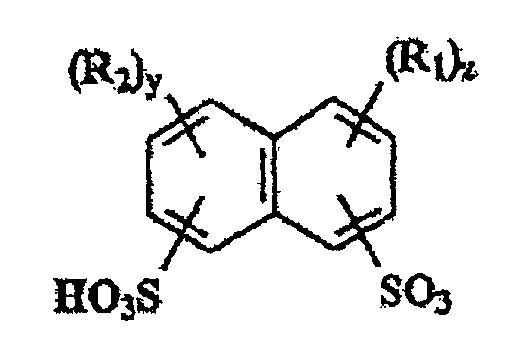
- Procédé selon la revendication 19, dans lequel le catalyseur de réticulation de silanol est de structure I et chacun de R1 et R2 est identique ou différent et est un groupe alkyle linéaire ou ramifié ayant 9 à 12 atomes de carbone, y vaut 0 à 3, z vaut 0 à 3 à condition que y + z vaille 1 à 4.
- Procédé selon la revendication 20, dans lequel le catalyseur de réticulation de silanol est de structure I et R1 et R2 sont identiques et sont un groupe alkyle linéaire ayant 9 à 12 atomes de carbone, et y vaut 1, z vaut 1.
- Procédé selon la revendication 21, dans lequel le catalyseur de réticulation de silanol est de structure I et R1 = R2 et est un groupe alkyle ayant 9 atomes de carbone, et y vaut 1 et z vaut 1.
- Procédé selon' la revendication 16, 17 ou 18, dans lequel le catalyseur de réticulation de silanol est un acide aryl disulfonique alkylé de structure IIdans laquelle chacun de R1 et R2 est identique ou différent et est un groupe alkyle linéaire ou ramifié ayant 6 à 16 atomes de carbone, y vaut 0 à 3, z vaut 0 à 3, à condition que y + z vaille 1 à 4, n vaut 0 à 3, X est une fraction divalente choisie dans le groupe constitué par -C(R3) (R4)-, dans laquelle chacun de R3 et R4 est H ou indépendamment un groupe alkyle linéaire ou ramifié de 1 à 4 atomes de carbone et n vaut 1 ; -C(=O)-, dans laquelle n vaut 1 ; -O- dans laquelle n vaut 1 ; -S-, dans laquelle n vaut 1 à 3 ; et S(O2) dans laquelle n vaut 1.
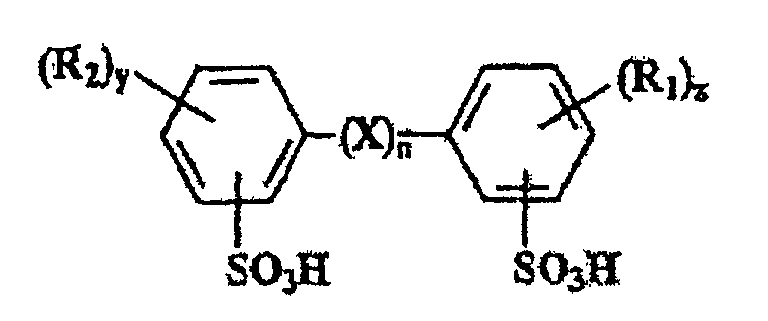
- Procédé selon la revendication 23, dans lequel le catalyseur de réticulation de silanol est de structure II et chacun de R1 et R2 est identique ou différent et est un groupe alkyle linéaire ou ramifié ayant 9 à 12 atomes de carbone, y vaut 0 à 3, z vaut 0 à 3, à condition que y + z vaille 1 à 4, n vaut 0 à 3, X est une fraction divalente choisie dans le groupe constitué par -C(R3) (R4)-, dans laquelle chacun de R3 et R4 est H ou indépendamment un groupe alkyle linéaire ou ramifié de 1 à 4 atomes de carbone et n vaut 1 ; -C(=O)-, dans laquelle n vaut 1 ; -O- dans laquelle n vaut 1 ; -S-, dans laquelle n vaut 1 à 3 ; et -S(O2)-dans laquelle n vaut 1.
- Procédé selon la revendication 23, dans lequel le catalyseur de réticulation de silanol est de structure II et chacun de R1 et R2 est identique ou différent et est un groupe alkyle linéaire ou ramifié ayant 6 à 16 atomes de carbone, y vaut 0 à 3, z vaut 0 à 3, à condition que y + z vaille 1 à 4 et n vaut 0.
- Procédé selon la revendication 24, dans lequel le catalyseur de réticulation de silanol est de structure II et chacun de R1 et R2 est identique ou différent et est un groupe alkyle linéaire ou ramifié ayant 9 à 12 atomes de carbone, y vaut 0 à 3, z vaut 0 à 3, à condition que y + z vaille 1 à 4 et n vaut 0.
- Procédé selon la revendication 23, dans lequel le catalyseur de réticulation de silanol est de structure II et chacun de R1 et R2 est identique ou différent et est un groupe alkyle linéaire ou ramifié ayant 6 à 16 atomes de carbone, y vaut 0 à 3, z vaut 0 à 3, à condition que y + z vaille 1 à 4 et X est une fraction divalente choisie dans le groupe constitué par -C(R3)(R4)-, -C(=O)-, et -O- et n vaut 1.
- Procédé selon la revendication 24, dans lequel le catalyseur de réticulation de silanol est de structure II et chacun de R1 et R2 est identique ou différent et est un groupe alkyle linéaire ou ramifié ayant 6 à 16 atomes de carbone, y vaut 0 à 3, z vaut 0 à 3, à condition que y + z vaille 1 à 4, et X est une fraction divalente, -S-, dans lequel n vaut 3.
- Procédé selon la revendication 27, dans lequel le catalyseur de réticulation de silanol est de structure II et chacun de R1 et R2 est identique ou différent et est un groupe alkyle linéaire ou ramifié ayant 6 à 16 atomes de carbone, y vaut 0 à 3, z vaut 0 à 3, à condition que y + z vaille 1 à 4, et X est -C(R3)(R4)- choisi dans le groupe constitué par le méthylène et le diméthylméthylène.
- Procédé selon la revendication 27, dans lequel le catalyseur de réticulation de silanol est de structure II et chacun de R1 et R2 est identique ou différent et est un groupe alkyle linéaire ou ramifié ayant 6 à 16 atomes de carbone, y vaut 0 à 3, z vaut 0 à 3, à condition que y + z vaille 1 à 4, et X est -O-.
- Procédé selon la revendication 27, dans lequel le catalyseur de réticulation de silanol est de structure II et chacun de R1 et R2 est identique ou différent et est un groupe alkyle linéaire ou ramifié ayant 6 à 16 atomes de carbone, y vaut 0 à 3, z vaut 0 à 3, à condition que y + z vaille 1 à 4, et X est -C(=O)-.
Applications Claiming Priority (5)
| Application Number | Priority Date | Filing Date | Title |
|---|---|---|---|
| US22289400P | 2000-08-03 | 2000-08-03 | |
| US222894P | 2000-08-03 | ||
| US909239 | 2001-07-19 | ||
| US09/909,239 US6395837B1 (en) | 2000-08-03 | 2001-07-19 | Alkylated aryl disulfonic acid catalysts for crosslinking polyethylene |
| PCT/US2001/024432 WO2002012355A1 (fr) | 2000-08-03 | 2001-08-02 | Catalyseurs a base d'acide aryldisulfonique alkyle destines a la reticulation du polyethylene |
Publications (3)
| Publication Number | Publication Date |
|---|---|
| EP1309632A1 EP1309632A1 (fr) | 2003-05-14 |
| EP1309632A4 EP1309632A4 (fr) | 2004-07-28 |
| EP1309632B1 true EP1309632B1 (fr) | 2005-04-27 |
Family
ID=26917259
Family Applications (2)
| Application Number | Title | Priority Date | Filing Date |
|---|---|---|---|
| EP01961886A Expired - Lifetime EP1309632B1 (fr) | 2000-08-03 | 2001-08-02 | Catalyseurs a base d'acide aryldisulfonique alkyle destines a la reticulation du polyethylene |
| EP01961883A Expired - Lifetime EP1309631B1 (fr) | 2000-08-03 | 2001-08-02 | Catalyseurs d'acide monosulfonique alkylaryle et arylalkyle pour la reticulation de polyethylene |
Family Applications After (1)
| Application Number | Title | Priority Date | Filing Date |
|---|---|---|---|
| EP01961883A Expired - Lifetime EP1309631B1 (fr) | 2000-08-03 | 2001-08-02 | Catalyseurs d'acide monosulfonique alkylaryle et arylalkyle pour la reticulation de polyethylene |
Country Status (8)
| Country | Link |
|---|---|
| US (1) | US6395837B1 (fr) |
| EP (2) | EP1309632B1 (fr) |
| AT (1) | ATE294195T1 (fr) |
| AU (2) | AU2001283112A1 (fr) |
| BR (1) | BR0112870A (fr) |
| CA (1) | CA2417348A1 (fr) |
| DE (1) | DE60110437T2 (fr) |
| WO (1) | WO2002012355A1 (fr) |
Cited By (9)
| Publication number | Priority date | Publication date | Assignee | Title |
|---|---|---|---|---|
| US8425806B2 (en) | 2007-10-23 | 2013-04-23 | Borealis Technology Oy | Semiconductive polymer composition |
| EP3035345A1 (fr) * | 2014-12-15 | 2016-06-22 | Borealis AG | Structure en couches de passivation avec du cuivre |
| US10233310B2 (en) | 2013-12-18 | 2019-03-19 | Borealis Ag | Polymer composition comprising a crosslinkable polyolefin with hydrolysable silane groups, catalyst and a surfactant interacting additive |
| US20190218380A1 (en) | 2016-06-03 | 2019-07-18 | Borealis Ag | Polymer composition for adhesion applications |
| US10688765B2 (en) | 2015-11-04 | 2020-06-23 | Borealis Ag | Process for producing a multilayer laminate |
| US11552210B2 (en) | 2017-06-16 | 2023-01-10 | Borealis Ag | Polymer composition for photovoltaic applications |
| US11884044B2 (en) | 2018-04-16 | 2024-01-30 | Borealis Ag | Process for producing a multilayer laminate |
| US11920018B2 (en) | 2013-12-20 | 2024-03-05 | Borealis Ag | Semiconductive polymer composition for electric power cables |
| US11981781B2 (en) | 2018-10-02 | 2024-05-14 | Borealis Ag | High speed cross-linking of grafted plastomers |
Families Citing this family (45)
| Publication number | Priority date | Publication date | Assignee | Title |
|---|---|---|---|---|
| CN1813006B (zh) * | 2003-06-25 | 2013-03-27 | 陶氏环球技术有限责任公司 | 聚合物组合物--缓蚀剂 |
| US6969821B2 (en) | 2003-06-30 | 2005-11-29 | General Electric Company | Airfoil qualification system and method |
| EP1784451A2 (fr) * | 2004-08-05 | 2007-05-16 | Dow Gloval Technologies Inc. | Composition de reticulation a base de silane reticulable par l'humidite |
| WO2006060714A1 (fr) * | 2004-12-03 | 2006-06-08 | Dow Global Technologies Inc. | Composites de fibres ligneuses et de plastique |
| EP1760111A1 (fr) | 2005-08-31 | 2007-03-07 | Borealis Technology Oy | Composition de polyoléfine contenant un catalyseur de condensation de silanol décolorer-libre |
| CN102142299B (zh) | 2005-09-13 | 2013-09-04 | 陶氏环球技术有限责任公司 | 用于硅烷交联和缩合反应的二锡氧烷催化剂 |
| ATE399187T1 (de) * | 2006-04-26 | 2008-07-15 | Borealis Tech Oy | Vernetzbare polyolefinzusammensetzung enthaltend hochmolekuaren silanolkondensationskatalysator |
| ATE523554T1 (de) * | 2006-05-30 | 2011-09-15 | Borealis Tech Oy | Eine siliziumverbindung als korrosionsinhibitor in polyolefinzusammensetzungen |
| ATE526362T1 (de) | 2006-05-30 | 2011-10-15 | Borealis Tech Oy | Eine siliciumverbindung als verarbeitungshilfsmittel für polyolefinzusammensetzungen, die vernetzbare polyolefine mit hydrolisierbaren silangruppen enthalten |
| EP1942131B1 (fr) | 2006-12-29 | 2009-10-21 | Borealis Technology Oy | Agent antiadhésif comportant une polyoléfine réticulable contenant du silicium |
| CN101790446B (zh) | 2007-08-27 | 2013-08-07 | 博里利斯技术有限公司 | 生产聚合物粒料的设备和方法 |
| EP2388294B1 (fr) | 2007-12-03 | 2013-05-29 | Borealis Technology OY | Composition polyoléfinique comprenant une polyoléfine réticulable avec des groupes silanes, un catalyseur de condensation au silanol et un composé contenant du silicium |
| ES2375226T3 (es) | 2007-12-21 | 2012-02-27 | Borealis Technology Oy | Uso de una composición de poliolefina que comprende poliolefina reticulable con grupos silano, catalizador de condensación de silanol y pigmento para la producción de una capa sobre un hilo o cable. |
| DE602007002200D1 (de) | 2007-12-21 | 2009-10-08 | Borealis Tech Oy | Polypropylenzusammensetzung mit einer vernetzbaren dispergierten Phase mit Nanofüllstoffe enthaltenden Silanolgruppen |
| EP2083047A1 (fr) | 2008-01-24 | 2009-07-29 | Borealis Technology OY | Composition de polypropylène partiellement réticulé comportant un catalyseur de condensation au silanol acide |
| ES2692278T3 (es) | 2008-07-09 | 2018-12-03 | Borealis Ag | Módulo fotovoltaico que comprende una capa de aislamiento con grupos silano |
| US8722827B2 (en) | 2009-05-14 | 2014-05-13 | Borealis Ag | Cross-linkable polyolefin composition comprising two types of silane groups |
| PL2251365T3 (pl) | 2009-05-14 | 2019-09-30 | Borealis Ag | Sieciowalna kompozycja poliolefinowa zawierająca grupy silanowe tworzące kwas lub zasadę w wyniku hydrolizy |
| EP2363267B1 (fr) | 2010-03-03 | 2013-08-21 | Borealis AG | Composition en polyoléfine réticulable comportant deux types de groupes de silane |
| WO2011106732A1 (fr) | 2010-02-25 | 2011-09-01 | Wyeth Llc | Surveillance pet d'une immunothérapie dirigée contre l'aβ |
| EP2444455A1 (fr) | 2010-10-21 | 2012-04-25 | Borealis AG | Composition de polymère semi-conducteur qui contient des groupes époxy |
| EP2444980B1 (fr) | 2010-10-21 | 2014-03-26 | Borealis AG | Câble comportant une couche formée d'une composition contenant des groupes époxy |
| EP2508566B1 (fr) | 2011-04-07 | 2014-05-28 | Borealis AG | Composition de polymère réticulable au silane |
| EP2508558B1 (fr) | 2011-04-07 | 2014-05-21 | Borealis AG | Composition de polymère réticulable au silane |
| DE102013216504A1 (de) * | 2013-08-21 | 2015-02-26 | Evonik Industries Ag | Zinn-freie Katalysator-haltige Zusammensetzung für einen Monosil-Prozess mit optimierter Prozesscharakteristik |
| WO2015091707A1 (fr) | 2013-12-18 | 2015-06-25 | Borealis Ag | Composition polymère comprenant une composition de polyoléfine et au moins un catalyseur de condensation de silanol |
| PL3083817T3 (pl) * | 2013-12-18 | 2023-09-11 | Borealis Ag | Kompozycja polimerowa zawierająca zdolną do sieciowania poliolefinę z ulegającymi hydrolizie grupami silanowymi oraz katalizator |
| EP3139417A1 (fr) | 2015-09-03 | 2017-03-08 | Borealis AG | Composition de polyéthylène pour un élément de couche d'un module photovoltaïque |
| CN114823957A (zh) | 2015-11-04 | 2022-07-29 | 博里利斯股份公司 | 光伏模块 |
| JP2019527929A (ja) | 2016-07-15 | 2019-10-03 | ボレアリス エージー | 熱可塑性のエンボス加工したフィルム |
| RU2720781C9 (ru) | 2016-12-02 | 2020-07-30 | Бореалис Аг | Полимерная композиция для клеящих составов |
| US20220347980A1 (en) | 2017-02-01 | 2022-11-03 | Borealis Ag | Article comprising a layer element |
| US11760067B2 (en) | 2017-03-23 | 2023-09-19 | Borealis Ag | Multilayer element comprising an interlayer comprising a copolymer of ethylene with a comonomer containing silane group(s) |
| JP2020519731A (ja) | 2017-06-16 | 2020-07-02 | ボレアリス エージー | 光起電用途用ポリマー組成物 |
| EP3470442A1 (fr) | 2017-10-11 | 2019-04-17 | Borealis AG | Matériau d'étanchéité comprenant des terpolymères |
| MY193435A (en) | 2018-02-15 | 2022-10-13 | Borealis Ag | A polymer composition for applications comprising a layer element |
| EP3877455A1 (fr) | 2018-11-06 | 2021-09-15 | Borealis AG | Composition de polyoléfine expansible réticulable au silane, et mousse |
| EP3723142A1 (fr) | 2019-04-12 | 2020-10-14 | Borealis AG | Module photovoltaïque doté d'une sortie de puissance améliorée |
| EP3733763A1 (fr) | 2019-04-30 | 2020-11-04 | Borealis AG | Composition de polyéthylène pour améliorer l'adhésion aux résines de polyuréthane |
| EP3828207A1 (fr) | 2019-11-29 | 2021-06-02 | Borealis AG | Procédé de production d'une composition de polyéthylène utilisant l'agrandissement du poids moléculaire |
| EP3848433A1 (fr) | 2020-01-10 | 2021-07-14 | Borealis AG | Adhésif thermofusible |
| BR112022026522A2 (pt) | 2020-06-24 | 2023-03-07 | Dow Global Technologies Llc | Processo para formar uma composição reticulada, composição, composição reticulada, e, artigo |
| EP4194500B1 (fr) | 2021-12-03 | 2025-03-19 | Borealis AG | Composition de polyoléfine soudable à haute fréquence |
| WO2023235176A1 (fr) | 2022-05-31 | 2023-12-07 | Dow Global Technologies Llc | Polymère de polyoléfine de silicium durcissable à l'humidité et procédé |
| CN120266228A (zh) | 2022-11-23 | 2025-07-04 | 北欧化工股份公司 | 包含具有提高的交联速度的可交联聚乙烯组合物层的电缆 |
Family Cites Families (10)
| Publication number | Priority date | Publication date | Assignee | Title |
|---|---|---|---|---|
| US4160072A (en) | 1975-03-20 | 1979-07-03 | Sekisui Kagaku Kogyo Kabushiki Kaisha | Foamable and crosslinkable polyethylene composition, process for its production, and process for producing crosslinked polyethylene foams using said composition |
| GB1575961A (en) | 1977-09-07 | 1980-10-01 | Sekisui Chemical Co Ltd | Foamable compositions and their use in preparing foams |
| US4413066A (en) | 1978-07-05 | 1983-11-01 | Mitsubishi Petrochemical Company, Ltd. | Crosslinkable polyethylene resin compositions |
| JPS5566809A (en) | 1978-11-13 | 1980-05-20 | Mitsubishi Petrochemical Co | Method of manufacturing crosslinked polyethylene resinncoated wire |
| JPS57207632A (en) | 1981-06-16 | 1982-12-20 | Mitsubishi Petrochem Co Ltd | Crosslinkable polyethylene resin composition |
| GB8514330D0 (en) | 1985-06-06 | 1985-07-10 | Bp Chem Int Ltd | Polymer composition |
| JP2632675B2 (ja) | 1986-02-04 | 1997-07-23 | 大日本インキ化学工業株式会社 | 被覆用樹脂組成物 |
| SE462752B (sv) | 1988-12-23 | 1990-08-27 | Neste Oy | Silanfoernaetningsbar polymerkomposition innehaallande en silanfoerening som motverkar foer tidig haerdning |
| DE69031016T2 (de) | 1989-02-10 | 1998-02-12 | Kanegafuchi Kagaku Kogyo K.K., Osaka | Wärmehärtbare Zusammensetzung |
| SE502171C2 (sv) | 1993-12-20 | 1995-09-04 | Borealis Holding As | Polyetenkompatibla sulfonsyror som silanförnätningskatalysatorer |
-
2001
- 2001-07-19 US US09/909,239 patent/US6395837B1/en not_active Expired - Fee Related
- 2001-08-02 AT AT01961886T patent/ATE294195T1/de not_active IP Right Cessation
- 2001-08-02 AU AU2001283112A patent/AU2001283112A1/en not_active Abandoned
- 2001-08-02 WO PCT/US2001/024432 patent/WO2002012355A1/fr not_active Ceased
- 2001-08-02 EP EP01961886A patent/EP1309632B1/fr not_active Expired - Lifetime
- 2001-08-02 EP EP01961883A patent/EP1309631B1/fr not_active Expired - Lifetime
- 2001-08-02 CA CA002417348A patent/CA2417348A1/fr not_active Abandoned
- 2001-08-02 DE DE60110437T patent/DE60110437T2/de not_active Expired - Fee Related
- 2001-08-02 AU AU2001283115A patent/AU2001283115A1/en not_active Abandoned
- 2001-08-02 BR BR0112870-1A patent/BR0112870A/pt not_active Application Discontinuation
Cited By (11)
| Publication number | Priority date | Publication date | Assignee | Title |
|---|---|---|---|---|
| US8425806B2 (en) | 2007-10-23 | 2013-04-23 | Borealis Technology Oy | Semiconductive polymer composition |
| US10233310B2 (en) | 2013-12-18 | 2019-03-19 | Borealis Ag | Polymer composition comprising a crosslinkable polyolefin with hydrolysable silane groups, catalyst and a surfactant interacting additive |
| US11920018B2 (en) | 2013-12-20 | 2024-03-05 | Borealis Ag | Semiconductive polymer composition for electric power cables |
| EP3035345A1 (fr) * | 2014-12-15 | 2016-06-22 | Borealis AG | Structure en couches de passivation avec du cuivre |
| WO2016096354A1 (fr) * | 2014-12-15 | 2016-06-23 | Borealis Ag | Structure stratifiée comprenant un passivateur de cuivre |
| US10688765B2 (en) | 2015-11-04 | 2020-06-23 | Borealis Ag | Process for producing a multilayer laminate |
| US20190218380A1 (en) | 2016-06-03 | 2019-07-18 | Borealis Ag | Polymer composition for adhesion applications |
| US10815399B2 (en) | 2016-06-03 | 2020-10-27 | Borealis Ag | Polymer composition for adhesion applications |
| US11552210B2 (en) | 2017-06-16 | 2023-01-10 | Borealis Ag | Polymer composition for photovoltaic applications |
| US11884044B2 (en) | 2018-04-16 | 2024-01-30 | Borealis Ag | Process for producing a multilayer laminate |
| US11981781B2 (en) | 2018-10-02 | 2024-05-14 | Borealis Ag | High speed cross-linking of grafted plastomers |
Also Published As
| Publication number | Publication date |
|---|---|
| BR0112870A (pt) | 2003-04-22 |
| WO2002012355A1 (fr) | 2002-02-14 |
| EP1309631A1 (fr) | 2003-05-14 |
| US20020035215A1 (en) | 2002-03-21 |
| AU2001283115A1 (en) | 2002-02-18 |
| CA2417348A1 (fr) | 2002-02-14 |
| US6395837B1 (en) | 2002-05-28 |
| DE60110437T2 (de) | 2006-02-23 |
| EP1309632A1 (fr) | 2003-05-14 |
| EP1309631A4 (fr) | 2004-07-28 |
| DE60110437D1 (de) | 2005-06-02 |
| EP1309631B1 (fr) | 2005-04-27 |
| EP1309632A4 (fr) | 2004-07-28 |
| AU2001283112A1 (en) | 2002-02-18 |
| ATE294195T1 (de) | 2005-05-15 |
Similar Documents
| Publication | Publication Date | Title |
|---|---|---|
| US6395837B1 (en) | Alkylated aryl disulfonic acid catalysts for crosslinking polyethylene | |
| US6441097B1 (en) | Alkylaryl and arylalkyl monosulfonic acid catalysts for crosslinking polyethylene | |
| KR102396102B1 (ko) | 안정화된 수분-경화성 폴리머성 조성물 | |
| EP0252878B1 (fr) | Composition de polyolefin stabilisée par rapport à la tension éléctrique et dérivés de glycoles de silicone utilisables dedans | |
| CN1993414A (zh) | 可湿固化的硅烷交联组合物 | |
| KR102643300B1 (ko) | 안정화된 수분-경화성 폴리머 조성물 | |
| TWI522451B (zh) | 長久抗靜電添加劑組合物 | |
| WO2010130458A1 (fr) | Composition de polyoléfine pouvant être réticulée comprenant des groupes silane formant un acide ou une base après hydrolyse | |
| JPS6019745B2 (ja) | ペルオキシド組成物、その製法、その用途 | |
| CN113508156A (zh) | 可快速湿固化的聚乙烯配制物 | |
| EP2251365B1 (fr) | Composition de polyoléfine réticulable comportant des groupes de silanes formant un acide ou une base par une hydrolisation | |
| WO2010074916A1 (fr) | Compositions isolantes durcissant à température et humidité ambiantes et procédés associés | |
| WO2009071265A2 (fr) | Composition de polyoléfine incluant une polyoléfine réticulable qui comporte des groupes silane, un catalyseur de condensation de silanol et un composé contenant du silicium | |
| AU654361B2 (en) | Cross linkable polymeric composition | |
| WO2007137754A1 (fr) | Composé contenant du silicium comme inhibiteur de corrosion dans des compositions polyoléfiniques | |
| JPS6143377B2 (fr) | ||
| US3282890A (en) | Poly-alpha-olefins containing a diester of 3, 3'-thiodipropionic acid and 3-hydroxy-2, 2, 4-trimethylpentyl isobutyrate and optionally a sterically hindered phenol as stabilizers | |
| TW202500728A (zh) | 用於線材及/或纜線中之聚合型溴化阻燃劑組合物 | |
| EP1422247A2 (fr) | Retardeurs de durcissement pour polyoléfines durcissables | |
| CN117279988A (zh) | 布朗斯台德酸催化剂聚合物组合物 |
Legal Events
| Date | Code | Title | Description |
|---|---|---|---|
| PUAI | Public reference made under article 153(3) epc to a published international application that has entered the european phase |
Free format text: ORIGINAL CODE: 0009012 |
|
| 17P | Request for examination filed |
Effective date: 20030225 |
|
| AK | Designated contracting states |
Designated state(s): AT BE CH CY DE DK ES FI FR GB GR IE IT LI LU MC NL PT SE TR |
|
| AX | Request for extension of the european patent |
Extension state: AL LT LV MK RO SI |
|
| A4 | Supplementary search report drawn up and despatched |
Effective date: 20040611 |
|
| RIC1 | Information provided on ipc code assigned before grant |
Ipc: 7C 08F 8/42 B Ipc: 7C 08F 10/00 A |
|
| GRAP | Despatch of communication of intention to grant a patent |
Free format text: ORIGINAL CODE: EPIDOSNIGR1 |
|
| GRAS | Grant fee paid |
Free format text: ORIGINAL CODE: EPIDOSNIGR3 |
|
| GRAA | (expected) grant |
Free format text: ORIGINAL CODE: 0009210 |
|
| AK | Designated contracting states |
Kind code of ref document: B1 Designated state(s): AT BE CH CY DE DK ES FI FR GB GR IE IT LI LU MC NL PT SE TR |
|
| PG25 | Lapsed in a contracting state [announced via postgrant information from national office to epo] |
Ref country code: TR Free format text: LAPSE BECAUSE OF FAILURE TO SUBMIT A TRANSLATION OF THE DESCRIPTION OR TO PAY THE FEE WITHIN THE PRESCRIBED TIME-LIMIT Effective date: 20050427 Ref country code: ES Free format text: LAPSE BECAUSE OF FAILURE TO SUBMIT A TRANSLATION OF THE DESCRIPTION OR TO PAY THE FEE WITHIN THE PRESCRIBED TIME-LIMIT Effective date: 20050427 |
|
| REG | Reference to a national code |
Ref country code: GB Ref legal event code: FG4D |
|
| REG | Reference to a national code |
Ref country code: CH Ref legal event code: EP |
|
| REG | Reference to a national code |
Ref country code: IE Ref legal event code: FG4D |
|
| REF | Corresponds to: |
Ref document number: 60110437 Country of ref document: DE Date of ref document: 20050602 Kind code of ref document: P |
|
| REG | Reference to a national code |
Ref country code: DK Ref legal event code: T3 |
|
| PG25 | Lapsed in a contracting state [announced via postgrant information from national office to epo] |
Ref country code: GR Free format text: LAPSE BECAUSE OF FAILURE TO SUBMIT A TRANSLATION OF THE DESCRIPTION OR TO PAY THE FEE WITHIN THE PRESCRIBED TIME-LIMIT Effective date: 20050727 |
|
| PG25 | Lapsed in a contracting state [announced via postgrant information from national office to epo] |
Ref country code: IT Free format text: LAPSE BECAUSE OF NON-PAYMENT OF DUE FEES Effective date: 20050802 Ref country code: LU Free format text: LAPSE BECAUSE OF NON-PAYMENT OF DUE FEES Effective date: 20050802 Ref country code: CY Free format text: LAPSE BECAUSE OF FAILURE TO SUBMIT A TRANSLATION OF THE DESCRIPTION OR TO PAY THE FEE WITHIN THE PRESCRIBED TIME-LIMIT Effective date: 20050802 Ref country code: AT Free format text: LAPSE BECAUSE OF NON-PAYMENT OF DUE FEES Effective date: 20050802 Ref country code: IE Free format text: LAPSE BECAUSE OF NON-PAYMENT OF DUE FEES Effective date: 20050802 |
|
| REG | Reference to a national code |
Ref country code: SE Ref legal event code: TRGR |
|
| PG25 | Lapsed in a contracting state [announced via postgrant information from national office to epo] |
Ref country code: LI Free format text: LAPSE BECAUSE OF NON-PAYMENT OF DUE FEES Effective date: 20050831 Ref country code: DK Free format text: LAPSE BECAUSE OF NON-PAYMENT OF DUE FEES Effective date: 20050831 Ref country code: CH Free format text: LAPSE BECAUSE OF NON-PAYMENT OF DUE FEES Effective date: 20050831 Ref country code: MC Free format text: LAPSE BECAUSE OF NON-PAYMENT OF DUE FEES Effective date: 20050831 |
|
| PGFP | Annual fee paid to national office [announced via postgrant information from national office to epo] |
Ref country code: BE Payment date: 20050902 Year of fee payment: 5 |
|
| PG25 | Lapsed in a contracting state [announced via postgrant information from national office to epo] |
Ref country code: PT Free format text: LAPSE BECAUSE OF FAILURE TO SUBMIT A TRANSLATION OF THE DESCRIPTION OR TO PAY THE FEE WITHIN THE PRESCRIBED TIME-LIMIT Effective date: 20051010 |
|
| PLBI | Opposition filed |
Free format text: ORIGINAL CODE: 0009260 |
|
| PG25 | Lapsed in a contracting state [announced via postgrant information from national office to epo] |
Ref country code: NL Free format text: LAPSE BECAUSE OF NON-PAYMENT OF DUE FEES Effective date: 20060301 |
|
| PLAX | Notice of opposition and request to file observation + time limit sent |
Free format text: ORIGINAL CODE: EPIDOSNOBS2 |
|
| 26 | Opposition filed |
Opponent name: BOREALIS TECHNOLOGY OY Effective date: 20060126 |
|
| ET | Fr: translation filed | ||
| REG | Reference to a national code |
Ref country code: CH Ref legal event code: PL |
|
| REG | Reference to a national code |
Ref country code: DK Ref legal event code: EBP |
|
| NLV4 | Nl: lapsed or anulled due to non-payment of the annual fee |
Effective date: 20060301 |
|
| REG | Reference to a national code |
Ref country code: IE Ref legal event code: MM4A |
|
| PLAF | Information modified related to communication of a notice of opposition and request to file observations + time limit |
Free format text: ORIGINAL CODE: EPIDOSCOBS2 |
|
| PG25 | Lapsed in a contracting state [announced via postgrant information from national office to epo] |
Ref country code: BE Free format text: LAPSE BECAUSE OF NON-PAYMENT OF DUE FEES Effective date: 20060831 |
|
| PLBB | Reply of patent proprietor to notice(s) of opposition received |
Free format text: ORIGINAL CODE: EPIDOSNOBS3 |
|
| PLCK | Communication despatched that opposition was rejected |
Free format text: ORIGINAL CODE: EPIDOSNREJ1 |
|
| PLBN | Opposition rejected |
Free format text: ORIGINAL CODE: 0009273 |
|
| STAA | Information on the status of an ep patent application or granted ep patent |
Free format text: STATUS: OPPOSITION REJECTED |
|
| 27O | Opposition rejected |
Effective date: 20070630 |
|
| BERE | Be: lapsed |
Owner name: *KING INDUSTRIES INC. Effective date: 20060831 |
|
| PGFP | Annual fee paid to national office [announced via postgrant information from national office to epo] |
Ref country code: GB Payment date: 20070830 Year of fee payment: 7 |
|
| PLAB | Opposition data, opponent's data or that of the opponent's representative modified |
Free format text: ORIGINAL CODE: 0009299OPPO |
|
| PGFP | Annual fee paid to national office [announced via postgrant information from national office to epo] |
Ref country code: DE Payment date: 20080814 Year of fee payment: 8 |
|
| PGFP | Annual fee paid to national office [announced via postgrant information from national office to epo] |
Ref country code: FR Payment date: 20080818 Year of fee payment: 8 |
|
| GBPC | Gb: european patent ceased through non-payment of renewal fee |
Effective date: 20080802 |
|
| PG25 | Lapsed in a contracting state [announced via postgrant information from national office to epo] |
Ref country code: GB Free format text: LAPSE BECAUSE OF NON-PAYMENT OF DUE FEES Effective date: 20080802 |
|
| PGFP | Annual fee paid to national office [announced via postgrant information from national office to epo] |
Ref country code: SE Payment date: 20090806 Year of fee payment: 9 |
|
| REG | Reference to a national code |
Ref country code: FR Ref legal event code: ST Effective date: 20100430 |
|
| PG25 | Lapsed in a contracting state [announced via postgrant information from national office to epo] |
Ref country code: DE Free format text: LAPSE BECAUSE OF NON-PAYMENT OF DUE FEES Effective date: 20100302 Ref country code: FR Free format text: LAPSE BECAUSE OF NON-PAYMENT OF DUE FEES Effective date: 20090831 |
|
| EUG | Se: european patent has lapsed | ||
| PG25 | Lapsed in a contracting state [announced via postgrant information from national office to epo] |
Ref country code: SE Free format text: LAPSE BECAUSE OF NON-PAYMENT OF DUE FEES Effective date: 20100803 |