EP1310536A2 - Wässriger Dispersionsklebstoff und dessen Verwendung als Kaschierkleber - Google Patents
Wässriger Dispersionsklebstoff und dessen Verwendung als Kaschierkleber Download PDFInfo
- Publication number
- EP1310536A2 EP1310536A2 EP02022768A EP02022768A EP1310536A2 EP 1310536 A2 EP1310536 A2 EP 1310536A2 EP 02022768 A EP02022768 A EP 02022768A EP 02022768 A EP02022768 A EP 02022768A EP 1310536 A2 EP1310536 A2 EP 1310536A2
- Authority
- EP
- European Patent Office
- Prior art keywords
- weight
- dispersion
- dispersion adhesive
- adhesive
- adhesive according
- Prior art date
- Legal status (The legal status is an assumption and is not a legal conclusion. Google has not performed a legal analysis and makes no representation as to the accuracy of the status listed.)
- Granted
Links
Classifications
-
- C—CHEMISTRY; METALLURGY
- C09—DYES; PAINTS; POLISHES; NATURAL RESINS; ADHESIVES; COMPOSITIONS NOT OTHERWISE PROVIDED FOR; APPLICATIONS OF MATERIALS NOT OTHERWISE PROVIDED FOR
- C09J—ADHESIVES; NON-MECHANICAL ASPECTS OF ADHESIVE PROCESSES IN GENERAL; ADHESIVE PROCESSES NOT PROVIDED FOR ELSEWHERE; USE OF MATERIALS AS ADHESIVES
- C09J133/00—Adhesives based on homopolymers or copolymers of compounds having one or more unsaturated aliphatic radicals, each having only one carbon-to-carbon double bond, and at least one being terminated by only one carboxyl radical, or of salts, anhydrides, esters, amides, imides, or nitriles thereof; Adhesives based on derivatives of such polymers
- C09J133/04—Homopolymers or copolymers of esters
- C09J133/06—Homopolymers or copolymers of esters of esters containing only carbon, hydrogen and oxygen, the oxygen atom being present only as part of the carboxyl radical
-
- C—CHEMISTRY; METALLURGY
- C08—ORGANIC MACROMOLECULAR COMPOUNDS; THEIR PREPARATION OR CHEMICAL WORKING-UP; COMPOSITIONS BASED THEREON
- C08F—MACROMOLECULAR COMPOUNDS OBTAINED BY REACTIONS ONLY INVOLVING CARBON-TO-CARBON UNSATURATED BONDS
- C08F265/00—Macromolecular compounds obtained by polymerising monomers on to polymers of unsaturated monocarboxylic acids or derivatives thereof as defined in group C08F20/00
- C08F265/04—Macromolecular compounds obtained by polymerising monomers on to polymers of unsaturated monocarboxylic acids or derivatives thereof as defined in group C08F20/00 on to polymers of esters
-
- C—CHEMISTRY; METALLURGY
- C08—ORGANIC MACROMOLECULAR COMPOUNDS; THEIR PREPARATION OR CHEMICAL WORKING-UP; COMPOSITIONS BASED THEREON
- C08F—MACROMOLECULAR COMPOUNDS OBTAINED BY REACTIONS ONLY INVOLVING CARBON-TO-CARBON UNSATURATED BONDS
- C08F265/00—Macromolecular compounds obtained by polymerising monomers on to polymers of unsaturated monocarboxylic acids or derivatives thereof as defined in group C08F20/00
- C08F265/04—Macromolecular compounds obtained by polymerising monomers on to polymers of unsaturated monocarboxylic acids or derivatives thereof as defined in group C08F20/00 on to polymers of esters
- C08F265/06—Polymerisation of acrylate or methacrylate esters on to polymers thereof
-
- C—CHEMISTRY; METALLURGY
- C09—DYES; PAINTS; POLISHES; NATURAL RESINS; ADHESIVES; COMPOSITIONS NOT OTHERWISE PROVIDED FOR; APPLICATIONS OF MATERIALS NOT OTHERWISE PROVIDED FOR
- C09D—COATING COMPOSITIONS, e.g. PAINTS, VARNISHES OR LACQUERS; FILLING PASTES; CHEMICAL PAINT OR INK REMOVERS; INKS; CORRECTING FLUIDS; WOODSTAINS; PASTES OR SOLIDS FOR COLOURING OR PRINTING; USE OF MATERIALS THEREFOR
- C09D151/00—Coating compositions based on graft polymers in which the grafted component is obtained by reactions only involving carbon-to-carbon unsaturated bonds; Coating compositions based on derivatives of such polymers
- C09D151/003—Coating compositions based on graft polymers in which the grafted component is obtained by reactions only involving carbon-to-carbon unsaturated bonds; Coating compositions based on derivatives of such polymers grafted on to macromolecular compounds obtained by reactions only involving unsaturated carbon-to-carbon bonds
-
- C—CHEMISTRY; METALLURGY
- C09—DYES; PAINTS; POLISHES; NATURAL RESINS; ADHESIVES; COMPOSITIONS NOT OTHERWISE PROVIDED FOR; APPLICATIONS OF MATERIALS NOT OTHERWISE PROVIDED FOR
- C09J—ADHESIVES; NON-MECHANICAL ASPECTS OF ADHESIVE PROCESSES IN GENERAL; ADHESIVE PROCESSES NOT PROVIDED FOR ELSEWHERE; USE OF MATERIALS AS ADHESIVES
- C09J4/00—Adhesives based on organic non-macromolecular compounds having at least one polymerisable carbon-to-carbon unsaturated bond ; adhesives, based on monomers of macromolecular compounds of groups C09J183/00 - C09J183/16
- C09J4/06—Organic non-macromolecular compounds having at least one polymerisable carbon-to-carbon unsaturated bond in combination with a macromolecular compound other than an unsaturated polymer of groups C09J159/00 - C09J187/00
-
- C—CHEMISTRY; METALLURGY
- C09—DYES; PAINTS; POLISHES; NATURAL RESINS; ADHESIVES; COMPOSITIONS NOT OTHERWISE PROVIDED FOR; APPLICATIONS OF MATERIALS NOT OTHERWISE PROVIDED FOR
- C09J—ADHESIVES; NON-MECHANICAL ASPECTS OF ADHESIVE PROCESSES IN GENERAL; ADHESIVE PROCESSES NOT PROVIDED FOR ELSEWHERE; USE OF MATERIALS AS ADHESIVES
- C09J2203/00—Applications of adhesives in processes or use of adhesives in the form of films or foils
- C09J2203/31—Applications of adhesives in processes or use of adhesives in the form of films or foils as a masking tape for painting
Definitions
- the invention relates to aqueous dispersion adhesives based on (Meth) acrylate copolymers with additives to crosslinkers, and their use for Film lamination.
- the plastic film is at least one-sided with one So-called lamination adhesive for connecting the plastic film with the one to be coated
- the foils are web-shaped Materials such as paper, plastics, textiles, with metal or metal oxides vaporized plastic or metal foils.
- the one with the laminating adhesive coated film is usually a polymer film such as an oriented PP film.
- Foil composites consist of flat materials with different flexibility and surface structure and are involved in the manufacture, processing and use of a number of Exposed to loads that create the bond between the materials Adhesive with regard to mechanical properties of the adhesive high requirements put.
- the sheet-like materials to be bonded are usually materials acts with great flexibility in the manufacture, processing and use are constantly exposed to tensile and bending movements, the adhesive itself must have sufficient flexibility to deal with the loads that occur without To survive damage or breakage of the adhesive connection.
- the adhesive usually also needs to be crystallized and discoloration meet a number of criteria, especially when bonding more transparently Plastic films.
- Glossy film lamination is the covering of flat printed products, e.g. made of paper or cardboard, with an optically clear, shiny film.
- the glossy film lamination becomes the brilliance of the printing inks, the resistance against external influences (scratching, fading, moisture) and thus the practical Use value improved.
- the adhesive film must be used during the Laminating process be plastic and flowable.
- the disadvantage of such adhesive films is that these do not harden sufficiently quickly and during application and shortly after the application are still so soft that this is followed by grooving and Embossing lead to a partial separation (delamination) of the film and the substrate can.
- plastically flowing adhesive films lead to punching and cutting processes after lamination by adhering to soiling the Cutting tools, which results in a reduced service life of these tools.
- UV-crosslinkable dispersions for film lamination have been proposed as described for example in DE 199 16 663-A1.
- a photo initiator bound to the polymer backing of the laminating adhesive are fixed and during the Adhesive formulation leaves little scope for adjusting the adhesive behavior and curing to process parameters such as temperature, air humidity or There are special features of the film to be coated.
- polyfunctional acrylate esters are usually used or polyacrylate ester used for postcrosslinking initiated by the UV initiator, since these have a high reactivity and can be polymerized easily.
- Methacrylates are considered less suitable in these systems because they polymerize too slowly and too high a radiation density or too much for complete polymerization require initiator.
- the object of the present invention is to overcome the disadvantages of the prior art described above to overcome the technology, and in particular to provide dispersion adhesives, which requires a wider variation of the process conditions and immediate further processing of the laminates without intermediate storage.
- the adhesives are said to have good adhesion Have substrates, in particular for printing inks and paper products.
- the dispersion adhesive preferably contains a UV initiator, this further preferably being added to the aqueous dispersion adhesive based on (meth) acrylate copolymers during the final formulation, ie UV initiator and possibly also crosslinking agents are mixed with the dispersion adhesive before application to the plastic films and not already added in the manufacture of precursors or precursors.
- the dispersion adhesive can also be formulated in such a way that it contains UV initiator before use, but additional UV initiator and / or reactive crosslinking agent can be added to adapt to the processing conditions.
- the UV initiator is preferably added shortly before use.
- the crosslinker can be produced by multiple esterification of a polyfunctional alcohol or ether alcohol with a total of 2 to 20 carbon atoms, which may alkoxylate is, with a methacrylic acid compound such as methacrylic acid, methacrylic anhydride or a lower ester of methacrylic acid or corresponding methacryamide compounds.
- the crosslinker preferably has a molecular weight of ⁇ 500 g / mol on.
- the polyfunctional alcohol can contain, for example, 1 to 10 C2 to C4 alkylene oxide units, alkoxylated in particular with ethylene oxide and / or propylene oxide units his.
- the crosslinker preferably contains no or only one free OH group.
- alcohols e.g. suitable 1,6-hexanediol, 1,4-butanediol, ethylene glycol, propylene glycol, Diethylene glycol, dipropylene glycol, triethylene glycol, tripropylene glycol, 1,4-cyclohexanediol, Glycerin, trimethylolpropane, neopentyl glycol, pentaerythritol and diPentaerythritol and the ethoxylated and / or propoxylated derivatives of the aforementioned Alcohols.
- the ( meth) acrylate copolymer preferably has a glass transition temperature of less than + 30 ° C, particularly preferably -10 to + 15 ° C.
- the dispersion adhesive according to the invention contains an aqueous copolymer dispersion as a binder.
- the polymer is preferably composed of free-radically polymerizable Monomers.
- the polymer preferably consists of the following main monomers: C1-C10-alkyl (meth) acrylates, vinyl esters of carboxylic acids containing up to 11 carbon atoms and styrene, mixtures of these monomers generally being used become. These main monomers together with 1 to 5 wt .-% acrylic or methacrylic acid polymerized.
- so-called auxiliary monomers are used z.
- acrylic or methacrylamide fumaric acid, maleic acid, ethoxylates of the above Acids, glycidyl (meth) acrylate or the above-mentioned difunctional acrylates and Methacrylates.
- the main monomers greater than 90 are preferred) > 98%) methyl methacrylate, butyl acrylate, 2-ethylhexyl acrylate and styrene and Mixtures of these monomers.
- Copolymer dispersions are particularly preferred from styrene and n-butyl acrylate and / or 2-ethylhexyl acrylate or copolymer dispersions from methyl methacrylate and n-butyl acrylate and / or 2-ethylhexyl acrylate.
- the mixing ratio the monomer is based on the desired glass transition temperature.
- the glass transition temperature of the polymer is preferably below 30 ° C, especially this is preferably -10 to + 15 ° C.
- the polymer is preferably used as an emulsion polymer by emulsion polymerization made in water.
- emulsion polymerization ionic and / or nonionic emulsifiers and / or protective colloids or stabilizers used as surfactant compounds.
- suitable emulsifiers and protective colloids are found e.g. B. in Hölscher, dispersions of synthetic high polymers, Springer-Verlag Berlin 1969 or Houben-Weyl, methods of organic Chemie, Vol. XIV / 1, ThiemeVerlag Stuttgart 1961. Usually 0.2 is used up to 10 wt .-% based on the monomer to be polymerized.
- Suitable initiators for emulsion polymerization are e.g. the ammonium and Alkali metal salts of peroxidic sulfuric acid or organic peroxides, e.g. B. tert-butyl hydroperoxide.
- Redox initiator systems such as those used for. B. described are in: Blackley, Emulsion Polymerization, Applied Science Publishers London, 1975.
- the removal of the residual monomers after the end of the actual emulsion polymerization can be done both by chemical aftertreatment and by physical Procedure.
- the dispersion adhesive according to the invention can be a photoinitiator as UV initiator or contain a mixture of two or more photoinitiators.
- the photoinitiator is able to initiate the crosslinking reaction induced by radiation.
- suitable photoinitiators which are exposed to electromagnetic radiation, initiate a radical reaction, especially when exposed to light.
- the one in Photoinitiator used within the scope of the present invention is able to Irradiation with light of a wavelength of about 200 to about 450 nm cross-links to initiate.
- the initiation takes place when irradiated with light of a wavelength of about 220 to about 380 nm.
- oligomeric hydroxy ketones or hydroxyphenyl ketones can be used as UV initiators optionally used in a mixture with benzophenones, such as.
- the dispersion adhesive z. B. contain emulsifiers, wetting agents, thickeners and defoamers.
- the (meth) acrylate copolymer dispersion preferably has a water content of 45 up to 60% by weight.
- the finished aqueous (meth) acrylate copolymer dispersion (A) is used to formulate the Dispersion adhesive with 1 to 12 wt .-% of the methacrylate crosslinking agent according to the invention (B) offset.
- the amount of UV initiator (C) added depends on the desired one Processing speed and usually ranges between 0.1 and 1.5 % By weight, preferably 0.2 to 0.5% by weight, based on the total weight, is added of the aqueous dispersion adhesive from (A), (B), (C) and, if necessary, other additives (D).
- the dispersion adhesive can be used as a laminating adhesive, preferred as laminating adhesive for glossy film lamination.
- the methacrylate crosslinker (B) is a special is a suitable UV crosslinker for aqueous dispersion adhesives.
- the specialist is over the low activity of methacrylic acid esters so far assumed that these are unsuitable for crosslinking (meth) acrylate polymers.
- the dispersion adhesives according to the invention allow the laminating adhesives usually used immediate further processing (e.g. cutting, punching, folding or embossing) of the products after lamination.
- the dispersion adhesive is applied to the transparent in a thin layer Laminated film applied and dried. Then the film is removed using a Roller pressed onto the substrate (paper, cardboard) and then using a commercially available UV lamp exposed.
- the processing of the laminates by Cutting, embossing, grooving, punching, etc. can be carried out immediately after this irradiation.
- the composite obtained in this way shows even when using critical printing inks a high adhesive strength on what is reflected in a high brilliance in the area of the grooves or embossing shows.
- Another advantage of the invention is the ability to add initiators and crosslinkers to mix, so that the processor adapts the adhesive to the respective process conditions can adjust.
- the methacrylate crosslinkers used continue to have less skin irritation than comparable acrylate crosslinkers (i.e. those with comparable Molecular weight and comparable double bond density).
- Suitable as a plastic film to be coated with a lamination adhesive are polyacetate films, PP films, PE films and polyester films.
- the one coated with the lamination adhesive Foil is preferably applied to the following materials: paper, glossy cardboard, Plastics, textiles or plastic films vapor-coated with metal or metal oxides.
- Oriented polypropylene films are preferably used as plastic films.
- the dispersions were applied to an oriented polypropylene film (12 ⁇ m thick) with a dry weight of 8-10 g / m 2 and dried at 20 ° C. This film was then laminated against a commercially available printed sheet.
- the UV curing dispersion was then immediately at 80 W / cm at a belt speed exposed from 10 m / min. Embossing strength was then achieved on these laminations and cut properties (3-side cut) checked. The embossing tests were started immediately after 1 Day room temperature storage and after 3 days room temperature storage. The 3-side cut was carried out after 1 day of room temperature storage. To the A comparison was made with a commercially available, chemically crosslinking dispersion for glossy film lamination used (Acronal® 310 S from BASF)
- the embossing was assessed using a microscope, with the liability of Film has been graded to the substrate in the area of the embossing (1: very good adhesion, 2: individual breaches of liability, 3: slight delamination, 4: partial delamination, 5: complete Delamination).
- the cut properties were assessed on the basis of the Contamination of the knives and the cutting edge with adhesive. The results of this Tests are listed in the table below.
- dispersion adhesives (A) according to the invention have very good adhesion after UV curing, while the chemically crosslinking dispersion adhesives or the dispersion adhesives (B) delaminate without a UV crosslinker after a short drying time and even after a drying time from 3 days of liability breaches.
- Dispersion adhesive based on Imprinting immediately Embossing after 1 d Embossing after 3 d 3-side cut after 1 d Dispersion A before UV curing 5 5 5 5 very bad Dispersion A after UV curing 1 1 1 Good Dispersion B 5 5 5 5 5 very bad Chemically cross-linking dispersion 5 5 2 sufficient
Landscapes
- Chemical & Material Sciences (AREA)
- Organic Chemistry (AREA)
- Chemical Kinetics & Catalysis (AREA)
- Health & Medical Sciences (AREA)
- Medicinal Chemistry (AREA)
- Polymers & Plastics (AREA)
- Life Sciences & Earth Sciences (AREA)
- Engineering & Computer Science (AREA)
- Materials Engineering (AREA)
- Wood Science & Technology (AREA)
- Adhesives Or Adhesive Processes (AREA)
- Laminated Bodies (AREA)
- Adhesive Tapes (AREA)
- Addition Polymer Or Copolymer, Post-Treatments, Or Chemical Modifications (AREA)
- Manufacture Of Macromolecular Shaped Articles (AREA)
Abstract
Description
- zumindest ein Vernetzer eine Methacryl-Verbindung der allgemeinen Formel
ist, worin

- n
- für eine ganze Zahl von 2 bis 8, vorzugsweise 2 bis 4, steht,
- X
- ggf. für jedes n unterschiedlich, für O und/oder NH steht, und
- R
- ein Kohlenwasserstoff-Rest mit 2 bis 20, vorzugsweise 3 bis 10 Kohlenstoffatomen ist, der ggf. 1 bis 10 Sauerstoffatome in Form von Etherbindungen (-O-) und/oder Hydroxylgruppen (-OH) aufweist.
| Dispersionskleber auf Basis von | Prägung sofort | Prägung nach 1 d | Prägung nach 3 d | 3-Seitenschnitt nach 1 d |
| Dispersion A vor UV-Härtung | 5 | 5 | 5 | sehr schlecht |
| Dispersion A nach UV-Härtung | 1 | 1 | 1 | gut |
| Dispersion B | 5 | 5 | 5 | sehr schlecht |
| Chemisch vernetzende Dispersion | 5 | 5 | 2 | ausreichend |
Claims (10)
- Wässriger Dispersionsklebstoff auf Basis von (Meth)Acrylatcopolymeren (A) mit Zusätzen von Vernetzern (B), dadurch gekennzeichnet, dass
zumindest ein Vernetzer (B) eine Methacryl-Verbindung der allgemeinen Formelist, worin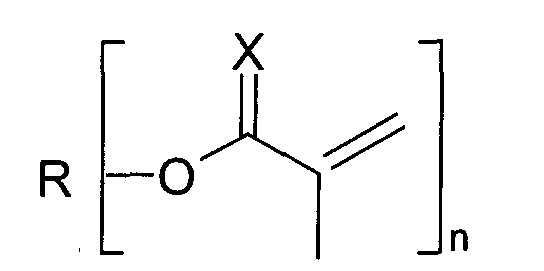
- n
- für eine ganze Zahl von 2 bis 8, vorzugsweise 2 bis 4, steht,
- X
- ggf. für jedes n unterschiedlich, für O und/oder NH steht, und
- R
- ein Kohlenwasserstoff-Rest mit 2 bis 20, vorzugsweise 3 bis 10 Kohlenstoffatomen ist, der ggf. 1 bis 10 Sauerstoffatome in Form von Etherbindungen (-O-) und/oder Hydroxylgruppen (-OH) aufweist.
- Dispersionklebstoff gemäß Anspruch 1, dadurch gekennzeichnet, dass der Dispersionklebstoff einen UV-Initiator (C) enthält, der vorzugsweise dem Klebstoffsystem erst während der Formulierung des Klebstoffsystems zugesetzt wird.
- Dispersionsklebstoff gemäß Anspruch 1 oder 2, dadurch gekennzeichnet, dass der Dispersionsklebstoff den Vernetzer (B) zu 1 bis 10 Gew.-% enthält, bezogen auf die Gesamtzusammensetzung des Dispersionsklebstoffs.
- Dispersionsklebstoff gemäß einem der vorhergehenden Ansprüche, dadurch gekennzeichnet, dass der Vernetzer (B)
- y
- ein ganze Zahl von 1 bis 8, vorzugsweise 1 bis 4,
- R'
- ein C1- bis C8-, vorzugsweise ein C2- bis C4-, Kohlenstoff-Rest und
- z
- ein ganze Zahl von 1 bis 20, vorzugsweise 2 bis 6, ist.
- Dispersionsklebstoff gemäß einem der vorhergehenden Ansprüche, dadurch gekennzeichnet, dass der Vernetzer (B) ein Molgewicht von < 500 g/mol aufweist.
- Dispersionsklebstoff gemäß einem der vorhergehenden Ansprüche, dadurch gekennzeichnet, dass das (Meth)Acrylatcopolymer eine Glasübergangstemperatur von kleiner + 30°C, vorzugsweise -10 bis + 15 °C aufweist.
- Dispersionsklebstoff gemäß einem der vorhergehenden Ansprüche, dadurch gekennzeichnet, dass der Dispersionsklebstoff zu 0,1 bis 1,5 Gew.-% UV-Initiator (C) enthält, bezogen auf die Gesamtzusammensetzung des Dispersionsklebstoffs.
- Dispersionsklebstoff gemäß einem der vorhergehenden Ansprüche, dadurch gekennzeichnet, dass der Dispersionsklebstoff ausbesteht.(A) 76,5 bis 99 Gew.-% einer wässrigen (Meth)Acrylatcopolymerdispersion mit Feststoffanteil von 40 bis 60 Gew%,(B) 1 bis 12 Gew.-%, vorzugsweise 4 bis 10 Gew.-%, des Vernetzers (B),(C) 0,1 bis 1,5 Gew.-%, vorzugsweise 0,2 bis 0,5 Gew.-%, eines UV-Initiators, bezogen auf die Aktivsubstanz, und ggf.(D) 0 bis 10 Gew.-%, vorzugsweise 0,2 bis 4 Gew.-%, weiteren Zusätzen
- Verwendung des Dispersionsklebers gemäß einem der Ansprüche 1 bis 8 als Kaschierklebstoff.
- Verwendung des Dispersionskleber gemäß einem der Ansprüche 1 bis 8 als Kaschierklebstoff zur Glanzfolienkaschierung.
Applications Claiming Priority (2)
| Application Number | Priority Date | Filing Date | Title |
|---|---|---|---|
| DE10152441A DE10152441B4 (de) | 2001-10-26 | 2001-10-26 | Verwendung eines wässrigen Dispersionsklebstoffes als Kaschierklebstoff |
| DE10152441 | 2001-10-26 |
Publications (3)
| Publication Number | Publication Date |
|---|---|
| EP1310536A2 true EP1310536A2 (de) | 2003-05-14 |
| EP1310536A3 EP1310536A3 (de) | 2003-12-03 |
| EP1310536B1 EP1310536B1 (de) | 2006-12-13 |
Family
ID=7703544
Family Applications (1)
| Application Number | Title | Priority Date | Filing Date |
|---|---|---|---|
| EP02022768A Expired - Lifetime EP1310536B1 (de) | 2001-10-26 | 2002-10-11 | Wässriger Dispersionsklebstoff und dessen Verwendung als Kaschierkleber |
Country Status (3)
| Country | Link |
|---|---|
| EP (1) | EP1310536B1 (de) |
| AT (1) | ATE348132T1 (de) |
| DE (2) | DE10152441B4 (de) |
Cited By (1)
| Publication number | Priority date | Publication date | Assignee | Title |
|---|---|---|---|---|
| WO2017122046A1 (en) * | 2016-01-14 | 2017-07-20 | Hewlett-Packard Industrial Printing Ltd | Foil printing |
Family Cites Families (3)
| Publication number | Priority date | Publication date | Assignee | Title |
|---|---|---|---|---|
| US6288190B1 (en) * | 1997-09-20 | 2001-09-11 | Roehm Gmbh | Materials which can be thermally coated with a polymerizable component |
| DE19857203A1 (de) * | 1997-12-23 | 1999-06-24 | Henkel Kgaa | Strahlenhärtbarer Kaschierklebstoff und dessen Verwendung |
| JP4601105B2 (ja) * | 1999-12-24 | 2010-12-22 | スリーエム イノベイティブ プロパティズ カンパニー | 導電性接着剤及び生体電極 |
-
2001
- 2001-10-26 DE DE10152441A patent/DE10152441B4/de not_active Expired - Fee Related
-
2002
- 2002-10-11 AT AT02022768T patent/ATE348132T1/de not_active IP Right Cessation
- 2002-10-11 EP EP02022768A patent/EP1310536B1/de not_active Expired - Lifetime
- 2002-10-11 DE DE50208945T patent/DE50208945D1/de not_active Expired - Fee Related
Cited By (2)
| Publication number | Priority date | Publication date | Assignee | Title |
|---|---|---|---|---|
| WO2017122046A1 (en) * | 2016-01-14 | 2017-07-20 | Hewlett-Packard Industrial Printing Ltd | Foil printing |
| US10618258B2 (en) | 2016-01-14 | 2020-04-14 | Hp Scitex Ltd. | Foil printing |
Also Published As
| Publication number | Publication date |
|---|---|
| DE10152441B4 (de) | 2007-01-04 |
| EP1310536A3 (de) | 2003-12-03 |
| ATE348132T1 (de) | 2007-01-15 |
| DE10152441A1 (de) | 2003-06-12 |
| EP1310536B1 (de) | 2006-12-13 |
| DE50208945D1 (de) | 2007-01-25 |
Similar Documents
| Publication | Publication Date | Title |
|---|---|---|
| EP1037934B1 (de) | Verfahren zur herstellung von folien-verbundmaterialien unter verwendung von klebstoff mit mehrstufiger aushärtung | |
| DE60307113T3 (de) | STRAHLUNGSHûRTBARER, LÖSUNGSMITTELFREIER UND AUFDRUCKBARER VORGûNGER EINES HAFTKLEBEMITTELS | |
| EP2274349B1 (de) | Wässrige polymerdispersionen für haftklebstoffe | |
| EP2619239B1 (de) | Mehrstufige herstellung wässriger haftklebstoffdispersionen für die herstellung von selbstklebenden artikeln | |
| DE1719093B2 (de) | Verwendung eines wäßrigen Latex mit einem Feststoffgehalt von 45 bis 60 Gew.-°/o aus einem Vinylacetat/Äthylen-Copolymeren mit 5 bis 40 Gew.-% Äthylen als Klebemittel | |
| DE2031706A1 (de) | Verfahren zur Herstellung druck empfindlicher Klebstoffe und Klebstruk türen | |
| EP3577165B1 (de) | Einkomponenten-haftklebstoffzusammensetzung mit auf reversibler vernetzung durch metallsalze beruhenden gelgehalt | |
| DE19649383A1 (de) | Kaschierklebstoffe | |
| EP0010690B1 (de) | Photopolymerisierbare Mischung für die Herstellung von Druck- und Reliefformen sowie damit hergestellte Elemente und Reliefformen | |
| EP2730626A1 (de) | Reaktiver Polyolefin-Heissschmelzklebstoff mit geringer Haftung zu nichtbeschichteten Aluminiumwerkzeugen und dessen Verwendung als Kaschier-Hotmelt | |
| WO1998006764A1 (de) | Haftklebstoffe auf basis mehrstufig aufgebauter polymerisate | |
| EP0547507B1 (de) | Wässrige Kontaktkleberdispersionen, Verfahren zu deren Herstellung sowie deren Verwendung | |
| EP1169403B1 (de) | Haftklebstoffe | |
| EP2759578B1 (de) | Reaktive Haftklebstoffprodukte | |
| EP1370590B2 (de) | Verfahren zur herstellung von vernetzten acrylatschmelzhaftklebemassen | |
| EP0352442B1 (de) | Wasserlöslicher Haftkleber auf Polyvinylcarbonsäurebasis seine Herstellung und seine Verwendung | |
| DE202011109020U1 (de) | Verklebtes Verbundsubstrat aus Karton und einem wässrigen Schaumklebstoff | |
| EP0900651B1 (de) | Verwendung wässriger Polyacrylatdispersionen als Kaschierklebstoffe | |
| DE10010983A1 (de) | Wiederabziehbare Schutzfolie | |
| EP1225209B1 (de) | Verwendung von Phosphatgruppen enthaltenden Polymerdispersionen als Klebstoff | |
| DE10152441B4 (de) | Verwendung eines wässrigen Dispersionsklebstoffes als Kaschierklebstoff | |
| DE102005062441B4 (de) | Polymer und ein auf diesem Polymer basierender Strukturklebstoff, sowie Verfahren zur Herstellung dieses Strukturklebstoffs, und dessen Verwendung | |
| EP1578820B1 (de) | Kaschierklebstoff | |
| EP1042422B1 (de) | Strahlenhärtbarer kaschierklebstoff und dessen verwendung | |
| EP1171539B1 (de) | Verfahren zur Verklebung einer UV-durchlässigen Folie mit einem weiteren Substrat |
Legal Events
| Date | Code | Title | Description |
|---|---|---|---|
| PUAI | Public reference made under article 153(3) epc to a published international application that has entered the european phase |
Free format text: ORIGINAL CODE: 0009012 |
|
| AK | Designated contracting states |
Designated state(s): AT BE BG CH CY CZ DE DK EE ES FI FR GB GR IE IT LI LU MC NL PT SE SK TR |
|
| AX | Request for extension of the european patent |
Extension state: AL LT LV MK RO SI |
|
| PUAL | Search report despatched |
Free format text: ORIGINAL CODE: 0009013 |
|
| AK | Designated contracting states |
Kind code of ref document: A3 Designated state(s): AT BE BG CH CY CZ DE DK EE ES FI FR GB GR IE IT LI LU MC NL PT SE SK TR |
|
| AX | Request for extension of the european patent |
Extension state: AL LT LV MK RO SI |
|
| 17P | Request for examination filed |
Effective date: 20040327 |
|
| AKX | Designation fees paid |
Designated state(s): AT BE BG CH CY CZ DE DK EE ES FI FR GB GR IE IT LI LU MC NL PT SE SK TR |
|
| 17Q | First examination report despatched |
Effective date: 20041126 |
|
| GRAP | Despatch of communication of intention to grant a patent |
Free format text: ORIGINAL CODE: EPIDOSNIGR1 |
|
| GRAS | Grant fee paid |
Free format text: ORIGINAL CODE: EPIDOSNIGR3 |
|
| GRAA | (expected) grant |
Free format text: ORIGINAL CODE: 0009210 |
|
| AK | Designated contracting states |
Kind code of ref document: B1 Designated state(s): AT BE BG CH CY CZ DE DK EE ES FI FR GB GR IE IT LI LU MC NL PT SE SK TR |
|
| PG25 | Lapsed in a contracting state [announced via postgrant information from national office to epo] |
Ref country code: IT Free format text: LAPSE BECAUSE OF FAILURE TO SUBMIT A TRANSLATION OF THE DESCRIPTION OR TO PAY THE FEE WITHIN THE PRESCRIBED TIME-LIMIT;WARNING: LAPSES OF ITALIAN PATENTS WITH EFFECTIVE DATE BEFORE 2007 MAY HAVE OCCURRED AT ANY TIME BEFORE 2007. THE CORRECT EFFECTIVE DATE MAY BE DIFFERENT FROM THE ONE RECORDED. Effective date: 20061213 Ref country code: SK Free format text: LAPSE BECAUSE OF FAILURE TO SUBMIT A TRANSLATION OF THE DESCRIPTION OR TO PAY THE FEE WITHIN THE PRESCRIBED TIME-LIMIT Effective date: 20061213 Ref country code: FI Free format text: LAPSE BECAUSE OF FAILURE TO SUBMIT A TRANSLATION OF THE DESCRIPTION OR TO PAY THE FEE WITHIN THE PRESCRIBED TIME-LIMIT Effective date: 20061213 Ref country code: IE Free format text: LAPSE BECAUSE OF FAILURE TO SUBMIT A TRANSLATION OF THE DESCRIPTION OR TO PAY THE FEE WITHIN THE PRESCRIBED TIME-LIMIT Effective date: 20061213 Ref country code: NL Free format text: LAPSE BECAUSE OF FAILURE TO SUBMIT A TRANSLATION OF THE DESCRIPTION OR TO PAY THE FEE WITHIN THE PRESCRIBED TIME-LIMIT Effective date: 20061213 Ref country code: CZ Free format text: LAPSE BECAUSE OF FAILURE TO SUBMIT A TRANSLATION OF THE DESCRIPTION OR TO PAY THE FEE WITHIN THE PRESCRIBED TIME-LIMIT Effective date: 20061213 Ref country code: DK Free format text: LAPSE BECAUSE OF FAILURE TO SUBMIT A TRANSLATION OF THE DESCRIPTION OR TO PAY THE FEE WITHIN THE PRESCRIBED TIME-LIMIT Effective date: 20061213 |
|
| REG | Reference to a national code |
Ref country code: GB Ref legal event code: FG4D Free format text: NOT ENGLISH |
|
| REG | Reference to a national code |
Ref country code: CH Ref legal event code: EP |
|
| REG | Reference to a national code |
Ref country code: IE Ref legal event code: FG4D Free format text: LANGUAGE OF EP DOCUMENT: GERMAN |
|
| REF | Corresponds to: |
Ref document number: 50208945 Country of ref document: DE Date of ref document: 20070125 Kind code of ref document: P |
|
| PLBI | Opposition filed |
Free format text: ORIGINAL CODE: 0009260 |
|
| PG25 | Lapsed in a contracting state [announced via postgrant information from national office to epo] |
Ref country code: SE Free format text: LAPSE BECAUSE OF FAILURE TO SUBMIT A TRANSLATION OF THE DESCRIPTION OR TO PAY THE FEE WITHIN THE PRESCRIBED TIME-LIMIT Effective date: 20070313 Ref country code: BG Free format text: LAPSE BECAUSE OF FAILURE TO SUBMIT A TRANSLATION OF THE DESCRIPTION OR TO PAY THE FEE WITHIN THE PRESCRIBED TIME-LIMIT Effective date: 20070313 |
|
| 26 | Opposition filed |
Opponent name: BASF AKTIENGESELLSCHAFT Effective date: 20070207 |
|
| PG25 | Lapsed in a contracting state [announced via postgrant information from national office to epo] |
Ref country code: ES Free format text: LAPSE BECAUSE OF FAILURE TO SUBMIT A TRANSLATION OF THE DESCRIPTION OR TO PAY THE FEE WITHIN THE PRESCRIBED TIME-LIMIT Effective date: 20070324 |
|
| NLR1 | Nl: opposition has been filed with the epo |
Opponent name: BASF AKTIENGESELLSCHAFT |
|
| PG25 | Lapsed in a contracting state [announced via postgrant information from national office to epo] |
Ref country code: PT Free format text: LAPSE BECAUSE OF FAILURE TO SUBMIT A TRANSLATION OF THE DESCRIPTION OR TO PAY THE FEE WITHIN THE PRESCRIBED TIME-LIMIT Effective date: 20070514 |
|
| NLV1 | Nl: lapsed or annulled due to failure to fulfill the requirements of art. 29p and 29m of the patents act | ||
| GBV | Gb: ep patent (uk) treated as always having been void in accordance with gb section 77(7)/1977 [no translation filed] |
Effective date: 20061213 |
|
| EN | Fr: translation not filed | ||
| PLAX | Notice of opposition and request to file observation + time limit sent |
Free format text: ORIGINAL CODE: EPIDOSNOBS2 |
|
| PG25 | Lapsed in a contracting state [announced via postgrant information from national office to epo] |
Ref country code: GB Free format text: LAPSE BECAUSE OF FAILURE TO SUBMIT A TRANSLATION OF THE DESCRIPTION OR TO PAY THE FEE WITHIN THE PRESCRIBED TIME-LIMIT Effective date: 20061213 |
|
| PLAF | Information modified related to communication of a notice of opposition and request to file observations + time limit |
Free format text: ORIGINAL CODE: EPIDOSCOBS2 |
|
| BERE | Be: lapsed |
Owner name: DYNEA MOERS G.M.B.H. Effective date: 20071031 |
|
| PG25 | Lapsed in a contracting state [announced via postgrant information from national office to epo] |
Ref country code: GR Free format text: LAPSE BECAUSE OF FAILURE TO SUBMIT A TRANSLATION OF THE DESCRIPTION OR TO PAY THE FEE WITHIN THE PRESCRIBED TIME-LIMIT Effective date: 20070314 Ref country code: FR Free format text: LAPSE BECAUSE OF FAILURE TO SUBMIT A TRANSLATION OF THE DESCRIPTION OR TO PAY THE FEE WITHIN THE PRESCRIBED TIME-LIMIT Effective date: 20070803 |
|
| PLBB | Reply of patent proprietor to notice(s) of opposition received |
Free format text: ORIGINAL CODE: EPIDOSNOBS3 |
|
| PG25 | Lapsed in a contracting state [announced via postgrant information from national office to epo] |
Ref country code: MC Free format text: LAPSE BECAUSE OF NON-PAYMENT OF DUE FEES Effective date: 20071031 |
|
| REG | Reference to a national code |
Ref country code: CH Ref legal event code: PL |
|
| PLAB | Opposition data, opponent's data or that of the opponent's representative modified |
Free format text: ORIGINAL CODE: 0009299OPPO |
|
| PG25 | Lapsed in a contracting state [announced via postgrant information from national office to epo] |
Ref country code: CH Free format text: LAPSE BECAUSE OF NON-PAYMENT OF DUE FEES Effective date: 20071031 Ref country code: LI Free format text: LAPSE BECAUSE OF NON-PAYMENT OF DUE FEES Effective date: 20071031 |
|
| PGFP | Annual fee paid to national office [announced via postgrant information from national office to epo] |
Ref country code: DE Payment date: 20080417 Year of fee payment: 6 |
|
| PG25 | Lapsed in a contracting state [announced via postgrant information from national office to epo] |
Ref country code: BE Free format text: LAPSE BECAUSE OF NON-PAYMENT OF DUE FEES Effective date: 20071031 |
|
| PG25 | Lapsed in a contracting state [announced via postgrant information from national office to epo] |
Ref country code: FR Free format text: LAPSE BECAUSE OF FAILURE TO SUBMIT A TRANSLATION OF THE DESCRIPTION OR TO PAY THE FEE WITHIN THE PRESCRIBED TIME-LIMIT Effective date: 20061213 |
|
| PG25 | Lapsed in a contracting state [announced via postgrant information from national office to epo] |
Ref country code: EE Free format text: LAPSE BECAUSE OF FAILURE TO SUBMIT A TRANSLATION OF THE DESCRIPTION OR TO PAY THE FEE WITHIN THE PRESCRIBED TIME-LIMIT Effective date: 20061213 |
|
| PG25 | Lapsed in a contracting state [announced via postgrant information from national office to epo] |
Ref country code: AT Free format text: LAPSE BECAUSE OF NON-PAYMENT OF DUE FEES Effective date: 20071011 |
|
| PG25 | Lapsed in a contracting state [announced via postgrant information from national office to epo] |
Ref country code: DE Free format text: LAPSE BECAUSE OF NON-PAYMENT OF DUE FEES Effective date: 20090501 Ref country code: LU Free format text: LAPSE BECAUSE OF NON-PAYMENT OF DUE FEES Effective date: 20071011 Ref country code: CY Free format text: LAPSE BECAUSE OF FAILURE TO SUBMIT A TRANSLATION OF THE DESCRIPTION OR TO PAY THE FEE WITHIN THE PRESCRIBED TIME-LIMIT Effective date: 20061213 |
|
| PG25 | Lapsed in a contracting state [announced via postgrant information from national office to epo] |
Ref country code: TR Free format text: LAPSE BECAUSE OF FAILURE TO SUBMIT A TRANSLATION OF THE DESCRIPTION OR TO PAY THE FEE WITHIN THE PRESCRIBED TIME-LIMIT Effective date: 20061213 |
|
| PLBD | Termination of opposition procedure: decision despatched |
Free format text: ORIGINAL CODE: EPIDOSNOPC1 |
|
| PLBM | Termination of opposition procedure: date of legal effect published |
Free format text: ORIGINAL CODE: 0009276 |
|
| STAA | Information on the status of an ep patent application or granted ep patent |
Free format text: STATUS: OPPOSITION PROCEDURE CLOSED |
|
| 27C | Opposition proceedings terminated |
Effective date: 20100221 |