EP1311112A2 - Digitale Bildoptimierung - Google Patents
Digitale Bildoptimierung Download PDFInfo
- Publication number
- EP1311112A2 EP1311112A2 EP02257133A EP02257133A EP1311112A2 EP 1311112 A2 EP1311112 A2 EP 1311112A2 EP 02257133 A EP02257133 A EP 02257133A EP 02257133 A EP02257133 A EP 02257133A EP 1311112 A2 EP1311112 A2 EP 1311112A2
- Authority
- EP
- European Patent Office
- Prior art keywords
- image
- images
- transformations
- printed
- library
- Prior art date
- Legal status (The legal status is an assumption and is not a legal conclusion. Google has not performed a legal analysis and makes no representation as to the accuracy of the status listed.)
- Withdrawn
Links
- 238000005457 optimization Methods 0.000 title description 2
- 230000009466 transformation Effects 0.000 claims abstract description 57
- 238000000844 transformation Methods 0.000 claims abstract description 31
- 238000007639 printing Methods 0.000 claims abstract description 30
- 238000000034 method Methods 0.000 claims abstract description 29
- 230000033458 reproduction Effects 0.000 claims abstract 6
- 238000011179 visual inspection Methods 0.000 claims abstract 3
- 238000012545 processing Methods 0.000 claims description 11
- 230000000007 visual effect Effects 0.000 claims 1
- 239000000976 ink Substances 0.000 description 29
- 239000000758 substrate Substances 0.000 description 12
- 238000012546 transfer Methods 0.000 description 12
- 230000008569 process Effects 0.000 description 11
- 238000012937 correction Methods 0.000 description 7
- 238000013501 data transformation Methods 0.000 description 6
- 239000003086 colorant Substances 0.000 description 4
- 238000012986 modification Methods 0.000 description 4
- 230000004048 modification Effects 0.000 description 4
- 238000013459 approach Methods 0.000 description 3
- 230000008901 benefit Effects 0.000 description 3
- 238000001035 drying Methods 0.000 description 3
- 230000004075 alteration Effects 0.000 description 2
- 238000010923 batch production Methods 0.000 description 2
- 230000008859 change Effects 0.000 description 2
- 230000000694 effects Effects 0.000 description 2
- 238000007641 inkjet printing Methods 0.000 description 2
- 238000005259 measurement Methods 0.000 description 2
- 238000012935 Averaging Methods 0.000 description 1
- 238000011088 calibration curve Methods 0.000 description 1
- 238000012512 characterization method Methods 0.000 description 1
- 239000000470 constituent Substances 0.000 description 1
- 239000013068 control sample Substances 0.000 description 1
- 238000007796 conventional method Methods 0.000 description 1
- 230000001419 dependent effect Effects 0.000 description 1
- 238000010586 diagram Methods 0.000 description 1
- 239000006185 dispersion Substances 0.000 description 1
- 238000003384 imaging method Methods 0.000 description 1
- 238000007689 inspection Methods 0.000 description 1
- 238000007726 management method Methods 0.000 description 1
- 238000004519 manufacturing process Methods 0.000 description 1
- 238000007645 offset printing Methods 0.000 description 1
- 230000004044 response Effects 0.000 description 1
- 238000012552 review Methods 0.000 description 1
- 239000000523 sample Substances 0.000 description 1
- 238000005549 size reduction Methods 0.000 description 1
- 238000012360 testing method Methods 0.000 description 1
Images



Classifications
-
- H—ELECTRICITY
- H04—ELECTRIC COMMUNICATION TECHNIQUE
- H04N—PICTORIAL COMMUNICATION, e.g. TELEVISION
- H04N1/00—Scanning, transmission or reproduction of documents or the like, e.g. facsimile transmission; Details thereof
- H04N1/46—Colour picture communication systems
- H04N1/56—Processing of colour picture signals
- H04N1/60—Colour correction or control
- H04N1/6002—Corrections within particular colour systems
- H04N1/6008—Corrections within particular colour systems with primary colour signals, e.g. RGB or CMY(K)
-
- H—ELECTRICITY
- H04—ELECTRIC COMMUNICATION TECHNIQUE
- H04N—PICTORIAL COMMUNICATION, e.g. TELEVISION
- H04N1/00—Scanning, transmission or reproduction of documents or the like, e.g. facsimile transmission; Details thereof
- H04N1/40—Picture signal circuits
- H04N1/407—Control or modification of tonal gradation or of extreme levels, e.g. background level
Definitions
- the present invention relates to image processing, and, more particularly, to correcting the printed color and tone scale of a library of similar digital images.
- Color and tone scale correction are, therefore, often necessary to obtain acceptable image quality of printed images.
- Methods of correcting color and tone of multiple color printing systems usually involves some trial and error. Correlation between the resultant image quality from the printer and the data or process modifications that caused the deviations in quality must be established.
- High speed digital inkjet printing systems apply the ink directly to the substrate as directed by the input data.
- the application of a linear gradation of ink to a substrate does not result in the appearance of a linear gradation in tone.
- the image data must be corrected so that tone linearity can be achieved on a particular substrate.
- printing system configurations and substrates differ in acceptable maximum ink limit. Problems in image quality, such as edged definition and loss of detail in the shadow areas, can result. Image quality and ink drying time varies significantly with the substrate. As conditions of the printing system and substrate type change regularly, it is often necessary to determine new data transformations that redefine the tone curve shape and upper ink limit for each ink in the system.
- the present invention relates to a determination of an appropriate data transformation to be applied to an image library.
- a number of predetermined transformations are applied to a page of sample image data.
- the printed output is examined to determine which transformation most closely approximates linear tone and optimal print quality for each type of graphics and text. From these master curve selections, unique curves for each primary ink in the system can be derived and applied to the image data. Further, any transformation function can be applied to a representative image within an image library to identify the effects on the printed output.
- a single image representative of a library of images is scaled down in size so that a number of them will fit onto a single printed page. Neighboring images on the page each represent different modifications to the image data relative to the control sample.
- a method for determining appropriate data transformations to be applied to an image library by evaluating the print quality of a single representative image in the library.
- a single image is selected from a library of similar images. This image is optionally resized so that multiples of the image will fit on a single page.
- Each image is manipulated be a fixed or a user defined set of transformations.
- the different versions of the same image are processed for printing. The printed results are evaluated side by side by the user, to determine the preferred printed result.
- Each of the different versions of the same image is labeled with a letter and a number that identifies the transformation applied to that image.
- the user inputs the code letter and number back into the same software that generated the multiple variations of the selected image.
- the software outputs the appropriate transformation, which is usually then input into the system RIP, that is to be used on the rest of the images in the library.
- the suitable transformations used on the single image are presumed to be appropriate on the rest of the image in the library.
- the present invention identifies a simplified method for determining an appropriate transformation for application to images to be printed on a given system and substrate.
- the present invention further permits determination of the most appropriate ink loading for text printing. It is not uncommon to have a separate data transformation specifically for text data in order to specifically optimize the quality of text.
- the system described herein allows determination of both the maximum graphics ink limit, as well as, the appropriate text printing level. Further, the present invention can be extended to identify the optimum curve shape and ink limit for specific types of graphics, such as business graphics, photographs, line art, etc.
- the output of this process is the determination of one or more one dimensional transformations of the cyan, magenta, yellow, black (CMYK) input data to achieve linear tone response on the printed image.
- a single image from a library is scaled in size so that multiple versions of this image will fit on a single or multiple printed pages.
- the image size can be auto scaled for printing, without changing the characteristics of the image.
- the resized images can be auto positioned on the substrate.
- a series of related transformations are applied to individual representations of the image and printed along side of the original control image.
- a number of processing parameters can be optimized by proper selection of the desired image quality. These parameters include, but are not limited to, tone scale correction, color correction in a multicolor system, optimized dithering algorithm, and maximum ink limit.
- the test page defined by the present invention contains a series of images and associated codes. The codes identify the settings for image transformation. By visually examining the images against a defined set of criteria, the proper image manipulations can be identified. These transformations can then be applied to the entire image library. Printer specific influences on image quality, such as drying power and paper selection, are automatically accounted for through this closed loop system.
- the present invention addresses these existing problems and difficulties by creating a simplified approach to image management by allowing an entire series of use selected transfer functions to be applied to a representative image in a library of similar character.
- the printed results from these multiple transformations are presented on paper for review by the press operator.
- the unaltered image data is printed at the same time for reference comparisons to the transformed data.
- the desired transform can be identified by a simple code name. This name can be input into commercially available, modified, or developed software that creates the appropriate transformation and/or look-up tables to be applied to the remainder of the image library data.
- Fig. 1 an exemplary image library 10, of images X, X 1 , X n-1 and X n .
- the images in the library are preferably created through a similar process and under similar conditions, such as via a scanner or a digital camera.
- the image processing for all images in the library is the same, with all of the pictures being of the same resolution and in the same color space.
- the images typically follow the same workflow of batch process manipulation, RIPping and, eventually, printing. It may be a group of scanned data from a singular scanning device, or it may be a set of pictures taken with a digital camera under similar lighting conditions. Alternatively, it may be a set of photographs which have been digitized by a fixed processes and stored on a CD. In any case, the files in the library all exhibit similar characteristics in terms of color saturation, hue, edge acuity, and so forth.
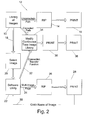
- Fig. 2 The process of the present invention is shown schematically in Fig. 2.
- the library of images 10 from Fig. 1 is used.
- One possible operation is simply to print them as they are shown. This is indicated as an uncorrected path to RIP 14 and a print operation at block 16.
- the uncorrected images have not been optimized for imaging on a particular marking device, such as a continuous inkjet multi-color printing press.
- a user may select an optimization process along path 18.
- a single representative image is selected at block 20 from the library 10. This image in input into software that will perform a transformation.
- different tone scale correction curves are applied to one or more of the primary inks in the system.
- different manipulations can be performed. For example, different upper ink limits can be applied to each image.
- the software at block 22 has a simple user interface that allows browser selection of the appropriate image from the library targeted for manipulation.
- the software allows for the selected image to be scaled down in size.
- a different transformation is then applied to each one of the smaller images.
- the transformations are stored in the form of LUT's or Look-up tables.
- a different table is applied to each image.
- the tables are tone scale correction transformations.
- the tables are stored in the same directory as the program, and the program automatically applies each one of the stored transformations to the selected image. If the user does not have a set of transformations of their own, the software can apply a set of default transformations to the selected image. If the user knows what transformation was applied to the data with the desired result, the user can apply the same transformations to the remainder of the image library manually, without going back into the program that created the full array of modified images.
- the user interface allows the user to determine whether to apply these transformations to each color plane of data (CMYK) or just to certain color data. For example, if an image is too green, based on the amount of cyan and yellow, the user may want to apply lower ink limits only to those colors. If the entire image is under exposed, the user may want to darken all color planes of data at the same time.
- the existing software accommodates these manipulations.
- a set of image modifications is selected.
- the selection of image alterations is limited only by the available software to generate these functions.
- One skilled in the art can conceive of a number of such functions that are typically applied at one time or another in a digital image workflow.
- tone scale linearization functions will be applied to the selected image via the software.
- the tone scale calibration curve can be used to restrict ink loading on the paper of the individual primary inks in the system. It is possible to identify a range of upper ink limits to cover the optimum selection for a number of paper stocks. Combining these variables allows one to develop a predetermined set of curves of which one of the set will be appropriate for a specific ink/substrate combination.
- the user first decides on a mode of operation. For example, the user can operate globally to adjust the continuous tone image, and thereby affect all of the colors simultaneously. Alternatively, the user can operate on individual color planes of the image, and thereby shift the color balance of the image.
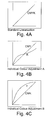
- These transformations are shown schematically in Figs. 3A, 3B, 3C and 4A, 4B, 4C, respectively. The type of transformation and its magnitude is determined by the condition of the original image.
- Fig. 3A is a standard linearization
- Figs. 3B and 3C are global adjustment illustrations.
- Fig. 4A is a standard linearization
- Figs. 4B and 4C are individual color adjustment representations.
- the individually manipulated and scaled images are placed on a page 40 by the software, as shown in Fig. 5.
- Each picture on the page has been manipulated with a different function and placed in a grid pattern, along with the original picture.
- a name (F1, F2, F3, F4, F5) is assigned to each image in the library of images through the software utility. These names are arbitrary, but could accurately describe the individual transformation applied to each image.
- RIP 26 After the multitrial job along path 24 of Fig. 2 is prepared, it is further processed to conventional means by the RIP 26 to create a binary digital file suitable for printing at 28.
- RIP's have the capability to further manipulate the image data prior to formatting for the printer. In this case, it is important that the image data pass through the RIP 26 without further color manipulation.
- the formatted trial job is imaged on the press at block 28 at the same conditions intended for the actual job. Parameters such as paper selection, print speed, dryer temperature, duplex selection, etc., are examples of control variables for the trial job run.
- the output is reviewed and one picture is selected from the group that most accurately represents the desired image quality.
- the associated code name of this image is sent via path 30 to be entered back into the software 22 that created the trial job.
- the code name, supplied in Fig. 5, is identified by the software at 22 and the appropriate transfer function along 32 is output for operation on the entire image library 10 for which the trial job at path 24 was created.
- the selected image library transformation of path 32 is then applied to the library of images directly in the RIP to format the data for the printer, or in a separate process at block 34 prior to RIPPING at block 36.
- the output of the RIP 36 is a transformed image library print job optimized for printing at 38 on the press.
- applications such as direct mail and catalogs do not print an entire image library exclusively.
- the library of images is one set of elements to be combined on composed pages made up of variable and fixed information containing text, line art and graphics.
- Automatic code naming can be used to identify the selected transfer function .
- integrated software can be used to create the job for press, based upon user selected transfer functions.
- An integrated package can output the selected transfer function for further processing of the entire image library.
- the integrated package can automatically apply transfer functions to the image library and create the job file.
Landscapes
- Engineering & Computer Science (AREA)
- Multimedia (AREA)
- Signal Processing (AREA)
- Image Processing (AREA)
- Record Information Processing For Printing (AREA)
- Fax Reproducing Arrangements (AREA)
- Facsimile Image Signal Circuits (AREA)
- Color Image Communication Systems (AREA)
- Ink Jet (AREA)
- Color, Gradation (AREA)
Applications Claiming Priority (2)
| Application Number | Priority Date | Filing Date | Title |
|---|---|---|---|
| US7972 | 2001-11-13 | ||
| US10/007,972 US20040125388A1 (en) | 2001-11-13 | 2001-11-13 | Digital image optimization through multiple on-press selections |
Publications (2)
| Publication Number | Publication Date |
|---|---|
| EP1311112A2 true EP1311112A2 (de) | 2003-05-14 |
| EP1311112A3 EP1311112A3 (de) | 2004-08-25 |
Family
ID=21729111
Family Applications (1)
| Application Number | Title | Priority Date | Filing Date |
|---|---|---|---|
| EP02257133A Withdrawn EP1311112A3 (de) | 2001-11-13 | 2002-10-15 | Digitale Bildoptimierung |
Country Status (3)
| Country | Link |
|---|---|
| US (1) | US20040125388A1 (de) |
| EP (1) | EP1311112A3 (de) |
| JP (1) | JP2003248572A (de) |
Families Citing this family (7)
| Publication number | Priority date | Publication date | Assignee | Title |
|---|---|---|---|---|
| JP2003219176A (ja) * | 2002-01-25 | 2003-07-31 | Canon Inc | 画像処理装置、画像処理システム、画像処理方法、記憶媒体、及びプログラム |
| US6803933B1 (en) * | 2003-06-16 | 2004-10-12 | Hewlett-Packard Development Company, L.P. | Systems and methods for dot gain determination and dot gain based printing |
| US7605959B2 (en) | 2005-01-05 | 2009-10-20 | The Ackley Martinez Company | System and method of color image transformation |
| US7835036B2 (en) * | 2005-05-02 | 2010-11-16 | Xerox Corporation | Method to automatically identify and compensate for substrate differences using a sensor |
| US20060250434A1 (en) * | 2005-05-05 | 2006-11-09 | Smith David E | Determining an energy delivered to a fluid |
| US7496414B2 (en) * | 2006-09-13 | 2009-02-24 | Rockwell Automation Technologies, Inc. | Dynamic controller utilizing a hybrid model |
| US8687236B2 (en) * | 2009-01-22 | 2014-04-01 | Hewlett-Packard Development Company, L.P. | Ink restriction determination |
Family Cites Families (12)
| Publication number | Priority date | Publication date | Assignee | Title |
|---|---|---|---|---|
| US5283671A (en) * | 1991-02-20 | 1994-02-01 | Stewart John R | Method and apparatus for converting RGB digital data to optimized CMYK digital data |
| US5495539A (en) * | 1993-09-02 | 1996-02-27 | Sieverding; David L. | Image production using multidimensional selection of image transformations |
| US5870503A (en) * | 1994-10-20 | 1999-02-09 | Minolta Co., Ltd. | Image processing apparatus using error diffusion technique |
| US5717838A (en) * | 1995-10-31 | 1998-02-10 | Seiko Epson Corporation | Computer calibration of a color print image using successive refinement |
| US5995714A (en) * | 1996-02-16 | 1999-11-30 | Eastman Kodak Company | Method for printer calibration |
| US6219154B1 (en) * | 1997-02-13 | 2001-04-17 | David J. Romano | Exposure control technique for imagesetting applications |
| US5999175A (en) * | 1997-07-03 | 1999-12-07 | Hewlett-Packard Co. | User interface for selecting scanner sensitivity |
| US6473199B1 (en) * | 1998-12-18 | 2002-10-29 | Eastman Kodak Company | Correcting exposure and tone scale of digital images captured by an image capture device |
| JP2000255115A (ja) * | 1999-03-05 | 2000-09-19 | Sony Corp | プリンタ装置及びその印画媒体並びに印画方法 |
| JP2001047665A (ja) * | 1999-05-28 | 2001-02-20 | Canon Inc | 画像処理方法、装置および記録媒体 |
| US6965462B1 (en) * | 2000-05-01 | 2005-11-15 | Xerox Corporation | Increased temporal flexibility when performing/applying/reverting calibration for a printer output device |
| US20030011790A1 (en) * | 2001-07-05 | 2003-01-16 | Eastman Kodak Company | Correcting exposure and tone scale of digital images using a plurality of transforms |
-
2001
- 2001-11-13 US US10/007,972 patent/US20040125388A1/en not_active Abandoned
-
2002
- 2002-10-15 EP EP02257133A patent/EP1311112A3/de not_active Withdrawn
- 2002-11-12 JP JP2002328456A patent/JP2003248572A/ja active Pending
Also Published As
| Publication number | Publication date |
|---|---|
| JP2003248572A (ja) | 2003-09-05 |
| EP1311112A3 (de) | 2004-08-25 |
| US20040125388A1 (en) | 2004-07-01 |
Similar Documents
| Publication | Publication Date | Title |
|---|---|---|
| US5528386A (en) | Color printer calibration architecture | |
| US5416613A (en) | Color printer calibration test pattern | |
| US5471324A (en) | Color printer calibration with improved color mapping linearity | |
| US7319547B2 (en) | Color printer calibration | |
| US6360007B1 (en) | Dynamic optimized color lut transformations based upon image requirements | |
| EP0854638B1 (de) | Verfahren zur kontinuierlichen inkrementalen Farbkalibrierung an der Ausgabeseite von Farbkopierern | |
| EP1047263B1 (de) | Genaue Farbbildreproduktion von Farben innerhalb des Farbtonbereichs und verbesserter Farbbildreproduktion von Farben ausserhalb des Farbtonbereichs | |
| CA2345908C (en) | On-line calibration system for a dynamically varying color marking device | |
| EP0398502B1 (de) | Verfahren und Vorrichtung zum Farbabgleich zwischen einem abgetasteten Testbild und dem zugehörigen Ausdruck eines Farbdruckers, mittels einer geschlossenen Regelschleife | |
| JP4976348B2 (ja) | 印刷システムのカラー印刷ジョブ出力のマッチング | |
| US7307755B2 (en) | Method for correcting unadjusted printing data on the basis of colormetrically measured reference sheet | |
| JPH07254988A (ja) | カラー画像処理システムおよびそのデータ補正方式 | |
| US7400335B2 (en) | Method for printing a halftone digital image | |
| US7298531B2 (en) | Digital image optimization incorporating paper evaluation | |
| US7826093B2 (en) | Scan-to-print color rendering | |
| US11962738B2 (en) | Method for performing transformations of color data | |
| EP1311112A2 (de) | Digitale Bildoptimierung | |
| US20050041038A1 (en) | Lookup table for adjusting dot-gain on bitmap files based on average number of dots | |
| US20050280870A1 (en) | Method for making a dot for dot proof | |
| Rosen et al. | Answering Hunt's web shopping challenge: Spectral color management for a virtual swatch | |
| EP1596576A2 (de) | Methode zur Charakterisierung eines geschlossenen Regelkreises | |
| JP2003011397A (ja) | プリンタ媒体とインキング強度との適合性を決定する方法 | |
| WO2015120896A1 (en) | A printer remodelling method | |
| EP1596575A2 (de) | Verfahren zur Erstellung eines punktgetreuen Abzugs | |
| Sigg | Optimizing special images for print |
Legal Events
| Date | Code | Title | Description |
|---|---|---|---|
| PUAI | Public reference made under article 153(3) epc to a published international application that has entered the european phase |
Free format text: ORIGINAL CODE: 0009012 |
|
| AK | Designated contracting states |
Designated state(s): AT BE BG CH CY CZ DE DK EE ES FI FR GB GR IE IT LI LU MC NL PT SE SK TR |
|
| AX | Request for extension of the european patent |
Extension state: AL LT LV MK RO SI |
|
| RAP1 | Party data changed (applicant data changed or rights of an application transferred) |
Owner name: EASTMAN KODAK COMPANY |
|
| PUAL | Search report despatched |
Free format text: ORIGINAL CODE: 0009013 |
|
| AK | Designated contracting states |
Kind code of ref document: A3 Designated state(s): AT BE BG CH CY CZ DE DK EE ES FI FR GB GR IE IT LI LU MC NL PT SE SK TR |
|
| AX | Request for extension of the european patent |
Extension state: AL LT LV MK RO SI |
|
| 17P | Request for examination filed |
Effective date: 20050131 |
|
| AKX | Designation fees paid |
Designated state(s): DE FR GB |
|
| RBV | Designated contracting states (corrected) |
Designated state(s): DE FR GB |
|
| STAA | Information on the status of an ep patent application or granted ep patent |
Free format text: STATUS: THE APPLICATION IS DEEMED TO BE WITHDRAWN |
|
| 18D | Application deemed to be withdrawn |
Effective date: 20060106 |