EP1311125A2 - Système et méthode de communication de données, appareil et méthode de transmission de données, appareil de réception de données, méthode de traitement de données recues et programme d'ordinateur - Google Patents
Système et méthode de communication de données, appareil et méthode de transmission de données, appareil de réception de données, méthode de traitement de données recues et programme d'ordinateur Download PDFInfo
- Publication number
- EP1311125A2 EP1311125A2 EP02025197A EP02025197A EP1311125A2 EP 1311125 A2 EP1311125 A2 EP 1311125A2 EP 02025197 A EP02025197 A EP 02025197A EP 02025197 A EP02025197 A EP 02025197A EP 1311125 A2 EP1311125 A2 EP 1311125A2
- Authority
- EP
- European Patent Office
- Prior art keywords
- packet
- data
- priority
- scalable
- encoded data
- Prior art date
- Legal status (The legal status is an assumption and is not a legal conclusion. Google has not performed a legal analysis and makes no representation as to the accuracy of the status listed.)
- Withdrawn
Links
Images









Classifications
-
- H—ELECTRICITY
- H04—ELECTRIC COMMUNICATION TECHNIQUE
- H04N—PICTORIAL COMMUNICATION, e.g. TELEVISION
- H04N21/00—Selective content distribution, e.g. interactive television or video on demand [VOD]
- H04N21/20—Servers specifically adapted for the distribution of content, e.g. VOD servers; Operations thereof
- H04N21/23—Processing of content or additional data; Elementary server operations; Server middleware
- H04N21/234—Processing of video elementary streams, e.g. splicing of video streams or manipulating encoded video stream scene graphs
- H04N21/2343—Processing of video elementary streams, e.g. splicing of video streams or manipulating encoded video stream scene graphs involving reformatting operations of video signals for distribution or compliance with end-user requests or end-user device requirements
- H04N21/234327—Processing of video elementary streams, e.g. splicing of video streams or manipulating encoded video stream scene graphs involving reformatting operations of video signals for distribution or compliance with end-user requests or end-user device requirements by decomposing into layers, e.g. base layer and one or more enhancement layers
-
- H—ELECTRICITY
- H04—ELECTRIC COMMUNICATION TECHNIQUE
- H04N—PICTORIAL COMMUNICATION, e.g. TELEVISION
- H04N19/00—Methods or arrangements for coding, decoding, compressing or decompressing digital video signals
- H04N19/60—Methods or arrangements for coding, decoding, compressing or decompressing digital video signals using transform coding
- H04N19/63—Methods or arrangements for coding, decoding, compressing or decompressing digital video signals using transform coding using sub-band based transform, e.g. wavelets
-
- H—ELECTRICITY
- H04—ELECTRIC COMMUNICATION TECHNIQUE
- H04N—PICTORIAL COMMUNICATION, e.g. TELEVISION
- H04N21/00—Selective content distribution, e.g. interactive television or video on demand [VOD]
- H04N21/20—Servers specifically adapted for the distribution of content, e.g. VOD servers; Operations thereof
- H04N21/23—Processing of content or additional data; Elementary server operations; Server middleware
- H04N21/234—Processing of video elementary streams, e.g. splicing of video streams or manipulating encoded video stream scene graphs
- H04N21/2343—Processing of video elementary streams, e.g. splicing of video streams or manipulating encoded video stream scene graphs involving reformatting operations of video signals for distribution or compliance with end-user requests or end-user device requirements
- H04N21/234354—Processing of video elementary streams, e.g. splicing of video streams or manipulating encoded video stream scene graphs involving reformatting operations of video signals for distribution or compliance with end-user requests or end-user device requirements by altering signal-to-noise ratio parameters, e.g. requantization
-
- H—ELECTRICITY
- H04—ELECTRIC COMMUNICATION TECHNIQUE
- H04N—PICTORIAL COMMUNICATION, e.g. TELEVISION
- H04N21/00—Selective content distribution, e.g. interactive television or video on demand [VOD]
- H04N21/20—Servers specifically adapted for the distribution of content, e.g. VOD servers; Operations thereof
- H04N21/23—Processing of content or additional data; Elementary server operations; Server middleware
- H04N21/234—Processing of video elementary streams, e.g. splicing of video streams or manipulating encoded video stream scene graphs
- H04N21/2343—Processing of video elementary streams, e.g. splicing of video streams or manipulating encoded video stream scene graphs involving reformatting operations of video signals for distribution or compliance with end-user requests or end-user device requirements
- H04N21/234363—Processing of video elementary streams, e.g. splicing of video streams or manipulating encoded video stream scene graphs involving reformatting operations of video signals for distribution or compliance with end-user requests or end-user device requirements by altering the spatial resolution, e.g. for clients with a lower screen resolution
-
- H—ELECTRICITY
- H04—ELECTRIC COMMUNICATION TECHNIQUE
- H04N—PICTORIAL COMMUNICATION, e.g. TELEVISION
- H04N21/00—Selective content distribution, e.g. interactive television or video on demand [VOD]
- H04N21/20—Servers specifically adapted for the distribution of content, e.g. VOD servers; Operations thereof
- H04N21/23—Processing of content or additional data; Elementary server operations; Server middleware
- H04N21/236—Assembling of a multiplex stream, e.g. transport stream, by combining a video stream with other content or additional data, e.g. inserting a URL [Uniform Resource Locator] into a video stream, multiplexing software data into a video stream; Remultiplexing of multiplex streams; Insertion of stuffing bits into the multiplex stream, e.g. to obtain a constant bit-rate; Assembling of a packetised elementary stream
- H04N21/23614—Multiplexing of additional data and video streams
-
- H—ELECTRICITY
- H04—ELECTRIC COMMUNICATION TECHNIQUE
- H04N—PICTORIAL COMMUNICATION, e.g. TELEVISION
- H04N21/00—Selective content distribution, e.g. interactive television or video on demand [VOD]
- H04N21/20—Servers specifically adapted for the distribution of content, e.g. VOD servers; Operations thereof
- H04N21/25—Management operations performed by the server for facilitating the content distribution or administrating data related to end-users or client devices, e.g. end-user or client device authentication, learning user preferences for recommending movies
- H04N21/258—Client or end-user data management, e.g. managing client capabilities, user preferences or demographics, processing of multiple end-users preferences to derive collaborative data
- H04N21/25808—Management of client data
-
- H—ELECTRICITY
- H04—ELECTRIC COMMUNICATION TECHNIQUE
- H04N—PICTORIAL COMMUNICATION, e.g. TELEVISION
- H04N21/00—Selective content distribution, e.g. interactive television or video on demand [VOD]
- H04N21/20—Servers specifically adapted for the distribution of content, e.g. VOD servers; Operations thereof
- H04N21/25—Management operations performed by the server for facilitating the content distribution or administrating data related to end-users or client devices, e.g. end-user or client device authentication, learning user preferences for recommending movies
- H04N21/266—Channel or content management, e.g. generation and management of keys and entitlement messages in a conditional access system, merging a VOD unicast channel into a multicast channel
- H04N21/2662—Controlling the complexity of the video stream, e.g. by scaling the resolution or bitrate of the video stream based on the client capabilities
-
- H—ELECTRICITY
- H04—ELECTRIC COMMUNICATION TECHNIQUE
- H04N—PICTORIAL COMMUNICATION, e.g. TELEVISION
- H04N21/00—Selective content distribution, e.g. interactive television or video on demand [VOD]
- H04N21/60—Network structure or processes for video distribution between server and client or between remote clients; Control signalling between clients, server and network components; Transmission of management data between server and client, e.g. sending from server to client commands for recording incoming content stream; Communication details between server and client
- H04N21/63—Control signaling related to video distribution between client, server and network components; Network processes for video distribution between server and clients or between remote clients, e.g. transmitting basic layer and enhancement layers over different transmission paths, setting up a peer-to-peer communication via Internet between remote STB's; Communication protocols; Addressing
- H04N21/637—Control signals issued by the client directed to the server or network components
- H04N21/6375—Control signals issued by the client directed to the server or network components for requesting retransmission, e.g. of data packets lost or corrupted during transmission from server
-
- H—ELECTRICITY
- H04—ELECTRIC COMMUNICATION TECHNIQUE
- H04N—PICTORIAL COMMUNICATION, e.g. TELEVISION
- H04N21/00—Selective content distribution, e.g. interactive television or video on demand [VOD]
- H04N21/60—Network structure or processes for video distribution between server and client or between remote clients; Control signalling between clients, server and network components; Transmission of management data between server and client, e.g. sending from server to client commands for recording incoming content stream; Communication details between server and client
- H04N21/63—Control signaling related to video distribution between client, server and network components; Network processes for video distribution between server and clients or between remote clients, e.g. transmitting basic layer and enhancement layers over different transmission paths, setting up a peer-to-peer communication via Internet between remote STB's; Communication protocols; Addressing
- H04N21/643—Communication protocols
- H04N21/64322—IP
-
- H—ELECTRICITY
- H04—ELECTRIC COMMUNICATION TECHNIQUE
- H04N—PICTORIAL COMMUNICATION, e.g. TELEVISION
- H04N21/00—Selective content distribution, e.g. interactive television or video on demand [VOD]
- H04N21/60—Network structure or processes for video distribution between server and client or between remote clients; Control signalling between clients, server and network components; Transmission of management data between server and client, e.g. sending from server to client commands for recording incoming content stream; Communication details between server and client
- H04N21/65—Transmission of management data between client and server
- H04N21/658—Transmission by the client directed to the server
- H04N21/6582—Data stored in the client, e.g. viewing habits, hardware capabilities, credit card number
-
- H—ELECTRICITY
- H04—ELECTRIC COMMUNICATION TECHNIQUE
- H04N—PICTORIAL COMMUNICATION, e.g. TELEVISION
- H04N21/00—Selective content distribution, e.g. interactive television or video on demand [VOD]
- H04N21/60—Network structure or processes for video distribution between server and client or between remote clients; Control signalling between clients, server and network components; Transmission of management data between server and client, e.g. sending from server to client commands for recording incoming content stream; Communication details between server and client
- H04N21/63—Control signaling related to video distribution between client, server and network components; Network processes for video distribution between server and clients or between remote clients, e.g. transmitting basic layer and enhancement layers over different transmission paths, setting up a peer-to-peer communication via Internet between remote STB's; Communication protocols; Addressing
- H04N21/64—Addressing
- H04N21/6405—Multicasting
Definitions
- the present invention relates to data communication systems, data transmission apparatuses, data receiving apparatuses, data communication methods, data transmission methods, received-data processing methods, and computer programs, and more particularly, to a data communication system, a data transmission apparatus, a data receiving apparatus, a data communication method, a data transmission method, a received-data processing method, and a computer program which assign a degree of priority to encoded image information and transmit and receive the encoded image information.
- image data especially moving-image data
- image data is encoded (compressed) at a transmission side to reduce the amount of data, and is sent to a network, and received encoded signal is decoded (decompressed) at a receiving side.
- MPEG Moving Pictures Experts Group
- data transfer is performed with receiving terminals having different performance, in video on demand, in streaming distribution of live images, and in real-time communications in video conferences and video phones.
- data transmitted from one information transmission source is received by a receiving terminal having a low-resolution display and a low-performance CPU, such as a portable telephone, and displayed on the display, and is also received by a receiving terminal having a high-resolution monitor and a high-performance CPU, such as a desk-top personal computer, and displayed.
- Data transmission is performed in this way to various receiving terminals having difference processing performance.
- a method for allowing such various receiving terminals to execute receiving processing and display processing according to their processing performance a method for hierarchically encoding transfer data has been examined, which leads to a communication system using scalable encoding.
- encoded data to be processed only by a receiving terminal having a high-resolution display and encoded data to be processed in common by both of a receiving terminal having a high-resolution display and a receiving terminal having a low-resolution display are packetized in a distinguishable manner and distributed, and the receiving terminals select corresponding data and process it.
- MPEG-4 and JPEG-2000 can be, for example, taken.
- MPEG-4 will include a fine granuality scalability technology and it is said that distribution is hierarchically possible at a low bit rate to a high bit rate with this scalable encoding technology.
- JPEG-2000 is based on the wavelet transform, and makes the best use of the features of the wavelet transform to be able to perform packetization based on spatial resolutions or to be able to perform hierarchical packetization based on image quality.
- Motion JPEG-2000 (part 3) can handle moving images as well as still images, and can save scalable data in a file format.
- the user datagram protocol UDP
- the real-time transport protocol RTP
- TCP transmission control protocol
- IP IP
- DCT discrete-cosine-transform-(DCT)-based technology
- DCT processing is applied to distribution information, such as image data, to generate layers with a high-frequency signal. and a low-frequency signal being distinguished, packets are generated in a high-frequency layer and a low-frequency layer, and data distribution is executed.
- receiving terminals can execute packet processing according to levels of priority for a high-frequency signal and a low-frequency signal, determined, for example, by the performance of the terminals.
- levels of priority There are only two levels of priority, one for a high-frequency signal and the other for a low-frequency signal.
- the bandwidths of network fluctuate in various ways. Therefore, it is difficult to say that only the processing based on two levels of priority is sufficient for handling various types of fluctuations of the bandwidths of networks.
- the DCT-based scalable technology is not sufficient for allowing terminals having different resolutions, for example, receiving terminals having a large resolution difference such as a portable telephone and a personal computer, to execute the most appropriate image display processing according to the performance of the terminals.
- the RTP format is defined for Motion JPEG in the IETF document, RFC 2435.
- the RTP format is not defined for JPEG-2000 video streams.
- the present invention has been made in consideration of the foregoing problems. It is an object of the present invention to provide a data communication system, a data transmission apparatus, a data receiving apparatus, a data communication method, a data transmission method, a received-data processing method, and a computer program which, in data distribution to which scalable encoding is applied, allow processing corresponding to various types of fluctuations of the bandwidths of networks to be performed, and allow, if an error such as a packet loss occurs on a network, a reduction in quality of received data to be suppressed as much as possible.
- the foregoing object is achieved in one aspect of the present invention through the provision of a data communication system including a data transmission apparatus and a data receiving apparatus.
- the data transmission apparatus includes encoding means for applying scalable-encoding processing by using wavelet transform to an image signal, and packet generation means for generating a packet which stores scalable-encoded data generated by the encoding means and for specifying priority-level information corresponding to a layer of the scalable-encoded data of the image signal, stored in the generated packet, as additional information of the generated packet.
- the data receiving apparatus includes decoding means for applying decoding processing to data stored in a packet to which the information of a level of priority equal to or larger than a value specified according to the processing performance of the data receiving apparatus is assigned.
- the data communication system may be configured such that the data receiving apparatus further includes packet-priority-level-information determination means for determining whether a packet has the information of a level of priority equal to or larger than the value specified according to the processing performance of the data receiving apparatus, and the decoding means applies the decoding processing to data stored in a packet selected by the packet-priority-level-information determination means.
- the data communication system may be configured such that the packet generation means specifies the priority-level information corresponding to the layer of the scalable-encoded data of the image signal, in an RTP header.
- the data communication system may be configured such that the packet generation means specifies the priority-level information corresponding to the layer of the scalable-encoded data of the image signal, in an IP header.
- the data communication system may be configured such that the packet generation means specifies the priority-level information corresponding to the layer of the scalable-encoded data of the image signal, in an RTP header and an IP header.
- the data communication system may be configured such that the packet generation means specifies the priority-level information corresponding to the layer of the scalable-encoded data of the image signal, stored in the generated packet, as additional information of the generated packet, according to a priority-level setting map in which the layer of the scalable-encoded data is associated with a level of priority.
- the data communication system may be configured such that the data transmission apparatus further includes a structure for receiving receiving-terminal information from the data receiving apparatus, and the packet generation means dynamically changes the priority-level information corresponding to the layer of the scalable-encoded data of the image signal, stored in the packet, according to the receiving-terminal information.
- the data communication system may be configured such that the data transmission apparatus dynamically changes the priority-level information corresponding to the layer of the scalable-encoded data of the image signal, stored in the packet, according to a network condition.
- the data communication system may be configured such that the encoding means of the data transmission apparatus applies the scalable-encoding processing by using the wavelet transform to the image signal, and generates encoded data having different spatial resolutions generated by the wavelet transform, and the packet generation means specifies priority-level information corresponding to layers of the spatial resolutions of the encoded data having the.different spatial resolutions, as additional information of the generated packet.
- the data communication system may be configured such that the encoding means of the data transmission apparatus generates scalable-encoded data by progressive encoding processing, and the packet generation means specifies priority-level information corresponding to a layer specified for a progressive order of the scalable-encoded data generated by applying the progressive encoding processing to the image signal and stored in the generated packet, as additional information of the generated packet.
- the data communication system may be configured such that the encoding means of the data transmission apparatus generates scalable-encoded data by progressive encoding processing in which different spatial resolutions are specified in a progressive order, and the packet generation means specifies priority-level information corresponding to a layer specified for each spatial resolution of the scalable-encoded data of the image signal, stored in the generated packet, as additional information of the generated packet.
- the data communication system may be configured such that the encoding means of the data transmission apparatus generates scalable-encoded data by progressive encoding processing in which different SNRs are specified in a progressive order, and the packet generation means specifies priority-level information corresponding to a layer specified for each SNR of the scalable-encoded data of the image signal, stored in the generated packet, as additional information of the generated packet.
- the data communication system may be configured such that the encoding means of the data transmission apparatus generates scalable-encoded data by progressive encoding processing in which different color components are specified in a progressive order, and the packet generation means specifies priority-level information corresponding to a layer specified for each color component of the scalable-encoded data of the image signal, stored in the generated packet, as additional information of the generated packet.
- the data communication system may be configured such that the data transmission apparatus further includes a re-transmission control structure for, in response to a packet re-transmission request sent from the data receiving apparatus, determining the levels of priority assigned to packets for which the re-transmission request has been sent; for determining whether re-transmission is to be performed according to the determined levels of priority, and for re-transmitting packets having higher levels of priority earlier.
- a re-transmission control structure for, in response to a packet re-transmission request sent from the data receiving apparatus, determining the levels of priority assigned to packets for which the re-transmission request has been sent; for determining whether re-transmission is to be performed according to the determined levels of priority, and for re-transmitting packets having higher levels of priority earlier.
- a data transmission apparatus for storing image data in a packet and for transmitting the packet, including encoding means for applying scalable-encoding processing by using wavelet transform to an image signal, and packet generation means. for generating a packet which stores scalable-encoded data generated by the encoding means and for specifying priority-level information corresponding to a layer of the scalable-encoded data of the image signal, stored in the generated packet, as additional information of the generated packet.
- the data transmission apparatus may be configured such that the packet generation means specifies the priority-level information corresponding to the layer of the scalable-encoded data of the image signal, in an RTP header.
- the data transmission apparatus may be configured such that the packet generation means specifies the priority-level information corresponding to the layer of the scalable-encoded data of the image signal, in an IP header.
- the data transmission apparatus may be configured such that the packet generation means specifies the priority-level information corresponding to the layer of the scalable-encoded data of the image signal, in an RTP header and an IP header.
- the data transmission apparatus may be configured such that the packet generation means specifies the priority-level information corresponding to the layer of the scalable-encoded data of the image signal, stored in the generated packet, as additional information of the generated packet, according to a priority-level setting map in which the layer of the scalable-encoded data is associated with a level of priority.
- the data transmission apparatus may be configured such that the data transmission apparatus further comprises a structure for receiving receiving-terminal information from the data receiving apparatus, and the packet generation means dynamically changes the priority-level information corresponding to the layer of the scalable-encoded data of the image signal, stored in the packet, according to the receiving-terminal information.
- the data transmission apparatus may dynamically change the priority-level information corresponding to the layer of the scalable-encoded data of the image signal, stored in the packet, according to a network condition.
- the data transmission apparatus may be configured such that the encoding means applies the scalable-encoding processing by using the wavelet transform to the image signal, and generates encoded data having different spatial resolutions generated by the wavelet transform, and the packet generation means specifies priority-level information corresponding to layers of the spatial resolutions of the encoded data having the different spatial resolutions, as additional information of the generated packet.
- the data transmission apparatus may be configured such that the encoding means generates scalable-encoded data by progressive encoding processing, and the packet generation means specifies priority-level information corresponding to a layer specified for a progressive order of the scalable-encoded data generated by applying the progressive encoding processing to the image signal and stored in the generated packet, as additional information of the generated packet.
- the data transmission apparatus may be configured such that the encoding means generates scalable-encoded data by progressive encoding processing in which different spatial resolutions are specified in a progressive order, and the packet generation means specifies priority-level information corresponding to a layer specified for each spatial resolution of the scalable-encoded data of the image signal, stored in the generated packet, as additional information of the generated packet.
- the data transmission apparatus may be configured such that the encoding means.generates scalable-encoded data by progressive encoding processing in which different SNRs are specified in a progressive order, and the packet generation means specifies priority-level information corresponding to a layer specified for each SNR of the scalable-encoded data of the image signal, stored in the generated packet, as additional information of the generated packet.
- the data transmission apparatus may be configured such that the encoding means generates scalable-encoded data by progressive encoding processing in which different color components are specified in a progressive order, and the packet generation means specifies priority-level information corresponding to a layer specified for each color component of the scalable-encoded data of the image signal, stored in the generated packet, as additional information of the generated packet.
- the data transmission apparatus may further include a re-transmission control structure for, in response to a packet re-transmission request sent from the data receiving apparatus, determining the levels of priority assigned to packets for which the re-transmission request has been sent; for determining whether re-transmission is to be performed according to the determined levels of priority, and for re-transmitting packets having higher levels of priority earlier.
- a re-transmission control structure for, in response to a packet re-transmission request sent from the data receiving apparatus, determining the levels of priority assigned to packets for which the re-transmission request has been sent; for determining whether re-transmission is to be performed according to the determined levels of priority, and for re-transmitting packets having higher levels of priority earlier.
- a data receiving apparatus for receiving packets which store encoded data, including receiving means for receiving packets which store data scalable-encoded by wavelet transform; packet-priority-level-information determination means for determining whether the packets have the' information of a level of priority equal to or larger than a value specified according to the processing performance of the data receiving apparatus; and decoding means for decoding data stored in packets selected by the packet-priority-level-information determination means.
- the data receiving apparatus may be configured such that the packet-priority-level-information determination means includes IP-packet filtering means for determining a level of priority assigned to the IP header of a received packet; and RTP-packet-header scanning means for determining a level of priority assigned to the RTP header of the received packet.
- IP-packet filtering means for determining a level of priority assigned to the IP header of a received packet
- RTP-packet-header scanning means for determining a level of priority assigned to the RTP header of the received packet.
- a data communication method for a data communication system comprising a data transmission apparatus and a data receiving apparatus, including the steps of an encoding step of applying scalable-encoding processing by using wavelet transform to an image signal; a packet generation step of generating a packet which stores scalable-encoded data generated in the encoding step and of specifying priority-level information corresponding to a layer of the scalable-encoded data of the image signal, stored in the generated packet, as additional information of the generated packet, both steps being executed in the data transmission apparatus; and a decoding step of decoding data stored in a packet to which the information of a level of priority equal to or larger than a value specified according to the processing performance of the data receiving apparatus is assigned, the decoding step being executed in the data receiving apparatus.
- the data communication method may be configured such that it further includes a packet-priority-level-information determination step of determining whether a packet has the information of a level of priority equal to or larger than the value specified according to the processing performance of the data receiving apparatus, the packet-priority-level-information determination step being executed by the data receiving apparatus, and the decoding step decodes data stored in a packet selected by the packet-priority-level-information determination step.
- the data communication method may be configured such that the packet generation step includes a step of specifying the priority-level information corresponding to the layer of the scalable-encoded data of the image signal, in an RTP header.
- the data communication method may be configured such that the packet generation step includes a step of specifying the priority-level information corresponding to the layer of the scalable-encoded data of the image signal, in an IP header.
- the data communication method may be configured such that the packet generation step includes a step of specifying the priority-level information corresponding to the layer of the scalable-encoded data of the image signal, in an RTP header and an IP header.
- the data communication method may be configured such that the packet generation step includes a step of specifying the priority-level information corresponding to the layer of the scalable-encoded data of the image signal, stored in the generated packet, as additional information of the generated packet, according to a priority-level setting map in which the layer of the scalable-encoded data is associated with a level of priority.
- the data communication method may be configured such that it further includes a step of receiving receiving-terminal information from the data receiving apparatus, the step being executed by the data transmission apparatus, and the packet generation step includes a step of dynamically changing the priority-level information corresponding to the layer of the scalable-encoded data of the image signal, stored in the packet, according to the receiving-terminal information.
- the data communication method may be configured such that it further includes a step of dynamically changing the priority-level information corresponding to the layer of the scalable-encoded.data of the image signal, stored in the packet, according to a network condition, the step being executed by the data transmission apparatus.
- the data communication method may be configured such that the encoding step executed in the data transmission apparatus includes a step of applying the scalable-encoding processing by using the wavelet transform to the image signal, and of generating encoded data having different spatial resolutions generated by the wavelet transform, and the packet generation step includes a step of specifying priority-level information corresponding to layers of the spatial resolutions of the encoded data having the different spatial resolutions, as additional information of the generated packet.
- the data communication method may be configured such that the encoding step executed in the data transmission apparatus includes a step of generating scalable-encoded data by progressive encoding processing, and the packet generation step includes a step of specifying priority-level information corresponding to a layer specified for a progressive order of the scalable-encoded data generated by applying the progressive encoding processing to the image signal and stored in the generated packet, as additional information of the generated packet.
- the data communication method may be configured such that the encoding step executed in the data transmission apparatus includes a step of generating scalable-encoded data by progressive encoding processing in which different spatial resolutions are specified in a progressive order, and the packet generation step includes a step of specifying priority-level information corresponding to a layer specified for each spatial resolution of the scalable-encoded data of the image signal, stored in the generated packet, as additional information of the generated packet.
- the data communication method may be configured such that the encoding step executed in the data transmission apparatus includes a step of generating scalable-encoded data by progressive encoding processing in which different SNRs are specified in a progressive order, and the packet generation step includes a step of specifying priority-level information corresponding to a layer specified for each SNR of the scalable-encoded data of the image signal, stored in the generated packet, as additional information of the generated packet.
- the data communication method may be configured such that the encoding step executed in the data transmission apparatus includes a step of generating scalable-encoded data by progressive encoding processing in which different color components are specified in a progressive order, and the packet generation step includes a step of specifying priority-level information corresponding to a layer specified for each color component of the scalable-encoded data of the image signal, stored in the generated packet, as additional information of the generated packet.
- the data communication method may further include a step of, in response to a packet re-transmission request sent from the data receiving apparatus, determining the levels of priority assigned to packets for which the re-transmission request has been sent; of determining whether re-transmission is to be performed according to the determined levels of priority, and of re-transmitting packets having higher levels of priority earlier, the step being executed by the data transmission apparatus.
- a data transmission method for storing image data in a packet and for transmitting the packet including the steps of an encoding step of applying scalable-encoding processing by using wavelet transform to an image signal, and a packet generation step. of generating a packet which stores scalable-encoded data generated in the encoding step and of specifying priority-level information corresponding to a layer of the scalable-encoded data of the image signal, stored in the generated packet, as additional information of the generated packet.
- the data transmission method may be configured such that the packet generation step includes a step of specifying the priority-level information corresponding to the layer of the scalable-encoded data of the image signal, in an RTP header.
- the data transmission method may be configured such that the packet generation step includes a step of specifying the priority-level information corresponding to the layer of the scalable-encoded data of the image signal, in an IP header.
- the data transmission method may be configured such that the packet generation step includes a step of specifying the priority-level information corresponding to the layer of the scalable-encoded data of the image signal, in an RTP header and an IP header.
- the data transmission method may be configured such that the packet generation step includes a step of specifying the priority-level information corresponding to the layer of the scalable-encoded data of the image signal, stored in the generated packet, as additional information of the generated packet, according to a priority-level setting map in which the layer of the scalable-encoded data is associated with a level of priority.
- the data transmission method may be configured such that it further comprises a step of receiving receiving-terminal information from the data receiving apparatus, the step being executed by the data transmission apparatus, and the packet generation step includes a step of dynamically changing the priority-level information corresponding to the layer of the scalable-encoded data of the image signal, stored in the packet, according to the receiving-terminal information.
- the data transmission method may be configured such that it further includes a step of dynamically changing the priority-level information corresponding to the layer of the scalable-encoded data of the image signal, stored in the packet, according to a network condition, the step being executed by the data transmission apparatus.
- the data transmission method may be configured such that the encoding step includes a step of applying the scalable-encoding processing by using the wavelet transform to the image signal, and of generating encoded data having different spatial resolutions generated by the wavelet transform, and the packet generation step includes a step of specifying priority-level information corresponding to layers of the spatial resolutions of the encoded data having the different spatial resolutions, as additional information of the generated packet.
- the data transmission method may be configured such that the encoding step includes a step of generating scalable-encoded data by progressive encoding processing, and the packet generation step includes a step of specifying priority-level information corresponding to a layer specified for a progressive order of the scalable-encoded data generated by applying the progressive encoding processing to the image signal and stored in the generated packet, as additional information of the generated packet.
- the data transmission method may be configured such that the encoding step includes a step of generating scalable-encoded data by progressive encoding processing in which different spatial resolutions are specified in a progressive order, and the packet generation step includes a step of specifying priority-level information corresponding to a layer specified for each spatial resolution of the scalable-encoded data of the image signal, stored in the generated packet, as additional information of the generated packet.
- the data transmission method may be configured such that the encoding step includes a step of generating scalable-encoded data by progressive encoding processing in which different SNRs are specified in a progressive order, and the packet generation step includes a step of specifying priority-level information corresponding to a layer specified for each SNR of the scalable-encoded data of the image signal, stored in the generated packet, as additional information of the generated packet.
- the data transmission method may be configured such that the encoding step includes a step of generating scalable-encoded data by progressive encoding processing in which different color components are specified in a progressive order, and the packet generation step includes a step of specifying priority-level information corresponding to a layer specified for each color component of the scalable-encoded data of the image signal, stored in the generated packet, as additional information of the generated packet.
- the data transmission method may further include a step of, in response to a packet re-transmission request sent from the data receiving apparatus, determining the levels of priority assigned to packets for which the re-transmission request has been sent; of determining whether re-transmission is to be performed according to the determined levels of priority, and of re-transmitting packets having higher levels of priority earlier, the step being executed by the data transmission apparatus.
- a received-data processing method for receiving packets which store encoded data and for executing data processing including the steps of a receiving step of receiving packets which store data scalable-encoded by wavelet transform; a packet-priority-level-information determination step of determining whether the packets have the information of a level of priority equal to or larger than a value specified according to the processing performance of the data receiving apparatus; and a decoding step of decoding data stored in packets selected in the packet-priority-level-information determination step.
- the received-data processing method may be configured such that the packet-priority-level-information determination step includes an IP-packet filtering step of determining a level of priority assigned to the IP header of each received packet, and an RTP-packet-header scanning step of determining a level of priority assigned to the RTP header of the received packet.
- a computer program for executing processing for storing image data in a packet and for sending the packet, including the steps of an encoding step of.applying scalable-encoding processing by using wavelet transform to an image signal, and a packet generation step of generating a packet which stores scalable-encoded data generated in the encoding step and of specifying priority-level information corresponding to a layer of the scalable-encoded data of the image signal, stored in the generated packet, as additional information of the generated packet.
- a computer program according to the present invention can be provided, for example, for general-purpose computer systems which can execute various program codes, by storage media, communication media, such as networks, and recording media, such as CDs, FDs, and MOs, in a computer-readable form.
- the program When the program is provided in a computer-readable form, the computer system executes processing according to the program.
- a system in the present specification refers to a logical combination of a plurality of apparatuses.
- the plurality of apparatuses are not necessarily disposed in the same cabinet.
- An image-information distribution system executes scalable encoding by using wavelet transform.
- Hierarchical code such as JPEG-2000, based on wavelet transform, can have layers where resolutions are finely specified, and it is easy to specify layers corresponding to any bit rates determined by various data receiving terminals having different processing performance. Since a JPEG-2000 video stream, which is a compression format based on JPEG-2000 for motion images, is formed of a series of intra-frame data without any interframe correlation, even if a packet loss occurs on a network, an error is not propagated from the lost packet to other packets.
- the present invention provides structures for scalable-encoding, packetizing, receiving, and decoding used when data to which the wavelet transform, which has the above characteristics, is applied is distributed through a communication network, such as the Internet.
- a system performs scalable encoding by wavelet transform, and transmits and receives scalable-encoded data.
- Levels of priority are assigned to data in a plurality of layer levels according to an application and the network layer, and used. For example, data communication is performed with error control or rate control being executed according to levels of priority. With this structure, high-quality image communication is allowed in image data transfer on a network where a packet loss may occur.
- a data source can execute communication suited to the performance of terminals in heterogeneous environments to implement a scalable communication system.
- Fig. 1 shows a data transmission and receiving system according to an embodiment of the present invention.
- a video camera 11 serves as an input apparatus for a data receiving side.
- the video camera 11 is connected to an encoding and communication apparatus 12 at a data transmission site.
- networks are connected by the Internet Protocol (IP).
- IP Internet Protocol
- the encoding and communication apparatus 12 at the data transmission site executes scalable encoding processing based on the wavelet transform, packetizes (applies packet generation processing to) encoded data in each of a plurality of layers specified by the scalable encoding processing, and sends IP packets generated in this way to a network 13.
- the network 13 sends the IP packets to a transmission destination according to address information specified in the IP packets.
- Various transmission forms are used. For example, packets are sent to a terminal 17 through a service provider network 14 which offers dial-up service, packets are sent to a terminal 18 through a service provider network 15 which uses ADSL, or packets are sent to a mobile terminal 19 through a base station 16 by a radio network.
- Each of the data receiving terminals 17, 18, and 19 reports to the encoding and communication apparatus 12 quality of service (QoS) information, such as the information of data rates at which the terminal can connect to a network, decoding possibility of encoded data received in the range of the data rates, and a resolution at which the terminal can display data, and a bit rate corresponding to the CPU performance of the terminal.
- QoS quality of service
- the encoding and communication apparatus 12 determines a layer(s) to which information is to be sent, according to the available bandwidths of the networks to be used and the QoS information received from each of the data receiving terminals 17, 18, and 19, as terminal-performance information, and sends necessary packets to each terminal.
- each of the terminals 17, 18, and 19 receives all packets sent to the terminal from the encoding and communication apparatus 12.
- each terminal receives packets having a level of priority equal to or lower than that requested by the terminal.
- the terminals 17, 18, and 19 execute packet selection processing according to the information of the level of priority attached to each packet by the encoding and communication apparatus 12. Details of the processing will be described later.
- a server 21 performs scalable encoding and sends packetized data for each layer through a bus. It is assumed that the server 21 outputs packets 22, 23, and 24, and they have a first level, a second level, and a third level of priority. The levels of priority are assigned to layers in a descending order from the most important layer.
- the packet having the first level of priority includes encoded data of the most important layer, and the packet having the third level of priority includes encoded data of the least important layer.
- the encoded data of the most important layer is basically required to display images for both of a terminal having a low-resolution display and a low processing performance and a terminal having a high-resolution display and a high processing performance.
- the encoded data of a layer having a low level of priority is effective, for example, when a high-quality image data is displayed on a high-resolution display, but is meaningless for data display in a low-resolution display. Details will be described later.
- a terminal 25 selectively receives the packet having the first level of priority
- a terminal 26 receives the packets having the first and second levels of priority
- a terminal 27 receives the packets having the first, second, and third levels of priority
- a terminal 28 receives the packets having the first and second levels of priority.
- the terminal 27 has the highest resolution and the highest CPU processing performance.
- Each terminal decodes encoded data included in the packet(s) selectively received to display data.
- FIG. 3 shows an example broadcasting system which uses a satellite.
- a server 35 executes scalable encoding processing based on the wavelet transform, packetizes (applies packet generation processing to) encoded data in each of a plurality of layers specified by the scalable encoding processing, and sends generated packets to a satellite 31.
- Each of terminals 36 to 39 receives packets having the level(s) of priority required according to the performance of the terminal through the satellite 31.
- Fig. 3 the same processing as that shown in the LAN of Fig. 2 is shown. It is assumed that the server 35 outputs packets 32, 33, and 34, and they have a first level, a second level, and a third level of priority.
- the packet having the first level of priority includes encoded data of the most important layer, and the packet having the third level of priority includes encoded data of the least important layer.
- the level of priority of each packet is detected, and only packets required according to the performance of each terminal, such as its resolution or the processing performance of its CPU, are decoded.
- the terminal 36 selectively receives the packet having the first level of priority
- the terminal 37 receives the packets having the first and second levels of priority
- the terminal 38 receives the packets having the first, second, and third levels of priority
- the terminal 39 receives the packets having the first and second levels of priority.
- Each terminal decodes encoded data included in each packet to display data.
- Fig. 4 is a block diagram of the encoding and communication apparatus of the data transmission site in the system according to the present invention.
- a camera 41 is used as an input apparatus of data to be encoded. Images and audio signals obtained by the camera 41 are input to an encoder 42.
- Data to be encoded is not limited to data obtained by the camera. It may be data stored in various storage media, such as a DVD, a CD, and a hard disk or data received from other servers.
- the encoder 42 applies the wavelet transform as encoding.
- the encoder 42 executes progressive encoding processing in a progressive order specified in advance. More specifically, the encoder 42 executes scalable encoding progressively based on spatial resolutions, signal-to-noise ratios (SNRs), that is, image quality, or color components (such as R, G, and B components, or Y, Cb, and Cr components), and temporarily stores encoded data in a buffer 43.
- SNRs signal-to-noise ratios
- Progressive encoding is frequently used for image distribution on the Internet, and allows a data receiving terminal to display a coarse image first, and then gradually finer images.
- progressive encoding based on spatial resolutions low-frequency-image data corresponding to a coarse image is encoded and then high-frequency-image data corresponding to finer images is encoded.
- a receiving terminal first decodes the encoded low-frequency-image data and displays the coarse, rough image on a display within a short period. Then, the receiving terminal decodes the encoded high-frequency-image data and displays finer images gradually.
- SNRs that is, based on image quality
- low-SNR (low-quality) data is distinguished from high-SNR (high-quality) data and encoded.
- progressive processing based on color components (R, G, and B components or Y, Cb, and Cr components), each color component is encoded.
- Fig. 5 shows an example structure of the encoder 42, which executes the wavelet transform.
- Octave division which is the most general wavelet transform among several wavelet transform methods, is applied to a plurality of levels.
- the number of levels is three (level 1 to level 3), an image signal is divided into a low-frequency component and a high-frequency component, and only the low-frequency component is divided hierarchically.
- wavelet transform is applied to a one-dimensional signal (such as the horizontal component of an image) in Fig. 5.
- a two-dimensional image signal can be handled.
- An input image signal 250 to a wavelet transform section is divided in band by a low-pass filter 211 (having a transfer function H0(z)) and a high-pass filter 212 (having transfer function H1(z)), and resolutions in the obtained low-frequency component and high-frequency component are halved (level 1) by down samplers 213 and 214.
- the outputs thereof are an L component 251 and an H component 256, where L indicates a low frequency, and H indicates a high frequency.
- the low-pass filter 211, the high-pass filter 212, and the two down samplers 213 and 214 form a level-1 circuit section 210 in Fig. 5.
- the level-2 circuit section 220 formed of the low-pass filter, the high-pass filter, and the down samplers, has the same structure as the level-1 circuit section 210, formed of the low-pass filter 211, the high-pass filter 212, and the down samplers 213 and 214.
- band components generated in level 2 are an LL component 252 and an LH component 255.
- Fig. 5 shows band divisions performed to level 3.
- the output of the down sampler connected to the low-pass filter in the level-2 circuit section 220 is sent to a level-3 circuit section 230 which has the same structure as the level-1 circuit section 210.
- an LLL component 253, an LLH component 254, the LH component 255, and the H component 256 are generated.
- Fig. 6 shows band components obtained when a two-dimensional image is divided in band to level 3.
- the notation of "L” and "H” in Fig. 6 differs from that in Fig. 5, which handles a one-dimensional signal.
- a two-dimensional signal is divided in band (horizontally and vertically) at level 1 into four components LL, LH, HL, and HH, where LL indicates that horizontal and vertical parts are both L, and LH indicates that a horizontal part is H and a vertical part is L.
- the LL component is further divided in band to generate LLLL, LLHL, LLLH, and LLHH components.
- the LLLL component is again divided in band to generate LLLLLL, LLLLHL, LLLLLH, and LLLLHH components.
- the encoder 42 shown in Fig. 4 executes the above-described wavelet transform processing.
- Data encoded by the encoder 42 is stored in the buffer 43 at each layer level.
- Layer level divisions based on spatial resolutions of data to which the wavelet transform is applied will be described by referring to Fig. 7.
- a structure shown in Fig. 7 corresponds to the data structure shown in Fig. 6.
- Fig. 7 shows a case in which a division process is performed three times in the wavelet transform, as described by referring to Fig. 6.
- the most-important layer level of data is required for displaying a coarse and rough image on a display, and corresponds to an encoding area which includes a low-frequency component (3LL), that is, data areas 701 to 704 having a size of one eighths in total.
- the next-important layer level of data corresponds to next-lower-frequency data areas 701 to 707 having a size of one fourth in total.
- the still-next-most-important layer level of data corresponds to still-next-lower-frequency data areas 701 to 710 having a half size in total.
- Fig. 8 shows the structure of the data output from the encoder 42.
- the output data starts with a start-of-code-stream (SOC) maker indicating the start of code data, a main header follows in which an encoding parameter, a quantization parameter, and a progressive order are described, and then encoded data follows.
- SOC start-of-code-stream
- the encoded data has a hierarchical structure.
- EOC end-of-code-stream
- a packetizer 44 serving as packet generation means analyzes the encoded data stored in the buffer 43, determines partitions according to the contents of the data, and packetizes the data.
- the packetizer 44 uses the main header in the data stored in the buffer 43 to obtain the progressive-order information of the encoded data, the number of layers, and information related to color components.
- the packetizer 44 reads these pieces of field information to analyze the layer structure.
- Layer-level structures include a progressive structure based on spatial resolutions, a progressive structure based on SNRs, that is, image quality, and a progressive structure based on color components (R, G, and B components or Y, Cb, and Cr components).
- Packet generation processing and processing for attaching levels of priority to packets performed in the packetizer 44 will be described next by referring to Fig. 9.
- Data is input from the camera 41 to the encoder 42.
- the encoder 42 applies scalable encoding to the data according to the wavelet hierarchical structure and stores encoded data in the buffer 43.
- the packetizer 44 reads the main header of the encoded data stored in the buffer 43 to obtain the progressive order information, the number of layers, and information related to color components, partitions the encoded data according to the obtained information in each layer, and applies packet generation processing to the partitioned data.
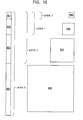
- Fig. 10 is a view showing a case in which data encoded according to a progressive order of spatial resolutions is associated with packets in each layer.
- An image of one frame is formed of packets 801 to 804.
- an image 805 having a spatial resolution one eighth that of the original is obtained.
- the packet 801 includes encoded data having the highest level of priority, and is required to display a coarse image first on the display of a data receiving terminal which executes decoding.
- an image 806 having a spatial resolution one fourth that of the original is obtained.
- the priority order of the four packets 801 to 804 shown in Fig. 10 is the packet 801, the packet 802, the packet 803, and the packet 804.
- the packetizer 44 executes processing for setting priority-level information corresponding to each spatial-resolution layer of encoded data of an image signal, stored in generated packets, as additional information of the generated packets.
- Fig. 11 is a view showing a case in which data encoded according to a progressive order of SNRs (image quality) is associated with packets in each layer.
- An image of one frame is formed of packets 811 to 814.
- an image 815 having the same spatial resolution as the original low-quality image is obtained.
- an image 816 having a higher image-quality than the decoding result of the encoded data stored in the packet 811 is obtained.
- an image 817 having a further higher image-quality with lower noise is obtained.
- an image 818 having the highest image quality is obtained.
- the priority order of the four packets 811 to 814 shown in Fig. 11 is the packet 811, the packet 812, the packet 813, and the packet 814.
- the packetizer 44 executes processing for setting priority-level information corresponding to each SNR layer of encoded data of an image signal, stored in generated packets, as additional information of the generated packets.
- Fig. 12 is a view showing a case in which data encoded according to a progressive order of color components is associated with packets in each layer.
- An image of one frame is formed of packets 821 to 823.
- a black-and-white image 825 is obtained.
- a color image 826 which includes a U component is obtained.
- a color image 827 which includes a V component is obtained.
- the priority order of the three packets 821 to 823 shown in Fig. 12 is the packet 821, the packet 822, and the packet 823.
- the packetizer 44 executes processing for setting priority-level information corresponding to each color-component layer of encoded data of an image signal, stored in generated packets, as additional information of the generated packets.
- the packetizer 44 executes processing for generating (IP) packets in which encoded data in each layer serves as a payload.
- IP real-time transport protocol
- RTP real-time transport protocol
- the packetizer 44 adds an RTP payload header for a JPEG-2000 video stream to a payload partitioned in each layer as a part of an RTP header, and further adds an RTP fixed header to make a packet.
- Fig. 13 shows the RTP payload header for a JPEG-2000 video stream and the RTP fixed header.
- a flag indicating a level of priority is included in the RTP payload header of a packet which accommodates data packetized in layer.
- the level of priority is stored in a [priority] field of the RTP payload header.
- a [type] field indicates the type of a packet carried by RTP in a JPEG-2000 video stream. To define a packet format other than that used in the present case, the value of the field is changed appropriately.
- the [priority] field indicates the degree of importance of the RTP packet as described above, and is determined according to an application or service used.
- An [mh_id] field indicates the identifier of each JPEG-2000 main header, and is used to prevent the packet from being unable to be decoded when a packet which includes the main header is lost.
- a [mh_length] field indicates the length of the JPEG-2000 main header, and is used as an offset for detecting the loss of the main header or for detecting packets following the main header.
- a [fragment offset] field indicates the offset of the packet from the starting byte of the JPEG-2000 data carried by the RTP packets.
- the RTP fixed header includes the fields of a version number (V), padding (P), whether an extension header (X) is disposed, the number (CC) of transmission sources, marker information (M), a payload type (PT), a sequence number, an RTP time stamp, a synchronization source (SSRC) identifier, and a contributing source (CSRC) identifier.
- the time stamp specified in the RTP header is used to control a processing time when the RTP packet is developed, allowing the reproduction of a real-time image or sound to be controlled.
- a plurality of scalable-encoded data items, which are compressed, can be stored in an IP packet.
- IP header is further added to the packet to which the RTP header has been added.
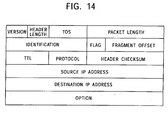
- Fig. 14 shows details of the IP header in an IP packet.
- the IP header includes a version, such as IPv4 or IPv6, a header length, a type-of-service (TOS) field which stores priority-level information, a packet length, an identification, a flag indicating control information related to data division (fragment) in an IP layer, a fragment offset indicating the location of divided (fragmented) data, time to live (TTL) indicating the information of time until the data is discarded, a protocol (IP: 4, TCP: 7, UDP: 17, ...) used in an upper layer, a header checksum, a source IP address, and a destination IP address.
- IPv4 or IPv6 a version, such as IPv4 or IPv6, a header length, a type-of-service (TOS) field which stores priority-level information, a packet length, an identification, a flag indicating control information related to data division (fragment) in
- a flag indicating a level of priority to be processed by a receiving side may be added in the IP header, in addition to the level of priority specified in the RTP payload header.
- IPv4 a level of priority is indicated in the TOS field, and priority control is possible for packets having levels of priority in a DiffServ network.
- IPv6 it is possible to indicate a level of priority in a flow label. In this way, when a different protocol is used in the network layer, the value indicating a level of priority also differs. Therefore., it is preferred that relationships among encoder layers, levels of priority of packets with an application used taken into account, and a level of priority in the network layer be specified.
- a control block 45 performs such a control.
- the packetizer 44 may execute priority-level setting processing under the control of the control block 45 according to a setting corresponding to the network protocol.
- levels of priority may be set according to QoS received from a receiving terminal or may be dynamically changed according to a network condition.
- IP packets generated by the packetizer 44 are output from the communication system through a network interface 46.
- DiffServ is service proposed in IETF.
- a router changes a packet processing method according to a level of priority specified in the TOS field of an IP header. The objective of this service is to increase the quality of the network by placing priority on real-time sound and images over usual data in processing, and discarding a packet having a lower level of priority when congestion occurs in a router and packets need to be discarded.
- a method for assigning levels of priority to an RTP header which include an RTP payload header and to an IP header will be described next.
- data encoded according to the progressive order of spatial resolutions shown in Fig. 10 is packetized, a higher level of priority is assigned to a packet which includes a lower-resolution encoded data, and a lower level of priority is assigned to a packet which includes a higher-resolution encoded data.
- data encoded according to the progressive order of SNRs (image quality) shown in Fig. 11 is packetized, a higher level of priority is assigned to a packet which includes a lower-SNR (image quality) encoded data, and a lower level of priority is assigned to a packet which includes a higher-SNR (image quality) encoded data.
- a higher level of priority is assigned to a packet which includes a Y-component encoded data
- a lower level of priority is assigned to a packet which includes a U-component or V-component encoded data.
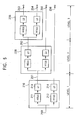
- levels of priority are specified by the packetizer 44 as shown in Fig. 9.
- the packetizer 44 divides data scalable-encoded by the encoder 42 into layer-0 to layer-4 encoded data, and stores in five packets 65 to 69 as payloads.
- a level [0] of priority is assigned to the RTP header (RTPH) of the IP packet 65, which has the layer-0 encoded data as a payload, and the level [0] of priority is assigned to its IP header (IPH). Since the layer-1 encoded data is the next most important, a level [1] of priority is assigned to the RTP header (RTPH) of the IP packet 66, which has the layer-1 encoded data as a payload, and the level [1] of priority is assigned to its IP header (IPH).
- a level [2] of priority is assigned to the RTP header (RTPH) of the IP packet 67, which has the layer-2 encoded data as a payload, and the level [1] of priority is assigned to its IP header (IPH).
- a level [3] of priority is assigned to the RTP header (RTPH) of the IP packet 68, which has the layer-3 encoded data as a payload, and the level [2] of priority is assigned to its IP header (IPH).
- a level [4] of priority is assigned to the RTP header (RTPH) of the IP packet 69, which has the layer-4 encoded data as a payload, and the level [2] of priority is assigned to its IP header (IPH).
- the priority-level setting processing for IP headers and RTP headers is, for example, executed according to a priority-level setting map stored in storage means of the packetizer 44.
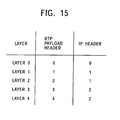
- Fig. 15 shows an example priority-level setting map.
- levels of priority assigned to an RTP header and an IP header are associated with each layer of data encoded by the encoder 42.
- the levels 0 to 4 of layers set in the wavelet transform are used as they are as the levels 0 to 4 of priority assigned to the extension headers (RTP payload headers following RTP fixed headers) of RTP packets.
- the three levels 0 to 2 of priority are assigned to IP headers, so that three levels of priority are specified when viewed from the IP network.
- a forward error correction (FEC) method is, for example, used as an error control method.
- FEC forward error correction
- a method for applying FEC to a packet loss in AAL1 of ATM or a method similar to a method in which a matrix described in the specification of the types 1 and 2 of B-ISDN ATM adaptation layer (AAL) in ITU-T Recommendation I.363.1 is generated to apply Reed-Solomon decoding to the lost packet can be used.
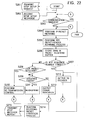
- the receiving side When the receiving side detects a packet loss, the receiving side can report the lost packet to the data transmission side and request the data transmission side to send again the lost packet. In this case, the receiving side can execute recovery processing by obtaining the lost packet by re-transmission.
- This type of processing is not necessarily performed uniformly for packets of all layer levels.
- the redundancy of forward error correction may be changed according to the bandwidth of a network, or the number of times re-transmission is performed may be weighted according to a level of priority.
- the packetizer may always use the priority-level setting map shown in Fig. 15 in a fixed manner.
- the packetizer may dynamically change the priority-level setting map according to a network condition.
- a network bandwidth for example, a method for monitoring a bandwidth at the transmission side and the receiving side, or a method for measuring the loss rate of transmission packets by RTCP may be used. Then, mapping can be changed with a transmission bandwidth and quality which can be assured being taken into account.
- a priority-level setting map which maps layer levels onto levels of priority in RTP packets, or onto levels of priority in IP packets is generated, levels of priority can be determined with a network loss rate which determines the effect of a loss on the original image being taken into account.
- a process for each layer level depends on the application used, and a process to be performed according to levels of priority may be determined only in RTP. In the same way, the processing method can be changed with levels of priority being assigned in IP. In this case, since this is a function offered by a network, such as DiffServ, in IP, levels of priority in RTP packets are mapped onto levels of priority in IP packets to specify levels of priority supported by the network, or determined by the network.
- the priority-level setting map shown in Fig. 15 five levels of priority are specified in RTP packets, and three levels of priority are specified in IP packets.
- the level 0 of priority in RTP packets corresponds to the level 0 of priority in IP packets
- the levels 1 and 2 of priority in RTP packets correspond to the level 1 of priority in IP packets
- the levels 3 and 4 of priority in RTP packets correspond to the level 2 of priority in IP packets.
- the number of levels of priority which can be handled by DiffServ is small in the current IPv4 format, but a process corresponding to three levels of priority can be performed with the mapping used in the present case being applied.
- a higher level of priority is assigned to a packet which includes lower-resolution encoded data
- a lower level of priority is assigned to a packet which includes higher-resolution encoded data.
- a receiving terminal can use the level of priority assigned to the IP header or the RTP header of each packet to process lower-frequency packets earlier. Even when congestion occurs in a network, the rate of discarding packets is reduced and image quality is improved.
- Fig. 16 shows an example priority-level setting map in which levels of priority assigned to the RTP headers and the IP headers of scalable-encoded data are associated with resolutions and SNRs (image quality).
- resolutions have three layer levels 0 to 2
- SNRs image quality
- the number of wavelet divisions in JPEG-2000 is set to two, that is, three levels of resolutions are used, and three levels of SNRs (image quality) are used. The lower the level number is, the more important the corresponding data is.
- mapping is performed to the RTP headers of data encoded according to a progressive order of spatial resolutions, for example, since an image having a higher spatial resolution is decoded by using an image having a lower spatial resolution, it is necessary to assign a higher level of priority to data having a lower spatial resolution.
- the highest level [0] of priority is assigned to both the RTP header and the IP header of a packet which includes encoded data corresponding to a level [0] of resolution, irrespective of image quality.
- mapping is performed such that different levels of priority are assigned to RTP headers according to two groups of SNRs (image quality) for encoded data having resolution levels 1 and 2. More specifically, the level [1] of priority is assigned to the RTP header of a packet which includes encoded data having the resolution level 1 and the SNR level 0, and the level [2] of priority is assigned to the RTP header of a packet which includes encoded data having the resolution level 1 and the SNR level 1 or 2.
- the level [3] of priority is assigned to the RTP header of a packet which includes encoded data having the resolution level 2 and the SNR level 0 or 1
- the level [4] of priority is assigned to the RTP header of a packet which includes encoded data having the resolution level 2 and the SNR level 2.
- mapping from RTP to IP be performed such that levels of priority which can be supported by network layer service such as DiffServ are specified.
- network layer service such as DiffServ
- priority-level setting maps can be used in addition to this case. As described above, it is possible that levels of priority depending on an application are assigned to RTP payload headers, and levels of priority are further assigned to IP headers, according to the degree of importance of scalable data. With the use of these plurality of levels of priority, an error control method can be changed for each layer or rate control can be applied to each layer.
- Levels of priority assigned to RTP payload headers may be dynamically changed according to an application, a user's request, or receiving-terminal information received from a receiving terminal.
- Levels of priority assigned to IP payload headers may be dynamically changed according to a network condition, such as the degree of congestion in a network.
- the data transmission apparatus at the data transmission site receives receiving-terminal information from a receiving terminal, has a structure to analyze the information, and also has a structure to monitor and analyze a network condition.
- levels of priority can be specified separately for RTP payload headers and IP headers, different levels of priority can be used between the network layer and a layer dependent on an application, and hence the quality of transmission data can be independently controlled.
- a network supports DiffServ, for example, if levels of priority are specified in a manner suited to DiffServ, the data loss rate of low-frequency parts of an image is reduced.
- the packetizer 44 shown in Fig. 9 packetizes data scalable-encoded by the encoder 42 according to the above-described processing, for each layer, stores in packets, assigns levels of priority corresponding to the layers of the scalable-encoded data to the RTP headers and to the IP headers to execute IP-packet generation processing.
- the IP packets generated in this way are sent to a network through the network interface 46.
- the structure and processing of a data receiving site for receiving packets in which encoded data is stored as payloads, in the system according to the present invention will be described next.
- the data receiving site executes packet receiving, packet processing, and decoding of the encoded data stored in the packets.
- Fig. 17 is a block diagram of a data receiving apparatus (terminal) in the data receiving site in the system according to the present invention.
- a network interface 51 receives packets, and an IP-packet filtering section 52 determines whether the packets are to be processed by a receiving side and applies filtering to unnecessary packets. For example, filtering is performed so as to pass packets having levels of priority to be processed according to the performance of the terminal, to a decoder 57.
- a terminal having a low-resolution display determines packets having higher levels of priority according to the levels of priority assigned to the IP headers. Packets having higher levels of priority, such as packets having the level 0 or 1 of priority assigned to the IP headers, are passed to the decoder 57, and packets having the levels 2, 3, ... of priority are not passed to the decoder 57 and discarded.
- an RTP-packet-header scanning section 53 analyzes the levels of priority of the filtered packets, and determines whether their order is correct and whether there is a missing packet, and stores the packets in an RTP buffer 54.
- the RTP-packet-header scanning section 53 determines the levels of priority specified in the RTP payload headers of the RTP headers, selects only packets having the levels of priority to be processed by this data receiving apparatus and passes them to the decoder 57, and does not pass packets having equal or lower levels of priority to or than that to be processed by this data receiving apparatus but discards them.
- the IP-packet filtering section 52 and the RTP-packet-header scanning section 53 function as packet-priority-level-information determination means for determining whether packets have levels of priority equal to or higher than a value specified according to the processing ability of the data receiving apparatus.
- the decoder 57 decodes only data stored in packets having levels of priority equal to or higher than a value specified according to the processing ability of the data receiving apparatus.
- the RTP-packet-header scanning section 53 further executes packet-loss detection processing according to sequence numbers in the FTP headers.
- an error-correction determination section 54 determines whether a re-transmission request is issued with the level of priority being taken into account.
- a report-packet transmission section 55 sends a report packet which stores sequence-number information to the data transmission source to report the sequence number of the RTP packet to be re-transmitted.
- the decoder 57 decodes received data, that is, encoded data stored as the payloads of packets, and outputs an image or sound to an output apparatus such as a display.
- Fig. 18 shows an example detailed structure of the decoder 57.
- the decoder 57 has an inverse wavelet transform processing structure for performing the inverse operation of the wavelet transform processing described before by referring to Fig. 5. More specifically, when the bandwidth components 253, 254, 255, and 256 output from the wavelet transform section described by referring to Fig. 5 are input to an inverse wavelet transform section shown in Fig. 18, the resolutions of the LLL component 253 and the LLH component 254 are doubled by up-samplers 272 and 273. Then, the low-frequency component is filtered by a low-pass filter 274, the high-frequency component is filtered by a high-pass filter 275, and they are synthesized by an adder.
- a circuit section 270 having the devices described so far completes the inverse transform processing of the transform processing performed by the level-3 circuit section 230 shown in Fig. 5, and an LL component 257 which is a level-2 low-frequency component is obtained. This processing is repeated to the level 1 to output a decoded image 259 obtained after final inverse transform.
- a level-2 circuit section 280 and a level-1 circuit section 290 have the same structure as the level-3 circuit section 270, the output of the level-3 circuit section 270 is input to a low-frequency side of the level-2 circuit section 280, and the output of the level-2 circuit section 280 is input to a low-frequency side of the level-1 circuit section 290.
- the basic structure of a general inverse wavelet transform section has been described.
- a re-transmission-request-processing sequence executed when the data receiving side detects a packet loss will be described next by referring to Fig. 19. Since RTP headers have sequence numbers, the data receiving site detects a packet loss according to the RTP headers.
- the effect of a packet loss on image quality depends on the degree of importance of the lost packet. For example, when high-frequency encoded data is lost, image quality does not largely reduced even if the data is not used. When low-frequency data is lost, a large effect is given.
- the data receiving site performs error control according to the degree of importance of a lost packet.
- a forward error correction (FEC) method is, for example, used as an error control method.
- FEC forward error correction
- a method for applying FEC to a packet loss in AAL1 of ATM or a method similar to a method in which a matrix described in the specification of the types 1 and 2 of B-ISDN ATM adaptation layer (AAL) in ITU-T Recommendation I.363.1 is generated to apply Reed-Solomon decoding to the lost packet can be used.
- the data receiving site changes a re-transmission control method according to the degree of importance of a lost packet.
- the data transmission site distributes images and sound by RTP, and the data receiving site detects a lost packet according to sequence numbers in RTP packet headers, and reports to the data transmission site re-transmission request information of the lost packet by a packet used in RTCP.
- the data transmission site re-transmits the lost packet reported by the data receiving site.
- the data transmission site Before executing re-transmission processing, the data transmission site performs control such that the level of priority of the packet for which a re-transmission request has been issued is determined by using the IP header or the RTP payload header, a packet having a higher level of priority is re-transmitted by priority, and a packet having a lower level of priority may be not re-transmitted in some cases.
- a re-transmission packet is sent together with usual requested data. Therefore, when a transmission band is limited, control may be performed such that packet data having a lower level of priority is not sent.
- the data receiving site can receive and process the re-transmitted packet to recover the lost packet to increase image quality.
- the relationships between the re-transmission control and levels of priority are shown at a lower part of Fig. 19. Error control is enhanced and a re-transmission request is issued for data having a higher-level (priority level 0) of priority, such as layer-level-0 data, and error control is weakened and a re-transmission request is not issued for data having a lower level (priority level 2) of priority.
- Such control can be changed according to a network condition and terminal processing.
- the data receiving side issues a setup request to the data transmission side by RTSP.
- the setup request includes the display resolution, the CPU processing performance, the service quality request, and the usable bandwidth of the data receiving side.
- the transmission side When the transmission side can respond to the setup request, it responds to the request. Then, the receiving side issues a play request by RTSP.
- the transmission side When the transmission side can respond to the play request, it responds to the request, stores scalable-encoded data as payloads, generates RTP packets in which levels of priority corresponding to layers have been specified in RTP payload headers and IP headers, and sends the packets.
- the transmission side sends to the receiving side at a constant interval a sender report which includes a time stamp and the number of transmitted packets according to RTCP.
- the receiving side receives the sender report, and sends a receiver report which includes information of the number of lost packets and the sequence number of the lost packets, used for re-transmission processing for the lost packets.
- the transmission side receives the receiver report, performs re-transmission control, and sends the lost packets.
- the data transmission side performs control such that packets having higher levels of priority are re-transmitted earlier with the priority levels of the packets being taken into account, as described above. Re-transmitted packets are sent together with usual requested data. Therefore, when a transmission bandwidth is limited, control is performed such that packets having lower levels of priority in the image-quality progressive order are not transmitted.
- FIG. 21 A case will be taken as an example, in which scalable-encoded data is stored in a recording medium in advance, and the data is read, packetized, and transmitted.
- the transmission apparatus is activated, and the preparation of transmission is started. Then, in step S101, the transmission side receives a setup request from the receiving side by RTSP. When the preparation of transmission has been finished, the transmission side sends a setup response to the receiving side in step S102.
- step S103 the transmission side determines a priority level and a mapping method for RTP/IP headers with the display resolution, the CPU processing performance, the requested service quality, and the usable bandwidth of the receiving side being used as input parameters.
- the value is used as an initial value in an RTP-priority-level mapping information generation process in step S110.
- step S104 the transmission side detects a packet partition of stored data corresponding to the quality requested by the receiving side.
- packet refers to a cluster unit in each layer level, for example, the minimum code string used in JPEG-2000 employing the wavelet transform.
- step S105 whether all data has been processed is determined. When it has been processed, the processing is terminated in step S113. When it has not yet been processed, a priority level corresponding to the layer level of scalable-encoded data stored in the packet is assigned to the RTP extension header, that is, the RTP payload header, in step S106.
- the priority level assigned to the RTP payload header in step S106 may be that specified in a priority-level setting map (such as the map shown in Fig. 15), which serves as mapping information specified in advance.
- the priority level may be specified according to a priority-level setting map generated in S110 when a dynamic generation process thereof is executed according to a network congestion state obtained in step S109 according to RTCP feedback information.
- step S114 The data in which the level of priority has been assigned to the RTP payload header in step S106 is stored in step S114 for an RTP re-transmission process.
- transmission packets are stored in step S114 for a predetermined period.
- a packet to be re-transmitted is determined in step S114 when the number of a lost packet is reported according to the RTCP feedback in step S109, and a memory area for packets which have been received can be released.
- the re-transmission packet is output in step S124, and the processing returns to step S104.
- control is performed as described above such that packets having higher levels of priority are re-transmitted earlier with the levels of priority of packets being taken into account.
- control is performed such that packets having lower levels of priority in the image-quality progressive order are not transmitted.
- step S107 an IP-packet generation process is executed.
- a level of priority corresponding to the layer of scalable-encoded data stored in an IP packet is specified in the IP header.
- the priority level assigned to the IP header in step S107 may be that specified in a priority-level setting map (such as the map shown in Fig. 15), which serves as mapping information specified in advance.
- the priority level may be specified according to a priority-level setting map generated in S112 when a dynamic generation process thereof is executed according to a network congestion state obtained in step S111.
- the level of priority is specified, for example, in the TOS field for IPv4 and in the flow label in IPv6 in the IP header.
- the destination of the IP packet is determined in steps S115, S116, and S122. It is determined in step S115 whether unicast is to be performed. When it is determined that unicast is to be performed, destination information is added in step S117. When it is determined in step S116 that multicast is to be performed, it is determined in step S118 that the packet belongs to which multicast group according to the level of priority assigned to the IP header, a copy of a packet section which satisfies the request of the corresponding multicast group is made in step S119, and a multicast address is assigned in step S120. The steps from S118 to S120 are repeated the same number of times as the number of destinations included in the multicast group, and the packet is transmitted in step S121.
- step S122 When it is determined in step S122 that broadcast is to be performed, a broadcast address is assigned in step S123. Addresses other than those described above usually are not generated. When the result of the determination of step S122 is negative, an error indication is output in step S125. When the packet is output in step S124, the processing returns to step S104 for detecting a packet partition.
- the data transmission site stores scalable-encoded data in a packet to be transmitted by unicast, multicast, or broadcast, as a payload, and assigns levels of priority corresponding to the layer level of the encoded data stored in the packet to the RTP payload header and to the IP header.
- the data transmission site also executes the re-transmission processing in response to a re-transmission request sent from the data receiving site.
- the receiving side After the preparation of receiving is started, the receiving side sends a setup request by RTSP to the transmission side in step S201.
- the request includes information such as the performance of a terminal and requested service quality.
- the receiving side receives a setup response from the data transmission side in step S202, and opens a port for receiving.
- step S203 It is determined in step S203 whether communication has been finished. When it is determined that the communication has been finished, the processing is terminated.
- step S204 an IP filtering process is executed. It is determined according to the IP header of a packet whether the packet is to be processed by the receiving side, and an unnecessary packet is filtered. For example, this is a filtering process for passing only packets having levels of priority to be processed according to the performance of a terminal, to the decoder.
- packets having higher levels of priority such as the levels 0 and 1 of priority
- packets having the level 2 or larger of priority are not passed to the. decoder but discarded.
- An RTP-packet-header scanning process is applied in step S205 to the packets to which filtering has been executed in step S204 according to the level of priority assigned to the IP header.
- the level of priority specified in the RTP payload header of the RTP header is determined, and only a packet having a level of priority to be processed by the receiving site itself is passed to the decoder. To this end, the packet is stored in a packet receiving buffer in step S206. A packet having a low level to priority lower than a level of priority to be processed by the receiving site itself is not passed to the decoder but discarded.
- step S207 the RTP header of the received packet is read and it is determined whether its sequence number is correct, that is, whether the order of the packet is correct and whether a packet has been lost.
- its sequence number is wrong
- a packet loss is detected in step S208.
- re-transmission control is performed in step S210, and the sequence number of the lost packet is reported to the transmission side.
- step S209 When a packet loss is not found, it is determined in step S209 according to the sequence number of the RTP header that a sequence error has occurred. When a sequence error has occurred, the order is arranged in step S211. In other cases, an error indication is output in step S212. When it is determined in step S207 that the sequence number is correct, the packet is sent to the decoder in step S213, and the memory area of the sent packet in the packet receiving buffer is released.
- step S214 a packet statistical process is executed according to the packet output from the buffer to the decoder and the result of the re-transmission process.
- An RTCP receiver report is sent to the transmission side in step S215.
- the data receiving site determines the level of priority corresponding to the layer level of encoded data stored in a received packet according to the RTP payload header and the IP header of the received packet, determines whether the decoding process is applied, and if necessary, performs decoding.
- the data receiving site detects a packet loss according to the sequence number of the RTP packet, and executes error control and re-transmission control based on the level of priority determined according to the RTP payload header and the IP header.
- the series of processing described in the above embodiment can be executed by hardware, by software or by a combination of both.
- a program having a processing sequence is installed into a memory of a data processing apparatus which is built in special hardware, or into a general-purpose computer, which can execute various functions, and executed.
- a program constituting the program is installed, for example, into a general-purpose computer or a microcomputer.
- Fig. 23 shows an example system structure of a data transmission apparatus and a data receiving apparatus which execute the series of processing described in the above embodiment.
- Data transmitted and received in the system of the present invention is scalable-encoded data.
- the data transmission apparatus executes encoding processing, and the data receiving apparatus performs decoding processing.
- Encoded data is transmitted and received as packets through a network.
- the data transmission side generates packets (performs packetizing) and the data receiving side develops the packets (performs depacketizing).
- a data transmission and receiving apparatus (such as a PC) 850 shown in Fig. 23 includes a codec 851 for executing encoding, decoding, packet generation, and packet development, a network interface 852 serving as an interface with a communication network, an input and output interface 853 serving as an interface with input units such as a mouse 837 and a keyboard 836, an audio and visual interface 854 for inputting and outputting data to and from audio-and-visual-data input and output units, such as a video camera 833, a microphone 834, and a speaker 835, a display interface 855 serving as a data output interface with a display 832, a CPU 856 for controlling data transfer among the data input and output interfaces, the codec 851, and the network interface 852, and for controlling various programs, a memory 857 formed of a RAM and a ROM, for storing various programs controlled by the CPU 856, for storing data, and for serving as a working area of the CPU 856, and an HDD 858 serving as a medium for
- the codec 851 receives, for example, image data from the video camera 833 and audio data from the microphone 834, and executes scalable encoding and packet generation (packetizing) to finally generate IP packets having scalable-encoded data as payloads, as shown in Fig. 23.
- the generated IP packets are output to the PCI bus 859, output to a network through the network interface 852, and distributed, for example, to a destination address specified in the headers of the IP packets.
- the data transmission and receiving apparatus may be configured such that video data input from the video camera 833 and audio data input from the microphone 834 are scalable-encoded and output to a network through the network interface 852 under the control of the CPU 856 according to a software encoding program stored in the HDD 858 or the memory 857.
- Data in IP packets input through a network is sent to the PCI bus 859 through the network interface 852 and input to the codec 851.
- the codec 851 applies packet development processing (depacketizes) the input data to extract scalable data stored in the packets as payloads, executes decoding, and reproduces the data to output to the display 832 and the speaker 835.
- Data to be processed in the above embodiment can be input from an input unit such as a camera, from a data input apparatus such as a scanner, or from a removable recording medium such as a floppy disk, a compact disc read only memory (CD-ROM), a digital versatile disk (DVD), a magnetic disk, or a semiconductor memory.
- an input unit such as a camera
- a data input apparatus such as a scanner
- a removable recording medium such as a floppy disk, a compact disc read only memory (CD-ROM), a digital versatile disk (DVD), a magnetic disk, or a semiconductor memory.
- the CPU 856 can load a program stored in the hard disk or a program transmitted from a satellite or a network, received, and installed, into a memory such as a RAM and execute it, in addition to a program stored in the ROM.
- a program may be processed by one computer or may be distributed-processed by a plurality of computers.
- a program may be transmitted from a remote computer and executed.
- a data transmission site stores scalable-encoded data as payloads in packets to be sent, and assigns priority-level information corresponding to the layer level of the encoded data stored in the packets to the packets
- a data receiving site executes processing with the priority-level information being taken into account, and the most appropriate packet processing corresponding to the performance of a terminal is allowed.
- encoded data having a higher level of priority can be re-transmitted earlier to suppress the degree of congestion on a network.
- the arrival rate of re-transmitted packets is increased and the quality of data displayed on a receiving terminal is improved.
- an error control method can be changed in each layer by using a plurality of pieces of priority-level information, and a rate control can be executed.
- a level of priority specified in an RTP payload header is dynamically changed according to an application or a user's request.
- a level of priority specified in an IP header is dynamically changed according to the degree of congestion on a network. Therefore, different levels of priority can be used between the network layer and a layer dependent on an application.
- the quality of transmission data can be independently controlled.
- a network supports DiffServ, for example, if a level of priority is specified in an IP header in a manner suitable for DiffServ, a data-loss rate in a low-frequency part of an image is reduced.
Landscapes
- Engineering & Computer Science (AREA)
- Multimedia (AREA)
- Signal Processing (AREA)
- Databases & Information Systems (AREA)
- Computer Graphics (AREA)
- Compression Or Coding Systems Of Tv Signals (AREA)
- Communication Control (AREA)
- Data Exchanges In Wide-Area Networks (AREA)
- Television Systems (AREA)
- Compression, Expansion, Code Conversion, And Decoders (AREA)
Applications Claiming Priority (2)
| Application Number | Priority Date | Filing Date | Title |
|---|---|---|---|
| JP2001346413A JP2003152544A (ja) | 2001-11-12 | 2001-11-12 | データ通信システム、データ送信装置、データ受信装置、および方法、並びにコンピュータ・プログラム |
| JP2001346413 | 2001-11-12 |
Publications (2)
| Publication Number | Publication Date |
|---|---|
| EP1311125A2 true EP1311125A2 (fr) | 2003-05-14 |
| EP1311125A3 EP1311125A3 (fr) | 2005-06-15 |
Family
ID=19159594
Family Applications (1)
| Application Number | Title | Priority Date | Filing Date |
|---|---|---|---|
| EP02025197A Withdrawn EP1311125A3 (fr) | 2001-11-12 | 2002-11-11 | Système et méthode de communication de données, appareil et méthode de transmission de données, appareil de réception de données, méthode de traitement de données recues et programme d'ordinateur |
Country Status (3)
| Country | Link |
|---|---|
| US (2) | US7385921B2 (fr) |
| EP (1) | EP1311125A3 (fr) |
| JP (1) | JP2003152544A (fr) |
Cited By (20)
| Publication number | Priority date | Publication date | Assignee | Title |
|---|---|---|---|---|
| WO2004054266A1 (fr) * | 2002-12-11 | 2004-06-24 | Sony Corporation | Systeme d'emission/de reception, dispositif d'emission, procede d'emission, dispositif de reception, procede de reception, support d'enregistrement et programme correspondant |
| WO2004114629A1 (fr) * | 2003-06-25 | 2004-12-29 | Toyota Jidosha Kabushiki Kaisha | Systeme de remise de contenu |
| DE102004014426A1 (de) * | 2004-03-19 | 2005-10-27 | Zirhli, Münevver | Flexinux System |
| WO2005112422A1 (fr) * | 2004-05-11 | 2005-11-24 | Fujitsu Siemens Computers Gmbh | Procede et dispositif pour transmettre des images dans un reseau |
| EP1650973A1 (fr) * | 2004-10-25 | 2006-04-26 | Alcatel USA Sourcing, L.P. | Procédé de codage d'un contenu multimédia |
| GB2432739A (en) * | 2005-11-04 | 2007-05-30 | Bosch Gmbh Robert | Storing video data in different hierarchy levels in network |
| WO2008032001A1 (fr) * | 2006-09-15 | 2008-03-20 | France Telecom | Procede et dispositif d'adaptation d'un flux de donnees scalable, produit programme d'ordinateur et equipement reseau correspondants |
| WO2008056878A1 (fr) * | 2006-11-09 | 2008-05-15 | Electronics And Telecommunications Research Institute | Procédé pour la détermination d'un type de paquet pour flux binaire vidéo svc, et appareil de mise en paquets rtp et son procédé d'utilisation |
| EP2094012A1 (fr) * | 2008-02-25 | 2009-08-26 | Broadcom Corporation | Vérification de réception/de non réception de couches vidéo de base/amélioration |
| US7627184B2 (en) | 2003-11-21 | 2009-12-01 | Nec Corporation | Content distribution/reception device, content transmission/reception method, and content distribution/reception program |
| EP2061174A4 (fr) * | 2006-09-06 | 2013-10-30 | Sony Corp | Système de communication de données, appareil d'envoi de données, procédé d'envoi de données, appareil de réception de données et procédé de réception de données |
| CN103430562A (zh) * | 2011-01-19 | 2013-12-04 | 三星电子株式会社 | 使用跨层优化发送多媒体数据封包的方法和装置 |
| US8761203B2 (en) | 2006-11-09 | 2014-06-24 | Electronics And Telecommunications Research Institute | Method for determining packet type for SVC video bitstream, and RTP packetizing apparatus and method using the same |
| EP2824919A4 (fr) * | 2012-03-09 | 2015-10-14 | Solution Inc G | Appareil de partitionnement d'une image satellite compressée et procédé associé |
| WO2016043920A1 (fr) * | 2014-09-16 | 2016-03-24 | Qualcomm Incorporated | Systèmes, procédés et appareil de diffusion de vidéo à la carte sur service mbms amélioré |
| CN106464952A (zh) * | 2014-06-02 | 2017-02-22 | 索尼公司 | 用于用户设备的基于上下文的自适应流处理算法 |
| KR101757771B1 (ko) | 2009-12-01 | 2017-07-17 | 삼성전자주식회사 | 상호 계층 최적화를 이용한 멀티미디어 데이터 패킷을 송신하는 방법 및 장치 |
| CN112335244A (zh) * | 2018-06-28 | 2021-02-05 | 苹果公司 | 基于优先级的视频编码和传输 |
| US11451788B2 (en) | 2018-06-28 | 2022-09-20 | Apple Inc. | Rate control for low latency video encoding and transmission |
| US11653026B2 (en) | 2018-06-28 | 2023-05-16 | Apple Inc. | Video encoding system |
Families Citing this family (120)
| Publication number | Priority date | Publication date | Assignee | Title |
|---|---|---|---|---|
| US7149514B1 (en) | 1997-07-30 | 2006-12-12 | Bellsouth Intellectual Property Corp. | Cellular docking station |
| US6499060B1 (en) | 1999-03-12 | 2002-12-24 | Microsoft Corporation | Media coding for loss recovery with remotely predicted data units |
| US20030041257A1 (en) * | 2001-05-04 | 2003-02-27 | Wee Susie J. | Systems, methods and storage devices for scalable data streaming |
| EP1271955A3 (fr) * | 2001-06-26 | 2007-05-02 | Koninklijke Philips Electronics N.V. | Procédé de transmission par paquet avec requetes en retransmission de paquet et mécanisme de controle relatif à la transmission de telles requètes |
| JP4549610B2 (ja) * | 2001-11-08 | 2010-09-22 | ソニー株式会社 | 通信システム、通信方法、送信装置および方法、受信装置および方法、並びにプログラム |
| JP4150951B2 (ja) * | 2002-02-19 | 2008-09-17 | ソニー株式会社 | 動画配信システム、動画配信装置および方法、並びにプログラム |
| US8533070B2 (en) * | 2002-07-15 | 2013-09-10 | At&T Intellectual Property I, L.P. | Apparatus and method for aggregating and accessing data according to user information |
| US8554187B2 (en) | 2002-07-15 | 2013-10-08 | At&T Intellectual Property I, L.P. | Apparatus and method for routing communications between networks and devices |
| US8543098B2 (en) | 2002-07-15 | 2013-09-24 | At&T Intellectual Property I, L.P. | Apparatus and method for securely providing communications between devices and networks |
| US8416804B2 (en) | 2002-07-15 | 2013-04-09 | At&T Intellectual Property I, L.P. | Apparatus and method for providing a user interface for facilitating communications between devices |
| US8526466B2 (en) * | 2002-07-15 | 2013-09-03 | At&T Intellectual Property I, L.P. | Apparatus and method for prioritizing communications between devices |
| JP3821086B2 (ja) * | 2002-11-01 | 2006-09-13 | ソニー株式会社 | ストリーミングシステム及びストリーミング方法、クライアント端末及びデータ復号方法、並びにプログラム |
| JP2004186871A (ja) * | 2002-12-02 | 2004-07-02 | Ricoh Co Ltd | 画像処理装置、撮像装置、プログラム及び記憶媒体 |
| JPWO2004075548A1 (ja) * | 2003-02-21 | 2006-06-01 | 日本電気株式会社 | 画像データ配信制御方法及び装置とシステムならびにプログラム |
| JP2004266504A (ja) * | 2003-02-28 | 2004-09-24 | Sony Corp | 送受信システム、送信装置および方法、受信装置および方法、記録媒体、並びにプログラム |
| US7774593B2 (en) * | 2003-04-24 | 2010-08-10 | Panasonic Corporation | Encrypted packet, processing device, method, program, and program recording medium |
| JP2005012685A (ja) | 2003-06-20 | 2005-01-13 | Canon Inc | 画像処理方法、画像処理装置 |
| US7483532B2 (en) * | 2003-07-03 | 2009-01-27 | Microsoft Corporation | RTP payload format |
| JP4544156B2 (ja) * | 2003-07-15 | 2010-09-15 | ソニー株式会社 | 処理方法並びにコンピュータ・プログラム |
| US7076735B2 (en) | 2003-07-21 | 2006-07-11 | Landmark Graphics Corporation | System and method for network transmission of graphical data through a distributed application |
| US7417989B1 (en) * | 2003-07-29 | 2008-08-26 | Sprint Spectrum L.P. | Method and system for actually identifying a media source in a real-time-protocol stream |
| JP2005130428A (ja) * | 2003-09-29 | 2005-05-19 | Ntt Communications Kk | 双方向画像通信装置、その処理方法及びクライアント装置並びにプログラム |
| US8437347B2 (en) * | 2003-10-14 | 2013-05-07 | Qualcomm Incorporated | Scalable encoding for multicast broadcast multimedia service |
| JP4656415B2 (ja) * | 2003-10-22 | 2011-03-23 | 日本電気株式会社 | 通信装置およびその通信方法ならびにプログラム |
| US8041186B1 (en) | 2003-12-09 | 2011-10-18 | Apple Inc. | Propagating metadata associated with digital video |
| US8483053B2 (en) | 2004-02-06 | 2013-07-09 | Sony Corporation | Information processing device, information processing method, program, and data structure |
| JP4433286B2 (ja) * | 2004-03-25 | 2010-03-17 | ソニー株式会社 | 送信装置および方法、受信装置および方法、記録媒体、並びにプログラム |
| JP4649859B2 (ja) * | 2004-03-25 | 2011-03-16 | ソニー株式会社 | 信号処理装置および方法、記録媒体、並びにプログラム |
| KR100565328B1 (ko) * | 2004-06-02 | 2006-03-30 | 엘지전자 주식회사 | Rtsp 프로토콜을 이용한 원격 제어 시스템 및 방법 |
| US20080089413A1 (en) * | 2004-06-28 | 2008-04-17 | Canon Kabushiki Kaisha | Moving Image Encoding Apparatus And Moving Image Encoding Method |
| JP2006033507A (ja) * | 2004-07-16 | 2006-02-02 | Sony Corp | 遠隔編集システム、主編集装置、遠隔編集装置、編集方法、編集プログラム、及び記憶媒体 |
| WO2006038715A1 (fr) * | 2004-10-07 | 2006-04-13 | Matsushita Electric Industrial Co., Ltd. | Support de stockage d'informations, appareil de determination de paquets ts et appareil de reproduction de donnees |
| JP4759998B2 (ja) * | 2004-12-07 | 2011-08-31 | ソニー株式会社 | 情報処理装置、情報処理方法、およびプログラム |
| JP4564350B2 (ja) * | 2004-12-27 | 2010-10-20 | 株式会社東芝 | 信号処理装置 |
| US8634413B2 (en) | 2004-12-30 | 2014-01-21 | Microsoft Corporation | Use of frame caching to improve packet loss recovery |
| EP1847071A4 (fr) | 2005-01-26 | 2010-10-20 | Internet Broadcasting Corp B V | Multi-diffusion en couches et attribution exacte de largeur de bande et priorisation de paquets |
| FR2882164A1 (fr) * | 2005-02-11 | 2006-08-18 | Canon Kk | Procede et dispositif de transfert de donnees numeriques a format progressif |
| US7925097B2 (en) * | 2005-02-18 | 2011-04-12 | Sanyo Electric Co., Ltd. | Image display method, image coding apparatus, and image decoding apparatus |
| JP2006285811A (ja) * | 2005-04-04 | 2006-10-19 | Hitachi Ltd | ストレージシステム及びデータ処理方法 |
| JP4618676B2 (ja) | 2005-04-28 | 2011-01-26 | 株式会社リコー | 構造化文書符号の転送方法、画像処理システム、サーバ装置、プログラム及び情報記録媒体 |
| US7684566B2 (en) | 2005-05-27 | 2010-03-23 | Microsoft Corporation | Encryption scheme for streamed multimedia content protected by rights management system |
| US7573820B2 (en) * | 2005-06-29 | 2009-08-11 | Intel Corporation | Techniques to control data transmission for a wireless system |
| JP5113050B2 (ja) * | 2005-07-29 | 2013-01-09 | エルジー エレクトロニクス インコーポレイティド | 符号化されたオーディオ信号の生成方法及びオーディオ信号の処理方法 |
| US8321690B2 (en) | 2005-08-11 | 2012-11-27 | Microsoft Corporation | Protecting digital media of various content types |
| WO2007032383A1 (fr) * | 2005-09-13 | 2007-03-22 | Kddi Corporation | Appareil et procede de reproduction de contenu |
| US8284663B2 (en) * | 2005-10-14 | 2012-10-09 | Turbine, Inc. | Selectively ordered protocol for unreliable channels |
| JP4727401B2 (ja) * | 2005-12-02 | 2011-07-20 | 日本電信電話株式会社 | 無線マルチキャスト伝送システム、無線送信装置及び無線マルチキャスト伝送方法 |
| CN105049894B (zh) * | 2005-12-08 | 2018-03-16 | 维德约股份有限公司 | 用于视频通信系统中的差错弹性和随机接入的系统和方法 |
| US8665967B2 (en) * | 2006-02-15 | 2014-03-04 | Samsung Electronics Co., Ltd. | Method and system for bit reorganization and packetization of uncompressed video for transmission over wireless communication channels |
| JP4232113B2 (ja) * | 2006-02-17 | 2009-03-04 | ソニー株式会社 | データ処理装置およびデータ処理方法、並びにプログラム |
| US7941724B2 (en) * | 2006-05-01 | 2011-05-10 | Nokia Siemens Networks Oy | Embedded retransmission scheme with cross-packet coding |
| US7778978B2 (en) * | 2006-05-01 | 2010-08-17 | Nokia Siemens Networks Oy | Decoder for a system with H-ARQ with cross-packet coding |
| US7756134B2 (en) | 2006-05-02 | 2010-07-13 | Harris Corporation | Systems and methods for close queuing to support quality of service |
| US7894509B2 (en) * | 2006-05-18 | 2011-02-22 | Harris Corporation | Method and system for functional redundancy based quality of service |
| US8516153B2 (en) | 2006-06-16 | 2013-08-20 | Harris Corporation | Method and system for network-independent QoS |
| US7990860B2 (en) | 2006-06-16 | 2011-08-02 | Harris Corporation | Method and system for rule-based sequencing for QoS |
| US7856012B2 (en) | 2006-06-16 | 2010-12-21 | Harris Corporation | System and methods for generic data transparent rules to support quality of service |
| US8064464B2 (en) | 2006-06-16 | 2011-11-22 | Harris Corporation | Method and system for inbound content-based QoS |
| US7916626B2 (en) | 2006-06-19 | 2011-03-29 | Harris Corporation | Method and system for fault-tolerant quality of service |
| US8730981B2 (en) | 2006-06-20 | 2014-05-20 | Harris Corporation | Method and system for compression based quality of service |
| US7769028B2 (en) * | 2006-06-21 | 2010-08-03 | Harris Corporation | Systems and methods for adaptive throughput management for event-driven message-based data |
| CN101491076B (zh) * | 2006-07-13 | 2011-05-04 | 日本电气株式会社 | 编码和译码装置以及编码方法和译码方法 |
| JP4129694B2 (ja) * | 2006-07-19 | 2008-08-06 | ソニー株式会社 | 情報処理装置および方法、プログラム、並びに記録媒体 |
| US20080019391A1 (en) * | 2006-07-20 | 2008-01-24 | Caterpillar Inc. | Uniform message header framework across protocol layers |
| US8300653B2 (en) | 2006-07-31 | 2012-10-30 | Harris Corporation | Systems and methods for assured communications with quality of service |
| CN101433089B (zh) | 2006-09-13 | 2011-11-23 | Kddi株式会社 | 广播内容传输装置和广播内容传输方法 |
| US8745185B1 (en) | 2006-10-12 | 2014-06-03 | Timothy J. Salo | Method and apparatus for providing semantically aware network services |
| US8175041B2 (en) * | 2006-12-14 | 2012-05-08 | Samsung Electronics Co., Ltd. | System and method for wireless communication of audiovisual data having data size adaptation |
| WO2009002303A1 (fr) | 2007-06-26 | 2008-12-31 | Nokia Corporation | Utilisation de codecs évolutifs pour fournir des informations de changement de chaîne à des récepteurs de diffusion |
| US8180029B2 (en) | 2007-06-28 | 2012-05-15 | Voxer Ip Llc | Telecommunication and multimedia management method and apparatus |
| JP5339697B2 (ja) * | 2007-08-14 | 2013-11-13 | キヤノン株式会社 | 送信装置、送信方法、及びコンピュータプログラム |
| US8514997B2 (en) * | 2007-09-28 | 2013-08-20 | Broadcom Corporation | Method and system for a receiver with undersampling mixing using multiple clock phases |
| US8321581B2 (en) * | 2007-10-19 | 2012-11-27 | Voxer Ip Llc | Telecommunication and multimedia management method and apparatus |
| US8391312B2 (en) | 2007-10-19 | 2013-03-05 | Voxer Ip Llc | Telecommunication and multimedia management method and apparatus |
| US8090867B2 (en) | 2007-10-19 | 2012-01-03 | Voxer Ip Llc | Telecommunication and multimedia management method and apparatus |
| US8682336B2 (en) * | 2007-10-19 | 2014-03-25 | Voxer Ip Llc | Telecommunication and multimedia management method and apparatus |
| US8699678B2 (en) | 2007-10-19 | 2014-04-15 | Voxer Ip Llc | Telecommunication and multimedia management method and apparatus |
| US8380874B2 (en) | 2007-10-19 | 2013-02-19 | Voxer Ip Llc | Telecommunication and multimedia management method and apparatus |
| US8145780B2 (en) * | 2007-10-19 | 2012-03-27 | Voxer Ip Llc | Telecommunication and multimedia management method and apparatus |
| US8001261B2 (en) | 2007-10-19 | 2011-08-16 | Voxer Ip Llc | Telecommunication and multimedia management method and apparatus |
| US8111713B2 (en) | 2007-10-19 | 2012-02-07 | Voxer Ip Llc | Telecommunication and multimedia management method and apparatus |
| US8706907B2 (en) | 2007-10-19 | 2014-04-22 | Voxer Ip Llc | Telecommunication and multimedia management method and apparatus |
| JP5141197B2 (ja) * | 2007-11-13 | 2013-02-13 | 富士通株式会社 | 符号化装置 |
| US8875208B1 (en) | 2007-11-21 | 2014-10-28 | Skype | High quality multimedia transmission from a mobile device for live and on-demand viewing |
| EP2073460A1 (fr) * | 2007-12-17 | 2009-06-24 | Alcatel Lucent | Procédé de transfert de paquets, système de transfert de paquet associé, dispositif de classification associé et dispositif de surveillance de popularité |
| US8260952B2 (en) * | 2008-01-31 | 2012-09-04 | Microsoft Corporation | Multi-rate peer-assisted data streaming |
| US20100085948A1 (en) * | 2008-01-31 | 2010-04-08 | Noosphere Communications, Inc. | Apparatuses for Hybrid Wired and Wireless Universal Access Networks |
| US8537743B2 (en) * | 2008-03-14 | 2013-09-17 | Cisco Technology, Inc. | Priority-based multimedia stream transmissions |
| US8176524B2 (en) * | 2008-04-22 | 2012-05-08 | Samsung Electronics Co., Ltd. | System and method for wireless communication of video data having partial data compression |
| FR2931025B1 (fr) * | 2008-05-07 | 2010-05-21 | Canon Kk | Procede de determination d'attributs de priorite associes a des conteneurs de donnees, par exemple dans un flux video, procede de codage, programme d'ordinateur et dispositifs associes |
| US20100002699A1 (en) * | 2008-07-01 | 2010-01-07 | Sony Corporation | Packet tagging for effective multicast content distribution |
| JP2010056964A (ja) * | 2008-08-28 | 2010-03-11 | Canon Inc | 受信装置及びその制御方法、プログラム、記録媒体 |
| JP5262536B2 (ja) * | 2008-10-02 | 2013-08-14 | 日本電気株式会社 | コンテンツ配信システム、配信装置、再生装置、配信方法、再生方法およびプログラム |
| JP4883076B2 (ja) * | 2008-12-12 | 2012-02-22 | ソニー株式会社 | 情報処理装置および方法 |
| JP5338394B2 (ja) * | 2009-03-10 | 2013-11-13 | 日本電気株式会社 | 映像配信システム、映像配信方法、映像配信装置及び映像配信プログラム |
| JP2010239288A (ja) * | 2009-03-30 | 2010-10-21 | Sony Corp | 情報処理装置および方法 |
| JP5195585B2 (ja) * | 2009-03-30 | 2013-05-08 | 日本電気株式会社 | 通信品質優先度設定システム、方法、装置、及びプログラム |
| US9338515B2 (en) * | 2009-09-03 | 2016-05-10 | At&T Intellectual Property I, L.P. | Real-time and secured picture/video upload via a content delivery network |
| US8862762B1 (en) | 2009-10-01 | 2014-10-14 | Skype | Real-time consumption of a live video stream transmitted from a mobile device |
| US8179909B2 (en) * | 2009-12-15 | 2012-05-15 | Mitsubishi Electric Research Laboratories, Inc. | Method and system for harmonizing QoS in home networks |
| JP2011139190A (ja) * | 2009-12-28 | 2011-07-14 | Hitachi Consumer Electronics Co Ltd | コンテンツ配信方式、および、コンテンツ受信装置 |
| US8422464B2 (en) * | 2010-12-29 | 2013-04-16 | General Electric Company | System and method for dynamic data management in a wireless network |
| US8422463B2 (en) * | 2010-12-29 | 2013-04-16 | General Electric Company | System and method for dynamic data management in a wireless network |
| US8358590B2 (en) | 2010-12-29 | 2013-01-22 | General Electric Company | System and method for dynamic data management in a wireless network |
| US8565081B1 (en) | 2011-02-23 | 2013-10-22 | Google Inc. | Rate adaptation in a communication system |
| WO2012114728A1 (fr) * | 2011-02-25 | 2012-08-30 | パナソニック株式会社 | Procédé de traitement de données d'émission, procédé de traitement d'informations, dispositif d'émission et dispositif de réception |
| US9380321B2 (en) * | 2012-01-18 | 2016-06-28 | Disney Enterprises, Inc. | Method and apparatus for low-latency camera control in a wireless broadcasting system |
| US9148306B2 (en) * | 2012-09-28 | 2015-09-29 | Avaya Inc. | System and method for classification of media in VoIP sessions with RTP source profiling/tagging |
| US9025458B2 (en) * | 2012-10-23 | 2015-05-05 | Verizon Patent And Licensing Inc. | Reducing congestion of media delivery over a content delivery network |
| US9609336B2 (en) * | 2013-04-16 | 2017-03-28 | Fastvdo Llc | Adaptive coding, transmission and efficient display of multimedia (acted) |
| EP2827522A1 (fr) * | 2013-07-15 | 2015-01-21 | Alcatel Lucent | Procédé pour un premier n'ud de réseau pour transmission ou retransmission de données vers un second n'ud de réseau et premier n'ud de réseau correspondant et procédé destiné à un second n'ud de réseau pour recevoir des données transmises ou retransmises depuis un premier n'ud de réseau et second n'ud de réseau associé |
| WO2015040824A1 (fr) * | 2013-09-20 | 2015-03-26 | パナソニック インテレクチュアル プロパティ コーポレーション オブ アメリカ | Procédé de transmission, procédé de réception, dispositif de transmission, et dispositif de réception |
| JP6268066B2 (ja) | 2013-09-20 | 2018-01-24 | パナソニック インテレクチュアル プロパティ コーポレーション オブ アメリカPanasonic Intellectual Property Corporation of America | 送信方法、受信方法、送信装置及び受信装置 |
| JP2017040768A (ja) * | 2015-08-19 | 2017-02-23 | ヤマハ株式会社 | コンテンツ送信装置 |
| US11895212B2 (en) | 2015-09-11 | 2024-02-06 | Amazon Technologies, Inc. | Read-only data store replication to edge locations |
| US10848582B2 (en) * | 2015-09-11 | 2020-11-24 | Amazon Technologies, Inc. | Customizable event-triggered computation at edge locations |
| JP6694280B2 (ja) * | 2016-01-22 | 2020-05-13 | 日本放送協会 | 映像信号送信装置、映像信号受信装置及び映像信号送受信システム |
| US10951931B2 (en) | 2017-02-06 | 2021-03-16 | Nippon Telegraph And Telephone Corporation | Data distribution system, data distribution method, marker, filter and program |
| KR20210067788A (ko) * | 2019-11-29 | 2021-06-08 | 삼성전자주식회사 | 전자 장치, 시스템 및 그 제어 방법 |
| CN115868941B (zh) * | 2023-03-03 | 2023-05-05 | 深圳市魔样科技有限公司 | 用于智能戒指的信息管理方法 |
Citations (1)
| Publication number | Priority date | Publication date | Assignee | Title |
|---|---|---|---|---|
| EP1006689A2 (fr) * | 1998-11-30 | 2000-06-07 | Matsushita Electric Industries Co., Ltd. | Commande de retransmission de paquets utilisant des informations prioritaires |
Family Cites Families (17)
| Publication number | Priority date | Publication date | Assignee | Title |
|---|---|---|---|---|
| JPH0715609A (ja) | 1993-06-17 | 1995-01-17 | Toshiba Corp | 画像伝送方法並びに画像送信装置、画像受信装置および画像伝送装置 |
| JPH07221789A (ja) | 1994-01-27 | 1995-08-18 | Hitachi Ltd | 連続データ伝送方法および連続データ伝送システム |
| JPH08163139A (ja) | 1994-12-05 | 1996-06-21 | Nippon Telegr & Teleph Corp <Ntt> | パケット通信方法 |
| JPH09191314A (ja) | 1996-01-10 | 1997-07-22 | Mitsubishi Electric Corp | 連続データ伝送方法および連続データ伝送装置 |
| JPH09205461A (ja) | 1996-01-29 | 1997-08-05 | Nec Corp | 優先制御方式 |
| JP3499670B2 (ja) | 1996-02-02 | 2004-02-23 | 株式会社東芝 | 無線通信方法、無線基地局装置及び無線端末装置 |
| US5953506A (en) * | 1996-12-17 | 1999-09-14 | Adaptive Media Technologies | Method and apparatus that provides a scalable media delivery system |
| JP3193947B2 (ja) * | 1997-01-08 | 2001-07-30 | 株式会社ディジタル・ビジョン・ラボラトリーズ | データ送信システム及びデータ送信方法 |
| US5918002A (en) * | 1997-03-14 | 1999-06-29 | Microsoft Corporation | Selective retransmission for efficient and reliable streaming of multimedia packets in a computer network |
| EP1835745A3 (fr) * | 1997-03-17 | 2010-09-29 | Panasonic Corporation | Terminal et procédé de réception pour la réception d'un sous-programme lié à un programme |
| US6680976B1 (en) * | 1997-07-28 | 2004-01-20 | The Board Of Trustees Of The University Of Illinois | Robust, reliable compression and packetization scheme for transmitting video |
| US6606413B1 (en) * | 1998-06-01 | 2003-08-12 | Trestle Acquisition Corp. | Compression packaged image transmission for telemicroscopy |
| CA2280662A1 (fr) * | 1999-05-21 | 2000-11-21 | Joe Toth | Serveur de media a compression evolutive multidimensionnelle des donnees |
| US6807550B1 (en) * | 1999-12-01 | 2004-10-19 | Microsoft Corporation | Methods and systems for providing random access to structured media content |
| US7679622B2 (en) * | 2000-07-28 | 2010-03-16 | Alcatel-Lucent Usa Inc. | Foveation-based error resilience algorithm |
| US20020097798A1 (en) * | 2000-11-17 | 2002-07-25 | Yehuda Manor | System and method for coding and decoding |
| JP2002232861A (ja) * | 2001-01-30 | 2002-08-16 | Hitachi Ltd | 映像情報配信装置および操作装置 |
-
2001
- 2001-11-12 JP JP2001346413A patent/JP2003152544A/ja active Pending
-
2002
- 2002-11-11 EP EP02025197A patent/EP1311125A3/fr not_active Withdrawn
- 2002-11-12 US US10/292,640 patent/US7385921B2/en not_active Expired - Fee Related
-
2007
- 2007-05-10 US US11/746,784 patent/US7577093B2/en not_active Expired - Fee Related
Patent Citations (1)
| Publication number | Priority date | Publication date | Assignee | Title |
|---|---|---|---|---|
| EP1006689A2 (fr) * | 1998-11-30 | 2000-06-07 | Matsushita Electric Industries Co., Ltd. | Commande de retransmission de paquets utilisant des informations prioritaires |
Non-Patent Citations (2)
| Title |
|---|
| MIYAZAKI H FUKUSHIMA K HATA T WIEBKE R HAKENBERG C BURMEISTER MATSUSHITA N TAKATORI S OKUMURA T OHNO MITSUBISHI A: "RTP Retransmission Payload Format; draft-ietf-avt-rtp-selret-02.txt", IETF STANDARD-WORKING-DRAFT, INTERNET ENGINEERING TASK FORCE, IETF, CH, vol. avt, no. 2, 18 July 2001 (2001-07-18), XP015015918, ISSN: 0000-0004 * |
| YAO WANG ET AL: "Error Control and Concealment for Video Communication: A Review", PROCEEDINGS OF THE IEEE, IEEE. NEW YORK, US, vol. 86, no. 5, 1 May 1998 (1998-05-01), XP011044024, ISSN: 0018-9219 * |
Cited By (40)
| Publication number | Priority date | Publication date | Assignee | Title |
|---|---|---|---|---|
| US7593424B2 (en) | 2002-12-11 | 2009-09-22 | Sony Corporation | Transmitting/receiving system, transmitting apparatus, transmitting method, receiving apparatus, receiving method, recording medium, and program |
| WO2004054266A1 (fr) * | 2002-12-11 | 2004-06-24 | Sony Corporation | Systeme d'emission/de reception, dispositif d'emission, procede d'emission, dispositif de reception, procede de reception, support d'enregistrement et programme correspondant |
| WO2004114629A1 (fr) * | 2003-06-25 | 2004-12-29 | Toyota Jidosha Kabushiki Kaisha | Systeme de remise de contenu |
| US9100447B2 (en) | 2003-06-25 | 2015-08-04 | Toyota Jidosha Kabushiki Kaisha | Content delivery system |
| CN1810008B (zh) * | 2003-06-25 | 2011-06-01 | 丰田自动车株式会社 | 内容输送系统 |
| US7849158B2 (en) | 2003-06-25 | 2010-12-07 | Toyota Jidosha Kabushiki Kaisha | Content delivery system |
| US7627184B2 (en) | 2003-11-21 | 2009-12-01 | Nec Corporation | Content distribution/reception device, content transmission/reception method, and content distribution/reception program |
| DE102004014426A1 (de) * | 2004-03-19 | 2005-10-27 | Zirhli, Münevver | Flexinux System |
| WO2005112422A1 (fr) * | 2004-05-11 | 2005-11-24 | Fujitsu Siemens Computers Gmbh | Procede et dispositif pour transmettre des images dans un reseau |
| EP1650973A1 (fr) * | 2004-10-25 | 2006-04-26 | Alcatel USA Sourcing, L.P. | Procédé de codage d'un contenu multimédia |
| GB2432739B (en) * | 2005-11-04 | 2008-12-03 | Bosch Gmbh Robert | Method for handling content information |
| GB2432739A (en) * | 2005-11-04 | 2007-05-30 | Bosch Gmbh Robert | Storing video data in different hierarchy levels in network |
| EP2061174A4 (fr) * | 2006-09-06 | 2013-10-30 | Sony Corp | Système de communication de données, appareil d'envoi de données, procédé d'envoi de données, appareil de réception de données et procédé de réception de données |
| WO2008032001A1 (fr) * | 2006-09-15 | 2008-03-20 | France Telecom | Procede et dispositif d'adaptation d'un flux de donnees scalable, produit programme d'ordinateur et equipement reseau correspondants |
| US8392595B2 (en) | 2006-09-15 | 2013-03-05 | France Telecom | Method and device for adapting a scalable data stream, corresponding computer program product and network element |
| WO2008056878A1 (fr) * | 2006-11-09 | 2008-05-15 | Electronics And Telecommunications Research Institute | Procédé pour la détermination d'un type de paquet pour flux binaire vidéo svc, et appareil de mise en paquets rtp et son procédé d'utilisation |
| US8761203B2 (en) | 2006-11-09 | 2014-06-24 | Electronics And Telecommunications Research Institute | Method for determining packet type for SVC video bitstream, and RTP packetizing apparatus and method using the same |
| EP2094012A1 (fr) * | 2008-02-25 | 2009-08-26 | Broadcom Corporation | Vérification de réception/de non réception de couches vidéo de base/amélioration |
| KR101757771B1 (ko) | 2009-12-01 | 2017-07-17 | 삼성전자주식회사 | 상호 계층 최적화를 이용한 멀티미디어 데이터 패킷을 송신하는 방법 및 장치 |
| CN109905729B (zh) * | 2011-01-19 | 2021-07-30 | 三星电子株式会社 | 使用跨层优化发送多媒体数据封包的方法和装置 |
| CN103430562A (zh) * | 2011-01-19 | 2013-12-04 | 三星电子株式会社 | 使用跨层优化发送多媒体数据封包的方法和装置 |
| US11316799B2 (en) | 2011-01-19 | 2022-04-26 | Samsung Electronics Co., Ltd. | Method and apparatus for transmitting a multimedia data packet using cross-layer optimization |
| AU2012207713B2 (en) * | 2011-01-19 | 2016-05-12 | Samsung Electronics Co., Ltd. | Method and apparatus for transmitting a multimedia data packet using cross-layer optimization |
| US10630603B2 (en) | 2011-01-19 | 2020-04-21 | Samsung Electronics Co., Ltd. | Method and apparatus for transmitting a multimedia data packet using cross-layer optimization |
| US9584441B2 (en) | 2011-01-19 | 2017-02-28 | Samsung Electronics Co., Ltd. | Method and apparatus for transmitting a multimedia data packet using cross-layer optimization |
| EP2667623A4 (fr) * | 2011-01-19 | 2015-03-18 | Samsung Electronics Co Ltd | Procédé et appareil pour transmettre un paquet de données multimédias faisant appel à une optimisation inter-couches |
| CN109905729A (zh) * | 2011-01-19 | 2019-06-18 | 三星电子株式会社 | 使用跨层优化发送多媒体数据封包的方法和装置 |
| EP2824919A4 (fr) * | 2012-03-09 | 2015-10-14 | Solution Inc G | Appareil de partitionnement d'une image satellite compressée et procédé associé |
| CN106464952A (zh) * | 2014-06-02 | 2017-02-22 | 索尼公司 | 用于用户设备的基于上下文的自适应流处理算法 |
| US11271980B2 (en) | 2014-06-02 | 2022-03-08 | Sony Group Corporation | Context-based adaptive streaming algorithm for a user device |
| WO2016043920A1 (fr) * | 2014-09-16 | 2016-03-24 | Qualcomm Incorporated | Systèmes, procédés et appareil de diffusion de vidéo à la carte sur service mbms amélioré |
| CN107079197A (zh) * | 2014-09-16 | 2017-08-18 | 高通股份有限公司 | 用于通过增强型多媒体广播多播服务广播按次付费视频的系统、方法和装置 |
| US11451788B2 (en) | 2018-06-28 | 2022-09-20 | Apple Inc. | Rate control for low latency video encoding and transmission |
| CN112335244A (zh) * | 2018-06-28 | 2021-02-05 | 苹果公司 | 基于优先级的视频编码和传输 |
| US11496758B2 (en) | 2018-06-28 | 2022-11-08 | Apple Inc. | Priority-based video encoding and transmission |
| CN112335244B (zh) * | 2018-06-28 | 2022-12-23 | 苹果公司 | 基于优先级的视频编码和传输 |
| US11653026B2 (en) | 2018-06-28 | 2023-05-16 | Apple Inc. | Video encoding system |
| US12052440B2 (en) | 2018-06-28 | 2024-07-30 | Apple Inc. | Video encoding system |
| US12081769B2 (en) | 2018-06-28 | 2024-09-03 | Apple Inc. | Rate control for low latency video encoding and transmission |
| US12238311B2 (en) | 2018-06-28 | 2025-02-25 | Apple Inc. | Priority-based video encoding and transmission |
Also Published As
| Publication number | Publication date |
|---|---|
| JP2003152544A (ja) | 2003-05-23 |
| EP1311125A3 (fr) | 2005-06-15 |
| US7385921B2 (en) | 2008-06-10 |
| US20030118107A1 (en) | 2003-06-26 |
| US20070206592A1 (en) | 2007-09-06 |
| US7577093B2 (en) | 2009-08-18 |
Similar Documents
| Publication | Publication Date | Title |
|---|---|---|
| US7385921B2 (en) | Data communication system, data transmission and encoding apparatus, data receiving apparatus, data communication method, data transmission method, received-data processing method, and computer program using priority information | |
| US7502818B2 (en) | Data communications system, data sender, data receiver, data communications method, and computer program | |
| US7639882B2 (en) | Moving picture distribution system, moving picture distribution device and method, recording medium, and program | |
| CN100505875C (zh) | 传输具有数据单元序列的数据信号的服务器、系统和方法 | |
| US7573877B2 (en) | Terminal apparatus, data transmitting apparatus, data transmitting and receiving system, and data transmitting and receiving method | |
| JP4360908B2 (ja) | 可変の変調レートを使用したビデオ転送 | |
| JP4549610B2 (ja) | 通信システム、通信方法、送信装置および方法、受信装置および方法、並びにプログラム | |
| US20110274180A1 (en) | Method and apparatus for transmitting and receiving layered coded video | |
| KR20040065234A (ko) | Mpeg-4 fgs 무선 전송 시스템용 변조 알고리즘 | |
| JP2000078573A (ja) | 階層符号化データ配信装置 | |
| MX2007014744A (es) | Metodo y aparatos para transmision/recepcion jerarquica en transmision digital. | |
| JP2004192140A (ja) | データ通信システム、データ送信装置、データ受信装置、および方法、並びにコンピュータ・プログラム | |
| JP2008067016A (ja) | データ通信システム、データ送信装置、データ送信方法、データ受信装置およびデータ受信方法 | |
| CN102342057A (zh) | 用于可伸缩媒体的封装的方法和装置 | |
| CN101741752B (zh) | 视频流传输的方法、装置和系统 | |
| JP4604851B2 (ja) | 送信装置、受信装置、送信処理方法、受信処理方法、それらのプログラム | |
| KR100978355B1 (ko) | 계층화된 데이터를 전송하는 데이터 전송 장치 및 데이터 전송 방법 | |
| Qiu et al. | An efficient quality scalable motion-JPEG2000 transmission scheme | |
| JP4356023B2 (ja) | 送信装置および方法、受信装置および方法、並びにプログラム | |
| Hong et al. | QoS control for internet delivery of video data | |
| Patrikakis et al. | Network support mechanisms for scalable media streaming | |
| Pozhenko et al. | Effect of parameterization and joint layer control for video streaming over wireless network | |
| Oju et al. | An Efficient Ouality Scalable Motion-JPEG2000 Transmission | |
| Futemma et al. | RFC 5371: RTP Payload Format for JPEG 2000 Video Streams |
Legal Events
| Date | Code | Title | Description |
|---|---|---|---|
| PUAI | Public reference made under article 153(3) epc to a published international application that has entered the european phase |
Free format text: ORIGINAL CODE: 0009012 |
|
| AK | Designated contracting states |
Designated state(s): AT BE BG CH CY CZ DE DK EE ES FI FR GB GR IE IT LI LU MC NL PT SE SK TR |
|
| AX | Request for extension of the european patent |
Extension state: AL LT LV MK RO SI |
|
| PUAL | Search report despatched |
Free format text: ORIGINAL CODE: 0009013 |
|
| AK | Designated contracting states |
Kind code of ref document: A3 Designated state(s): AT BE BG CH CY CZ DE DK EE ES FI FR GB GR IE IT LI LU MC NL PT SE SK TR |
|
| AX | Request for extension of the european patent |
Extension state: AL LT LV MK RO SI |
|
| 17P | Request for examination filed |
Effective date: 20051117 |
|
| AKX | Designation fees paid |
Designated state(s): DE FR GB |
|
| 17Q | First examination report despatched |
Effective date: 20070102 |
|
| STAA | Information on the status of an ep patent application or granted ep patent |
Free format text: STATUS: THE APPLICATION IS DEEMED TO BE WITHDRAWN |
|
| 18D | Application deemed to be withdrawn |
Effective date: 20140603 |