EP1312323A2 - Assemblage de cupule prothétique avec congruence croissante de l'assemblage - Google Patents
Assemblage de cupule prothétique avec congruence croissante de l'assemblage Download PDFInfo
- Publication number
- EP1312323A2 EP1312323A2 EP02257858A EP02257858A EP1312323A2 EP 1312323 A2 EP1312323 A2 EP 1312323A2 EP 02257858 A EP02257858 A EP 02257858A EP 02257858 A EP02257858 A EP 02257858A EP 1312323 A2 EP1312323 A2 EP 1312323A2
- Authority
- EP
- European Patent Office
- Prior art keywords
- taper
- shell
- liner
- angle
- prosthetic component
- Prior art date
- Legal status (The legal status is an assumption and is not a legal conclusion. Google has not performed a legal analysis and makes no representation as to the accuracy of the status listed.)
- Granted
Links
- 230000007704 transition Effects 0.000 claims description 44
- 239000002184 metal Substances 0.000 claims description 18
- 229910052751 metal Inorganic materials 0.000 claims description 18
- 210000000988 bone and bone Anatomy 0.000 claims description 13
- 229910000684 Cobalt-chrome Inorganic materials 0.000 claims description 6
- 239000010952 cobalt-chrome Substances 0.000 claims description 6
- 239000004698 Polyethylene Substances 0.000 claims description 5
- RTAQQCXQSZGOHL-UHFFFAOYSA-N Titanium Chemical compound [Ti] RTAQQCXQSZGOHL-UHFFFAOYSA-N 0.000 claims description 5
- -1 polyethylene Polymers 0.000 claims description 5
- 229920000573 polyethylene Polymers 0.000 claims description 5
- 239000010936 titanium Substances 0.000 claims description 5
- 229910052719 titanium Inorganic materials 0.000 claims description 5
- WAIPAZQMEIHHTJ-UHFFFAOYSA-N [Cr].[Co] Chemical compound [Cr].[Co] WAIPAZQMEIHHTJ-UHFFFAOYSA-N 0.000 claims 2
- 230000003247 decreasing effect Effects 0.000 abstract description 2
- 239000000463 material Substances 0.000 description 27
- 229920003023 plastic Polymers 0.000 description 10
- 239000004033 plastic Substances 0.000 description 10
- 210000000588 acetabulum Anatomy 0.000 description 7
- 239000007769 metal material Substances 0.000 description 5
- 229920010741 Ultra High Molecular Weight Polyethylene (UHMWPE) Polymers 0.000 description 4
- 210000002391 femur head Anatomy 0.000 description 4
- 210000001624 hip Anatomy 0.000 description 4
- 238000003780 insertion Methods 0.000 description 4
- 230000037431 insertion Effects 0.000 description 4
- 238000000034 method Methods 0.000 description 4
- 239000002245 particle Substances 0.000 description 4
- 229910010293 ceramic material Inorganic materials 0.000 description 3
- 230000008859 change Effects 0.000 description 3
- 238000002513 implantation Methods 0.000 description 3
- IJGRMHOSHXDMSA-UHFFFAOYSA-N Atomic nitrogen Chemical compound N#N IJGRMHOSHXDMSA-UHFFFAOYSA-N 0.000 description 2
- 210000003484 anatomy Anatomy 0.000 description 2
- 230000000712 assembly Effects 0.000 description 2
- 238000000429 assembly Methods 0.000 description 2
- 230000009286 beneficial effect Effects 0.000 description 2
- 239000011248 coating agent Substances 0.000 description 2
- 238000000576 coating method Methods 0.000 description 2
- 230000002265 prevention Effects 0.000 description 2
- 241001653121 Glenoides Species 0.000 description 1
- 208000003076 Osteolysis Diseases 0.000 description 1
- 229910001069 Ti alloy Inorganic materials 0.000 description 1
- 230000001154 acute effect Effects 0.000 description 1
- 230000008878 coupling Effects 0.000 description 1
- 238000010168 coupling process Methods 0.000 description 1
- 238000005859 coupling reaction Methods 0.000 description 1
- 230000001419 dependent effect Effects 0.000 description 1
- 210000004394 hip joint Anatomy 0.000 description 1
- 230000003993 interaction Effects 0.000 description 1
- 239000007788 liquid Substances 0.000 description 1
- 230000007774 longterm Effects 0.000 description 1
- 208000029791 lytic metastatic bone lesion Diseases 0.000 description 1
- 230000014759 maintenance of location Effects 0.000 description 1
- 230000013011 mating Effects 0.000 description 1
- 230000007246 mechanism Effects 0.000 description 1
- 229910052757 nitrogen Inorganic materials 0.000 description 1
- 230000002093 peripheral effect Effects 0.000 description 1
- 230000008569 process Effects 0.000 description 1
- 238000005057 refrigeration Methods 0.000 description 1
- 238000005549 size reduction Methods 0.000 description 1
- 230000000087 stabilizing effect Effects 0.000 description 1
- 238000006467 substitution reaction Methods 0.000 description 1
- 238000001356 surgical procedure Methods 0.000 description 1
- 210000000689 upper leg Anatomy 0.000 description 1
Images










Classifications
-
- A—HUMAN NECESSITIES
- A61—MEDICAL OR VETERINARY SCIENCE; HYGIENE
- A61F—FILTERS IMPLANTABLE INTO BLOOD VESSELS; PROSTHESES; DEVICES PROVIDING PATENCY TO, OR PREVENTING COLLAPSING OF, TUBULAR STRUCTURES OF THE BODY, e.g. STENTS; ORTHOPAEDIC, NURSING OR CONTRACEPTIVE DEVICES; FOMENTATION; TREATMENT OR PROTECTION OF EYES OR EARS; BANDAGES, DRESSINGS OR ABSORBENT PADS; FIRST-AID KITS
- A61F2/00—Filters implantable into blood vessels; Prostheses, i.e. artificial substitutes or replacements for parts of the body; Appliances for connecting them with the body; Devices providing patency to, or preventing collapsing of, tubular structures of the body, e.g. stents
- A61F2/02—Prostheses implantable into the body
- A61F2/30—Joints
- A61F2/32—Joints for the hip
- A61F2/34—Acetabular cups
-
- A—HUMAN NECESSITIES
- A61—MEDICAL OR VETERINARY SCIENCE; HYGIENE
- A61F—FILTERS IMPLANTABLE INTO BLOOD VESSELS; PROSTHESES; DEVICES PROVIDING PATENCY TO, OR PREVENTING COLLAPSING OF, TUBULAR STRUCTURES OF THE BODY, e.g. STENTS; ORTHOPAEDIC, NURSING OR CONTRACEPTIVE DEVICES; FOMENTATION; TREATMENT OR PROTECTION OF EYES OR EARS; BANDAGES, DRESSINGS OR ABSORBENT PADS; FIRST-AID KITS
- A61F2/00—Filters implantable into blood vessels; Prostheses, i.e. artificial substitutes or replacements for parts of the body; Appliances for connecting them with the body; Devices providing patency to, or preventing collapsing of, tubular structures of the body, e.g. stents
- A61F2/02—Prostheses implantable into the body
- A61F2/30—Joints
- A61F2/30767—Special external or bone-contacting surface, e.g. coating for improving bone ingrowth
-
- A—HUMAN NECESSITIES
- A61—MEDICAL OR VETERINARY SCIENCE; HYGIENE
- A61F—FILTERS IMPLANTABLE INTO BLOOD VESSELS; PROSTHESES; DEVICES PROVIDING PATENCY TO, OR PREVENTING COLLAPSING OF, TUBULAR STRUCTURES OF THE BODY, e.g. STENTS; ORTHOPAEDIC, NURSING OR CONTRACEPTIVE DEVICES; FOMENTATION; TREATMENT OR PROTECTION OF EYES OR EARS; BANDAGES, DRESSINGS OR ABSORBENT PADS; FIRST-AID KITS
- A61F2/00—Filters implantable into blood vessels; Prostheses, i.e. artificial substitutes or replacements for parts of the body; Appliances for connecting them with the body; Devices providing patency to, or preventing collapsing of, tubular structures of the body, e.g. stents
- A61F2/02—Prostheses implantable into the body
- A61F2/30—Joints
- A61F2/30767—Special external or bone-contacting surface, e.g. coating for improving bone ingrowth
- A61F2/30771—Special external or bone-contacting surface, e.g. coating for improving bone ingrowth applied in original prostheses, e.g. holes or grooves
-
- A—HUMAN NECESSITIES
- A61—MEDICAL OR VETERINARY SCIENCE; HYGIENE
- A61F—FILTERS IMPLANTABLE INTO BLOOD VESSELS; PROSTHESES; DEVICES PROVIDING PATENCY TO, OR PREVENTING COLLAPSING OF, TUBULAR STRUCTURES OF THE BODY, e.g. STENTS; ORTHOPAEDIC, NURSING OR CONTRACEPTIVE DEVICES; FOMENTATION; TREATMENT OR PROTECTION OF EYES OR EARS; BANDAGES, DRESSINGS OR ABSORBENT PADS; FIRST-AID KITS
- A61F2/00—Filters implantable into blood vessels; Prostheses, i.e. artificial substitutes or replacements for parts of the body; Appliances for connecting them with the body; Devices providing patency to, or preventing collapsing of, tubular structures of the body, e.g. stents
- A61F2/02—Prostheses implantable into the body
- A61F2/30—Joints
- A61F2/46—Special tools for implanting artificial joints
- A61F2/4603—Special tools for implanting artificial joints for insertion or extraction of endoprosthetic joints or of accessories thereof
- A61F2/4609—Special tools for implanting artificial joints for insertion or extraction of endoprosthetic joints or of accessories thereof of acetabular cups
-
- A—HUMAN NECESSITIES
- A61—MEDICAL OR VETERINARY SCIENCE; HYGIENE
- A61F—FILTERS IMPLANTABLE INTO BLOOD VESSELS; PROSTHESES; DEVICES PROVIDING PATENCY TO, OR PREVENTING COLLAPSING OF, TUBULAR STRUCTURES OF THE BODY, e.g. STENTS; ORTHOPAEDIC, NURSING OR CONTRACEPTIVE DEVICES; FOMENTATION; TREATMENT OR PROTECTION OF EYES OR EARS; BANDAGES, DRESSINGS OR ABSORBENT PADS; FIRST-AID KITS
- A61F2/00—Filters implantable into blood vessels; Prostheses, i.e. artificial substitutes or replacements for parts of the body; Appliances for connecting them with the body; Devices providing patency to, or preventing collapsing of, tubular structures of the body, e.g. stents
- A61F2/02—Prostheses implantable into the body
- A61F2/30—Joints
- A61F2/46—Special tools for implanting artificial joints
- A61F2/468—Testing instruments for artificial joints
-
- A—HUMAN NECESSITIES
- A61—MEDICAL OR VETERINARY SCIENCE; HYGIENE
- A61F—FILTERS IMPLANTABLE INTO BLOOD VESSELS; PROSTHESES; DEVICES PROVIDING PATENCY TO, OR PREVENTING COLLAPSING OF, TUBULAR STRUCTURES OF THE BODY, e.g. STENTS; ORTHOPAEDIC, NURSING OR CONTRACEPTIVE DEVICES; FOMENTATION; TREATMENT OR PROTECTION OF EYES OR EARS; BANDAGES, DRESSINGS OR ABSORBENT PADS; FIRST-AID KITS
- A61F2/00—Filters implantable into blood vessels; Prostheses, i.e. artificial substitutes or replacements for parts of the body; Appliances for connecting them with the body; Devices providing patency to, or preventing collapsing of, tubular structures of the body, e.g. stents
- A61F2/02—Prostheses implantable into the body
- A61F2/30—Joints
- A61F2002/30001—Additional features of subject-matter classified in A61F2/28, A61F2/30 and subgroups thereof
- A61F2002/30316—The prosthesis having different structural features at different locations within the same prosthesis; Connections between prosthetic parts; Special structural features of bone or joint prostheses not otherwise provided for
- A61F2002/30317—The prosthesis having different structural features at different locations within the same prosthesis
- A61F2002/30324—The prosthesis having different structural features at different locations within the same prosthesis differing in thickness
-
- A—HUMAN NECESSITIES
- A61—MEDICAL OR VETERINARY SCIENCE; HYGIENE
- A61F—FILTERS IMPLANTABLE INTO BLOOD VESSELS; PROSTHESES; DEVICES PROVIDING PATENCY TO, OR PREVENTING COLLAPSING OF, TUBULAR STRUCTURES OF THE BODY, e.g. STENTS; ORTHOPAEDIC, NURSING OR CONTRACEPTIVE DEVICES; FOMENTATION; TREATMENT OR PROTECTION OF EYES OR EARS; BANDAGES, DRESSINGS OR ABSORBENT PADS; FIRST-AID KITS
- A61F2/00—Filters implantable into blood vessels; Prostheses, i.e. artificial substitutes or replacements for parts of the body; Appliances for connecting them with the body; Devices providing patency to, or preventing collapsing of, tubular structures of the body, e.g. stents
- A61F2/02—Prostheses implantable into the body
- A61F2/30—Joints
- A61F2002/30001—Additional features of subject-matter classified in A61F2/28, A61F2/30 and subgroups thereof
- A61F2002/30316—The prosthesis having different structural features at different locations within the same prosthesis; Connections between prosthetic parts; Special structural features of bone or joint prostheses not otherwise provided for
- A61F2002/30329—Connections or couplings between prosthetic parts, e.g. between modular parts; Connecting elements
- A61F2002/30331—Connections or couplings between prosthetic parts, e.g. between modular parts; Connecting elements made by longitudinally pushing a protrusion into a complementarily-shaped recess, e.g. held by friction fit
- A61F2002/30332—Conically- or frustoconically-shaped protrusion and recess
-
- A—HUMAN NECESSITIES
- A61—MEDICAL OR VETERINARY SCIENCE; HYGIENE
- A61F—FILTERS IMPLANTABLE INTO BLOOD VESSELS; PROSTHESES; DEVICES PROVIDING PATENCY TO, OR PREVENTING COLLAPSING OF, TUBULAR STRUCTURES OF THE BODY, e.g. STENTS; ORTHOPAEDIC, NURSING OR CONTRACEPTIVE DEVICES; FOMENTATION; TREATMENT OR PROTECTION OF EYES OR EARS; BANDAGES, DRESSINGS OR ABSORBENT PADS; FIRST-AID KITS
- A61F2/00—Filters implantable into blood vessels; Prostheses, i.e. artificial substitutes or replacements for parts of the body; Appliances for connecting them with the body; Devices providing patency to, or preventing collapsing of, tubular structures of the body, e.g. stents
- A61F2/02—Prostheses implantable into the body
- A61F2/30—Joints
- A61F2002/30001—Additional features of subject-matter classified in A61F2/28, A61F2/30 and subgroups thereof
- A61F2002/30316—The prosthesis having different structural features at different locations within the same prosthesis; Connections between prosthetic parts; Special structural features of bone or joint prostheses not otherwise provided for
- A61F2002/30329—Connections or couplings between prosthetic parts, e.g. between modular parts; Connecting elements
- A61F2002/30331—Connections or couplings between prosthetic parts, e.g. between modular parts; Connecting elements made by longitudinally pushing a protrusion into a complementarily-shaped recess, e.g. held by friction fit
- A61F2002/30332—Conically- or frustoconically-shaped protrusion and recess
- A61F2002/30345—Multiple conical connection, i.e. the protrusion and recess having several tapered sections of different complementary conicities
-
- A—HUMAN NECESSITIES
- A61—MEDICAL OR VETERINARY SCIENCE; HYGIENE
- A61F—FILTERS IMPLANTABLE INTO BLOOD VESSELS; PROSTHESES; DEVICES PROVIDING PATENCY TO, OR PREVENTING COLLAPSING OF, TUBULAR STRUCTURES OF THE BODY, e.g. STENTS; ORTHOPAEDIC, NURSING OR CONTRACEPTIVE DEVICES; FOMENTATION; TREATMENT OR PROTECTION OF EYES OR EARS; BANDAGES, DRESSINGS OR ABSORBENT PADS; FIRST-AID KITS
- A61F2/00—Filters implantable into blood vessels; Prostheses, i.e. artificial substitutes or replacements for parts of the body; Appliances for connecting them with the body; Devices providing patency to, or preventing collapsing of, tubular structures of the body, e.g. stents
- A61F2/02—Prostheses implantable into the body
- A61F2/30—Joints
- A61F2002/30001—Additional features of subject-matter classified in A61F2/28, A61F2/30 and subgroups thereof
- A61F2002/30316—The prosthesis having different structural features at different locations within the same prosthesis; Connections between prosthetic parts; Special structural features of bone or joint prostheses not otherwise provided for
- A61F2002/30329—Connections or couplings between prosthetic parts, e.g. between modular parts; Connecting elements
- A61F2002/30331—Connections or couplings between prosthetic parts, e.g. between modular parts; Connecting elements made by longitudinally pushing a protrusion into a complementarily-shaped recess, e.g. held by friction fit
- A61F2002/30332—Conically- or frustoconically-shaped protrusion and recess
- A61F2002/30349—Conically- or frustoconically-shaped protrusion and recess the male and female complementary cones being of different conicities, i.e. for reducing the contact area
-
- A—HUMAN NECESSITIES
- A61—MEDICAL OR VETERINARY SCIENCE; HYGIENE
- A61F—FILTERS IMPLANTABLE INTO BLOOD VESSELS; PROSTHESES; DEVICES PROVIDING PATENCY TO, OR PREVENTING COLLAPSING OF, TUBULAR STRUCTURES OF THE BODY, e.g. STENTS; ORTHOPAEDIC, NURSING OR CONTRACEPTIVE DEVICES; FOMENTATION; TREATMENT OR PROTECTION OF EYES OR EARS; BANDAGES, DRESSINGS OR ABSORBENT PADS; FIRST-AID KITS
- A61F2/00—Filters implantable into blood vessels; Prostheses, i.e. artificial substitutes or replacements for parts of the body; Appliances for connecting them with the body; Devices providing patency to, or preventing collapsing of, tubular structures of the body, e.g. stents
- A61F2/02—Prostheses implantable into the body
- A61F2/30—Joints
- A61F2002/30001—Additional features of subject-matter classified in A61F2/28, A61F2/30 and subgroups thereof
- A61F2002/30316—The prosthesis having different structural features at different locations within the same prosthesis; Connections between prosthetic parts; Special structural features of bone or joint prostheses not otherwise provided for
- A61F2002/30329—Connections or couplings between prosthetic parts, e.g. between modular parts; Connecting elements
- A61F2002/30331—Connections or couplings between prosthetic parts, e.g. between modular parts; Connecting elements made by longitudinally pushing a protrusion into a complementarily-shaped recess, e.g. held by friction fit
- A61F2002/30362—Connections or couplings between prosthetic parts, e.g. between modular parts; Connecting elements made by longitudinally pushing a protrusion into a complementarily-shaped recess, e.g. held by friction fit with possibility of relative movement between the protrusion and the recess
- A61F2002/30364—Rotation about the common longitudinal axis
- A61F2002/30367—Rotation about the common longitudinal axis with additional means for preventing said rotation
-
- A—HUMAN NECESSITIES
- A61—MEDICAL OR VETERINARY SCIENCE; HYGIENE
- A61F—FILTERS IMPLANTABLE INTO BLOOD VESSELS; PROSTHESES; DEVICES PROVIDING PATENCY TO, OR PREVENTING COLLAPSING OF, TUBULAR STRUCTURES OF THE BODY, e.g. STENTS; ORTHOPAEDIC, NURSING OR CONTRACEPTIVE DEVICES; FOMENTATION; TREATMENT OR PROTECTION OF EYES OR EARS; BANDAGES, DRESSINGS OR ABSORBENT PADS; FIRST-AID KITS
- A61F2/00—Filters implantable into blood vessels; Prostheses, i.e. artificial substitutes or replacements for parts of the body; Appliances for connecting them with the body; Devices providing patency to, or preventing collapsing of, tubular structures of the body, e.g. stents
- A61F2/02—Prostheses implantable into the body
- A61F2/30—Joints
- A61F2002/30001—Additional features of subject-matter classified in A61F2/28, A61F2/30 and subgroups thereof
- A61F2002/30316—The prosthesis having different structural features at different locations within the same prosthesis; Connections between prosthetic parts; Special structural features of bone or joint prostheses not otherwise provided for
- A61F2002/30329—Connections or couplings between prosthetic parts, e.g. between modular parts; Connecting elements
- A61F2002/30331—Connections or couplings between prosthetic parts, e.g. between modular parts; Connecting elements made by longitudinally pushing a protrusion into a complementarily-shaped recess, e.g. held by friction fit
- A61F2002/30378—Spherically-shaped protrusion and recess
-
- A—HUMAN NECESSITIES
- A61—MEDICAL OR VETERINARY SCIENCE; HYGIENE
- A61F—FILTERS IMPLANTABLE INTO BLOOD VESSELS; PROSTHESES; DEVICES PROVIDING PATENCY TO, OR PREVENTING COLLAPSING OF, TUBULAR STRUCTURES OF THE BODY, e.g. STENTS; ORTHOPAEDIC, NURSING OR CONTRACEPTIVE DEVICES; FOMENTATION; TREATMENT OR PROTECTION OF EYES OR EARS; BANDAGES, DRESSINGS OR ABSORBENT PADS; FIRST-AID KITS
- A61F2/00—Filters implantable into blood vessels; Prostheses, i.e. artificial substitutes or replacements for parts of the body; Appliances for connecting them with the body; Devices providing patency to, or preventing collapsing of, tubular structures of the body, e.g. stents
- A61F2/02—Prostheses implantable into the body
- A61F2/30—Joints
- A61F2002/30001—Additional features of subject-matter classified in A61F2/28, A61F2/30 and subgroups thereof
- A61F2002/30316—The prosthesis having different structural features at different locations within the same prosthesis; Connections between prosthetic parts; Special structural features of bone or joint prostheses not otherwise provided for
- A61F2002/30329—Connections or couplings between prosthetic parts, e.g. between modular parts; Connecting elements
- A61F2002/30383—Connections or couplings between prosthetic parts, e.g. between modular parts; Connecting elements made by laterally inserting a protrusion, e.g. a rib into a complementarily-shaped groove
- A61F2002/30403—Longitudinally-oriented cooperating ribs and grooves on mating lateral surfaces of a mainly longitudinal connection
-
- A—HUMAN NECESSITIES
- A61—MEDICAL OR VETERINARY SCIENCE; HYGIENE
- A61F—FILTERS IMPLANTABLE INTO BLOOD VESSELS; PROSTHESES; DEVICES PROVIDING PATENCY TO, OR PREVENTING COLLAPSING OF, TUBULAR STRUCTURES OF THE BODY, e.g. STENTS; ORTHOPAEDIC, NURSING OR CONTRACEPTIVE DEVICES; FOMENTATION; TREATMENT OR PROTECTION OF EYES OR EARS; BANDAGES, DRESSINGS OR ABSORBENT PADS; FIRST-AID KITS
- A61F2/00—Filters implantable into blood vessels; Prostheses, i.e. artificial substitutes or replacements for parts of the body; Appliances for connecting them with the body; Devices providing patency to, or preventing collapsing of, tubular structures of the body, e.g. stents
- A61F2/02—Prostheses implantable into the body
- A61F2/30—Joints
- A61F2002/30001—Additional features of subject-matter classified in A61F2/28, A61F2/30 and subgroups thereof
- A61F2002/30316—The prosthesis having different structural features at different locations within the same prosthesis; Connections between prosthetic parts; Special structural features of bone or joint prostheses not otherwise provided for
- A61F2002/30329—Connections or couplings between prosthetic parts, e.g. between modular parts; Connecting elements
- A61F2002/30474—Connections or couplings between prosthetic parts, e.g. between modular parts; Connecting elements using an intermediate sleeve interposed between both prosthetic parts to be coupled
-
- A—HUMAN NECESSITIES
- A61—MEDICAL OR VETERINARY SCIENCE; HYGIENE
- A61F—FILTERS IMPLANTABLE INTO BLOOD VESSELS; PROSTHESES; DEVICES PROVIDING PATENCY TO, OR PREVENTING COLLAPSING OF, TUBULAR STRUCTURES OF THE BODY, e.g. STENTS; ORTHOPAEDIC, NURSING OR CONTRACEPTIVE DEVICES; FOMENTATION; TREATMENT OR PROTECTION OF EYES OR EARS; BANDAGES, DRESSINGS OR ABSORBENT PADS; FIRST-AID KITS
- A61F2/00—Filters implantable into blood vessels; Prostheses, i.e. artificial substitutes or replacements for parts of the body; Appliances for connecting them with the body; Devices providing patency to, or preventing collapsing of, tubular structures of the body, e.g. stents
- A61F2/02—Prostheses implantable into the body
- A61F2/30—Joints
- A61F2002/30001—Additional features of subject-matter classified in A61F2/28, A61F2/30 and subgroups thereof
- A61F2002/30316—The prosthesis having different structural features at different locations within the same prosthesis; Connections between prosthetic parts; Special structural features of bone or joint prostheses not otherwise provided for
- A61F2002/30329—Connections or couplings between prosthetic parts, e.g. between modular parts; Connecting elements
- A61F2002/30476—Connections or couplings between prosthetic parts, e.g. between modular parts; Connecting elements locked by an additional locking mechanism
- A61F2002/30487—Circumferential cooperating grooves and beads on cooperating lateral surfaces of a mainly longitudinal connection
-
- A—HUMAN NECESSITIES
- A61—MEDICAL OR VETERINARY SCIENCE; HYGIENE
- A61F—FILTERS IMPLANTABLE INTO BLOOD VESSELS; PROSTHESES; DEVICES PROVIDING PATENCY TO, OR PREVENTING COLLAPSING OF, TUBULAR STRUCTURES OF THE BODY, e.g. STENTS; ORTHOPAEDIC, NURSING OR CONTRACEPTIVE DEVICES; FOMENTATION; TREATMENT OR PROTECTION OF EYES OR EARS; BANDAGES, DRESSINGS OR ABSORBENT PADS; FIRST-AID KITS
- A61F2/00—Filters implantable into blood vessels; Prostheses, i.e. artificial substitutes or replacements for parts of the body; Appliances for connecting them with the body; Devices providing patency to, or preventing collapsing of, tubular structures of the body, e.g. stents
- A61F2/02—Prostheses implantable into the body
- A61F2/30—Joints
- A61F2002/30001—Additional features of subject-matter classified in A61F2/28, A61F2/30 and subgroups thereof
- A61F2002/30316—The prosthesis having different structural features at different locations within the same prosthesis; Connections between prosthetic parts; Special structural features of bone or joint prostheses not otherwise provided for
- A61F2002/30329—Connections or couplings between prosthetic parts, e.g. between modular parts; Connecting elements
- A61F2002/30476—Connections or couplings between prosthetic parts, e.g. between modular parts; Connecting elements locked by an additional locking mechanism
- A61F2002/30495—Connections or couplings between prosthetic parts, e.g. between modular parts; Connecting elements locked by an additional locking mechanism using a locking ring
-
- A—HUMAN NECESSITIES
- A61—MEDICAL OR VETERINARY SCIENCE; HYGIENE
- A61F—FILTERS IMPLANTABLE INTO BLOOD VESSELS; PROSTHESES; DEVICES PROVIDING PATENCY TO, OR PREVENTING COLLAPSING OF, TUBULAR STRUCTURES OF THE BODY, e.g. STENTS; ORTHOPAEDIC, NURSING OR CONTRACEPTIVE DEVICES; FOMENTATION; TREATMENT OR PROTECTION OF EYES OR EARS; BANDAGES, DRESSINGS OR ABSORBENT PADS; FIRST-AID KITS
- A61F2/00—Filters implantable into blood vessels; Prostheses, i.e. artificial substitutes or replacements for parts of the body; Appliances for connecting them with the body; Devices providing patency to, or preventing collapsing of, tubular structures of the body, e.g. stents
- A61F2/02—Prostheses implantable into the body
- A61F2/30—Joints
- A61F2002/30001—Additional features of subject-matter classified in A61F2/28, A61F2/30 and subgroups thereof
- A61F2002/30316—The prosthesis having different structural features at different locations within the same prosthesis; Connections between prosthetic parts; Special structural features of bone or joint prostheses not otherwise provided for
- A61F2002/30329—Connections or couplings between prosthetic parts, e.g. between modular parts; Connecting elements
- A61F2002/30476—Connections or couplings between prosthetic parts, e.g. between modular parts; Connecting elements locked by an additional locking mechanism
- A61F2002/305—Snap connection
-
- A—HUMAN NECESSITIES
- A61—MEDICAL OR VETERINARY SCIENCE; HYGIENE
- A61F—FILTERS IMPLANTABLE INTO BLOOD VESSELS; PROSTHESES; DEVICES PROVIDING PATENCY TO, OR PREVENTING COLLAPSING OF, TUBULAR STRUCTURES OF THE BODY, e.g. STENTS; ORTHOPAEDIC, NURSING OR CONTRACEPTIVE DEVICES; FOMENTATION; TREATMENT OR PROTECTION OF EYES OR EARS; BANDAGES, DRESSINGS OR ABSORBENT PADS; FIRST-AID KITS
- A61F2/00—Filters implantable into blood vessels; Prostheses, i.e. artificial substitutes or replacements for parts of the body; Appliances for connecting them with the body; Devices providing patency to, or preventing collapsing of, tubular structures of the body, e.g. stents
- A61F2/02—Prostheses implantable into the body
- A61F2/30—Joints
- A61F2002/30001—Additional features of subject-matter classified in A61F2/28, A61F2/30 and subgroups thereof
- A61F2002/30316—The prosthesis having different structural features at different locations within the same prosthesis; Connections between prosthetic parts; Special structural features of bone or joint prostheses not otherwise provided for
- A61F2002/30535—Special structural features of bone or joint prostheses not otherwise provided for
- A61F2002/30537—Special structural features of bone or joint prostheses not otherwise provided for adjustable
- A61F2002/30538—Special structural features of bone or joint prostheses not otherwise provided for adjustable for adjusting angular orientation
-
- A—HUMAN NECESSITIES
- A61—MEDICAL OR VETERINARY SCIENCE; HYGIENE
- A61F—FILTERS IMPLANTABLE INTO BLOOD VESSELS; PROSTHESES; DEVICES PROVIDING PATENCY TO, OR PREVENTING COLLAPSING OF, TUBULAR STRUCTURES OF THE BODY, e.g. STENTS; ORTHOPAEDIC, NURSING OR CONTRACEPTIVE DEVICES; FOMENTATION; TREATMENT OR PROTECTION OF EYES OR EARS; BANDAGES, DRESSINGS OR ABSORBENT PADS; FIRST-AID KITS
- A61F2/00—Filters implantable into blood vessels; Prostheses, i.e. artificial substitutes or replacements for parts of the body; Appliances for connecting them with the body; Devices providing patency to, or preventing collapsing of, tubular structures of the body, e.g. stents
- A61F2/02—Prostheses implantable into the body
- A61F2/30—Joints
- A61F2002/30001—Additional features of subject-matter classified in A61F2/28, A61F2/30 and subgroups thereof
- A61F2002/30316—The prosthesis having different structural features at different locations within the same prosthesis; Connections between prosthetic parts; Special structural features of bone or joint prostheses not otherwise provided for
- A61F2002/30535—Special structural features of bone or joint prostheses not otherwise provided for
- A61F2002/30537—Special structural features of bone or joint prostheses not otherwise provided for adjustable
- A61F2002/30538—Special structural features of bone or joint prostheses not otherwise provided for adjustable for adjusting angular orientation
- A61F2002/3054—Special structural features of bone or joint prostheses not otherwise provided for adjustable for adjusting angular orientation about a connection axis or implantation axis for selecting any one of a plurality of radial orientations between two modular parts, e.g. Morse taper connections, at discrete positions, angular positions or continuous positions
-
- A—HUMAN NECESSITIES
- A61—MEDICAL OR VETERINARY SCIENCE; HYGIENE
- A61F—FILTERS IMPLANTABLE INTO BLOOD VESSELS; PROSTHESES; DEVICES PROVIDING PATENCY TO, OR PREVENTING COLLAPSING OF, TUBULAR STRUCTURES OF THE BODY, e.g. STENTS; ORTHOPAEDIC, NURSING OR CONTRACEPTIVE DEVICES; FOMENTATION; TREATMENT OR PROTECTION OF EYES OR EARS; BANDAGES, DRESSINGS OR ABSORBENT PADS; FIRST-AID KITS
- A61F2/00—Filters implantable into blood vessels; Prostheses, i.e. artificial substitutes or replacements for parts of the body; Appliances for connecting them with the body; Devices providing patency to, or preventing collapsing of, tubular structures of the body, e.g. stents
- A61F2/02—Prostheses implantable into the body
- A61F2/30—Joints
- A61F2002/30001—Additional features of subject-matter classified in A61F2/28, A61F2/30 and subgroups thereof
- A61F2002/30316—The prosthesis having different structural features at different locations within the same prosthesis; Connections between prosthetic parts; Special structural features of bone or joint prostheses not otherwise provided for
- A61F2002/30535—Special structural features of bone or joint prostheses not otherwise provided for
- A61F2002/30604—Special structural features of bone or joint prostheses not otherwise provided for modular
-
- A—HUMAN NECESSITIES
- A61—MEDICAL OR VETERINARY SCIENCE; HYGIENE
- A61F—FILTERS IMPLANTABLE INTO BLOOD VESSELS; PROSTHESES; DEVICES PROVIDING PATENCY TO, OR PREVENTING COLLAPSING OF, TUBULAR STRUCTURES OF THE BODY, e.g. STENTS; ORTHOPAEDIC, NURSING OR CONTRACEPTIVE DEVICES; FOMENTATION; TREATMENT OR PROTECTION OF EYES OR EARS; BANDAGES, DRESSINGS OR ABSORBENT PADS; FIRST-AID KITS
- A61F2/00—Filters implantable into blood vessels; Prostheses, i.e. artificial substitutes or replacements for parts of the body; Appliances for connecting them with the body; Devices providing patency to, or preventing collapsing of, tubular structures of the body, e.g. stents
- A61F2/02—Prostheses implantable into the body
- A61F2/30—Joints
- A61F2002/30001—Additional features of subject-matter classified in A61F2/28, A61F2/30 and subgroups thereof
- A61F2002/30316—The prosthesis having different structural features at different locations within the same prosthesis; Connections between prosthetic parts; Special structural features of bone or joint prostheses not otherwise provided for
- A61F2002/30535—Special structural features of bone or joint prostheses not otherwise provided for
- A61F2002/30604—Special structural features of bone or joint prostheses not otherwise provided for modular
- A61F2002/30616—Sets comprising a plurality of prosthetic parts of different sizes or orientations
-
- A—HUMAN NECESSITIES
- A61—MEDICAL OR VETERINARY SCIENCE; HYGIENE
- A61F—FILTERS IMPLANTABLE INTO BLOOD VESSELS; PROSTHESES; DEVICES PROVIDING PATENCY TO, OR PREVENTING COLLAPSING OF, TUBULAR STRUCTURES OF THE BODY, e.g. STENTS; ORTHOPAEDIC, NURSING OR CONTRACEPTIVE DEVICES; FOMENTATION; TREATMENT OR PROTECTION OF EYES OR EARS; BANDAGES, DRESSINGS OR ABSORBENT PADS; FIRST-AID KITS
- A61F2/00—Filters implantable into blood vessels; Prostheses, i.e. artificial substitutes or replacements for parts of the body; Appliances for connecting them with the body; Devices providing patency to, or preventing collapsing of, tubular structures of the body, e.g. stents
- A61F2/02—Prostheses implantable into the body
- A61F2/30—Joints
- A61F2002/30001—Additional features of subject-matter classified in A61F2/28, A61F2/30 and subgroups thereof
- A61F2002/30667—Features concerning an interaction with the environment or a particular use of the prosthesis
- A61F2002/30682—Means for preventing migration of particles released by the joint, e.g. wear debris or cement particles
- A61F2002/30683—Means for collecting wear particles in a hollow cavity inside the prosthesis
-
- A—HUMAN NECESSITIES
- A61—MEDICAL OR VETERINARY SCIENCE; HYGIENE
- A61F—FILTERS IMPLANTABLE INTO BLOOD VESSELS; PROSTHESES; DEVICES PROVIDING PATENCY TO, OR PREVENTING COLLAPSING OF, TUBULAR STRUCTURES OF THE BODY, e.g. STENTS; ORTHOPAEDIC, NURSING OR CONTRACEPTIVE DEVICES; FOMENTATION; TREATMENT OR PROTECTION OF EYES OR EARS; BANDAGES, DRESSINGS OR ABSORBENT PADS; FIRST-AID KITS
- A61F2/00—Filters implantable into blood vessels; Prostheses, i.e. artificial substitutes or replacements for parts of the body; Appliances for connecting them with the body; Devices providing patency to, or preventing collapsing of, tubular structures of the body, e.g. stents
- A61F2/02—Prostheses implantable into the body
- A61F2/30—Joints
- A61F2002/30001—Additional features of subject-matter classified in A61F2/28, A61F2/30 and subgroups thereof
- A61F2002/30667—Features concerning an interaction with the environment or a particular use of the prosthesis
- A61F2002/30682—Means for preventing migration of particles released by the joint, e.g. wear debris or cement particles
- A61F2002/30685—Means for reducing or preventing the generation of wear particulates
-
- A—HUMAN NECESSITIES
- A61—MEDICAL OR VETERINARY SCIENCE; HYGIENE
- A61F—FILTERS IMPLANTABLE INTO BLOOD VESSELS; PROSTHESES; DEVICES PROVIDING PATENCY TO, OR PREVENTING COLLAPSING OF, TUBULAR STRUCTURES OF THE BODY, e.g. STENTS; ORTHOPAEDIC, NURSING OR CONTRACEPTIVE DEVICES; FOMENTATION; TREATMENT OR PROTECTION OF EYES OR EARS; BANDAGES, DRESSINGS OR ABSORBENT PADS; FIRST-AID KITS
- A61F2/00—Filters implantable into blood vessels; Prostheses, i.e. artificial substitutes or replacements for parts of the body; Appliances for connecting them with the body; Devices providing patency to, or preventing collapsing of, tubular structures of the body, e.g. stents
- A61F2/02—Prostheses implantable into the body
- A61F2/30—Joints
- A61F2/30767—Special external or bone-contacting surface, e.g. coating for improving bone ingrowth
- A61F2/30771—Special external or bone-contacting surface, e.g. coating for improving bone ingrowth applied in original prostheses, e.g. holes or grooves
- A61F2002/30878—Special external or bone-contacting surface, e.g. coating for improving bone ingrowth applied in original prostheses, e.g. holes or grooves with non-sharp protrusions, for instance contacting the bone for anchoring, e.g. keels, pegs, pins, posts, shanks, stems, struts
- A61F2002/30891—Plurality of protrusions
- A61F2002/30892—Plurality of protrusions parallel
-
- A—HUMAN NECESSITIES
- A61—MEDICAL OR VETERINARY SCIENCE; HYGIENE
- A61F—FILTERS IMPLANTABLE INTO BLOOD VESSELS; PROSTHESES; DEVICES PROVIDING PATENCY TO, OR PREVENTING COLLAPSING OF, TUBULAR STRUCTURES OF THE BODY, e.g. STENTS; ORTHOPAEDIC, NURSING OR CONTRACEPTIVE DEVICES; FOMENTATION; TREATMENT OR PROTECTION OF EYES OR EARS; BANDAGES, DRESSINGS OR ABSORBENT PADS; FIRST-AID KITS
- A61F2/00—Filters implantable into blood vessels; Prostheses, i.e. artificial substitutes or replacements for parts of the body; Appliances for connecting them with the body; Devices providing patency to, or preventing collapsing of, tubular structures of the body, e.g. stents
- A61F2/02—Prostheses implantable into the body
- A61F2/30—Joints
- A61F2/32—Joints for the hip
- A61F2/34—Acetabular cups
- A61F2002/3401—Acetabular cups with radial apertures, e.g. radial bores for receiving fixation screws
- A61F2002/3403—Polar aperture
-
- A—HUMAN NECESSITIES
- A61—MEDICAL OR VETERINARY SCIENCE; HYGIENE
- A61F—FILTERS IMPLANTABLE INTO BLOOD VESSELS; PROSTHESES; DEVICES PROVIDING PATENCY TO, OR PREVENTING COLLAPSING OF, TUBULAR STRUCTURES OF THE BODY, e.g. STENTS; ORTHOPAEDIC, NURSING OR CONTRACEPTIVE DEVICES; FOMENTATION; TREATMENT OR PROTECTION OF EYES OR EARS; BANDAGES, DRESSINGS OR ABSORBENT PADS; FIRST-AID KITS
- A61F2/00—Filters implantable into blood vessels; Prostheses, i.e. artificial substitutes or replacements for parts of the body; Appliances for connecting them with the body; Devices providing patency to, or preventing collapsing of, tubular structures of the body, e.g. stents
- A61F2/02—Prostheses implantable into the body
- A61F2/30—Joints
- A61F2/32—Joints for the hip
- A61F2/34—Acetabular cups
- A61F2002/3412—Acetabular cups with pins or protrusions, e.g. non-sharp pins or protrusions projecting from a shell surface
-
- A—HUMAN NECESSITIES
- A61—MEDICAL OR VETERINARY SCIENCE; HYGIENE
- A61F—FILTERS IMPLANTABLE INTO BLOOD VESSELS; PROSTHESES; DEVICES PROVIDING PATENCY TO, OR PREVENTING COLLAPSING OF, TUBULAR STRUCTURES OF THE BODY, e.g. STENTS; ORTHOPAEDIC, NURSING OR CONTRACEPTIVE DEVICES; FOMENTATION; TREATMENT OR PROTECTION OF EYES OR EARS; BANDAGES, DRESSINGS OR ABSORBENT PADS; FIRST-AID KITS
- A61F2/00—Filters implantable into blood vessels; Prostheses, i.e. artificial substitutes or replacements for parts of the body; Appliances for connecting them with the body; Devices providing patency to, or preventing collapsing of, tubular structures of the body, e.g. stents
- A61F2/02—Prostheses implantable into the body
- A61F2/30—Joints
- A61F2/32—Joints for the hip
- A61F2/34—Acetabular cups
- A61F2002/3429—Acetabular cups with an integral peripheral collar or flange, e.g. oriented away from the shell centre line
-
- A—HUMAN NECESSITIES
- A61—MEDICAL OR VETERINARY SCIENCE; HYGIENE
- A61F—FILTERS IMPLANTABLE INTO BLOOD VESSELS; PROSTHESES; DEVICES PROVIDING PATENCY TO, OR PREVENTING COLLAPSING OF, TUBULAR STRUCTURES OF THE BODY, e.g. STENTS; ORTHOPAEDIC, NURSING OR CONTRACEPTIVE DEVICES; FOMENTATION; TREATMENT OR PROTECTION OF EYES OR EARS; BANDAGES, DRESSINGS OR ABSORBENT PADS; FIRST-AID KITS
- A61F2/00—Filters implantable into blood vessels; Prostheses, i.e. artificial substitutes or replacements for parts of the body; Appliances for connecting them with the body; Devices providing patency to, or preventing collapsing of, tubular structures of the body, e.g. stents
- A61F2/02—Prostheses implantable into the body
- A61F2/30—Joints
- A61F2/32—Joints for the hip
- A61F2/34—Acetabular cups
- A61F2002/3441—Acetabular cups the outer shell having an outer surface and an inner insert receiving cavity being angularly inclined with respect to the longitudinal axis of the outer surface
-
- A—HUMAN NECESSITIES
- A61—MEDICAL OR VETERINARY SCIENCE; HYGIENE
- A61F—FILTERS IMPLANTABLE INTO BLOOD VESSELS; PROSTHESES; DEVICES PROVIDING PATENCY TO, OR PREVENTING COLLAPSING OF, TUBULAR STRUCTURES OF THE BODY, e.g. STENTS; ORTHOPAEDIC, NURSING OR CONTRACEPTIVE DEVICES; FOMENTATION; TREATMENT OR PROTECTION OF EYES OR EARS; BANDAGES, DRESSINGS OR ABSORBENT PADS; FIRST-AID KITS
- A61F2/00—Filters implantable into blood vessels; Prostheses, i.e. artificial substitutes or replacements for parts of the body; Appliances for connecting them with the body; Devices providing patency to, or preventing collapsing of, tubular structures of the body, e.g. stents
- A61F2/02—Prostheses implantable into the body
- A61F2/30—Joints
- A61F2/32—Joints for the hip
- A61F2/34—Acetabular cups
- A61F2002/3443—Acetabular cups with an anti-luxation elevated rim portion, e.g. on the inner shell
-
- A—HUMAN NECESSITIES
- A61—MEDICAL OR VETERINARY SCIENCE; HYGIENE
- A61F—FILTERS IMPLANTABLE INTO BLOOD VESSELS; PROSTHESES; DEVICES PROVIDING PATENCY TO, OR PREVENTING COLLAPSING OF, TUBULAR STRUCTURES OF THE BODY, e.g. STENTS; ORTHOPAEDIC, NURSING OR CONTRACEPTIVE DEVICES; FOMENTATION; TREATMENT OR PROTECTION OF EYES OR EARS; BANDAGES, DRESSINGS OR ABSORBENT PADS; FIRST-AID KITS
- A61F2/00—Filters implantable into blood vessels; Prostheses, i.e. artificial substitutes or replacements for parts of the body; Appliances for connecting them with the body; Devices providing patency to, or preventing collapsing of, tubular structures of the body, e.g. stents
- A61F2/02—Prostheses implantable into the body
- A61F2/30—Joints
- A61F2/32—Joints for the hip
- A61F2/34—Acetabular cups
- A61F2002/3445—Acetabular cups having a number of shells different from two
- A61F2002/3448—Multiple cups made of three or more concentric shells fitted or nested into one another
-
- A—HUMAN NECESSITIES
- A61—MEDICAL OR VETERINARY SCIENCE; HYGIENE
- A61F—FILTERS IMPLANTABLE INTO BLOOD VESSELS; PROSTHESES; DEVICES PROVIDING PATENCY TO, OR PREVENTING COLLAPSING OF, TUBULAR STRUCTURES OF THE BODY, e.g. STENTS; ORTHOPAEDIC, NURSING OR CONTRACEPTIVE DEVICES; FOMENTATION; TREATMENT OR PROTECTION OF EYES OR EARS; BANDAGES, DRESSINGS OR ABSORBENT PADS; FIRST-AID KITS
- A61F2/00—Filters implantable into blood vessels; Prostheses, i.e. artificial substitutes or replacements for parts of the body; Appliances for connecting them with the body; Devices providing patency to, or preventing collapsing of, tubular structures of the body, e.g. stents
- A61F2/02—Prostheses implantable into the body
- A61F2/30—Joints
- A61F2/46—Special tools for implanting artificial joints
- A61F2/4637—Special tools for implanting artificial joints for connecting or disconnecting two parts of a prosthesis
- A61F2002/4641—Special tools for implanting artificial joints for connecting or disconnecting two parts of a prosthesis for disconnecting
-
- A—HUMAN NECESSITIES
- A61—MEDICAL OR VETERINARY SCIENCE; HYGIENE
- A61F—FILTERS IMPLANTABLE INTO BLOOD VESSELS; PROSTHESES; DEVICES PROVIDING PATENCY TO, OR PREVENTING COLLAPSING OF, TUBULAR STRUCTURES OF THE BODY, e.g. STENTS; ORTHOPAEDIC, NURSING OR CONTRACEPTIVE DEVICES; FOMENTATION; TREATMENT OR PROTECTION OF EYES OR EARS; BANDAGES, DRESSINGS OR ABSORBENT PADS; FIRST-AID KITS
- A61F2/00—Filters implantable into blood vessels; Prostheses, i.e. artificial substitutes or replacements for parts of the body; Appliances for connecting them with the body; Devices providing patency to, or preventing collapsing of, tubular structures of the body, e.g. stents
- A61F2/02—Prostheses implantable into the body
- A61F2/30—Joints
- A61F2/46—Special tools for implanting artificial joints
- A61F2002/4653—Special tools for implanting artificial joints using cooling means
-
- A—HUMAN NECESSITIES
- A61—MEDICAL OR VETERINARY SCIENCE; HYGIENE
- A61F—FILTERS IMPLANTABLE INTO BLOOD VESSELS; PROSTHESES; DEVICES PROVIDING PATENCY TO, OR PREVENTING COLLAPSING OF, TUBULAR STRUCTURES OF THE BODY, e.g. STENTS; ORTHOPAEDIC, NURSING OR CONTRACEPTIVE DEVICES; FOMENTATION; TREATMENT OR PROTECTION OF EYES OR EARS; BANDAGES, DRESSINGS OR ABSORBENT PADS; FIRST-AID KITS
- A61F2220/00—Fixations or connections for prostheses classified in groups A61F2/00 - A61F2/26 or A61F2/82 or A61F9/00 or A61F11/00 or subgroups thereof
- A61F2220/0025—Connections or couplings between prosthetic parts, e.g. between modular parts; Connecting elements
-
- A—HUMAN NECESSITIES
- A61—MEDICAL OR VETERINARY SCIENCE; HYGIENE
- A61F—FILTERS IMPLANTABLE INTO BLOOD VESSELS; PROSTHESES; DEVICES PROVIDING PATENCY TO, OR PREVENTING COLLAPSING OF, TUBULAR STRUCTURES OF THE BODY, e.g. STENTS; ORTHOPAEDIC, NURSING OR CONTRACEPTIVE DEVICES; FOMENTATION; TREATMENT OR PROTECTION OF EYES OR EARS; BANDAGES, DRESSINGS OR ABSORBENT PADS; FIRST-AID KITS
- A61F2220/00—Fixations or connections for prostheses classified in groups A61F2/00 - A61F2/26 or A61F2/82 or A61F9/00 or A61F11/00 or subgroups thereof
- A61F2220/0025—Connections or couplings between prosthetic parts, e.g. between modular parts; Connecting elements
- A61F2220/0033—Connections or couplings between prosthetic parts, e.g. between modular parts; Connecting elements made by longitudinally pushing a protrusion into a complementary-shaped recess, e.g. held by friction fit
-
- A—HUMAN NECESSITIES
- A61—MEDICAL OR VETERINARY SCIENCE; HYGIENE
- A61F—FILTERS IMPLANTABLE INTO BLOOD VESSELS; PROSTHESES; DEVICES PROVIDING PATENCY TO, OR PREVENTING COLLAPSING OF, TUBULAR STRUCTURES OF THE BODY, e.g. STENTS; ORTHOPAEDIC, NURSING OR CONTRACEPTIVE DEVICES; FOMENTATION; TREATMENT OR PROTECTION OF EYES OR EARS; BANDAGES, DRESSINGS OR ABSORBENT PADS; FIRST-AID KITS
- A61F2250/00—Special features of prostheses classified in groups A61F2/00 - A61F2/26 or A61F2/82 or A61F9/00 or A61F11/00 or subgroups thereof
- A61F2250/0004—Special features of prostheses classified in groups A61F2/00 - A61F2/26 or A61F2/82 or A61F9/00 or A61F11/00 or subgroups thereof adjustable
- A61F2250/0006—Special features of prostheses classified in groups A61F2/00 - A61F2/26 or A61F2/82 or A61F9/00 or A61F11/00 or subgroups thereof adjustable for adjusting angular orientation
-
- A—HUMAN NECESSITIES
- A61—MEDICAL OR VETERINARY SCIENCE; HYGIENE
- A61F—FILTERS IMPLANTABLE INTO BLOOD VESSELS; PROSTHESES; DEVICES PROVIDING PATENCY TO, OR PREVENTING COLLAPSING OF, TUBULAR STRUCTURES OF THE BODY, e.g. STENTS; ORTHOPAEDIC, NURSING OR CONTRACEPTIVE DEVICES; FOMENTATION; TREATMENT OR PROTECTION OF EYES OR EARS; BANDAGES, DRESSINGS OR ABSORBENT PADS; FIRST-AID KITS
- A61F2250/00—Special features of prostheses classified in groups A61F2/00 - A61F2/26 or A61F2/82 or A61F9/00 or A61F11/00 or subgroups thereof
- A61F2250/0014—Special features of prostheses classified in groups A61F2/00 - A61F2/26 or A61F2/82 or A61F9/00 or A61F11/00 or subgroups thereof having different values of a given property or geometrical feature, e.g. mechanical property or material property, at different locations within the same prosthesis
- A61F2250/0036—Special features of prostheses classified in groups A61F2/00 - A61F2/26 or A61F2/82 or A61F9/00 or A61F11/00 or subgroups thereof having different values of a given property or geometrical feature, e.g. mechanical property or material property, at different locations within the same prosthesis differing in thickness
-
- A—HUMAN NECESSITIES
- A61—MEDICAL OR VETERINARY SCIENCE; HYGIENE
- A61F—FILTERS IMPLANTABLE INTO BLOOD VESSELS; PROSTHESES; DEVICES PROVIDING PATENCY TO, OR PREVENTING COLLAPSING OF, TUBULAR STRUCTURES OF THE BODY, e.g. STENTS; ORTHOPAEDIC, NURSING OR CONTRACEPTIVE DEVICES; FOMENTATION; TREATMENT OR PROTECTION OF EYES OR EARS; BANDAGES, DRESSINGS OR ABSORBENT PADS; FIRST-AID KITS
- A61F2310/00—Prostheses classified in A61F2/28 or A61F2/30 - A61F2/44 being constructed from or coated with a particular material
- A61F2310/00005—The prosthesis being constructed from a particular material
- A61F2310/00011—Metals or alloys
- A61F2310/00023—Titanium or titanium-based alloys, e.g. Ti-Ni alloys
-
- A—HUMAN NECESSITIES
- A61—MEDICAL OR VETERINARY SCIENCE; HYGIENE
- A61F—FILTERS IMPLANTABLE INTO BLOOD VESSELS; PROSTHESES; DEVICES PROVIDING PATENCY TO, OR PREVENTING COLLAPSING OF, TUBULAR STRUCTURES OF THE BODY, e.g. STENTS; ORTHOPAEDIC, NURSING OR CONTRACEPTIVE DEVICES; FOMENTATION; TREATMENT OR PROTECTION OF EYES OR EARS; BANDAGES, DRESSINGS OR ABSORBENT PADS; FIRST-AID KITS
- A61F2310/00—Prostheses classified in A61F2/28 or A61F2/30 - A61F2/44 being constructed from or coated with a particular material
- A61F2310/00005—The prosthesis being constructed from a particular material
- A61F2310/00011—Metals or alloys
- A61F2310/00029—Cobalt-based alloys, e.g. Co-Cr alloys or Vitallium
-
- A—HUMAN NECESSITIES
- A61—MEDICAL OR VETERINARY SCIENCE; HYGIENE
- A61F—FILTERS IMPLANTABLE INTO BLOOD VESSELS; PROSTHESES; DEVICES PROVIDING PATENCY TO, OR PREVENTING COLLAPSING OF, TUBULAR STRUCTURES OF THE BODY, e.g. STENTS; ORTHOPAEDIC, NURSING OR CONTRACEPTIVE DEVICES; FOMENTATION; TREATMENT OR PROTECTION OF EYES OR EARS; BANDAGES, DRESSINGS OR ABSORBENT PADS; FIRST-AID KITS
- A61F2310/00—Prostheses classified in A61F2/28 or A61F2/30 - A61F2/44 being constructed from or coated with a particular material
- A61F2310/00005—The prosthesis being constructed from a particular material
- A61F2310/00179—Ceramics or ceramic-like structures
Definitions
- the present invention is directed to a prosthetic cup assembly that is disclosed in the context of a hip prosthesis.
- an acetabular cup assembly that includes a metal shell component for attachment to an acetabulum to replace the natural socket and a plastic bearing component that is inserted into the shell to provide a bearing surface for receiving a femur ball prosthesis element, for example as disclosed in US-5049158.
- traditional bearing components include a built-up lip around a portion of the bearing surface, for example as disclosed in US-5282864 and US-5413603.
- a problem that can occur with such acetabular cup assemblies is motion between the outer metal shell and the plastic bearing component or insert. Motion between the outer metal shell and the plastic bearing insert causes wear and thus the possibility of wear debris particles. Wear debris particles have been associated with particle-induced osteolysis. In view of this, it is desirable to reduce or eliminate motion between the metal shell and the plastic insert of acetabular cup assemblies.
- acetabular cup assembly designs have focussed on macroscopic motion between the metal shell and the plastic insert. Other designs have sought to decrease the amount of particles generated by such motion by decreasing the surface finish at the surface of interaction between the metal shell and the plastic insert (see US-5310408). Still further, acetabular cup assembly designs have focussed on using a third member as a way to maintain macrostability of the assembly parts while maintaining dome loading. Dome loading designs essentially ensure contact in the dome region by leaving clearance under the lip of the liner. These dome loading designs however, cause the insert to seat in the direction of the applied load.
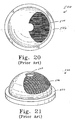
- the prior acetabular cup assembly 500 represents a typical dome loading ring lock design and includes a shell 502 and a bearing insert or liner (not seen in the figures) that is disposed interior of the shell 502.
- the portion of the shell 502 shaded for orange may thus be considered a load pattern and is generally designated 506.
- the remaining portion of the shell 502 that is not shaded for orange represents non-congruency between the liner and the shell 502.
- prior dome loading ring lock designs primarily load on a spherical surface. This causes the liner (typically polyethylene) to seat against the inner surface of the shell 502 in the direction of the applied load. As the applied load shifts from one direction to another direction, the loading pattern 506 shifts about the shell. This shifting motion applied to the liner that is then in turn applied to the shell causes wear on the liner.
- liner typically polyethylene
- a prosthetic component assembly that has increased congruency between a liner and shell of the prosthetic component assembly. It is also desirable to provide a prosthetic component assembly that maintains an increased congruency between a liner and a shell thereof regardless of loading induced on the liner. It is still further desirable to provide a prosthetic component assembly that provides controllable motion between a liner and a shell of the prosthetic component assembly. It is yet further desirable to provide a prosthetic component assembly that provides uniform controllable motion between a liner and a shell thereof.
- a prosthetic cup assembly for use in a joint such as a hip joint.
- the prosthetic cup assembly includes a shell defining a cavity, and a bearing insert or liner adapted for insertion into the shell cavity.
- the shell cavity and an outer surface of the bearing insert are configured with co-acting tapers.
- the co-acting tapers of the shell cavity and the bearing insert outer surface provide an interference fit between the bearing insert and the shell.
- the tapers are positioned on the shell and bearing insert such that the bearing insert is essentially congruent with the shell.
- each taper of the co-acting shell cavity taper and the bearing insert taper has a first portion and a second portion.
- the first and second portions are defined from a gage or transition point of the respective taper.
- first portions of each taper are essentially parallel and/or congruent with respect to each other, while second portions of each taper are convergent with respect to each other.
- the parallel/congruent taper portions define a substantially zero interference between each other (a "negative interference"), while the convergent taper portions define non-zero interference between each other.
- the amount of interference between the two convergent tapers is defined by the amount of, or literally, the degree of convergence, between the two convergent taper portions.
- the total degree of convergence between the two convergent taper portions defines a total amount of interference between the convergent portions.
- the amount of interference may be varied. This is achieved by varying the angle of each convergent taper portion.
- Various combinations of angled convergent portions provide various interference.
- the interference causes the bearing insert to effectively fix with the shell. By effectively fixing the bearing insert to the shell, control of motion between the bearing insert and the shell is effectively controlled.
- the length of the convergent taper portions may also be varied, including the length with respect to each other. Such variation in length of the convergent taper portions may be combined with the variation in angle of convergence of the taper portions. In this manner, the amount of interference between the shell and the bearing insert may be controlled. This translates to an amount of immobility (locking) between the bearing insert and the shell.
- the subject invention effectively allows the bearing insert to substantially completely dome load with respect to the shell while also providing stability in the peripheral regions (load sharing). Since the bearing insert is fixed at both a portion of the tapers and the dome, the relative location of the bearing insert does not move or change when a load is applied to the liner.
- the subject invention provides a prosthetic component assembly for use in fixation to a bone.
- the prosthetic component assembly includes a shell and a liner.
- the shell is formed with an inner surface having an inner taper.
- the inner taper has an inner taper angle.
- the liner is configured to be received in the shell and is formed with an outer surface having an outer taper.
- the outer taper has a first outer taper portion and a second outer taper portion.
- the first outer taper portion has a first outer taper angle and the second outer taper portion has a second outer taper angle.
- the first outer taper angle is less than or equal to the inner taper angle.
- the second outer taper angle is greater than the inner taper angle in a pre-assembly state of the liner.
- the subject invention provides a prosthetic component assembly for use in fixation to a bone.
- the prosthetic component assembly includes a shell and a liner.
- the shell is formed with an inner surface having an inner taper.
- the inner taper has an inner taper angle.
- the liner is configured to be received in the shell and is formed with an outer surface having an outer taper.
- the outer taper has a first outer taper portion and a second outer taper portion.
- the first outer taper portion defines a first outer taper angle.
- the second outer taper portion defines a second outer taper angle.
- the first outer taper angle is less than or equal to the inner taper angle.
- the second outer taper angle is greater than or equal to the inner taper angle in a pre-assembly state of the liner.
- the subject invention provides a prosthetic component assembly for use in fixation to a bone.
- the prosthetic component assembly includes a shell and a liner.
- the shell is formed with an inner surface having an inner taper.
- the inner taper has a first inner taper portion and a second inner taper portion.
- the first inner taper portion has a first inner angle, while the second inner taper portion has a second inner angle.
- the liner is formed with an outer surface having an outer taper.
- the outer taper has a first outer taper portion and a second outer taper portion.
- the first outer taper portion has a first outer taper angle, while the second outer taper portion has a second outer taper angle.
- the first outer taper angle is less than or equal to the first inner taper angle, while the second outer taper angle is greater than the second inner taper angle in a pre-assembly state of the liner.
- the subject invention is a method of assembling a prosthetic component assembly.
- the method includes the steps of: (a) providing a shell having a cavity with an inner surface, the inner surface having an inner taper, the inner taper having an inner taper angle; (b) providing a liner having an outer surface with an outer taper, the outer taper having a first outer taper portion and a second outer taper portion, the first outer taper portion having a first outer taper angle and the second outer taper portion having a second outer taper angle, the first outer taper angle being substantially equal to the inner taper angle, and the second outer taper angle having a pre-assembled taper angle that is greater than the inner taper angle; and (c) inserting the liner into the cavity of the shell until said second outer taper portion mechanically engages the inner taper and prevents further insertion of the liner into the cavity.
- the subject invention is a prosthetic component assembly for use in fixation to a bone.
- the prosthetic component assembly includes a shell and a bearing insert.
- the shell has an inner surface and an inner taper disposed on the inner surface.
- the bearing insert has an outer surface with an outer taper disposed on the outer surface.
- the outer taper has a first outer taper portion and a second outer taper portion. The first outer taper portion is configured to be substantially congruent with a portion of the inner taper portion when the bearing insert is assembled into the shell, and the second outer taper portion is configured to provide an interference fit with another portion of the inner taper when the bearing insert is assembled into the shell.
- Fig. 1 shows an acetabular cup assembly 10 which includes a shell 12 adapted to be affixed to the acetabulum (not shown) to replace the natural hip socket, a liner 14 adapted to be coupled to shell 12, and a bearing 16 adapted to be coupled to liner 14.
- Shell 12 includes an outer surface 18 that can be textured to facilitate securing shell 12 in place within an appropriately prepared acetabulum.
- Shell 12 is preferably made from titanium, but may be made from a cobalt chrome material or other suitable materials.
- Shell 12 also includes a generally hemispherical shaped inner surface 20.
- Shell 12 further includes a rim 22.
- Rim 22 defines a plane through which liner 14 and bearing 16 enter a cavity 24 of shell 12 formed by inner surface 20.
- Inner surface 20 of shell 12 is formed to include a side wall 26 providing, at its outer extent 28 a female taper 30.
- Female taper 30 extends around the entire periphery of cavity 24 adjacent rim 22. It is understood that the axial depth of female taper 30 within cavity 24 may vary.
- Liner 14 includes an outside spherical surface 32 having a male taper 44 that is sized to engage and lock with female taper 30. It is understood that the length of male taper 44 may vary, so long as it securely engages female taper 30. Liner 14 is preferably made from titanium, but may be made from a cobalt chrome material, or other suitable materials. Liner 14 includes an inside surface 34 that preferably defines a chamber 36 sized for receiving bearing component 16. Typically, inside surface 34 is generally hemispherical in shape. In addition, projections 53 may extend from inside surface 34 in a spaced-apart relationship relative to one another for secure engagement with bearing component 16. See Fig. 2.
- liner 14 typically includes four projections 53 positioned at approximately 90 ° relative to one another to prevent rotation of bearing component 16 within chamber 36.
- Liner 14 further includes an outer rim 40.
- a locking tab 42 extends into chamber 36 from inside surface 34 adjacent outer rim 40. See Fig. 2.
- bearing 16 includes an outer surface 52 that is generally hemispherical in shape. Bearing 16 also includes an inner bearing surface 54 that defines an opening 55 sized to receive a prosthetic femoral ball (not shown). A rim 56 extends circumferentially around opening 55 of bearing 16. Bearing 16 is symmetrical. It is understood, however, that bearing 16 of the present invention may be a non-symmetrical component. Bearing 16 further includes a circumferential groove 58 spaced apart from rim 56 and sized to receive locking tab 42 of liner 14. Bearing 16 is preferably made from a polymeric material such as ultra high molecular weight polyethylene (UHMWPE). Of course, bearing 16 could be made of other types of implantable bearing materials such as a metal material or a ceramic material.
- UHMWPE ultra high molecular weight polyethylene
- bearing 16 may be selectively coupled to liner 14 to form a subassembly 60 in accordance with a kit of the present invention.
- the user will receive the kit that includes shell 12, and at least two bearing/liner subassemblies 60, 160, 260 such as, for example of the types shown in Figs. 2, 5 and 6 respectively.
- appropriate subassembly 60, 160, 260 for use with the environment may be selected.
- bearing 16 is press-fit into chamber 36 of liner 14.
- Inside surface 34 of liner 14 has an inner radius 66 that is less than a normal predetermined radius 64 (Fig. 1) of outer surface 52 of bearing 16. Therefore, prior to assembly, bearing 16 is cooled to a temperature that causes its outer surface 52, to shrink in size to a reduced second radius (not shown). It is understood that the amount of size reduction will vary depending upon the material used to construct bearing component 16 and the temperature to which bearing 16 is cooled. Typically, bearing 16 is cooled in liquid nitrogen, however other common refrigeration methods may be used. Therefore, once normal pre-determined radius 64 of outer surface 52 has been reduced, bearing 16 is press-fit into chamber 36 of liner 14.
- Circumferential groove 58 is generally aligned with locking tab 42 of liner 14. After circumferential groove 58 and locking tab 42 are aligned, bearing 16 is warmed to a temperature sufficient to return outside surface 52 of bearing 16 to a size approaching its normal pre-determined radius 64. Thus, bearing 16 and liner 14 are fastened together in a fixed and locked position and form bearing/liner subassembly 60.
- This subassembly 60 is then inserted into cavity 24 of shell 12 to form assembled acetabular cup assembly 10. See Fig. 3.
- female and male tapers 30, 44 cooperate to hold subassembly 60 in place.
- Male taper 44 of liner 14 engages female taper 30 of shell 12 and forms a metal-to-metal locking mechanical connection between them.
- Tapers 30, 44 may be a straight taper, as in Figs. 2 to 7, or they may be as a curve of a conic section, for example circle, ellipse, parabola, hyperbola or the like. If taper 44 of outside surface 32 of liner 14 is straight, taper 30 of side wall 26 of shell 12 is also straight.
- tapers 30, 44 are machine tapers that provide a connection that ensures and maintains accurate alignment between shell 12 and liner 14 and permits shell 12 and liner 14 to be separated for reconditioning or for substitution of other parts.
- Tapers 30, 44 may be a self-holding taper (i.e. self-locking) or a self-releasing taper.
- self-holding and self-locking are defined as male and female tapers that when in engagement with one another, tend to stay in place owing to the taper angle; no other means of holding is required.
- the included angle between diametrically opposite points on male taper 44 will be greater than 0° and less than or equal to about 17°.
- an angle 48 between the opposite points on male taper 44 is greater than 0° and less than or equal to about 7°.
- a curved locking taper is achieved when the acute angles between tangents to the curve over much of its length and perpendicular to rim 40 are greater than 0° and do not exceed about 7°. Removal of the male taper from the female taper is accomplished by starting the removal with a drift key or some other positive mechanism.
- self-releasing is distinguished from the term “self-holding” (or “self-locking") by the taper angle that is sufficiently large to make retention of the male taper in the female taper dependent upon a positive locking device, such as the positive pressure from a corresponding femur head against bearing component 16.
- a positive locking device such as the positive pressure from a corresponding femur head against bearing component 16.
- the included angle between diametrically opposite points on male taper 44 will be about 17°.
- the taper fit between male and female tapers 30, 44 serves only to maintain alignment. Self-releasing tapers will release themselves.
- Acetabular cup assembly 110 includes shell 12, a liner 114 that is coupled in shell 12, and bearing 16 coupled to liner 114 to create liner/bearing subassembly 160.
- Liner 114 includes an outside surface 132 that is formed for engaging inner surface 20 of shell 12, an inside chamber 134, and an outer rim 140 extending about the circumference of liner 114.
- a locking tab 142 extends into inside chamber 134 for engagement with bearing 16.
- outside surface 132 includes a male taper 144 that is angled about its circumference to create unequal tapering lengths on opposite sides 133, 135 of liner 114.
- This angled taper 144 causes liner/bearing subassembly 160 to be positioned in a lipped orientation within shell 12. It is understood that the angle can be varied to create various tapering lengths in order to create multiple orientations for subassembly 160 within shell 12. Such a lipped orientation can be beneficial in certain environments to aid in the prevention of femoral ball dislocation.
- Acetabular cup assembly 210 includes shell 12, a liner 214 that is coupled in shell 12, and bearing 16 coupled to liner 214 to create liner/bearing subassembly 260.
- Liner 214 is ringshaped and includes an outside surface 232 that is formed for engaging female taper 30 of shell 12 and an opposite inside surface 234.
- liner 214 includes an inner rim 238, an outer rim 240, and an inside chamber 235 extending between rims 238, 240.
- a locking tab 242 extends into inside chamber 235 for engagement with outside surface 52 of bearing 16.
- outside surface 232 is formed as a male taper 244 that extends about the circumference.
- the taper feature of the present invention provides mechanical lock integrity for the two or three piece construct.
- This alternative design avoids the need for a metal locking ring and provides a rigid engagement of the liner, essentially eliminating the potential for any relative motion between the metal liner and the metal shell. Without this relative motion, the potential for abrasive wear on an outer surface of the bearing is substantially eliminated.
- a liner that includes a tapered portion helps push the bearing into a pre-determined position and inhibits wear debris from escaping from the liner into the patient.
- each subassembly is infinitely adjustable within the shell to create a variety of orientations suitable for preventing dislocation of the corresponding femur head.
- the surgeon must only select a suitable bearing orientation relative to the femur head and press the subassembly in place to engage the corresponding tapers. Once the tapers are engaged, the acetabular cup assembly is automatically and easily held in place.
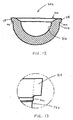
- Figs. 7 to 15 show still another embodiment of the present invention.
- Figs. 7 to 9 disclose a shell 300 and Figs. 10 to 15 disclose a bearing 302 which, when assembled together, collectively creates another acetabular cup assembly which incorporates the features of the present invention therein.
- the acetabular cup assembly which is made up of the components shown in Figs. 7 to 15 is assembled by inserting the bearing 302 (see Figs. 10 to 15) into a cavity 304 defined by the shell 300 in a manner similar to the insertion of the liner/bearing subassembly into the cavity of the shell as described above with respect to the embodiments depicted in Figs. 1 to 6.
- the embodiment described with respect to Figs. 7 to 15 is a two to piece cup assembly, while each of the embodiments described with respect to Figs. 1 to 6 is a three-piece cup assembly.
- the shell 300 possesses a generally hemispherical shape and is preferably made from a metallic material such as a titanium alloy. Alternatively, the shell 300 may be made from a metallic material such as cobalt chrome.
- the shell 300 possesses a porous coating 306 located on an outer surface of the shell as shown in FIG. 7.
- the porous coating 306 is configured to facilitate biological ingrowth of a patient's bone within the outer surface of the shell whereby long-term fixation of the shell 300 to the patient's bone may be achieved.
- a number of spikes (not shown) may be secured to the outer surface of the shell to further facilitate fixation of the shell 300 to the patient's bone as is well known in the art.
- An apex hole 308 is defined in the shell 300. The apex hole is provided with a number of threads so as to allow coupling of an insertion instrument (not shown) thereto. The instrument may be coupled to the shell 300 during implantation of the acetabular cup assembly into the patient's body.
- the shell 300 possesses a plurality of tangs 310 located at an upper rim 312 of the shell 300. Each of the plurality of tangs 310 extends inwardly toward the centre of the shell 300 as shown in FIG. 8.
- the plurality of tangs 310 define a plurality of anti-rotation recesses 313 which are evenly spaced around the upper rim 312 of the shell 300 as shown in FIG. 8.
- the shell 300 also includes an annular recess 314 which is positioned immediately below the plurality of tangs 310 (see Figs. 8 and 9).
- the shell 300 also includes a female taper 315 which is defined in an inner surface of the shell as shown in FIG. 9.
- the female taper 315 extends around the entire periphery of the cavity 304 of the shell 300. Moreover, the female taper 315 extends axially for a distance D1 near its upper rim 312 as shown in FIG. 9.
- the bearing 302 possesses a generally hemispherical shape and is preferably made from a polymeric material such as ultra high molecular weight polyethylene (UHMWPE).
- UHMWPE ultra high molecular weight polyethylene
- the bearing 302 could be made of other types of materials which are suitable for implantation into the body of a human being.
- the bearing 302 defines a cavity 316 which is configured to receive a prosthetic femoral ball (not shown).
- the bearing 302 includes a plurality of anti-rotation protrusions 318 which are evenly spaced around an upper rim 320 of the bearing 302 as shown in FIG. 11. Each of the plurality of protrusions 318 extends outwardly away from the centre of the bearing 302 as shown in FIG. 11.
- the bearing 302 also includes a male taper 323 which is defined in an outer surface of the bearing as shown in Figs. 10 and 12-15.
- the male taper 323 extends around the entire periphery of the bearing 302.
- the male taper 323 extends axially for a distance D2 near its upper rim 320 as shown in FIG. 14.
- the bearing 302 also includes an annular locking member 324 which is located immediately below the plurality of protrusions 318 (see Figs. 8 and 9).
- the annular locking member 324 extends around the entire periphery of the bearing 302.
- the annular locking member 324 extends outwardly from the male taper 323.
- the bearing 302 When the bearing 302 is positioned in the cavity 304 of the shell 300 after assembly of the acetabular cup assembly made up of the components shown in Figs. 7 to 15, the female taper 315 of the shell 300 engages and locks with the male taper 323 of the bearing 302 so as to secure the bearing 302 to the shell 300. Moreover, when the bearing 302 is positioned in the cavity 304 of the shell 300 after assembly of the acetabular cup assembly, the annular locking member 324 of the bearing 302 is located within the annular recess 314 defined in the shell 300 so as to further secure the bearing 302 to the shell 300.
- the lengths of the female taper 315 and the male taper 323 may vary so long as such lengths are of sufficient magnitude to cause the female taper 315 and the male taper 323 to securely engage each other.
- the taper angle between the two tapers 315, 323 is chosen to be within the range of self-locking tapers. For example, if each taper 315, 323 was in the range of 2° to 8.5° (for an aggregate taper angle range of 4° to 17°), appropriate engagement and locking between the two components would be achieved.
- the plurality of protrusions 318 are respectively positioned within the plurality of recesses 313. With the protrusions 318 positioned within recesses 313, rotational movement of the bearing 302 relative to the shell 300 is inhibited.
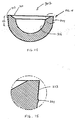
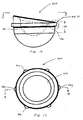
- Figs. 16 to 19 show an alternative bearing 400 which could be substituted for the bearing 302 in order to create yet another acetabular cup assembly which incorporates the features of the present invention therein.
- Such acetabular cup assembly would cause a cavity 402 of the bearing 400 to be angled with respect to the shell 300 which may be beneficial in certain environments to aid in the prevention of femoral ball dislocation.
- the bearing 400 possesses a somewhat hemispherical shape as best shown in Figs. 16 and 18.
- the bearing 400 is preferably made from a polymeric material such as ultra high molecular weight polyethylene (UHMWPE).
- UHMWPE ultra high molecular weight polyethylene
- the bearing 400 may be made of other types of materials which are suitable for implantation into the body of a human being such as a metal material or a ceramic material.
- the bearing 400 defines the cavity 402 which is configured to receive a prosthetic femoral ball (not shown).
- the bearing 400 includes a plurality of anti-rotation protrusions 404 which are evenly spaced around the bearing 400 as shown in FIG. 17. Each of the plurality of protrusions 404 extends outwardly away from the centre of the bearing 400 as shown in FIG. 17.
- the bearing 400 also includes a male taper 406 which is defined in an outer surface of the bearing as shown in Figs. 16 and 18 to 19.
- the male taper 406 extends around the entire periphery of the bearing 400.
- the male taper 406 extends axially for a distance D3 as shown in FIG. 14.
- the bearing 400 also includes an annular locking member 410 which is located immediately below the plurality of protrusions 404 (see e.g. Fig. 19).
- the annular locking member 410 extends around the entire periphery of the bearing 400.
- the annular locking member 410 extends outwardly from the male taper 406.
- the bearing 400 When the bearing 400 is positioned in the cavity 304 of the shell 300 after assembly of the acetabular cup assembly made up of the components shown in Figs. 7 to 9 and 16 to 19, the female taper 315 of the shell 300 engages and locks with the male taper 406 of the bearing 400 so as to secure the bearing 400 to the shell 300. Moreover, when the bearing 400 is positioned in the cavity 304 of the shell 300 after assembly of the acetabular cup assembly, the annular locking member 410 of the bearing 400 is located within the annular recess 314 defined in the shell 300 so as to further secure the bearing 400 to the shell 300.
- the lengths of the female taper 315 and the male taper 406 may vary so long as such lengths are of sufficient magnitude to cause the female taper 315 and the male taper 406 to securely engage each other.
- the taper angle between the two tapers 315, 406 is chosen to be within the range of self-locking tapers as described above.
- the plurality of protrusions 404 are respectively positioned within the plurality of recesses 313. With the protrusions 404 positioned within recesses 313, rotational movement of the bearing 404 relative to the shell 300 is inhibited.
- a bearing insert or liner (hereinafter “liner"), generally designated 600, in accordance with principles of the subject invention and shown in a pre-assembled state (i.e. without other components thereof that form a prosthetic assembly).
- the liner 600 is preferably fabricated from a polymeric material such as plastic.
- the liner 600 is preferably fabricated from the plastic polyethylene.
- the liner 600 is preferably fabricated from an ultra high molecular weight polyethylene (UHMWPE).
- UHMWPE ultra high molecular weight polyethylene
- the liner 600 is also preferably formed as one piece.
- the liner 600 is formed by a body 602 that has or defines an interior, chamber or cavity 604 and a rim 606 that surrounds an opening of the interior 604.
- the interior 604 is preferably, but not necessarily semi-hemispherical to hemispherical in shape.
- the cavity 604 in all cases is configured to accept a head of a prosthetic (not shown) or a head of a bone (not shown).
- the interior 604 has an angled or ramped portion 608 that extends from the rim 606 into the interior 604.
- the interior 604 also preferably extends annularly about the top of or opening to the interior 604.
- the interior 604 also has a dome-shaped or generally hemispherical-shaped surface 609 that begins at an end of the angled portion 608.
- the rim 606 may include a plurality of protrusions or projections 610 that are spaced annularly about the rim 606.
- the protrusions 610 extend generally radially from the rim 606 and aid in preventing rotation of the liner 600 (stabilizing the liner 600) when the liner 600 is assembled as described herein. While the liner 600 depicts six (6) protrusions 610, the number of protrusions 610 is essentially arbitrary but are of a number that is enough to provide rotational stability.
- the body 602 has a sidewall or wall 618 that has a tapered or angled outer surface portion or outer taper 614 and a dome or a generally hemispherical-shaped portion (outer surface) 616 extending from the outer taper 614.
- the outer taper 614 may be termed an outside or male taper and preferably, but not necessarily, extends annularly about the entire periphery of the wall 618.
- the taper 614 forms an annular band between the generally hemispherical-shaped dome 616 and the rim 602. There may additionally be a band of space between the rim 602 and the taper 614.
- the liner 600 may be fabricated in different sizes to accommodate different anatomies of a patient.
- the cavity 604 of the liner 600 is sized to accommodate different balls or heads of corresponding prosthetics.
- the body 602 is sized to be accommodated in various sized shells as described herein.
- FIG. 25 there is depicted another illustrative embodiment of a shell, generally designated 620, in accordance with the principles of the subject invention, and shown in a pre-assembled state (i.e. without other components thereof that form a prosthetic assembly).
- the shell 620 is adapted to be affixed to the acetabulum of a patient (not shown) to replace the natural hip socket.
- the shell 620 includes an outer surface 636 that is generally semi-hemispherical to hemispherical in shape.
- the outer surface 636 can be textured to facilitate securing the shell 620 in place within an appropriately prepared acetabulum (not shown).
- the shell 620 is preferably made from a metal such as titanium, but may be fabricated from a cobalt chrome material, other metal or other suitable materials.
- the shell 620 may also include a plurality of pegs, posts, or the like 638 that are adapted to help maintain the shell 620 seated in the appropriately prepared acetabulum.
- the pegs 638 are optional and thus may or may not be provided.
- the shell 620 has an interior, chamber or cavity 630 that has a tapered or angled inner surface or inner taper 632 joined with a generally hemispherical-shaped inner surface 634 extending from an end point of the taper 632.
- the taper 632 may be termed a female, inside, or inner taper and preferably, but not necessarily, extends annularly about the entire periphery of the cavity 630.
- the shell 620 also has a rim 626.
- the rim 626 defines a plane through which the liner 620 enters the cavity 630 when the prosthetic component (constituting in this case, the shell 620 and the liner 600) is assembled.
- the rim 626 has a plurality of notches or cutouts 628 that are spaced annularly thereabout.
- the notches 628 correspond in shape to the protrusions 610 of the liner 600 but are a little larger in dimension (width and length) than the protrusions 610. In this manner the protrusions 610 are thus adapted to be received in the notches 628 when assembled.
- the liner 600 is received into the shell 620 to form a prosthetic component assembly (prosthetic assembly) 650.
- the prosthetic assembly 650 may be provided as a kit.
- a user typically a doctor
- the shell and liner are coordinated in size. It should be appreciated however, that the shell and liner assembly come in various sizes to accommodate the various differences in human anatomy.
- the liner 600 is inserted into the shell 620 at a point in the assembly process.
- Fig. 26 depicts an exploded view illustrating how the liner 600 fits into or is received by the shell 620 (assembled). It should be appreciated that the exploded view of Fig. 26 is with respect to the shell 620 and the liner 600 and thus is without regard to the shell 620 being affixed to a patient's bone.
- the liner 600 is received into the cavity 630 of the shell 620.
- the liner 600 is axially received into the cavity 630 until the outside taper 614 of the liner 600 co-acts with the inside taper 632 of the shell 620 to prevent further axial movement of the liner 600 with respect to the shell 620.
- the co-action of the tapers 614 and 632 also prevents rotational movement (micro motion) of the liner 600 with respect to the shell 620.
- the notches 628 and protrusions 610 also prevent rotational movement (macro motion) of the liner 600 with respect to the shell 620.
- Such co-action of the tapers 614 and 632 locks (preferably releasably) the liner 600 to the shell 620.
- the exterior surface 616 of the liner 600 is substantially congruent with the interior surface 634 of the shell 620. Additionally, the protrusions 610 are received in the notches 628, if the liner and shell optionally include such protrusions and notches.
- the outer taper 614 of the liner 600 is depicted in a sectional view with regard to a portion of the sidewall or wall 618 of the liner or bearing insert 600.
- the outer taper 614 is defined between a beginning or commencement point 666 and an end or termination point 676. It should be appreciated that the commencement point 666 and the termination point 676 are arbitrary designations and can be reversed such that the point 676 is the commencement point and the point 666 is the termination point.
- the commencement point 666 also defines a beginning point for the surface 616.
- the thickness of the wall 618 may be substantially constant throughout the length of the taper 614 (wall 618 portion) as well as elsewhere along the length of the wall 618. Alternatively, the thickness of the wall 618 along the length of the taper 614 may be variable. The remaining portions of the wall may have a variable thickness as well. Additionally, the wall 618 of the liner 600, may be formed of variable to constant wall thickness sections. In an exemplary embodiment of a variable thickness wall 618, the taper 614 may be thicker at the termination point 676 than at the commencement point 666. This may be gradual from one point to the other point and thus defines a gradient of thickness for the wall.
- the taper 614 has a first or lower section or portion 660 and a second or upper section or portion 670.
- first and second are arbitrary designations and thus the first may be the second, while the second may be the first.
- a transition point 668 defines the first and second portions 660 and 670.
- the first portion 660 is defined as between the commencement point 666 and the transition point 668
- the second portion 670 is defined as between the transition point 668 and the termination point 676.
- the length of each portion 660 and 670 is variable within any constraints discussed herein.
- each portion 660 and 670 are preferably within a predetermined proportion with respect to the overall length of the taper 614.
- each taper portion 660 and 670 may have their own constant or variable thickness, the variable thickness having a gradient of thickness variation.
- a preferable benchmark or fundamental transition point is approximately 2 / 3 of the length of the taper 614 relative from the termination point 676.
- the length of the first portion 660 is preferably, approximately 1 / 3 of the total length of the taper 614, while the length of the second portion 670 is preferably, approximately 2 / 3 of the total length of the of the taper 614. This may also be considered a baseline or fundamental position to which other lengths of the outer taper portions 660 and 670 and the overall length of the outer taper 614 are considered.
- a first outer surface 662 of the taper portion 660 is at an angle ⁇ L with respect to a vertical 664, while a second outer portion surface 672 of the taper portion 670 is at an angle ⁇ L with respect to a vertical 674.
- the verticals 672 and 674 are parallel such that the angles ⁇ L and ⁇ L are definable from a common (translatable) vertical.
- the angles ⁇ L and ⁇ L are non-zero, where a zero angle is defined as parallel to or congruent with the verticals 672 and 674.
- the first outer surface 662 between points 666 and 668, defines an angle ⁇ L from the vertical 664.
- the angle ⁇ L is radially outward of the interior 604.
- the angle ⁇ L is preferably between 0° and 22.5° inclusive (0° ⁇ ⁇ L ⁇ 22.5°).
- the angle ⁇ L is radically outward of the interior 604.
- the angle ⁇ L is preferably between 0° and 22.5° inclusive (0° ⁇ ⁇ L ⁇ 22.5°).
- the angles ⁇ L and ⁇ L also preferably have a relationship wherein the angle ⁇ L is equal to or greater than the angle ⁇ L ( ⁇ L ⁇ ⁇ L ).
- the second outer surface 672 (the outer surface of the second outer taper portion 670) is preferably at an angle ⁇ L that is greater than the angle ⁇ L of the first outer surface 662 (the outer surface of the first outer
- the first outer surface 662 of the first taper portion 660 may also be described in terms of outer diameters of the various points of the first outer surface 662 of the first taper portion 660.
- the first outer surface 662 has an outer diameter OD L1 that is defined from the commencement point 666 on one side of the liner 600 and the commencement point 666 on the other side (180° thereof) of the liner 600, and an outer diameter OD L2 that is defined from the transition point 668 at one side of the liner 600 and the transition point 668 on the other side (180° thereof) of the liner 600.
- the outer diameters OD L1 and OD L2 have a relationship of OD L1 ⁇ OD L2 .
- a positive slope or gradient 700 of outer diameters is thus defined between the outer diameters OD L1 and OD L2 .
- the first taper portion 660 can also be considered a first conic portion (a truncated cone section) defined by two parallel planes (one plane defined as through the commencement points 666, and the other plane defined as through the transition points 668) intersecting a cone, the two planes being parallel to a base of the cone.
- the cone has a side surface having an angle corresponding to the angle ( ⁇ L ) of the first outer surface 662.
- the second outer surface 672 of the second taper portion 670 may also be described in terms of outer diameters of the various points of the second outer surface 662 of the second taper portion 670.
- the second outer surface 662 has an outer diameter OD L2 that is defined from the transition point 668 at one side of the liner 600 and the transition point 668 on the other side (180° thereof) of the liner 600, and an outer diameter OD L3 that is defined from the termination point 676 on one side of the liner 600 and the termination point 676 on the other side (180° thereof) of the liner 600.
- the outer diameters OD L2 and OD L3 have a relationship of OD L2 ⁇ OD L3.
- a positive slope or gradient 702 of outer diameters is thus defined between the outer diameters OD L2 and OD L3 .
- the second taper portion 670 can also be considered a second conic portion (a truncated cone section) defined by two parallel planes (one plane defined as through the transition points 668, and the other plane defined as through the termination points 676) intersecting a cone, the two planes being parallel to a base of the cone.
- the cone has a side surface having an angle corresponding to the angle ( ⁇ L ) of the second outer surface 672.
- the outer taper 614 may be described in terms of outer diameters of the various points of the outer taper 614.
- the outer taper 614 may be defined as a plurality of outer diameters from the points of the outer surface 662 between the outer diameters OD L1 to OD L3 .
- the outer diameters OD L1 to OD L3 have a relationship of OD L1 ⁇ OD L3 and thus define a positive slope or gradient 704 of outer diameters between them.
- the slope of the outer diameters may change (become greater) at the transition point 668 if the angle ⁇ L is greater than the angle ⁇ L ( ⁇ L > ⁇ L ).
- the inner taper 632 of the shell 620 is depicted in a sectional view with regard to a portion of the sidewall or wall 642 of the shell 620.
- the inner taper 632 is defined between a beginning or commencement point 686 and an end or termination point 696. It should be appreciated that the commencement point 686 and the termination point 696 are arbitrary designations and can be reversed such that the point 696 is the commencement point and the point 686 is the termination point.
- the commencement point 686 also defines a beginning point for the surfaces 636 and 634.
- the thickness of the wall 642 may be substantially constant throughout the length of the taper 632 (wall 642 portion) as well as elsewhere along the length of the wall 642. Alternatively, the thickness of the wall 642 along the length of the taper 632 may be variable. The remaining portions of the wall may have a variable thickness as well. Additionally, the wall 642 of the shell 620, may be formed of variable to constant wall thickness sections. In an exemplary embodiment of a variable thickness wall 642, the taper 632 may be thicker at the termination point 696 than at the commencement point 686. This may be gradual from one point to the other point and thus defines a gradient of thickness for the wall.
- the taper 632 has a first or lower section or portion 680 and a second or upper section or portion 690.
- first and second are arbitrary designations and thus the first may be the second, while the second may be the first.
- a transition point 688 defines the first and second portions 680 and 690.
- the first portion 680 is defined as between the commencement point 686 and the transition point 688
- the second portion 690 is defined as between the transition point 688 and the termination point 696.
- the length of each portion 680 and 690 is variable within any constraints discussed herein.
- each portion 680 and 690 are preferably within a predetermined proportion with respect to the overall length of the taper 632. Further, with respect to was thickness, each taper portion 680 and 690 may have their own constant or variable thickness, the variable thickness having a gradient of thickness variation.
- a preferable benchmark or fundamental transition point is approximately 2 / 3 of the length of the taper 632 relative from the termination point 696.
- the length of the first portion 680 is preferably, approximately 1 / 3 of the total length of the taper 632
- the length of the second portion 690 is preferably, approximately 2 / 3 of the total length of the of the taper 632.
- This may also be considered a baseline or fundamental position to which other lengths of the inner taper portions 680 and 690 and the overall length of the inner taper 632 are considered. This also comports with the dimensions of the outer taper 614 of the liner 600.
- a first inner surface 682 of the taper portion 680 is at an angle ⁇ S with respect to a vertical 684, while a second inner portion surface 692 of the taper portion 690 is at an angle ⁇ S with respect to a vertical 694.
- the verticals 684 and 694 are parallel such that the angles ⁇ S and ⁇ S are definable from a common (translatable) vertical.
- the angles ⁇ S and ⁇ S are non-zero where a zero angle is defined as parallel to or congruent with the vertical 684 and 694.
- the first inner surface 682 between points 686 and 688, defines an angle ⁇ s from the vertical 684.
- the angle ⁇ s is radially inward toward the cavity 630.
- the angle ⁇ s is preferably between 0° and 22.5° inclusive (0° ⁇ ⁇ s ⁇ 22.5°).
- the second inner surface 692 between the points 688 and 696, defines an angle ⁇ s from the vertical 694.
- the angle ⁇ s is radially inward toward the cavity 630.
- the angle ⁇ s is preferably between 0° and 22.5°, inclusive (0 ⁇ ⁇ s ⁇ 22.5°).
- the second inner surface 692 (the inner surface of the second inter taper portion 690) is preferably at an angle ⁇ s that is the same as the angle ⁇ s of the first inner surface 682 (the inner surface of the first inner taper portion 680).
- the first inner surface 682 of the first taper portion 680 may also be described in terms of inner diameters of the various points of the first inner surface 682 of first taper portion 680.
- the first inner surface 682 has an inner diameter ID S1 that is defined from the commencement point 686 on one side of the shell 620 and the commencement point 686 on the other side (180° thereof) of the shell 620, and an inner diameter ID S2 that is defined from the transition point 688 at one side of the shell 620 and the transition point 688 on the other side (180° thereof) of the shell 620.
- the inner diameters ID S1 and ID S2 have a relationship of ID S1 ⁇ ID S2 .
- a positive slope or gradient 710 of inner diameters is thus defined between the inner diameters ID S1 and ID S2 .
- the first taper portion 680 can also be considered a first conic portion (a truncated cone section) defined by two parallel planes (one plane defined as through the commencement points 686, and the other plane defined as through the transition points 688) intersecting a cone, the two planes being parallel to a base of the cone.
- the cone has a side surface having an angle corresponding to the angle ( ⁇ s ) of the first inner surface 682.
- the second inner surface 692 of the second taper portion 690 may also be described in terms of inner diameters of the various points of the second inner surface 692 of the second taper portion 690.
- the second inner surface 692 has an inner diameter ID S2 that is defined from the transition point 688 at one side of the shell 620 and the transition point 688 on the other side (180° thereof) of the shell 620, and an inner diameter ID S3 that is defined from the termination point 696 on one side of the shell 620 and the termination point 696 on the other side (180° thereof) of the shell 620.
- the inner diameters ID S2 and ID S3 have a relationship of ID S2 ⁇ ID S3 . A positive slope or gradient 712 of inner diameters is thus detained between the inner diameters ID S2 and ID S3 .
- the second taper portion 690 can also be considered a second conic portion (a truncated cone section) defined by two parallel planes (one plane defined as through the transition points 688, and the outer plane defined as through the termination points 696) intersecting a cone, the two planes being parallel to a base of the cone.
- the cone has a side surface having an angle corresponding to the angle ( ⁇ s ) of the second inner surface 692.
- the inner taper 632 may be described in terms of inner diameters of the various points of the inner taper 632.
- the inner taper 632 may be defined as a plurality of inner diameters from the points of the inner surface 682 between the inner diameters ID S1 to ID S3 .
- the inner diameters ID S1 to ID S3 have a relationship of ID S1 ⁇ ID S3 and thus define a positive slope or gradient 714 of inner diameters between them.
- the slope of the inner diameters may or may not change at the transition point 688. If the angles ⁇ s and ⁇ s are the same, the inner taper 632 may be considered as continuous and thus not having two taper portions,
- the transition or gage point 668 of the liner 600 and the transition or gage point 688 of the shell 620 when assembled, define an essentially zero interference or interference fit between the outer surface at the transition point 668 of the liner 600 and the inner surface at the transition point 688 of the shell 620.
- the first outer surface 662 (first outer taper portion 660) of the liner 600 when assembled into the shell 620, is either substantially congruent with the first inner surface 682 (first inner taper portion 680) or defines a gap or tolerance (negative interference) between the first outer surface 662 and the first inner surface 682.
- the gap or tolerance may be constant between the surfaces or may increase between the surfaces.
- the angle ⁇ L of the first outer taper portion 660 is thus equal to or less than the angle ⁇ s of the first inner taper portion 680 ( ⁇ L ⁇ ⁇ s ) Further, the outer diameters OD L1 and OD L2 of the first outer taper portion 660 are essentially equal to or less than the inner diameters ID S1 and ID S2 respectively of the first inner taper portion 680.
- the second outer surface 672 (second outer taper portion 670) of the liner 600 when assembled into the shell 620, provides an interference fit with regard to the second inner surface 692 of the shell.
- the interference begins at the transition points 668 and 688 of the liner 600 and the shell 620 respectively.
- the interference fit also depends on the angular relationship of the two angles ⁇ L and ⁇ s .
- the amount of interference depends on the angle ( ⁇ L and ⁇ s )of each respective surface 674 and 692.
- the angle ⁇ L of the second outer taper portion 672 is thus equal to or greater than the angle ⁇ s of the second inner taper portion 692 ( ⁇ L ⁇ ⁇ s ).
- the outer diameters OD L1 and OD L2 of the first outer taper portion 660 are essentially equal to or less than the inner diameters ID S1 and ID S2 respectively of the first inner taper portion 680.
- the shell taper 632 may have a consistent angle throughout its entire length. As such, the shell taper 632 may not be divided or segregated into the two portions 680 and 690.
- the transition or gage point 688 of the shell taper 632 would still provide an interference benchmark or fundamental position for zero interference for the liner 600 and the shell 620 at which point the interference changes.
- the transition point 688 of the shell 620 in this particular illustration still provides an alignment with the transition or gage point 668 of the liner 600 when assembled.
- FIGs. 31 to 36 there is depicted an exemplary embodiment of an assembled prosthetic component generally designated 650'.
- Figs. 31 to 36 illustrate a maximum material condition (MMC) and the attendant interference fit relationships between the tapers of the liner and the shell due to the MMC.
- MMC maximum material condition
- the MMC provides the most or maximum amount of acceptable interference.
- the MMC also provides the most or maximum amount of material for the outer diameter of the liner 600' (i.e. the taper is at a maximum thereby producing a maximum outer diameter at the taper).
- the MMC prosthetic component assembly 650' includes a 48 mm outer diameter shell 620' and a 48 mm outer diameter by 28 mm inner diameter liner or bearing insert 600'.
- the MMC prosthetic component assembly 650' is such that when assembled, the inner diameter at the shell gage ID S2 is slightly smaller than the outer diameter at the liner gage OD L2 .
- a groove diameter 720 of the shell 620' has a larger diameter than a barb diameter 722 of the liner 600'.
- the angle ⁇ L of the liner (here at 5.35°) is greater than the angle ⁇ S of the shell (here at 4.95°). This creates an interference fit when assembled between the tapers 614' and 632'.
- the liner 600' has a greater outer diameter (OD L3 ) than the inner diameter (ID S3 ) of the shell 620'.
- Fig. 35 Such an interference fit is illustrated in Fig. 35.
- the interference at the liner face is projected beyond the liner 600' for illustrative purposes. Additionally shown in Fig. 35 is the congruity between the spherical radii of the liner 600' and the shell 620', the collinear gage points, the interference between the liner and shell at the gage points, the clearance at the dome end of the taper, and the position of the liner and shell gage points.
- Fig. 36 there is illustrated the channel or groove 724 on the inner surface of the shell 620'.
- the liner 600' may include a barb 726 that is positioned in the channel 724 when the liner 600' is assembled into the shell 620'.
- FIGs. 37 to 42 there is depicted an exemplary embodiment of an assembled prosthetic component generally designated 150".
- Figs. 37 to 42 illustrate a least material condition (LMC) and the attendant interference fit relationships between the tapers of the liner and the shell due to the LMC.
- the LMC provides the least or minimal amount of acceptable interference.
- the LMC also provides the least or minimal amount of material for the outer diameter of the liner 600" (i.e. the taper is at a minimum thereby producing a minimum outer diameter at the taper).
- the LMC prosthetic component assembly 650" includes a 48mm outer diameter shell 620" and a 48mm outer diameter by 28mm inner diameter liner or bearing insert 600".
- the LMC prosthetic component assembly 650" is such that when assembled, the inner diameter at the shell gage ID S2 is slightly smaller than the outer diameter at the liner gage OD L2 .
- a groove diameter 720' of the shell 620" has a larger diameter than a barb diameter 722' of the liner 600".
- the angle ⁇ L of the liner (here at 5.35°) is greater than the angle ⁇ S of the shell (here at 4.95°). This creates an interference fit when assembled between the tapers 614" and 632".
- the liner 600" has a greater outer diameter (OD L3 ) than the inner diameter (ID S3 ) of the shell 620".
- FIG. 41 Such an interference fit is illustrated in Fig. 41.
- the interference at the liner face is projected beyond the liner 600" for illustrative purposes.
- Fig. 42 is the congruity between the spherical radii of the liner 600" and the shell 620", the collinear gage points, the interference between the liner and shell at the gage points, the clearance at the dome end of the taper, the position of the liner and shell gage points, and other points.
- Fig. 42 there is illustrated the channel or groove 724' on the inner surface of the shell 620".
- the liner 600" may include a barb 726' that is positioned in the channel 724' when the liner 600" is assembled into the shell 620".
- a loading pattern is shown for the prosthetic component assembly, generally designated 620 herein, defined by the components of Figs. 24 to 42.
- the portion of the shell 636 shaded for orange may thus be considered a load pattern.
- the remaining portion of the shell 636 that is not shaded for orange represents non-congruency between the liner and the shell.
- the prosthetic cup assembly is disclosed in the context of a hip prosthesis, it has utility in other locations within a patient's body.
- the tapers of the various embodiments depicted in the drawings are shown to each be a straight taper, it should be understood that such tapers may assume other configurations such as a curve of a conic section, for example circle, ellipse, parabola, hyperbola or the like.
- any such taper takes on a configuration that is non-straight, it should be appreciated that the respective mating taper should take on a complimentary configuration.
Landscapes
- Health & Medical Sciences (AREA)
- Orthopedic Medicine & Surgery (AREA)
- Cardiology (AREA)
- Oral & Maxillofacial Surgery (AREA)
- Transplantation (AREA)
- Engineering & Computer Science (AREA)
- Biomedical Technology (AREA)
- Heart & Thoracic Surgery (AREA)
- Vascular Medicine (AREA)
- Life Sciences & Earth Sciences (AREA)
- Animal Behavior & Ethology (AREA)
- General Health & Medical Sciences (AREA)
- Public Health (AREA)
- Veterinary Medicine (AREA)
- Prostheses (AREA)
Applications Claiming Priority (3)
| Application Number | Priority Date | Filing Date | Title |
|---|---|---|---|
| US52579100A | 2000-03-15 | 2000-03-15 | |
| US33318001P | 2001-11-16 | 2001-11-16 | |
| US333180P | 2001-11-16 |
Publications (3)
| Publication Number | Publication Date |
|---|---|
| EP1312323A2 true EP1312323A2 (fr) | 2003-05-21 |
| EP1312323A3 EP1312323A3 (fr) | 2005-08-24 |
| EP1312323B1 EP1312323B1 (fr) | 2011-08-10 |
Family
ID=23301666
Family Applications (1)
| Application Number | Title | Priority Date | Filing Date |
|---|---|---|---|
| EP02257858A Expired - Lifetime EP1312323B1 (fr) | 2000-03-15 | 2002-11-14 | Assemblage de cupule prothétique avec congruence croissante de l'assemblage |
Country Status (7)
| Country | Link |
|---|---|
| US (1) | US7326253B2 (fr) |
| EP (1) | EP1312323B1 (fr) |
| JP (3) | JP2003190194A (fr) |
| AT (1) | ATE519453T1 (fr) |
| AU (1) | AU2002302005B2 (fr) |
| DK (1) | DK1312323T3 (fr) |
| ES (1) | ES2369204T3 (fr) |
Cited By (8)
| Publication number | Priority date | Publication date | Assignee | Title |
|---|---|---|---|---|
| WO2009108788A1 (fr) * | 2008-02-27 | 2009-09-03 | Biomet Manufacturing Corp. | Procédé et appareil pour l'utilisation d'implants poreux |
| EP2158877A1 (fr) * | 2008-09-01 | 2010-03-03 | Denis Pichon | Cotyle prothétique articulaire |
| US8123814B2 (en) | 2001-02-23 | 2012-02-28 | Biomet Manufacturing Corp. | Method and appartus for acetabular reconstruction |
| US8123815B2 (en) | 2008-11-24 | 2012-02-28 | Biomet Manufacturing Corp. | Multiple bearing acetabular prosthesis |
| US8197550B2 (en) | 2005-04-21 | 2012-06-12 | Biomet Manufacturing Corp. | Method and apparatus for use of porous implants |
| US8292967B2 (en) | 2005-04-21 | 2012-10-23 | Biomet Manufacturing Corp. | Method and apparatus for use of porous implants |
| US8308810B2 (en) | 2009-07-14 | 2012-11-13 | Biomet Manufacturing Corp. | Multiple bearing acetabular prosthesis |
| AU2015200199B2 (en) * | 2011-09-30 | 2017-03-02 | Depuy Products, Inc. | Self-centering, anti-seizing acetabular liner |
Families Citing this family (54)
| Publication number | Priority date | Publication date | Assignee | Title |
|---|---|---|---|---|
| FR2801193B1 (fr) * | 1999-11-19 | 2002-02-15 | Proconcept | Prothese cotyloidienne expansible a double mobilite |
| US7497874B1 (en) | 2001-02-23 | 2009-03-03 | Biomet Manufacturing Corp. | Knee joint prosthesis |
| US20020120340A1 (en) | 2001-02-23 | 2002-08-29 | Metzger Robert G. | Knee joint prosthesis |
| FR2827154B1 (fr) * | 2001-07-16 | 2004-04-30 | Jean Yves Lazennec | Implant cotyloidien pour prothese de hanche |
| US7169185B2 (en) * | 2004-05-26 | 2007-01-30 | Impact Science And Technology, Inc. | Canine acetabular cup |
| US20060226570A1 (en) * | 2005-04-12 | 2006-10-12 | Zimmer Technology, Inc. | Method for making a metal-backed acetabular implant |
| US8066778B2 (en) * | 2005-04-21 | 2011-11-29 | Biomet Manufacturing Corp. | Porous metal cup with cobalt bearing surface |
| US8021432B2 (en) * | 2005-12-05 | 2011-09-20 | Biomet Manufacturing Corp. | Apparatus for use of porous implants |
| US7708783B2 (en) * | 2005-11-04 | 2010-05-04 | Zimmer Technology, Inc. | Rotating constrained liner |
| US7635447B2 (en) | 2006-02-17 | 2009-12-22 | Biomet Manufacturing Corp. | Method and apparatus for forming porous metal implants |
| US8308811B2 (en) * | 2006-04-11 | 2012-11-13 | Zimmer, Inc. | Acetabular cup conversion ring |
| US20070239283A1 (en) | 2006-04-11 | 2007-10-11 | Berger Richard A | Acetabular cup conversion ring |
| DE102007031667A1 (de) * | 2006-08-04 | 2008-02-14 | Ceramtec Ag Innovative Ceramic Engineering | Einfügen von schwingungsdämpfenden Elementen in Prothesensysteme zur Manipulation und Dämpfung der Eigenfrequenzen |
| US8308812B2 (en) | 2006-11-07 | 2012-11-13 | Biomedflex, Llc | Prosthetic joint assembly and joint member therefor |
| US9005307B2 (en) | 2006-11-07 | 2015-04-14 | Biomedflex, Llc | Prosthetic ball-and-socket joint |
| US20110166671A1 (en) | 2006-11-07 | 2011-07-07 | Kellar Franz W | Prosthetic joint |
| US8512413B2 (en) | 2006-11-07 | 2013-08-20 | Biomedflex, Llc | Prosthetic knee joint |
| WO2008058756A2 (fr) | 2006-11-17 | 2008-05-22 | Scyon Orthopaedics Ag | Géométrie d'articulations permettant de réduire l'usure lors d'arthroplastie par prothèse totale |
| EP2091469A4 (fr) * | 2006-12-12 | 2013-07-24 | Exactech Inc | Anneau de verrouillage de revêtement contraint et particularité de congruence de revêtement en poly(éthylène) |
| US8187280B2 (en) | 2007-10-10 | 2012-05-29 | Biomet Manufacturing Corp. | Knee joint prosthesis system and method for implantation |
| US8163028B2 (en) | 2007-01-10 | 2012-04-24 | Biomet Manufacturing Corp. | Knee joint prosthesis system and method for implantation |
| US8562616B2 (en) | 2007-10-10 | 2013-10-22 | Biomet Manufacturing, Llc | Knee joint prosthesis system and method for implantation |
| JP5448842B2 (ja) | 2007-01-10 | 2014-03-19 | バイオメト マニファクチャリング コーポレイション | 膝関節プロテーゼシステムおよび埋込み方法 |
| US8328873B2 (en) | 2007-01-10 | 2012-12-11 | Biomet Manufacturing Corp. | Knee joint prosthesis system and method for implantation |
| US20080281428A1 (en) * | 2007-05-07 | 2008-11-13 | Zimmer, Inc. | Methods and apparatuses for attaching soft tissue to orthopaedic implants |
| EP2008619B1 (fr) * | 2007-06-26 | 2016-11-02 | Finsbury (Development) Limited | Prothèse |
| EP2008620A3 (fr) * | 2007-06-26 | 2009-08-19 | Finsbury (Development) Limited | Prothèse |
| GB0809721D0 (en) * | 2008-05-28 | 2008-07-02 | Univ Bath | Improvements in or relating to joints and/or implants |
| GB0820219D0 (en) * | 2008-11-05 | 2008-12-10 | Imp Innovations Ltd | Hip resurfacing |
| US8177851B2 (en) * | 2008-12-19 | 2012-05-15 | Depuy Products, Inc. | Prosthetic liner for an acetabular prosthesis |
| US9820853B2 (en) * | 2009-05-06 | 2017-11-21 | Biomet Manufacturing, Llc | Acetabular cup system |
| JP2012525942A (ja) * | 2009-05-07 | 2012-10-25 | スミス アンド ネフュー インコーポレーテッド | モジュール式試行プロテーゼヘッド |
| US9023112B2 (en) * | 2011-02-24 | 2015-05-05 | Depuy (Ireland) | Maintaining proper mechanics THA |
| CA2837872A1 (fr) | 2011-06-03 | 2012-12-06 | Smith & Nephew, Inc. | Guide de prothese comprenant des caracteristiques appariees a un patient |
| JP5848537B2 (ja) * | 2011-07-12 | 2016-01-27 | 京セラメディカル株式会社 | 人工股関節用カップおよびそれを用いた人工股関節 |
| JP5965121B2 (ja) * | 2011-09-15 | 2016-08-03 | 京セラメディカル株式会社 | 人工股関節用コンポーネント |
| US8771367B2 (en) | 2011-09-30 | 2014-07-08 | DePuy Synthes Products, LLC | Self centering, anti-seizing acetabular liner |
| AU2012227336B2 (en) * | 2011-09-30 | 2015-03-26 | Depuy Products, Inc. | Self-centering, anti-seizing acetabular liner |
| GB201121529D0 (en) * | 2011-12-15 | 2012-01-25 | Springer Thorwald | A prosthetic acetabular cup |
| ITUD20120179A1 (it) * | 2012-10-24 | 2014-04-25 | Limacorporate Spa | Protesi acetabolare e relativo procedimento di fabbricazione e di assemblaggio |
| US20140343682A1 (en) * | 2013-05-17 | 2014-11-20 | Zimmer, Inc. | Convertible acetabular bearing |
| EP3412252B1 (fr) | 2017-06-09 | 2020-02-12 | Howmedica Osteonics Corp. | Structure de support d'interverrouillage de polymère |
| US10307255B1 (en) | 2017-11-29 | 2019-06-04 | b-ONE Ortho, Corp. | Acetabular cup assembly |
| US12171666B2 (en) * | 2019-12-10 | 2024-12-24 | Depuy Ireland Unlimited Company | Metal reinforced acetabular shell liner |
| US11291549B2 (en) | 2019-12-11 | 2022-04-05 | Depuy Ireland Unlimited Company | Ceramic acetabular shell liners with augments |
| US11857422B2 (en) | 2020-02-04 | 2024-01-02 | Encore Medical, Lp | Acetabular cup system |
| US12150859B2 (en) * | 2020-07-20 | 2024-11-26 | Joint Development, Inc. | Dual mobility acetabular component |
| US12053383B2 (en) | 2020-09-18 | 2024-08-06 | Globus Medical Inc. | Hip arthroplasty implants |
| US12083018B2 (en) | 2020-09-18 | 2024-09-10 | Globus Medical, Inc. | Hip arthroplasty implants |
| US12042389B2 (en) | 2021-04-30 | 2024-07-23 | Depuy Ireland Unlimited Company | Apparatus and method for installing an acetabular liner on an acetabular cup |
| US12376964B2 (en) | 2021-04-30 | 2025-08-05 | Depuy Ireland Unlimited Company | Apparatus and method for locking an acetabular liner to an acetabular cup |
| EP4329679B1 (fr) * | 2021-04-30 | 2026-02-25 | DePuy Ireland Unlimited Company | Ensemble de prothèse acétabulaire |
| JP2024543695A (ja) * | 2021-12-17 | 2024-11-21 | シグニチャー オルソペディクス ヨーロッパ リミテッド | 非衝突式デュアルモビリティ型股関節プロテーゼ |
| WO2023108228A1 (fr) * | 2021-12-17 | 2023-06-22 | Signature Orthopaedics Europe Ltd | Prothèse de hanche à double mobilité non incidente |
Citations (4)
| Publication number | Priority date | Publication date | Assignee | Title |
|---|---|---|---|---|
| US5049158A (en) | 1990-04-20 | 1991-09-17 | Boehringer Mannheim Corporation | Acetabular cup assembly |
| US5282864A (en) | 1992-02-19 | 1994-02-01 | Joint Medical Products Corporation | Acetabular prosthesis having a metal socket bearing |
| US5310408A (en) | 1991-02-14 | 1994-05-10 | Smith & Nephew Richards Inc. | Acetabular cup body prosthesis |
| DE19654409C1 (de) | 1996-12-24 | 1998-04-23 | Chiropro Gmbh | Hüftgelenkpfanne |
Family Cites Families (97)
| Publication number | Priority date | Publication date | Assignee | Title |
|---|---|---|---|---|
| US2910978A (en) | 1955-03-28 | 1959-11-03 | Marshall R Urist | Hip socket means |
| GB1126961A (en) | 1965-01-14 | 1968-09-11 | Nat Res Dev | Artificial joints for use in surgery |
| US3744061A (en) | 1971-09-13 | 1973-07-10 | H Frost | Artificial hip joint and method of implanting in a patient |
| GB1409051A (en) | 1971-09-24 | 1975-10-08 | Nat Research Department Corp | Hip joint prostheses |
| US3806960A (en) | 1973-02-01 | 1974-04-30 | Sulzer Ag | Acetabulum implant |
| CH593054A5 (fr) | 1975-06-18 | 1977-11-15 | Sulzer Ag | |
| DE3147707A1 (de) | 1981-05-18 | 1982-12-23 | Mecron Medizinische Produkte Gmbh, 1000 Berlin | Teil einer hueftgelenkprothese |
| US4978356A (en) | 1983-03-08 | 1990-12-18 | Joint Medical Products Corporation | Ball and socket bearing for artificial joint |
| US4678472A (en) | 1983-03-08 | 1987-07-07 | Joint Medical Products Corporation | Ball and socket bearing for artificial joint |
| US4666450A (en) | 1983-08-26 | 1987-05-19 | Pfizer Hospital Products Group, Inc. | Acetabular cup assembly prosthesis |
| EP0142759A3 (fr) | 1983-11-22 | 1985-12-27 | Protek AG | Cuvette d'articulation de la hanche |
| US4681589A (en) | 1984-06-01 | 1987-07-21 | Tronzo Raymond G | Adjustable acetabular cup prosthesis as part of a total cup replacement system |
| FR2585946B1 (fr) | 1985-08-12 | 1990-05-11 | Epinette Jean Alain | Composant cotyloidien de prothese de hanche, a implanter sans ciment |
| CA1290099C (fr) | 1986-01-21 | 1991-10-08 | Thomas H. Mallory | Articulation artificielle a revetement poreux |
| US4695282A (en) | 1986-01-23 | 1987-09-22 | Osteonics Corp. | Acetabular cup assembly with selective bearing face orientation |
| US4704127A (en) | 1986-01-23 | 1987-11-03 | Osteonics Corp. | Dual-geometry acetabular cup component and method of implant |
| US4650491A (en) | 1986-02-14 | 1987-03-17 | Pfizer Hospital Products Group, Inc. | Locking mechanism for prosthesis components |
| US4718911A (en) * | 1986-02-19 | 1988-01-12 | Pfizer Hospital Products Group Inc. | Acetabular cup assembly |
| US4784663A (en) | 1986-02-19 | 1988-11-15 | Pfizer Hospital Products Group, Inc. | Acetabular cup assembly |
| US5413610A (en) | 1986-12-25 | 1995-05-09 | Kyocera Corporation | Artificial hip joint |
| DE3701381C1 (de) * | 1987-01-20 | 1988-08-04 | Orthoplant Endoprothetik | Hueftpfanne fuer eine Hueftgelenk-Endoprothese |
| AU1591688A (en) | 1987-03-27 | 1988-11-02 | A. Creig MacArthur | Prosthesis and methods for subtotal dome arthroplasty of the hip joint |
| AT386948B (de) | 1987-07-09 | 1988-11-10 | Menschik Alfred Dr | Kuenstliches hueftgelenk |
| CH673087A5 (fr) | 1987-10-28 | 1990-02-15 | Sulzer Ag | |
| CH672985A5 (fr) | 1987-11-11 | 1990-01-31 | Sulzer Ag | |
| FR2633179B1 (fr) | 1988-06-28 | 1992-03-27 | Desmarquest Ceramiques Tech | Assemblage ameliore d'une tete ceramique sur une tige metallique pour prothese de hanche |
| GB8819589D0 (en) | 1988-08-17 | 1988-09-21 | Minnesota Mining & Mfg | Acetabular component of hip joint prosthesis |
| US4892549B1 (en) | 1989-01-31 | 1999-10-05 | Stryker Corp | Dual-radius acetubular cup component |
| FR2644691B1 (fr) | 1989-03-23 | 1991-11-15 | Desmarquest Ceramiques Tech | Prothese femorale utilisant une rotule en ceramique de petit diametre |
| US5019105A (en) | 1989-08-03 | 1991-05-28 | Biomet, Inc. | Acetabular cup prosthesis assembly |
| US5002577A (en) | 1989-08-10 | 1991-03-26 | Boehringer Mannheim Corporation | Variable position acetabular cup |
| US4917530A (en) | 1989-08-31 | 1990-04-17 | Boehringer Mannheim Corporation | Structural joint |
| GB9000124D0 (en) | 1990-01-04 | 1990-03-07 | Howmedica | Prosthetic bearing assembly |
| DE59002036D1 (de) | 1990-03-01 | 1993-08-26 | Sulzer Ag | Zementfrei einzusetzende metallische hueftgelenkspfanne. |
| US5092897A (en) | 1990-03-15 | 1992-03-03 | Forte Mark R | Implantable acetabular prosthetic hip joint with universal adjustability |
| US5226917A (en) | 1991-02-14 | 1993-07-13 | Smith & Nephew Richards Inc. | Acetabular prosthesis with anchoring pegs |
| KR100236324B1 (ko) * | 1991-08-20 | 2000-03-02 | 게리 제이. 밀러 | 양극 보철 |
| US5171285A (en) | 1992-02-18 | 1992-12-15 | Zimmer, Inc. | Acetabular cup with shiftable elevated rim liner |
| US5358532A (en) | 1992-06-16 | 1994-10-25 | Smith & Nephew Richards Inc. | Cementless acetabular cup |
| US5383938A (en) | 1993-02-12 | 1995-01-24 | Zimmer, Inc. | Locking ring for an acetabular cup |
| US5507824A (en) | 1993-02-23 | 1996-04-16 | Lennox; Dennis W. | Adjustable prosthetic socket component, for articulating anatomical joints |
| US5443519A (en) | 1993-04-22 | 1995-08-22 | Implex Corporation | Prosthetic ellipsoidal acetabular cup |
| CA2133718A1 (fr) | 1993-10-18 | 1995-04-19 | Gene M. Farling | Cupule acetabulaire non spherique pour une prothese totale de hanche |
| DE4335931B4 (de) * | 1993-10-21 | 2006-10-12 | Cerasiv Gmbh Innovatives Keramik-Engineering | Hüftgelenkpfanne |
| GB9322383D0 (en) | 1993-10-29 | 1993-12-15 | Howmedica | Method and apparatus for implanting an acetabular cup |
| DE4402675A1 (de) | 1993-11-26 | 1995-06-01 | Cerasiv Gmbh | Konische Hüftgelenkpfanne ohne Selbsthemmung |
| US5658294A (en) | 1993-12-02 | 1997-08-19 | Sulzer Orthopedics Inc. | Instrument for holding an acetabular cup |
| US5571198A (en) | 1994-01-21 | 1996-11-05 | David A. Drucker | Acetabular shell with selectively available bone screw holds |
| DE59408730D1 (de) | 1994-02-07 | 1999-10-14 | Sulzer Orthopaedie Ag | Aussenschale zu einer mindestens zweischaligen Gelenkpfanne einer Hüftgelenkprothese und Hüftgelenkprothese mit einer derartigen Aussenschale |
| CA2142634C (fr) | 1994-02-18 | 2005-09-20 | Salvatore Caldarise | Membre articule implantable auto-lubrifiant |
| WO1995022944A1 (fr) | 1994-02-25 | 1995-08-31 | Intermedics Orthopedics, Inc. | Insert composite pour cupule acetabulaire et procede d'assemblage |
| GB9404077D0 (en) | 1994-03-03 | 1994-04-20 | Univ Leeds | Acetabular cup |
| US5658347A (en) | 1994-04-25 | 1997-08-19 | Sarkisian; James S. | Acetabular cup with keel |
| US5515590A (en) | 1994-07-19 | 1996-05-14 | University Of Kentucky Research Foundation | Method for reducing the generation of wear particulates from an implant |
| DE4428290A1 (de) | 1994-08-10 | 1996-02-15 | Kubein Meesenburg Dietmar | Künstliches Gelenk, insbesondere künstliches menschliches Hüftgelenk mit Gelenkschmierung |
| DE4428407A1 (de) | 1994-08-11 | 1996-02-15 | Kubein Meesenburg Dietmar Pro | Künstliches Gelenk, insbesondere zum Ersatz des menschlichen Hüftgelenks |
| JPH10503951A (ja) | 1994-08-12 | 1998-04-14 | ユーエス・シンセティック | ダイヤモンドで覆われた境界面を備えた補綴関節 |
| US5755803A (en) | 1994-09-02 | 1998-05-26 | Hudson Surgical Design | Prosthetic implant |
| US5549697A (en) | 1994-09-22 | 1996-08-27 | Johnson & Johnson Professional, Inc. | Hip joint prostheses and methods for manufacturing the same |
| US5702483A (en) | 1994-10-06 | 1997-12-30 | Kwong; Louis M. | Debris isolating prosthetic hip joint |
| ATE204726T1 (de) | 1994-11-30 | 2001-09-15 | Sulzer Orthopaedie Ag | Innenschale für eine künstliche hüftgelenkpfanne |
| EP0806919A1 (fr) | 1995-01-31 | 1997-11-19 | Howmedica Inc. | Bouchon acetabulaire |
| US5549703A (en) | 1995-02-16 | 1996-08-27 | Smith & Nephew Richards Inc. | Orthopedic prosthesis apparatus with improved taper locking connection |
| US5577368A (en) | 1995-04-03 | 1996-11-26 | Johnson & Johnson Professional, Inc. | Method for improving wear resistance of polymeric bioimplantable components |
| US5888204A (en) | 1996-04-15 | 1999-03-30 | Fastenetix, Llc | Acetabular cup having capped polyaxial locking screws |
| EP0743049B1 (fr) | 1995-05-18 | 2001-08-29 | Sulzer Orthopädie AG | Cupule acétabulaire artificielle |
| FR2735356B1 (fr) | 1995-06-16 | 1997-11-28 | Tornier Sa | Implant cotyloidien destine notamment a la cavite articulaire iliaque |
| WO1997016138A1 (fr) | 1995-11-02 | 1997-05-09 | Wright Medical Technology, Inc. | Prothese articulaire a faible usure |
| DE29517637U1 (de) | 1995-11-07 | 1996-01-04 | Aesculap AG & Co. KG, 78532 Tuttlingen | Endoprothetische Hüftgelenkpfanne |
| US5676704A (en) | 1995-11-27 | 1997-10-14 | Smith & Nephew, Inc. | Acetabular cup body prosthesis |
| US5782928A (en) | 1995-11-27 | 1998-07-21 | Smith & Nephew, Inc. | Acetabular cup body prosthesis |
| US5782930A (en) | 1996-02-13 | 1998-07-21 | Hommedica Inc. | Polyetheretherketone (PEEK) retaining ring for an acetabular cup assembly |
| US5871547A (en) | 1996-03-01 | 1999-02-16 | Saint-Gobain/Norton Industrial Ceramics Corp. | Hip joint prosthesis having a zirconia head and a ceramic cup |
| DE19616059A1 (de) | 1996-04-23 | 1997-10-30 | Cerasiv Gmbh | Verfahren zum Erneuern einer prothetischen Gelenkpfanne |
| ATE282376T1 (de) | 1996-04-23 | 2004-12-15 | Biomet Ltd | Verfahren zum herstellen einer hüftgelenkpfanne |
| US5711973A (en) | 1996-04-24 | 1998-01-27 | Rothschild's Orthopedics | Apparatus for making a prosthetic socket |
| US5702477A (en) | 1996-05-09 | 1997-12-30 | Osteonics Corp. | Acetabular shell with supplemental support and method |
| GB9623942D0 (en) * | 1996-11-15 | 1997-01-08 | Johnson & Johnson Professional | Extraction device |
| US5755808A (en) | 1996-06-27 | 1998-05-26 | Joint Medical Products, Corporation | Connector plug for multi-component orthopedic implant |
| DE19701536A1 (de) * | 1996-08-24 | 1998-02-26 | Cerasiv Gmbh | Gelenkprothese |
| ES2184017T3 (es) | 1996-08-24 | 2003-04-01 | Cerasiv Gmbh | Protesis de articulacion. |
| US5658348A (en) | 1996-09-09 | 1997-08-19 | Bristol-Myers Squibb Company | Acetabular implant with threaded liner and locking ring |
| US5888205A (en) | 1996-10-01 | 1999-03-30 | Kinamed, Inc. | Device for sealing acetabular cup holes |
| WO1998017206A1 (fr) | 1996-10-23 | 1998-04-30 | Smith & Nephew Inc. | Prothese de l'acetabulum en forme de cupule |
| US5782929A (en) | 1996-12-31 | 1998-07-21 | Sulzer Orthopedics Inc. | Acetabular shell having sintered screw hole plugs |
| US5879406A (en) | 1997-07-15 | 1999-03-09 | Saint-Gobain Industrial Ceramics, Inc. | Artificial joint bioprosthesis for mitigation of wear |
| US5879407A (en) | 1997-07-17 | 1999-03-09 | Waggener; Herbert A. | Wear resistant ball and socket joint |
| US5938702A (en) * | 1997-10-31 | 1999-08-17 | Sulzer Orthopedics Inc. | Locking mechanism for acetabular cup |
| US6132469A (en) * | 1997-11-07 | 2000-10-17 | Biomet, Inc. | Acetabular liner extractor |
| US6152961A (en) * | 1997-12-29 | 2000-11-28 | Depuy Orthopaedics, Inc. | Acetabular prosthesis assembly |
| US5935175A (en) | 1998-03-13 | 1999-08-10 | Johnson & Johnson Professional, Inc. | Acetabular prosthesis with ring lock mechanism |
| AU2695799A (en) | 1998-05-22 | 1999-12-02 | Howmedica Osteonics Corp. | Acetabular cup assembly with selected bearing |
| FR2793137B1 (fr) * | 1999-05-07 | 2001-08-31 | Tornier Sa | Implant cotyloidien et son dispositif d'adaptation |
| US6368354B2 (en) * | 1999-10-07 | 2002-04-09 | Exactech, Inc. | Acetabular bearing assembly for total hip joints |
| AU783205C (en) * | 2000-03-15 | 2006-08-17 | Depuy Orthopaedics, Inc. | Prosthetic cup assembly which includes components possessing self-locking taper |
| DE10036987A1 (de) * | 2000-07-29 | 2002-02-07 | Klaus Draenert | Modularer Pfannenersatz |
| US6527808B1 (en) * | 2000-10-11 | 2003-03-04 | Zimmer Technology, Inc. | Constrained socket for use with a ball-and-socket joint |
-
2002
- 2002-10-23 US US10/278,577 patent/US7326253B2/en not_active Expired - Lifetime
- 2002-11-12 AU AU2002302005A patent/AU2002302005B2/en not_active Ceased
- 2002-11-14 DK DK02257858.7T patent/DK1312323T3/da active
- 2002-11-14 EP EP02257858A patent/EP1312323B1/fr not_active Expired - Lifetime
- 2002-11-14 AT AT02257858T patent/ATE519453T1/de active
- 2002-11-14 ES ES02257858T patent/ES2369204T3/es not_active Expired - Lifetime
- 2002-11-15 JP JP2002332574A patent/JP2003190194A/ja active Pending
-
2008
- 2008-08-11 JP JP2008206833A patent/JP4813526B2/ja not_active Expired - Lifetime
- 2008-12-18 JP JP2008321779A patent/JP4813541B2/ja not_active Expired - Lifetime
Patent Citations (6)
| Publication number | Priority date | Publication date | Assignee | Title |
|---|---|---|---|---|
| US5049158A (en) | 1990-04-20 | 1991-09-17 | Boehringer Mannheim Corporation | Acetabular cup assembly |
| US5310408A (en) | 1991-02-14 | 1994-05-10 | Smith & Nephew Richards Inc. | Acetabular cup body prosthesis |
| US5310408B1 (en) | 1991-02-14 | 1997-02-11 | Smith & Nephew Richards Inc | Acetabular cup body prosthesis |
| US5282864A (en) | 1992-02-19 | 1994-02-01 | Joint Medical Products Corporation | Acetabular prosthesis having a metal socket bearing |
| US5413603A (en) | 1992-02-19 | 1995-05-09 | Joint Medical Products Corporation | Taper-locked acetabular socket bearing |
| DE19654409C1 (de) | 1996-12-24 | 1998-04-23 | Chiropro Gmbh | Hüftgelenkpfanne |
Cited By (13)
| Publication number | Priority date | Publication date | Assignee | Title |
|---|---|---|---|---|
| US8123814B2 (en) | 2001-02-23 | 2012-02-28 | Biomet Manufacturing Corp. | Method and appartus for acetabular reconstruction |
| US8551181B2 (en) | 2001-02-23 | 2013-10-08 | Biomet Manufacturing, Llc | Method and apparatus for acetabular reconstruction |
| US9375316B2 (en) | 2001-02-23 | 2016-06-28 | Biomet Manufacturing, Llc. | Method and apparatus for acetabular reconstruction |
| US8197550B2 (en) | 2005-04-21 | 2012-06-12 | Biomet Manufacturing Corp. | Method and apparatus for use of porous implants |
| US8292967B2 (en) | 2005-04-21 | 2012-10-23 | Biomet Manufacturing Corp. | Method and apparatus for use of porous implants |
| WO2009108788A1 (fr) * | 2008-02-27 | 2009-09-03 | Biomet Manufacturing Corp. | Procédé et appareil pour l'utilisation d'implants poreux |
| EP2158877A1 (fr) * | 2008-09-01 | 2010-03-03 | Denis Pichon | Cotyle prothétique articulaire |
| US9445903B2 (en) | 2008-11-24 | 2016-09-20 | Biomet Manufacturing, Llc | Multi-bearing acetabular prosthesis |
| US8123815B2 (en) | 2008-11-24 | 2012-02-28 | Biomet Manufacturing Corp. | Multiple bearing acetabular prosthesis |
| US8308810B2 (en) | 2009-07-14 | 2012-11-13 | Biomet Manufacturing Corp. | Multiple bearing acetabular prosthesis |
| US9445904B2 (en) | 2009-07-14 | 2016-09-20 | Biomet Manufacturing, Llc | Multiple bearing acetabular prosthesis |
| AU2015200199B2 (en) * | 2011-09-30 | 2017-03-02 | Depuy Products, Inc. | Self-centering, anti-seizing acetabular liner |
| AU2017203409B2 (en) * | 2011-09-30 | 2017-12-21 | Depuy Products, Inc. | Self-centering, anti-seizing acetabular liner |
Also Published As
| Publication number | Publication date |
|---|---|
| ES2369204T3 (es) | 2011-11-28 |
| AU2002302005B2 (en) | 2008-08-07 |
| EP1312323A3 (fr) | 2005-08-24 |
| US20030105529A1 (en) | 2003-06-05 |
| ATE519453T1 (de) | 2011-08-15 |
| JP2003190194A (ja) | 2003-07-08 |
| JP4813541B2 (ja) | 2011-11-09 |
| US7326253B2 (en) | 2008-02-05 |
| JP4813526B2 (ja) | 2011-11-09 |
| JP2008264589A (ja) | 2008-11-06 |
| DK1312323T3 (da) | 2011-10-17 |
| JP2009056341A (ja) | 2009-03-19 |
| EP1312323B1 (fr) | 2011-08-10 |
Similar Documents
| Publication | Publication Date | Title |
|---|---|---|
| US7326253B2 (en) | Prosthetic cup assembly having increased assembly congruency | |
| US6610097B2 (en) | Prosthetic cup assembly which includes components possessing self-locking taper and associated method | |
| CA2472416C (fr) | Composant acetabulaire | |
| US7022142B2 (en) | Constrained acetabular liner | |
| US20210145605A1 (en) | Acetabular cup assembly for multiple bearing materials | |
| EP0927547B1 (fr) | Ensemble prothétique acétabulaire | |
| US5092897A (en) | Implantable acetabular prosthetic hip joint with universal adjustability | |
| US5263988A (en) | Bipolar endoprosthesis | |
| US5935175A (en) | Acetabular prosthesis with ring lock mechanism | |
| EP2772229A1 (fr) | Prothèse acétabulaire dotée d'une face orientable | |
| WO1995022944A1 (fr) | Insert composite pour cupule acetabulaire et procede d'assemblage | |
| EP1945146B1 (fr) | Insert contraint rotatif |
Legal Events
| Date | Code | Title | Description |
|---|---|---|---|
| PUAI | Public reference made under article 153(3) epc to a published international application that has entered the european phase |
Free format text: ORIGINAL CODE: 0009012 |
|
| AK | Designated contracting states |
Designated state(s): AT BE BG CH CY CZ DE DK EE ES FI FR GB GR IE IT LI LU MC NL PT SE SK TR |
|
| AX | Request for extension of the european patent |
Extension state: AL LT LV MK RO SI |
|
| PUAL | Search report despatched |
Free format text: ORIGINAL CODE: 0009013 |
|
| AK | Designated contracting states |
Kind code of ref document: A3 Designated state(s): AT BE BG CH CY CZ DE DK EE ES FI FR GB GR IE IT LI LU MC NL PT SE SK TR |
|
| AX | Request for extension of the european patent |
Extension state: AL LT LV MK RO SI |
|
| 17P | Request for examination filed |
Effective date: 20060126 |
|
| AKX | Designation fees paid |
Designated state(s): AT BE BG CH CY CZ DE DK EE ES FI FR GB GR IE IT LI LU MC NL PT SE SK TR |
|
| 17Q | First examination report despatched |
Effective date: 20081223 |
|
| GRAP | Despatch of communication of intention to grant a patent |
Free format text: ORIGINAL CODE: EPIDOSNIGR1 |
|
| GRAS | Grant fee paid |
Free format text: ORIGINAL CODE: EPIDOSNIGR3 |
|
| GRAA | (expected) grant |
Free format text: ORIGINAL CODE: 0009210 |
|
| AK | Designated contracting states |
Kind code of ref document: B1 Designated state(s): AT BE BG CH CY CZ DE DK EE ES FI FR GB GR IE IT LI LU MC NL PT SE SK TR |
|
| REG | Reference to a national code |
Ref country code: GB Ref legal event code: FG4D |
|
| REG | Reference to a national code |
Ref country code: CH Ref legal event code: EP Ref country code: CH Ref legal event code: NV Representative=s name: E. BLUM & CO. AG PATENT- UND MARKENANWAELTE VSP |
|
| REG | Reference to a national code |
Ref country code: IE Ref legal event code: FG4D |
|
| REG | Reference to a national code |
Ref country code: DE Ref legal event code: R096 Ref document number: 60240725 Country of ref document: DE Effective date: 20111013 |
|
| REG | Reference to a national code |
Ref country code: DK Ref legal event code: T3 |
|
| REG | Reference to a national code |
Ref country code: NL Ref legal event code: T3 |
|
| REG | Reference to a national code |
Ref country code: ES Ref legal event code: FG2A Ref document number: 2369204 Country of ref document: ES Kind code of ref document: T3 Effective date: 20111128 |
|
| REG | Reference to a national code |
Ref country code: SE Ref legal event code: TRGR |
|
| PG25 | Lapsed in a contracting state [announced via postgrant information from national office to epo] |
Ref country code: PT Free format text: LAPSE BECAUSE OF FAILURE TO SUBMIT A TRANSLATION OF THE DESCRIPTION OR TO PAY THE FEE WITHIN THE PRESCRIBED TIME-LIMIT Effective date: 20111212 |
|
| REG | Reference to a national code |
Ref country code: DE Ref legal event code: R082 Ref document number: 60240725 Country of ref document: DE Representative=s name: BOEHMERT & BOEHMERT, DE Ref country code: DE Ref legal event code: R082 Ref document number: 60240725 Country of ref document: DE Representative=s name: BOEHMERT & BOEHMERT ANWALTSPARTNERSCHAFT MBB -, DE |
|
| PG25 | Lapsed in a contracting state [announced via postgrant information from national office to epo] |
Ref country code: GR Free format text: LAPSE BECAUSE OF FAILURE TO SUBMIT A TRANSLATION OF THE DESCRIPTION OR TO PAY THE FEE WITHIN THE PRESCRIBED TIME-LIMIT Effective date: 20111111 Ref country code: CY Free format text: LAPSE BECAUSE OF FAILURE TO SUBMIT A TRANSLATION OF THE DESCRIPTION OR TO PAY THE FEE WITHIN THE PRESCRIBED TIME-LIMIT Effective date: 20110810 |
|
| PG25 | Lapsed in a contracting state [announced via postgrant information from national office to epo] |
Ref country code: SK Free format text: LAPSE BECAUSE OF FAILURE TO SUBMIT A TRANSLATION OF THE DESCRIPTION OR TO PAY THE FEE WITHIN THE PRESCRIBED TIME-LIMIT Effective date: 20110810 Ref country code: CZ Free format text: LAPSE BECAUSE OF FAILURE TO SUBMIT A TRANSLATION OF THE DESCRIPTION OR TO PAY THE FEE WITHIN THE PRESCRIBED TIME-LIMIT Effective date: 20110810 |
|
| PG25 | Lapsed in a contracting state [announced via postgrant information from national office to epo] |
Ref country code: EE Free format text: LAPSE BECAUSE OF FAILURE TO SUBMIT A TRANSLATION OF THE DESCRIPTION OR TO PAY THE FEE WITHIN THE PRESCRIBED TIME-LIMIT Effective date: 20110810 |
|
| PLBE | No opposition filed within time limit |
Free format text: ORIGINAL CODE: 0009261 |
|
| STAA | Information on the status of an ep patent application or granted ep patent |
Free format text: STATUS: NO OPPOSITION FILED WITHIN TIME LIMIT |
|
| PG25 | Lapsed in a contracting state [announced via postgrant information from national office to epo] |
Ref country code: MC Free format text: LAPSE BECAUSE OF NON-PAYMENT OF DUE FEES Effective date: 20111130 |
|
| 26N | No opposition filed |
Effective date: 20120511 |
|
| REG | Reference to a national code |
Ref country code: DE Ref legal event code: R097 Ref document number: 60240725 Country of ref document: DE Effective date: 20120511 |
|
| PG25 | Lapsed in a contracting state [announced via postgrant information from national office to epo] |
Ref country code: LU Free format text: LAPSE BECAUSE OF NON-PAYMENT OF DUE FEES Effective date: 20111114 |
|
| PG25 | Lapsed in a contracting state [announced via postgrant information from national office to epo] |
Ref country code: BG Free format text: LAPSE BECAUSE OF FAILURE TO SUBMIT A TRANSLATION OF THE DESCRIPTION OR TO PAY THE FEE WITHIN THE PRESCRIBED TIME-LIMIT Effective date: 20111110 |
|
| PG25 | Lapsed in a contracting state [announced via postgrant information from national office to epo] |
Ref country code: TR Free format text: LAPSE BECAUSE OF FAILURE TO SUBMIT A TRANSLATION OF THE DESCRIPTION OR TO PAY THE FEE WITHIN THE PRESCRIBED TIME-LIMIT Effective date: 20110810 |
|
| PGFP | Annual fee paid to national office [announced via postgrant information from national office to epo] |
Ref country code: FI Payment date: 20151111 Year of fee payment: 14 Ref country code: DK Payment date: 20151110 Year of fee payment: 14 |
|
| PGFP | Annual fee paid to national office [announced via postgrant information from national office to epo] |
Ref country code: AT Payment date: 20151027 Year of fee payment: 14 Ref country code: SE Payment date: 20151111 Year of fee payment: 14 |
|
| REG | Reference to a national code |
Ref country code: FR Ref legal event code: PLFP Year of fee payment: 15 |
|
| PGFP | Annual fee paid to national office [announced via postgrant information from national office to epo] |
Ref country code: DE Payment date: 20161108 Year of fee payment: 15 Ref country code: IE Payment date: 20161109 Year of fee payment: 15 Ref country code: GB Payment date: 20161109 Year of fee payment: 15 Ref country code: NL Payment date: 20161110 Year of fee payment: 15 Ref country code: CH Payment date: 20161115 Year of fee payment: 15 |
|
| PGFP | Annual fee paid to national office [announced via postgrant information from national office to epo] |
Ref country code: IT Payment date: 20161122 Year of fee payment: 15 Ref country code: BE Payment date: 20161013 Year of fee payment: 15 Ref country code: ES Payment date: 20161011 Year of fee payment: 15 |
|
| REG | Reference to a national code |
Ref country code: DK Ref legal event code: EBP Effective date: 20161130 |
|
| REG | Reference to a national code |
Ref country code: SE Ref legal event code: EUG |
|
| REG | Reference to a national code |
Ref country code: AT Ref legal event code: MM01 Ref document number: 519453 Country of ref document: AT Kind code of ref document: T Effective date: 20161114 |
|
| PG25 | Lapsed in a contracting state [announced via postgrant information from national office to epo] |
Ref country code: FI Free format text: LAPSE BECAUSE OF NON-PAYMENT OF DUE FEES Effective date: 20161114 |
|
| PG25 | Lapsed in a contracting state [announced via postgrant information from national office to epo] |
Ref country code: AT Free format text: LAPSE BECAUSE OF NON-PAYMENT OF DUE FEES Effective date: 20161114 Ref country code: SE Free format text: LAPSE BECAUSE OF NON-PAYMENT OF DUE FEES Effective date: 20161115 |
|
| REG | Reference to a national code |
Ref country code: FR Ref legal event code: PLFP Year of fee payment: 16 |
|
| PG25 | Lapsed in a contracting state [announced via postgrant information from national office to epo] |
Ref country code: DK Free format text: LAPSE BECAUSE OF NON-PAYMENT OF DUE FEES Effective date: 20161130 |
|
| PGFP | Annual fee paid to national office [announced via postgrant information from national office to epo] |
Ref country code: FR Payment date: 20171012 Year of fee payment: 16 |
|
| REG | Reference to a national code |
Ref country code: DE Ref legal event code: R119 Ref document number: 60240725 Country of ref document: DE |
|
| REG | Reference to a national code |
Ref country code: NL Ref legal event code: MM Effective date: 20171201 |
|
| GBPC | Gb: european patent ceased through non-payment of renewal fee |
Effective date: 20171114 |
|
| PG25 | Lapsed in a contracting state [announced via postgrant information from national office to epo] |
Ref country code: LI Free format text: LAPSE BECAUSE OF NON-PAYMENT OF DUE FEES Effective date: 20171130 Ref country code: CH Free format text: LAPSE BECAUSE OF NON-PAYMENT OF DUE FEES Effective date: 20171130 |
|
| REG | Reference to a national code |
Ref country code: BE Ref legal event code: MM Effective date: 20171130 |
|
| REG | Reference to a national code |
Ref country code: IE Ref legal event code: MM4A |
|
| PG25 | Lapsed in a contracting state [announced via postgrant information from national office to epo] |
Ref country code: NL Free format text: LAPSE BECAUSE OF NON-PAYMENT OF DUE FEES Effective date: 20171201 Ref country code: IE Free format text: LAPSE BECAUSE OF NON-PAYMENT OF DUE FEES Effective date: 20171114 Ref country code: DE Free format text: LAPSE BECAUSE OF NON-PAYMENT OF DUE FEES Effective date: 20180602 Ref country code: IT Free format text: LAPSE BECAUSE OF NON-PAYMENT OF DUE FEES Effective date: 20171114 |
|
| PG25 | Lapsed in a contracting state [announced via postgrant information from national office to epo] |
Ref country code: GB Free format text: LAPSE BECAUSE OF NON-PAYMENT OF DUE FEES Effective date: 20171114 Ref country code: BE Free format text: LAPSE BECAUSE OF NON-PAYMENT OF DUE FEES Effective date: 20171130 |
|
| REG | Reference to a national code |
Ref country code: ES Ref legal event code: FD2A Effective date: 20181226 |
|
| PG25 | Lapsed in a contracting state [announced via postgrant information from national office to epo] |
Ref country code: ES Free format text: LAPSE BECAUSE OF NON-PAYMENT OF DUE FEES Effective date: 20171115 |
|
| PG25 | Lapsed in a contracting state [announced via postgrant information from national office to epo] |
Ref country code: FR Free format text: LAPSE BECAUSE OF NON-PAYMENT OF DUE FEES Effective date: 20181130 |