EP1314005B1 - Verfahren zur reaktorfüllstandsmessung - Google Patents
Verfahren zur reaktorfüllstandsmessung Download PDFInfo
- Publication number
- EP1314005B1 EP1314005B1 EP01976133A EP01976133A EP1314005B1 EP 1314005 B1 EP1314005 B1 EP 1314005B1 EP 01976133 A EP01976133 A EP 01976133A EP 01976133 A EP01976133 A EP 01976133A EP 1314005 B1 EP1314005 B1 EP 1314005B1
- Authority
- EP
- European Patent Office
- Prior art keywords
- reactor
- measuring
- phase interface
- radioactive
- measurement
- Prior art date
- Legal status (The legal status is an assumption and is not a legal conclusion. Google has not performed a legal analysis and makes no representation as to the accuracy of the status listed.)
- Expired - Lifetime
Links
- 238000000034 method Methods 0.000 title claims abstract description 49
- 238000005259 measurement Methods 0.000 claims abstract description 61
- 230000002285 radioactive effect Effects 0.000 claims abstract description 44
- 238000006116 polymerization reaction Methods 0.000 claims abstract description 42
- 230000005501 phase interface Effects 0.000 claims abstract description 30
- 230000005855 radiation Effects 0.000 claims abstract description 30
- 230000005865 ionizing radiation Effects 0.000 claims abstract description 12
- 150000001875 compounds Chemical class 0.000 claims description 30
- 229910052719 titanium Inorganic materials 0.000 claims description 29
- 239000010936 titanium Substances 0.000 claims description 29
- RTAQQCXQSZGOHL-UHFFFAOYSA-N Titanium Chemical compound [Ti] RTAQQCXQSZGOHL-UHFFFAOYSA-N 0.000 claims description 27
- 239000007787 solid Substances 0.000 claims description 23
- 238000012685 gas phase polymerization Methods 0.000 claims description 8
- 239000011954 Ziegler–Natta catalyst Substances 0.000 claims description 7
- 229910052751 metal Inorganic materials 0.000 claims description 7
- 239000002184 metal Substances 0.000 claims description 7
- AZDRQVAHHNSJOQ-UHFFFAOYSA-N alumane Chemical class [AlH3] AZDRQVAHHNSJOQ-UHFFFAOYSA-N 0.000 claims description 4
- 229920000642 polymer Polymers 0.000 description 31
- 239000007789 gas Substances 0.000 description 27
- 238000010521 absorption reaction Methods 0.000 description 20
- 229910052809 inorganic oxide Inorganic materials 0.000 description 19
- -1 ethylene, propylene, but-1-ene Chemical class 0.000 description 16
- 238000006243 chemical reaction Methods 0.000 description 13
- 239000012071 phase Substances 0.000 description 12
- 239000000203 mixture Substances 0.000 description 11
- 239000002245 particle Substances 0.000 description 11
- IMNFDUFMRHMDMM-UHFFFAOYSA-N N-Heptane Chemical compound CCCCCCC IMNFDUFMRHMDMM-UHFFFAOYSA-N 0.000 description 10
- 229910052782 aluminium Inorganic materials 0.000 description 10
- 239000003054 catalyst Substances 0.000 description 10
- 229910052801 chlorine Inorganic materials 0.000 description 10
- 239000000460 chlorine Substances 0.000 description 10
- ZAMOUSCENKQFHK-UHFFFAOYSA-N Chlorine atom Chemical compound [Cl] ZAMOUSCENKQFHK-UHFFFAOYSA-N 0.000 description 9
- 229910052749 magnesium Inorganic materials 0.000 description 9
- 239000011777 magnesium Substances 0.000 description 9
- 238000004519 manufacturing process Methods 0.000 description 9
- LFQSCWFLJHTTHZ-UHFFFAOYSA-N Ethanol Chemical compound CCO LFQSCWFLJHTTHZ-UHFFFAOYSA-N 0.000 description 7
- 150000002681 magnesium compounds Chemical class 0.000 description 7
- 239000000843 powder Substances 0.000 description 7
- 239000011164 primary particle Substances 0.000 description 7
- 239000012429 reaction media Substances 0.000 description 7
- 239000000523 sample Substances 0.000 description 7
- XLYOFNOQVPJJNP-UHFFFAOYSA-N water Substances O XLYOFNOQVPJJNP-UHFFFAOYSA-N 0.000 description 7
- VXNZUUAINFGPBY-UHFFFAOYSA-N 1-Butene Chemical compound CCC=C VXNZUUAINFGPBY-UHFFFAOYSA-N 0.000 description 6
- VGGSQFUCUMXWEO-UHFFFAOYSA-N Ethene Chemical compound C=C VGGSQFUCUMXWEO-UHFFFAOYSA-N 0.000 description 6
- 239000005977 Ethylene Substances 0.000 description 6
- 125000004432 carbon atom Chemical group C* 0.000 description 6
- 229920001577 copolymer Polymers 0.000 description 6
- 125000000058 cyclopentadienyl group Chemical group C1(=CC=CC1)* 0.000 description 6
- 239000001257 hydrogen Substances 0.000 description 6
- 229910052739 hydrogen Inorganic materials 0.000 description 6
- 239000000047 product Substances 0.000 description 6
- QQONPFPTGQHPMA-UHFFFAOYSA-N propylene Natural products CC=C QQONPFPTGQHPMA-UHFFFAOYSA-N 0.000 description 6
- 125000004805 propylene group Chemical group [H]C([H])([H])C([H])([*:1])C([H])([H])[*:2] 0.000 description 6
- 229920005653 propylene-ethylene copolymer Polymers 0.000 description 6
- WKBOTKDWSSQWDR-UHFFFAOYSA-N Bromine atom Chemical compound [Br] WKBOTKDWSSQWDR-UHFFFAOYSA-N 0.000 description 5
- UFHFLCQGNIYNRP-UHFFFAOYSA-N Hydrogen Chemical compound [H][H] UFHFLCQGNIYNRP-UHFFFAOYSA-N 0.000 description 5
- 125000000217 alkyl group Chemical group 0.000 description 5
- 238000011156 evaluation Methods 0.000 description 5
- 229910052736 halogen Inorganic materials 0.000 description 5
- 150000002367 halogens Chemical class 0.000 description 5
- 239000000178 monomer Substances 0.000 description 5
- XJDNKRIXUMDJCW-UHFFFAOYSA-J titanium tetrachloride Chemical class Cl[Ti](Cl)(Cl)Cl XJDNKRIXUMDJCW-UHFFFAOYSA-J 0.000 description 5
- YNQLUTRBYVCPMQ-UHFFFAOYSA-N Ethylbenzene Chemical compound CCC1=CC=CC=C1 YNQLUTRBYVCPMQ-UHFFFAOYSA-N 0.000 description 4
- FYYHWMGAXLPEAU-UHFFFAOYSA-N Magnesium Chemical compound [Mg] FYYHWMGAXLPEAU-UHFFFAOYSA-N 0.000 description 4
- VYPSYNLAJGMNEJ-UHFFFAOYSA-N Silicium dioxide Chemical compound O=[Si]=O VYPSYNLAJGMNEJ-UHFFFAOYSA-N 0.000 description 4
- XAGFODPZIPBFFR-UHFFFAOYSA-N aluminium Chemical compound [Al] XAGFODPZIPBFFR-UHFFFAOYSA-N 0.000 description 4
- 125000004429 atom Chemical group 0.000 description 4
- GDTBXPJZTBHREO-UHFFFAOYSA-N bromine Substances BrBr GDTBXPJZTBHREO-UHFFFAOYSA-N 0.000 description 4
- 229910052794 bromium Inorganic materials 0.000 description 4
- 230000000052 comparative effect Effects 0.000 description 4
- DOIRQSBPFJWKBE-UHFFFAOYSA-N dibutyl phthalate Chemical compound CCCCOC(=O)C1=CC=CC=C1C(=O)OCCCC DOIRQSBPFJWKBE-UHFFFAOYSA-N 0.000 description 4
- 229920005606 polypropylene copolymer Polymers 0.000 description 4
- 229920001384 propylene homopolymer Polymers 0.000 description 4
- 239000000243 solution Substances 0.000 description 4
- RGPSRYWDFHAWOT-UHFFFAOYSA-N CCCCCCCC[Mg]CCCC Chemical compound CCCCCCCC[Mg]CCCC RGPSRYWDFHAWOT-UHFFFAOYSA-N 0.000 description 3
- OKKJLVBELUTLKV-UHFFFAOYSA-N Methanol Chemical compound OC OKKJLVBELUTLKV-UHFFFAOYSA-N 0.000 description 3
- 238000004458 analytical method Methods 0.000 description 3
- 230000015572 biosynthetic process Effects 0.000 description 3
- 239000000969 carrier Substances 0.000 description 3
- 239000003795 chemical substances by application Substances 0.000 description 3
- 125000004122 cyclic group Chemical group 0.000 description 3
- 238000011049 filling Methods 0.000 description 3
- 230000002140 halogenating effect Effects 0.000 description 3
- 229920001519 homopolymer Polymers 0.000 description 3
- 150000002739 metals Chemical class 0.000 description 3
- 150000003961 organosilicon compounds Chemical class 0.000 description 3
- 230000000737 periodic effect Effects 0.000 description 3
- 150000003021 phthalic acid derivatives Chemical class 0.000 description 3
- 238000004886 process control Methods 0.000 description 3
- 239000000741 silica gel Substances 0.000 description 3
- 229910002027 silica gel Inorganic materials 0.000 description 3
- 229920006301 statistical copolymer Polymers 0.000 description 3
- 239000000126 substance Substances 0.000 description 3
- 125000001424 substituent group Chemical group 0.000 description 3
- 150000003609 titanium compounds Chemical class 0.000 description 3
- VOITXYVAKOUIBA-UHFFFAOYSA-N triethylaluminium Chemical compound CC[Al](CC)CC VOITXYVAKOUIBA-UHFFFAOYSA-N 0.000 description 3
- 125000000008 (C1-C10) alkyl group Chemical group 0.000 description 2
- 125000003837 (C1-C20) alkyl group Chemical group 0.000 description 2
- ZGEGCLOFRBLKSE-UHFFFAOYSA-N 1-Heptene Chemical compound CCCCCC=C ZGEGCLOFRBLKSE-UHFFFAOYSA-N 0.000 description 2
- BBMCTIGTTCKYKF-UHFFFAOYSA-N 1-heptanol Chemical compound CCCCCCCO BBMCTIGTTCKYKF-UHFFFAOYSA-N 0.000 description 2
- LIKMAJRDDDTEIG-UHFFFAOYSA-N 1-hexene Chemical compound CCCCC=C LIKMAJRDDDTEIG-UHFFFAOYSA-N 0.000 description 2
- KWKAKUADMBZCLK-UHFFFAOYSA-N 1-octene Chemical compound CCCCCCC=C KWKAKUADMBZCLK-UHFFFAOYSA-N 0.000 description 2
- YIWUKEYIRIRTPP-UHFFFAOYSA-N 2-ethylhexan-1-ol Chemical compound CCCCC(CC)CO YIWUKEYIRIRTPP-UHFFFAOYSA-N 0.000 description 2
- ZCYVEMRRCGMTRW-UHFFFAOYSA-N 7553-56-2 Chemical compound [I] ZCYVEMRRCGMTRW-UHFFFAOYSA-N 0.000 description 2
- IJGRMHOSHXDMSA-UHFFFAOYSA-N Atomic nitrogen Chemical compound N#N IJGRMHOSHXDMSA-UHFFFAOYSA-N 0.000 description 2
- KCXZNSGUUQJJTR-UHFFFAOYSA-N Di-n-hexyl phthalate Chemical compound CCCCCCOC(=O)C1=CC=CC=C1C(=O)OCCCCCC KCXZNSGUUQJJTR-UHFFFAOYSA-N 0.000 description 2
- MQIUGAXCHLFZKX-UHFFFAOYSA-N Di-n-octyl phthalate Chemical compound CCCCCCCCOC(=O)C1=CC=CC=C1C(=O)OCCCCCCCC MQIUGAXCHLFZKX-UHFFFAOYSA-N 0.000 description 2
- PXGOKWXKJXAPGV-UHFFFAOYSA-N Fluorine Chemical compound FF PXGOKWXKJXAPGV-UHFFFAOYSA-N 0.000 description 2
- VEXZGXHMUGYJMC-UHFFFAOYSA-N Hydrochloric acid Chemical compound Cl VEXZGXHMUGYJMC-UHFFFAOYSA-N 0.000 description 2
- KFZMGEQAYNKOFK-UHFFFAOYSA-N Isopropanol Chemical compound CC(C)O KFZMGEQAYNKOFK-UHFFFAOYSA-N 0.000 description 2
- 239000002841 Lewis acid Substances 0.000 description 2
- TWRXJAOTZQYOKJ-UHFFFAOYSA-L Magnesium chloride Chemical compound [Mg+2].[Cl-].[Cl-] TWRXJAOTZQYOKJ-UHFFFAOYSA-L 0.000 description 2
- LRHPLDYGYMQRHN-UHFFFAOYSA-N N-Butanol Chemical compound CCCCO LRHPLDYGYMQRHN-UHFFFAOYSA-N 0.000 description 2
- MZRVEZGGRBJDDB-UHFFFAOYSA-N N-Butyllithium Chemical compound [Li]CCCC MZRVEZGGRBJDDB-UHFFFAOYSA-N 0.000 description 2
- PPBRXRYQALVLMV-UHFFFAOYSA-N Styrene Chemical compound C=CC1=CC=CC=C1 PPBRXRYQALVLMV-UHFFFAOYSA-N 0.000 description 2
- DKGAVHZHDRPRBM-UHFFFAOYSA-N Tert-Butanol Chemical compound CC(C)(C)O DKGAVHZHDRPRBM-UHFFFAOYSA-N 0.000 description 2
- QCWXUUIWCKQGHC-UHFFFAOYSA-N Zirconium Chemical compound [Zr] QCWXUUIWCKQGHC-UHFFFAOYSA-N 0.000 description 2
- 150000001298 alcohols Chemical class 0.000 description 2
- BTANRVKWQNVYAZ-UHFFFAOYSA-N butan-2-ol Chemical compound CCC(C)O BTANRVKWQNVYAZ-UHFFFAOYSA-N 0.000 description 2
- KBPLFHHGFOOTCA-UHFFFAOYSA-N caprylic alcohol Natural products CCCCCCCCO KBPLFHHGFOOTCA-UHFFFAOYSA-N 0.000 description 2
- 150000001244 carboxylic acid anhydrides Chemical class 0.000 description 2
- 150000001733 carboxylic acid esters Chemical class 0.000 description 2
- 150000001735 carboxylic acids Chemical class 0.000 description 2
- 239000007795 chemical reaction product Substances 0.000 description 2
- 125000000753 cycloalkyl group Chemical group 0.000 description 2
- FLKPEMZONWLCSK-UHFFFAOYSA-N diethyl phthalate Chemical compound CCOC(=O)C1=CC=CC=C1C(=O)OCC FLKPEMZONWLCSK-UHFFFAOYSA-N 0.000 description 2
- XFAOZKNGVLIXLC-UHFFFAOYSA-N dimethoxy-(2-methylpropyl)-propan-2-ylsilane Chemical compound CO[Si](C(C)C)(OC)CC(C)C XFAOZKNGVLIXLC-UHFFFAOYSA-N 0.000 description 2
- IPKKHRVROFYTEK-UHFFFAOYSA-N dipentyl phthalate Chemical compound CCCCCOC(=O)C1=CC=CC=C1C(=O)OCCCCC IPKKHRVROFYTEK-UHFFFAOYSA-N 0.000 description 2
- 238000009826 distribution Methods 0.000 description 2
- 230000000694 effects Effects 0.000 description 2
- 150000002170 ethers Chemical class 0.000 description 2
- 239000010419 fine particle Substances 0.000 description 2
- 229910052731 fluorine Inorganic materials 0.000 description 2
- 239000011737 fluorine Substances 0.000 description 2
- 150000004820 halides Chemical class 0.000 description 2
- 239000000017 hydrogel Substances 0.000 description 2
- 229910000041 hydrogen chloride Inorganic materials 0.000 description 2
- IXCSERBJSXMMFS-UHFFFAOYSA-N hydrogen chloride Substances Cl.Cl IXCSERBJSXMMFS-UHFFFAOYSA-N 0.000 description 2
- 238000010191 image analysis Methods 0.000 description 2
- 238000007689 inspection Methods 0.000 description 2
- 229910052740 iodine Inorganic materials 0.000 description 2
- 239000011630 iodine Substances 0.000 description 2
- 150000008040 ionic compounds Chemical class 0.000 description 2
- 230000001788 irregular Effects 0.000 description 2
- ZXEKIIBDNHEJCQ-UHFFFAOYSA-N isobutanol Chemical compound CC(C)CO ZXEKIIBDNHEJCQ-UHFFFAOYSA-N 0.000 description 2
- 150000002576 ketones Chemical class 0.000 description 2
- 150000002596 lactones Chemical class 0.000 description 2
- 239000007791 liquid phase Substances 0.000 description 2
- 239000012968 metallocene catalyst Substances 0.000 description 2
- 150000002903 organophosphorus compounds Chemical class 0.000 description 2
- YWAKXRMUMFPDSH-UHFFFAOYSA-N pentene Chemical compound CCCC=C YWAKXRMUMFPDSH-UHFFFAOYSA-N 0.000 description 2
- 229920001155 polypropylene Polymers 0.000 description 2
- 239000011148 porous material Substances 0.000 description 2
- 238000002360 preparation method Methods 0.000 description 2
- BDERNNFJNOPAEC-UHFFFAOYSA-N propan-1-ol Chemical compound CCCO BDERNNFJNOPAEC-UHFFFAOYSA-N 0.000 description 2
- 239000012495 reaction gas Substances 0.000 description 2
- 238000004626 scanning electron microscopy Methods 0.000 description 2
- 230000035945 sensitivity Effects 0.000 description 2
- 239000002002 slurry Substances 0.000 description 2
- 239000012265 solid product Substances 0.000 description 2
- 238000001179 sorption measurement Methods 0.000 description 2
- MCULRUJILOGHCJ-UHFFFAOYSA-N triisobutylaluminium Chemical compound CC(C)C[Al](CC(C)C)CC(C)C MCULRUJILOGHCJ-UHFFFAOYSA-N 0.000 description 2
- JLTRXTDYQLMHGR-UHFFFAOYSA-N trimethylaluminium Chemical compound C[Al](C)C JLTRXTDYQLMHGR-UHFFFAOYSA-N 0.000 description 2
- 229910052726 zirconium Inorganic materials 0.000 description 2
- LWNGJAHMBMVCJR-UHFFFAOYSA-N (2,3,4,5,6-pentafluorophenoxy)boronic acid Chemical compound OB(O)OC1=C(F)C(F)=C(F)C(F)=C1F LWNGJAHMBMVCJR-UHFFFAOYSA-N 0.000 description 1
- 125000004178 (C1-C4) alkyl group Chemical group 0.000 description 1
- 125000004209 (C1-C8) alkyl group Chemical group 0.000 description 1
- DNIAPMSPPWPWGF-GSVOUGTGSA-N (R)-(-)-Propylene glycol Chemical compound C[C@@H](O)CO DNIAPMSPPWPWGF-GSVOUGTGSA-N 0.000 description 1
- 239000007848 Bronsted acid Substances 0.000 description 1
- OJVWBQRZCJLURF-UHFFFAOYSA-L C1=CC=C2C(C3=CC=CC4=C3C=C(C)C4[Zr](Cl)(Cl)(C3C4=C(C(=CC=C4)C=4C5=CC=CC=C5C=CC=4)C=C3C)=[Si](C)C)=CC=CC2=C1 Chemical compound C1=CC=C2C(C3=CC=CC4=C3C=C(C)C4[Zr](Cl)(Cl)(C3C4=C(C(=CC=C4)C=4C5=CC=CC=C5C=CC=4)C=C3C)=[Si](C)C)=CC=CC2=C1 OJVWBQRZCJLURF-UHFFFAOYSA-L 0.000 description 1
- CZPSTFVUNSZYCA-UHFFFAOYSA-L CC(C)c1cc2C(C(C)=Cc2c(c1)C(C)C)[Zr](Cl)(Cl)(C1C(C)=Cc2c1cc(cc2C(C)C)C(C)C)=[Si](C)C Chemical compound CC(C)c1cc2C(C(C)=Cc2c(c1)C(C)C)[Zr](Cl)(Cl)(C1C(C)=Cc2c1cc(cc2C(C)C)C(C)C)=[Si](C)C CZPSTFVUNSZYCA-UHFFFAOYSA-L 0.000 description 1
- FLFNHHSXSLXYQB-UHFFFAOYSA-L CC1=CC(C(=CC=C2)C=3C=CC=CC=3)=C2C1[Zr](Cl)(Cl)(=[Si](C)C)C1C(C)=CC2=C1C=CC=C2C1=CC=CC=C1 Chemical compound CC1=CC(C(=CC=C2)C=3C=CC=CC=3)=C2C1[Zr](Cl)(Cl)(=[Si](C)C)C1C(C)=CC2=C1C=CC=C2C1=CC=CC=C1 FLFNHHSXSLXYQB-UHFFFAOYSA-L 0.000 description 1
- UGVVIPAIDGTTNN-UHFFFAOYSA-N C[Zr]C Chemical class C[Zr]C UGVVIPAIDGTTNN-UHFFFAOYSA-N 0.000 description 1
- KZBUYRJDOAKODT-UHFFFAOYSA-N Chlorine Chemical compound ClCl KZBUYRJDOAKODT-UHFFFAOYSA-N 0.000 description 1
- 239000005046 Chlorosilane Substances 0.000 description 1
- SVHPGKHHBXQFLQ-UHFFFAOYSA-L Cl[Zr](Cl)(C1C=CC=C1)(C1c2ccccc2-c2ccccc12)=C(c1ccccc1)c1ccccc1 Chemical compound Cl[Zr](Cl)(C1C=CC=C1)(C1c2ccccc2-c2ccccc12)=C(c1ccccc1)c1ccccc1 SVHPGKHHBXQFLQ-UHFFFAOYSA-L 0.000 description 1
- GUTLYIVDDKVIGB-OUBTZVSYSA-N Cobalt-60 Chemical compound [60Co] GUTLYIVDDKVIGB-OUBTZVSYSA-N 0.000 description 1
- 239000004803 Di-2ethylhexylphthalate Substances 0.000 description 1
- 101100490437 Mus musculus Acvrl1 gene Proteins 0.000 description 1
- BPQQTUXANYXVAA-UHFFFAOYSA-N Orthosilicate Chemical compound [O-][Si]([O-])([O-])[O-] BPQQTUXANYXVAA-UHFFFAOYSA-N 0.000 description 1
- 239000004743 Polypropylene Substances 0.000 description 1
- 229910003902 SiCl 4 Inorganic materials 0.000 description 1
- 229910004298 SiO 2 Inorganic materials 0.000 description 1
- KBOAIUOMHXNSGH-UHFFFAOYSA-L [Cl-].[Cl-].CC(C)c1cccc2[C@H](C(C)=Cc12)[Zr++]([C@@H]1C(C)=Cc2c1cccc2C(C)C)=[Si](C)C Chemical compound [Cl-].[Cl-].CC(C)c1cccc2[C@H](C(C)=Cc12)[Zr++]([C@@H]1C(C)=Cc2c1cccc2C(C)C)=[Si](C)C KBOAIUOMHXNSGH-UHFFFAOYSA-L 0.000 description 1
- 125000003545 alkoxy group Chemical group 0.000 description 1
- XYLMUPLGERFSHI-UHFFFAOYSA-N alpha-Methylstyrene Chemical compound CC(=C)C1=CC=CC=C1 XYLMUPLGERFSHI-UHFFFAOYSA-N 0.000 description 1
- 150000008064 anhydrides Chemical group 0.000 description 1
- 239000002216 antistatic agent Substances 0.000 description 1
- 125000003118 aryl group Chemical group 0.000 description 1
- QVGXLLKOCUKJST-UHFFFAOYSA-N atomic oxygen Chemical compound [O] QVGXLLKOCUKJST-UHFFFAOYSA-N 0.000 description 1
- BJQHLKABXJIVAM-UHFFFAOYSA-N bis(2-ethylhexyl) phthalate Chemical compound CCCCC(CC)COC(=O)C1=CC=CC=C1C(=O)OCC(CC)CCCC BJQHLKABXJIVAM-UHFFFAOYSA-N 0.000 description 1
- NVHCKYSIRWGHRB-UHFFFAOYSA-N butan-2-yl-dimethoxy-(2-methylpropyl)silane Chemical compound CCC(C)[Si](OC)(OC)CC(C)C NVHCKYSIRWGHRB-UHFFFAOYSA-N 0.000 description 1
- PJUXDQIPAXQXHH-UHFFFAOYSA-N butan-2-yl-dimethoxy-propan-2-ylsilane Chemical compound CCC(C)[Si](OC)(OC)C(C)C PJUXDQIPAXQXHH-UHFFFAOYSA-N 0.000 description 1
- 229910052799 carbon Inorganic materials 0.000 description 1
- 150000001732 carboxylic acid derivatives Chemical class 0.000 description 1
- 150000001768 cations Chemical class 0.000 description 1
- TVFDJXOCXUVLDH-RNFDNDRNSA-N cesium-137 Chemical compound [137Cs] TVFDJXOCXUVLDH-RNFDNDRNSA-N 0.000 description 1
- KOPOQZFJUQMUML-UHFFFAOYSA-N chlorosilane Chemical class Cl[SiH3] KOPOQZFJUQMUML-UHFFFAOYSA-N 0.000 description 1
- 238000004590 computer program Methods 0.000 description 1
- 238000010924 continuous production Methods 0.000 description 1
- 238000001816 cooling Methods 0.000 description 1
- 230000001419 dependent effect Effects 0.000 description 1
- 239000002274 desiccant Substances 0.000 description 1
- 238000001514 detection method Methods 0.000 description 1
- 238000011161 development Methods 0.000 description 1
- JWCYDYZLEAQGJJ-UHFFFAOYSA-N dicyclopentyl(dimethoxy)silane Chemical compound C1CCCC1[Si](OC)(OC)C1CCCC1 JWCYDYZLEAQGJJ-UHFFFAOYSA-N 0.000 description 1
- 150000005690 diesters Chemical class 0.000 description 1
- MYBJXSAXGLILJD-UHFFFAOYSA-N diethyl(methyl)alumane Chemical compound CC[Al](C)CC MYBJXSAXGLILJD-UHFFFAOYSA-N 0.000 description 1
- MGWAVDBGNNKXQV-UHFFFAOYSA-N diisobutyl phthalate Chemical compound CC(C)COC(=O)C1=CC=CC=C1C(=O)OCC(C)C MGWAVDBGNNKXQV-UHFFFAOYSA-N 0.000 description 1
- NHYFIJRXGOQNFS-UHFFFAOYSA-N dimethoxy-bis(2-methylpropyl)silane Chemical compound CC(C)C[Si](OC)(CC(C)C)OC NHYFIJRXGOQNFS-UHFFFAOYSA-N 0.000 description 1
- VHPUZTHRFWIGAW-UHFFFAOYSA-N dimethoxy-di(propan-2-yl)silane Chemical compound CO[Si](OC)(C(C)C)C(C)C VHPUZTHRFWIGAW-UHFFFAOYSA-N 0.000 description 1
- JLTDJTHDQAWBAV-UHFFFAOYSA-O dimethyl(phenyl)azanium Chemical class C[NH+](C)C1=CC=CC=C1 JLTDJTHDQAWBAV-UHFFFAOYSA-O 0.000 description 1
- 239000000428 dust Substances 0.000 description 1
- 238000010894 electron beam technology Methods 0.000 description 1
- 238000004453 electron probe microanalysis Methods 0.000 description 1
- 238000007786 electrostatic charging Methods 0.000 description 1
- 238000000921 elemental analysis Methods 0.000 description 1
- 238000005886 esterification reaction Methods 0.000 description 1
- 150000002148 esters Chemical class 0.000 description 1
- 238000002474 experimental method Methods 0.000 description 1
- 230000002349 favourable effect Effects 0.000 description 1
- 238000004817 gas chromatography Methods 0.000 description 1
- 238000000227 grinding Methods 0.000 description 1
- 229910052735 hafnium Inorganic materials 0.000 description 1
- VBJZVLUMGGDVMO-UHFFFAOYSA-N hafnium atom Chemical compound [Hf] VBJZVLUMGGDVMO-UHFFFAOYSA-N 0.000 description 1
- 125000005843 halogen group Chemical group 0.000 description 1
- ZSIAUFGUXNUGDI-UHFFFAOYSA-N hexan-1-ol Chemical compound CCCCCCO ZSIAUFGUXNUGDI-UHFFFAOYSA-N 0.000 description 1
- 150000002431 hydrogen Chemical class 0.000 description 1
- 150000002440 hydroxy compounds Chemical class 0.000 description 1
- 125000002887 hydroxy group Chemical group [H]O* 0.000 description 1
- 238000002329 infrared spectrum Methods 0.000 description 1
- 150000002500 ions Chemical class 0.000 description 1
- 150000007517 lewis acids Chemical class 0.000 description 1
- 239000007788 liquid Substances 0.000 description 1
- 230000007774 longterm Effects 0.000 description 1
- OTCKOJUMXQWKQG-UHFFFAOYSA-L magnesium bromide Chemical compound [Mg+2].[Br-].[Br-] OTCKOJUMXQWKQG-UHFFFAOYSA-L 0.000 description 1
- 235000011147 magnesium chloride Nutrition 0.000 description 1
- 239000000395 magnesium oxide Substances 0.000 description 1
- CPLXHLVBOLITMK-UHFFFAOYSA-N magnesium oxide Inorganic materials [Mg]=O CPLXHLVBOLITMK-UHFFFAOYSA-N 0.000 description 1
- 239000000391 magnesium silicate Substances 0.000 description 1
- 235000012243 magnesium silicates Nutrition 0.000 description 1
- YHNWUQFTJNJVNU-UHFFFAOYSA-N magnesium;butane;ethane Chemical compound [Mg+2].[CH2-]C.CCC[CH2-] YHNWUQFTJNJVNU-UHFFFAOYSA-N 0.000 description 1
- AXZKOIWUVFPNLO-UHFFFAOYSA-N magnesium;oxygen(2-) Chemical compound [O-2].[Mg+2] AXZKOIWUVFPNLO-UHFFFAOYSA-N 0.000 description 1
- 239000000463 material Substances 0.000 description 1
- 238000000691 measurement method Methods 0.000 description 1
- 239000000155 melt Substances 0.000 description 1
- QSHDDOUJBYECFT-UHFFFAOYSA-N mercury Chemical compound [Hg] QSHDDOUJBYECFT-UHFFFAOYSA-N 0.000 description 1
- 229910052753 mercury Inorganic materials 0.000 description 1
- TVMXDCGIABBOFY-UHFFFAOYSA-N n-Octanol Natural products CCCCCCCC TVMXDCGIABBOFY-UHFFFAOYSA-N 0.000 description 1
- 230000007935 neutral effect Effects 0.000 description 1
- 229910052757 nitrogen Inorganic materials 0.000 description 1
- 239000013110 organic ligand Substances 0.000 description 1
- 150000002901 organomagnesium compounds Chemical class 0.000 description 1
- 150000002902 organometallic compounds Chemical class 0.000 description 1
- TWNQGVIAIRXVLR-UHFFFAOYSA-N oxo(oxoalumanyloxy)alumane Chemical compound O=[Al]O[Al]=O TWNQGVIAIRXVLR-UHFFFAOYSA-N 0.000 description 1
- 239000001301 oxygen Substances 0.000 description 1
- 229910052760 oxygen Inorganic materials 0.000 description 1
- NFHFRUOZVGFOOS-UHFFFAOYSA-N palladium;triphenylphosphane Chemical compound [Pd].C1=CC=CC=C1P(C=1C=CC=CC=1)C1=CC=CC=C1.C1=CC=CC=C1P(C=1C=CC=CC=1)C1=CC=CC=C1.C1=CC=CC=C1P(C=1C=CC=CC=1)C1=CC=CC=C1.C1=CC=CC=C1P(C=1C=CC=CC=1)C1=CC=CC=C1 NFHFRUOZVGFOOS-UHFFFAOYSA-N 0.000 description 1
- 150000002989 phenols Chemical class 0.000 description 1
- XNGIFLGASWRNHJ-UHFFFAOYSA-L phthalate(2-) Chemical compound [O-]C(=O)C1=CC=CC=C1C([O-])=O XNGIFLGASWRNHJ-UHFFFAOYSA-L 0.000 description 1
- JQCXWCOOWVGKMT-UHFFFAOYSA-N phthalic acid diheptyl ester Natural products CCCCCCCOC(=O)C1=CC=CC=C1C(=O)OCCCCCCC JQCXWCOOWVGKMT-UHFFFAOYSA-N 0.000 description 1
- 238000002459 porosimetry Methods 0.000 description 1
- 238000012545 processing Methods 0.000 description 1
- 239000003380 propellant Substances 0.000 description 1
- 150000003254 radicals Chemical class 0.000 description 1
- 229920005604 random copolymer Polymers 0.000 description 1
- 239000011541 reaction mixture Substances 0.000 description 1
- 230000001105 regulatory effect Effects 0.000 description 1
- 230000002040 relaxant effect Effects 0.000 description 1
- 150000003839 salts Chemical class 0.000 description 1
- 238000005029 sieve analysis Methods 0.000 description 1
- 229910052710 silicon Inorganic materials 0.000 description 1
- 239000010703 silicon Substances 0.000 description 1
- 229910052814 silicon oxide Inorganic materials 0.000 description 1
- 238000001694 spray drying Methods 0.000 description 1
- 238000003756 stirring Methods 0.000 description 1
- VBRKIFAYTJZAFZ-UHFFFAOYSA-N tert-butyl-dimethoxy-propan-2-ylsilane Chemical compound CO[Si](OC)(C(C)C)C(C)(C)C VBRKIFAYTJZAFZ-UHFFFAOYSA-N 0.000 description 1
- 238000012360 testing method Methods 0.000 description 1
- LFXVBWRMVZPLFK-UHFFFAOYSA-N trioctylalumane Chemical compound CCCCCCCC[Al](CCCCCCCC)CCCCCCCC LFXVBWRMVZPLFK-UHFFFAOYSA-N 0.000 description 1
- OBAJXDYVZBHCGT-UHFFFAOYSA-N tris(pentafluorophenyl)borane Chemical compound FC1=C(F)C(F)=C(F)C(F)=C1B(C=1C(=C(F)C(F)=C(F)C=1F)F)C1=C(F)C(F)=C(F)C(F)=C1F OBAJXDYVZBHCGT-UHFFFAOYSA-N 0.000 description 1
- 125000000391 vinyl group Chemical group [H]C([*])=C([H])[H] 0.000 description 1
- VPGLGRNSAYHXPY-UHFFFAOYSA-L zirconium(2+);dichloride Chemical compound Cl[Zr]Cl VPGLGRNSAYHXPY-UHFFFAOYSA-L 0.000 description 1
Classifications
-
- G—PHYSICS
- G01—MEASURING; TESTING
- G01F—MEASURING VOLUME, VOLUME FLOW, MASS FLOW OR LIQUID LEVEL; METERING BY VOLUME
- G01F23/00—Indicating or measuring liquid level or level of fluent solid material, e.g. indicating in terms of volume or indicating by means of an alarm
- G01F23/22—Indicating or measuring liquid level or level of fluent solid material, e.g. indicating in terms of volume or indicating by means of an alarm by measuring physical variables, other than linear dimensions, pressure or weight, dependent on the level to be measured, e.g. by difference of heat transfer of steam or water
- G01F23/28—Indicating or measuring liquid level or level of fluent solid material, e.g. indicating in terms of volume or indicating by means of an alarm by measuring physical variables, other than linear dimensions, pressure or weight, dependent on the level to be measured, e.g. by difference of heat transfer of steam or water by measuring the variations of parameters of electromagnetic or acoustic waves applied directly to the liquid or fluent solid material
- G01F23/284—Electromagnetic waves
- G01F23/288—X-rays; Gamma rays or other forms of ionising radiation
-
- B—PERFORMING OPERATIONS; TRANSPORTING
- B01—PHYSICAL OR CHEMICAL PROCESSES OR APPARATUS IN GENERAL
- B01J—CHEMICAL OR PHYSICAL PROCESSES, e.g. CATALYSIS OR COLLOID CHEMISTRY; THEIR RELEVANT APPARATUS
- B01J8/00—Chemical or physical processes in general, conducted in the presence of fluids and solid particles; Apparatus for such processes
- B01J8/18—Chemical or physical processes in general, conducted in the presence of fluids and solid particles; Apparatus for such processes with fluidised particles
- B01J8/1809—Controlling processes
-
- B—PERFORMING OPERATIONS; TRANSPORTING
- B01—PHYSICAL OR CHEMICAL PROCESSES OR APPARATUS IN GENERAL
- B01J—CHEMICAL OR PHYSICAL PROCESSES, e.g. CATALYSIS OR COLLOID CHEMISTRY; THEIR RELEVANT APPARATUS
- B01J8/00—Chemical or physical processes in general, conducted in the presence of fluids and solid particles; Apparatus for such processes
- B01J8/001—Controlling catalytic processes
-
- C—CHEMISTRY; METALLURGY
- C08—ORGANIC MACROMOLECULAR COMPOUNDS; THEIR PREPARATION OR CHEMICAL WORKING-UP; COMPOSITIONS BASED THEREON
- C08F—MACROMOLECULAR COMPOUNDS OBTAINED BY REACTIONS ONLY INVOLVING CARBON-TO-CARBON UNSATURATED BONDS
- C08F10/00—Homopolymers and copolymers of unsaturated aliphatic hydrocarbons having only one carbon-to-carbon double bond
- C08F10/04—Monomers containing three or four carbon atoms
- C08F10/06—Propene
-
- G—PHYSICS
- G01—MEASURING; TESTING
- G01F—MEASURING VOLUME, VOLUME FLOW, MASS FLOW OR LIQUID LEVEL; METERING BY VOLUME
- G01F23/00—Indicating or measuring liquid level or level of fluent solid material, e.g. indicating in terms of volume or indicating by means of an alarm
- G01F23/22—Indicating or measuring liquid level or level of fluent solid material, e.g. indicating in terms of volume or indicating by means of an alarm by measuring physical variables, other than linear dimensions, pressure or weight, dependent on the level to be measured, e.g. by difference of heat transfer of steam or water
- G01F23/28—Indicating or measuring liquid level or level of fluent solid material, e.g. indicating in terms of volume or indicating by means of an alarm by measuring physical variables, other than linear dimensions, pressure or weight, dependent on the level to be measured, e.g. by difference of heat transfer of steam or water by measuring the variations of parameters of electromagnetic or acoustic waves applied directly to the liquid or fluent solid material
- G01F23/284—Electromagnetic waves
- G01F23/288—X-rays; Gamma rays or other forms of ionising radiation
- G01F23/2885—X-rays; Gamma rays or other forms of ionising radiation for discrete levels
-
- B—PERFORMING OPERATIONS; TRANSPORTING
- B01—PHYSICAL OR CHEMICAL PROCESSES OR APPARATUS IN GENERAL
- B01J—CHEMICAL OR PHYSICAL PROCESSES, e.g. CATALYSIS OR COLLOID CHEMISTRY; THEIR RELEVANT APPARATUS
- B01J2208/00—Processes carried out in the presence of solid particles; Reactors therefor
- B01J2208/00008—Controlling the process
- B01J2208/0061—Controlling the level
-
- C—CHEMISTRY; METALLURGY
- C08—ORGANIC MACROMOLECULAR COMPOUNDS; THEIR PREPARATION OR CHEMICAL WORKING-UP; COMPOSITIONS BASED THEREON
- C08F—MACROMOLECULAR COMPOUNDS OBTAINED BY REACTIONS ONLY INVOLVING CARBON-TO-CARBON UNSATURATED BONDS
- C08F110/00—Homopolymers of unsaturated aliphatic hydrocarbons having only one carbon-to-carbon double bond
- C08F110/04—Monomers containing three or four carbon atoms
- C08F110/06—Propene
-
- C—CHEMISTRY; METALLURGY
- C08—ORGANIC MACROMOLECULAR COMPOUNDS; THEIR PREPARATION OR CHEMICAL WORKING-UP; COMPOSITIONS BASED THEREON
- C08F—MACROMOLECULAR COMPOUNDS OBTAINED BY REACTIONS ONLY INVOLVING CARBON-TO-CARBON UNSATURATED BONDS
- C08F210/00—Copolymers of unsaturated aliphatic hydrocarbons having only one carbon-to-carbon double bond
- C08F210/04—Monomers containing three or four carbon atoms
- C08F210/06—Propene
Definitions
- the present invention relates to a method for measuring the reactor level in continuously operated polymerization processes, with the respective phase interface in the reactor With the help of an ionizing radiation, which is measured is characterized in that there is at least one measuring unit from a radiation source which is an ionizing radiation emitted and a corresponding detector at the phase interface introduced in the reactor and flexibly fixed there the reactor level measurement is carried out in such a way that the phase interface is measured using the radioactive backscatter measurement determined.
- the present invention relates to a device for Reactor level measurement in continuously operated polymerization processes.
- Continuous polymerization processes are commonly used in in a liquid phase, in a slurry, in the bulk phase or but carried out in the gas phase.
- the reaction mixture present is operated either as a fluidized bed (EP-B 0089691) or kept in motion by movable stirrers.
- Purposes are u. a. vertically arranged; self-supporting spiral stirrers well suited (EP-B 000512, EP-B 031417).
- the reactor level i.e. the phase interface between the reaction medium and the overlying medium often with the help of a radioactive absorption measurement certainly.
- Both radioactive point or Rod emitters are used, either on the outer wall of the reactor or are attached in a central tube in the reactor.
- the respective detectors are at different points in the area the reactor wall or the reactor cover positioned.
- the radioactive absorption measurement has the disadvantage, however, that due to the strong absorption of radioactive radiation in the Reaction medium it especially in commercial gas phase reactors it is not possible to irradiate the entire reactor, so that only a partial area can be measured. there the absorption of radiation by the Metal to the reactor wall and the central tube, which also must be irradiated. Furthermore, it is for the measuring range the radioactive absorption measurement unfavorable that the Radiation source intensity due to radiation protection regulations is to be limited.
- the radioactive absorption measurement is a relative measurement method, which u. a. from the measuring arrangement of radioactive Radiation source and detector as well as parameters of the polymerization process and strongly dependent on the polymer obtained is.
- the absorption in a stirred Fixed bed depending on the bulk density, the type of used Polymers, the amount of cycle gas, the formation of fine dust, the reactor output and the shape of the fixed bed.
- the absorption in a gas phase in turn hangs. a. from the density of the gas as well as from its composition, the pressure and the temperature of the Reactor.
- the present invention was therefore based on the object remedied disadvantages and as little as possible Process for reactor level measurement at continuous operated polymerization processes to develop which a direct and absolute determination of the respective phase interface allows.
- the task of the present also extended Invention also on the development of such Device suitable for reactor level measurements.
- a new method for reactor level measurement has been developed developed in continuously operated polymerization processes, using the respective phase interface in the reactor an ionizing radiation is measured, which is characterized by is that at least one measuring unit consists of a radiation source which emits ionizing radiation and a corresponding detector at the phase interface brought up in the reactor and flexibly fixed there, the Reactor level measurement in such a way that the Phase interface determined using the radioactive backscatter measurement.
- At least one measuring unit consisting of a radiation source which emits the ionizing radiation and a corresponding detector is used.
- the radiation source and detector can optionally also be separated from one another by one or more shields, for example lead bodies.
- Suitable radiation sources include radioactive emitters such as cesium 137 or cobalt 60 emitters or a conventional neutron source. Geiger-Müller counters, scintillation counters or generally detectors that can detect emitting radiation are used as detectors.
- such a measuring unit brought up to the phase interface in the reactor and flexible there fixed can a. by making the measuring unit consisting of the radiation source and the detector to the Phase interface in the reactor and there before the start of Polymerization flexibly fixed. This can include the Use a movable rod. Furthermore, this is but also possible by having several measuring units from one radiation source and one detector to different ones Places in the reactor, but near the phase interface used for reactor level measurement, the measuring unit is used which is closest to the phase interface stands. Depending on the respective product and Process parameters are then optionally different measuring units used.
- the measuring units used here from the radiation source and detector are commercially available.
- the phase interface determined with the help of radioactive backscatter measurement.
- a reaction medium with a lower density for example a gas
- a low radioactive Backscatter has as a reaction medium with a higher density, for example a moving fixed bed.
- the process according to the invention is suitable for measuring the reactor fill level in continuously operated polymerization processes, in particular in processes in the liquid phase, in a slurry, in the bulk phase or in the gas phase. It can be used, inter alia, for the production of various polymers which consist of monomers with vinyl end groups.
- the process is particularly suitable for the production of polymers from C 2 -C 8 -alk-1-enes and of vinylaromatic monomers, for example of styrene or of ⁇ -methylstyrene.
- Suitable C 2 -C 8 alk-1-enes are, in particular, ethylene, propylene, but-1-ene, pent-1-ene, hex-1-ene, hept-1-ene or oct-1-ene, ethylene, propylene or 1-butene are preferably used.
- the process can be used to prepare homopolymers of C 2 -C 8 -alk-1-enes or copolymers of C 2 -C 8 -alk-1-enes, preferably with up to 30% by weight of other alk-1 polymerized in ene with up to 8 carbon atoms can be used.
- Copolymers are to be understood here as meaning both statistical copolymers and also the so-called block or impact copolymers.
- the inventive method is at least one reaction zone, often also in two or more reaction zones carried out, i.e. distinguish the polymerization conditions so far in the reaction zones that polymers with different Properties are created.
- this can be, for example, the molecular weight be, i.e. to broaden the molecular weight distribution are in the reaction zones produced polymers with different molecular weights. Different ones are preferred in the reaction zones Monomers or monomer compositions polymerized. this leads to then usually to the block or impact copolymers.
- the method according to the invention is particularly well suited for measuring the reactor fill level in the production of homopolymers Propylene or copolymers of propylene with up to 30% by weight polymerized other alk-1-enes with up to 8 carbon atoms.
- the Copolymers of propylene are statistical copolymers or block or impact copolymers. If the copolymers of propylene are statistically constructed, they generally contain up to 15% by weight, preferably up to 6% by weight, other alk-1-enes with up to 8 carbon atoms, especially ethylene, but-1-ene or a mixture from ethylene and but-1-ene.
- the block or impact copolymers of propylene are polymers in which, in the first stage, a propylene homopolymer or a random copolymer of propylene with up to 15% by weight, preferably up to 6% by weight, of other alk-1-enes produces up to 8 carbon atoms and then in the second stage a propylene-ethylene copolymer with ethylene contents of 15 to 80% by weight, the propylene-ethylene copolymer additionally containing further C 4 -C 8 -alk-1- can contain, polymerized.
- so much of the propylene-ethylene copolymer is polymerized in that the copolymer produced in the second stage makes up from 3 to 60% by weight in the end product.
- the inventive method can u. a. for reactor level measurement used in gas phase polymerizations, both a polymerization in a fluidized bed and is also possible in a stirred gas phase.
- the polymerization is preferably carried out with the aid of a Ziegler-Natta catalyst system.
- catalyst systems are used which, in addition to a titanium-containing solid component a), also have cocatalysts in the form of organic aluminum compounds b) and electron donor compounds c).
- the method according to the invention can also be used to measure the reactor fill level in polymerizations using Ziegler-Natta catalyst systems based on metallocene compounds or used on the basis of polymerization-active metal complexes become.
- titanium-containing solid component a) as titanium compounds generally the halides or alcoholates of tri- or tetravalent titanium is used, whereby also Titaniumalkoxyhalogentagen or mixtures of different Titanium compounds come into consideration.
- the titanium compounds are preferred used that contain chlorine as halogen.
- the titanium halides which besides titanium only Contain halogen, and especially the titanium chlorides and especially titanium tetrachloride.
- the titanium-containing solid component a) preferably contains at least a halogen-containing magnesium compound.
- halogens chlorine, bromine, iodine or fluorine are understood here, bromine or in particular chlorine are preferred.
- the halogenated ones Magnesium compounds are used either in the manufacture of the titanium-containing solid component a) used directly or at their manufacture formed.
- magnesium compounds that are are suitable for producing the titanium-containing solid component a) come especially the magnesium halides, such as magnesium dichloride in particular or magnesium dibromide, or magnesium compounds, from which the halides in the usual way e.g.
- halogenating agents such as magnesium alkyls, Magnesium aryls, magnesium alkoxy or magnesium aryloxy compounds or Grignard compounds.
- Preferred examples for halogen-free compounds of magnesium used in the manufacture the titanium-containing solid component a) are suitable, are n-butylethylmagnesium or n-butyloctylmagnesium.
- preferred Halogenating agents are chlorine or hydrogen chloride. It can however, the titanium halides also serve as halogenating agents.
- titanium-containing solid component a) expediently electron donor compounds, for example monofunctional or polyfunctional carboxylic acids, carboxylic anhydrides or carboxylic acid esters, furthermore ketones, ethers, alcohols, lactones or organophosphorus or organosilicon compounds.
- electron donor compounds for example monofunctional or polyfunctional carboxylic acids, carboxylic anhydrides or carboxylic acid esters, furthermore ketones, ethers, alcohols, lactones or organophosphorus or organosilicon compounds.
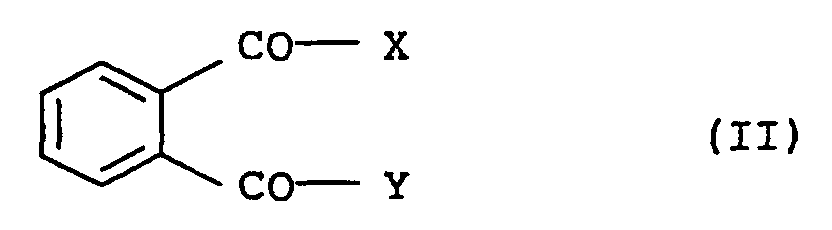
- Preferred electron donor compounds within the titanium-containing solid component are carboxylic acid derivatives and in particular phthalic acid derivatives of the general formula (II) used, where X and Y each represent a chlorine or bromine atom or a C 1 -C 10 alkoxy radical or together represent oxygen in anhydride function.
- Particularly preferred electron donor compounds are phthalic acid esters, where X and Y represent a C 1 -C 8 alkoxy radical.
- phthalic acid esters which are preferably used are diethyl phthalate, di-n-butyl phthalate, di-isobutyl phthalate, di-n-pentyl phthalate, di-n-hexyl phthalate, di-nheptyl phthalate, di-n-octyl phthalate or di-2-ethylhexyl phthalate.
- Further preferred electron donor compounds within the titanium-containing solid component are diesters of 3- or 4-membered, optionally substituted cycloalkyl-1,2-dicarboxylic acids, and monoesters of substituted benzophenone-2-carboxylic acids or substituted benzophenone-2-carboxylic acids.
- the hydroxy compounds used in these esters are the alkanols customary in esterification reactions, for example C 1 -C 15 -alkanols or C 5 -C 7 -cycloalkanols, which in turn can carry one or more C 1 -C 10 -alkyl groups, and also C 6 -C 10 phenols.
- the titanium-containing solid component a) are usually from 0.05 to per mole of magnesium compound 2.0 mol, preferably from 0.2 to 1.0 mol, of the electron donor compounds used.
- the titanium-containing solid component a) inorganic Contain oxides as carriers. It usually becomes one finely divided inorganic oxide used as a carrier, which an average particle diameter of 5 to 200 microns, preferred from 20 to 70 ⁇ m. Under the mean particle diameter is the volume-based mean (median) the grain size distribution determined by Coulter counter analysis to understand.
- the grains are preferably the finely divided inorganic oxide composed of primary particles that have an average particle diameter the primary particles from 1 to 20 ⁇ m, in particular have from 1 to 5 ⁇ m.
- primary particles are porous, granular oxide particles, which in general by grinding from a hydrogel of the inorganic oxide be preserved. It is also possible to pre-prime the primary particles their further processing into seven.
- the inorganic oxide to be preferably used is also characterized in that there are cavities or channels with a average diameter of 0.1 to 20 microns, in particular from 1 to 15 ⁇ m, whose macroscopic volume fraction of the total particle in the range of 5 to 30%, especially in the range of 10 to 30%.
- the determination of the average particle diameter of the primary particles and the macroscopic volume fraction of the cavities and Channels of the inorganic oxide are advantageously carried out through Image analysis with the help of scanning electron microscopy (scanning electron microscopy) or the Electron Probe Micro Analysis (Electron beam micro-range analysis) on grain surfaces in each case and on grain cross sections of the inorganic oxide.
- the received Recordings are evaluated and the middle ones Particle diameter of the primary particles as well as the macroscopic Volume fraction of the cavities and channels determined.
- the image analysis is preferably done by transferring the electron microscopic Data material in a gray value binary image and the digital Evaluation using a suitable computer program, e.g. of the software package Analysis by SIS.
- the preferred inorganic oxide to be used for example by spray drying the ground hydrogel, which mixed with water or an aliphatic alcohol will be preserved.
- Such finely divided inorganic oxides are also commercially available.
- the finely divided inorganic oxide also typically has a pore volume of 0.1 to 10 cm 3 / g, preferably 1.0 to 4.0 cm 3 / g, and a specific surface area of 10 to 1000 m 2 / g, preferably 100 up to 500 m 2 / g, where the values determined by mercury porosimetry according to DIN 66133 and by nitrogen adsorption according to DIN 66131 are to be understood.
- inorganic oxide whose pH, i.e. the negative decimal logarithm of the proton concentration, in the range from 1 to 6.5 and in particular in the Range from 2 to 6.
- the inorganic oxides are primarily the oxides of silicon, the aluminum, the titanium or one of the metals of the I. or the II. Main group of the periodic table into consideration.
- As special preferred oxide is in addition to aluminum oxide or magnesium oxide or a layered silicate used mainly silicon oxide (silica gel).
- Mixed oxides such as aluminum silicates or Magnesium silicates are used.
- the inorganic oxides used as carriers contain water on their surface. This water is partly bound physically by adsorption and partly chemically in the form of hydroxyl groups.
- the water content of the inorganic oxide can be reduced or eliminated entirely by thermal or chemical treatment, with conventional drying agents such as SiCl 4 , chlorosilanes or aluminum alkyls generally being used in a chemical treatment.
- the water content of suitable inorganic oxides is from 0 to 6% by weight.
- An inorganic oxide in the form as is commercially available is preferably used without further treatment.
- the magnesium compound and the inorganic oxide are within the titanium-containing solid component a) preferably in such Amounts before that per mole of the inorganic oxide from 0.1 to 1.0 mol, in particular from 0.2 to 0.5 mol of the compound of Magnesium are present.
- C 1 -C 8 -alkanols such as methanol, ethanol, n-propanol, isopropanol, n-butanol, sec-butanol, tert-butanol, isobutanol, n- Hexanol, n-heptanol, n-octanol or 2-ethylhexanol or their mixtures are used.
- Ethanol is preferably used.
- the titanium-containing solid component can be prepared in a manner known per se Methods are made. Examples include: in the EP-A 45 975, EP-A 45 977, EP-A 86 473, EP-A 171 200, GB-A-2 111 066, US-A 4 857 613 and US-A 5 288 824 described. What is known from DE-A 195 29 240 is preferred Procedure applied.
- Suitable aluminum compounds b) include trialkyl aluminum also those compounds in which an alkyl group by a Alkoxy group or by a halogen atom, for example by Chlorine or bromine, is replaced.
- the alkyl groups can be the same or be different from each other. There are linear or branched Alkyl groups into consideration.
- Trialkyl aluminum compounds are preferred used, the alkyl groups of 1 to 8 carbon atoms have, for example trimethyl aluminum, triethyl aluminum, Tri-iso-butyl aluminum, trioctyl aluminum or methyl diethyl aluminum or mixtures thereof.
- electron donor compounds c) such as monofunctional or polyfunctional carboxylic acids, carboxylic acid anhydrides or carboxylic acid esters, furthermore ketones, ethers, alcohols, lactones and organophosphorus and organosilicon compounds are generally used as further cocatalyst, the electron donor compounds c) being identical or may be different from the electron donor compounds used to produce the titanium-containing solid component a).
- Preferred electron donor compounds are organosilicon compounds of the general formula (I) R 1 n Si (OR 2 ) 4-n wherein R 1 is the same or different and a C 1 -C 20 alkyl group, a 5- to 7-membered cycloalkyl group, which in turn can be substituted by C 1 -C 10 alkyl, a C 6 -C 18 aryl group or C 6 -C 18 aryl-C 1 -C 10 alkyl group, R 2 is the same or different and denotes a C 1 -C 20 alkyl group and n represents the integers 1, 2 or 3.
- R 1 is a C 1 -C 8 alkyl group or a 5- to 7-membered cycloalkyl group and R 2 is a C 1 -C 4 alkyl group and n is the number 1 or 2 are particularly preferred.
- dimethoxydiisopropylsilane Dimethoxyisobutylisopropylsilane, dimethoxydiisobutylsilane, Dimethoxydicyclopentylsilane, dimethoxyisopropyl tert-butylsilane, Dimethoxyisobutyl sec-butyl silane and dimethoxy isopropyl sec-butyl silane emphasized.
- the cocatalysts b) and c) are preferred in such Quantity used that the atomic ratio between aluminum the aluminum compound b) and titanium from the titanium-containing solid component a) from 10: 1 to 800: 1, in particular from 20: 1 to Is 200: 1 and the molar ratio between the aluminum compound b) and the electron donor compound c) at 1: 1 to 250: 1, in particular 10: 1 to 80: 1.
- the titanium-containing solid component a), the aluminum compound b) and the electron donor compound c) generally used together form the Ziegler-Natta catalyst system.
- the catalyst components b) and c) can be used together with the titanium-containing Solid component a) or as a mixture or in any Sequence individually introduced into the polymerization reactor become.
- the process according to the invention for measuring the reactor fill level can also be used in the polymerization of C 2 -C 8 -alk-1-enes with the aid of Ziegler-Natta catalyst systems based on metallocene compounds or on the basis of polymerization-active metal complexes.
- Complex compounds of metals are said to be here under metallocenes of subgroups of the periodic table with organic ligands are understood that together with metallocenium ion-forming Compounds yield effective catalyst systems.
- the metallocene complexes are usually supported in the catalyst system.
- Inorganic oxides are often used as carriers. Prefers are the inorganic oxides described above, which are also used for Production of the titanium-containing solid component a) used become.
- metallocenes typically contain titanium, zirconium or hafnium as central atoms, zirconium being preferred.
- the central atom is bonded via a ⁇ bond to at least one, usually substituted, cyclopentadienyl group and to further substituents.
- the further substituents can be halogens, hydrogen or organic radicals, with fluorine, chlorine, bromine or iodine or a C 1 -C 10 -alkyl group being preferred.
- Preferred metallocenes contain central atoms which have two ⁇ bonds attached to two substituted cyclopentadienyl groups are, with those in which are particularly preferred Substituents of the cyclopentadienyl groups on both cyclopentadienyl groups are bound.
- complexes are preferred, whose cyclopentadienyl groups additionally by cyclic Groups on two adjacent carbon atoms are substituted.
- Preferred metallocenes are also those which have only one cyclopentadienyl group included, but substituted with a residue which is also bound to the central atom.
- Suitable metallocene compounds are, for example Ethylenebis (indenyl) zirconium dichloride, ethylenebis (tetrahydroindenyl) zirconium dichloride, diphenylmethylene-9-fluorenylcyclopentadienylzirconium dichloride, dimethylsilanediylbis (-3-tert.butyl-5-methylcyclopentadienyl) methylzirconyldichloridiumdichloridiumdichloride -methylbenzindenyl) zirconium dichloride, dimethylsilanediylbis (-2-methyl-4-phenylindenyl) zirconium dichloride, dimethylsilanediylbis (-2-methyl-4-naphthylindenyl) zirconium dichloride, Dimethylsilanediylbis (-2-methyl-4-isopropylindenyl) zirconium dichloride or Dimethylsilane
- the metallocene compounds are either known or according to known methods available.
- metallocene catalyst systems contain metallocenium ions Links. Strong, neutral ones are suitable Lewis acids, ionic compounds with Lewis acid cations or Ionic compounds with Bronsted acids as the cation. Examples are tris (pentafluorophenyl) borane, tetrakis (pentafluorophenyl) borate or salts of N, N-dimethylanilinium. Also suitable as metallocenium ion-forming compounds are open-chain or cyclic alumoxane compounds. These are usually prepared by reacting trialkyl aluminum with water and are usually different as mixtures long, both linear and cyclic chain molecules.
- the metallocene catalyst systems can be organometallic Compounds of metals of I., II. Or III. main group of the periodic table, such as n-butyl lithium, n-butyl-n-octyl magnesium or tri-iso-butyl aluminum, triethyl aluminum or trimethyl aluminum.
- the method according to the invention can be used to measure the reactor fill level in continuously operated polymerization processes for this usual reactors are carried out.
- Suitable reactors include continuously operated stirred tanks, Loop reactors or fluidized bed reactors.
- the size of the Reactors is not of importance for the process according to the invention essential. It depends on the output, which in which is to be achieved or in the individual reaction zones.
- reaction bed generally consists of the polymer of C 2 -C 8 -alk-1-enes, which is polymerized in the respective reactor.
- the method according to the invention for measuring the reactor fill level in the polymerization process can be carried out in a reactor or in a cascade of reactors connected in series, in which the powdered reaction bed is kept in motion by a vertical stirrer, so-called self-supporting spiral stirrers being particularly suitable.
- Such stirrers are known, inter alia, from EP-B 000 512 and EP-B 031 417. They are particularly characterized by the fact that they distribute the powdered reaction bed very homogeneously. Examples of such powdered reaction beds are described in EP-B 038 478.
- the reactor cascade preferably consists of two series-connected, kettle-shaped reactors provided with a stirrer and having a volume of 0.1 to 100 m 3 , for example 12.5, 25, 50 or 75 m 3 .
- Continuous polymerization reactions in which the Processes according to the invention are used for measuring the reactor level will normally be under normal reaction conditions at temperatures from 40 to 150 ° C and pressures of 1 up to 100 bar. Temperatures of 40 to are preferred 100 ° C, in particular from 60 to 90 ° C and pressures from 10 to 50 bar, in particular from 20 to 40 bar.
- the molar mass of the formed Polymers can be added by adding in the polymerization technique conventional regulators, for example of hydrogen, are controlled and be set. In addition to regulators, so-called regulators, i.e. Compounds that affect catalyst activity or antistatic agents can be used. Prevent the latter the formation of deposits on the reactor wall by electrostatic Charging.
- the polymers obtained usually have one Melt flow rate (MFR) from 0.1 to 3000 g / 10 min., In particular from 0.2 to 100 g / 10 min, at 230 ° C and under a weight of 2.16 kg.
- MFR Melt flow rate
- the melt flow rate corresponds to the amount of polymers that within 10 minutes from the ISO 1133 standardized test device at a temperature of 230 ° C and below a weight of 2.16 kg is pressed out.
- Particularly preferred are those polymers whose melt flow rate is 0.2 to 50 g / 10 min, at 230 ° C and under a weight of 2.16 kg.
- the average residence times in continuously operated polymerization reactions are in the range of 0.1 to 10 hours, preferably in the range from 0.2 to 5 hours and in particular in the Range from 0.3 to 4 hours.
- the method according to the invention for measuring the reactor level continuously operated polymerization reactors are preferred executed in such a way that the measuring unit or Measuring units, d. H. Radiation sources and corresponding detectors, shortly before the actual polymerization begins the empirically determined phase interface between the individual Bring phases in the reactor, there flexibly fixed accordingly and then using the radioactive backscatter measurement, the phase interface determined.
- the principle behind the radioactive residue measurement is that the ionizing radiation is backscattered to different extents depending on the density of the filling medium, and the backscattered radiation is measured with the aid of a detector, and the height of the phase interface is thus determined.
- the measurement is carried out in such a way that a measuring unit with a radiator and a detector, separated by a shield, is used.
- a measuring unit with a radioactive source (Cs 137 ) and a scintillation detector, separated by a lead shield is brought up to the interface between the powder bed and the gas space (gas phase polymerization) by means of a pulse rate comparison.
- the method according to the invention for measuring the reactor level stands out u. a. through a high sensitivity at relative low radiation intensities of the radiation source as well a significantly improved process stability, especially with Use of scintillation counters.
- This is mainly due to it attributable to the fact that the measurement accuracy thereby improved is that the measurement signal has a discrete sawtooth structure and the radioactive backscatter measurement quickly and very sensitive reacts to changes in level. For this reason, the discharge amount from the reactor per discharge reduced by up to 50% without loss of measuring accuracy has, which further improves process stability continuous polymerization reactions is possible.
- lower pressure fluctuations are observed in the discharge cyclone regarding the amount of propellant gas, an improved pressure and Temperature fluctuations in the reactor, increased product homogeneity as well as a reduced tendency to form lumps in the reactor.
- the device according to the invention for measuring the reactor fill level in continuously operated polymerization processes is technically easy to handle and requires little equipment. It is particularly suitable for the continuous polymerization of C 2 -C 8 -alk-1-enes and vinylaromatic monomers.
- the method according to the invention for measuring the reactor fill level was in the continuous production of a propylene homopolymer (Example 1) and a propylene-ethylene copolymer (examples 2) performed).
- a Ziegler-Natta catalyst system was used in all experiments used, which is a titanium-containing manufactured according to the following process Solid component a) contained.
- a finely divided silica gel which had an average particle diameter of 30 ⁇ m, a pore volume of 1.5 cm 3 / g and a specific surface area of 260 m 2 / g, was mixed with a solution of n-butyloctyl magnesium in n-heptane added, 0.3 mol of the magnesium compound being used per mole of SiO 2 .
- the fine-particle silica gel was additionally characterized by an average particle size of the primary particles of 3-5 ⁇ m and by cavities and channels with a diameter of 3-5 ⁇ m, the macroscopic volume fraction of the cavities and channels in the total particle being about 15%.
- the solution was stirred at 95 ° C for 45 minutes, then cooled to 20 ° C, after which 10 times the molar amount, based on the organomagnesium compound, of hydrogen chloride was introduced. After 60 minutes, the reaction product was mixed with 3 mol of ethanol per mol of magnesium with constant stirring. This mixture was stirred at 80 ° C. for 0.5 hours and then 7.2 mol of titanium tetrachloride and 0.5 mol of di-n-butyl phthalate, based in each case on 1 mol of magnesium, were added. The mixture was then stirred at 100 ° C. for 1 hour, the solid substance obtained in this way was filtered off and washed several times with ethylbenzene.
- the solid product obtained was extracted for 3 hours at 125 ° C with a 10 vol .-% solution of titanium tetrachloride in Ethylbenzene. The solid product was then filtered off Extractant separated and washed with n-heptane until the extractant is only 0.3% by weight of titanium tetrachloride had.
- the polymerization was carried out in a vertically mixed gas phase reactor with a usable volume of 800 l, equipped with a self-supporting spiral stirrer (80 revolutions / min).
- the reactor contained a moving fixed bed of fine particles Polymer.
- the reactor pressure was 32 bar.
- As a catalyst the titanium-containing solid component a) was used.
- the catalyst was dosed together with the Pressure control added fresh propylene.
- Triethylaluminum in the form of a 1st molar heptane solution
- Isobutylisopropyldimethoxysilane in the form of a 0.25 molar Heptane
- Hydrogen was metered in to regulate the molar mass.
- the hydrogen concentration in the reaction gas was 2.9 vol% and was determined by gas chromatography.
- the heat of reaction arising during the polymerization was reduced by Evaporative cooling removed.
- a circulating gas flow the quantitative 4 to 6 times the amount of gas converted matters, led in a circle.
- the evaporated propylene was drawn off at the top of the reactor after passing through the reaction zone, separated from entrained polymer particles in a cycle gas filter and condensed against secondary water in a heat exchanger.
- the condensed cycle gas was pumped back into the reactor up to 40 ° C.
- the hydrogen that cannot be condensed in the condenser was sucked off by an ejector and the liquid circulating gas stream fed again.
- the temperature in the reactor was above Circular gas flow regulated and was 80 ° C.
- the polymer was gradually removed from the reactor by briefly relaxing the reactor via a dip tube.
- the discharge frequency was determined using the method according to the invention by radioactive backscatter measurement. This was done with the help of a rod probe, which was inserted into the reactor in the virtual axis of the self-supporting spiral stirrer and a measuring unit consists of an integrated radioactive source (Cs 137 , 185 MBq) and a scintillation counter.
- the discharge frequency was determined using a rod probe with an integrated radioactive source (Cs 137 , 185 MBq) / scintillation counter unit). Before commissioning, the rod probe was compared to the moving phase interface between the gas space and the powder bed in the middle of the bowl at 80 ° C, 80 rpm stirrer rotation and 200 kg / h fresh propylene over the shaft gap with the aid of a comparison of the backscattered radiation intensity (pulse rate comparison) before the start of polymerization introduced at operating pressure, fixed there and used for reactor level control. The amount of polymer powder used before the start of polymerization in the reactor was 240 kg. After 75 hours of stable gas phase polymerization, the reactor was depressurized. The amount of polymer grit in the reactor was then weighed and gave 236 kg.
- Cs 137 , 185 MBq integrated radioactive source
- the polymerization in a continuous 800 1 gas phase reactor was carried out analogously to Example 1.
- the reactor level control was carried out using a radioactive absorption measurement carried out.
- the radioactive emitter was a Co60 rod preparation on the outer wall of the reactor and the detector was attached to the reactor cover.
- the evaluation of the trend lines of pressure and temperature control and the measurement signal reproduction of the radioactive absorption measurement showed that the trend lines of pressure and temperature control long deviations of approx. 1 to 2% of the mean value within of an hour occurred.
- the measurement signal reproduction of the radioactive Absorption measurement showed irregular oscillating Fluctuations in the seconds range, their maxima and minima more than 50% of the average of an idealized curve with a sawtooth structure both in terms of intensity and in terms of Deviate timeline.
- the individual process parameters as well as the Properties of the propylene homopolymer obtained are in the Table I reproduced below.
- the polymerization in a continuous 800 1 gas phase reactor was carried out analogously to Example 1.
- the reactor pressure was 23 bar and the reactor temperature was 80 ° C.
- the hydrogen concentration in the reaction gas was 0.2% and was gas chromatographed determined.
- 1.0 vol% ethylene was added to the reactor dosed and the ethylene concentration was also gas chromatographic determined.
- the rod probe had to be 7 cm be lowered lower.
- the radioactive absorption measurement was calibrated analogous to comparative example A.
- the reactor level control in continuous polymerization operation was set to 89%.
- the evaluation of the trend lines of pressure and temperature control and the measurement signal reproduction of the radioactive absorption measurement showed that the trend lines of pressure and temperature control Long-term fluctuations of approx. 1 to 2% of the mean within occurred from 1 hour.
- the measurement signal reproduction of the radioactive Absorption measurement showed irregular oscillating fluctuations in the seconds range, their maxima and minima more than 50% of the average of an idealized sawtooth curve in terms of both intensity and timeline differed.
- the radioactive Backscatter measurement compared to radioactive absorption measurement u. a. has the following advantages: a discrete sawtooth structure of the measurement signal for level measurement, further Equidistant discharge intervals, fast and sensitive Response to level changes, improved temperature, Pressure and recycle gas flow, increased process stability with an optimized morphology of the polymer powder obtained. There is also a lower tendency to form lumps in the reactor and an increase in productivity.
- the radioactive backscatter measurement as an absolute reactor level measurement it enables the dependence of the radioactive absorption measurement on the level control et al of the drum shape, the operating parameters and of the product type using the backscatter probe. at the radioactive absorption measurement it is possible with radiators less activity, which means that Radiation field around the reactor is lower and that the used Spotlights are easier to handle.
Landscapes
- Chemical & Material Sciences (AREA)
- Physics & Mathematics (AREA)
- Electromagnetism (AREA)
- Organic Chemistry (AREA)
- Chemical Kinetics & Catalysis (AREA)
- Thermal Sciences (AREA)
- Fluid Mechanics (AREA)
- General Physics & Mathematics (AREA)
- Engineering & Computer Science (AREA)
- Combustion & Propulsion (AREA)
- Health & Medical Sciences (AREA)
- Medicinal Chemistry (AREA)
- Polymers & Plastics (AREA)
- Polymerisation Methods In General (AREA)
- Measurement Of Levels Of Liquids Or Fluent Solid Materials (AREA)
- Addition Polymer Or Copolymer, Post-Treatments, Or Chemical Modifications (AREA)
- Transition And Organic Metals Composition Catalysts For Addition Polymerization (AREA)
- Devices And Processes Conducted In The Presence Of Fluids And Solid Particles (AREA)
- Measurement Of Radiation (AREA)
Description
Ethylenbis(indenyl)-zirkoniumdichlorid, Ethylenbis(tetrahydroindenyl)-zirkoniumdichlorid, Diphenylmethylen-9-fluorenylcyclopentadienylzirkoniumdichlorid, Dimethylsilandiylbis(-3-tert.butyl-5-methylcyclopentadienyl)-zirkoniumdichlorid, Dimethylsilandiylbis(-2-methylindenyl)-zirkoniumdichlorid, Dimethylsilandiylbis(-2-methylbenzindenyl)-zirkoniumdichlorid Dimethylsilandiylbis(-2-methyl-4-phenylindenyl)zirkoniumdichlorid, Dimethylsilandiylbis(-2-methyl-4-naphthylindenyl)zirkoniumdichlorid,
Dimethylsilandiylbis (-2-methyl-4-isopropylindenyl)zirkoniumdichlorid oder
Dimethylsilandiylbis(-2-methyl-4,6-diisopropylindenyl)zirkoniumdichlorid sowie die entsprechenden Dimethylzirkoniumverbindungen.
- Schmelzflußrate (MFR):
- nach ISO 1133, bei 230°C und 2,16 kg
- Ethylengehalte [Gew.-%]:
- durch Auswertung entsprechender IR-Spektren
- Produktivität: [g Polymer / g Katalysator]
- Aus dem Chlorgehalt des erhaltenen Polymeren, wobei dieser wiederum durch Elementaranalyse bestimmt wird. Dabei wurde die Produktivität aus dem Quotienten aus dem Chlorgehalt des Katalysators und dem Chlorgehalt des erhaltenen Polymeren bestimmt.
- Polymergrießmorphologie [Gew.%]:
- durch Siebanalyse

Claims (11)
- Verfahren zu Reaktorfüllstandsmessung bei kontinuierlich betriebenen Polymerisationsprozessen, wobei die jeweilige Phasengrenzfläche im Reaktor mit Hilfe einer ionisierenden Strahlung gemessen wird, dadurch gekennzeichnet, dass mindestens eine Meßeinheit bestehend aus einer Strahlungsquelle, welche eine ionisierende Strahlung emittiert und einen entsprechenden Detektor an die Phasengrenzfläche im Reaktor herangeführt und dort flexibel fixiert wird, wobei die Reaktorfüllstandsmessung in der Weise erfolgt, dass man die Phasengrenzfläche mit Hilfe der radioaktiven Rückstreumessung ermittelt.
- Verfahren nach Anspruch 1, dadurch gekennzeichnet, dass mehrere Meßeinheiten bestehend aus jeweils einer Strahlungsquelle und einem Detektor an unterschiedlichen Stellen im Reaktor, aber in der Nähe der Phasengrenzfläche zur Reaktorfüllstandsmessung eingesetzt werden, wobei diejenige Meßeinheit verwendet wird, die der Phasengrenzfläche am nächsten steht.
- Verfahren nach den Ansprüchen 1 oder 2, dadurch gekennzeichnet, dass eine Strahlungsquelle verwendet wird, welche eine radioaktive Strahlung emittiert.
- Verfahren nach den Ansprüchen 1 bis 3, dadurch gekennzeichnet, dass als Detektor ein Szintillationszähler eingesetzt wird.
- Verfahren nach den Ansprüchen 1 bis 4, dadurch gekennzeichnet, dass dieses bei der kontinuierlichen Polymerisation von C2-C8-Alk-1-enen verwendet wird.
- Verfahren nach den Ansprüchen 1 bis 5, dadurch gekennzeichnet, dass es sich bei den Polymerisationsprozessen um Gasphasenverfahren handelt.
- Verfahren nach den Ansprüchen 1 bis 6, dadurch gekennzeichnet, dass die Polymerisationsprozesse mittels eines Ziegler-Natta-Katalysatorsystems durchgeführt werden, welches neben einer titanhaltigen Feststoffkomponente a) noch Cokatalysatoren in Form von organischen Aluminiumverbindungen b), und Elektronendonorverbindungen c), aufweist.
- Verfahren nach den Ansprüchen 1 bis 7, dadurch gekennzeichnet, dass die Polymerisationsprozesse mittels eines Ziegler-Natta-Katalysatorsystems auf der Basis von Metallocenverbindungen oder von polymerisationsaktiven Metallkomplexen durchgeführt werden.
- Vorrichtung zur Reaktorfüllstandsmessung bei kontinuierlich betriebenen Polymerisationsprozessen durch Messung der jeweiligen Phasengrenzfläche im Reaktor mit Hilfe einer ionisierenden Strahlung, wobei der jeweilige Reaktor mindestens eine Meßeinheit aufweist, die aus einer Strahlungsquelle, welche eine ionisierende Strahlung emittiert und einen entsprechenden Detektor besteht, wobei die Meßeinheit flexibel an der Phasengrenzfläche im Reaktor fixiert ist und die Reaktorfüllstandsmessung mit Hilfe der radioaktiven Rückstreumessung erfolgt.
- Vorrichtung nach Anspruch 9, wobei die Meßeinheit bestehend aus der Strahlungsquelle und dem Detektor an einem beweglichen Stab befestigt ist, der an der Phasengrenzfläche im Reaktor fixiert ist.
- Vorrichtung nach Anspruch 9, wobei mehrere Meßeinheiten bestehend aus jeweils einer Strahlungsquelle und einem Detektor an unterschiedlichen Stellen im Reaktor aber in der Nähe der Phasengrenzfläche befestigt sind.
Applications Claiming Priority (3)
| Application Number | Priority Date | Filing Date | Title |
|---|---|---|---|
| DE10041813 | 2000-08-25 | ||
| DE10041813A DE10041813A1 (de) | 2000-08-25 | 2000-08-25 | Verfahren zur Reaktorfüllstandsmessung |
| PCT/EP2001/009683 WO2002016019A2 (de) | 2000-08-25 | 2001-08-22 | Verfahren zur reaktorfüllstandsmessung |
Publications (2)
| Publication Number | Publication Date |
|---|---|
| EP1314005A2 EP1314005A2 (de) | 2003-05-28 |
| EP1314005B1 true EP1314005B1 (de) | 2004-05-12 |
Family
ID=7653780
Family Applications (1)
| Application Number | Title | Priority Date | Filing Date |
|---|---|---|---|
| EP01976133A Expired - Lifetime EP1314005B1 (de) | 2000-08-25 | 2001-08-22 | Verfahren zur reaktorfüllstandsmessung |
Country Status (13)
| Country | Link |
|---|---|
| US (1) | US20040021080A1 (de) |
| EP (1) | EP1314005B1 (de) |
| JP (1) | JP2004506916A (de) |
| KR (1) | KR20030022420A (de) |
| CN (1) | CN1213286C (de) |
| AT (1) | ATE266855T1 (de) |
| AU (1) | AU2001295500A1 (de) |
| BR (1) | BR0114800A (de) |
| CA (1) | CA2420489A1 (de) |
| DE (2) | DE10041813A1 (de) |
| ES (1) | ES2219566T3 (de) |
| RU (1) | RU2277228C2 (de) |
| WO (1) | WO2002016019A2 (de) |
Families Citing this family (5)
| Publication number | Priority date | Publication date | Assignee | Title |
|---|---|---|---|---|
| CA2700139C (en) | 2007-09-27 | 2013-04-02 | Nippon Steel Engineering Co., Ltd. | Bubble column type hydrocarbon synthesis reactor, and slurry level detecting method |
| US8324572B2 (en) * | 2009-05-29 | 2012-12-04 | Endress + Hauser Flowtec Ag | Radiometric fill level measuring arrangement |
| EP2926112B1 (de) * | 2012-11-27 | 2016-03-02 | Total Research & Technology Feluy | Vorrichtung und verfahren zum quantifizieren einer polymerisationsreaktion |
| WO2015082568A1 (en) * | 2013-12-04 | 2015-06-11 | Basell Polyolefine Gmbh | Process for separating components of a reaction mixture obtained by high-pressure polymerization of ethylenically unsaturated monomers with improved level control |
| CN121297981B (zh) * | 2025-12-15 | 2026-04-14 | 北京鑫美格工程设计有限公司 | 卧式搅拌床反应器的物位测量方法及放射性仪表检测器 |
Family Cites Families (11)
| Publication number | Priority date | Publication date | Assignee | Title |
|---|---|---|---|---|
| US2378219A (en) * | 1940-05-29 | 1945-06-12 | Texas Co | Method and apparatus for determining liquid level |
| US2714167A (en) * | 1950-04-11 | 1955-07-26 | Texas Co | Liquid level measuring apparatus |
| US3100841A (en) * | 1959-09-25 | 1963-08-13 | Industrial Nucleonics Corp | Radioactive measuring system for blast furnace charge location |
| FR2464462B1 (fr) * | 1979-09-05 | 1986-03-07 | Commissariat Energie Atomique | Procede et dispositif de mesure du niveau d'un liquide dans une enceinte |
| US4395633A (en) * | 1979-09-11 | 1983-07-26 | Commonwealth Scientific And Industrial Research Organization | Level gauge using neutron irradiation |
| US4358682A (en) * | 1980-07-07 | 1982-11-09 | Shell Oil Company | Neutron interface detector |
| US5099124A (en) * | 1990-07-24 | 1992-03-24 | Benson Royal H | Level detecting apparatus |
| DE4114030C1 (de) * | 1991-04-29 | 1992-09-17 | Laboratorium Prof. Dr. Rudolf Berthold Gmbh & Co, 7547 Wildbad, De | |
| US5300781A (en) * | 1991-12-09 | 1994-04-05 | Kay-Ray/Sensall, Inc. | Non-hydrogenous process level measurement |
| DE19653079A1 (de) * | 1996-12-19 | 1998-06-25 | Basf Ag | Verfahren zur Gasphasenpolymerisation von C¶2¶-C¶8¶-Alk-1-enen mittels Ziegler -Natta- oder Metallocen-Katalysatorsystemen |
| JP2001124613A (ja) * | 1999-10-28 | 2001-05-11 | Teijin Engineering Kk | 攪拌槽のレベル測定方法 |
-
2000
- 2000-08-25 DE DE10041813A patent/DE10041813A1/de not_active Withdrawn
-
2001
- 2001-08-22 RU RU2003107934/28A patent/RU2277228C2/ru not_active IP Right Cessation
- 2001-08-22 AT AT01976133T patent/ATE266855T1/de not_active IP Right Cessation
- 2001-08-22 KR KR10-2003-7002702A patent/KR20030022420A/ko not_active Ceased
- 2001-08-22 DE DE50102281T patent/DE50102281D1/de not_active Expired - Fee Related
- 2001-08-22 CN CNB018180272A patent/CN1213286C/zh not_active Expired - Fee Related
- 2001-08-22 US US10/362,055 patent/US20040021080A1/en not_active Abandoned
- 2001-08-22 JP JP2002520936A patent/JP2004506916A/ja active Pending
- 2001-08-22 WO PCT/EP2001/009683 patent/WO2002016019A2/de not_active Ceased
- 2001-08-22 CA CA002420489A patent/CA2420489A1/en not_active Abandoned
- 2001-08-22 EP EP01976133A patent/EP1314005B1/de not_active Expired - Lifetime
- 2001-08-22 BR BR0114800-1A patent/BR0114800A/pt not_active IP Right Cessation
- 2001-08-22 ES ES01976133T patent/ES2219566T3/es not_active Expired - Lifetime
- 2001-08-22 AU AU2001295500A patent/AU2001295500A1/en not_active Abandoned
Also Published As
| Publication number | Publication date |
|---|---|
| BR0114800A (pt) | 2003-12-23 |
| ATE266855T1 (de) | 2004-05-15 |
| WO2002016019A2 (de) | 2002-02-28 |
| WO2002016019A9 (de) | 2004-05-13 |
| RU2277228C2 (ru) | 2006-05-27 |
| WO2002016019A3 (de) | 2002-06-27 |
| CA2420489A1 (en) | 2003-02-25 |
| CN1213286C (zh) | 2005-08-03 |
| EP1314005A2 (de) | 2003-05-28 |
| KR20030022420A (ko) | 2003-03-15 |
| US20040021080A1 (en) | 2004-02-05 |
| DE10041813A1 (de) | 2002-03-07 |
| CN1471628A (zh) | 2004-01-28 |
| JP2004506916A (ja) | 2004-03-04 |
| AU2001295500A1 (en) | 2002-03-04 |
| DE50102281D1 (de) | 2004-06-17 |
| ES2219566T3 (es) | 2004-12-01 |
Similar Documents
| Publication | Publication Date | Title |
|---|---|---|
| EP0881239B1 (de) | Statistische Propylencopolymerisate | |
| EP0945472B1 (de) | Verfahren zur Herstellung von biaxial gereckten Folien aus statistischen Propylencopolymerisaten | |
| DE69029324T2 (de) | Polymerisierungsverfahren und -katalysator | |
| EP1320559A1 (de) | Verfahren zur voraktivierung von katalysatoren | |
| EP0889064B1 (de) | Verfahren zur Polymerisation von C2-C8-Alk-1-enen mittels eines Ziegler-Natta-Katalysatorsystems | |
| DE10025727A1 (de) | Hochfließfähige Propylenblockcopolymerisate | |
| DE10105276A1 (de) | Verfahren zum Dosieren von Katalysatoren | |
| EP0761696B1 (de) | Katalysatorsysteme vom Typ der Ziegler-Natta-Katalysatoren | |
| EP1314005B1 (de) | Verfahren zur reaktorfüllstandsmessung | |
| EP0812861B1 (de) | Katalysatorsysteme vom Typ der Ziegler-Natta-Katalysatoren | |
| DE19545499A1 (de) | Verbesserte statistische Propylencopolymerisate | |
| DE19912011A1 (de) | Verfahren zur Gasphasenpolymerisation von C2-C8-Alk-1-enen | |
| EP0531838B1 (de) | Verfahren zur Herstellung von Ziegler-Natta-Katalysatorsystemen | |
| DE10261107A1 (de) | Formmassen aus einem hochmolekularen Propylenpolymerisat | |
| EP0613909A1 (de) | Verfahren zur Herstellung eines Poly-1-olefins | |
| EP1120158B1 (de) | Katalysatorsysteme vom Typ der Ziegler-Natta-Katalysatoren | |
| EP1373333B1 (de) | Verfahren zur dosierung von katalysatoren | |
| DE4119345A1 (de) | Propylen-ethylen-copolymerisate mit hohem kautschukgehalt | |
| DE10233700A1 (de) | Mindestens zweistufiges Verfahren zur Herstellung von Propylenpolymerisat-Zusammensetzungen | |
| EP0864591A1 (de) | Hochkristalline Propylenhomopolymerisate | |
| DE19545497A1 (de) | Verbesserte Propylenhomopolymerisate |
Legal Events
| Date | Code | Title | Description |
|---|---|---|---|
| PUAI | Public reference made under article 153(3) epc to a published international application that has entered the european phase |
Free format text: ORIGINAL CODE: 0009012 |
|
| 17P | Request for examination filed |
Effective date: 20030321 |
|
| AK | Designated contracting states |
Designated state(s): AT BE CH CY DE DK ES FI FR GB GR IE IT LI LU MC NL PT SE TR |
|
| AX | Request for extension of the european patent |
Extension state: AL LT LV MK RO SI |
|
| GRAP | Despatch of communication of intention to grant a patent |
Free format text: ORIGINAL CODE: EPIDOSNIGR1 |
|
| GRAS | Grant fee paid |
Free format text: ORIGINAL CODE: EPIDOSNIGR3 |
|
| GRAA | (expected) grant |
Free format text: ORIGINAL CODE: 0009210 |
|
| RIN1 | Information on inventor provided before grant (corrected) |
Inventor name: BIDELL, WOLFGANG Inventor name: LUTZ, GERALD Inventor name: OELZE, JUERGEN Inventor name: SCHERER, GUENTER Inventor name: GERBIG, HANS-JUERGEN Inventor name: HUEHNERBEIN, JUERGEN Inventor name: MECKELNBURG, DIRK Inventor name: LANGHAUSER, FRANZ |
|
| AK | Designated contracting states |
Kind code of ref document: B1 Designated state(s): AT BE CH CY DE DK ES FI FR GB GR IE IT LI LU MC NL PT SE TR |
|
| PG25 | Lapsed in a contracting state [announced via postgrant information from national office to epo] |
Ref country code: NL Free format text: LAPSE BECAUSE OF FAILURE TO SUBMIT A TRANSLATION OF THE DESCRIPTION OR TO PAY THE FEE WITHIN THE PRESCRIBED TIME-LIMIT Effective date: 20040512 Ref country code: IE Free format text: LAPSE BECAUSE OF FAILURE TO SUBMIT A TRANSLATION OF THE DESCRIPTION OR TO PAY THE FEE WITHIN THE PRESCRIBED TIME-LIMIT Effective date: 20040512 Ref country code: CY Free format text: LAPSE BECAUSE OF FAILURE TO SUBMIT A TRANSLATION OF THE DESCRIPTION OR TO PAY THE FEE WITHIN THE PRESCRIBED TIME-LIMIT Effective date: 20040512 Ref country code: TR Free format text: LAPSE BECAUSE OF FAILURE TO SUBMIT A TRANSLATION OF THE DESCRIPTION OR TO PAY THE FEE WITHIN THE PRESCRIBED TIME-LIMIT Effective date: 20040512 |
|
| REG | Reference to a national code |
Ref country code: GB Ref legal event code: FG4D Free format text: NOT ENGLISH |
|
| REG | Reference to a national code |
Ref country code: CH Ref legal event code: EP |
|
| REG | Reference to a national code |
Ref country code: IE Ref legal event code: FG4D Free format text: GERMAN |
|
| REF | Corresponds to: |
Ref document number: 50102281 Country of ref document: DE Date of ref document: 20040617 Kind code of ref document: P |
|
| GBT | Gb: translation of ep patent filed (gb section 77(6)(a)/1977) |
Effective date: 20040712 |
|
| PG25 | Lapsed in a contracting state [announced via postgrant information from national office to epo] |
Ref country code: SE Free format text: LAPSE BECAUSE OF FAILURE TO SUBMIT A TRANSLATION OF THE DESCRIPTION OR TO PAY THE FEE WITHIN THE PRESCRIBED TIME-LIMIT Effective date: 20040812 Ref country code: GR Free format text: LAPSE BECAUSE OF FAILURE TO SUBMIT A TRANSLATION OF THE DESCRIPTION OR TO PAY THE FEE WITHIN THE PRESCRIBED TIME-LIMIT Effective date: 20040812 Ref country code: DK Free format text: LAPSE BECAUSE OF FAILURE TO SUBMIT A TRANSLATION OF THE DESCRIPTION OR TO PAY THE FEE WITHIN THE PRESCRIBED TIME-LIMIT Effective date: 20040812 |
|
| PG25 | Lapsed in a contracting state [announced via postgrant information from national office to epo] |
Ref country code: AT Free format text: LAPSE BECAUSE OF NON-PAYMENT OF DUE FEES Effective date: 20040822 Ref country code: LU Free format text: LAPSE BECAUSE OF NON-PAYMENT OF DUE FEES Effective date: 20040822 |
|
| PG25 | Lapsed in a contracting state [announced via postgrant information from national office to epo] |
Ref country code: BE Free format text: LAPSE BECAUSE OF NON-PAYMENT OF DUE FEES Effective date: 20040831 Ref country code: MC Free format text: LAPSE BECAUSE OF NON-PAYMENT OF DUE FEES Effective date: 20040831 |
|
| LTIE | Lt: invalidation of european patent or patent extension |
Effective date: 20040512 |
|
| NLV1 | Nl: lapsed or annulled due to failure to fulfill the requirements of art. 29p and 29m of the patents act | ||
| REG | Reference to a national code |
Ref country code: ES Ref legal event code: FG2A Ref document number: 2219566 Country of ref document: ES Kind code of ref document: T3 |
|
| ET | Fr: translation filed | ||
| REG | Reference to a national code |
Ref country code: IE Ref legal event code: FD4D |
|
| BERE | Be: lapsed |
Owner name: BASELL POLIOLEFINE ITALIA S.P.A. Effective date: 20040831 |
|
| PLBE | No opposition filed within time limit |
Free format text: ORIGINAL CODE: 0009261 |
|
| STAA | Information on the status of an ep patent application or granted ep patent |
Free format text: STATUS: NO OPPOSITION FILED WITHIN TIME LIMIT |
|
| 26N | No opposition filed |
Effective date: 20050215 |
|
| PG25 | Lapsed in a contracting state [announced via postgrant information from national office to epo] |
Ref country code: CH Free format text: LAPSE BECAUSE OF NON-PAYMENT OF DUE FEES Effective date: 20050831 Ref country code: LI Free format text: LAPSE BECAUSE OF NON-PAYMENT OF DUE FEES Effective date: 20050831 |
|
| REG | Reference to a national code |
Ref country code: CH Ref legal event code: PL |
|
| PGFP | Annual fee paid to national office [announced via postgrant information from national office to epo] |
Ref country code: DE Payment date: 20060802 Year of fee payment: 6 |
|
| PGFP | Annual fee paid to national office [announced via postgrant information from national office to epo] |
Ref country code: GB Payment date: 20060825 Year of fee payment: 6 |
|
| PGFP | Annual fee paid to national office [announced via postgrant information from national office to epo] |
Ref country code: ES Payment date: 20060828 Year of fee payment: 6 |
|
| PGFP | Annual fee paid to national office [announced via postgrant information from national office to epo] |
Ref country code: FI Payment date: 20060830 Year of fee payment: 6 |
|
| PGFP | Annual fee paid to national office [announced via postgrant information from national office to epo] |
Ref country code: FR Payment date: 20060831 Year of fee payment: 6 Ref country code: IT Payment date: 20060831 Year of fee payment: 6 |
|
| BERE | Be: lapsed |
Owner name: *BASELL POLIOLEFINE ITALIA S.P.A. Effective date: 20040831 |
|
| PG25 | Lapsed in a contracting state [announced via postgrant information from national office to epo] |
Ref country code: PT Free format text: LAPSE BECAUSE OF NON-PAYMENT OF DUE FEES Effective date: 20041012 |
|
| GBPC | Gb: european patent ceased through non-payment of renewal fee |
Effective date: 20070822 |
|
| PG25 | Lapsed in a contracting state [announced via postgrant information from national office to epo] |
Ref country code: FI Free format text: LAPSE BECAUSE OF NON-PAYMENT OF DUE FEES Effective date: 20070822 |
|
| REG | Reference to a national code |
Ref country code: FR Ref legal event code: ST Effective date: 20080430 |
|
| PG25 | Lapsed in a contracting state [announced via postgrant information from national office to epo] |
Ref country code: DE Free format text: LAPSE BECAUSE OF NON-PAYMENT OF DUE FEES Effective date: 20080301 |
|
| PG25 | Lapsed in a contracting state [announced via postgrant information from national office to epo] |
Ref country code: FR Free format text: LAPSE BECAUSE OF NON-PAYMENT OF DUE FEES Effective date: 20070831 |
|
| REG | Reference to a national code |
Ref country code: ES Ref legal event code: FD2A Effective date: 20070823 |
|
| PG25 | Lapsed in a contracting state [announced via postgrant information from national office to epo] |
Ref country code: GB Free format text: LAPSE BECAUSE OF NON-PAYMENT OF DUE FEES Effective date: 20070822 |
|
| PG25 | Lapsed in a contracting state [announced via postgrant information from national office to epo] |
Ref country code: ES Free format text: LAPSE BECAUSE OF NON-PAYMENT OF DUE FEES Effective date: 20070823 |
|
| PG25 | Lapsed in a contracting state [announced via postgrant information from national office to epo] |
Ref country code: IT Free format text: LAPSE BECAUSE OF NON-PAYMENT OF DUE FEES Effective date: 20070822 |