EP1315146A2 - Méthode et appareil pour améliorer l'accès à l'information numérique dans des messages vocaux - Google Patents
Méthode et appareil pour améliorer l'accès à l'information numérique dans des messages vocaux Download PDFInfo
- Publication number
- EP1315146A2 EP1315146A2 EP02257418A EP02257418A EP1315146A2 EP 1315146 A2 EP1315146 A2 EP 1315146A2 EP 02257418 A EP02257418 A EP 02257418A EP 02257418 A EP02257418 A EP 02257418A EP 1315146 A2 EP1315146 A2 EP 1315146A2
- Authority
- EP
- European Patent Office
- Prior art keywords
- digits
- numbers
- telephone number
- caller
- voice message
- Prior art date
- Legal status (The legal status is an assumption and is not a legal conclusion. Google has not performed a legal analysis and makes no representation as to the accuracy of the status listed.)
- Withdrawn
Links
- 238000000034 method Methods 0.000 title claims abstract description 48
- 230000004044 response Effects 0.000 claims description 16
- 230000008569 process Effects 0.000 description 31
- 230000008859 change Effects 0.000 description 4
- 230000004048 modification Effects 0.000 description 4
- 230000006872 improvement Effects 0.000 description 3
- 230000004075 alteration Effects 0.000 description 2
- 238000010586 diagram Methods 0.000 description 2
- 238000012986 modification Methods 0.000 description 2
- 238000012545 processing Methods 0.000 description 2
- 238000012937 correction Methods 0.000 description 1
- 230000007423 decrease Effects 0.000 description 1
- 238000001514 detection method Methods 0.000 description 1
- JLYFCTQDENRSOL-VIFPVBQESA-N dimethenamid-P Chemical compound COC[C@H](C)N(C(=O)CCl)C=1C(C)=CSC=1C JLYFCTQDENRSOL-VIFPVBQESA-N 0.000 description 1
- 238000005516 engineering process Methods 0.000 description 1
- 208000003580 polydactyly Diseases 0.000 description 1
Images

Classifications
-
- H—ELECTRICITY
- H04—ELECTRIC COMMUNICATION TECHNIQUE
- H04M—TELEPHONIC COMMUNICATION
- H04M3/00—Automatic or semi-automatic exchanges
- H04M3/42—Systems providing special services or facilities to subscribers
- H04M3/50—Centralised arrangements for answering calls; Centralised arrangements for recording messages for absent or busy subscribers ; Centralised arrangements for recording messages
- H04M3/53—Centralised arrangements for recording incoming messages, i.e. mailbox systems
- H04M3/533—Voice mail systems
-
- G—PHYSICS
- G10—MUSICAL INSTRUMENTS; ACOUSTICS
- G10L—SPEECH ANALYSIS TECHNIQUES OR SPEECH SYNTHESIS; SPEECH RECOGNITION; SPEECH OR VOICE PROCESSING TECHNIQUES; SPEECH OR AUDIO CODING OR DECODING
- G10L15/00—Speech recognition
- G10L15/26—Speech to text systems
-
- H—ELECTRICITY
- H04—ELECTRIC COMMUNICATION TECHNIQUE
- H04M—TELEPHONIC COMMUNICATION
- H04M1/00—Substation equipment, e.g. for use by subscribers
- H04M1/64—Automatic arrangements for answering calls; Automatic arrangements for recording messages for absent subscribers; Arrangements for recording conversations
- H04M1/65—Recording arrangements for recording a message from the calling party
- H04M1/6505—Recording arrangements for recording a message from the calling party storing speech in digital form
-
- H—ELECTRICITY
- H04—ELECTRIC COMMUNICATION TECHNIQUE
- H04M—TELEPHONIC COMMUNICATION
- H04M1/00—Substation equipment, e.g. for use by subscribers
- H04M1/26—Devices for calling a subscriber
- H04M1/27—Devices whereby a plurality of signals may be stored simultaneously
- H04M1/271—Devices whereby a plurality of signals may be stored simultaneously controlled by voice recognition
-
- H—ELECTRICITY
- H04—ELECTRIC COMMUNICATION TECHNIQUE
- H04M—TELEPHONIC COMMUNICATION
- H04M1/00—Substation equipment, e.g. for use by subscribers
- H04M1/57—Arrangements for indicating or recording the number of the calling subscriber at the called subscriber's set
-
- H—ELECTRICITY
- H04—ELECTRIC COMMUNICATION TECHNIQUE
- H04M—TELEPHONIC COMMUNICATION
- H04M2201/00—Electronic components, circuits, software, systems or apparatus used in telephone systems
- H04M2201/40—Electronic components, circuits, software, systems or apparatus used in telephone systems using speech recognition
Definitions
- the present invention relates generally to methods and apparatus for detecting spoken numerical digits, and more specifically, relates to systems and methods for improving access to numerical digits such as telephone numbers in voice messages.
- voice mail systems in wireless and landline telephones has increased significantly over the last several years.
- a caller will provide a brief message and also will provide a return telephone number at which the called party can reach the caller.
- the called party must replay a voice mail message several times before the called party is able to fully recognize the return telephone number in a message. Having to repeatedly play the message becomes particularly bothersome when dealing with relatively long messages.
- Some voice mail systems have attempted to solve this problem by providing an automatic "call back" feature that allows a called party that is listening to a message to execute a call back command that causes the voice mail system to attempt to call the caller that left the voice mail message.
- These systems typically use caller line identification (also known as caller ID) to identify the caller when recording the message.
- caller line identification also known as caller ID
- Drawbacks of these systems are that many callers disable caller identification and/or the caller's system or the called party's system does not support caller ID.
- a further drawback with these systems occurs when the caller leaves a return telephone number that is different from the number the caller is calling from when the voice mail message is recorded.
- Embodiments of the present invention provide improved systems and methods for locating numerical digits in voice mail messages and for providing automatic call back to a caller that has a left a voice mail message.
- a voice mail system of the present invention identifies digit strings, such as telephone numbers, in voice mail messages and allows a user of the voice mail system to move ahead to a next digit string or to move back to a prior digit string to enable the user to more easily locate telephone numbers contained in a voice message.
- the voice mail system may also include a caller identification system that identifies the telephone number of a caller that has left a voice mail message, and in this embodiment, the system allows automatic call back by the user of the system, if a digit string in the voice mail message matches the telephone number provided in the caller identification information. This embodiment provides an improvement over existing call back systems that fail to recognize that the caller may not desire to be called back at the number that the caller was calling from.
- the present invention compares digit strings in voice mail messages with telephone numbers in a user's address book that is accessible by the voice mail system. Automatic call back to a telephone number in the address book that matches numbers in a digit string can then be commanded by the user.
- Embodiments of the present invention also account for errors in the detection of numbers in digit strings in voice mail messages.
- match criteria are established that allows for a match to occur when one or more digits are not identical.
- the use of match criteria allows for deciding that a match has been made even if one or more digits of a recognized number are different from the number from caller ID.
- characteristics of telephone numbers of prior calls are used to further relax the match criteria.
- match criteria may be relaxed to allow for the two digit mismatch in the area code.
- the match criteria may be user selectable and/or selectable by a system administrator.
- Embodiments of the present invention identify the location of telephone numbers (as well as any other numerical data string) in voice mail messages and allow a listener of a message to skip ahead to the next numerical string in the voice mail message or return to a prior numerical string in the message. Further, embodiments of the present invention provide enhanced call back to allow a user to call back a party that has left a voice mail message
- voice messages are sent to a digit recognizer that identifies each set of digits recognized in the voice mail message and stores information related to the message.
- the information that is stored can be used by a user or subscriber of the voice mail system in a number of different ways when the user retrieves the voice mail message.
- the user can execute a command to go to the next digit string, or the user can execute a command to replay the last digit string.
- the system compares stored strings of digits with caller identification information, and will provide automatic call back capability when a stored string matches the telephone number from the caller identification information for a voice mail message.
- digit strings can be identified dynamically while a user is playing a voice mail message.
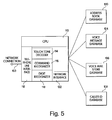
- Voice mail system 100 includes a computer system 102 and three storage units 104, 106 and 108 coupled to the computer system 102.
- the three storage units are shown as devices external to the computer system, however, in other embodiments, the storage units may be implemented within the computer system 102, or could also be implemented as remote storage units coupled to the computer system 102 through a network. Further, the three storage units may be implemented within one single storage device.
- the voice mail system 100 may be used in a telephony central switching office (wireless or wireline) within a private telephone exchange system or within an answering machine used within a home or office.
- telephone calls may be routed by a switch to a network connection 103 of the voice mail system 100 by a central switch upon the occurrence of a number of events, for example, when a subscriber of the voice mail system directly calls the system to retrieve voice messages or to configure user selectable parameters, in response to a busy signal or "no answer" at a subscriber's call station (i.e., a landline telephone, a wireless telephone, or some other wireless device), or in response to a direct call from a caller desiring to leave a voice mail message for a subscriber.
- a subscriber's call station i.e., a landline telephone, a wireless telephone, or some other wireless device
- the computer system may be implemented using one of a number of computers, such as a PENTIUM® based computer using a version of the MICROSOFT® WINDOWS® operating system.
- the computer system includes a central processing unit 110, a telephone interface module 112, a touch tone decoder 114, a command recognizer module 116 and a digit recognizer module 118.
- the modules of the computer system are implemented using hardware, software or a combination of hardware and software in the computer system. Also, as understood by those skilled in the art, the individual modules shown in Fig. 1 may be replaced by other modules that perform a combination of the functions of two or more modules, or the functions of a particular module may be performed by two or more other modules.
- the system 100 is shown as one computer system, the functions of the system could also be performed by two or more networked computers.
- the central processing unit 110 of the computer system provides flow control and programming of user interfaces in conjunction with each of the modules to enable the voice mail message system 100 to perform the functions described below.
- the voice mail system may include additional modules not shown, such as analog to digital converters, and recorders and playback modules for recording and playing voice messages.
- the telephone interface module 112 is a telephone switch that provides the physical connection to a telephone network for the system 100, and the interface module detects incoming calls, answers calls and places outgoing calls.
- the telephone interface is implemented using a model EXS 2000 Programmable Switch available from Lucent Technologies.
- the digit speech recognizer module 118 is coupled to the telephone line interface module and the voice message database and performs speech recognition on recorded voice mail messages to detect the presence of numerical digit strings in messages and to detect the location (i.e., start time and stop time) of the strings in the message. The location of the strings is stored for use during playback.
- the digit speech recognizer may be implemented using one or more of a number of known techniques for recognizing digits, such as those described in U.S. Patents 6,219,407, 5,848,130, 5,509,104 and 4,783,804.
- the command speech recognizer module 116 recognizes voice commands provided by a user of the voice mail system 100.
- the voice command recognizer may be implemented using one of a number of commercially available voice recognition systems such as those available from Philips, Dragon Systems and Microsoft. In one embodiment, the command speech recognizer may be combined with the digit speech recognizer module.
- the touch tone decoder module 114 is used to detect touch tones corresponding to telephone key pad entries made by the subscriber.
- the touch tones may be used by the subscriber as commands to the system.
- only one of the command speech recognizer module and the touch tone decoder module may be included in a voice mail system.
- the touch tone decoder module may be implemented using a telephony board such as those available from NMS Communications or Dialogic Corporation.
- the voice mail store database 106 is a database used to store voice mail messages received from callers for a user.
- the caller ID database 108 is an optional database used to store caller ID information associated with incoming calls for voice messages stored in the voice mail store.
- the voice message database 104 stores attributes associated with messages in the voice mail database. For example, the attributes stored in the voice message database may include the name and time of the caller and may include locations of recognized digit strings in voice mail messages.
- the voice mail system 100 may be implemented by providing software modifications to an existing voice mail system to accomplish the additional functions provided by embodiments of the present invention.
- the voice mail system 100 is implemented by providing software modifications to the AccessNP Voice Mail System available from Comverse, Inc. of Wakefield, MA.
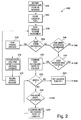
- Fig. 2 provides a flow chart of a process 200 for recognizing strings of digits in a voice mail message received by the voice mail system 100 in accordance with one embodiment of the present invention.
- the message may be transcoded prior to being played to the digit recognizer.
- the digit recognizer proceeds to play the message until a string of digits is recognized 208. Once a digit is recognized, the playback is stopped 210, and the string of digits and the time offset in the message to the start (and in some embodiments to the end) of the message are recorded 212 in the voice message database.
- the playback of the message then continues 214, 208 until another string of digits is detected. If another string is detected in the message, then steps 210 to 214 of the process are repeated. If another string is not detected, or if there are no strings of digits in the message, then the process proceeds to decision block 216.
- any remaining strings are compared with the caller ID number in steps 226 and 228. If any other strings match the caller id telephone number then the caller ID flag is set to 1, otherwise, process 200 ends.
- a digit string length may be set, such that for the outcome of decision block 208 to be YES, any digit strings recognized must have a string length (i.e., number of digits) equal to the set length.
- This feature allows a user to set the string length to be equal to the number of digits in a telephone number for the locality of the voice mail system to reduce the likelihood that non-telephone number digit strings are detected.
- the digit length can be set to a minimum value so that all strings greater than the minimum value are detected.
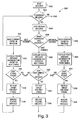
- a process 300 of embodiments of the present invention for operating the system 100 to retrieve messages will now be described with reference to Fig. 3.
- a subscriber or user may access the voice mail system through the telephone interface using a landline or wireless telephone as is well known. After accessing the voice mail system, the subscriber may initiate process 300 by issuing a command to the voice mail system to play a selected stored voice mail message.
- the subscriber may provide commands to the voice mail system in one of a number of ways, such as uttering commands that are recognized by the command recognizer, or pressing keys on a touch tone phone that are recognized by the touch tone decoder.
- the voice message system retrieves the message from the voice mail store database.
- the voice mail message system retrieves any attributes associated with the message from the voice message database, and retrieves any caller ID information associated with the message from the caller ID store database.
- the attributes and caller ID information is not retrieved until a command requiring its retrieval is provided by the user.
- step 302 of process 300 the selected message is played for the user.
- the voice message system (block 304) waits for a valid command to be issued by the user. If no valid command is received, the message will finish playing and process 300 ends. If a command is received while the message is being played, the command will be interpreted by either the command recognizer or the touch tone decoder. Once a valid command is received, the system stops 306 playing the message. For the process 300 shown in Fig. 3, there are three possible valid interpretations for the command. These interpretations include NEXT NUMBER, PREVIOUS NUMBER, FIRST NUMBER, and at step 308 one of three procedures are followed depending on the command that was received.
- the system determines 310 a current time offset of the voice message, retrieves 312 the attribute information for the message from the voice message database, and determines 314 whether there is a digit string in the message having a time offset greater than the present time offset. If the outcome of block 314 is NO, then process 300 finishes. In one embodiment, the system may provide the subscriber with a message such as "There are no remaining digit strings in the message" prior to ending the process.
- step 316 the system skips ahead in the message to the offset time for the next digit string and resumes 318 playing the message, the process then returns to step 304.
- the system determines 320 a current time offset of the voice message, retrieves 322 the attribute information for the message from the voice message database, and determines 324 whether there is a digit string in the message having a time offset less than the present time offset. If the outcome of block 324 is NO, then process 300 finishes. If the outcome of block 324 is YES, then in step 326, the system moves back in the message to the offset time for the next previous digit string and resumes 328 playing the message, the process then returns to step 304.
- the system retrieves 330 the attribute information for the message from the voice message database, and determines 332 whether there are any digit strings in the message. If the outcome of block 334 is NO, then process 300 finishes. If the outcome of block 334 is YES, then in step 336, the system moves to the offset time for the first digit string in the message and resumes 338 playing the message, the process then returns to step 304.
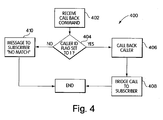
- a process 400 of embodiments of the present invention for operating the system 100 to provide subscriber or user call back to a caller that has left a voice message for the subscriber will now be described with reference to Fig. 4.
- the process 400 begins when the voice mail system 100 receives 402 a command to call back a caller that has left a voice mail message. The command may be received during playback of the message, prior to playback, or after playback.
- the voice mail system at decision block 404 determines whether the caller ID verified flag has been set to 1. As described above with reference to process 200, the caller ID flag is set to 1 when a digit string in the voice mail message matches a telephone number contained in caller ID information for the voice mail message.
- step 406 the voice mail system through the telephone interface calls the telephone number from the caller ID information, and bridges 408 the call to the subscriber. If the outcome of decision block 404 is NO, then the voice mail system provides 410 a message to the caller indicating that the telephone number does not match a digit string in the message, and the process ends.
- digit strings in voice messages are compared with telephone numbers contained in caller identification information to determine if a match exists.
- a number of known techniques exist for comparing two digit strings such as those described in Wagner R.A and Fischer M.J. "The String to String Correction Problem", Journal of the Assocation for Computing Machinery , 21, 168-173 (1974)(”hereinafter "Wagner") and Cormen, Leiserson and Rivest, Introduction to Algorithms, Cambridge, MA, MIT Press, 1990.
- a call back command causes the voice mail system to call back a caller that has left a voice mail message when a telephone number in caller ID information matches the number in a digit string in the voice mail message.
- an exact match between the number in the digit string and the caller ID number is not required, particularly when there is a strong probability that the numbers may be the same.
- errors sometimes occur when a voice recognition system is used to detect a word.
- Embodiments of the present invention allow for some differences between a caller ID number and numbers in a digit string to account for such errors.
- An administrator of the voice mail system is able to configure match criteria of the system that indicate how close a match is needed.
- a mismatch of only one digit between a caller ID number and a number in a digit string is ignored and results in an acceptable match.
- a match may be indicated when only 75% of the digits match.
- match criteria used in embodiments of the present invention can indicate a match when less than all digits or more than all digits are present.
- a minimum string edit distance can be used to describe differences between two strings (e.g., a telephone number and a digit string) as a number of steps of change, where the steps of change include, for example, insert a character, delete a character, or change a character. Each of these steps of change may have a different associated cost, and the difference between two strings may be set equal to the sum of these costs.
- Match criteria used in embodiments of the present invention may include a maximum acceptable cost.
- a log is maintained of all telephone calls (or all recent telephone calls) that have been received by the voice message system that contain telephone number caller ID information.
- the log may be stored in the caller ID store database.
- the telephone numbers are grouped based on semantically salient fields. For example, in the U.S., the calls can be grouped based on area code (the first three digits) and exchange (the second three digits). In other countries, the grouping will be different, but may still be based on geographical codes in telephone numbers, such as city codes.
- the system determines the probability that a particular call will be from a particular area code and a particular exchange within the area code based on prior calls that are received. This probability is used when matching a digit string in a voice mail message to a caller ID telephone number. If the-probability is high that a call will be from a particular area code, then differences of one or two digits in the exchange code may still be an acceptable match. Further if an area code is matched, and the probability of a particular exchange code is high, then differences of one or two digits in the area code may still be an acceptable match.
- the match requirement may be relaxed so that "7xx” "x8x” or "xx1", where "x" is any number, would be an acceptable match for the area code of the number.
- the voice mail system 100 may include an additional address book data base 130 as shown in Fig. 5.
- the voice mail system may have a network interface 132 that allows the computer system to couple to computer networks such as the Internet.
- the address book database contains telephone numbers for contacts of a particular subscriber, and in embodiments of the present invention, the address book information for a particular subscriber can be downloaded to the voice mail system over the Internet or a private intranet from, for example, a hand held computer, or from a contact information program, such as MICROSOFT OUTLOOK.
- digit strings in voice mail messages can be compared with all of the telephone numbers in the address book to look for a match (or a close match) before a call back command can be initiated.
- the address book telephone number when a close match is achieved between a telephone number in a voice mail digit string and a telephone number from the address book, the address book telephone number, rather than the voice mail telephone number, is used as the telephone number for call back.
- digit recognition is performed on voice mail messages after they are stored in the voice mail store database. In other embodiments, digit recognition may occur at the time that the message is recorded. In addition, digit recognition can be performed to detect digit strings other than telephone numbers, such as social security numbers, street addresses, credit card numbers, flight numbers, or other quantities, such as price quotes. In addition, voice messages used with the present invention may be delivered to users by means other than telephone devices, such as over the Internet or some other network.
- a subscriber can move to a next digit string or a prior digit string by providing appropriate commands to a voice mail system.
- the voice mail system either automatically, or in response to a subscriber's command, detects when a digit string is being played, based on previously stored time offsets, and decreases the speed of playback to allow the user to more easily comprehend the numbers of the digit string.
- telephony messages are described as voice mail messages.
- voice mail systems may also use multimedia messages as well.
Landscapes
- Engineering & Computer Science (AREA)
- Signal Processing (AREA)
- Computational Linguistics (AREA)
- Health & Medical Sciences (AREA)
- Audiology, Speech & Language Pathology (AREA)
- Human Computer Interaction (AREA)
- Physics & Mathematics (AREA)
- Acoustics & Sound (AREA)
- Multimedia (AREA)
- Telephonic Communication Services (AREA)
Applications Claiming Priority (2)
| Application Number | Priority Date | Filing Date | Title |
|---|---|---|---|
| US52959 | 2001-10-29 | ||
| US10/052,959 US20030081738A1 (en) | 2001-10-29 | 2001-10-29 | Method and apparatus for improving access to numerical information in voice messages |
Publications (2)
| Publication Number | Publication Date |
|---|---|
| EP1315146A2 true EP1315146A2 (fr) | 2003-05-28 |
| EP1315146A3 EP1315146A3 (fr) | 2006-06-07 |
Family
ID=21981026
Family Applications (1)
| Application Number | Title | Priority Date | Filing Date |
|---|---|---|---|
| EP02257418A Withdrawn EP1315146A3 (fr) | 2001-10-29 | 2002-10-25 | Méthode et appareil pour améliorer l'accès à l'information numérique dans des messages vocaux |
Country Status (3)
| Country | Link |
|---|---|
| US (1) | US20030081738A1 (fr) |
| EP (1) | EP1315146A3 (fr) |
| IL (1) | IL152206A0 (fr) |
Cited By (2)
| Publication number | Priority date | Publication date | Assignee | Title |
|---|---|---|---|---|
| EP1672897A1 (fr) * | 2004-12-15 | 2006-06-21 | Alcatel | Détection d'un numéro de rappel dans un système de messagerie vocale |
| US11153472B2 (en) | 2005-10-17 | 2021-10-19 | Cutting Edge Vision, LLC | Automatic upload of pictures from a camera |
Families Citing this family (5)
| Publication number | Priority date | Publication date | Assignee | Title |
|---|---|---|---|---|
| US7251313B1 (en) * | 2004-04-12 | 2007-07-31 | Sprint Spectrum L.P. | Method and system for returning a call based on information in a voicemail message |
| US8675833B2 (en) * | 2008-10-22 | 2014-03-18 | CentruryLink Intellectual Property LLC | System and method for managing messages |
| US9412381B2 (en) * | 2010-03-30 | 2016-08-09 | Ack3 Bionetics Private Ltd. | Integrated voice biometrics cloud security gateway |
| US9767807B2 (en) | 2011-03-30 | 2017-09-19 | Ack3 Bionetics Pte Limited | Digital voice signature of transactions |
| US10468026B1 (en) * | 2018-08-17 | 2019-11-05 | Century Interactive Company, LLC | Dynamic protection of personal information in audio recordings |
Family Cites Families (7)
| Publication number | Priority date | Publication date | Assignee | Title |
|---|---|---|---|---|
| US5231670A (en) * | 1987-06-01 | 1993-07-27 | Kurzweil Applied Intelligence, Inc. | Voice controlled system and method for generating text from a voice controlled input |
| US5504805A (en) * | 1993-04-05 | 1996-04-02 | At&T Corp. | Calling number identification using speech recognition |
| US5848130A (en) * | 1996-12-31 | 1998-12-08 | At&T Corp | System and method for enhanced intelligibility of voice messages |
| US6219407B1 (en) * | 1998-01-16 | 2001-04-17 | International Business Machines Corporation | Apparatus and method for improved digit recognition and caller identification in telephone mail messaging |
| US6249765B1 (en) * | 1998-12-22 | 2001-06-19 | Xerox Corporation | System and method for extracting data from audio messages |
| US6567506B1 (en) * | 1999-12-02 | 2003-05-20 | Agere Systems Inc. | Telephone number recognition of spoken telephone number in a voice message stored in a voice messaging system |
| US6442243B1 (en) * | 2000-04-25 | 2002-08-27 | Sbc Technology Resources, Inc. | Voice mail interface |
-
2001
- 2001-10-29 US US10/052,959 patent/US20030081738A1/en not_active Abandoned
-
2002
- 2002-10-09 IL IL15220602A patent/IL152206A0/xx unknown
- 2002-10-25 EP EP02257418A patent/EP1315146A3/fr not_active Withdrawn
Non-Patent Citations (1)
| Title |
|---|
| None * |
Cited By (3)
| Publication number | Priority date | Publication date | Assignee | Title |
|---|---|---|---|---|
| EP1672897A1 (fr) * | 2004-12-15 | 2006-06-21 | Alcatel | Détection d'un numéro de rappel dans un système de messagerie vocale |
| US11153472B2 (en) | 2005-10-17 | 2021-10-19 | Cutting Edge Vision, LLC | Automatic upload of pictures from a camera |
| US11818458B2 (en) | 2005-10-17 | 2023-11-14 | Cutting Edge Vision, LLC | Camera touchpad |
Also Published As
| Publication number | Publication date |
|---|---|
| US20030081738A1 (en) | 2003-05-01 |
| EP1315146A3 (fr) | 2006-06-07 |
| IL152206A0 (en) | 2003-05-29 |
Similar Documents
| Publication | Publication Date | Title |
|---|---|---|
| US4608460A (en) | Comprehensive automatic directory assistance apparatus and method thereof | |
| US5651055A (en) | Digital secretary | |
| US9215305B2 (en) | Voice-operated interface for DTMF-controlled systems | |
| EP0935378B1 (fr) | Système et méthode de traitement automatique le transfert d'appel et de données | |
| US6687673B2 (en) | Speech recognition system | |
| CA2105034C (fr) | Systeme de verification de haut-parleurs utilisant l'evaluation normalisee de cohortes | |
| CA2412950C (fr) | Methode de fournir une interface utilisateur pour systemes de telecommunications audio | |
| US6198808B1 (en) | Controller for use with communications systems for converting a voice message to a text message | |
| JP4247929B2 (ja) | 電話における自動音声認識のための方法 | |
| US6049594A (en) | Automatic vocabulary generation for telecommunications network-based voice-dialing | |
| JP3758685B2 (ja) | 電話帳内の所望の記録を検索する方法および装置 | |
| US5799066A (en) | Automated message system for a calling party | |
| US8379803B2 (en) | Voice response apparatus and method of providing automated voice responses with silent prompting | |
| US5917889A (en) | Capture of alphabetic or alphanumeric character strings in an automated call processing environment | |
| US8346539B2 (en) | System and method for indexing voice mail messages by speaker | |
| US7660716B1 (en) | System and method for automatic verification of the understandability of speech | |
| US6035017A (en) | Background speech recognition for voice messaging applications | |
| US6567506B1 (en) | Telephone number recognition of spoken telephone number in a voice message stored in a voice messaging system | |
| WO1994026054A1 (fr) | Procede et appareil de telephonie transparente | |
| JP2000078296A (ja) | 対話的音声応答システムにおける指示方法および対話的音声応答システム | |
| JP2003520983A (ja) | 改良されたテキスト−音声変換 | |
| US6223156B1 (en) | Speech recognition of caller identifiers using location information | |
| GB2317782A (en) | Voice dialling server for branch exchange telephone systems | |
| US5949852A (en) | Method for recording messages for absent parties | |
| US20010049599A1 (en) | Tone and speech recognition in communications systems |
Legal Events
| Date | Code | Title | Description |
|---|---|---|---|
| PUAI | Public reference made under article 153(3) epc to a published international application that has entered the european phase |
Free format text: ORIGINAL CODE: 0009012 |
|
| AK | Designated contracting states |
Designated state(s): AT BE BG CH CY CZ DE DK EE ES FI FR GB GR IE IT LI LU MC NL PT SE SK TR |
|
| AX | Request for extension of the european patent |
Extension state: AL LT LV MK RO SI |
|
| PUAL | Search report despatched |
Free format text: ORIGINAL CODE: 0009013 |
|
| AK | Designated contracting states |
Kind code of ref document: A3 Designated state(s): AT BE BG CH CY CZ DE DK EE ES FI FR GB GR IE IT LI LU MC NL PT SE SK TR |
|
| AX | Request for extension of the european patent |
Extension state: AL LT LV MK RO SI |
|
| RIC1 | Information provided on ipc code assigned before grant |
Ipc: H04M 3/53 20060101ALI20060503BHEP Ipc: H04M 1/65 20060101ALI20060503BHEP Ipc: G10L 15/26 20060101AFI20060503BHEP |
|
| 17P | Request for examination filed |
Effective date: 20061205 |
|
| AKX | Designation fees paid |
Designated state(s): AT BE BG CH CY CZ DE DK EE ES FI FR GB GR IE IT LI LU MC NL PT SE SK TR |
|
| 17Q | First examination report despatched |
Effective date: 20070131 |
|
| STAA | Information on the status of an ep patent application or granted ep patent |
Free format text: STATUS: THE APPLICATION IS DEEMED TO BE WITHDRAWN |
|
| 18D | Application deemed to be withdrawn |
Effective date: 20070811 |