EP1316351A2 - Gasreinigung mit konditionierten Kondensaten - Google Patents
Gasreinigung mit konditionierten Kondensaten Download PDFInfo
- Publication number
- EP1316351A2 EP1316351A2 EP02026642A EP02026642A EP1316351A2 EP 1316351 A2 EP1316351 A2 EP 1316351A2 EP 02026642 A EP02026642 A EP 02026642A EP 02026642 A EP02026642 A EP 02026642A EP 1316351 A2 EP1316351 A2 EP 1316351A2
- Authority
- EP
- European Patent Office
- Prior art keywords
- gas
- water
- circuit
- mixture
- medium
- Prior art date
- Legal status (The legal status is an assumption and is not a legal conclusion. Google has not performed a legal analysis and makes no representation as to the accuracy of the status listed.)
- Ceased
Links
Images



Classifications
-
- B—PERFORMING OPERATIONS; TRANSPORTING
- B01—PHYSICAL OR CHEMICAL PROCESSES OR APPARATUS IN GENERAL
- B01D—SEPARATION
- B01D53/00—Separation of gases or vapours; Recovering vapours of volatile solvents from gases; Chemical or biological purification of waste gases, e.g. engine exhaust gases, smoke, fumes, flue gases, aerosols
- B01D53/34—Chemical or biological purification of waste gases
- B01D53/46—Removing components of defined structure
- B01D53/72—Organic compounds not provided for in groups B01D53/48 - B01D53/70, e.g. hydrocarbons
-
- B—PERFORMING OPERATIONS; TRANSPORTING
- B01—PHYSICAL OR CHEMICAL PROCESSES OR APPARATUS IN GENERAL
- B01D—SEPARATION
- B01D53/00—Separation of gases or vapours; Recovering vapours of volatile solvents from gases; Chemical or biological purification of waste gases, e.g. engine exhaust gases, smoke, fumes, flue gases, aerosols
- B01D53/002—Separation of gases or vapours; Recovering vapours of volatile solvents from gases; Chemical or biological purification of waste gases, e.g. engine exhaust gases, smoke, fumes, flue gases, aerosols by condensation
-
- B—PERFORMING OPERATIONS; TRANSPORTING
- B01—PHYSICAL OR CHEMICAL PROCESSES OR APPARATUS IN GENERAL
- B01D—SEPARATION
- B01D53/00—Separation of gases or vapours; Recovering vapours of volatile solvents from gases; Chemical or biological purification of waste gases, e.g. engine exhaust gases, smoke, fumes, flue gases, aerosols
- B01D53/14—Separation of gases or vapours; Recovering vapours of volatile solvents from gases; Chemical or biological purification of waste gases, e.g. engine exhaust gases, smoke, fumes, flue gases, aerosols by absorption
- B01D53/1406—Multiple stage absorption
-
- B—PERFORMING OPERATIONS; TRANSPORTING
- B01—PHYSICAL OR CHEMICAL PROCESSES OR APPARATUS IN GENERAL
- B01D—SEPARATION
- B01D53/00—Separation of gases or vapours; Recovering vapours of volatile solvents from gases; Chemical or biological purification of waste gases, e.g. engine exhaust gases, smoke, fumes, flue gases, aerosols
- B01D53/34—Chemical or biological purification of waste gases
- B01D53/74—General processes for purification of waste gases; Apparatus or devices specially adapted therefor
- B01D53/77—Liquid phase processes
- B01D53/78—Liquid phase processes with gas-liquid contact
-
- F—MECHANICAL ENGINEERING; LIGHTING; HEATING; WEAPONS; BLASTING
- F23—COMBUSTION APPARATUS; COMBUSTION PROCESSES
- F23G—CREMATION FURNACES; CONSUMING WASTE PRODUCTS BY COMBUSTION
- F23G2201/00—Pretreatment
- F23G2201/30—Pyrolysing
- F23G2201/301—Treating pyrogases
-
- F—MECHANICAL ENGINEERING; LIGHTING; HEATING; WEAPONS; BLASTING
- F23—COMBUSTION APPARATUS; COMBUSTION PROCESSES
- F23J—REMOVAL OR TREATMENT OF COMBUSTION PRODUCTS OR COMBUSTION RESIDUES; FLUES
- F23J2219/00—Treatment devices
- F23J2219/70—Condensing contaminants with coolers
Definitions
- the process is used to carry out gas cleaning by means of conditioned washing media, the sequentially separated in process steps and in turn a process step-related cleaning and conditioning by absorption and Deposition processes undergo or through thermal processes in a particular Composition to be made.
- a carbonization gas consisting of aliphates, Aromatics, olefins, water and other ingredients passed through several gas scrubber units while doing so each loaded with a washing medium, which at Operation of the gas scrubber units from the emerging Condensate is formed and conditioned. From the The condensates, e.g. B. by Lowering of temperature and separation.
- the gas scrubber units are in one Pipeline circuit arranged apparatus in which the gas components, the vaporous components and the washing media as liquids one after the other brought intimate contact, through physical and treated chemical processes and then again be separated from each other. So find in the Washer units in succession Mass transfer processes gas / liquid and Liquid / liquid thermal and chemical processes instead of. In the evaporation and Condensation processes are used in gas and media treated in liquid phases. In the Absorption processes are usually liquids and solids involved, with several Liquid separation processes of immiscible phases drain off and in a solid bed Combination process absorption / cleavage becomes effective.
- the gas scrubber units in which these processes run out, washing media flow through them be moved by pump units.
- the content of the Gas scrubber units, the proportions of the components and the process states are process-related specified.
- the process is through the circuit the process sequence described. In one at a time Circuitry is one or more due to the process Gas scrubber units are integrated and stand in this respect for different washing media in each desired circuit in connection.
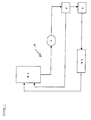
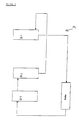
- circuits 1, 2, 3, 4 and 5 ( Figures 1 - 5) as a process sequence and thus described procedures described in assemble the overall process according to FIG. 5.
- the switching sequence integrates the gas scrubber Gl Oil separator Al and the absorber Kl, which the Execution of the processes serve.
- a gas vapor mixture is introduced and at a temperature of 400 - 800 ° C above one Headed coke bed.
- the absorption and splitting process follows the condensation and washing process in the Gas scrubber Gl, in which the gas vapor mixture with the Washing medium of the low boiler circuit (switching sequence 2) is applied to condense components.
- the gas scrubbing turns them over the coke bed low boilers formed at a temperature of 100 - 300 ° C in the gas stream and taken with it continued in vapor form.
- the one with the washing medium condensable high boilers (oil) leave the Process gas scrubbing, flow through the apparatus of the Switching sequence 2 and are in separator A1 physically of highly viscous components and Coke particles freed, which the absorber Kl in connection with a previously conducted Heating can be supplied under pressure.
- the switching sequence causes the generation of low-boiling components, reducing the Heavy boiler, the separation of coke particles and the removal of pollutants such. B. dioxin and other higher molecular substances, which are thus conditioned washing medium are soluble (see Switching sequence 2).
- the switching sequence integrates the gas scrubbing process Eq with the above Condition features, the Gas scrubbing process G2, with a temperature below 60 ° C for extensive separation of all condensable components contributes to the separator A2 for the separation process of low boilers and water and the vaporizer V1, which has a temperature of 100 - 150 ° C is used for the thermal Separation process water - benzene (or BTEX partially).
- the switching sequence engages in the equipment units of the Gas washer 1, 2 and 3, integrating the associated processes by heat transfer in the apparatus Wl and the separation in the separator Al can be added. These are for switching sequence 2 not relevant as basic operations.
- the switching sequence has the function of a gas / steam mixture through the gas scrubber G1 in Washer G2 a mixture of water vapor and Low boiler steam partly and in the gas scrubber G2 (with Condensation).
- Separator processes for water are found in separator A2 and low boilers instead, based on density differences based. Flow through the separated low boilers exclusively the vaporizer V1 and are here from Free from benzene. Then the condensed low boilers in the switching sequence 1, in which reduces viscosity.
- the switching sequence integrates the processes into the Gas scrubbers G1, G2 and G3, separator A2, Heat exchanger W1 and absorber K1.
- the third Gas scrubber has a temperature at which the entrained water component evaporates.
- the components of the Medium which consists mostly of water, only in second scrubber and partly in the third Gas washer condenses, from here to the Separator A2 introduced into the heat exchanger W1 and heated. You will be evaporation subjected. This creates a pollutant enriched residue, which as a partial stream in the Absorber K1 and in a second heat exchanger is returned after becoming one Temperature treatment in the first heat exchanger has undergone.
- the switching sequence causes that benzene before the evaporation process in the Gas scrubber unit 3 physically separated and then from the low-viscosity low boilers can be evaporated and thus the processes of Switching sequence 4 not loaded.
- organic water-soluble Pollutants such as B. furan, from the washing medium eliminated the absorption switching process fed and thereby catalytically split and thus be eliminated.
- the washing medium is converted into heat by applying heat Heat exchanger W1, at temperatures from 80 ° C to 110 ° C in the gas stream low boilers and water evaporated.
- the Swamp from W2 is also in the absorber K1 passed while the steam condenses and the Waste water pretreatment is supplied.
- the switching sequence integrates the processes into the Gas scrubber units 3, 4 and possibly another, the Separator A3 and the absorber K. Furthermore Integrated heat transfer processes.
- the switching sequence consists of a row of scrubbers, in the water is injected and circulated.
- the medium is cooled and in the switching sequence 4 fed.
- the general principle is that in the Gas scrubbing processes in short condensation sections by mixing the oil condensates produced with atomized washing medium due to temperature shock Component is condensed due to their droplet-shaped distribution of carbon particles ties up in a collection room with the others Components entered, separated here and to be subsequently discharged in fluid form.
- a component consisting of paraffins and aliphatics is condensed out by mixing the oil condensates produced thereby with the atomized washing medium by temperature shock, which has a density of 1, 0 to 1.3 kg / l and, due to their droplet-like distribution in the gas / steam mixture, binds carbon particles with a particle size range between 0.01 and 1 mm, but also up to a size of 5 mm, in order to enter them into a collecting space with the other components , here separated from the mixture due to the density by settling and then in fl to be carried out in the form.
Landscapes
- Chemical & Material Sciences (AREA)
- Engineering & Computer Science (AREA)
- Analytical Chemistry (AREA)
- General Chemical & Material Sciences (AREA)
- Oil, Petroleum & Natural Gas (AREA)
- Chemical Kinetics & Catalysis (AREA)
- Environmental & Geological Engineering (AREA)
- Health & Medical Sciences (AREA)
- Biomedical Technology (AREA)
- Treating Waste Gases (AREA)
- Gas Separation By Absorption (AREA)
Abstract
Description


- A1
- Abscheideprozess
- V1
- Verdampfer
- K
- Abscheider
- G1
- Gaswäscherprozess
- G2
- Gaswäscherprozess
- G3
- Gaswäscherprozess
- G4
- Gaswäscherprozess
- A
- Stoffstrom Schwersieder
- B
- Stoffstrom Medium mit Schadstoffen
- C
- Stoffstrom Salzlösung
Claims (16)
- Verfahren zur Gasreinigung und zur Abscheidung von dampfförmigen Stoffen aus Gasen und zur Konditionierung der sich dabei bildenden Kondensate als olefin- und aliphathaltige Fraktionen bzw. als Waschmedium in wässriger Lösung dadurch gekennzeichnet, dass eine Zusammenschaltung von Schaltfolgen vorgenommen wird, die an Verbindungsstellen der geschalteten Folgen dem Stoffübergang und damit der Konditionierung der Waschmedien bzw. dem Stoffübergang mit dem Produktgas dienen bzw. in dem Verlaufe der Schaltfolgen mit der Durchführung der Grundoperationen, die in den gasförmigen, flüssigen und festen Medien ablaufen und mit einem Zutritt oder Abgang von Komponenten verbunden wird, wobei die Schaltfolge (1), die der Abtrennung von hochviskosen schadstoffhaltigen organischen Komponenten mit Kohlenstoffanteilen dient - Schaltung (1), zusammengeschaltet wird durch den Gaswäscherprozess (Gl) und den physikalischen Abscheideprozess (Al) mit der Prozessfolge für Benzol- und Leichtsiederbehandlung - Schaltung (2), diese Prozessfolge - Schaltung (2) zusammengeschaltet wird durch den Gaswäscherprozess (G2) mit der Prozessfolge zur Ausschleusung der wasserlöslichen Schadstoffe - Schaltung (3), die ihrerseits über den Abscheider (K) mit der Schaltung (1) in Verbindung steht und weiterhin die Ausschleusung - Schaltung (4) durch eine Verbindung in den Gaswäscherprozess (G3) mit der Schaltung (3) in Verbindung steht, wodurch in den Prozessfolgen Komponenten sequentiell abgeschieden, die Waschmedien durch eine Führung im Kreislauf durch Prozessfolgen konditioniert und Schadstoffe ausgeschleust werden.
- Verfahren nach Anspruch 1 dadurch gekennzeichnet, dass Schaltungen von Prozessen auf die Stoffströme wirksam werden, bei denen aus dem Stoffstrom Gas in der Aufeinanderfolge der Stoffstrom A Schwersieder, der Stoffstrom B Medium mit Schadstoffen, der Stoffstrom C Salzlösungen abgeschieden und in der jeweiligen Prozessfolge konditioniert werden.
- Verfahren nach Anspruch 1 dadurch gekennzeichnet, dass die Stoffströme Gas A, B, C, ... sich - wie in der Tabelle angegeben - zusammensetzen.
- Verfahren nach Anspruch 1 dadurch gekennzeichnet, dass der Stoffstrom A Schwersieder, bestehend aus Aliphaten, Olefinen, Paraffine usw., der Kokspartikel enthält, auf eine Temperatur von > 200 °C, vorzugsweise > 300 °C, und auf höheren Druck gebracht wird, in diesem Zustand mit dem schadstoffhaltigen Medium, bestehend aus Öl und/oder Wasserkomponenten, gemischt und dann über ein Koksbett geleitet wird, das eine Temperatur > 400 °C aufweist, um in der Schaltung (1) dem Gaswäscher (Gl) zugeführt zu werden.
- Verfahren nach Anspruch 1 dadurch gekennzeichnet, dass das Kondensat aus dem Wäscher (G2) im Verlauf der Schaltung (2) in einem Abscheider (Al) aufgespalten wird, im Verdampfer (Vl) Leichtsieder abgibt, um anschließend den Wäscher (Gl) durch Einmischen des Mediums in die Schaltung (1) zugeführt zu werden.
- Verfahren nach Anspruch 1 dadurch gekennzeichnet, dass die Schadstoffe in einem Wäscher mit Medium C kondensiert und in Medium C in Abmischung mit Öl absorbiert werden, in dem Medium durch Verdampfung von Wasser angereichert und dann durch die Schaltung (1) ausgeschleust werden.
- Verfahren nach Anspruch 1 dadurch gekennzeichnet, dass das Gas-/Dampfgemisch mit einem Molekulargewicht von ca. 50 bis 250 kg/kmol in inniger Mischung mit den in Kreisläufen gefahrenen Medien mit sequentiellem Lösungsverhalten für flüchtige Stoffe abgekühlt wird, wodurch Kondensatgemische entstehen, die in den folgenden Verfahrensschritten gelöste Stoffe absorbieren.
- Verfahren nach Anspruch 1 dadurch gekennzeichnet, dass die Verfahrensschritte stattfindenin einem innigen Öl/Wassergemischin einem innigen Öl/Gas/Wassergemischin einem innigen Wasser/Wasserdampf/Gasgemisch bei Zuführung von Wärmein einem innigen Wasser, Lösungsmittel /Gasgemisch, wobei das Lösungsmittel ein aliphatischer Kohlenwasserstoff C6 bis C12 ist.
- Verfahren nach Anspruch 1 dadurch gekennzeichnet, dass die erste Verfahrensstufe ein Öl/Gasgemisch enthält, in das bis zu 0,05 Anteile Kokspartikel eingetragen werden.
- Verfahren nach Anspruch 1 dadurch gekennzeichnet, dass im Gaswäscherprozess (G3) eine Verdampfung von Wasser und Leichtsieder stattfindet.
- Verfahren nach Anspruch 1 dadurch gekennzeichnet, dass Gaswäscherprozess (G3) als Lösungsmittel Olefine und Aliphate enthält.
- Verfahren nach Anspruch 1 dadurch gekennzeichnet, dass die Kondensatströme und Absorptionsmittelströme mindestens zweistufig erhitzt, nach der ersten Stufe von Leichtsiedern befreit und nach der zweiten Stufe auf ein Koksbett gegeben werden.
- Verfahren nach Anspruch 1 dadurch gekennzeichnet, dass aus dem Stoffstrom nach der zweiten Erhitzung ein Lösungsmittel für Aromaten abgeleitet wird.
- Verfahren nach Anspruch 1 dadurch gekennzeichnet, dass ein Crackverfahren integriert ist und eine Spaltung von Aliphaten, Olefinen, Paraffinen und weiteren Stoffen, wie zum Beispiel Heterozyklen, erfolgt.
- Verfahren nach Anspruch 1 dadurch gekennzeichnet, dass eine Benzol-Wasser-Trennung erfolgt.
- Verfahren nach Anspruch 1 dadurch gekennzeichnet, dass in Gaswaschprozessen, die einer Gaserzeugungseinrichtung nachgeschaltet sind, in kurzen Kondensationsstrecken von 2 bis 4 m Länge aus einem verunreinigten Gas/Dampfgemisch, das eine Temperatur von 200 bis 500 °C aufweist durch Einsprühen einer Waschflüssigkeit mit einer Temperatur von 60 bis 150 °C das Gas/Dampfgemisch um 50 bis 100 °C abgekühlt und durch Vermischung der dadurch hergestellten Ölkondensate mit dem verdüsten Waschmedium durch Temperaturschock eine Komponente, bestehend aus Paraffinen und Aliphaten auskondensiert wird, die eine Dichte von 1,0 bis 1,3 kg/l aufweist und aufgrund ihrer tröpfchenförmigen Verteilung im Gas/Dampfgemisch Kohlenstoffpartikel mit einem Kornspektrum zwischen 0,01 und 1 mm, jedoch auch bis zu einer Größe von 5 mm bindet, um in einen Sammelraum mit den weiteren Komponenten eingetragen, hier aufgrund der Dichte aus der Mischung durch Absetzen abgeschieden und anschließend in fluider Form ausgetragen zu werden.
Applications Claiming Priority (2)
| Application Number | Priority Date | Filing Date | Title |
|---|---|---|---|
| DE2001159133 DE10159133A1 (de) | 2001-12-01 | 2001-12-01 | Gasreinigung mit konditionierten Kondensaten |
| DE10159133 | 2001-12-01 |
Publications (2)
| Publication Number | Publication Date |
|---|---|
| EP1316351A2 true EP1316351A2 (de) | 2003-06-04 |
| EP1316351A3 EP1316351A3 (de) | 2004-10-13 |
Family
ID=7707760
Family Applications (1)
| Application Number | Title | Priority Date | Filing Date |
|---|---|---|---|
| EP02026642A Ceased EP1316351A3 (de) | 2001-12-01 | 2002-11-29 | Gasreinigung mit konditionierten Kondensaten |
Country Status (2)
| Country | Link |
|---|---|
| EP (1) | EP1316351A3 (de) |
| DE (1) | DE10159133A1 (de) |
Cited By (3)
| Publication number | Priority date | Publication date | Assignee | Title |
|---|---|---|---|---|
| EP2679659A1 (de) | 2012-06-29 | 2014-01-01 | Jacobsen, Jorn | Verfahren und Anlage für die Herstellung von Kraftstoffgas aus Abfall |
| CN104324592A (zh) * | 2014-10-19 | 2015-02-04 | 镇江大成新能源有限公司 | 一种废气处理装置 |
| WO2024200528A1 (en) | 2023-03-30 | 2024-10-03 | Global Gateways Uk Holding Ltd | Method and apparatus for the cyclonic separation of solid particles |
Family Cites Families (8)
| Publication number | Priority date | Publication date | Assignee | Title |
|---|---|---|---|---|
| GB785453A (en) * | 1954-07-30 | 1957-10-30 | Basf Ag | Improvements in cracking hydrocarbons |
| DE2538611C2 (de) * | 1975-08-29 | 1983-09-08 | Linde Ag, 6200 Wiesbaden | Verfahren zur Abkühlung eines verschieden siedende Kohlenwasserstoffe enthaltenden Rohgasgemisches |
| US4188195A (en) * | 1977-09-16 | 1980-02-12 | Richard Jablin | Treatment of waste liquor |
| DE2853989C2 (de) * | 1978-12-14 | 1980-07-31 | Metallgesellschaft Ag, 6000 Frankfurt | Verfahren zum Behandeln von wasserhaltigem Kondensat aus der Kühlung des Rohgases der Druckvergasung |
| JPS55106292A (en) * | 1979-01-16 | 1980-08-14 | Showa Denko Kk | Method of cooling cracked hydrocarbon gas |
| GB2125060B (en) * | 1982-08-04 | 1986-08-28 | British Gas Corp | Purifying aqueous effluents in synthesis gas purification |
| DE3421393A1 (de) * | 1984-06-08 | 1985-12-12 | Krupp Koppers GmbH, 4300 Essen | Verfahren zur weiterverarbeitung von schwelgas aus der abfallpyrolyse |
| DE4012145A1 (de) * | 1990-04-14 | 1991-10-17 | Still Otto Gmbh | Verfahren zur fraktionierenden vorkuehlung von kokerei-rohgas |
-
2001
- 2001-12-01 DE DE2001159133 patent/DE10159133A1/de not_active Withdrawn
-
2002
- 2002-11-29 EP EP02026642A patent/EP1316351A3/de not_active Ceased
Cited By (6)
| Publication number | Priority date | Publication date | Assignee | Title |
|---|---|---|---|---|
| EP2679659A1 (de) | 2012-06-29 | 2014-01-01 | Jacobsen, Jorn | Verfahren und Anlage für die Herstellung von Kraftstoffgas aus Abfall |
| WO2014001580A1 (en) | 2012-06-29 | 2014-01-03 | Jacobsen Joern | Method and plant for production of a fuel gas from waste |
| CN104324592A (zh) * | 2014-10-19 | 2015-02-04 | 镇江大成新能源有限公司 | 一种废气处理装置 |
| WO2024200528A1 (en) | 2023-03-30 | 2024-10-03 | Global Gateways Uk Holding Ltd | Method and apparatus for the cyclonic separation of solid particles |
| EP4502114A2 (de) | 2023-03-30 | 2025-02-05 | Jacobsen, Jørn | Verfahren und anlage zur herstellung eines brenngases und methanol aus abfall |
| EP4502113A2 (de) | 2023-03-30 | 2025-02-05 | Jacobsen, Jørn | Verfahren und vorrichtung zur zyklonabscheidung von feststoffpartikeln |
Also Published As
| Publication number | Publication date |
|---|---|
| EP1316351A3 (de) | 2004-10-13 |
| DE10159133A1 (de) | 2003-06-26 |
Similar Documents
| Publication | Publication Date | Title |
|---|---|---|
| DE69609922T2 (de) | Verfahren zur Trocknung von Gasen mittels Glycol mit anschliessender Raffinierung von gasförmigen Abflüssen | |
| EP0167702B1 (de) | Verfahren zur Weiterverarbeitung von Schwelgas aus der Abfallpyrolyse | |
| DE3047658C2 (de) | Verfahren zur Reinigung von lösungsmittelhaltiger Abluft und Vorrichtung zur Durchführung des Verfahrens | |
| DE2511181A1 (de) | Verfahren zur reinigung von abgasen | |
| DE3612259A1 (de) | Loesemittel-eliminationsverfahren zur reinigung von luft von loesemitteldaempfen | |
| DE1924052A1 (de) | Verfahren zum Entfernen von CO2 und/oder H2S aus Spaltgasen und Vorrichtung zum Durchfuehren des Verfahrens | |
| EP0203259B1 (de) | Verfahren zur Regenerierung eines beladenen Waschmittels | |
| DE69501897T2 (de) | Methode und vorrichtung zur reinigung eines dampfes | |
| IT8422594A1 (it) | Procedimento e apparecchiature per il ritrattamento di olio vecchio | |
| EP0230543B1 (de) | Verfahren zur Aufarbeitung von Altöl | |
| DE3873925T2 (de) | Verfahren und vorrichtung zur reinigung von gueterbehaeltern sowie zur behandlung und zirkulation der verwendeten fluessigkeiten. | |
| EP1316351A2 (de) | Gasreinigung mit konditionierten Kondensaten | |
| EP0701491B1 (de) | Vorrichtung und verfahren zur reinigung von verunreinigtem bodenmaterial | |
| DE3002920A1 (de) | Verfahren zum abtrennen von autopolymerisierbaren kohlenwasserstoffdaempfen aus luft | |
| CH676675A5 (de) | ||
| DE3435735C2 (de) | ||
| DE69204420T2 (de) | Verfahren zum Entfernen von Schadstoffen aus Substrattrocknungsgas. | |
| DE3323770A1 (de) | Verfahren zum trocknen und erhitzen von oelhaltigen feststoffen | |
| EP0084319B1 (de) | Verfahren zur Trocknung und Entfernung von Kohlenwasserstoffen aus bzw. von Gasen | |
| DE3002649C2 (de) | ||
| DE220067C (de) | ||
| EP0437221A2 (de) | Emissionsfreier Desorptionsprozess | |
| DE4304193C1 (de) | Verfahren zum Auswaschen der sauren Gaskomponenten aus Rauchgasen durch Absorption | |
| DE3503500A1 (de) | Verfahren zur abluftreinigung | |
| AT390245B (de) | Verfahren zur gewinnung und/oder entfernung von in waessern, wie organisch belasteten abwaessern, enthaltenen stoffen |
Legal Events
| Date | Code | Title | Description |
|---|---|---|---|
| PUAI | Public reference made under article 153(3) epc to a published international application that has entered the european phase |
Free format text: ORIGINAL CODE: 0009012 |
|
| AK | Designated contracting states |
Designated state(s): AT BE BG CH CY CZ DE DK EE ES FI FR GB GR IE IT LI LU MC NL PT SE SK TR |
|
| AX | Request for extension of the european patent |
Extension state: AL LT LV MK RO SI |
|
| PUAL | Search report despatched |
Free format text: ORIGINAL CODE: 0009013 |
|
| AK | Designated contracting states |
Kind code of ref document: A3 Designated state(s): AT BE BG CH CY CZ DE DK EE ES FI FR GB GR IE IT LI LU MC NL PT SE SK TR |
|
| AX | Request for extension of the european patent |
Extension state: AL LT LV MK RO SI |
|
| 17P | Request for examination filed |
Effective date: 20050412 |
|
| AKX | Designation fees paid |
Designated state(s): AT BE BG CH CY CZ DE DK EE ES FI FR GB GR IE IT LI LU MC NL PT SE SK TR |
|
| 17Q | First examination report despatched |
Effective date: 20070124 |
|
| STAA | Information on the status of an ep patent application or granted ep patent |
Free format text: STATUS: THE APPLICATION HAS BEEN REFUSED |
|
| 18R | Application refused |
Effective date: 20091214 |