EP1316624A1 - Stahl mit guter Zerspanbarkeit und Spanbrechung für Maschinenbauanwendungen - Google Patents
Stahl mit guter Zerspanbarkeit und Spanbrechung für Maschinenbauanwendungen Download PDFInfo
- Publication number
- EP1316624A1 EP1316624A1 EP02026499A EP02026499A EP1316624A1 EP 1316624 A1 EP1316624 A1 EP 1316624A1 EP 02026499 A EP02026499 A EP 02026499A EP 02026499 A EP02026499 A EP 02026499A EP 1316624 A1 EP1316624 A1 EP 1316624A1
- Authority
- EP
- European Patent Office
- Prior art keywords
- steel
- machine structural
- yes
- inclusion
- structural use
- Prior art date
- Legal status (The legal status is an assumption and is not a legal conclusion. Google has not performed a legal analysis and makes no representation as to the accuracy of the status listed.)
- Granted
Links
- 229910000831 Steel Inorganic materials 0.000 title claims abstract description 86
- 239000010959 steel Substances 0.000 title claims abstract description 86
- 239000002245 particle Substances 0.000 claims abstract description 76
- UCKMPCXJQFINFW-UHFFFAOYSA-N Sulphide Chemical compound [S-2] UCKMPCXJQFINFW-UHFFFAOYSA-N 0.000 claims abstract description 36
- 239000000203 mixture Substances 0.000 claims abstract description 23
- 229910052717 sulfur Inorganic materials 0.000 claims abstract description 20
- 238000000034 method Methods 0.000 claims abstract description 18
- 229910052791 calcium Inorganic materials 0.000 claims abstract description 12
- 229910052799 carbon Inorganic materials 0.000 claims abstract description 12
- 229910052757 nitrogen Inorganic materials 0.000 claims abstract description 11
- 229910052782 aluminium Inorganic materials 0.000 claims abstract description 10
- 229910052726 zirconium Inorganic materials 0.000 claims abstract description 10
- 229910052760 oxygen Inorganic materials 0.000 claims abstract description 9
- 229910052748 manganese Inorganic materials 0.000 claims abstract description 8
- 229910052710 silicon Inorganic materials 0.000 claims abstract description 8
- 239000012535 impurity Substances 0.000 claims abstract description 7
- 229910045601 alloy Inorganic materials 0.000 claims description 27
- 239000000956 alloy Substances 0.000 claims description 27
- 238000002844 melting Methods 0.000 claims description 18
- 230000008018 melting Effects 0.000 claims description 18
- 239000006185 dispersion Substances 0.000 claims description 11
- 239000013078 crystal Substances 0.000 claims description 6
- 238000001556 precipitation Methods 0.000 claims description 5
- QVGXLLKOCUKJST-UHFFFAOYSA-N atomic oxygen Chemical compound [O] QVGXLLKOCUKJST-UHFFFAOYSA-N 0.000 claims description 3
- 229910001566 austenite Inorganic materials 0.000 claims description 3
- 229910052796 boron Inorganic materials 0.000 claims description 3
- 229910052749 magnesium Inorganic materials 0.000 claims description 3
- 229910052750 molybdenum Inorganic materials 0.000 claims description 3
- 239000001301 oxygen Substances 0.000 claims description 3
- 238000012545 processing Methods 0.000 claims description 3
- 238000009628 steelmaking Methods 0.000 claims description 3
- 229910052714 tellurium Inorganic materials 0.000 claims description 3
- 238000006243 chemical reaction Methods 0.000 claims description 2
- 229910052802 copper Inorganic materials 0.000 claims description 2
- 229910052759 nickel Inorganic materials 0.000 claims description 2
- 238000007670 refining Methods 0.000 claims description 2
- 230000001105 regulatory effect Effects 0.000 claims description 2
- 229910052711 selenium Inorganic materials 0.000 claims description 2
- 229910052720 vanadium Inorganic materials 0.000 claims description 2
- 238000004519 manufacturing process Methods 0.000 abstract description 5
- 239000000126 substance Substances 0.000 abstract 1
- 239000011575 calcium Substances 0.000 description 53
- 229910000915 Free machining steel Inorganic materials 0.000 description 52
- 238000012360 testing method Methods 0.000 description 22
- 230000015572 biosynthetic process Effects 0.000 description 16
- 239000011572 manganese Substances 0.000 description 16
- 230000000694 effects Effects 0.000 description 13
- NINIDFKCEFEMDL-UHFFFAOYSA-N Sulfur Chemical compound [S] NINIDFKCEFEMDL-UHFFFAOYSA-N 0.000 description 12
- 239000011593 sulfur Substances 0.000 description 12
- 238000007514 turning Methods 0.000 description 11
- PNEYBMLMFCGWSK-UHFFFAOYSA-N aluminium oxide Inorganic materials [O-2].[O-2].[O-2].[Al+3].[Al+3] PNEYBMLMFCGWSK-UHFFFAOYSA-N 0.000 description 9
- 239000002131 composite material Substances 0.000 description 9
- 229910052593 corundum Inorganic materials 0.000 description 8
- 229910001845 yogo sapphire Inorganic materials 0.000 description 8
- 239000011248 coating agent Substances 0.000 description 7
- 238000000576 coating method Methods 0.000 description 7
- 238000009792 diffusion process Methods 0.000 description 7
- 238000005299 abrasion Methods 0.000 description 6
- 238000005520 cutting process Methods 0.000 description 6
- 150000004763 sulfides Chemical class 0.000 description 6
- OKTJSMMVPCPJKN-UHFFFAOYSA-N Carbon Chemical compound [C] OKTJSMMVPCPJKN-UHFFFAOYSA-N 0.000 description 5
- 238000005266 casting Methods 0.000 description 5
- 102200029231 rs11551768 Human genes 0.000 description 5
- 102220259718 rs34120878 Human genes 0.000 description 5
- 102200082816 rs34868397 Human genes 0.000 description 5
- 238000005452 bending Methods 0.000 description 4
- 230000001050 lubricating effect Effects 0.000 description 4
- 239000011777 magnesium Substances 0.000 description 4
- 239000011651 chromium Substances 0.000 description 3
- 238000003754 machining Methods 0.000 description 3
- NUJOXMJBOLGQSY-UHFFFAOYSA-N manganese dioxide Inorganic materials O=[Mn]=O NUJOXMJBOLGQSY-UHFFFAOYSA-N 0.000 description 3
- PXHVJJICTQNCMI-UHFFFAOYSA-N nickel Substances [Ni] PXHVJJICTQNCMI-UHFFFAOYSA-N 0.000 description 3
- 239000010955 niobium Substances 0.000 description 3
- IJGRMHOSHXDMSA-UHFFFAOYSA-N Atomic nitrogen Chemical compound N#N IJGRMHOSHXDMSA-UHFFFAOYSA-N 0.000 description 2
- OYPRJOBELJOOCE-UHFFFAOYSA-N Calcium Chemical compound [Ca] OYPRJOBELJOOCE-UHFFFAOYSA-N 0.000 description 2
- WZTUBTNFIBFQGT-UHFFFAOYSA-N [S-2].[Mn+2].[Ca+2].[S-2] Chemical compound [S-2].[Mn+2].[Ca+2].[S-2] WZTUBTNFIBFQGT-UHFFFAOYSA-N 0.000 description 2
- 238000004458 analytical method Methods 0.000 description 2
- 229910052797 bismuth Inorganic materials 0.000 description 2
- 239000003795 chemical substances by application Substances 0.000 description 2
- 239000010949 copper Substances 0.000 description 2
- 230000003247 decreasing effect Effects 0.000 description 2
- 230000007547 defect Effects 0.000 description 2
- 238000005553 drilling Methods 0.000 description 2
- 230000002349 favourable effect Effects 0.000 description 2
- AMWRITDGCCNYAT-UHFFFAOYSA-L hydroxy(oxo)manganese;manganese Chemical compound [Mn].O[Mn]=O.O[Mn]=O AMWRITDGCCNYAT-UHFFFAOYSA-L 0.000 description 2
- 238000005461 lubrication Methods 0.000 description 2
- 239000000463 material Substances 0.000 description 2
- 238000002360 preparation method Methods 0.000 description 2
- 239000000047 product Substances 0.000 description 2
- 238000011160 research Methods 0.000 description 2
- ZOXJGFHDIHLPTG-UHFFFAOYSA-N Boron Chemical compound [B] ZOXJGFHDIHLPTG-UHFFFAOYSA-N 0.000 description 1
- VYZAMTAEIAYCRO-UHFFFAOYSA-N Chromium Chemical compound [Cr] VYZAMTAEIAYCRO-UHFFFAOYSA-N 0.000 description 1
- RYGMFSIKBFXOCR-UHFFFAOYSA-N Copper Chemical compound [Cu] RYGMFSIKBFXOCR-UHFFFAOYSA-N 0.000 description 1
- 229910000532 Deoxidized steel Inorganic materials 0.000 description 1
- FYYHWMGAXLPEAU-UHFFFAOYSA-N Magnesium Chemical compound [Mg] FYYHWMGAXLPEAU-UHFFFAOYSA-N 0.000 description 1
- PWHULOQIROXLJO-UHFFFAOYSA-N Manganese Chemical compound [Mn] PWHULOQIROXLJO-UHFFFAOYSA-N 0.000 description 1
- ZOKXTWBITQBERF-UHFFFAOYSA-N Molybdenum Chemical compound [Mo] ZOKXTWBITQBERF-UHFFFAOYSA-N 0.000 description 1
- OAICVXFJPJFONN-UHFFFAOYSA-N Phosphorus Chemical compound [P] OAICVXFJPJFONN-UHFFFAOYSA-N 0.000 description 1
- ATJFFYVFTNAWJD-UHFFFAOYSA-N Tin Chemical compound [Sn] ATJFFYVFTNAWJD-UHFFFAOYSA-N 0.000 description 1
- 238000005275 alloying Methods 0.000 description 1
- XAGFODPZIPBFFR-UHFFFAOYSA-N aluminium Chemical compound [Al] XAGFODPZIPBFFR-UHFFFAOYSA-N 0.000 description 1
- 229910052661 anorthite Inorganic materials 0.000 description 1
- 230000033228 biological regulation Effects 0.000 description 1
- JCXGWMGPZLAOME-UHFFFAOYSA-N bismuth atom Chemical compound [Bi] JCXGWMGPZLAOME-UHFFFAOYSA-N 0.000 description 1
- JGIATAMCQXIDNZ-UHFFFAOYSA-N calcium sulfide Chemical compound [Ca]=S JGIATAMCQXIDNZ-UHFFFAOYSA-N 0.000 description 1
- XFWJKVMFIVXPKK-UHFFFAOYSA-N calcium;oxido(oxo)alumane Chemical compound [Ca+2].[O-][Al]=O.[O-][Al]=O XFWJKVMFIVXPKK-UHFFFAOYSA-N 0.000 description 1
- 229910052804 chromium Inorganic materials 0.000 description 1
- 230000015271 coagulation Effects 0.000 description 1
- 238000005345 coagulation Methods 0.000 description 1
- 238000005336 cracking Methods 0.000 description 1
- GWWPLLOVYSCJIO-UHFFFAOYSA-N dialuminum;calcium;disilicate Chemical compound [Al+3].[Al+3].[Ca+2].[O-][Si]([O-])([O-])[O-].[O-][Si]([O-])([O-])[O-] GWWPLLOVYSCJIO-UHFFFAOYSA-N 0.000 description 1
- 238000004453 electron probe microanalysis Methods 0.000 description 1
- 238000005516 engineering process Methods 0.000 description 1
- 230000001747 exhibiting effect Effects 0.000 description 1
- 238000002474 experimental method Methods 0.000 description 1
- 239000010419 fine particle Substances 0.000 description 1
- 238000005242 forging Methods 0.000 description 1
- 239000011159 matrix material Substances 0.000 description 1
- 238000001000 micrograph Methods 0.000 description 1
- 239000011733 molybdenum Substances 0.000 description 1
- 229910052758 niobium Inorganic materials 0.000 description 1
- GUCVJGMIXFAOAE-UHFFFAOYSA-N niobium atom Chemical compound [Nb] GUCVJGMIXFAOAE-UHFFFAOYSA-N 0.000 description 1
- 150000004767 nitrides Chemical class 0.000 description 1
- 230000003287 optical effect Effects 0.000 description 1
- 239000002244 precipitate Substances 0.000 description 1
- 230000002035 prolonged effect Effects 0.000 description 1
- 238000012827 research and development Methods 0.000 description 1
- 238000005096 rolling process Methods 0.000 description 1
- 239000010703 silicon Substances 0.000 description 1
- 238000005979 thermal decomposition reaction Methods 0.000 description 1
- WFKWXMTUELFFGS-UHFFFAOYSA-N tungsten Chemical compound [W] WFKWXMTUELFFGS-UHFFFAOYSA-N 0.000 description 1
- 238000009827 uniform distribution Methods 0.000 description 1
- LEONUFNNVUYDNQ-UHFFFAOYSA-N vanadium atom Chemical compound [V] LEONUFNNVUYDNQ-UHFFFAOYSA-N 0.000 description 1
Images


Classifications
-
- C—CHEMISTRY; METALLURGY
- C22—METALLURGY; FERROUS OR NON-FERROUS ALLOYS; TREATMENT OF ALLOYS OR NON-FERROUS METALS
- C22C—ALLOYS
- C22C38/00—Ferrous alloys, e.g. steel alloys
- C22C38/60—Ferrous alloys, e.g. steel alloys containing lead, selenium, tellurium, or antimony, or more than 0.04% by weight of sulfur
-
- C—CHEMISTRY; METALLURGY
- C22—METALLURGY; FERROUS OR NON-FERROUS ALLOYS; TREATMENT OF ALLOYS OR NON-FERROUS METALS
- C22C—ALLOYS
- C22C38/00—Ferrous alloys, e.g. steel alloys
- C22C38/001—Ferrous alloys, e.g. steel alloys containing N
-
- C—CHEMISTRY; METALLURGY
- C22—METALLURGY; FERROUS OR NON-FERROUS ALLOYS; TREATMENT OF ALLOYS OR NON-FERROUS METALS
- C22C—ALLOYS
- C22C38/00—Ferrous alloys, e.g. steel alloys
- C22C38/002—Ferrous alloys, e.g. steel alloys containing In, Mg, or other elements not provided for in one single group C22C38/001 - C22C38/60
-
- C—CHEMISTRY; METALLURGY
- C22—METALLURGY; FERROUS OR NON-FERROUS ALLOYS; TREATMENT OF ALLOYS OR NON-FERROUS METALS
- C22C—ALLOYS
- C22C38/00—Ferrous alloys, e.g. steel alloys
- C22C38/02—Ferrous alloys, e.g. steel alloys containing silicon
-
- C—CHEMISTRY; METALLURGY
- C22—METALLURGY; FERROUS OR NON-FERROUS ALLOYS; TREATMENT OF ALLOYS OR NON-FERROUS METALS
- C22C—ALLOYS
- C22C38/00—Ferrous alloys, e.g. steel alloys
- C22C38/04—Ferrous alloys, e.g. steel alloys containing manganese
-
- C—CHEMISTRY; METALLURGY
- C22—METALLURGY; FERROUS OR NON-FERROUS ALLOYS; TREATMENT OF ALLOYS OR NON-FERROUS METALS
- C22C—ALLOYS
- C22C38/00—Ferrous alloys, e.g. steel alloys
- C22C38/14—Ferrous alloys, e.g. steel alloys containing titanium or zirconium
Definitions
- the present invention concerns a steel for machine structural use having good machinability and good chip-breakability in cutting by cemented carbide tools, as well as a method of producing the steel.
- the invention also concerns a steel for machine structural use exhibiting high fatigue strength and bend-straightenability in addition to the good machinability and chip-breakability.
- duplex inclusion means an inclusion of the structure in which a core mainly consisting of oxide inclusion is surrounded by another inclusion consisting mainly of sulfides.
- tools life ratio and “life ratio” mean a ratio of tool life of the free-cutting steel according to the invention to tool life of the conventional sulfur free-cutting steel containing the same S-contents in turning with a cemented carbide tool.
- Fully dispersed MnS inclusion particles are the particles finer than those in the conventional MnS inclusions particles contained in the conventional steel and existing in the form of uniform distribution in the steel matrix without coagulation or concentration.
- the free-cutting steel of this invention is characterized by calcium-manganese sulfide inclusion containing 1% or more of Ca in a spindle shape with an aspect ratio (length/width) up to 5, which envelopes a core of calcium aluminate containing 8-62% of CaO. Though the steel exhibited excellent machinability, dispersion of the machinability has been sometimes experienced. This was considered to be due to variety of types of the above-mentioned calcium-manganese sulfide inclusion.
- the steel of this invention is characterized in that it contains five or more particles per 3.3mm 2 of equivalent diameter 5 ⁇ m or more of sulfide inclusion containing 0.1-1.0% of Ca. There was, however, still some room for improving the dispersion of the machinability.
- the characteristic feature of the steel is the above-mentioned "duplex inclusion", i.e., the inclusion of the structure in which "sulfide inclusion particles containing Ca of 1.0wt.% or more and neighboring to oxide inclusion particles containing CaO of 8-62 wt.%" exists at least a certain amount, specifically, "that the area occupied by the sulfide inclusion is 2.0 X 10 -4 mm 2 per 3.5mm 2 or more in microscopic field".
- the free-cutting steel consists essentially of, as the basic alloy composition, by wt.%, C: 0.05-0.8%, Si: 0.01-2.5%, Mn: 0.1-3.5%, S: 0.01-0.2%, Al: 0.001-0.020%, Ca: 0.0005-0.02%, O: 0.0005-0.01% and N: 0.001-0.04%, and further, one or both of Ti: 0.002-0.010% and Zr: 0.002-0.025%, the balance being Fe and inevitable impurities, and is characterized in that the area occupied by the sulfide inclusion particles containing Ca of 1.0 wt.% or more and neighboring to oxide inclusion particles containing CaO of 0.2-62 wt.% is 2.0 ⁇ 10 -4 mm 2 per 3.5mm 2 or more of microscopic field and that the above MnS inclusion particles are finely dispersed in the steel.
- Novel features of this invention in comparison with the previous invention are, in one hand, extended lower limit of CaO-content of the oxide inclusion particles which form the duplex inclusion, and on the other hand, a more important difference that "the MnS inclusions are finely dispersed".
- the latter feature brings about the improved chip-breakability, and as the result, realizes suitable balance of the tool life and the chip-breakability.
- the former feature fine dispersion of the MnS inclusions can be given by addition of a certain amount or amounts of Ti and/or Zr to form fine Ti-oxide, Zr-oxide or (Ti+Zr)-oxide to have MnS precipitated on the oxide nuclei.
- These oxides may include manganese oxide, and thus, in that case, they may be TiO 2 -MnO 2 , ZrO 2 -MnO 2 or TiO 2 -ZrO 2 -MnO 2 .
- the free-cutting steel covers various kinds of steel classified in the steel for machine structural use. It has been found that, in the process of establishing concrete alloy compositions in the applicable fields, the invention is useful even in the relatively high S-content range. In other words, it has been revealed that, of the operation conditions mentioned above, the upper limit of [S]/[O]: 8-40 can be increased to 80 or so. On the other hand, after wide-ranged experiments, some dispersion in the balance of the tool life and the chip-breakability was still observed.
- the object of the present invention is to add further improvements to the free-cutting steel for machine structural use having improved dispersion of the machinability by utilizing the above described duplex inclusion to enable such improvement in machinability as fivefold or more tool life and good chip-breakability, and thus, to provide a steel in which better chip-breakability can be always obtained and is suitable for machining, particularly, turning.
- good fatigue strength and good bend-staightenability is also included in the object of the present invention.
- the free-cutting steel for machine structural use according to the present invention achieving the above-mentioned object, or the steel having good machinability as well as good chip-breakability consists essentially of, as the basic alloy composition, by wt.%, C: 0.05-0.8%, Si: 0.01-2.0%, Mn: 0.1-3.5%, S: 0.01-0.2%, Al: 0.001-0.020%, Ca: 0.0005-0.02%, O: 0.0005-0.01% and N: 0.001-0.04%, and further, one or both of Ti: 0.002-0.010% and Zr: 0.002-0.025%, the balance being Fe and inevitable impurities, and is characterized in that the area occupied by the sulfide inclusion particles containing Ca of 1-45 wt.% and neighboring to oxide inclusion particles containing CaO of 0.2-62 wt.% and having melting point of 1500-1750°C is 2.0 ⁇ 10 -4 mm 2 per 3.5mm 2 or more in microscopic field, and that the sul
- the method for producing the above described free-cutting steel for machine structural use comprises the steps of preparing an alloy consisting essentially of, by wt.%, C: 0.05-0.8%, Si: 0.01-2.0%, Mn: 0.1-3.5%, S: 0.01-0.2%, Al: 0.001-0.020%, Ca: 0.0005-0.02%, O: 0.0005-0.01% and N: 0.001-0.04%, the balance being Fe and inevitable impurities, by melting and refining process for the conventional steel making, in which controlled deoxidization is conducted under the following conditions:
- Carbon is an element necessary for ensuring strength of the steel, and at content less than 0.05% the strength is insufficient for machine structural use.
- carbon enhances the activity of sulfur, and at a high C-content it will be difficult to obtain the duplex inclusion which can be obtained only under the specific balance of [S]/[O], [Ca] ⁇ [S], [Ca]/[S] and specific amount of [Al].
- Si 0.01-2.0%
- Silicon is used as a deoxidizing agent at steel making and becomes a component of the steel to increase hardenability thereof. These effects are not available at such a small Si-content as less than 0.01%. Si also enhances the activity of S. A large Si-content causes the same problem as caused by a large amount of C, and it is apprehensive that formation of the duplex inclusion may be prevented. A large content of Si damages ductility of the steel and cracks may occur at plastic processing. Thus, 2.0% is the upper limit of addition. Mn: 0.1-3.5%
- Sulfur is rather necessary than useful for improving machinability of the steel, and therefore, at least 0.01% of S is added.
- S In order to achieve the fivefold or more tool life ratio S of 0.01% or more is necessary.
- S-content more than 0.2% not only damages resilience and ductility, but also causes formation of CaS, which has a high melting point and makes casting the steel difficult.
- Al 0.001-0.020%
- Aluminum is necessary for realizing suitable composition of oxide inclusions and is added in an amount of at least 0.001%. At an Al-content more than 0.020% hard alumina cluster will form and lowers machinability of the steel. Regulation of the Al-content must be carried out in the process of preparing the present free-cutting steel prior to addition of Ti and/or Zr. This will be explained later. Ca: 0.0005-0.02%
- Calcium is a very important component of the steel according to the invention.
- Ca contained in the sulfides it is essential to add at least 0.0005% of Ca.
- addition of Ca exceeding 0.02% causes, as mentioned above, formation of high melting point CaS, which makes the casting of the product steel difficult.
- Oxygen is an element necessary for forming the oxides.
- CaS In the extremely deoxidized steel high melting point CaS will form and cause trouble in casting, and therefore, at least 0.0005%, preferably 0.015% or more, of O is necessary.
- O of 0.0100% or more will give much amount of hard oxides, which makes it difficult to form the desired calcium sulfide and damages machinability of the steel.
- Deoxidization with double deoxidizing agents, Ca and Al causes formation of CaO-Al 2 O 3 type inclusions, which are low melting point inclusions favorable for the machinability without improving chip-breakability. Therefore, it is preferable to minimize formation of CaO-Al 2 O 3 type inclusions.
- O contributes to make MnS particles fine by combining with Ti and/or Zr to form fine oxide particles, which offer nuclei for MnS-precipitation.
- Ti-oxide Zr-oxide or (Ti+Zr)-oxide, to which Mn-oxide may accompany as mentioned above, and therefore, the above-noted condition, [O]/[N]: 0.06 or more, should be met.
- N tends to combine with Ti and Zr and, if these nitrides formed, formation of oxides will be insufficient.
- N 0.001-0.04%
- N is an element useful for preventing coarsening of crystal grains. Also, N is important due to combination with Ti to form TiN. From this point of view addition of N in the amount of 0.001% or more is essential. Excess N results in casting defects and thus, the upper limit of 0.04% is set. One or two of Ti: 0.002-0.010% and Zr: 0.002-0.025%
- Ti and Zr of small amounts combine with O in the steel deoxidized with Ca and Al to form fine oxides.
- the oxide particles take the role of nuclei for MnS-precipitation and contribute to fine dispersion of MnS. It is advantageous to use both Ti and Zr (for example, Ti 0.005% + Zr 0.015%) because high effect of comminuting the MnS inclusion particles can be obtained.
- Ti forms fine Ti(CN) particles
- those satisfying these balances exhibit high fatigue strength and good bend-straightenability, and therefore, are suitable as the materials of crank shafts and connecting rods, to which these properties are required.
- Phosphor an inevitable impurity, is harmful for resilience of the steel, and existence in an amount more than 0.2% is unfavorable.
- P improves machinability, particularly turned surface properties. This effect is appreciable at a content of 0.001% or higher.
- the free-cutting steel of this invention may further contain, in addition to the above-discussed basic alloy components, at least one element selected from the respective groups in an amount or amounts defined below.
- At least one element selected from the respective groups in an amount or amounts defined below.
- the following explains the roles of the optionally added alloying elements in the modified embodiments and the reasons for limiting the composition ranges.
- Cr up to 3.5%
- Mo up to 2.0%
- Chromium and molybdenum enhance hardenability of the steel, and so, it is recommended to add a suitable amount or amounts of the element or elements. However, addition of a large amount or amounts will damage hot workability of the steel and causes cracking. Also from the view point of manufacturing cost the respective upper limits are set to be 3.5% for Cr and 2.0% for Mo. Cu: up to 2.0%
- Copper makes the structure of steel fine and heightens strength of the steel. Much addition is not desirable from the viewpoints of hot workability and machinability. Addition amount should be up to 2.0%. Ni: up to 4.0%
- Nickel also enhances hardenability of the steel. This is a component unfavorable to the machinability. Taking the manufacturing cost into account, 4.0% is chosen as the upper limit.
- B Boron enhances hardenability of the steel even at a small content. To obtain this effect addition of B of 0.0005% or more is necessary. B-content more than 0.01% is harmful due to decreased hot workability. Mg: up to 0.02%
- Magnesium is effective to form oxide inclusion particles which become nuclei for the double structure inclusion particles. Addition of a large amount of Mg results in formation of MgS. MgS reacts CaO to form CaS, which gives difficulty in casting. The upper limit, 0.2%, is thus set. Nb: up to 0.2%
- Niobium is useful for preventing coarsening of crystal grains of the steel at high temperature. Because the effect saturates as the addition amount increases, it is advisable to add Nb in an amount up to 0.2%. V: up to 0.5%
- Vanadium combines with carbon and nitrogen to form carbonitride, which makes the crystal grains of the steel fine. This effect saturates at V-content more than 0.5%.
- Pb up to 0.4%
- Bi up to 0.4%
- Both lead and bismuth are machinability-improving elements.
- Lead exists, as the inclusion in the steel, alone or with sulfide in the form of adhered matter on outer surfaces of the sulfide inclusion particles and improves machinability.
- the upper limit, 0.4% is set because, even if a larger amount is added, excess lead will not dissolve in the steel and coagulate to form defects in the steel ingot.
- the reason for setting the upper limit of Bi is the same. Se: up to 0.4%, Te: up to 0.2%
- Se and Te are also machinability-improving elements.
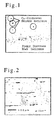
- the inclusions existing in the free-cutting steel for machine structural use according to the invention are, as seen in Fig. 1, the duplex inclusion and the MnS inclusion.
- EPMA analysis revealed that the core consists of oxides of Ca, Mg, Si and Al, and the core is surrounded by MnS containing CaS.
- the MnS inclusion particles in this steel of the invention are finely dispersed. Contrary to this, the MnS inclusion particles of the conventional free-cutting steel in which machinability-improving effect by MnS is simply sought are, as seen in Fig. 2, large and elongated during rolling.
- the shape and the amount of the duplex inclusion are essential for achieving good machinability of the fivefold tool life ratio aimed by the present invention and good chip-breakability through the mechanism discussed later.
- the significance of the shape and the amount will be, though partly mentioned in the disclosure of the prior invention, explained below with novel knowledge.
- the area occupied by the sulfide inclusions containing Ca of 1.0 % or more neighboring to the oxide inclusions containing CaO of 0.2-62% is 2.0 ⁇ 10 -4 mm 2 per 3.5mm 2 or more in the microscopic field:
- Fig. 3 The relation between the area occupied by the inclusion satisfying the above condition and tool life ratio obtained by turning with cemented carbide tool of the present steels and the conventional sulfur free-cutting steel of the same S-contents is shown in Fig. 3.
- the data in Fig. 3 were obtained by turning S45C-series free-cutting steel of the invention, and show that the results of the fivefold tool life ratio is achieved only when the duplex inclusion occupies the area of 2.0x10 -4 mm 2 or more.
- the steel containing much duplex inclusion in the total sulfide inclusions is preferable.
- the duplex inclusion shares at least 15% of the total sulfide inclusion This is shown in Fig. 4.
- percentage of simple sulfide inclusion other than the duplex inclusion must not be lower than a certain limit. This is the limit that the share of the duplex inclusion in the total sulfide inclusions is not more than 40%. Support for this can be found in Fig. 5.
- the graph of Fig. 5 shows the significance of the area percentage of 40% or less also in regard to the rotary bending fatigue limit.
- a high rotary bending fatigue limit (a limit of stress at which or lower no fatigue failure occurs even if repeatedly posed) is required. If the duplex inclusion becomes dominant to reach the level of 40% or more, very big duplex inclusion particles may form and, due to the mechanism that cracks occur and propagate from them to cause failure. Then, the rotary bending fatigue limit will decrease, and thus, it is preferable that the area percentage of the duplex inclusion does not exceed 40%.
- the duplex inclusion particle has a core of CaO ⁇ Al 2 O 3 -based composite oxides and the circumference of the core is surrounded by (Ca, Mn)-based composite sulfides. These oxides in question have relatively low melting points out of the CaO ⁇ Al 2 O 3 -based oxides, while the composite sulfide has a melting point higher than that of simple sulfide or MnS.
- the duplex inclusion surely precipitates by such arrangement that the CaO ⁇ Al 2 O 3 -based oxide of a low melting point may be in the form that the sulfides envelop the oxides. It is well known that, at cutting, the inclusions soften to coat the surface of the tool to protect it.
- the significance of formation of coating film on the tool edge by the composite sulfide of (Ca,Mn)S-base is to suppress so-called "heat diffusion abrasion" of cemented carbide tools.
- the heat diffusion abrasion is the abrasion of the tools caused by embrittlement of the tool through the mechanism that the tool contacts cut chips coming from the material just cut at a high temperature followed by thermal decomposition of carbide, represented by wolfram carbide WC, and resulting loss of carbon by diffusion into the cut chips. If a coating of high lubricating effect is formed on the tool edge, temperature increase of the tool will be prevented and diffusion of carbon will thus be suppressed.
- the duplex inclusion CaO-Al 2 O 3 /(Ca,Mn)S can be interpreted to have the merit of MnS, which is the inclusion in the conventional sulfur free-cutting steel, and the merit given by anorthite inclusion, CaO ⁇ Al 2 O 3 ⁇ 2SiO 2 , which is the inclusion in the conventional calcium free-cutting steel, in combination.
- MnS inclusion exhibits lubricating effect on the tool edge, while the stability of the coating film is somewhat dissatisfactory, and has no competence against the heat diffusion abrasion.
- CaO ⁇ Al 2 O 3 ⁇ 2SiO 2 forms a stable coating film to prevent the thermal diffusion abrasion, while has little lubrication effect.
- the duplex inclusion of the present invention forms a stable coating film to effectively prevent the thermal diffusion abrasion, and at the same time, offer better lubricating effect.
- Formation of the duplex inclusion begins with, as mentioned above, preparation of the low melting temperature composite oxides, and therefore, the amount of [Al] is important. At least 0.001% of [Al] is essential. However, if [Al] is too much the melting point of the composite oxide will increase, and thus, the amount of [Al] must be up to 0.020%. Then, for the purpose of adjusting the amount of CaS formed the values of [Ca] ⁇ [S] and [Ca]/[S] are controlled to the above mentioned levels.
- the improved chip-breakability which characterizes the present free-cutting steel for machine structural use is brought about, as mentioned above, by comminution of the MnS inclusion particles.
- comminution means increase of the number of the particles.
- the amount of the MnS inclusion in the present steel depends mainly on the content of sulfur. S-content varies in the range of 0.01-0.2%, and due to the resulting variety of the MnS amount, the number of the comminuted inclusion particles varies.
- MnS inclusion particles are finer than those in the conventional free-cutting steel.
- the particles which influence the chip-breakability are those having averaged particle sizes of 1.0 ⁇ m or more.
- Averaged particle size here means an averaged value of long diameter and short diameter of the particle section in microscopic field.
- the graph of Fig. 9 clearly shows this.
- the graph is prepared by plotting the relation between the percentage of the MnS inclusion particles having averaged diameters of 1.0 ⁇ m or more and smaller than those of the MnS inclusion particles of the conventional free-cutting steel and the chip-breakability.
- the graph shows that, the higher the percentage of the smaller MnS inclusion particles is, the higher the chip-breakability indices are.
- the free-cutting steel for machine structural use according to the present invention exhibits good machinability of the same level as in the free-cutting steel of the previous invention. Because the duplex inclusion exists in the best form in the steel, it is easy to achieve the aim of the invention, the fivefold tool life ratio to the conventional sulfur free-cutting steel in machining, particularly, turning with a cemented carbide tool.
- the fairly good chip-breakability realized in the free-cutting steel of the previous invention was given by adding a small amount of Ti (or Zr) to form finely dispersed MnS inclusion particles. This effect is obtained also in the free-cutting steel of the present invention.
- the fact that the chip-breakability is high is of course particularly favorable to turning. In the steel in which fine Ti(C,N)-particles are formed, growth of former austenite crystal grains during hot processing is suppressed, and therefore, the steel enjoys, not only the good machinability and chip-breakability, but also good fatigue strength and bend-straightenability, and is suitable for the use where these properties are required.
- the present method of producing is the method by which the above-described free-cutting steel for machine structural use can be surely produced.
- the method is characterized by regulating Al-content before addition of Ca and other components to carry out the controlled deoxidization, and advantageously forming the duplex inclusion, then, at a suitable timing, or after formation of the duplex inclusion by the controlled deoxidization, a suitable amount of Ti is added and thus, a free-cutting steel in which MnS inclusion particles are finely dispersed and further, the tool life and the chip-breakability are suitably balanced by a specific share of the duplex inclusion particles in the total sulfide inclusions.
- duplex inclusion or sulfide inclusion particles containing Ca and neighboring to oxide inclusion particles occupies an area of 2.0 ⁇ 10 -4 mm 2 per 3.5mm 2 or more were marked "Yes", and the contrary cases, "No".
- microphotographs magnitude 200
- the total sulfide inclusions were classified into the simple sulfide inclusion and the duplex inclusion. Percentage of the area shared by the duplex inclusion was determined.
- Respective points 0-4 were assigned to the chips depending on the length thereof. The sums of the points for total 30 cutting conditions were recorded as "chip-breakability indices". The obtained indices were compared with the chip-breakability indices obtained for the sulfur-containing free-cutting steels containing the same quantities of sulfur, and evaluated as follows: better point: "Good”. the same or lower point: "Poor"
- the invention was applied on S45C steel.
- the alloy compositions are shown in Table 1 (working examples) and Table 2 (control examples).
- Operation conditions of the free-cutting steels, component ratios and performance data such as tool lives and chip-breakabilities are shown together in Table 3 (working examples) and Table 4 (control examples).
- Example 1 The same producing procedures and machinability tests as those in Example 1 were applied to S15C steel.
- the alloy compositions are shown in Table 5 (working examples) and Table 6 (control examples), and the test results are shown in Table 7 (working examples) and Table 8 (control examples).
- Example 1 The same producing procedures and machinability tests as those in Example 1 were applied to S55C steel.
- the alloy compositions are shown in Table 9 (working examples) and Table 10 (control examples), and the test results are shown in Table 11 (working examples) and Table 12 (control examples).
- Example 2 The same producing procedures and machinability tests as those in Example 1 were applied to SCR415 steel.
- the alloy compositions are shown in Table 13 (working examples) and Table 14 (control examples), and the test results are shown in Table 15 (working examples) and Table 16 (control examples).
- Example 2 The same producing procedures and machinability tests as those in Example 1 were applied to SCM440 steel.
- the alloy compositions are shown in Table 17 (working examples) and Table 18 (control examples), and the test results are shown in Table 19 (working examples) and Table 20 (control examples).
- S45C Working Examples wt.%, balance Fe
- Alloy Compositions wt.%, balance Fe
Landscapes
- Chemical & Material Sciences (AREA)
- Engineering & Computer Science (AREA)
- Materials Engineering (AREA)
- Mechanical Engineering (AREA)
- Metallurgy (AREA)
- Organic Chemistry (AREA)
- Treatment Of Steel In Its Molten State (AREA)
Applications Claiming Priority (6)
| Application Number | Priority Date | Filing Date | Title |
|---|---|---|---|
| JP2001362733 | 2001-11-28 | ||
| JP2001362733 | 2001-11-28 | ||
| JP2002119677A JP4023196B2 (ja) | 2001-11-28 | 2002-04-22 | 被削性にすぐれた機械構造用鋼 |
| JP2002119677 | 2002-04-22 | ||
| JP2002256778A JP4013706B2 (ja) | 2002-09-02 | 2002-09-02 | 被削性にすぐれるとともに切屑破砕性が高い機械構造用鋼 |
| JP2002256778 | 2002-09-02 |
Publications (2)
| Publication Number | Publication Date |
|---|---|
| EP1316624A1 true EP1316624A1 (de) | 2003-06-04 |
| EP1316624B1 EP1316624B1 (de) | 2006-08-09 |
Family
ID=27347882
Family Applications (1)
| Application Number | Title | Priority Date | Filing Date |
|---|---|---|---|
| EP02026499A Expired - Lifetime EP1316624B1 (de) | 2001-11-28 | 2002-11-28 | Stahl mit guter Zerspanbarkeit und Spanbrechung für Maschinenbauanwendungen |
Country Status (4)
| Country | Link |
|---|---|
| US (1) | US6764645B2 (de) |
| EP (1) | EP1316624B1 (de) |
| CN (1) | CN1276114C (de) |
| DE (1) | DE60213743T2 (de) |
Cited By (5)
| Publication number | Priority date | Publication date | Assignee | Title |
|---|---|---|---|---|
| EP1471159A4 (de) * | 2002-01-29 | 2005-04-27 | Tanaka Seimitsu Kogyo Co Ltd | Nichtraffinierter stahl vom bainit-typ für die nitridierung, herstellungsverfahren dafür und nitridiertes produkt |
| EP1528114A1 (de) * | 2003-10-28 | 2005-05-04 | Daido Tokushuko Kabushiki Kaisha | Automatenstahl und Bestandteil einer Kraftstoffeinspritzeinrichtung aus diesem Stahl |
| EP1553201A4 (de) * | 2002-08-09 | 2005-10-05 | Honda Motor Co Ltd | Stahl f r maschinenbauzwecke mit hervorragender zerspanbarkeit |
| CN107312908A (zh) * | 2017-07-06 | 2017-11-03 | 北京科技大学 | 一种非调质钢中改善MnS夹杂物形态的冶金方法 |
| EP3647453A4 (de) * | 2017-06-29 | 2021-03-03 | Baoshan Iron & Steel Co., Ltd. | Nicht abgelöschter und getemperter stahl mit freier bearbeitung sowie herstellungsverfahren dafür |
Families Citing this family (19)
| Publication number | Priority date | Publication date | Assignee | Title |
|---|---|---|---|---|
| JP3468239B2 (ja) * | 2001-10-01 | 2003-11-17 | 住友金属工業株式会社 | 機械構造用鋼及びその製造方法 |
| JP3929035B2 (ja) * | 2002-07-03 | 2007-06-13 | 三菱製鋼株式会社 | 硫黄含有快削性機械構造用鋼 |
| JP2004332078A (ja) * | 2003-05-09 | 2004-11-25 | Sanyo Special Steel Co Ltd | 切屑処理性に優れた機械構造用快削鋼 |
| RU2544981C1 (ru) * | 2014-03-06 | 2015-03-20 | Закрытое акционерное общество "Омутнинский металлургический завод" | Среднеуглеродистая автоматная сталь |
| CN104593641A (zh) * | 2014-05-23 | 2015-05-06 | 无锡市乾丰锻造有限公司 | 一种新型高强度铁铝合金锻造材料 |
| GB2546809B (en) * | 2016-02-01 | 2018-05-09 | Rolls Royce Plc | Low cobalt hard facing alloy |
| GB2546808B (en) * | 2016-02-01 | 2018-09-12 | Rolls Royce Plc | Low cobalt hard facing alloy |
| CN105779907A (zh) * | 2016-03-19 | 2016-07-20 | 上海大学 | 一种含镁钙的易切削钢及生产工艺 |
| WO2018021452A1 (ja) * | 2016-07-27 | 2018-02-01 | 新日鐵住金株式会社 | 機械構造用鋼 |
| CN108660289A (zh) * | 2017-03-29 | 2018-10-16 | 鞍钢股份有限公司 | 一种解决含铜钢铜脆缺陷的方法 |
| CN109022697B (zh) * | 2018-09-21 | 2019-07-23 | 江西樟树市兴隆特殊钢有限公司 | 一种非调质模具钢及其制备方法 |
| CN109371322A (zh) * | 2018-11-07 | 2019-02-22 | 邯郸钢铁集团有限责任公司 | 满足余热淬火工艺的半轴用钢及其制造方法 |
| EP3674425B1 (de) * | 2018-12-31 | 2022-05-04 | Baker Hughes Energy Technology UK Limited | Stahldraht |
| CN111187994A (zh) * | 2020-02-17 | 2020-05-22 | 本钢板材股份有限公司 | 一种高c刀具用钢c60热轧卷板及其制备方法 |
| CN111778379B (zh) * | 2020-06-02 | 2022-07-15 | 江阴兴澄特种钢铁有限公司 | 含硫钢中硫化物的控制工艺 |
| CN112048668B (zh) * | 2020-08-28 | 2021-09-07 | 北京科技大学 | 一种高硬度盾构刀具用钢及其制造方法 |
| CN112159928B (zh) * | 2020-09-28 | 2021-11-12 | 广东韶钢松山股份有限公司 | 一种含Zr轴承钢及其制备方法 |
| CN113462983B (zh) * | 2021-07-15 | 2021-12-31 | 安徽工业大学 | 一种易钻孔且排屑快的锁体钢及其制备方法 |
| CN113913676B (zh) * | 2021-10-27 | 2022-05-20 | 广东韶钢松山股份有限公司 | 一种改善中碳高硫易切削钢铸态硫化物形貌的冶金方法 |
Citations (4)
| Publication number | Priority date | Publication date | Assignee | Title |
|---|---|---|---|---|
| EP0903418A1 (de) * | 1996-11-25 | 1999-03-24 | Sumitomo Metal Industries, Ltd. | Stahl mit hervorragender verarbeitbarkeit und damit hegestelltes bauteil |
| JP2000219936A (ja) * | 1999-02-01 | 2000-08-08 | Daido Steel Co Ltd | 快削鋼 |
| EP1069198A1 (de) * | 1999-01-28 | 2001-01-17 | Sumitomo Metal Industries, Ltd. | Stahlstrukturprodukt für maschinen |
| EP1264912A1 (de) * | 2001-06-08 | 2002-12-11 | Daido Steel Co., Ltd. | Automatenstahl mit guter Zerspanbarkeit beim Bearbeiten durch ein Werkzeug aus Hartmetall |
Family Cites Families (6)
| Publication number | Priority date | Publication date | Assignee | Title |
|---|---|---|---|---|
| US3857740A (en) * | 1972-07-11 | 1974-12-31 | Nippon Steel Corp | Precipitation hardening high strength cold rolled steel sheet and method for producing same |
| JPS5133716A (en) * | 1974-09-17 | 1976-03-23 | Daido Steel Co Ltd | * teitansokarushiumu iokeikaisakuko * |
| JPS61124554A (ja) * | 1984-11-20 | 1986-06-12 | Nippon Steel Corp | 耐サワ−性の優れた高靭性電縫鋼管用鋼 |
| US4746361A (en) * | 1987-04-03 | 1988-05-24 | Inland Steel Company | Controlling dissolved oxygen content in molten steel |
| FR2765593B1 (fr) * | 1997-07-04 | 1999-08-20 | Ascometal Sa | Acier au carbone ou faiblement allie a usinabilite amelioree et procede d'elaboration de cet acier |
| KR100420304B1 (ko) * | 2000-08-30 | 2004-03-04 | 가부시키가이샤 고베 세이코쇼 | 절설(切屑)처리성 및 기계적 특성이 우수한 기계구조용강 |
-
2002
- 2002-11-27 US US10/305,064 patent/US6764645B2/en not_active Expired - Lifetime
- 2002-11-28 EP EP02026499A patent/EP1316624B1/de not_active Expired - Lifetime
- 2002-11-28 DE DE60213743T patent/DE60213743T2/de not_active Expired - Lifetime
- 2002-11-28 CN CNB021518653A patent/CN1276114C/zh not_active Expired - Fee Related
Patent Citations (4)
| Publication number | Priority date | Publication date | Assignee | Title |
|---|---|---|---|---|
| EP0903418A1 (de) * | 1996-11-25 | 1999-03-24 | Sumitomo Metal Industries, Ltd. | Stahl mit hervorragender verarbeitbarkeit und damit hegestelltes bauteil |
| EP1069198A1 (de) * | 1999-01-28 | 2001-01-17 | Sumitomo Metal Industries, Ltd. | Stahlstrukturprodukt für maschinen |
| JP2000219936A (ja) * | 1999-02-01 | 2000-08-08 | Daido Steel Co Ltd | 快削鋼 |
| EP1264912A1 (de) * | 2001-06-08 | 2002-12-11 | Daido Steel Co., Ltd. | Automatenstahl mit guter Zerspanbarkeit beim Bearbeiten durch ein Werkzeug aus Hartmetall |
Non-Patent Citations (1)
| Title |
|---|
| PATENT ABSTRACTS OF JAPAN vol. 2000, no. 11 3 January 2001 (2001-01-03) * |
Cited By (7)
| Publication number | Priority date | Publication date | Assignee | Title |
|---|---|---|---|---|
| EP1471159A4 (de) * | 2002-01-29 | 2005-04-27 | Tanaka Seimitsu Kogyo Co Ltd | Nichtraffinierter stahl vom bainit-typ für die nitridierung, herstellungsverfahren dafür und nitridiertes produkt |
| EP1553201A4 (de) * | 2002-08-09 | 2005-10-05 | Honda Motor Co Ltd | Stahl f r maschinenbauzwecke mit hervorragender zerspanbarkeit |
| EP1528114A1 (de) * | 2003-10-28 | 2005-05-04 | Daido Tokushuko Kabushiki Kaisha | Automatenstahl und Bestandteil einer Kraftstoffeinspritzeinrichtung aus diesem Stahl |
| US7338630B2 (en) | 2003-10-28 | 2008-03-04 | Daido Tokushuko Kabushiki Kaisha | Free-cutting steel and fuel injection system component using the same |
| EP3647453A4 (de) * | 2017-06-29 | 2021-03-03 | Baoshan Iron & Steel Co., Ltd. | Nicht abgelöschter und getemperter stahl mit freier bearbeitung sowie herstellungsverfahren dafür |
| US11396682B2 (en) | 2017-06-29 | 2022-07-26 | Baoshan Iron & Steel Co., Ltd. | Free machining and non-quenched and tempered steel and manufacturing method therefor |
| CN107312908A (zh) * | 2017-07-06 | 2017-11-03 | 北京科技大学 | 一种非调质钢中改善MnS夹杂物形态的冶金方法 |
Also Published As
| Publication number | Publication date |
|---|---|
| DE60213743D1 (de) | 2006-09-21 |
| CN1276114C (zh) | 2006-09-20 |
| US20030178105A1 (en) | 2003-09-25 |
| DE60213743T2 (de) | 2007-09-13 |
| US6764645B2 (en) | 2004-07-20 |
| CN1427088A (zh) | 2003-07-02 |
| EP1316624B1 (de) | 2006-08-09 |
Similar Documents
| Publication | Publication Date | Title |
|---|---|---|
| US6764645B2 (en) | Steel for machine structural use having good machinability and chip-breakability | |
| US9725783B2 (en) | Steel for machine structure use excellent in cutting tool lifetime and machining method of same | |
| US3973950A (en) | Low carbon calcium-sulfur containing free-cutting steel | |
| US6783728B2 (en) | Free-cutting steel for machine structural use having good machinability in cutting by cemented carbide tool | |
| CA2444286C (en) | Sulfur-containing free-cutting steel for machine structural use | |
| EP1484422B1 (de) | Schwefelhaltiger automatenstahl | |
| JP2000219936A (ja) | 快削鋼 | |
| CN111876689B (zh) | 一种仪器仪表用低碳含硒的易切削钢及其制造方法 | |
| EP1262573A1 (de) | Automatenstahl | |
| JP4023196B2 (ja) | 被削性にすぐれた機械構造用鋼 | |
| EP1553201A1 (de) | Stahl f r maschinenbauzwecke mit hervorragender zerspanbarkeit | |
| JP2003049240A (ja) | 快削鋼 | |
| JP4013706B2 (ja) | 被削性にすぐれるとともに切屑破砕性が高い機械構造用鋼 | |
| WO2003064715A1 (en) | Bainite type non-refined steel for nitriding, method for production thereof and nitrided product | |
| JP2005307241A (ja) | 高硫黄快削鋼 | |
| JP3740042B2 (ja) | 硫化物系介在物の形態制御方法 | |
| JPS62103340A (ja) | 機械構造用Ca快削鋼 | |
| AU2006241390A1 (en) | Free-cutting steel having excellent high temperature ductility | |
| US20040081575A1 (en) | Corrosion resistant steel having good cold-workability and machinability | |
| JP2001214240A (ja) | 被削性に優れた快削鋼およびその製法 | |
| JP4222112B2 (ja) | 高硫黄快削鋼 | |
| JPH0273950A (ja) | 熱間延性に優れた快削鋼 |
Legal Events
| Date | Code | Title | Description |
|---|---|---|---|
| PUAI | Public reference made under article 153(3) epc to a published international application that has entered the european phase |
Free format text: ORIGINAL CODE: 0009012 |
|
| AK | Designated contracting states |
Designated state(s): AT BE BG CH CY CZ DE DK EE ES FI FR GB GR IE IT LI LU MC NL PT SE SK TR |
|
| AX | Request for extension of the european patent |
Extension state: AL LT LV MK RO SI |
|
| 17P | Request for examination filed |
Effective date: 20031113 |
|
| AKX | Designation fees paid |
Designated state(s): DE FR GB IT |
|
| 17Q | First examination report despatched |
Effective date: 20040629 |
|
| GRAP | Despatch of communication of intention to grant a patent |
Free format text: ORIGINAL CODE: EPIDOSNIGR1 |
|
| GRAS | Grant fee paid |
Free format text: ORIGINAL CODE: EPIDOSNIGR3 |
|
| GRAA | (expected) grant |
Free format text: ORIGINAL CODE: 0009210 |
|
| AK | Designated contracting states |
Kind code of ref document: B1 Designated state(s): DE FR GB IT |
|
| PG25 | Lapsed in a contracting state [announced via postgrant information from national office to epo] |
Ref country code: IT Free format text: LAPSE BECAUSE OF FAILURE TO SUBMIT A TRANSLATION OF THE DESCRIPTION OR TO PAY THE FEE WITHIN THE PRESCRIBED TIME-LIMIT;WARNING: LAPSES OF ITALIAN PATENTS WITH EFFECTIVE DATE BEFORE 2007 MAY HAVE OCCURRED AT ANY TIME BEFORE 2007. THE CORRECT EFFECTIVE DATE MAY BE DIFFERENT FROM THE ONE RECORDED. Effective date: 20060809 |
|
| REG | Reference to a national code |
Ref country code: GB Ref legal event code: FG4D |
|
| REF | Corresponds to: |
Ref document number: 60213743 Country of ref document: DE Date of ref document: 20060921 Kind code of ref document: P |
|
| ET | Fr: translation filed | ||
| PLBE | No opposition filed within time limit |
Free format text: ORIGINAL CODE: 0009261 |
|
| STAA | Information on the status of an ep patent application or granted ep patent |
Free format text: STATUS: NO OPPOSITION FILED WITHIN TIME LIMIT |
|
| 26N | No opposition filed |
Effective date: 20070510 |
|
| GBPC | Gb: european patent ceased through non-payment of renewal fee |
Effective date: 20061128 |
|
| PG25 | Lapsed in a contracting state [announced via postgrant information from national office to epo] |
Ref country code: GB Free format text: LAPSE BECAUSE OF NON-PAYMENT OF DUE FEES Effective date: 20061128 |
|
| PGFP | Annual fee paid to national office [announced via postgrant information from national office to epo] |
Ref country code: DE Payment date: 20091126 Year of fee payment: 8 |
|
| PGFP | Annual fee paid to national office [announced via postgrant information from national office to epo] |
Ref country code: FR Payment date: 20091123 Year of fee payment: 8 |
|
| REG | Reference to a national code |
Ref country code: FR Ref legal event code: ST Effective date: 20110801 |
|
| REG | Reference to a national code |
Ref country code: DE Ref legal event code: R119 Ref document number: 60213743 Country of ref document: DE Effective date: 20110601 Ref country code: DE Ref legal event code: R119 Ref document number: 60213743 Country of ref document: DE Effective date: 20110531 |
|
| PG25 | Lapsed in a contracting state [announced via postgrant information from national office to epo] |
Ref country code: FR Free format text: LAPSE BECAUSE OF NON-PAYMENT OF DUE FEES Effective date: 20101130 |
|
| PG25 | Lapsed in a contracting state [announced via postgrant information from national office to epo] |
Ref country code: DE Free format text: LAPSE BECAUSE OF NON-PAYMENT OF DUE FEES Effective date: 20110531 |