EP1316919A2 - Méthode d'amélioration du contraste d'images portales numériques - Google Patents
Méthode d'amélioration du contraste d'images portales numériques Download PDFInfo
- Publication number
- EP1316919A2 EP1316919A2 EP02079598A EP02079598A EP1316919A2 EP 1316919 A2 EP1316919 A2 EP 1316919A2 EP 02079598 A EP02079598 A EP 02079598A EP 02079598 A EP02079598 A EP 02079598A EP 1316919 A2 EP1316919 A2 EP 1316919A2
- Authority
- EP
- European Patent Office
- Prior art keywords
- image
- radiation
- collimation
- field
- tone
- Prior art date
- Legal status (The legal status is an assumption and is not a legal conclusion. Google has not performed a legal analysis and makes no representation as to the accuracy of the status listed.)
- Granted
Links
Images





Classifications
-
- G—PHYSICS
- G06—COMPUTING OR CALCULATING; COUNTING
- G06T—IMAGE DATA PROCESSING OR GENERATION, IN GENERAL
- G06T7/00—Image analysis
- G06T7/0002—Inspection of images, e.g. flaw detection
- G06T7/0012—Biomedical image inspection
-
- G—PHYSICS
- G06—COMPUTING OR CALCULATING; COUNTING
- G06T—IMAGE DATA PROCESSING OR GENERATION, IN GENERAL
- G06T5/00—Image enhancement or restoration
- G06T5/40—Image enhancement or restoration using histogram techniques
-
- G—PHYSICS
- G06—COMPUTING OR CALCULATING; COUNTING
- G06T—IMAGE DATA PROCESSING OR GENERATION, IN GENERAL
- G06T5/00—Image enhancement or restoration
- G06T5/90—Dynamic range modification of images or parts thereof
- G06T5/94—Dynamic range modification of images or parts thereof based on local image properties, e.g. for local contrast enhancement
-
- G—PHYSICS
- G06—COMPUTING OR CALCULATING; COUNTING
- G06T—IMAGE DATA PROCESSING OR GENERATION, IN GENERAL
- G06T7/00—Image analysis
- G06T7/10—Segmentation; Edge detection
- G06T7/12—Edge-based segmentation
-
- G—PHYSICS
- G06—COMPUTING OR CALCULATING; COUNTING
- G06T—IMAGE DATA PROCESSING OR GENERATION, IN GENERAL
- G06T7/00—Image analysis
- G06T7/10—Segmentation; Edge detection
- G06T7/194—Segmentation; Edge detection involving foreground-background segmentation
-
- G—PHYSICS
- G06—COMPUTING OR CALCULATING; COUNTING
- G06T—IMAGE DATA PROCESSING OR GENERATION, IN GENERAL
- G06T2207/00—Indexing scheme for image analysis or image enhancement
- G06T2207/10—Image acquisition modality
- G06T2207/10116—X-ray image
-
- G—PHYSICS
- G06—COMPUTING OR CALCULATING; COUNTING
- G06T—IMAGE DATA PROCESSING OR GENERATION, IN GENERAL
- G06T2207/00—Indexing scheme for image analysis or image enhancement
- G06T2207/30—Subject of image; Context of image processing
- G06T2207/30004—Biomedical image processing
Definitions
- This invention relates in general to a method for enhancing an image that is composed of two or more regions with different gray level concentrations, and more particularly to a method for visual enhancement of anatomical details in digital portal images that possess multiple X-ray exposure fields.
- portal imaging is an important tool for the optimization of treatment.
- digital imaging methods e.g., computed radiography (CR)
- CR computed radiography
- digital image processing methods can be used to optimally display the resultant portal images.
- Portal images are used to evaluate the position of the radiation beam and the placement of x-ray radiation shielding blocks with respect to the patient's anatomy.
- portal images When portal images are taken before the treatment, they give the radiation oncologists the opportunity of correcting for minor patient positioning errors.
- portal images are taken during treatment they provide a means of monitoring patient movement.
- a portal image may be acquired by two (or more) radiation exposures.
- a first exposure is taken only with the collimator mounted. Then the shielding blocks are mounted in front of the collimator before the second (or the following) exposure is taken.
- Interior of the shielding blocks is the treatment field, which is called the radiation field.
- the collimation field represents the interior of the collimator where the useful patient anatomic locations are recorded. There is no treatment information exterior of the collimation field.
- the image portions inside and outside the radiation field have different gray level concentrations because of different radiation doses that are applied to inside and outside the radiation field. Therefore, the edges of the radiation field appear relatively strong indicating the placement of the shielding blocks. However, because of the high energy of the radiation, digital portal images suffer from systematic low contrast.
- the processed portal images can provide radiation oncologists with the opportunity to check the treatment setup accurately and reduce localization errors.
- a method for enhancing the image contrast of digital portal images for presentation on an output medium comprising: providing an input digital portal image having radiation and collimation fields; locating and labeling said radiation and collimation fields to produce labeled radiation and labeled collimation field images; designing a tone scale curve to display the image inside the radiation field using the full dynamic range of the output medium; applying said tone scale curve to the input digital portal image to produce a tone-scaled radiation field image; designing a tone scale curve to display the image outside the radiation field using the full dynamic range of said output medium; applying said tone scale curve to the input digital portal image to produce a tone-scaled collimation field image; enhancing the image contrast of said tone-scaled radiation field image and said tone-scaled collimation field image; combining said enhanced images using the labeled radiation and collimation field images; and black-surrounding the collimation field to produce a contrast enhancement output image which can be presented on said output medium.
- the invention provides a general method of enhancing the image contrast in a digital portal image without adding the edge-banding artifacts around high-contrast edges.
- the invention has the following advantages.
- Fig. 1 is a block diagram of an embodiment of the present invention.
- Fig. 2 is a block diagram of an element of the invention of Fig. 1, i.e., the algorithm of locating and labeling the radiation and collimation fields.
- Fig. 3 is a block diagram of another element of the invention of Fig. 1, i.e., the design of the tone scale curves.
- Figs. 4a-4c are graphical views illustrating an example of selectively scaling the input tone scale curve to meet the dynamic range of the output medium.
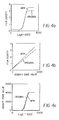
- Fig. 5a is a graphical view showing a comparison of the new, contrast adjusted tone scale curve (solid line) and the original tone scale curve (dashed line).
- Fig. 5b is a graphical view showing a comparison of the new, shifted tone scale curve (solid line) and the original tone scale curve (dashed line).
- Fig. 6 is a block diagram of determining the speed points for the radiation and collimation tone scale curves.
- Fig. 7 is a graphical view showing an example of the radiation and collimation tone scale curves designed using the preferred embodiment of this invention.
- Fig. 8 is a block diagram of the contrast enhancement algorithm of the embodiment of the invention shown in Fig. 1.
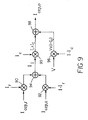
- Fig. 9 is a block diagram of producing the output image of the embodiment of the invention shown in Fig. 1.
- Fig. 10 is a block diagram of a system for carrying out the present invention.
- Fig. 11 and 12 are diagrammatic views useful in illustrating the present invention.
- the present invention provides a method for enhancing a region that is composed of two or more regions with different gray level concentrations.
- the method is particularly applicable to the visual enhancement of anatomical details in digital portal images that possess multiple X-ray exposure fields.
- Fig. 10 shows a system for carrying out the present invention.
- system 100 includes an input image source 102 , image processor 104 and output 106 .
- Input image source 102 provides an input digital image that is composed of two or more regions with different gray level concentrations.
- source 102 is a source of a digital portal image that possesses multiple X-ray exposure fields.
- Source 102 can, for example, be a direct digital X-ray system that converts an X-ray image directly into a digital X-ray image.
- Source 102 may also be a computed radiography system in which an X-ray image is recorded in a storage phosphor plate which is then read out to produce an input digital X-ray image.
- Image processor 104 carries out the method of the present invention and can be a digital computer. Image processor 104 can also include appropriate firmware and/or hardware for carrying out digital image processing.
- Output 106 can be a high resolution electronic display, such as a computer monitor, or a printer which produces a permanent copy of the processed digital X-ray image on output media such as film or paper.
- Fig. 11 shows a diagrammatic view of a projection X-ray system illustrating an input image source.
- system 110 includes an X-ray source 112 of an X-ray beam 114 which can be used for radiation treatment of a patient 116 .
- Collimator blades 118 are adjusted to shape the size of beam 114.
- Shielding blocks 120 are mounted in front of collimator 118 to shield patient 116 from radiation. Blocks 120 reduce the size of beam 114 to a beam 122 which irradiates the region of patient 116 to be treated.
- the X-ray image is captured by device 124 which can be a CR plate or a direct digital capture device, such as a scintillator-electronic imager device.
- Fig. 12 is a diagrammatic view illustrating the X-ray image captured by device 124 .
- Image 130 includes a central region 132 representing the radiation field, a region 134 outward of region 132 representing the collimation field region blocked by blocks 120 , and a region 136 representing the region blocked by collimator 118 .
- Region 136 is blackened to produce a contrast enhanced output image.
- an input digital image is provided from an input image source.
- the input digital image 10 is first passed into an algorithm of locating and labeling the radiation and collimation fields 12 . This operation is performed to generate the labeled radiation field image and the labeled collimation field image.
- the labeled radiation field image is a binary image whose pixels inside and outside the radiation field are 1 and 0, respectively.
- the labeled collimation field image is a binary image whose pixels inside and outside the collimation field are 1 and 0, respectively.
- the next step is to develop an optimal method to display these regions using a tone scaling and the contrast enhancement algorithm.
- the major function of a tone scaling algorithm is to stretch or compress the dynamic range of the input image into a dynamic range of the output medium such that the output medium can render the image effectively.
- the goal of rendering the digital portal image effectively is to have the image both inside and outside the radiation field displayed using the full dynamic range of the output medium.
- This invention discloses a method of formulating the given input tone scale curve into the appropriate tone scale curves to display the digital portal image effectively. Therefore, one tone scale curve, which is called the radiation tone scale curve, is designed and maps the image inside the radiation field into the full dynamic range of the output medium 14 . While the other tone scale curve, which is called the collimation tone scale curve, is also designed and maps the image outside the radiation field into the full dynamic range of the output medium 16 .
- the contrast enhancement algorithm is then applied to the tone scale enhanced image both inside and outside the radiation field 18 , 20 .
- the important image details that radiation oncologists use for checking the treatment setup are the high-contrast edges at coarse level where subtle image details have been smoothed out.
- a tool (see: Docket 82297/WFN, U.S. Patent Application U.S. Serial No. 09/824,602, filed on April 2, 2001, "Method for improving breast cancer diagnosis using mountain-view and contrast-enhancement presentation of mammograph", inventor Susan S. Young), called contrast-enhancement presentation based on edge-wavelet filters is applied for this purpose.
- the output image is the combination of the enhanced images that have the appropriate radiation and collimation tone scales, respectively 22 .
- the image details inside the radiation field are enhanced and displayed using the full dynamic range of the output medium, while the image details outside the radiation field but inside the collimation field are enhanced and displayed using the full dynamic range of the output medium too.
- the pixels outside the collimation field are replaced with a uniform value such that they appear as black 24 .
- the input digital portal images can be captured and digitized by various imaging devices. It is important to calibrate the digital image to the desired metric.
- all images are calibrated to relative log X-ray exposure.
- the relative log X-ray exposure is scaled up by a factor of 1000 so that one can use only integer values to represent the input and output images.
- the intermediate results from the various filters are represented as floating point numbers, so that proper precision is always retained.
- the radiation and collimation fields are located and labeled first. Then the appropriate tone scaling and contrast enhancement can be applied to each field accordingly.
- the image details in both fields can be displayed using the full dynamic range of the output medium.
- Fig. 2 is a block diagram of a method for locating and labeling the radiation and collimation fields.
- the input image I is first passed through two filters F N -1 and F N 30, 32 to produce the edge information in the horizontal and vertical directions in the coarsest resolution N / 2.
- N / 2 4.
- the filters used in this invention have the following frequency responses ( ⁇ x and ⁇ y are the spatial angular frequency in the x and y directions):
- the algorithm calculates the edge gradient from the filters' outputs, I N -1 and I N 34.
- the edge gradient amplitude is computed by taking the square root of the sum of square of I N -1 and the square of I N .
- the algorithm computes the edge map 36 by finding the local maximum gradient magnitude along the gradient direction.
- the edge map is a binary image where the pixel value 1 represents the local maximum gradient pixels and pixel value 0 represents other pixels.
- the algorithm determines the candidate locations of the collimation and radiation fields by setting a threshold on the local maximum gradient pixels 38 . Since the edges of the radiation and collimation fields are much stronger than the edges of other anatomical structures in the digital portal images, it is natural to remove the small edges by thresholding the local maximum gradient pixels at the coarsest resolution. Therefore, there are no pixels at the edges of radiation and collimation fields that are missed and the small edges are removed to simplify further analysis.
- a digital portal image may contain other objects with strong edges, such as lead markers, labels, etc.
- the gradient amplitude values at these objects may be comparable to the gradient amplitude at the edges of the collimation and radiation fields.
- the candidate locations of the collimation and radiation fields may contain these objects.
- the largest and the second largest connected objects are computed in the next step 40 , 42 .
- the collimation field always circumscribes the radiation field.
- the collimation field is determined by the location of the largest connected object 44 .
- the radiation field is determined by the location of the second largest connected object 46 .
- the last step is to label the radiation and collimation fields 48, 50.
- the output binary image I c ( x , y) is 1 inside the collimation field and 0, otherwise.
- the output binary image I r (x, y) is 1 inside the radiation field and 0, otherwise.
- the tone scale is defined as the log exposure to density conversion curve.
- the horizontal axis of a tone scale curve in this invention represents the log exposure code values.
- the vertical axis of the tone scale represents the density code values, which are linearly related to the output density.
- Fig. 3 shows a diagram of the design of tone scale curves. For an input tone scale, t i , it is scaled selectively to produce t s to meet the dynamic range of the output medium first 52 .
- the input tone scale curve could be the one that is computed by the visually optimized method or the one that is designed for a certain type of film.
- one particular tone scale curve might not be designed for a new output medium, e.g., the new printer system might have a higher or lower density range than the range of the tone scale curve.
- the algorithm in this invention scales the tone scale curve selectively instead of linearly to meet the dynamic range of the output medium. This allows the image to be displayed in the designated output medium effectively.
- t s is then adjusted for contrast to produce t sc 54.
- the speed point sp ( e s , d s ) is determined (box 56), the initial point sp ( e o , d s ) is determined 58, and the preprocessed input tone scale t sc is shifted from sp ( e o , d s ) to sp ( e s , d s ) to produce the output tone curve t o 60.
- Figs. 4a-4c show examples of selectively scaling the input tone scale curve to meet the dynamic range of the output medium.
- the original D-LogE curve (dashed line) spans the dynamic range from .21 to 3.0 in density unit, while the new desired D-LogE curve has the density range from .21 to 3.5.
- the new D-LogE curve (solid line) is scaled selectively such that the tone scale curve is the same as the original one from the density 21 to 3 and is expanded to the density 3.5 using a smooth function. This operation keeps the printer's response as the original one for the lower density range and takes the advantage of the higher density range of the new printer system.
- FIG. 4b shows the linear relationship between the output density and the density code values for the original (dashed lines) and new (solid line) density ranges.
- the original (dashed line) and the selectively scaled (solid line) tone scale curves are shown in Fig. 4c.
- the contrast of the scaled tone scale curve is adjusted (Fig. 3, 54 ).
- the contrast of the input tone scale curve might not be appropriate for the input image.
- a digital portal image requires a tone scale curve with a higher contrast to effectively map the input image to the output medium.
- the crucial point of adjusting the contrast of a tone scale curve is to select a pivot point. At this pivot point, the contrast is unchanged. This pivot point is defined as a pair of points, pp ( e p , d p ), where e p represents the log exposure code value and d p represents the density code value.
- the pivot point is determined such that d p is selected as the unchanged density code value and e p is the corresponding log exposure code value that is obtained from the inverse tone scale curve.
- the contrast adjusted input tone scale curve, t sc is produced by the following.
- the density code values for the points above d p are increased by a contrast factor
- the density code values for the points below d p are decreased by a contrast factor.
- the operation is opposite.
- Fig. 5a shows this phenomenon.
- This unchanged density code value can be calculated directly from the output density value.
- the unchanged density value can be selected between the minimum and maximum of the output medium.
- the middle density point is about 1.6.
- the unchanged density point is selected as 1.6 for the collimation tone scale curve, and 1.3 for the radiation tone scale curve. Because the image portion that is inside the radiation field is acquired by a higher radiation, it appears darker in the digital portal image. By selecting the unchanged density point at a lower density, the tone scale maps most of the image inside the radiation field to a lower density. The image inside the radiation field appears even brighter than the image outside the radiation field.
- the algorithm determines the speed point of the tone scale curve (Fig. 3, 56 ).
- the concept of the speed point is inherited from film processing.
- the speed point is the point where the input tone scale curve is shifted to such that the span of the tone scale curve covers the dynamic range of the input image.
- the speed point of the tone scale is determined by a pair of points, sp ( e s , d s ), where e s represents the log exposure code value and d s represents the density code value.
- e s is determined by the log exposure code value corresponding to the peak of the histogram of the region of interest in the input image
- d s is determined by the unchanged density code value.
- the initial point e 0 is determined (Fig. 3, 58 ) by the corresponding log exposure code value of d s , which is obtained from the inverse tone scale curve t sc . Then the scaled and contrast adjusted tone scale curve t sc is shifted to the speed point sp ( e s , d s ) from the initial point sp ( e 0 , d s ) to generate the output tone scale curve t o .
- Fig. 5b shows this situation.
- Fig. 6 illustrates the preferred embodiment of determining the speed points for the radiation and collimation tone scale curves t sc .
- the scaled and contrast adjusted input tone scale t sc is shifted to the selected speed point to output the radiation tone scale curve t r 74.
- the collimation histogram 64 the histogram of the pixels outside the radiation field but inside the collimation field is calculated, which is called the collimation histogram 64.
- the collimation tone scale curve t c is obtained by shifting the scaled and contrast adjusted input tone scale curve t sc to the selected speed point sp c ( e c , d c ) 76.
- Fig. 7 shows an example of the radiation (solid line) and collimation (dashed line) tone scale curves designed using the above method.
- Fig. 8 shows the diagram of the contrast enhancement procedure in this invention.
- the input image I is processed using a tone scale 80 before it passed through the filter U N /2 82 to produce the lowest resolution version of the tone-scaled image, I B N /2, t .
- the input image I is passed through the decomposition filter bank 84 to produce I d .
- the contrast weight control mechanism 86 produces the desired weighting factors for the output from the decomposition bank, I d , to produce I w .
- the output image is reconstructed using a reconstruction filter bank from I w and I B N /2, t 88 .
- the output reconstructed image I cep contains useful enhanced image details, and also contains a right dynamic range to match the intended output medium. (The details of this tool was described in U.S. Patent Application S.N. 09/824,602, filed on April 2, 2001, Docket 82297/WFN, "Method for improving breast cancer diagnosis using mountain-view and contrast-enhancement presentation of mammograph", inventor Susan S. Young).
- the output image is the contrast-enhanced radiation field image, I cep,r .
- the output image is the contrast-enhanced collimation field image, I cep , c .
- Figure 9 shows the diagram of combining the images I cep , r and I cep , c to produce the final output image I cep , o .
- the combining can be carried out in software, firmware or hardware using multipliers 90, 92, 95, 96 and adders 94, 98, as shown.
- the intermediate image I 1 is produced by the sum of two signals, I cep , r ⁇ I r and I cep , c ⁇ (1 -I r ), where I r is the labeled radiation field image.
- This intermediate image I 1 represents the image inside the radiation field using the enhanced radiation field image I cep , r and the image outside the radiation field using the enhanced collimation field image I cep , c .
- the black-surrounding the collimation field is completed by summing two signals, I 1 x I c and V ⁇ (1 - I c ), where I c is the labeled collimation field image and V is a constant value.
- V is selected as 4095 to make the pixels outside the collimation field appear black.
Landscapes
- Engineering & Computer Science (AREA)
- Physics & Mathematics (AREA)
- General Physics & Mathematics (AREA)
- Theoretical Computer Science (AREA)
- Computer Vision & Pattern Recognition (AREA)
- General Health & Medical Sciences (AREA)
- Health & Medical Sciences (AREA)
- Medical Informatics (AREA)
- Nuclear Medicine, Radiotherapy & Molecular Imaging (AREA)
- Radiology & Medical Imaging (AREA)
- Quality & Reliability (AREA)
- Image Processing (AREA)
- Apparatus For Radiation Diagnosis (AREA)
- Image Analysis (AREA)
Applications Claiming Priority (2)
| Application Number | Priority Date | Filing Date | Title |
|---|---|---|---|
| US993953 | 1997-12-18 | ||
| US09/993,953 US6836570B2 (en) | 2001-11-14 | 2001-11-14 | Method for contrast-enhancement of digital portal images |
Publications (3)
| Publication Number | Publication Date |
|---|---|
| EP1316919A2 true EP1316919A2 (fr) | 2003-06-04 |
| EP1316919A3 EP1316919A3 (fr) | 2003-09-10 |
| EP1316919B1 EP1316919B1 (fr) | 2006-02-01 |
Family
ID=25540129
Family Applications (1)
| Application Number | Title | Priority Date | Filing Date |
|---|---|---|---|
| EP02079598A Expired - Lifetime EP1316919B1 (fr) | 2001-11-14 | 2002-11-04 | Méthode d'amélioration du contraste d'images portales numériques |
Country Status (4)
| Country | Link |
|---|---|
| US (1) | US6836570B2 (fr) |
| EP (1) | EP1316919B1 (fr) |
| JP (1) | JP2003198941A (fr) |
| DE (1) | DE60208970T2 (fr) |
Cited By (18)
| Publication number | Priority date | Publication date | Assignee | Title |
|---|---|---|---|---|
| US7342592B2 (en) | 2004-06-14 | 2008-03-11 | Sharp Laboratories Of America, Inc. | System for reducing crosstalk |
| US7505018B2 (en) | 2004-05-04 | 2009-03-17 | Sharp Laboratories Of America, Inc. | Liquid crystal display with reduced black level insertion |
| US7525528B2 (en) | 2004-11-16 | 2009-04-28 | Sharp Laboratories Of America, Inc. | Technique that preserves specular highlights |
| US7532192B2 (en) | 2004-05-04 | 2009-05-12 | Sharp Laboratories Of America, Inc. | Liquid crystal display with filtered black point |
| US7556836B2 (en) | 2004-09-03 | 2009-07-07 | Solae, Llc | High protein snack product |
| US7573457B2 (en) | 2001-11-09 | 2009-08-11 | Sharp Laboratories Of America, Inc. | Liquid crystal display backlight with scaling |
| US7602369B2 (en) | 2004-05-04 | 2009-10-13 | Sharp Laboratories Of America, Inc. | Liquid crystal display with colored backlight |
| US7612757B2 (en) | 2004-05-04 | 2009-11-03 | Sharp Laboratories Of America, Inc. | Liquid crystal display with modulated black point |
| US7623105B2 (en) | 2003-11-21 | 2009-11-24 | Sharp Laboratories Of America, Inc. | Liquid crystal display with adaptive color |
| WO2010003541A1 (fr) * | 2008-07-06 | 2010-01-14 | DüRR DENTAL AG | Procédé d'amélioration du contraste d'images, en particulier d'images à nuances de gris, et dispositif en vue de son exécution |
| US7777714B2 (en) | 2004-05-04 | 2010-08-17 | Sharp Laboratories Of America, Inc. | Liquid crystal display with adaptive width |
| US7853094B2 (en) | 2006-01-24 | 2010-12-14 | Sharp Laboratories Of America, Inc. | Color enhancement technique using skin color detection |
| US7872631B2 (en) | 2004-05-04 | 2011-01-18 | Sharp Laboratories Of America, Inc. | Liquid crystal display with temporal black point |
| US7898519B2 (en) | 2005-02-17 | 2011-03-01 | Sharp Laboratories Of America, Inc. | Method for overdriving a backlit display |
| US8121401B2 (en) | 2006-01-24 | 2012-02-21 | Sharp Labortories of America, Inc. | Method for reducing enhancement of artifacts and noise in image color enhancement |
| US8395577B2 (en) | 2004-05-04 | 2013-03-12 | Sharp Laboratories Of America, Inc. | Liquid crystal display with illumination control |
| US8941580B2 (en) | 2006-11-30 | 2015-01-27 | Sharp Laboratories Of America, Inc. | Liquid crystal display with area adaptive backlight |
| EP2859848A4 (fr) * | 2012-06-11 | 2016-03-23 | Fujifilm Corp | Dispositif et procédé de traitement d'image de rayonnement |
Families Citing this family (28)
| Publication number | Priority date | Publication date | Assignee | Title |
|---|---|---|---|---|
| WO2005020130A2 (fr) * | 2000-08-18 | 2005-03-03 | Paul Reed Smith Guitars, Limited Partnership | Procede d'accentuation de couleurs avec compensation et ajustement |
| WO2003069557A1 (fr) | 2002-02-12 | 2003-08-21 | Matsushita Electric Industrial Co., Ltd. | Dispositif et procede de traitement d'image |
| US7221408B2 (en) | 2003-08-15 | 2007-05-22 | Samsung Electronics Co., Ltd. | Adaptive contrast enhancement method for video signals based on time-varying nonlinear transforms |
| US7394924B2 (en) * | 2003-10-14 | 2008-07-01 | Mirada Solutions Limited | Scatter correction in scanning imaging systems |
| FI20045201A7 (fi) * | 2004-05-31 | 2005-12-01 | Nokia Corp | Menetelmä ja järjestelmä kuvien katsomiseksi ja parantamiseksi |
| US7386186B2 (en) * | 2004-08-27 | 2008-06-10 | Micron Technology, Inc. | Apparatus and method for processing images |
| DE102004042792B3 (de) * | 2004-09-03 | 2006-06-08 | Siemens Ag | Verfahren zur Verbesserung der Darstellung von CT-Aufnahmen |
| US8050512B2 (en) * | 2004-11-16 | 2011-11-01 | Sharp Laboratories Of America, Inc. | High dynamic range images from low dynamic range images |
| US8050511B2 (en) | 2004-11-16 | 2011-11-01 | Sharp Laboratories Of America, Inc. | High dynamic range images from low dynamic range images |
| US7508970B2 (en) * | 2004-12-24 | 2009-03-24 | General Electric Company | Systems, methods and apparatus for detecting a collimation edge in digital image radiography |
| US7787703B2 (en) * | 2005-05-11 | 2010-08-31 | Xerox Corporation | Method and system for extending binary image data to contone image data |
| US8139828B2 (en) * | 2005-10-21 | 2012-03-20 | Carestream Health, Inc. | Method for enhanced visualization of medical images |
| US7580569B2 (en) * | 2005-11-07 | 2009-08-25 | Xerox Corporation | Method and system for generating contone encoded binary print data streams |
| US7773254B2 (en) * | 2005-11-10 | 2010-08-10 | Xerox Corporation | Method and system for improved copy quality in a multifunction reprographic system |
| US7869093B2 (en) * | 2005-11-17 | 2011-01-11 | Xerox Corporation | Method and system for improved copy quality in a multifunction reprographic system |
| US20070183684A1 (en) * | 2006-02-08 | 2007-08-09 | Bhattacharjya Anoop K | Systems and methods for contrast adjustment |
| US7298820B2 (en) * | 2006-03-31 | 2007-11-20 | Wisconsin Alumni Research Foundation | Portal imaging using modulated treatment beam |
| EP1840831A1 (fr) * | 2006-03-31 | 2007-10-03 | Sony Deutschland Gmbh | Égalisation d'histogramme adaptative pour des images présentant un fort contraste local |
| US20080049238A1 (en) * | 2006-08-28 | 2008-02-28 | Xerox Corporation | Method and system for automatic window classification in a digital reprographic system |
| US8184874B2 (en) * | 2006-12-22 | 2012-05-22 | Carestream Health, Inc. | Enhanced display of medical images |
| US8045776B2 (en) * | 2007-03-06 | 2011-10-25 | General Electric Company | Geometry-dependent filtering in CT method and apparatus |
| US8055072B2 (en) * | 2007-11-27 | 2011-11-08 | Himax Technologies Limited | Image display panel and driving method thereof |
| CN101540040B (zh) * | 2008-03-21 | 2012-12-12 | 深圳迈瑞生物医疗电子股份有限公司 | 自动检测限束器边界的方法与装置 |
| US8073199B2 (en) * | 2008-05-30 | 2011-12-06 | Drs Rsta, Inc. | Method for minimizing scintillation in dynamic images |
| US9460491B2 (en) * | 2008-08-25 | 2016-10-04 | Xerox Corporation | Method for binary to contone conversion with non-solid edge detection |
| JP5868119B2 (ja) * | 2010-12-09 | 2016-02-24 | キヤノン株式会社 | 画像処理装置、放射線撮影システム、画像処理方法及び記録媒体 |
| WO2012123850A1 (fr) * | 2011-03-15 | 2012-09-20 | Koninklijke Philips Electronics N.V. | Dispositif d'imagerie médicale pour fournir un support de représentation d'image lors du positionnement d'un dispositif d'intervention |
| CN110353707A (zh) | 2018-03-26 | 2019-10-22 | 通用电气公司 | 准直器边界检测方法的训练方法和系统 |
Family Cites Families (11)
| Publication number | Priority date | Publication date | Assignee | Title |
|---|---|---|---|---|
| US5128864A (en) * | 1989-08-09 | 1992-07-07 | W. L. Systems, Inc. | Method for computing tomographic scans |
| EP0527525B1 (fr) * | 1991-08-14 | 1996-10-02 | Agfa-Gevaert N.V. | Procédé et dispositif d'amélioration du contraste d'une image |
| US5850836A (en) * | 1995-09-22 | 1998-12-22 | Hologic, Inc. | Morphometric x-ray absorptiometry (MXA) |
| US6195474B1 (en) * | 1997-10-28 | 2001-02-27 | Eastman Kodak Company | Pathology dependent viewing of processed dental radiographic film having authentication data |
| GB9724110D0 (en) * | 1997-11-15 | 1998-01-14 | Elekta Ab | Analysis of radiographic images |
| EP1040653A2 (fr) * | 1998-07-01 | 2000-10-04 | Koninklijke Philips Electronics N.V. | Appareil d'examen aux rayons x comportant un filtre de rayons x |
| US6094152A (en) | 1998-12-23 | 2000-07-25 | Siemens Medical Systems, Inc. | Algorithm for A/D window control for electronic portal image acquisition in a radiotherapy system |
| US6795577B2 (en) * | 1999-12-03 | 2004-09-21 | Canon Research Centre France S.A. | Digital signal analysis, with hierarchical segmentation |
| EP1211642A2 (fr) * | 2000-10-04 | 2002-06-05 | Eastman Kodak Company | Amélioration interacive de radiographies numériques à exposition multiple |
| US6708054B2 (en) * | 2001-04-12 | 2004-03-16 | Koninklijke Philips Electronics, N.V. | MR-based real-time radiation therapy oncology simulator |
| US6626569B2 (en) * | 2001-05-30 | 2003-09-30 | The Research Foundation Of Suny | Quality assurance system for a medical linear accelerator |
-
2001
- 2001-11-14 US US09/993,953 patent/US6836570B2/en not_active Expired - Fee Related
-
2002
- 2002-11-01 JP JP2002319870A patent/JP2003198941A/ja not_active Withdrawn
- 2002-11-04 DE DE60208970T patent/DE60208970T2/de not_active Expired - Fee Related
- 2002-11-04 EP EP02079598A patent/EP1316919B1/fr not_active Expired - Lifetime
Cited By (23)
| Publication number | Priority date | Publication date | Assignee | Title |
|---|---|---|---|---|
| US7675500B2 (en) | 2001-11-09 | 2010-03-09 | Sharp Laboratories Of America, Inc. | Liquid crystal display backlight with variable amplitude LED |
| US7737936B2 (en) | 2001-11-09 | 2010-06-15 | Sharp Laboratories Of America, Inc. | Liquid crystal display backlight with modulation |
| US8378955B2 (en) | 2001-11-09 | 2013-02-19 | Sharp Laboratories Of America, Inc. | Liquid crystal display backlight with filtering |
| US7714830B2 (en) | 2001-11-09 | 2010-05-11 | Sharp Laboratories Of America, Inc. | Liquid crystal display backlight with level change |
| US7573457B2 (en) | 2001-11-09 | 2009-08-11 | Sharp Laboratories Of America, Inc. | Liquid crystal display backlight with scaling |
| US7623105B2 (en) | 2003-11-21 | 2009-11-24 | Sharp Laboratories Of America, Inc. | Liquid crystal display with adaptive color |
| US7602369B2 (en) | 2004-05-04 | 2009-10-13 | Sharp Laboratories Of America, Inc. | Liquid crystal display with colored backlight |
| US7872631B2 (en) | 2004-05-04 | 2011-01-18 | Sharp Laboratories Of America, Inc. | Liquid crystal display with temporal black point |
| US8395577B2 (en) | 2004-05-04 | 2013-03-12 | Sharp Laboratories Of America, Inc. | Liquid crystal display with illumination control |
| US7777714B2 (en) | 2004-05-04 | 2010-08-17 | Sharp Laboratories Of America, Inc. | Liquid crystal display with adaptive width |
| US7505018B2 (en) | 2004-05-04 | 2009-03-17 | Sharp Laboratories Of America, Inc. | Liquid crystal display with reduced black level insertion |
| US7532192B2 (en) | 2004-05-04 | 2009-05-12 | Sharp Laboratories Of America, Inc. | Liquid crystal display with filtered black point |
| US7612757B2 (en) | 2004-05-04 | 2009-11-03 | Sharp Laboratories Of America, Inc. | Liquid crystal display with modulated black point |
| US7342592B2 (en) | 2004-06-14 | 2008-03-11 | Sharp Laboratories Of America, Inc. | System for reducing crosstalk |
| US7556836B2 (en) | 2004-09-03 | 2009-07-07 | Solae, Llc | High protein snack product |
| US7525528B2 (en) | 2004-11-16 | 2009-04-28 | Sharp Laboratories Of America, Inc. | Technique that preserves specular highlights |
| US7898519B2 (en) | 2005-02-17 | 2011-03-01 | Sharp Laboratories Of America, Inc. | Method for overdriving a backlit display |
| US7853094B2 (en) | 2006-01-24 | 2010-12-14 | Sharp Laboratories Of America, Inc. | Color enhancement technique using skin color detection |
| US8121401B2 (en) | 2006-01-24 | 2012-02-21 | Sharp Labortories of America, Inc. | Method for reducing enhancement of artifacts and noise in image color enhancement |
| US9143657B2 (en) | 2006-01-24 | 2015-09-22 | Sharp Laboratories Of America, Inc. | Color enhancement technique using skin color detection |
| US8941580B2 (en) | 2006-11-30 | 2015-01-27 | Sharp Laboratories Of America, Inc. | Liquid crystal display with area adaptive backlight |
| WO2010003541A1 (fr) * | 2008-07-06 | 2010-01-14 | DüRR DENTAL AG | Procédé d'amélioration du contraste d'images, en particulier d'images à nuances de gris, et dispositif en vue de son exécution |
| EP2859848A4 (fr) * | 2012-06-11 | 2016-03-23 | Fujifilm Corp | Dispositif et procédé de traitement d'image de rayonnement |
Also Published As
| Publication number | Publication date |
|---|---|
| DE60208970T2 (de) | 2006-09-21 |
| EP1316919A3 (fr) | 2003-09-10 |
| DE60208970D1 (de) | 2006-04-13 |
| JP2003198941A (ja) | 2003-07-11 |
| US20030091222A1 (en) | 2003-05-15 |
| EP1316919B1 (fr) | 2006-02-01 |
| US6836570B2 (en) | 2004-12-28 |
Similar Documents
| Publication | Publication Date | Title |
|---|---|---|
| EP1316919B1 (fr) | Méthode d'amélioration du contraste d'images portales numériques | |
| US9002134B2 (en) | Multi-scale image normalization and enhancement | |
| JP3683914B2 (ja) | ピラミッド的画像分解に基づいた放射線画像の多重処理法 | |
| Sherrier et al. | Regionally adaptive histogram equalization of the chest | |
| US8605970B2 (en) | Denoising medical images | |
| US6956975B2 (en) | Method for improving breast cancer diagnosis using mountain-view and contrast-enhancement presentation of mammography | |
| JP4309062B2 (ja) | 画像化方法 | |
| US7362845B2 (en) | Method and apparatus of global de-noising for cone beam and fan beam CT imaging | |
| EP1497796A2 (fr) | Reconstruction filtree generalisee par projection par transparence dans une tomosynthese numerique | |
| JP6835813B2 (ja) | コンピュータ断層撮影視覚化調整 | |
| CN114494498A (zh) | 一种基于双域傅里叶神经网络的金属伪影去除方法 | |
| US6788826B1 (en) | Method for correcting artefacts in a digital image | |
| US7433086B2 (en) | Edge detection and correcting system and method | |
| Senthil et al. | Enhancement Sushisen algorithms in images analysis technologies to increase computerized tomography images | |
| US7310437B2 (en) | Image processing method and system, and storage medium | |
| EP1716537B1 (fr) | Dispositif et procede de traitement de d'images en coupe | |
| CN120495171A (zh) | 基于cbct图像的牙周问题数据定位方法 | |
| JP2001325583A (ja) | 画像処理方法および画像処理装置 | |
| Dogra et al. | Image Integration Procedures in Multisensory Medical Images: A Comprehensive Survey of the State-of-the-art Paradigms | |
| EP0654762B1 (fr) | Visualisation de zones diagnostiquement non-pertinentes dans une image de radiographie | |
| Bakaev et al. | Feasibility of spine segmentation in ML-based recognition of vertebrae in X-ray images | |
| Kim et al. | A model-based radiography restoration method based on simple scatter-degradation scheme for improving image visibility | |
| Csébfalvi et al. | Vector Quantization for Feature-Preserving Volume Filtering. | |
| Price | Image manipulation | |
| Logeswaran | Magnetic resonance cholangiopancreatography image enhancement for automatic disease detection |
Legal Events
| Date | Code | Title | Description |
|---|---|---|---|
| PUAI | Public reference made under article 153(3) epc to a published international application that has entered the european phase |
Free format text: ORIGINAL CODE: 0009012 |
|
| AK | Designated contracting states |
Designated state(s): AT BE BG CH CY CZ DE DK EE ES FI FR GB GR IE IT LI LU MC NL PT SE SK TR |
|
| AX | Request for extension of the european patent |
Extension state: AL LT LV MK RO SI |
|
| PUAL | Search report despatched |
Free format text: ORIGINAL CODE: 0009013 |
|
| AK | Designated contracting states |
Kind code of ref document: A3 Designated state(s): AT BE BG CH CY CZ DE DK EE ES FI FR GB GR IE IT LI LU MC NL PT SE SK TR |
|
| AX | Request for extension of the european patent |
Extension state: AL LT LV MK RO SI |
|
| RIC1 | Information provided on ipc code assigned before grant |
Ipc: 7G 06T 5/40 B Ipc: 7G 06T 5/00 A |
|
| 17P | Request for examination filed |
Effective date: 20040301 |
|
| AKX | Designation fees paid |
Designated state(s): DE FR GB |
|
| 17Q | First examination report despatched |
Effective date: 20040609 |
|
| GRAP | Despatch of communication of intention to grant a patent |
Free format text: ORIGINAL CODE: EPIDOSNIGR1 |
|
| GRAS | Grant fee paid |
Free format text: ORIGINAL CODE: EPIDOSNIGR3 |
|
| GRAA | (expected) grant |
Free format text: ORIGINAL CODE: 0009210 |
|
| AK | Designated contracting states |
Kind code of ref document: B1 Designated state(s): DE FR GB |
|
| REG | Reference to a national code |
Ref country code: GB Ref legal event code: FG4D |
|
| REF | Corresponds to: |
Ref document number: 60208970 Country of ref document: DE Date of ref document: 20060413 Kind code of ref document: P |
|
| ET | Fr: translation filed | ||
| PLBE | No opposition filed within time limit |
Free format text: ORIGINAL CODE: 0009261 |
|
| STAA | Information on the status of an ep patent application or granted ep patent |
Free format text: STATUS: NO OPPOSITION FILED WITHIN TIME LIMIT |
|
| 26N | No opposition filed |
Effective date: 20061103 |
|
| PGFP | Annual fee paid to national office [announced via postgrant information from national office to epo] |
Ref country code: DE Payment date: 20071130 Year of fee payment: 6 |
|
| REG | Reference to a national code |
Ref country code: GB Ref legal event code: 732E |
|
| PGFP | Annual fee paid to national office [announced via postgrant information from national office to epo] |
Ref country code: FR Payment date: 20071105 Year of fee payment: 6 Ref country code: GB Payment date: 20071005 Year of fee payment: 6 |
|
| REG | Reference to a national code |
Ref country code: FR Ref legal event code: TP |
|
| GBPC | Gb: european patent ceased through non-payment of renewal fee |
Effective date: 20081104 |
|
| REG | Reference to a national code |
Ref country code: FR Ref legal event code: ST Effective date: 20090731 |
|
| PG25 | Lapsed in a contracting state [announced via postgrant information from national office to epo] |
Ref country code: DE Free format text: LAPSE BECAUSE OF NON-PAYMENT OF DUE FEES Effective date: 20090603 |
|
| PG25 | Lapsed in a contracting state [announced via postgrant information from national office to epo] |
Ref country code: GB Free format text: LAPSE BECAUSE OF NON-PAYMENT OF DUE FEES Effective date: 20081104 |
|
| PG25 | Lapsed in a contracting state [announced via postgrant information from national office to epo] |
Ref country code: FR Free format text: LAPSE BECAUSE OF NON-PAYMENT OF DUE FEES Effective date: 20081130 |