EP1318662A2 - Obtention de demi-teintes avec positionnement des points uniformément dispersés - Google Patents
Obtention de demi-teintes avec positionnement des points uniformément dispersés Download PDFInfo
- Publication number
- EP1318662A2 EP1318662A2 EP02102675A EP02102675A EP1318662A2 EP 1318662 A2 EP1318662 A2 EP 1318662A2 EP 02102675 A EP02102675 A EP 02102675A EP 02102675 A EP02102675 A EP 02102675A EP 1318662 A2 EP1318662 A2 EP 1318662A2
- Authority
- EP
- European Patent Office
- Prior art keywords
- halftone dot
- supercell
- base
- dot center
- virtual halftone
- Prior art date
- Legal status (The legal status is an assumption and is not a legal conclusion. Google has not performed a legal analysis and makes no representation as to the accuracy of the status listed.)
- Withdrawn
Links
- 239000011159 matrix material Substances 0.000 claims abstract description 68
- 238000000034 method Methods 0.000 claims abstract description 59
- VAYOSLLFUXYJDT-RDTXWAMCSA-N Lysergic acid diethylamide Chemical compound C1=CC(C=2[C@H](N(C)C[C@@H](C=2)C(=O)N(CC)CC)C2)=C3C2=CNC3=C1 VAYOSLLFUXYJDT-RDTXWAMCSA-N 0.000 claims abstract description 49
- 230000004044 response Effects 0.000 claims abstract description 18
- 230000000737 periodic effect Effects 0.000 claims description 14
- 238000012216 screening Methods 0.000 claims description 13
- 230000010076 replication Effects 0.000 claims description 12
- 230000009466 transformation Effects 0.000 claims description 4
- 230000006870 function Effects 0.000 description 94
- 238000000926 separation method Methods 0.000 description 18
- 238000007639 printing Methods 0.000 description 11
- 230000008569 process Effects 0.000 description 10
- 238000009877 rendering Methods 0.000 description 6
- 239000006185 dispersion Substances 0.000 description 4
- 230000006872 improvement Effects 0.000 description 4
- 238000004364 calculation method Methods 0.000 description 3
- 230000001419 dependent effect Effects 0.000 description 3
- 230000000694 effects Effects 0.000 description 3
- 238000003384 imaging method Methods 0.000 description 3
- 241001479434 Agfa Species 0.000 description 2
- 230000008901 benefit Effects 0.000 description 2
- 239000003086 colorant Substances 0.000 description 2
- 238000011156 evaluation Methods 0.000 description 2
- 238000007641 inkjet printing Methods 0.000 description 2
- 230000003993 interaction Effects 0.000 description 2
- 230000003362 replicative effect Effects 0.000 description 2
- 230000007704 transition Effects 0.000 description 2
- 238000013459 approach Methods 0.000 description 1
- 230000008859 change Effects 0.000 description 1
- 238000006243 chemical reaction Methods 0.000 description 1
- 230000008602 contraction Effects 0.000 description 1
- 230000003247 decreasing effect Effects 0.000 description 1
- 230000007812 deficiency Effects 0.000 description 1
- 230000004069 differentiation Effects 0.000 description 1
- 230000010339 dilation Effects 0.000 description 1
- 238000007647 flexography Methods 0.000 description 1
- 238000005259 measurement Methods 0.000 description 1
- 238000012986 modification Methods 0.000 description 1
- 230000004048 modification Effects 0.000 description 1
- 238000007645 offset printing Methods 0.000 description 1
- 230000003287 optical effect Effects 0.000 description 1
- 239000002243 precursor Substances 0.000 description 1
- 230000009467 reduction Effects 0.000 description 1
- 230000000717 retained effect Effects 0.000 description 1
- 238000012552 review Methods 0.000 description 1
Images







Classifications
-
- H—ELECTRICITY
- H04—ELECTRIC COMMUNICATION TECHNIQUE
- H04N—PICTORIAL COMMUNICATION, e.g. TELEVISION
- H04N1/00—Scanning, transmission or reproduction of documents or the like, e.g. facsimile transmission; Details thereof
- H04N1/40—Picture signal circuits
- H04N1/405—Halftoning, i.e. converting the picture signal of a continuous-tone original into a corresponding signal showing only two levels
- H04N1/4055—Halftoning, i.e. converting the picture signal of a continuous-tone original into a corresponding signal showing only two levels producing a clustered dots or a size modulated halftone pattern
- H04N1/4058—Halftoning, i.e. converting the picture signal of a continuous-tone original into a corresponding signal showing only two levels producing a clustered dots or a size modulated halftone pattern with details for producing a halftone screen at an oblique angle
-
- H—ELECTRICITY
- H04—ELECTRIC COMMUNICATION TECHNIQUE
- H04N—PICTORIAL COMMUNICATION, e.g. TELEVISION
- H04N1/00—Scanning, transmission or reproduction of documents or the like, e.g. facsimile transmission; Details thereof
- H04N1/40—Picture signal circuits
- H04N1/405—Halftoning, i.e. converting the picture signal of a continuous-tone original into a corresponding signal showing only two levels
- H04N1/4051—Halftoning, i.e. converting the picture signal of a continuous-tone original into a corresponding signal showing only two levels producing a dispersed dots halftone pattern, the dots having substantially the same size
Definitions
- the present invention relates to devices and methods for the reproduction of images, color or monochrome, by means of halftoning techniques.
- the halftone dots in periodic halftoning are laid out on a fixed grid of a given frequency and angle. Tone is modulated by changing the size of the halftone dots.
- Tone is modulated by changing the size of the halftone dots.
- Particular problems arise in these processes where the reproduction characteristics of a halftone dot are size dependent. Examples of such processes are the flexographic, the offset and the xerographic printing processes.
- the size of the smallest halftone dot on film that still reproduces consistently on press can be as small as 40 micron. Below this size, halftone dots tend to print unevenly or not at all. The unevenness can be improved if a screen is used with a lower frequency. For example, by applying a 65 lpi screen instead of a 120 lpi screen, a stable dot with a size of 40 micron corresponds with a coverage on film of less than 1%. The range over which the discontinuity occurs is hence three times smaller in this case, and the corresponding tone jump will be less disturbing.
- the offset printing process exhibits the same fundamental problem: depending on the quality of the paper and the specifics of the printing process, the maximum frequency of the halftone screen, and hence the spatial resolution, is limited by the demand of a consistent halftone dot reproduction across the tone scale. Even now, few offset processes are capable of rendering images with halftone frequencies higher than 200 lpi without jeopardizing the smoothness of the highlight tone rendition. The same issues occur in electrophotographic printing. A minimum dot size is typically needed in order to obtain stable rendering of halftone dots.
- Frequency modulation (FM) techniques are an alternative method in which the average distance between fixed sized halftone dots is varied. By selecting a size for the halftone dot that is large enough for consistent reproduction, the unevenness and other problems described above are avoided.
- FM screening however, has its own drawbacks. Especially in the midtones, the fixed sized halftone dots exhibit a larger total circumference than the halftone dots in a periodic screen and are therefore more sensitive to variations in size during the various stages of the reproduction process. In addition, most FM screens are prone to graininess, which is particularly objectionable in smooth tone transitions and flat tints. These drawbacks explain why FM screening does not provide a viable solution for all applications.
- a disadvantage of the double dot technique is that below a certain dot percentage the same fundamental problem occurs as with the conventional screens, that is, below a certain diameter, which diameter corresponds to a certain tone value, all the halftone dots in the halftone will tend to disappear at the same time during the reproduction, creating an undesirable jump in the tone curve. This means that a discontinuity will occur somewhere in the tone curve.
- this problem can be solved by selecting a screen that has a lower frequency, but this is, as mentioned already, at the cost of the visibility of artifacts and a reduction of the spatial detail rendering. See U.S. Pat. No. 3,197,558; U.S. Pat. No. 5,068,165; RCA Review, Vol. 31, no. 3, p. 517-533; U.S. Pat. No. 4,501,811; U.S. Pat. No. 4,736,254 and U.S. Pat. No. 4,752,822.
- threshold matrix or "mask”
- This matrix is an array of threshold values that spatially correspond to the addressable points on the output medium. At each location an input value is compared to a threshold to make the decision whether to print a dot or not.
- the matrix can be used on a large image by applying it periodically.
- this "screen” produces halftone dots that are arranged along parallel lines in two directions, i.e. at the vertices of a parallelogram tiling the plane. If the two directions are orthogonal, the screen can be specified by a single angle and frequency.
- the halftone dots grow according to a spot function as the desired coverage increases in accordance with the tone level of the reproducible image.
- a threshold matrix is said to be suitable for periodically tiling a plane, meaning that the threshold matrix may be repeated horizontally and vertically, or in other directions, such that adjacent threshold matrices fit to each other.
- a threshold matrix may be square or rectangular, but may also have another shape that is suitable to tile a plane. Specific threshold matrices and tiling methods are described in U.S. Pat. No. 5,155,599 to Delabastita ("Delabastita '599”) and EP 0 427 380 B1 to Adobe Systems Inc.
- a square tile is used to produce screens closely approximating an angle or frequency.
- the tile parameters determine the number of halftone dots contained within a tile and their locations.
- the halftone dot centers are "virtual" in the sense that they do not necessarily lie on the underlying printer grid.
- the virtual halftone dot centers are used to generate the threshold matrix.
- the threshold matrix is being computed, the halftone dots are created at the dot locations on the output device, as the halftone dots "grow" around the virtual halftone dot centers.
- the dot growth is dithered and the halftone dots do not grow synchronously. Instead, each halftone dot is grown independently in a pre-determined order.
- ink jet printing single ink dots created by the device are typically reliably printed.
- the smallest printable dot is quite large, typically exceeding 51 ⁇ m (1/500 inch).
- some type of dithering should be used among the halftone dots.
- the dithering may become noticeable because the ink dots are visible to the naked eye. Therefore, the chosen dither order has a significant effect on quality.
- the interaction between the two dither patterns may also become noticeable. For example, if the two dither patterns are identical, the overlapping dots will be even more visible; on the other hand, two dither patterns that have been designed independently from one another may have random overlaps, which will may make the pattern look grainy.
- the dither order can also have another strong effect on image quality in the midtones. Even if the screen itself were not visible due to its high frequency, other patterns can occur due to printer non-linearities. For example, at the tone level when halftone dots just begin to touch, the connection points may be very visible. Since these connections are made in the pattern determined by the dither order, their visibility will be a direct consequence of the order chosen.
- the Bayer dither is a recursively-defined pattern, which is known to have optimal dispersion properties.
- the Bayer dither pattern is independent of scale -- dots will be placed based only on their relative positions to the other dots.
- the Bayer dither is most easily applied to a square periodic array of an even power of two number of elements, for these reasons, it cannot easily be applied to the dot center grid (except in the 0 degree case) where the dot centers are oriented at a different angle than the tile shape, and any number of dots are possible. Even in cases where the Bayer dither could be used, it may not be desirable in printing systems with visible dots due to the highly regular patterns produced.
- embodiments of the invention improve on those of US 5,155,599 and US 5,766,807 with changes to the way that the ordering sequence of virtual halftone dot centers is generated.
- the improved ordering sequence that results is then used to create a threshold matrix, which is in turn used for halftoning an image.
- the improved ordering sequence retains the benefits of US 5,155,599 and US 5,766,807 with additional improvements in operation and image quality.
- the second virtual halftone dot center in the ordering sequence is selected in a manner such that it is asymmetric in relation to the periodic replication of the first virtual halftone dot center.
- an aggregate distance function is used that calculates a sum of inverse distances for each virtual halftone dot center from that virtual halftone dot center to each virtual halftone dot center not already included in the ordering sequence, with each of the distances raised to a positive power.
- a virtual halftone dot center having one of the least values of the sum is selected as the next virtual halftone dot center in the ordering sequence.
- locations of virtual halftone dot centers of other color separations are used in the calculation of a combined aggregate distance function for virtual halftone dot centers of a selected color separation.
- the invention features a method for reproducing a contone image as a halftone image on a recording medium, using threshold values in a threshold matrix, including the steps of providing a base supercell suitable for periodically tiling a plane, which has a plurality of microdots and a plurality of virtual halftone dot centers; assigning an ordering sequence consisting of a series of numbers on the virtual halftone dot centers in the base supercell; assigning threshold values to microdots in response to the ordering sequence thereby generating the threshold matrix in the base supercell; and using the threshold matrix in combination with the contone image to generate a screened halftone image on the recording medium.
- the step of assigning an ordering sequence includes: (i) assigning a first number in the ordering sequence to a first virtual halftone dot center in the base supercell; (ii) assigning a second consecutive number in the ordering sequence to a second virtual halftone dot center in the base supercell; (iii) calculating a value of an aggregate distance function for each virtual halftone dot center in the base supercell not already included in the ordering sequence; (iv) selecting a next virtual halftone dot center in the base supercell in response to the calculated aggregate distance function, the next virtual halftone dot center having one of the least values of the calculated aggregate distance function; (v) assigning the next consecutive number in the ordering sequence to the selected next virtual halftone dot center in the base supercell; and then repeating steps (iii), (iv), and (v), until each virtual halftone dot center in the base supercell is included in the ordering sequence.
- the invention features a method for reproducing a contone image as a multi-color halftone image on a recording medium, using threshold values in threshold matrices, including the steps of: (a) providing a first base supercell suitable for periodically tiling a plane, the first base supercell having a first plurality of microdots and a first plurality of virtual halftone dot centers; (b) providing a second base supercell suitable for periodically tiling a plane, the second base supercell having a second plurality of microdots and a second plurality of virtual halftone dot centers; (c) assigning a first ordering sequence and a second ordering sequence to the virtual halftone dot centers in both base supercells, each ordering sequence consisting of series of numbers, (d) assigning threshold values to microdots in response to the first ordering sequence thereby generating the first threshold matrix in the first base supercell; (e) assigning threshold values to microdots in response to the second ordering sequence thereby generating
- the step of assigning ordering sequences includes the following steps: (i) assigning a first number in the first ordering sequence to a first virtual halftone dot center in the first base supercell; (ii) assigning a first number in the second ordering sequence to a first virtual halftone dot center in the second base supercell; (iii) calculating a value of a combined aggregate distance function for each virtual halftone dot center from a first plurality of virtual halftone dot centers in the first base supercell not already included in the first ordering sequence; (iv) selecting a first next virtual halftone dot center in the first base supercell in response to the value of the combined aggregate distance function calculated in step (iii), the first next virtual halftone dot center having one of the least values of the combined calculated aggregate distance function; (v) assigning the next consecutive number in the first ordering sequence to the selected first next virtual halftone dot center in the first base supercell; (vi) calculating a value of a combined aggregate distance function for each virtual halftone dot center from a second plurality of
- the embodiments of the invention also include screens and screening systems implementing the above methods.
- the improvements presented herein, separately and in combination, provide improved reproduction of the halftone dots across the full tone scale and provide good spatial resolution.
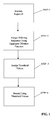
- FIG. 1 is a flowchart of an embodiment of a method according to one embodiment of the present invention.
- FIG. 2 shows an embodiment of a rational tangent supercell, having ten halftone dots.
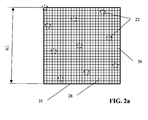
- FIG. 2a shows the rational tangent supercell according to FIG. 2 projected onto the addressable grid of an output device.
- FIG. 3 demonstrates by example how a complete and contiguous halftone screen may be obtained by replicating the rational tangent supercell according to FIG. 2 horizontally and vertically.
- FIG. 4 is a flowchart of an embodiment of ordering sequence assignment according to the invention.
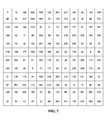
- FIG. 7 shows a threshold matrix obtained from the matrix in FIG. 5 by rescaling the values to a range from 1 to 255.
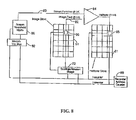
- FIG. 8 shows an embodiment of a circuit for generating a halftone image, which may be used in combination with the supercell of FIG. 2 or the threshold matrix of FIG. 5.
- FIG. 9 shows a rational tangent supercell having 640 virtual dot centers.
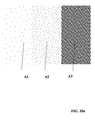
- FIG. 10a shows a halftone pattern for three tone levels generated using the threshold matrix obtained using the rational tangent supercell in FIG. 9 according to one embodiment of the invention.
- FIG. 10b shows a halftone pattern for three tone levels generated using the threshold matrix obtained using the rational tangent supercell in FIG. 9 according to another embodiment of the invention.
- FIG. 11 shows for comparison a halftone pattern for three tone levels generated using the threshold matrix according to US 5,766,807.
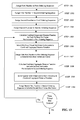
- FIG. 12 is a flowchart of a method according to another embodiment of the present invention.
- FIG.13 shows a flowchart of an embodiment of ordering sequence assignment for two color separations according to the invention.
- an embodiment of a method according to the current invention may be used to reproduce a continuous tone image as a halftone image using threshold values in a threshold matrix.
- a rational tangent supercell such as described in US 5,155,599, is generated (STEP 11) .
- such a supercell 21 is characterized by a tilesize TS, indicating the linear size of the tile expressed in a number of microdots, and two integer values A and B, defining the geometry of the halftone screen.
- the angle ⁇ of the screen is given by the arctangent of A/B.
- the total number of halftone dots 22 in the supercell 21 is designated by the "number_of_dots,” and is (A 2 +B 2 ).
- the total number of microdots contained in the supercell 21 is designated by "number_of_rels" and is equal to TS*TS.
- the halftone dot centers 22 do not necessarily lie precisely on a whole number of the underlying addressable grid elements of the output device, and thus are referred to as "virtual".
- the centers of the virtual halftone dots 22 are represented by circles in FIGS. 2 and 2a. It is possible, for example, that all or none may line up with the underlying addressable grid 26 , or that some do and some do not.
- halftone dots on a recording medium are created out of grid elements or microdots 28 that form dots that "grow" around these virtual halftone dot centers.
- Virtual halftone dot centers might be "dark” dots, meaning that a cluster of "on” microdots grow around a center, or they might be the centers of "light” dots, meaning that a cluster of "off” microdots grow around a center.
- Each microdot within the supercell is associated with one threshold value in the threshold matrix.
- 144 threshold values are generated for the supercell 21 .
- a complete and contiguous halftone screen 23 may be obtained by replicating the rational tangent supercell 21 horizontally and vertically.
- the square base supercell 21A is replicated with adjacent supercells to the right (horizontally) 21B, below (vertically) 21C, and at a diagonal (a combination of horizontal and vertical) 21D. While this example shows 2 x 2 tiles, typically, an image would have many more tiles arranged in horizontal rows and vertical columns.
- an ordering sequence is assigned to the virtual halftone dot centers of the supercell using an ordering function (STEP 12) .
- the ordering sequence is a sequence of numbers, for example the series 1, 2, 3 ... number_of_dots.
- the use of whole, positive numbers and the use of a contiguous series of numbers is not a requirement, and it may be useful in some embodiments to use other types of numbers or orders, to skip numbers, use modulo arithmetic, or other variations, and the term sequence is intended to include such.
- the ordering function is an aggregate distance function, although, in some embodiments, features of the invention may be used with other ordering functions.
- the first number of the sequence is assigned to a first virtual halftone dot center in the base supercell (STEP 401) .
- the first number in the sequence is typically the lowest or highest number in the ordering sequence. In the example of FIG. 2 , the first number in the ordering sequence is the number 0.
- the virtual halftone dot center that receives the first number of the sequence can be chosen in a number of ways, including arbitrarily.
- the virtual halftone dot center located in the top left corner of the supercell can be selected, or alternatively the virtual halftone dot center on the lower right can be selected.
- the choice of the first virtual dot center generally does not affect the method steps that follow.
- the second number in the ordering sequence is assigned to a second virtual halftone dot center in the base supercell (STEP 402) .
- the second number is typically the next lowest or highest number in the ordering sequence.
- the second number in the ordering sequence is the number 1.
- the virtual halftone dot center that receives the second number in the sequence is selected so that it is disposed asymmetrically in relation to the halftone dot center that has received the first sequence number, taking into account the horizontal and vertical replication. For example, if the respective horizontal and vertical distances between (i) the first virtual halftone dot center and the second virtual halftone dot center, and (ii) the second virtual halftone dot center and the replication of the first virtual halftone dot center in any supercells adjacent to the base supercell, are not equal, the second virtual halftone dot center will be asymmetric.
- the distance between the second virtual halftone dot center and the first virtual halftone dot center is substantially not equal to the distance between the second virtual halftone dot center and the replication of the first virtual halftone dot center in any supercells adjacent to the base supercell. In other embodiments, it may be sufficiently asymmetric if just the virtual halftone dot centers that are most symmetric are not chosen.
- the virtual halftone dot center that is assigned the second number in the ordering sequence is selected so that it is disposed symmetrically in relation to the virtual halftone dot center that has received the first sequence number, again, taking into account the horizontal and vertical replication. For example, if the respective horizontal and vertical distances between (i) the first virtual halftone dot center and the second virtual halftone dot center, and (ii) the second virtual halftone dot center and the replication of the first virtual halftone dot center in any supercells adjacent to the base supercell, are substantially equal, the second virtual halftone dot center will be symmetric.
- Each next number in the ordering sequence is assigned to a virtual halftone dot center in the base supercell.
- An aggregate distance function is calculated for each virtual dot center not already included in the ordering sequence (STEP 403) .
- the next number in the ordering sequence is typically the next lowest or highest number in the sequence.
- the aggregate distance function is a function that takes as input the distances from that virtual halftone dot center to other virtual halftone dot centers. In one preferred embodiment, the aggregate distance function takes as input the distances from that virtual halftone dot center to other virtual halftone dot centers already included in the ordering sequence.
- the aggregate distance function for a given virtual halftone dot center is a function that takes as input all distances from that virtual halftone dot center to other virtual halftone dot centers not already included in the ordering sequence, or some combination.
- the aggregate distance function for a given virtual halftone dot center is a function that, in addition to taking as input all distances from that virtual halftone dot center to other virtual halftone dot centers, also takes as input the number in the ordering sequence, which is being assigned, as well as the total number of virtual halftone dot centers in the supercell.
- the aggregate distance function is calculated for each virtual halftone dot center not already assigned a number in the ordering sequence.
- the virtual halftone dot center is selected in response to the aggregate distance function as the virtual dot center that has one of the least values of the calculated aggregate distance function (STEP 404) .
- the virtual halftone dot center with the lowest aggregate distance value is selected.
- one of the least values may be selected.
- the virtual halftone dot center is selected in response to the aggregate distance function as the virtual dot center that has one of the largest values of the calculated aggregate distance function.
- the next number in the ordering sequence is assigned to the selected virtual dot center (STEP 405) .
- These three steps are repeated until each virtual halftone dot center in the base supercell is included in the ordering sequence.
- the aggregate distance function is the minimization of a convolution-style "cost" function
- Each potential next virtual halftone dot center is evaluated in terms of a sum of a specific function f of the distances d between the candidate virtual halftone dot center j and each previously chosen virtual halftone dot center k .
- the candidate virtual halftone dot center with the minimum "cost" is chosen, and the process is iterated until all virtual halftone dot centers in the supercell are included in the ordering sequence.
- This class of functions has useful properties.
- this function prevents clustering of the dots.
- the function is concave as a function of distance, which ensures that local decisions of selecting a best candidate among dot centers take priority over global decisions.
- this function is invariant to arbitrary dilations or contractions of scale. That is, if the units of measurement are arbitrarily scaled, the costs will maintain their relationships. Good performance results can be achieved with values of a of 1.5 and 2.
- the algorithm can produce an approximation of a Bayer dither pattern (up to certain symmetries) on a tile with which it is possible.
- the Bayer pattern may be produced up to the point where the sub-grids contain no further factors of two.
- the initial two (or more) virtual halftone dot centers can be selected such that the chosen virtual halftone dot centers are not symmetric, as described above. Then, the pattern produced will maintain both local and global dispersion but will not follow the standard Bayer dither order.
- the method further includes assigning the threshold values to microdots to obtain a threshold matrix (STEP 13) .
- This step comprises of assigning microdots to each of the virtual halftone dot centers in the supercell, and then (optionally) rescaling the range of matrix elements to obtain a threshold matrix suitable for electronic screening.
- the threshold values are rescaled according to a range of pixel values within the contone image.
- microdots are preferentially done by means of three nested loops.
- a variable, indicated by "relcounter” is initialized to 0.
- the outer loop controls the order according to which every virtual halftone dot center is "visited”.
- a variable, indicated by "sizecounter”, is initialized to 1.
- the middle loop keeps track of the size of the halftone dot at the virtual halftone dot center that is "being visited”.
- a spot function identified by "S(dot,rel)"
- S(dot,rel) (X dot -X rel ) 2 + (Y dot -Y rel ) 2
- (X dot ,Y dot ) represents the position coordinates of the center of the virtual halftone dot or shortly "halftone dot center”
- (X rel ,Y rel ) represents the position coordinates of a candidate microdot, also referred to as "microdot center” or, in conjunction with a threshold matrix, "center of threshold matrix element”
- the spot function itself, S(dot,rel) is the square of the Euclidean distance between the virtual halftone dot center (X dot ,Y dot ) and the position of candidate microdot (X rel ,Y rel ).
- This is just one example of a spot function, and that other spot functions can be used. Examples of other useful functions include elliptical spot functions and line screens.
- the one microdot is retained that yields the lowest value for the spot function, and the value of the variable "relcounter” is assigned to it, after which the variables “relcounter” and “sizecounter” are incremented by one.
- the microdot that has received the value is marked as "assigned" to a virtual halftone dot center.
- the algorithm proceeds by returning to the beginning of the outer loop, at which point the next halftone dot is "visited”. Otherwise, it proceeds by returning to the beginning of the middle loop, at which point the search for a next microdot for the same halftone dot or within the halftone dot environment is started.
- maxsizecounter a constant value, indicating the size of the halftone dot at the virtual halftone dot center, in number of microdots, at which the heuristic algorithm stops assigning subsequent microdots to a single virtual halftone dot centers, and starts assigning subsequent microdots to different halftone dots.
- number_of_dots total number of halftone dots in a supercell. In a supercell of the type described in FIG. 2, this value is equal to A 2 +B 2 .
- number_of_rels total number of microdots in a supercell. In a supercell of the type described in FIG. 2, this value is equal to TS*TS.
- relcounter counts the total number of microdots in the supercell, already assigned to any halftone dot, during the heuristic search.
- sizecounter a variable used in the heuristic algorithms to count the number of microdots assigned to one specific halftone dot.
- TS tilesize
- FIG. 5 and FIG. 6 show examples where the method was applied for a value of "maxsizecounter" equal to 1 and 4 respectively.
- This embodiment of the invention is suitable, for example, for inkjet printers, in which a reproduction of a single microdot on the recording medium (e.g., plain paper), is typically stable.
- the remaining microdots are assigned to the virtual halftone dot centers in the supercell. This is preferentially done by first visiting the virtual halftone dot centers in order of their sequence number and looking for the microdot that yields the lowest spot function value, e.g. the closest microdot according to the spot function. The value of "relcounter” is then assigned to that microdot, after which this value is incremented by one. This process is repeated until no microdots are left in the supercell. This condition is fulfilled when the value of "relcounter” is equal to "number_of_rels". At that point, the heuristic search is stopped.
- the following pseudo-code summarizes the algorithm: The above algorithm was used to give the other values required in the matrices according to FIG. 5 and FIG. 6 .
- the ordering sequence could be used instead to select the order in which to remove microdots from a completely filled in pattern.
- the largest thresholds are assigned first.
- both the smallest and largest thresholds could be assigned according to the chosen order.
- a matrix with TSxTS elements is obtained.
- such a matrix contains values ranging from 0 to number_of_rels-1.
- its elements are preferentially rescaled to match the range of input image pixels to be screened electronically.
- the range of the input image pixels is from 0 to 255. Therefore the range of threshold values is preferentially expanded to the range [1,255].
- this example which is a range of 1-144, this may be done by multiplying every element by a constant factor equal to 254/143; adding 1 to the result; and rounding the result to the closest integer number. This leads to the matrix shown in FIG. 7 .
- the resulting threshold matrix represents a screen (photomechanical or electronic threshold matrix).
- the method of the present invention concludes with the transformation of a continuous tone image into a halftone image (STEP 14) .
- the threshold matrix according to FIG. 7 may be used, for example, in a device according to FIG. 8 for converting a continuous tone image into a halftone image, by combining the threshold values with the contone pixel values of the continuous tone image, and marking a microdot on a film or printing plate as a result of the combination or comparison.
- a halftone image on film or on a printing plate may also produced in the classical photomechanical way, by using this above described screen.
- the original matrix values may be scaled non-proportionally to obtain the final threshold matrix suitable for screening.
- Such non-proportional scaling, built into the threshold matrix is extremely useful to achieve a non-linear relationship between the pixel values of the unscreened input image and the halftone dot sizes of the output image, into which these values are translated during the screening operation.
- the threshold matrix may be used in combination with a circuit for halftone generation.
- the halftone image generator compares at every position of the recorder grid the pixel value with a screen threshold value. Depending on the outcome, the recorder element is turned “on” or "off”.
- a recorder address counter 89 generates all possible combinations or addresses (i,j) to cover the area occupied by the halftone image 81 , which may be stored partly or wholly within a halftone data store, such as RAM memory, hard drive, etc.
- a contone image 91 may be stored in an image store, but with an orientation and scale different from the required scale and orientation of the halftone image 81 at the recorder grid. Therefore, the i-counter and j-counter from the recorder address counter 89 undergo a scaling and rotation transformation in a scaling and rotation unit 72 .
- the input of this unit 72 are the i-counter and j-counter values
- the output is an address (x,y) that addresses a contone pixel 90 within the contone image 91 , having a contone pixel value 82 , which is usually an eight bit value ranging from 0 to 255.
- the contone image 91 may be brought at the correct orientation and scale before the screening effectively starts, such that the scaling and rotation unit 72 is superfluous, and each contone pixel 90 is addressed directly by the (i,j) address.
- the contone pixel value 82 is fed into the comparator 84 .
- the address (i,j) is fed into the "modulo tile size unit" 92 .
- the threshold matrix 86 is periodical in a horizontal and vertical dimension, only one template of the complete screening function or the threshold matrix (equivalent to a photomechanical screen) must be stored, preferentially as a pre-rotated supertile, comprising several halftone dots, and the (i,j) coordinates can be reduced to [0 .. TS] by a modulo operation on i and j, shown in 92 .
- TS is the tile size, giving the width and height of the threshold matrix 86 , which is square in a preferred embodiment.
- the recorder element or microdot 85 is turned “on” 40 or “off”. E.g. if the image pixel value is less than the threshold value, then the microdot is turned “on” otherwise "off". More information on similar circuits may be found in US 5,155,599 and US 5,766,807.
- Signals according to the "on” or “off” state of the microdot 85 may now optionally be temporarily stored and then sent to drive an exposing light beam of an image setter, such as Agfa PhoenixTM Series of imagesetters, available from Agfa Corporation of Wilmington, Massachusetts.
- an image setter such as Agfa PhoenixTM Series of imagesetters, available from Agfa Corporation of Wilmington, Massachusetts.
- the light beam could, for example, expose a graphical film of the type SFP812p, marketed by AGFA-GEVAERT in Mortsel, Belgium. After exposure by a light beam modulated according to the halftone image, the film is developed and dried. This film is exposed in contact with a photosensitive lithographic printing plate precursor, also called imaging element. The imaging element is generally developed thereafter so that a differentiation results in ink accepting properties between the exposed and unexposed areas.
- the threshold matrix may be used in combination with a circuit for halftone generation using inkjet printing devices, such as the Lexmark Optra Color 45 and Lexmark J110 inkjet printers available from Lexmark International, Inc. of Lexington, Kentucky.
- the angle ⁇ of the screen is given by the arctangent of 1/3.
- the total number of microdots contained in the supercell 91 is equal to 6400.
- the ordering sequence is generated using the aggregate distance function
- Each potential next virtual halftone dot center is evaluated in terms of a sum of a specific function f of the distances d between the candidate virtual halftone dot center j and each previously chosen virtual halftone dot center k.
- the candidate virtual halftone dot center with the minimum "cost" is chosen, and the process is iterated until all virtual halftone dot centers in the supercell are included in the ordering sequence.
- First eleven virtual halftone dot centers of the ordering sequence generated according to the embodiment present invention are labeled 0 through 10.
- halftone patterns A1, A2, A3 are generated for three different tone levels using the threshold matrix generated using the supercell in FIG. 9 .
- the resulting three halftone patterns have 40, 192, and 3300 black microdots out of 6400 microdots.
- the second number in the ordering sequence was disposed asymmetrically in relation to the halftone dot center that has received the first sequence number.
- the halftone pattern A1 is a well-dispersed halftone pattern in the highlights where the number of dot centers visited is much less than the total number.
- the halftone pattern A2 is a pattern where the number of "visited" dot centers is nearing the total number.
- the underlying grid structure is visible, but the "holes" in the pattern are well dispersed.
- the halftone A3 represents a tone level of just above 50% coverage. Some gaps in the white lines are visible on the printed page, but the pattern of gaps is well dispersed.
- the second number in the ordering sequence was disposed symmetrically in relation to the halftone dot center that has received the first sequence number.
- Corresponding halftone patterns B1, B2 , and B3 have more regular structure than patterns of FIG. 10a , but also show good dispersion.
- a different halftone screen is used for each color separation.
- One example of such is described in US 5,155,599.
- the improved ordering sequence that results is then used to create threshold matrices for each color separation, which is in turn used for halftoning an image.
- an embodiment of a method according to the current invention may be used to reproduce a continuous tone image as a halftone color image using threshold values in threshold matrices created for each color separation.
- rational tangent supercells are generated for each color separation (STEP 1201) .
- each supercell, or tile is characterized by a tilesize TS, indicating the linear size of the tile expressed in a number of microdots, and two integer values A and B, defining the geometry of the halftone screen.
- supercells for each color separation are of the same size TS and contain the same number of microdots.
- each screen defined by the arctangent of A/B, however, is different for each screen, as is typically done to minimize artifacts.
- the angle for cyan screen can be 15.1360 degrees; the angle for magenta screen can be 45.2046 degrees, and the screen for the yellow screen can be 75.2732 degrees.
- ordering sequences are assigned to the virtual halftone dot centers of the supercells for each color separation using an ordering function, which preferably is an aggregate distance function (STEP 1202 ).
- the ordering sequences are assigned for two or more color separations simultaneously, wherein the next dot center in the ordering sequence is chosen alternately for each screen.
- the first number of the first sequence is assigned to a first virtual halftone dot center in the first base supercell (STEP 1301) .
- the first number in the sequence is typically the lowest or highest number in the ordering sequence, for example, the number 1.
- the first number in the second ordering sequence is assigned to a first virtual halftone dot center in the second base supercell (STEP 1302) .
- the virtual halftone dot center that receives the first number of either sequence can be chosen in a number of ways, including arbitrarily.
- the first number in the second sequence is assigned to a virtual halftone dot center that is asymmetric to the virtual halftone dot center assigned to the first number in the first ordering sequence.
- the two virtual halftone dot centers are sufficiently asymmetric if the respective horizontal and vertical distances between (i) the first virtual halftone dot center and the second virtual halftone dot center, and (ii) the second virtual halftone dot center and the replication of the first virtual halftone dot center in any supercells adjacent to the base supercell, are substantially not equal.
- the supercells for each color can be considered to be overlaid for this determination. If the combined aggregate function takes into account the locations of virtual halftone dot centers in supercells associated with more than one color, it may be sufficient to select the second number of the first sequence so that it is asymmetric. Use of the combined aggregate function below would select the second number in the second ordering sequence appropriately.
- the second number in the first ordering sequence is assigned to a second virtual halftone dot center in the first base supercell (STEP 1303)
- the second number in the second ordering sequence is assigned to a second virtual halftone dot center in the second base supercell (STEP 1304) .
- the second number in each ordering sequence is typically the next lowest or highest number in the ordering sequence, for example, the number 2.
- the virtual halftone dot center that receives the second number in a given ordering sequence is selected so that it is disposed asymmetrically in relation to the halftone dot center that has received the first sequence number, taking into account the horizontal and vertical replication, as described in the embodiment of FIG. 4 .
- the virtual halftone dot centers that are most symmetric are not chosen.
- the first virtual halftone dot center in the first ordering sequence are chosen in a predetermined manner or arbitrarily, and the second virtual halftone dot center is chosen to be asymmetric.
- the virtual halftone dot center that receives the second number in a given ordering sequence is selected so that it is disposed symmetrically in relation to the halftone dot center that has received the first sequence number, taking into account the horizontal and vertical replication.
- a combined aggregate distance function is calculated for each virtual dot center not already included in that ordering sequence.
- the next number in the ordering sequence is typically the next lowest or highest number in the sequence.
- the combined aggregate distance function is a function that takes as input the distances from a dot center to other dot centers.
- the combined aggregate distance function takes as input the locations of the virtual halftone dot centers from supercells each associated with different color separation.
- the combined aggregate distance function takes as input the locations of the virtual halftone dot centers already included in at least one of the ordering sequences.
- the aggregate distance function is calculated for each virtual halftone dot center not already assigned a number in the first ordering sequence.
- the next virtual halftone dot center is selected in response to the combined aggregate distance function as the virtual dot center that has one of the least values of the calculated combined aggregate distance function (STEP 1306) .
- the virtual halftone dot center with the lowest aggregate distance value is selected.
- the next number in the first ordering sequence is assigned to the selected virtual dot center (STEP 1307).
- the combined aggregate distance function is calculated for each virtual halftone dot center not already assigned a number in the second ordering sequence. (STEP 1308) .
- next virtual halftone dot center is selected in response to the combined aggregate distance function as the virtual dot center that has one of the least values of the calculated combined aggregate distance function (STEP 1309) .
- the virtual halftone dot center with the lowest aggregate distance value is selected.
- the next number in the second ordering sequence is assigned to the selected virtual dot center (STEP 1310) .
- the combined aggregate distance function is a sum of two component aggregate distance functions, each of which is based on the minimization of a convolution-style "cost" function
- the first component aggregate distance function is a sum of inverse distances from that virtual halftone dot center to each virtual halftone dot center already included in the given ordering sequence; each of the distances raised to a positive power.
- the second component aggregate distance function is a constant multiplied by a sum of inverse distances from that virtual halftone dot center to each virtual halftone dot center already included either in the given ordering sequence or in the other ordering sequence; each of the distances raised to a positive power.
- the constant is less than one. In a preferred embodiment of the invention, the constant equals 0.5.
- the assignment proceeds as follows.
- the aggregate distance function is calculated for each candidate j virtual dot center in the first supercell.
- [d(j,k)] 2 (x j -x k ) 2 + (y j -y k ) 2 .
- the number of candidates m having least value of the aggregate distance function is chosen, where m is the square root of the total number of virtual halftone dot centers in the first supercell.
- six closest virtual halftone dot centers in the second supercell, which are already assigned numbers to in the second ordering sequence, are identified.
- next number in the first ordering sequence is then assigned to the virtual halftone dot center among the m candidates having a maximum minimal distance to its previously identified six closest virtual halftone dot centers in the second supercell.
- the second minimal distance is calculated and the candidate having a larger value of the second minimal distance is chosen. Further ties can be resolved by examining the next larger minimal distances in the same manner.
- the algorithm is then repeated to assign next number in the second ordering sequence.
- the predetermined number of order numbers at which this change is made is 75% of the total number of virtual halftone dot centers in the supercell.
- the embodiment further includes assigning the threshold values to microdots according to each ordering sequence to obtain a threshold matrix for each color separation (STEP 1203) .
- This step comprises assigning microdots to each of the halftone dot centers in the base supercells for each color separation, and then optionally rescaling the range of matrix elements to obtain threshold matrices suitable for electronic screening, as described above in connection with FIG. 1 .
- the method of the present invention concludes with the transformation of a continuous tone image into a color halftone image using threshold matrix of each color separation as described in connection with FIG. 8 (STEP 1204) .
Landscapes
- Engineering & Computer Science (AREA)
- Multimedia (AREA)
- Signal Processing (AREA)
- Image Processing (AREA)
- Facsimile Image Signal Circuits (AREA)
- Color, Gradation (AREA)
- Color Image Communication Systems (AREA)
Applications Claiming Priority (2)
| Application Number | Priority Date | Filing Date | Title |
|---|---|---|---|
| US10/007,440 US20030107768A1 (en) | 2001-12-04 | 2001-12-04 | Halftoning with uniformly dispersed dot growth |
| US7440 | 2001-12-04 |
Publications (1)
| Publication Number | Publication Date |
|---|---|
| EP1318662A2 true EP1318662A2 (fr) | 2003-06-11 |
Family
ID=21726164
Family Applications (1)
| Application Number | Title | Priority Date | Filing Date |
|---|---|---|---|
| EP02102675A Withdrawn EP1318662A2 (fr) | 2001-12-04 | 2002-12-04 | Obtention de demi-teintes avec positionnement des points uniformément dispersés |
Country Status (3)
| Country | Link |
|---|---|
| US (1) | US20030107768A1 (fr) |
| EP (1) | EP1318662A2 (fr) |
| JP (1) | JP2003234900A (fr) |
Cited By (3)
| Publication number | Priority date | Publication date | Assignee | Title |
|---|---|---|---|---|
| EP1519565A2 (fr) * | 2003-09-26 | 2005-03-30 | Xerox Corporation | Codage de points de demi-teintes |
| CN107509004A (zh) * | 2016-06-14 | 2017-12-22 | 北大方正集团有限公司 | 双队列半色调网点生成方法和装置 |
| US11667115B2 (en) | 2017-10-27 | 2023-06-06 | Agfa Offset Bv | Digital halftoning with spiral dots |
Families Citing this family (21)
| Publication number | Priority date | Publication date | Assignee | Title |
|---|---|---|---|---|
| US6606168B1 (en) * | 1999-03-31 | 2003-08-12 | 3M Innovative Properties Company | Narrow band, anisotropic stochastic halftone patterns and methods of creating and using the same |
| US7492480B2 (en) * | 2001-08-27 | 2009-02-17 | Phototype Engraving Company | System for halftone screen production |
| US7215444B2 (en) * | 2002-07-16 | 2007-05-08 | Xerox Corporation | Systems and methods for designing zero-shift supercell halftone screens |
| US7025515B2 (en) | 2003-05-20 | 2006-04-11 | Software 2000 Ltd. | Bit mask generation system |
| JP2005286999A (ja) * | 2004-03-05 | 2005-10-13 | Fuji Photo Film Co Ltd | 閾値マトリクスの割当方法 |
| JP2005252893A (ja) | 2004-03-05 | 2005-09-15 | Fuji Photo Film Co Ltd | 閾値マトリクス |
| JP2005252888A (ja) | 2004-03-05 | 2005-09-15 | Fuji Photo Film Co Ltd | 閾値マトリクスの作成方法及びその閾値マトリクス並びにカラー画像の再現方法 |
| JP4289232B2 (ja) * | 2004-06-29 | 2009-07-01 | セイコーエプソン株式会社 | 閾値マトリクスを用いた画像処理 |
| US7394572B2 (en) | 2004-09-23 | 2008-07-01 | Kabushiki Kaisha Toshiba | Method and apparatus for processing of half-tone image |
| GB2419250C (en) * | 2004-10-18 | 2008-04-24 | Software 2000 Ltd | Bit mask generation system. |
| JP4241632B2 (ja) * | 2005-01-25 | 2009-03-18 | 富士フイルム株式会社 | 色版作成用閾値マトリクスの作成方法、カラー画像の再現方法、カラー画像分版作成装置及び閾値マトリクス |
| US7505176B2 (en) | 2005-03-17 | 2009-03-17 | Kabushiki Kaisha Toshiba | Image processing apparatus |
| KR100648928B1 (ko) * | 2005-07-25 | 2006-11-27 | 삼성전자주식회사 | 하프톤 스크린 설계 방법 및 그 장치 |
| JP4527633B2 (ja) * | 2005-08-23 | 2010-08-18 | 株式会社リコー | 階調処理装置および方法 |
| US8254002B2 (en) * | 2008-02-08 | 2012-08-28 | Kabushiki Kaisha Toshiba | Screen generating apparatus, screen generating method, and image processing apparatus |
| US9336302B1 (en) | 2012-07-20 | 2016-05-10 | Zuci Realty Llc | Insight and algorithmic clustering for automated synthesis |
| US8922802B2 (en) | 2013-02-21 | 2014-12-30 | Ricoh Company, Ltd. | Method and system for halftoning using energy minimization |
| JP6278942B2 (ja) * | 2015-10-21 | 2018-02-14 | 日本航空電子工業株式会社 | フレキソ印刷による絶縁膜の形成方法 |
| US11205103B2 (en) | 2016-12-09 | 2021-12-21 | The Research Foundation for the State University | Semisupervised autoencoder for sentiment analysis |
| WO2020161764A1 (fr) * | 2019-02-04 | 2020-08-13 | 株式会社Fuji | Système de partage de données de forme et procédé de partage de données de forme |
| US11446923B2 (en) | 2019-02-19 | 2022-09-20 | Xitron LLC | Systems and methods for improved flexographic printing with reduced mottling and increased highlight stability |
Citations (1)
| Publication number | Priority date | Publication date | Assignee | Title |
|---|---|---|---|---|
| GB2353579A (en) | 1999-07-29 | 2001-02-28 | Minster Machine Co | A mechanical press with clutch slippage monitor |
Family Cites Families (24)
| Publication number | Priority date | Publication date | Assignee | Title |
|---|---|---|---|---|
| US3742129A (en) * | 1971-07-07 | 1973-06-26 | Harris Intertype Corp | Apparatus and method for generating halftones for image reproduction |
| US4955065A (en) * | 1987-03-17 | 1990-09-04 | Digital Equipment Corporation | System for producing dithered images from continuous-tone image data |
| US5111310A (en) * | 1990-12-04 | 1992-05-05 | Research Technologies Corporation, Inc. | Method and apparatus for halftone rendering of a gray scale image using a blue noise mask |
| US5341228A (en) * | 1990-12-04 | 1994-08-23 | Research Corporation Technologies | Method and apparatus for halftone rendering of a gray scale image using a blue noise mask |
| US5155599A (en) * | 1991-07-25 | 1992-10-13 | Miles, Inc. | Screening system and method for color reproduction in offset printing |
| US5276535A (en) * | 1991-12-24 | 1994-01-04 | Levien Raphael L | Method and apparatus for halftoning of images using grayscale error diffusion |
| US5438431A (en) * | 1992-05-21 | 1995-08-01 | Ostromoukhov; Victor B. | Method and apparatus for generating digital halftone images using a rotated dispersed dither matrix |
| BE1007264A4 (nl) * | 1993-07-12 | 1995-05-02 | Agfa Gevaert Nv | Rastermethode voor een schrijfsysteem met beperkte densiteitsresolutie. |
| DE69403581T2 (de) * | 1993-08-13 | 1998-02-05 | Agfa Gevaert Nv | Verfahren zum Erzeugen frequenzmodulierter Halbtonbilder |
| DE69425244T2 (de) * | 1994-04-27 | 2001-01-25 | Agfa-Gevaert N.V., Mortsel | Tonabhängige Rosettenstrukturen bei der Mehrschichthalbtonrasterung durch Phasenmodulation |
| DE69517504T2 (de) * | 1995-03-22 | 2001-02-08 | Agfa-Gevaert N.V., Mortsel | Zeitmodulierte stochastische Halbtonrasterung |
| EP0734147B1 (fr) * | 1995-03-22 | 2000-06-14 | Agfa-Gevaert N.V. | Tramage stochastique modulé en intensité pour la préparation de plaques d'impression lithographiques |
| JP2889177B2 (ja) * | 1995-03-22 | 1999-05-10 | アグフア−ゲヴエルト・ナームローゼ・フエンノートシヤツプ | コントーン画像から中間調画像を生成するための方法 |
| US5832122A (en) * | 1995-03-24 | 1998-11-03 | Fuji Photo Film Co., Ltd. | Method of processing image data |
| EP0910206B1 (fr) * | 1995-04-28 | 2001-10-10 | Agfa-Gevaert N.V. | Trame de demi-teintes et son procédé de fabrication |
| AUPN743096A0 (en) * | 1996-01-05 | 1996-02-01 | Canon Kabushiki Kaisha | Force field halftoning |
| US5783356A (en) * | 1996-04-17 | 1998-07-21 | Agfa-Gevaert, N.V. | Halftone reproduction by single spot multibeam laser recording |
| US5822451A (en) * | 1996-06-05 | 1998-10-13 | Eastman Kodak Company | Method for halftoning a multi-channel digital color image |
| US6025930A (en) * | 1997-08-12 | 2000-02-15 | International Business Machines Corporation | Multicell clustered mask with blue noise adjustments |
| US6020978A (en) * | 1997-09-30 | 2000-02-01 | Lexmark International, Inc. | Method and apparatus for color halftoning using interlocked threshold arrays |
| US6433891B1 (en) * | 1998-12-14 | 2002-08-13 | Oak Technology, Inc. | Stochastic screening method with dot pattern regularity control and dot growth |
| GB9915365D0 (en) * | 1999-07-02 | 1999-09-01 | Software 2000 Ltd | Stochastic screens for printing |
| JP2001326817A (ja) * | 2000-05-15 | 2001-11-22 | Matsushita Electric Ind Co Ltd | 画像処理装置 |
| US7492480B2 (en) * | 2001-08-27 | 2009-02-17 | Phototype Engraving Company | System for halftone screen production |
-
2001
- 2001-12-04 US US10/007,440 patent/US20030107768A1/en not_active Abandoned
-
2002
- 2002-12-03 JP JP2002350877A patent/JP2003234900A/ja active Pending
- 2002-12-04 EP EP02102675A patent/EP1318662A2/fr not_active Withdrawn
Patent Citations (1)
| Publication number | Priority date | Publication date | Assignee | Title |
|---|---|---|---|---|
| GB2353579A (en) | 1999-07-29 | 2001-02-28 | Minster Machine Co | A mechanical press with clutch slippage monitor |
Non-Patent Citations (1)
| Title |
|---|
| KANG H.R.: "Dispersed Micro-Cluster Halftoning", RECENT PROGRESS IN DIGITAL HALFTONING II, March 1999 (1999-03-01), pages 144 - 147, XP002231673 |
Cited By (3)
| Publication number | Priority date | Publication date | Assignee | Title |
|---|---|---|---|---|
| EP1519565A2 (fr) * | 2003-09-26 | 2005-03-30 | Xerox Corporation | Codage de points de demi-teintes |
| CN107509004A (zh) * | 2016-06-14 | 2017-12-22 | 北大方正集团有限公司 | 双队列半色调网点生成方法和装置 |
| US11667115B2 (en) | 2017-10-27 | 2023-06-06 | Agfa Offset Bv | Digital halftoning with spiral dots |
Also Published As
| Publication number | Publication date |
|---|---|
| US20030107768A1 (en) | 2003-06-12 |
| JP2003234900A (ja) | 2003-08-22 |
Similar Documents
| Publication | Publication Date | Title |
|---|---|---|
| EP1318662A2 (fr) | Obtention de demi-teintes avec positionnement des points uniformément dispersés | |
| US5903713A (en) | Moire free multilevel halftoning of color images | |
| US5766807A (en) | Halftone screen and methods for making and using the same | |
| JP3874828B2 (ja) | カラードキュメントを処理するための処理システム | |
| EP1557279A2 (fr) | Plaques en relief, formes initiales de ces plaques et procédés de fabrication de ces plaques et de ces formes initiales | |
| EP0680195B1 (fr) | Obtention de demi-teintes à niveaux multiples et à points et lignes groupés pour l'impression électrographique en couleurs | |
| US7139101B2 (en) | Anisotropic stochastic screen | |
| US6081349A (en) | Image processing device, image processing system, and method for generating screens for image processing | |
| JPH0785273A (ja) | 周波数変調ハーフトーン画像および作成方法 | |
| JP2005286999A (ja) | 閾値マトリクスの割当方法 | |
| US6791718B1 (en) | Halftone printing with dither matrices generated by using cluster filters | |
| JP2005252888A (ja) | 閾値マトリクスの作成方法及びその閾値マトリクス並びにカラー画像の再現方法 | |
| JPH11177821A (ja) | 多階調画像のハーフトーン化方法 | |
| US6864996B1 (en) | Image processor and image processing method, and printer system equipped with image processor | |
| JPH08184958A (ja) | 閾値マトリクスの作成方法並びに画像のハーフトーン化方法および装置 | |
| JP2002118746A (ja) | 画像形成方法 | |
| US7440141B2 (en) | Method for generating a dither mask | |
| US20040136035A1 (en) | Method for generating a screened representation of an image | |
| JP2905105B2 (ja) | 画像のハーフトーン化方法 | |
| EP1608146B1 (fr) | Procédé pour la génération d'une matrice de tremblement | |
| JPH08228289A (ja) | 連続トーン再現方法及び連続トーン再現デバイス |
Legal Events
| Date | Code | Title | Description |
|---|---|---|---|
| PUAI | Public reference made under article 153(3) epc to a published international application that has entered the european phase |
Free format text: ORIGINAL CODE: 0009012 |
|
| AK | Designated contracting states |
Designated state(s): AT BE BG CH CY CZ DE DK EE ES FI FR GB GR IE IT LI LU MC NL PT SE SI SK TR |
|
| AX | Request for extension of the european patent |
Extension state: AL LT LV MK RO |
|
| TPAC | Observations filed by third parties |
Free format text: ORIGINAL CODE: EPIDOSNTIPA |
|
| STAA | Information on the status of an ep patent application or granted ep patent |
Free format text: STATUS: THE APPLICATION IS DEEMED TO BE WITHDRAWN |
|
| 18D | Application deemed to be withdrawn |
Effective date: 20070703 |