EP1319431A2 - Netzwerkspielsystem, Klientsystem, Netzwerkspielverarbeitungsverfahren und Aufzeichnungsmedium - Google Patents
Netzwerkspielsystem, Klientsystem, Netzwerkspielverarbeitungsverfahren und Aufzeichnungsmedium Download PDFInfo
- Publication number
- EP1319431A2 EP1319431A2 EP02027588A EP02027588A EP1319431A2 EP 1319431 A2 EP1319431 A2 EP 1319431A2 EP 02027588 A EP02027588 A EP 02027588A EP 02027588 A EP02027588 A EP 02027588A EP 1319431 A2 EP1319431 A2 EP 1319431A2
- Authority
- EP
- European Patent Office
- Prior art keywords
- requests
- storage
- packet
- different kinds
- client
- Prior art date
- Legal status (The legal status is an assumption and is not a legal conclusion. Google has not performed a legal analysis and makes no representation as to the accuracy of the status listed.)
- Withdrawn
Links
Images




Classifications
-
- A—HUMAN NECESSITIES
- A63—SPORTS; GAMES; AMUSEMENTS
- A63F—CARD, BOARD, OR ROULETTE GAMES; INDOOR GAMES USING SMALL MOVING PLAYING BODIES; VIDEO GAMES; GAMES NOT OTHERWISE PROVIDED FOR
- A63F13/00—Video games, i.e. games using an electronically generated display having two or more dimensions
- A63F13/30—Interconnection arrangements between game servers and game devices; Interconnection arrangements between game devices; Interconnection arrangements between game servers
- A63F13/35—Details of game servers
- A63F13/358—Adapting the game course according to the network or server load, e.g. for reducing latency due to different connection speeds between clients
-
- A—HUMAN NECESSITIES
- A63—SPORTS; GAMES; AMUSEMENTS
- A63F—CARD, BOARD, OR ROULETTE GAMES; INDOOR GAMES USING SMALL MOVING PLAYING BODIES; VIDEO GAMES; GAMES NOT OTHERWISE PROVIDED FOR
- A63F13/00—Video games, i.e. games using an electronically generated display having two or more dimensions
- A63F13/30—Interconnection arrangements between game servers and game devices; Interconnection arrangements between game devices; Interconnection arrangements between game servers
- A63F13/33—Interconnection arrangements between game servers and game devices; Interconnection arrangements between game devices; Interconnection arrangements between game servers using wide area network [WAN] connections
- A63F13/335—Interconnection arrangements between game servers and game devices; Interconnection arrangements between game devices; Interconnection arrangements between game servers using wide area network [WAN] connections using Internet
Definitions
- the present invention relates to subject matter contained in Japanese Patent Application No. 2001-379493, filed on December 13, 2001, the disclosure of which is expressly incorporated herein by reference in the entirety.
- the present invention relates to a network game system using a UDP/IP communication protocol, a server system, a client system, a network game processing method and a recording medium.
- a packet is transmitted when a request in accordance with an operation by a player is sent.
- the transmitted packet is compressed and is sent to a game server.
- the load on the network is reduced such that a quick response can be obtained.
- the maximum number of people connectable to one server is set.
- the same number of players does not always participate in the game.
- the number varies largely depending on times.
- estimating a current network load is extremely difficult. Therefore, when an amount of communications is greater than or equal to the prepared backbone, a time lag occurs in a response from the game server due to an increase in traffic. As a result, it is difficult to maintain the response speed.
- the packet amount may need to be suppressed significantly as the number of players participating in the network game is increased.
- packets flow frequently and continuously all the time during a network game.
- Some clients players (players) pause play or stop play. In this case, however, it is technically difficult to assign the communication resources to other clients in the game server while the game is advancing.
- the present invention was made in view of the above situation. It is an object of the present invention to improve the response speed in a network game by setting a maximum value of the load on the game server.
- a network game system including a server system that provides an environment for a network game and multiple client systems connected to the server system over a network.
- a server system that provides an environment for a network game and multiple client systems connected to the server system over a network.
- an exchange of information between the server system and the client systems is performed through packet communication.
- the server system includes a client manager that identifies and manages the client systems when receiving the packet communication over the network.
- the server system further includes a server side request manager that manages a request through the packet communication over the network for each of the client systems based on a result of the identification by the client manager.
- the server system further includes a memory that stores information managed by the server side request manager.
- the client system includes a first storage that stores different kinds of generated requests.
- the client system further includes a second storage that stores the different kinds of requests when they are to be sent to the server system.
- the client system further includes a client side request manager that generates the different kinds of requests in accordance with operations by a player as the network game advances, stores the different kinds of generated requests in the first storage, stores a predetermined amount of the different kinds of stored requests in the second storage and transmits a packet including the different kinds of requests stored in the second storage.
- the client system further includes a transmitter and receiver that sends the packet to the server system and receives a reply packet from the server system.
- a server system that provides an environment for a network game.
- the server system includes a client manager that identifies and manages client systems when receiving a packet communication over a network.
- the server system further includes a server side request manager that manages a request through the packet communication over the network for each of the client systems based on a result of the identification by the client manager.
- the server system further includes a memory that stores information managed by the server side request manager.
- a client system that generates different kinds of requests in accordance with states of a network game provided by a server system.
- the client system includes a first storage that stores generated different kinds of requests.
- the client system further includes a second storage that stores the different kinds of requests when they are to be sent to the server system.
- the client system further includes a client side request manager that generates the different kinds of requests in accordance with operations by a player as the network game advances, stores the different kinds of generated requests in the first storage, stores a predetermined amount of the different kinds of stored requests in the second storage and transmits a packet including the different kinds of requests stored in the second storage.
- the client system further includes a transmitter that sends the transmission packet to the server system and a receiver that receives a reply packet from the server system.
- a network game processing method in which a server system that provides an environment for a network game and client systems connected to the server system over a network are provided.
- an exchange of information between the server system and the client systems is performed through packet communication.
- the server system identifies and manages the client systems when receiving the packet communication over the network.
- the server system further manages a request through the packet communication over the network for each of the client systems based on a result of the identification, and stores the managed information.
- the client system stores different kinds of generated requests in a first storage, and stores the different kinds of requests when they are to be sent to the server system in a second storage. Furthermore, the client system, by using a client side request manager, generates the different kinds of requests in accordance with operations by a player as the network game advances. The client system, by using the client side request manager, further stores the different kinds of generated requests in the first storage, and stores a predetermined amount of the different kinds of stored requests in the second storage. The client system, by using the client side request manager, further transmits a packet of the different kinds of requests stored in the second storage, transmits the packet to the server system and receives a reply packet from the server system.
- a recording medium on which is recorded a program.
- the program causes a server system to identify and manage client systems when receiving packet communications over a network.
- the program further causes the sever system to manage a request through the packet communication over the network for each of the client systems based on a result of the identification.
- the program further causes the server system to store the managed information.
- a recording medium on which is recorded a program.
- the program causes a client system to store different kinds of generated requests in a first storage.
- the program further causes a client system to store the different kinds of requests when they are to be sent to the server system in a second storage.
- the program further causes the client system, to generate, by using a client side request manager, the different kinds of requests in accordance with operations by a player as the network game advances.
- the program further causes the client system to store, by using a client side request manager, the different kinds of generated requests in the first storage.
- the program further causes the client system to store, by using the client side request manager, a predetermined amount of the different kinds of stored requests in the second storage and to transmit a packet including the different kinds of requests stored in the second storage.
- the program further causes the client system, to transmit, by using the client side request manager, the packet to the server system and to receive a reply packet from the server system.
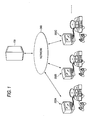
- Fig. 1 shows an embodiment of a network game system of the present invention.
- the network game system shown in Fig. 1 includes an echo server 100, which is a server system for providing a network game environment, and clients (communication terminals) 200A, 200B and 200C, which are multiple client systems used for participating in a game.
- Server 100 and clients 200A, 200B and 200C communicate with each other over a network 300.
- the packet communication is performed between the echo server 100 and each of the clients (communication terminals) 200A, 200B and 200C.
- UDP/IP is used as the communication protocol for the packet communication, because UDP/IP requires simpler steps than those of TCP/IP for fast data transfer.
- a predetermined maximum communication amount within a unit period of time is set in the packet communication between the echo server 100 and each of the clients (communication terminal) 200A, 200B and 200C. This is because the estimation of a current network load is extremely difficult. By keeping the network load below the predetermined value (set value), a good response speed can be maintained between the echo server 100 and each of the clients (communication terminal) 200A, 200B and 200C.
- the size of a packet communicated between the echo server 100 and each of the clients (communication terminals) 200A, 200B and 200C is also determined in order to keep the maximum communication amount of the packet communication lower than the predetermined value (set value). The details will be described later.
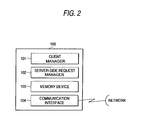
- the echo server 100 includes a client manager 101, a server side request manager 102, a memory device 103 and a communication interface 104, as shown in Fig. 2.
- the client manager 101 manages each of the clients (communication terminals) 200A, 200B and 200C accessing the network 300. For the management, each of the clients 200A, 200B and 200C can be identified based on data indicating the sender within a packet from each of the clients 200A, 200B and 200C.
- the server side request manager 102 manages requests from the clients 200A, 200B and 200C generated during a game. The detail will be described later. Information on processed requests from the clients 200A, 200B and 200C and the history of the information are stored in the memory device 103. The details of the requests will be described later.
- the communication interface 104 performs the packet communication with each of the clients 200A, 200B and 200C over the network 300.
- each of the clients 200A, 200B and 200C includes a controller 201, a RAM 202, a client side request manager 203, a QUEUE buffer 204, a packet buffer 205, a sound processor 206, an input unit 207, an interface 208, a graphics processor 209, a CD-ROM driver 210, and a communication interface 211.
- the data exchanges among the components are performed through a data bus 213.
- the controller 201 controls operations by the components in accordance with a predetermined control program stored in a ROM, not shown.
- the RAM 202 stores a game program and audio/video data in the CD-ROM 221 read by the CD-ROM driver 210.
- the client side request manager 203 manages requests. In order to manage requests, different kinds of requests are generated in accordance with operation by a player during a network game. Each of the generated requests is stored in the QUEUE buffer 204 one time. A predetermined number of requests are stored in the packet buffer 205 in accordance with predetermined timing. Then, a transmission packet for the requests stored in the packet buffer 205 is transmitted at predetermined intervals.
- the request is generated when a player character performs some action in accordance with a operation by a player as a result of the determination by the player, as will be described later.
- a request is generated when the position of the player character is moved, when a command (fight, magic and so on) is executed, when the equipment is changed and so on.
- the amount of each request generated in accordance with each operation depends on the type but is generally several tens of bytes. As many as possible of these requests are stored in the packet buffer 205 having a predetermined size (for example, 1500 bytes), as will be described later. Therefore, a total number of requests to be stored is controlled so as not to exceed a predetermined amount of storage.
- the QUEUE buffer 204 which is a first storage unit.
- a request within the QUEUE buffer 204 to be transmitted to the echo server 100 is stored in the packet buffer 205, which is a second storage unit.
- the packet buffer 205 has a storage area of a predetermined size (for example, 1500 bytes). Therefore, only a predetermined amount of the requests are stored in the packet buffer 205.
- the sound processor 206 converts and outputs audio data stored in the RAM 202 to analog signals in accordance with a state of a game.
- the input unit 207 inputs data indicating a type of operation instruction from a controller, keyboard, a remote controller and so on.
- the interface 208 exchanges game information with the memory card 212.
- the graphics processor 209 converts video data stored in the RAM 202 to analog signals in accordance with a state of a game and outputs the analog signals to the display unit 220.
- the CD-ROM driver 210 reads data in the CD-ROM 221.
- the communication interface 211 is responsible for the communication with the network 300.
- each of the clients (communication terminals) 200A, 200B and 200C may be a personal computer, a laptop personal computer, a PDA (personal information terminal), a mobile phone, a Web TV, a game machine having a communication function and so on.
- the CD-ROM 221 is reproduced by the CD-ROM driver 210.
- a game program and/or audio/video data reproduced by the CD-ROM driver 210 are stored in the RAM 202.
- the game program may be a role-playing game, for example.
- a role-playing game may advance in order to reach a certain goal or may advance without any final goal in particular.
- a game advances for a certain goal, a player operates a character in a game so that the character performs an action. Then, different kinds of events are cleared. The action by the character is determined by a player operation. When the result of the action satisfies a condition for clearing an event, the event is cleared. In this way, every time one event is cleared, the player can approach the final goal (event).
- the scenes of role-playing games include a realistic world, a fantasy world in which a hero plays an active role, the universe in the science fiction world, a horror world, which is similar to a real world but in which a devastating monster appears, and any other fictional world.
- Each player for playing a role-playing game can advance the game by manipulating one of characters living in such a world. In this case, each player selects one character.
- prepared events In order to advance the game, prepared events must be cleared. Thus, the player must input so as to cause the character to perform a desired action.
- the character can perform moving actions such as walking and running, motion actions such as waving a sword and using magic and actions for changing the character's equipment. Every time when one of these actions is caused to be performed, a request in accordance with the action is generated.
- requests R1 to R5 are generated in accordance with inputs by a player
- these requests R1 to R5 are stored in the QUEUE buffer 204 (step S401).
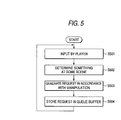
- an input by a player causes a character selected by the player (player character) (step S502) to perform a predetermined action in a certain scene.
- a request for the action is generated by the request manager 203 (step S503).
- the generated request is stored in the QUEUE buffer 204 by the request manager 203 (step S504).
- a request in accordance with the action is generated and is stored in the QUEUE buffer 204 sequentially by the request manager 203.
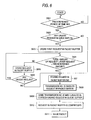
- requests within the QUEUE buffer 204 are stored in the packet buffer 205.
- a predetermined period of time is judged by the request manager 203 (step S601). If it is determined that the predetermined period of time has passed, whether or not any request, which has not been transmitted to the QUEUE buffer 204 is judged by the request manager 203 (step S602). The request, which has not been transmitted, will be described later.
- the first request within the QUEUE buffer 204 is stored in the packet buffer 205 by the request manager 203 (step S603).
- a total size of the requests, including the first request stored in the packet buffer 205 reaches the predetermined amount of memory is judged by the request manager 203 (step S604). If the predetermined amount is not reached, the next request is stored in the packet buffer 205 (step S605).
- step S606 whether or not any request, which has not been transmitted yet, exists in the QUEUE buffer 204 is determined.
- step S604 if it is judged that the predetermined amount of memory is reached, storing requests in the packet buffer 205 by the request manager 203 ends (step S607). At the step S606, if requests, which have not been transmitted, do not exist, storing requests into the packet buffer 205 ends.
- transmission numbers are given to the requests in the packet buffer 205 (step S608).
- the same transmission numbers are assigned to the requests within the QUEUE buffer 204, which correspond to the requests within the packet buffer 205, respectively (step S609).
- the transmission numbers are given by the request manager 203.
- the requests within the packet buffer 205 are compressed and a packet is transmitted by the request manager 203 (steps 610 and 611).
- a packet transmitted by the request manager 203 is sent to the echo server 100 as a transmission packet over the network 300 (step S403).
- the transmission number S1 within the transmission packet is checked in a history stored in the memory device 103 (step S405). If the transmission number S1 is found in the history, the transmission packet is discarded. On the other hand, if the transmission number S1 is not found in the history, the requests R1 and R2 within the transmission packet are processed (step S406). Here, the requests R1 and R2, which have been processed, are stored in the memory device 103 as processed requests RR1 and RR2 (step S407). Once the processed requests RR1 and RR2 are stored in the memory device 103, a reply packet including the transmission number S1 received from the echo server 100 side is returned to the client 200 side (step S408 and 409).
- step S410 whether the requests R1 and R2 corresponding to the transmission number S1 are in the QUEUE buffer 204 or not is judged by the request manager 203 based on the transmission number S1 in the reply packet returned from the echo server 100 side. If it is determined that the requests R1 and R2 are in the QUEUE buffer 204, the requests R1 and R2 are discarded (step S410).
- step S701 when the client 200 side receives a reply packet returned from the echo server 100 side (step S701), whether or not any request corresponding to a transmission number within the reply packet is in the QUEUE buffer 204 is judged by the request manager 203 (step S702) based on the transmission number in the reply packet. If so, the request is discarded (step S703).
- requests R3 and R4 within the QUEUE buffer 204 are stored in the packet buffer 205 sequentially by the request manager 203.
- the storing of requests into the packet buffer 205 ends.
- transmission number S2 is written in the requests R3 and R4 within the packet buffer 205 (a step S411).
- the same transmission number S2 is written in the requests R3 and R4 in the QUEUE buffer 204, which correspond to the requests in the packet buffer 205 (a step S412).
- the requests R3 and R4 within the packet buffer 205 are compressed and a packet is transmitted by the request manager 203. Then, at a time t2, which is the time for transmitting the packet, the packet is transmitted to the echo server 100 as a transmission packet over the network 300 (a step S413).
- the transmission number S2 within the transmission packet is checked in a history stored in the memory device 103 (step S415). If the transmission number (S2) is found in the history, the transmission packet is discarded. On the other hand, if the transmission number S2 is not found in the history, the requests R3 and R4 within the transmission packet are processed (a step S416). Here, the requests R3 and R4, which have been processed, are stored in the memory device 103 as processed requests RR3 and RR4 (a step S417). Once the processed requests RR3 and RR4 are stored in the memory device 103, a reply packet including the transmission number (S2) received from the echo server 100 side is returned to the client 200 side (steps 418 and 419).
- the transmission packet of a predetermined amount is sent from the client 200 side to the echo server 100 side sequentially in the same manner. Based on the transmission number in the reply packet, whether or not the request corresponding to the transmission number is in the QUEUE buffer 204 is determined in the client 200 side. If so, the request is discarded. This processing is repeated until the network game ends.
- steps 801 to 818 are the same as steps 401 to 418 in Fig. 4. Therefore, the description will be omitted here.
- the processing for issuing a packet for the next request R5 and subsequent requests is started in the client 200 side.
- a time t3 which is the time for sending the packet for the request R5 and the subsequent requests
- the transmission packet is sent to the echo server 100 over the network 300 in the same manner. If it is determined that the reply packet for the requests R3 and R4 is not returned at the time t3 (step 819), the transmission packet for the previous requests R3 and R4 is sent to the echo server 100 again at the time t3 (steps 820 and 821).
- the reply packet is returned for the transmission packet including the resent requests R3 and R4 so that the packet for the next request and the subsequent requests can be ensured to have been sent.
- a predetermined maximum communication amount is set for packet communication between the echo server 100, which is a server system, and each of the clients 200A, 200B and 200C, which are client systems.
- the packet sent from each of the clients 200A, 200B and 200C is a predetermined size.
- a predetermined maximum communication amount is set for packet communication between the echo server 100, which is a server system, and each of the clients 200A, 200B and 200C, which are client systems.
- a reply packet including the transmission number can be returned to the clients 200A, 200B and 200C. In this case, the network load can still be reduced.
- Each of the clients 200A, 200B and 200C can send a transmission packet to the echo server 100 through the communication interface 211, which is an exchanging unit, and can receive a reply packet from the echo server 100.
- Different kinds of requests in accordance with states of a network game are generated by the client side request manager 203.
- the generated requests are stored in the QUEUE buffer 204, which is a first storage unit.
- the requests in a predetermined amount of the QUEUE buffer 204 are stored in the packet buffer 205.
- a packet in which a transmission number is written in the requests and compressed is transmitted. Therefore, the network load does not exceed a predetermined maximum communication amount. As a result, the occurrence of the communication amount exceeding the backbone can be suppressed.
- the communication protocol for the transmission packet and the reply packet between the echo server 100 and each of the clients 200A, 200B and 200C is UDP/IP, which does not require more complex steps than those of TCP/IP. Therefore, the packet communication can be performed fast.
- the transmission packet can be confidently sent from the clients 200A, 200B and 200C to the echo server 100.
Landscapes
- Engineering & Computer Science (AREA)
- Multimedia (AREA)
- Computer And Data Communications (AREA)
- Small-Scale Networks (AREA)
Applications Claiming Priority (2)
| Application Number | Priority Date | Filing Date | Title |
|---|---|---|---|
| JP2001379493A JP3998466B2 (ja) | 2001-12-13 | 2001-12-13 | ネットワークゲームシステムおよびネットワークゲーム処理方法 |
| JP2001379493 | 2001-12-13 |
Publications (2)
| Publication Number | Publication Date |
|---|---|
| EP1319431A2 true EP1319431A2 (de) | 2003-06-18 |
| EP1319431A3 EP1319431A3 (de) | 2004-06-30 |
Family
ID=19186841
Family Applications (1)
| Application Number | Title | Priority Date | Filing Date |
|---|---|---|---|
| EP02027588A Withdrawn EP1319431A3 (de) | 2001-12-13 | 2002-12-10 | Netzwerkspielsystem, Klientsystem, Netzwerkspielverarbeitungsverfahren und Aufzeichnungsmedium |
Country Status (3)
| Country | Link |
|---|---|
| US (1) | US20030114225A1 (de) |
| EP (1) | EP1319431A3 (de) |
| JP (1) | JP3998466B2 (de) |
Cited By (2)
| Publication number | Priority date | Publication date | Assignee | Title |
|---|---|---|---|---|
| EP1908504A4 (de) * | 2005-06-28 | 2009-07-29 | Konami Digital Entertainment | Spielsystem, steuerverfahren dafür, spielvorrichtung und programm |
| EP2179773A4 (de) * | 2007-08-02 | 2010-08-25 | Konami Digital Entertainment | Spielsystem, endgerätevorrichtung und computerprogramm |
Families Citing this family (6)
| Publication number | Priority date | Publication date | Assignee | Title |
|---|---|---|---|---|
| US7211624B2 (en) | 1999-12-03 | 2007-05-01 | Acushnet Company | Golf ball layers formed of polyurethane-based and polyurea-based compositions incorporating block copolymers |
| JP4047874B2 (ja) * | 2005-06-28 | 2008-02-13 | 株式会社コナミデジタルエンタテインメント | ゲームシステム及びその制御方法、ゲーム装置、並びにプログラム |
| JP4308283B2 (ja) * | 2007-06-29 | 2009-08-05 | 株式会社スクウェア・エニックス | サーバ装置、携帯電話機、対戦者選定システム及び方法、プログラム及び記録媒体 |
| JP2009119150A (ja) * | 2007-11-16 | 2009-06-04 | Square Enix Co Ltd | ネットワークゲームシステム、及びプログラム |
| CN106973074B (zh) * | 2016-01-13 | 2019-11-19 | 腾讯科技(深圳)有限公司 | 一种数据处理方法、装置及系统 |
| CN106375314B (zh) * | 2016-08-31 | 2018-10-02 | 腾讯科技(深圳)有限公司 | 一种游戏同步方法、游戏客户端及游戏服务器 |
Family Cites Families (16)
| Publication number | Priority date | Publication date | Assignee | Title |
|---|---|---|---|---|
| US4908828A (en) * | 1987-12-29 | 1990-03-13 | Indesys, Inc. | Method for error free message reception |
| US5598535A (en) * | 1994-08-01 | 1997-01-28 | International Business Machines Corporation | System for selectively and cumulatively grouping packets from different sessions upon the absence of exception condition and sending the packets after preselected time conditions |
| US5751951A (en) * | 1995-10-30 | 1998-05-12 | Mitsubishi Electric Information Technology Center America, Inc. | Network interface |
| US6050898A (en) * | 1996-05-15 | 2000-04-18 | Vr-1, Inc. | Initiating and scaling massive concurrent data transaction |
| US5930252A (en) * | 1996-12-11 | 1999-07-27 | International Business Machines Corporation | Method and apparatus for queuing and triggering data flow streams for ATM networks |
| US5903735A (en) * | 1996-12-24 | 1999-05-11 | Intel Corporation | Method and apparatus for transmitting data having minimal bandwidth requirements |
| US6161123A (en) * | 1997-05-06 | 2000-12-12 | Intermec Ip Corporation | Providing reliable communication over an unreliable transport layer in a hand-held device using a persistent session |
| JPH1157215A (ja) * | 1997-08-20 | 1999-03-02 | Fuji Xerox Co Ltd | ネットワークゲームシステム、ネットワークゲームサーバ装置、ネットワークゲームクライアント装置、対局者選定プログラムを記録した媒体及び対局者情報取得プログラムを記録した媒体 |
| JP3990051B2 (ja) * | 1998-10-02 | 2007-10-10 | 株式会社バンダイナムコゲームス | ゲーム装置及び情報記憶媒体 |
| US6621799B1 (en) * | 1998-10-05 | 2003-09-16 | Enterasys Networks, Inc. | Semi-reliable data transport |
| US20010044339A1 (en) * | 2000-02-17 | 2001-11-22 | Angel Cordero | Multi-player computer game, system and method |
| JP2001237882A (ja) * | 2000-02-23 | 2001-08-31 | Nec Corp | パケットデータ転送におけるパケットサイズ制御装置及びその制御方法 |
| US6767287B1 (en) * | 2000-03-16 | 2004-07-27 | Sony Computer Entertainment America Inc. | Computer system and method for implementing a virtual reality environment for a multi-player game |
| JP4168582B2 (ja) * | 2000-08-31 | 2008-10-22 | 沖電気工業株式会社 | 通信接続装置およびデータ出力制御方法 |
| US7013346B1 (en) * | 2000-10-06 | 2006-03-14 | Apple Computer, Inc. | Connectionless protocol |
| US6963921B1 (en) * | 2001-02-16 | 2005-11-08 | 3Com Corporation | Method and apparatus for hardware assisted TCP packet re-assembly |
-
2001
- 2001-12-13 JP JP2001379493A patent/JP3998466B2/ja not_active Expired - Lifetime
-
2002
- 2002-12-10 EP EP02027588A patent/EP1319431A3/de not_active Withdrawn
- 2002-12-11 US US10/315,998 patent/US20030114225A1/en not_active Abandoned
Non-Patent Citations (1)
| Title |
|---|
| None |
Cited By (3)
| Publication number | Priority date | Publication date | Assignee | Title |
|---|---|---|---|---|
| EP1908504A4 (de) * | 2005-06-28 | 2009-07-29 | Konami Digital Entertainment | Spielsystem, steuerverfahren dafür, spielvorrichtung und programm |
| US8137198B2 (en) | 2005-06-28 | 2012-03-20 | Konami Digital Entertainment Co., Ltd. | Game system, method for controlling game system, game device therefor, and program therefor |
| EP2179773A4 (de) * | 2007-08-02 | 2010-08-25 | Konami Digital Entertainment | Spielsystem, endgerätevorrichtung und computerprogramm |
Also Published As
| Publication number | Publication date |
|---|---|
| EP1319431A3 (de) | 2004-06-30 |
| JP3998466B2 (ja) | 2007-10-24 |
| US20030114225A1 (en) | 2003-06-19 |
| JP2003181145A (ja) | 2003-07-02 |
Similar Documents
| Publication | Publication Date | Title |
|---|---|---|
| US6050898A (en) | Initiating and scaling massive concurrent data transaction | |
| US7927217B2 (en) | Network game system, game server system, client system, network game processing method, and recording medium | |
| KR100598481B1 (ko) | 동적 대역폭 제어 | |
| US20150367238A1 (en) | Game system, game apparatus, a method of controlling the same, a program, and a storage medium | |
| US9858210B2 (en) | Information processing apparatus, rendering apparatus, method and program | |
| KR100459392B1 (ko) | 게임을 이용한 완구 구동 장치 및 방법 | |
| EP3000232A1 (de) | Dynamische zuweisung von rendering-ressourcen in einem cloud-spielsystem | |
| IL179054A (en) | Server unit, client unit and communication network for multiplier applications | |
| WO2002092177A2 (en) | Method and arrangement for providing an interactive game including three-dimensional graphics | |
| EP1319431A2 (de) | Netzwerkspielsystem, Klientsystem, Netzwerkspielverarbeitungsverfahren und Aufzeichnungsmedium | |
| CN101389385B (zh) | 通信游戏系统和通信游戏控制方法 | |
| EP2301634A1 (de) | Spielvorrichtung und Steuerverfahren | |
| EP1755060A1 (de) | Kommunikationssteuerungsprogramm, -server und -verfahren | |
| TW200909034A (en) | Game system, terminal machine and computer program | |
| KR100883907B1 (ko) | 다중 접속 온라인 게임에서의 분산 서버를 통한 게임 제어방법 및 시스템 | |
| KR101087089B1 (ko) | 네트워크 시스템, 노드 기기, 데이터 송신방법, 정보기록매체 및 프로그램 | |
| EP1206955A2 (de) | Informationsterminal, Server zur Bereitstellung von informationen, Online-Spielverfahren und Aufzeichungsmedium | |
| JP5067993B2 (ja) | サーバ、プログラム及び情報記憶媒体 | |
| US9545577B2 (en) | Method and system for renewing screen using mechanics information | |
| US20160271495A1 (en) | Method and system of creating and encoding video game screen images for transmission over a network | |
| JP3916601B2 (ja) | 通信システム、サーバ装置、端末、サービス方法、端末方法、および、プログラム | |
| KR20080018512A (ko) | 다중 접속 온라인 게임에서 p2p 메시지 전송 시스템 방법 | |
| Delaney et al. | Reducing update packets in distributed interactive applications using a hybrid approach | |
| KR100829810B1 (ko) | 온라인 게임에서 게임 캐릭터 정보 동기화 방법 및 시스템 | |
| JP3455418B2 (ja) | ネットワークゲームシステム |
Legal Events
| Date | Code | Title | Description |
|---|---|---|---|
| PUAI | Public reference made under article 153(3) epc to a published international application that has entered the european phase |
Free format text: ORIGINAL CODE: 0009012 |
|
| AK | Designated contracting states |
Designated state(s): AT BE BG CH CY CZ DE DK EE ES FI FR GB GR IE IT LI LU MC NL PT SE SI SK TR |
|
| AX | Request for extension of the european patent |
Extension state: AL LT LV MK RO |
|
| RAP1 | Party data changed (applicant data changed or rights of an application transferred) |
Owner name: KABUSHIKI KAISHA SQUARE ENIX |
|
| PUAL | Search report despatched |
Free format text: ORIGINAL CODE: 0009013 |
|
| AK | Designated contracting states |
Kind code of ref document: A3 Designated state(s): AT BE BG CH CY CZ DE DK EE ES FI FR GB GR IE IT LI LU MC NL PT SE SI SK TR |
|
| AX | Request for extension of the european patent |
Extension state: AL LT LV MK RO |
|
| 17P | Request for examination filed |
Effective date: 20041025 |
|
| AKX | Designation fees paid |
Designated state(s): DE FR GB |
|
| 17Q | First examination report despatched |
Effective date: 20050511 |
|
| RAP1 | Party data changed (applicant data changed or rights of an application transferred) |
Owner name: KABUSHIKI KAISHA SQUARE ENIX HOLDINGS (ALSO TRADIN |
|
| RAP1 | Party data changed (applicant data changed or rights of an application transferred) |
Owner name: KABUSHIKI KAISHA SQUARE ENIX (ALSO TRADING AS SQUA |
|
| RIC1 | Information provided on ipc code assigned before grant |
Ipc: A63F 13/335 20140101ALI20160429BHEP Ipc: A63F 13/358 20140101AFI20160429BHEP |
|
| GRAP | Despatch of communication of intention to grant a patent |
Free format text: ORIGINAL CODE: EPIDOSNIGR1 |
|
| INTG | Intention to grant announced |
Effective date: 20180119 |
|
| RIN1 | Information on inventor provided before grant (corrected) |
Inventor name: KIMURA, MASAAKI |
|
| INTG | Intention to grant announced |
Effective date: 20180119 |
|
| STAA | Information on the status of an ep patent application or granted ep patent |
Free format text: STATUS: THE APPLICATION IS DEEMED TO BE WITHDRAWN |
|
| 18D | Application deemed to be withdrawn |
Effective date: 20180530 |
|
| RIC1 | Information provided on ipc code assigned before grant |
Ipc: A63F 13/335 20140101ALI20160429BHEP Ipc: A63F 13/358 20140101AFI20160429BHEP |
|
| RIC1 | Information provided on ipc code assigned before grant |
Ipc: A63F 13/358 20140101AFI20160429BHEP Ipc: A63F 13/335 20140101ALI20160429BHEP |