EP1320027B1 - Auf elliptischen Kurven basierte Kryptosystemvorrichtung, sowie entsprechendes Verfahren und Programm - Google Patents
Auf elliptischen Kurven basierte Kryptosystemvorrichtung, sowie entsprechendes Verfahren und Programm Download PDFInfo
- Publication number
- EP1320027B1 EP1320027B1 EP02258503A EP02258503A EP1320027B1 EP 1320027 B1 EP1320027 B1 EP 1320027B1 EP 02258503 A EP02258503 A EP 02258503A EP 02258503 A EP02258503 A EP 02258503A EP 1320027 B1 EP1320027 B1 EP 1320027B1
- Authority
- EP
- European Patent Office
- Prior art keywords
- variable
- coordinate
- value
- result
- elliptic curve
- Prior art date
- Legal status (The legal status is an assumption and is not a legal conclusion. Google has not performed a legal analysis and makes no representation as to the accuracy of the status listed.)
- Expired - Lifetime
Links
Images








Classifications
-
- G—PHYSICS
- G06—COMPUTING OR CALCULATING; COUNTING
- G06F—ELECTRIC DIGITAL DATA PROCESSING
- G06F7/00—Methods or arrangements for processing data by operating upon the order or content of the data handled
- G06F7/60—Methods or arrangements for performing computations using a digital non-denominational number representation, i.e. number representation without radix; Computing devices using combinations of denominational and non-denominational quantity representations, e.g. using difunction pulse trains, STEELE computers, phase computers
- G06F7/72—Methods or arrangements for performing computations using a digital non-denominational number representation, i.e. number representation without radix; Computing devices using combinations of denominational and non-denominational quantity representations, e.g. using difunction pulse trains, STEELE computers, phase computers using residue arithmetic
- G06F7/724—Finite field arithmetic
- G06F7/725—Finite field arithmetic over elliptic curves
-
- G—PHYSICS
- G06—COMPUTING OR CALCULATING; COUNTING
- G06F—ELECTRIC DIGITAL DATA PROCESSING
- G06F2207/00—Indexing scheme relating to methods or arrangements for processing data by operating upon the order or content of the data handled
- G06F2207/72—Indexing scheme relating to groups G06F7/72 - G06F7/729
- G06F2207/7219—Countermeasures against side channel or fault attacks
- G06F2207/7261—Uniform execution, e.g. avoiding jumps, or using formulae with the same power profile
Definitions
- the present invention relates to an elliptic curve cryptosystem apparatus, a storage medium storing an elliptic curve cryptosystem program, and an elliptic curve cryptosystem arithmetic method.
- EP 1160661 discloses a cryptographic processing method in which dependence of cryptographic processing process and secret information on each other is cut off; and in which, when a scalar multiplied point is calculated from a scalar value and a point on an elliptic curve in an elliptic curve cryptosystem, a value of a bit of the scalar value is judged; and in which operations on the elliptic curve are executed a predetermined number of times and in a predetermined order without depending on the judged value of the bit.
- EP 1160661 discloses the simultaneous performance of elliptic curve addition and doubling operations.
- An elliptic curve cryptosystem is one of the public key cryptosystem, and is used in the processes of encryption, decryption, signature generation, authentication, etc.
- the point at infinity can also be represented by 0.
- a1, a2, a3, a4, a6, x, and y are elements of the GF(q).
- the point at infinity ⁇ can also be represented by 0.
- a, b, x, and y are elements of the GF(p ⁇ m) , and satisfy 4 ⁇ a ⁇ 3+27 ⁇ b ⁇ 2 ⁇ 0.
- the point at infinity ⁇ is a point which cannot be represented in the (x, y) coordinate system.
- FIGS. 1 and 2 are explanatory views of the elliptic curve addition and the elliptic curve doubling.
- the values of x3 and y3 can be represented by the following equations.
- x ⁇ 3 y ⁇ 1 - y ⁇ 2 / x ⁇ 1 - x ⁇ 2 2 ⁇ - x ⁇ 1 - x ⁇ 2
- the scalar multiplication is represented by a combination of the elliptic curve addition and the elliptic curve doubling.
- the computation time of the elliptic curve addition, the elliptic curve doubling, and the scalar multiplication can be frequently estimated by a sum of the computation times of multiplication, squaring, and inversion in the GF(q).
- the above mentioned elliptic curve addition requires two multiplying operations, one squaring operation, and one inversion operation in the GF(p ⁇ m). These operations are represented by 2M + 1S + 1I.
- the elliptic curve addition can be computed by 12M + 2S, and the elliptic curve doubling can be computed by 7M + 5S.
- there are improved projective coordinate systems such as Jacobian coordinates, Chudonovsky coordinates, modified Jacobian coordinates, etc.
- a group of points (u, v) satisfying the equation B ⁇ v ⁇ ⁇ 2 u ⁇ ⁇ 3 + A ⁇ u ⁇ ⁇ 2 + u for the elements A and B in the GF(p ⁇ m), and a group of the points referred to as points at infinity ⁇ are referred to as a Montgomery form elliptic curve.
- a point is represented as a set (U : V : W) of three elements in the GF(p ⁇ m), and a curve is represented by the following equation.
- B ⁇ V ⁇ ⁇ 2 ⁇ W U ⁇ ⁇ 3 + A ⁇ U ⁇ ⁇ 2 ⁇ W + U ⁇ W ⁇ ⁇ 2
- the entire computation time is evaluated based on the number of times of the arithmetics performed.
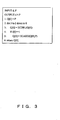
- FIG. 3 shows the algorithm 1 of the conventional scalar multiplication.
- P indicates the initial value of the variable Q[0]
- the elliptic curve doubling is performed on (the point Q[0] in step 3, and an arithmetic result is stored in the Q[0].
- the elliptic curve addition ECADD is performed on the point Q [0] and the point P in step 5, and the arithmetic result is stored in the point Q[0].
- the computation time required in the scalar multiplication of the algorithm 1 is (n-1) / 2 ⁇ E CADD +(n-1) ⁇ E ECDBL on average.
- the binary method can be replaced with the signed binary method so as to shorten the average computation time into (n-1) /3 ⁇ ECADD+ (n-1) ⁇ ECDBL.
- scalar multiplication an arithmetic referred to as scalar multiplication is commonly used, and is more popularly used in the entire encryption and decryption process. Therefore, the performance of the entire encryption and decryption totally depend on the performance of this portion. Since the scalar multiplication process is a major process in the elliptic curve cryptosystem, it is desired that higher performance can be realized by the scalar multiplication.
- the elliptic curve cryptosystem can guarantee the security using a key length shorter than a conventional cryptosystem, it has become widespread in such low-power devices as smart cards, etc.
- the side channel attacks can be effective on these devices, and an algorithm of the scalar multiplication resistant to the attacks is required.
- the elliptic curve addition ECADD and the elliptic curve doubling ECDBL can be concurrently performed. Therefore, the computation time for the scalar multiplication can be considerably shortened. Furthermore, for example, the elliptic curve addition ECADD and the elliptic curve doubling ECDBL can be performed independent of d[i] in the steps above, thereby improving the resistance to the side attacks.
- aspects of the invention comprise computer programs which, when loaded into or run on a computer, cause the computer to become apparatus, or to carry out methods, according to the aspects described above.
- the elliptic curve cryptosystem apparatus comprises, for example, an information processing device exclusive for elliptic curve cryptosystem, a personal computer, an IC chip built in an smart card, etc., a mobile phone, a mobile information terminal device (PDA, etc.), a DVD player, etc., includes at least two processors, and has the function of concurrently performing the elliptic curve addition ECADD and the elliptic curve doubling ECDBL described later.
- Described below is an arithmetic method for an elliptic curve cryptosystem according to an embodiment of the present invention applied to an Weierstrass form elliptic curve over the finite field GF(p ⁇ m) with p ⁇ m elements ( ⁇ indicates a power).
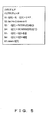
- FIG. 4 shows the algorithm 2 for an arithmetic operation of the scalar multiplication d x P on an elliptic curve cryptosystem not embodying the present invention.
- the point P on the elliptic curve E and the n-bit natural number d are obtained (or input).
- step S2 i is changed by 1 from 0 to n - 1 each time the loop is repeated.
- step S4 the elliptic curve doubling ECDBL is performed on Q[0], and the arithmetic result is stored in Q[0].
- the above mentioned algorithm 2 can independently compute the elliptic curve addition ECADD and the elliptic curve doubling ECDBL.
- the computation time of the scalar multiplication can be shortened by concurrently computing the elliptic curve addition ECADD and the elliptic curve doubling ECDBL of the above mentioned algorithm 2 using two processors.
- FIG. 5 shows the algorithm 3 for computing the scalar multiplication d x P of the elliptic curve cryptosystem according to a first embodiment of the present invention.
- the point P on the elliptic curve E and an n-bit natural number d are input.
- P is set as the initial value of the Q[0]
- 2 x P is set as the initial value of the Q[1].
- step S2 i is changed by 1 from n - 2 to 0 each time the loop is repeated.
- the elliptic curve addition ECADD and the elliptic curve doubling ECDBL can be independently performed. Therefore, the elliptic curve addition ECADD and the elliptic curve doubling ECDBL can be concurrently performed using two processors to shorten the computation time required for the scalar multiplication.
- the above mentioned algorithms 2 and 3 can improve the resistance to the side channel attacks of encryption and decryption as compared with the algorithm 1 because they can perform the elliptic curve addition ECADD and the elliptic curve doubling ECDBL independent of d[i].
- FIG. 6 is a flowchart of the elliptic curve cryptosystem program of the elliptic curve cryptosystem apparatus.
- the scalar multiplication is performed on the private key s and the point P on the elliptic curve to generate a public key.
- step S12 shown in FIG. 6 An example of a practical process of the scalar multiplication (step S12 shown in FIG. 6 ) to be performed using the algorithm 3 is described below by referring to FIG. 7 .
- FIG. 7 shows the contents of the processes when the elliptic curve addition ECADD and the elliptic curve doubling ECDBL of the elliptic curve cryptosystem program are concurrently performed based on the algorithm 3 using two processors.
- the elliptic curve cryptosystem apparatus comprises two registers 11 and 12.
- the register 11 stores a variable Q[0]
- the register 12 stores a variable Q[1].
- the initial value P of Q[0] and the initial value 2 x P of Q[1] are respectively set in the registers 11 and 12.
- the first processor sets Q[d[i]] in Q[0] (S21 shown in FIG. 7 ), performs the elliptic curve doubling ECDBL on Q[0], and sets the arithmetic result in Q[0] (s22).
- Another processor reads Q[0] stored in the register 11 and Q[1] stored in the register 12, performs the elliptic curve addition ECADD on the points, and sets the arithmetic results in Q[1] (S23).
- the concurrent computation of the ECADD and the ECDBL can be performed in the scalar multiplication.
- the total computation time is 1 x ECDBL + (n - 1) x ECADD because the computation time of the ECADD is normally longer than the computation time of the ECDBL, thereby considerably shortening the total computation time.
- the x coordinate x1 of the point P1 of the elliptic curve E, the x coordinate x2 of the point P2, and the x coordinate x3' of P3' - P1 - P2 are obtained.
- the x coordinate of the elliptic curve addition ECADD can be obtained without using y coordinates, thereby simplifying the arithmetic program of the elliptic curve addition ECADD, and shortening the computation time.
- the GF(p ⁇ m) is defined as a finite field with p elements where p indicates a prime number equal to or larger than 5.
- the elliptic curve doubling can be performed without using y coordinates, thereby simplifying the elliptic curve doubling, and shortening the computation time.
- the X coordinate X1 and the Z coordinate Z1 in the projective coordinate system of the point P1 on the elliptic curve E, the X coordinate X2 and the Z coordinate Z2 of the point P2, the X coordinate X3' and the Z coordinate Z3' of the point P3' , and the X coordinate X3 and the Z coordinate Z3 of P3 P1 + P2 are obtained.
- the elliptic curve addition can be performed without using Y coordinates of the projective coordinate system, thereby simplifying the arithmetic program and shortening the computation time.
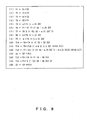
- FIG. 8 shows an example of a practical arithmetic program according to the fourth algorithm.
- the arithmetic program shown in FIG. 8 realizes the arithmetics by the equations (1A) and (2A) according to the fourth algorithm, and includes the following processes.
- the X coordinate X3 and the Z coordinate Z3 of the point P3 of the elliptic curve addition in the projective coordinate system can be computed by eight multiplying operations, two squaring operations, and several adding, subtracting, and constant multiplying operations.
- the X coordinate X3 and the Z coordinate Z3 of the elliptic curve addition P3 - P1 + P2 can be computed without using Y coordinates in the projective coordinate system, thereby shortening the computation time.
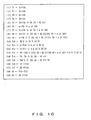
- FIG. 10 shows the arithmetic program by the equations (1A and (2A) according to the fifth algorithm, and comprises the following processes.
- the X coordinate X3 and the Z coordinate Z3 of the point P3 of the elliptic curve addition in the projective coordinate system can be computed by eight multiplying operations, two squaring operations, and several adding, subtracting, and constant multiplying operations.
- the X coordinate X1 and the Z coordinate Z1 of the point P1 on the Weierstrass form elliptic curve E in the GF(p ⁇ m) are input.
- FIG. 12 shows an example of a practical arithmetic program by the equations (1A) and (2A) according to the sixth algorithm, and includes the following processes.
- a seventh algorithm not directly embodying the present invention.
- this seventh algorithm the x coordinate and the y coordinate of the point P of the elliptic curve E, and the x coordinates of the points P[d] and P[d + 1] are obtained, and the y coordinate of the point P[d] is computed.
- the x coordinate and the y coordinate of the point P of the Weierstrass form elliptic curve E in the GF (p ⁇ m) , and the x coordinates x [d] and x [d+1] of the points P[d] and P[d + 1] are obtained.
- the y coordinate y[d] of the point P[d] can be obtained by the equation above.
- the points P[d] and P[d + 1] are computed without using y coordinates in the above mentioned computing method, and the y coordinate y[d] of the point P[d] can be obtained using the x coordinates, thereby shortening the computation time.
- Described below is an eighth algorithm not directly embodying the present invention. According to this eighth algorithm, after obtaining the X coordinate and the Z coordinate of the P[d] and P[d + 1] in the projective coordinate system, the Y coordinate of the P[d] in the projective coordinate is obtained.
- the x coordinate and the y coordinate of the point P on the Weierstrass form elliptic curve E in the GF(p ⁇ m), and the X coordinate and the Z coordinate of the points P[d] and P[d + 1] in the projective coordinate system are obtained.
- the Z coordinate is Z[d]
- the Z coordinate is Z[d + 1].
- the value of the denominator of Y[d] is set as r.
- the projective coordinate of P[d] can be represented by the following equation.
- X ⁇ d 2 ⁇ y ⁇ Z ⁇ d ⁇ ⁇ 2 ⁇ Z ⁇ d + 1 ⁇ X d
- the Y coordinate of P[d] in the projective coordinate system can be computed by an equation not containing a division.
- (X[d]: Y[d]: Z[d]) equals (X' [d] : Y' [d] : Z' [d] ) obtained by multiplying each of the original elements by r. Therefore, the Y coordinate of P[d] can be obtained from the above mentioned result.
- the Y coordinate of the point P[d] of the scalar multiplication can be obtained in the projective coordinate system without a dividing operation, thereby shortening the computation time.
- FIG. 13 shows an example of a practical arithmetic program according to the eighth algorithm.
- the arithmetic program comprises the following processes.
- the above mentioned arithmetic program can be realized by fourteen multiplying operations, three squaring operations, and several adding, subtracting, and constant multiplying operations.
- the elliptic curve addition ECADD in the algorithm 3 shown in FIG. 5 is performed in the arithmetic method of the multiplicative elliptic curve addition without using y coordinates according to the first algorithm, and the elliptic curve doubling ECDBL is performed in the arithmetic method of the elliptic curve doubling without using y coordinates according to the third algorithm.
- the coordinate of the point P on the elliptic curve E and n-bit natural number d are input, the elliptic curve addition ECADD in the arithmetic program of the algorithm 3 shown in FIG. 5 is performed, in the arithmetic method of the additive elliptic curve addition without using y coordinates according to the second algorithm, and the elliptic curve doubling ECDBL is performed in the arithmetic method of the elliptic curve doubling without using y coordinates according to the third algorithm.
- the coordinates of the point P in the projective coordinate system are (X : Y : Z).
- the elliptic curve addition ECADD of the arithmetic program of the algorithm 3 shown in FIG. 5 is performed in the arithmetic method of the multiplicative elliptic curve addition without using Y coordinates in the projective coordinate system according to the fourth algorithm, and the elliptic curve doubling ECDBL is performed in the arithmetic method of the elliptic curve doubling without using Y coordinates in the projective coordinate system according to the sixth algorithm of the present invention.
- the elliptic curve addition ECADD of the algorithm 3 can be performed by the arithmetic program of the elliptic curve addition according to the fourth algorithm shown in FIG. 8
- the elliptic curve doubling ECDBL can be performed by the arithmetic program of the elliptic curve doubling according to the sixth algorithm shown in FIG. 12 .
- the computation of the coordinates (X'[d] : Y' [d] : Z'[d]) of the point P[d] in the projective coordinate system can be performed by the arithmetic program for computing the projective coordinate in the eighth algorithm shown in FIG. 13 .
- the computation in each loop of the algorithm 3 can be realized by fifteen multiplying operations, five squaring operations, and several adding, subtracting, and constant multiplying operations.
- the elliptic curve addition ECADD of the algorithm 3 can be performed by the arithmetic program shown in FIG. 11 instead of executing the arithmetic program shown in FIG. 8 .
- Other arithmetic operations are the same as those described above.
- the computation in each loop of the algorithm 3 can be realized by fourteen multiplying operations, five squaring operations, and several adding, subtracting, and constant multiplying operations.
- the coordinates of the point P in the projective coordinate system are (X : Y : Z).
- the elliptic curve addition ECADD of the arithmetic program of the algorithm 3 shown in FIG. 5 is performed in the arithmetic method of the additive elliptic curve addition without using Y coordinates in the projective coordinate system according to the fifth algorithm, and the elliptic curve doubling ECDBL is performed in the arithmetic method of the elliptic curve doubling without using Y coordinates in the projective coordinate system according to the sixth algorithm of the present invention.
- the subsequent arithmetic process is the same as that performed after the completion of the loop of the algorithm 3 according to the above mentioned fourth embodiment.
- the elliptic curve addition ECADD of the algorithm 3 is performed by the arithmetic program of the elliptic curve addition without using Y coordinates in the projective coordinate system shown in FIG. 10 (fifth algorithm), and the elliptic curve doubling ECDBL can be performed by the arithmetic program of the elliptic curve doubling without using Y coordinates in the projective coordinate system shown in FIG. 12 (sixth algorithm).
- the computation in each loop of the algorithm 3 can be realized by sixteen multiplying operations, five squaring operations, and several adding, subtracting, and constant multiplying operations.
- the computation in each loop of the algorithm 3 can be realized by fourteen multiplying operations, five squaring operations, and several adding, subtracting, and constant multiplication.
- FIG. 14 shows an example of an arithmetic program ECADDDBL obtained by summarizing the common elements of the elliptic curve addition ECADD and elliptic curve doubling ECDBL according to the second algorithm.
- the arithmetic program comprises the following processes.
- the coordinates (X'[d] : Y' [d] : Z' [d]) of the P[d] in the projective coordinate system can be computed.
- each loop of the algorithm 3 can be realized by fourteen multiplying operations, five squaring operations, and several adding, subtracting, and constant multiplication in the GF(p ⁇ m).
- each loop of the algorithm 3 can be realized by thirteen multiplying operations, four squaring operations, and several adding, subtracting, and" constant multiplication.
- the coordinates (u, v) of the point P on the Montgomery form elliptic curve E, the U coordinate and V coordinate of the point P[d] and P[d + 1] in the projective coordinate system are obtained or input.
- the coordinates of the P[d] in the projective coordinate system can be computed without using a division, thereby shortening the computation time.
- FIG. 16 shows an example of an arithmetic program by the equations (1A) through (3A) according to the above mentioned ninth algorithm.
- the arithmetic program is formed by the following processes.
- the computation can be realized by eleven multiplying operations and several adding, subtracting, and constant multiplication.
- the computation time required by the arithmetic program in the above mentioned embodiment is compared with the computation time required by the algorithm shown in FIG. 3 .
- the computation time required by the algorithm 1 (binary method) and the scalar multiplication on the Jacobian coordinates is 2226.0 M, and the computation time required by the algorithm 1 (signed binary method) and the scalar multiplication on the Jacobian coordinates is 1950.4 M.
- the computation time required by, for example, the algorithm 3 for computing the scalar multiplication using the arithmetic program of the elliptic curve addition without using a Y coordinate in the projective coordinate shown in FIG. 8 , the arithmetic program of the elliptic curve doubling without using a Y coordinate in the projective coordinate system shown in FIG. 12 , and the arithmetic program for computing the coordinates (X' [d] : Y' [d] : Z' [d] ) in the projective coordinate system shown in FIG. 13 is 1742.2 M.
- the computation time required when the algorithm 3 is used for computing the scalar multiplication when Z 1, using the arithmetic program of the elliptic curve addition without using a Y. coordinate in the projective coordinate system shown in FIG. 9 , the arithmetic program of the elliptic curve doubling without using the Y coordinate in the projective coordinate system shown in FIG. 12 , and the arithmetic program for computing the coordinates (X'[d] : Y' [d] : Z'[d]) in the projective coordinate system shown in FIG. 13 is 1583.2 M.
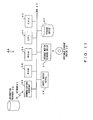
- FIG. 17 shows an example of the hardware environment of an information processing device 20 for executing the arithmetic program of the scalar multiplication according to the embodiments of the present invention.
- BIOS basic program
- BIOS is stored in ROM 24 connected to two CPUs 22 and 23 through a bus 21.
- the program is also stored in a storage device 25 such as a hard disk connected to the CPUs 22 and 23 through the bus 21, copied to RAM 26, and executed by the CPUs 22 and 23.
- a storage medium reading device 27 reads the program from a portable storage medium 28 such as a flexible disk, CD-ROM, DVD, etc., and allows the information processing device 20 to install it, or reads the program directly from the portable storage medium 28 for execution by the CPUs 22 and 23.
- An input/output device 29 comprises a keyboard, a mouse, a template, a display, etc., transmits an instruction from a user of the information processing device 20 to the CPUs 22 and 23, and presents an arithmetic result from the CPUs 22 and 23 to the user.
- a communications interface 30 connects the information processing device 20 to an information provider 32 through a network 31.
- the information provider 32 can store the program in the server device, etc. to download it to the information processing device 20 through the network 31.
- An embodiment of the present invention can be applied not only to the above mentioned binary expression of a natural number d, but also to any arithmetic method of the scalar multiplication in which an elliptic curve addition and an elliptic curve doubling can be concurrently performed.
- An embodiment of the present invention can perform scalar multiplication at a high speedy, and Improve the resistance to side channel attacks.
Landscapes
- Physics & Mathematics (AREA)
- Engineering & Computer Science (AREA)
- General Physics & Mathematics (AREA)
- Mathematical Analysis (AREA)
- Mathematical Optimization (AREA)
- Pure & Applied Mathematics (AREA)
- Computational Mathematics (AREA)
- Theoretical Computer Science (AREA)
- Computing Systems (AREA)
- Mathematical Physics (AREA)
- General Engineering & Computer Science (AREA)
- Complex Calculations (AREA)
- Image Generation (AREA)
Claims (23)
- Kryptosystem-Vorrichtung, basierend auf elliptischen Kurven, die umfasst:eine Erlangungseinheit, die dafür ausgelegt ist, um x- und y-Koordinaten eines Punktes P auf einer elliptischen Kurve, die in einem affinen Koordinatensystem definiert ist, über ein endliches Feld und einen Schlüssel zu erlangen, der eine natürliche Zahl d von n Bits ist, wovon jedes Bit entweder 0 oder 1 ist; undeine Arithmetikeinheit, die dafür ausgelegt ist, um ein Resultat der Skalarmultiplikation d×P zu erzeugen, indem:a) eine Variable Q[0] auf einen Wert initialisiert wird, der wenigstens eine x-Koordinaten-Komponente hat, die die erlangte x-Koordinate des Punktes P ist, eine Variable Q[1] auf einen Wert initialisiert wird, der auch wenigstens eine x-Koordinaten-Komponente hat, die eine x-Koordinate eines Punktes 2×P ist, und eine Variablen i auf den Wert n-2 initialisiert wird;b) eine Additionsoperation auf der elliptischen Kurve ECADD und eine Verdopplungsoperation auf der elliptischen Kurve ECDBL gleichzeitig ausgeführt werden, so dass ein Wert einer Variable Q[2] auf ECDBL(Q[d[i]]) gesetzt wird, wobei d[i] der Wert des i-ten Bits der Zahl d ist, und der Wert der Variable Q[1] auf ECADD(Q[0],Q[1]) gesetzt wird;c) der Wert der Variable Q[0] auf den Wert der Variable Q[2-d[i]] gesetzt wird und der Wert der Variable Q[1] auf den Wert der Variable Q[1+d[i]] gesetzt wird; undd) die Schritte b) und c) noch n-2 Mal wiederholt werden, wobei bei jeder sukzessiven Wiederholung ein Wert von i verwendet wird, der um eins niedriger als der vorhergehende Wert ist,bei der das Resultat x-Koordinaten- und y-Koordinatell-Komponenten umfasst, wobei die ×-Koordinaten-Komponente des Resultates die x-Koordinaten-Komponente des Endwertes der Variable Q[Q] ist.
- Vorrichtung nach Anspruch 1, bei der die Arithmetikeinheit ein erstes Register (11) zum Speichern eines Wertes der Variable Q[0] und ein zweites Register (12) zum Speichern eines Wertes der Variable Q[1] umfasst, welche Vorrichtung so ausgelegt ist, dass:der Wert, der wenigstens die x-Koordinate des Punktes P umfasst, anfangs in das erste Register gesetzt wird;der Wert, der wenigstens die x-Koordinate des Punktes 2xP umfasst, anfangs in das zweite Register gesetzt wird; und im Anschluss an jede Ausführung von Schritt b) das Resultat der betreffenden ECDBL-Operation in dem ersten Register gespeichert wird und das Resultat der betreffenden ECADD-Operation in dem zweiten Register gespeichert wird, wenn d[i]=0 ist, und das Resultat der betreffenden ECDBL-Operation in dem zweiten Register gespeichert wird und das Resultat der betreffenden ECADD-Operation in dem ersten Register gespeichert wird, wenn d[i]=1 ist.
- Vorrichtung nach Anspruch 1, bei der:das endliche Feld die Form GF(p^m) hat, wobei p eine Primzahl größer gleich 5 ist und m eine natürliche Zahl ist; die elliptische Kurve durch die Gleichung y2=x3+ax+b definiert ist, wobei 4a2+27b2≠0 ist;welche Vorrichtung so ausgelegt ist, dass die Werte, auf die die Variablen Q[0], Q[1] und Q[2] gesetzt werden, x-Koordinaten-Komponenten umfassen, aber keine y-Koordinaten-Komponenten; undunter der Bedingung, dass eine Ausgabe der ECADD-Operation durch eine Variable P3 repräsentiert wird, die eine x-Koordinaten-Komponente x3 hat, und unter der Bedingung, dass die zwei Eingaben jener Operation durch Variablen P1 und P2 repräsentiert werden, die jeweilige x-Koordinaten-Komponenten x1 und x2 haben, so dass P3=ECADD(P1,P2) ist, die ECADD-Operation ausgeführt wird, indem die Variable x3 gleich [(x1·x2-a) ^2-4b(x1+x2)] / [x3'·(x1-x2) ^2] gesetzt wird, wobei x3' eine x-Koordinate von P3' ist und P3'=P1-P2=P ist.
- Vorrichtung nach Anspruch 1, bei der:das endliche Feld die Form GF(p^m) hat, wobei p eine Primzahl größer gleich 5 ist und m eine natürliche Zahl ist;die elliptische Kurve durch die Gleichung y2=x3+ax+b definiert ist, wobei 4a3+27b2≠0 ist;welche Vorrichtung so ausgelegt ist, dass die Werte, auf die die Variablen Q[0], Q[1] und Q[2] gesetzt werden, x-Koordinaten-Komponenten umfassen, aber keine y-Koordinaten-Komponenten; undunter der Bedingung, dass eine Ausgabe der ECADD-Operation durch eine Variable P3 repräsentiert wird, die eine x-Koordinaten-Komponente x3 hat, und unter der Bedingung, dass die zwei Eingaben jener Operation durch Variablen P1 und P2 repräsentiert werden, die jeweilige x-Koordinaten-Komponenten x1 und x2 haben, so dass P3=ECADD(P1,P2) ist, die ECADD-Operation ausgeführt wird, indem die Variable x3 gleich [2 (x1+x2) · (x1·x2+a) +4b] / [ (x1-x2) ^2]-x3' gesetzt wird, wobei x3' eine x-Koordinate von P3' ist und P3'=P1-P2=P ist.
- Vorrichtung nach Anspruch 1, bei der:das endliches Feld die Form GF(p^m) hat, wobei p eine Primzahl größer gleich 5 ist und m eine natürliche Zahl ist;die elliptische Kurve durch die Gleichung y2=x3+ax+b definiert ist, wobei 4a3+27b2≠0 ist;welche Vorrichtung so ausgelegt ist, dass die Werte, auf die die Variablen Q[0], Q[1] und Q[2] gesetzt werden, x-Koordinaten-Komponenten umfassen, aber keine y-Koordinaten-Komponenten; und unter der Bedingung, dass eine Ausgabe der ECDBL-Operation durch eine variable P4 repräsentiert wird, die eine x-Koordinaten-Komponente x4 hat, und unter der Bedingung, dass die Eingabe jener Operation durch eine Variable P1 repräsentiert wird, die eine x-Koordinaten-Komponente x1 hat, so dass P4=ECDBL(P1) ist, die ECDBL-Operation ausgeführt wird, indem die Variable x4 gleich [(x10^2-a)^2-8bx1]/[4(x1^3+ ax1+b)] gesetzt wird.
- Vorrichtung nach Anspruch 1, bei der:das endliche Feld die Form GF(p^m) hat, wobei p eine Primzahl größer gleich 5 ist und m eine natürliche Zahl ist;die elliptische Kurve durch die Gleichung y2=x3+ax+b definiert ist, wobei 4a1+27b2#0 ist;welche Vorrichtung so ausgelegt ist, dass die Werte, auf die die Variablen Q[0], Q[1] und Q[2] gesetzt werden, x-Koordinaten-Komponenten umfassen, aber keine y-Koordinaten-Komponenten;die x-Koordinaten-Komponente des Resultates der Endwert der Variable Q[0] ist;unter der Bedingung, dass die Ausgabe der ECADD-Operation durch eine Variable P3 repräsentiert wird, die eine x-Koordinaten-Komponente x3 hat, und unter der Bedingung, dass die zwei Eingaben jener Operation durch Variablen P1 und P2 repräsentiert werden, die jeweilige x-Koordinaten-Komponenten x1 und x2 haben, so dass P3=ECADD(P1,P2) ist, die ECADD-Operation ausgeführt wird, indem die Variable x3 gleich [(x1·x2-a) ^2-4b (x1+x2) ] / [x3' · (x1-x2) ^2] gesetzt wird, wobei x3' eine x-Koordinate von P3' ist und P3'=P1-P2=P ist;unter der Bedingung, dass eine Ausgabe der ECDBL-Operation durch eine Variable P4 repräsentiert wird, die eine x-Koordinaten-Komponente x4 hat, und unter der Bedingung, dass die Eingabe jener Operation durch eine Variable P1 mit der x-Koordinaten-Komponente x1 repräsentiert wird, so dass P4=ECDBL(P1) ist, die ECDBL-Operation ausgeführt wird, indem die Variable x4 gleich [(x1^2-a)^2-8bx1]/[4(x1^3+ax1+b)] gesetzt wird; undunter der Bedingung, dass die y-Koordinaten-Komponente des Resultates durch eine Variable y[d] repräsentiert wird, jene Komponente erlangt wird, indem die Variable y[d] gleich [y^2+x[d]^3+ax[d]+b-(x-x[d])^2·(x+x[d]+x[d+1])]/[2y] gesetzt wird, wobei der Wert der Variable x[d] gleich dem Endwert der Variable Q[0] ist und der Wert der Variable x[d+1] gleich dem Endwert der Variable Q[1] ist.
- Vorrichtung nach Anspruch 1, bei der:das endliche Feld die Form CF(p^m) hat, wobei p eine Primzahl größer gleich 5 ist und m eine natürliche Zahl ist; die elliptische Kurve durch die Gleichung y'=x3+ax+b definiert ist, wobei 4a3+27b2≠0 ist;die Werte, auf die die Variablen Q[0], Q[1] und Q[2] gesetzt werden, x-Koordinaten-Komponenten umfassen, aber keine y-Koordinaten-Komponenten;die x-Koordinaten-Komponente des Resultates der Endwert der Variable Q[0] ist;welche Vorrichtung so ausgelegt ist, dass unter der Bedingung, dass eine Ausgabe der ECADD-Operation durch eine Variable P3 repräsentiert wird, die eine x-Koordinaten-Komponente x3 hat, und unter der Bedingung, dass die zwei Eingaben jener Operation durch Variablen P1 und P2 repräsentiert werden, die jeweilige x-Koordinaten-Komponenten x1 und x2 haben, so dass P3-ECADD(P1,P2) ist, die ECADD-Operation ausgeführt wird, indem die Variable x3 gleich [2(x1+x2)·(x1·x2+a)+4b]/[(x1-x2)^2]-x3' gesetzt wird, wobei x3' eine x-Koordinate von P3' ist und P3'=P1-P2=p ist; unter der Bedingung, dass eine Ausgabe der ECDBL-Operation durch eine Variable P4 repräsentiert wird, die eine x-Koordinaten-Komponente x4 hat, und unter der Bedingung, dass die Eingabe jener Operation durch die Variable P1 mit der x-Koordinaren-Komponente x1 repräsentiert wird, so dass P4=ECDBL(P1) ist, die ECDBL-Operation ausgeführt wird, indem die Variable x4 gleich [(x1^2-a)^2-8bx1]/[4(x1^3+ax1+b)] gesetzt wird; undunter der Bedingung, dass die y-Koorditiaten-Komponente des Resultates durch eine Variable y[d] repräsentiert wird, jene Komponente erlangt wird, indem die Variable y[d] gleich [y^2+x [d] ^3+ax [d] +b- (x-x [d] ) ^2· (x+x [d]+x [d+1] ) ] / [2y] gesetzt wird, wobei der Wert der Variable x[d] gleich dem Endwert der Variable Q[0] ist und der Wert der Variable x[d+1] gleich dem Endwert der Variable Q[1] ist.
- Kryptosystem-Vorrichtung, basierend auf elliptischen Kurven, die umfasst:eine Erlangungseinheit, die dafür ausgelegt ist, um X-, Y- und Z-Koordinaten eines Punktes P auf einer elliptischen Kurve, die in einem projektiven Koordinatensystem definiert ist, über ein endliches Feld und einen Schlüssel zu erlangen, der eine natürliche Zahl d von n Bits ist, wovon jedes Bit entweder 0 oder 1 ist; undeine Arithmetikeinheit, die dafür ausgelegt ist, um ein Resultat der Skalarmultiplikation d×P zu erzeugen, indem:a) eine Variable Q[0] auf einen Wert initialisiert wird, der wenigstens x- und Z-Koordinaten-Komponenten hat, die die erlangten X- und Z-Koordinaten des Punktes P sind, eine Variable Q[1] auf einen Wert initialisiert wird, der auch wenigstens X- und Z-Koordinaten-Komponenten hat, die X- und Z-Koordinaten eines Punktes 2xP sind, und eine Variable i auf den Wert n-2 initialisiert wird;b) eine Additionsoperation auf der elliptischen Kurve ECADD und eine Verdopplungsoperation auf der elliptischen Kurve ECDBL gleichzeitig ausgeführt werden, so dass ein Wert einer Variable Q[2] auf ECDBL(Q[d[i]]) gesetzt wird, wobei d[i] der Wert des i-ten Bis der Zahl d ist, und der Wert der Variable Q[1] auf ECADD(Q[0],Q[1]) gesetzt wird;c) der Wert der Variable Q[0] auf den Wert der Variable Q[2-d[i]] gesetzt wird und der Wert der Variable Q[1] auf den Wert der Variable Q[1+d[ij] gesetzt wird; undd) die Schritte b) und c) noch n-2 Mal wiederholt werden, wobei bei jeder sukzessiven Wiederholung ein Wert von i verwendet wird; der um eins niedriger als der vorhergehende Wert ist,bei der das Resultat X-, Y- und Z-Koordinaten-Komponenten umfasst, wobei die X- und Z-Koordinaten-Komponenten des Resultates die X- und Z-Koordinaten-Komponenten des Endwertes der Variable Q[0] sind.
- Vorrichtung nach Anspruch 8, bei der die Arithmetikeinheit ein erstes Register (11) zum Speichern eines Wertes der Variable Q[0] und ein zweites Register (12) zum Speichern eines Wertes der Variable Q[1] umfasst, welche Vorrichtung so ausgelegt ist, dass:der Wert, der wenigstens die X- und 2-Koordinaten des Punktes P umfasst, anfangs in das erste Register gesetzt wird;der Wert, der wenigstens die X- und Z-Koordinaten des Punktes 2×P umfasst, anfangs in das zweite Register gesetzt wird; undim Anschluss an jede Ausführung von Schritt b) das Resultat der betreffenden ECDBL-Operation in dem ersten Register gespeichert wird und das Resultat der betreffenden ECADD-Operation in dem zweiten Register gespeichert wird, wenn d[i]=0 ist, und das Resultat der betreffenden ECDBL-Operation in dem zweiten Register gespeichert wird und das Resultat der betreffenden ECADD-Operation in dem ersten Register gespeichert wird, wenn d[i]=1 ist.
- Vorrichtung nach Anspruch 8, bei der:das endliche Feld die Form GF(p^m) hat, wobei p eine Primzahl größer gleich 5 ist und m eine natürliche Zahl ist;die elliptische Kurve durch die Gleichung Y2Z=X3+aXZ3+bZ3 definiert ist, wobei 4a3+27b2≠0 ist;welche Vorrichtung so ausgelegt ist, dass die Werte, auf die die Variablen Q[0], Q[1] und Q[2] gesetzt werden, X-und Z-Koordinaten-Komponenten umfassen, aber keine Y-Koordinaten-Komponenten;unter der Bedingung, dass eine Ausgabe der ECADD-Operation durch eine Variable P3 repräsentiert wird, die eine X-Koordinate X3 und eine Z-Koordinaten-Komponente Z3 hat, und unter der Bedingung, dass die zwei Eingaben jener Operation durch Variablen P1 und P2 repräsentiert werden, die jeweilige X- und Z-Koordinaten-Komponenten X1, Z1, X2 und Z2 haben, so dass P3=ECADD(P1,P2) ist, die ECADD-Operation ausgeführt wird, indem die Variable X3 gleich Z3'·[(x1·X2-aZ1·Z2)^2-4bZ1·Z2 (X1·Z2+X2·Z1)] gesetzt wird und die Variable Z3 gleich X3'·[ (X1·Z2-X2·Z1) ^2] gesetzt wird, wobei X3' eine X-Koordinaten-Komponente von P3' ist und Z3' eine Z-Koordinaten-Komponente von P3' ist und P3'=P1-P2=P, Z3'#0 und X1·Z2≠X2·Z1 in dem projektiven Koordinatensystem ist.
- Vorrichtung nach Anspruch 8, bei der:das endliche Feld die Form GF(p^m) hat, wobei p eine Primzahl größer gleich 5 ist und m eine natürliche Zahl ist;die elliptische Kurve durch die Gleichung Y2Z=X3+aXZ3+bZ3 definiert ist, Wobei 4a3+27b2≠0 ist;welche Vorrichtung so ausgelegt ist, dass die Werte, auf die die Variablen Q[0], Q[1] und Q[2] gesetzt werden, X-und Z-Koordinaten-Komponenten umfassen, aber keine Y-Koordinatcn-Komponenten;unter der Bedingung, dass eine Ausgabe der ECADD-Operation durch eine Variable P3 repräsentiert wird, die eine X-Koordinaten-Komponente X3 und eine Z-Koordinaten-Komponente Z3 hat, und unter der Bedingung, dass die zwei Eingaben jener Operation durch Variablen P1 und P2 repräsentiert werden, die jeweilige X- und Z-Koordinaten-Komponenten X1, Z1, X2 und Z2 haben, so dass P3=ECADD(P1,P2) ist, die ECADD-Operation ausgeführt wird, indem die Variable X3 gleich Z3'·[(X1-X2-aZ1·Z2) ^2-4bZ1·Z2 (X1·Z2+X2·Z1)] gesetzt wird und die Variable Z3 gleich X3'· [(X1·Z2-X2·Z1) ^2] gesetzt wird, wobei X3' eine X-Koordinaten-Komponente von P3' ist und Z3' eine Z-Koordinaten-Komponente von P3' ist und P3'=P1-P2=P, 23'≠0 und X1·Z2≠X2·Z1 in dem projektiven Koordinatensystem ist;unter der Bedingung, dass eine Ausgabe der ECDBL-Operation durch eine Variable P4 repräsentiert wird, die X- und Z-Koordinaten-Komponenten X4 und Z4 hat, und unter der Bedingung, dass die Eingabe jener Operation durch die Variable P1 repräsentiert wird, die die Komponenten X1 und Z1 hat, so dass P4=ECDBL(P1) ist, die ECDBL-Operation ausgeführt wird, indem die Variable X4 gleich [(X1^2-aZ1^2)^2-8bX1·Z1^3] gesetzt wird und die Variable 24 gleich [4(X1·Z1×(X1^2+aZ1^2)+ bZ1^4)] gesetzt wird; undunter der Bedingung, dass:die X-Koordinaten-Komponente des Resultates durch eine Variable X[d] repräsentiert wird;die Y-Koordinaten-Komponente des Resultates durch eine Variable Y[d] repräsentiert wird;die Z-Koordinaten-Komponente des Resultates durch eine Variable Z[d] repräsentiert wird;eine X-Koordinaten-Komponente einer Variable P[d+1] durch eine Variable X[d+1] repräsentiert wird und eine Z-Koordinaten-Komponente der Variable P(d+1] durch eine Variable Z[d+1] repräsentiert wird, wobei P[d+1]=(d+1)×P ist; undX[d+1] und Z[d+1] gleich den X-Koordinaten- und Z-Koordinaten-Komponenten des Endwertes der Variable Q[1] sind,die Komponente Y[d] gemäß der Gleichung Y'[d]=PY[d] erlangt wird, indem die Variable Y'[d] gleich Z [d+1] · (y^2·Z [d] ^3+X [d] ^3+aX [d] · Z [d] ^2+b·Z [d] ^3) - (x·Z [d] - X [d] ) ^2· (x·z [d] ·Z [d+1] +X[d] ·Z [d+1] +x [d+1] ·Z [d] gesetzt wird, wobei r einen vorbestimmton Wert hat.
- Vorrichtung nach Anspruch 8, bei der:das endliche Feld die Form GF(p^m) hat, wobei p eine Primzahl größer gleich 5 ist und m eine natürliche Zahl ist;die elliptische Kurve durch die Gleichung Y2Z-X3+aXZ1+bZ3 definiert ist, wobei 4a3+27b2≠0 ist;welche Vorrichtung so ausgelegt ist, dass die Werte, auf die die Variablen Q[0], Q[1] und Q[2] gesetzt werden, X-und Z-Koordinaten-Komponenten umfassen, aber keine Y-Koordinaten-Komponenten;unter der Bedingung, dass eine Ausgabe der ECADD-Operation durch eine Variable P3 repräsentiert wird, die eine X-Koordinaten-Komponente X3 und eine Z-Koordinaten-Komponente Z3 hat, und unter der Bedingung, dass die zwei Eingaben jener Operation durch Variablen P1 und P2 repräsentiert werden, die jeweilige X- und Z-Koordinaten-Komponenten X1, Z1, X2 und Z2 haben, so dass P3=ECADD(P1,P2) ist, die ECADD-Operation ausgeführt wird, indem die Variable X3 gleich Z3'·[2(X1·Z2+X2·Z1)·(X1·X2+aZ1·Z2)-4bZ1^2·Z2^2]-X3'·[(X1·22-X2·Z1)^2] gesetzt wird und die Variable Z3 gleich 23'·[(X1·Z2-X2·Z1)^2] gesetzt wird, wobei X3' eine X-Koordinaten-Komponente von P3' ist und Z:3' eine Z-Koordinaten-Komponente von P3' ist und P3'=P1-P2=P, Z3'≠0 und X1·Z2≠X2·Z1 in dem projektiven Koordinatensystem ist;unter der Bedingung, dass eine Ausgabe der ECDBL-Operation durch eine Variable P4 repräsentiert wird, die X- und Z-Koordinaten-Komponenten X4 und Z4 hat, und unter der Bedingung, dass die Eingabe jener Operation durch die Variable P1 repräsentiert wird, die die Komponenten X1 und Z1 hat, so dass P4=ECDBL(P1) ist, die ECDBI,-Operation ausgeführt wird, indem die Variable X4 gleich [(X1^2-aZ1^2)^2-8bX1·Z1^3] gesetzt wird und die Variable Z4 gleich [4 (X1·Z1· (X1^2+aZ1^2)+ bZ1^4)] gesetzt wird, wobei Z1≠0 in dem projektiven Koordinatensystem ist; undunter der Bedingung, dass:die X-Koordinaten-Komponente des Resultates durch eine Variable X [d] repräsentiert wird;die Y-Koordinaten-Komponente des Resultates durch eine Variable Y[d] repräsentiert wird;die Z-Koordinaten-Komponente des Resultates durch eine Variable Z [d] repräsentiert wird; eine X-Koordinaten-Komponente einer Variable P[d+1] durch eine Variable X[d+1] repräsentiert wird und eine Z-Koordinaten-Komponente der Variable P[d+1] durch eine Variable G[d+1] repräsentiert wird, wobei P[d+1]=(d+1)×P ist; undX[d+1] und Z[d+1] gleich den X-Koordinaten- und Z-Koordinaten-Komponenten des Endwertes der Variable Q[1] sind,die Komponente Y[d] gemäß der Gleichung Y'[d]=rY[d] erlangt wird, indem die Variable Y'[d] gleich Z [d+1]·(y^2·Z[d]^3+X[d]^3+aX[d]·Z[d]^2+b·Z[d]^3)-(x·Z[d]-X[d])^2·(x·Z[d]·z[d+1]+X[d]·Z[d+1]+X[d+1]·2[d] gesetzt wird, wobei r einen vorbestimmten Wert hat.
- Vorrichtung nach Anspruch 8, bei der:das endliche Feld die Form GF (p^m) hat, wobei p eine Primzahl größer gleich 5 ist und m eine natürliche Zahl ist;die elliptische Kurve durch die Gleichung Y2Z=X2+aXZ2+bZ3 definiert ist, wobei 4a3+27b2≠0 ist;welche Vorrichtung so ausgelegt ist, dass die Werte, auf die die Variablen Q[0], Q[1] und Q[2] gesetzt werden, X-und Z-Koordinaten-Komponenten umfassen, aber keine Y-Koordinaten-Komponenten; undunter der Bedingung, dass:eine Ausgabe der ECADD-Operation durch eine Variable P3 repräsentiert wird, die eine X-Koordinaten-Komponente X3 und eine Z-Koordinaten-Komponente Z3 hat, und unter der Bedingung, dass die zwei Eingaben jener Operation durch Variablen P1 und P2 repräsentiert werden, die jeweilige x-und Z-Koordinaten-Komponenten X1, Z1, X2 und 22 haben, so dass P3=ECADD(P1,P2) ist; undeine Ausgabe der ECDBL-Operation durch eine Variable P4 repräsentiert wird, die X- und Z-Koordinaten-Komponenten X4 und Z4 hat, und unter der Bedingung, dass die Eingabe jener Operation durch die Variable P1 repräsentiert wird, die die Komponenten X1 und Z1 hat, so dass P4-ECDBL(P1) ist;der Schritt b) durch einen ECADDDBL-Algorithmus berechnet wird, der die Operationen umfasst:1) T1←X1×X22) T2←Z1xZ23) T3←X1×Z24) T1←X2×Z15) T5←T3+T46) T6< a×T27) T7←T1|T68) T8←T5xT79) T9←2T810) T10←T2^211) T11←bxT1012) T12←4T1113) T13←T9+T*1214) T14←T3-T415) T15←T14^*216) T16←Z3'xT1317) T17←X3'×T1518) X3←T16-T1719) Z3←Z3'×T1520) T21←T3^221) T22← T6×T222) T23←T21-T22.23) T24←T23^224) T25←T1125) T26←T25×T226) T27←T26×T327) T28←8×T2728) X4←T24-T2829) T29←T21+T2230) T30←T3×T2931) T31←T30+T2632) T32←T2×T3133) Z4←4T32so dass der wert der Variable Q[1] auf den Wert der Variable P3 gesetzt wird, die die Komponenten X3 und Z3 hat, wie durch den Algorithmus berechnet, und der Wert der Variable Q[2] auf den Wert der Variable P4 gesetzt wird, die die Komponenten X4 und Z4 hat, wie durch den Algorithmus berechnet, wobei X3' eine X-Koordinaten-Komponente von P3' ist und Z3' eine Z-Koordinaten-Komponente von P3' ist, P3'=P1-P2=P, Z3'≠0 und X1-Z2≠X2-Z1 in dem projektiven Koordinatensystem ist.
- Vorrichtung nach Anspruch 13, bei dem dann, wenn Z3'=1 ist, die Arithmetikeinheit dafür ausgelegt ist, um die Operationen 1) bis 33) unter Verwendung von Z3'=1 auszuführen.
- Arithmetisches, auf einem Computer implementiertes Verfahren, das zur Verwendung in einem auf elliptischen Kurven basierenden Kryptosystem geeignet ist, welches Verfahren umfasst:Erlangen von x- und y-Koordinaten eines Punktes P auf einer elliptischen Kurve, die in einem affinen Koordinatensystem definiert ist, über ein endliches Feld und einen Schlüssel, der eine natürliche Zahl d von n Bits ist, wovon jedes Bit entweder 0 oder 1 ist; undErzeugen eines Resultates der Skalarmultiplikation d×P durch:a) Initialisieren einer Variable Q[0] auf einen Wert, der wenigstens eine x-Koordinaten-Komponente hat, die die erlangte x-Koordinate des Punktes P ist, Initialisieren einer Variable Q[1] auf einen Wert, der auch wenigstens eine x-Koordinaten-Komponente hat, die eine x-Koordinate eines Punktes 2xP ist, und Initialisieren einer Variable i auf den Wert n-2;b) gleichzeitiges Ausführen einer Additionsoperation auf der elliptischen Kurve ECADD und einer Verdopplungsoperation auf der elliptischen Kurve ECDBL, so dass ein Wert einer Variable Q[2] auf ECDBL(Q[d[i]]) gesetzt wird, wobei d[i] der Wert des i-ten Bits der Zahl d ist, und der Wert der Variable Q[1] auf ECADD(Q[0],Q[1]) gesetzt wird;c) Setzen des Wertes der Variable Q[0] auf den Wert der Variable Q[2-d[i]] und Setzen des Wertes der Variable Q[1] auf den Wert der Variable Q[1+d[i]]; undd) Wiederholen der Schritte b) und c) noch n-2 Mal, wobei bei jeder sukzessiven Wiederholung ein Wert von i verwendet wird, der um eins niedriger als der vorhergehend Wert ist, bei dem das Resultat x-Koordinaten- und y-Koordinaten-Komponenten umfasst, wobei die x-Koordinaten-Komponente des Resultates die x-Koordinaten-Komponente des Endwertes der Variable Q[0] ist.
- Verfahren nach Anspruch 15, ferner mit der Verwendung eines ersten Registers (11), um einen Wert der Variable Q[0] zu speichern, und eines zweiten Registers (12), um einen Wert der Variable Q[1] zu speichern, so dass:der Wert, der wenigstens die x-Koordinate des Punktes P umfasst, anfangs in das erste Register gesetzt wird;der Wert, der wenigstens die x-Koordinate des Punktes 2xP umfasst, anfangs in das zweite Register gesetzt wird; und im Anschluss an jede Ausführung von Schritt b) das Resultat der betreffenden ECDBL-Operation in dem ersten Register gespeichert wird und das Resultat der betreffenden ECADD-Operation in dem zweiten Register gespeichert wird, wenn d[i]=0 ist, und das Resultat der betreffenden ECDBL-Operation in dem zweiten Register gespeichert wird und das Resultat der betreffenden ECADD-Operation in dem ersten Register gespeichert wird, wenn d[i]=1 ist.
- Arithmetisches, auf einem Computer implementiertes Verfahren, das zur Verwendung in einem auf elliptischen Kurven basierenden Kryptosystem geeignet ist, welches Verfahren umfasst:Erlangen von X-, Y- und Z-Koordinaten eines Punktes P auf einer elliptischen Kurve, die in einem projektiven Koordinatensystem definiert ist, über ein endliches Feld und einen Schlüssel, der eine natürliche Zahl d von n Bits ist, wovon jedes Bit entweder 0 oder 1 ist; undErzeugen eines Resultates der Skalarmultiplikation dxP durch:a) Initialisieren einer Variable Q[0] auf einen Wert, der wenigstens X- und Z-Koordinaten-Komponenten hat, die die erlangten X- und Z-Koordinaten des Punktes sind, Initialisieren einer Variable Q[1] auf einen Wert, der auch wenigstens X- und Z-Koordinaten-Komponenten hat, die X- und Z-Koordinaten eines Punktes 2xP sind, und Initialisieren einer variable i auf den Wert n-2;b) gleichzeitiges Ausführen einer Additionsoperation auf der elliptischen Kurve ECADD und einer Verdopplungsoperation auf der elliptischen Kurve ECDDL, so dass ein Wert einer Variable Q[2] auf ECDBL(Q[d[i]]) gesetzt wird, wobei d[i] der Wert des i-ten Bits der Zahl d ist, und der Wert der Variable Q[1] auf ECADD(Q[0],Q[1]) gesetzt wird;c) Setzen des Wertes der Variable Q[0] auf den Wert der Variable Q[2-d[i]] und Setzen des Wertes der Variable Q[1] auf den Wert der Variable Q[1+d[i]]; undd) Wiederholen der Schritte b) und c) noch n-2 Mal, wobei bei jeder sukzessiven Wiederholung ein Wert von i verwendet wird, der um eins niedriger als der vorhergehende Wert ist, bei dem das Resultat X-, Y- und Z-Koordinaten-Komponenten umfasst, wobei die X- und Z-Koordinaten-Komponenten des Resultates die X- und Z-Koordinaten-Komponenten des Endwertes der Variable Q[0] sind.
- Verfahren nach Anspruch 17, ferner mit der Verwendung eines ersten Registers (11), um einen Wert der Variable Q[0] zu speichern, und eines zweiten Registers (12), um einen Wert der Variable Q[1] zu speichern, so dass:der Wert, der wenigstens die X- und Z-Koordinaten des Punktes P umfasst, anfangs in das erste Register gesetzt wird;der Wert, der wenigstens die X- und Z-Koordinaten des Punktes 2xP umfasst, anfangs in das zweite Register gesetzt wird; und im Anschluss an jede Ausführung von Schritt b) das Resultat der betreffenden ECDBL-Operation in dem ersten Register gespeichert wird und das Resultat der betreffenden ECADD-Operation in dem zweiten Register gespeichert wird, wenn d[i]=0 ist, und das Resultat der betreffenden ECDBL-Operation in dem zweiten Register gespeichert wird und das Resultat der betreffenden ECADD-Operation in dem ersten Register gespeichert wird, wenn d[i]=1 ist.
- Computerprogramm, durch das, wenn es in einen Computer geladen ist, der Computer als Vorrichtung nach einem der Ansprüche 1 bis l1 fungiert.
- Computerprogramm, durch das, wenn es auf einem Computer läuft, der Computer ein Verfahren nach einem der Ansprüche 15 bis 18 ausführt.
- Computerprogramm nach Anspruch 19 oder 20, das auf einem Trägermedium getragen wird.
- Computerprogramm nach Anspruch 21, bei dem das Trägermedium ein Übertragungsmedium ist.
- Computerprogramm nach Anspruch 21, bei dem das Trägermedium ein Speichermedium ist.
Applications Claiming Priority (2)
| Application Number | Priority Date | Filing Date | Title |
|---|---|---|---|
| JP2001376516A JP4067818B2 (ja) | 2001-12-10 | 2001-12-10 | 楕円曲線暗号装置、楕円曲線暗号プログラム及び楕円曲線暗号の演算方法 |
| JP2001376516 | 2001-12-10 |
Publications (3)
| Publication Number | Publication Date |
|---|---|
| EP1320027A2 EP1320027A2 (de) | 2003-06-18 |
| EP1320027A3 EP1320027A3 (de) | 2003-12-03 |
| EP1320027B1 true EP1320027B1 (de) | 2009-07-29 |
Family
ID=19184692
Family Applications (1)
| Application Number | Title | Priority Date | Filing Date |
|---|---|---|---|
| EP02258503A Expired - Lifetime EP1320027B1 (de) | 2001-12-10 | 2002-12-10 | Auf elliptischen Kurven basierte Kryptosystemvorrichtung, sowie entsprechendes Verfahren und Programm |
Country Status (5)
| Country | Link |
|---|---|
| US (2) | US7505587B2 (de) |
| EP (1) | EP1320027B1 (de) |
| JP (1) | JP4067818B2 (de) |
| CA (1) | CA2414057A1 (de) |
| DE (1) | DE60233104D1 (de) |
Families Citing this family (35)
| Publication number | Priority date | Publication date | Assignee | Title |
|---|---|---|---|---|
| US20040001590A1 (en) * | 2002-06-27 | 2004-01-01 | Eisentraeger Anne Kirsten | Efficient elliptic curve double-and-add calculator |
| US7961874B2 (en) * | 2004-03-03 | 2011-06-14 | King Fahd University Of Petroleum & Minerals | XZ-elliptic curve cryptography with secret key embedding |
| US7379546B2 (en) * | 2004-03-03 | 2008-05-27 | King Fahd University Of Petroleum And Minerals | Method for XZ-elliptic curve cryptography |
| US7961873B2 (en) * | 2004-03-03 | 2011-06-14 | King Fahd University Of Petroleum And Minerals | Password protocols using XZ-elliptic curve cryptography |
| JP4668931B2 (ja) | 2005-01-24 | 2011-04-13 | 富士通株式会社 | 電力解析攻撃に対する耐タンパ性を持った暗号化処理装置 |
| CN100437611C (zh) * | 2005-08-03 | 2008-11-26 | 武汉理工大学 | 一种基于椭圆曲线的可控授权电子签名方法 |
| DE602005020702D1 (de) | 2005-10-18 | 2010-05-27 | Telecom Italia Spa | Verfahren zur skalarmultiplikation in gruppen elliptischer kurven über primkörpern für nebenkanal-attacken-beständige kryptosysteme |
| DE602005020991D1 (de) | 2005-10-28 | 2010-06-10 | Telecom Italia Spa | Verfahren zur skalarmultiplikation in gruppen ellir nebenkanalattacken-beständige kryptosysteme |
| ATE507625T1 (de) | 2005-11-03 | 2011-05-15 | Certicom Corp | Verfahren zur gleichzeitigen skalarmultiplikation |
| US9137012B2 (en) * | 2006-02-03 | 2015-09-15 | Emc Corporation | Wireless authentication methods and apparatus |
| KR100850202B1 (ko) * | 2006-03-04 | 2008-08-04 | 삼성전자주식회사 | Ecc 패스트 몽고매리 전력 래더 알고리즘을 이용하여dfa 에 대응하는 암호화 방법 |
| DE102006014353B4 (de) | 2006-03-28 | 2007-11-22 | Siemens Ag | Verfahren zum sicheren Ermitteln von Daten |
| US7864951B2 (en) * | 2006-07-10 | 2011-01-04 | King Fahd University Of Petroleum And Minerals | Scalar multiplication method with inherent countermeasures |
| US7983415B2 (en) * | 2006-12-19 | 2011-07-19 | King Fahd University Of Petroleum And Minerals | Method for performing iterative scalar multiplication which is protected against address bit attack |
| US7856101B2 (en) * | 2007-02-07 | 2010-12-21 | King Fahd University Of Petroleum And Minerals | Method for elliptic curve scalar multiplication |
| US8160245B2 (en) | 2007-03-07 | 2012-04-17 | Research In Motion Limited | Methods and apparatus for performing an elliptic curve scalar multiplication operation using splitting |
| US8050403B2 (en) * | 2007-03-06 | 2011-11-01 | Research In Motion Limited | Method and apparatus for generating a public key in a manner that counters power analysis attacks |
| US8243919B2 (en) * | 2007-03-07 | 2012-08-14 | Research In Motion Limited | Method and apparatus for performing elliptic curve scalar multiplication in a manner that counters power analysis attacks |
| US8102998B2 (en) * | 2007-05-02 | 2012-01-24 | King Fahd University Of Petroleum And Minerals | Method for elliptic curve scalar multiplication using parameterized projective coordinates |
| JP5000399B2 (ja) * | 2007-06-28 | 2012-08-15 | ルネサスエレクトロニクス株式会社 | 楕円曲線演算装置および楕円曲線演算方法 |
| US8369517B2 (en) * | 2008-08-12 | 2013-02-05 | Inside Secure | Fast scalar multiplication for elliptic curve cryptosystems over prime fields |
| KR101006358B1 (ko) * | 2008-11-13 | 2011-01-10 | 단국대학교 산학협력단 | 실수체 기반의 타원 곡선 암호 시스템 및 그 방법 |
| US8184803B2 (en) * | 2008-12-29 | 2012-05-22 | King Fahd University Of Petroleum And Minerals | Hash functions using elliptic curve cryptography |
| US20100169658A1 (en) * | 2008-12-30 | 2010-07-01 | Lahouari Ghouti | Elliptic curve-based message authentication code |
| US8542820B2 (en) * | 2009-02-05 | 2013-09-24 | Infineon Technologies Ag | Apparatus for calculating a result of a scalar multiplication |
| US8755517B2 (en) | 2010-12-08 | 2014-06-17 | Total Technology Solutions Co. | Method for generic-point parallel elliptic curve scalar multiplication |
| US9400636B2 (en) * | 2011-02-11 | 2016-07-26 | Infineon Technologies Ag | Apparatus and method for calculating a result in a scalar multiplication |
| US8804952B2 (en) | 2012-12-26 | 2014-08-12 | Umm Al-Qura University | System and method for securing scalar multiplication against differential power attacks |
| US8861721B2 (en) * | 2012-12-26 | 2014-10-14 | Umm Al-Qura University | System and method for securing scalar multiplication against simple power attacks |
| CN103929305A (zh) * | 2013-01-16 | 2014-07-16 | 上海华虹集成电路有限责任公司 | Sm2签名算法的实现方法 |
| DE102014204044A1 (de) * | 2014-03-05 | 2015-09-10 | Robert Bosch Gmbh | Verfahren zum Widerrufen einer Gruppe von Zertifikaten |
| US9645794B2 (en) * | 2014-09-23 | 2017-05-09 | Texas Instruments Incorporated | Homogeneous atomic pattern for double, add, and subtract operations for digital authentication using elliptic curve cryptography |
| GB201705749D0 (en) * | 2017-04-10 | 2017-05-24 | Nchain Holdings Ltd | Computer-implemented system and method |
| CN108875416B (zh) * | 2018-06-22 | 2020-05-19 | 北京智芯微电子科技有限公司 | 椭圆曲线多倍点运算方法和装置 |
| CN115344525B (zh) * | 2022-08-16 | 2023-04-18 | 江南信安(北京)科技有限公司 | 一种椭圆曲线点加硬件加速方法及装置 |
Family Cites Families (8)
| Publication number | Priority date | Publication date | Assignee | Title |
|---|---|---|---|---|
| US6307935B1 (en) | 1991-09-17 | 2001-10-23 | Apple Computer, Inc. | Method and apparatus for fast elliptic encryption with direct embedding |
| US6038581A (en) * | 1997-01-29 | 2000-03-14 | Nippon Telegraph And Telephone Corporation | Scheme for arithmetic operations in finite field and group operations over elliptic curves realizing improved computational speed |
| DE69905145T2 (de) * | 1998-03-25 | 2003-06-05 | Certicom Corp., Mississauga | Beschleunigte begrenztes-feld-operationen auf einer elliptischen kurve |
| CA2252078C (en) | 1998-10-28 | 2009-02-17 | Certicom Corp. | Power signature attack resistant cryptographic system |
| JP2001290420A (ja) | 2000-02-01 | 2001-10-19 | Fujitsu Ltd | 楕円曲線暗号処理装置及び方法と楕円曲線暗号処理用プログラム及びそのプログラムの記録媒体 |
| JP3821631B2 (ja) | 2000-05-30 | 2006-09-13 | 株式会社日立製作所 | 楕円曲線暗号におけるスカラー倍計算方法及び装置、並びに記憶媒体 |
| US6836784B2 (en) * | 2001-01-17 | 2004-12-28 | Matsushita Electric Industrial Co., Ltd. | Efficient greatest common divisor algorithm using multiprecision arithmetic |
| US7068785B2 (en) * | 2002-02-05 | 2006-06-27 | Matsushita Electric Industrial Co., Ltd. | Table driven method for calculating arithmetic inverse for use in cryptography |
-
2001
- 2001-12-10 JP JP2001376516A patent/JP4067818B2/ja not_active Expired - Fee Related
-
2002
- 2002-12-09 CA CA002414057A patent/CA2414057A1/en not_active Abandoned
- 2002-12-10 US US10/315,244 patent/US7505587B2/en not_active Expired - Fee Related
- 2002-12-10 EP EP02258503A patent/EP1320027B1/de not_active Expired - Lifetime
- 2002-12-10 DE DE60233104T patent/DE60233104D1/de not_active Expired - Lifetime
-
2009
- 2009-02-04 US US12/365,560 patent/US7970131B2/en not_active Expired - Fee Related
Also Published As
| Publication number | Publication date |
|---|---|
| JP4067818B2 (ja) | 2008-03-26 |
| US20090207997A1 (en) | 2009-08-20 |
| EP1320027A3 (de) | 2003-12-03 |
| EP1320027A2 (de) | 2003-06-18 |
| DE60233104D1 (de) | 2009-09-10 |
| CA2414057A1 (en) | 2003-06-10 |
| JP2003177670A (ja) | 2003-06-27 |
| US7970131B2 (en) | 2011-06-28 |
| US20030123656A1 (en) | 2003-07-03 |
| US7505587B2 (en) | 2009-03-17 |
Similar Documents
| Publication | Publication Date | Title |
|---|---|---|
| EP1320027B1 (de) | Auf elliptischen Kurven basierte Kryptosystemvorrichtung, sowie entsprechendes Verfahren und Programm | |
| Owens et al. | Efficient and side-channel resistant Ed25519 on ARM Cortex-M4 | |
| EP1653428B1 (de) | Einrichtung zur verschlüsselung mit elliptischen kurven, verfahren zur verschlüsselung mit elliptischen kurven, programm zur verschlüsselung mit elliptischen kurven und das programm aufzeichnendes computerlesbares aufzeichnungsmedium | |
| US10361854B2 (en) | Modular multiplication device and method | |
| US8402287B2 (en) | Protection against side channel attacks | |
| US6466668B1 (en) | IC card equipped with elliptical curve encryption processing facility | |
| Wook Chung et al. | Fast implementation of elliptic curve defined over GF (pm) on CalmRISC with MAC2424 coprocessor | |
| US20070211894A1 (en) | Encryption processing apparatus, encryption processing method, and computer program | |
| JP2010217880A (ja) | 故障耐性のある楕円曲線上の計算 | |
| CN113141255B (zh) | 用于在处理设备、对应的处理设备和计算机程序产品中对数据执行密码运算的方法 | |
| EP1191740B1 (de) | Verfahren und Vorrichtung zur Hardwarenormalisierung und -entnormalisierung | |
| CN101213513A (zh) | 保护数据处理装置免受密码攻击或分析的设备和方法 | |
| EP1068565B1 (de) | Beschleunigung und sicherheitsverbesserung für koprozessoren zur berechnung einer elliptischen kurve und einer rsa-funktion | |
| EP1687930A1 (de) | Randomisiertes modulares reduktionsverfahren und hardware dafür | |
| US7603558B2 (en) | Montgomery transform device, arithmetic device, IC card, encryption device, decryption device and program | |
| Negre et al. | Efficient regular modular exponentiation using multiplicative half-size splitting | |
| Woodbury | Efficient algorithms for elliptic curve cryptosystems on embedded systems. | |
| Anagreh et al. | Accelerate Performance for Elliptic Curve Scalar Multiplication based on NAF by Parallel Computing. | |
| Hodjat et al. | A scalable and high performance elliptic curve processor with resistance to timing attacks | |
| Batina et al. | Reconfigurable architectures for curve-based cryptography on embedded micro-controllers | |
| JP2004053814A (ja) | 楕円曲線暗号装置及び楕円曲線暗号演算方法 | |
| Liu et al. | Implementation of a resource-constrained ECC processor with power analysis countermeasure | |
| WO2026047012A1 (en) | Optimized key generation for falcon | |
| KR100399048B1 (ko) | 타원곡선 암호화 장치 | |
| CN112487448A (zh) | 一种加密信息处理装置、方法及计算机设备 |
Legal Events
| Date | Code | Title | Description |
|---|---|---|---|
| PUAI | Public reference made under article 153(3) epc to a published international application that has entered the european phase |
Free format text: ORIGINAL CODE: 0009012 |
|
| AK | Designated contracting states |
Designated state(s): AT BE BG CH CY CZ DE DK EE ES FI FR GB GR IE IT LI LU MC NL PT SE SI SK TR |
|
| AX | Request for extension of the european patent |
Extension state: AL LT LV MK RO |
|
| PUAL | Search report despatched |
Free format text: ORIGINAL CODE: 0009013 |
|
| AK | Designated contracting states |
Kind code of ref document: A3 Designated state(s): AT BE BG CH CY CZ DE DK EE ES FI FR GB GR IE IT LI LU MC NL PT SE SI SK TR |
|
| AX | Request for extension of the european patent |
Extension state: AL LT LV MK RO |
|
| 17P | Request for examination filed |
Effective date: 20040407 |
|
| AKX | Designation fees paid |
Designated state(s): DE FR GB |
|
| 17Q | First examination report despatched |
Effective date: 20040906 |
|
| 17Q | First examination report despatched |
Effective date: 20040906 |
|
| GRAP | Despatch of communication of intention to grant a patent |
Free format text: ORIGINAL CODE: EPIDOSNIGR1 |
|
| GRAS | Grant fee paid |
Free format text: ORIGINAL CODE: EPIDOSNIGR3 |
|
| GRAA | (expected) grant |
Free format text: ORIGINAL CODE: 0009210 |
|
| AK | Designated contracting states |
Kind code of ref document: B1 Designated state(s): DE FR GB |
|
| REG | Reference to a national code |
Ref country code: GB Ref legal event code: FG4D |
|
| REF | Corresponds to: |
Ref document number: 60233104 Country of ref document: DE Date of ref document: 20090910 Kind code of ref document: P |
|
| PLBE | No opposition filed within time limit |
Free format text: ORIGINAL CODE: 0009261 |
|
| STAA | Information on the status of an ep patent application or granted ep patent |
Free format text: STATUS: NO OPPOSITION FILED WITHIN TIME LIMIT |
|
| 26N | No opposition filed |
Effective date: 20100503 |
|
| REG | Reference to a national code |
Ref country code: FR Ref legal event code: PLFP Year of fee payment: 14 |
|
| REG | Reference to a national code |
Ref country code: FR Ref legal event code: PLFP Year of fee payment: 15 |
|
| REG | Reference to a national code |
Ref country code: FR Ref legal event code: PLFP Year of fee payment: 16 |
|
| PGFP | Annual fee paid to national office [announced via postgrant information from national office to epo] |
Ref country code: DE Payment date: 20171206 Year of fee payment: 16 Ref country code: FR Payment date: 20171113 Year of fee payment: 16 |
|
| PGFP | Annual fee paid to national office [announced via postgrant information from national office to epo] |
Ref country code: GB Payment date: 20171206 Year of fee payment: 16 |
|
| REG | Reference to a national code |
Ref country code: DE Ref legal event code: R119 Ref document number: 60233104 Country of ref document: DE |
|
| GBPC | Gb: european patent ceased through non-payment of renewal fee |
Effective date: 20181210 |
|
| PG25 | Lapsed in a contracting state [announced via postgrant information from national office to epo] |
Ref country code: FR Free format text: LAPSE BECAUSE OF NON-PAYMENT OF DUE FEES Effective date: 20181231 Ref country code: DE Free format text: LAPSE BECAUSE OF NON-PAYMENT OF DUE FEES Effective date: 20190702 |
|
| PG25 | Lapsed in a contracting state [announced via postgrant information from national office to epo] |
Ref country code: GB Free format text: LAPSE BECAUSE OF NON-PAYMENT OF DUE FEES Effective date: 20181210 |