EP1321128A2 - Schaumförmige Haarbehandlungsmittel - Google Patents
Schaumförmige Haarbehandlungsmittel Download PDFInfo
- Publication number
- EP1321128A2 EP1321128A2 EP02027911A EP02027911A EP1321128A2 EP 1321128 A2 EP1321128 A2 EP 1321128A2 EP 02027911 A EP02027911 A EP 02027911A EP 02027911 A EP02027911 A EP 02027911A EP 1321128 A2 EP1321128 A2 EP 1321128A2
- Authority
- EP
- European Patent Office
- Prior art keywords
- bis
- und
- acid
- amino
- salt
- Prior art date
- Legal status (The legal status is an assumption and is not a legal conclusion. Google has not performed a legal analysis and makes no representation as to the accuracy of the status listed.)
- Granted
Links
Classifications
-
- A—HUMAN NECESSITIES
- A61—MEDICAL OR VETERINARY SCIENCE; HYGIENE
- A61K—PREPARATIONS FOR MEDICAL, DENTAL OR TOILETRY PURPOSES
- A61K8/00—Cosmetics or similar toiletry preparations
- A61K8/18—Cosmetics or similar toiletry preparations characterised by the composition
- A61K8/72—Cosmetics or similar toiletry preparations characterised by the composition containing organic macromolecular compounds
- A61K8/90—Block copolymers
-
- A—HUMAN NECESSITIES
- A61—MEDICAL OR VETERINARY SCIENCE; HYGIENE
- A61K—PREPARATIONS FOR MEDICAL, DENTAL OR TOILETRY PURPOSES
- A61K8/00—Cosmetics or similar toiletry preparations
- A61K8/02—Cosmetics or similar toiletry preparations characterised by special physical form
- A61K8/04—Dispersions; Emulsions
- A61K8/046—Aerosols; Foams
-
- A—HUMAN NECESSITIES
- A61—MEDICAL OR VETERINARY SCIENCE; HYGIENE
- A61Q—SPECIFIC USE OF COSMETICS OR SIMILAR TOILETRY PREPARATIONS
- A61Q5/00—Preparations for care of the hair
- A61Q5/06—Preparations for styling the hair, e.g. by temporary shaping or colouring
- A61Q5/065—Preparations for temporary colouring the hair, e.g. direct dyes
-
- A—HUMAN NECESSITIES
- A61—MEDICAL OR VETERINARY SCIENCE; HYGIENE
- A61Q—SPECIFIC USE OF COSMETICS OR SIMILAR TOILETRY PREPARATIONS
- A61Q5/00—Preparations for care of the hair
- A61Q5/10—Preparations for permanently dyeing the hair
Definitions
- the present invention relates to the use of special compounds for Stabilization of saline foam aerosol formulations as well as saline foam aerosols containing these compounds.
- Foam aerosol preparations have long been used in cosmetics. she are used in almost all areas of cosmetics these days for example shaving foams, hair fixatives, permanent waving agents and colorants often formulated as a foam aerosol.
- Such preparations are usually low viscosity O / W emulsions in their fat phase the propellant is dissolved or emulsified. When this mixture is pushed through the valve , the propellant tries to evaporate back into the more energetically favorable gaseous state. Because the propellant is part of the internal phase of the emulsion, the gas cannot immediately escape and form within the Emulsion gas bubbles so that a foam is created.
- a first subject of the present invention is therefore the use of compounds of formula (I) RO- (C 2 H 4 -O) x - (C 3 H 6 -O) y -H where R stands for a linear or branched alkyl radical with 8 to 30 carbon atoms, x stands for an integer from 0 to 50 and y stands for an integer from 0 to 25, with the proviso that at least one of the variables x or y is different from zero, for the stabilization of saline, cosmetic foam aerosol formulations.
- the alkylene oxide addition products have proven to be preferred compounds of the formula (I) to saturated fatty alcohols which branched linearly or methyl in the 2-position are proven.
- the alkyl radical R preferably has 8 to 22 carbon atoms.
- alkyl radicals are 1-octyl, 1-decyl, 1-lauryl, 1-myristyl, 1-cetyl and 1-stearyl.
- 1-Lauryl, 1-myristyl, 1-cetyl and 1-stearyl are particularly preferred.
- the compounds of the formula (I) with alkyl groups used can be in each case act as uniform substances. However, it is usually preferred at Manufacture of these substances from native vegetable or animal raw materials to go out, so that you can mix substances with different, from the respective raw material dependent alkyl chain lengths.
- Preferred compounds of the formula (I) are, for example, those under the INCI names PPG-2-Ceteareth-9, PPG-4-Ceteareth-12, PPG-10-Ceteareth-20, PPG-1-Ceteth-1, PPG-1-Ceteth-5, PPG-1-Ceteth-10, PPG-1-Ceteth-20, PPG-2-Ceteth-1, PPG-2-Ceteth-5, PPG-2-Ceteth-10, PPG-2-Ceteth-20, PPG-4-Ceteth-1, PPG-4-Ceteth-5, PPG-4-Ceteth-10, PPG-4-Ceteth-20, PPG-5-Ceteth-20, PPG-8-Ceteth-1, PPG-8-Ceteth-2, PPG-8-Ceteth-5, PPG-8-Ceteth-10, PPG-8-Ceteth-20,
- particularly preferred compounds of the formula (I) are PPG-5-ceteth-20, PPG-4-Ceteth-20, PPG-8-Ceteth-20 and PPG-4-Laureth-2.
- the present invention is not subject to any fundamental restrictions.
- Dye (preliminary product) which is particularly preferred according to the invention and which is in salt form are used are p-phenylenediamine, p-toluenediamine, 2- ( ⁇ -hydroxyethyl) -phenylenediamine, 2,4,5,6-tetraaminopyrimidine, 1-methoxy-2-amino-4- ( ⁇ -hydroxyethylamino) benzene, 3-amino-2-methylamino-6-methoxypyridine, 2,4-diaminophenoxyethanol, 1,3-bis (2 ', 4'-diaminophenoxy) propane, 5,6-dihydroxyindoline, 4- (N-ethyl, N- ( ⁇ -hydroxyethyl) amino) -1- ( ⁇ -hydroxyethylamino) -2-nitrobenzene, 1,4-bis - (( ⁇ -hydroxyethylamino) -2-nitrobenzene and 2-amino-4,6-dinitrophenol and the under
- C 1 to C 4 alkyl radicals mentioned as substituents in the compounds according to the invention are the groups methyl, ethyl, propyl, isopropyl and butyl. Ethyl and methyl are preferred alkyl radicals.
- C 1 to C 4 alkoxy radicals preferred according to the invention are, for example, a methoxy or an ethoxy group.
- Further preferred examples of a C 1 to C 4 hydroxyalkyl group are a hydroxymethyl, a 2-hydroxyethyl, a 3-hydroxypropyl or a 4-hydroxybutyl group. A 2-hydroxyethyl group is particularly preferred.
- a particularly preferred C 2 - to C 4 -polyhydroxyalkyl group is the 1,2-dihydroxyethyl group.
- halogen atoms according to the invention are F, Cl or Br atoms, Cl atoms are very particularly preferred.
- the other terms used are derived from the definitions given here.
- nitrogen-containing groups of the formula (E1) are in particular the amino groups, C 1 - to C 4 -monoalkylamino groups, C 1 - to C 4 -dialkylamino groups, C 1 - to C 4 -trialkylammonium groups, C 1 - to C 4 -monohydroxyalkylamino groups, Imidazolinium and ammonium.
- Particularly preferred p-phenylenediamines of the formula (E1) are selected from p-phenylenediamine, p-tolylene diamine, 2-chloro-p-phenylene diamine, 2,3-dimethyl-p-phenylene diamine, 2,6-dimethyl-p-phenylenediamine, 2,6-diethyl-p-phenylenediamine, 2,5-dimethyl-p-phenylenediamine, N, N-dimethyl-p-phenylenediamine, N, N-diethyl-pphenylenediamine, N, N-dipropyl-p-phenylenediamine, 4-amino-3-methyl- (N, N-diethyl) aniline, N, N-bis ( ⁇ -hydroxyethyl) p-phenylenediamine, 4-N, N-bis ( ⁇ -hydroxyethyl) amino-2-methylaniline, 4-N, N-bis- ( ⁇ -hydroxyethyl)
- particularly preferred p-phenylenediamine derivatives of the formula (E1) are p-phenylenediamine, p-toluenediamine, 2- ( ⁇ -hydroxyethyl) -p-phenylenediamine, 2- ( ⁇ , ⁇ -dihydroxyethyl) -p-phenylenediamine and N, N-bis ( ⁇ -hydroxyethyl) phenylenediamine.
- the developer component can also be preferred as the developer component to use compounds that contain at least two aromatic nuclei with Amino and / or hydroxyl groups are substituted.
- Preferred dinuclear developer components of the formula (E2) are in particular: N, N'-bis ( ⁇ -hydroxyethyl) -N, N'-bis (4'-aminophenyl) -1,3-diamino-propan-2-ol, N, N'-bis ( ⁇ -hydroxyethyl ) -N, N'-bis- (4'-aminophenyl) ethylenediamine, N, N'-bis (4-aminophenyl) tetramethylenediamine, N, N'-bis ( ⁇ -hydroxyethyl) -N, N'-bis (4-aminophenyl) tetramethylenediamine, N, N'-bis (4-methyl-aminophenyl) tetramethylenediamine, N, N'-diethyl-N, N'-bis- (4'-amino-3'-methylphenyl) ethylenediamine, Bis (2-hydroxy-5-aminophenyl) methane
- Very particularly preferred binuclear developer components of the formula (E2) are N, N'-bis ( ⁇ -hydroxyethyl) -N, N'-bis- (4'-aminophenyl) -1,3-diamino-propan-2-ol, bis- (2-hydroxy-5-aminophenyl) -methane, N, N'-bis (4'-aminophenyl) -1,4-diazacycloheptane and 1,10-bis (2 ', 5'-diaminophenyl) -1,4,7,10-tetraoxadecane or one of its physiological tolerable salts.
- Preferred p-aminophenols of the formula (E3) are in particular p-aminophenol, N-methyl-p-aminophenol, 4-amino-3-methylphenol, 4-amino-3-fluorophenol, 2-hydroxymethylamino-4-aminophenol, 4-amino-3-hydroxymethylphenol, 4-amino-2- ( ⁇ -hydroxyethoxy) phenol, 4-amino-2-methylphenol, 4-amino-2-hydroxymethylphenol, 4-amino-2-methoxymethylphenol, 4-amino-2-aminomethylphenol, 4-amino-2- ( ⁇ -hydroxyethyl-aminomethyl) phenol, 4-amino-2- ( ⁇ , ⁇ -dihydroxyethyl) phenol, 4-amino-2-fluorophenol, 4-amino-2-chlorophenol, 4-amino-2,6-dichlorophenol, 4-amino-2- (diethylaminomethyl) phenol as well as their physiologically acceptable salts.
- Very particularly preferred compounds of the formula (E3) are p-aminophenol, 4-amino-3-methylphenol, 4-amino-2-aminomethylphenol, 4-amino-2- ( ⁇ , ⁇ -dihydroxyethyl) phenol and 4-amino-2- (diethylaminomethyl) phenol.
- the developer component can be selected from o-aminophenol and its Derivatives such as 2-amino-4-methylphenol, 2-amino-5-methylphenol or 2-amino-4-chlorophenol.
- the developer component can be selected from heterocyclic Developer components such as the pyridine, pyrimidine, pyrazole, pyrazole-pyrimidine derivatives and their physiologically acceptable salts.
- Preferred pyridine derivatives are especially the compounds described in the patents GB 1 026 978 and GB 1 153 196 can be described, such as 2,5-diamino-pyridine, 2- (4'-methoxyphenyl) -amino-3-aminopyridine, 2,3-diamino-6-methoxy-pyridine, 2- ( ⁇ -methoxyethyl) amino-3-amino-6-methoxy-pyridine and 3,4-diamino-pyridine.
- Preferred pyrimidine derivatives are, in particular, the compounds described in German Patent DE 2 359 399, Japanese laid-open patent publication JP 02019576 A2 or in Published patent application WO 96/15765, such as 2,4,5,6-tetraaminopyrimidine, 4-hydroxy-2,5,6-triaminopyrimidine, 2-hydroxy-4,5,6-triaminopyrimidine, 2-dimethylamino-4,5,6-triaminopyrimidine, 2,4-dihydroxy-5,6-diaminopyrimidine and 2,5,6-triaminopyrimidine.
- Preferred pyrazole derivatives are in particular the compounds described in the patents DE 3 843 892, DE 4 133 957 and patent applications WO 94/08969, WO 94/08970, EP-740 931 and DE 195 43 988, such as 4,5-diamino-1-methylpyrazole, 4,5-diamino-1- ( ⁇ -hydroxyethyl) pyrazole, 3,4-diaminopyrazole, 4,5-diamino-1- (4'chlorobenzyl) pyrazole, 4,5-diamino-1,3-dimethylpyrazole, 4,5-diamino-3-methyl-1-phenylpyrazole, 4,5-diamino-1-methyl-3-phenylpyrazole, 4-amino-1,3-dimethyl-5-hydrazinopyrazole, 1-benzyl-4,5-diamino-3-methylpyrazole, 4,5-diamino-3-tert-
- the pyrazole- [1,5-a] pyrimidines of the above formula (E4) can be as in the Literature described by cyclization starting from an aminopyrazole or from Hydrazine can be produced.
- the agents according to the invention can also have a or contain more coupler components.
- coupler components in the Rule m-phenylenediamine derivatives, naphthols, resorcinol and resorcinol derivatives, pyrazolones and m-aminophenol derivatives are used.
- Coupler components are 1-naphthol, 1,5-, 2,7- and 1,7-dihydroxynaphthalene, 3-aminophenol, 5-amino-2-methylphenol, 2-amino-3-hydroxypyridine, Resorcinol, 4-chlororesorcinol, 2-chloro-6-methyl-3-aminophenol, 2-methylresorcinol, 5-methylresorcinol, 2,5-dimethylresorcinol and 2,6-dihydroxy-3,4-dimethylpyridine.
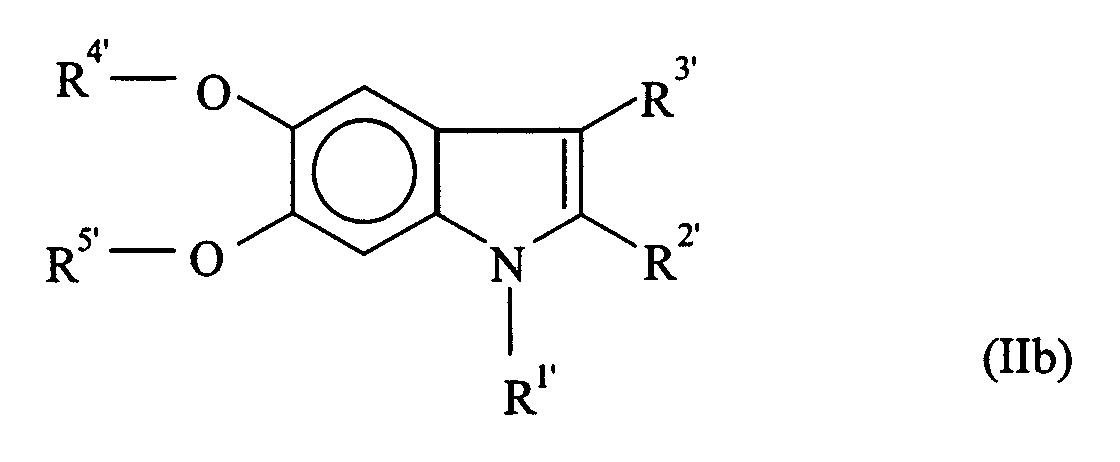
- Such indoles and indolines are preferably used as precursors of nature-analogous dyes, the at least one hydroxy or amino group, preferably as a substituent on Six ring.
- These groups can carry further substituents, e.g. B. in the form an etherification or esterification of the hydroxy group or an alkylation of the Amino group.
- Particularly preferred derivatives of indoline are 5,6-dihydroxyindoline, N-methyl-5,6-dihydroxyindoline, N-ethyl-5,6-dihydroxyindoline, N-propyl-5,6-dihydroxyindoline, N-butyl-5,6-dihydroxyindoline, 5,6-dihydroxyindoline-2-carboxylic acid and 6-hydroxyindoline, the 6-aminoindoline and the 4-aminoindoline.
- N-methyl-5,6-dihydroxyindoline N-ethyl-5,6-dihydroxyindoline, N-propyl-5,6-dihydroxyindoline, N-butyl-5,6-dihydroxyindoline and especially 5,6-dihydroxyindoline.
- Particularly preferred derivatives of indole are 5,6-dihydroxyindole, N-methyl-5,6-dihydroxyindole, N-ethyl-5,6-dihydroxyindole, N-propyl-5,6-dihydroxyindole, N-butyl-5,6-dihydroxyindole, 5,6-dihydroxyindole-2-carboxylic acid, 6-hydroxyindole, 6-aminoindole and 4-aminoindole.
- N-methyl-5,6-dihydroxyindole N-ethyl-5,6-dihydroxyindole, N-propyl-5,6-dihydroxyindole, N-butyl-5,6-dihydroxyindole and in particular the 5,6-dihydroxyindole.
- the indoline and indole derivatives can be used in the process according to the invention Colorants used both as free bases and in the form of their physiological compatible salts with inorganic or organic acids, e.g. B. the hydrochloride, of sulfates and hydrobromides.
- the indole or indoline derivatives are usually in amounts of 0.05-10% by weight, preferably 0.2-5 % By weight.
- the simple salts that result from the manufacturing process as an admixture are preferably selected from the chlorides, sulfates and carbonates of monovalent or divalent cations selected from the alkali cations the Alkaline earth cations and the ammonium cation.
- Sodium cations are particularly common as You can find admixtures. Since the foam aerosol formulation by the Use of the compounds of formula (I) according to the invention insensitive to such salts, it is now possible, for example, less expensive use cleaned raw materials, which are usually significantly cheaper.
- dyes which are often salt admixtures from the Manufacturing process included, 4 [(3-hydroxypropyl) amino] -3-nitrophenol and N '( ⁇ -hydroxyethylamino) -2-nitro-4-aminobenzene.
- the Foam aerosol formulation is an aromatic acid salt.
- Such salts are in Foam aerosol formulations used for example as a preservative.
- Particularly preferred salts of an aromatic acid are the salts of benzoic acid, especially the sodium benzoate, and the salts of the derivatives of benzoic acid such as for example the p-hydroxybenzoic acid alkyl ester. Those are very particularly preferred Sodium salts of methyl p-hydroxybenzoate and propyl p-hydroxybenzoate.
- the Foam aerosol formulation a salt of a UV filter.
- the salts are according to the invention 2-hydroxy-4-methoxybenzophenone-5-sulfonic acid, especially the sodium salts, particularly preferred.
- the agents according to the invention contain component (A) in an amount of 0.1 to 20.0 wt .-%, in particular from 0.5 to 5.0 wt .-%, each based on the total Means used.
- component (A) in an amount of 0.1 to 20.0 wt .-%, in particular from 0.5 to 5.0 wt .-%, each based on the total Means used.
- the reference variable "total mean" is understood according to the invention including the LPG phase.
- Component (B) is preferably in an amount of 0.01 to 10% by weight, in particular 0.05 to 5% by weight, very particularly preferably of 0.1 to 1 wt .-%, each based on the total agent.
- Preferred propellant gases according to the invention are selected from the hydrocarbons, the fluorine-chlorine hydrocarbons, the fluorocarbons and Dimethyl ether.
- blowing agents are alkanes with 3 to 5 Carbon atoms such as propane, n-butane, iso-butane, n-pentane and iso-pentane as well their mixtures; n-butane, isobutane and propane and their are particularly preferred Mixtures.
- alkanes with 3 to 5 Carbon atoms such as propane, n-butane, iso-butane, n-pentane and iso-pentane as well their mixtures
- the use of pure butane and of is very particularly preferred Mixtures of butane with up to 50% by weight propane.
- the agents according to the invention contain the propellant gases (component (C)) in an amount up to 20% by weight, in particular up to 10% by weight, very particularly preferred of up to 8% by weight, based on the total agent.
- the agents according to the invention can be a cationic and / or a contain nonionic surfactant.
- Any mono- or oligosaccharides can be used as the sugar building block Z.
- sugar with 5 or 6 carbon atoms and the corresponding Oligosaccharides used.
- sugars are glucose, fructose, Galactose, arabinose, ribose, xylose, lyxose, allose, old rose, mannose, gulose, idose, Talose and sucrose.
- Preferred sugar components are glucose, fructose, galactose, Arabinose and sucrose; Glucose is particularly preferred.
- alkyl polyglycosides which can be used according to the invention contain on average 1.1 to 5 Sugar units. Alkyl polyglycosides with x values from 1.1 to 2.0 are preferred. All alkyl glycosides in which x is 1.1 to 1.8 are particularly preferred.
- alkoxylated homologs of the alkyl polyglycosides mentioned can also be used according to the invention be used. These homologues can average up to 10 Contain ethylene oxide and / or propylene oxide units per alkyl glycoside unit.
- alkylene oxide addition products have proven to be preferred nonionic surfactants of saturated linear fatty alcohols and fatty acids, each with 2 to 30 moles of ethylene oxide per Mole of fatty alcohol or fatty acid has been proven. Preparations with excellent properties are also obtained if they are fatty acid esters of nonionic surfactants contain ethoxylated glycerin.
- the alkyl radical R contains 6 to 22 carbon atoms and can be linear or branched. Primary linear and methyl-branched aliphatic radicals in the 2-position are preferred. Such alkyl radicals are, for example, 1-octyl, 1-decyl, 1-lauryl, 1-myristyl, 1-cetyl and 1-stearyl. 1-Octyl, 1-decyl, 1-lauryl, 1-myristyl are particularly preferred. Using So-called "oxo alcohols" as starting materials predominate compounds with an odd number of carbon atoms in the alkyl chain.
- the compounds with alkyl groups used as surfactant can in each case be act uniform substances. However, it is usually preferred in manufacturing these substances from natural vegetable or animal raw materials, so that one Mixtures of substances with different, depending on the respective raw material Maintains alkyl chain lengths.
- the addition products of ethylene and / or propylene oxide Fatty alcohols or derivatives of these adducts can represent both Products with a "normal” homolog distribution as well as those with a narrow homolog distribution can be used.
- Under "normal” Homolog distribution is understood to mean mixtures of homologues that are used in the conversion of fatty alcohol and alkylene oxide using alkali metals, Alkali metal hydroxides or alkali metal alcoholates as catalysts.
- narrow homolog distributions are obtained if, for example Hydrotalcites, alkaline earth metal salts of ether carboxylic acids, alkaline earth metal oxides, hydroxides or alcoholates can be used as catalysts.
- the use of Products with a narrow homolog distribution can be preferred.
- Cationic surfactants of the quaternary type are preferred according to the invention
- Ammonium compounds, esterquats and amidoamines are preferred according to the invention
- Preferred quaternary Ammonium compounds are ammonium halides, especially chlorides and bromides, such as alkyl trimethyl ammonium chlorides, dialkyl dimethyl ammonium chlorides and Trialkylmethylammoniumchloride, e.g. B.
- cetyltrimethylammonium chloride stearyltrimethylammonium chloride, Distearyldimethylammonium chloride, lauryldimethylammonium chloride, Lauryldimethylbenzylammonium chloride and tricetylmethylammonium chloride, as well as those under the INCI names Quaternium-27 and Quaternium-83 known imidazolium compounds.
- the long alkyl chains of the above Surfactants preferably have 10 to 18 carbon atoms.
- Esterquats are known substances that both have at least one ester function and also contain at least one quaternary ammonium group as a structural element.
- Preferred ester quats are quaternized ester salts of fatty acids with triethanolamine, quaternized ester salts of fatty acids with diethanolalkylamines and quaternized Ester salts of fatty acids with 1,2-dihydroxypropyl dialkylamines.
- Such products are for example under the trademark Stepantex®, Dehyquart® and Armocare® distributed.
- alkylamidoamines are usually made more natural or synthetic by amidation Fatty acids and fatty acid cuts made with dialkylaminoamines.
- One according to the invention that is particularly suitable compound from this group of substances the name Tegoamid® S 18 commercially available stearamidopropyl-dimethylamine represents.
- the cationic surfactants are preferred in the agents used according to the invention in Amounts of 0.05 to 10 wt .-%, based on the total agent. Amounts of 0.1 to 5% by weight are particularly preferred.
- the agents according to the invention can contain at least one fatty substance.
- Fats are understood to mean fatty acids, fatty alcohols, natural and synthetic Waxes which are present both in solid form and in liquid form in aqueous dispersion can understand and natural and synthetic cosmetic oil components.
- Fatty acids are caproic acid, caprylic acid, 2-ethylhexanoic acid, capric acid, lauric acid, Isotridecanoic acid, myristic acid, palmitic acid, palmitoleic acid, stearic acid, Isostearic acid, oleic acid, elaidic acid, petroselinic acid, linoleic acid, linolenic acid, elaeostearic acid, Arachidic acid, gadoleic acid, behenic acid and erucic acid and their technical mixtures, e.g.
- fatty acid cuts which are available from coconut oil or palm oil; the use of stearic acid is generally particularly preferred.
- the amount used is 0.1-15% by weight, based on the total agent. In a preferred embodiment, the amount is 0.5-10% by weight, with whole Amounts of 1-5% by weight are particularly advantageous.
- Saturated, mono- or polyunsaturated, branched or unbranched fatty alcohols with C 6 -C 30 , preferably C 10 -C 22 and very particularly preferably C 12 -C 22 carbon atoms can be used as fatty alcohols.
- the fatty alcohols derive from preferably natural fatty acids, and it can usually be assumed that the esters of the fatty acids are obtained by reduction.
- suitable according to the invention are those fatty alcohol cuts which are produced by reducing naturally occurring triglycerides such as beef tallow, palm oil, peanut oil, rapeseed oil, cottonseed oil, soybean oil, sunflower oil and linseed oil or fatty acid esters formed from their transesterification products with corresponding alcohols, and thus represent a mixture of different fatty alcohols.
- Such substances are, for example, under the names Stenol®, for example Stenol® 1618 or Lanette®, for example Lanette® O or Lorol®, for example Lorol® C8, Lorol® C14, Lorol® C18, Lorol® C8-18, HD-Ocenol®, Crodacol®, e.g. Crodacol® CS, Novol®, Eutanol® G, Guerbitol® 16, Guerbitol® 18, Guerbitol® 20, Isofol® 12, Isofol® 16, Isofol® 24, Isofol® 36, Isocarb® 12, Isocarb® 16 or to buy Isocarb® 24.
- wool wax alcohols such as are commercially available under the names Corona®, White Swan®, Coronet® or Fluilan®, can also be used.
- the fatty alcohols are used in amounts of 0.1-20% by weight, based on the entire preparation, preferably in amounts of 0.1-10% by weight.
- natural or synthetic waxes can be used solid paraffins or isoparaffins, carnauba waxes, beeswaxes, candelilla waxes, Ozokerite, Ceresin, Walrat, Sunflower wax, fruit waxes such as Apple wax or citrus wax, microwaxes made of PE or PP.
- Such waxes are available, for example, from Kahl & Co., Trittau.
- the amount used is 0.1-50% by weight, based on the total agent, preferably 0.1 - 20% by weight and particularly preferably 0.1 - 15% by weight based on the total agent.
- the total amount of oil and fat components in the agents according to the invention is usually 6-45% by weight, based on the total agent. Amounts from 10-35 % By weight is preferred according to the invention.
- the agents according to the invention can also contain hydroxycarboxylic acid esters.
- Preferred hydroxycarboxylic acid esters are full esters of glycolic acid, lactic acid, malic acid, tartaric acid or citric acid.
- Other basically suitable hydroxycarboxylic acid esters are esters of ⁇ -hydroxypropionic acid, tartronic acid, D-gluconic acid, sugar acid, mucic acid or glucuronic acid.
- Suitable alcohol components of these esters are primary, linear or branched aliphatic alcohols with 8-22 carbon atoms, for example fatty alcohols or synthetic fatty alcohols.
- the esters of C 12 -C 15 fatty alcohols are particularly preferred.
- Esters of this type are commercially available, for example under the trademark Cosmacol® from EniChem, Augusta Industriale.
- the amount of the hydroxycarboxylic acid esters used is 0.1-15% by weight, based on the composition, preferably 0.1-10% by weight and very particularly preferably 0.1-5% by weight.
- Hair dye A cetyltrimethylammonium 1.5 cetyl alcohol 2.0
- Procetyl® AWS 1.0 Monoethanolamine 0.2 Perfume 0.5 p-hydroxybenzoate 0.2 p-hydroxybenzoate 0.2 Propane-butane mixture (50:50) 10.00 Arianor® mahogany 1.5 Arianor® Straw Yellow 0.3 Arianor® Steel Blue 0.5 HC Red BN 0.50 3-amino-4-nitrophenol 0.25 sodium sulphate 2.0 water ad 100
- a chestnut-sized amount of foam was applied to a subject's medium blonde hair using a plastic brush. The application was repeated until the entire hair section was combed with the colored foam. After a 20-minute exposure, the hair was rinsed and dried. The hair had a brilliant shade of red copper with a beautiful sheen.
- Procetyl® AWS 1.0 Monoethanolamine 0.2 Perfume 0.5 p-hydroxybenzoate 0.2 p-hydroxybenzoate 0.2 Propane-butane mixture (50:50) 10.00 4-hydroxyethylamino-3-nitrophenol 0.5 HC Red 3 0.5 HC Yellow No.
- a chestnut-sized amount of foam was pressed onto a plastic brush and the partially gray light blond hair was combed with the product.
- the application was repeated until the entire hair section was combed with the colored foam.
- the hair was rinsed and dried. The hair was a light blonde shade with good gray coverage.
- a chestnut-sized amount of foam was pressed onto a plastic brush and that light gray blonde hair combed through with the product. The application was repeated until the entire hair section was combed with the colored foam. To After a 15-minute exposure time, the hair was rinsed and dried. The hair pointed a light blonde copper shade with good gray coverage.
Landscapes
- Life Sciences & Earth Sciences (AREA)
- Health & Medical Sciences (AREA)
- Animal Behavior & Ethology (AREA)
- General Health & Medical Sciences (AREA)
- Public Health (AREA)
- Veterinary Medicine (AREA)
- Birds (AREA)
- Epidemiology (AREA)
- Chemical & Material Sciences (AREA)
- Dispersion Chemistry (AREA)
- Cosmetics (AREA)
- Organic Low-Molecular-Weight Compounds And Preparation Thereof (AREA)
Abstract
Description
- ein Salz eines Farbstoff(vorprodukt)es und/oder
- ein einfaches Salz, das als Beimischung aus dem Herstellprozess der Farbstoff(vorprodukt)e resultiert.
- Oxidationsfarbstoffvorprodukte vom Entwickler- und Kuppler-Typ, und
- Vorstufen naturanaloger Farbstoffe, wie Indol- und Indolin-Derivate,

- G1 steht für ein Wasserstoffatom, einen C1- bis C4-Alkylrest, einen C1- bis C4-Monohydroxyalkylrest, einen C2- bis C4-Polyhydroxyalkylrest, einen (C1- bis C4)-Alkoxy-(C1- bis C4)-alkylrest, einen 4'-Aminophenylrest oder einen C1- bis C4-Alkylrest, der mit einer stickstoffhaltigen Gruppe, einem Phenyl- oder einem 4'-Aminophenylrest substituiert ist;
- G2 steht für ein Wasserstoffatom, einen C1- bis C4-Alkylrest, einen C1- bis C4-Monohydroxyalkylrest, einen C2- bis C4-Polyhydroxyalkylrest, einen (C1- bis C4)-Alkoxy-(C1- bis C4)-alkylrest oder einen C1- bis C4-Alkylrest, der mit einer stickstoffhaltigen Gruppe substituiert ist;
- G3 steht für ein Wasserstoffatom, ein Halogenatom, wie ein Chlor-, Brom-, Iododer Fluoratom, einen C1- bis C4-Alkylrest, einen C1- bis C4-Monohydroxyalkylrest, einen C2- bis C4-Polyhydroxyalkylrest, einen C1- bis C4-Hydroxyalkoxyrest, einen C1- bis C4-Acetylaminoalkoxyrest, einen C1- bis C4- Mesylaminoalkoxyrest oder einen C1- bis C4-Carbamoylaminoalkoxyrest;
- G4 steht für ein Wasserstoffatom, ein Halogenatom oder einen C1- bis C4-Alkylrest oder
- wenn G3 und G4 in ortho-Stellung zueinander stehen, können sie gemeinsam eine verbrückende α,ω-Alkylendioxogruppe, wie beispielsweise eine Ethylendioxygruppe bilden.
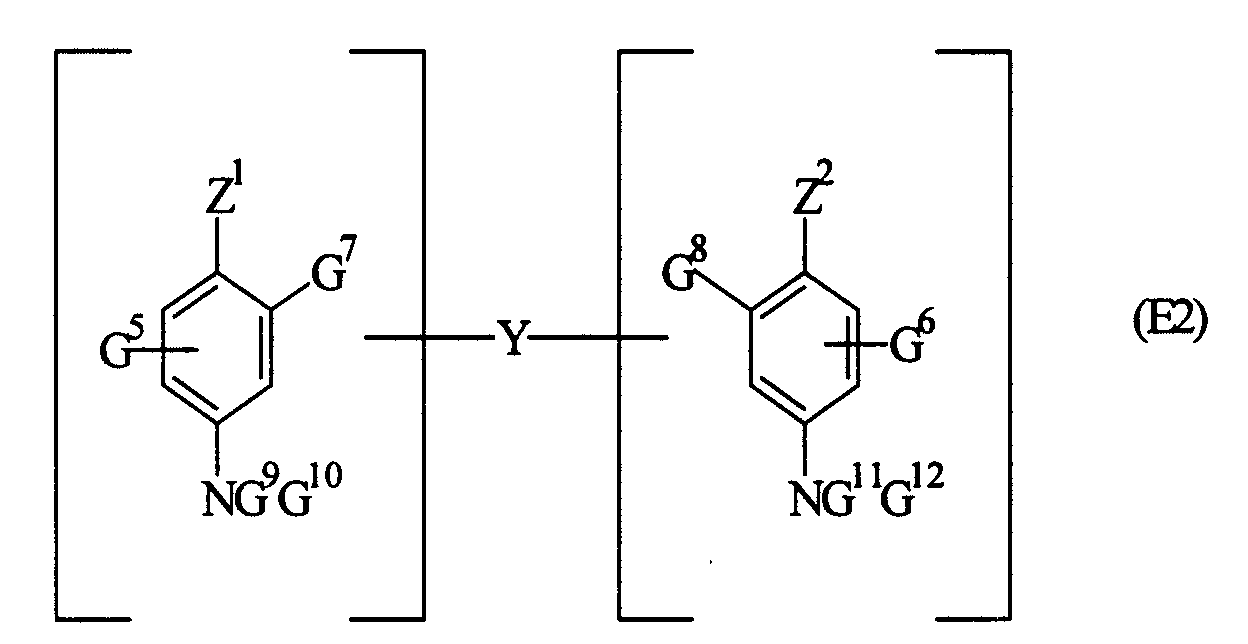
- Z1 und Z2 stehen unabhängig voneinander für einen Hydroxyl- oder NH2-Rest, der gegebenenfalls durch einen C1- bis C4-Alkylrest, durch einen C1- bis C4-Hydroxyalkylrest und/oder durch eine Verbrückung Y substituiert ist oder der gegebenenfalls Teil eines verbrückenden Ringsystems ist,
- die Verbrückung Y steht für eine Alkylengruppe mit 1 bis 14 Kohlenstoffatomen, wie beispielsweise eine lineare oder verzweigte Alkylenkette oder einen Alkylenring, die von einer oder mehreren stickstoffhaltigen Gruppen und/oder einem oder mehreren Heteroatomen wie Sauerstoff-, Schwefel- oder Stickstoffatomen unterbrochen oder beendet sein kann und eventuell durch einen oder mehrere Hydroxyl- oder C1- bis C8-Alkoxyreste substituiert sein kann, oder eine direkte Bindung,
- G5 und G6 stehen unabhängig voneinander für ein Wasserstoff- oder Halogenatom, einen C1- bis C4-Alkylrest, einen C1- bis C4-Monohydroxyalkylrest, einen C2- bis C4-Polyhydroxyalkylrest, einen C1- bis C4-Aminoalkylrest oder eine direkte Verbindung zur Verbrückung Y,
- G7, G8, G9, G10, G11 und G12 stehen unabhängig voneinander für ein Wasserstoffatom, eine direkte Bindung zur Verbrückung Y oder einen C1- bis C4-Alkylrest,
- die Verbindungen der Formel (E2) nur eine Verbrückung Y pro Molekül enthalten und
- die Verbindungen der Formel (E2) mindestens eine Aminogruppe enthalten, die mindestens ein Wasserstoffatom trägt.
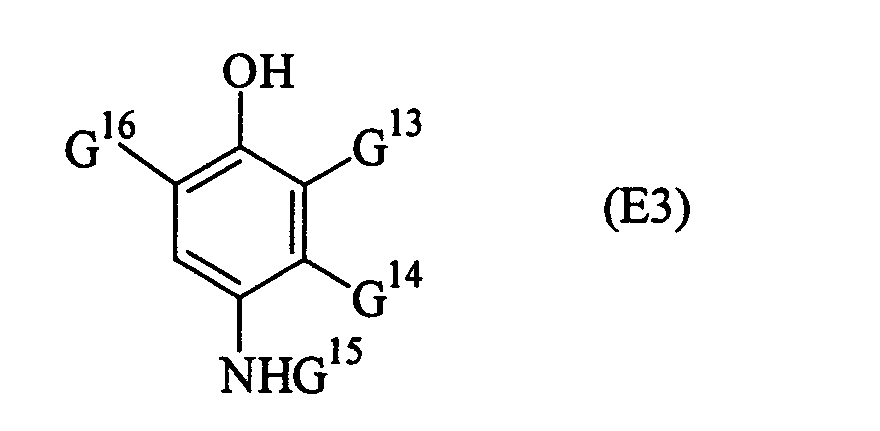
- G13 steht für ein Wasserstoffatom, ein Halogenatom, einen C1- bis C4-Alkylrest, einen C1- bis C4-Monohydroxyalkylrest, einen C2- bis C4-Polyhydroxyalkylrest, einen (C1- bis C4)-Alkoxy-(C1- bis C4)-alkylrest, einen C1- bis C4-Aminoalkylrest, einen Hydroxy-(C1- bis C4)-alkylaminorest, einen C1- bis C4-Hydroxyalkoxyrest, einen C1bis C4-Hydroxyalkyl-(C1-bis C4)-aminoalkylrest oder einen (Di-C1- bis C4-Alkylamino)-(C1- bis C4)-alkylrest, und
- G14 steht für ein Wasserstoff- oder Halogenatom, einen C1- bis C4-Alkylrest, einen C1- bis C4-Monohydroxyalkylrest, einen C2- bis C4-Polyhydroxyalkylrest, einen (C1bis C4)-Alkoxy-(C1- bis C4)-alkylrest, einen C1- bis C4-Aminoalkylrest oder einen C1bis C4-Cyanoalkylrest,
- G15 steht für Wasserstoff, einen C1- bis C4-Alkylrest, einen C1- bis C4-Monohydroxyalkylrest, einen C2- bis C4-Polyhydroxyalkylrest, einen Phenylrest oder einen Benzylrest, und
- G16 steht für Wasserstoff oder ein Halogenatom.
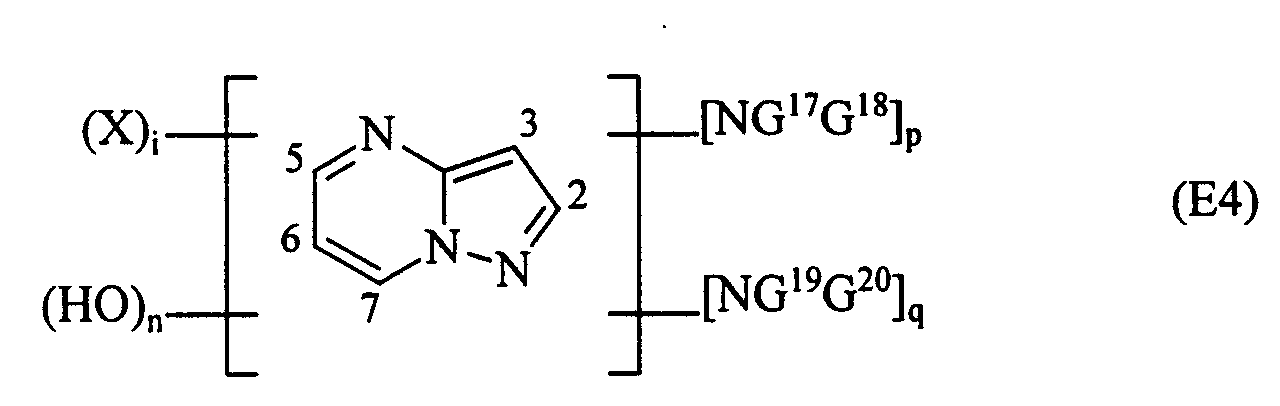
- G17, G18, G19 und G20 unabhängig voneinander stehen für ein Wasserstoffatom, einen C1- bis C4-Alkylrest, einen Aryl-Rest, einen C1- bis C4-Hydroxyalkylrest, einen C2bis C4-Polyhydroxyalkylrest einen (C1- bis C4)-Alkoxy-(C1- bis C4)-alkylrest, einen C1bis C4-Aminoalkylrest, der gegebenenfalls durch ein Acetyl-Ureid- oder einen SulfonylRest geschützt sein kann, einen (C1- bis C4)-Alkylamino-(C1- bis C4)-alkylrest, einen Di-[(C1- bis C4)-alkyl]-(C1- bis C4)-aminoalkylrest, wobei die Dialkyl-Reste gegebenenfalls einen Kohlenstoffzyklus oder einen Heterozyklus mit 5 oder 6 Kettengliedern bilden, einen C1- bis C4-Hydroxyalkyl- oder einen Di-(C1- bis C4)-[Hydroxyalkyl]-(C1- bis C4)-aminoalkylrest,
- die X-Reste stehen unabhängig voneinander für ein Wasserstoffatom, einen C1bis C4-Alkylrest, einen Aryl-Rest, einen C1- bis C4-Hydroxyalkylrest, einen C2- bis C4-Polyhydroxyalkylrest, einen C1- bis C4-Aminoalkylrest, einen (C1- bis C4)-Alkylamino-(C1- bis C4)-alkylrest, einen Di-[(C1- bis C4)alkyl]- (C1- bis C4)-aminoalkylrest, wobei die Dialkyl-Reste gegebenenfalls einen Kohlenstoffzyklus oder einen Heterozyklus mit 5 oder 6 Kettengliedern bilden, einen C1- bis C4-Hydroxyalkyl- oder einen Di-(C1- bis C4hydroxyalkyl)-aminoalkylrest, einen Aminorest, einen C1- bis C4-Alkyl- oder Di-(C1- bis C4-hydroxyalkyl)-aminorest, ein Halogenatom, eine Carboxylsäuregruppe oder eine Sulfonsäuregruppe,
- i hat den Wert 0, 1, 2 oder 3,
- p hat den Wert 0 oder 1,
- q hat den Wert 0 oder 1 und
- n hat den Wert 0 oder 1,
- die Summe aus p + q ungleich 0 ist,
- wenn p + q gleich 2 ist, n den Wert 0 hat, und die Gruppen NG17G18 und NG19G20 belegen die Positionen (2,3); (5,6); (6,7); (3,5) oder (3,7);
- wenn p + q gleich 1 ist, n den Wert 1 hat, und die Gruppen NG17G18 (oder NG19G20) und die Gruppe OH belegen die Positionen (2,3); (5,6); (6,7); (3,5) oder (3,7);

- Pyrazol-[1,5-a]-pyrimidin-3,7-diamin;
- 2,5-Dimethyl-pyrazol-[1,5-a]-pyrimidin-3,7-diamin;
- Pyrazol-[1,5-a]-pyrimidin-3,5-diamin;
- 2,7-Dimethyl-pyrazol-[1,5-a]-pyrimidin-3,5-diamin;
- 3-Aminopyrazol-[1,5-a]-pyrimidin-7-ol;
- 3-Aminopyrazol-[1,5-a]-pyrimidin-5-ol;
- 2-(3-Aminopyrazol-[1,5-a]-pyrimidin-7-ylamino)-ethanol;
- 2-(7-Aminopyrazol-[1,5-a]-pyrimidin-3-ylamino)-ethanol;
- 2-[(3-Aminopyrazol-[1,5-a]-pyrimidin-7-yl)-(2-hydroxy-ethyl)-amino]-ethanol;
- 2-[(7-Aminopyrazol-[1,5-a]-pyrimidin-3-yl)-(2-hydroxy-ethyl)-amino]-ethanol;
- 5,6-Dimethylpyrazol-[1,5-a]-pyrimidin-3,7-diamin;
- 2,6-Dimethylpyrazol-[1,5-a]-pyrimidin-3,7-diamin;
- 3-Amino-7-dimethylamino-2,5-dimethylpyrazol-[1,5-a]-pyrimidin;
- m-Aminophenol und dessen Derivate wie beispielsweise 5-Amino-2-methylphenol, N-Cyclopentyl-3-aminophenol, 3-Amino-2-chlor-6-methylphenol, 2-Hydroxy-4-aminophenoxyethanol, 2,6-Dimethyl-3-aminophenol, 3-Trifluoroacetylamino-2-chlor-6-methylphenol, 5-Amino-4-chlor-2-methylphenol, 5-Amino-4-methoxy-2-methylphenol, 5-(2'-Hydroxyethyl)-amino-2-methylphenol, 3-(Diethylamino)-phenol, N-Cyclopentyl-3-aminophenol, 1,3-Dihydroxy-5-(methylamino)-benzol, 3-Ethylamino-4-methylphenol und 2,4-Dichlor-3-aminophenol,
- o-Aminophenol und dessen Derivate,
- m-Diaminobenzol und dessen Derivate wie beispielsweise 2,4-Diaminophenoxyethanol, 1,3-Bis-(2',4'-diaminophenoxy)-propan, 1-Methoxy-2-amino-4-(2'-hydroxyethylamino)benzol, 1,3-Bis-(2',4'-diaminophenyl)-propan, 2,6-Bis-(2'-hydroxyethylamino)-1-methylbenzol und 1-Amino-3-bis-(2'-hydroxyethyl)-aminobenzol,
- o-Diaminobenzol und dessen Derivate wie beispielsweise 3,4-Diaminobenzoesäure und 2,3-Diamino-1-methylbenzol,
- Di- beziehungsweise Trihydroxybenzolderivate wie beispielsweise Resorcin, Resorcinmonomethylether, 2-Methylresorcin, 5-Methylresorcin, 2,5-Dimethylresorcin, 2-Chlorresorcin, 4-Chlorresorcin, Pyrogallol und 1,2,4-Trihydroxybenzol,
- Pyridinderivate wie beispielsweise 2,6-Dihydroxypyridin, 2-Amino-3-hydroxypyridin, 2-Amino-5-chlor-3-hydroxypyridin, 3-Amino-2-methylamino-6-methoxypyridin, 2,6-Dihydroxy-3,4-dimethylpyridin, 2,6-Dihydroxy-4-methylpyridin, 2,6-Diaminopyridin, 2,3-Diamino-6-methoxypyridin und 3,5-Diamino-2,6-dimethoxypyridin,
- Naphthalinderivate wie beispielsweise 1-Naphthol, 2-Methyl-1-naphthol, 2-Hydroxymethyl-1-naphthol, 2-Hydroxyethyl-1-naphthol, 1,5-Dihydroxynaphthalin, 1,6-Dihydroxynaphthalin, 1,7-Dihydroxynaphthalin, 1,8-Dihydroxynaphthalin, 2,7-Dihydroxynaphthalin und 2,3-Dihydroxynaphthalin,
- Morpholinderivate wie beispielsweise 6-Hydroxybenzomorpholin und 6-Aminobenzomorpholin,
- Chinoxalinderivate wie beispielsweise 6-Methyl-1,2,3,4-tetrahydrochinoxalin,
- Pyrazolderivate wie beispielsweise 1-Phenyl-3-methylpyrazol-5-on,
- Indolderivate wie beispielsweise 4-Hydroxyindol, 6-Hydroxyindol und 7-Hydroxyindol,
- Pyrimidinderivate, wie beispielsweise 4,6-Diaminopyrimidin, 4-Amino-2,6-dihydroxypyrimidin, 2,4-Diamino-6-hydroxypyrimidin, 2,4,6-Trihydroxypyrimidin, 2-Amino-4-methylpyrimidin, 2-Amino-4-hydroxy-6-methylpyrimidin und 4,6-Dihydroxy-2-methylpyrimidin, oder
- Methylendioxybenzolderivate wie beispielsweise 1-Hydroxy-3,4-methylendioxybenzol, 1-Amino-3,4-methylendioxybenzol und 1-(2'-Hydroxyethyl)-amino-3,4-methylendioxybenzol.
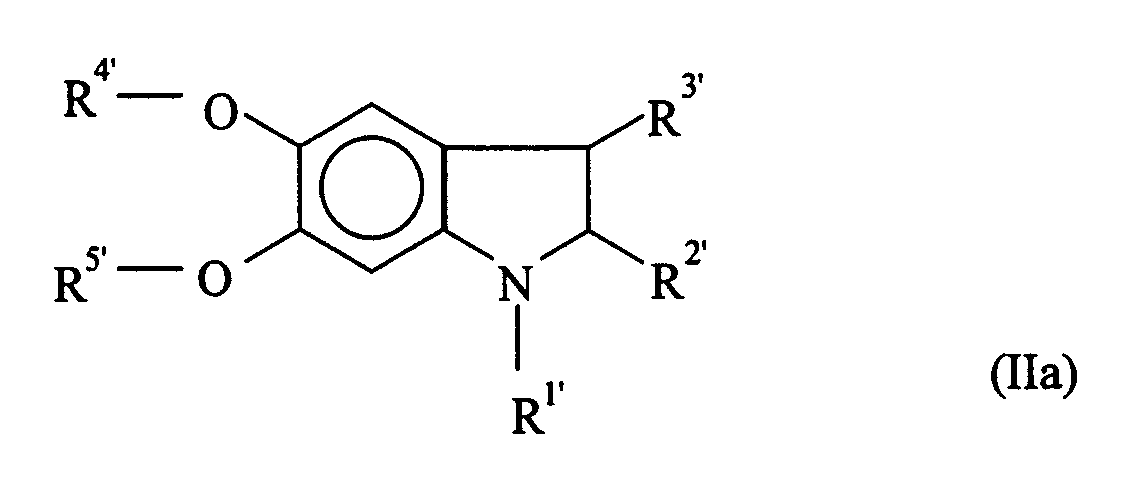
sowie physiologisch verträgliche Salze dieser Verbindungen mit einer organischen oder anorganischen Säure.
- Anlagerungsprodukte von 2 bis 50 Mol Ethylenoxid und/oder 0 bis 5 Mol Propylenoxid an lineare und verzweigte Fettalkohole mit 8 bis 30 C-Atomen, an Fettsäuren mit 8 bis 30 C-Atomen und an Alkylphenole mit 8 bis 15 C-Atomen in der Alkylgruppe,
- mit einem Methyl- oder C2 - C6 - Alkylrest endgruppenverschlossene Anlagerungsprodukte von 2 bis 50 Mol Ethylenoxid und/oder 0 bis 5 Mol Propylenoxid an lineare und verzweigte Fettalkohole mit 8 bis 30 C-Atomen, an Fettsäuren mit 8 bis 30 C-Atomen und an Alkylphenole mit 8 bis 15 C-Atomen in der Alkylgruppe, wie beispielsweise die unter den Verkaufsbezeichnungen Dehydol® LS, Dehydol® LT (Cognis) erhältlichen Typen,
- C12-C30-Fettsäuremono- und -diester von Anlagerungsprodukten von 1 bis 30 Mol Ethylenoxid an Glycerin,
- Anlagerungsprodukte von 5 bis 60 Mol Ethylenoxid an Rizinusöl und gehärtetes Rizinusöl,
- Polyolfettsäureester, wie beispielsweise das Handelsprodukt Hydagen® HSP (Cognis) oder Sovermol - Typen (Cognis),
- alkoxilierte Triglyceride,
- alkoxilierte Fettsäurealkylester der Formel (IX)
- Aminoxide,
- Hydroxymischether, wie sie beipielsweise in der DE-OS 19738866 beschrieben sind,
- Sorbitanfettsäureester und Anlagerungeprodukte von Ethylenoxid an Sorbitanfettsäureester wie beispielsweise die Polysorbate,
- Zuckerfettsäureester und Anlagerungsprodukte von Ethylenoxid an Zuckerfettsäureester,
- Anlagerungsprodukte von Ethylenoxid an Fettsäurealkanolamide und Fettamine,
- Fettsäure-N-alkylglucamide,
- Alkylpolygykoside entsprechend der allgemeinen Formel RO-(Z)x wobei R für Alkyl, Z für Zucker sowie x für die Anzahl der Zuckereinheiten steht. Die erfindungsgemäß verwendbaren Alkylpolyglykoside können lediglich einen bestimmten Alkylrest R enthalten. Üblicherweise werden diese Verbindungen aber ausgehend von natürlichen Fetten und Ölen oder Mineralölen hergestellt. In diesem Fall liegen als Alkylreste R Mischungen entsprechend den Ausgangsverbindungen bzw. entsprechend der jeweiligen Aufarbeitung dieser Verbindungen vor.
- im wesentlichen aus C8- und C10-Alkylgruppen,
- im wesentlichen aus C12- und C14-Alkylgruppen,
- im wesentlichen aus C8- bis C16-Alkylgruppen oder
- im wesentlichen aus C12- bis C16-Alkylgruppen oder
- im wesentlichen aus C16 bis C18-Alkylgruppen besteht.
- pflanzliche Öle. Beispiele für solche Öle sind Sonnenblumenöl, Olivenöl, Sojaöl, Rapsöl, Mandelöl, Jojobaöl, Orangenöl, Weizenkeimöl, Pfirsichkernöl und die flüssigen Anteile des Kokosöls. Geeignet sind aber auch andere Triglyceridöle wie die flüssigen Anteile des Rindertalgs sowie synthetische Triglyceridöle.
- flüssige Paraffinöle, Isoparaffinöle und synthetische Kohlenwasserstoffe sowie Di-nalkylether mit insgesamt zwischen 12 bis 36 C-Atomen, insbesondere 12 bis 24 C-Atomen, wie beispielsweise Di-n-octylether, Di-n-decylether, Di-n-nonylether, Di-nundecylether, Di-n-dodecylether, n-Hexyl-n-octylether, n-Octyl-n-decylether, n-Decyl-n-undecylether, n-Undecyl-n-dodecylether und n-Hexyl-n-Undecylether sowie Di-tert-butylether, Di-iso-pentylether, Di-3-ethyldecylether, tert.-Butyl-n-octylether, iso-Pentyl-n-octylether und 2-Methyl-pentyl-n-octylether. Die als Handelsprodukte erhältlichen Verbindungen 1,3-Di-(2-ethyl-hexyl)-cyclohexan (Cetiol® S) und Di-n-octylether (Cetiol® OE) können bevorzugt sein.
- Esteröle. Unter Esterölen sind zu verstehen die Ester von C6 - C30 - Fettsäuren mit C2 - C30 - Fettalkoholen. Bevorzugt sind die Monoester der Fettsäuren mit Alkoholen mit 2 bis 24 C-Atomen. Beispiele für eingesetzte Fettsäurenanteile in den Estern sind Capronsäure, Caprylsäure, 2-Ethylhexansäure, Caprinsäure, Laurinsäure, Isotridecansäure, Myristinsäure, Palmitinsäure, Palmitoleinsäure, Stearinsäure, Isostearinsäure, Ölsäure, Elaidinsäure, Petroselinsäure, Linolsäure, Linolensäure, Elaeostearinsäure, Arachinsäure, Gadoleinsäure, Behensäure und Erucasäure sowie deren technische Mischungen, die z.B. bei der Druckspaltung von natürlichen Fetten und Ölen, bei der Oxidation von Aldehyden aus der Roelen'schen Oxosynthese oder der Dimerisierung von ungesättigten Fettsäuren anfallen. Beispiele für die Fettalkoholanteile in den Esterölen sind Isopropylalkohol, Capronalkohol, Caprylalkohol, 2-Ethylhexylalkohol, Caprinalkohol, Laurylalkohol, Isotridecylalkohol, Myristylalkohol, Cetylalkohol, Palmoleylalkohol, Stearylalkohol, Isostearylalkohol, Oleylalkohol, Elaidylalkohol, Petroselinylalkohol, Linolylalkohol, Linolenylalkohol, Elaeostearylalkohol, Arachylalkohol, Gadoleylalkohol, Behenylalkohol, Erucylalkohol und Brassidylalkohol sowie deren technische Mischungen, die z.B. bei der Hochdruckhydrierung von technischen Methylestern auf Basis von Fetten und Ölen oder Aldehyden aus der Roelen'schen Oxosynthese sowie als Monomerfraktion bei der Dimerisierung von ungesättigten Fettalkoholen anfallen. Erfindungsgemäß besonders bevorzugt sind Isopropylmyristat (Rilanit® IPM), Isononansäure-C16-18-alkylester (Cetiol® SN), 2-Ethylhexylpalmitat (Cegesoft® 24), Stearinsäure-2-ethylhexylester (Cetiol® 868), Cetyloleat, Glycerintricaprylat, Kokosfettalkohol-caprinat/-caprylat (Cetiol® LC), n-Butylstearat, Oleylerucat (Cetiol® J 600), Isopropylpalmitat (Rilanit® IPP), Oleyl Oleate (Cetiol®), Laurinsäurehexylester (Cetiol® A), Di-n-butyladipat (Cetiol® B), Myristylmyristat (Cetiol® MM), Cetearyl Isononanoate (Cetiol® SN), Ölsäuredecylester (Cetiol® V).
- Dicarbonsäureester wie Di-n-butyladipat, Di-(2-ethylhexyl)-adipat, Di-(2-ethylhexyl)-succinat und Di-isotridecylacelaat sowie Diolester wie Ethylenglykol-dioleat, Ethylenglykol-di-isotridecanoat, Propylenglykol-di(2-ethylhexanoat), Propylenglykoldi-isostearat, Propylenglykol-di-pelargonat, Butandiol-di-isostearat, Neopentylglykoldicaprylat,
- symmetrische, unsymmetrische oder cyclische Ester der Kohlensäure mit Fettalkoholen, beispielsweise beschrieben in der DE-OS 197 56 454, Glycerincarbonat oder Dicaprylylcarbonat (Cetiol® CC),
- Mono,- Di- und Trifettsäureester von gesättigten und/oder ungesättigten linearen und/oder verzweigten Fettsäuren mit Glycerin, wie beispielsweise Monomuls® 90-O18, Monomuls® 90-L12 oder Cutina® MD.
- nichtionische Polymere wie beispielsweise Vinylpyrrolidon/Vinylacrylat-Copolymere, Polyvinylpyrrolidon und Vinylpyrrolidon/Vinylacetat-Copolymere und Polysiloxane,
- kationische Polymere wie quaternisierte Celluloseether, Polysiloxane mit quaternären Gruppen, Dimethyldiallylammoniumchlorid-Polymere, Acrylamid-Dimethyldiallylammoniumchlorid-Copolymere, mit Diethylsulfat quaternierte Dimethylaminoethylmethacrylat-Vinylpyrrolidon-Copolymere, Vinylpyrrolidon-Imidazoliniummethochlorid-Copolymere und quaternierter Polyvinylalkohol,
- zwitterionische und amphotere Polymere wie beispielsweise Acrylamidopropyl-trimethylammoniumchlorid/Acrylat-Copolymere und Octylacrylamid/Methyl-methacrylat/tert-Butylaminoethylmethacrylat/2-Hydroxypropylmethacrylat-Copolymere,
- anionische Polymere wie beispielsweise Polyacrylsäuren, vernetzte Polyacrylsäuren, Vinylacetat/Crotonsäure-Copolymere, Vinylpyrrolidon/Vinylacrylat-Copolymere, Vinylacetat/Butylmaleat/Isobornylacrylat-Copolymere, Methylvinylether/Maleinsäureanhydrid-Copolymere und Acrylsäure/Ethylacrylat/N-tert.Butyl-acrylamid-Terpolymere,
- Verdickungsmittel wie Agar-Agar, Guar-Gum, Alginate, Xanthan-Gum, Gummi arabicum, Karaya-Gummi, Johannisbrotkernmehl, Leinsamengummen, Dextrane, Cellulose-Derivate, z. B. Methylcellulose, Hydroxyalkylcellulose und Carboxymethylcellulose, Stärke-Fraktionen und Derivate wie Amylose, Amylopektin und Dextrine, Tone wie z. B. Bentonit oder vollsynthetische Hydrokolloide wie z.B. Polyvinylalkohol,
- Strukturanten wie Maleinsäure und Milchsäure,
- haarkonditionierende Verbindungen wie Phospholipide, beispielsweise Sojalecithin, Ei-Lecitin und Kephaline,
- Proteinhydrolysate, insbesondere Elastin-, Kollagen-, Keratin-, Milcheiweiß-, Sojaprotein- und Weizenproteinhydrolysate, deren Kondensationsprodukte mit Fettsäuren sowie quaternisierte Proteinhydrolysate,
- Parfümöle, Dimethylisosorbid und Cyclodextrine,
- Lösungsmittel und -vermittler wie Ethanol, Isopropanol, Ethylenglykol, Propylenglykol, Glycerin und Diethylenglykol,
- faserstrukturverbessernde Wirkstoffe, insbesondere Mono-, Di- und Oligosaccharide wie beispielsweise Glucose, Galactose, Fructose, Fruchtzucker und Lactose,
- quaternierte Amine wie Methyl-1-alkylamidoethyl-2-alkylimidazolinium-methosulfat
- Entschäumer wie Silikone,
- Farbstoffe zum Anfärben des Mittels,
- Antischuppenwirkstoffe wie Piroctone Olamine, Zink Omadine und Climbazol,
- Lichtschutzmittel, insbesondere derivatisierte Benzophenone, Zimtsäure-Derivate und Triazine,
- Substanzen zur Einstellung des pH-Wertes, wie beispielsweise übliche Säuren, insbesondere Genußsäuren und Basen,
- Wirkstoffe wie Allantoin, Pyrrolidoncarbonsäuren und deren Salze sowie Bisabolol,
- Vitamine, Provitamine und Vitaminvorstufen, insbesondere solche der Gruppen A, B3, B5, B6, C, E, F und H,
- Pflanzenextrakte wie die Extrakte aus Grünem Tee, Eichenrinde, Brennessel, Hamamelis, Hopfen, Kamille, Klettenwurzel, Schachtelhalm, Weißdorn, Lindenblüten, Mandel, Aloe Vera, Fichtennadel, Roßkastanie, Sandelholz, Wacholder, Kokosnuß, Mango, Aprikose, Limone, Weizen, Kiwi, Melone, Orange, Grapefruit, Salbei, Rosmarin, Birke, Malve, Wiesenschaumkraut, Quendel, Schafgarbe, Thymian, Melisse, Hauhechel, Huflattich, Eibisch, Meristem, Ginseng und Ingwerwurzel,.
- Cholesterin,
- Konsistenzgeber wie Zuckerester, Polyolester oder Polyolalkylether,
- Fette und Wachse wie Walrat, Bienenwachs, Montanwachs und Paraffine,
- Fettsäurealkanolamide,
- Komplexbildner wie EDTA, NTA, β-Alanindiessigsäure und Phosphonsäuren,
- Quell- und Penetrationsstoffe wie Glycerin, Propylenglykolmonoethylether, Carbonate, Hydrogencarbonate, Guanidine, Harnstoffe sowie primäre, sekundäre und tertiäre Phosphate,
- Trübungsmittel wie Latex, Styrol/PVP- und Styrol/Acrylamid-Copolymere
- Perlglanzmittel wie Ethylenglykolmono- und -distearat sowie PEG-3-distearat,
- Pigmente,
- Stabilisierungsmittel für Wassserstoffperoxid und andere Oxidationsmittel,
- Treibmittel wie Propan-Butan-Gemische, N2O, Dimethylether, CO2 und Luft,
- Antioxidantien.
| Haartönungsmittel A | |
| Cetyltrimethylammoniumbromid | 1,5 |
| Cetylalkohol | 2,0 |
| Procetyl® AWS | 1,0 |
| Monoethanolamin | 0,2 |
| Parfüm | 0,5 |
| p-Hydroxybenzoesäuremethylester | 0,2 |
| p-Hydroxybenzoesäurepropylester | 0,2 |
| Propan-Butan-Gemisch (50:50) | 10,00 |
| Arianor® Mahagoni | 1,5 |
| Arianor® Straw Yellow | 0,3 |
| Arianor® Steel Blue | 0,5 |
| HC Red BN | 0,50 |
| 3-Amino-4-nitrophenol | 0,25 |
| Natriumsulfat | 2,0 |
| Wasser | ad 100 |
| Haartönungsmittel B | |
| Cetyltrimethylammoniumbromid | 1,5 |
| Cetylalkohol | 2,0 |
| Procetyl® AWS | 1,0 |
| Monoethanolamin | 0,2 |
| Parfüm | 0,5 |
| p-Hydroxybenzoesäuremethylester | 0,2 |
| p-Hydroxybenzoesäurepropylester | 0,2 |
| Propan-Butan-Gemisch (50:50) | 10,00 |
| 4-Hydroxyethylamino-3-nitrophenol | 0,5 |
| HC Red 3 | 0,5 |
| HC Yellow No. 2 | 0,3 |
| Kaliumchlorid | 3,0 |
| Wasser | ad 100 |
| Haarfärbemittel C | |
| Cetyltrimethylammoniumbromid | 1,7 |
| Cetylalkohol | 2,2 |
| Procetyl® AWS | 1,5 |
| Monoethanolamin | 0,2 |
| Natriumsulfit | 0,1 |
| Parfüm | 0,5 |
| p-Hydroxybenzoesäuremethylester | 0,2 |
| p-Hydroxybenzoesäurepropylester | 0,2 |
| Propan-Butan-Gemisch (50:50) | 10,00 |
| p-Toluylendiamin-sulfat | 0,10 |
| 2-(β-Hydroxyethyl)-p-phenylendiamin-sulfat | 0,20 |
| 1,3-Dihydroxy-2-methylbenzol | 0,15 |
| 2-Amino-3-hydroxypyridin | 0,12 |
| 3-Methyl-4-aminophenol | 0,10 |
| 5,6-Dihydroxyindolin-hydrobromid | 0,20 |
| Wasser | ad 100 |
| Färbemittel D | |
| Cetyltrimethylammoniumbromid | 1,5 |
| Cetylalkohol | 2,2 |
| Procetyl® AWS | 0,75 |
| Monoethanolamin | 0,2 |
| Natriumsulfit | 0,1 |
| Parfüm | 0,5 |
| p-Hydroxybenzoesäuremethylester | 0,2 |
| p-Hydroxybenzoesäurepropylester | 0,2 |
| Propan-Butan-Gemisch (50:50) | 10,00 |
| p-Phenylendiamin-hydrochlorid | 0,10 |
| 2-(β-Hydroxyethyl)-p-phenylendiamin-sulfat | 0,15 |
| 1,3-Dihydroxy-2-methylbenzol | 0,10 |
| 2-Amino-3-hydroxypyridin | 0,10 |
| 3-Methyl-4-aminophenol | 0,10 |
| 5,6-Dihydroxyindolin-hydrobromid | 0,10 |
| HC Red 3 | 0,20 |
| 3-Nitro-4-aminophenol | 0,10 |
| Wasser | ad 100 |
Claims (19)
- Verwendung von Verbindungen der Formel (I)
- Verwendung nach Anspruch 1, dadurch gekennzeichnet, dass die Variablen x und y beide von null verschieden sind.
- Verwendung nach einem der Ansprüche 1 oder 2, dadurch gekennzeichnet, dass die Variable x steht für eine Zahl von 1 bis 50 und die Variable y steht für eine Zahl von 1 bis 15.
- Verwendung nach einem der Ansprüche 1 bis 3, dadurch gekennzeichnet, dass die Schaumaerosolformulierung Salze eines Farbstoff(vorprodukte)s enthält.
- Verwendung nach einem der Ansprüche 1 bis 4, dadurch gekennzeichnet, dass die Schaumaerosolformulierung Chloride, Sulfate oder Carbonate von einwertigen oder zweiwertigen Kationen, ausgewählt aus den Alkalikationen, den Erdalkalikationen und dem Ammoniumkation, enthält.
- Verwendung nach einem der Ansprüche 1 bis 5, dadurch gekennzeichnet, dass die Schaumaerosolformulierung ein Salz einer aromatischen Säure enthält.
- Verwendung nach Anspruch 6, dadurch gekennzeichnet, dass es ein Salz der Benzoesäure oder eines Benzoesäurederivates ist.
- Verwendung nach einem der Ansprüche 1 bis 7, dadurch gekennzeichnet, dass die Schaumaerosolformulierung ein Salz eines UV-Filters enthält.
- Verwendung nach Anspruch 8, dadurch gekennzeichnet, dass das Salz ein Salz der 2-Hydroxy-4-methoxybenzophenon-5-sulfonsäure ist.
- Schaumförmiges Mittel, dadurch gekennzeichnet, dass es in einem kosmetisch akzeptablen Medium,(A) mindestens ein Salz,(B) mindestens eine Verbindungen der Formel (I)(C) mindestens ein Treibgas
enthält. - Mittel nach Anspruch 10, dadurch gekennzeichnet, dass das Treibgas ausgewählt ist aus den Kohlenwasserstoffen, den Fluor-Chlor-Kohlenwasserstoffen, den Fluor-Kohlenwasserstoffen sowie Dimethylether.
- Mittel nach Anspruch 11, dadurch gekennzeichnet, dass das Treibgas ausgewählt ist aus Propan, n-Butan und iso-Butan sowie deren Mischungen.
- Mittel nach einem der Ansprüche 10 bis 12, dadurch gekennzeichnet, dass es weiterhin ein kationisches und/oder ein nichtionisches Tensid enthält.
- Mittel nach einem der Ansprüche 10 bis 13, dadurch gekennzeichnet, dass es mindestens ein Salz eines Farbstoff(vorprodukt)es enthält.
- Mittel nach einem der Ansprüche 10 bis 14, dadurch gekennzeichnet, dass es mindestens ein Salz einer aromatischen Säure enthält.
- Mittel nach einem der Ansprüche 10 bis 15, dadurch gekennzeichnet, dass es mindestens ein Salz eines UV-Filters enthält.
- Mittel nach einem der Ansprüche 10 bis 16, dadurch gekennzeichnet, dass es die Komponente (A) in einer Menge von 0,1 bis 20,0 Gew.-%, bezogen auf das gesamte Mittel, enthält.
- Mittel nach einem der Ansprüche 10 bis 17, dadurch gekennzeichnet, dass es die Komponente (B) in einer Menge von 0,01 bis 10 Gew.-%, insbesondere von 0,05 bis 5 Gew.-%, ganz besonders bevorzugt von 0,1 bis 1 Gew.-%, jeweils bezogen auf das gesamte Mittel, enthält.
- Mittel nach einem der Ansprüche 10 bis 18, dadurch gekennzeichnet, dass es die Komponente (C) in einer Menge von bis zu 20 Gew.-%, insbesondere von bis zu 10 Gew.-%, ganz besonders bevorzugt von bis zu 8 Gew.-%, jeweils bezogen auf das gesamte Mittel, enthält.
Applications Claiming Priority (2)
| Application Number | Priority Date | Filing Date | Title |
|---|---|---|---|
| DE10163257 | 2001-12-21 | ||
| DE10163257A DE10163257A1 (de) | 2001-12-21 | 2001-12-21 | Schaumförmige Haarbehandlungsmittel |
Publications (3)
| Publication Number | Publication Date |
|---|---|
| EP1321128A2 true EP1321128A2 (de) | 2003-06-25 |
| EP1321128A3 EP1321128A3 (de) | 2003-11-12 |
| EP1321128B1 EP1321128B1 (de) | 2007-08-22 |
Family
ID=7710377
Family Applications (1)
| Application Number | Title | Priority Date | Filing Date |
|---|---|---|---|
| EP02027911A Revoked EP1321128B1 (de) | 2001-12-21 | 2002-12-13 | Schaumförmige Haarbehandlungsmittel mit einem Salzgehalt von 0,5 bis 20 Gew.% |
Country Status (3)
| Country | Link |
|---|---|
| EP (1) | EP1321128B1 (de) |
| AT (1) | ATE370721T1 (de) |
| DE (2) | DE10163257A1 (de) |
Cited By (7)
| Publication number | Priority date | Publication date | Assignee | Title |
|---|---|---|---|---|
| FR2878154A1 (fr) * | 2004-11-25 | 2006-05-26 | Oreal | Composition aqueuse de coloration des fibres keratiniques comprenant un colorant et un copolymere blocs particulier |
| WO2006066642A1 (de) | 2004-12-20 | 2006-06-29 | Henkel Kommanditgesellschaft Auf Aktien | Haarfarbveränderndes shampoo |
| WO2012007219A3 (de) * | 2010-07-15 | 2013-03-21 | Henkel Ag & Co. Kgaa | Schaumförmige färbemittel |
| WO2013045626A1 (en) * | 2011-09-30 | 2013-04-04 | L'oreal | Foam dye composition comprising a polycondensate of ethylene oxide and propylene oxide |
| WO2013060838A1 (en) * | 2011-10-26 | 2013-05-02 | L'oreal | Device for self-foaming oxidation dyeing, ready-for-use self-foaming composition and method for dyeing keratinous fibres |
| US20140245543A1 (en) * | 2011-09-30 | 2014-09-04 | L'oreal | Foam dye composition comprising at least one particular oxyethylenated nonionic surfactant |
| EP2345400A3 (de) * | 2009-12-16 | 2015-10-21 | Henkel AG & Co. KGaA | Blondierungen mit verringerter Haarschädigung |
Family Cites Families (3)
| Publication number | Priority date | Publication date | Assignee | Title |
|---|---|---|---|---|
| JP2950561B2 (ja) * | 1989-12-28 | 1999-09-20 | ポーラ化成工業株式会社 | かつら用エアゾール型清浄剤 |
| US5443817A (en) * | 1993-08-23 | 1995-08-22 | Chesebrough-Pond's Usa Co., Division Of Conopco, Inc. | Self-foaming cleanser |
| US6231844B1 (en) * | 1995-04-13 | 2001-05-15 | The Procter & Gamble Company | Nonionic surfactant foaming agents for foaming cosmetic compositions |
-
2001
- 2001-12-21 DE DE10163257A patent/DE10163257A1/de not_active Withdrawn
-
2002
- 2002-12-13 EP EP02027911A patent/EP1321128B1/de not_active Revoked
- 2002-12-13 DE DE50210746T patent/DE50210746D1/de not_active Revoked
- 2002-12-13 AT AT02027911T patent/ATE370721T1/de active
Cited By (15)
| Publication number | Priority date | Publication date | Assignee | Title |
|---|---|---|---|---|
| EP1661554A1 (de) * | 2004-11-25 | 2006-05-31 | L'oreal | Wässriges Haarfärbemittel enthaltend ein Blockpolymer |
| FR2878154A1 (fr) * | 2004-11-25 | 2006-05-26 | Oreal | Composition aqueuse de coloration des fibres keratiniques comprenant un colorant et un copolymere blocs particulier |
| WO2006066642A1 (de) | 2004-12-20 | 2006-06-29 | Henkel Kommanditgesellschaft Auf Aktien | Haarfarbveränderndes shampoo |
| EP2345400A3 (de) * | 2009-12-16 | 2015-10-21 | Henkel AG & Co. KGaA | Blondierungen mit verringerter Haarschädigung |
| US8734530B2 (en) | 2010-07-15 | 2014-05-27 | Henkel Ag & Co. Kgaa | Colorants in foam form |
| WO2012007219A3 (de) * | 2010-07-15 | 2013-03-21 | Henkel Ag & Co. Kgaa | Schaumförmige färbemittel |
| US20140245543A1 (en) * | 2011-09-30 | 2014-09-04 | L'oreal | Foam dye composition comprising at least one particular oxyethylenated nonionic surfactant |
| FR2980695A1 (fr) * | 2011-09-30 | 2013-04-05 | Oreal | Composition de coloration mousse comprenant un polycondensat d'oxyde d'ethylene et d'oxyde de propylene |
| WO2013045626A1 (en) * | 2011-09-30 | 2013-04-04 | L'oreal | Foam dye composition comprising a polycondensate of ethylene oxide and propylene oxide |
| US9226879B2 (en) | 2011-09-30 | 2016-01-05 | L'oreal | Foam dye composition comprising at least one particular oxyethylenated nonionic surfactant |
| US9463148B2 (en) | 2011-09-30 | 2016-10-11 | L'oreal | Foam dye composition comprising a polycondensate of ethylene oxide and propylene oxide |
| FR2981831A1 (fr) * | 2011-10-26 | 2013-05-03 | Oreal | Dispositif pour la coloration d'oxydation auto-moussante, composition auto-moussante prete a l'emploi et procede de coloration des fibres keratiniques |
| WO2013060838A1 (en) * | 2011-10-26 | 2013-05-02 | L'oreal | Device for self-foaming oxidation dyeing, ready-for-use self-foaming composition and method for dyeing keratinous fibres |
| US9358187B2 (en) | 2011-10-26 | 2016-06-07 | L'oreal | Device for self-foaming oxidation dyeing, ready-for-use self-foaming composition and method for dyeing keratinous fibres |
| EP3900791A1 (de) * | 2011-10-26 | 2021-10-27 | L'oreal | Vorrichtung für selbstschäumende oxidationsfärbung, gebrauchsfertige selbstschäumende zusammensetzung und verfahren zur färbung von keratinfasern |
Also Published As
| Publication number | Publication date |
|---|---|
| DE50210746D1 (de) | 2007-10-04 |
| EP1321128A3 (de) | 2003-11-12 |
| DE10163257A1 (de) | 2003-07-03 |
| ATE370721T1 (de) | 2007-09-15 |
| EP1321128B1 (de) | 2007-08-22 |
Similar Documents
| Publication | Publication Date | Title |
|---|---|---|
| EP1335696B1 (de) | Enzymatisches färbemittel | |
| EP1321132A2 (de) | Stabile Färbeemulsionen | |
| EP1542647B1 (de) | Verwendung von Färbemitteln mit 5,6-Dihydroxyindolin oder seinen physiologisch verträglichen Salzen | |
| WO2006108458A1 (de) | Mittel zum gleichzeitigen färben und aufhellen von keratinhaltigen fasern | |
| EP2054021B1 (de) | Haarfärbemittel mit reiskeimöl und proteinhydrolysat | |
| DE102004020501A1 (de) | Verwendung von Organosilikon-Copolymeren in Haarfärbemitteln | |
| EP1696871B1 (de) | Oxidationsfärbemittel in Tube | |
| EP1321128B1 (de) | Schaumförmige Haarbehandlungsmittel mit einem Salzgehalt von 0,5 bis 20 Gew.% | |
| EP1715837B1 (de) | Kationische cremegrundlage | |
| EP1239818B1 (de) | Enzymatisches färbemittel | |
| EP1789015B1 (de) | Verfahren zur modischen farbveränderung keratinhaltiger fasern | |
| WO2008012182A2 (de) | Haarfärbemittel mit shea butter | |
| EP1453477B1 (de) | Entwickler-kuppler-kombination mit 2,4-dichlor-3-aminophenol | |
| DE10116759A1 (de) | Grundlage für enzymatische Färbemittel | |
| DE102004047137B4 (de) | Kationische Cremegrundlage II | |
| DE10016279A1 (de) | Enzymatisches Färbemittel | |
| EP1771150A1 (de) | Kationische azoverbindungen als direktziehende farbstoffe zur färbung keratinischer fasern | |
| DE10361278A1 (de) | Kationische Cremegrundlage | |
| EP1637119A1 (de) | Direktziehende Farbstoffe | |
| DE10057545A1 (de) | Enzymatisches Färbemittel | |
| EP1731196A1 (de) | Mehrstufiges Färbeverfahren für keratinische Fasern | |
| DE10361276A1 (de) | Enzymatisches Färbemittel | |
| DE102005055268A1 (de) | Neue Farbstoffvorproduktkombinationen | |
| EP1575910A1 (de) | Entwicklerkomponente zur färbung keratinischer fasern | |
| DE202004014826U1 (de) | Mittel zur Tönung keratinischer Fasern, insbesondere menschlicher Haare |
Legal Events
| Date | Code | Title | Description |
|---|---|---|---|
| PUAI | Public reference made under article 153(3) epc to a published international application that has entered the european phase |
Free format text: ORIGINAL CODE: 0009012 |
|
| 17P | Request for examination filed |
Effective date: 20021213 |
|
| AK | Designated contracting states |
Designated state(s): AT BE BG CH CY CZ DE DK EE ES FI FR GB GR IE IT LI LU MC NL PT SE SI SK TR |
|
| AX | Request for extension of the european patent |
Extension state: AL LT LV MK RO |
|
| PUAL | Search report despatched |
Free format text: ORIGINAL CODE: 0009013 |
|
| AK | Designated contracting states |
Kind code of ref document: A3 Designated state(s): AT BE BG CH CY CZ DE DK EE ES FI FR GB GR IE IT LI LU MC NL PT SE SI SK TR |
|
| AX | Request for extension of the european patent |
Extension state: AL LT LV MK RO |
|
| AKX | Designation fees paid |
Designated state(s): AT BE BG CH CY CZ DE DK EE ES FI FR GB GR IE IT LI LU MC NL PT SE SI SK TR |
|
| 17Q | First examination report despatched |
Effective date: 20050111 |
|
| RAP1 | Party data changed (applicant data changed or rights of an application transferred) |
Owner name: HENKEL KOMMANDITGESELLSCHAFT AUF AKTIEN |
|
| RIC1 | Information provided on ipc code assigned before grant |
Ipc: A61K 8/02 20060101AFI20070205BHEP Ipc: A61Q 5/00 20060101ALI20070205BHEP Ipc: A61K 8/86 20060101ALI20070205BHEP |
|
| RTI1 | Title (correction) |
Free format text: HAIR MOUSSE COMPRISING SALTS IN AN AMOUNT OF FROM 0,5 TO 20% |
|
| GRAP | Despatch of communication of intention to grant a patent |
Free format text: ORIGINAL CODE: EPIDOSNIGR1 |
|
| GRAS | Grant fee paid |
Free format text: ORIGINAL CODE: EPIDOSNIGR3 |
|
| GRAA | (expected) grant |
Free format text: ORIGINAL CODE: 0009210 |
|
| AK | Designated contracting states |
Kind code of ref document: B1 Designated state(s): AT BE BG CH CY CZ DE DK EE ES FI FR GB GR IE IT LI LU MC NL PT SE SI SK TR |
|
| REG | Reference to a national code |
Ref country code: GB Ref legal event code: FG4D Free format text: NOT ENGLISH |
|
| REG | Reference to a national code |
Ref country code: CH Ref legal event code: EP |
|
| REG | Reference to a national code |
Ref country code: IE Ref legal event code: FG4D Free format text: LANGUAGE OF EP DOCUMENT: GERMAN |
|
| REF | Corresponds to: |
Ref document number: 50210746 Country of ref document: DE Date of ref document: 20071004 Kind code of ref document: P |
|
| GBT | Gb: translation of ep patent filed (gb section 77(6)(a)/1977) |
Effective date: 20071204 |
|
| ET | Fr: translation filed | ||
| PG25 | Lapsed in a contracting state [announced via postgrant information from national office to epo] |
Ref country code: FI Free format text: LAPSE BECAUSE OF FAILURE TO SUBMIT A TRANSLATION OF THE DESCRIPTION OR TO PAY THE FEE WITHIN THE PRESCRIBED TIME-LIMIT Effective date: 20070822 Ref country code: ES Free format text: LAPSE BECAUSE OF FAILURE TO SUBMIT A TRANSLATION OF THE DESCRIPTION OR TO PAY THE FEE WITHIN THE PRESCRIBED TIME-LIMIT Effective date: 20071203 Ref country code: BG Free format text: LAPSE BECAUSE OF FAILURE TO SUBMIT A TRANSLATION OF THE DESCRIPTION OR TO PAY THE FEE WITHIN THE PRESCRIBED TIME-LIMIT Effective date: 20071122 Ref country code: NL Free format text: LAPSE BECAUSE OF FAILURE TO SUBMIT A TRANSLATION OF THE DESCRIPTION OR TO PAY THE FEE WITHIN THE PRESCRIBED TIME-LIMIT Effective date: 20070822 |
|
| NLV1 | Nl: lapsed or annulled due to failure to fulfill the requirements of art. 29p and 29m of the patents act | ||
| REG | Reference to a national code |
Ref country code: IE Ref legal event code: FD4D |
|
| PG25 | Lapsed in a contracting state [announced via postgrant information from national office to epo] |
Ref country code: DK Free format text: LAPSE BECAUSE OF FAILURE TO SUBMIT A TRANSLATION OF THE DESCRIPTION OR TO PAY THE FEE WITHIN THE PRESCRIBED TIME-LIMIT Effective date: 20070822 Ref country code: GR Free format text: LAPSE BECAUSE OF FAILURE TO SUBMIT A TRANSLATION OF THE DESCRIPTION OR TO PAY THE FEE WITHIN THE PRESCRIBED TIME-LIMIT Effective date: 20071123 |
|
| PG25 | Lapsed in a contracting state [announced via postgrant information from national office to epo] |
Ref country code: SK Free format text: LAPSE BECAUSE OF FAILURE TO SUBMIT A TRANSLATION OF THE DESCRIPTION OR TO PAY THE FEE WITHIN THE PRESCRIBED TIME-LIMIT Effective date: 20070822 Ref country code: PT Free format text: LAPSE BECAUSE OF FAILURE TO SUBMIT A TRANSLATION OF THE DESCRIPTION OR TO PAY THE FEE WITHIN THE PRESCRIBED TIME-LIMIT Effective date: 20080122 Ref country code: IE Free format text: LAPSE BECAUSE OF FAILURE TO SUBMIT A TRANSLATION OF THE DESCRIPTION OR TO PAY THE FEE WITHIN THE PRESCRIBED TIME-LIMIT Effective date: 20070822 Ref country code: CZ Free format text: LAPSE BECAUSE OF FAILURE TO SUBMIT A TRANSLATION OF THE DESCRIPTION OR TO PAY THE FEE WITHIN THE PRESCRIBED TIME-LIMIT Effective date: 20070822 |
|
| PLBI | Opposition filed |
Free format text: ORIGINAL CODE: 0009260 |
|
| RAP2 | Party data changed (patent owner data changed or rights of a patent transferred) |
Owner name: HENKEL AG & CO. KGAA |
|
| PLAX | Notice of opposition and request to file observation + time limit sent |
Free format text: ORIGINAL CODE: EPIDOSNOBS2 |
|
| BERE | Be: lapsed |
Owner name: HENKEL K.G.A.A. Effective date: 20071231 |
|
| PG25 | Lapsed in a contracting state [announced via postgrant information from national office to epo] |
Ref country code: SE Free format text: LAPSE BECAUSE OF FAILURE TO SUBMIT A TRANSLATION OF THE DESCRIPTION OR TO PAY THE FEE WITHIN THE PRESCRIBED TIME-LIMIT Effective date: 20071122 |
|
| 26 | Opposition filed |
Opponent name: KPSS-KAO PROFESSIONAL SALON SERVICES GMBH Effective date: 20080523 Opponent name: BEIERSDORF AKTIENGESELLSCHAFT Effective date: 20080522 |
|
| PG25 | Lapsed in a contracting state [announced via postgrant information from national office to epo] |
Ref country code: MC Free format text: LAPSE BECAUSE OF NON-PAYMENT OF DUE FEES Effective date: 20071231 |
|
| PG25 | Lapsed in a contracting state [announced via postgrant information from national office to epo] |
Ref country code: BE Free format text: LAPSE BECAUSE OF NON-PAYMENT OF DUE FEES Effective date: 20071231 |
|
| PLBB | Reply of patent proprietor to notice(s) of opposition received |
Free format text: ORIGINAL CODE: EPIDOSNOBS3 |
|
| PG25 | Lapsed in a contracting state [announced via postgrant information from national office to epo] |
Ref country code: EE Free format text: LAPSE BECAUSE OF FAILURE TO SUBMIT A TRANSLATION OF THE DESCRIPTION OR TO PAY THE FEE WITHIN THE PRESCRIBED TIME-LIMIT Effective date: 20070822 |
|
| PG25 | Lapsed in a contracting state [announced via postgrant information from national office to epo] |
Ref country code: SI Free format text: LAPSE BECAUSE OF FAILURE TO SUBMIT A TRANSLATION OF THE DESCRIPTION OR TO PAY THE FEE WITHIN THE PRESCRIBED TIME-LIMIT Effective date: 20070822 |
|
| RDAF | Communication despatched that patent is revoked |
Free format text: ORIGINAL CODE: EPIDOSNREV1 |
|
| PG25 | Lapsed in a contracting state [announced via postgrant information from national office to epo] |
Ref country code: CY Free format text: LAPSE BECAUSE OF FAILURE TO SUBMIT A TRANSLATION OF THE DESCRIPTION OR TO PAY THE FEE WITHIN THE PRESCRIBED TIME-LIMIT Effective date: 20070822 |
|
| PG25 | Lapsed in a contracting state [announced via postgrant information from national office to epo] |
Ref country code: LU Free format text: LAPSE BECAUSE OF NON-PAYMENT OF DUE FEES Effective date: 20071213 |
|
| APBM | Appeal reference recorded |
Free format text: ORIGINAL CODE: EPIDOSNREFNO |
|
| APBP | Date of receipt of notice of appeal recorded |
Free format text: ORIGINAL CODE: EPIDOSNNOA2O |
|
| APAH | Appeal reference modified |
Free format text: ORIGINAL CODE: EPIDOSCREFNO |
|
| PG25 | Lapsed in a contracting state [announced via postgrant information from national office to epo] |
Ref country code: TR Free format text: LAPSE BECAUSE OF FAILURE TO SUBMIT A TRANSLATION OF THE DESCRIPTION OR TO PAY THE FEE WITHIN THE PRESCRIBED TIME-LIMIT Effective date: 20070822 |
|
| PGFP | Annual fee paid to national office [announced via postgrant information from national office to epo] |
Ref country code: AT Payment date: 20091211 Year of fee payment: 8 Ref country code: CH Payment date: 20091215 Year of fee payment: 8 |
|
| APBU | Appeal procedure closed |
Free format text: ORIGINAL CODE: EPIDOSNNOA9O |
|
| PGFP | Annual fee paid to national office [announced via postgrant information from national office to epo] |
Ref country code: FR Payment date: 20091221 Year of fee payment: 8 Ref country code: GB Payment date: 20091209 Year of fee payment: 8 |
|
| RDAG | Patent revoked |
Free format text: ORIGINAL CODE: 0009271 |
|
| STAA | Information on the status of an ep patent application or granted ep patent |
Free format text: STATUS: PATENT REVOKED |
|
| PGFP | Annual fee paid to national office [announced via postgrant information from national office to epo] |
Ref country code: DE Payment date: 20091222 Year of fee payment: 8 |
|
| REG | Reference to a national code |
Ref country code: CH Ref legal event code: PL |
|
| 27W | Patent revoked |
Effective date: 20090710 |
|
| GBPR | Gb: patent revoked under art. 102 of the ep convention designating the uk as contracting state |
Effective date: 20090710 |
|
| PG25 | Lapsed in a contracting state [announced via postgrant information from national office to epo] |
Ref country code: LI Free format text: LAPSE BECAUSE OF THE APPLICANT RENOUNCES Effective date: 20070822 Ref country code: CH Free format text: LAPSE BECAUSE OF THE APPLICANT RENOUNCES Effective date: 20070822 |
|
| PG25 | Lapsed in a contracting state [announced via postgrant information from national office to epo] |
Ref country code: IT Free format text: LAPSE BECAUSE OF NON-PAYMENT OF DUE FEES Effective date: 20071231 |