EP1322075B1 - Amélioration du débit de communication dans une communication sans fil - Google Patents
Amélioration du débit de communication dans une communication sans fil Download PDFInfo
- Publication number
- EP1322075B1 EP1322075B1 EP20020028144 EP02028144A EP1322075B1 EP 1322075 B1 EP1322075 B1 EP 1322075B1 EP 20020028144 EP20020028144 EP 20020028144 EP 02028144 A EP02028144 A EP 02028144A EP 1322075 B1 EP1322075 B1 EP 1322075B1
- Authority
- EP
- European Patent Office
- Prior art keywords
- response packet
- packet
- slave
- master
- wireless communication
- Prior art date
- Legal status (The legal status is an assumption and is not a legal conclusion. Google has not performed a legal analysis and makes no representation as to the accuracy of the status listed.)
- Expired - Lifetime
Links
Images



Classifications
-
- H—ELECTRICITY
- H04—ELECTRIC COMMUNICATION TECHNIQUE
- H04W—WIRELESS COMMUNICATION NETWORKS
- H04W28/00—Network traffic management; Network resource management
- H04W28/02—Traffic management, e.g. flow control or congestion control
- H04W28/04—Error control
-
- H—ELECTRICITY
- H04—ELECTRIC COMMUNICATION TECHNIQUE
- H04L—TRANSMISSION OF DIGITAL INFORMATION, e.g. TELEGRAPHIC COMMUNICATION
- H04L1/00—Arrangements for detecting or preventing errors in the information received
- H04L1/12—Arrangements for detecting or preventing errors in the information received by using return channel
- H04L1/16—Arrangements for detecting or preventing errors in the information received by using return channel in which the return channel carries supervisory signals, e.g. repetition request signals
- H04L1/18—Automatic repetition systems, e.g. Van Duuren systems
- H04L1/1829—Arrangements specially adapted for the receiver end
- H04L1/1858—Transmission or retransmission of more than one copy of acknowledgement message
-
- H—ELECTRICITY
- H04—ELECTRIC COMMUNICATION TECHNIQUE
- H04W—WIRELESS COMMUNICATION NETWORKS
- H04W84/00—Network topologies
- H04W84/18—Self-organising networks, e.g. ad-hoc networks or sensor networks
-
- H—ELECTRICITY
- H04—ELECTRIC COMMUNICATION TECHNIQUE
- H04W—WIRELESS COMMUNICATION NETWORKS
- H04W88/00—Devices specially adapted for wireless communication networks, e.g. terminals, base stations or access point devices
- H04W88/02—Terminal devices
Definitions
- the present invention relates to a wireless communication apparatus and a communication method using the same, and more particularly, to a wireless communication apparatus and a communication method capable of reducing the error rate of a connection conversion by improving communication flow during a conversion into a connection mode.
- Bluetooth is a wireless data communication technique employed in a range of fields in electrical communication, networking, computing, and consumer goods. Bluetooth can replace several cables required for connecting devices separated by a short distance. For example, when Bluetooth is realized in a mobile phone and a laptop computer, the devices can communicate with each other without using a cable. A printer, a PDA (personal digital assistance), a desktop computer, a facsimile, a keyboard, a joystick, and virtually all digital devices can be used in the Bluetooth system.
- PDA personal digital assistance
- the fastest data transmission speed of Bluetooth is 1Mbps and the maximum range of data transmission of Bluetooth is 10m.
- 1Mbps is an available transmission speed using a frequency within a range of the ISM (industrial scientific medical) frequency band of 2.4 GHz, which a user can use without permission and with low cost.
- the transmission range of 10m is great enough for the user to transmit data between a device and a PC in an office.
- the data can be stably transmitted in a wireless frequency having much noise by using a frequency hopping method of 1600 times per second.
- the frequency hopping method is also called an FHSS (frequency hopping spread spectrum) method.
- FHSS frequency hopping spread spectrum
- a given frequency band is divided into many hopping channels, and is allocated to different hopping channels according to an order decided in advance when a signal (medium frequency) firstly modulated at a sending terminal is converted into an RF frequency band 2.4GHz. Since the channel to which the signal is allocated is changed at a high speed, multi-channel interference and narrow band impulsive noise can be reduced.
- a receiving terminal restores an original signal by connecting the received signals after being allocated to several hopping channels in the same order as that of the sending terminal.
- 79 hopping channels are used for IEEE 802.11, and each hopping channel is disposed at an interval of 1MHz.
- the signal is allocated by hopping several channels, there should be at least a 6MHz interval to avoid mutual interference between two temporally consecutive hopping channels, and the speed for changing the hopping channel (hopping rate) is more than 2.5 times per second.
- the Bluetooth system supports a one-to-multiple connection as well as a one-to-one connection.
- a plurality of piconets can be constructed and connected, respective piconets being divided by different frequency hopping orders.
- the term "piconet” refers to a Bluetooth unit formed by connecting one or more slaves to one master device.
- a piconet can have one master and a maximum of seven slaves.
- the master device decides the overall characteristics with respect to the channel in the piconet.
- Bluetooth device address (BD_ADDR) decides a frequency hopping sequence and a channel access code. In other words, a clock of the master decides a phase of the hopping sequence and sets up timing.
- the master controls the traffic on the channels. Any digital device can be a master, and once the piconet is configured, a master and a slave can change their roles.
- the master and the slave basically perform bi-directional communication by a time division duplex method having a hopping slot of 625 ⁇ s (1/1600 second).
- a plurality of piconets connected with each other is called a scatternet.
- FIG. 2 is a view showing communication by TDD between the master and the slave.
- the length of each of the channels allocated to the time slot is 625 ⁇ s.
- the number of the time slot is decided in accordance with the Bluetooth clock of the piconet master.
- the master and the slave can selectively transmit a packet by the time slot. In other words, the master transmits the packet to time slots marked as even numbers, and the slave transmits the packet to time slots marked as odd numbers. Furthermore, the packet transmitted by the master and the slave should be realized within five time slots. Packet means a unit of data transmitted on the piconet channel.
- the master can operate the slave in a hold mode, a sniff mode, or a park mode.
- the hold mode the slave connected with the master goes into a sleep state, while keeping an AM_ADDR (active member address).
- AM_ADDR active member address
- the sniff mode a listening period is lengthened between the master and the slave that is connected with the master, while keeping an AM_ADDR.
- the park mode the slave connected with the master enters into the sleep state after releasing the AM_ADDR. And before the slave moves to the park mode, the slave is allocated either a PM_ADDR (parked member address) or an AR_ADDR (access request address).
- AM_ADDR is expressed as a member address, and recognizes active members in the piconet.
- the master allocates a temporary three bit address to be used when the slaves are activated to recognize each slave. Therefore, the packets exchanged between the master and the slaves all carry AM_ADDR.
- an AM_ADDR of the slave is used not only for the packet transmission from the master to the slave but also for the packet transmission from the slave to the master.
- the allocated AM_ADDR is withdrawn.
- a new AM_ADDR should be allocated.
- the piconet should be limited to one master and seven slaves because the address allocated by a master to activate slaves is defined as three bits in the Bluetooth standard. In other words, address "000" among maximum eight addresses is reserved for broadcasting from a master to the slaves, and rest of the addresses from "001" to "111" are available.
- Inquiry and paging processes are used to connect a new slave with the master.
- the inquiry process allows the apparatuses in the Bluetooth system to ascertain the address and clock of each of the apparatuses.
- the paging process is periodically performed by the master, and wakes up the slave.
- the response of the slave with respect to the paging process by the master is shown in FIGS. 3 and 4 .
- FIG. 3 is a view showing an initial connection when the slave responses a first paging message of the master.
- FIG. 4 is a view showing an initial connection when the slave responses a second paging message of the master.
- the hopping frequency number of the master and the slave is synchronized.
- the master and the slave maintain the connection state and enter into a response routine to communicate information.
- An important aspect of the piconet connection state is that the master and the slave use the same channel access code and the same channel hopping sequence, and the clocks of the master and the slave are synchronized.
- the channel access code and the channel hopping sequence are obtained from BD_ADDR of the master, and the timing is established by the clock of the master.
- offset is added to the native clock of the slave.
- frequency f(k) and f(k+1) are frequencies of a hopping sequence of a page decided by BD_ADDR of the slave.
- Frequencies f'(k) and f'(k+1) correspond to a page response frequency from the slave to the master.
- Frequency g(m) is included in the channel hopping sequence.
- Table 1 shows an initial message communicated between the master and the salve. Step Message Direction Hopping sequence Access code and clock 1 slave ID master to slave page slave 2 slave ID slave to master page response slave 3 FHS master to slave page slave 4 slave ID slave to master page response slave 5 first packet master master to slave channel master 6 first packet slave slave to master channel master
- step 1 the master is in the paging state, and the slave is in the paging scan state.
- the slave selects a scan frequency corresponding to the page hopping sequence of the master.
- the page message device access code of slave
- the slave transmits the response message in step 2.
- the response message transmitted by the slave is composed only of the device access code of the slave.
- the slave transmits the response message at 625 ⁇ s from the start of the received page message (ID packet of slave), and the hopping frequency of the response message coincides with the hopping frequency of the received page message.
- the slave uses the page response hopping sequence to return information to the master.
- a receiver of the slave waits for a FHS (frequency hopping synchronization) packet by being activated at 312.5 ⁇ s after the response message is started (step 3). As shown in FIG.
- the FHS packet might be able to be transmitted 312.5 ⁇ s after the page message is transmitted when the slave responds to the second paging message of the master. In other words, in this case, the interval of 625 ⁇ s like in RX/TX timing is not applied.
- the slave When the FHS packet is transmitted to the slave in the slave response state, the slave returns a response configured only with the device access code of the slave to the master to inform of receipt of the FHS packet by using the page response hopping sequence (step 4).
- the transmission of the response packet is based on the FHS packet.
- the slave alters the access code and the clock to the channel of the master transmitted from the FHS packet.
- the slave enters into the connection state, and from that time, the slave uses the clock and BD_ADDR of the master to decide the channel hopping sequence and the channel access code.
- Connection mode is started by a POLL packet transmitted by the master.
- the POLL packet and the NULL packet have the same structure.
- a POLL packet requires a response from a receiving terminal indicating whether the receiving terminal has data to send.
- a POLL packet does not affect a response controller with ARQ (automatic repeat request) and SEQN (sequential numbering scheme) or re-transmission control method.
- ARQ automatic repeat request
- SEQN sequential numbering scheme
- a representative usage of a POLL packet is to examine the existence of the slave by the master in the piconet. When there is a slave, it responds to the master.
- step 6 the slave provides responses corresponding to the type of packet. After a FHS packet is received, when a POLL packet is not received by the slave during a new allocated connection number or the response packet is not received by the master, the master and the slave return to a paging and a paging scan state.
- a page and a page scanning process should be successful in a setting-up step so that the slave can receive the clock value of the master.
- the master when the master cannot receive the ID packet of the slave due to, for example, excessive distance, an obstacle, or a defective RF module, the master consecutively transmits a FHS packet for a predetermined number of times as shown in FIG. 5 .
- the slave has already entered into the channel hopping sequence state after receiving the FHS packet and sending an ID packet.
- the slave awaits receipt of the POLL packet by the channel hopping sequence. Therefore, the connection of the master and the slave cannot be further processed.
- the connection set-up process ends in failure. Accordingly, the master and the slave should start from step 1 again, thereby causing more consumption of electrical power and lowering the connection rate.
- WO 01/37507 relates to the method of carrying out a transaction involving transmission of data over a link between a mobile terminal and a gateway.
- the data is transmitted in the form of a plurality of data messages wherein each data message comprises at least one data packet.
- the described method comprises the steps that the mobile terminal acknowledges the receipt of data packets so as to provide a reliable connection.
- the gateway notifies the receiver of the last data packet in each data message.
- the documents refer to an initiator which sends the invoke PDU, starts the retransmission timer and then sets the retransmission counter to zero.
- the initiator initializes the PSN to zero and starts waiting for an acknowledgment from the responder.
- the responder receives the invoke PDU with a valid TID, it acknowledges the invoke message and delivers it to the responder by generating the TR-Stream invoke indication service primitive.
- DATA AND COMPUTER COMMUNICATIONS FIFTH EDTITION 1997; PRENTICE-HALL INTERNATIONAL, INC., NEW JERSEY, ISBN 0-13-571274-2 pp. 171-175 refers to data and computer communications which refers to a stop and wait ARQ, a data link control. As described, a source station waits for an acknowledgement, after a frame is transmitted. If no acknowledgement is received by the time the timer expires, then the same frame is sent again.
- WO 01/37473 refers to a link layer acknowledgement and retransmission for cellular telecommunications. In particular, it describes that if a segment is lost, the reception of a next segment triggers both transmission of a negative acknowledgement message and starting of an estimated PDU counter timer to protect the negative acknowledgment message from loss.
- Bluetooth Specification 1.0 B, Core, December 1, 1999 describes in chapter 10 "Channel Control" that the master and the slave transmit packets only at regular intervals. Furthermore, it describes that after the master has sent its FHS packet, it waits for a second response from the slave in a first step which acknowledges the reception of the FHS packet. If no response is received, the master retransmits the FHS packet but with an updated clock and still using the slave's parameters.
- the present invention has been made to overcome the above-mentioned problems.
- the object of the present invention is to provide a wireless communication apparatus and a wireless communication method capable of reducing connection failure rate.
- a wireless communication apparatus comprises: a transceiver for transceiving data with an external device; a response packet generator for generating a response packet for informing of a successful reception of a packet transmitted by the external device; and a control unit for transmitting the generated response packet to the external device through the transceiver when the packet is received, and re-transmitting the response packet after a predetermined time when it is judged that an error occurred in the transmitted response packet.
- the control unit judges that an error has occurred in the response packet when no packet corresponding to the response packet is received within a predetermined time. Moreover, the control unit judges that an error has occurred in the response packet when a received packet corresponding to the transmitted response packet is identical to a previously received packet.
- the wireless communication apparatus further comprises a counter for counting the number of times the response packet is transmitted.
- the control unit initializes a connection with the external device when the number of times counted reaches a predetermined number.
- the control unit commences to transceive the data when it is judged that the response packet is successfully transmitted.
- the control unit judges that the response packet is successfully transmitted when a packet transmitted from the external device corresponding to the response packet is received within a predetermined time.
- a wireless communication method comprises the steps of: generating a response packet for informing of a successful reception of a packet received from the external device; transmitting the generated response packet to the external device through a transceiver; judging if there is an error in receiving the response packet; and controlling the response packet to be re-transmitted after a predetermined time when it is judged that there is an error in receiving the response packet.
- FIG. 6 is a view schematically showing a wireless communication apparatus according to the present invention.
- the wireless communication apparatus has transceiver 21 (31), response packet generator 23 (33), control unit 25 (35), and counter 27 (37).
- the control unit 25 (35) of the wireless communication apparatus 20 (30) is connected with host 40 (50).
- the reference numerals 20, 21, 23, and 25 are given to elements of the wireless communication apparatus operated as a master 20, and the reference numerals 30, 31, 33, and 35 are given to the wireless communication apparatus operated as a slave 30.
- Each of the elements of the master 20 has the same function as the wireless communication apparatus 30 that is operated as a slave.
- the transceiver 21 (31) processes an RF signal transmitted from the outside, and sends an object data packet to the outside.
- the response packet generator 23 (33) generates a response packet for informing of a successful reception of a packet transmitted by an external device.
- the control unit 25 (35) sends the response packet generated at the response packet generator 23 (33), to the external device through the transceiver 21 (31), when a predetermined packet is transmitted from the external device by the transceiver 21 (31). Furthermore, the control unit 25 (35) judges whether an error is generated with respect to the transmitted response packet. When it is judged that there is an error generated with respect to the transmitted response packet, the control unit 25 (35) re-send the transmitted response packet after a predetermined time.
- the counter 27 (37) counts the number of transmissions of the transmitted response packet.
- FIG. 7 is a flow chart showing a connection method of the wireless communication apparatus of FIG. 6 to the external communication apparatus. Referring to FIG. 7 , the wireless communication apparatus 20 according to the present invention will be described in greater detail.
- a device in a stand-by state has an inactive connection state and transmits no data.
- the wireless communication apparatus 20 starts an inquiry process for finding all Bluetooth apparatuses in a region in which communication is possible.
- the wireless communication apparatus 20 which attempts to connect, becomes the master 20.
- the master 20 transmits a page message indicating an intended slave.
- the master 20 uses a device access code of the slave and timing information gained from the inquiry process.
- the response packet generator 33 of the slave 30 When the slave 30 intended by the master 20 receives the page message, the response packet generator 33 of the slave 30 generates a response packet to the page massage transmitted from the master 20 (S 701).
- the response packet generated in the response packet generator 33 is composed only of the device access code of the slave 30.
- the response packet generated in the response packet generator 33 is controlled by the control unit 35 and transmitted to the transceiver 35.
- the transceiver 35 transmits the received response packet to the master 20 (S 703).
- the control unit 35 of the slave 30 judges whether the received response packet is successfully transmitted to the master (S 705). In this case, the control unit 35 of the slave 30 judges that there is an error in the transmitted response packet, when a packet corresponding to the transmitted response packet is not transmitted from the master 20 in a predetermined time. Moreover, the control unit 35 of the slave 30 judges that there is an error in the transmitted response packet, when the packet transmitted from the master 20 corresponding to the transmitted response packet is the same as a packet already transmitted.
- the control unit 35 of the slave 30 controls the response packet generator 33 and the transceiver 31 so that a response packet which is the same as the transmitted response packet can be re-sent after a predetermined time, when it is judged that there is an error in the transmitted response packet (S 707).
- the counter 33 of the slave 30 counts the number of transmissions of the transmitted response packet (S 709).
- the control unit 35 of the slave 30 checks if the transmission number counted by the counter 33 reaches a predetermined value (S 711). When the control unit 35 of the slave 30 judges that the counted transmission number reaches the predetermined value, the control unit 35 initializes the connection with the master 20 (S 713). In other words, the connection process between the master 20 and the slave 30 is ended, and the master 20 starts again from the inquiry process.
- the master 20 When the master successfully receives the response packet of the page message from the slave 30, then the master 20 enters into a master response state.
- the response packet generator 23 of the master 20 generates a FHS packet as a response to the transmitted response packet (S 701).
- the FHS packet generated from the response packet generator 23 of the master 20 provides all the information required by the slave 30 including timing information, frequency hopping channel synchronization information and an accurate device access code.
- the FHS packet generated at the response packet generator 23 of the master 20 is controlled by the control unit 25 of the master 20 and transmitted to the transceiver 25.
- the transceiver 25 of the master 20 sends the transmitted FHS packet to the slave (S 703).
- the control unit 25 of the master 20 judges whether the transmitted response packet is successfully transmitted to the slave 30 (S 705). In this case, the control unit 25 of the master 20 judges that there is an error in the transmitted FHS packet, when a response packet corresponding to the transmitted FHS packet is not transmitted from the slave in a predetermined time.
- the control unit 25 of the master 20 controls the response packet generator 23 and the transceiver 21 so that an FHS packet which is the same as the transmitted FHS packet can be re-sent after a predetermined time (S 707).
- the counter 23 of the master 20 counts the number of times the FHS packet is transmitted (S 709).
- the control unit 25 of the master 20 checks whether the number of transmissions counted by the counter 23 reaches a predetermined value (S 711). When the control unit 25 of the master 20 judges that the counted transmission number reaches the predetermined value, the control unit 25 initializes a connection with the slave 30 (S 713). In other words, the connection process between the master 20 and the slave 30 is ended, and the inquiry process is started again.
- the response packet generator 33 of the slave 30 When the slave 30 successfully receives a FHS packet from the master 20, the response packet generator 33 of the slave 30 generates a response packet indicating receipt of the FHS packet transmitted from the master 20 (S 701).
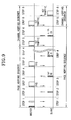
- the response packet with respect to the FHS packet is transmitted to the master 20 (S 703), and the processes are shown in FIGS. 8 and 9 as steps 1 through 4.
- a train of signals wherein the master sends the device access code of the slave 30 to connect with the slave 30 is a page hopping sequence.
- page scan means that the slave 30 receives its device access code with respect to the page hopping sequence of the master 20 and transmits the device access code to indicate receipt of the device access code to the master 20.
- a train of signals of the device access code of the slave transmitted by the slave 30 is a page hopping sequence by the slave 30.
- the control unit 35 of the slave 30 judges whether the response packet of the FHS packet is successfully transmitted to the master 20 (S 705). The subsequent process is the same as described before. As the control unit 35 of the slave 30 judges that the transmitted response packet corresponding to the transmitted FHS packet is successfully received, the page message by the master 20 is allowed.
- the master 20 When the master 20 receives the response packet with respect to the FHS packet from the slave 30, the master 20 starts data transmission and transmits data traffic to the slave 30 (S 715). From this time, a channel for data transmission of the master 20 and the slave 30 is opened.
- the train of the data packet transmitted through the channel is the channel hopping sequence.
- the slave 30 When the slave 30 successfully receives a first traffic transmitted from the master 20, the slave 30 transmits data traffic intended to be transmitted by the slave 30 to the master 20. Data transmission between the master 20 and the slave 30 is performed as described so far (S 717).
- the control unit 35 of the slave 30 judges that there is no response from the master 20 in a predetermined time and also there is an error in the response packet transmitted by the slave 30. Therefore, the control unit 35 of the slave 30 controls the transceiver 31 and the response packet generator 33 so that a response packet which is the same as the response packet transmitted after the predetermined time can be transmitted (S 707).
- the master 20 receives a response packet re-transmitted by the slave 30, the master 20 re-sends the first traffic to the slave 30. The above process is repeated until the slave 30 successfully receives the first traffic transmitted by the master 20 within a set-up range of the transmission numbers counted by the counters 27 and 37. The process is described in steps 5 and 6 in FIG. 8 .
- FIG. 9 shows a case that the control unit 35 of the slave 30 judges that there is an error in the response packet of the FHS packet and the first traffic.
- slave 30 re-sends the response packet if the slave 30 does not receive the FHS packet transmitted from the master 20.
- the master 20 re-sends the FHS packet in accordance with the response packet re-transmitted from the slave 30.
- the slave 30 successfully receives the FHS packet re-transmitted by the master 20.
- the same process is operated in this case.
- FIG. 10 is a view schematically showing a connection process with an external device.
- the page scan process of the slave 30 is operated by the inquiry process and the page process of the master 20.
- the response packet of the slave 30 is transmitted to the master 20 through the page scan process of the slave 30, and the response packet of the slave 30 is successfully transmitted, the connection of the master 20 and the slave 30 is completed.
- the master 20 and the slave 30 communicate the data.
- the connection success rate of the master 20 and the slave 30 is increased.
- the wireless communication apparatus does not have to try again from the initial set-up due to the connection failure. Therefore, the connection success rate is increased, and consequently, electrical consumption caused by one or more re-tries from the initial set-up can be reduced.
Landscapes
- Engineering & Computer Science (AREA)
- Computer Networks & Wireless Communication (AREA)
- Signal Processing (AREA)
- Mobile Radio Communication Systems (AREA)
- Small-Scale Networks (AREA)
- Communication Control (AREA)
Claims (14)
- Appareil de communication sans fil destiné à une technique de communication Bluetooth comprenant :un émetteur - récepteur (21, 31) destiné à émettre et à recevoir des données avec un dispositif extérieur ;un générateur de paquet de réponse (23, 33) destiné à générer un paquet de réponse afin d'informer de la réception réussie d'un paquet de données émis par le dispositif extérieur ; etune unité de contrôle (25, 35) destinée à émettre le paquet de réponse généré vers le dispositif extérieur par l'intermédiaire de l'émetteur - récepteur lorsque le paquet de données est reçu,caractérisé par :des moyens de jugement destinés à faire juger par l'appareil lui-même, en l'absence de toute réception d'informations en provenance du dispositif extérieur, qu'une erreur s'est produite lors de l'émission du paquet de réponse généré,dans lequel l'unité de contrôle est en outre apte à réémettre le paquet de réponse après une période de temps prédéterminée au bout de laquelle les moyens de jugement ont jugé qu'une erreur s'est produite lors de l'émission du paquet de réponse généré, et à maintenir un état de l'appareil, sur la base d'un jugement selon lequel une erreur s'est produite lors de l'émission du paquet de réponse généré ou selon lequel le paquet de données n'a pas été reçu avec succès de la part du dispositif extérieur, état dans lequel une séquence de saut de page est envoyée.
- Appareil de communication sans fil selon la revendication 1, dans lequel l'unité de contrôle est en outre apte à juger que l'erreur s'est produite lors de l'émission du paquet de réponse quand un paquet correspondant au paquet de réponse n'est pas reçu au cours d'une période de temps prédéterminée.
- Appareil de communication sans fil selon la revendication 1 ou la revendication 2, dans lequel l'unité de contrôle est en outre apte à juger que l'erreur s'est produite lors de l'émission du paquet de réponse quand un paquet reçu correspondant au paquet de réponse émis est identique à un paquet reçu précédemment.
- Appareil de communication sans fil selon l'une quelconque des revendications 1 à 3, dans lequel le paquet de réponse inclut un code d'accès au dispositif.
- Appareil de communication sans fil selon l'une quelconque des revendications 1 à 4, comprenant en outre un compteur (27, 37) destiné à compter un certain nombre de fois où le paquet de réponse est émis, dans lequel l'unité de contrôle est en outre apte à initialiser une connexion avec le dispositif extérieur lorsque le nombre de fois compté atteint un nombre prédéterminé.
- Appareil de communication sans fil selon l'une quelconque des revendications 1 à 5, dans lequel l'unité de contrôle est en outre apte à commencer à émettre et à recevoir les données quand il a été jugé que le paquet de réponse a été émis avec succès.
- Appareil de communication sans fil selon la revendication 6, dans lequel l'unité de contrôle est en outre apte à juger que le paquet de réponse a été émis avec succès quand un paquet correspondant au paquet de réponse est reçu en provenance du dispositif extérieur au cours d'une période de temps prédéterminée.
- Procédé de communication sans fil destiné à une technique de communication Bluetooth comprenant les étapes consistant à :générer (S701) au niveau d'un appareil, un paquet de réponse afin d'informer de la réception réussie d'un paquet de données reçu en provenance d'un dispositif extérieur ;émettre (S703) à partir de l'appareil, le paquet de réponse généré vers le dispositif extérieur ;l'appareil jugeant (S705) par lui-même, en l'absence de toute réception d'informations en provenance du dispositif extérieur, si une erreur s'est produite lors de réception du paquet de réponse ; etl'appareil contrôlant (S707) le paquet de réponse à réémettre après une période de temps prédéterminée quand il a été jugé qu'une erreur s'est produite lors de la réception du paquet de réponse,dans lequel l'étape de contrôle inclut en outre le fait que l'appareil maintient un état sur la base d'un jugement qu'une erreur s'est produite lors de la réception du paquet de réponse généré ou si le paquet de données en provenance du dispositif extérieur n'est pas reçu avec succès, état dans lequel une séquence de saut de page est envoyée.
- Procédé de communication sans fil selon la revendication 8, dans lequel l'étape de jugement juge que l'erreur s'est produite lors de la réception du paquet de réponse quand aucun paquet de données correspondant au paquet de réponse en provenance du dispositif extérieur n'est reçu.
- Procédé de communication sans fil selon la revendication 8 ou la revendication 9, dans lequel l'étape de jugement juge que l'erreur s'est produite lors de la réception du paquet de réponse quand un paquet de données reçu correspondant au paquet de réponse reçu est identique à un paquet de réponse reçu précédemment.
- Procédé de communication sans fil selon l'une quelconque des revendications 8 à 10, dans lequel le paquet de réponse inclut un code d'accès au dispositif.
- Procédé de communication sans fil selon l'une quelconque des revendications 8 à 11, comprenant en outre les étapes consistant à :compter (S709) un certain nombre de fois où le paquet de réponse est reçu ; etinitialiser (S711, S713) une connexion avec le dispositif extérieur lorsque le nombre de fois compté atteint un nombre prédéterminé.
- Procédé de communication sans fil selon l'une quelconque des revendications 8 à 12, dans lequel, dans l'étape de contrôle, l'émission et la réception des données sont commencées quand il a été jugé que le paquet de réponse a été émis avec succès.
- Procédé de communication sans fil selon la revendication 13, dans lequel l'étape de jugement juge que le paquet de réponse a été émis avec succès quand un paquet de données correspondant au paquet de réponse est reçu en provenance du dispositif extérieur.
Applications Claiming Priority (2)
| Application Number | Priority Date | Filing Date | Title |
|---|---|---|---|
| KR2001080518 | 2001-12-18 | ||
| KR10-2001-0080518A KR100460967B1 (ko) | 2001-12-18 | 2001-12-18 | 접속률을 높일 수 있는 무선통신기기 및 그 방법 |
Publications (2)
| Publication Number | Publication Date |
|---|---|
| EP1322075A1 EP1322075A1 (fr) | 2003-06-25 |
| EP1322075B1 true EP1322075B1 (fr) | 2009-06-24 |
Family
ID=19717168
Family Applications (1)
| Application Number | Title | Priority Date | Filing Date |
|---|---|---|---|
| EP20020028144 Expired - Lifetime EP1322075B1 (fr) | 2001-12-18 | 2002-12-18 | Amélioration du débit de communication dans une communication sans fil |
Country Status (6)
| Country | Link |
|---|---|
| US (1) | US7286541B2 (fr) |
| EP (1) | EP1322075B1 (fr) |
| JP (1) | JP3777155B2 (fr) |
| KR (1) | KR100460967B1 (fr) |
| CN (1) | CN1427549A (fr) |
| DE (1) | DE60232709D1 (fr) |
Families Citing this family (20)
| Publication number | Priority date | Publication date | Assignee | Title |
|---|---|---|---|---|
| KR100498361B1 (ko) * | 2003-07-18 | 2005-07-01 | 엘지전자 주식회사 | 이동 통신단말기의 무선 인터넷 동기화 방법 |
| EP1536599A1 (fr) * | 2003-11-26 | 2005-06-01 | STMicroelectronics Belgium N.V. | Ordonnancement de paquets d'interrogation dans bluetooth en mode sniff |
| KR100572051B1 (ko) * | 2004-05-28 | 2006-04-18 | 주식회사 오픈솔루션 | 근거리 무선 데이터 전송장치 및 방법 |
| US7656853B2 (en) * | 2004-12-27 | 2010-02-02 | Microsoft Corporation | Reducing power consumption of a wireless device |
| KR101066870B1 (ko) | 2005-09-02 | 2011-09-26 | 에스케이텔레콤 주식회사 | 패킷 데이터 망에서의 화상 호 설정 방법 |
| KR101067139B1 (ko) | 2005-09-02 | 2011-09-22 | 에스케이 텔레콤주식회사 | 패킷 데이터 망에서의 화상 호 설정 방법 |
| EP1770897B1 (fr) | 2005-09-29 | 2010-04-28 | Samsung Electronics Co.,Ltd. | Procédé, dispositif et système de communication mobile pour la retransmission de paquets |
| KR100760421B1 (ko) * | 2006-02-13 | 2007-09-20 | 주식회사 팬택앤큐리텔 | 시그널링 채널을 통해 메시지를 전송하는 방법 및 그 전송제어 장치 |
| KR100793993B1 (ko) * | 2006-04-24 | 2008-01-10 | 주식회사 대우일렉트로닉스 | 홈 네트워크 시스템 |
| EP2137884A1 (fr) * | 2007-03-22 | 2009-12-30 | Nokia Corporation | Commutation du rôle d'appareils entre un contrôleur (hôte) et un participant (dispositif) pour programmer un transfert de données bidirectionnelles |
| US20090298420A1 (en) * | 2008-05-27 | 2009-12-03 | Sony Ericsson Mobile Communications Ab | Apparatus and methods for time synchronization of wireless audio data streams |
| TWI381675B (zh) * | 2008-10-09 | 2013-01-01 | Pixart Imaging Inc | 藍芽系統處理回應失敗的方法及其相關僕裝置 |
| US9173190B2 (en) * | 2012-06-29 | 2015-10-27 | Qualcomm Incorporated | System and method for controlling paging delay |
| KR20170047854A (ko) * | 2015-10-26 | 2017-05-08 | 삼성전자주식회사 | 전자기기 및 그 제어방법 |
| CN108449114B (zh) * | 2018-03-14 | 2020-01-21 | 维沃移动通信有限公司 | 一种蓝牙连接方法及移动终端 |
| KR102632299B1 (ko) * | 2019-03-05 | 2024-02-02 | 삼성전자주식회사 | 블루투스 네트워크 환경에서 응답 메시지를 전송하기 위한 전자 장치 및 그에 관한 방법 |
| KR102632536B1 (ko) * | 2019-03-05 | 2024-02-02 | 삼성전자주식회사 | 블루투스 네트워크 환경에서 응답 메시지를 전송하기 위한 전자 장치 및 그에 관한 방법 |
| KR102652380B1 (ko) * | 2019-03-05 | 2024-03-29 | 삼성전자주식회사 | 블루투스 네트워크 환경에서 응답 메시지를 전송하기 위한 전자 장치 및 그에 관한 방법 |
| KR102795191B1 (ko) | 2019-04-19 | 2025-04-14 | 삼성전자주식회사 | 블루투스 네트워크 환경에서 eir 패킷을 전송하기 위한 전자 장치 및 그에 관한 방법 |
| US10805967B1 (en) * | 2019-09-03 | 2020-10-13 | Audiowise Technology Inc. | Fast paging method, bluetooth system and bluetooth connection method using the same |
Citations (5)
| Publication number | Priority date | Publication date | Assignee | Title |
|---|---|---|---|---|
| GB1470883A (en) * | 1973-04-02 | 1977-04-21 | Texas Instruments Inc | Data communications system and its method of operation |
| US4551834A (en) * | 1983-10-25 | 1985-11-05 | U.S. Philips Corporation | Method and system for communicating over an open communication network |
| US4725834A (en) * | 1984-02-27 | 1988-02-16 | American Telephone And Telegraph Company, At&T Bell Laboratories | Reliable broadcast protocol for a token passing bus network |
| EP0570220A2 (fr) * | 1992-05-15 | 1993-11-18 | International Business Machines Corporation | Protocole d'acquittement pour des réseaux de données en série avec délivrance en désordre |
| WO2001037473A1 (fr) * | 1999-11-17 | 2001-05-25 | Telefonaktiebolaget Lm Ericsson (Publ) | Reconnaissance de couche de liaison et retransmission pour telecommunications cellulaires |
Family Cites Families (23)
| Publication number | Priority date | Publication date | Assignee | Title |
|---|---|---|---|---|
| JP3247753B2 (ja) | 1993-03-29 | 2002-01-21 | シャープ株式会社 | 通信システム |
| KR970056264A (ko) * | 1995-12-06 | 1997-07-31 | 양승택 | 멀티캐스트 컴퓨터 통신에서의 분산버퍼 처리에 의한 오류제어 방법 |
| JP3560423B2 (ja) * | 1996-09-17 | 2004-09-02 | 松下電器産業株式会社 | パケット送受信装置及びパケット受信装置 |
| KR19980050158A (ko) * | 1996-12-20 | 1998-09-15 | 양승택 | 통신처리 시스템의 전달 프로토콜 |
| US6272117B1 (en) * | 1998-02-20 | 2001-08-07 | Gwcom, Inc. | Digital sensing multi access protocol |
| CA2288682C (fr) | 1998-03-26 | 2003-04-15 | Samsung Electronics Co., Ltd. | Dispositif et procede de commande de puissances d'un canal orthogonal et d'un canal quasi-orthogonal dans un systeme de telecommunications amdc |
| JP3190895B2 (ja) | 1998-10-02 | 2001-07-23 | エヌイーシーマイクロシステム株式会社 | 通信エラー自動修復システム |
| US6611495B1 (en) * | 1999-02-22 | 2003-08-26 | Telefonaktiebolaget Lm Ericsson (Publ) | System and method for improved data transfer in packet-switched communication networks |
| JP3456923B2 (ja) * | 1999-05-20 | 2003-10-14 | シャープ株式会社 | ホスト機器及び同期通信システム及び通信干渉防止方法及び通信干渉防止プログラムを記録したコンピュータ読み取り可能な記録媒体 |
| KR20010037519A (ko) * | 1999-10-18 | 2001-05-15 | 서평원 | 이동 통신 시스템에서 호 접속율 향상 방법 |
| FI19992470A7 (fi) | 1999-11-17 | 2001-05-18 | Nokia Mobile Phones Ltd | Tiedonsiirto |
| US6751200B1 (en) * | 1999-12-06 | 2004-06-15 | Telefonaktiebolaget Lm Ericsson (Publ) | Route discovery based piconet forming |
| US7164704B1 (en) * | 1999-12-09 | 2007-01-16 | Texas Instruments Incorporated | Beam forming for transmit using bluetooth modified hopping sequences (BFTBMH) |
| US7039358B1 (en) * | 2000-01-10 | 2006-05-02 | Symbol Technologies, Inc. | Coexistence techniques in wireless networks |
| EP1119153A1 (fr) | 2000-01-19 | 2001-07-25 | Lucent Technologies Inc. | Procédé et dispositif pour une réduction robuste de débit dans un système de communication de données |
| US7218680B1 (en) * | 2000-02-29 | 2007-05-15 | Texas Instruments Incorporated | Retransmission techniques for enhanced performance in fading wireless communication channels |
| JP4045714B2 (ja) | 2000-03-30 | 2008-02-13 | 日本ビクター株式会社 | 光無線送信装置、光無線送信方法 |
| EP1299804A2 (fr) * | 2000-05-08 | 2003-04-09 | Microtune (San Diego) Inc. | Architecture logicielle pour modem |
| JP4520032B2 (ja) * | 2000-08-17 | 2010-08-04 | パナソニック株式会社 | ヘッダ圧縮装置およびヘッダ圧縮方法 |
| JP2002152308A (ja) * | 2000-11-09 | 2002-05-24 | Nec Corp | データ通信システム、その通信方法及びその通信プログラムを記録した記録媒体 |
| KR100434270B1 (ko) * | 2001-05-30 | 2004-06-04 | 엘지전자 주식회사 | 가전기기 네트워크 제어시스템 |
| US7024216B2 (en) * | 2001-06-21 | 2006-04-04 | Motorola, Inc. | Method and apparatus for allocating a communication resource in a broadband communication system |
| US7082107B1 (en) * | 2001-11-26 | 2006-07-25 | Intel Corporation | Power control in wireless communications based on estimations of packet error rate |
-
2001
- 2001-12-18 KR KR10-2001-0080518A patent/KR100460967B1/ko not_active Expired - Fee Related
-
2002
- 2002-12-16 CN CN02156097A patent/CN1427549A/zh active Pending
- 2002-12-18 US US10/322,358 patent/US7286541B2/en not_active Expired - Fee Related
- 2002-12-18 JP JP2002366377A patent/JP3777155B2/ja not_active Expired - Fee Related
- 2002-12-18 DE DE60232709T patent/DE60232709D1/de not_active Expired - Lifetime
- 2002-12-18 EP EP20020028144 patent/EP1322075B1/fr not_active Expired - Lifetime
Patent Citations (5)
| Publication number | Priority date | Publication date | Assignee | Title |
|---|---|---|---|---|
| GB1470883A (en) * | 1973-04-02 | 1977-04-21 | Texas Instruments Inc | Data communications system and its method of operation |
| US4551834A (en) * | 1983-10-25 | 1985-11-05 | U.S. Philips Corporation | Method and system for communicating over an open communication network |
| US4725834A (en) * | 1984-02-27 | 1988-02-16 | American Telephone And Telegraph Company, At&T Bell Laboratories | Reliable broadcast protocol for a token passing bus network |
| EP0570220A2 (fr) * | 1992-05-15 | 1993-11-18 | International Business Machines Corporation | Protocole d'acquittement pour des réseaux de données en série avec délivrance en désordre |
| WO2001037473A1 (fr) * | 1999-11-17 | 2001-05-25 | Telefonaktiebolaget Lm Ericsson (Publ) | Reconnaissance de couche de liaison et retransmission pour telecommunications cellulaires |
Non-Patent Citations (2)
| Title |
|---|
| JOURNAL ARTICLE: "BLUETOOTH SPECIFICATION VERSION 1.0B,CORE", BLUETOOTH SPECIFICATION VERSION, vol. 1, 1 December 1999 (1999-12-01), pages 95 - 126, XP002174708 * |
| STALLINGS W.: "DATA AND COMPUTER COMMUNICATIONS, Fifth Edition", ISBN 0-13-571274-2, 1997, PRENTICE-HALL INTERNATIONAL, INC., NEW JERSEY,, pages 171 - 175 * |
Also Published As
| Publication number | Publication date |
|---|---|
| EP1322075A1 (fr) | 2003-06-25 |
| CN1427549A (zh) | 2003-07-02 |
| US20030139191A1 (en) | 2003-07-24 |
| US7286541B2 (en) | 2007-10-23 |
| JP3777155B2 (ja) | 2006-05-24 |
| DE60232709D1 (de) | 2009-08-06 |
| KR20030050124A (ko) | 2003-06-25 |
| KR100460967B1 (ko) | 2004-12-09 |
| JP2003224622A (ja) | 2003-08-08 |
Similar Documents
| Publication | Publication Date | Title |
|---|---|---|
| EP1322075B1 (fr) | Amélioration du débit de communication dans une communication sans fil | |
| US7193986B2 (en) | Wireless network medium access control protocol | |
| McDermott-Wells | What is bluetooth? | |
| JP5258358B2 (ja) | ワイヤレスノードネットワークのチャネルにアクセスする方法及びシステム | |
| US7602754B2 (en) | Short-range RF access point design enabling services to master and slave mobile devices | |
| EP0713345B1 (fr) | Procédé et dispositif pour la communication directe dans un système de radiocommunication AMRT | |
| EP0681763B1 (fr) | Protocole de controle d'acces a un moyen de communication destine a un reseau sans fil | |
| US6721302B1 (en) | Apparatus, and associated method, for communicating packet data in a SDMA (Space-Division, Multiple-Access) communication scheme | |
| CN101667849B (zh) | 数据传输方法、网络设备及通信系统 | |
| EP1475924B1 (fr) | Communication sans fils ad hoc avec niveaux de puissance differents pour l'en-tête et la charge utile des messages | |
| EP1232613B1 (fr) | Systeme de communications | |
| EP1133094A2 (fr) | Allocation dynamique de creneaux de retransmission dans des liaisons de communication sans fils | |
| JP3872786B2 (ja) | コネクションレスのブロードキャストが可能な無線通信方法 | |
| EP2632209A2 (fr) | Procédé, appareil et produit de programme informatique destinés à un mécanisme de communication avec reconnaissance de coexistence pour multi-radios | |
| US20060239223A1 (en) | Method and system for bluetooth and wireless local area network coexistence | |
| US20040142690A1 (en) | Wireless communication system and a hand-off method therefor | |
| JP3165125B2 (ja) | 無線通信における多重アクセス方法 | |
| US7684465B1 (en) | Frequency hopping communication protocol | |
| KR100691419B1 (ko) | 무선 통신기기 및 그 통신방법 및 이를 적용한 무선통신시스템 | |
| US20120182928A1 (en) | Wireless internet connection repeater without signal interference | |
| EP1770667A2 (fr) | Méthode pour la synchronisation de dispositifs dans des réseaux sans fil | |
| CN100348002C (zh) | 援救信标 | |
| US8306002B2 (en) | Wireless communication technique comprising multiple beacons in each communications superframe | |
| US7260359B2 (en) | Method for transmission of data between a master station and a slave station, and a data transmission system | |
| JP2025520151A (ja) | 効率的なユニキャストスーパーフレーム通信 |
Legal Events
| Date | Code | Title | Description |
|---|---|---|---|
| PUAI | Public reference made under article 153(3) epc to a published international application that has entered the european phase |
Free format text: ORIGINAL CODE: 0009012 |
|
| 17P | Request for examination filed |
Effective date: 20021218 |
|
| AK | Designated contracting states |
Designated state(s): AT BE BG CH CY CZ DE DK EE ES FI FR GB GR IE IT LI LU MC NL PT SE SI SK TR |
|
| AX | Request for extension of the european patent |
Extension state: AL LT LV MK RO |
|
| AKX | Designation fees paid |
Designated state(s): DE FR GB |
|
| 17Q | First examination report despatched |
Effective date: 20040617 |
|
| 17Q | First examination report despatched |
Effective date: 20040617 |
|
| GRAP | Despatch of communication of intention to grant a patent |
Free format text: ORIGINAL CODE: EPIDOSNIGR1 |
|
| GRAS | Grant fee paid |
Free format text: ORIGINAL CODE: EPIDOSNIGR3 |
|
| GRAA | (expected) grant |
Free format text: ORIGINAL CODE: 0009210 |
|
| AK | Designated contracting states |
Kind code of ref document: B1 Designated state(s): DE FR GB |
|
| REG | Reference to a national code |
Ref country code: GB Ref legal event code: FG4D |
|
| REF | Corresponds to: |
Ref document number: 60232709 Country of ref document: DE Date of ref document: 20090806 Kind code of ref document: P |
|
| PGFP | Annual fee paid to national office [announced via postgrant information from national office to epo] |
Ref country code: GB Payment date: 20091125 Year of fee payment: 8 |
|
| PLBE | No opposition filed within time limit |
Free format text: ORIGINAL CODE: 0009261 |
|
| STAA | Information on the status of an ep patent application or granted ep patent |
Free format text: STATUS: NO OPPOSITION FILED WITHIN TIME LIMIT |
|
| PGFP | Annual fee paid to national office [announced via postgrant information from national office to epo] |
Ref country code: FR Payment date: 20100115 Year of fee payment: 8 |
|
| 26N | No opposition filed |
Effective date: 20100325 |
|
| PGFP | Annual fee paid to national office [announced via postgrant information from national office to epo] |
Ref country code: DE Payment date: 20091204 Year of fee payment: 8 |
|
| GBPC | Gb: european patent ceased through non-payment of renewal fee |
Effective date: 20101218 |
|
| REG | Reference to a national code |
Ref country code: FR Ref legal event code: ST Effective date: 20110831 |
|
| PG25 | Lapsed in a contracting state [announced via postgrant information from national office to epo] |
Ref country code: FR Free format text: LAPSE BECAUSE OF NON-PAYMENT OF DUE FEES Effective date: 20110103 |
|
| PG25 | Lapsed in a contracting state [announced via postgrant information from national office to epo] |
Ref country code: DE Free format text: LAPSE BECAUSE OF NON-PAYMENT OF DUE FEES Effective date: 20110701 Ref country code: GB Free format text: LAPSE BECAUSE OF NON-PAYMENT OF DUE FEES Effective date: 20101218 |
|
| REG | Reference to a national code |
Ref country code: DE Ref legal event code: R119 Ref document number: 60232709 Country of ref document: DE Effective date: 20110701 |