EP1322437B1 - Angestauchte rorhverbindungsmanschette und matrize - Google Patents
Angestauchte rorhverbindungsmanschette und matrize Download PDFInfo
- Publication number
- EP1322437B1 EP1322437B1 EP01971016A EP01971016A EP1322437B1 EP 1322437 B1 EP1322437 B1 EP 1322437B1 EP 01971016 A EP01971016 A EP 01971016A EP 01971016 A EP01971016 A EP 01971016A EP 1322437 B1 EP1322437 B1 EP 1322437B1
- Authority
- EP
- European Patent Office
- Prior art keywords
- collar
- work piece
- die
- fitting
- tube
- Prior art date
- Legal status (The legal status is an assumption and is not a legal conclusion. Google has not performed a legal analysis and makes no representation as to the accuracy of the status listed.)
- Expired - Lifetime
Links
- 238000000034 method Methods 0.000 claims description 20
- 238000013016 damping Methods 0.000 claims 3
- 238000003780 insertion Methods 0.000 description 10
- 230000037431 insertion Effects 0.000 description 10
- 239000004677 Nylon Substances 0.000 description 7
- 229920001778 nylon Polymers 0.000 description 7
- 239000000463 material Substances 0.000 description 6
- 229910000838 Al alloy Inorganic materials 0.000 description 2
- 229910000990 Ni alloy Inorganic materials 0.000 description 2
- 229910000831 Steel Inorganic materials 0.000 description 2
- 229910001069 Ti alloy Inorganic materials 0.000 description 2
- RTAQQCXQSZGOHL-UHFFFAOYSA-N Titanium Chemical compound [Ti] RTAQQCXQSZGOHL-UHFFFAOYSA-N 0.000 description 2
- XAGFODPZIPBFFR-UHFFFAOYSA-N aluminium Chemical compound [Al] XAGFODPZIPBFFR-UHFFFAOYSA-N 0.000 description 2
- 238000005242 forging Methods 0.000 description 2
- 230000000977 initiatory effect Effects 0.000 description 2
- 230000035945 sensitivity Effects 0.000 description 2
- 239000010935 stainless steel Substances 0.000 description 2
- 229910001256 stainless steel alloy Inorganic materials 0.000 description 2
- 239000010959 steel Substances 0.000 description 2
- 239000010936 titanium Substances 0.000 description 2
- 230000008878 coupling Effects 0.000 description 1
- 238000010168 coupling process Methods 0.000 description 1
- 238000005859 coupling reaction Methods 0.000 description 1
- 230000001419 dependent effect Effects 0.000 description 1
- 239000007769 metal material Substances 0.000 description 1
- 239000003190 viscoelastic substance Substances 0.000 description 1
Images
Classifications
-
- B—PERFORMING OPERATIONS; TRANSPORTING
- B21—MECHANICAL METAL-WORKING WITHOUT ESSENTIALLY REMOVING MATERIAL; PUNCHING METAL
- B21D—WORKING OR PROCESSING OF SHEET METAL OR METAL TUBES, RODS OR PROFILES WITHOUT ESSENTIALLY REMOVING MATERIAL; PUNCHING METAL
- B21D39/00—Application of procedures in order to connect objects or parts, e.g. coating with sheet metal otherwise than by plating; Tube expanders
- B21D39/04—Application of procedures in order to connect objects or parts, e.g. coating with sheet metal otherwise than by plating; Tube expanders of tubes with tubes; of tubes with rods
- B21D39/046—Connecting tubes to tube-like fittings
-
- Y—GENERAL TAGGING OF NEW TECHNOLOGICAL DEVELOPMENTS; GENERAL TAGGING OF CROSS-SECTIONAL TECHNOLOGIES SPANNING OVER SEVERAL SECTIONS OF THE IPC; TECHNICAL SUBJECTS COVERED BY FORMER USPC CROSS-REFERENCE ART COLLECTIONS [XRACs] AND DIGESTS
- Y10—TECHNICAL SUBJECTS COVERED BY FORMER USPC
- Y10T—TECHNICAL SUBJECTS COVERED BY FORMER US CLASSIFICATION
- Y10T29/00—Metal working
- Y10T29/49—Method of mechanical manufacture
- Y10T29/4981—Utilizing transitory attached element or associated separate material
-
- Y—GENERAL TAGGING OF NEW TECHNOLOGICAL DEVELOPMENTS; GENERAL TAGGING OF CROSS-SECTIONAL TECHNOLOGIES SPANNING OVER SEVERAL SECTIONS OF THE IPC; TECHNICAL SUBJECTS COVERED BY FORMER USPC CROSS-REFERENCE ART COLLECTIONS [XRACs] AND DIGESTS
- Y10—TECHNICAL SUBJECTS COVERED BY FORMER USPC
- Y10T—TECHNICAL SUBJECTS COVERED BY FORMER US CLASSIFICATION
- Y10T29/00—Metal working
- Y10T29/49—Method of mechanical manufacture
- Y10T29/49826—Assembling or joining
- Y10T29/4984—Retaining clearance for motion between assembled parts
- Y10T29/49845—Retaining clearance for motion between assembled parts by deforming interlock
-
- Y—GENERAL TAGGING OF NEW TECHNOLOGICAL DEVELOPMENTS; GENERAL TAGGING OF CROSS-SECTIONAL TECHNOLOGIES SPANNING OVER SEVERAL SECTIONS OF THE IPC; TECHNICAL SUBJECTS COVERED BY FORMER USPC CROSS-REFERENCE ART COLLECTIONS [XRACs] AND DIGESTS
- Y10—TECHNICAL SUBJECTS COVERED BY FORMER USPC
- Y10T—TECHNICAL SUBJECTS COVERED BY FORMER US CLASSIFICATION
- Y10T29/00—Metal working
- Y10T29/49—Method of mechanical manufacture
- Y10T29/49826—Assembling or joining
- Y10T29/49908—Joining by deforming
-
- Y—GENERAL TAGGING OF NEW TECHNOLOGICAL DEVELOPMENTS; GENERAL TAGGING OF CROSS-SECTIONAL TECHNOLOGIES SPANNING OVER SEVERAL SECTIONS OF THE IPC; TECHNICAL SUBJECTS COVERED BY FORMER USPC CROSS-REFERENCE ART COLLECTIONS [XRACs] AND DIGESTS
- Y10—TECHNICAL SUBJECTS COVERED BY FORMER USPC
- Y10T—TECHNICAL SUBJECTS COVERED BY FORMER US CLASSIFICATION
- Y10T29/00—Metal working
- Y10T29/53—Means to assemble or disassemble
- Y10T29/53987—Tube, sleeve or ferrule
-
- Y—GENERAL TAGGING OF NEW TECHNOLOGICAL DEVELOPMENTS; GENERAL TAGGING OF CROSS-SECTIONAL TECHNOLOGIES SPANNING OVER SEVERAL SECTIONS OF THE IPC; TECHNICAL SUBJECTS COVERED BY FORMER USPC CROSS-REFERENCE ART COLLECTIONS [XRACs] AND DIGESTS
- Y10—TECHNICAL SUBJECTS COVERED BY FORMER USPC
- Y10T—TECHNICAL SUBJECTS COVERED BY FORMER US CLASSIFICATION
- Y10T29/00—Metal working
- Y10T29/53—Means to assemble or disassemble
- Y10T29/53996—Means to assemble or disassemble by deforming
Definitions
- This invention relates generally to swage machines and more particularly to collars and dies used to retain tubes in such machines during the swaging process, see for example US-A-3 726 122.
- Swaging involves the tapering of a rod or tube, such as by forging, hammering, or squeezing. It may also involve the joining together of two components by similar manipulation.
- a fitting just as a coupling, may be joined to the exterior of a tube by any of the operations of forging, hammering or squeezing. In general, the fitting is placed on the outside of the rod or tube and then swaged into place, preferably substantially where located.
- Swaging is a common practice for applying fittings to tubes. A plurality of tubes may be joined together by way of their fitting connections that have been swaged to either or both ends of the tubes.
- swaging may be performed manually, swage machines are used to automate and facilitate the process of swaging a fitting to a tube.
- a wide array of swaging machines is available. Most include means for retaining one or more dies. A die retains the fitting and tube in place during the swaging process. With the fitting and tube in place in the die, pressure is applied to the exterior of the fitting where it is in contact with the exterior of the tube. This is achieved either by rotating the piece, tube, rod, or the like, to be worked or by rotating swaging devices about the piece that remains in a fixed position.
- the pressure applied to a tube work piece may alternatively be made from the interior of the tube by way of an expander. This is referred to as internal roller swaging.
- the fitting is larger than the tube.
- means to capture the tube within the die to keep it fixed in place during the swaging process.
- Such means is a tight-fit annular insert that is placed around the tube and resides in a recess in the die.
- the insert is generally made of a non-metallic material, such as nylon.
- the nylon insert wedges the tube in place within the die.
- a set of opposing die halves is used to position the fitting and tube. Each half includes a half-annular nylon insert. The tube and fitting are placed in one of the halves and then clamped in place when the second die half is mated to the first.
- the nylon insert is inadequate to retain the tube in place during the swaging process.
- the insert is made of a viscoelastic material, it often fails to provide adequate clamping force during the rigorous swaging process.
- the tube rotates and/or moves axially during the process.
- the amount of clamping force associated with the die set is dependent on individual die tolerances and die wear when using the nylon inserts. It is therefore often necessary for an operator to hold the tube in place to prevent rotation and axial movement. This limits the efficiency of the automated swaging process, minimizes the operator's ability to perform other tasks, and increases the yield of detective parts. Therefore, what is needed is a die and die-to-tube interface arrangement that retain the tube and fitting in place with certainty during swaging.
- the above-mentioned need is met by the present invention, which provides a wage die and collar assembly for retaining a work piece in a swage machine.
- the assembly includes a collar releasably placcable on the work piece and including a first clamping section and a second clamping section connected together and a die in sertable into the swage machine.
- the die includes a work piece slot and a collar recess in a die face of the die. The collar recess is configured to retain the collar that in turn is coupled about the work piece.
- the collar may include in one of its faces a chamfered section to accommodate the curved portion of the work piece.
- the collar recess and the collar may be of hexagonal shape.
- a fitting recess is formed in the die face.
- a dummy fitting may be used to fix the position of the collar on the work piece before swaging a final fitting.
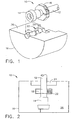
- Figures 1 and 2 illustrate a first die-and-collar assembly 10 that may be used in a swaging machine to swage a work piece, such as tube 12, and a fitting 14.
- the assembly 10 includes a die 16 and a collar 18 that in combination retain the tube 12 and fitting 14 in place during swaging.
- the die includes a fitting recess 20, a collar recess 22, and a tube slot 24 in a die retaining face 26.
- the fitting recess 20 and the tube slot 24 may be sized to accommodate the particular dimensions of the fitting 14 and the tube 12.
- the collar 18 is formed in a configuration that minimizes the opportunity for it to spin within the collar recess 22 when the swaging operation occurs. Although many rotation-prevention configurations are possible, one approach is to form the collar recess 22 in a hex shape. For that shape, the collar 18 could also be hex shape, as shown in Figures 1 and 3. Of course, other types of "anti-rotation" features may form part of the collar 18 and/or the recess 22. One example may be the introduction of a set screw.
- the collar recess 22 has dimensions exceeding the outer dimensions of the collar 18. There may be a slight gap between the sidewalls of the collar recess 22 and the collar 18 when the collar is in place in the collar recess 22. The slight gap permits easy insertion and removal of the collar 18 when applied to the tube 12 as shown in Figure 1. However, that gap is not to be so large as to permit significant fore and aft movement of the collar 18 in the die 16.
- the die 16 and the collar 18 may be formed of any material suitable for swaging work pieces.
- the die 16 and collar 18 may both be made of a similar material, such as steel. Either or both components may alternatively be fabricated of other suitable materials including, but not limited to, Aluminum, stainless steel, Titanium, or Nickel alloys.
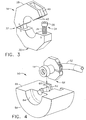
- the collar 18 shown in Figure 3 includes a first clamping section 28 and a second clamping section 30.
- the first clamping section 28 and the second clamping section 30 are connected together by a hinge 32.
- the second clamping section 30 includes in a collar face a collar clasp or collar retainer such as a capture bolt 34.
- the capture bolt 34 includes a bolt body 36 and a bolt head 38.
- the bolt body 36 is designed to fit within a collar slot 40 of the first clamping section 28.
- the collar slot 40 includes retaining prongs 42 against which the bolt head 38 resides when a work piece is disposed between sections 28 and 30.
- the bolt head 38 may be slotted or have similar tightening means such that when tightened onto the prongs 42, the work piece remains fixed in place.
- the hinge 32 provides an easy means for keeping sections 28 and 30 together while making insertion and removal of the work piece simple.
- the collar may alternatively be formed of two separate sections not hingedly connected together. Instead, the two separate sections may be coupled together by alternative collar attachment means, such as a set of threaded bolts and corresponding nuts, among other common attachment options.
- the die-and-collar assembly 10 of Figures 1-3 enables secure placement of a work piece, such as tube 12, into a swaging machine. It eliminates the problems associated with use of the nylon insertion. In particular, it prevents work piece rotation and fore and aft movement of the work piece. It eliminates the need to have an operator manually hold the work piece in place during the swaging operation.
- a "dummy" fitting may be employed prior to insertion of the work piece in the die 16. The dummy fitting, essentially a fitting of the type to be swaged, may be placed in the appropriate position on the tube 12. The collar 18 may then be fixed in place on the tube 12. This procedure may be completed prior to initiating the swaging process.
- the fitting to be swaged and the tube 12 with the collar 18 fixed in place are then inserted into the appropriate recesses in the die face 26.
- the swage machine may then be operated and with the collar 18 in the appropriate position, accurate setback of the fitting 14 on the tube 12 is assured. Sensitivity of the process to roller wear and die tolerance variations is also eliminated.
- FIG. 1-3 The assembly 10 of Figures 1-3 is suitable for retaining a work piece such as tube 12 that has a "long" straight length. However, it may not be suitable for work pieces having "short" straight lengths in relation to the location of the fitting to be swaged.
- Figures 4-6 illustrate a second embodiment of the present invention suitable for work pieces of short straight length.
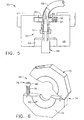
- a second die-and-collar assembly 50 may be used in a swaging machine to swage a short piece, such as curved tube 52, and a fitting 14.
- the assembly 50 includes a die 54 and a collar 56 that in combination retain the tube 52 and fitting 14 in place during swaging.
- the die includes a fitting recess 58, a collar recess 60, and a chamfered tube slot 62 and an optional expander port 64 in a die retaining face 66.
- the fitting recess 58 may be sized to accommodate the particular dimensions of the fitting 14.
- the chamfered tube slot 62 allows for the insertion of tubes having very short straight sections into the die 54 without impact on the curved portion of the tube 52 that is not held in the die 54.
- the die 54 may also include port 64 to permit insertion of an expander 68 if the tube 52 is to be expanded in the region where the fitting 14 is to be located.
- the collar 56 is formed in a configuration that minimizes the opportunity for it to spin within the collar recess 60 when the swaging operation occurs.
- one approach is to form the collar recess 60 in a hex shape.
- the collar 56 could also be hex shape, as shown in Figures 4 and 6.
- the collar recess 60 has dimensions exceeding the outer dimensions of the collar 56.
- the slight gap permits easy insertion and removal of the collar 56 when applied to the tube 52 as shown in Figure 4.
- that gap is not to be so large as to permit significant fore and aft movement of the collar 56 in the die 54.
- the die 54 and the collar 56 may be formed of any material suitable for swaging work pieces.
- the die 54 and collar 56 may both be made of a similar material, such as steel. Either or both components may alternatively be fabricated of other suitable materials including, but not limited to, Aluminum, stainless steel, Titanium, or Nickel alloys.
- the collar 56 shown in Figure 6 includes a first clamping section 70 and a second clamping section 72.
- the first clamping section 70 and the second clamping section 72 are connected together by a hinge 74.
- the second clamping section 72 includes in a collar face a collar clasp or collar retainer such as a capture bolt 76.
- the capture bolt 76 includes a bolt body 78 and a bolt head 80.
- the bolt body 78 is designed to fit within a collar slot substantially the same as the arrangement and clamping mechanism of collar 18 of Figure 3.
- the hinge 74 provides an easy means for keeping sections 70 and 72 together while making insertion and removal of the work piece simple.
- the second clamping section 72 includes a chamfer or recess 82 in its vertical face closest to the curve.
- the die-and-collar assembly 50 of Figures 4-6 enables secure placement of a work piece having a short straight length, such as tube 52, into a swaging machine. It eliminates the problems associated with use of the nylon insertion. In particular, it prevents rotation and fore and aft movement of the curved work piece. It eliminates the need to have an operator manually hold the work piece in place during the swaging operation, which may be particularly difficult for curved work pieces.
- a "dummy" fitting may be employed prior to insertion of the work piece in the die 54. The dummy fitting, essentially a fitting of the type to be swaged, may be placed in the appropriate position on the tube 52. The collar 56 may then be fixed in place on the tube 52.
- This procedure may be completed prior to initiating the swaging process.
- the fitting to be swaged and the tube 52 with the collar 56 fixed in place are then inserted into the appropriate recesses in the die face 66.
- the swage machine may then be operated and with the collar 56 in the appropriate position, accurate setback of the fitting 14 on the tube 52 is assured. Sensitivity of the process to roller wear and die tolerance variations is also eliminated.
Landscapes
- Engineering & Computer Science (AREA)
- Mechanical Engineering (AREA)
- Forging (AREA)
- Non-Disconnectible Joints And Screw-Threaded Joints (AREA)
- Adornments (AREA)
Claims (9)
- Umformmatrize und Manschettenanordnung (10, 50) zum Festhalten eines Werkstücks in einer Umformmaschine wobei die Anordnung (10, 50) aufweist:eine Manschette (18, 56), die lösbar auf dem Werkstück platzierbar ist und einen ersten Klemmabschnitt (28, 70) und einen zweiten Klemmabschnitt (30, 72) enthält die miteinander verbunden sind,eine in die Umformmaschine einsetzbare Matrize (16, 54), wobei die Matrize (16, 54) einen Werkstückschlitz (24, 62) und eine Manschettenaussparung (22, 16) in ihrer Matrizenstirnfläche (22, 66) enthält, wobei die Manschettenaussparung (22, 60) zum Festhalten der Manschette (18, 56) darin konfiguriert ist.
- Anordnung (10, 50) nach Anspruch 1, wobei der zweite Klemmabschnitt (30, 72) eine Klemmschraube (34, 76) zum lösbaren Klemmen der Manschette (18, 56) um das Werkstück enthält, wobei die Klemmschraube (34, 76) den ersten Klemmabschnitt (28, 70) und den zweiten Klemmabschnitt (30, 72) miteinander verbindet.
- Anordnung (10, 50) nach Anspruch 1, wobei das Werkstück ein gekrümmtes Werkstück ist und der zweite Klemmabschnitt der Manschette (56) eine abgeschrägte Fläche (66) enthält, und die Matrize (54) eine abgeschrägte Werkstücköffnung (62) enthält.
- Anordnung (10, 50) nach einem der vorstehenden Ansprüche, welche ferner eine Rotationsverhinderungseinrichtung aufweist, so dass sich die Manschette (18, 56) innerhalb der Manschettenaussparung (22, 60) nicht dreht.
- Verfahren zum Umformen eines Werkstücks in einer Umformmaschine wobei das Verfahren die Schritte aufweist:Anbringen einer Manschette (18, 56) um das Werkstück an einer wählbaren Position;Anziehen der Manschette (18, 56) um das Werkstück;Einführen der Manschette (18, 56) und des Werkstücks in eine Manschettenaussparung (22, 60) bzw. einen Werkstückschlitz (24, 62) einer Matrize (16, 54); undEinsetzen der Matrize (16, 54) mit der Manschette (18, 56) und dem Werkstück in die Umformmaschine.
- Verfahren nach Anspruch 5, welches ferner vor dem Schritt der Anbringung der Manschette (18, 56) um das Werkstück den Schritt der Platzierung eines Ersatzformstück auf dem Werkstück in einer wählbaren Position und nach dem Anbringen und Anziehen des Manschette (18, 56) den Schritt der Entfernung des Ersatzformstücks und der Anbringung eines Formstücks an dem Werkstück, das auf das Werkstück aufzudrücken ist, enthält.
- Verfahren nach Anspruch 5 oder 6, welches ferner den Schritt der Ausbildung einer Formstückaussparung (20, 58) in der Matrizenstirnfläche (26, 66) aufweist, um darin ein auf das Werkstück aufzudrückendes Formstück aufzunehmen.
- Verfahren nach Anspruch 5 oder 6, wobei das Werkstück ein Rohr ist, und welches ferner den Schritt der Ausbildung einer Erweiterungsöffnung (64) in der Matrizenstirnfläche (66) der Matrize (54) aufweist.
- Verfahren nach Anspruch 5 bis 8, wobei die Manschette (18, 56) einen ersten Klemmabschnitt (28, 70) und einen zweiten Klemmabschnitt (30, 72) enthält, die gelenkig miteinander verbundenen sind.
Applications Claiming Priority (3)
| Application Number | Priority Date | Filing Date | Title |
|---|---|---|---|
| US09/668,909 US6412160B1 (en) | 2000-09-22 | 2000-09-22 | Swaged tube fitting collar and die |
| US668909 | 2000-09-22 | ||
| PCT/US2001/028819 WO2002024373A2 (en) | 2000-09-22 | 2001-09-14 | Swaged tube fitting collar and die |
Publications (2)
| Publication Number | Publication Date |
|---|---|
| EP1322437A2 EP1322437A2 (de) | 2003-07-02 |
| EP1322437B1 true EP1322437B1 (de) | 2006-06-14 |
Family
ID=24684246
Family Applications (1)
| Application Number | Title | Priority Date | Filing Date |
|---|---|---|---|
| EP01971016A Expired - Lifetime EP1322437B1 (de) | 2000-09-22 | 2001-09-14 | Angestauchte rorhverbindungsmanschette und matrize |
Country Status (12)
| Country | Link |
|---|---|
| US (1) | US6412160B1 (de) |
| EP (1) | EP1322437B1 (de) |
| JP (1) | JP5072165B2 (de) |
| CN (1) | CN1236876C (de) |
| AU (1) | AU2001290953A1 (de) |
| BR (1) | BR0114064A (de) |
| CA (1) | CA2421555C (de) |
| DE (1) | DE60120727T2 (de) |
| MX (1) | MXPA03002379A (de) |
| MY (1) | MY126114A (de) |
| RU (1) | RU2272691C2 (de) |
| WO (1) | WO2002024373A2 (de) |
Cited By (1)
| Publication number | Priority date | Publication date | Assignee | Title |
|---|---|---|---|---|
| FR3050949A1 (fr) * | 2016-05-06 | 2017-11-10 | Soc D'assemblage Et Brasage | Dispositif de pre-assemblage pour machine de sertissage de raccord a bague coupante, et machine de sertissage le comprenant |
Families Citing this family (7)
| Publication number | Priority date | Publication date | Assignee | Title |
|---|---|---|---|---|
| US6659976B2 (en) * | 2001-04-16 | 2003-12-09 | Zevek, Inc. | Feeding set adaptor |
| EP1338230B1 (de) * | 2002-02-21 | 2006-05-17 | Ford Global Technologies, LLC | Beheizbares Bechersystem |
| US6802366B1 (en) * | 2002-10-31 | 2004-10-12 | Advanced Energy Industries, Inc. | Swage method for cooling pipes |
| WO2006015444A2 (en) * | 2004-08-12 | 2006-02-16 | Brian Investments Pty Ltd | A screw threaded member |
| US8590129B2 (en) * | 2011-06-16 | 2013-11-26 | Noel E. Garces | Temporary beveled clamping surface casing alignment tool (CAT) |
| CN103934400A (zh) * | 2014-03-17 | 2014-07-23 | 天津机辆轨道交通装备有限责任公司 | 涨紧装置拉杆锻造工装 |
| US10955839B1 (en) * | 2020-05-28 | 2021-03-23 | Trinity Bay Equipment Holdings, LLC | Remotely operated pipe fitting swaging systems and methods |
Family Cites Families (25)
| Publication number | Priority date | Publication date | Assignee | Title |
|---|---|---|---|---|
| US2381747A (en) * | 1942-11-02 | 1945-08-07 | Chicago Forging & Manufactuing | Tool for forming joints |
| US2972186A (en) * | 1955-11-14 | 1961-02-21 | Chicago Forging & Mfg Co | Mandrel swage |
| US3115797A (en) * | 1955-11-14 | 1963-12-31 | Earl E Howe | Mandrel swage |
| US3019520A (en) * | 1961-01-23 | 1962-02-06 | Tex Tube Inc | Pipe crimping apparatus |
| US3244441A (en) * | 1961-12-28 | 1966-04-05 | Mueller Co | Crimped tube joint |
| US3230754A (en) * | 1961-12-28 | 1966-01-25 | Alfred C Arbogast | Means for forming tube fittings |
| US3252192A (en) * | 1964-04-01 | 1966-05-24 | Joseph B Smith | Clamp ring for pipe and the like |
| US3503244A (en) * | 1967-05-29 | 1970-03-31 | Joslin Alvin E | Pipe holding mechanism |
| US3726122A (en) * | 1971-03-10 | 1973-04-10 | Mc Donnell Douglas Corp | Swaging tool |
| US3803897A (en) * | 1971-03-11 | 1974-04-16 | Universal Refrigeration Inc | Compression staking apparatus |
| US3724053A (en) * | 1971-09-28 | 1973-04-03 | Lockheed Aircraft Corp | Apparatus for performing axially-and-radially located operations on tubular construction |
| US3959998A (en) * | 1972-08-30 | 1976-06-01 | Ross Bernard D | Pipe swaging apparatus |
| US3838591A (en) * | 1972-08-30 | 1974-10-01 | B Ross | Automatic pipe swaging apparatus |
| US3848451A (en) * | 1972-11-24 | 1974-11-19 | Deutsch Co Metal Components | Swaging tool |
| US3956815A (en) * | 1975-05-06 | 1976-05-18 | Amp Incorporated | Explosively propelled equal mass tubular member swaging tool |
| US4418458A (en) * | 1978-08-09 | 1983-12-06 | Hunter John J | Apparatus for making pipe coupling joint |
| SU837723A1 (ru) * | 1980-01-18 | 1981-06-15 | Государственный Проектно-Конструкторскийи Технологический Институт Подъемно-Транспортного Машиностроения | Устройство дл сборки шлангов |
| US4362042A (en) * | 1980-10-01 | 1982-12-07 | The Lamson & Sessions Co. | Method of forming a fastener |
| US4773249A (en) * | 1986-11-26 | 1988-09-27 | Dana Corporation | Hose fitting crimper |
| US5040396A (en) * | 1990-01-19 | 1991-08-20 | Sierracin Corporation | Portable internal roller swager |
| US5056208A (en) * | 1990-03-19 | 1991-10-15 | Vsi Corporation | Method for providing captive panel fastener assembly |
| US5454152A (en) * | 1993-09-16 | 1995-10-03 | Sierracin Corporation | Roller swaging tool |
| US5657656A (en) * | 1995-12-29 | 1997-08-19 | Aeroquip Corporation | Automatic positioning system for a hose assembly and method therefor |
| US5776519A (en) * | 1997-06-06 | 1998-07-07 | Graham Engineering Corporation | Parison extrusion head with quick change die ring clamp assembly |
| US6199254B1 (en) * | 1999-11-05 | 2001-03-13 | Mechl Llc | Swaging tool with multiple pushers |
-
2000
- 2000-09-22 US US09/668,909 patent/US6412160B1/en not_active Expired - Lifetime
-
2001
- 2001-09-14 EP EP01971016A patent/EP1322437B1/de not_active Expired - Lifetime
- 2001-09-14 BR BR0114064-7A patent/BR0114064A/pt not_active IP Right Cessation
- 2001-09-14 CA CA002421555A patent/CA2421555C/en not_active Expired - Fee Related
- 2001-09-14 JP JP2002528431A patent/JP5072165B2/ja not_active Expired - Fee Related
- 2001-09-14 WO PCT/US2001/028819 patent/WO2002024373A2/en not_active Ceased
- 2001-09-14 AU AU2001290953A patent/AU2001290953A1/en not_active Abandoned
- 2001-09-14 MX MXPA03002379A patent/MXPA03002379A/es active IP Right Grant
- 2001-09-14 CN CNB018161650A patent/CN1236876C/zh not_active Expired - Fee Related
- 2001-09-14 RU RU2003111465/02A patent/RU2272691C2/ru not_active IP Right Cessation
- 2001-09-14 DE DE60120727T patent/DE60120727T2/de not_active Expired - Lifetime
- 2001-09-21 MY MYPI20014424A patent/MY126114A/en unknown
Cited By (1)
| Publication number | Priority date | Publication date | Assignee | Title |
|---|---|---|---|---|
| FR3050949A1 (fr) * | 2016-05-06 | 2017-11-10 | Soc D'assemblage Et Brasage | Dispositif de pre-assemblage pour machine de sertissage de raccord a bague coupante, et machine de sertissage le comprenant |
Also Published As
| Publication number | Publication date |
|---|---|
| US6412160B1 (en) | 2002-07-02 |
| CA2421555C (en) | 2009-04-14 |
| CN1466500A (zh) | 2004-01-07 |
| WO2002024373A3 (en) | 2002-06-20 |
| BR0114064A (pt) | 2003-10-14 |
| CN1236876C (zh) | 2006-01-18 |
| DE60120727D1 (de) | 2006-07-27 |
| EP1322437A2 (de) | 2003-07-02 |
| MY126114A (en) | 2006-09-29 |
| JP5072165B2 (ja) | 2012-11-14 |
| CA2421555A1 (en) | 2002-03-28 |
| AU2001290953A1 (en) | 2002-04-02 |
| JP2004508938A (ja) | 2004-03-25 |
| WO2002024373A2 (en) | 2002-03-28 |
| DE60120727T2 (de) | 2007-07-12 |
| RU2272691C2 (ru) | 2006-03-27 |
| MXPA03002379A (es) | 2003-06-30 |
Similar Documents
| Publication | Publication Date | Title |
|---|---|---|
| AU2004202418B2 (en) | Deformed Reinforcing Bar Splice and Method | |
| US5890287A (en) | Connection structure and process for connecting eye joints and slender metal pipes | |
| EP1322437B1 (de) | Angestauchte rorhverbindungsmanschette und matrize | |
| JP3488201B2 (ja) | ボルト圧入設備 | |
| US4969785A (en) | Fastener mandrel and method | |
| RU2429933C1 (ru) | Способ и устройство для изготовления трубчатых деталей из предварительно снабженного отверстием полого блока | |
| US6193195B1 (en) | Clamp for metal tubing | |
| US6108895A (en) | Method of axially swaging a male end fitting assembly | |
| JP2010506115A (ja) | ホース接続具 | |
| US5186570A (en) | Fastening device for the releasable fastening of a strut to a column, a column for holding struts, and strut for fastening to a column | |
| US5615481A (en) | Method and apparatus for the production of circumferentially compressible pipe fittings | |
| EP0663535A1 (de) | Zusammenbau und Verfahren zur Montage von Bauteilen | |
| US20230120330A1 (en) | Apparatus and method for disassembling a pipe joint | |
| DE19923164A1 (de) | Spannfutter zum Spannen von Werkzeugen durch Schrumpfsitz | |
| JP2003305524A (ja) | エンジンバルブの製造方法 | |
| US6543817B1 (en) | Process for forming radially upset tube flange and tube connector assembly formed thereby | |
| US6019559A (en) | Fastener having spiral shaped collar portion | |
| EP0593950A1 (de) | Verfahren zur Befestigung eines rohrförmigen Verstärkungseinsatzes in eine metallische rohrförmige Struktur und Vorrichtung zur Anwendung des Verfahrens | |
| JPH07227698A (ja) | 管接続用溶接治具 | |
| US4829654A (en) | Method of manufacturing a pressurized fluid coupling | |
| JPH11197786A (ja) | カラー又はカラーナットの製造方法 | |
| GB2356677A (en) | Blind fastener with separately-formed swaging collar | |
| EP0052480A1 (de) | Niet- und Setzverfahren und -werkzeug | |
| JPS5913146A (ja) | ト−シヨンばね装置におけるトルクチユ−ブとアンカ−ア−ムの結合方法 | |
| JP3416533B2 (ja) | 合成樹脂管と金属管との接続方法 |
Legal Events
| Date | Code | Title | Description |
|---|---|---|---|
| PUAI | Public reference made under article 153(3) epc to a published international application that has entered the european phase |
Free format text: ORIGINAL CODE: 0009012 |
|
| 17P | Request for examination filed |
Effective date: 20030422 |
|
| AK | Designated contracting states |
Designated state(s): AT BE CH CY DE DK ES FI FR GB GR IE IT LI LU MC NL PT SE TR |
|
| AX | Request for extension of the european patent |
Extension state: AL LT LV MK RO SI |
|
| 17Q | First examination report despatched |
Effective date: 20040415 |
|
| RBV | Designated contracting states (corrected) |
Designated state(s): DE FR GB IT SE |
|
| GRAP | Despatch of communication of intention to grant a patent |
Free format text: ORIGINAL CODE: EPIDOSNIGR1 |
|
| GRAS | Grant fee paid |
Free format text: ORIGINAL CODE: EPIDOSNIGR3 |
|
| GRAA | (expected) grant |
Free format text: ORIGINAL CODE: 0009210 |
|
| AK | Designated contracting states |
Kind code of ref document: B1 Designated state(s): DE FR GB IT SE |
|
| REG | Reference to a national code |
Ref country code: GB Ref legal event code: FG4D |
|
| REF | Corresponds to: |
Ref document number: 60120727 Country of ref document: DE Date of ref document: 20060727 Kind code of ref document: P |
|
| REG | Reference to a national code |
Ref country code: SE Ref legal event code: TRGR |
|
| ET | Fr: translation filed | ||
| PLBE | No opposition filed within time limit |
Free format text: ORIGINAL CODE: 0009261 |
|
| STAA | Information on the status of an ep patent application or granted ep patent |
Free format text: STATUS: NO OPPOSITION FILED WITHIN TIME LIMIT |
|
| 26N | No opposition filed |
Effective date: 20070315 |
|
| PGFP | Annual fee paid to national office [announced via postgrant information from national office to epo] |
Ref country code: SE Payment date: 20060927 Year of fee payment: 6 |
|
| PG25 | Lapsed in a contracting state [announced via postgrant information from national office to epo] |
Ref country code: SE Free format text: LAPSE BECAUSE OF NON-PAYMENT OF DUE FEES Effective date: 20070915 |
|
| EUG | Se: european patent has lapsed | ||
| REG | Reference to a national code |
Ref country code: FR Ref legal event code: PLFP Year of fee payment: 15 |
|
| PGFP | Annual fee paid to national office [announced via postgrant information from national office to epo] |
Ref country code: GB Payment date: 20150928 Year of fee payment: 15 |
|
| PGFP | Annual fee paid to national office [announced via postgrant information from national office to epo] |
Ref country code: FR Payment date: 20150917 Year of fee payment: 15 |
|
| PGFP | Annual fee paid to national office [announced via postgrant information from national office to epo] |
Ref country code: IT Payment date: 20150923 Year of fee payment: 15 |
|
| PGFP | Annual fee paid to national office [announced via postgrant information from national office to epo] |
Ref country code: DE Payment date: 20150929 Year of fee payment: 15 |
|
| REG | Reference to a national code |
Ref country code: DE Ref legal event code: R119 Ref document number: 60120727 Country of ref document: DE |
|
| GBPC | Gb: european patent ceased through non-payment of renewal fee |
Effective date: 20160914 |
|
| REG | Reference to a national code |
Ref country code: FR Ref legal event code: ST Effective date: 20170531 |
|
| PG25 | Lapsed in a contracting state [announced via postgrant information from national office to epo] |
Ref country code: DE Free format text: LAPSE BECAUSE OF NON-PAYMENT OF DUE FEES Effective date: 20170401 Ref country code: GB Free format text: LAPSE BECAUSE OF NON-PAYMENT OF DUE FEES Effective date: 20160914 Ref country code: FR Free format text: LAPSE BECAUSE OF NON-PAYMENT OF DUE FEES Effective date: 20160930 |
|
| PG25 | Lapsed in a contracting state [announced via postgrant information from national office to epo] |
Ref country code: IT Free format text: LAPSE BECAUSE OF NON-PAYMENT OF DUE FEES Effective date: 20160914 |