EP1322794B1 - Revetement applique par voie thermique, destine a des segments de piston et constitue de poudres alliees mecaniquement - Google Patents
Revetement applique par voie thermique, destine a des segments de piston et constitue de poudres alliees mecaniquement Download PDFInfo
- Publication number
- EP1322794B1 EP1322794B1 EP01976101A EP01976101A EP1322794B1 EP 1322794 B1 EP1322794 B1 EP 1322794B1 EP 01976101 A EP01976101 A EP 01976101A EP 01976101 A EP01976101 A EP 01976101A EP 1322794 B1 EP1322794 B1 EP 1322794B1
- Authority
- EP
- European Patent Office
- Prior art keywords
- piston ring
- wear
- ring according
- resistant coating
- coating
- Prior art date
- Legal status (The legal status is an assumption and is not a legal conclusion. Google has not performed a legal analysis and makes no representation as to the accuracy of the status listed.)
- Expired - Lifetime
Links
Images
Classifications
-
- C—CHEMISTRY; METALLURGY
- C22—METALLURGY; FERROUS OR NON-FERROUS ALLOYS; TREATMENT OF ALLOYS OR NON-FERROUS METALS
- C22C—ALLOYS
- C22C1/00—Making non-ferrous alloys
- C22C1/10—Alloys containing non-metals
- C22C1/1084—Alloys containing non-metals by mechanical alloying (blending, milling)
-
- C—CHEMISTRY; METALLURGY
- C23—COATING METALLIC MATERIAL; COATING MATERIAL WITH METALLIC MATERIAL; CHEMICAL SURFACE TREATMENT; DIFFUSION TREATMENT OF METALLIC MATERIAL; COATING BY VACUUM EVAPORATION, BY SPUTTERING, BY ION IMPLANTATION OR BY CHEMICAL VAPOUR DEPOSITION, IN GENERAL; INHIBITING CORROSION OF METALLIC MATERIAL OR INCRUSTATION IN GENERAL
- C23C—COATING METALLIC MATERIAL; COATING MATERIAL WITH METALLIC MATERIAL; SURFACE TREATMENT OF METALLIC MATERIAL BY DIFFUSION INTO THE SURFACE, BY CHEMICAL CONVERSION OR SUBSTITUTION; COATING BY VACUUM EVAPORATION, BY SPUTTERING, BY ION IMPLANTATION OR BY CHEMICAL VAPOUR DEPOSITION, IN GENERAL
- C23C4/00—Coating by spraying the coating material in the molten state, e.g. by flame, plasma or electric discharge
- C23C4/04—Coating by spraying the coating material in the molten state, e.g. by flame, plasma or electric discharge characterised by the coating material
- C23C4/06—Metallic material
-
- Y—GENERAL TAGGING OF NEW TECHNOLOGICAL DEVELOPMENTS; GENERAL TAGGING OF CROSS-SECTIONAL TECHNOLOGIES SPANNING OVER SEVERAL SECTIONS OF THE IPC; TECHNICAL SUBJECTS COVERED BY FORMER USPC CROSS-REFERENCE ART COLLECTIONS [XRACs] AND DIGESTS
- Y10—TECHNICAL SUBJECTS COVERED BY FORMER USPC
- Y10S—TECHNICAL SUBJECTS COVERED BY FORMER USPC CROSS-REFERENCE ART COLLECTIONS [XRACs] AND DIGESTS
- Y10S428/00—Stock material or miscellaneous articles
- Y10S428/922—Static electricity metal bleed-off metallic stock
- Y10S428/9335—Product by special process
- Y10S428/937—Sprayed metal
-
- Y—GENERAL TAGGING OF NEW TECHNOLOGICAL DEVELOPMENTS; GENERAL TAGGING OF CROSS-SECTIONAL TECHNOLOGIES SPANNING OVER SEVERAL SECTIONS OF THE IPC; TECHNICAL SUBJECTS COVERED BY FORMER USPC CROSS-REFERENCE ART COLLECTIONS [XRACs] AND DIGESTS
- Y10—TECHNICAL SUBJECTS COVERED BY FORMER USPC
- Y10T—TECHNICAL SUBJECTS COVERED BY FORMER US CLASSIFICATION
- Y10T29/00—Metal working
- Y10T29/49—Method of mechanical manufacture
- Y10T29/49229—Prime mover or fluid pump making
- Y10T29/49274—Piston ring or piston packing making
- Y10T29/49281—Piston ring or piston packing making including coating or plating
-
- Y—GENERAL TAGGING OF NEW TECHNOLOGICAL DEVELOPMENTS; GENERAL TAGGING OF CROSS-SECTIONAL TECHNOLOGIES SPANNING OVER SEVERAL SECTIONS OF THE IPC; TECHNICAL SUBJECTS COVERED BY FORMER USPC CROSS-REFERENCE ART COLLECTIONS [XRACs] AND DIGESTS
- Y10—TECHNICAL SUBJECTS COVERED BY FORMER USPC
- Y10T—TECHNICAL SUBJECTS COVERED BY FORMER US CLASSIFICATION
- Y10T428/00—Stock material or miscellaneous articles
- Y10T428/12—All metal or with adjacent metals
- Y10T428/12014—All metal or with adjacent metals having metal particles
-
- Y—GENERAL TAGGING OF NEW TECHNOLOGICAL DEVELOPMENTS; GENERAL TAGGING OF CROSS-SECTIONAL TECHNOLOGIES SPANNING OVER SEVERAL SECTIONS OF THE IPC; TECHNICAL SUBJECTS COVERED BY FORMER USPC CROSS-REFERENCE ART COLLECTIONS [XRACs] AND DIGESTS
- Y10—TECHNICAL SUBJECTS COVERED BY FORMER USPC
- Y10T—TECHNICAL SUBJECTS COVERED BY FORMER US CLASSIFICATION
- Y10T428/00—Stock material or miscellaneous articles
- Y10T428/12—All metal or with adjacent metals
- Y10T428/12014—All metal or with adjacent metals having metal particles
- Y10T428/12028—Composite; i.e., plural, adjacent, spatially distinct metal components [e.g., layers, etc.]
- Y10T428/12063—Nonparticulate metal component
-
- Y—GENERAL TAGGING OF NEW TECHNOLOGICAL DEVELOPMENTS; GENERAL TAGGING OF CROSS-SECTIONAL TECHNOLOGIES SPANNING OVER SEVERAL SECTIONS OF THE IPC; TECHNICAL SUBJECTS COVERED BY FORMER USPC CROSS-REFERENCE ART COLLECTIONS [XRACs] AND DIGESTS
- Y10—TECHNICAL SUBJECTS COVERED BY FORMER USPC
- Y10T—TECHNICAL SUBJECTS COVERED BY FORMER US CLASSIFICATION
- Y10T428/00—Stock material or miscellaneous articles
- Y10T428/12—All metal or with adjacent metals
- Y10T428/12014—All metal or with adjacent metals having metal particles
- Y10T428/1216—Continuous interengaged phases of plural metals, or oriented fiber containing
- Y10T428/12174—Mo or W containing
-
- Y—GENERAL TAGGING OF NEW TECHNOLOGICAL DEVELOPMENTS; GENERAL TAGGING OF CROSS-SECTIONAL TECHNOLOGIES SPANNING OVER SEVERAL SECTIONS OF THE IPC; TECHNICAL SUBJECTS COVERED BY FORMER USPC CROSS-REFERENCE ART COLLECTIONS [XRACs] AND DIGESTS
- Y10—TECHNICAL SUBJECTS COVERED BY FORMER USPC
- Y10T—TECHNICAL SUBJECTS COVERED BY FORMER US CLASSIFICATION
- Y10T428/00—Stock material or miscellaneous articles
- Y10T428/12—All metal or with adjacent metals
- Y10T428/12493—Composite; i.e., plural, adjacent, spatially distinct metal components [e.g., layers, joint, etc.]
- Y10T428/12771—Transition metal-base component
- Y10T428/12806—Refractory [Group IVB, VB, or VIB] metal-base component
-
- Y—GENERAL TAGGING OF NEW TECHNOLOGICAL DEVELOPMENTS; GENERAL TAGGING OF CROSS-SECTIONAL TECHNOLOGIES SPANNING OVER SEVERAL SECTIONS OF THE IPC; TECHNICAL SUBJECTS COVERED BY FORMER USPC CROSS-REFERENCE ART COLLECTIONS [XRACs] AND DIGESTS
- Y10—TECHNICAL SUBJECTS COVERED BY FORMER USPC
- Y10T—TECHNICAL SUBJECTS COVERED BY FORMER US CLASSIFICATION
- Y10T428/00—Stock material or miscellaneous articles
- Y10T428/12—All metal or with adjacent metals
- Y10T428/12493—Composite; i.e., plural, adjacent, spatially distinct metal components [e.g., layers, joint, etc.]
- Y10T428/12771—Transition metal-base component
- Y10T428/12806—Refractory [Group IVB, VB, or VIB] metal-base component
- Y10T428/12826—Group VIB metal-base component
-
- Y—GENERAL TAGGING OF NEW TECHNOLOGICAL DEVELOPMENTS; GENERAL TAGGING OF CROSS-SECTIONAL TECHNOLOGIES SPANNING OVER SEVERAL SECTIONS OF THE IPC; TECHNICAL SUBJECTS COVERED BY FORMER USPC CROSS-REFERENCE ART COLLECTIONS [XRACs] AND DIGESTS
- Y10—TECHNICAL SUBJECTS COVERED BY FORMER USPC
- Y10T—TECHNICAL SUBJECTS COVERED BY FORMER US CLASSIFICATION
- Y10T428/00—Stock material or miscellaneous articles
- Y10T428/12—All metal or with adjacent metals
- Y10T428/12493—Composite; i.e., plural, adjacent, spatially distinct metal components [e.g., layers, joint, etc.]
- Y10T428/12771—Transition metal-base component
- Y10T428/12806—Refractory [Group IVB, VB, or VIB] metal-base component
- Y10T428/12826—Group VIB metal-base component
- Y10T428/12847—Cr-base component
Definitions
- the present invention relates to piston rings in internal combustion engines with a wear-resistant coating on the running surfaces and flanks of the piston rings.
- the wear-resistant coating according to the invention is obtained by mechanical alloying of powders which form a metallic matrix with hard as well as lubricant dispersoids. The coating is then applied thermally to the running surfaces and flank parts of piston rings in internal combustion engines, in particular by means of high-speed flame spraying (HVOF).
- HVOF high-speed flame spraying
- the invention is therefore particularly concerned with the production and composition of coatings of mechanically alloyed powders having tribologically optimum properties as starting materials for the purpose of coating piston ring treads by means of thermal processes, e.g. by means of the thermal spraying and with the coatings resulting from the mentioned powders on e.g. Piston rings of internal combustion engines.
- Piston rings are subject by their constant engagement with the cylinder bore a constant sliding wear. This manifests itself in both abrasive abrasion of the piston ring surface or its coating as well as partial transfer of material from the cylinder surface to the piston ring raceway and vice versa.
- adapted coatings it is possible to reduce these negative influences.
- particle-reinforced hard chrome coatings show significantly better abrasion resistance than uncoated or nitrided rings (see EP 217126 B1 ), but also as conventional hard chrome layers and molybdenum-based plasma spray layers. Nevertheless, these coatings also come within the limit of their performance due to the increasing pressure and temperature parameters in modern internal combustion engines.
- Ceramics are suitable as materials in principle to fulfill this task. They have excellent abrasion resistance and because of their non-metallic bonding character over a very low tendency to adhesion to metal alloys.
- Ceramics can also be applied directly to piston rings by various coating methods. So they can e.g. deposited by vapor deposition (PVD or CVD) directly.
- PVD vapor deposition
- CVD chemical vapor deposition
- Plasma spraying leads to relatively high application rates, but these coatings are generally subject to tensile stresses, as a result of which they are susceptible to tearing and breakage. This is especially reinforced by the very brittle nature of the ceramics themselves.
- Nano-oxidically reinforced metals should therefore be sprayed primarily by means of high-speed flame spraying (HVOF).
- HVOF high-speed flame spraying
- Such a composite principle is already being implemented today.
- powdered hard metals (WC-Co) or cermets (NiCr-CrC) are processed by means of thermal coating processes to layers.
- the basis for this is either a powder mixture or a composite powder.
- mechanical mixtures usually provide the lowest layer qualities, since the composite formation takes place here only in the coating process and the hard materials must be relatively large due to their required flowability.
- Composite powders are usually produced by agglomeration into so-called micropellets. In this process, microfine starting powders become processable in a spray-drying process, i. processed primarily free-flowing powders.
- composite powder production is the mixing of the components with subsequent sintering to the block.
- the powder is recovered here by breaking and grinding the block.
- composite powders are enveloped, e.g. a hard material powder by a metallic element chemically or physically coated, or so-called cladding - this fine metal powders are glued to the hard core in the spray-drying process - produced.
- Characteristic of the production of conventional composite powders is that compound formation in the powder usually requires a sintering process, since the powders can otherwise disintegrate in the coating processes into their starting constituents and the advantageous composite effect in the layer is lost. This is all the more important as the processing forces become stronger during the coating. These are very high, especially in the high speed spray processes where the powders are processed in a supersonic gas stream. Furthermore, an optimal connection between ceramic and metallic binder phase is necessary to fulfill the tribological task, which is achieved in particular by a chemical-metallic compound.
- a disadvantage of the required sintering is that on the one hand the efficiency of the powder is reduced, on the other hand, a sinterability of the starting components is required. This is especially the combination WC-Co available, but is not given in the interesting from economic and tribological point of view combination of eg metallic binder and oxide ceramic hard materials. Therefore, such powders for the thermal coating of piston ring raceways could not be successfully used.
- JP 62-99449 discloses a thermal spray powder containing 75 wt% Cr 3 C 2 , 2 wt% Ni, 19 wt% Cr, and 4 wt% Al 2 O 3 .
- the particle diameter of the Al 2 O 3 is in this case 10 microns.
- EP 0 559 229 A1 discloses the production of a thermal spray powder by milling 2264 g of a powder of Co-30Ni-20Cr-8A1-0.5Y alloy in an attritor mill with 251 g of 1 ⁇ m Al 2 O 3 dispersoids.
- the composite powder used in this document is a mixture of carbides, metal powders and solid lubricants, which is processed into a self-lubricating composite layer by a high-speed flame spraying process.
- the composite particles of CrC and NiCr are mixed with the solid lubricants.
- a disadvantage of this type of production of the composite powder according to DE 197 00 835 A1 is that to obtain the necessary flowability, as a condition for processing in the high-speed flame spraying process, relatively coarse-grained particles must be formed.
- the particle size of the solid lubricant particles must be> 20 ⁇ m, so that the composite powder has the flowability required for spraying in the high-speed flame spraying process.
- These coarse particles cause a concentrated accumulation of solid lubricant phases in the coating, which in turn has a negative effect on the wear, since the coarse and thus relatively large solid lubricant areas can break out and are only selectively available due to their size as a lubricant.
- the starting powders are mechanically alloyed, in particular in attritors, hammer or ball mills.
- starting powders are crushed small and at the same time kneaded into one another, so that a composite powder is formed even without sintering.
- non-sinterable material combinations such as metals and oxides can be processed into composite powders.
- This technology is used, for example, industrially for the production of so-called ODS alloys for high-temperature applications, where approximately 2% by weight of nanodimensionally sized oxides are added to the metallic matrix.
- the invention therefore relates to piston rings with coatings of treads and flanks.
- the starting powders used according to the invention have a suitable particle size.
- particle sizes preferably particle sizes of 5-80 ⁇ m, more preferably 5-60 ⁇ m, are used.
- the starting powder consists of a metallic matrix and at least one ceramic phase for increasing the wear resistance of the metallic matrix.
- the ceramic phases in the starting powder or in the finished coating have a diameter of ⁇ 10 .mu.m. Preferably, they have size ranges from a few nanometers to a few micrometers.
- the metallic matrix of the starting powder and the coating comprise in particular alloys based on iron, nickel, chromium, cobalt, molybdenum.
- the starting powder may consist of a metallic matrix and at least one solid lubricant phase to improve the lubricating properties of the matrix.
- the solid lubricant phase in the starting powder has particle sizes ⁇ 20 .mu.m, preferably ⁇ 10 .mu.m.
- solid lubricant particles for example, those of graphite, hexagonal boron nitride or polytetrafluoroethylene can be used.
- hard material particles for example from the group of tungsten carbide, chromium carbide, aluminum oxide, silicon carbide, boron carbide, titanium carbide and / or diamond, into the material according to the invention.
- the mechanical alloying allows two major advantages over all other powder manufacturing methods while maintaining economic advantages.
- composite materials such as metal + oxide ceramics and metal + diamond can be produced relatively easily for subsequent coating-related processing by means of thermal processes.
- the contents of hard materials in the metal matrix can be well over 50% by volume, which allows the properties of the hard material phases to be utilized significantly better than at the low contents which are achieved today, for example, with galvanic chromium dispersion coatings.
- virtually any desired fine and homogeneously distributed hard material phases can be produced in the arbitrarily assembled metal matrix.
- both the matrix can be specifically optimized for abrasion and fire resistance as well as fulfill a specific proportion of larger hard phases purely tribological tasks.
- the starting materials are filled into the mill and the grinding process is started.
- the powders are broken or deformed by impact processes, which are generated either by the balls contained in the mixer or by contact with the chamber walls, depending on the deformability.
- Ceramics for example, which have no ductility, are continuously broken into small pieces. Experiments have shown that these can be broken down to nanodimension. It has also been shown that the metallic matrix undergoes significant increases in strength when it falls below the ceramic phases contained therein below the one-micron limit. On the other hand, metals with deformability are only deformed to the greatest possible extent, partly due to embrittling work hardening but also broken.
- the broken hard material phases are then alloyed into the metal matrix and kneaded by the continuous grinding movement into workable powder fractions.
- oxide ceramics and metals without sintering. This is justified by the fact that the crushing process on the ceramic continuously generates fresh, high-energy surfaces that have a high microscopic affinity. Due to the high mechanical impulses during grinding, the metallic and ceramic surfaces are pressed together so strongly that it is likely that interfacial reactions occur at the atomic level. Subsequent sintering of the powders may occasionally produce a further increase in ceramic-metal cohesion.
- the hard material sizes in the powder can be adjusted specifically.
- not only a hard material phase and a metal matrix can serve as starting materials, but virtually any number.
- the powder can be additionally supplied with a useful for the application of solid lubricants.
- the powders are then applied by thermal coating processes, in which case thermal spraying, laser coating, as well as build-up welding and soldering can be used particularly well.
- HVOF high-speed flame spraying
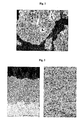
- Example 1 conventional wettable powder of alumina was ground with a conventional wettable powder of NiCr in the volume ratio of 1: 1. After the milling process, a powder of very finely distributed aluminum oxide phases (gray) was formed in the matrix (Fig. 1: mechanically alloyed powder NiCr-34Al 2 O 3 ). After processing by means of HVOF, a very well adhering, dense coating is produced, which has the same microstructure to the powder (FIG. 2: HVOF-sprayed layer shows identical microstructures).
- Example 2 up to 20% by volume of a pulverulent solid lubricant was added to the powder from Example 1, which after detection by means of HVOF is demonstrably present in the layer and clearly improves the friction behavior of the layer on the piston ring.
- Example 3 the matrix of Example 1 was further metalated such as e.g. Mo alloyed to improve the tribological properties of the piston ring coating.
- Mo powder is only slightly finely ground in the grinding process because of its high toughness, but is present in the powder and in the coating as homogeneously distributed, superbly embedded phase. The fire trail behavior of the piston ring coating could be demonstrably improved in this way.
- Example 4 50% by volume of two different ceramic phases (aluminum oxide, zirconium oxide) were admixed with the powder from Example 1.
- the ceramics were added to the grinding process at different times, whereby the different ceramic phases in the HVOF layer have different fractions.
- the matrix hardness can be controlled in a targeted manner by the one ceramic without the tribologically required hard phase size of the other ceramic being adversely affected.
- the abrasion resistance of the piston ring coating can be clearly improved.
- Example 5 fine diamond dust was admixed and alloyed with a commercial NiCr spray powder. After processing by means of HVOF, it was possible to ascertain an increase in wear resistance compared with the unalloyed matrix, which has an advantageous effect on the tribological properties of the piston ring coating.
Landscapes
- Chemical & Material Sciences (AREA)
- Engineering & Computer Science (AREA)
- Materials Engineering (AREA)
- Mechanical Engineering (AREA)
- Metallurgy (AREA)
- Organic Chemistry (AREA)
- Physics & Mathematics (AREA)
- Plasma & Fusion (AREA)
- Chemical Kinetics & Catalysis (AREA)
- Coating By Spraying Or Casting (AREA)
- Powder Metallurgy (AREA)
- Pistons, Piston Rings, And Cylinders (AREA)
- Other Surface Treatments For Metallic Materials (AREA)
Claims (11)
- Segment de piston pour moteurs à combustion interne, caractérisé en ce que le segment de piston présente sur les surfaces de flancs et/ou la surface de glissement un revêtement résistant à l'usure à base de poudres alliées mécaniquement qui peuvent être obtenues en alliant mécaniquement- des poudres constituées de nickel ou de fer et d'un ou plusieurs des éléments d'alliage avec le nickel ou le fer que sont le carbone, le silicium, le chrome, le molybdène, le cobalt ainsi que de fer ou de nickel en tant que matrice métallique, en une quantité de 70 à 5% en volume ramenée au mélange total, la proportion des éléments d'alliage pris ensemble ne dépassant pas 70% en poids de la totalité de l'alliage de la matrice,- un ou plusieurs des dispersoïdes Al2O3, Cr2O3, TiO2, ZrO2, Fe3O4, TiC, SiC, CrC, WC, BC ou diamant, la taille de particules du ou des dispersoïdes allant jusqu'à 10 µm environ et la proportion des dispersoïdes se situant dans la plage de 30 à 95% en volume, ramenée au mélange total,et en déposant la poudre alliée mécaniquement par projection à chaud.
- Segment de piston selon la revendication 1, caractérisé en ce que le revêtement résistant à l'usure est mécaniquement allié en plus avec des quantités de lubrifiants solides en poudre choisis dans le groupe comprenant le graphite, le nitrure de bore hexagonal, le polytétrafluoroéthylène, la proportion des lubrifiants solides en poudre allant jusqu'à 30% en volume, ramenée au mélange total.
- Segment de piston selon l'une des revendications 1 et/ou 2, caractérisé en ce que le revêtement résistant à l'usure est mécaniquement allié en plus avec des quantités d'un ou plusieurs additifs choisis dans le groupe comprenant les éléments Ti, Zr, Hf, Al, Si, P, B en une quantité allant jusqu'à 2% en poids, ramenée à l'alliage total de la matrice métallique.
- Segment de piston selon l'une des revendications 1 à 3, caractérisé en ce que la phase céramique du revêtement résistant à l'usure représente de 70 à 90% en volume.
- Segment de piston selon l'une des revendications 1 à 4 précédentes, caractérisé en ce que la matrice métallique du revêtement résistant à l'usure se présente sous la forme de nickel contenant jusqu'à 50% en poids de chrome.
- Segment de piston selon l'une des revendications 1 à 4 précédentes, caractérisé en ce que la matrice métallique du revêtement résistant à l'usure se compose de nickel contenant jusqu'à 30% en poids de chrome et jusqu'à 30% en poids de molybdène.
- Segment de piston selon l'une des revendications 1 à 4 précédentes, caractérisé en ce que la matrice métallique du revêtement résistant à l'usure se présente sous la forme de fer contenant jusqu'à 50% en poids de chrome.
- Segment de piston selon l'une des revendications 1 à 4, précédentes caractérisé en ce que la matrice métallique du revêtement résistant à l'usure se compose de fer contenant jusqu'à 30% en poids de chrome et jusqu'à 30% en poids de molybdène.
- Segment de piston selon l'une des revendications 1 à 8 précédentes, caractérisé en ce que la phase céramique du revêtement résistant à l'usure se compose d'Al2O3.
- Segment de piston selon l'une des revendications précédentes, caractérisé en ce que l'épaisseur du revêtement se situe dans la plage de 0,01 à 1,0 mm.
- Segment de piston selon l'une des revendications précédentes, caractérisé en ce que le revêtement a été déposé par projection à chaud, en particulier par projection à la flamme à grande vitesse (HVOF).
Applications Claiming Priority (3)
| Application Number | Priority Date | Filing Date | Title |
|---|---|---|---|
| DE10046956 | 2000-09-21 | ||
| DE10046956A DE10046956C2 (de) | 2000-09-21 | 2000-09-21 | Thermisch aufgetragene Beschichtung für Kolbenringe aus mechanisch legierten Pulvern |
| PCT/EP2001/009514 WO2002024970A2 (fr) | 2000-09-21 | 2001-08-17 | Revetement applique par voie thermique, destine a des segments de piston et constitue de poudres alliees mecaniquement |
Publications (2)
| Publication Number | Publication Date |
|---|---|
| EP1322794A2 EP1322794A2 (fr) | 2003-07-02 |
| EP1322794B1 true EP1322794B1 (fr) | 2008-05-28 |
Family
ID=7657203
Family Applications (1)
| Application Number | Title | Priority Date | Filing Date |
|---|---|---|---|
| EP01976101A Expired - Lifetime EP1322794B1 (fr) | 2000-09-21 | 2001-08-17 | Revetement applique par voie thermique, destine a des segments de piston et constitue de poudres alliees mecaniquement |
Country Status (6)
| Country | Link |
|---|---|
| US (1) | US6887585B2 (fr) |
| EP (1) | EP1322794B1 (fr) |
| JP (1) | JP2004510050A (fr) |
| DE (1) | DE10046956C2 (fr) |
| PT (1) | PT1322794E (fr) |
| WO (1) | WO2002024970A2 (fr) |
Families Citing this family (111)
| Publication number | Priority date | Publication date | Assignee | Title |
|---|---|---|---|---|
| JP3555844B2 (ja) | 1999-04-09 | 2004-08-18 | 三宅 正二郎 | 摺動部材およびその製造方法 |
| DE10061750B4 (de) * | 2000-12-12 | 2004-10-21 | Federal-Mogul Burscheid Gmbh | Wolframhaltige Verschleißschutzschicht für Kolbenringe |
| US6562480B1 (en) * | 2001-01-10 | 2003-05-13 | Dana Corporation | Wear resistant coating for piston rings |
| US6887530B2 (en) * | 2002-06-07 | 2005-05-03 | Sulzer Metco (Canada) Inc. | Thermal spray compositions for abradable seals |
| WO2004035852A1 (fr) * | 2002-10-15 | 2004-04-29 | Kabushiki Kaisha Riken | Segment de piston et revetement applique par un projection a l'arc a utiliser pour le segment, ainsi que procede de fabrication de ce segment |
| JP2004138128A (ja) | 2002-10-16 | 2004-05-13 | Nissan Motor Co Ltd | 自動車エンジン用摺動部材 |
| US6969198B2 (en) | 2002-11-06 | 2005-11-29 | Nissan Motor Co., Ltd. | Low-friction sliding mechanism |
| US6808756B2 (en) * | 2003-01-17 | 2004-10-26 | Sulzer Metco (Canada) Inc. | Thermal spray composition and method of deposition for abradable seals |
| DE10308561B4 (de) * | 2003-02-27 | 2005-03-17 | Federal-Mogul Burscheid Gmbh | Verschleißschutzbeschichtung, ihre Verwendung auf einem Kolben oder Kolbenring und ihr Herstellungsverfahren |
| JP3891433B2 (ja) | 2003-04-15 | 2007-03-14 | 日産自動車株式会社 | 燃料噴射弁 |
| DE10319141A1 (de) * | 2003-04-28 | 2004-11-25 | Man B&W Diesel A/S | Kolben für einen Großmotor sowie Verfahren zur Herstellung einer Verschleißschutzschicht bei einem derartigen Kolben |
| US7175687B2 (en) * | 2003-05-20 | 2007-02-13 | Exxonmobil Research And Engineering Company | Advanced erosion-corrosion resistant boride cermets |
| EP1479946B1 (fr) | 2003-05-23 | 2012-12-19 | Nissan Motor Co., Ltd. | Piston pour un moteur à combustion interne |
| EP1482190B1 (fr) | 2003-05-27 | 2012-12-05 | Nissan Motor Company Limited | Elément de roulement |
| JP2004360649A (ja) | 2003-06-06 | 2004-12-24 | Nissan Motor Co Ltd | エンジン用ピストンピン |
| JP4863152B2 (ja) | 2003-07-31 | 2012-01-25 | 日産自動車株式会社 | 歯車 |
| DE102004038572B4 (de) * | 2003-08-06 | 2005-10-27 | Steinführer, Uwe | Verschleißfester Überzug zum Schutz einer Oberfläche und Verfahren zur Herstellung desselben |
| WO2005014761A2 (fr) | 2003-08-06 | 2005-02-17 | Nissan Motor Co., Ltd. | Mecanisme coulissant a faible frottement, composition d'agent a faible frottement et procede de reduction de frottement |
| JP2005054617A (ja) | 2003-08-08 | 2005-03-03 | Nissan Motor Co Ltd | 動弁機構 |
| JP4973971B2 (ja) | 2003-08-08 | 2012-07-11 | 日産自動車株式会社 | 摺動部材 |
| JP4117553B2 (ja) | 2003-08-13 | 2008-07-16 | 日産自動車株式会社 | チェーン駆動装置 |
| DE602004008547T2 (de) | 2003-08-13 | 2008-05-21 | Nissan Motor Co., Ltd., Yokohama | Struktur zur Verbindung von einem Kolben mit einer Kurbelwelle |
| US7771821B2 (en) | 2003-08-21 | 2010-08-10 | Nissan Motor Co., Ltd. | Low-friction sliding member and low-friction sliding mechanism using same |
| JP4539205B2 (ja) | 2003-08-21 | 2010-09-08 | 日産自動車株式会社 | 冷媒圧縮機 |
| EP1508611B1 (fr) | 2003-08-22 | 2019-04-17 | Nissan Motor Co., Ltd. | Boîte de vitesse comprenant une composition d`huile de transmission |
| DE102004014871A1 (de) * | 2004-03-26 | 2005-10-13 | Federal-Mogul Burscheid Gmbh | Kolbenring |
| CN1309515C (zh) * | 2004-05-08 | 2007-04-11 | 吴立新 | 一种粉末冶金活塞环及其生产方法 |
| WO2005118185A1 (fr) * | 2004-05-28 | 2005-12-15 | Praxair S. T. Technology, Inc. | Poudres et revetements en alliages resistants a l'usure |
| DE102004038173B4 (de) * | 2004-08-06 | 2020-01-16 | Daimler Ag | Verfahren zum thermischen Spritzen von Zylinderlaufflächen bei mehrreihigen Motoren |
| GB0421566D0 (en) * | 2004-09-29 | 2004-10-27 | Dana Corp | Bearing materials and method for the production thereof |
| KR100590941B1 (ko) | 2004-11-20 | 2006-06-19 | 현대자동차주식회사 | 실린더 블록의 용사코팅용 분말합금 조성물 |
| US7799111B2 (en) * | 2005-03-28 | 2010-09-21 | Sulzer Metco Venture Llc | Thermal spray feedstock composition |
| DE102005020999A1 (de) * | 2005-05-03 | 2006-11-09 | Alfred Flamang | Verfahren zur Beschichtung von verschleißbeaufschlagten Bauteilen und beschichtetes Bauteil |
| KR100655366B1 (ko) | 2005-07-04 | 2006-12-08 | 한국과학기술연구원 | 내열, 내마모, 저마찰 특성을 가지는 코팅제 및 이의코팅방법 |
| US20070099014A1 (en) * | 2005-11-03 | 2007-05-03 | Sulzer Metco (Us), Inc. | Method for applying a low coefficient of friction coating |
| US8034153B2 (en) * | 2005-12-22 | 2011-10-11 | Momentive Performances Materials, Inc. | Wear resistant low friction coating composition, coated components, and method for coating thereof |
| US8206792B2 (en) * | 2006-03-20 | 2012-06-26 | Sulzer Metco (Us) Inc. | Method for forming ceramic containing composite structure |
| DE102006023396B4 (de) * | 2006-05-17 | 2009-04-16 | Man B&W Diesel A/S | Verschleißschutzbeschichtung sowie Verwendung und Verfahren zur Herstellung einer solchen |
| US20070269151A1 (en) * | 2006-05-18 | 2007-11-22 | Hamilton Sundstrand | Lubricated metal bearing material |
| US7799388B2 (en) * | 2006-05-26 | 2010-09-21 | Sulzer Metco Venture, Llc | Mechanical seals and method of manufacture |
| JP4185534B2 (ja) * | 2006-07-20 | 2008-11-26 | 本田技研工業株式会社 | エンジン |
| DE102006038670B4 (de) * | 2006-08-17 | 2010-12-09 | Federal-Mogul Burscheid Gmbh | Hochsiliziumhaltiger Stahlwerkstoff zur Herstellung von Kolbenringen und Zylinderlaufbuchsen |
| KR100849075B1 (ko) * | 2006-08-29 | 2008-07-30 | 한국과학기술연구원 | 고속 터보 기기의 무급유 베어링용 중온 코팅제 및 그 코팅방법 |
| US8147980B2 (en) * | 2006-11-01 | 2012-04-03 | Aia Engineering, Ltd. | Wear-resistant metal matrix ceramic composite parts and methods of manufacturing thereof |
| US20080145649A1 (en) * | 2006-12-14 | 2008-06-19 | General Electric | Protective coatings which provide wear resistance and low friction characteristics, and related articles and methods |
| US20080145554A1 (en) * | 2006-12-14 | 2008-06-19 | General Electric | Thermal spray powders for wear-resistant coatings, and related methods |
| US7862901B2 (en) * | 2006-12-15 | 2011-01-04 | General Electric Company | Yttria containing thermal barrier coating topcoat layer and method for applying the coating layer |
| CN100419242C (zh) * | 2006-12-27 | 2008-09-17 | 吴炬平 | 内燃机用活塞环及其制备工艺 |
| DE102007010698A1 (de) * | 2007-03-06 | 2008-09-11 | Bayerische Motoren Werke Aktiengesellschaft | Verfahren zur Herstellung einer Beschichtung |
| DE102007019510B3 (de) | 2007-04-25 | 2008-09-04 | Man Diesel A/S | Zu einer Gleitpaarung gehörendes Maschinenteil sowie Verfahren zu dessen Herstellung |
| DE102007026746A1 (de) * | 2007-06-09 | 2008-12-11 | Alfred Flamang | Flammspritzpulver und Verfahren zur Herstellung einer hochtemperaturbeständigen Beschichtung |
| DE102007042382B3 (de) * | 2007-09-05 | 2009-04-02 | Siemens Ag | Bauteil zur gleitenden Lagerung eines anderen Bauteils und Verfahren zu dessen Herstellung |
| US7998604B2 (en) * | 2007-11-28 | 2011-08-16 | United Technologies Corporation | Article having composite layer |
| US9624568B2 (en) | 2008-04-08 | 2017-04-18 | Federal-Mogul Corporation | Thermal spray applications using iron based alloy powder |
| US9162285B2 (en) | 2008-04-08 | 2015-10-20 | Federal-Mogul Corporation | Powder metal compositions for wear and temperature resistance applications and method of producing same |
| US9546412B2 (en) | 2008-04-08 | 2017-01-17 | Federal-Mogul Corporation | Powdered metal alloy composition for wear and temperature resistance applications and method of producing same |
| US8790789B2 (en) * | 2008-05-29 | 2014-07-29 | General Electric Company | Erosion and corrosion resistant coatings, methods and articles |
| US8101286B2 (en) * | 2008-06-26 | 2012-01-24 | GM Global Technology Operations LLC | Coatings for clutch plates |
| BRPI0803956B1 (pt) * | 2008-09-12 | 2018-11-21 | Whirlpool S.A. | composição metalúrgica de materiais particulados e processo de obtenção de produtos sinterizados autolubrificantes |
| DE102009016650B3 (de) * | 2009-04-07 | 2010-07-29 | Federal-Mogul Burscheid Gmbh | Gleitelement mit einstellbaren Eigenschaften |
| DE102009026655B3 (de) * | 2009-06-03 | 2011-06-30 | Linde Aktiengesellschaft, 80331 | Verfahren zur Herstellung eines Metallmatrix-Verbundwerkstoffs, Metallmatrix-Verbundwerkstoff und seine Verwendung |
| DE102009035210B3 (de) * | 2009-07-29 | 2010-11-25 | Federal-Mogul Burscheid Gmbh | Gleitelement mit thermisch gespritzter Beschichtung und Herstellungsverfahren dafür |
| JP5399954B2 (ja) | 2009-09-07 | 2014-01-29 | 株式会社フジミインコーポレーテッド | 溶射用粉末 |
| US8906130B2 (en) | 2010-04-19 | 2014-12-09 | Praxair S.T. Technology, Inc. | Coatings and powders, methods of making same, and uses thereof |
| DE102010022039B3 (de) * | 2010-05-25 | 2011-07-14 | Siemens Aktiengesellschaft, 80333 | Bauteil mit einer Gleitfläche für die Lagerung eines anderen Bauteils sowie Verfahren zum Erzeugen einer Gleitschicht |
| US20110312860A1 (en) | 2010-06-17 | 2011-12-22 | General Electric Company | Wear-resistant and low-friction coatings and articles coated therewith |
| DE102010038289A1 (de) * | 2010-07-22 | 2012-01-26 | Federal-Mogul Burscheid Gmbh | Kolbenring mit thermischen gespritzter Beschichtung und Herstellungsverfahren davon |
| BRPI1101402A2 (pt) * | 2011-03-29 | 2013-06-04 | Mahle Metal Leve Sa | elemento deslizante |
| DE102011079016B3 (de) * | 2011-07-12 | 2012-09-20 | Federal-Mogul Burscheid Gmbh | Verschleißschutzschicht für Kolbenringe, Auftragsverfahren und Kolbenring |
| DE102011052120A1 (de) * | 2011-07-25 | 2013-01-31 | Eckart Gmbh | Verwendung speziell belegter, pulverförmiger Beschichtungsmaterialien und Beschichtungsverfahren unter Einsatz derartiger Beschichtungsmaterialien |
| JP2014527575A (ja) * | 2011-07-25 | 2014-10-16 | エッカルト ゲゼルシャフト ミット ベシュレンクテル ハフツングEckart GmbH | 基材コーティングのための方法、およびそのような方法における添加剤含有粉末化コーティング物質の使用 |
| DE102011052119A1 (de) * | 2011-07-25 | 2013-01-31 | Eckart Gmbh | Verfahren zur Substratbeschichtung und Verwendung additivversehener, pulverförmiger Beschichtungsmaterialien in derartigen Verfahren |
| DE102011112435B3 (de) * | 2011-09-06 | 2012-10-25 | H.C. Starck Gmbh | Cermetpulver, Verfahren zur Herstellung eines Cermetpulvers, Verwendung der Cermetpulver, Verfahren zur Herstellung eines beschichteten Bauteils, Beschichtetes Bauteil |
| CN103857823B (zh) | 2011-10-25 | 2015-09-30 | 株式会社Ihi | 活塞环 |
| CN104302426A (zh) * | 2012-03-09 | 2015-01-21 | 费德罗-莫格尔公司 | 采用铁基合金粉末的热喷涂应用 |
| EP2650398B8 (fr) | 2012-04-11 | 2015-05-13 | Oerlikon Metco AG, Wohlen | Poudre mouillable avec liaison à base de fer super-ferritique, ainsi qu'un substrat, notamment un disque de frein avec une couche de diffusion thermique |
| DE102012211941B4 (de) * | 2012-07-09 | 2021-04-22 | Hilti Aktiengesellschaft | Werkzeugmaschine und Herstellungsverfahren |
| DE102012018276A1 (de) * | 2012-09-14 | 2014-05-15 | Federal-Mogul Burscheid Gmbh | Verschleißschutzschicht für Kolbenringe |
| JP6038349B2 (ja) * | 2012-12-12 | 2016-12-07 | アーベーベー ターボ システムズ アクチエンゲゼルシャフト | 耐摩耗性層および耐摩耗性層の製造方法 |
| US10683808B2 (en) | 2013-02-26 | 2020-06-16 | Raytheon Technologies Corporation | Sliding contact wear surfaces coated with PTFE/aluminum oxide thermal spray coating |
| CN104846320A (zh) * | 2015-05-09 | 2015-08-19 | 安徽鼎恒再制造产业技术研究院有限公司 | 一种硬质Co-SiC-Fe纳米涂层材料及其制备方法 |
| CN104911529A (zh) * | 2015-05-09 | 2015-09-16 | 芜湖鼎恒材料技术有限公司 | 高强度WC-ZrO2-Si纳米涂层材料及其制备方法 |
| CN104878340A (zh) * | 2015-05-09 | 2015-09-02 | 安徽鼎恒再制造产业技术研究院有限公司 | 一种Fe-HfO2纳米涂层材料及其制备方法 |
| CN104911527A (zh) * | 2015-05-09 | 2015-09-16 | 芜湖鼎恒材料技术有限公司 | 硬质Fe-SiC-TiO2纳米涂层材料及其制备方法 |
| CN104878338A (zh) * | 2015-05-09 | 2015-09-02 | 安徽再制造工程设计中心有限公司 | 一种高硬度Fe-HfO2纳米涂层材料及其制备方法 |
| CN104831168A (zh) * | 2015-05-09 | 2015-08-12 | 安徽鼎恒再制造产业技术研究院有限公司 | 高强度Fe-SiC-TiO2涂层材料及其制备方法 |
| CN104831215A (zh) * | 2015-05-09 | 2015-08-12 | 芜湖鼎恒材料技术有限公司 | 一种耐磨Co-SiC-Fe纳米涂层材料及其制备方法 |
| CN104831216A (zh) * | 2015-05-09 | 2015-08-12 | 芜湖鼎恒材料技术有限公司 | 一种Ni-Co-Mo-Mn纳米涂层材料及其制备方法 |
| CN104831224A (zh) * | 2015-05-09 | 2015-08-12 | 芜湖鼎恒材料技术有限公司 | 一种硬质WC-Co-B-Ni涂层材料及其制备方法 |
| CN104831213A (zh) * | 2015-05-09 | 2015-08-12 | 安徽鼎恒再制造产业技术研究院有限公司 | 一种Ni-Co-Mo-Mn材料及其制备方法 |
| CN104878339A (zh) * | 2015-05-09 | 2015-09-02 | 芜湖鼎恒材料技术有限公司 | 一种Co-SiC-Fe纳米涂层材料及其制备方法 |
| CN104862636A (zh) * | 2015-05-09 | 2015-08-26 | 芜湖鼎瀚再制造技术有限公司 | 一种Fe-Al2O3-Mo材料及其制备方法 |
| CN104831222A (zh) * | 2015-05-09 | 2015-08-12 | 芜湖鼎恒材料技术有限公司 | Co-TiO2-Mo纳米涂层材料及其制备方法 |
| CN104831209A (zh) * | 2015-05-09 | 2015-08-12 | 芜湖鼎恒材料技术有限公司 | Fe-Al2O3-Mo纳米涂层材料及其制备方法 |
| US11028923B2 (en) | 2015-06-11 | 2021-06-08 | Hamilton Sundstrand Corporation | High vibration pneumatic piston assembly made from additive manufacturing |
| KR101652049B1 (ko) * | 2015-06-16 | 2016-08-29 | 주식회사 아이스기술 | 텅스텐 카바이드 코팅소재를 이용한 코팅방법 |
| CN104947027A (zh) * | 2015-06-24 | 2015-09-30 | 安徽再制造工程设计中心有限公司 | MnO2-TiC-Co纳米材料及其制备方法 |
| CN104928610A (zh) * | 2015-06-24 | 2015-09-23 | 安徽再制造工程设计中心有限公司 | 一种Co-SiC-Mo涂层材料及制备方法 |
| CN105057678A (zh) * | 2015-07-29 | 2015-11-18 | 安徽普源分离机械制造有限公司 | 一种抗高温开裂剥落能力佳的金属镍陶瓷涂层及其制作方法 |
| CN105524382B (zh) * | 2015-11-03 | 2017-09-12 | 南京肯特复合材料股份有限公司 | 耐热耐磨ptfe塑材及其制备方法 |
| SE539354C2 (en) | 2015-11-16 | 2017-08-01 | Scania Cv Ab | Arrangement and process for thermal spray coating vehicle components with solid lubricants |
| CN106435385B (zh) * | 2016-10-17 | 2017-11-28 | 武汉春禾科技有限公司 | 一种耐高温耐磨滑轮涂层 |
| EP3724366A4 (fr) * | 2017-12-15 | 2021-05-12 | Oerlikon Metco (US) Inc. | Matériau de revêtement par pulvérisation thermique métallique mécaniquement allié et procédé de revêtement par pulvérisation thermique l'utilisant |
| WO2020123848A1 (fr) * | 2018-12-13 | 2020-06-18 | Oerlikon Metco (Us) Inc. | Matériau de revêtement par pulvérisation thermique métallique obtenu par alliage mécanique et procédé de revêtement par pulvérisation thermique utilisant ce matériau |
| CN110016601B (zh) * | 2019-05-22 | 2020-05-22 | 中国矿业大学 | 一种镍铬-金刚石合金复合粉末及其制备方法和用途 |
| CN110842396A (zh) * | 2019-12-02 | 2020-02-28 | 江苏米孚自动化科技有限公司 | 一种抗磨损焊丝涂层及焊丝的制备方法 |
| CN112281105B (zh) * | 2020-10-23 | 2022-11-15 | 中国人民解放军陆军装甲兵学院 | 一种金属陶瓷复合涂层及其制备方法和应用 |
| CN112553567B (zh) * | 2020-11-23 | 2022-05-17 | 苏州大学 | 一种氮化硼纳米片增强镍基复合涂层及其制备方法 |
| CN113512311B (zh) * | 2021-04-14 | 2022-04-15 | 武汉理工大学 | 一种应用于回转支承滚道的润滑耐磨涂层及其制备方法 |
| SE548199C2 (en) * | 2021-12-16 | 2026-04-16 | Nippon Piston Ring Co Ltd | Thermal spray coating, sliding member, and piston ring |
| CN116426860B (zh) * | 2023-06-12 | 2023-09-26 | 四川大学 | 基于hBN的硬密封控制阀用宽温域自润滑涂层制备方法 |
Family Cites Families (10)
| Publication number | Priority date | Publication date | Assignee | Title |
|---|---|---|---|---|
| US3556747A (en) * | 1967-11-07 | 1971-01-19 | Koppers Co Inc | Piston ring coatings for high temperature applications |
| US4334927A (en) * | 1980-12-08 | 1982-06-15 | Hyde Glenn F | Piston ring coatings |
| US4681817A (en) * | 1984-12-24 | 1987-07-21 | Kabushiki Kaisha Riken | Piston ring |
| JPS6299449A (ja) * | 1985-10-25 | 1987-05-08 | Showa Denko Kk | クロムカ−バイト系溶射用粉末 |
| JPH0645863B2 (ja) * | 1990-01-30 | 1994-06-15 | 新日本製鐵株式会社 | 高温耐摩耗・耐ビルドアップ性に優れた溶射材料およびその被覆物品 |
| US5372845A (en) * | 1992-03-06 | 1994-12-13 | Sulzer Plasma Technik, Inc. | Method for preparing binder-free clad powders |
| US5385789A (en) * | 1993-09-15 | 1995-01-31 | Sulzer Plasma Technik, Inc. | Composite powders for thermal spray coating |
| US5763106A (en) * | 1996-01-19 | 1998-06-09 | Hino Motors, Ltd. | Composite powder and method for forming a self-lubricating composite coating and self-lubricating components formed thereby |
| US5713129A (en) * | 1996-05-16 | 1998-02-03 | Cummins Engine Company, Inc. | Method of manufacturing coated piston ring |
| US6562480B1 (en) * | 2001-01-10 | 2003-05-13 | Dana Corporation | Wear resistant coating for piston rings |
-
2000
- 2000-09-21 DE DE10046956A patent/DE10046956C2/de not_active Expired - Fee Related
-
2001
- 2001-08-17 WO PCT/EP2001/009514 patent/WO2002024970A2/fr not_active Ceased
- 2001-08-17 US US10/363,341 patent/US6887585B2/en not_active Expired - Lifetime
- 2001-08-17 JP JP2002529560A patent/JP2004510050A/ja active Pending
- 2001-08-17 PT PT01976101T patent/PT1322794E/pt unknown
- 2001-08-17 EP EP01976101A patent/EP1322794B1/fr not_active Expired - Lifetime
Also Published As
| Publication number | Publication date |
|---|---|
| WO2002024970A3 (fr) | 2002-06-27 |
| PT1322794E (pt) | 2008-07-30 |
| DE10046956C2 (de) | 2002-07-25 |
| EP1322794A2 (fr) | 2003-07-02 |
| DE10046956A1 (de) | 2002-04-25 |
| WO2002024970A2 (fr) | 2002-03-28 |
| US20030180565A1 (en) | 2003-09-25 |
| JP2004510050A (ja) | 2004-04-02 |
| US6887585B2 (en) | 2005-05-03 |
Similar Documents
| Publication | Publication Date | Title |
|---|---|---|
| EP1322794B1 (fr) | Revetement applique par voie thermique, destine a des segments de piston et constitue de poudres alliees mecaniquement | |
| DE4413306C1 (de) | Verfahren zur Verstärkung eines Bauteils und Anwendung des Verfahrens | |
| DE19700835C2 (de) | Kompositpulver und Verfahren zum Bilden einer selbstschmierenden Kompositschicht und dadurch gebildete selbstschmierende Bauteile | |
| DE3785885T2 (de) | Zusammengesetzter draht fuer verschleissfeste ueberzuege. | |
| EP2746613B1 (fr) | Disque de frien pour véhicule | |
| EP2948261B1 (fr) | Procédé de fabrication de poudres pour pulvérisation contenant du nitrure de chrome, poudres pour pulvérisation contenant du nitrure de chrome, procédé de pulvérisation à chaud de composants utilisant lesdites poudres, et utilisation de ces poudres pour pulvérisation pour revêtir des composants | |
| DE69110541T2 (de) | Verbundpulver aus Metallen und Nichtmetallen für thermisches Spritzen. | |
| DE3689512T2 (de) | Molybdän, Kupfer und Bor enthaltende Eisenlegierung. | |
| DE3937526C2 (de) | Verschleißfeste Titanlegierung, Verfahren zu ihrer Herstellung und ihre Verwendung | |
| DE69303060T2 (de) | Verfahren zur Herstellung von Überzügen auf Pulver ohne Bindemittel | |
| EP3052670A1 (fr) | Poudre de projection frittée à base de carbure de molybdène | |
| EP2948260A1 (fr) | Poudre de projection thermique pour systèmes de coulissement fortement sollicités | |
| DE19701170A1 (de) | Verfahren zur Oberflächenbehandlung mittels elektrischer Entladung | |
| WO1982001897A1 (fr) | Materiel permettant la stratification de pieces d'usinage, ces dernieres presentant alors une resistance accrue a l'abrasion et au martelage | |
| DE69902449T2 (de) | Verfahren zur herstellung einer gleitlagerbeschichtung | |
| DE2208070C2 (de) | Verbundkörper und Verfahren zu dessen Herstellung | |
| DE19640788C1 (de) | Beschichtungspulver und Verfahren zu seiner Herstellung | |
| EP0881958A1 (fr) | Materiau s'utilisant en metallurgie des poudres pour produire des pieces moulees, notamment des sieges de soupape rapportes ou des guides de soupape tres resistants a l'usure | |
| DE10002570B4 (de) | Thermisches Spritzmaterial, Struktur und Verfahren zu ihrer Herstellung | |
| DE10061749C2 (de) | Kolbenring für Brennkraftmaschinen | |
| DE10308561B4 (de) | Verschleißschutzbeschichtung, ihre Verwendung auf einem Kolben oder Kolbenring und ihr Herstellungsverfahren | |
| DE10334703A1 (de) | Ventilsitzringe aus Co oder Co/Mo-Basislegierungen und deren Herstellung | |
| DE102011120989B3 (de) | Spritzwerkstoff für thermische Spritzbeschichtungen,dessen Verwendung und mit dem Spritzwerkstoffthermisch beschichteter Grauguss-Grundkörper | |
| DE10061751C1 (de) | Verschleißschutzschicht für Kolbenringe | |
| DE102023207017B3 (de) | Bremskörper für ein Kraftfahrzeug |
Legal Events
| Date | Code | Title | Description |
|---|---|---|---|
| PUAI | Public reference made under article 153(3) epc to a published international application that has entered the european phase |
Free format text: ORIGINAL CODE: 0009012 |
|
| 17P | Request for examination filed |
Effective date: 20021107 |
|
| AK | Designated contracting states |
Designated state(s): AT BE CH CY DE DK ES FI FR GB GR IE IT LI LU MC NL PT SE TR |
|
| RBV | Designated contracting states (corrected) |
Designated state(s): FR GB PT |
|
| REG | Reference to a national code |
Ref country code: DE Ref legal event code: 8566 |
|
| 17Q | First examination report despatched |
Effective date: 20070726 |
|
| GRAP | Despatch of communication of intention to grant a patent |
Free format text: ORIGINAL CODE: EPIDOSNIGR1 |
|
| GRAS | Grant fee paid |
Free format text: ORIGINAL CODE: EPIDOSNIGR3 |
|
| GRAA | (expected) grant |
Free format text: ORIGINAL CODE: 0009210 |
|
| AK | Designated contracting states |
Kind code of ref document: B1 Designated state(s): FR GB PT |
|
| REG | Reference to a national code |
Ref country code: GB Ref legal event code: FG4D Free format text: NOT ENGLISH |
|
| REG | Reference to a national code |
Ref country code: PT Ref legal event code: SC4A Free format text: AVAILABILITY OF NATIONAL TRANSLATION Effective date: 20080718 |
|
| PLBE | No opposition filed within time limit |
Free format text: ORIGINAL CODE: 0009261 |
|
| STAA | Information on the status of an ep patent application or granted ep patent |
Free format text: STATUS: NO OPPOSITION FILED WITHIN TIME LIMIT |
|
| 26N | No opposition filed |
Effective date: 20090303 |
|
| PGFP | Annual fee paid to national office [announced via postgrant information from national office to epo] |
Ref country code: FR Payment date: 20090806 Year of fee payment: 9 |
|
| PGFP | Annual fee paid to national office [announced via postgrant information from national office to epo] |
Ref country code: GB Payment date: 20090708 Year of fee payment: 9 |
|
| GBPC | Gb: european patent ceased through non-payment of renewal fee |
Effective date: 20100817 |
|
| REG | Reference to a national code |
Ref country code: FR Ref legal event code: ST Effective date: 20110502 |
|
| PG25 | Lapsed in a contracting state [announced via postgrant information from national office to epo] |
Ref country code: FR Free format text: LAPSE BECAUSE OF NON-PAYMENT OF DUE FEES Effective date: 20100831 |
|
| PG25 | Lapsed in a contracting state [announced via postgrant information from national office to epo] |
Ref country code: GB Free format text: LAPSE BECAUSE OF NON-PAYMENT OF DUE FEES Effective date: 20100817 |
|
| PGFP | Annual fee paid to national office [announced via postgrant information from national office to epo] |
Ref country code: PT Payment date: 20170726 Year of fee payment: 17 |
|
| PG25 | Lapsed in a contracting state [announced via postgrant information from national office to epo] |
Ref country code: PT Free format text: LAPSE BECAUSE OF NON-PAYMENT OF DUE FEES Effective date: 20190218 |