EP1323509B1 - Procédé pour la fabrication en continu de panneaux en fibres lignocellulosiques - Google Patents
Procédé pour la fabrication en continu de panneaux en fibres lignocellulosiques Download PDFInfo
- Publication number
- EP1323509B1 EP1323509B1 EP02028550A EP02028550A EP1323509B1 EP 1323509 B1 EP1323509 B1 EP 1323509B1 EP 02028550 A EP02028550 A EP 02028550A EP 02028550 A EP02028550 A EP 02028550A EP 1323509 B1 EP1323509 B1 EP 1323509B1
- Authority
- EP
- European Patent Office
- Prior art keywords
- mat
- steam
- water
- belt
- press
- Prior art date
- Legal status (The legal status is an assumption and is not a legal conclusion. Google has not performed a legal analysis and makes no representation as to the accuracy of the status listed.)
- Expired - Lifetime
Links
Images
Classifications
-
- B—PERFORMING OPERATIONS; TRANSPORTING
- B27—WORKING OR PRESERVING WOOD OR SIMILAR MATERIAL; NAILING OR STAPLING MACHINES IN GENERAL
- B27N—MANUFACTURE BY DRY PROCESSES OF ARTICLES, WITH OR WITHOUT ORGANIC BINDING AGENTS, MADE FROM PARTICLES OR FIBRES CONSISTING OF WOOD OR OTHER LIGNOCELLULOSIC OR LIKE ORGANIC MATERIAL
- B27N7/00—After-treatment, e.g. reducing swelling or shrinkage, surfacing; Protecting the edges of boards against access of humidity
-
- B—PERFORMING OPERATIONS; TRANSPORTING
- B27—WORKING OR PRESERVING WOOD OR SIMILAR MATERIAL; NAILING OR STAPLING MACHINES IN GENERAL
- B27N—MANUFACTURE BY DRY PROCESSES OF ARTICLES, WITH OR WITHOUT ORGANIC BINDING AGENTS, MADE FROM PARTICLES OR FIBRES CONSISTING OF WOOD OR OTHER LIGNOCELLULOSIC OR LIKE ORGANIC MATERIAL
- B27N1/00—Pretreatment of moulding material
-
- B—PERFORMING OPERATIONS; TRANSPORTING
- B27—WORKING OR PRESERVING WOOD OR SIMILAR MATERIAL; NAILING OR STAPLING MACHINES IN GENERAL
- B27N—MANUFACTURE BY DRY PROCESSES OF ARTICLES, WITH OR WITHOUT ORGANIC BINDING AGENTS, MADE FROM PARTICLES OR FIBRES CONSISTING OF WOOD OR OTHER LIGNOCELLULOSIC OR LIKE ORGANIC MATERIAL
- B27N3/00—Manufacture of substantially flat articles, e.g. boards, from particles or fibres
- B27N3/08—Moulding or pressing
- B27N3/18—Auxiliary operations, e.g. preheating, humidifying, cutting-off
-
- B—PERFORMING OPERATIONS; TRANSPORTING
- B27—WORKING OR PRESERVING WOOD OR SIMILAR MATERIAL; NAILING OR STAPLING MACHINES IN GENERAL
- B27N—MANUFACTURE BY DRY PROCESSES OF ARTICLES, WITH OR WITHOUT ORGANIC BINDING AGENTS, MADE FROM PARTICLES OR FIBRES CONSISTING OF WOOD OR OTHER LIGNOCELLULOSIC OR LIKE ORGANIC MATERIAL
- B27N3/00—Manufacture of substantially flat articles, e.g. boards, from particles or fibres
- B27N3/08—Moulding or pressing
- B27N3/24—Moulding or pressing characterised by using continuously acting presses having endless belts or chains moved within the compression zone
Definitions
- the invention relates to a method for the continuous production of wood-based panels according to the preamble of claim 1 and a system for carrying out the method according to claim 17.
- a method for the continuous production of wood-based panels, in particular plates with a closed plate surface on both sides in the thickness range of 1.5 - 6 mm in the dry process is for example from WO 99/24233 known.
- a mat formed from a spreading station is sprayed with water after the pre-pressing and the mat trimming on the top of the mat.
- the molding tape on which the mat is scattered sprayed with water.
- the lignocellulosic particles have a moisture content below 15%, as a rule, the moisture content of the mat is around 9%.
- a higher humidity can not be adjusted, otherwise it will burst in the hot press.
- the Platzer are caused by a high vapor pressure, which in turn has its cause in the high humidity. At a higher humidity than 15% a sieve would have to be used in the hot press for evaporation.
- the associated screenprint is disturbing and must be sanded.
- release agent is added to the spray water or the release agent is sprayed directly onto the forming belt.
- the release agent makes it possible to spray a larger amount of water onto the forming belt without the particles sticking to the forming belt.
- the cost of the release agent per m 2 produced plate are significant.
- the amount of spray that is absorbed by the forming belt by the particles resting on the forming belt is limited.
- the water must be sucked against gravity by capillary forces into the mat. This different order quantity above and below Often causes the plates to curve after leaving the hot press. To avoid this curvature, it must then be sprayed less on the upper mat surface.
- Dry-process adhesive consumption is significantly higher than in semi-dry and wet processes, as dry-bonded hydrogen bonds can not be used in the same way.
- the object of the present invention is now to provide a method and to provide a plant with the closed-surface wood-based panels are produced by dry process and this method is to replace the semi-dry and wet process of fiber board production by a more environmentally friendly and cost-effective drying process.
- the solution to this problem for the process is that the wood chips cooked at a temperature in the boiler between 190-230 ° (and a vapor pressure) over 12 bar, preferably at 16 bar, with a residence time of greater than 3 minutes, the fibers are with glued a consisting of predominantly phenolic components adhesive in a blowpipe and / or in a mixer, wherein the dosage is less than 5% of solid resin related atro wood, the scattered mat with a moisture ⁇ 15% is moistened immediately before the continuous press by spraying water of 5 to 80 g / m 2 on the mat top side and by steam in the appropriate amount on the mat base and the mat thus prepared is introduced into the continuous press and at the beginning with maximum specific pressure of 2.5 N / mm 2 to 5.5 N / mm 2 compacted and cured to a fiberboard with double-sided closed surfaces.
- the solution for a plant according to the method is characterized by the following arranged in the working direction combination: a wood chip cooker, a Beleim driving blowgun and / or mixer, a Formband-water spray, a spreader to form a mat on a continuously moving forming belt, a water spray for Moistening of the mat top, possibly a pre-compression and preheating, a steamer with or without screen belt for the mat top, a steamer for the mat base, being steamed by a circulating as Mattenzu Glassbahn screen belt and a continuously operating press.
- the process must be carried out so that the chips are thermally pretreated at high temperature in the digester (190 to 230 ° C, vapor pressure 12 to 16 bar) and long residence times (greater than 3 minutes), so that arise from the hemicelluloses adhesives, the lignin is activated on the fiber surface and a very well-open pulp is formed without a large proportion of coarse fiber bundles.
- This pretreatment produces dark fibers and thus dark plates regardless of the use of a dark adhesive.
- the chips are steamed in the digester preferably at 200 to 210 ° C for 4 minutes.
- the fibers thus produced lead to a closed plate surface during hot pressing rather than fibers which are cooked at low temperature, provided that the fibers are sufficiently moistened before the hot pressing.
- the moistening is carried out according to the invention on the top of the mat with a Wasserbesprühung and on the bottom with a Dampfbefeuchtung.
- the achieved closed surfaces is attributed to the combination of very well digested pulp and moistening.
- the pulp contains hardly any fiber bundles. Fiber bundles have a higher stiffness than individual fibers. They can not nest as well in individual cavities as individual fibers.
- the high temperature pretreatment also reduces the stiffness of the individual fibers, making it easier to soften the single fiber during hot pressing.
- the mat is moistened on the underside with a targeted planar introduction of steam immediately before the hot press.
- the steam should have a pressure of 1.01 to 1.3 bar (absolute), preferably 1.01 bar and should be as saturated as possible or slightly overheated.
- the steam pressure must not be too high, otherwise the mat will lift off the screen belt due to the steam.
- the introduced amount of steam is measured and regulated. Due to the condensation of the steam, the mat moisture is increased by approx. 5% - depending on the mat's initial moisture content and the mat temperature.
- the top of the mat can be sprayed with 20 g / m 2 of water and the same amount of moisture on the bottom with the introduction of 20 g / m 2 of steam fed.
- 400 g of wood are moistened by the steam and heated from 35 ° C to almost 100 ° C.
- About 13% of the total mat thickness is therefore moistened by the steam. This means that the moisture is still limited to the outer area of the mat.
- the amount of steam can be slightly increased compared to the sprayed amount of water. Due to the high temperature of the wood particles, the condensed water is absorbed extremely quickly by the wood, so that on the underside a nearly similar closed surface is formed as on the top, the density maximum is also increased and the density maximum is closer to the plate surface.
- the fibers are less stiff during the hot pressing, whereby the contact surface of the fibers with each other is larger.
- the larger contact area is important to get an adhesive bond over the activated fiber surface and also promotes the formation of hydrogen bonds.
- the pressing time must be extended by at least 15% compared to the conventional dry process due to the longer curing time of the adhesive, the time-consuming activation of the bondable substances and the prolonged devolatilization. In order to avoid a large extension of the pressing time, a high hotplate temperature at the beginning of the hot pressing has proven to be favorable.
- the steam is passed through a screen belt, which should consist of a vapor-resistant material such as vapor-resistant plastic, from a steam box in the mat.
- the transfer belt should be made in the press as a screen belt. On this transfer belt, the mat is transported in the press.
- the invention may be carried out by spraying 20 g / m 2 of water on top and introducing 15 g / m 2 of steam and spraying 5 g / m 2 of water onto the forming belt and introducing 30 g / m 2 of steam on the underside becomes.
- the more steam is moistened and preheated the more the press speed can be increased.
- the hot press may be designed so that the platen temperature for the top and bottom heating plates can be set differently, whereby even steam humidification from below and one-sided spraying from above can achieve uniform heating through a higher top platen temperature.
- Phenolleim unlike Aminoplastharzen at the end of the blowpipe (not shown) must be driven into the pipe shortly before the dryer.
- the Phenolleim leads to caking on the inner wall of the blower tube, which can only be removed mechanically.
- Aminoplastleimen the caking is degraded by hydrolysis with time during operation, without mechanical removal is necessary. It has also proven advantageous for trouble-free operation that a switch is installed shortly after dosing so that it is possible to clean one pipe and guide the fiber flow through the other.
- the dark plates thus produced must be thermally treated after the hot pressing.
- the plates are passed through a heat channel or stacked warm in a heated hall.
- the heat treatment of the fiberboard 11 at temperatures between 110 ° C and 200 ° C after the continuous press, the bonding of the individual fibers is increased, whereby the bending properties and the swelling values are improved.
- the fibreboard 11 are stacked warm or pulled as a package through a heat channel.
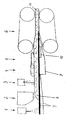
- the device for introducing steam in each case consists of a steam box 5 and 10, are introduced to the mat side openings, for example in slot shape.
- the steam boxes 5 and 10 can be additionally heated to avoid condensate or a condensate separator is connected.
- the steam boxes 10 are installed in the wire 9 directly in front of the inlet of the continuous press 6.
- the steam box 10 should be installed as close as possible in front of the continuous press 6 to avoid precuring of the adhesive. If the moistening is to take place on the top of the mat 8, an upper steam box 5 must be used with a further circulating screen belt.
- the system is still running without pre-press, then must be precompressed before the steam box 5 on a short distance with a Vorverdichtungs- and preheating 4. For this, the sieve can be guided over rollers.
- a typical plant with spreader 2, pre-press, a continuous press with a length of more than 15 m, cooling star turners and destacking requires high investment costs.
Landscapes
- Life Sciences & Earth Sciences (AREA)
- Engineering & Computer Science (AREA)
- Manufacturing & Machinery (AREA)
- Wood Science & Technology (AREA)
- Forests & Forestry (AREA)
- Dry Formation Of Fiberboard And The Like (AREA)
Claims (20)
- Procédé pour la fabrication en continu de panneaux de matériau à base de bois, tels que des panneaux de particules ou de fibres, en particulier des panneaux de fibres à base de bois et d'autres matériaux contenant de la lignocellulose, selon le procédé à sec, dans lequel, à partir d'un poste d'épandage, un tapis de matériau à presser additionné de liant est formé sur une bande de formage se déplaçant en continu pour être durci, après avoir été introduit entre les bandes d'acier d'une presse fonctionnant en continu guidées en circulation autour d'une partie de cadre supérieure et d'une autre inférieure, sous l'action de pression et de chaleur, en un lé de panneau ou un panneau sans fin de matériau à base de bois, caractérisé en ce qu'il combine les étapes de procédé suivantes :les copeaux de broyage sont cuits sous plus de 12 bars, de préférence sous 16 bars, pendant un temps de traitement de plus de 3 minutes,les fibres sont encollées avec une colle contenant principalement des composants phénoliques dans un tube de soufflage et/ou un mélangeur, le dosage étant de moins de 5 % de résine solide par rapport au bois,le tapis épandu ayant une humidité ≤ 15 % est humidifié, immédiatement avant la presse fonctionnant en continu, par projection d'eau à raison de 5 à 80 g/m2 sur la face supérieure du tapis et par de la vapeur dans une quantité correspondante sur la face inférieure du tapis,le tapis ainsi préparé est introduit dans la presse fonctionnant en continu et compacté en continu sous une pression spécifique maximale de 2,5 N/mm2 à 5,5 N/mm2 et durci pour obtenir un panneau de fibres ayant des surfaces fermées des deux côtés.
- Procédé selon la revendication 1, caractérisé en ce que le tapis présente une humidité de 12 à 14%.
- Procédé selon les revendications 1 et 2, caractérisé en ce que la face supérieure du tapis et/ou la bande de formage sont arrosés d'eau puis humidifiés à la vapeur sur les deux faces.
- Procédé selon la revendication 1 à 3, caractérisé en ce que 20 g/m2 d'eau sont pulvérisés sur la face supérieure du tapis et 5 g/m2 sur la bande de formage et 30 g/m2 de vapeur sont introduits dans le tapis sur chaque face.
- Procédé selon une ou plusieurs des revendications 1 à 4, caractérisé en ce que les particules hachées sont exposées à la vapeur dans le cuiseur sous 16 bars à 19 bars pendant une durée de 4 minutes.
- Procédé selon une ou plusieurs des revendications 1 à 5, caractérisé en ce que l'introduction de vapeur dans le tapis est effectuée sous une pression de 1,01 à 1,3 bar, de préférence de 1,01 bar.
- Procédé selon une ou plusieurs des revendications 1 à 6, caractérisé en ce que la vapeur à introduire dans le tapis est aussi saturée que possible ou peu chauffée.
- Procédé selon une ou plusieurs des revendications 1 à 7, caractérisé en ce que lors de la cuisson des particules hachées, de l'acide est introduit dans le cuiseur.
- Procédé selon une ou plusieurs des revendications 1 à 8, caractérisé en ce que pendant l'encollage, du formaldéhyde est ajouté comme mouillant des particules de bois.
- Procédé selon une ou plusieurs des revendications 1 à 9, caractérisé en ce que le tapis est arrosé de 20 g/m2 d'eau sur sa face supérieure et 15 g/m2 de vapeur y sont introduits, et sur la face inférieure, 5 g/m2 sont pulvérisés sur la bande de formage et 30 g/m2 de vapeur sont introduit dans le tapis.
- Procédé selon une ou plusieurs des revendications 1 à 10, caractérisé en ce que la bande de tamisage précédant l'introduction de vapeur est chauffée à plus de 100°C.
- Procédé selon une ou plusieurs des revendications 1 à 11, caractérisé en ce que la couche supérieure extérieure du tapis est en outre humidifiée spécifiquement dans un dispositif léger de précompactage et de préchauffage.
- Procédé selon une ou plusieurs des revendications 1 à 12, caractérisé en ce que la bande de formage est arrosée avec de l'eau et/ou un agent de démoulage.
- Procédé selon une ou plusieurs des revendications 1 à 13, caractérisé en ce que la colle est une résine phénol-formaldéhyde contenant 4 % de résine solide par rapport aux fibres.
- Procédé selon une ou plusieurs des revendications 1 à 14, caractérisé en ce que la colle est ajoutée à la fin du tube de soufflage, peu avant le séchoir, et en ce que deux tubes de soufflage sont utilisés à l'aide d'un aiguillage.
- Procédé selon une ou plusieurs des revendications 1 à 15, caractérisé en ce que les panneaux finis sont empilés à chaud et maintenus en outre à plus de 60°C, de préférence plus de 100°C.
- Installation pour la mise en oeuvre du procédé selon les revendications 1 à 16, comprenant, dans le sens du travail, un cuiseur de particules hachées (non représenté), une installation d'encollage formée d'un tube de soufflage et/ou d'un mélangeur (non représentée), une installation de projection d'eau sur la bande de formage (1), une machine d'épandage (2) pour former un tapis (8) sur une bande de formage (7) avançant en continu, une installation de projection d'eau (3) pour humidifier la face supérieure du tapis, éventuellement un dispositif de précompactage et de préchauffage (4), une installation de projection de vapeur (5) avec ou sans bande de tamisage pour la face supérieure du tapis, un dispositif de projection de vapeur (10) pour la face inférieure du tapis, une bande de tamisage (9) circulant pour servir de bande d'arrivée du tapis étant exposée à la vapeur, et une presse (6) fonctionnant en continu.
- Installation selon la revendication 17, caractérisée en ce que la longueur de pressage de la presse (6) fonctionnant en continu est inférieure à 15 m et l'installation est construite sans presse de préformage.
- Installation selon les revendications 17 et 18, caractérisée en ce que les panneaux (11) peuvent être empilés après leur sortie de la presse (6) fonctionnant en continu ayant une longueur de pressage inférieure à 15 m sans passer dans une roue de refroidissement.
- Installation selon les revendications 17 à 19, caractérisée en ce qu'une température différente des panneaux de pressage est réglée dans la partie supérieure et la partie inférieure de la presse (6) fonctionnant en continu.
Priority Applications (1)
| Application Number | Priority Date | Filing Date | Title |
|---|---|---|---|
| EP06010284A EP1688230B1 (fr) | 2001-12-20 | 2002-12-20 | Procédé pour la fabrication en continu de panneaux en fibres lignocellulosiques |
Applications Claiming Priority (2)
| Application Number | Priority Date | Filing Date | Title |
|---|---|---|---|
| DE10163090 | 2001-12-20 | ||
| DE10163090A DE10163090A1 (de) | 2001-12-20 | 2001-12-20 | Verfahren zur kontinuierlichen Herstellung von Holzwerkstoffplatten |
Related Child Applications (1)
| Application Number | Title | Priority Date | Filing Date |
|---|---|---|---|
| EP06010284A Division EP1688230B1 (fr) | 2001-12-20 | 2002-12-20 | Procédé pour la fabrication en continu de panneaux en fibres lignocellulosiques |
Publications (2)
| Publication Number | Publication Date |
|---|---|
| EP1323509A1 EP1323509A1 (fr) | 2003-07-02 |
| EP1323509B1 true EP1323509B1 (fr) | 2008-05-28 |
Family
ID=7710253
Family Applications (2)
| Application Number | Title | Priority Date | Filing Date |
|---|---|---|---|
| EP06010284A Expired - Lifetime EP1688230B1 (fr) | 2001-12-20 | 2002-12-20 | Procédé pour la fabrication en continu de panneaux en fibres lignocellulosiques |
| EP02028550A Expired - Lifetime EP1323509B1 (fr) | 2001-12-20 | 2002-12-20 | Procédé pour la fabrication en continu de panneaux en fibres lignocellulosiques |
Family Applications Before (1)
| Application Number | Title | Priority Date | Filing Date |
|---|---|---|---|
| EP06010284A Expired - Lifetime EP1688230B1 (fr) | 2001-12-20 | 2002-12-20 | Procédé pour la fabrication en continu de panneaux en fibres lignocellulosiques |
Country Status (3)
| Country | Link |
|---|---|
| EP (2) | EP1688230B1 (fr) |
| AT (2) | ATE396853T1 (fr) |
| DE (3) | DE10163090A1 (fr) |
Families Citing this family (9)
| Publication number | Priority date | Publication date | Assignee | Title |
|---|---|---|---|---|
| DE102005055813B4 (de) * | 2005-11-21 | 2013-03-21 | Fritz Egger Gmbh & Co. | Vorrichtung und Verfahren zur Herstellung von Holzwerkstoffen sowie Verfahren zur Abreinigung |
| DE102006058612A1 (de) * | 2006-12-11 | 2008-06-19 | Fritz Egger Gmbh & Co. | Optimierte Trägerplatte |
| EP2388117A1 (fr) * | 2010-05-17 | 2011-11-23 | Flooring Technologies Ltd. | Procédé et installation de fabrication d'une plaque en fibres de bois |
| ITMO20120311A1 (it) * | 2012-12-20 | 2014-06-21 | Imal Srl | Metodo per la lavorazione di pannelli a base di materiale legnoso incoerente. |
| DE102017110865B4 (de) * | 2017-05-18 | 2019-10-10 | Siempelkamp Maschinen- Und Anlagenbau Gmbh | Verfahren zum Verpressen einer Pressgutmatte |
| CA3098456C (fr) * | 2018-05-30 | 2023-02-07 | Xylo Technologies Ag | Procede de fabrication de panneau a base de bois |
| CZ20203A3 (cs) * | 2020-01-03 | 2021-03-10 | Smart Technik A.S. | Způsob zpracování tříděného komunálního odpadu |
| CN115349734B (zh) * | 2022-08-19 | 2024-04-30 | 大自然科技股份有限公司 | 一种植物纤维床垫热压工艺 |
| DE102024001720B3 (de) * | 2024-05-28 | 2025-10-23 | Siempelkamp Maschinen- Und Anlagenbau Gmbh | Verfahren zur Herstellung einer Werkstoffplatte sowie Werkstoffplatte und Verwendung einer Werkstoffplatte |
Family Cites Families (7)
| Publication number | Priority date | Publication date | Assignee | Title |
|---|---|---|---|---|
| CA1213707A (fr) * | 1984-12-28 | 1986-11-12 | Forintek Canada Corp. | Methode de fabrication d'un panneau composite dimensionnellement stable, et produit ainsi obtenu |
| EP0365708B2 (fr) * | 1988-10-28 | 2004-09-15 | Kronospan Technical Company Ltd. | Méthode de fabrication d'articles de bois ou de matériel en fibres |
| CA1308013C (fr) * | 1989-09-25 | 1992-09-29 | Lars Bach | Procede de traitement thermique apres pressage destine a ameliorer la stabilite des panneaux de grandes particules |
| DE19640593A1 (de) * | 1996-10-01 | 1998-04-09 | Fraunhofer Ges Forschung | Verfahren zur Herstellung organischgebundener Holzwerkstoffe |
| MY114970A (en) * | 1997-11-12 | 2003-02-28 | Huber Corp J M | Steam pre-heating in oriented strand board production |
| DE19858079A1 (de) * | 1998-12-16 | 2000-06-21 | Edmone Roffael | Verfahren zur Herstellung von mitteldichten Faserplatten (MDF) mit niedriger Dickenquellung und Wasseraufnahme |
| DE10024543A1 (de) * | 2000-05-18 | 2001-11-22 | Dieffenbacher Gmbh Maschf | Verfahren und Anlage zur kontinuierlichen Herstellung einer Mehrschichtplatte |
-
2001
- 2001-12-20 DE DE10163090A patent/DE10163090A1/de not_active Withdrawn
-
2002
- 2002-12-20 EP EP06010284A patent/EP1688230B1/fr not_active Expired - Lifetime
- 2002-12-20 AT AT06010284T patent/ATE396853T1/de active
- 2002-12-20 DE DE50212339T patent/DE50212339D1/de not_active Expired - Lifetime
- 2002-12-20 EP EP02028550A patent/EP1323509B1/fr not_active Expired - Lifetime
- 2002-12-20 DE DE50212316T patent/DE50212316D1/de not_active Expired - Lifetime
- 2002-12-20 AT AT02028550T patent/ATE396852T1/de active
Also Published As
| Publication number | Publication date |
|---|---|
| DE50212316D1 (de) | 2008-07-10 |
| EP1688230A1 (fr) | 2006-08-09 |
| EP1323509A1 (fr) | 2003-07-02 |
| DE10163090A1 (de) | 2003-07-03 |
| ATE396853T1 (de) | 2008-06-15 |
| EP1688230B1 (fr) | 2008-05-28 |
| ATE396852T1 (de) | 2008-06-15 |
| DE50212339D1 (de) | 2008-07-10 |
Similar Documents
| Publication | Publication Date | Title |
|---|---|---|
| DE4434876B4 (de) | Verfahren und Anlage zur kontinuierlichen Herstellung einer Mehrschichtplatte | |
| DE69801228T2 (de) | Verfahren zum herstellen von holzspanplatten, faserplatten und ähnlichen platten | |
| DE4423632A1 (de) | Verfahren zum Vorwärmen von Streugut auf eine vorgebbare Vorwärmtemperatur im Zuge der Herstellung von Holzwerkstoffplatten | |
| EP1519818B1 (fr) | Technologie de presse mdf | |
| DE19718771A1 (de) | Verfahren und Anlage zur Herstellung von Holzwerkstoffplatten | |
| EP1236552B1 (fr) | Procédé et installation pour la fabrication de panneaux en fibres lignocellulosiques | |
| EP1323509B1 (fr) | Procédé pour la fabrication en continu de panneaux en fibres lignocellulosiques | |
| DE102008057557A1 (de) | Verfahren und Kalibrier- und Verschweißeinheit zur Herstellung von flexiblen Dämm-und/oder Schallschutzplatten oder flexiblem Halbzeug zur Weiterverarbeitung in Heißpressen | |
| EP3028829B1 (fr) | Installation pour la fabrication d'un panneau en bois agglomeré | |
| EP1110687B2 (fr) | Procédé de production d'un panneau de fibres léger à surface fermée | |
| DE69406127T2 (de) | Verfahren und vorrichtung zum vorpressen von fasermaterial für faserplatten | |
| DE69619102T2 (de) | Verfahren zum herstellen von platten aus lignocelluloseteilchen | |
| EP2036692A1 (fr) | Procédé de fabrication de plaques isolantes et/ou acoustiques en fibres de bois selon le procédé à sec et un dispositif de calibrage et de durcissement | |
| AT392758B (de) | Verfahren zum herstellen eines gegebenenfalls plattenfoermigen kunstharz-druckformkoerpers sowie vorprodukt zum einsatz bei einem solchen verfahren | |
| DE102007044161A1 (de) | Verfahren und Anlage zur Herstellung von Dämm- und/oder Schallschutzplatten aus Holzfasern im Trockenverfahren | |
| EP1608494B1 (fr) | Dispositif de vaporisation | |
| EP0839616B1 (fr) | Procédé de préparation de panneaux de bois avec un liant organique | |
| EP1508414A2 (fr) | Méthode et presse à plateaux simples ou multiples pour la fabrication des panneaux de fibres de bois, en particulier des panneaux OSB | |
| EP1769894B1 (fr) | Procédé et dispositif de préchauffage d'une nappe pour la fabrication des panneaux à base de bois | |
| DE10037508B4 (de) | Verfahren und Anlage zur Herstellung von Holzwerkstoffplatten | |
| WO2003013809A1 (fr) | Panneau realise dans un materiau derive du bois et de production ecologique | |
| DE202005009342U1 (de) | Befeuchtungseinrichtung | |
| DE19606262C1 (de) | Verfahren und Vorrichtung zur Herstellung einer mitteldichten Faserplatte | |
| DE1808375A1 (de) | Verfahren zum Herstellen eines Presswerkstoffes | |
| DE102024001720B3 (de) | Verfahren zur Herstellung einer Werkstoffplatte sowie Werkstoffplatte und Verwendung einer Werkstoffplatte |
Legal Events
| Date | Code | Title | Description |
|---|---|---|---|
| PUAI | Public reference made under article 153(3) epc to a published international application that has entered the european phase |
Free format text: ORIGINAL CODE: 0009012 |
|
| AK | Designated contracting states |
Designated state(s): AT BE BG CH CY CZ DE DK EE ES FI FR GB GR IE IT LI LU MC NL PT SE SI SK TR |
|
| AX | Request for extension of the european patent |
Extension state: AL LT LV MK RO |
|
| 17P | Request for examination filed |
Effective date: 20040102 |
|
| AKX | Designation fees paid |
Designated state(s): AT BE BG CH CY CZ DE DK EE ES FI FR GB GR IE IT LI LU MC NL PT SE SI SK TR |
|
| RAP1 | Party data changed (applicant data changed or rights of an application transferred) |
Owner name: DIEFFENBACHER GMBH & CO. KG |
|
| RAP1 | Party data changed (applicant data changed or rights of an application transferred) |
Owner name: DIEFFENBACHER GMBH + CO. KG |
|
| GRAP | Despatch of communication of intention to grant a patent |
Free format text: ORIGINAL CODE: EPIDOSNIGR1 |
|
| GRAS | Grant fee paid |
Free format text: ORIGINAL CODE: EPIDOSNIGR3 |
|
| GRAA | (expected) grant |
Free format text: ORIGINAL CODE: 0009210 |
|
| AK | Designated contracting states |
Kind code of ref document: B1 Designated state(s): AT BE BG CH CY CZ DE DK EE ES FI FR GB GR IE IT LI LU MC NL PT SE SI SK TR |
|
| REG | Reference to a national code |
Ref country code: GB Ref legal event code: FG4D Free format text: NOT ENGLISH |
|
| REG | Reference to a national code |
Ref country code: CH Ref legal event code: EP |
|
| REF | Corresponds to: |
Ref document number: 50212316 Country of ref document: DE Date of ref document: 20080710 Kind code of ref document: P |
|
| REG | Reference to a national code |
Ref country code: IE Ref legal event code: FG4D Free format text: LANGUAGE OF EP DOCUMENT: GERMAN |
|
| PG25 | Lapsed in a contracting state [announced via postgrant information from national office to epo] |
Ref country code: SI Free format text: LAPSE BECAUSE OF FAILURE TO SUBMIT A TRANSLATION OF THE DESCRIPTION OR TO PAY THE FEE WITHIN THE PRESCRIBED TIME-LIMIT Effective date: 20080528 |
|
| PG25 | Lapsed in a contracting state [announced via postgrant information from national office to epo] |
Ref country code: ES Free format text: LAPSE BECAUSE OF FAILURE TO SUBMIT A TRANSLATION OF THE DESCRIPTION OR TO PAY THE FEE WITHIN THE PRESCRIBED TIME-LIMIT Effective date: 20080908 Ref country code: FI Free format text: LAPSE BECAUSE OF FAILURE TO SUBMIT A TRANSLATION OF THE DESCRIPTION OR TO PAY THE FEE WITHIN THE PRESCRIBED TIME-LIMIT Effective date: 20080528 |
|
| REG | Reference to a national code |
Ref country code: CH Ref legal event code: NV Representative=s name: ISLER & PEDRAZZINI AG |
|
| PG25 | Lapsed in a contracting state [announced via postgrant information from national office to epo] |
Ref country code: NL Free format text: LAPSE BECAUSE OF FAILURE TO SUBMIT A TRANSLATION OF THE DESCRIPTION OR TO PAY THE FEE WITHIN THE PRESCRIBED TIME-LIMIT Effective date: 20080528 |
|
| NLV1 | Nl: lapsed or annulled due to failure to fulfill the requirements of art. 29p and 29m of the patents act | ||
| REG | Reference to a national code |
Ref country code: IE Ref legal event code: FD4D |
|
| PG25 | Lapsed in a contracting state [announced via postgrant information from national office to epo] |
Ref country code: DK Free format text: LAPSE BECAUSE OF FAILURE TO SUBMIT A TRANSLATION OF THE DESCRIPTION OR TO PAY THE FEE WITHIN THE PRESCRIBED TIME-LIMIT Effective date: 20080528 Ref country code: PT Free format text: LAPSE BECAUSE OF FAILURE TO SUBMIT A TRANSLATION OF THE DESCRIPTION OR TO PAY THE FEE WITHIN THE PRESCRIBED TIME-LIMIT Effective date: 20081028 Ref country code: IE Free format text: LAPSE BECAUSE OF FAILURE TO SUBMIT A TRANSLATION OF THE DESCRIPTION OR TO PAY THE FEE WITHIN THE PRESCRIBED TIME-LIMIT Effective date: 20080528 Ref country code: SE Free format text: LAPSE BECAUSE OF FAILURE TO SUBMIT A TRANSLATION OF THE DESCRIPTION OR TO PAY THE FEE WITHIN THE PRESCRIBED TIME-LIMIT Effective date: 20080828 |
|
| PLBE | No opposition filed within time limit |
Free format text: ORIGINAL CODE: 0009261 |
|
| STAA | Information on the status of an ep patent application or granted ep patent |
Free format text: STATUS: NO OPPOSITION FILED WITHIN TIME LIMIT |
|
| PG25 | Lapsed in a contracting state [announced via postgrant information from national office to epo] |
Ref country code: BG Free format text: LAPSE BECAUSE OF FAILURE TO SUBMIT A TRANSLATION OF THE DESCRIPTION OR TO PAY THE FEE WITHIN THE PRESCRIBED TIME-LIMIT Effective date: 20080828 Ref country code: EE Free format text: LAPSE BECAUSE OF FAILURE TO SUBMIT A TRANSLATION OF THE DESCRIPTION OR TO PAY THE FEE WITHIN THE PRESCRIBED TIME-LIMIT Effective date: 20080528 |
|
| 26N | No opposition filed |
Effective date: 20090303 |
|
| BERE | Be: lapsed |
Owner name: DIEFFENBACHER G.M.B.H. + CO. KG Effective date: 20081231 |
|
| PG25 | Lapsed in a contracting state [announced via postgrant information from national office to epo] |
Ref country code: MC Free format text: LAPSE BECAUSE OF NON-PAYMENT OF DUE FEES Effective date: 20081231 |
|
| PG25 | Lapsed in a contracting state [announced via postgrant information from national office to epo] |
Ref country code: BE Free format text: LAPSE BECAUSE OF NON-PAYMENT OF DUE FEES Effective date: 20081231 |
|
| PGFP | Annual fee paid to national office [announced via postgrant information from national office to epo] |
Ref country code: CZ Payment date: 20091125 Year of fee payment: 8 |
|
| PGFP | Annual fee paid to national office [announced via postgrant information from national office to epo] |
Ref country code: GB Payment date: 20091209 Year of fee payment: 8 |
|
| PG25 | Lapsed in a contracting state [announced via postgrant information from national office to epo] |
Ref country code: CY Free format text: LAPSE BECAUSE OF FAILURE TO SUBMIT A TRANSLATION OF THE DESCRIPTION OR TO PAY THE FEE WITHIN THE PRESCRIBED TIME-LIMIT Effective date: 20080528 |
|
| PG25 | Lapsed in a contracting state [announced via postgrant information from national office to epo] |
Ref country code: GR Free format text: LAPSE BECAUSE OF FAILURE TO SUBMIT A TRANSLATION OF THE DESCRIPTION OR TO PAY THE FEE WITHIN THE PRESCRIBED TIME-LIMIT Effective date: 20080829 |
|
| PG25 | Lapsed in a contracting state [announced via postgrant information from national office to epo] |
Ref country code: CZ Free format text: LAPSE BECAUSE OF NON-PAYMENT OF DUE FEES Effective date: 20101220 |
|
| GBPC | Gb: european patent ceased through non-payment of renewal fee |
Effective date: 20101220 |
|
| PG25 | Lapsed in a contracting state [announced via postgrant information from national office to epo] |
Ref country code: GB Free format text: LAPSE BECAUSE OF NON-PAYMENT OF DUE FEES Effective date: 20101220 |
|
| REG | Reference to a national code |
Ref country code: DE Ref legal event code: R082 Ref document number: 50212316 Country of ref document: DE Representative=s name: ANTON HARTDEGEN, DE |
|
| REG | Reference to a national code |
Ref country code: DE Ref legal event code: R081 Ref document number: 50212316 Country of ref document: DE Owner name: DIEFFENBACHER GMBH MASCHINEN- UND ANLAGENBAU, DE Free format text: FORMER OWNER: DIEFFENBACHER GMBH + CO. KG, 75031 EPPINGEN, DE Effective date: 20121116 Ref country code: DE Ref legal event code: R082 Ref document number: 50212316 Country of ref document: DE Representative=s name: HARTDEGEN, ANTON, DIPL.-ING.(FH), DE Effective date: 20121116 |
|
| PGFP | Annual fee paid to national office [announced via postgrant information from national office to epo] |
Ref country code: SK Payment date: 20131129 Year of fee payment: 12 Ref country code: CH Payment date: 20131210 Year of fee payment: 12 Ref country code: DE Payment date: 20131206 Year of fee payment: 12 Ref country code: AT Payment date: 20131204 Year of fee payment: 12 |
|
| PGFP | Annual fee paid to national office [announced via postgrant information from national office to epo] |
Ref country code: IT Payment date: 20131220 Year of fee payment: 12 Ref country code: TR Payment date: 20131129 Year of fee payment: 12 Ref country code: FR Payment date: 20131204 Year of fee payment: 12 |
|
| PGFP | Annual fee paid to national office [announced via postgrant information from national office to epo] |
Ref country code: LU Payment date: 20140527 Year of fee payment: 12 |
|
| REG | Reference to a national code |
Ref country code: DE Ref legal event code: R119 Ref document number: 50212316 Country of ref document: DE |
|
| PG25 | Lapsed in a contracting state [announced via postgrant information from national office to epo] |
Ref country code: LU Free format text: LAPSE BECAUSE OF NON-PAYMENT OF DUE FEES Effective date: 20141220 |
|
| REG | Reference to a national code |
Ref country code: CH Ref legal event code: PL |
|
| REG | Reference to a national code |
Ref country code: AT Ref legal event code: MM01 Ref document number: 396852 Country of ref document: AT Kind code of ref document: T Effective date: 20141220 |
|
| REG | Reference to a national code |
Ref country code: SK Ref legal event code: MM4A Ref document number: E 4479 Country of ref document: SK Effective date: 20141220 |
|
| REG | Reference to a national code |
Ref country code: FR Ref legal event code: ST Effective date: 20150831 |
|
| PG25 | Lapsed in a contracting state [announced via postgrant information from national office to epo] |
Ref country code: DE Free format text: LAPSE BECAUSE OF NON-PAYMENT OF DUE FEES Effective date: 20150701 Ref country code: LI Free format text: LAPSE BECAUSE OF NON-PAYMENT OF DUE FEES Effective date: 20141231 Ref country code: CH Free format text: LAPSE BECAUSE OF NON-PAYMENT OF DUE FEES Effective date: 20141231 Ref country code: SK Free format text: LAPSE BECAUSE OF NON-PAYMENT OF DUE FEES Effective date: 20141220 |
|
| PG25 | Lapsed in a contracting state [announced via postgrant information from national office to epo] |
Ref country code: AT Free format text: LAPSE BECAUSE OF NON-PAYMENT OF DUE FEES Effective date: 20141220 Ref country code: FR Free format text: LAPSE BECAUSE OF NON-PAYMENT OF DUE FEES Effective date: 20141231 |
|
| PG25 | Lapsed in a contracting state [announced via postgrant information from national office to epo] |
Ref country code: IT Free format text: LAPSE BECAUSE OF NON-PAYMENT OF DUE FEES Effective date: 20141220 |
|
| PG25 | Lapsed in a contracting state [announced via postgrant information from national office to epo] |
Ref country code: TR Free format text: LAPSE BECAUSE OF NON-PAYMENT OF DUE FEES Effective date: 20141220 |