EP1324362A2 - Bouton poussoir intégré sur feuille - Google Patents
Bouton poussoir intégré sur feuille Download PDFInfo
- Publication number
- EP1324362A2 EP1324362A2 EP02445179A EP02445179A EP1324362A2 EP 1324362 A2 EP1324362 A2 EP 1324362A2 EP 02445179 A EP02445179 A EP 02445179A EP 02445179 A EP02445179 A EP 02445179A EP 1324362 A2 EP1324362 A2 EP 1324362A2
- Authority
- EP
- European Patent Office
- Prior art keywords
- film
- resin
- key top
- integrated
- matte
- Prior art date
- Legal status (The legal status is an assumption and is not a legal conclusion. Google has not performed a legal analysis and makes no representation as to the accuracy of the status listed.)
- Withdrawn
Links
- 229920005989 resin Polymers 0.000 claims abstract description 186
- 239000011347 resin Substances 0.000 claims abstract description 186
- 239000000843 powder Substances 0.000 claims abstract description 50
- 239000005001 laminate film Substances 0.000 claims abstract description 41
- 229910052751 metal Inorganic materials 0.000 claims description 18
- 239000002184 metal Substances 0.000 claims description 18
- 229920002725 thermoplastic elastomer Polymers 0.000 claims description 17
- 239000002245 particle Substances 0.000 claims description 14
- 238000002834 transmittance Methods 0.000 claims description 11
- 239000002585 base Substances 0.000 description 39
- 238000000034 method Methods 0.000 description 22
- -1 fluororesin Polymers 0.000 description 20
- 229920000139 polyethylene terephthalate Polymers 0.000 description 19
- 239000005020 polyethylene terephthalate Substances 0.000 description 19
- 230000001681 protective effect Effects 0.000 description 19
- VYPSYNLAJGMNEJ-UHFFFAOYSA-N Silicium dioxide Chemical compound O=[Si]=O VYPSYNLAJGMNEJ-UHFFFAOYSA-N 0.000 description 16
- 229920000728 polyester Polymers 0.000 description 16
- 239000000463 material Substances 0.000 description 13
- 238000007639 printing Methods 0.000 description 12
- 238000010030 laminating Methods 0.000 description 11
- 229920005992 thermoplastic resin Polymers 0.000 description 11
- 230000008021 deposition Effects 0.000 description 10
- 238000000576 coating method Methods 0.000 description 9
- 238000001746 injection moulding Methods 0.000 description 9
- 229920005668 polycarbonate resin Polymers 0.000 description 9
- 239000004431 polycarbonate resin Substances 0.000 description 9
- 229920002799 BoPET Polymers 0.000 description 8
- 229920003002 synthetic resin Polymers 0.000 description 8
- 239000000057 synthetic resin Substances 0.000 description 8
- 238000004519 manufacturing process Methods 0.000 description 7
- 238000004080 punching Methods 0.000 description 7
- 238000007493 shaping process Methods 0.000 description 7
- 239000000377 silicon dioxide Substances 0.000 description 7
- 229910052782 aluminium Inorganic materials 0.000 description 6
- XAGFODPZIPBFFR-UHFFFAOYSA-N aluminium Chemical compound [Al] XAGFODPZIPBFFR-UHFFFAOYSA-N 0.000 description 6
- 229920002803 thermoplastic polyurethane Polymers 0.000 description 6
- 239000000853 adhesive Substances 0.000 description 4
- 230000001070 adhesive effect Effects 0.000 description 4
- 239000011248 coating agent Substances 0.000 description 4
- 239000000428 dust Substances 0.000 description 4
- 229920001971 elastomer Polymers 0.000 description 4
- 239000000806 elastomer Substances 0.000 description 4
- 238000005530 etching Methods 0.000 description 4
- 229920003225 polyurethane elastomer Polymers 0.000 description 4
- 229920000178 Acrylic resin Polymers 0.000 description 3
- 239000004925 Acrylic resin Substances 0.000 description 3
- 239000011324 bead Substances 0.000 description 3
- 229920006026 co-polymeric resin Polymers 0.000 description 3
- 238000004049 embossing Methods 0.000 description 3
- 238000001125 extrusion Methods 0.000 description 3
- 239000002932 luster Substances 0.000 description 3
- VTYYLEPIZMXCLO-UHFFFAOYSA-L Calcium carbonate Chemical compound [Ca+2].[O-]C([O-])=O VTYYLEPIZMXCLO-UHFFFAOYSA-L 0.000 description 2
- 239000004640 Melamine resin Substances 0.000 description 2
- 229920000877 Melamine resin Polymers 0.000 description 2
- 229920006778 PC/PBT Polymers 0.000 description 2
- PPBRXRYQALVLMV-UHFFFAOYSA-N Styrene Chemical compound C=CC1=CC=CC=C1 PPBRXRYQALVLMV-UHFFFAOYSA-N 0.000 description 2
- 239000003513 alkali Substances 0.000 description 2
- 230000001413 cellular effect Effects 0.000 description 2
- 238000004891 communication Methods 0.000 description 2
- 230000000052 comparative effect Effects 0.000 description 2
- 230000001771 impaired effect Effects 0.000 description 2
- 230000001788 irregular Effects 0.000 description 2
- 239000007788 liquid Substances 0.000 description 2
- 239000000155 melt Substances 0.000 description 2
- 238000000465 moulding Methods 0.000 description 2
- 239000003973 paint Substances 0.000 description 2
- 238000010422 painting Methods 0.000 description 2
- 239000004417 polycarbonate Substances 0.000 description 2
- 229920000515 polycarbonate Polymers 0.000 description 2
- 229920006289 polycarbonate film Polymers 0.000 description 2
- 229920006267 polyester film Polymers 0.000 description 2
- 238000007788 roughening Methods 0.000 description 2
- 239000004576 sand Substances 0.000 description 2
- 229920002050 silicone resin Polymers 0.000 description 2
- 239000007787 solid Substances 0.000 description 2
- 239000002904 solvent Substances 0.000 description 2
- 239000004677 Nylon Substances 0.000 description 1
- 239000004952 Polyamide Substances 0.000 description 1
- 239000004433 Thermoplastic polyurethane Substances 0.000 description 1
- GWEVSGVZZGPLCZ-UHFFFAOYSA-N Titan oxide Chemical compound O=[Ti]=O GWEVSGVZZGPLCZ-UHFFFAOYSA-N 0.000 description 1
- 239000003522 acrylic cement Substances 0.000 description 1
- XECAHXYUAAWDEL-UHFFFAOYSA-N acrylonitrile butadiene styrene Chemical compound C=CC=C.C=CC#N.C=CC1=CC=CC=C1 XECAHXYUAAWDEL-UHFFFAOYSA-N 0.000 description 1
- 229920000122 acrylonitrile butadiene styrene Polymers 0.000 description 1
- 239000004676 acrylonitrile butadiene styrene Substances 0.000 description 1
- 229920001893 acrylonitrile styrene Polymers 0.000 description 1
- 239000000956 alloy Substances 0.000 description 1
- 229910045601 alloy Inorganic materials 0.000 description 1
- PNEYBMLMFCGWSK-UHFFFAOYSA-N aluminium oxide Inorganic materials [O-2].[O-2].[O-2].[Al+3].[Al+3] PNEYBMLMFCGWSK-UHFFFAOYSA-N 0.000 description 1
- 230000005540 biological transmission Effects 0.000 description 1
- 230000000903 blocking effect Effects 0.000 description 1
- 229910000019 calcium carbonate Inorganic materials 0.000 description 1
- 230000003247 decreasing effect Effects 0.000 description 1
- 239000003822 epoxy resin Substances 0.000 description 1
- 150000002148 esters Chemical class 0.000 description 1
- 229920000554 ionomer Polymers 0.000 description 1
- 238000002156 mixing Methods 0.000 description 1
- 239000000203 mixture Substances 0.000 description 1
- 229920001778 nylon Polymers 0.000 description 1
- 239000003960 organic solvent Substances 0.000 description 1
- 239000005026 oriented polypropylene Substances 0.000 description 1
- 238000000016 photochemical curing Methods 0.000 description 1
- 229920002647 polyamide Polymers 0.000 description 1
- 229920001707 polybutylene terephthalate Polymers 0.000 description 1
- 229920000647 polyepoxide Polymers 0.000 description 1
- 229920001225 polyester resin Polymers 0.000 description 1
- 239000004645 polyester resin Substances 0.000 description 1
- 229920001721 polyimide Polymers 0.000 description 1
- 229920000098 polyolefin Polymers 0.000 description 1
- 229920006124 polyolefin elastomer Polymers 0.000 description 1
- 239000004800 polyvinyl chloride Substances 0.000 description 1
- 229920000915 polyvinyl chloride Polymers 0.000 description 1
- SCUZVMOVTVSBLE-UHFFFAOYSA-N prop-2-enenitrile;styrene Chemical compound C=CC#N.C=CC1=CC=CC=C1 SCUZVMOVTVSBLE-UHFFFAOYSA-N 0.000 description 1
- 239000002994 raw material Substances 0.000 description 1
- 239000012508 resin bead Substances 0.000 description 1
- OGIDPMRJRNCKJF-UHFFFAOYSA-N titanium oxide Inorganic materials [Ti]=O OGIDPMRJRNCKJF-UHFFFAOYSA-N 0.000 description 1
- 125000000391 vinyl group Chemical group [H]C([*])=C([H])[H] 0.000 description 1
- 229920002554 vinyl polymer Polymers 0.000 description 1
Images

Classifications
-
- H—ELECTRICITY
- H01—ELECTRIC ELEMENTS
- H01H—ELECTRIC SWITCHES; RELAYS; SELECTORS; EMERGENCY PROTECTIVE DEVICES
- H01H13/00—Switches having rectilinearly-movable operating part or parts adapted for pushing or pulling in one direction only, e.g. push-button switch
- H01H13/70—Switches having rectilinearly-movable operating part or parts adapted for pushing or pulling in one direction only, e.g. push-button switch having a plurality of operating members associated with different sets of contacts, e.g. keyboard
- H01H13/702—Switches having rectilinearly-movable operating part or parts adapted for pushing or pulling in one direction only, e.g. push-button switch having a plurality of operating members associated with different sets of contacts, e.g. keyboard with contacts carried by or formed from layers in a multilayer structure, e.g. membrane switches
-
- H—ELECTRICITY
- H01—ELECTRIC ELEMENTS
- H01H—ELECTRIC SWITCHES; RELAYS; SELECTORS; EMERGENCY PROTECTIVE DEVICES
- H01H2219/00—Legends
- H01H2219/054—Optical elements
- H01H2219/056—Diffuser; Uneven surface
-
- H—ELECTRICITY
- H01—ELECTRIC ELEMENTS
- H01H—ELECTRIC SWITCHES; RELAYS; SELECTORS; EMERGENCY PROTECTIVE DEVICES
- H01H2221/00—Actuators
- H01H2221/002—Actuators integral with membrane
Definitions
- the present invention relates to a key top of the push button which is used in a mobile device or communication device such as a cellular phone. More specifically, the present invention relates to a film-integrated key top which has a resin film integrated with the surface of the resin key top and which shows excellent translucency and matte texture.
- Japanese Laid-Open Patent Publication No.2000-182470 discloses a key top in which a matte coat of paint containing resin beads is applied to the key top surface such that the beads form irregularities on the surface.
- the objective of the present invention is to provide a film-integrated key top which shows excellent translucency and matte texture.
- a film-integrated key top includes a resin key top and a resin film integrated with the resin key top.
- the resin film includes a matte film that contains powders fine enough to provide the film with translucency.
- a film-integrated key top includes a resin key top and a resin film integrated with the resin key top.
- the resin film include a laminate film.
- the laminate film includes a base film and a resin matte layer which is laminated on at least one side of the base film.
- the resin matte layer contains powders fine enough to provide the layer with translucency.
- a film-integrated key top includes a resin key top and a resin film integrated with the resin key top.
- the resin film includes a base film which has translucency. At least a surface of the base film is processed to have a roughened portion.
- a film-integrated key top includes a resin key top and a resin film integrated with the resin key top.
- the resin film includes a laminate film.
- the laminate film includes a base film and a resin matte layer which is laminated on at least one side of the base film.
- the resin matte layer contains powders fine enough to provide the layer with translucency. At least a surface of the laminate film is processed to have a roughened portion.
- a film-integrated key sheet 11 is provided on the surface of mobile device or communication device such as a cellular phone.
- a plurality of the key tops 12, or push buttons, are located on the key sheet 11.
- the plurality of resin key tops 12 and a resin film 13 are extended from the key sheet 11.
- Each resin key top 12 is covered with the resin film 13 and integrated with the resin film 13 to form a film-integrated key top 14.
- Each film-integrated key top 14 is provided in given size and given position for intended use.
- a decorative layer 15 is formed on the surface (an upper surface and a side surface in Fig. 1) of each resin key top 12 to cover the entire outer surface of the key top 12.
- a display portion 16 is provided in the center of the upper surface of the decorative layer 15.
- the decorative layer 15 and the display portion 16 may be formed by printing.
- the resin film 13 is provided to cover the decorative layer 15 and the display portion 16.
- the film-integrated key top 14 is integrally formed, that is, the surface of the resin key top 12 is covered with the resin film 13 which conforms to the surface of the resin key top 12 with the decorative layer 15 and the display portion 16 placed therebeween. The method of manufacturing the film-integrated key top 14 is described in detail below.
- Each resin key top 12 is formed into a defined protruding shape by molding synthetic resin such as thermoplastic resin, for example, by injection molding.
- the synthetic resin includes polycarbonate resin, polyester resin, fluororesin, acrylic resin, acrylonitrile-butadiene-styrene copolymer resin, acrylonitrile-styrene copolymer resin, and acrylonitrile-chlorinated polyethylene-styrene copolymer resin.
- polycarbonate resin is preferred in terms of rigidity, translucency, heat resistance, and costs.
- the resin film 13 is formed of synthetic resin such as thermoplastic resin.
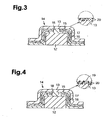
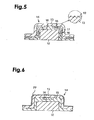
- the resin film 13 is classified in three types. Specifically, in the first embodiment of Fig. 2, the resin film 13 is a matte film which contains powders fine enough to provide the film with translucency. In the second embodiment of Fig. 3, the resin film 13 is a laminate film where a matte layer which contains powders fine enough to provide the film with translucency is laminated on at least one side of the base film. In the third embodiment of Figs. 4 and 5, the resin film 13 is a processed film in which at least a surface of the base film or the laminate film is processed to have a roughened portion. As used herein, the term "fine enough to provide the film (or the layer) with translucency" means that the surface of the film contains the average particle size of the powders of 40 ⁇ m or less, as discussed below.
- the fine powders include inorganic powders made of materials such as silica, alumina, calcium carbonate, titanium oxide; and synthetic resin powders made of materials such as acrylic resin, urethane resin, nylon resin, and silicone resin.
- the amount of the powders is adjusted depending on the required matte texture of the matte film.
- the amount of the powders is preferably from 0.1 to 50% by weight. If the amount is less than 0.1% by weight, the matte texture of the matte film may be impaired. If the amount is more than 50% by weight, translucency of the matte film may be decreased.
- the average particle size of the powders in the matte film is preferably 40 ⁇ m or less, more preferably 10 ⁇ m or less to achieve uniform matte texture and translucency.
- a laminating process to laminate the matte layer on the base film includes (a) a extrusion laminating process in which a melt base resin is extruded through the small slit in a T-shaped die of the extruder, the resultant extruded film is laminated on the separate matte layer, and the laminate film is cooled and hardened, (b) a multi-layer molding process in which a melt resin is extruded from each passage of the multi-layer die which has several separate passages in its inside or at the outlet to form a laminate film of the base film and the matte layer, (c) a dry laminate process in which an adhesive dissolved in the solvent is applied to the base film, the solvent is dried, and the base film is pressed against and adhered to matte layer to laminate, (d) a laminate coating process in which a resin coating containing the above-mentioned powders is applied at least one side of the base film to laminate.
- methods such as (i) sandblast in which sand is blasted to the base film surface, (ii) etch-matting in which the base film surface is matted by etching with alkali saponified liquid or organic solvent, (iii) a surface coating process in which a resin containing the above-mentioned powders coated on the base film surface, (iv) a method of matting during or after the manufacture process of the base film or the laminate film with an embossing roll; a drum or an endless belt having a rough surface or a matting surface; or a press die.
- the roughening process may be applied on the front surface of the base film or the laminate film, the back surface of the base film or the laminate film, or the front and back surfaces of the base film or the laminate film.
- the roughening process may be grain finishing the surface by using an injection-molding die which includes surfaces which define a cavity for holding the key top and which have irregular portions when the film-integrated key top is injection-molded.
- a laminate coating process, sandblast, etch-matting, a surface coating process, and a method of matting by using a drum or a die can selectively matte the film at the desired location.
- selected one(s) of a plurality of key tops may have translucency and matte texture or one key top may have both a matte portion and a luster portion.
- the resin which forms the matte layer is generally synthetic resin by not particularly limited if it is adhesive to the base film.
- the synthetic resin such as urethane resin, acrylic resin, silicone resin, epoxy resin, and ester resin are included.
- the hardening form of the resin includes thermal hardening, photo-curing, and moisture hardening.
- urethane resin is preferably hardened by thermal hardening.
- the resin is preferably thermoplastic elastomer.
- the thermoplastic elastomer includes polyurethane elastomer, polyolefin elastomer, polyester elastomer, styrene elastomer, and polyvinylchloride elastomer.
- the hardness of the thermoplastic elastomer is preferably 30 to 98 degree with a Type-A durometer pursuant to JIS K6253.
- the base film includes polyester film, polyolefin film, vinyl resin film, fluororesin film, polycarbonate film, polyacetate film, polyamide film, ionomer film, and polyimide film.
- the film of high transparency is desirable.
- fluororesin film, polyester film, polycarbonate film are included.
- the resin films 13 of the first to third embodiments preferably have thickness of 12 to 300 ⁇ m. When the thickness is less than 12 ⁇ m, rigidity of the resin film 13 may decrease and the powders may come out of the surface of the resin film 13. When the thickness is more than 300 ⁇ m, translucency or matte texture may be impaired.
- the resin films 13 of the first to third embodiments preferably have degree of brilliancy of 1 to 80%, haze value (which indicates degree of haze of the film, greater value means as the film is more clear) of 20 to 70%, and transmittance (transmittance of parallel lights) of 40 to 70% to exhibit both translucency and matte texture. If degree of brilliancy is lower than 1%, the surface may be too rough to achieve excellent matte texture. If degree of brilliancy is higher than 80%, the surface may be optically too smooth to have sufficient matte texture. If haze value is lower than 20%, the film may be too clear to have sufficient matte texture. If haze value is higher than 70%, the film may be too opaque to have excellent matte texture. If transmittance is lower than 40%, the translucency of the lights in the film may be poor. If transmittance is higher than 70%, matte texture of the film may be poor.
- a laminate film is used as the resin film 13.
- a metal film 17, a display portion 16, and a decorative layer 15 are provided in order.
- Each of the metal film 17 and the display portion 16 has a hole 18 above the center of each resin key top 12.
- the decorative layer 15 extends in the hole 18.
- the metal film 17 exhibits metallic luster.
- the metal film 17 is formed by deposition of metal such as aluminum.
- the display portion 16 and the decorative layer 15 are formed by printing or painting with an ink such as a polyester ink.
- the display portion 16 may include a character such as a letter and a symbol.
- the decorative layer 15 may include a graphic.
- the display portion 16 may include a raised character or a dented character formed by boring a hole.
- the thickness of the display portion 16 and the decorative layer 15 may be determined depending on their purposes.
- the thickness of the metal film 17 is preferably from 10 to 60nm.
- the resin film 13 contains the powders 20 and the resin film 13 has a flat surface.
- the resin film 13 contains the powders 20 and the resin film 13 has a surface which includes a roughened portion 19 formed by, for example, sandblast.
- the resin film 13 has a surface which includes a roughened portion 19 formed, for example, by sandblast. Since the roughened portion 19 is formed directly on the surface of the resin film 13, separate beads are eliminated. Thus, the manufacture of the resin film 13 is simplified.
- a process of manufacturing the film-integrated key top 14, where the resin film 13 is integrally formed on the surface of the resin key top 12, is generally conducted as follows.
- Synthetic resin such as polyethylene terephthalate that contains powders such as silica powders is used as a raw material of the resin film 13.
- the synthetic resin is extruded by extrusion molding and stretched by biaxial stretching to form a stretched resin film 13. Then, the resin film 13 is cut out to the size suitable for manufacturing each resin key top 12. If required, the display portion 16 or the decorative layer 15 may be formed at the back surface of the resin film 13 by printing or painting. Further, the metal film 17 may be formed at the back surface of the resin film 13 by deposition of metal such as aluminum.
- the resin film 13 is deformed in the shaping die to conform to the surface of each resin key top 12.
- the deformed resin film 13 is inserted in the cavity of the die for injection molding of each resin key top 12.
- thermoplastic resin such as polycarbonate resin, which is thermoplastic resin and a material of each resin key top 12
- the perimeter of the integrated resin key tops 12 is cut out by punching.
- a film-integrated key top 14 in which the resin key top 12 and the resin film 13 that conforms to the surface of the resin key top 12 are integrally formed, are produced.
- the resin film 13 of the resultant film-integrated key top 14 may be formed of the matte film or matte layer that contains powders fine enough to provide the film with translucency or the base film or the laminate film that has a surface which includes a roughened portion 19. Therefore, the resin film 13 can transmit lights and the transmit lights are refracted or reflected diffusely by the fine powders or the roughened portion. This causes the surface of the resin film 13 to have a matte appearance.
- a detachable protective film 22 may be laminated on the surface of the resin film 13 of any one of first to third embodiments.
- the protective film 22 can protect the surface of the film-integrated key top 14 prior to its use.
- the protective film 22 may be detached when the film-integrated key top 14 is used.
- the surface of the protective film 22 may have a roughened portion such that the portion is transferred to the resin film 13. In this case, the roughened portion 19 of the surface the resin film 13 is easily produced.
- the protective film 22 may also be used to prevent blocking and deformation or damage of a thermoplastic elastomer when the thermoplastic elastomer, which serves as a laminate film and has a heat resistance lower than a base film, is contacted with a heat roller. Further, the protective film 22 may be used to prevent the thermoplastic elastomer from fusing to the heat roller and then to prevent the thermoplastic elastomer from fusing to the mold.
- the roughened portion of the protective film 22 may be made by coating the surface of the protective film 22 with melamine resin containing silica powders or mixing powders in the protective film 22.
- the protective film 22 is preferably made from a material which is hard to adhere to thermoplastic elastomer or, in the case thermo-laminating process is used, a material which is blocking-free with the heat roller.
- thermoplastic elastomer is thermoplastic polyurethane elastomer, such material is, for example, oriented polypropylene and polyethylene terephthalate or polycarbonate the surface of which is treated with melamine resin to detach from the mold.
- the protective film 22 has a thickness of 25 ⁇ m or less, more preferably 6 to 25 ⁇ m, most preferably 12 ⁇ m.
- the thickness is larger than 25 ⁇ m, transmission of heat is insufficient during the thermo-laminating process, which results in insufficient adhesive strength between the base film and the thermoplastic elastomer film.
- the resin film 13 is formed of a matte film that contains powders fine enough to provide the film with translucency. Accordingly, the film-integrated key top 14 can show excellent translucency as well as excellent matte texture. In addition, when the average particle size of the powders is less than 40 ⁇ m and the powder is dispersed uniformly in the matte film, more excellent translucency and uniform matte texture can be achieved.
- the resin film 13 is formed of a laminate film where a matte layer which contains powders fine enough to provide the film with translucency is laminated on at least one side of the base film. Accordingly, the film-integrated key top 14 can show excellent translucency as well as excellent matte texture.
- the resin film 13 is formed of a processed film.
- the processed film is either a base film which has translucency and which is processed to have a roughened portion 19 or a laminate film where a matte layer which contains powders fine enough to provide the film with translucency is laminated on at least one side of the base film and which is processed to have a roughened portion 19. Accordingly, the film-integrated key top 14 can show excellent translucency as well as excellent matte texture.
- the key top 14 can be easily manufactured by using the resin film 13 and the manufacturing costs can be reduced. Further, by adjusting the average particle size or the amount of the powders in the matte film or the matte layer of the laminate film, or the thickness of the matte film or layer which contains the powders, the matte texture can be controlled freely.
- This example is for a film-integrated key top 14 of Fig. 2.
- a display portion 16 was formed at the back surface of the film 13 by printing with a polyester ink.
- the display portion 16 included a raised character.
- a decorative layer 15 was formed by solid printing with a polyester ink.
- the film 13 was deformed in the shaping die to conform to the surface of each resin key top 12.
- the deformed film 13 was inserted in the die for injection molding of the resin key top 12.
- polycarbonate resin which is thermoplastic resin and a material of the resin key top 12
- the perimeter of the integrated key tops was cut out by punching to produce film-integrated key tops 14 each of which includes a surface having uniform matte texture and includes the display portion 16 having a raised character.
- This example is for a film-integrated key top 14 of Fig. 3.
- Polyethylene terephthalate was stretched by biaxial stretching to form a sheet of a base film having a thickness of 50 ⁇ m. Dust or other foreign particles were removed from the surface of the base film. Then, by the surface coating process, urethane resin containing silica powders (average particle size of 1 to 2 ⁇ m) as fine powders was applied to the surface of the base film with a roll coater to produce a laminate film. The thickness of the applied urethane resin was 2 to 5 ⁇ m. The coating was carefully conducted so as not to make a scratch on the surface of the film.
- the deposition of aluminum was performed by using a batch take-up deposition machine to form a metal film 17 at the back surface of the resin film 13.
- the metal film 17 had a thickness of 40nm.
- the resin film 13 was cut to an appropriate size.
- a display portion 16 was formed at the back surface of the film 13 by printing with a polyester ink.
- the display portion 16 included a dented character.
- the metal film 17 was alkalietched to remove an exposed part. The alkali-etching was conducted according to a known technique. The film was neutralized, washed intensively, dried, and printed with a polyester ink to form a decorative layer 15.
- the film 13 was deformed in the shaping die to conform to the surface of each resin key top 12.
- the deformed film 13 was inserted in the die for injection molding of the resin key top 12.
- polycarbonate resin which is thermoplastic resin and a material of the resin key top 12
- the perimeter of the integrated key tops was cut out by punching to produce film-integrated key tops 14 each of which includes a surface having uniform matte texture and includes the display portion 16 having a dented character.
- This example is for a film-integrated key top 14 of Fig. 4.
- Polyethylene terephthalate film was coextruded with polyethylene terephthalate film containing fine powders to form a resin film 13 with the polyethylene terephthalate film containing fine powders placed on both (front and back) sides of the polyethylene terephthalate base film. Concurrently with the laminating, minute roughened portion was made on the film by using an embossing roll. Each of the polyester layers had a thickness of 5pm. The total thickness of the laminate film was 50 ⁇ m.
- the deposition of aluminum was performed by using a batch take-up deposition machine to form a metal film 17 at the back surface of the resin film 13.
- the deposition of aluminum was performed by using a batch take-up deposition machine to form a metal film 17 at the back surface of the resin film 13.
- the resin film 13 was cut to an appropriate size.
- a display portion 16 was formed at the back surface of the film 13 by printing with a polyester ink.
- the display portion 16 included a dented character.
- the metal film 17 was alkalietched to remove an exposed part. The alkali-etching was conducted according to a known technique. The film was neutralized, washed intensively, dried, and printed with a polyester ink to form a decorative layer 15.
- the film 13 was deformed in the shaping die to conform to the surface of each resin key top 12.
- the deformed film 13 was inserted in the die for injection molding of the resin key top 12.
- polycarbonate resin which is thermoplastic resin and a material of the resin key top 12
- the perimeter of the integrated key tops was cut out by punching to produce film-integrated key tops 14 each of which includes a surface having uniform matte texture and includes the display portion 16 having a dented character.
- This example was prepared in the same manner as Example 3, except that the following laminate film was used as a resin film 13.
- a laminate film was formed by an extrusion laminating process in which polyethylene terephthalate film containing fine powders was laminated on both sides of polyethylene terephthalate film as a base film and extruded into a sheet.
- Each of the polyester layers in the laminate film had a thickness of 5 ⁇ m.
- the total thickness of the laminate film was 50 ⁇ m.
- a resultant film-integrated key top 14 included a surface having uniform matte texture.
- This example was prepared in the same manner as Example 3, except that the following laminate film was used as a resin film 13.
- a laminate film was formed by a dry laminate process in which acrylic adhesive was applied to polyethylene terephthalate film, pressed against and adhered to a polyester layer containing silica powders (average particle size of 1 to 2 ⁇ m) as fine powders to laminate.
- a resultant film-integrated key top 14 included a surface having uniform matte texture.
- This example is for a film-integrated key top 14 of Fig. 5.
- This example was prepared in the same manner as Example 3, except that the resin film 13 was a processed film which was formed by sandblast in which a polyethylene terephthalate film was roughened by being blasted sand.
- a resultant film-integrated key top 14 included a surface having uniform matte texture.
- This example was prepared in the same manner as Example 3, except that the resin film 13 was a processed film which was formed by etch-matting in which the surface of a polyethylene terephthalate film was etched with alkali saponified liquid to have a roughed portion.
- a resultant film-integrated key top 14 included a surface having uniform matte texture.
- This example was prepared in the same manner as Example 3, except that the resin film 13 was a processed film which was formed by matting the surface of the polyethylene terephthalate film during the manufacture with an embossing roll.
- a resultant film-integrated key top 14 included a surface having uniform matte texture.
- This example was prepared in the same manner as Example 3, except that the resin film 13 was a processed film which was formed by matting the surface of the polyethylene terephthalate film with a press die.
- a resultant film-integrated key top 14 included a surface having uniform matte texture.
- Polyethylene terephthalate film was stretched by biaxial stretching to form a sheet of a resin film 13 having a thickness of 50 ⁇ m.
- a display portion 16 was formed at the back surface of the film 13 by printing with a polyester ink.
- the display portion 16 included a dented character.
- the film 13 was deformed in the shaping die to conform to the surface of the resin key top 12.
- the resin film 13 was then inserted in a injection-molding die which includes surfaces which define a cavity for holding the key top and the surfaces have grain-finished portions.
- Polycarbonate resin which is thermoplastic resin and a material of the resin key top 12, was injection-molded to integrate the resin film 13 with each resin key top 12.
- the perimeter of the integrated resin key top 12 is cut out by punching to produce film-integrated key tops 14 each of which includes a surface having uniform matte texture and includes the display portion 16 having a dented character.
- Example 2 Example 3
- Example 4 PET film Degree of brilliancy(%) 39 40 76 6 150 haze value(%) 35 33 59 26 4 transmittance(%) 66 57 45 53 85
- This example is for a film-integrated key top 14 of Fig. 3.
- a matte layer which is a thermoplastic elastomer film containing slilica powders (average particle size of 1 to 2 ⁇ m) as fine powders, was laminated on the surface of the base film, which is an alloy film of polycarbonate and polybutylene terephthalate (an PC/PBT film), by thermo-laminating method to form a laminate film.
- the thermoplastic elastomer film was formed by extruding polyurethane elastomer through the small slit in a T-shaped die of the extruder to have a thickness of 50 ⁇ m.
- a display portion 16 was formed at the back surface of the film 13 by printing with a polyester ink.
- the display portion 16 included a raised character.
- decorative layer 15 was formed by solid printing with a polyester ink.
- the laminate film was deformed in the shaping die to conform to the surface of each resin key top 12.
- the deformed film was inserted in the die for injection molding of each resin key top 12.
- polycarbonate resin which is thermoplastic resin and a material of the resin key top 12
- the perimeter of the integrated key tops was cut out by punching to produce film-integrated key tops 14 each of which includes a surface having a soft touch and includes the display portion 16 having a raised character.
- This example is for a film-integrated key top 14 of Fig. 4.
- thermoplastic elastomer film having a thickness of 50 ⁇ m and a protective film having a roughened portion on the laminating surface were laminated on the surface of the base film.
- the base film is a polyethylene terephthalate film having a thickness of 50 ⁇ m.
- the thermoplastic elastomer film was formed by extruding polyurethane elastomer through the small slit in a T-shaped die of the extruder.
- Dust or other foreign particles were removed from the surface of the processed film. Further, the deposition of aluminum was performed by using a batch take-up deposition machine to form a metal film 17 at the back surface of the processed film.
- the metal film 17 had a thickness of 40nm.
- This matte film was cut to an appropriate size.
- a display portion 16 was formed at the back surface of the film 13 by printing with a polyester ink.
- the display portion 16 included a dented character.
- the metal film 17 was alkalietched to remove an exposed part. The alkali-etching was conducted according to a known technique in the art. The film was neutralized, washed intensively, dried, and printed with a polyester ink to form a decorative layer 15.
- the processed film was deformed in the shaping die to conform to the surface of the resin key top 12.
- the deformed film was inserted in the die for injection molding of each resin key top 12.
- polycarbonate resin which is thermoplastic resin and a material of the resin key top 12
- the perimeter of the integrated key tops was cut out by punching.
- the protective film was detached and a roughened portion on the protective film were transferred.
- a film-integrated key top 14 that includes a surface having soft touch and includes the display portion 16 having a dented character was produced.
- This example is for a film-integrated key top 14 of Fig. 5.
- a matte layer which is a thermoplastic elastomer film containing silica powders (average particle size of 1 to 2 ⁇ m) as fine powders, and a protective film, which has a roughened portion on the laminating surface, were laminated on the surface of the base film, which is an PC/PBT film, by thermo-laminating method to form a laminate film which has a protective film on its surface.
- the thermoplastic elastomer film was formed by extruding polyurethane elastomer through the small slit in a T-shaped die of the extruder to have a thickness of 50 ⁇ m.
- the resultant laminate film was used to produce a film-integrated key top 14, as described in Example 3.
- the film-integrated key top 14 included a surface having soft touch.
- Example 11 Example 12
- Example 13 Degree of brilliancy(%) 67 50 64 haze value(%) 51 32 55 transmittance(%) 62 64 59
- degrees of brilliancy of the resin films of Examples 11 to 13 are much lower than that of the general PET film, indicating that the films of Examples 2 to 4 and 6 are matte.
- the haze values of the resin films of Examples 11 to 13 are much higher than that of the general PET film, indicating that the films of Examples 2 to 4 and 6 are in a haze.
- the transmittances of the resin films of Examples 11 to 13 are lower than that of the general PET film, indicating that the films of Examples 2 to 4 and 6 transmit smaller amount of lights.
- An adhesive or an agglutinant may be used when the resin key top 12 and the resin film 13 are integrally formed.
- a plurality of the matte layers can be used.
- the amount and kind of the powders contained in each matte layer can be varied.
- a roughened portion 19 may not include protrusions and depressions alternately.
- shape of the cross-section of the protrusions and the depressions may be varied.
- the height of the protrusions and the depth of the depressions may be varied.
- density of the protrusions and the depressions may be varied.
- the display portion 16 and the decorative layer 15 may be formed at the back surface of the resin film 13 by applying a paint, instead of printing.
Landscapes
- Push-Button Switches (AREA)
- Laminated Bodies (AREA)
Applications Claiming Priority (2)
| Application Number | Priority Date | Filing Date | Title |
|---|---|---|---|
| JP2001385203 | 2001-12-18 | ||
| JP2001385203 | 2001-12-18 |
Publications (2)
| Publication Number | Publication Date |
|---|---|
| EP1324362A2 true EP1324362A2 (fr) | 2003-07-02 |
| EP1324362A3 EP1324362A3 (fr) | 2005-04-06 |
Family
ID=19187800
Family Applications (1)
| Application Number | Title | Priority Date | Filing Date |
|---|---|---|---|
| EP02445179A Withdrawn EP1324362A3 (fr) | 2001-12-18 | 2002-12-17 | Bouton poussoir intégré sur feuille |
Country Status (3)
| Country | Link |
|---|---|
| US (1) | US20030132507A1 (fr) |
| EP (1) | EP1324362A3 (fr) |
| CN (1) | CN1228704C (fr) |
Cited By (3)
| Publication number | Priority date | Publication date | Assignee | Title |
|---|---|---|---|---|
| FR2888662A1 (fr) * | 2005-07-13 | 2007-01-19 | Siemens Ag | Unite de commande a revetement metallique. |
| EP1865523A1 (fr) * | 2006-07-27 | 2007-12-12 | Silitech Technology Corp. | Plaque mince de touches avec effet de lumière éblouissante |
| DE102014019245A1 (de) * | 2014-12-19 | 2016-06-23 | Audi Ag | Anzeigeelement für eine Anzeigeanordnung zum Anzeigen von Symbolen mittels Such- und/oder Funktionsbeleuchtung, Anzeigeanordnung und Verfahren zum Bereitstellen eines Anzeigegelements |
Families Citing this family (9)
| Publication number | Priority date | Publication date | Assignee | Title |
|---|---|---|---|---|
| DE10346219A1 (de) * | 2003-09-23 | 2005-04-28 | Decoma Germany Gmbh | Strukturbauteil und Verfahren und Werkzeugvorrichtung zu dessen Herstellung |
| JP4801537B2 (ja) * | 2005-10-13 | 2011-10-26 | ポリマテック株式会社 | キーシート |
| JP4843419B2 (ja) * | 2005-10-13 | 2011-12-21 | ポリマテック株式会社 | キーシート |
| DE102006005089B4 (de) * | 2006-02-04 | 2015-04-16 | Preh Gmbh | Bedienelement |
| CN101175380A (zh) * | 2006-11-03 | 2008-05-07 | 深圳富泰宏精密工业有限公司 | 便携式电子装置外壳及其制造方法 |
| CN102472888B (zh) * | 2009-07-06 | 2014-08-20 | 株式会社尼康 | 显微镜装置 |
| CN101958201A (zh) * | 2010-06-07 | 2011-01-26 | 昆山鼎硕电子科技有限公司 | 不易撕裂的硅胶模件 |
| TWI702626B (zh) * | 2018-03-30 | 2020-08-21 | 英屬開曼群島商康而富控股股份有限公司 | 具有較佳按壓手感的觸控按鍵 |
| CN109757777B (zh) * | 2018-11-06 | 2022-03-29 | 深圳麦克韦尔科技有限公司 | 雾化器及其外壳的成型模具 |
Family Cites Families (11)
| Publication number | Priority date | Publication date | Assignee | Title |
|---|---|---|---|---|
| US2536764A (en) * | 1947-04-05 | 1951-01-02 | American Optical Corp | Method of forming a reflection reducing coating |
| JPH07104747B2 (ja) * | 1983-03-18 | 1995-11-13 | ブラザー工業株式会社 | キートップの製造方法 |
| JPH0789459B2 (ja) * | 1986-06-24 | 1995-09-27 | アルプス電気株式会社 | キートツプの製造方法 |
| US5225818A (en) * | 1990-11-26 | 1993-07-06 | Data Entry Products, Incorporated | Data entry control panel |
| JP2772760B2 (ja) * | 1994-07-12 | 1998-07-09 | 帝国通信工業株式会社 | 図柄付き合成樹脂フイルムの図柄拡大方法 |
| JPH1020103A (ja) * | 1996-07-05 | 1998-01-23 | Dainippon Printing Co Ltd | 防眩フィルム |
| JP3812980B2 (ja) * | 1996-12-06 | 2006-08-23 | ポリマテック株式会社 | シート状キートップ構造 |
| JPH10289633A (ja) * | 1997-04-15 | 1998-10-27 | Polymertech Kk | 加飾透光性キートップおよびその製造方法 |
| JPH1173837A (ja) * | 1997-08-28 | 1999-03-16 | Taisei Plas Co Ltd | 照光式押釦スイッチ |
| JP3515426B2 (ja) * | 1999-05-28 | 2004-04-05 | 大日本印刷株式会社 | 防眩フィルムおよびその製造方法 |
| JP2001084863A (ja) * | 1999-09-13 | 2001-03-30 | Polymatech Co Ltd | シート状キートップ |
-
2002
- 2002-12-17 EP EP02445179A patent/EP1324362A3/fr not_active Withdrawn
- 2002-12-18 US US10/325,229 patent/US20030132507A1/en not_active Abandoned
- 2002-12-18 CN CN02157437.5A patent/CN1228704C/zh not_active Expired - Fee Related
Non-Patent Citations (1)
| Title |
|---|
| None |
Cited By (4)
| Publication number | Priority date | Publication date | Assignee | Title |
|---|---|---|---|---|
| FR2888662A1 (fr) * | 2005-07-13 | 2007-01-19 | Siemens Ag | Unite de commande a revetement metallique. |
| EP1865523A1 (fr) * | 2006-07-27 | 2007-12-12 | Silitech Technology Corp. | Plaque mince de touches avec effet de lumière éblouissante |
| DE102014019245A1 (de) * | 2014-12-19 | 2016-06-23 | Audi Ag | Anzeigeelement für eine Anzeigeanordnung zum Anzeigen von Symbolen mittels Such- und/oder Funktionsbeleuchtung, Anzeigeanordnung und Verfahren zum Bereitstellen eines Anzeigegelements |
| DE102014019245B4 (de) | 2014-12-19 | 2022-06-23 | Audi Ag | Anzeigeelement für eine Anzeigeanordnung zum Anzeigen von Symbolen mittels Such- und/oder Funktionsbeleuchtung, Anzeigeanordnung und Verfahren zum Bereitstellen eines Anzeigegelements |
Also Published As
| Publication number | Publication date |
|---|---|
| CN1228704C (zh) | 2005-11-23 |
| US20030132507A1 (en) | 2003-07-17 |
| CN1427322A (zh) | 2003-07-02 |
| EP1324362A3 (fr) | 2005-04-06 |
Similar Documents
| Publication | Publication Date | Title |
|---|---|---|
| EP1669191B1 (fr) | Feuille de decoration, article moule decore et moulage par injection de decoration dans le moule | |
| EP1324362A2 (fr) | Bouton poussoir intégré sur feuille | |
| CA2266873C (fr) | Systeme de pellicule de fini permettant l'emploi des motifs | |
| EP1304173B1 (fr) | Procédé de formation d'un produit moulé à base de résine avec une surface comportant une lustre métallique | |
| KR100894445B1 (ko) | 장식 성형품과 그 제조방법 | |
| KR101034442B1 (ko) | 성형 동시 가식성형품 및 성형 동시 가식성형품의 제조방법 | |
| US6984440B2 (en) | Decorative sheet and method for producing the same | |
| EP2657014A1 (fr) | Structure de film décoratif multicouche | |
| JP4488485B2 (ja) | 金属光沢シートとその製造方法、金属光沢成形品の製造方法 | |
| JP4307241B2 (ja) | 保護シート付き加飾シートおよび加飾成形品の製造方法 | |
| WO2008018715A1 (fr) | Feuille haute brillance contenant une feuille d'aluminium | |
| JP4295497B2 (ja) | フィルム一体型キートップ及びその製造方法 | |
| JP4851307B2 (ja) | 成形同時加飾用シートおよびこれを用いた加飾成形品の製法 | |
| JP7484066B2 (ja) | 合成樹脂表皮材、合成樹脂表皮材形成用金型の製造方法及び合成樹脂表皮材の製造方法 | |
| JP2002002192A (ja) | 加飾用フィルムおよびこれを用いた加飾成形品の製造方法 | |
| JP4478541B2 (ja) | 裏面側から照光可能な成形同時加飾成形品の製造方法 | |
| JP2004017508A (ja) | 成形加飾用シート及び射出成形同時加飾方法 | |
| JP7108151B1 (ja) | 加飾シート | |
| JPH081712A (ja) | スエード調の表面を有する成形物及びその製造方法 | |
| JP4488843B2 (ja) | 成形同時加飾成形品およびその製造方法 | |
| JP5359158B2 (ja) | 加飾樹脂成形品及び加飾樹脂成形品の製造方法 | |
| JP4426634B1 (ja) | 加飾プラスチックシート | |
| WO2023053890A1 (fr) | Feuille décorative | |
| JP2025010544A (ja) | 加飾シート | |
| JP2007320148A (ja) | カバーパーツの成形同時絵付け金型 |
Legal Events
| Date | Code | Title | Description |
|---|---|---|---|
| PUAI | Public reference made under article 153(3) epc to a published international application that has entered the european phase |
Free format text: ORIGINAL CODE: 0009012 |
|
| AK | Designated contracting states |
Designated state(s): AT BE BG CH CY CZ DE DK EE ES FI FR GB GR IE IT LI LU MC NL PT SE SI SK TR |
|
| AX | Request for extension of the european patent |
Extension state: AL LT LV MK RO |
|
| PUAL | Search report despatched |
Free format text: ORIGINAL CODE: 0009013 |
|
| AK | Designated contracting states |
Kind code of ref document: A3 Designated state(s): AT BE BG CH CY CZ DE DK EE ES FI FR GB GR IE IT LI LU MC NL PT SE SI SK TR |
|
| AX | Request for extension of the european patent |
Extension state: AL LT LV MK RO |
|
| 17P | Request for examination filed |
Effective date: 20050616 |
|
| AKX | Designation fees paid |
Designated state(s): DE FI GB SE |
|
| 17Q | First examination report despatched |
Effective date: 20100730 |
|
| STAA | Information on the status of an ep patent application or granted ep patent |
Free format text: STATUS: THE APPLICATION IS DEEMED TO BE WITHDRAWN |
|
| 18D | Application deemed to be withdrawn |
Effective date: 20120703 |