EP1324608A2 - Vorrichtung und Verfahren zum Aufbau einer Videokonferenz - Google Patents
Vorrichtung und Verfahren zum Aufbau einer Videokonferenz Download PDFInfo
- Publication number
- EP1324608A2 EP1324608A2 EP02028612A EP02028612A EP1324608A2 EP 1324608 A2 EP1324608 A2 EP 1324608A2 EP 02028612 A EP02028612 A EP 02028612A EP 02028612 A EP02028612 A EP 02028612A EP 1324608 A2 EP1324608 A2 EP 1324608A2
- Authority
- EP
- European Patent Office
- Prior art keywords
- videoconference
- audio
- terminals
- session
- terminal
- Prior art date
- Legal status (The legal status is an assumption and is not a legal conclusion. Google has not performed a legal analysis and makes no representation as to the accuracy of the status listed.)
- Withdrawn
Links
- 238000000034 method Methods 0.000 title claims abstract description 44
- 230000000977 initiatory effect Effects 0.000 title claims abstract description 36
- 238000004891 communication Methods 0.000 claims description 112
- 238000001514 detection method Methods 0.000 claims 18
- 230000004044 response Effects 0.000 abstract description 3
- 230000006835 compression Effects 0.000 description 5
- 238000007906 compression Methods 0.000 description 5
- 230000006837 decompression Effects 0.000 description 5
- 230000009471 action Effects 0.000 description 3
- 230000003139 buffering effect Effects 0.000 description 3
- 230000001413 cellular effect Effects 0.000 description 3
- 230000006870 function Effects 0.000 description 3
- 230000000712 assembly Effects 0.000 description 2
- 238000000429 assembly Methods 0.000 description 2
- 238000010276 construction Methods 0.000 description 2
- 230000003111 delayed effect Effects 0.000 description 2
- 230000005540 biological transmission Effects 0.000 description 1
- 230000008859 change Effects 0.000 description 1
- 230000000295 complement effect Effects 0.000 description 1
- 230000006855 networking Effects 0.000 description 1
- 230000008520 organization Effects 0.000 description 1
- 230000008569 process Effects 0.000 description 1
Images


Classifications
-
- H—ELECTRICITY
- H04—ELECTRIC COMMUNICATION TECHNIQUE
- H04M—TELEPHONIC COMMUNICATION
- H04M7/00—Arrangements for interconnection between switching centres
- H04M7/0024—Services and arrangements where telephone services are combined with data services
- H04M7/0027—Collaboration services where a computer is used for data transfer and the telephone is used for telephonic communication
-
- H—ELECTRICITY
- H04—ELECTRIC COMMUNICATION TECHNIQUE
- H04N—PICTORIAL COMMUNICATION, e.g. TELEVISION
- H04N7/00—Television systems
- H04N7/14—Systems for two-way working
- H04N7/141—Systems for two-way working between two video terminals, e.g. videophone
- H04N7/148—Interfacing a video terminal to a particular transmission medium, e.g. ISDN
-
- H—ELECTRICITY
- H04—ELECTRIC COMMUNICATION TECHNIQUE
- H04N—PICTORIAL COMMUNICATION, e.g. TELEVISION
- H04N7/00—Television systems
- H04N7/14—Systems for two-way working
- H04N7/15—Conference systems
- H04N7/152—Multipoint control units therefor
-
- H—ELECTRICITY
- H04—ELECTRIC COMMUNICATION TECHNIQUE
- H04M—TELEPHONIC COMMUNICATION
- H04M2201/00—Electronic components, circuits, software, systems or apparatus used in telephone systems
- H04M2201/50—Telephonic communication in combination with video communication
Definitions
- the present invention relates to videoconferencing; specifically, to a system and method for easy and convenient initiation of videoconferences.
- a user may generate an audio telephony call or session using an audio communication terminal such as a telephone or personal computer (PC). Initiation of such a session is extremely simple - typically, a user merely enters a telephone number of another party. Conversely, currently, the initiation of videoconference sessions is relatively complex. A separate and complex system may be required, including a centralized control system, which may require specialized instruction to operate. First, a user must ascertain whether or not the other party (or parties) with which the user wishes to have videoconference session possesses videoconference capabilities, and, if so, what their address is. Then, typically, a centralized control system must be operated to link the parties. Users wishing to hold a videoconference may not have access to or control over a specialized videoconference equipment. Therefore, it is difficult to quickly or spontaneously arrange videoconferences; advance scheduling is often required.
- Embodiments of the system and method of the present invention accept information regarding an audio telephony session (e.g., a telephone call) and, in response, initiate a videoconference via videoconference, preferably via terminals associated with the audio terminals used for the audio telephony sessions.
- an audio telephony session e.g., a telephone call
- initiate a videoconference via videoconference preferably via terminals associated with the audio terminals used for the audio telephony sessions.
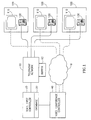
- Fig. 1 depicts a network including a videoconference system according to an embodiment of the present invention.
- a plurality of user sites 100 each include videoconference terminals 110 and audio communication terminals 130.
- User sites 100 may be, for example, offices or other sites, and may be distributed within an organization or enterprise, or among various organizations and in addition sites outside organizations.
- a user site 100 may be a user's home or office.
- a videoconference terminal 110 is a device including the ability to acquire video data from a device such as a camera, a display device displaying the video data for videoconferencing such as a PC screen, and compression/decompression software and/or hardware.
- Other types of videoconference terminals may be used and fall within the scope of the invention.
- associated audio communications terminals and videoconference terminals need not be physically located at the same site.
- an audio communication terminal 130 is a device allowing an audio conversation, for example a telephone or a PC having telephone-over-IP capabilities; other devices may be used for audio communication terminals.
- each audio communication terminal 130 has a unique telephone address such as a telephone number or telephone number and extension combination; in alternate embodiments audio communication terminals may have other sorts of addresses, for example, an Internet Protocol (IP) address.
- IP Internet Protocol
- the audio communication terminals 130 are preferably interconnected via one or more telephony networks 10.
- Telephony networks 10 communicate with audio communication terminals, each other, and possibly other networks to conduct and transmit audio telephony.
- Telephony networks 10 may include, for example, a PBX system operating within an enterprise, or other networks transmitting audio and other information, such as intranets or the Internet, or cellular networks.
- Endpoints such as audio communication terminals 130 may be required to register or be registered with a telephony network 10 providing service to the endpoint, and the telephony network 10 may assign an ID, a telephone number/address and/or an extension to endpoints.
- a telephony network 10 includes a buffer 12 for storing portions of audio conversations for delaying the timing of such conversations.
- a buffer 12 for storing portions of audio conversations for delaying the timing of such conversations.
- such buffering need not be required, or the buffering functionality may be provided by different systems.
- a communications network 8 may be available to interconnect various devices, and to augment the interconnection provided by networks such as telephony networks 10.
- the communications network 8 may include a series of networks, such as the Internet, local LANs, intranets (such as enterprise intranets), DSL or xDSL lines, cellular networks, and other networks or combinations of networks.
- a videoconference controller 40 is in communication with videoconference terminals 110 via networks such as the communications network 8.
- the videoconference controller 40 may initiate a videoconference between various videoconference terminals 110.
- the videoconference controller 40 may be a known videoconference controller, such as the Media Xchange ManagerTM provided by VCON, of Herzliya, Israel.
- the videoconference controller 40 includes common videoconference capabilities, such as managing and configuring endpoints, call initiation, call transfer, conference calling, and other features.
- a database 20 stores information on registered users or user sites 100. Such information may include, for example, a telephone number or other address of an audio communication terminal 130, an IP address, Media Access Control (MAC) address, or other address of a videoconference terminal 110, and/or other information such as a user name or ID, physical location, alternate contact information, etc.
- the database 20 may preferably be used to produce the address of a videoconference terminal 110 when presented with the address (e.g. , telephone number) of an audio communication terminal 130 located at the corresponding user site 100 of the videoconference terminal 110.
- multiple audio communication terminals 130 may be so associated with a videoconference terminal 110, and multiple videoconference terminals 110 may be so associated with an audio communication terminal 130.
- the database 20 may be implemented through known methods, such as by using databases implementing the Lightweight Directory Access Protocol (LDAP), the Open Database Connectivity (ODBC) standard, or via other methods, such as methods not including standards. In alternate embodiments a separate database may not be needed, and information linking audio communication terminals 130 and videoconference terminals 110 may be linked in other manners. A telephony network 10 and endpoints such as audio communication terminals 130 and videoconference terminals 110 may be required to register or be registered with the database 20.
- LDAP Lightweight Directory Access Protocol
- ODBC Open Database Connectivity
- a voice first controller 30 is in communication with the database 20, the videoconference controller 40, and also with one or more telephony networks 10.
- the voice first controller 30 may be in communication with other networks such as communications network 8; such networks may provide a link to telephony networks 10 or other entities.
- the voice first controller 30 preferably operates to detect an audio communication (e.g ., an audio telephony call or session) between two or more audio communication terminals 130, and, in response requests the videoconference controller 40 to initiate a videoconference between the videoconference terminals 110 located at the user sites 100 possibly including the audio communication terminals 130 conducting an audio telephony session.
- an audio communication e.g ., an audio telephony call or session
- certain telephony networks 10 include functionality allowing reporting of audio telephony sessions among audio communication terminals 130 to other equipment. Such reporting may include information such as the telephone number or other identification of the audio communication terminals 130 involved, or other information.
- a telephony network 10 and a voice first controller 30 may communicate over, for example, communications network 8, or by other known means. Such functionality may be easily added to current telephony networks.
- Fig. 2 depicts a videoconference terminal used with an embodiment of the system and method of the present invention.
- videoconference terminal 110 is a PC including a communications/networking card 112, a videoconference hardware set 114 such as a videoconference card, a monitor 116, and a video camera 118.
- the videoconference terminal includes compression/decompression software and/or hardware.
- the videoconference terminal 110 may also contain audio acquisition and play devices (e.g. , an audio headset, or microphone and speaker), audio compression/decompression software and/or hardware, and a communication interface.
- Videoconference hardware set 114 may be of known construction, such as a commercially available PCI system including video compression/decompression capabilities such as the ViGQTM or the Escort 25 PCI card, which may be installed within a personal computer (PC) and furnished with the appropriate software, both provided by VCON, of Herzliya, Israel.
- Videoconference terminal 110 may include software enabling videoconference capabilities.
- the videoconference terminal 110 is responsive to remote initiation of videoconference sessions.
- the H.323 standard may be used to enable remote initiation of videoconference calls.
- videoconference terminals 110 may include other devices, such as specialized videoconference terminals or telephones, cellular devices, the assemblies of videoconference equipment (camera(s), microphone(s), controller, video screen) commonly set up in, for example, conference rooms, or other devices or assemblies.
- the videoconference terminal 110 may include audio telephony capability, and thus may include an audio communication terminal 130.
- a videoconference terminal 110 may be implemented in software; for example, a videoconference terminal 110 may be a software application running on a PC or other device, using the hardware provided with that device. Known methods of providing audio telephony capability to devices such as PCs may be used.
- audio communication terminal 130 is an audio telephone or audio handset of known construction, and preferably includes a video indicator 132, for indicating whether or not a party in an audio conversation has video capability and is available, a video button 134, for indicating a user's preferences regarding participation in a videoconference, and a videoconference button 136, for allowing a user to indicate a videoconfererice is desired.
- the video indicator 132 may be, for example, an LED or other lamp, or an indicator on the display of the audio communication terminal 130 (if such a display is included). In alternate embodiments, the video indicator 132 need not be included, or may be in other forms.
- the video indicator 132 may be an icon or other indication on a monitor.
- the video button 134 and/or the videoconference button 136 need not be included, or may be in other forms.
- the video buttons' functionalities may be achieved via icons or keypresses.
- Fig. 4 depicts a voice first controller and database according to an embodiment of the system and method of the present invention.
- the voice first controller 30 and database 20 are co-located at the same site or within the same device.
- the database 20 preferably includes information regarding registered user sites of user sites 100; such a database may be located in a different device or at a different site from the voice first controller 30.
- the voice first controller 30 may be implemented within a workstation such as a PC implementing the WindowsTM operating system or a workstation implementing Linux; such a workstation or PC may include other functionality, such as network control functionality.
- a system including voice first controller 30 capability may be a standalone system.
- voice first controller 30 includes processor 32, which may be, for example, one or more microprocessors, memory 34, and network communications interface 36.
- Fig. 5 depicts a videoconference controller according to an embodiment of the system and method of the present invention.
- the videoconference controller 40 includes a processor 42, which may be, for example, one or more microprocessors, a memory 44, and a network communications interface 46.
- videoconference controller 40 may be located at the same site with or in the same device as the voice first controller 30 and/or database 20.
- the location and functionality of the database 20, voice first controller 30, and/or videoconference controller 40 may differ.
- a PBX-or other telephony network, intranet, or other network may include the functionality of the database 20, voice first controller 30, and/or videoconference controller 40.
- Such functionality may be included with existing telephony network or network equipment.
- the functionality of the database 20, voice first controller 30, and/or videoconference controller 40 may be located in one location, separate from a telephony network or from network equipment.
- the various audio communication terminals 130 may be connected by a local network such as a LAN or intranet, which may include PBX such as an IP PBX; such a PBX may function as the telephony network 10 of Fig. 1.
- the various videoconference terminals 110 may similarly be connected by a local network such as a LAN or intranet.
- Each network may be connected to a voice first controller 30 via, for example, a bridge or router; alternately, the voice first controller 30 may be included in one of the local networks.
- some or all of the various audio communication terminals 130 may be connected by an ISDN or PSTN telephone network including, for example, a PBX such as an ISDN PBX or other PBX which may include an analog/digital unit.
- the ISDN PBX may be connected to a voice first controller 30 via, for example, a gateway; alternately, the voice first controller 30 may be included in one of the local networks.
- some or all of the various audio communication terminals 130 may be connected by the communications network 8.
- the communications network 8 or portions of the communications network 8 connecting the audio communication terminals 130 may be the same as or separate from the communications network 8 or portions thereof that connect the videoconference terminals 110.
- a user at a user site 100 operating an audio communication terminal 130 initiates an audio telephony session (e.g. , a telephone call) to another audio communication terminal 130.
- an audio telephony session e.g. , a telephone call
- the user using the audio communication terminal 130 simply enters the telephone number associated with the receiving audio communication terminal 130 (commonly termed "dialing" despite the current rarity of telephone number dials).
- the audio telephony session is initiated and maintained via the telephony network 10. While, typically, the initiation of an audio telephony session is from one party calling a second party, audio telephony sessions may take place among more than two parties.
- the telephony network 10 servicing the relevant audio communications terminals reports the audio telephony session to a voice first controller 30.
- a call detail record including, for example, the telephone number/address or other identification of the audio communication terminals 130 involved is passed; in alternate embodiments other information maybe passed.
- each telephony network 10 may report the session; alternately only one network may report the session.
- the voice first controller 30 accesses the database 20 for information regarding the audio communication terminals 130 involved. Preferably, the voice first controller 30 accesses information regarding whether or not videoconference capability exists for terminals associated with the relevant audio communication terminals 130, and the IP or other address of the relevant videoconference terminals 110 associated with the audio communication terminals 130.
- the voice first controller 30 determines status and availability information regarding the relevant videoconference terminals 110. In alternate embodiments, status and/or availability information for audio communication terminals 130 may be checked.
- the voice first controller 30 accesses the database 20 to translate the identity of the relevant communication terminals 130 into an address or identity for the associated videoconference terminals 110.
- the voice first controller 30 forwards this information to the videoconference controller 40 and requests from the videoconference controller 40 the status of each videoconference terminal 110 associated with the audio communication terminals 130 - e.g., whether such terminals are active and accessible, and can participate in a videoconference.
- the videoconference controller 40 may directly access such videoconference terminals 110 to determine such information, or may perform this operation in other manners.
- the videoconference controller 40 communicates with the various videoconference terminals via networks such as the communications network 8 (in which case the connections between the videoconference controller 40 and certain videoconference terminals in Fig. 1 may be via the communications network 8).
- status and information on audio communication terminals 130 and videoconference terminals 110 may be determined in different manners.
- the videoconference controller 40 may not perform such actions; other components may gather such information in different manners.
- the voice first controller 30 determines, from the status information, which videoconference terminals 110 are eligible to participate in the videoconference, and passes this information to the videoconference controller 40.
- Information and commands passed between the voice first controller 30 and videoconference controller 40 may be passed directly or by means of third entity; in alternate embodiments the voice first controller 30 and videoconference controller 40 functionalities may be in the same device.
- An indication may be provided to participants in the audio session if any of the other users have video capability which is operational and in communication with the videoconference controller 40.
- a video indicator 132 indicates such information to the other users.
- a video indicator 132 may indicate other information.
- each user may activate the appropriate videoconference button 136.
- the audio communication terminal 130 transmits a signal regarding the user action to, typically, the relevant telephony network 10.
- each user with active and accessible videoconference capability must press their appropriate videoconference button 136 before the videoconference may be started.
- other protocols may be used.
- a user may press a videoconference button 136 to grant permission to be viewed in videoconference mode.
- the videoconference button 136 may be an on/off type switch such that, when on, a videoconference is automatically started at the time of the initiation of the audio session. If the videoconference button 136 is in one position, it is an indication that the user is allowing a videoconference, if in another position, the user is not allowing such a conference.
- no "permission" capability need be included, or such permission information may be ascertained through other methods.
- a video button 134 and/or videoconference button 136 may be included on a videoconference terminal 110, or a setting on a PC acting as an audio communication terminal 130 or a videoconference terminal 110 may be ascertained.
- other user preferences may be taken into consideration when initiating and carrying out videoconferences.
- other methods may be used, and other signals may be generated, to initiate a videoconference.
- Video button 134 and/or videoconference button 136 may be transmitted to the videoconference controller 40 directly from audio communication terminals 130 or via the relevant telephony network 10, or in other manners.
- the videoconference controller 40 initiates a videoconference among the set of the videoconference terminals 110 associated with the audio communication terminals 130, or a subset of such videoconference terminals 110, depending on information such as permission and availability information.
- Some videoconference terminals must be set to a certain mode, e.g. an answer, autoanswer or other mode, to be receptive to a videoconference controller command to initiate a videoconference.
- a certain mode e.g. an answer, autoanswer or other mode
- the videoconference controller 40 sends a command to the relevant videoconference terminals 110 to enter such a mode.
- a mode change need not be required.
- a videoconference terminal not in such a mode may accept a command requiring the initiation of a videoconference without an answer or user acceptance.
- a videoconference terminal may not be able to "autoanswer" and be forced into a videoconference.
- a user action such as a "pickup" or answer, may be required after the videoconference controller 40 requests the videoconference terminal to enter a videoconference.
- the videoconference controller 40 may need to join the videoconference terminals 110 into the videoconference.
- the videoconference takes place simultaneously with the audio telephony session.
- no audio is transmitted via the videoconference, and the audio telephony session transmits the audio channel of the videoconference.
- the relevant videoconference terminals 110 display and capture video data associated with the videoconference, and the relevant audio communication terminals 130 output and capture the audio data associated with the videoconference.
- the user may continue to use the audio communication terminals 130 to communicate, even after the videoconference terminals 110 enter the videoconference.
- the transmission and display of captured video images may be delayed a certain amount, possibly due to compression and decompression, or due to other causes. Therefore, audio data transmitted by the audio telephony session may be delayed a similar amount, in order that the users perceive the video and audio data as being in synchrony. In an exemplary embodiment, this delay is performed by buffering capability included at the relevant telephony network 10; in alternate embodiments other delay methods may be used. For each audio channel associated with a video channel, the audio data enters a buffer where it is held a certain amount of time before being forwarded onward. Such capability is easily added to current telephony networks. In alternate embodiments, delay capability may be added to other components, such as the audio communication terminals 130.
- a fixed time delay may be used.
- the delay may be fixed beforehand by the characteristics of the components involved, such as the videoconference terminals 110 or any equipment or networks transmitting videoconference data (e.g. , network or videoconference controller 40 load), and a delay calculated. Data on such equipment may come from the database 20 (e.g., the known delay for the videoconference terminal 110, network, or other equipment associated with each user), from a query to the relevant equipment at the time of the initiation of the videoconference, or by other methods.
- the actual delay of the video data experienced by the videoconference terminals 110 may be periodically ascertained during the videoconference, and the delay adjusted accordingly.
- data on a delay may need to be transmitted from, for example, the videoconference controller 40, to other equipment such as the telephony network 10.
- Embodiments of the system and method of the present invention eliminate the requirement of planning a videoconference in advance.
- the requirement of having training and access to videoconference equipment separate from preferably simple and ubiquitous audio communication terminals 130 may be eliminated, simplifying the process of initiating a videoconference session.
- the initiation of such a session becomes as easy as initiating a telephone call.
- any set of users may participate in videoconference sessions using the system and method of the present invention.
- An additional user may enter an existing teleconference via steps similar to those described herein.
- the various components of embodiments of the system of the present invention may add users of the teleconference to the videoconference.
- the videoconference may be stopped with respect to that user.
- the audio communication terminal 130 passes this information to the voice first controller 30.
- the relevant telephony network 10 passes this information to the voice first controller 30.
- the voice first controller 30 causes the videoconference controller 40 to remove the relevant videoconference terminal 110 from the videoconference. In alternate embodiments, other situations may cause the cessation of a videoconference.
- an existing audio telephony session which has no current videoconference may have a videoconference included.
- a user may alter a setting on a switch on a videoconference terminal 110 or an audio communication terminal 130 to easily initiate a videoconference to complement an existing audio telephony session.
- an audio telephony session may cause the initiation of a one way video conference.
- video information may be transmitted from the call center to the calling party.
- Such a one-way video session may be initiated by an embodiment of the present invention.
- Fig. 6 is a flow chart depicting a series of steps for initiating a videoconference according to an embodiment of the system and method of the present invention.
- a user initiates an audio session.
- a user places a telephone call using an audio communication terminal 130.
- an audio communication terminal 130 may include existing videoconference sessions to add additional audio and video participants.
- one of two parties engaged in an audio session and a videoconference may contact a third via telephone; the third party may then be automatically joined in to the video conference.
- the telephony network(s) 10 servicing the audio communication terminals 130 report(s) the audio telephony session.
- such information is reported to a voice first controller 30, but other components or combinations of components may receive and act on such information.
- functionality within a telephony network 10 may detect a telephony session and perform steps 220-250, below.
- a database is accessed for information regarding the relevant audio communication terminals 130.
- a database access need not be required.
- step 230 status and availability information is determined regarding the relevant videoconference terminals 110 and possibly regarding the associated audio communication terminals 130.
- a videoconference controller 40 is polled for the status of the relevant videoconference terminals 110.
- status and availability information may include other data and may be determined through other methods.
- the relevant audio communication terminals 130 may be polled for certain settings.
- step 240 it is determined which videoconference terminals 110 are able to participate in the videoconference. While, preferably, this determination is made by a voice first controller 30, in alternate embodiments this determination may be made by other components, such as a videoconference controller 40.
- a videoconference is initiated among the relevant videoconference terminals 110.
- a videoconference controller 40 performs such a function, although other components may perform this function.
- users may be required to signal their desire to enter a videoconference prior to the videoconference. In alternate embodiments, user signals need not be required.
Landscapes
- Engineering & Computer Science (AREA)
- Signal Processing (AREA)
- Multimedia (AREA)
- General Engineering & Computer Science (AREA)
- Computer Networks & Wireless Communication (AREA)
- Telephonic Communication Services (AREA)
- Data Exchanges In Wide-Area Networks (AREA)
Applications Claiming Priority (2)
| Application Number | Priority Date | Filing Date | Title |
|---|---|---|---|
| US32146 | 2001-12-31 | ||
| US10/032,146 US6831675B2 (en) | 2001-12-31 | 2001-12-31 | System and method for videoconference initiation |
Publications (2)
| Publication Number | Publication Date |
|---|---|
| EP1324608A2 true EP1324608A2 (de) | 2003-07-02 |
| EP1324608A3 EP1324608A3 (de) | 2004-05-19 |
Family
ID=21863348
Family Applications (1)
| Application Number | Title | Priority Date | Filing Date |
|---|---|---|---|
| EP02028612A Withdrawn EP1324608A3 (de) | 2001-12-31 | 2002-12-20 | Vorrichtung und Verfahren zum Aufbau einer Videokonferenz |
Country Status (2)
| Country | Link |
|---|---|
| US (1) | US6831675B2 (de) |
| EP (1) | EP1324608A3 (de) |
Cited By (12)
| Publication number | Priority date | Publication date | Assignee | Title |
|---|---|---|---|---|
| EP1555819A1 (de) * | 2004-01-13 | 2005-07-20 | France Telecom S.A. | Verfahren und Vorrichtung zum Aufbau einer Bildfernsprechsitzung |
| EP1624657A1 (de) * | 2004-08-06 | 2006-02-08 | Research In Motion Limited | System und Verfahren zur Nutzung einer ersten Kommunikation über ein erstes Kommunikationsmittel zum Herstellen einer zweiten Kommunikation über ein zweites Kommunikationsmittel |
| EP1578084A3 (de) * | 2004-03-16 | 2006-05-03 | V Con Telecommunications Ltd. | Systeme und Verfahren für Videokonferenz und/oder Initialisierung datenbasierter Zusammenarbeit |
| GB2429601A (en) * | 2005-06-30 | 2007-02-28 | Toshiba Kk | Server with memory storing identification information to link data communication connections |
| CN100536398C (zh) * | 2005-04-27 | 2009-09-02 | 富士施乐株式会社 | 用于存储连接切换程序的电子会议系统和连接切换方法 |
| US7609659B2 (en) | 2004-08-06 | 2009-10-27 | Research In Motion Limited | Systems and methods for facilitating communication over a plurality of communication mediums |
| WO2009133426A1 (en) * | 2008-04-29 | 2009-11-05 | Telefonaktiebolaget L M Ericsson (Publ) | Method and system for launching a collaboration among teleconference participants |
| CN101110946B (zh) * | 2007-08-17 | 2011-01-05 | 中兴通讯股份有限公司 | 对会话初始化协议终端的音频和视频通信进行切换的方法 |
| EP2405638A1 (de) * | 2010-07-08 | 2012-01-11 | Deutsche Telekom AG | Verfahren, System und Gerät zur audio-visuellen Telekommunikation |
| GB2491872A (en) * | 2011-06-16 | 2012-12-19 | Blinkpipe Ltd | Automatic setup of audio/computer teleconference |
| EP2571260A4 (de) * | 2010-09-06 | 2013-12-04 | Huawei Device Co Ltd | Verfahren, vorrichtung und system für eine videokonferenzanwendung |
| US9225938B2 (en) | 2011-06-16 | 2015-12-29 | Starleaf Ltd | Video conferencing systems |
Families Citing this family (34)
| Publication number | Priority date | Publication date | Assignee | Title |
|---|---|---|---|---|
| US8098651B1 (en) | 2001-07-27 | 2012-01-17 | Rockstar Bidco, LP | Integrating multimedia capabilities with circuit-switched calls |
| US7920546B2 (en) | 2002-10-01 | 2011-04-05 | Nortel Networks Limited | Automated attendant multimedia session |
| US7646761B2 (en) * | 2002-10-01 | 2010-01-12 | Nortel Networks Limited | Integrating multimedia capabilities with legacy networks |
| US7653192B1 (en) * | 2002-12-20 | 2010-01-26 | Nortel Networks Limited | Multimedia augmented conference bridge |
| JP2005049993A (ja) * | 2003-07-30 | 2005-02-24 | Canon Inc | 会議システムおよびその制御方法 |
| CN100484230C (zh) * | 2004-01-16 | 2009-04-29 | 华为技术有限公司 | 控制会议电视系统中会场的方法 |
| US7432951B1 (en) * | 2004-03-31 | 2008-10-07 | Avaya Technology Corp. | Video-telephony integration |
| US7176957B2 (en) * | 2004-05-25 | 2007-02-13 | Seiko Epson Corporation | Local video loopback method for a multi-participant conference system using a back-channel video interface |
| US20060132595A1 (en) * | 2004-10-15 | 2006-06-22 | Kenoyer Michael L | Speakerphone supporting video and audio features |
| US7760887B2 (en) * | 2004-10-15 | 2010-07-20 | Lifesize Communications, Inc. | Updating modeling information based on online data gathering |
| US7903137B2 (en) * | 2004-10-15 | 2011-03-08 | Lifesize Communications, Inc. | Videoconferencing echo cancellers |
| US7826624B2 (en) * | 2004-10-15 | 2010-11-02 | Lifesize Communications, Inc. | Speakerphone self calibration and beam forming |
| US7720236B2 (en) * | 2004-10-15 | 2010-05-18 | Lifesize Communications, Inc. | Updating modeling information based on offline calibration experiments |
| US7720232B2 (en) * | 2004-10-15 | 2010-05-18 | Lifesize Communications, Inc. | Speakerphone |
| US7970151B2 (en) * | 2004-10-15 | 2011-06-28 | Lifesize Communications, Inc. | Hybrid beamforming |
| US8116500B2 (en) * | 2004-10-15 | 2012-02-14 | Lifesize Communications, Inc. | Microphone orientation and size in a speakerphone |
| US7688344B2 (en) * | 2004-12-17 | 2010-03-30 | Fuji Xerox Co., Ltd. | Systems and methods for mediating teleconferences |
| US7970150B2 (en) * | 2005-04-29 | 2011-06-28 | Lifesize Communications, Inc. | Tracking talkers using virtual broadside scan and directed beams |
| US7991167B2 (en) * | 2005-04-29 | 2011-08-02 | Lifesize Communications, Inc. | Forming beams with nulls directed at noise sources |
| US7593539B2 (en) | 2005-04-29 | 2009-09-22 | Lifesize Communications, Inc. | Microphone and speaker arrangement in speakerphone |
| JP4578317B2 (ja) * | 2005-05-13 | 2010-11-10 | 富士通株式会社 | Ip電話機に関連する情報処理機器を接続するためのシステム、ip電話機、呼制御管理情報処理装置、プログラムおよび方法 |
| US9614977B1 (en) | 2005-12-16 | 2017-04-04 | At&T Intellectual Property Ii, L.P. | Real-time media control for audio and multimedia conferencing services |
| EP2009868B1 (de) * | 2007-06-29 | 2016-09-07 | Alcatel Lucent | Methode und System zur Verbesserung des Erscheinungsbilds einer Person oder von einem Medien-Endgerät kommenden RTP-Stroms |
| CA2716637A1 (en) | 2009-10-07 | 2011-04-07 | Telewatch Inc. | Video analytics with pre-processing at the source end |
| CA2716705A1 (en) * | 2009-10-07 | 2011-04-07 | Telewatch Inc. | Broker mediated video analytics method and system |
| WO2011041904A1 (en) | 2009-10-07 | 2011-04-14 | Telewatch Inc. | Video analytics method and system |
| US9143739B2 (en) | 2010-05-07 | 2015-09-22 | Iwatchlife, Inc. | Video analytics with burst-like transmission of video data |
| CA2748065A1 (en) | 2010-08-04 | 2012-02-04 | Iwatchlife Inc. | Method and system for locating an individual |
| US8860771B2 (en) | 2010-08-04 | 2014-10-14 | Iwatchlife, Inc. | Method and system for making video calls |
| US20120033028A1 (en) * | 2010-08-04 | 2012-02-09 | Murphy William A | Method and system for making video calls |
| CA2748059A1 (en) | 2010-08-04 | 2012-02-04 | Iwatchlife Inc. | Method and system for initiating communication via a communication network |
| US8830295B2 (en) | 2012-05-23 | 2014-09-09 | Google Inc. | Multimedia conference endpoint transfer system |
| US8830296B1 (en) | 2012-06-26 | 2014-09-09 | Google Inc. | Endpoint device-specific stream control for multimedia conferencing |
| CA2822217A1 (en) | 2012-08-02 | 2014-02-02 | Iwatchlife Inc. | Method and system for anonymous video analytics processing |
Family Cites Families (13)
| Publication number | Priority date | Publication date | Assignee | Title |
|---|---|---|---|---|
| JPS6079887A (ja) * | 1983-10-06 | 1985-05-07 | Nippon Telegr & Teleph Corp <Ntt> | 遠隔テレビ会議通信方式 |
| US5717857A (en) * | 1993-03-19 | 1998-02-10 | Ncr Corporation | System for switching data connection to use first channel and second channel without substantial interruption of transfer of audio signals and image data between computers |
| US5742670A (en) | 1995-01-09 | 1998-04-21 | Ncr Corporation | Passive telephone monitor to control collaborative systems |
| JPH0937220A (ja) * | 1995-07-17 | 1997-02-07 | Oki Electric Ind Co Ltd | 画像・音声多重化装置 |
| US6021428A (en) | 1997-09-15 | 2000-02-01 | Genesys Telecommunications Laboratories, Inc. | Apparatus and method in improving e-mail routing in an internet protocol network telephony call-in-center |
| CN1166163C (zh) | 1997-03-03 | 2004-09-08 | 株式会社东芝 | 通信终端装置 |
| US7043749B1 (en) | 1998-02-27 | 2006-05-09 | Tandberg Telecom As | Audio-video packet synchronization at network gateway |
| US5959662A (en) * | 1998-05-04 | 1999-09-28 | Siemens Information And Communication Networks, Inc. | System and method for enhanced video conferencing security |
| US6430176B1 (en) * | 1998-11-06 | 2002-08-06 | Nortel Networks Limited | Multimedia channel management through PSTN signaling |
| US6628767B1 (en) * | 1999-05-05 | 2003-09-30 | Spiderphone.Com, Inc. | Active talker display for web-based control of conference calls |
| GB2391134B (en) | 1999-12-23 | 2004-05-12 | Mitel Knowledge Corp | Communication system architecture for voice first collaboration |
| JP2001275095A (ja) * | 2000-03-27 | 2001-10-05 | Sony Corp | 通信方法、通信サービス装置、通信端末装置および通信システム |
| US6545697B1 (en) * | 2001-10-16 | 2003-04-08 | Sprint Communications Company, LP | Video telephony |
-
2001
- 2001-12-31 US US10/032,146 patent/US6831675B2/en not_active Expired - Lifetime
-
2002
- 2002-12-20 EP EP02028612A patent/EP1324608A3/de not_active Withdrawn
Non-Patent Citations (1)
| Title |
|---|
| WILLEBEEK-LEMAIR M H ET AL: "On multipoint control units for videoconferencing", LOCAL COMPUTER NETWORKS, 1994. PROCEEDINGS., 19TH CONFERENCE ON MINNEAPOLIS, MN, USA 2-5 OCT. 1994, LOS ALAMITOS, CA, USA,IEEE COMPUT. SOC, 2 October 1994 (1994-10-02), pages 356 - 364, XP010128913 * |
Cited By (16)
| Publication number | Priority date | Publication date | Assignee | Title |
|---|---|---|---|---|
| US7283154B2 (en) | 2001-12-31 | 2007-10-16 | Emblaze V Con Ltd | Systems and methods for videoconference and/or data collaboration initiation |
| EP1555819A1 (de) * | 2004-01-13 | 2005-07-20 | France Telecom S.A. | Verfahren und Vorrichtung zum Aufbau einer Bildfernsprechsitzung |
| EP1578084A3 (de) * | 2004-03-16 | 2006-05-03 | V Con Telecommunications Ltd. | Systeme und Verfahren für Videokonferenz und/oder Initialisierung datenbasierter Zusammenarbeit |
| EP1624657A1 (de) * | 2004-08-06 | 2006-02-08 | Research In Motion Limited | System und Verfahren zur Nutzung einer ersten Kommunikation über ein erstes Kommunikationsmittel zum Herstellen einer zweiten Kommunikation über ein zweites Kommunikationsmittel |
| US7609659B2 (en) | 2004-08-06 | 2009-10-27 | Research In Motion Limited | Systems and methods for facilitating communication over a plurality of communication mediums |
| CN100536398C (zh) * | 2005-04-27 | 2009-09-02 | 富士施乐株式会社 | 用于存储连接切换程序的电子会议系统和连接切换方法 |
| GB2429601A (en) * | 2005-06-30 | 2007-02-28 | Toshiba Kk | Server with memory storing identification information to link data communication connections |
| GB2429601B (en) * | 2005-06-30 | 2008-08-06 | Toshiba Kk | Communication system, server apparatus and data terminal apparatus |
| CN101110946B (zh) * | 2007-08-17 | 2011-01-05 | 中兴通讯股份有限公司 | 对会话初始化协议终端的音频和视频通信进行切换的方法 |
| WO2009133426A1 (en) * | 2008-04-29 | 2009-11-05 | Telefonaktiebolaget L M Ericsson (Publ) | Method and system for launching a collaboration among teleconference participants |
| EP2405638A1 (de) * | 2010-07-08 | 2012-01-11 | Deutsche Telekom AG | Verfahren, System und Gerät zur audio-visuellen Telekommunikation |
| EP2571260A4 (de) * | 2010-09-06 | 2013-12-04 | Huawei Device Co Ltd | Verfahren, vorrichtung und system für eine videokonferenzanwendung |
| US8842157B2 (en) | 2010-09-06 | 2014-09-23 | Huawei Device Co., Ltd. | Method, apparatus, and system for implementing videoconferencing application |
| GB2491872A (en) * | 2011-06-16 | 2012-12-19 | Blinkpipe Ltd | Automatic setup of audio/computer teleconference |
| US9225938B2 (en) | 2011-06-16 | 2015-12-29 | Starleaf Ltd | Video conferencing systems |
| GB2491872B (en) * | 2011-06-16 | 2017-12-13 | Starleaf Ltd | Video conferencing systems |
Also Published As
| Publication number | Publication date |
|---|---|
| US6831675B2 (en) | 2004-12-14 |
| EP1324608A3 (de) | 2004-05-19 |
| US20030122923A1 (en) | 2003-07-03 |
Similar Documents
| Publication | Publication Date | Title |
|---|---|---|
| US6831675B2 (en) | System and method for videoconference initiation | |
| US7283154B2 (en) | Systems and methods for videoconference and/or data collaboration initiation | |
| US7472162B2 (en) | Communication system architecture for voice first collaboration | |
| US7603412B2 (en) | System and method for collaborating using instant messaging in multimedia telephony-over-LAN conferences | |
| EP1868363B1 (de) | System, Verfahren und Knoten um die Anzahl von Audioströmen in einer Telekonferenz zu begrenzen | |
| US7685235B2 (en) | Method and system for integration of instant messaging and teleconferencing via a telephone network | |
| EP1751923B1 (de) | Multimedia-zugangseinrichtung und system damit | |
| RU2396730C2 (ru) | Управление компоновкой конференции и протокол управления | |
| US20030023672A1 (en) | Voice over IP conferencing server system with resource selection based on quality of service | |
| US20070291667A1 (en) | Intelligent audio limit method, system and node | |
| US20070294263A1 (en) | Associating independent multimedia sources into a conference call | |
| EP1868347A2 (de) | Verknüpfung unabhängiger Multimediaquellen mit einer Fernsprechkonferenz | |
| US20120086769A1 (en) | Conference layout control and control protocol | |
| JP2005506018A (ja) | データ会議方法、装置及びシステム | |
| US6522645B1 (en) | Computer telephony integration system and operation method therein | |
| EP1505766B1 (de) | Verbessertes Gruppenkommunikationssystem | |
| US7620158B2 (en) | Video relay system and method | |
| US20060221943A1 (en) | Connecting a packet-based call to multiple devices | |
| CN100473147C (zh) | 可视通信服务器及可视通信方法 | |
| US7907550B1 (en) | Method and system for providing voice over IP conferencing service | |
| US7609286B2 (en) | Method and apparatus for video conferencing | |
| KR20050061188A (ko) | 일대일 방식의 휴대폰 화상통화 서비스 방법 | |
| KR20030073893A (ko) | 무선 인스턴트 메신저를 이용한 실시간 음성정보 전송 방법 | |
| KR100598351B1 (ko) | 이기종 망간의 다자간 회의 장치 | |
| KR100474070B1 (ko) | 디스플레이 장착형 전화기를 이용한 전화 채팅 서비스제공방법 |
Legal Events
| Date | Code | Title | Description |
|---|---|---|---|
| PUAI | Public reference made under article 153(3) epc to a published international application that has entered the european phase |
Free format text: ORIGINAL CODE: 0009012 |
|
| AK | Designated contracting states |
Designated state(s): AT BE BG CH CY CZ DE DK EE ES FI FR GB GR IE IT LI LU MC NL PT SE SI SK TR |
|
| AX | Request for extension of the european patent |
Extension state: AL LT LV MK RO |
|
| PUAL | Search report despatched |
Free format text: ORIGINAL CODE: 0009013 |
|
| AK | Designated contracting states |
Kind code of ref document: A3 Designated state(s): AT BE BG CH CY CZ DE DK EE ES FI FR GB GR IE IT LI LU MC NL PT SE SI SK TR |
|
| AX | Request for extension of the european patent |
Extension state: AL LT LV MK RO |
|
| RIC1 | Information provided on ipc code assigned before grant |
Ipc: 7H 04M 7/00 B Ipc: 7H 04N 7/14 B Ipc: 7H 04N 7/15 A |
|
| 17P | Request for examination filed |
Effective date: 20041118 |
|
| AKX | Designation fees paid |
Designated state(s): AT BE BG CH CY CZ DE DK EE ES FI FR GB GR IE IT LI LU MC NL PT SE SI SK TR |
|
| 17Q | First examination report despatched |
Effective date: 20050111 |
|
| RAP1 | Party data changed (applicant data changed or rights of an application transferred) |
Owner name: EMBLAZE V CON LTD. |
|
| STAA | Information on the status of an ep patent application or granted ep patent |
Free format text: STATUS: THE APPLICATION IS DEEMED TO BE WITHDRAWN |
|
| 18D | Application deemed to be withdrawn |
Effective date: 20110701 |