EP1326295A2 - Doppelte chemische Elektrodenanordnung - Google Patents
Doppelte chemische Elektrodenanordnung Download PDFInfo
- Publication number
- EP1326295A2 EP1326295A2 EP03000015A EP03000015A EP1326295A2 EP 1326295 A2 EP1326295 A2 EP 1326295A2 EP 03000015 A EP03000015 A EP 03000015A EP 03000015 A EP03000015 A EP 03000015A EP 1326295 A2 EP1326295 A2 EP 1326295A2
- Authority
- EP
- European Patent Office
- Prior art keywords
- cathode
- active material
- contacted
- anode
- cathode active
- Prior art date
- Legal status (The legal status is an assumption and is not a legal conclusion. Google has not performed a legal analysis and makes no representation as to the accuracy of the status listed.)
- Withdrawn
Links
Images


Classifications
-
- H—ELECTRICITY
- H01—ELECTRIC ELEMENTS
- H01M—PROCESSES OR MEANS, e.g. BATTERIES, FOR THE DIRECT CONVERSION OF CHEMICAL ENERGY INTO ELECTRICAL ENERGY
- H01M10/00—Secondary cells; Manufacture thereof
- H01M10/05—Accumulators with non-aqueous electrolyte
- H01M10/052—Li-accumulators
-
- H—ELECTRICITY
- H01—ELECTRIC ELEMENTS
- H01M—PROCESSES OR MEANS, e.g. BATTERIES, FOR THE DIRECT CONVERSION OF CHEMICAL ENERGY INTO ELECTRICAL ENERGY
- H01M10/00—Secondary cells; Manufacture thereof
- H01M10/05—Accumulators with non-aqueous electrolyte
- H01M10/056—Accumulators with non-aqueous electrolyte characterised by the materials used as electrolytes, e.g. mixed inorganic/organic electrolytes
- H01M10/0564—Accumulators with non-aqueous electrolyte characterised by the materials used as electrolytes, e.g. mixed inorganic/organic electrolytes the electrolyte being constituted of organic materials only
- H01M10/0566—Liquid materials
- H01M10/0569—Liquid materials characterised by the solvents
-
- H—ELECTRICITY
- H01—ELECTRIC ELEMENTS
- H01M—PROCESSES OR MEANS, e.g. BATTERIES, FOR THE DIRECT CONVERSION OF CHEMICAL ENERGY INTO ELECTRICAL ENERGY
- H01M4/00—Electrodes
- H01M4/02—Electrodes composed of, or comprising, active material
-
- H—ELECTRICITY
- H01—ELECTRIC ELEMENTS
- H01M—PROCESSES OR MEANS, e.g. BATTERIES, FOR THE DIRECT CONVERSION OF CHEMICAL ENERGY INTO ELECTRICAL ENERGY
- H01M4/00—Electrodes
- H01M4/02—Electrodes composed of, or comprising, active material
- H01M4/04—Processes of manufacture in general
-
- H—ELECTRICITY
- H01—ELECTRIC ELEMENTS
- H01M—PROCESSES OR MEANS, e.g. BATTERIES, FOR THE DIRECT CONVERSION OF CHEMICAL ENERGY INTO ELECTRICAL ENERGY
- H01M4/00—Electrodes
- H01M4/02—Electrodes composed of, or comprising, active material
- H01M4/04—Processes of manufacture in general
- H01M4/0402—Methods of deposition of the material
- H01M4/0404—Methods of deposition of the material by coating on electrode collectors
-
- H—ELECTRICITY
- H01—ELECTRIC ELEMENTS
- H01M—PROCESSES OR MEANS, e.g. BATTERIES, FOR THE DIRECT CONVERSION OF CHEMICAL ENERGY INTO ELECTRICAL ENERGY
- H01M4/00—Electrodes
- H01M4/02—Electrodes composed of, or comprising, active material
- H01M4/06—Electrodes for primary cells
- H01M4/08—Processes of manufacture
-
- H—ELECTRICITY
- H01—ELECTRIC ELEMENTS
- H01M—PROCESSES OR MEANS, e.g. BATTERIES, FOR THE DIRECT CONVERSION OF CHEMICAL ENERGY INTO ELECTRICAL ENERGY
- H01M4/00—Electrodes
- H01M4/02—Electrodes composed of, or comprising, active material
- H01M4/36—Selection of substances as active materials, active masses, active liquids
-
- H—ELECTRICITY
- H01—ELECTRIC ELEMENTS
- H01M—PROCESSES OR MEANS, e.g. BATTERIES, FOR THE DIRECT CONVERSION OF CHEMICAL ENERGY INTO ELECTRICAL ENERGY
- H01M4/00—Electrodes
- H01M4/02—Electrodes composed of, or comprising, active material
- H01M4/36—Selection of substances as active materials, active masses, active liquids
- H01M4/362—Composites
- H01M4/366—Composites as layered products
-
- H—ELECTRICITY
- H01—ELECTRIC ELEMENTS
- H01M—PROCESSES OR MEANS, e.g. BATTERIES, FOR THE DIRECT CONVERSION OF CHEMICAL ENERGY INTO ELECTRICAL ENERGY
- H01M4/00—Electrodes
- H01M4/02—Electrodes composed of, or comprising, active material
- H01M4/36—Selection of substances as active materials, active masses, active liquids
- H01M4/38—Selection of substances as active materials, active masses, active liquids of elements or alloys
- H01M4/381—Alkaline or alkaline earth metals elements
-
- H—ELECTRICITY
- H01—ELECTRIC ELEMENTS
- H01M—PROCESSES OR MEANS, e.g. BATTERIES, FOR THE DIRECT CONVERSION OF CHEMICAL ENERGY INTO ELECTRICAL ENERGY
- H01M4/00—Electrodes
- H01M4/02—Electrodes composed of, or comprising, active material
- H01M4/36—Selection of substances as active materials, active masses, active liquids
- H01M4/38—Selection of substances as active materials, active masses, active liquids of elements or alloys
- H01M4/381—Alkaline or alkaline earth metals elements
- H01M4/382—Lithium
-
- H—ELECTRICITY
- H01—ELECTRIC ELEMENTS
- H01M—PROCESSES OR MEANS, e.g. BATTERIES, FOR THE DIRECT CONVERSION OF CHEMICAL ENERGY INTO ELECTRICAL ENERGY
- H01M4/00—Electrodes
- H01M4/02—Electrodes composed of, or comprising, active material
- H01M4/36—Selection of substances as active materials, active masses, active liquids
- H01M4/48—Selection of substances as active materials, active masses, active liquids of inorganic oxides or hydroxides
- H01M4/54—Selection of substances as active materials, active masses, active liquids of inorganic oxides or hydroxides of silver
-
- H—ELECTRICITY
- H01—ELECTRIC ELEMENTS
- H01M—PROCESSES OR MEANS, e.g. BATTERIES, FOR THE DIRECT CONVERSION OF CHEMICAL ENERGY INTO ELECTRICAL ENERGY
- H01M4/00—Electrodes
- H01M4/02—Electrodes composed of, or comprising, active material
- H01M4/36—Selection of substances as active materials, active masses, active liquids
- H01M4/58—Selection of substances as active materials, active masses, active liquids of inorganic compounds other than oxides or hydroxides, e.g. sulfides, selenides, tellurides, halogenides or LiCoFy; of polyanionic structures, e.g. phosphates, silicates or borates
- H01M4/581—Chalcogenides or intercalation compounds thereof
-
- H—ELECTRICITY
- H01—ELECTRIC ELEMENTS
- H01M—PROCESSES OR MEANS, e.g. BATTERIES, FOR THE DIRECT CONVERSION OF CHEMICAL ENERGY INTO ELECTRICAL ENERGY
- H01M4/00—Electrodes
- H01M4/02—Electrodes composed of, or comprising, active material
- H01M4/36—Selection of substances as active materials, active masses, active liquids
- H01M4/58—Selection of substances as active materials, active masses, active liquids of inorganic compounds other than oxides or hydroxides, e.g. sulfides, selenides, tellurides, halogenides or LiCoFy; of polyanionic structures, e.g. phosphates, silicates or borates
- H01M4/581—Chalcogenides or intercalation compounds thereof
- H01M4/5815—Sulfides
-
- H—ELECTRICITY
- H01—ELECTRIC ELEMENTS
- H01M—PROCESSES OR MEANS, e.g. BATTERIES, FOR THE DIRECT CONVERSION OF CHEMICAL ENERGY INTO ELECTRICAL ENERGY
- H01M4/00—Electrodes
- H01M4/02—Electrodes composed of, or comprising, active material
- H01M4/36—Selection of substances as active materials, active masses, active liquids
- H01M4/58—Selection of substances as active materials, active masses, active liquids of inorganic compounds other than oxides or hydroxides, e.g. sulfides, selenides, tellurides, halogenides or LiCoFy; of polyanionic structures, e.g. phosphates, silicates or borates
- H01M4/583—Carbonaceous material, e.g. graphite-intercalation compounds or CFx
-
- H—ELECTRICITY
- H01—ELECTRIC ELEMENTS
- H01M—PROCESSES OR MEANS, e.g. BATTERIES, FOR THE DIRECT CONVERSION OF CHEMICAL ENERGY INTO ELECTRICAL ENERGY
- H01M6/00—Primary cells; Manufacture thereof
- H01M6/14—Cells with non-aqueous electrolyte
- H01M6/16—Cells with non-aqueous electrolyte with organic electrolyte
-
- A—HUMAN NECESSITIES
- A61—MEDICAL OR VETERINARY SCIENCE; HYGIENE
- A61N—ELECTROTHERAPY; MAGNETOTHERAPY; RADIATION THERAPY; ULTRASOUND THERAPY
- A61N1/00—Electrotherapy; Circuits therefor
- A61N1/02—Details
- A61N1/04—Electrodes
- A61N1/05—Electrodes for implantation or insertion into the body, e.g. heart electrode
-
- A—HUMAN NECESSITIES
- A61—MEDICAL OR VETERINARY SCIENCE; HYGIENE
- A61N—ELECTROTHERAPY; MAGNETOTHERAPY; RADIATION THERAPY; ULTRASOUND THERAPY
- A61N1/00—Electrotherapy; Circuits therefor
- A61N1/18—Applying electric currents by contact electrodes
- A61N1/32—Applying electric currents by contact electrodes alternating or intermittent currents
- A61N1/36—Applying electric currents by contact electrodes alternating or intermittent currents for stimulation
- A61N1/372—Arrangements in connection with the implantation of stimulators
- A61N1/378—Electrical supply
-
- H—ELECTRICITY
- H01—ELECTRIC ELEMENTS
- H01M—PROCESSES OR MEANS, e.g. BATTERIES, FOR THE DIRECT CONVERSION OF CHEMICAL ENERGY INTO ELECTRICAL ENERGY
- H01M4/00—Electrodes
- H01M4/02—Electrodes composed of, or comprising, active material
- H01M2004/026—Electrodes composed of, or comprising, active material characterised by the polarity
- H01M2004/028—Positive electrodes
-
- H—ELECTRICITY
- H01—ELECTRIC ELEMENTS
- H01M—PROCESSES OR MEANS, e.g. BATTERIES, FOR THE DIRECT CONVERSION OF CHEMICAL ENERGY INTO ELECTRICAL ENERGY
- H01M4/00—Electrodes
- H01M4/02—Electrodes composed of, or comprising, active material
- H01M4/36—Selection of substances as active materials, active masses, active liquids
- H01M4/48—Selection of substances as active materials, active masses, active liquids of inorganic oxides or hydroxides
- H01M4/485—Selection of substances as active materials, active masses, active liquids of inorganic oxides or hydroxides of mixed oxides or hydroxides for inserting or intercalating light metals, e.g. LiTi2O4 or LiTi2OxFy
-
- H—ELECTRICITY
- H01—ELECTRIC ELEMENTS
- H01M—PROCESSES OR MEANS, e.g. BATTERIES, FOR THE DIRECT CONVERSION OF CHEMICAL ENERGY INTO ELECTRICAL ENERGY
- H01M4/00—Electrodes
- H01M4/02—Electrodes composed of, or comprising, active material
- H01M4/36—Selection of substances as active materials, active masses, active liquids
- H01M4/48—Selection of substances as active materials, active masses, active liquids of inorganic oxides or hydroxides
- H01M4/50—Selection of substances as active materials, active masses, active liquids of inorganic oxides or hydroxides of manganese
-
- H—ELECTRICITY
- H01—ELECTRIC ELEMENTS
- H01M—PROCESSES OR MEANS, e.g. BATTERIES, FOR THE DIRECT CONVERSION OF CHEMICAL ENERGY INTO ELECTRICAL ENERGY
- H01M4/00—Electrodes
- H01M4/02—Electrodes composed of, or comprising, active material
- H01M4/36—Selection of substances as active materials, active masses, active liquids
- H01M4/48—Selection of substances as active materials, active masses, active liquids of inorganic oxides or hydroxides
- H01M4/50—Selection of substances as active materials, active masses, active liquids of inorganic oxides or hydroxides of manganese
- H01M4/505—Selection of substances as active materials, active masses, active liquids of inorganic oxides or hydroxides of manganese of mixed oxides or hydroxides containing manganese for inserting or intercalating light metals, e.g. LiMn2O4 or LiMn2OxFy
-
- H—ELECTRICITY
- H01—ELECTRIC ELEMENTS
- H01M—PROCESSES OR MEANS, e.g. BATTERIES, FOR THE DIRECT CONVERSION OF CHEMICAL ENERGY INTO ELECTRICAL ENERGY
- H01M4/00—Electrodes
- H01M4/02—Electrodes composed of, or comprising, active material
- H01M4/36—Selection of substances as active materials, active masses, active liquids
- H01M4/48—Selection of substances as active materials, active masses, active liquids of inorganic oxides or hydroxides
- H01M4/52—Selection of substances as active materials, active masses, active liquids of inorganic oxides or hydroxides of nickel, cobalt or iron
- H01M4/525—Selection of substances as active materials, active masses, active liquids of inorganic oxides or hydroxides of nickel, cobalt or iron of mixed oxides or hydroxides containing iron, cobalt or nickel for inserting or intercalating light metals, e.g. LiNiO2, LiCoO2 or LiCoOxFy
-
- H—ELECTRICITY
- H01—ELECTRIC ELEMENTS
- H01M—PROCESSES OR MEANS, e.g. BATTERIES, FOR THE DIRECT CONVERSION OF CHEMICAL ENERGY INTO ELECTRICAL ENERGY
- H01M4/00—Electrodes
- H01M4/02—Electrodes composed of, or comprising, active material
- H01M4/36—Selection of substances as active materials, active masses, active liquids
- H01M4/58—Selection of substances as active materials, active masses, active liquids of inorganic compounds other than oxides or hydroxides, e.g. sulfides, selenides, tellurides, halogenides or LiCoFy; of polyanionic structures, e.g. phosphates, silicates or borates
- H01M4/5825—Oxygenated metallic salts or polyanionic structures, e.g. borates, phosphates, silicates, olivines
-
- H—ELECTRICITY
- H01—ELECTRIC ELEMENTS
- H01M—PROCESSES OR MEANS, e.g. BATTERIES, FOR THE DIRECT CONVERSION OF CHEMICAL ENERGY INTO ELECTRICAL ENERGY
- H01M4/00—Electrodes
- H01M4/02—Electrodes composed of, or comprising, active material
- H01M4/36—Selection of substances as active materials, active masses, active liquids
- H01M4/58—Selection of substances as active materials, active masses, active liquids of inorganic compounds other than oxides or hydroxides, e.g. sulfides, selenides, tellurides, halogenides or LiCoFy; of polyanionic structures, e.g. phosphates, silicates or borates
- H01M4/583—Carbonaceous material, e.g. graphite-intercalation compounds or CFx
- H01M4/5835—Comprising fluorine or fluoride salts
-
- Y—GENERAL TAGGING OF NEW TECHNOLOGICAL DEVELOPMENTS; GENERAL TAGGING OF CROSS-SECTIONAL TECHNOLOGIES SPANNING OVER SEVERAL SECTIONS OF THE IPC; TECHNICAL SUBJECTS COVERED BY FORMER USPC CROSS-REFERENCE ART COLLECTIONS [XRACs] AND DIGESTS
- Y02—TECHNOLOGIES OR APPLICATIONS FOR MITIGATION OR ADAPTATION AGAINST CLIMATE CHANGE
- Y02E—REDUCTION OF GREENHOUSE GAS [GHG] EMISSIONS, RELATED TO ENERGY GENERATION, TRANSMISSION OR DISTRIBUTION
- Y02E60/00—Enabling technologies; Technologies with a potential or indirect contribution to GHG emissions mitigation
- Y02E60/10—Energy storage using batteries
Definitions
- This invention relates to the conversion of chemical energy to electrical energy.
- the present invention relates to an electrode design having a cathode active material of a relatively low energy density but of a relatively high rate capability and a second active material having a relatively high energy density but of a relatively low rate capability.
- the first and second active materials are short circuited to each other by contacting the opposite sides of a current collector.
- a preferred form of the cell has the electrode as a cathode connected to a terminal lead insulated from the casing serving as the negative terminal for the anode electrode.
- the present electrode design is useful for powering an implantable medical device requiring a high rate discharge application.
- an implantable cardiac defibrillator is a device that requires a power source for a generally medium rate, constant resistance load component provided by circuits performing such functions as, for example, the heart sensing and pacing functions. From time-to-time, the cardiac defibrillator may require a generally high rate, pulse discharge load component that occurs, for example, during charging of a capacitor in the defibrillator for the purpose of delivering an electrical shock to the heart to treat tachyarrhythmias, the irregular, rapid heartbeats that can be fatal if left uncorrected.
- SVO silver vanadium oxide
- ⁇ -phase silver vanadium oxide AgV 2 O 5.5
- SVO silver vanadium oxide
- This active material has a theoretical volumetric capacity of 1.37 Ah/ml.
- SVO is preferred because it can deliver high current pulses or high energy within a short period of time.
- CF x has higher volumetric capacity, it cannot be used in medical devices requiring a high rate discharge application due to its low to medium rate of discharge capability.
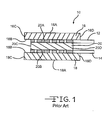
- FIG. 1 is a schematic view of a portion of a cathode electrode 10 according to the filed application. Electrode 10 is in an exaggerated, uncompressed condition and comprises spaced apart current collectors 12 and 14 supporting layers 16 and 18 of a first cathode active material on their respective outer major sides. The first cathode active materials 16, 18 are of a relatively high rate capability, but of a low energy density in comparison to a second cathode active material 20 sandwiched between and in contact with the current collectors 12, 14.
- a high rate active material such as SVO
- CF x high energy density material
- the cathode active layer 16 has upper and lower sides 16A and 16B extending to and meeting with spaced apart left and right ends 16C and 16D. While not shown in the drawing, the sides 16A, 16B and ends 16C, 16D extend to and meet with a front side and a back side. Similarly, the cathode active layer 18 has lower and upper sides 18A and 18B and ends 18C and 18D extending to and meeting with a front side and a back side. For all intents and purposes, the layers 16 and 18 are of a similar shape.
- the intermediate cathode active layer 20 has upper and lower sides 20A and 20B extending to spaced apart left and right ends 20C and 20D.
- the sides 20A, 20B and the ends 20C, 20D extend to and meet with a front side and a back side.
- the first cathode active layers 16, 18 supported on the current collectors 12, 14, in turn, sandwiching the intermediate second cathode active layer 20 is compressed into a relatively thin assembly.
- the ends 16C and 18C of the cathode layers 16, 18 extend beyond the ends 20C and 20D of the second active material layer 20.
- the ends 16C and 18 do not touch each other.
- the front and back sides of the layers 16 and 18 also extend beyond the front and back sides of the intermediate layer 20, but in the compressed state they also do not touch each other.
- the distal ends of the current collectors 12, 14 generally align with the left edge 20C of the intermediate layer 20.
- the cathode layers 16 and 18 With the cathode 10 shown in Fig. 1, it is possible for the cathode layers 16 and 18 to delaminate from the current collectors 12 and 14, especially in the vicinity of the ends 16C and 18C and the front and back sides. Essentially, potential sites of delamination exist wherever the layers 16, 18 extend beyond the peripheral edge of the intermediate layer 20 and of the current collectors 12, 14. The electrode construction of the present invention prevents such delamination from occurring.
- the object of the present invention is to improve the performance of lithium electrochemical cells by providing a new concept in electrode design.
- This new design is predicated on the optimization of the relatively high rate capability of SVO contacted to one side of a current collector with the relatively high energy density of CF x contacted to the other side of the current collector.
- This design has the separate SVO and CF x materials short-circuited to each other through the current collector.
- Providing the active materials in a short circuit relationship means that their respective attributes of high rate and high energy density benefit overall cell discharge performance.
- the present invention provides a construction for the respective active materials that promotes improved contact with the opposed sides of the current collector. This, in turn, prevents delamination of the active materials from the current collector. Delamination can result in diminished discharge efficiency.
- pulse means a short burst of electrical current of significantly greater amplitude than that of a pre-pulse current immediately prior to the pulse.
- a pulse train consists of at least two pulses of electrical current delivered in relatively short succession with or without open circuit rest between the pulses.
- An exemplary pulse train may consist of four 10-second pulses (23.2 mA/cm 2 ) with a 15 second rest between each pulse.
- a typically used range of current densities for cells powering implantable medical devices is from about 15 mA/cm 2 to about 50 mA/cm 2 , and more preferably from about 18 mA/cm 2 to about 35 mA/cm 2 .
- a 10 second pulse is suitable for medical implantable applications. However, it could be significantly shorter or longer depending on the specific cell design and chemistry.
- An electrochemical cell that possesses sufficient energy density and discharge capacity required to meet the vigorous requirements of implantable medical devices comprises an anode of a metal selected from Groups IA, IIA and IIIB of the Periodic Table of the Elements.
- Such anode active materials include lithium, sodium, potassium, etc., and their alloys and intermetallic compounds including, for example, Li-Si, Li-Al, Li-B and Li-Si-B alloys and intermetallic compounds.
- the preferred anode comprises lithium.
- An alternate anode comprises a lithium alloy such as a lithium-aluminum alloy. The greater the amounts of aluminum present by weight in the alloy, however, the lower the energy density of the cell.
- the form of the anode may vary, but preferably the anode is a thin metal sheet or foil of the anode metal, pressed or rolled on a metallic anode current collector, i.e., preferably comprising titanium, titanium alloy or nickel, to form an anode component. Copper, tungsten and tantalum are also suitable materials for the anode current collector.
- the anode component has an extended tab or lead of the same material as the anode current collector, i.e., preferably nickel or titanium, integrally formed therewith such as by welding and contacted by a weld to a cell case of conductive metal in a case-negative electrical configuration.
- the anode may be formed in some other geometry, such as a bobbin shape, cylinder or pellet to allow an alternate low surface cell design.
- the electrochemical cell of the present invention further comprises a cathode of electrically conductive material that serves as the other electrode of the cell.
- the cathode is preferably of solid materials and the electrochemical reaction at the cathode involves conversion of ions that migrate from the anode to the cathode into atomic or molecular forms.
- the solid cathode may comprise a first active material of a metal element, a metal oxide, a mixed metal oxide and a metal sulfide, and combinations thereof and a second active material of a carbonaceous chemistry.
- the metal oxide, the mixed metal oxide and the metal sulfide of the first active material has a relatively lower energy density but a relatively higher rate capability than the second active material.
- the first active material is formed by the chemical addition, reaction, or otherwise intimate contact of various metal oxides, metal sulfides and/or metal elements, preferably during thermal treatment, sol-gel formation, chemical vapor deposition or hydrothermal synthesis in mixed states.
- the active materials thereby produced contain metals, oxides and sulfides of Groups, IB, IIB, IIIB, IVB, VB, VIB, VIIB and VIII, which includes the noble metals and/or other oxide and sulfide compounds.
- a preferred cathode active material is a reaction product of at least silver and vanadium.
- One preferred mixed metal oxide is a transition metal oxide having the general formula SM x V 2 O y where SM is a metal selected from Groups IB to VIIB and VIII of the Periodic Table of Elements, wherein x is about 0.30 to 2.0 and y is about 4.5 to 6.0 in the general formula.
- Another preferred composite transition metal oxide cathode material includes V 2 O 2 wherein z ⁇ 5 combined with Ag 2 O with silver in either the silver(II), silver(I) or silver(0) oxidation state and CuO with copper in either the copper(II), copper(I) or copper(0) oxidation state to provide the mixed metal oxide having the general formula Cu x Ag y V 2 O z , (CSVO).
- the composite cathode active material may be described as a metal oxide-metal oxide-metal oxide, a metal-metal oxide-metal oxide, or a metal-metal-metal oxide and the range of material compositions found for Cu x Ag y V 2 O z is preferably about 0.01 ⁇ z ⁇ 6.5.
- Typical forms of CSVO are Cu 0.16 Ag 0.67 V 2 O z with z being about 5.5 and Cu 0.5 Ag 0.5 V 2 O z with z being about 5.75.
- the oxygen content is designated by z since the exact stoichiometric proportion of oxygen in CSVO can vary depending on whether the cathode material is prepared in an oxidizing atmosphere such as air or oxygen, or in an inert atmosphere such as argon, nitrogen and helium.
- an oxidizing atmosphere such as air or oxygen
- an inert atmosphere such as argon, nitrogen and helium.
- the cathode design of the present invention further includes a second active material of a relatively high energy density and a relatively low rate capability in comparison to the first cathode active material.
- the second active material is preferably a carbonaceous compound prepared from carbon and fluorine, which includes graphitic and nongraphitic forms of carbon, such as coke, charcoal or activated carbon.
- Fluorinated carbon is represented by the formula (CF x ) n wherein x varies between about 0.1 to 1.9 and preferably between about 0.2 and 1.2, and (C 2 F) n wherein the n refers to the number of monomer units which can vary widely.
- the true density of CF x is 2.70 g/ml and its theoretical capacity is 2.42 Ah/ml.
- the first cathode active material is any material that has a relatively lower energy density but a relatively higher rate capability than the second active material.
- V 2 O 5 , MnO 2 , LiCoO 2 , LiNiO 2 , LiMn 2 O 4 , TiS 2 , Cu 2 S, FeS, FeS 2 , copper oxide, copper vanadium oxide, and mixtures thereof are useful as the first active material.
- fluorinated carbon Ag 2 O, Ag 2 O 2 , CuF, Ag 2 CrO 4 , MnO 2 , and even SVO itself, are useful as the second active material.
- the first cathode active material prepared as described above is preferably mixed with a binder material such as a powdered fluoro-polymer, more preferably powdered polytetrafluoroethylene or powdered polyvinylidene flouride present at about 1 to about 5 weight percent of the cathode mixture.
- a binder material such as a powdered fluoro-polymer, more preferably powdered polytetrafluoroethylene or powdered polyvinylidene flouride present at about 1 to about 5 weight percent of the cathode mixture.
- a conductive diluent is preferably added to the first cathode mixture to improve conductivity.
- Suitable materials for this purpose include acetylene black, carbon black and/or graphite or a metallic powder such as powdered nickel, aluminum, titanium and stainless steel.
- the preferred first cathode active mixture thus includes a powdered fluoro-polymer binder present at about 3 weight percent, a conductive
- the second cathode active mixture includes a powdered fluoro-polymer binder present at about 4 weight percent, a conductive diluent present at about 5 weight percent and about 91 weight percent of the cathode active material.
- a preferred second active mixture is, by weight, 91% CF x , 4% PTFE and 5% carbon black.
- Cathode components for incorporation into an electrochemical cell according to the present invention may be prepared by rolling, spreading or pressing the first and second cathode active materials onto a suitable current collector selected from the group consisting of stainless steel, titanium, tantalum, platinum and gold.
- the preferred current collector material is titanium, and most preferably the titanium cathode current collector has a thin layer of graphite/carbon paint applied thereto.
- Cathodes prepared as described above may be in the form of one or more plates operatively associated with at least one or more plates of anode material, or in the form of a strip wound with a corresponding strip of anode material in a structure similar to a "jellyroll".
- Electrode 30 comprises opposed assemblies 30A and 30B extending outwardly from the opposite sides of current collectors 32 and 34. This leaves an intermediate portion of the current collectors 32 and 34 that are not contacted by either the first or the second cathode active materials.
- the cathode assemblies 30A and 30B are essentially identical and will be described with respect to one of them.
- Cathode assembly 30A in an exaggerated, uncompressed condition comprises spaced apart current collectors 32 and 34 supporting layers 36 and 38 of a first cathode active material on their respective outer major sides.
- the first cathode active materials 36, 38 are of a relatively high rate capability, but of a low energy density in comparison to a second cathode active material 40 sandwiched between and in contact with the current collectors 32, 34.
- the cathode active layer 36 has upper and lower sides 36A and 36B extending to and meeting with spaced apart left and right ends 36C and 36D. While not shown in Fig. 2, the sides 36A, 36B and ends 36C, 36D extend to a front side and a back side. Similarly, the cathode active layer 38 has lower and upper sides 38A and 38B and ends 38C and 38D extending to a front side and a back side. For all intents and purposes, the layers 36 and 38 are of a similar shape.
- the intermediate cathode active layer 40 has upper and lower sides 40A and 40B extending to spaced apart left and right ends 40C and 40D.
- the sides 40A, 40B and the ends 40C, 40D extend to a front side and a back side.
- the end 40C of the intermediate, second active material cathode layer 40 extends beyond the ends 36C and 38C of the first active material cathode layers 36, 38.
- the end 40D of layer 40 extends beyond the ends 36D and 38D of the cathode layers 36, 38. While not shown, the front and back sides of the intermediate layer extend beyond the front and back sides of the layers 36 and 38.
- the cathode assemblies 30A and 30B are folded toward each other and toward the opposed sides of an anode electrode to provide an electrochemical cell. However, before the assemblies 30A and 30B are folded, they are compressed. This causes the periphery of the first cathode active materials 36, 38 to expand substantially to the size of the periphery of the second cathode material 40. There is also some expansion of the second active material during compression of the assemblies, just not as much as that of the first active material.
- each cathode assembly is from about 0.020 inches to about 0.035 inches, the current collectors 32, 34 each being about 0.002 inches thick with a carbon coating of about 0.0004 inches thick per current collector side.
- cathode 30 the provision of the peripheral edge of the intermediate layer 40 extending beyond the peripheral edges of the layers 36 and 38 in the uncompressed state prevents delamination of the first cathode active material from the current collectors 32 and 34 after the assembly is pressed to its final thickness.
- providing the peripheral edge of the intermediate cathode layer 40 extending beyond the peripheral edges of the current collectors 32 and 34 and of the first active layers 36 and 38 ensures that delamination of the compressed cathode does not occur when the assemblies 30A and 30B are folded toward each other and electrically associated with the anode electrode.
- the anode electrode comprises a number of anode structures; each comprising a current collector having an alkali metal contacted thereto, lithium being preferred.
- the cell 50 is built with the first anode structure 52A having lithium 54 only contacted to the one major side of the anode current collector 56 adjacent to the cathode assembly 30B.
- the opposite major side 58 of the anode current collector 56 is bare and in direct contact with the casing serving as the anode electrode terminal in the case-negative cell design.
- the second anode structure 52B is intermediate the cathode assemblies 30A, 30B and comprises layers 60 and 62 of lithium contacted to the opposed major sides of current collector 64.
- the third anode structure 52C comprises lithium 66 only contacted to the one major side of the anode current collector 68 adjacent to the cathode assembly 30A.
- the anode layers 54, 60, 62 and 66 are of substantially the same size and thickness.
- the cathode current collectors 32 and 34 are connected to a common terminal insulated from the casing by a suitable glass-to-metal seal. This describes a case-negative cell design, which is the preferred form of the cell 50.
- the cell 50 can also be built in a case-positive design with the cathode current collectors contacted to the casing and the anode current collectors 56, 64 and 68 connected to a common terminal lead insulated from the casing.
- the cell is built in a case-neutral configuration with both the anode and the cathode being connected to respective terminal leads insulated from the casing.
- Fig. 4 is a schematic view of another electrochemical cell 70 according to the present invention. As with the cell 50 described in Fig. 3, this cell 70 is shown exaggerated somewhat with the first active materials 36 and 38 shown not touching the second active material 40. However, in a compressed state, the active materials 36, 38 and 40 touch at the ends beyond the current collectors 32, 34 with the ends being substantially aligned.
- Cell 70 is housed in a conductive casing (not shown) in either a case-negative, a case-positive or a case-neutral design.
- the anode electrode comprises an anode current collector 72 having an alkali metal contacted thereto.
- the preferred alkali metal is lithium, and it is provided in a serpentine shape weaving or winding between two pairs of the cathode assemblies 30A and 30B.
- the cathode assemblies similar in thickness to those described with respect to cell 50.
- the cell 70 is built with the anode portion 74 having lithium 76 only contacted to the one major side 78 of the anode current collector 72 adjacent to the cathode assembly 30B.
- the opposite major side 80 of the anode current collector 72 is bare and in direct contact with the casing serving as the anode electrode terminal in the case-negative cell design.
- the serpentine anode electrode doubles back to provide anode portion 82 having the lithium 76 contacting the current collector side 78 and a layer of lithium 84 contacted to the other major side 80 of the current collector.
- the anode portion 82 continues weaving between the cathode assemblies 30A, 30B, and 30A.
- the lithium layer 76 ends. Then, the anode electrode is completed by anode portion 86 comprising lithium layer 84 only contacted to the major side 80 of the anode current collector 72.
- the opposite major side 78 of the anode current collector is bare and in direct contact with the casing serving as the anode electrode terminal.
- Anode layers 76 and 84 are of substantially the same size and thickness.
- the sandwich cathode is separated from the Group IA, IIA or IIIB anode by a suitable separator material.
- the separator is of electrically insulative material, and the separator material also is chemically unreactive with the anode and cathode active materials and both chemically unreactive with and insoluble in the electrolyte.
- the separator material has a degree of porosity sufficient to allow flow there through of the electrolyte during the electrochemical reaction of the cell.
- Illustrative separator materials include fabrics woven from fluoropolymeric fibers including polyvinylidine fluoride, polyethylenetetrafluoroethylene, and polyethylenechlorotrifluoroethylene used either alone or laminated with a fluoropolymeric microporous film, non-woven glass, polypropylene, polyethylene, glass fiber materials, ceramics, polytetrafluoroethylene membrane commercially available under the designation ZITEX (Chemplast Inc.), polypropylene/polyethylene membrane commercially available under the designation CELGARD (Celanese Plastic Company, Inc.), a membrane commercially available under the designation DEXIGLAS (C.H. Dexter, Div., Dexter Corp.), and a polyethylene membrane commercially available from Tonen Chemical Corp.
- fluoropolymeric fibers including polyvinylidine fluoride, polyethylenetetrafluoroethylene, and polyethylenechlorotrifluoroethylene used either alone or laminated with a fluoropolymeric microporous
- the electrochemical cell of the present invention further includes a nonaqueous, ionically conductive electrolyte that serves as a medium for migration of ions between the anode and the cathode electrodes during the electrochemical reactions of the cell.
- the electrochemical reaction at the electrodes involves conversion of ions in atomic or molecular forms that migrate from the anode to the cathode.
- nonaqueous electrolytes suitable for the present invention are substantially inert to the anode and cathode materials, and they exhibit those physical properties necessary for ionic transport, namely, low viscosity, low surface tension and wettability.
- a suitable electrolyte has an inorganic, ionically conductive salt dissolved in a mixture of aprotic organic solvents comprising a low viscosity solvent and a high permittivity solvent.
- preferred lithium salts that are useful as a vehicle for transport of alkali metal ions from the anode to the cathode include LiPF 6 , LiBF 4 , LiAsF 6 , LiSbF 6 , LiClO 4 , LiO 2 , LiAlCl 4 , LiGaCl 4 , LiC(SO 2 CF 3 ) 3 , LiN(SO 2 CF 3 ) 2 , LiSCN, LiO 3 SCF 3 , LiC 6 F 5 SO 3 , LiO 2 CCF 3 , LiSO 6 F, LiB(C 6 H 5 ) 4 and LiCF 3 SO 3 , and mixtures thereof.
- Low viscosity solvents useful with the present invention include esters, linear and cyclic ethers and dialkyl carbonates such as tetrahydrofuran (THF), methyl acetate (MA), diglyme, trigylme, tetragylme, dimethyl carbonate (DMC), 1,2-dimethoxyethane (DME), 1,2-diethoxyethane (DEE), 1-ethoxy,2-methoxyethane (EME), ethyl methyl carbonate, methyl propyl carbonate, ethyl propyl carbonate, diethyl carbonate, dipropyl carbonate, and mixtures thereof, and high permittivity solvents include cyclic carbonates, cyclic esters and cyclic amides such as propylene carbonate (PC), ethylene carbonate (EC), butylene carbonate, acetonitrile, dimethyl sulfoxide, dimethyl formamide, dimethyl acetamide, ⁇ -valerolactone,
- the preferred anode is lithium metal and the preferred electrolyte is 0.8M to 1.5M LiAsF 6 or LiPF 6 dissolved in a 50:50 mixture, by volume, of propylene carbonate and 1,2-dimethoxyethane.
- SVO cathode material which provides a relatively high power or rate capability but a relatively low energy density or volumetric capability and CF x cathode material, which has a relatively high energy density but a relatively low rate capability, are individually pressed on current collector screens.
- CF x material has significantly higher volumetric capacity than that of SVO material, i.e., approximately 1.77 times greater, in order to optimize the final cell capacity, the amount of CF x material should be maximized and the amount of SVO material used in each electrode should be minimized to the point that it is still practical in engineering and acceptable in electrochemical performance.
- end of service life indication is the same as that of a standard Li/SVO cell. And, it has been determined that the SVO electrode material and the CF x electrode material according to the present invention reach end of life at the same time. This is the case in spite of the varied usage in actual defibrillator applications. Since both electrode materials reach end of service life at the same time, no energy capacity is wasted.
- the corrosion resistant glass used in the glass-to-metal seals has up to about 50% by weight silicon such as CABAL 12, TA 23, FUSITE 425 or FUSITE 435.
- the positive terminal leads preferably comprise molybdenum, although titanium, aluminum, nickel alloy, or stainless steel can also be used.
- the cell casing is an open container hermetically sealed with a lid typically of a material similar to that of the casing.
Landscapes
- Chemical & Material Sciences (AREA)
- Chemical Kinetics & Catalysis (AREA)
- Electrochemistry (AREA)
- General Chemical & Material Sciences (AREA)
- Engineering & Computer Science (AREA)
- Manufacturing & Machinery (AREA)
- Inorganic Chemistry (AREA)
- Composite Materials (AREA)
- Materials Engineering (AREA)
- Physics & Mathematics (AREA)
- Condensed Matter Physics & Semiconductors (AREA)
- General Physics & Mathematics (AREA)
- Battery Electrode And Active Subsutance (AREA)
- Secondary Cells (AREA)
- Primary Cells (AREA)
- Cell Electrode Carriers And Collectors (AREA)
- Prostheses (AREA)
Applications Claiming Priority (2)
| Application Number | Priority Date | Filing Date | Title |
|---|---|---|---|
| US34572402P | 2002-01-02 | 2002-01-02 | |
| US345724P | 2002-01-02 |
Publications (2)
| Publication Number | Publication Date |
|---|---|
| EP1326295A2 true EP1326295A2 (de) | 2003-07-09 |
| EP1326295A3 EP1326295A3 (de) | 2005-08-24 |
Family
ID=23356223
Family Applications (1)
| Application Number | Title | Priority Date | Filing Date |
|---|---|---|---|
| EP03000015A Withdrawn EP1326295A3 (de) | 2002-01-02 | 2003-01-02 | Doppelte chemische Elektrodenanordnung |
Country Status (4)
| Country | Link |
|---|---|
| US (1) | US7018743B2 (de) |
| EP (1) | EP1326295A3 (de) |
| JP (1) | JP2004039616A (de) |
| CA (1) | CA2415881A1 (de) |
Cited By (4)
| Publication number | Priority date | Publication date | Assignee | Title |
|---|---|---|---|---|
| WO2005022678A1 (en) * | 2003-08-27 | 2005-03-10 | The Gillette Company | Cathode material and method of manufacturing |
| EP1914823A1 (de) * | 2006-10-03 | 2008-04-23 | Greatbatch Ltd. | Hybridkathodenentwurf für eine elektrochemische Zelle |
| US8192867B2 (en) | 2006-10-03 | 2012-06-05 | Greatbatch Ltd. | Hybrid cathode design for an electrochemical cell |
| CN103608963A (zh) * | 2011-06-14 | 2014-02-26 | 原子能和代替能源委员会 | 包含非水有机溶剂三元混合物的用于锂蓄电池的液体电解质 |
Families Citing this family (31)
| Publication number | Priority date | Publication date | Assignee | Title |
|---|---|---|---|---|
| US7531274B1 (en) * | 2002-01-17 | 2009-05-12 | Greatbatch Ltd. | Sandwich electrode design having relatively thin current collectors |
| US8980453B2 (en) | 2008-04-30 | 2015-03-17 | Medtronic, Inc. | Formation process for lithium-ion batteries |
| US8105714B2 (en) * | 2004-10-29 | 2012-01-31 | Medtronic, Inc. | Lithium-ion battery |
| CN101048898B (zh) * | 2004-10-29 | 2012-02-01 | 麦德托尼克公司 | 锂离子电池及医疗装置 |
| US9077022B2 (en) | 2004-10-29 | 2015-07-07 | Medtronic, Inc. | Lithium-ion battery |
| US20080044728A1 (en) * | 2004-10-29 | 2008-02-21 | Medtronic, Inc. | Lithium-ion battery |
| US9065145B2 (en) * | 2004-10-29 | 2015-06-23 | Medtronic, Inc. | Lithium-ion battery |
| US7563541B2 (en) * | 2004-10-29 | 2009-07-21 | Medtronic, Inc. | Lithium-ion battery |
| US7927742B2 (en) | 2004-10-29 | 2011-04-19 | Medtronic, Inc. | Negative-limited lithium-ion battery |
| US7855009B2 (en) * | 2005-09-15 | 2010-12-21 | Greatbatch Ltd. | Sandwich cathode electrochemical cell with wound electrode assembly |
| GB2431287A (en) * | 2006-07-13 | 2007-04-18 | Imran Hussain | Supacell Lithium Battery |
| KR100912787B1 (ko) * | 2006-09-11 | 2009-08-18 | 주식회사 엘지화학 | 하이브리드형 전극조립체 |
| KR100912788B1 (ko) * | 2006-09-11 | 2009-08-18 | 주식회사 엘지화학 | 우수한 펄스 방전 특성의 전극조립체 |
| WO2008047421A1 (en) * | 2006-10-18 | 2008-04-24 | Panasonic Corporation | Lithium primary battery |
| US20090117457A1 (en) * | 2007-11-02 | 2009-05-07 | Greatbatch Ltd. | Electrochemical Cells And Method Of Manufacturing Same |
| JP4934607B2 (ja) * | 2008-02-06 | 2012-05-16 | 富士重工業株式会社 | 蓄電デバイス |
| JP2010015974A (ja) * | 2008-03-28 | 2010-01-21 | Fuji Heavy Ind Ltd | 電極の製造方法、蓄電デバイス、および中間積層材 |
| US20100279155A1 (en) * | 2009-04-30 | 2010-11-04 | Medtronic, Inc. | Lithium-ion battery with electrolyte additive |
| GB2477552B (en) * | 2010-02-08 | 2016-01-27 | Qinetiq Ltd | Thin electrochemical cell |
| KR101147241B1 (ko) | 2010-05-20 | 2012-05-18 | 삼성에스디아이 주식회사 | 전극 어셈블리, 이차 전지, 및 전극의 제조 방법 |
| US8198210B2 (en) | 2010-05-27 | 2012-06-12 | Corning Incorporated | Halogenated activated carbon materials for high energy density ultracapacitors |
| US9287580B2 (en) | 2011-07-27 | 2016-03-15 | Medtronic, Inc. | Battery with auxiliary electrode |
| US8842417B2 (en) | 2011-09-23 | 2014-09-23 | Corning Incorporated | High voltage electro-chemical double layer capacitor |
| US9289611B2 (en) | 2011-11-22 | 2016-03-22 | Medtronic, Inc. | Electrochemical cell with adjacent cathodes |
| US20130149560A1 (en) | 2011-12-09 | 2013-06-13 | Medtronic, Inc. | Auxiliary electrode for lithium-ion battery |
| KR101645470B1 (ko) * | 2013-12-18 | 2016-08-04 | 주식회사 엘지화학 | 저온 특성이 향상된 전극조립체 및 이를 포함하는 이차전지 |
| US10263240B2 (en) | 2015-10-10 | 2019-04-16 | Greatbatch Ltd. | Sandwich cathode lithium battery with high energy density |
| KR102340100B1 (ko) * | 2017-08-18 | 2021-12-16 | 주식회사 엘지에너지솔루션 | 이차 전지용 전극 및 이를 포함하는 이차 전지 |
| US12255288B2 (en) * | 2019-03-29 | 2025-03-18 | Mitsui Chemicals, Inc. | Nonaqueous electrolytic solution for battery and lithium secondary battery |
| JP7680766B2 (ja) * | 2020-06-10 | 2025-05-21 | TeraWatt Technology株式会社 | 2次電池及びその製造方法 |
| DE102021103991A1 (de) | 2021-02-19 | 2022-08-25 | Volkswagen Aktiengesellschaft | Batteriezelle |
Family Cites Families (7)
| Publication number | Priority date | Publication date | Assignee | Title |
|---|---|---|---|---|
| US4310609A (en) | 1979-12-17 | 1982-01-12 | Wilson Greatbatch Ltd. | Metal oxide composite cathode material for high energy density batteries |
| US5180642A (en) | 1992-02-24 | 1993-01-19 | Medtronic, Inc. | Electrochemical cells with end-of-service indicator |
| JP3445654B2 (ja) | 1993-03-17 | 2003-09-08 | ウィルソン グレイトバッチ リミテッド | 電気化学電池およびそのカソード |
| US5516340A (en) * | 1993-03-17 | 1996-05-14 | Wilson Greatbatch Ltd. | Process for making a metal oxide composite cathode material for high energy density batteries |
| US5744258A (en) | 1996-12-23 | 1998-04-28 | Motorola,Inc. | High power, high energy, hybrid electrode and electrical energy storage device made therefrom |
| US6063519A (en) | 1998-05-15 | 2000-05-16 | Valence Technology, Inc. | Grid placement in lithium ion bi-cell counter electrodes |
| US6607861B2 (en) * | 2000-04-05 | 2003-08-19 | Wilson Greatbatch Ltd. | Application of γ-SVO and mixture of γ-SVO/ε-SVO in high rate electrochemical lithium cells containing SVO/CFx/SVO sandwich cathodes |
-
2003
- 2003-01-02 US US10/336,455 patent/US7018743B2/en not_active Expired - Fee Related
- 2003-01-02 EP EP03000015A patent/EP1326295A3/de not_active Withdrawn
- 2003-01-02 CA CA002415881A patent/CA2415881A1/en not_active Abandoned
- 2003-01-06 JP JP2003034379A patent/JP2004039616A/ja not_active Withdrawn
Cited By (5)
| Publication number | Priority date | Publication date | Assignee | Title |
|---|---|---|---|---|
| WO2005022678A1 (en) * | 2003-08-27 | 2005-03-10 | The Gillette Company | Cathode material and method of manufacturing |
| US8287605B2 (en) | 2003-08-27 | 2012-10-16 | The Gillette Company | Method of making cathode |
| EP1914823A1 (de) * | 2006-10-03 | 2008-04-23 | Greatbatch Ltd. | Hybridkathodenentwurf für eine elektrochemische Zelle |
| US8192867B2 (en) | 2006-10-03 | 2012-06-05 | Greatbatch Ltd. | Hybrid cathode design for an electrochemical cell |
| CN103608963A (zh) * | 2011-06-14 | 2014-02-26 | 原子能和代替能源委员会 | 包含非水有机溶剂三元混合物的用于锂蓄电池的液体电解质 |
Also Published As
| Publication number | Publication date |
|---|---|
| CA2415881A1 (en) | 2003-07-02 |
| JP2004039616A (ja) | 2004-02-05 |
| US7018743B2 (en) | 2006-03-28 |
| US20030129485A1 (en) | 2003-07-10 |
| EP1326295A3 (de) | 2005-08-24 |
Similar Documents
| Publication | Publication Date | Title |
|---|---|---|
| US7018743B2 (en) | Dual chemistry electrode design | |
| US6551747B1 (en) | Sandwich cathode design for alkali metal electrochemical cell with high discharge rate capability | |
| US6645670B2 (en) | Efficient cell stack for cells with double current collectors sandwich cathodes | |
| US8153293B2 (en) | Sandwich cathode electrochemical cell with wound electrode assembly | |
| US6692871B2 (en) | Double current collector cathode design for alkali metal electrochemical cells having short circuit safety characteristics | |
| US6692865B2 (en) | Double current collector cathode design using mixtures of two active materials for alkali metal or ion electrochemical cells | |
| US6926991B2 (en) | SVO/CFx parallel cell design within the same casing | |
| US6936379B2 (en) | Method for electrode design for implantable device applications that require the elective replacement indicator (ERI) | |
| US20030134188A1 (en) | Sandwich electrode design having relatively thin current collectors | |
| JP2002270162A (ja) | 二種の活物質の混合物を用いた二重集電体カソード構造を含むアルカリ金属電池又はイオン電気化学的電池からなる電気化学セル | |
| US7108942B1 (en) | Efficient electrode assembly design for cells with alkali metal anodes | |
| US7531274B1 (en) | Sandwich electrode design having relatively thin current collectors | |
| US8192867B2 (en) | Hybrid cathode design for an electrochemical cell | |
| US6673487B2 (en) | Double current collector cathode design using the same active material in varying thicknesses for alkali metal or ION electrochemical cells | |
| EP1914823B1 (de) | Hybridkathodenentwurf für eine elektrochemische Zelle | |
| EP1768203B1 (de) | Batterieelektroden | |
| US9231256B2 (en) | Flat and high-density cathodes for use in electrochemical cells |
Legal Events
| Date | Code | Title | Description |
|---|---|---|---|
| PUAI | Public reference made under article 153(3) epc to a published international application that has entered the european phase |
Free format text: ORIGINAL CODE: 0009012 |
|
| AK | Designated contracting states |
Designated state(s): AT BE BG CH CY CZ DE DK EE ES FI FR GB GR HU IE IT LI LU MC NL PT SE SI SK TR |
|
| AX | Request for extension of the european patent |
Extension state: AL LT LV MK RO |
|
| PUAL | Search report despatched |
Free format text: ORIGINAL CODE: 0009013 |
|
| AK | Designated contracting states |
Kind code of ref document: A3 Designated state(s): AT BE BG CH CY CZ DE DK EE ES FI FR GB GR HU IE IT LI LU MC NL PT SE SI SK TR |
|
| AX | Request for extension of the european patent |
Extension state: AL LT LV MK RO |
|
| RIC1 | Information provided on ipc code assigned before grant |
Ipc: 7H 01M 6/16 B Ipc: 7H 01M 4/36 B Ipc: 7H 01M 4/06 B Ipc: 7H 01M 4/02 A |
|
| 17P | Request for examination filed |
Effective date: 20051121 |
|
| AKX | Designation fees paid |
Designated state(s): DE FR GB SE |
|
| 17Q | First examination report despatched |
Effective date: 20070727 |
|
| STAA | Information on the status of an ep patent application or granted ep patent |
Free format text: STATUS: THE APPLICATION HAS BEEN WITHDRAWN |
|
| 18W | Application withdrawn |
Effective date: 20071112 |