EP1326466A1 - Procédé de communication dans un réseau - Google Patents
Procédé de communication dans un réseau Download PDFInfo
- Publication number
- EP1326466A1 EP1326466A1 EP02293254A EP02293254A EP1326466A1 EP 1326466 A1 EP1326466 A1 EP 1326466A1 EP 02293254 A EP02293254 A EP 02293254A EP 02293254 A EP02293254 A EP 02293254A EP 1326466 A1 EP1326466 A1 EP 1326466A1
- Authority
- EP
- European Patent Office
- Prior art keywords
- mobile terminal
- access point
- beacon signal
- authentication
- network
- Prior art date
- Legal status (The legal status is an assumption and is not a legal conclusion. Google has not performed a legal analysis and makes no representation as to the accuracy of the status listed.)
- Granted
Links
- 238000004891 communication Methods 0.000 title claims abstract description 29
- 238000000034 method Methods 0.000 title claims description 40
- 238000001514 detection method Methods 0.000 claims abstract description 5
- 230000005540 biological transmission Effects 0.000 claims description 11
- 238000004364 calculation method Methods 0.000 claims description 10
- 230000004044 response Effects 0.000 claims description 10
- 238000012545 processing Methods 0.000 claims description 6
- 238000012360 testing method Methods 0.000 description 17
- 238000007726 management method Methods 0.000 description 14
- 238000010586 diagram Methods 0.000 description 7
- 238000012790 confirmation Methods 0.000 description 6
- 238000004590 computer program Methods 0.000 description 4
- 230000011664 signaling Effects 0.000 description 4
- 238000004422 calculation algorithm Methods 0.000 description 3
- 230000006870 function Effects 0.000 description 2
- 238000013523 data management Methods 0.000 description 1
- 230000008054 signal transmission Effects 0.000 description 1
- 238000012795 verification Methods 0.000 description 1
Images




Classifications
-
- H—ELECTRICITY
- H04—ELECTRIC COMMUNICATION TECHNIQUE
- H04W—WIRELESS COMMUNICATION NETWORKS
- H04W48/00—Access restriction; Network selection; Access point selection
- H04W48/08—Access restriction or access information delivery, e.g. discovery data delivery
- H04W48/12—Access restriction or access information delivery, e.g. discovery data delivery using downlink control channel
Definitions
- the present invention relates to a method of communication in a network.
- the invention is in the field of wireless networks. These networks may be highly centralized, have one base station which manages the whole network and allocates network access to the various members, or else may be more distributed, that is to say that the decisions about network access are the result of one or more terminals deciding the rights of network access for themselves or for the others.
- beacon channel for network management information
- payload data data carried by the base station
- the terminal is capable of transmitting a certain amount of information to the base station, in order to describe its own situation in relation to the network.
- beacon channel The commencement of the existence of a wireless network, on switching on the elements which make it up, is generally characterized by the presence of a beacon channel.
- this beacon channel is attributed to a base station which is an access point to a wired network.
- a base station or an access point begins to transmit over a beacon channel as soon as it is turned on, or a mobile terminal that is turned on detects the lack of a beacon channel and declares itself to be a base station, whether or not it is an access point.
- the network under consideration is a mixed network, that is to say having a wired part and a wireless part, where the access points are multiple and linked to the same wired network.
- a mixed network is shown in Figure 1 .
- the references MT0 and MT1 in the Figure represent mobile terminals and AP0, AP1, and AP2 represent access points linked to the same wired network.
- the object of the present invention is to remedy the disadvantages described above.
- the present invention provides a communication method in a wireless communication network comprising at least one access point and one mobile terminal, remarkable in that it comprises steps according to which:
- a temporary wireless network is created between the pre-existing mobile terminals and access points. If there is no need for this network, no transmission takes place on the beacon channel. In other words, the network is only put into operation in the presence of a person operating his or her mobile terminal.
- An advantage of the present invention is that it makes it possible to save energy.
- the present invention makes it possible to avoid congesting the radio frequency space when there is no network user, since the temporary network is cut off in that case.
- the present invention also provides a communication method in a wireless communication network comprising at least one access point and one mobile terminal, remarkable in that it comprises steps according to which, on reception of a first beacon signal transmitted by a mobile terminal:
- This feature makes it possible to guarantee not only that the mobile terminal is connected to an access point over which it has rights, but also that the access point is connected to a mobile terminal which has access rights to the network. This makes attempts at fraudulent access more difficult.
- the access point when the mobile terminal has terminated its connection, if, after a predetermined period has passed, the access point detects no new connection of a mobile terminal, the access point stops transmitting the second beacon signal, as a result of which the temporary network is cut off.
- the first and second authentication messages contain a random number and, at the time of the operation of authentication of the mobile terminal:
- the first and second authentication messages contain a random number and, at the time of the operation of authentication of the access point:
- the present invention also provides a mobile terminal in a wireless communication network comprising at least one access point, remarkable in that it comprises:
- the mobile terminal further comprises an authentication module.
- the authentication module comprises a module for random number generation.
- the present invention further provides an access point in a wireless communication network comprising at least one mobile terminal, remarkable in that it comprises:
- the access point further comprises a module for time synchronization with respect to the mobile terminal.
- the access point further comprises an authentication module.
- the authentication module comprises a module for random number generation.
- the present invention also relates to a microcontroller, comprising means adapted to implement a communication method as above.
- the present invention also relates to an FPGA (Field Programmable Gate Array), comprising means adapted to implement a communication method as above.
- FPGA Field Programmable Gate Array
- the present invention also relates to a telecommunications network, comprising means adapted to implement a communication method as above.
- the present invention also relates to a digital signal processing apparatus, comprising means adapted to implement a communication method as above.
- the invention also relates to:
- the invention also relates to a computer program product containing sequences of instructions for implementing a communication method as above.
- the object of the present invention is to create a beacon channel and thereby a wireless network, at the initiative of the mobile terminal, then to re-attribute this beacon channel to a point of access to the wired network, at the same time as the management of the access to the wireless network.
- all the terminals are capable of transmitting and receiving information over at least one beacon channel, in addition to their minimum capability of receiving or transmitting over a signaling channel, and vice-versa.
- the mobile items of equipment must be capable of measuring a period of time.
- the mobile terminals possess an authentication system as well as an authentication key.
- This authentication key is held in a memory.
- This memory may be pre-loaded by the manufacturer or by a suitable system, as for example in a procedure for terminal - base station association by means of a cable, the manufacturer having pre-loaded the key in one of the two elements.
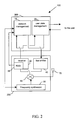
- Figure 2 shows the simplified architecture of an element of a network of the type of that in Figure 1.
- a transmitter-receiver 100 of the network comprises a radio module 200 and a data processing module 300 which contains a user data management module 20 as well as a network management module 10.
- This management module may create a beacon channel and receive the information from the signaling channel, or else it may create the signaling information and receive the beacon channel.
- the radio module contains a frequency synthesizer 50 which is programmable by the network management module 10. This frequency synthesizer, with the aid of a mixer 60, makes it possible to modulate or demodulate the signals coming from
- An antenna 70 provides the interface with the outside.
- the receiver module 30 contains an RSSI (Received Signal Strength Indicator) 35 which sends an indication to the management module 10.
- RSSI Receiveived Signal Strength Indicator
- FIG. 3 shows a possible architecture for the network management module 10.
- a clock 370 makes it possible to have a time base and to create time-outs.
- a RAM memory 380 enables a large amount of data to be stored
- a ROM memory 330 enables storage of the program to be executed
- a central processing unit 350 enables the sequential execution to be carried out of a certain number of instructions stored in ROM 330 or in RAM 380.
- a random generator 360 which, as a variant, may be implemented purely in software form, is necessary.
- a radio module interface 340 enables the frequency synthesizer 50 to be driven. There may of course be an interface with other functions 310, whose processing it may be wished to integrate, as well as an interface with the wired or cabled network 320 if the member of the network under consideration is an access point.
- the structure of the network is such that a frame comprises several time windows, it being possible to attribute each window to a member of the network for the transmission of a signal. For each new frame, a given member of the network systematically uses that window until the end of the connection.
- each window network management information as well as user data information are transmitted.
- the entirety of the management information is transmitted over several frames. This group is called a "super frame”.
- the flow chart of Figure 5 shows the succession of operations carried out by a mobile terminal, in accordance with the present invention. Let Nmax be the number of frequencies used by the network and let Tmax be a period greater than the transmission period of a frame.
- the mobile terminal When the user decides to use the wireless network from the mobile terminal which accompanies him, he communicates this intention via the man-machine interface. The mobile terminal then receives this call (step 100).
- the mobile terminal monitors the RSSI signal which gives it information on the energy received at the antenna (test 103). If this energy remains below a predetermined threshold, it is considered that no signal is received.
- the threshold is determined from constraints of the network, such as the admitted useful range and the power at the transmitter as well as the minimum required signal to noise ratio.
- the terminal awaits the following frame (test 104) to demodulate the management channel of the network (step 105) until a complete beacon signal is obtained normally, that is to say a complete super frame (test 106).
- a complete beacon signal is obtained normally, that is to say a complete super frame (test 106).
- the connection-making procedure commences (step 107).
- the index N is incremented by one unit (step 109).
- the mobile terminal returns to step 102 and synthesizes the frequency corresponding to the index N +1.
- step 111 If the number N is greater than the number Nmax (test 110 positive), it is considered that the terminal has explored the whole time-frequency domain and has not found any pre-existing network there. It must then create this network. To do this, it transmits (step 111) a beacon signal in a time window and at a frequency of its choice, and waits for a connection to be established (step 112).
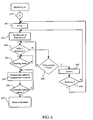
- the flow chart of Figure 6 shows the succession of operations carried out by an access point belonging to the potential network.
- the access point monitors the RSSI signal which gives it information on the energy received at the antenna (test 203). If this energy remains below a predetermined threshold, it is considered that no signal is received.
- the access point awaits the following frame (test 204) to demodulate the management channel of the network (step 205) until a complete beacon signal is obtained normally, that is to say a complete super frame (test 206). When this is obtained, a conventional connection-making procedure is commenced (step 207).
- the index N is incremented by one unit (step 209).
- the access point returns to step 202 and synthesizes the frequency corresponding to the index N + 1.
- the access point If the number N is greater than the number Nmax (test 210 positive), the access point returns to waiting for a beacon signal starting from step 201.
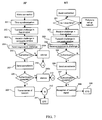
- the flow chart of Figure 7 shows the actual creation of the network, that is to say the first connection between access point and terminal.
- the steps corresponding to the access point (denoted AP in the drawing) are placed opposite those corresponding to the mobile terminal (denoted MT in the drawing).
- a time synchronization step 301 is carried out.
- the beacon channel indicates the frequency-time windows domain, and so the access point knows, after complete reception of a super frame, in which window and at which frequency the terminal will be listening.
- the access point transmits, in any one of the time windows, the fact that the terminal is listening (step 302).
- the mobile terminal carries out a test 351 which makes it possible to indicate the failure of the commencement of the network if for example no access point that is on has been detected after a period "max time".
- the transmission made by the access point at step 302 contains a specific so-called "challenge" message. It is a random number destined to be encoded with the use of a private key algorithm. Let there be two entities A and B wishing to authenticate each other. The entities A and B both know the same key and will use the same encryption algorithm. A sends a random number to B. A and B carry out a predefined calculation with this random number as operand. Next, B sends A the result of its calculation. A then compares this result with its own result and if the two are identical, A has authenticated B.
- This challenge is received at step 352 by the mobile terminal, which transmits the response to the challenge within the conjugate time window (or slot), followed by a new challenge.
- each communication between A and B uses a slot for the transmission from A to B and a slot for the transmission from B to A, and that these two slots are said to be conjugates of each other.
- This message is received by the access point at step 303.
- the mobile terminal sends the access point a message with the response to the challenge sent out by the access point as well as a challenge which it has created.
- the access point sends a message back to the mobile terminal with the response to the challenge sent out by the mobile terminal.
- the mobile terminal receives this response at step 354.
- the procedure has been simplified and account has not been taken of possible re-transmissions in case of error, the correct transmission of the data being ensured by the person skilled in the art knowing these methods.
- the access point having sent out a challenge and received a response, can authenticate the mobile terminal at step 306. If the authentication fails, the access point ceases all transmission at step 305a and remains silent, then resumes the process from the connector A 212, that is to say at step 201 of Figure 6.
- the access point sends a message to the mobile terminal to inform it of this (step 307), then awaits the confirmation of its own authentication by the mobile terminal (step 308). If this confirmation is not received, as previously, the access point becomes silent (step 305b) then resumes the process in A (212), that is to say at step 201 of Figure 6.
- the access point undertakes the transmission of the beacon signal.
- the verification of whether or not the access point belongs to the network is established at an authentication step 355.
- the process resumes at 351.
- the mobile terminal sends the access point a message of acceptance (step 356) and awaits confirmation of its own authentication by the access point (test 357). If this confirmation is not obtained, the process resumes at test 351.
- the mobile terminal stops transmitting the beacon signal, transmits that for signaling and receives the new beacon signal (step 358).
- the method then continues in conventional manner, as is summarized on the drawing by "ETC.” (step 359).
- the flow chart of Figure 8 shows the end of the temporary network.
- the access point continues to transmit a beacon signal for a predetermined time (step 401), in order permit the possibility of a terminal establishing a new connection.
- test 402 If a new connection is detected (test 402), the temporary network continues its existence in conventional manner, that is to say that connector B 312 of Figure 7 is proceeded to.
- the beacon signal is no longer transmitted (step 405) and the access point proceeds to the connector A 212, that is to say at step 201 of Figure 6.
- the mobile terminal it is deactivated or reactivated by the user.
Landscapes
- Engineering & Computer Science (AREA)
- Computer Security & Cryptography (AREA)
- Computer Networks & Wireless Communication (AREA)
- Signal Processing (AREA)
- Mobile Radio Communication Systems (AREA)
- Communication Control (AREA)
Applications Claiming Priority (2)
| Application Number | Priority Date | Filing Date | Title |
|---|---|---|---|
| FR0200175 | 2002-01-08 | ||
| FR0200175A FR2834595A1 (fr) | 2002-01-08 | 2002-01-08 | Procede de communication dans un reseau |
Publications (2)
| Publication Number | Publication Date |
|---|---|
| EP1326466A1 true EP1326466A1 (fr) | 2003-07-09 |
| EP1326466B1 EP1326466B1 (fr) | 2009-09-09 |
Family
ID=8871199
Family Applications (1)
| Application Number | Title | Priority Date | Filing Date |
|---|---|---|---|
| EP02293254A Expired - Lifetime EP1326466B1 (fr) | 2002-01-08 | 2002-12-27 | Procédé de communication dans un réseau |
Country Status (5)
| Country | Link |
|---|---|
| US (1) | US7684785B2 (fr) |
| EP (1) | EP1326466B1 (fr) |
| JP (1) | JP3559786B2 (fr) |
| DE (1) | DE60233631D1 (fr) |
| FR (1) | FR2834595A1 (fr) |
Cited By (1)
| Publication number | Priority date | Publication date | Assignee | Title |
|---|---|---|---|---|
| WO2011073516A1 (fr) * | 2009-12-16 | 2011-06-23 | Nokia Corporation | Système, procédé et appareil permettant d'effectuer une recherche fiable de réseau, de capacité et de service |
Families Citing this family (14)
| Publication number | Priority date | Publication date | Assignee | Title |
|---|---|---|---|---|
| US7099627B2 (en) * | 2003-06-11 | 2006-08-29 | Acco Brands Usa Llc | Systems and methods for a wireless network connection point locator |
| US20050054327A1 (en) * | 2003-09-04 | 2005-03-10 | David Johnston | System and associated methods to determine authentication priority between devices |
| WO2005031988A2 (fr) * | 2003-09-23 | 2005-04-07 | Acco Brands, Inc. | Analyseur de reseau sans fil portatif |
| KR20050051050A (ko) * | 2003-11-26 | 2005-06-01 | 삼성전자주식회사 | 무선 랜 사용 가능 지역을 알리는 송수신 장치 및 그 방법 |
| US7738877B2 (en) * | 2004-07-19 | 2010-06-15 | Cisco Technology, Inc. | Wireless network management with antenna control |
| US7263079B2 (en) * | 2004-07-30 | 2007-08-28 | Microsoft Corporation | System and methods for joining the correct wireless network |
| WO2007127312A2 (fr) * | 2006-04-25 | 2007-11-08 | Interdigital Technology Corporation | Fonctionnement de canal a haut debit dans un reseau sans fil de zone locale maille |
| FR2906428A1 (fr) * | 2006-09-26 | 2008-03-28 | Canon Kk | Procede, dispositif et application logicielle pour la transmission de paquets de donnees dands un systeme de communication. |
| US20080240146A1 (en) * | 2007-03-27 | 2008-10-02 | Harkirat Singh | System and method for wireless communication of uncompressed video having data transmission on a secondary low rate channel |
| US8150372B2 (en) * | 2007-09-28 | 2012-04-03 | Symbol Technologies, Inc. | Method and system for distributing data within a group of mobile units |
| JP5112229B2 (ja) * | 2008-09-05 | 2013-01-09 | 株式会社エヌ・ティ・ティ・ドコモ | 配信装置、端末装置及びシステム並びに方法 |
| CN103533512A (zh) * | 2013-09-17 | 2014-01-22 | 英华达(上海)科技有限公司 | 一种配置设备加入网络群组的方法、装置及系统 |
| JP6355425B2 (ja) * | 2014-05-20 | 2018-07-11 | キヤノン株式会社 | システムおよびその制御方法 |
| CN104333890A (zh) * | 2014-10-17 | 2015-02-04 | 小米科技有限责任公司 | 信号传输的控制方法及装置、电子设备 |
Citations (4)
| Publication number | Priority date | Publication date | Assignee | Title |
|---|---|---|---|---|
| EP0490441A2 (fr) * | 1990-12-14 | 1992-06-17 | Philips Electronics Uk Limited | Procédé pour exploiter un système de communications, système de communications et station secondaire pour utilisation dans le système |
| WO1995031080A1 (fr) * | 1994-05-06 | 1995-11-16 | Motorola, Inc. | Procede pour etablir une liaison de telecommunications |
| WO2001093619A1 (fr) * | 2000-05-31 | 2001-12-06 | Telefonaktiebolaget Lm Ericsson | Procede et dispositif de selection d'une unite d'acces par radio dans un systeme de radio communications |
| FR2809897A1 (fr) * | 2000-05-31 | 2001-12-07 | Gemplus Card Int | Procede de communication securisee entre un reseau et une carte a puce d'un terminal |
Family Cites Families (7)
| Publication number | Priority date | Publication date | Assignee | Title |
|---|---|---|---|---|
| US5835061A (en) * | 1995-06-06 | 1998-11-10 | Wayport, Inc. | Method and apparatus for geographic-based communications service |
| US6961762B1 (en) * | 2000-02-14 | 2005-11-01 | Sygate Technologies, Inc. | Automatic switching network points based on configuration profiles |
| US20020022483A1 (en) * | 2000-04-18 | 2002-02-21 | Wayport, Inc. | Distributed network communication system which allows multiple wireless service providers to share a common network infrastructure |
| US6618584B1 (en) * | 2000-08-30 | 2003-09-09 | Telefonaktiebolaget Lm Ericsson (Publ) | Terminal authentication procedure timing for data calls |
| US7330472B2 (en) * | 2001-10-26 | 2008-02-12 | Sharp Laboratories Of America, Inc. | System and method for hybrid coordination in a wireless LAN |
| US7286671B2 (en) * | 2001-11-09 | 2007-10-23 | Ntt Docomo Inc. | Secure network access method |
| US20030125057A1 (en) * | 2001-12-27 | 2003-07-03 | Pesola Troy Raymond | System and method for automatic synchronization of managed data |
-
2002
- 2002-01-08 FR FR0200175A patent/FR2834595A1/fr not_active Withdrawn
- 2002-12-27 EP EP02293254A patent/EP1326466B1/fr not_active Expired - Lifetime
- 2002-12-27 DE DE60233631T patent/DE60233631D1/de not_active Expired - Lifetime
- 2002-12-31 US US10/331,477 patent/US7684785B2/en not_active Expired - Fee Related
-
2003
- 2003-01-08 JP JP2003002422A patent/JP3559786B2/ja not_active Expired - Fee Related
Patent Citations (4)
| Publication number | Priority date | Publication date | Assignee | Title |
|---|---|---|---|---|
| EP0490441A2 (fr) * | 1990-12-14 | 1992-06-17 | Philips Electronics Uk Limited | Procédé pour exploiter un système de communications, système de communications et station secondaire pour utilisation dans le système |
| WO1995031080A1 (fr) * | 1994-05-06 | 1995-11-16 | Motorola, Inc. | Procede pour etablir une liaison de telecommunications |
| WO2001093619A1 (fr) * | 2000-05-31 | 2001-12-06 | Telefonaktiebolaget Lm Ericsson | Procede et dispositif de selection d'une unite d'acces par radio dans un systeme de radio communications |
| FR2809897A1 (fr) * | 2000-05-31 | 2001-12-07 | Gemplus Card Int | Procede de communication securisee entre un reseau et une carte a puce d'un terminal |
Cited By (2)
| Publication number | Priority date | Publication date | Assignee | Title |
|---|---|---|---|---|
| WO2011073516A1 (fr) * | 2009-12-16 | 2011-06-23 | Nokia Corporation | Système, procédé et appareil permettant d'effectuer une recherche fiable de réseau, de capacité et de service |
| US9548977B2 (en) | 2009-12-16 | 2017-01-17 | Nokia Technologies Oy | System, method, and apparatus for performing reliable network, capability, and service discovery |
Also Published As
| Publication number | Publication date |
|---|---|
| US20030129966A1 (en) | 2003-07-10 |
| US7684785B2 (en) | 2010-03-23 |
| DE60233631D1 (de) | 2009-10-22 |
| JP2003218983A (ja) | 2003-07-31 |
| FR2834595A1 (fr) | 2003-07-11 |
| EP1326466B1 (fr) | 2009-09-09 |
| JP3559786B2 (ja) | 2004-09-02 |
Similar Documents
| Publication | Publication Date | Title |
|---|---|---|
| US7684785B2 (en) | Method of communication in a network | |
| AU715234B2 (en) | Checking the presence of mobile stations communicating on a direct mode channel | |
| US5103445A (en) | Method of adapting a mobile radio communication system to traffic and performance requirements | |
| US7729693B2 (en) | Method of controlling and analyzing communications in a telephone network | |
| EP1326386A1 (fr) | Procédé et dispositif de communication dans un réseau | |
| CN109150336B (zh) | 创建Zigbee网络的方法及装置 | |
| JPH02260719A (ja) | 無線システムのチャネル選択方法 | |
| US20040166897A1 (en) | Wireless base station, control method for the same, program for implementing the method | |
| JP2531254B2 (ja) | 分散無線システムの回線接続方法 | |
| US6119002A (en) | Mobile station having methods and apparatus for performing neighbor channel measurements from analog control channel | |
| EP0583073B1 (fr) | Système de téléphone sans fil | |
| KR20100108496A (ko) | 인지 무선 시스템에서의 채널 선택 장치 및 방법 | |
| CN112929056A (zh) | 一种载波通信模块智能检测方法及系统 | |
| US6061569A (en) | Free channel double checking protocol and systems | |
| KR101150668B1 (ko) | 주파수 호핑 시스템에서 이용하기 위한 장치 및 방법, 주파수 호핑 시스템, 회로 및 컴퓨터 판독가능 저장 매체 | |
| MXPA02002820A (es) | Proceso para asociar un aparato en una red de comunicacion. | |
| JP2947278B1 (ja) | Tdma−tdd移動通信システムの制御チャネルキャリアセンス方法 | |
| JPS60256250A (ja) | ブロ−ドバンドチヤンネル争奪方式 | |
| US6337982B2 (en) | Cordless telephony device having a scanning element to analyze a frame requesting a connection | |
| JP3221992B2 (ja) | ディジタル無線電話装置 | |
| EP4665040A1 (fr) | Procédé et appareil d'entraînement de faisceau de liaison latérale | |
| CN114080855B (zh) | 通信方法、装置、接入网设备和存储介质 | |
| JPH10164655A (ja) | 基地局と少なくとも1つの移動ユニットとからなる通信装置及び移動ユニットを基地局へ接続する方法 | |
| CN110830976B (zh) | 一种通信连接建立方法及装置 | |
| CN121284705A (zh) | 一种测距方法 |
Legal Events
| Date | Code | Title | Description |
|---|---|---|---|
| PUAI | Public reference made under article 153(3) epc to a published international application that has entered the european phase |
Free format text: ORIGINAL CODE: 0009012 |
|
| AK | Designated contracting states |
Designated state(s): AT BE BG CH CY CZ DE DK EE ES FI FR GB GR IE IT LI LU MC NL PT SE SI SK TR |
|
| AX | Request for extension of the european patent |
Extension state: AL LT LV MK RO |
|
| 17P | Request for examination filed |
Effective date: 20031201 |
|
| AKX | Designation fees paid |
Designated state(s): DE FI FR GB SE |
|
| 17Q | First examination report despatched |
Effective date: 20061229 |
|
| RIC1 | Information provided on ipc code assigned before grant |
Ipc: H04W 48/12 20090101AFI20090211BHEP |
|
| GRAP | Despatch of communication of intention to grant a patent |
Free format text: ORIGINAL CODE: EPIDOSNIGR1 |
|
| GRAS | Grant fee paid |
Free format text: ORIGINAL CODE: EPIDOSNIGR3 |
|
| GRAA | (expected) grant |
Free format text: ORIGINAL CODE: 0009210 |
|
| AK | Designated contracting states |
Kind code of ref document: B1 Designated state(s): DE FI FR GB SE |
|
| REG | Reference to a national code |
Ref country code: GB Ref legal event code: FG4D |
|
| REF | Corresponds to: |
Ref document number: 60233631 Country of ref document: DE Date of ref document: 20091022 Kind code of ref document: P |
|
| REG | Reference to a national code |
Ref country code: SE Ref legal event code: TRGR |
|
| PLBE | No opposition filed within time limit |
Free format text: ORIGINAL CODE: 0009261 |
|
| STAA | Information on the status of an ep patent application or granted ep patent |
Free format text: STATUS: NO OPPOSITION FILED WITHIN TIME LIMIT |
|
| 26N | No opposition filed |
Effective date: 20100610 |
|
| PGFP | Annual fee paid to national office [announced via postgrant information from national office to epo] |
Ref country code: FI Payment date: 20121203 Year of fee payment: 11 |
|
| PGFP | Annual fee paid to national office [announced via postgrant information from national office to epo] |
Ref country code: SE Payment date: 20121109 Year of fee payment: 11 |
|
| PGFP | Annual fee paid to national office [announced via postgrant information from national office to epo] |
Ref country code: FR Payment date: 20130118 Year of fee payment: 11 |
|
| REG | Reference to a national code |
Ref country code: SE Ref legal event code: EUG |
|
| PG25 | Lapsed in a contracting state [announced via postgrant information from national office to epo] |
Ref country code: SE Free format text: LAPSE BECAUSE OF NON-PAYMENT OF DUE FEES Effective date: 20131228 Ref country code: FI Free format text: LAPSE BECAUSE OF NON-PAYMENT OF DUE FEES Effective date: 20131227 |
|
| REG | Reference to a national code |
Ref country code: FR Ref legal event code: ST Effective date: 20140829 |
|
| PG25 | Lapsed in a contracting state [announced via postgrant information from national office to epo] |
Ref country code: FR Free format text: LAPSE BECAUSE OF NON-PAYMENT OF DUE FEES Effective date: 20131231 |
|
| PGFP | Annual fee paid to national office [announced via postgrant information from national office to epo] |
Ref country code: GB Payment date: 20161230 Year of fee payment: 15 |
|
| PGFP | Annual fee paid to national office [announced via postgrant information from national office to epo] |
Ref country code: DE Payment date: 20161231 Year of fee payment: 15 |
|
| REG | Reference to a national code |
Ref country code: DE Ref legal event code: R119 Ref document number: 60233631 Country of ref document: DE |
|
| GBPC | Gb: european patent ceased through non-payment of renewal fee |
Effective date: 20171227 |
|
| PG25 | Lapsed in a contracting state [announced via postgrant information from national office to epo] |
Ref country code: DE Free format text: LAPSE BECAUSE OF NON-PAYMENT OF DUE FEES Effective date: 20180703 |
|
| PG25 | Lapsed in a contracting state [announced via postgrant information from national office to epo] |
Ref country code: GB Free format text: LAPSE BECAUSE OF NON-PAYMENT OF DUE FEES Effective date: 20171227 |