EP1327874A2 - Formulierung für einen Sensor zum Nachweis einer Gaszusammensetzung und zugehörige Herstellungsmethode - Google Patents
Formulierung für einen Sensor zum Nachweis einer Gaszusammensetzung und zugehörige Herstellungsmethode Download PDFInfo
- Publication number
- EP1327874A2 EP1327874A2 EP03000370A EP03000370A EP1327874A2 EP 1327874 A2 EP1327874 A2 EP 1327874A2 EP 03000370 A EP03000370 A EP 03000370A EP 03000370 A EP03000370 A EP 03000370A EP 1327874 A2 EP1327874 A2 EP 1327874A2
- Authority
- EP
- European Patent Office
- Prior art keywords
- fluorophore
- silica powder
- sensor
- dye
- acid
- Prior art date
- Legal status (The legal status is an assumption and is not a legal conclusion. Google has not performed a legal analysis and makes no representation as to the accuracy of the status listed.)
- Granted
Links
- 239000000203 mixture Substances 0.000 title claims abstract description 92
- 238000009472 formulation Methods 0.000 title claims abstract description 46
- 238000000034 method Methods 0.000 title claims description 29
- 238000001514 detection method Methods 0.000 title description 6
- CURLTUGMZLYLDI-UHFFFAOYSA-N Carbon dioxide Chemical compound O=C=O CURLTUGMZLYLDI-UHFFFAOYSA-N 0.000 claims abstract description 62
- 239000007789 gas Substances 0.000 claims abstract description 45
- 229910002092 carbon dioxide Inorganic materials 0.000 claims abstract description 44
- 244000005700 microbiome Species 0.000 claims abstract description 43
- QVGXLLKOCUKJST-UHFFFAOYSA-N atomic oxygen Chemical compound [O] QVGXLLKOCUKJST-UHFFFAOYSA-N 0.000 claims abstract description 35
- 239000001301 oxygen Substances 0.000 claims abstract description 35
- 229910052760 oxygen Inorganic materials 0.000 claims abstract description 35
- 238000012544 monitoring process Methods 0.000 claims abstract description 33
- 239000001569 carbon dioxide Substances 0.000 claims abstract description 18
- VYPSYNLAJGMNEJ-UHFFFAOYSA-N Silicium dioxide Chemical compound O=[Si]=O VYPSYNLAJGMNEJ-UHFFFAOYSA-N 0.000 claims description 74
- 239000000377 silicon dioxide Substances 0.000 claims description 37
- 239000000975 dye Substances 0.000 claims description 35
- 239000000843 powder Substances 0.000 claims description 26
- 239000011159 matrix material Substances 0.000 claims description 18
- 239000002696 acid base indicator Substances 0.000 claims description 16
- 239000003054 catalyst Substances 0.000 claims description 8
- 239000003112 inhibitor Substances 0.000 claims description 7
- 230000004044 response Effects 0.000 claims description 6
- OBRMNDMBJQTZHV-UHFFFAOYSA-N cresol red Chemical group C1=C(O)C(C)=CC(C2(C3=CC=CC=C3S(=O)(=O)O2)C=2C=C(C)C(O)=CC=2)=C1 OBRMNDMBJQTZHV-UHFFFAOYSA-N 0.000 claims description 5
- 229920000642 polymer Polymers 0.000 claims description 5
- 239000004971 Cross linker Substances 0.000 claims description 4
- 230000000694 effects Effects 0.000 claims description 4
- 230000004060 metabolic process Effects 0.000 claims description 4
- BASFCYQUMIYNBI-UHFFFAOYSA-N platinum Chemical group [Pt] BASFCYQUMIYNBI-UHFFFAOYSA-N 0.000 claims description 4
- XMBWDFGMSWQBCA-UHFFFAOYSA-N hydrogen iodide Chemical compound I XMBWDFGMSWQBCA-UHFFFAOYSA-N 0.000 claims description 3
- YHOBKUYNQOIGKG-UHFFFAOYSA-L dichlororuthenium;hydrate Chemical compound O.Cl[Ru]Cl YHOBKUYNQOIGKG-UHFFFAOYSA-L 0.000 claims description 2
- 229910052697 platinum Inorganic materials 0.000 claims description 2
- 239000008187 granular material Substances 0.000 claims 9
- 239000011248 coating agent Substances 0.000 claims 4
- 238000000576 coating method Methods 0.000 claims 4
- 239000004615 ingredient Substances 0.000 claims 2
- VUJZDACPHNGGJQ-UHFFFAOYSA-K 4,7-diphenyl-1,10-phenanthroline trichlororuthenium pentahydrate Chemical group O.O.O.O.O.[Ru](Cl)(Cl)Cl.C1(=CC=CC=C1)C1=CC=NC2=C3N=CC=C(C3=CC=C12)C1=CC=CC=C1.C1(=CC=CC=C1)C1=CC=NC2=C3N=CC=C(C3=CC=C12)C1=CC=CC=C1.C1(=CC=CC=C1)C1=CC=NC2=C3N=CC=C(C3=CC=C12)C1=CC=CC=C1 VUJZDACPHNGGJQ-UHFFFAOYSA-K 0.000 claims 1
- 238000006116 polymerization reaction Methods 0.000 claims 1
- 239000001044 red dye Substances 0.000 claims 1
- 230000002503 metabolic effect Effects 0.000 abstract description 14
- 238000004519 manufacturing process Methods 0.000 abstract description 5
- 238000012360 testing method Methods 0.000 description 17
- 230000008859 change Effects 0.000 description 9
- 150000001875 compounds Chemical class 0.000 description 9
- IJGRMHOSHXDMSA-UHFFFAOYSA-N Atomic nitrogen Chemical compound N#N IJGRMHOSHXDMSA-UHFFFAOYSA-N 0.000 description 8
- 230000003377 anti-microbal effect Effects 0.000 description 8
- 230000003287 optical effect Effects 0.000 description 7
- GWEVSGVZZGPLCZ-UHFFFAOYSA-N Titan oxide Chemical compound O=[Ti]=O GWEVSGVZZGPLCZ-UHFFFAOYSA-N 0.000 description 5
- 238000004458 analytical method Methods 0.000 description 5
- 239000000463 material Substances 0.000 description 5
- 239000000243 solution Substances 0.000 description 5
- 238000011534 incubation Methods 0.000 description 4
- 238000005259 measurement Methods 0.000 description 4
- 230000000813 microbial effect Effects 0.000 description 4
- 229910052757 nitrogen Inorganic materials 0.000 description 4
- 238000001228 spectrum Methods 0.000 description 4
- SEQKRHFRPICQDD-UHFFFAOYSA-N N-tris(hydroxymethyl)methylglycine Chemical compound OCC(CO)(CO)[NH2+]CC([O-])=O SEQKRHFRPICQDD-UHFFFAOYSA-N 0.000 description 3
- HEMHJVSKTPXQMS-UHFFFAOYSA-M Sodium hydroxide Chemical compound [OH-].[Na+] HEMHJVSKTPXQMS-UHFFFAOYSA-M 0.000 description 3
- 238000000862 absorption spectrum Methods 0.000 description 3
- 239000003242 anti bacterial agent Substances 0.000 description 3
- 229940088710 antibiotic agent Drugs 0.000 description 3
- 239000012528 membrane Substances 0.000 description 3
- 230000036284 oxygen consumption Effects 0.000 description 3
- -1 polydimethylsiloxane Polymers 0.000 description 3
- 239000012085 test solution Substances 0.000 description 3
- 102000004190 Enzymes Human genes 0.000 description 2
- 108090000790 Enzymes Proteins 0.000 description 2
- LFQSCWFLJHTTHZ-UHFFFAOYSA-N Ethanol Chemical compound CCO LFQSCWFLJHTTHZ-UHFFFAOYSA-N 0.000 description 2
- XUIMIQQOPSSXEZ-UHFFFAOYSA-N Silicon Chemical compound [Si] XUIMIQQOPSSXEZ-UHFFFAOYSA-N 0.000 description 2
- 239000007983 Tris buffer Substances 0.000 description 2
- 238000013459 approach Methods 0.000 description 2
- 239000003153 chemical reaction reagent Substances 0.000 description 2
- 229920001577 copolymer Polymers 0.000 description 2
- 239000008367 deionised water Substances 0.000 description 2
- 229910021641 deionized water Inorganic materials 0.000 description 2
- 230000001066 destructive effect Effects 0.000 description 2
- 239000004205 dimethyl polysiloxane Substances 0.000 description 2
- 239000000835 fiber Substances 0.000 description 2
- 239000011521 glass Substances 0.000 description 2
- 239000007788 liquid Substances 0.000 description 2
- 238000012986 modification Methods 0.000 description 2
- 230000004048 modification Effects 0.000 description 2
- 230000017066 negative regulation of growth Effects 0.000 description 2
- 229920000435 poly(dimethylsiloxane) Polymers 0.000 description 2
- 229910052710 silicon Inorganic materials 0.000 description 2
- 239000010703 silicon Substances 0.000 description 2
- 239000007787 solid Substances 0.000 description 2
- 239000000126 substance Substances 0.000 description 2
- 125000000391 vinyl group Chemical group [H]C([*])=C([H])[H] 0.000 description 2
- 229920002554 vinyl polymer Polymers 0.000 description 2
- XLYOFNOQVPJJNP-UHFFFAOYSA-N water Chemical compound O XLYOFNOQVPJJNP-UHFFFAOYSA-N 0.000 description 2
- PKDBCJSWQUOKDO-UHFFFAOYSA-M 2,3,5-triphenyltetrazolium chloride Chemical compound [Cl-].C1=CC=CC=C1C(N=[N+]1C=2C=CC=CC=2)=NN1C1=CC=CC=C1 PKDBCJSWQUOKDO-UHFFFAOYSA-M 0.000 description 1
- 229910002012 Aerosil® Inorganic materials 0.000 description 1
- OKTJSMMVPCPJKN-UHFFFAOYSA-N Carbon Chemical compound [C] OKTJSMMVPCPJKN-UHFFFAOYSA-N 0.000 description 1
- 102000001554 Hemoglobins Human genes 0.000 description 1
- 108010054147 Hemoglobins Proteins 0.000 description 1
- COMRCFFJRJWQFI-UHFFFAOYSA-K O.O.O.O.O.Cl[Ru](Cl)Cl.C1=CC=CC=C1C1=CC=NC2=C1C=CC1=C(C=3C=CC=CC=3)C=CN=C21 Chemical compound O.O.O.O.O.Cl[Ru](Cl)Cl.C1=CC=CC=C1C1=CC=NC2=C1C=CC1=C(C=3C=CC=CC=3)C=CN=C21 COMRCFFJRJWQFI-UHFFFAOYSA-K 0.000 description 1
- PLXBWHJQWKZRKG-UHFFFAOYSA-N Resazurin Chemical compound C1=CC(=O)C=C2OC3=CC(O)=CC=C3[N+]([O-])=C21 PLXBWHJQWKZRKG-UHFFFAOYSA-N 0.000 description 1
- UZMAPBJVXOGOFT-UHFFFAOYSA-N Syringetin Natural products COC1=C(O)C(OC)=CC(C2=C(C(=O)C3=C(O)C=C(O)C=C3O2)O)=C1 UZMAPBJVXOGOFT-UHFFFAOYSA-N 0.000 description 1
- 239000007997 Tricine buffer Substances 0.000 description 1
- 230000003466 anti-cipated effect Effects 0.000 description 1
- 238000000149 argon plasma sintering Methods 0.000 description 1
- 230000001580 bacterial effect Effects 0.000 description 1
- 229920005601 base polymer Polymers 0.000 description 1
- 230000009286 beneficial effect Effects 0.000 description 1
- 230000008901 benefit Effects 0.000 description 1
- 230000003115 biocidal effect Effects 0.000 description 1
- 230000005540 biological transmission Effects 0.000 description 1
- 230000015572 biosynthetic process Effects 0.000 description 1
- 238000002815 broth microdilution Methods 0.000 description 1
- 229920005549 butyl rubber Polymers 0.000 description 1
- 239000000470 constituent Substances 0.000 description 1
- 238000004132 cross linking Methods 0.000 description 1
- KCFYHBSOLOXZIF-UHFFFAOYSA-N dihydrochrysin Natural products COC1=C(O)C(OC)=CC(C2OC3=CC(O)=CC(O)=C3C(=O)C2)=C1 KCFYHBSOLOXZIF-UHFFFAOYSA-N 0.000 description 1
- 201000010099 disease Diseases 0.000 description 1
- 208000037265 diseases, disorders, signs and symptoms Diseases 0.000 description 1
- 239000003814 drug Substances 0.000 description 1
- 229940079593 drug Drugs 0.000 description 1
- 239000000890 drug combination Substances 0.000 description 1
- 238000007877 drug screening Methods 0.000 description 1
- 229920001971 elastomer Polymers 0.000 description 1
- 239000000839 emulsion Substances 0.000 description 1
- 238000011156 evaluation Methods 0.000 description 1
- 238000002474 experimental method Methods 0.000 description 1
- 238000001917 fluorescence detection Methods 0.000 description 1
- 239000003365 glass fiber Substances 0.000 description 1
- 238000013007 heat curing Methods 0.000 description 1
- 235000019534 high fructose corn syrup Nutrition 0.000 description 1
- 230000002401 inhibitory effect Effects 0.000 description 1
- 230000002452 interceptive effect Effects 0.000 description 1
- 239000003550 marker Substances 0.000 description 1
- 230000007246 mechanism Effects 0.000 description 1
- 238000009629 microbiological culture Methods 0.000 description 1
- 230000003278 mimic effect Effects 0.000 description 1
- 238000001139 pH measurement Methods 0.000 description 1
- 229920003023 plastic Polymers 0.000 description 1
- 239000004033 plastic Substances 0.000 description 1
- 230000008569 process Effects 0.000 description 1
- 238000010791 quenching Methods 0.000 description 1
- 229910052707 ruthenium Inorganic materials 0.000 description 1
- PKFZNOZRJYLKGV-UHFFFAOYSA-L ruthenium(2+);dichloride;pentahydrate Chemical compound O.O.O.O.O.Cl[Ru]Cl PKFZNOZRJYLKGV-UHFFFAOYSA-L 0.000 description 1
- 230000035945 sensitivity Effects 0.000 description 1
- 238000005507 spraying Methods 0.000 description 1
- 239000011550 stock solution Substances 0.000 description 1
- 239000000758 substrate Substances 0.000 description 1
- 238000010998 test method Methods 0.000 description 1
- 239000004408 titanium dioxide Substances 0.000 description 1
- LENZDBCJOHFCAS-UHFFFAOYSA-N tris Chemical compound OCC(N)(CO)CO LENZDBCJOHFCAS-UHFFFAOYSA-N 0.000 description 1
- 239000002076 α-tocopherol Substances 0.000 description 1
- GVJHHUAWPYXKBD-IEOSBIPESA-N α-tocopherol Chemical compound OC1=C(C)C(C)=C2O[C@@](CCC[C@H](C)CCC[C@H](C)CCCC(C)C)(C)CCC2=C1C GVJHHUAWPYXKBD-IEOSBIPESA-N 0.000 description 1
- 235000004835 α-tocopherol Nutrition 0.000 description 1
Images
Classifications
-
- G—PHYSICS
- G01—MEASURING; TESTING
- G01N—INVESTIGATING OR ANALYSING MATERIALS BY DETERMINING THEIR CHEMICAL OR PHYSICAL PROPERTIES
- G01N21/00—Investigating or analysing materials by the use of optical means, i.e. using sub-millimetre waves, infrared, visible or ultraviolet light
- G01N21/75—Systems in which material is subjected to a chemical reaction, the progress or the result of the reaction being investigated
- G01N21/77—Systems in which material is subjected to a chemical reaction, the progress or the result of the reaction being investigated by observing the effect on a chemical indicator
-
- G—PHYSICS
- G01—MEASURING; TESTING
- G01N—INVESTIGATING OR ANALYSING MATERIALS BY DETERMINING THEIR CHEMICAL OR PHYSICAL PROPERTIES
- G01N21/00—Investigating or analysing materials by the use of optical means, i.e. using sub-millimetre waves, infrared, visible or ultraviolet light
- G01N21/62—Systems in which the material investigated is excited whereby it emits light or causes a change in wavelength of the incident light
- G01N21/63—Systems in which the material investigated is excited whereby it emits light or causes a change in wavelength of the incident light optically excited
- G01N21/64—Fluorescence; Phosphorescence
- G01N21/6428—Measuring fluorescence of fluorescent products of reactions or of fluorochrome labelled reactive substances, e.g. measuring quenching effects, using measuring "optrodes"
-
- G—PHYSICS
- G01—MEASURING; TESTING
- G01N—INVESTIGATING OR ANALYSING MATERIALS BY DETERMINING THEIR CHEMICAL OR PHYSICAL PROPERTIES
- G01N21/00—Investigating or analysing materials by the use of optical means, i.e. using sub-millimetre waves, infrared, visible or ultraviolet light
- G01N21/75—Systems in which material is subjected to a chemical reaction, the progress or the result of the reaction being investigated
- G01N21/77—Systems in which material is subjected to a chemical reaction, the progress or the result of the reaction being investigated by observing the effect on a chemical indicator
- G01N2021/7769—Measurement method of reaction-produced change in sensor
- G01N2021/7786—Fluorescence
-
- G—PHYSICS
- G01—MEASURING; TESTING
- G01N—INVESTIGATING OR ANALYSING MATERIALS BY DETERMINING THEIR CHEMICAL OR PHYSICAL PROPERTIES
- G01N21/00—Investigating or analysing materials by the use of optical means, i.e. using sub-millimetre waves, infrared, visible or ultraviolet light
- G01N21/75—Systems in which material is subjected to a chemical reaction, the progress or the result of the reaction being investigated
- G01N21/77—Systems in which material is subjected to a chemical reaction, the progress or the result of the reaction being investigated by observing the effect on a chemical indicator
- G01N21/78—Systems in which material is subjected to a chemical reaction, the progress or the result of the reaction being investigated by observing the effect on a chemical indicator producing a change of colour
- G01N21/783—Systems in which material is subjected to a chemical reaction, the progress or the result of the reaction being investigated by observing the effect on a chemical indicator producing a change of colour for analysing gases
-
- G—PHYSICS
- G01—MEASURING; TESTING
- G01N—INVESTIGATING OR ANALYSING MATERIALS BY DETERMINING THEIR CHEMICAL OR PHYSICAL PROPERTIES
- G01N21/00—Investigating or analysing materials by the use of optical means, i.e. using sub-millimetre waves, infrared, visible or ultraviolet light
- G01N21/75—Systems in which material is subjected to a chemical reaction, the progress or the result of the reaction being investigated
- G01N21/77—Systems in which material is subjected to a chemical reaction, the progress or the result of the reaction being investigated by observing the effect on a chemical indicator
- G01N21/78—Systems in which material is subjected to a chemical reaction, the progress or the result of the reaction being investigated by observing the effect on a chemical indicator producing a change of colour
- G01N21/80—Indicating pH value
Definitions
- Microorganisms pervade our environment affecting our lives in both beneficial and harmful ways. For this reason there is an ever increasing requirement to provide a sensitive, effective, speedy mechanism for the detection, identification and study of the presence and metabolic activity of microorganisms.
- Another popular method for antimicrobic susceptibility testing is the broth micro-dilution method, such as the Sceptor RTM.
- Sceptor RTM. System for identification and antimicrobic susceptibility testing of organisms Becton Dickinson Diagnostic Instrumentation Systems, Sparks, Md.
- That system uses a disposable plastic panel having a plurality of low volume cupulas (ca. 0.4 ml per cupula), each containing a different test compound or a different concentration of a test compound dried on the cupula surface.
- the organism to be tested is suspended in the desired testing medium, and aliquots are delivered to the individual cupulas of the test panel.
- the reagent dried on the panel dissolves in the sample, and the system is then incubated overnight (18 to 24 hrs.) to allow sufficient time for the organisms to interact with the reagent and for visible growth to appear.
- the panel is subsequently examined visually for the presence or absence of growth, thereby obtaining information on the susceptibility of the organism undergoing testing. Additional wells aid in identifying the organism.
- this test method like the Bauer-Kirby Disc Method, suffers from the drawback of also requiring a long incubation period.
- One innovation in the field of microorganism monitoring is an apparatus, which utilizes light scattering optical means to determine susceptibility by probing the change in size or number of microorganisms in the presence of various antimicrobic compounds.
- An example of commercial instruments, which utilize this methodology is embodied by the Vitec System (BioMerieux Corp.). At best this system is expected to yield information on antimicrobic susceptibility of microorganisms within 6 hours for many organism and drug combinations. Other combinations can require as long as 18 hours before the antimicrobic susceptibility of the organism can be determined by the Vitech System method.
- Still other approaches have involved monitoring of microbial oxygen consumption by the measurement of pH and/or hemoglobin color change, or by the use of dyes such as triphenyl-tetrazolium chloride and resazurin, that change color in response to the total redox potential of the liquid test medium.
- C. E. Clifton monitored the oxygen consumption of microorganisms over a period of several days using a Warburg flask in 1937. This method measured the change in oxygen concentration in a slow and cumbersome manner.
- Clark electrode an electrochemical device, is also commonly used to measure dissolved oxygen.
- the Clark electrode consumes oxygen during use (thereby reducing the oxygen available to the microorganisms) and the "standard" size electrode is typically used only to measure volumes of 100 mls or greater to prevent the electrode from interfering with the measurements.
- a “miniature” Clark electrode has been described, but this electrode is a complicated multi-component part, which, like the larger electrode, must be in contact with the solution being measured. While an oxygen permeable membrane can be used to prevent the electrode components of the device from interacting with the constituents of the test solution, the oxygen must still equilibrate between the test solution and the measurement system and is consumed once it passes the membrane.
- Optical systems which can yield oxygen concentration data, have been developed to overcome the shortcomings of the Clark electrode systems.
- the main advantage of such optical methods is that the instrumentation required to determine quantitative value does not itself make physical contact with the test solution.
- Optical techniques allowing both colorimetric and fluorometric analyses for oxygen to be carried out rapidly and reproducibly are known, and costs for such analyses are often quite low.
- luminescent techniques for the determination of oxygen have been described which are based on the ability of oxygen to quench the fluorescence or phosphorescence emissions of a variety of compounds.
- luminescent techniques for the determination of oxygen have been described which are based on the ability of oxygen to quench the fluorescence or phosphorescence emissions of a variety of compounds.
- such methods have not been readily adapted to microbial monitoring.
- such systems like the Clarke Electrode system are limited to monitoring only the consumption of dissolved oxygen by microorganisms.
- U.S. Patent No. 4,152,213 discloses a system for analysis by monitoring the vacuum produced by growing organisms in a closed head space above a test sample.
- U.S. Patent No. 4,116,775 to Charles et. al is an example of the use of optical means based on the increase in turbidity or optical density of a growing microbial culture for the detection and monitoring of bacterial growth.
- Clarke Electrode systems these systems are designed to provide data limited to oxygen consumption.
- U.S. Patent 5,629,533 issued to Ackley et al. is exemplary of optical sensors, which have been developed for monitoring carbon dioxide levels on a continuous basis. Such sensors involve the use of glass fiber optics in combination with a sol-gel sensor element, which contains a chemical indicator sensitive to the presence of carbon dioxide.
- This system encompasses a grooved substrate with a sol-gel material having a chemical indicator adhered within the grooves. Fiber optic cables are coupled to the grooves and as light is passed through the fiber optic cables, the transmission is affected by the sol-gel sensor element.
- testing methods as exemplified above have improved in recent years to provide faster more accurate means of detecting the growth and metabolic activity of microorganisms
- it is a common shortcoming of such testing methods that none of the innovations have provided a biological sensor that is capable of simultaneously detecting growth of both aneroboc and aerobic microorganisms in a sample.
- This limitation in commonly used monitoring systems exists because such systems typically allow only one gas component to be detected in one sensor unit.
- Gas composition monitoring systems which can be used to detect metabolic activity of microorganisms are limited to monitoring either oxygen or carbon dioxide.
- Carbon dioxide sensors can use an acid-base indicator chromophore to modulate the signal output of a fluorophore.
- the chromophore absorbance spectrum changes when the pH value of a measured sample changes.
- the system is able to determine the carbon dioxide level because the pH value of a measured sample depends upon the carbon dioxide level of the sample environment.
- a monitoring system which determines metabolic activity of microorgansims by employing an oxygen sensor, can employ an oxygen sensitive fluorophore to detect the oxygen level changes in a sample environment.
- the combination of the ability to monitor both carbon dioxide and oxygen levels in a gas composition simultaneously was frustrated by the overwhelming problem of cross-talk between the system sensors.
- the present invention addresses this problem by providing a sensor formulation and system that can respond independently and simultaneously to oxygen and carbon dioxide.
- the present invention includes the use of a novel fluorescence detection system wherein fluorescing sensor compounds are employed to measurably respond individually and simultaneously to the level of oxygen and the level of carbon dioxide associated with the metabolic activity of a microorganism with minimal or no cross-talk between the different sensor compounds.
- the fluorescence system of the present invention can be employed with a modified commercially available fluorescence reading device, such as, but not limited to a breadboard configured from a BD 9050 instrument.
- the modified florescence reading device can be so modified as to have at least two sensors, each sensor being separately matched to the wavelength of a corresponding fluorophore dye.
- modified fluorescence reading instrument can be the commercially available BD 9050 device that has been modified to have two sensors matched to the respective wavelengths (sensitivity) of two corresponding fluorophore dyes; one of the fluorophore dyes being included in the formulation of the present invention for the purpose of reacting to oxygen levels in the sample being studied and the second fluorophore dye being included in the formulation for the purpose of reacting to the carbon dioxide levels of the sample being tested. It is within the concept of the present invention that, if it is desired to measure additional gases in a gas composition, additional distinct fluorophore dyes corresponding to additional sensors for the additional gases to be monitored can be employed. The additional sensors can be separately and distinctly matched to the respective wavelengths of the additional corresponding fluorophore dyes as necessary.
- the sensor formulation of the present invention can be brought into contact with the test sample (either directly or separated by an oxygen permeable membrane) and the level of fluorescence for each of the fluorophore dyes of the composition can be measured using fluorescence reading equipment as described above.
- An increase in fluorescence is indicative of respiring aerobic microorganisms, which utilize (and thereby reduce) the oxygen in the sample.
- the system can, thus, be used to detect a variety of respiring microorganisms, both anerobic and aerobic. It is further anticipated that this system can be used to detect the effectiveness of compounds such as antibiotics on the metabolic activity of microorganisms.
- the biological sensor system of the present invention provides a novel sensor formulation which when employed in the sensor system is capable of detecting the growth of both anerobicc and aerobic microorganisms in a sample.
- the unexpected result of simultaneously sensing changes in oxygen and carbon dioxide gas levels in a gas composition with minimal to no cross talk between the distinct sensors for the two gases is achieved due to the novel sensor formulation.
- the sensor formulation is composed of a mixture of chromophore, fluorophores, and supporting inert materials in such a way that each active fluorophore dye can respond to a specific gas composition change in a distinct manner without cross-interaction with the simultaneous composition changes detected by another fluorophore dye in the same sensor matrix.
- the sensor system of the present invention achieves this minimization of cross-talk between sensors by employment of the novel sensor composition.
- the present invention therefore, provides a novel formulation of composition for a "combi-sensor" for CO 2 and O 2 detection-in one sensing element; the method of manufacturing the sensor; and the use of the sensor to detect the growth (or the inhibition of growth as may be the case with anti-biotic drugs) of a large variety of disease causing microorganisms by both CO 2 production and O 2 consumption. It is also possible to use this sensor to detect the growth (or the inhibition of growth) in eukariotic cells, such as those grown in tissue culture and used for drug screening.
- the novel formulation of the present invention allows both CO 2 production and O 2 consumption to be monitored without the expected cross-talk between sensors.
- the CO 2 sensor employs an acid-base indicator chromophore as a modulator to modulate the signal output of a fluorophore dye.
- the chromophore absorbance spectrum changes in relation to the change in pH value.
- the O 2 sensor employs an oxygen sensitive fluorophore dye that correspondingly changes with a change in O 2 levels in the sample environment.
- the sensors in a fluoroscence reading device can be tuned to the wavelength of distinct dyes for each of the separate gases being monitored; however, the cross-talk between the different sensors can be so severe as to nullify any effort to monitor the gas composition.
- any O 2 sensitive fluorophore dye can be coated on to a heavier density silica powder.
- the dense silica powder causes the fluorophore coated silica to settle to the bottom of the sensor matrix as it is formed.
- the fluorophore dye which is used for CO 2 detection is coated on a lighter density silica, which results in the CO 2 associated fluorophore being floated throughout the sensor matrix.
- the acid-base indicator chromophore is made into an emulsion into the sensor matrix and therefore dispersed throughout the sensor matrix.
- the spectra profile of the O 2 sensitive fluorophore and CO 2 sensitive fluorophore can have minimum or no overlaps.
- the O 2 signal operates near independently from the CO 2 variations due to the segregated configuration of the different sensors, which results from the distinct densities of the selected silica used during matrix formation.
- the CO 2 modulation operates near independently from the oxygen level sensor due to the segregated configuration of the formulation described above.
- the sensor formulation can be composed of a mixture of chromophore, fluorophores, and supporting inert materials
- a non limiting example of the novel sensor formulation of the present invention can include (a) tris(4,7-diphenyl-10-phenanthroline) ruthenium dichloride pentahydrate; (b) 1.1',3,3,3',3'-Hexamethylindodicarbobyanine iodide; (c) an acid-base indicator dye; (d) a silicon polymer; (e) a hydrogen-silicon compound; (f) a catalyst; and optionally (g) an inhibitor and a method for preparing the novel composition.
- the selection of components of the novel formulation allows one of ordinary skill in the art to tailor the sensor system to provide a clear gas composition determination for each sample being tested. It is also important to understand that while the examples provided are directed to a sensor formulation and system, which can simultaneously detect O 2 and CO 2 levels in a gas composition, the formulation and system can be, if desired, expanded to include additional sensors and additional corresponding fluorophore dyes which can enable the simultaneous monitoring of additional gases.
- the sensor system therefore has a very broad range of capabilities and is not limited to the examples described herein.
- Formulations for some non-limiting examples of the sensor composition of the present invention are provided in Table 1.
- the specific components shown for each of the examples of Table 1 are representative of components which can be selected to achieve the present invention.
- the novel formulation of the present invention can include any mixture of chromophore, fluorophores, and supporting inert materials which in combination result in a high return of the fluorescent signal for the distinct fluorophore dyes with minimal to no cross talk between the corresponding sensors.
- a modified BD 9050 fluorescence reading device was provided with channel configurations as shown in Table 2. Similar channel configurations can be provided for any fluorescence reading device which one of ordinary skill in the art would use to monitor metabolism of a microorganism Channel Configurations (modified BD 9050) ID Channel EX Filter EM Filter LED current (mA) Feedback Resis (R 1 inM ) NB1314 A(O 2 ) 467IF10 660IF40 20 25 B(CO 2 ) 573IF12 630IF40 20 10
- HIDC 1.1',3,3,3',3'-Hexamethylindodicarbocyanine iodide hereinafter called "HIDC" coated silica
- HIDC 1.1',3,3,3',3'-Hexamethylindodicarbocyanine iodide
- R812 Degussa Aerosil® R812 Silica
- a Cresol Red Indicator stock solution (hereinafter called "CR") was prepared by dissolving 0.345g of Cresol Red (CAS# 1733-12-6), 0.54g of Tricine (CAS#5704-04-1) and 0.19g of KC1 in 4.95g of 1N NaOH and 25.2g of Deionized water.
- a heat curable silicon base polymer was made by mixing a vinyl terminated polydimethylsiloxane with various amounts of catalyst and inhibitor and a crosslinker, which is a polymethylhydrodimethysiloxane copolymer or a mixture of a vinyl terminated polydimethylsiloxane and a polymethylhydrodimethylsiloxane copolymer.
- the catalyst can be included in the formulation from lppm to 5 % and the inhibitor can be included from lppm to 10%.
- Non-limiting examples of satisfactory catalyst and inhibitors are platinum catalyst and cyclic vinylmethyl-dimethylsiloxane inhibitor as light reflectors.
- the sensor formulation can consist of 0.36g of CR, 0.2g of HIDC coated silica, 0.03g of DuPont Ti-Pure Titanium Dioxide, and 21g of polymer.
- the resulting mixture can be mixed mechanically.
- RFCS (0.25g) can be added to the above mixture and mixed again.
- 3.5g of a crosslinker can be added and mixed the third time. Any suitable crosslinker can be employed depending upon the degree of cross-linking desired.
- Two grams of the resulting sensor mixture was loaded into a Bactec 9000 glass bottle. The sensor bottle can then be allowed to set at ambient room temperature for three hours followed by heat cure at 75° for 3.5 hours. Variations on this method can be made without departing from the concept of the present invention.
- the combination sensor signals are measured by two separate detectors at two different wavelengths of a same instrument unit on a same sensor device.
- the breadboard used to monitor sensor function in the examples was made from a modified BD 9050 instrument.
- the instrument was modified so as to match the distinct wavelengths of the dyes/fluorophores in the sensor composition to the instrument.
- Two detector channels were provided in the modified instrument. One was provided for oxygen variation signals and the second was provided for CO 2 variation signals.
- the wavelength control of any detector can be accomplished by appropriate LED's or filters or the combination of the two.
- the simplicity of the modifications to any fluorescence reading capable instrument is within the ordinary skill of one familiar with such instruments.
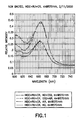
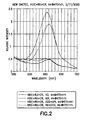
- FIG's 1 and 2 provide a graphic display of CO 2 monitoring of a test sample, example 4. Shown is the spectra of the sensor formulation of example 4 at 570nm and 470nm respectively.
- example 4 represents a high dynamic range and low cross-talk in both oxygen and carbon dioxide channels.
- the dynamic range measures the signal change upon gas composition changes.
- the cross-talk indicates the independency of one gas composition change from the other.
- the test material employed for all formulation examples was an artificially prepared gas composition.
- the prepared gas composition includes 30% CO 2 and is a generally accepted gas composition to mimic real microbiology growing profiles.
- the glass sensor bottle, which contains the artificial gas composition is capped with a rubber septum.
- a double-needle device is then inserted with one needle connected to a gas supplier and the other needle open to the air.
- the gas supplier is a gas cylinder with a specific gas composition such as pure nitrogen, 30% CO 2 balanced with nitrogen and so on. These gas cylinders can be purchased directly from commercial distributors or customized through the vendors.
- the specified gas is then flushed through the sensor bottle for an undefined period (normally five minutes) to replace the air with the desired gas. While the gas cylinder is still allowing gas to flow into the sensor bottle, the needle device is pulled out to complete the process.
Landscapes
- Health & Medical Sciences (AREA)
- Chemical & Material Sciences (AREA)
- Physics & Mathematics (AREA)
- Immunology (AREA)
- General Physics & Mathematics (AREA)
- Chemical Kinetics & Catalysis (AREA)
- Pathology (AREA)
- Life Sciences & Earth Sciences (AREA)
- Analytical Chemistry (AREA)
- Biochemistry (AREA)
- General Health & Medical Sciences (AREA)
- Optics & Photonics (AREA)
- Nuclear Medicine, Radiotherapy & Molecular Imaging (AREA)
- Engineering & Computer Science (AREA)
- Plasma & Fusion (AREA)
- Measuring Or Testing Involving Enzymes Or Micro-Organisms (AREA)
- Investigating Or Analysing Materials By The Use Of Chemical Reactions (AREA)
- Investigating Or Analyzing Non-Biological Materials By The Use Of Chemical Means (AREA)
- Heterocyclic Carbon Compounds Containing A Hetero Ring Having Oxygen Or Sulfur (AREA)
- Apparatus Associated With Microorganisms And Enzymes (AREA)
Applications Claiming Priority (2)
| Application Number | Priority Date | Filing Date | Title |
|---|---|---|---|
| US10/041,661 US6989246B2 (en) | 2002-01-10 | 2002-01-10 | Sensor formulation for simultaneously monitoring at least two components of a gas composition |
| US41661 | 2002-01-10 |
Publications (3)
| Publication Number | Publication Date |
|---|---|
| EP1327874A2 true EP1327874A2 (de) | 2003-07-16 |
| EP1327874A3 EP1327874A3 (de) | 2004-09-29 |
| EP1327874B1 EP1327874B1 (de) | 2010-03-03 |
Family
ID=21917684
Family Applications (1)
| Application Number | Title | Priority Date | Filing Date |
|---|---|---|---|
| EP03000370A Expired - Lifetime EP1327874B1 (de) | 2002-01-10 | 2003-01-10 | Sensorzusammensetzung zum Nachweis einer Gaszusammensetzung und Verfahren zum Nachweis von atmenden Mikroorganismen. |
Country Status (6)
| Country | Link |
|---|---|
| US (1) | US6989246B2 (de) |
| EP (1) | EP1327874B1 (de) |
| JP (1) | JP4404555B2 (de) |
| AT (1) | ATE459873T1 (de) |
| DE (1) | DE60331491D1 (de) |
| ES (1) | ES2338221T3 (de) |
Cited By (9)
| Publication number | Priority date | Publication date | Assignee | Title |
|---|---|---|---|---|
| WO2006107370A1 (en) * | 2005-03-30 | 2006-10-12 | Kimberly-Clark Worldwide, Inc. | Technique for detecting microorganisms |
| GB2474571A (en) * | 2009-10-16 | 2011-04-20 | Univ Strathclyde | Polymer composite with chemical indicator and method of production and uses thereof |
| US7992561B2 (en) | 2006-09-25 | 2011-08-09 | Nellcor Puritan Bennett Llc | Carbon dioxide-sensing airway products and technique for using the same |
| US8396524B2 (en) | 2006-09-27 | 2013-03-12 | Covidien Lp | Medical sensor and technique for using the same |
| US8420405B2 (en) | 2006-09-25 | 2013-04-16 | Covidien Lp | Carbon dioxide detector having borosilicate substrate |
| US8431088B2 (en) | 2006-09-25 | 2013-04-30 | Covidien Lp | Carbon dioxide detector having borosilicate substrate |
| US8431087B2 (en) | 2006-09-25 | 2013-04-30 | Covidien Lp | Carbon dioxide detector having borosilicate substrate |
| US8449834B2 (en) | 2006-09-25 | 2013-05-28 | Covidien Lp | Carbon dioxide detector having borosilicate substrate |
| CN115561217A (zh) * | 2022-11-21 | 2023-01-03 | 深圳湃诺瓦医疗科技有限公司 | 生物传感器以及监测设备 |
Families Citing this family (16)
| Publication number | Priority date | Publication date | Assignee | Title |
|---|---|---|---|---|
| US6925853B2 (en) * | 2002-10-24 | 2005-08-09 | Midwest Research Institute | Air quality sampler using solid phase coated material |
| US8062221B2 (en) | 2005-09-30 | 2011-11-22 | Nellcor Puritan Bennett Llc | Sensor for tissue gas detection and technique for using the same |
| US20070083094A1 (en) * | 2005-10-11 | 2007-04-12 | Colburn Joel C | Medical sensor and technique for using the same |
| US20070106134A1 (en) | 2005-11-10 | 2007-05-10 | O'neil Michael P | Medical sensor and technique for using the same |
| US20090165801A1 (en) * | 2007-12-31 | 2009-07-02 | Nellcor Puritan Bennett Llc | Carbon dioxide detector having an acrylic based substrate |
| US20090246797A1 (en) * | 2008-03-28 | 2009-10-01 | Nellcor Puritan Bennett Llc | Medical device for the assessment of internal organ tissue and technique for using the same |
| US8467977B2 (en) | 2010-07-29 | 2013-06-18 | General Electric Company | Fiber optic carbon dioxide purity sensor package and system |
| US10143401B2 (en) | 2011-06-13 | 2018-12-04 | Arizona Board Of Regents Acting For And On Behalf Of Arizona State University | Metabolic analyzer |
| EP2929323B1 (de) | 2012-12-05 | 2024-05-01 | Agilent Technologies, Inc. | Individuell und flexibel einsetzbare targetanalytempfindliche partikelsonden und verfahren zur herstellung und verwendung |
| ES2716568T3 (es) | 2013-03-11 | 2019-06-13 | Becton Dickinson Co | Cartucho de detección bacteriana |
| US10323265B2 (en) * | 2015-06-26 | 2019-06-18 | Konica Minolta Laboratory U.S.A., Inc. | Rapid and high-sensitive bacteria detection |
| CN110678758A (zh) | 2017-05-10 | 2020-01-10 | 卢克塞尔生物科学公司 | 实时的细胞或细胞周围微环境的氧控制 |
| US12059683B2 (en) | 2017-05-16 | 2024-08-13 | Agilent Technologies, Inc. | Headspace eliminating microtiter plate lid and method of optically measuring well oxygen concentration through the lid |
| KR102413155B1 (ko) * | 2021-10-14 | 2022-06-24 | 주식회사 휴피트 | 패혈증 진단용 이산화탄소 비색 센서 기반의 미생물 생장배지 |
| CN119255867A (zh) | 2022-04-08 | 2025-01-03 | 安捷伦科技有限公司 | 顶空消除式微量滴定板盖 |
| WO2023196547A1 (en) | 2022-04-08 | 2023-10-12 | Agilent Technologies, Inc. | Microtiter plate lid and magnetic adapter |
Family Cites Families (19)
| Publication number | Priority date | Publication date | Assignee | Title |
|---|---|---|---|---|
| DE3369801D1 (en) | 1982-10-06 | 1987-03-19 | Avl Ag | Measurement device for determining the carbon dioxide content of a sample |
| CA1276532C (en) | 1985-02-26 | 1990-11-20 | Heinrich Kimmel | Method for the continuous measurement of the partial pressure of gases and vapors |
| US5019350A (en) | 1986-02-13 | 1991-05-28 | Pfizer Hospital Products, Inc. | Fluorescent polymers |
| US4824789B1 (en) * | 1986-10-10 | 1996-08-13 | Minnesota Mining & Mfg | Gas sensor |
| US4785814A (en) | 1987-08-11 | 1988-11-22 | Cordis Corporation | Optical probe for measuring pH and oxygen in blood and employing a composite membrane |
| US6395506B1 (en) * | 1991-04-18 | 2002-05-28 | Becton, Dickinson And Company | Device for monitoring cells |
| AU647609B2 (en) | 1991-04-18 | 1994-03-24 | Becton Dickinson & Company | Microbial monitoring device |
| US5262192A (en) * | 1992-04-27 | 1993-11-16 | Puritan-Bennett Corporation | Method and compositions for manufacture of chemical sensors |
| US5266271A (en) * | 1992-05-22 | 1993-11-30 | Puritan-Bennett Corporation | Microsensor copolymer and method of manufacture |
| US5852126A (en) * | 1994-05-02 | 1998-12-22 | Novartis Ag | Polymerisable composition and the use thereof |
| US6080574A (en) * | 1994-05-10 | 2000-06-27 | Becton, Dickinson And Company | Composite optical blood culture sensor |
| US5489988A (en) | 1995-01-03 | 1996-02-06 | Motorola | Environmental sensor and method therefor |
| US5629533A (en) | 1995-02-06 | 1997-05-13 | Motorola | Optical sensor and method |
| US5517313A (en) | 1995-02-21 | 1996-05-14 | Colvin, Jr.; Arthur E. | Fluorescent optical sensor |
| US5747349A (en) | 1996-03-20 | 1998-05-05 | University Of Washington | Fluorescent reporter beads for fluid analysis |
| DE19741335C1 (de) * | 1997-09-19 | 1999-06-10 | Bosch Gmbh Robert | Sensormembran einer Optode sowie Verfahren, Vorrichtung und deren Verwendung zur Bestimmung von Gasen in Gasgemischen |
| US6254831B1 (en) * | 1998-01-21 | 2001-07-03 | Bayer Corporation | Optical sensors with reflective materials |
| US6241948B1 (en) | 1998-05-20 | 2001-06-05 | The Research Foundation Of State University Of New York | Sensing device with sol-gel derived film on the light source |
| US6368558B1 (en) * | 2000-03-21 | 2002-04-09 | The Board Of Trustees Of The University Of Illinois | Colorimetric artificial nose having an array of dyes and method for artificial olfaction |
-
2002
- 2002-01-10 US US10/041,661 patent/US6989246B2/en not_active Expired - Lifetime
-
2003
- 2003-01-10 JP JP2003005019A patent/JP4404555B2/ja not_active Expired - Lifetime
- 2003-01-10 DE DE60331491T patent/DE60331491D1/de not_active Expired - Lifetime
- 2003-01-10 ES ES03000370T patent/ES2338221T3/es not_active Expired - Lifetime
- 2003-01-10 EP EP03000370A patent/EP1327874B1/de not_active Expired - Lifetime
- 2003-01-10 AT AT03000370T patent/ATE459873T1/de not_active IP Right Cessation
Cited By (15)
| Publication number | Priority date | Publication date | Assignee | Title |
|---|---|---|---|---|
| WO2006107370A1 (en) * | 2005-03-30 | 2006-10-12 | Kimberly-Clark Worldwide, Inc. | Technique for detecting microorganisms |
| US8431087B2 (en) | 2006-09-25 | 2013-04-30 | Covidien Lp | Carbon dioxide detector having borosilicate substrate |
| US8454526B2 (en) | 2006-09-25 | 2013-06-04 | Covidien Lp | Carbon dioxide-sensing airway products and technique for using the same |
| US8109272B2 (en) | 2006-09-25 | 2012-02-07 | Nellcor Puritan Bennett Llc | Carbon dioxide-sensing airway products and technique for using the same |
| US8128574B2 (en) | 2006-09-25 | 2012-03-06 | Nellcor Puritan Bennett Llc | Carbon dioxide-sensing airway products and technique for using the same |
| US7992561B2 (en) | 2006-09-25 | 2011-08-09 | Nellcor Puritan Bennett Llc | Carbon dioxide-sensing airway products and technique for using the same |
| US8449834B2 (en) | 2006-09-25 | 2013-05-28 | Covidien Lp | Carbon dioxide detector having borosilicate substrate |
| US8420405B2 (en) | 2006-09-25 | 2013-04-16 | Covidien Lp | Carbon dioxide detector having borosilicate substrate |
| US8431088B2 (en) | 2006-09-25 | 2013-04-30 | Covidien Lp | Carbon dioxide detector having borosilicate substrate |
| US8396524B2 (en) | 2006-09-27 | 2013-03-12 | Covidien Lp | Medical sensor and technique for using the same |
| GB2474571A (en) * | 2009-10-16 | 2011-04-20 | Univ Strathclyde | Polymer composite with chemical indicator and method of production and uses thereof |
| GB2474571B (en) * | 2009-10-16 | 2012-03-28 | Univ Strathclyde | Intelligent pigments and plastics |
| US8790930B2 (en) | 2009-10-16 | 2014-07-29 | University Of Strathclyde | Intelligent pigments and plastics |
| AU2010308169B2 (en) * | 2009-10-16 | 2014-08-21 | University Of Strathclyde | Intelligent pigments and plastics |
| CN115561217A (zh) * | 2022-11-21 | 2023-01-03 | 深圳湃诺瓦医疗科技有限公司 | 生物传感器以及监测设备 |
Also Published As
| Publication number | Publication date |
|---|---|
| US20030133123A1 (en) | 2003-07-17 |
| US6989246B2 (en) | 2006-01-24 |
| EP1327874B1 (de) | 2010-03-03 |
| JP4404555B2 (ja) | 2010-01-27 |
| JP2003262628A (ja) | 2003-09-19 |
| ES2338221T3 (es) | 2010-05-05 |
| EP1327874A3 (de) | 2004-09-29 |
| ATE459873T1 (de) | 2010-03-15 |
| DE60331491D1 (de) | 2010-04-15 |
Similar Documents
| Publication | Publication Date | Title |
|---|---|---|
| US6989246B2 (en) | Sensor formulation for simultaneously monitoring at least two components of a gas composition | |
| CA2066329C (en) | Microbial monitoring device | |
| O'Riordan et al. | A cell viability assay based on monitoring respiration by optical oxygen sensing | |
| US7338778B2 (en) | Luminescent method for determining cell oxygen consumption | |
| DE10101576B4 (de) | Optischer Sensor und Sensorfeld | |
| Kocincová et al. | Multiplex bacterial growth monitoring in 24‐well microplates using a dual optical sensor for dissolved oxygen and pH | |
| KR0183402B1 (ko) | 미생물의 검출방법 및 장치 | |
| US20180202996A1 (en) | Compositions and assays for determining cell viability | |
| JPH0216965A (ja) | 微生物を検出するための装置及びデバイス | |
| US20040171094A1 (en) | Oxygen sensors disposed on a microtiter plate | |
| Lu et al. | New ratiometric optical oxygen and pH dual sensors with three emission colors for measuring photosynthetic activity in cyanobacteria | |
| Wood et al. | Transduction in microbial biosensors using muliplexed bioluminescence | |
| EP0472622B1 (de) | Vorrichtung zum nachweis von mikroorganismen | |
| US5372784A (en) | Measurement of bacterial CO2 production in an isolated fluorophore by monitoring an absorbance regulated change of fluorescence | |
| CA2086608A1 (en) | Method and apparatus to detect bacterial contamination of transfusable blood | |
| US4916060A (en) | Process for chemical measurement in small volume samples by fluorescent indicators | |
| WO1998012348A9 (en) | Microbial monitoring device | |
| EP1021557A1 (de) | Vorrichtung zur überwachung mikrobieller aktivität | |
| RU93990U1 (ru) | Устройство для мультисубстратной флуоресцентной идентификации биологических микрообъектов и их биологических свойств | |
| EP0519066A4 (en) | Measurement of bacterial co 2? production in an isolated fluorophore by monitoring an absorbance regulated change of fluorescence | |
| Gansert et al. | Hybrid optodes (HYBOP) |
Legal Events
| Date | Code | Title | Description |
|---|---|---|---|
| PUAI | Public reference made under article 153(3) epc to a published international application that has entered the european phase |
Free format text: ORIGINAL CODE: 0009012 |
|
| AK | Designated contracting states |
Designated state(s): AT BE BG CH CY CZ DE DK EE ES FI FR GB GR HU IE IT LI LU MC NL PT SE SI SK TR |
|
| AX | Request for extension of the european patent |
Extension state: AL LT LV MK RO |
|
| PUAL | Search report despatched |
Free format text: ORIGINAL CODE: 0009013 |
|
| AK | Designated contracting states |
Kind code of ref document: A3 Designated state(s): AT BE BG CH CY CZ DE DK EE ES FI FR GB GR HU IE IT LI LU MC NL PT SE SI SK TR |
|
| AX | Request for extension of the european patent |
Extension state: AL LT LV MK RO |
|
| RIC1 | Information provided on ipc code assigned before grant |
Ipc: 7G 01N 21/77 B Ipc: 7G 01N 21/64 A Ipc: 7G 01N 31/22 B |
|
| AKX | Designation fees paid | ||
| REG | Reference to a national code |
Ref country code: DE Ref legal event code: 8566 |
|
| 17P | Request for examination filed |
Effective date: 20050525 |
|
| RBV | Designated contracting states (corrected) |
Designated state(s): AT BE BG CH CY CZ DE DK EE ES FI FR GB GR IE IT LI LU MC NL PT SE SK TR |
|
| RBV | Designated contracting states (corrected) |
Designated state(s): AT BE BG CH CY CZ DE DK EE ES FI FR GB GR HU IE IT LI LU MC NL PT SE SI SK TR |
|
| 17Q | First examination report despatched |
Effective date: 20071108 |
|
| GRAP | Despatch of communication of intention to grant a patent |
Free format text: ORIGINAL CODE: EPIDOSNIGR1 |
|
| RTI1 | Title (correction) |
Free format text: SENSOR FORMULATION FOR THE DETECTION OF A GAS COMPOSITION AND METHOD FOR DETECTING PRESENCE OF RESPIRING ORGANISMS |
|
| GRAS | Grant fee paid |
Free format text: ORIGINAL CODE: EPIDOSNIGR3 |
|
| GRAA | (expected) grant |
Free format text: ORIGINAL CODE: 0009210 |
|
| AK | Designated contracting states |
Kind code of ref document: B1 Designated state(s): AT BE BG CH CY CZ DE DK EE ES FI FR GB GR HU IE IT LI LU MC NL PT SE SI SK TR |
|
| REG | Reference to a national code |
Ref country code: GB Ref legal event code: FG4D |
|
| REG | Reference to a national code |
Ref country code: CH Ref legal event code: EP |
|
| REG | Reference to a national code |
Ref country code: IE Ref legal event code: FG4D |
|
| REF | Corresponds to: |
Ref document number: 60331491 Country of ref document: DE Date of ref document: 20100415 Kind code of ref document: P |
|
| REG | Reference to a national code |
Ref country code: ES Ref legal event code: FG2A Ref document number: 2338221 Country of ref document: ES Kind code of ref document: T3 |
|
| REG | Reference to a national code |
Ref country code: NL Ref legal event code: VDEP Effective date: 20100303 |
|
| PG25 | Lapsed in a contracting state [announced via postgrant information from national office to epo] |
Ref country code: SI Free format text: LAPSE BECAUSE OF FAILURE TO SUBMIT A TRANSLATION OF THE DESCRIPTION OR TO PAY THE FEE WITHIN THE PRESCRIBED TIME-LIMIT Effective date: 20100303 Ref country code: FI Free format text: LAPSE BECAUSE OF FAILURE TO SUBMIT A TRANSLATION OF THE DESCRIPTION OR TO PAY THE FEE WITHIN THE PRESCRIBED TIME-LIMIT Effective date: 20100303 Ref country code: AT Free format text: LAPSE BECAUSE OF FAILURE TO SUBMIT A TRANSLATION OF THE DESCRIPTION OR TO PAY THE FEE WITHIN THE PRESCRIBED TIME-LIMIT Effective date: 20100303 |
|
| PG25 | Lapsed in a contracting state [announced via postgrant information from national office to epo] |
Ref country code: EE Free format text: LAPSE BECAUSE OF FAILURE TO SUBMIT A TRANSLATION OF THE DESCRIPTION OR TO PAY THE FEE WITHIN THE PRESCRIBED TIME-LIMIT Effective date: 20100303 Ref country code: GR Free format text: LAPSE BECAUSE OF FAILURE TO SUBMIT A TRANSLATION OF THE DESCRIPTION OR TO PAY THE FEE WITHIN THE PRESCRIBED TIME-LIMIT Effective date: 20100604 Ref country code: CY Free format text: LAPSE BECAUSE OF FAILURE TO SUBMIT A TRANSLATION OF THE DESCRIPTION OR TO PAY THE FEE WITHIN THE PRESCRIBED TIME-LIMIT Effective date: 20100303 Ref country code: BE Free format text: LAPSE BECAUSE OF FAILURE TO SUBMIT A TRANSLATION OF THE DESCRIPTION OR TO PAY THE FEE WITHIN THE PRESCRIBED TIME-LIMIT Effective date: 20100303 Ref country code: NL Free format text: LAPSE BECAUSE OF FAILURE TO SUBMIT A TRANSLATION OF THE DESCRIPTION OR TO PAY THE FEE WITHIN THE PRESCRIBED TIME-LIMIT Effective date: 20100303 Ref country code: SE Free format text: LAPSE BECAUSE OF FAILURE TO SUBMIT A TRANSLATION OF THE DESCRIPTION OR TO PAY THE FEE WITHIN THE PRESCRIBED TIME-LIMIT Effective date: 20100303 |
|
| PG25 | Lapsed in a contracting state [announced via postgrant information from national office to epo] |
Ref country code: CZ Free format text: LAPSE BECAUSE OF FAILURE TO SUBMIT A TRANSLATION OF THE DESCRIPTION OR TO PAY THE FEE WITHIN THE PRESCRIBED TIME-LIMIT Effective date: 20100303 Ref country code: BG Free format text: LAPSE BECAUSE OF FAILURE TO SUBMIT A TRANSLATION OF THE DESCRIPTION OR TO PAY THE FEE WITHIN THE PRESCRIBED TIME-LIMIT Effective date: 20100603 Ref country code: SK Free format text: LAPSE BECAUSE OF FAILURE TO SUBMIT A TRANSLATION OF THE DESCRIPTION OR TO PAY THE FEE WITHIN THE PRESCRIBED TIME-LIMIT Effective date: 20100303 |
|
| PLBE | No opposition filed within time limit |
Free format text: ORIGINAL CODE: 0009261 |
|
| STAA | Information on the status of an ep patent application or granted ep patent |
Free format text: STATUS: NO OPPOSITION FILED WITHIN TIME LIMIT |
|
| PG25 | Lapsed in a contracting state [announced via postgrant information from national office to epo] |
Ref country code: DK Free format text: LAPSE BECAUSE OF FAILURE TO SUBMIT A TRANSLATION OF THE DESCRIPTION OR TO PAY THE FEE WITHIN THE PRESCRIBED TIME-LIMIT Effective date: 20100303 Ref country code: PT Free format text: LAPSE BECAUSE OF FAILURE TO SUBMIT A TRANSLATION OF THE DESCRIPTION OR TO PAY THE FEE WITHIN THE PRESCRIBED TIME-LIMIT Effective date: 20100705 |
|
| 26N | No opposition filed |
Effective date: 20101206 |
|
| PG25 | Lapsed in a contracting state [announced via postgrant information from national office to epo] |
Ref country code: MC Free format text: LAPSE BECAUSE OF NON-PAYMENT OF DUE FEES Effective date: 20110131 |
|
| REG | Reference to a national code |
Ref country code: CH Ref legal event code: PL |
|
| REG | Reference to a national code |
Ref country code: IE Ref legal event code: MM4A |
|
| PG25 | Lapsed in a contracting state [announced via postgrant information from national office to epo] |
Ref country code: LI Free format text: LAPSE BECAUSE OF NON-PAYMENT OF DUE FEES Effective date: 20110131 Ref country code: CH Free format text: LAPSE BECAUSE OF NON-PAYMENT OF DUE FEES Effective date: 20110131 |
|
| PG25 | Lapsed in a contracting state [announced via postgrant information from national office to epo] |
Ref country code: IE Free format text: LAPSE BECAUSE OF NON-PAYMENT OF DUE FEES Effective date: 20110110 |
|
| PG25 | Lapsed in a contracting state [announced via postgrant information from national office to epo] |
Ref country code: LU Free format text: LAPSE BECAUSE OF NON-PAYMENT OF DUE FEES Effective date: 20110110 |
|
| PG25 | Lapsed in a contracting state [announced via postgrant information from national office to epo] |
Ref country code: TR Free format text: LAPSE BECAUSE OF FAILURE TO SUBMIT A TRANSLATION OF THE DESCRIPTION OR TO PAY THE FEE WITHIN THE PRESCRIBED TIME-LIMIT Effective date: 20100303 |
|
| PG25 | Lapsed in a contracting state [announced via postgrant information from national office to epo] |
Ref country code: HU Free format text: LAPSE BECAUSE OF FAILURE TO SUBMIT A TRANSLATION OF THE DESCRIPTION OR TO PAY THE FEE WITHIN THE PRESCRIBED TIME-LIMIT Effective date: 20100303 |
|
| REG | Reference to a national code |
Ref country code: FR Ref legal event code: PLFP Year of fee payment: 14 |
|
| REG | Reference to a national code |
Ref country code: FR Ref legal event code: PLFP Year of fee payment: 15 |
|
| REG | Reference to a national code |
Ref country code: FR Ref legal event code: PLFP Year of fee payment: 16 |
|
| PGFP | Annual fee paid to national office [announced via postgrant information from national office to epo] |
Ref country code: FR Payment date: 20211215 Year of fee payment: 20 Ref country code: GB Payment date: 20211216 Year of fee payment: 20 |
|
| PGFP | Annual fee paid to national office [announced via postgrant information from national office to epo] |
Ref country code: DE Payment date: 20211215 Year of fee payment: 20 |
|
| PGFP | Annual fee paid to national office [announced via postgrant information from national office to epo] |
Ref country code: IT Payment date: 20220103 Year of fee payment: 20 Ref country code: ES Payment date: 20220201 Year of fee payment: 20 |
|
| REG | Reference to a national code |
Ref country code: DE Ref legal event code: R071 Ref document number: 60331491 Country of ref document: DE |
|
| REG | Reference to a national code |
Ref country code: GB Ref legal event code: PE20 Expiry date: 20230109 |
|
| REG | Reference to a national code |
Ref country code: ES Ref legal event code: FD2A Effective date: 20230426 |
|
| PG25 | Lapsed in a contracting state [announced via postgrant information from national office to epo] |
Ref country code: GB Free format text: LAPSE BECAUSE OF EXPIRATION OF PROTECTION Effective date: 20230109 |
|
| PG25 | Lapsed in a contracting state [announced via postgrant information from national office to epo] |
Ref country code: ES Free format text: LAPSE BECAUSE OF EXPIRATION OF PROTECTION Effective date: 20230111 |