EP1329083B1 - Verfahren und einrichtungen zur übertragung und zum empfang von atvef daten in einem fernsehsystem - Google Patents
Verfahren und einrichtungen zur übertragung und zum empfang von atvef daten in einem fernsehsystem Download PDFInfo
- Publication number
- EP1329083B1 EP1329083B1 EP01989002A EP01989002A EP1329083B1 EP 1329083 B1 EP1329083 B1 EP 1329083B1 EP 01989002 A EP01989002 A EP 01989002A EP 01989002 A EP01989002 A EP 01989002A EP 1329083 B1 EP1329083 B1 EP 1329083B1
- Authority
- EP
- European Patent Office
- Prior art keywords
- address
- receiver
- data
- range
- multicast
- Prior art date
- Legal status (The legal status is an assumption and is not a legal conclusion. Google has not performed a legal analysis and makes no representation as to the accuracy of the status listed.)
- Expired - Lifetime
Links
- 230000005540 biological transmission Effects 0.000 title claims abstract description 40
- 238000000034 method Methods 0.000 title claims abstract description 24
- 230000002452 interceptive effect Effects 0.000 claims description 20
- 230000011664 signaling Effects 0.000 claims description 9
- 238000003780 insertion Methods 0.000 claims 1
- 230000037431 insertion Effects 0.000 claims 1
- 238000010586 diagram Methods 0.000 description 5
- 238000012545 processing Methods 0.000 description 5
- 230000006399 behavior Effects 0.000 description 2
- 230000007175 bidirectional communication Effects 0.000 description 1
- 238000012937 correction Methods 0.000 description 1
- 239000000284 extract Substances 0.000 description 1
- 238000001914 filtration Methods 0.000 description 1
- 238000011065 in-situ storage Methods 0.000 description 1
- 238000012360 testing method Methods 0.000 description 1
- 230000001960 triggered effect Effects 0.000 description 1
Images



Classifications
-
- H—ELECTRICITY
- H04—ELECTRIC COMMUNICATION TECHNIQUE
- H04N—PICTORIAL COMMUNICATION, e.g. TELEVISION
- H04N7/00—Television systems
- H04N7/14—Systems for two-way working
-
- H—ELECTRICITY
- H04—ELECTRIC COMMUNICATION TECHNIQUE
- H04N—PICTORIAL COMMUNICATION, e.g. TELEVISION
- H04N21/00—Selective content distribution, e.g. interactive television or video on demand [VOD]
- H04N21/60—Network structure or processes for video distribution between server and client or between remote clients; Control signalling between clients, server and network components; Transmission of management data between server and client, e.g. sending from server to client commands for recording incoming content stream; Communication details between server and client
- H04N21/63—Control signaling related to video distribution between client, server and network components; Network processes for video distribution between server and clients or between remote clients, e.g. transmitting basic layer and enhancement layers over different transmission paths, setting up a peer-to-peer communication via Internet between remote STB's; Communication protocols; Addressing
- H04N21/643—Communication protocols
- H04N21/64322—IP
-
- H—ELECTRICITY
- H04—ELECTRIC COMMUNICATION TECHNIQUE
- H04L—TRANSMISSION OF DIGITAL INFORMATION, e.g. TELEGRAPHIC COMMUNICATION
- H04L65/00—Network arrangements, protocols or services for supporting real-time applications in data packet communication
- H04L65/1066—Session management
- H04L65/1101—Session protocols
- H04L65/1104—Session initiation protocol [SIP]
-
- H—ELECTRICITY
- H04—ELECTRIC COMMUNICATION TECHNIQUE
- H04L—TRANSMISSION OF DIGITAL INFORMATION, e.g. TELEGRAPHIC COMMUNICATION
- H04L65/00—Network arrangements, protocols or services for supporting real-time applications in data packet communication
- H04L65/60—Network streaming of media packets
- H04L65/61—Network streaming of media packets for supporting one-way streaming services, e.g. Internet radio
- H04L65/611—Network streaming of media packets for supporting one-way streaming services, e.g. Internet radio for multicast or broadcast
-
- H—ELECTRICITY
- H04—ELECTRIC COMMUNICATION TECHNIQUE
- H04L—TRANSMISSION OF DIGITAL INFORMATION, e.g. TELEGRAPHIC COMMUNICATION
- H04L9/00—Cryptographic mechanisms or cryptographic arrangements for secret or secure communications; Network security protocols
- H04L9/40—Network security protocols
-
- H—ELECTRICITY
- H04—ELECTRIC COMMUNICATION TECHNIQUE
- H04N—PICTORIAL COMMUNICATION, e.g. TELEVISION
- H04N21/00—Selective content distribution, e.g. interactive television or video on demand [VOD]
- H04N21/20—Servers specifically adapted for the distribution of content, e.g. VOD servers; Operations thereof
- H04N21/23—Processing of content or additional data; Elementary server operations; Server middleware
- H04N21/238—Interfacing the downstream path of the transmission network, e.g. adapting the transmission rate of a video stream to network bandwidth; Processing of multiplex streams
-
- H—ELECTRICITY
- H04—ELECTRIC COMMUNICATION TECHNIQUE
- H04N—PICTORIAL COMMUNICATION, e.g. TELEVISION
- H04N21/00—Selective content distribution, e.g. interactive television or video on demand [VOD]
- H04N21/20—Servers specifically adapted for the distribution of content, e.g. VOD servers; Operations thereof
- H04N21/23—Processing of content or additional data; Elementary server operations; Server middleware
- H04N21/238—Interfacing the downstream path of the transmission network, e.g. adapting the transmission rate of a video stream to network bandwidth; Processing of multiplex streams
- H04N21/2381—Adapting the multiplex stream to a specific network, e.g. an Internet Protocol [IP] network
-
- H—ELECTRICITY
- H04—ELECTRIC COMMUNICATION TECHNIQUE
- H04N—PICTORIAL COMMUNICATION, e.g. TELEVISION
- H04N21/00—Selective content distribution, e.g. interactive television or video on demand [VOD]
- H04N21/40—Client devices specifically adapted for the reception of or interaction with content, e.g. set-top-box [STB]; Operations thereof
- H04N21/43—Processing of content or additional data, e.g. demultiplexing additional data from a digital video stream; Elementary client operations, e.g. monitoring of home network or synchronising decoder's clock; Client middleware
- H04N21/438—Interfacing the downstream path of the transmission network originating from a server, e.g. retrieving encoded video stream packets from an IP network
- H04N21/4381—Recovering the multiplex stream from a specific network, e.g. recovering MPEG packets from ATM cells
-
- H—ELECTRICITY
- H04—ELECTRIC COMMUNICATION TECHNIQUE
- H04N—PICTORIAL COMMUNICATION, e.g. TELEVISION
- H04N21/00—Selective content distribution, e.g. interactive television or video on demand [VOD]
- H04N21/80—Generation or processing of content or additional data by content creator independently of the distribution process; Content per se
- H04N21/85—Assembly of content; Generation of multimedia applications
- H04N21/858—Linking data to content, e.g. by linking an URL to a video object, by creating a hotspot
-
- H—ELECTRICITY
- H04—ELECTRIC COMMUNICATION TECHNIQUE
- H04N—PICTORIAL COMMUNICATION, e.g. TELEVISION
- H04N7/00—Television systems
- H04N7/08—Systems for the simultaneous or sequential transmission of more than one television signal, e.g. additional information signals, the signals occupying wholly or partially the same frequency band, e.g. by time division
- H04N7/087—Systems for the simultaneous or sequential transmission of more than one television signal, e.g. additional information signals, the signals occupying wholly or partially the same frequency band, e.g. by time division with signal insertion during the vertical blanking interval only
- H04N7/088—Systems for the simultaneous or sequential transmission of more than one television signal, e.g. additional information signals, the signals occupying wholly or partially the same frequency band, e.g. by time division with signal insertion during the vertical blanking interval only the inserted signal being digital
-
- H—ELECTRICITY
- H04—ELECTRIC COMMUNICATION TECHNIQUE
- H04L—TRANSMISSION OF DIGITAL INFORMATION, e.g. TELEGRAPHIC COMMUNICATION
- H04L12/00—Data switching networks
- H04L12/02—Details
- H04L12/16—Arrangements for providing special services to substations
- H04L12/18—Arrangements for providing special services to substations for broadcast or conference, e.g. multicast
-
- H—ELECTRICITY
- H04—ELECTRIC COMMUNICATION TECHNIQUE
- H04L—TRANSMISSION OF DIGITAL INFORMATION, e.g. TELEGRAPHIC COMMUNICATION
- H04L65/00—Network arrangements, protocols or services for supporting real-time applications in data packet communication
- H04L65/1066—Session management
- H04L65/1101—Session protocols
Definitions
- the invention concerns a method for transmitting data in a television system, as well as an emitter and a receiver in such a system.
- the invention applies in particular, but is not limited to, systems implementing the ATVEF specification.
- ATVEF Advanced Television Enhancement Forum
- IP multicast Internet Protocol multicast
- a service provider when a service provider wishes to transmit an interactive service, he first has to transmit a message called an announcement, containing information describing the interactive service. This announcement is transmitted to a specific IP multicast address and to a specific port, known to all receivers (IP address 224.0.1.113 and UDP Port 2670).
- Receivers compatible with the ATVEF specification continuously monitor this address/port couple. Their resident software modules retrieve the announcement, which contains a pair of IP addresses, one for the transmission of the interactive service (called the 'content'), another one of the transmission of triggers. Triggers are messages for triggering a certain behavior of interactive services at predetermined moments.
- Software modules resident in the receivers may require updates. For flexibility reasons, it should be possible to make such an update in remote fashion, i.e. to transmit the updated software modules to the receivers in situ. Such a transmission should obviously use some of the already available transmission media, such as the return channel (be it through the PSTN or the cable network, or another type of bi-directional communication means) or the television broadcast medium.
- the ATVEF protocol stack (see figure 1a ) cannot be used directly to transmit the update - or other types of binary data -, because the software in charge of retrieving the interactive service (e.g. a browser) is not able to interpret the content data which represents the resident software module update.
- This update is typically binary data, instead of the UHTTP data expected by the browser. This could result in unpredictable behavior at the receiver level. Modifying the browser to detect and process binary data would be impractical.
- transporting binary data using UHTTP is cumbersome, since this protocol has not been developed for such a purpose.
- An object of the invention is a method for transmitting as claimed in claim 1.
- Another object of the invention is a method for receiving as claimed in claim 5.
- Another object of the invention is an emitter as claimed in claim 7.
- Another object of the invention is a receiver as claimed in claim 9.
- ATVEF Advanced TeleVision Enhancement Forum
- ATVEF announcements are sent to a predefined IP address (224.0.1.113) and a predefined UDP port number (2670).
- the parameter 'c' of an announcement indicates to which address content and triggers will be sent, while the parameter 'm' indicates on which port they will be sent. Triggers and content may be sent on different ports at the same address, as well as on different addresses.
- the present embodiment concerns an analog television system in which the vertical blanking interval lines of the analog video signal are used to transmit digital data. Modulation of this kind of data on an analog television signal is well known per se.
- FIG. 1b is a diagram of the protocol stack used by a receiver in conformance with the present embodiment.
- the UHTTP layer has been replaced by a proprietary layer.
- the stack includes UDP (User Datagram Protocol) over IP (Internet Protocol), SLIP (Serial Line Internet Protocol) and IDL-B, as defined in ETS 300 708.
- the role of the proprietary layer is to manage binary data downloading.
- the binary data to be downloaded is split into sections having the size of IP packet payloads, i.e. 1472 octets.
- the layer assembles the different sections it receives in the right order. If a section contains uncorrectable errors, then the proprietary layer waits for a next transmission (see below) and inserts it at its proper place.
- the proprietary layer also retrieves date/time information and announcements relating to binary data downloads and date/time information.
- Enhancements and binary data are usually sent repeatedly, in order to enable receivers to access the corresponding data even when they do not listen from the beginning of the transmission, and in order to retrieve packets which were previously received with uncorrectable errors.
- an announcement of the SDP format is made at another address and port than the address and port used by the ATVEF announcements. Accordingly, as an example, the receiver listens to the address 235.0.1.113, port number 2670, to detect these novel types of announcements. In parallel, the receiver continues to listen to the standard ATVEF announcement address and port.
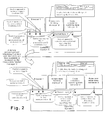
- FIG. 2 is a diagram of an example of the applications and tasks that a receiver according to the present embodiment runs in parallel according to the present embodiment. Of course, other applications and tasks may also run, but are not directly relevant to the present embodiment.
- the receiver listens to six different IP multicast addresses, numbered A1 to A6.
- An IP multicast address comprises an IP address and a port number.
- An ATVEF announcement is sent to the well-known ATVEF address/port couple A1 as already described above.
- ATVEF content and triggers ('ATVEF data') is sent to two different address/port couples, A3 and A4, which are specified by the ATVEF announcement.
- Two different non-ATVEF announcements are sent to predefined, fixed address/port A2. The first one indicates an address/port A5 for retrieving date and time information, while the second one indicates an address/port A6 for retrieving the binary data.
- VBI Vertical Blanking Interval
- IDLB packet format
- the driver extracts the payload from these packets and applies an error correction process.
- the payload is a SLIP-format stream which enables the driver to identify and separate IP packets.
- the browser 1 and the other applications are clients of the socket layer 4 which enables them to listen to an IP address and a UDP port in order to retrieve the transmitted content.
- the upper part of figure 2 will be described first.
- the upper and lower parts show the receiver's state at different moments in time.
- the receiver runs a browser 1 in charge of retrieving respectively the ATVEF announcements, content and triggers and listens respectively to addresses A1, A3, A4, which the browser 1 has programmed at the socket level).
- a first task 2 ('Binary data fetching manager') is in charge of retrieving the non-ATVEF announcements sent on address A2.
- a second task 3 ('Code download signaling data retriever') is used to retrieve the binary file itself on an address A6. The address A6 has previously been specified in a binary announcement on address A2. Two different tasks are used to retrieve the update announcement and the update file itself: this avoids having to sort the incoming data relating to these addresses.
- the second task 3 need not be active all the time. It can be triggered by the first task 2, upon reception of an announcement relating to the kind of data retrieved by the second task 3.
- the 'i' field of an announcement is used to inform the task 2 of the nature of the data to be transmitted.
- 'i' is equal to 'code download' for the transmission of binary data, and equal to 'date&time' for the transmission of the date and time information.
- the announcement according to the present embodiment contains only one address and associated port value, to indicate to the receiver where to listen for the transmission of the binary data (code update, time, or other).
- such an announcement contains the following parameters relating to the address and port of the update file:
- a non-ATVEF announcement contains the following fields:
- Figure 2 also illustrates the dynamics of announcement handling in the receiver.
- the upper part of figure 2 shows the receiver's task at a time t.
- the browser 1 listens to its predetermined ATVEF announcement address A1, and to two further addresses for content (A3) and triggers (A4).
- the binary data fetching module 2 listens to the address corresponding to binary data announcements.
- a binary announcement concerning the transmission of date and time is received by the binary data fetching module 2.
- This announcement contains an IP multicast address A5 on which data and time information is due to be transmitted.
- a third task 6, named 'Date and time data retriever' is launched, in order to listen to the address A5 specified in the announcement.
- FIG. 3 is a flowchart which further illustrates the processing of ATVEF and non-ATVEF announcements and data in the receiver.
- the service provider or the broadcaster's emitter selects the address values for data transmission in a certain range.
- one such range is reserved for ATVEF transmissions, while another such range is reserved for non-ATVEF transmissions (e.g. software module updates according to the present example). This avoids having ATVEF data sent to non-ATVEF addresses and vice-versa.
- Figure 4 is a flowchart of the announcement creation process in a server, showing how IP multicast addresses are automatically selected and inserted into announcements by the emitter in the absence of preset addresses.
- the broadcaster receives the ATVEF or non-ATVEF announcements and dynamically adds through its emitter the content, trigger or binary data transmission addresses according to the predefined ranges.
- the following address range is used for sending ATVEF enhancements on manually attributed addresses:
- Manually attributed addresses are addresses which are predetermined in announcements received by the emitter from e.g. the service provider, i.e. the emitter does not itself select such addresses, as opposed to announcements were such a choice is made automatically by the emitter, when at least one address is missing in an announcement. Different address ranges are used to avoid having the emitter pick an address which has already been defined manually in another announcement.
- the address ranges used for ATVEF and non-ATVEF data transmissions are the same or at least overlap to a certain extent, but the port number ranges attributed to each kind of data transmission do not overlap. In other words, there will still be different IP multicast address ranges.
- the two address ranges may be modified.
- an update mechanism is put in place at the receiver.
- FIG. 5 A variant embodiment, illustrated by figure 5 , will now be described. This embodiment concerns the case in which the binary data to be downloaded may influence - and in particular interrupt - certain processes of the receiver.
- the receiver comprises a loader program 7 in order to perform the download.
- This program is stored in ROM, since all code stored in the flash memory is to be replaced.
- the binary data fetching module When the binary data fetching module receives a non-ATVEF announcement for an update, it starts a specific task (the code download signaling retriever of figure 2 ), which listens to an address specified in the update announcement.
- the code to be downloaded is not sent to this address, eventually with other signaling information describing the download to be carried out. Instead, this address receives a stream which describes the upcoming download, and in particular a download address.
- the code download signaling data retriever task stores this address in a predefined location in the flash memory 8 of the receiver, this location being protected from being erased during the subsequent download.
- the task reboots the decoder.
- the loader 7 is then launched. This program fetches the download address from the flash memory and downloads the code from this address.
- This update process may also be used in other environments than that of the present embodiment (i.e. environments not related to ATVEF).
- FIG. 6 is a schematic diagram of a network comprising an emitter 51, and a plurality of receivers 52i.
- the emitter comprises a video signal source 53, a data inserter 54 controlled by a broadcast server 61.
- the broadcast server 61 is connected to a database 55, containing ATVEF and non-ATVEF data and announcements.
- the data inserter inserts data into the VBI lines of the video signal in an appropriate format, under control of the broadcast server, which defines timing and allocates signal resources.
- Data in database 55 may be provided by different sources, in particular a service provider 56.
- the broadcast server 61 automatically selects addresses as explained above, in case such an automatic selection is required.
- Receivers also comprise a microprocessor 57, a ROM 58 with a loader program 59 mentioned above, as well as a register or memory 60 adapted to hold a multicast address during receiver reset and/or reboot and/or power loss.
- the emitter and receiver in the described system both comprises processing means such as a microprocessor (reference 57 in receivers of figure 5 ) and memory, for processing and respectively sending or receiving announcements, triggers, enhancement content and binary data.
- processing means such as a microprocessor (reference 57 in receivers of figure 5 ) and memory, for processing and respectively sending or receiving announcements, triggers, enhancement content and binary data.
Landscapes
- Engineering & Computer Science (AREA)
- Multimedia (AREA)
- Signal Processing (AREA)
- Computer Networks & Wireless Communication (AREA)
- Computer Security & Cryptography (AREA)
- Business, Economics & Management (AREA)
- General Business, Economics & Management (AREA)
- Two-Way Televisions, Distribution Of Moving Picture Or The Like (AREA)
- Data Exchanges In Wide-Area Networks (AREA)
- Television Systems (AREA)
Claims (12)
- Verfahren zum Übertragen von Binärdaten in einem Videoübertragungssystem, wobei das Verfahren die folgenden Schritte umfasst:- Liefern von Ankündigungen interaktiver Fernsehprogramm-Erweiterungsdienste an einer ersten vorgegebenen IP-Gruppenadresse;- Liefern einer Auslösung interaktiver Fernsehprogramm-Erweiterungsdienste und/oder einer Inhaltsübertragung an einem ersten Bereich von IP-Gruppenadressen, wobei das Verfahren durch die folgenden Schritte gekennzeichnet ist:- Liefern von Ankündigungen einer Empfänger-Softwaremodul-Aktualisierung an einer zweiten vorgegebenen Gruppenadresse, die von der ersten Adresse verschieden ist;- Liefern einer Empfänger-Softwaremodul-Aktualisierungsdatenübertragung an einem zweiten Bereich von IP-Gruppenadressen ausschließlich des ersten Bereichs.
- Verfahren gemäß Anspruch 1, bei dem das System einen Sender (51) umfasst, der eine Dateneinfügeeinrichtung (54) zum Einfügen interaktiver Fernsehprogramm-Erweiterungsdienste und Empfänger-Softwaremodul-Aktualisierungsinformationen in ein Sendesignal umfasst, wobei das Verfahren ferner die folgenden Schritte umfasst:- Liefern von Ankündigungen interaktiver Fernsehprogramm-Erweiterungsdienste und Empfänger-Softwaremodul-Aktualisierungsankündigungen an die Dateneinfügeeinrichtung (54),- dynamische Einfügung von IP-Gruppenadressen durch die Dateneinfügeeinrichtung (54) in die Ankündigungen in Übereinstimmung mit dem ersten und mit dem zweiten Bereich.
- Verfahren gemäß Anspruch 2, das ferner den Schritt des Trennens jeweils des ersten und/oder des zweiten Bereichs von IP-Gruppenadressen in einen dritten und in einen vierten Bereich umfasst, wobei der dritte Bereich für die automatische Adressenbestimmung durch die Dateneinfügeeinrichtung (54) reserviert wird und wobei der vierte Bereich für Adressen reserviert wird, die in den an die Dateneinfügeeinrichtung gelieferten Ankündigungen vorgegeben sind.
- Verfahren gemäß einem der Ansprüche 1 bis 3, bei dem die Bereiche durch unterschiedliche IP-Adressenbereiche, durch unterschiedliche Portbereiche oder durch beides unterschieden sind.
- Verfahren zum Empfangen von Daten in einem Videoübertragungssystem, wobei das Verfahren die folgenden Schritte umfasst:- Empfangen von Ankündigungen interaktiver Fernsehprogramm-Erweiterungsdienste an einer ersten vorgegebenen IP-Gruppenadresse;- Empfangen einer Auslösung interaktiver Fernsehprogramm-Erweiterungsdienste und/oder einer Inhaltsübertragung an einem ersten Bereich von IP-Gruppenadressen, wobei das Verfahren durch die folgenden Schritte gekennzeichnet ist:- Empfangen von Ankündigungen einer Empfänger-Softwaremodul-Aktualisierung an einer zweiten vorgegebenen Gruppenadresse, die von der ersten Adresse verschieden ist;- Empfangen einer Empfänger-Softwaremodul-Aktualisierungsdatenübertragung an einem zweiten Bereich von IP-Gruppenadressen ausschließlich des ersten Bereichs.
- Verfahren gemäß Anspruch 5, das auf der Ebene eines Empfängers die folgenden Schritte umfasst:- Empfangen einer Empfänger-Softwaremodul-Aktualisierungsankündigung, die die Übertragung von Empfänger-Softwaremodul-Aktualisierungsdaten ankündigt, wobei die Ankündigung eine IP-Gruppenadresse (A6) enthält, an der Signalisierungsdaten gesendet werden sollen, die die Empfänger-Softwaremodul-Aktualisierungsdatenübertragung beschreiben;- Abhören der in der Ankündigung spezifizierten Adresse (A6);- Wiedergewinnen und Speichern der Signalisierungsdaten in einem Speicher, der während des Herunterladens der Empfänger-Softwaremodul-Aktualisierungsdaten nicht gelöscht wird;- Starten eines Programmladers;- Veranlassen, dass der Programmlader die gespeicherten Signalisierungsdaten wiedergewinnt; und- Fortfahren mit dem Herunterladen der Empfänger-Softwaremodul-Aktualisierungsdaten auf der Grundlage der gespeicherten Signalisierungsdaten.
- Sendervorrichtung (51) zum Rundsenden von Ankündigungen in einem Übertragungssystem, das mit Übertragungen interaktiver Fernsehprogramm-Erweiterungsdienste kompatibel ist, wobei der Sender umfasst:- Mittel zum Liefern von Ankündigungen interaktiver Fernsehprogramm-Erweiterungsdienste an einer ersten vorgegebenen IP-Gruppenadresse;- Mittel zum Liefern einer Auslösung interaktiver Fernsehprogramm-Erweiterungsdienste und/oder von Inhaltsdaten an einem ersten Bereich von IP-Gruppenadressen, wobei der Sender dadurch gekennzeichnet ist, dass er ferner umfasst:- Mittel zum Liefern von Empfänger-Softwaremodul-Aktualisierungsankündigungen an einer zweiten vorgegebenen IP-Gruppenadresse, die von der ersten vorgegebenen Adresse verschieden ist;- Mittel zum Liefern von Empfänger-Softwaremodul-Aktualisierungsdaten an einem zweiten Bereich von IP-Gruppenadressen, wobei der erste und der zweite Adressenbereich einander ausschließen.
- Vorrichtung gemäß Anspruch 7, die ferner Mittel (54, 55) zum Empfangen einer Ankündigung umfasst, um zu bestimmen, ob die Ankündigung eine vorgegebene IP-Gruppenadresse in einem ersten Bereich umfasst, und im negativen Fall eine IP-Gruppenadresse in einem zweiten Bereich auszuwählen, der von dem ersten Bereich verschieden ist, und die ausgewählte IP-Gruppenadresse in die Ankündigung einzufügen.
- Empfänger (52i) für ein mit interaktiven Fernsehprogramm-Erweiterungsdiensten kompatibles Übertragungssystem, wobei der Empfänger umfasst:- Mittel zum Empfangen von Ankündigungen interaktiver Fernsehprogramm-Erweiterungsdienste an einer ersten vorgegebenen Gruppenadresse;- Mittel zum Empfangen einer Auslösung interaktiver Fernsehinhalts-Erweiterungsdienste und/oder einer Inhaltsübertragung an einem ersten Bereich von IP-Gruppenadressen, wobei der Empfänger dadurch gekennzeichnet ist, dass er ferner umfasst:- Mittel zum Empfangen von Empfänger-Softwaremodul-Aktualisierungsankündigungen an einer zweiten vorgegebenen Gruppenadresse, die von der ersten Adresse verschieden ist; und- Mittel zum Empfangen einer Empfänger-Softwaremodul-Aktualisierungsdatenübertragung an einem zweiten Bereich von IP-Gruppenadressen ausschließlich des ersten Bereichs.
- Empfänger gemäß Anspruch 9, der ferner einen Speicher (60) umfasst, um eine dritte Gruppenadresse zu empfangen, an der eine Binärdatenübertragung angekündigt wird, wobei der Speicher derart ist, dass er die Gruppenadresse während eines Empfängerneustartprozesses aufrecht erhält, wobei der Empfänger ferner Mittel (57, 58, 59) umfasst, um die dritte Gruppenadresse in dem Speicher nach dem Neustart abzuhören, um die Binärdaten von der dritten Gruppenadresse herunterzuladen.
- Empfänger gemäß Anspruch 10, bei dem die dritte Gruppenadresse, an der die Binärdatenübertragung angekündigt wird, in Signalisierungsdaten geliefert wird, die an der zweiten Gruppenadresse angekündigt werden.
- Empfänger gemäß Anspruch 11, bei dem die heruntergeladene Binärdatei eine vollständige Systemaktualisierung ist.
Priority Applications (1)
| Application Number | Priority Date | Filing Date | Title |
|---|---|---|---|
| EP01989002A EP1329083B1 (de) | 2000-10-23 | 2001-10-18 | Verfahren und einrichtungen zur übertragung und zum empfang von atvef daten in einem fernsehsystem |
Applications Claiming Priority (4)
| Application Number | Priority Date | Filing Date | Title |
|---|---|---|---|
| EP00402921 | 2000-10-23 | ||
| EP00402921A EP1202520A1 (de) | 2000-10-23 | 2000-10-23 | Verfahren und Vorrichtung zur Datenübertragung in einem Fernsehsystem |
| EP01989002A EP1329083B1 (de) | 2000-10-23 | 2001-10-18 | Verfahren und einrichtungen zur übertragung und zum empfang von atvef daten in einem fernsehsystem |
| PCT/EP2001/012333 WO2002035791A1 (en) | 2000-10-23 | 2001-10-18 | Method and device for the transmission of data in a television system |
Publications (2)
| Publication Number | Publication Date |
|---|---|
| EP1329083A1 EP1329083A1 (de) | 2003-07-23 |
| EP1329083B1 true EP1329083B1 (de) | 2009-07-22 |
Family
ID=8173914
Family Applications (2)
| Application Number | Title | Priority Date | Filing Date |
|---|---|---|---|
| EP00402921A Withdrawn EP1202520A1 (de) | 2000-10-23 | 2000-10-23 | Verfahren und Vorrichtung zur Datenübertragung in einem Fernsehsystem |
| EP01989002A Expired - Lifetime EP1329083B1 (de) | 2000-10-23 | 2001-10-18 | Verfahren und einrichtungen zur übertragung und zum empfang von atvef daten in einem fernsehsystem |
Family Applications Before (1)
| Application Number | Title | Priority Date | Filing Date |
|---|---|---|---|
| EP00402921A Withdrawn EP1202520A1 (de) | 2000-10-23 | 2000-10-23 | Verfahren und Vorrichtung zur Datenübertragung in einem Fernsehsystem |
Country Status (9)
| Country | Link |
|---|---|
| US (1) | US7984471B2 (de) |
| EP (2) | EP1202520A1 (de) |
| JP (1) | JP2004512772A (de) |
| KR (1) | KR20030045108A (de) |
| CN (1) | CN100496042C (de) |
| AU (1) | AU2002220658A1 (de) |
| DE (1) | DE60139332D1 (de) |
| MX (1) | MXPA03003505A (de) |
| WO (1) | WO2002035791A1 (de) |
Families Citing this family (9)
| Publication number | Priority date | Publication date | Assignee | Title |
|---|---|---|---|---|
| US7076467B1 (en) * | 2000-08-04 | 2006-07-11 | Sony Computer Entertainment America Inc. | Network-based method and system for transmitting digital data to a client computer and charging only for data that is used by the client computer user |
| US7660878B2 (en) * | 2003-06-02 | 2010-02-09 | Seiko Epson Corporation | Image display device executing instructions in a multicast message to configure itself to connect to a network |
| US20060230102A1 (en) * | 2005-03-25 | 2006-10-12 | Murray Hidary | Automated training program generation and distribution system |
| KR101270275B1 (ko) * | 2005-08-17 | 2013-05-31 | 삼성전자주식회사 | 방송 시스템에서의 통지 메시지 제공 방법 및 장치 |
| US20070300273A1 (en) * | 2006-06-21 | 2007-12-27 | Gary Turner | Interactive television application and content enhancement |
| US20080092193A1 (en) * | 2006-10-17 | 2008-04-17 | The Video Load, Llc | Methods and systems for creating video files for a mobile device |
| US20080267589A1 (en) * | 2007-04-27 | 2008-10-30 | Gary Turner | Television bandwidth optimization system and method |
| US20110067050A1 (en) * | 2009-09-17 | 2011-03-17 | Ad-Fuse Technologies Ltd. | System and Method for Enhancing Video Data |
| TWI528749B (zh) * | 2011-09-06 | 2016-04-01 | Sony Corp | A signal receiving device, a signal receiving method, an information processing program and an information processing system |
Family Cites Families (27)
| Publication number | Priority date | Publication date | Assignee | Title |
|---|---|---|---|---|
| US5694163A (en) * | 1995-09-28 | 1997-12-02 | Intel Corporation | Method and apparatus for viewing of on-line information service chat data incorporated in a broadcast television program |
| US6009274A (en) * | 1996-12-13 | 1999-12-28 | 3Com Corporation | Method and apparatus for automatically updating software components on end systems over a network |
| US6055364A (en) * | 1997-07-31 | 2000-04-25 | Cisco Technology, Inc. | Content-based filtering of multicast information |
| CN1147145C (zh) * | 1997-12-01 | 2004-04-21 | 星视电视广播公司 | 在弹出区域中具有广告消息的电子节目表系统 |
| US6718387B1 (en) * | 1997-12-10 | 2004-04-06 | Sun Microsystems, Inc. | Reallocating address spaces of a plurality of servers using a load balancing policy and a multicast channel |
| WO1999055088A1 (de) * | 1998-04-22 | 1999-10-28 | Siemens Aktiengesellschaft | Verfahren zur übertragung von zusatzinformationssignalen in austastlücken eines videosignales und vorrichtung zum empfang dieser zusatzinformationssignale |
| US6311165B1 (en) * | 1998-04-29 | 2001-10-30 | Ncr Corporation | Transaction processing systems |
| US6040829A (en) * | 1998-05-13 | 2000-03-21 | Croy; Clemens | Personal navigator system |
| US7370114B1 (en) * | 1998-09-11 | 2008-05-06 | Lv Partners, L.P. | Software downloading using a television broadcast channel |
| JP2000156658A (ja) | 1998-11-19 | 2000-06-06 | Nec Corp | 端末プログラム更新システム、方法および記録媒体 |
| GB9826697D0 (en) * | 1998-12-05 | 1999-01-27 | Philips Electronics Nv | Television receiver |
| JP3644009B2 (ja) * | 1999-02-19 | 2005-04-27 | 富士通株式会社 | マルチキャストセッション管理装置 |
| US6278995B1 (en) * | 1999-03-02 | 2001-08-21 | Nms Communications Corporation | Apparatus and method for providing a binary range tree search |
| JP3633356B2 (ja) * | 1999-03-31 | 2005-03-30 | 株式会社日立製作所 | サーバ装置、サービス制御ゲートウェイ装置、サービス制御装置及び通信制御方法 |
| US6938270B2 (en) * | 1999-04-07 | 2005-08-30 | Microsoft Corporation | Communicating scripts in a data service channel of a video signal |
| US6460180B1 (en) * | 1999-04-20 | 2002-10-01 | Webtv Networks, Inc. | Enabling and/or disabling selected types of broadcast triggers |
| US6839348B2 (en) * | 1999-04-30 | 2005-01-04 | Cisco Technology, Inc. | System and method for distributing multicasts in virtual local area networks |
| US7051357B2 (en) * | 1999-05-28 | 2006-05-23 | Intel Corporation | Communicating ancillary information associated with a plurality of audio/video programs |
| US6415438B1 (en) * | 1999-10-05 | 2002-07-02 | Webtv Networks, Inc. | Trigger having a time attribute |
| US7284261B1 (en) * | 1999-10-05 | 2007-10-16 | Intel Corporation | Broadcasting and processing multiple data formats |
| US20010003212A1 (en) * | 1999-10-29 | 2001-06-07 | Jerilyn L. Marler | Identifying ancillary information associated with an audio/video program |
| US6557111B1 (en) * | 1999-11-29 | 2003-04-29 | Xerox Corporation | Multicast-enhanced update propagation in a weakly-consistant, replicated data storage system |
| US7174562B1 (en) * | 1999-12-20 | 2007-02-06 | Microsoft Corporation | Interactive television triggers having connected content/disconnected content attribute |
| US7237253B1 (en) * | 2000-04-27 | 2007-06-26 | Microsoft Corporation | User interface for interactive television systems |
| US7720903B1 (en) * | 2000-08-31 | 2010-05-18 | Intel Corporation | Client messaging in multicast networks |
| US7024476B1 (en) * | 2000-09-13 | 2006-04-04 | Canon Kabushiki Kaisha | Directory-enabled device management |
| US7263711B1 (en) * | 2000-09-18 | 2007-08-28 | Intel Corporation | Terminating enhanced television broadcasts |
-
2000
- 2000-10-23 EP EP00402921A patent/EP1202520A1/de not_active Withdrawn
-
2001
- 2001-10-18 MX MXPA03003505A patent/MXPA03003505A/es active IP Right Grant
- 2001-10-18 US US10/399,987 patent/US7984471B2/en not_active Expired - Fee Related
- 2001-10-18 WO PCT/EP2001/012333 patent/WO2002035791A1/en not_active Ceased
- 2001-10-18 JP JP2002538639A patent/JP2004512772A/ja active Pending
- 2001-10-18 DE DE60139332T patent/DE60139332D1/de not_active Expired - Lifetime
- 2001-10-18 KR KR10-2003-7005041A patent/KR20030045108A/ko not_active Ceased
- 2001-10-18 CN CNB018178510A patent/CN100496042C/zh not_active Expired - Fee Related
- 2001-10-18 EP EP01989002A patent/EP1329083B1/de not_active Expired - Lifetime
- 2001-10-18 AU AU2002220658A patent/AU2002220658A1/en not_active Abandoned
Non-Patent Citations (2)
| Title |
|---|
| HANDLEY M.; JACOBSON V.: "SDP:Session Description Protocol", RFC 2327 NETWORK WORKING GROUP REQUEST FOR COMMENTS, 1 April 1998 (1998-04-01), pages 1 - 42, XP002278846 * |
| HOLFELDER W.: "Interactive remote recording and playback of multicast videoconferences", COMPUTER COMMUNICATIONS, ELSEVIER SCIENCE PUBLISHERS BV, vol. 21, 1 October 1998 (1998-10-01), AMSTERDAM, NL, pages 1285 - 1294 * |
Also Published As
| Publication number | Publication date |
|---|---|
| US7984471B2 (en) | 2011-07-19 |
| JP2004512772A (ja) | 2004-04-22 |
| CN1471782A (zh) | 2004-01-28 |
| DE60139332D1 (de) | 2009-09-03 |
| CN100496042C (zh) | 2009-06-03 |
| EP1202520A1 (de) | 2002-05-02 |
| EP1329083A1 (de) | 2003-07-23 |
| AU2002220658A1 (en) | 2002-05-06 |
| WO2002035791A1 (en) | 2002-05-02 |
| MXPA03003505A (es) | 2003-08-07 |
| US20040078826A1 (en) | 2004-04-22 |
| KR20030045108A (ko) | 2003-06-09 |
Similar Documents
| Publication | Publication Date | Title |
|---|---|---|
| CN100546236C (zh) | 用于网络通信的知道时间的最大努力的填孔再试方法和系统 | |
| KR101115147B1 (ko) | 콘텐트 멀티캐스팅 방법 | |
| US20060085724A1 (en) | Error correction apparatus and method | |
| CN1309871A (zh) | 通过网络分布系统提供交互式接入信息源的接入系统和方法 | |
| JP2006528857A (ja) | 放送におけるフィーチャ利用可能性を処理する方法 | |
| US20030200328A1 (en) | Content delivery | |
| EP1329083B1 (de) | Verfahren und einrichtungen zur übertragung und zum empfang von atvef daten in einem fernsehsystem | |
| EP1424853B1 (de) | Digitale rundsendeempfangsvorrichtung und kommunikationsinformationsübertragungsverfahren | |
| US20080301314A1 (en) | Auxiliary Content Handling Over Digital Communication Systems | |
| KR101046867B1 (ko) | 수신된 서비스들과 관련하여 조건화된 실행 판정을수행하고 상기 서비스들과 관련된 정보 메시지들을생성하는 장치들과 방법들, 및 관련 제품들 | |
| EP1791362A2 (de) | Verfahren und Vorrichtung zur Behandlung der Uebertragungsfehler eines elektronischen Dienstführers in einem digitalen Videorundfunkssystem | |
| EP3010204B1 (de) | Verfahren zum empfangen einer benachrichtigungsmitteilung und vorrichtung dafür | |
| US20090281907A1 (en) | Method and arrangement for purchasing streamed media | |
| US20040163122A1 (en) | Protocol and system for broadcasting audiovisual programs from a server | |
| CN101438588B (zh) | 在数据分发业务中利用更改对象来传输静态对象的更改的方法、以及发送器和接收器 | |
| WO2005114905A1 (en) | Announcing applications in a digital broadcasting system | |
| JP3610534B2 (ja) | サービス選択装置 | |
| Annex et al. | Declarative Data Essence—Internet Protocol Multicast Encapsulation | |
| CN101336548A (zh) | 在数字视频广播系统中处置电子服务指南传送误差的方法和设备 | |
| KR20080065400A (ko) | 이동통신 단말기의 방송 관련 정보 처리 방법 및 이를이용한 이동통신 단말기, 그리고 방송 시스템 | |
| AU2004203204A1 (en) | A decoder unit and a data transmission system incorporating a decoder unit |
Legal Events
| Date | Code | Title | Description |
|---|---|---|---|
| PUAI | Public reference made under article 153(3) epc to a published international application that has entered the european phase |
Free format text: ORIGINAL CODE: 0009012 |
|
| 17P | Request for examination filed |
Effective date: 20030326 |
|
| AK | Designated contracting states |
Designated state(s): AT BE CH CY DE DK ES FI FR GB GR IE IT LI LU MC NL PT SE TR |
|
| AX | Request for extension of the european patent |
Extension state: AL LT LV MK RO SI |
|
| RBV | Designated contracting states (corrected) |
Designated state(s): DE ES FR GB IT |
|
| RAP1 | Party data changed (applicant data changed or rights of an application transferred) |
Owner name: THOMSON LICENSING |
|
| 17Q | First examination report despatched |
Effective date: 20061228 |
|
| GRAP | Despatch of communication of intention to grant a patent |
Free format text: ORIGINAL CODE: EPIDOSNIGR1 |
|
| RTI1 | Title (correction) |
Free format text: METHODS AND DEVICES FOR THE TRANSMISSION AND RECEPTION OF DATA IN AN ATVEF TELEVISION SYSTEM |
|
| GRAS | Grant fee paid |
Free format text: ORIGINAL CODE: EPIDOSNIGR3 |
|
| GRAA | (expected) grant |
Free format text: ORIGINAL CODE: 0009210 |
|
| AK | Designated contracting states |
Kind code of ref document: B1 Designated state(s): DE ES FR GB IT |
|
| REG | Reference to a national code |
Ref country code: GB Ref legal event code: FG4D |
|
| REF | Corresponds to: |
Ref document number: 60139332 Country of ref document: DE Date of ref document: 20090903 Kind code of ref document: P |
|
| PG25 | Lapsed in a contracting state [announced via postgrant information from national office to epo] |
Ref country code: ES Free format text: LAPSE BECAUSE OF FAILURE TO SUBMIT A TRANSLATION OF THE DESCRIPTION OR TO PAY THE FEE WITHIN THE PRESCRIBED TIME-LIMIT Effective date: 20091102 |
|
| RAP2 | Party data changed (patent owner data changed or rights of a patent transferred) |
Owner name: THOMSON LICENSING |
|
| PLBE | No opposition filed within time limit |
Free format text: ORIGINAL CODE: 0009261 |
|
| STAA | Information on the status of an ep patent application or granted ep patent |
Free format text: STATUS: NO OPPOSITION FILED WITHIN TIME LIMIT |
|
| 26N | No opposition filed |
Effective date: 20100423 |
|
| PG25 | Lapsed in a contracting state [announced via postgrant information from national office to epo] |
Ref country code: IT Free format text: LAPSE BECAUSE OF FAILURE TO SUBMIT A TRANSLATION OF THE DESCRIPTION OR TO PAY THE FEE WITHIN THE PRESCRIBED TIME-LIMIT Effective date: 20090722 |
|
| REG | Reference to a national code |
Ref country code: FR Ref legal event code: PLFP Year of fee payment: 15 |
|
| REG | Reference to a national code |
Ref country code: FR Ref legal event code: PLFP Year of fee payment: 16 |
|
| REG | Reference to a national code |
Ref country code: DE Ref legal event code: R082 Ref document number: 60139332 Country of ref document: DE Representative=s name: DEHNS, DE Ref country code: DE Ref legal event code: R082 Ref document number: 60139332 Country of ref document: DE Representative=s name: HOFSTETTER, SCHURACK & PARTNER PATENT- UND REC, DE |
|
| REG | Reference to a national code |
Ref country code: FR Ref legal event code: PLFP Year of fee payment: 17 |
|
| REG | Reference to a national code |
Ref country code: FR Ref legal event code: PLFP Year of fee payment: 18 |
|
| REG | Reference to a national code |
Ref country code: DE Ref legal event code: R082 Ref document number: 60139332 Country of ref document: DE Representative=s name: DEHNS, DE Ref country code: DE Ref legal event code: R081 Ref document number: 60139332 Country of ref document: DE Owner name: INTERDIGITAL CE PATENT HOLDINGS SAS, FR Free format text: FORMER OWNER: THOMSON LICENSING, BOULOGNE-BILLANCOURT, FR |
|
| REG | Reference to a national code |
Ref country code: GB Ref legal event code: 732E Free format text: REGISTERED BETWEEN 20190912 AND 20190918 |
|
| PGFP | Annual fee paid to national office [announced via postgrant information from national office to epo] |
Ref country code: FR Payment date: 20191024 Year of fee payment: 19 |
|
| PGFP | Annual fee paid to national office [announced via postgrant information from national office to epo] |
Ref country code: DE Payment date: 20191227 Year of fee payment: 19 Ref country code: GB Payment date: 20191029 Year of fee payment: 19 |
|
| REG | Reference to a national code |
Ref country code: DE Ref legal event code: R119 Ref document number: 60139332 Country of ref document: DE |
|
| GBPC | Gb: european patent ceased through non-payment of renewal fee |
Effective date: 20201018 |
|
| PG25 | Lapsed in a contracting state [announced via postgrant information from national office to epo] |
Ref country code: FR Free format text: LAPSE BECAUSE OF NON-PAYMENT OF DUE FEES Effective date: 20201031 Ref country code: DE Free format text: LAPSE BECAUSE OF NON-PAYMENT OF DUE FEES Effective date: 20210501 |
|
| PG25 | Lapsed in a contracting state [announced via postgrant information from national office to epo] |
Ref country code: GB Free format text: LAPSE BECAUSE OF NON-PAYMENT OF DUE FEES Effective date: 20201018 |